Refine search
Actions for selected content:
28358 results in Astrophysics
The Impact of the Group Environment on the Molecular Gas and Star Formation Activity
-
- Journal:
- Proceedings of the International Astronomical Union / Volume 17 / Issue S373 / August 2021
- Published online by Cambridge University Press:
- 09 June 2023, pp. 136-139
- Print publication:
- August 2021
-
- Article
-
- You have access
- Open access
- Export citation
Discrete Absorption Components from 3-D spot models of hot star winds
-
- Journal:
- Proceedings of the International Astronomical Union / Volume 17 / Issue S370 / August 2021
- Published online by Cambridge University Press:
- 16 August 2023, pp. 161-167
- Print publication:
- August 2021
-
- Article
-
- You have access
- Export citation
Winds and magnetospheres from stars and planets: similarities and differences
-
- Journal:
- Proceedings of the International Astronomical Union / Volume 17 / Issue S370 / August 2021
- Published online by Cambridge University Press:
- 16 August 2023, pp. 3-22
- Print publication:
- August 2021
-
- Article
-
- You have access
- Open access
- Export citation
Testing the quenching subgrid physics in Green Valley galaxies
-
- Journal:
- Proceedings of the International Astronomical Union / Volume 17 / Issue S373 / August 2021
- Published online by Cambridge University Press:
- 09 June 2023, pp. 203-206
- Print publication:
- August 2021
-
- Article
-
- You have access
- Export citation
Extended neutral hydrogen filamentary network in NGC 2403
-
- Journal:
- Proceedings of the International Astronomical Union / Volume 17 / Issue S373 / August 2021
- Published online by Cambridge University Press:
- 09 June 2023, pp. 75-77
- Print publication:
- August 2021
-
- Article
-
- You have access
- Open access
- Export citation
Evolution equations of the multi-planetary problem with variable masses
-
- Journal:
- Proceedings of the International Astronomical Union / Volume 17 / Issue S370 / August 2021
- Published online by Cambridge University Press:
- 16 August 2023, pp. 283-284
- Print publication:
- August 2021
-
- Article
-
- You have access
- Export citation
The first detection of deuterated water toward extragalactic hot cores with ALMA
-
- Journal:
- Proceedings of the International Astronomical Union / Volume 17 / Issue S373 / August 2021
- Published online by Cambridge University Press:
- 09 June 2023, pp. 21-24
- Print publication:
- August 2021
-
- Article
-
- You have access
- Open access
- Export citation
Water and silicon-monoxide masers monitored towards the “water fountain” sources
-
- Journal:
- Proceedings of the International Astronomical Union / Volume 17 / Issue S370 / August 2021
- Published online by Cambridge University Press:
- 16 August 2023, pp. 91-93
- Print publication:
- August 2021
-
- Article
-
- You have access
- Export citation
Slingshot Prominences, Formation, Ejection and Cycle Frequency in Cool Stars
-
- Journal:
- Proceedings of the International Astronomical Union / Volume 17 / Issue S370 / August 2021
- Published online by Cambridge University Press:
- 16 August 2023, pp. 144-147
- Print publication:
- August 2021
-
- Article
-
- You have access
- Open access
- Export citation
Statistical properties of cold circumstellar envelops observed in NESS–NRO
-
- Journal:
- Proceedings of the International Astronomical Union / Volume 17 / Issue S370 / August 2021
- Published online by Cambridge University Press:
- 16 August 2023, pp. 97-99
- Print publication:
- August 2021
-
- Article
-
- You have access
- Export citation
The JWST/NIRSpec GTO programme “The Physics of Galaxy Assembly: IFS observations of high-z galaxies”
-
- Journal:
- Proceedings of the International Astronomical Union / Volume 17 / Issue S373 / August 2021
- Published online by Cambridge University Press:
- 09 June 2023, pp. 60-62
- Print publication:
- August 2021
-
- Article
-
- You have access
- Export citation
The porous envelope and circumstellar wind matter of the closest carbon star, CW Leonis
-
- Journal:
- Proceedings of the International Astronomical Union / Volume 17 / Issue S370 / August 2021
- Published online by Cambridge University Press:
- 16 August 2023, pp. 78-83
- Print publication:
- August 2021
-
- Article
-
- You have access
- Export citation
IAU volume 17 issue 373 Cover and Back matter
-
- Journal:
- Proceedings of the International Astronomical Union / Volume 17 / Issue S373 / August 2021
- Published online by Cambridge University Press:
- 09 June 2023, pp. b1-b4
- Print publication:
- August 2021
-
- Article
-
- You have access
- Export citation
Clumping and X-rays in cool B Supergiants
-
- Journal:
- Proceedings of the International Astronomical Union / Volume 17 / Issue S370 / August 2021
- Published online by Cambridge University Press:
- 16 August 2023, pp. 200-201
- Print publication:
- August 2021
-
- Article
-
- You have access
- Open access
- Export citation
Star formation feedback onto molecular clouds of KAGONMA sources using temperature distribution
-
- Journal:
- Proceedings of the International Astronomical Union / Volume 17 / Issue S373 / August 2021
- Published online by Cambridge University Press:
- 09 June 2023, pp. 154-156
- Print publication:
- August 2021
-
- Article
-
- You have access
- Export citation
Mass loss implementation and temperature evolution of very massive stars
-
- Journal:
- Proceedings of the International Astronomical Union / Volume 17 / Issue S370 / August 2021
- Published online by Cambridge University Press:
- 16 August 2023, pp. 263-268
- Print publication:
- August 2021
-
- Article
-
- You have access
- Export citation
Is star formation in gas-rich bars suppressed?
-
- Journal:
- Proceedings of the International Astronomical Union / Volume 17 / Issue S373 / August 2021
- Published online by Cambridge University Press:
- 09 June 2023, pp. 207-209
- Print publication:
- August 2021
-
- Article
-
- You have access
- Export citation
The interplay of internal and external processes in the buildup of disk galaxies: thick-disk star formation histories in AURIGA simulations
-
- Journal:
- Proceedings of the International Astronomical Union / Volume 17 / Issue S373 / August 2021
- Published online by Cambridge University Press:
- 09 June 2023, pp. 151-153
- Print publication:
- August 2021
-
- Article
-
- You have access
- Export citation
The Extragalactic Database for Galaxy Evolution (EDGE)
-
- Journal:
- Proceedings of the International Astronomical Union / Volume 17 / Issue S373 / August 2021
- Published online by Cambridge University Press:
- 09 June 2023, pp. 328-330
- Print publication:
- August 2021
-
- Article
-
- You have access
- Open access
- Export citation
Star formation history for the starburst dwarf galaxy in the Local Group, IC 10
-
- Journal:
- Proceedings of the International Astronomical Union / Volume 17 / Issue S373 / August 2021
- Published online by Cambridge University Press:
- 09 June 2023, pp. 117-120
- Print publication:
- August 2021
-
- Article
-
- You have access
- Export citation
-
IC 10 as a starburst dwarf galaxy in the Local Group (LG) has a large population of newly formed stars that are massive and intrinsically very bright in comparison with other LG galaxies. Using the Isaac Newton Telescope (INT) with the Wide Field Camera (WFC) in the i-band and V-band, we performed an optical monitoring survey to identify the most evolved asymptotic giant branch stars (AGBs) and red supergiant stars (RSGs) in this star-forming galaxy, which can be used to determine the star formation history (SFH). The E(B - V) as an effective factor for obtaining the precise magnitude of stars is measured for each star using a 2D dust map (SFD98) to obtain a total extinction for each star in both the i-band and V-band. We obtained the photometric catalog for 53579 stars within the area of 0.07 deg2 (13.5 kpc2), of which 762 stars are classified as variable candidates after removing the foreground stars and saturated ones from our catalog. To reconstruct the SFH for IC 10, we first identified 424 long-period variable (LPV) candidates within the area of two half-light radii (2rh) from the center of the galaxy. We estimated the recent star formation rate (SFR) at ∼ 0.32
 yr-1 for a constant metallicity Z = 0.0008, showing the galaxy is currently undergoing high levels of star formation. Also, a total stellar mass of
 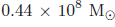 is obtained within 2rh for that metallicity.
 yr
yr is obtained within 2r