To save content items to your account,
please confirm that you agree to abide by our usage policies.
If this is the first time you use this feature, you will be asked to authorise Cambridge Core to connect with your account.
Find out more about saving content to .
To save content items to your Kindle, first ensure no-reply@cambridge.org
is added to your Approved Personal Document E-mail List under your Personal Document Settings
on the Manage Your Content and Devices page of your Amazon account. Then enter the ‘name’ part
of your Kindle email address below.
Find out more about saving to your Kindle.
Note you can select to save to either the @free.kindle.com or @kindle.com variations.
‘@free.kindle.com’ emails are free but can only be saved to your device when it is connected to wi-fi.
‘@kindle.com’ emails can be delivered even when you are not connected to wi-fi, but note that service fees apply.
Foreground contamination is one of the most important limiting factors in detecting the neutral hydrogen in the epoch of reionisation. These foregrounds can be roughly split into galactic and extragalactic foregrounds. In these proceedings we highlight information that can be gleaned from multi-wavelength extragalactic surveys in order to overcome this issue. We discuss how clustering information from the lower-redshift, foreground galaxies, can be used as additional information in accounting for the noise associated with the foregrounds. We then go on to highlight the expected contribution of future optical and near-infrared surveys for detecting the galaxies responsible for ionising the Universe. We suggest that these galaxies can also be used to reduce the systematics in the 21-cm epoch of reionisation signal through cross-correlations if enough common area is surveyed.
AGILE is a space mission of the Italian Space Agency dedicated to γ-ray astrophysics, launched in 2007. AGILE performed dedicated real-time searches for possible γ-ray counterparts of gravitational wave (GW) events detected by the LIGO-Virgo scientific Collaboration (LVC) during the O2 observation run. We present a review of AGILE observations of GW events, starting with the first, GW150914, which was a test case for future searches. We focus here on the main characteristics of the observations of the most important GW events detected in 2017, i.e. GW170104 and GW170817. In particular, for the former event we published γ-ray upper limits (ULs) in the 50 MeV – 10 GeV energy band together with a detailed analysis of a candidate precursor event in the Mini-Calorimeter data. As for GW170817, we published a set of constraining γ-ray ULs obtained for integrations preceding and following the event time. These results allow us to establish important constraints on the γ-ray emission from a possible magnetar-like remnant in the first ~1000 s following T0. AGILE is a major player in the search of electromagnetic counterparts of GW events, and its enhanced detection capabilities in hard X-ray/MeV/GeV ranges will play a crucial role in the future O3 observing run.
In the last decade, it has become clear that the dust-enshrouded star formation contributes significantly to early galaxy evolution. Detection of dust is therefore essential in determining the properties of galaxies in the high-redshift universe. This requires observations at the (sub-)millimeter wavelengths. Unfortunately, sensitivity and background confusion of single dish observations on the one hand, and mapping efficiency of interferometers on the other hand, pose unique challenges to observers. One promising route to overcome these difficulties is intensity mapping of fluctuations which exploits the confusion-limited regime and measures the collective light emission from all sources, including unresolved faint galaxies. We discuss in this contribution how 2D and 3D intensity mapping can measure the dusty star formation at high redshift, through the Cosmic Infrared Background (2D) and [CII] fine structure transition (3D) anisotropies.
The cross power spectrum of the 21 cm signal and Lyman-α emitters (LAEs) is a probe of the Epoch of Reionization. Astrophysical foregrounds do not correlate with the LAE distribution, though the foregrounds contribute to the error. To study the impact of foregrounds on the measurement, we assume realistic observation by the Murchison Widefield Array using a catalogue of radio galaxies, a LAE survey by the Subaru Hyper Supreme-Cam and the redshift of LAEs is determined by the Prime Focus Spectrograph. The HI distribution is estimated from a radiative transfer simulation with models based on results of radiation hydrodynamics simulation. Using these models, we found that the error of cross power spectrum is dominated by foreground terms. Furthermore, we estimate the effects of foreground removal, and find 99% of the foreground removal is required to detect the 21 cm-LAE signal at k ∼ 0.4 h Mpc−1.
Next-generation 21cm observations will enable imaging of reionization on very large scales. These images will contain more astrophysical and cosmological information than the power spectrum, and hence providing an alternative way to constrain the contribution of different reionizing sources populations to cosmic reionization. Using Convolutional Neural Networks, we present a simple network architecture that is sufficient to discriminate between Galaxy-dominated versus AGN-dominated models, even in the presence of simulated noise from different experiments such as the HERA and SKA.
The author - with his collaborators - already in years 1995-96 have shown - purely from the analyses of the observations - that the gamma-ray bursts (GRBs) can be till redshift 20. Since that time several other statistical studies of the spatial distribution of GRBs were provided. Remarkable conclusions concerning the star-formation rate and the validity of the cosmological principle were obtained about the regions of the cosmic dawn. In this contribution these efforts are surveyed.
The 21cm signal at epoch of reionization (EoR) should be observed within next decade. We expect that cosmic 21cm signal at the EoR provides us both cosmological and astrophysical information. In order to extract fruitful information from observation data, we need to develop inversion method. For such a method, we introduce artificial neural network (ANN) which is one of the machine learning techniques. We apply the ANN to inversion problem to constrain astrophysical parameters from 21cm power spectrum. We train the architecture of the neural network with 70 training datasets and apply it to 54 test datasets with different value of parameters. We find that the quality of the parameter reconstruction depends on the sensitivity of the power spectrum to the different parameter sets at a given redshift and also find that the accuracy of reconstruction is improved by increasing the number of given redshifts. We conclude that the ANN is viable inversion method whose main strength is that they require a sparse extrapolation of the parameter space and thus should be usable with full simulation.
The sky-averaged (global) 21-cm signal is a very promising probe of the Cosmic Dawn, when the first luminous sources were formed and started to shine in a substantially neutral intergalactic medium. I here report on the status and early result of the Large-Aperture Experiment to Detect the Dark Age that focuses on observations of the global 21-cm signal in the 16 ≲ z ≲ 30 range.
Intensity mapping (IM) is a new observational technique to survey the large-scale structure of matter using spectral emission lines. IM observations are contaminated by instrumental noise and astrophysical foregrounds. The foregrounds are at least three orders of magnitude larger than the searched signals. In this work, we apply the Generalized Needlet Internal Linear Combination (GNILC) method to subtract radio foregrounds and to recover the cosmological HI and CO signals within the IM context. For the HI IM case, we find that GNILC can reconstruct the HI plus noise power spectra with 7.0% accuracy for z = 0.13 − 0.48 (960 − 1260 MHz) and ℓ ≲ 400, while for the CO IM case, we find that it can reconstruct the CO plus noise power spectra with 6.7% accuracy for z = 2.4 − 3.4 (26 − 34 GHz) and ℓ ≲ 3000.
Redshifted HI 21-cm signal from the cosmic dawn and epoch of reionization evolve considerably along the LoS. We study the impact of this evolution (so called the light cone effect) on the HI 21-cm power spectrum. It is found that the LC effect has a significant impact on the 3D power spectrum and the change could be up to a factor of few. The LC effect is particularly strong during the cosmic dawn near the ‘peaks’ and ‘dips’ in the power spectrum when plotted with redshift. We also show that the 3D power spectrum, which could fully describe ergodic and periodic signal, losses out some information regarding the second order statistics of the signal as the EoR/CD 21-cm signal is non-ergodic and non-periodic along the line of sight. We show that the multi-frequency angular power spectrum (MAPS) ${\mathcal {C}}_{\ell }(\nu _1, \nu _2)$ captures all the information regarding the second order statistics of the signal even in the presence of the LC effect.
We report our investigations on the host galaxy properties of stellar binary black holes (SBBHs) by implementing simple recipes for SBBH formation and merger into cosmological galaxy formation model. If the time delay between SBBH formation and merger ranges from Gyr to the Hubble time, SBBH mergers at redshift z < 0.3 occur preferentially in big galaxies with stellar mass M* > 2 × 10¹⁰M⊙ and metallicities Z peaking around ~0.6Z⊙. However, the host galaxy stellar mass distribution of heavy SBBH mergers (with total black hole mass >50M⊙) is bimodal with one peak at ~109M⊙ and the other peak at ~2 × 10¹⁰M⊙. The contribution fraction from metal-poor host galaxies (Z < 0.2Z⊙) to heavy mergers is much larger than that to less heavy mergers. If SBBHs were formed in the early universe, their mergers detected at z < 0.3 occur preferentially in even more massive galaxies with M* > 3 × 10¹⁰M⊙ and in galaxies with metallicities mostly >0.2Z⊙ and peaking at Z ~ 0.6Z⊙.
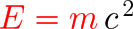
The LIGO direct-detection of gravitational waves arriving from cosmic sources—now, happily including (as of this meeting!) the merging of two neutron stars—opens a new chapter in our understanding of physics itself: for General Relativity, conceptually so extremely simple, has robustly produced predictions that have invariably been found to be correct when tested. My poster (page 3 of this paper) is intended for high school students who have just learned simple algebra. My derivation of the famous E = mc2 from the Pythagorean Theorem necessarily requires an algebraic expansion that is due to Newton, but apart from that it is simplicity itself: a transparent introduction to what all of physics is today: the construction of mathematics that, miraculously, reproduces our observations of the world—and which also successfully predicts the results of future observations—as so magnificently demonstrated at this glorious Symposium!
There seems to be magnetic fields at all scales and epochs in our Universe, but their origin at large scales remains an important open question of cosmology. In this work we focus on the generation of magnetic fields in the intergalactic medium due to the photoionizations by the first galaxies, all along the Epoch of Reionization. Based on previous studies which considered only isolated sources, we develop an analytical model to estimate the mean magnetic energy density accumulated in the Universe by this process. In our model, without considering any amplification process, the Universe is globally magnetized by this mechanism to the order of, at least, several 10−18 G during the Epoch of Reionization (i.e. a few 10−20 G comoving).
We highlight recent progress in the sophistication and diversification of the simulations of cosmic dawn and reionization. The application of these modeling tools to recent observations has allowed us narrow down the timing of reionization. The midpoint of reionization is constrained to z = 7.6−0.7+0.8 (1 σ), with the strongest constraints coming from the optical depth to the CMB measured with the Planck satellite and the first detection of ongoing reionization from the spectra of the z = 7.1 QSOs ULASJ1120+0641. However, we still know virtually nothing about the astrophysical sources during the first billion years. The revolution in our understanding will be led by upcoming interferometric observations of the cosmic 21-cm signal. The properties of the sources and sinks of UV and X-ray photons are encoded in the 3D patterns of the signal. The development of Bayesian parameter recovery techniques, which tap into the wealth of the 21-cm signal, will soon usher in an era of precision astrophysical cosmology.
The Galactic magnetic field (GMF) plays a role in many astrophysical processes and is a significant foreground to cosmological signals, such as the Epoch of Reionization (EoR), but is not yet well understood. Dispersion and Faraday rotation measurements (DMs and RMs, respectively) towards a large number of pulsars provide an efficient method to probe the three-dimensional structure of the GMF. Low-frequency polarisation observations with large fractional bandwidth can be used to measure precise DMs and RMs. This is demonstrated by a catalogue of RMs (corrected for ionospheric Faraday rotation) from the Low Frequency Array (LOFAR), with a growing complementary catalogue in the southern hemisphere from the Murchison Widefield Array (MWA). These data further our knowledge of the three-dimensional GMF, particularly towards the Galactic halo. Recently constructed or upgraded pathfinder and precursor telescopes, such as LOFAR and the MWA, have reinvigorated low-frequency science and represent progress towards the construction of the Square Kilometre Array (SKA), which will make significant advancements in studies of astrophysical magnetic fields in the future. A key science driver for the SKA-Low is to study the EoR, for which pulsar and polarisation data can provide valuable insights in terms of Galactic foreground conditions.
The Square Kilometre Array (SKA) Epoch of Reionisation and Cosmic Dawn (EoR/CD) experiments aim to explore the growth of structure and production of ionising radiation in the first billion years of the Universe. Here I describe the experiments planned for the future low-frequency components of the Observatory, and work underway to define, design and execute these programs.
This contribution describes how low-frequency radio-spectropolarimetric imaging as done for Epoch of Reionization detection is used to investigate the nearby Galactic interstellar medium. The method of Faraday Tomography allows disentangling of every line of sight into various components in Faraday depth, which is a proxy for density-weighted magnetic field. I discuss instrumental biases and side effects of this method, and early results it has yielded.
On August 17, 2017 LIGO/Virgo detected a binary neutron star via gravitational waves. We observed 70 sq-degrees in the LIGO/Virgo spatial localization with the DECam on the 4m Blanco telescope covering 80% of the final map. Our group independently discovered an optical counterpart in NGC 4993. We searched our entire imaged region: the object in NGC 4993 was the only viable candidate. Our observations of NGC4993 show complicated morphology but simple star formation history. Our x-ray and radio observations indicate an off-axis jet as afterglow. Our high-cadence optical and infrared spectra show a source that must be described by at least two components, one of which is dominated by the r-process nucleosynthesis elements characteristic of a kilonova. Our modeling of the light curve demonstrates such a model in which 0.05 M⊙ of material is ejected from the system. Finally, we discuss the first standard siren measurement of H0.
The Large Synoptic Survey Telescope (LSST), a next generation astronomical survey, sited on Cerro Pachon in Chile, will provide an unprecedented amount of imaging data for studies of the faint optical sky. The LSST system includes an 8.4m (6.7m effective) primary mirror and a 3.2 Gigapixel camera with a 9.6 sq. deg. field of view. This system will enable about 10,000 sq. deg. of sky to be covered twice per night, every three to four nights on average, with typical 5-sigma depth for point sources of r = 24.5 (AB). With over 800 observations in the ugrizy bands over a 10-year period, these data will enable coadded images reaching r = 27.5 (about 5 magnitudes deeper than SDSS) as well as studies of faint time-domain astronomy. The measured properties of newly discovered and known astrometric and photometric transients will be publicly reported within 60 sec after closing the shutter. The resulting hundreds of petabytes of imaging data for about 40 billion objects will be used for scientific investigations ranging from the properties of near-Earth asteroids to characterizations of dark matter and dark energy. For example, simulations estimate that LSST will discover about 1,000 quasars at redshifts exceeding 7; this sample will place tight constraints on the cosmic environment at the end of the reionization epoch. In addition to a brief introduction to LSST, I review the value of LSST data in support of epoch of reionization experiments and discuss how international participants can join LSST.