To save content items to your account,
please confirm that you agree to abide by our usage policies.
If this is the first time you use this feature, you will be asked to authorise Cambridge Core to connect with your account.
Find out more about saving content to .
To save content items to your Kindle, first ensure no-reply@cambridge.org
is added to your Approved Personal Document E-mail List under your Personal Document Settings
on the Manage Your Content and Devices page of your Amazon account. Then enter the ‘name’ part
of your Kindle email address below.
Find out more about saving to your Kindle.
Note you can select to save to either the @free.kindle.com or @kindle.com variations.
‘@free.kindle.com’ emails are free but can only be saved to your device when it is connected to wi-fi.
‘@kindle.com’ emails can be delivered even when you are not connected to wi-fi, but note that service fees apply.
Can we claim that the dynamics of the solar wind is consistent with a SOC system? Observationally we find that magnetic field and kinetic energy fluctuations measured in the solar wind exhibit power law distributions, which is consistent with a SOC system. What about the driver, instability, and avalanches expected in a SOC system? The driver mechanism is the acceleration of the solar wind in the solar corona itself, a process that basically follows the hydrodynamic model of Parker (1958), and may be additionally complicated by the presence of nonlinear wave–particle interactions, such as ion-cyclotron resonance. Then, the instability threshold, triggering extreme bursts of magnetic field fluctuations, the avalanches of solar wind SOC events, can be caused by dissipation of Alfven waves, onset of turbulence, or by the ion-cyclotron instability. Thus, in principle the generalized SOC concept can be applied to the solar wind, if there is a system-wide threshold for an instability that causes extreme magnetic field fluctuations.
Weinberg collaborates with Ed Witten. He becomes the youngest member of the Saturday Club of Boston. Weinberg signs up to write The Discovery of Subatomic Particles. After their continued separation due to teaching, Weinberg grows to like Austin more and more, with its social scene that crossed from academia into the public sphere. He negotiates with the Universioty of Texas for a position in Austin as the Josey Regental Chair in Science beginning in 1982. He joins the Headliners Club in Austin. Weinberg helps found the Jerusalem Winter School in Theoretical Physics. He begins exploring physical theories in higher dimensions. He attends the Shelter Island Conference in 1983. He is elected to the Philosophical Society of Texas and joined the Town and Gown Club in Austin, but quits the latter over its male-only stance, to help form a rival, the Tuesday Club (of Austin). In mid-1980s, he becomes seriously interested in string theory.
Congruence subgroups form a countable infinite class of discrete non-Abelian subgroups of SL(2,Z) and play a particularly prominent role in deriving the arithmetic properties of modular forms. In this chapter, we study various aspects of congruence subgroups, including their elliptic points, cusps, and topological properties of the associated modular curve. Jacobi theta-functions, theta-constants, and the Dedekind eta-function are used as examples of modular forms under congruence subgroups that are not modular forms under the full modular group SL(2,Z).
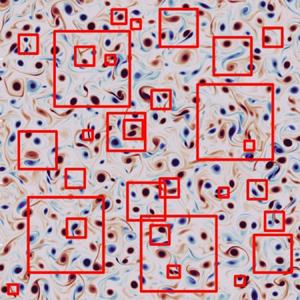
Modern machine-learning techniques are generally considered data-hungry. However, this may not be the case for turbulence as each of its snapshots can hold more information than a single data file in general machine-learning settings. This study asks the question of whether nonlinear machine-learning techniques can effectively extract physical insights even from as little as a single snapshot of turbulent flow. As an example, we consider machine-learning-based super-resolution analysis that reconstructs a high-resolution field from low-resolution data for two examples of two-dimensional isotropic turbulence and three-dimensional turbulent channel flow. First, we reveal that a carefully designed machine-learning model trained with flow tiles sampled from only a single snapshot can reconstruct vortical structures across a range of Reynolds numbers for two-dimensional decaying turbulence. Successful flow reconstruction indicates that nonlinear machine-learning techniques can leverage scale-invariance properties to learn turbulent flows. We also show that training data of turbulent flows can be cleverly collected from a single snapshot by considering characteristics of rotation and shear tensors. Second, we perform the single-snapshot super-resolution analysis for turbulent channel flow, showing that it is possible to extract physical insights from a single flow snapshot even with inhomogeneity. The present findings suggest that embedding prior knowledge in designing a model and collecting data is important for a range of data-driven analyses for turbulent flows. More broadly, this work hopes to stop machine-learning practitioners from being wasteful with turbulent flow data.
The size distribution of solar energetic particle (SEP) events, which represent a more energetic subset than flare events, is mostly found to follow power law distribution functions, rather than Poissonian random distribution functions. However, the numerical value of the power law slope is generally flatter than the slopes of the flare size distributions in hard X-rays, soft X-rays, and EUV (Hudson 1978), which can be explained in at least four different ways: (i) normal flares and proton flares are produced by two fundamentally different acceleration mechanisms; (ii) proton flares behave differently than normal flares; (iii) the fractal dimensionality of SEP events is different from normal flares; (iv) proton flares are subject to a selection bias toward the most energetic events and thus are not a representative sample of large flares. Nevertheless, the standard fractal-diffusive SOC model can explain the observed slopes of SEP size distributions, but observations reveal deviations from straight power law functions, or broken power law slopes, and thus are not unique and need to be modeled in more detail.
We focus on the statistics of SOC-related solar flare parameters in soft X-ray wavelengths, including their size and waiting time distributions. An early SOC model assumed a linear increase of the energy storage, but this pioneering model is not consistent with the expected correlation between the waiting time interval and the subsequently dissipated energy. The Neupert effect in solar flares implies a correlation between the hard X-ray fluence and the soft X-ray flux, which predicts identical size distributions for these two parameters. Quantifying of thermal flare energies in soft X-ray emitting plasma needs also to include radiative and conductive losses. The intermittency and bursty variability of the solar dynamo implies a nonstationary SOC driver, which yields a universal value for the power law slope of fluxes, but the power law slopes of waiting times vary with the flare rate. While our focus encompasses primarily SOC models, alternative models in terms of MHD turbulence can explain some characteristics of SOC features also, such as size distribution functions, Fourier spectra, and structure functions.
The Schroedinger equation for a particle in a potential is introduced and the general properties of its solutions are discussed; the uncertainity relations are derived; the Gram--Schimdt procedure for orthonormalizing a set of independent wave functions is introduced; the time evolution of the expectation values of the position and momentum operatorsfor a particle in a potential and in an electromagnetic field are derived.
For physicists who study elementary particles and quantum field theory, the 1970s was a golden age. It saw the experimental confirmation of the electroweak theory, and the extension of that thinking would lead us to a successful theory of strong interactions as well. All the fundamental forces of nature, except for gravity, would be unified in what became known as the “Standard Model.” By the end of 1973, there was some experimental verification of the electroweak theory. Weinberg agrees to write The First Three Minutes, which was published in 1977. Louise visits Stanford Law School, accompanied by Weinberg, who finds his host department cold. In 1977, he collaborates with Ben Lee of Fermilab, who tragically died in a car accident later that year. Louise is invited to teach at University of Texas Law School, in the summer of 1979, after which she was offered a full professorship. The Weinbergs taught in their respective universities and met in Cambridge in the holidays. Weinberg’s Nobel Prize, shared with Salam and Glashow, is announced in October 1979, ahead of the ceremony that December.
A natural set of mutually commuting linear operators acting on the space of modular forms are the Hecke operators. They map holomorphic functions to holomorphic functions, weight-k modular forms to weight-k modular forms, and weight-k cusp forms to weight-k cusp forms. For the full modular group SL(2,Z), the Hecke operators map the space of holomorphic modular forms into itself and map the subspace of cusp forms into itself. For congruence subgroups, the Hecke operators map weight-k modular forms of one congruence subgroup into those of another congruence subgroup. Hecke operators commute with the Laplace–Beltrami operator on the upper half plane so that Maass forms and cusp forms are simultaneous eigenfunctions of all Hecke operators. Finally, given a modular form with positive integer Fourier coefficients, the Hecke transforms also have positive integer Fourier coefficients. For this reason, Hecke operators are relevant in a number of physical problems, such as two-dimensional conformal field theory, that we shall discuss.
In Chapter 3, we introduced SL(2,Z) as the automorphism group of a two-dimensional lattice with an arbitrary modulus. For every value of the modulus, the lattice also possesses a ring of endomorphisms which multiply the lattice by a nonvanishing integer to produce a sublattice of the original lattice. Multiplying the lattice by an arbitrary complex number gives a lattice that will generally not be a sublattice of the original lattice. However, for special values of the modulus, referred to as singular moduli, and associated special values of the complex-valued multiplying factor, the lattice obtained by multiplication will be a sublattice of the original lattice and the ring of endomorphisms will be enlarged. This phenomenon is referred to as complex multiplication. From a mathematics standpoint, various modular forms take on special values at singular moduli, as illustrated by the fact that the j-function is an algebraic integer. From a physics standpoint, the enlargement of the endomorphism ring has arithmetic consequences in conformal field theory, as illustrated by the fact that conformal field theories corresponding to toroidal compactifications at singular moduli are rational conformal field theories as will be discussed in Chapter 13.
Weinberg takes up a National Science Foundation predoctoral fellowship to study at the Niels Bohr Institute in Copenhagen. He is encouraged to take up research on nuclear alpha decay. His advisor, Gunnar Källén, tasks him with studying the Lee model. He plans to obtain his PhD from Princeton.