Refine search
Actions for selected content:
238141 results in Physics and Astronomy
32 - (Pseudo)scalar correlators
- from Part VIII - QCD two–point functions
-
- Book:
- QCD as a Theory of Hadrons
- Published online:
- 04 November 2022
- Print publication:
- 09 February 2023, pp 345-351
-
- Chapter
-
- You have access
- Open access
- Export citation
6 - Supersymmetric gauge theories
-
- Book:
- Weak Scale Supersymmetry
- Published online:
- 05 November 2022
- Print publication:
- 09 February 2023, pp 79-104
-
- Chapter
-
- You have access
- Open access
- Export citation
14 - Unified kinematics and dynamics
- from Part 2 - Groups and fields
-
- Book:
- Classical Covariant Fields
- Published online:
- 04 November 2022
- Print publication:
- 09 February 2023, pp 358-389
-
- Chapter
-
- You have access
- Open access
- Export citation
Appendix B - SU(N) generators
-
- Book:
- Kinks and Domain Walls
- Published online:
- 04 November 2022
- Print publication:
- 09 February 2023, pp 155-156
-
- Chapter
-
- You have access
- Open access
- Export citation
Frontmatter
-
- Book:
- Hadrons and Quark–Gluon Plasma
- Published online:
- 04 November 2022
- Print publication:
- 09 February 2023, pp i-vi
-
- Chapter
-
- You have access
- Open access
- Export citation
18 - More on unpolarized deep inelastic scatterings
- from Part IV - Deep inelastic scatterings at hadron colliders
-
- Book:
- QCD as a Theory of Hadrons
- Published online:
- 04 November 2022
- Print publication:
- 09 February 2023, pp 180-187
-
- Chapter
-
- You have access
- Open access
- Export citation
24 - Effective actions in ten dimensions
- from Part 3 - String Theory
-
- Book:
- Supersymmetry and String Theory
- Published online:
- 10 November 2022
- Print publication:
- 09 February 2023, pp 340-346
-
- Chapter
-
- You have access
- Open access
- Export citation
15 - Particle density fluctuations and RFT
-
- Book:
- Strong Interactions of Hadrons at High Energies
- Published online:
- 04 November 2022
- Print publication:
- 09 February 2023, pp 381-417
-
- Chapter
-
- You have access
- Open access
- Export citation
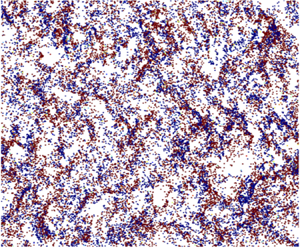
Direct numerical simulation of particle-laden flow in an open channel at $Re_{\tau }=5186$
-
- Journal:
- Journal of Fluid Mechanics / Volume 957 / 25 February 2023
- Published online by Cambridge University Press:
- 09 February 2023, A3
-
- Article
- Export citation
-
We perform two-way coupled direct numerical simulation of particle-laden flow in an open channel at a friction Reynolds number ( $Re_{\tau }$) of 5186, which exhibits many characteristics of high-Reynolds-number wall-bounded turbulence, such as the distinct separation of scales in the inner and outer layers. Three representative cases, an unladen case and low- and high-Stokes-number particle-laden cases, are performed to investigate the turbulent modification by particles. To this end, we compare several statistical quantities to understand the particle effect on momentum exchange and interphasial energy transfer. The modulation of large-scale motions (LSMs) and very-large-scale motions (VLSMs) are analysed using spectral information, and we find that the LSMs and VLSMs are generally weakened in the inner and outer layers, which is qualitatively different from similar simulations at lower Reynolds numbers ( $Re_{\tau } \approx 500$). The spatial structures are investigated with correlation analysis, and inclined VLSMs are observed in the near-wall region, with decreased inclination angles by particles. The particles tend to widen and shorten the spanwise and streamwise extent of coherent structures, respectively. Furthermore, we find that the vorticity vector displays a preferential alignment with the eigenvector corresponding to the intermediate eigenvalue of the strain-rate tensor, independent of the particle Stokes number.


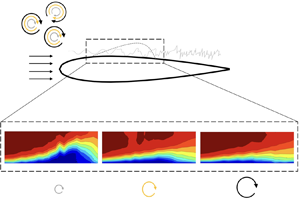
Disturbance growth in a laminar separation bubble subjected to free-stream turbulence
-
- Journal:
- Journal of Fluid Mechanics / Volume 956 / 10 February 2023
- Published online by Cambridge University Press:
- 09 February 2023, A33
-
- Article
- Export citation
-
Experiments were conducted to study the transition and flow development in a laminar separation bubble (LSB) formed on an aerofoil. The effects of a wide range of free-stream turbulence intensity ( $0.15\,\%< Tu<6.26\,\%$) and streamwise integral length scale ( $4.6\ {\rm mm}<\varLambda _{u}<17.2\ {\rm mm}$) are considered. The co-existence of modal instability due to the LSB and non-modal instability caused by streaks generated by free-stream turbulence is observed. The flow field is measured using hot-wire anemometry, which showed that the presence of streaks in the boundary layer modifies the mean-flow topology of the bubble. These changes in the mean flow field result in the modification of the convective disturbance growth, where an increase in turbulence intensity is found to dampen the growth of the modal instability. For a relatively fixed level of $Tu$, the variation of $\varLambda _{u}$ has modest effects. However, a slight advancement of the nonlinear growth of disturbances and eventual breakdown with the decrease in $\varLambda _{u}$ is observed. The data show that the streamwise growth of the disturbance energy is exponential for the lowest levels of free-stream turbulence and gradually becomes algebraic as the level of free-stream turbulence increases. Once a critical turbulence intensity is reached, there is enough energy in the boundary layer to suppress the laminar separation bubble, resulting in the non-modal instability taking over the transition process. Linear stability analysis is conducted in the fore position of the LSB. It accurately models incipient disturbance growth, unstable frequencies and eigenfunctions for configurations subjected to turbulence intensity levels up to 3 %, showing that the mean-flow modification due to the non-modal instability dampens the modal instability.


2 - Field parameters
-
- Book:
- Kinks and Domain Walls
- Published online:
- 04 November 2022
- Print publication:
- 09 February 2023, pp 20-34
-
- Chapter
-
- You have access
- Open access
- Export citation
3 - Some optics
- from Part 1 - Introduction
-
- Book:
- Electron Scattering for Nuclear and Nucleon Structure
- Published online:
- 05 November 2022
- Print publication:
- 09 February 2023, pp 9-13
-
- Chapter
-
- You have access
- Open access
- Export citation
Appendix C - Probability and statistics
-
- Book:
- Introduction to Experimental Particle Physics
- Published online:
- 05 November 2022
- Print publication:
- 09 February 2023, pp 388-390
-
- Chapter
-
- You have access
- Open access
- Export citation
Appendix E - Feynman rules
- from Part XI - Appendices
-
- Book:
- QCD as a Theory of Hadrons
- Published online:
- 04 November 2022
- Print publication:
- 09 February 2023, pp 714-718
-
- Chapter
-
- You have access
- Open access
- Export citation
Preface
-
- Book:
- Quantum Chromodynamics and the Pomeron
- Published online:
- 05 November 2022
- Print publication:
- 09 February 2023, pp xiii-xiv
-
- Chapter
-
- You have access
- Open access
- Export citation
References
-
- Book:
- Quantum Chromodynamics and the Pomeron
- Published online:
- 05 November 2022
- Print publication:
- 09 February 2023, pp 240-245
-
- Chapter
-
- You have access
- Open access
- Export citation
31 - References guide to original works
- from Part VIII - QCD two–point functions
-
- Book:
- QCD as a Theory of Hadrons
- Published online:
- 04 November 2022
- Print publication:
- 09 February 2023, pp 343-344
-
- Chapter
-
- You have access
- Open access
- Export citation
4 - Particle beams
-
- Book:
- Introduction to Experimental Particle Physics
- Published online:
- 05 November 2022
- Print publication:
- 09 February 2023, pp 93-124
-
- Chapter
-
- You have access
- Open access
- Export citation
Outline of the book
-
- Book:
- QCD as a Theory of Hadrons
- Published online:
- 04 November 2022
- Print publication:
- 09 February 2023, pp xxvii-xxviii
-
- Chapter
-
- You have access
- Open access
- Export citation
6 - Decay of the False Vacuum
-
- Book:
- The Theory and Applications of Instanton Calculations
- Published online:
- 04 November 2022
- Print publication:
- 09 February 2023, pp 71-110
-
- Chapter
-
- You have access
- Open access
- Export citation
