Refine search
Actions for selected content:
4783 results in Particle Physics and Nuclear Physics
19 - Motivation for the Theory
- from Part VI - Gauge Theory of the Weak Interactions
-
- Book:
- The Ideas of Particle Physics
- Published online:
- 12 September 2020
- Print publication:
- 24 September 2020, pp 99-100
-
- Chapter
- Export citation
Part XI - Beyond the Standard Model
-
- Book:
- The Ideas of Particle Physics
- Published online:
- 12 September 2020
- Print publication:
- 24 September 2020, pp 209-210
-
- Chapter
- Export citation
60 - Consequences of the Theory
- from Part XIV - String Theory
-
- Book:
- The Ideas of Particle Physics
- Published online:
- 12 September 2020
- Print publication:
- 24 September 2020, pp 280-282
-
- Chapter
- Export citation
24 - The Hunt for the W±, Z0 Bosons
- from Part VI - Gauge Theory of the Weak Interactions
-
- Book:
- The Ideas of Particle Physics
- Published online:
- 12 September 2020
- Print publication:
- 24 September 2020, pp 116-122
-
- Chapter
- Export citation
31 - Colour Gauge Theory
- from Part VIII - Quantum Chromodynamics – the Theory of Quarks
-
- Book:
- The Ideas of Particle Physics
- Published online:
- 12 September 2020
- Print publication:
- 24 September 2020, pp 150-153
-
- Chapter
- Export citation
Appendix C - List of Symbols
- from Appendices
-
- Book:
- The Ideas of Particle Physics
- Published online:
- 12 September 2020
- Print publication:
- 24 September 2020, pp 306-307
-
- Chapter
- Export citation
47 - Axions and the Strong CP Problem
- from Part XI - Beyond the Standard Model
-
- Book:
- The Ideas of Particle Physics
- Published online:
- 12 September 2020
- Print publication:
- 24 September 2020, pp 231-232
-
- Chapter
- Export citation
21 - Spontaneous Symmetry Breaking
- from Part VI - Gauge Theory of the Weak Interactions
-
- Book:
- The Ideas of Particle Physics
- Published online:
- 12 September 2020
- Print publication:
- 24 September 2020, pp 105-107
-
- Chapter
- Export citation
Dedication
-
- Book:
- The Ideas of Particle Physics
- Published online:
- 12 September 2020
- Print publication:
- 24 September 2020, pp v-vi
-
- Chapter
- Export citation
51 - Dark Matter
- from Part XII - Particle Physics and Cosmology
-
- Book:
- The Ideas of Particle Physics
- Published online:
- 12 September 2020
- Print publication:
- 24 September 2020, pp 246-248
-
- Chapter
- Export citation
26 - Electron–Nucleon Scattering
- from Part VII - Deep Inelastic Scattering
-
- Book:
- The Ideas of Particle Physics
- Published online:
- 12 September 2020
- Print publication:
- 24 September 2020, pp 127-130
-
- Chapter
- Export citation
29 - The Quark Model of the Structure Functions
- from Part VII - Deep Inelastic Scattering
-
- Book:
- The Ideas of Particle Physics
- Published online:
- 12 September 2020
- Print publication:
- 24 September 2020, pp 138-142
-
- Chapter
- Export citation
48 - The Big Bang and Inflation
- from Part XII - Particle Physics and Cosmology
-
- Book:
- The Ideas of Particle Physics
- Published online:
- 12 September 2020
- Print publication:
- 24 September 2020, pp 235-239
-
- Chapter
- Export citation
61 - Accelerators, Observatories and Other Experiments
- from Part XV - The Future: To Boldly Go!
-
- Book:
- The Ideas of Particle Physics
- Published online:
- 12 September 2020
- Print publication:
- 24 September 2020, pp 285-288
-
- Chapter
- Export citation
58 - String Theory to M-theory
- from Part XIV - String Theory
-
- Book:
- The Ideas of Particle Physics
- Published online:
- 12 September 2020
- Print publication:
- 24 September 2020, pp 275-277
-
- Chapter
- Export citation
Appendices
-
- Book:
- The Ideas of Particle Physics
- Published online:
- 12 September 2020
- Print publication:
- 24 September 2020, pp 295-296
-
- Chapter
- Export citation
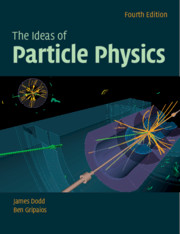
The Ideas of Particle Physics
-
- Published online:
- 12 September 2020
- Print publication:
- 24 September 2020
Elementary Particle Physics
- An Intuitive Introduction
-
- Published online:
- 29 August 2020
- Print publication:
- 23 May 2019
-
- Textbook
- Export citation
Appendix D - Numerical Input
-
- Book:
- Gauge Theory of Weak Decays
- Published online:
- 11 June 2020
- Print publication:
- 02 July 2020, pp 661-662
-
- Chapter
-
- You have access
- Open access
- Export citation
11 - Charm Flavor Physics
- from Part III - Weak Decays in the Standard Model
-
- Book:
- Gauge Theory of Weak Decays
- Published online:
- 11 June 2020
- Print publication:
- 02 July 2020, pp 402-409
-
- Chapter
-
- You have access
- Open access
- Export citation
