Refine search
Actions for selected content:
26255 results in Theoretical Physics and Mathematical Physics
PSP volume 35 issue 3 Cover and Front matter
-
- Journal:
- Mathematical Proceedings of the Cambridge Philosophical Society / Volume 35 / Issue 3 / July 1939
- Published online by Cambridge University Press:
- 24 October 2008, pp. f1-f2
- Print publication:
- July 1939
-
- Article
-
- You have access
- Export citation
PSP volume 35 issue 3 Cover and Back matter
-
- Journal:
- Mathematical Proceedings of the Cambridge Philosophical Society / Volume 35 / Issue 3 / July 1939
- Published online by Cambridge University Press:
- 24 October 2008, pp. b1-b2
- Print publication:
- July 1939
-
- Article
-
- You have access
- Export citation
An automatic curve follower for use with the differential analyser
-
- Journal:
- Mathematical Proceedings of the Cambridge Philosophical Society / Volume 35 / Issue 3 / July 1939
- Published online by Cambridge University Press:
- 24 October 2008, pp. 494-505
- Print publication:
- July 1939
-
- Article
- Export citation
A new notation for quantum mechanics
-
- Journal:
- Mathematical Proceedings of the Cambridge Philosophical Society / Volume 35 / Issue 3 / July 1939
- Published online by Cambridge University Press:
- 24 October 2008, pp. 416-418
- Print publication:
- July 1939
-
- Article
- Export citation
On the derivation of discontinuous functions
-
- Journal:
- Mathematical Proceedings of the Cambridge Philosophical Society / Volume 35 / Issue 3 / July 1939
- Published online by Cambridge University Press:
- 24 October 2008, pp. 373-381
- Print publication:
- July 1939
-
- Article
- Export citation
The minimum χ′2 approximation
-
- Journal:
- Mathematical Proceedings of the Cambridge Philosophical Society / Volume 35 / Issue 3 / July 1939
- Published online by Cambridge University Press:
- 24 October 2008, p. 520
- Print publication:
- July 1939
-
- Article
- Export citation
Zur Summabilitätstheorie der Fourierschen Doppelreihe
-
- Journal:
- Mathematical Proceedings of the Cambridge Philosophical Society / Volume 35 / Issue 3 / July 1939
- Published online by Cambridge University Press:
- 24 October 2008, pp. 343-350
- Print publication:
- July 1939
-
- Article
- Export citation
-
Es sei f(ξ) eine L-integrierbare und nach 2π periodische Funktion der reellen Variabeln ξ und es sei {sn} die Folge der Partialsummen ihrer Fourierschen Reihe an einer Stelle ξ = x, wo die Funktion stetig ist. Dann ist nach einem klassischen Satze von Fejér

und nach Hardy und Littlewood

Vor kurzem hat L. Fejér gefunden, dass der Hardy-Littlewoodsche Satz (2) Spezialfall eines “gewöhnlichen” Summabilitätssatzes wie (1) ist, der sich aber auf die Fouriersche Reihe einer Funktion zweier Variabeln bezieht. Dieser Satz ist der folgende.
Quantum electrodynamics. II
-
- Journal:
- Mathematical Proceedings of the Cambridge Philosophical Society / Volume 35 / Issue 3 / July 1939
- Published online by Cambridge University Press:
- 24 October 2008, pp. 438-462
- Print publication:
- July 1939
-
- Article
- Export citation
A problem in conduction of heat
-
- Journal:
- Mathematical Proceedings of the Cambridge Philosophical Society / Volume 35 / Issue 3 / July 1939
- Published online by Cambridge University Press:
- 24 October 2008, pp. 394-404
- Print publication:
- July 1939
-
- Article
- Export citation
The effect of interstellar matter on climatic variation
-
- Journal:
- Mathematical Proceedings of the Cambridge Philosophical Society / Volume 35 / Issue 3 / July 1939
- Published online by Cambridge University Press:
- 24 October 2008, pp. 405-415
- Print publication:
- July 1939
-
- Article
- Export citation
Note on the calculation of the Peltier effect
-
- Journal:
- Mathematical Proceedings of the Cambridge Philosophical Society / Volume 35 / Issue 3 / July 1939
- Published online by Cambridge University Press:
- 24 October 2008, pp. 521-522
- Print publication:
- July 1939
-
- Article
- Export citation
The production of 8Li by bombardment of boron with neutrons
-
- Journal:
- Mathematical Proceedings of the Cambridge Philosophical Society / Volume 35 / Issue 2 / April 1939
- Published online by Cambridge University Press:
- 24 October 2008, pp. 304-308
- Print publication:
- April 1939
-
- Article
- Export citation
-
The decay period of the α-activity produced when boron is bombarded with neutrons from a (Li + D) source has been measured, and found to agree with the known decay period of 8Li. It has been shown that no activity is produced when (Be + D) neutrons (maximum energy 4·5 × 106 e.V.) are used. The results are explained by postulating the formation of radioactive 8Li according to the process

A short investigation of the number-range distribution for the α-particles emitted by 8Li indicated that a maximum occurred in the distribution at a range of about 6 mm.
The γ-rays of ionium
-
- Journal:
- Mathematical Proceedings of the Cambridge Philosophical Society / Volume 35 / Issue 2 / April 1939
- Published online by Cambridge University Press:
- 24 October 2008, pp. 322-326
- Print publication:
- April 1939
-
- Article
- Export citation
On the stability of nuclei against β-emission
-
- Journal:
- Mathematical Proceedings of the Cambridge Philosophical Society / Volume 35 / Issue 2 / April 1939
- Published online by Cambridge University Press:
- 24 October 2008, pp. 242-255
- Print publication:
- April 1939
-
- Article
- Export citation
A peculiarity in the infra-red absorption spectrum of germane
-
- Journal:
- Mathematical Proceedings of the Cambridge Philosophical Society / Volume 35 / Issue 2 / April 1939
- Published online by Cambridge University Press:
- 24 October 2008, pp. 341-342
- Print publication:
- April 1939
-
- Article
- Export citation
The heating of iron ammonium alum by alternating magnetic fields at very low temperatures
-
- Journal:
- Mathematical Proceedings of the Cambridge Philosophical Society / Volume 35 / Issue 2 / April 1939
- Published online by Cambridge University Press:
- 24 October 2008, pp. 327-335
- Print publication:
- April 1939
-
- Article
- Export citation
Base conditions and covariant systems in an algebraic threefold
-
- Journal:
- Mathematical Proceedings of the Cambridge Philosophical Society / Volume 35 / Issue 2 / April 1939
- Published online by Cambridge University Press:
- 24 October 2008, pp. 166-179
- Print publication:
- April 1939
-
- Article
- Export citation
-
If F is a free linear system of surfaces in an algebraic threefold V which is either non-singular or possesses only normal singularities, then F has Jacobian and adjoint surfaces, J2(F) and A2(F), and Jacobian and adjoint curve systems, J1(F) and A1(F), such that


where X2, X2 are the canonical systems of surfaces and curves on V, and X1(F) is the canonical system of curves of F. The imposition of base elements (points or curves) Ei, of assigned multiplicities λi, on F defines a system F1 which we may represent formally by the equation
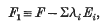
and it is natural to enquire how the Jacobian systems of F1 differ from those of F, and how we may define adjoint systems A2(F1) and A1(F1) which cut on F1 its canonical curves and sets respectively.
On the easier Waring problem for powers of primes. II
-
- Journal:
- Mathematical Proceedings of the Cambridge Philosophical Society / Volume 35 / Issue 2 / April 1939
- Published online by Cambridge University Press:
- 24 October 2008, pp. 149-165
- Print publication:
- April 1939
-
- Article
- Export citation
-
In a previous paper I proved that the density of the positive integers of the form
 where the letters p, q, and later P, Q, r, denote primes, is positive. As indicated in the Introduction of I, I now give proofs of the following results:
The density of each of the sets of integers

is positive.
 where the letters
A note on the boundary layer equations
-
- Journal:
- Mathematical Proceedings of the Cambridge Philosophical Society / Volume 35 / Issue 2 / April 1939
- Published online by Cambridge University Press:
- 24 October 2008, pp. 338-340
- Print publication:
- April 1939
-
- Article
- Export citation
A new proof of the joint product moment distribution
-
- Journal:
- Mathematical Proceedings of the Cambridge Philosophical Society / Volume 35 / Issue 2 / April 1939
- Published online by Cambridge University Press:
- 24 October 2008, pp. 336-338
- Print publication:
- April 1939
-
- Article
- Export citation
