Refine search
Actions for selected content:
26232 results in Theoretical Physics and Mathematical Physics
PSP volume 36 issue 1 Cover and Back matter
-
- Journal:
- Mathematical Proceedings of the Cambridge Philosophical Society / Volume 36 / Issue 1 / January 1940
- Published online by Cambridge University Press:
- 24 October 2008, p. b1
- Print publication:
- January 1940
-
- Article
-
- You have access
- Export citation
PSP volume 36 issue 1 Cover and Front matter
-
- Journal:
- Mathematical Proceedings of the Cambridge Philosophical Society / Volume 36 / Issue 1 / January 1940
- Published online by Cambridge University Press:
- 24 October 2008, p. f1
- Print publication:
- January 1940
-
- Article
-
- You have access
- Export citation
Properties of some superconductors
-
- Journal:
- Mathematical Proceedings of the Cambridge Philosophical Society / Volume 36 / Issue 1 / January 1940
- Published online by Cambridge University Press:
- 24 October 2008, pp. 84-93
- Print publication:
- January 1940
-
- Article
- Export citation
Notes on special systems of orthogonal Functions (III): A System of orthogonal polynomials†
-
- Journal:
- Mathematical Proceedings of the Cambridge Philosophical Society / Volume 36 / Issue 1 / January 1940
- Published online by Cambridge University Press:
- 24 October 2008, pp. 1-8
- Print publication:
- January 1940
-
- Article
- Export citation
-
Generalities. Suppose that
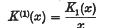
is real and L2(0, ∞), that

is its Mellin transform, and that
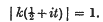
Then K(1)(x) generates a “Watson transformation”, with a “Fourier theorem”

valid for every F(x) of L2(0, ∞).

The adsorption of dipoles
-
- Journal:
- Mathematical Proceedings of the Cambridge Philosophical Society / Volume 36 / Issue 1 / January 1940
- Published online by Cambridge University Press:
- 24 October 2008, pp. 69-78
- Print publication:
- January 1940
-
- Article
- Export citation
The inner shell ionization of atoms by electron impact
-
- Journal:
- Mathematical Proceedings of the Cambridge Philosophical Society / Volume 36 / Issue 1 / January 1940
- Published online by Cambridge University Press:
- 24 October 2008, pp. 43-52
- Print publication:
- January 1940
-
- Article
- Export citation
Paramagnetic hysteresis
-
- Journal:
- Mathematical Proceedings of the Cambridge Philosophical Society / Volume 36 / Issue 1 / January 1940
- Published online by Cambridge University Press:
- 24 October 2008, pp. 79-83
- Print publication:
- January 1940
-
- Article
- Export citation
The interpretation of ionization measurements in gases at high pressures
-
- Journal:
- Mathematical Proceedings of the Cambridge Philosophical Society / Volume 36 / Issue 1 / January 1940
- Published online by Cambridge University Press:
- 24 October 2008, pp. 101-126
- Print publication:
- January 1940
-
- Article
- Export citation
The approximate local monotony of measurable functions
-
- Journal:
- Mathematical Proceedings of the Cambridge Philosophical Society / Volume 36 / Issue 1 / January 1940
- Published online by Cambridge University Press:
- 24 October 2008, pp. 9-13
- Print publication:
- January 1940
-
- Article
- Export citation
Critical conditions in neutron multiplication
-
- Journal:
- Mathematical Proceedings of the Cambridge Philosophical Society / Volume 35 / Issue 4 / November 1939
- Published online by Cambridge University Press:
- 24 October 2008, pp. 610-615
- Print publication:
- November 1939
-
- Article
- Export citation
The evolution of the stars
-
- Journal:
- Mathematical Proceedings of the Cambridge Philosophical Society / Volume 35 / Issue 4 / November 1939
- Published online by Cambridge University Press:
- 24 October 2008, pp. 592-609
- Print publication:
- November 1939
-
- Article
- Export citation
Photoemission in Geiger-Müller counters
-
- Journal:
- Mathematical Proceedings of the Cambridge Philosophical Society / Volume 35 / Issue 4 / November 1939
- Published online by Cambridge University Press:
- 24 October 2008, pp. 654-657
- Print publication:
- November 1939
-
- Article
- Export citation
PSP volume 35 issue 4 Cover and Front matter
-
- Journal:
- Mathematical Proceedings of the Cambridge Philosophical Society / Volume 35 / Issue 4 / November 1939
- Published online by Cambridge University Press:
- 24 October 2008, pp. f1-f2
- Print publication:
- November 1939
-
- Article
-
- You have access
- Export citation
The exchange force between three heavy particles due to the meson exchange field
-
- Journal:
- Mathematical Proceedings of the Cambridge Philosophical Society / Volume 35 / Issue 4 / November 1939
- Published online by Cambridge University Press:
- 24 October 2008, pp. 616-621
- Print publication:
- November 1939
-
- Article
- Export citation
Introduction to the theory of operators. IV Linear functionals
-
- Journal:
- Mathematical Proceedings of the Cambridge Philosophical Society / Volume 35 / Issue 4 / November 1939
- Published online by Cambridge University Press:
- 24 October 2008, pp. 562-578
- Print publication:
- November 1939
-
- Article
- Export citation
Proceedings at the Meetings Held During the Session 1938–1939
-
- Journal:
- Mathematical Proceedings of the Cambridge Philosophical Society / Volume 35 / Issue 4 / November 1939
- Published online by Cambridge University Press:
- 24 October 2008, pp. 659-663
- Print publication:
- November 1939
-
- Article
- Export citation
An apparent inconsistency arising from tests of significance based on fiducial distributions of unknown parameters
-
- Journal:
- Mathematical Proceedings of the Cambridge Philosophical Society / Volume 35 / Issue 4 / November 1939
- Published online by Cambridge University Press:
- 24 October 2008, pp. 579-591
- Print publication:
- November 1939
-
- Article
- Export citation
A critical examination of the Benedicks homogeneous thermoelectric effect
-
- Journal:
- Mathematical Proceedings of the Cambridge Philosophical Society / Volume 35 / Issue 4 / November 1939
- Published online by Cambridge University Press:
- 24 October 2008, pp. 622-636
- Print publication:
- November 1939
-
- Article
- Export citation
On a Hardy-Littlewood problem of diophantine approximation
-
- Journal:
- Mathematical Proceedings of the Cambridge Philosophical Society / Volume 35 / Issue 4 / November 1939
- Published online by Cambridge University Press:
- 24 October 2008, pp. 527-547
- Print publication:
- November 1939
-
- Article
- Export citation
-
1. Let
 .
.When r is a positive integer, various writers have considered sums of the form
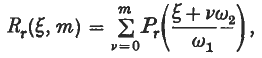
where ω1 and ω2 are two positive numbers whose ratio θ = ω1/ω2 is irrational and ξ is a real number satisfying 0 ≤ ξ < ω1. In particular, Hardy and Littlewood (2,3,4), Ostrowski(9), Hecke(6), Behnke(1), and Khintchine(7) have given best possible approximations for sums of this type for various classes of irrational numbers. Most writers have confined themselves to the case r = 1, in which

 .
.
The Cambridge Philosophical Society Statement of Accounts for the Period 1 January 1938 to 31 July 1938
-
- Journal:
- Mathematical Proceedings of the Cambridge Philosophical Society / Volume 35 / Issue 4 / November 1939
- Published online by Cambridge University Press:
- 24 October 2008, pp. 664-665
- Print publication:
- November 1939
-
- Article
- Export citation
