





Introduction
While non-native English speakers (NNESs) have outnumbered native English speakers (NESs) (Rose and Galloway Reference Rose and Galloway2019) and most English interactions occur among NNESs, the former continue to experience linguistic discrimination. Moreover, native English varieties, especially standard American (AmE) and British English (BrE), and their accompanying accents remain idealized while non-native varieties and accents are regarded as inferior (Dalton–Puffer et al. Reference Dalton–Puffer, Kaltenboeck and Smit1997; Manzouri et al. Reference Manzouri, Tajeddin and Kiany2024; Scales et al. Reference Scales, Wennerstrom, Richard and Su Hui2006; Seyranyan and Westphal Reference Seyranyan and Westphal2021; Sung Reference Sung2016a). Likewise, in English language teaching (ELT), native English-speaking teachers (NESTs) are often preferred over non-native English-speaking teachers (NNESTs) (Jindapitak Reference Jindapitak2019; Kang Reference Kang2015) with comprehensibility as a factor that contributes to the perceived higher suitability of NESTs (Moran et al. Reference Moran, Kang and McGroarty2024).
While previous research examined attitudes toward Englishes in different settings (e.g., Hänsel et al. Reference Hänsel, Westphal, Meer and Deuber2022; Kang et al. Reference Kang, Yaw and Kostromitina2023), there has been no study concerning this issue in the Thai context. Thus, the current study was conducted to investigate Thai speakers’ perceptions of native Englishes and Thai-accented English (TaE) in academic and communicative settings. It also compared perceptions toward NESTs and two groups of NNESTs with different accents: native-like and Thai-accented English. The study adopted the Kachruvian three concentric circles with countries where English is used as a native language (e.g., the US and the UK) referred to as the Inner Circle, those where English functions as a second language (e.g., India and Singapore) as the Outer Circle, and those with English as a foreign language (e.g., South Korea and Thailand) as the Expanding Circle (Kachru Reference Kachru1992). It additionally revisited language ideology through native-speakerism (Holliday Reference Holliday2006) and the native speaker fallacy (Phillipson Reference Phillipson1992). In short, the findings revealed the persistence of native-speakerism in academic settings only. Furthermore, NNESTs with TaE were viewed as less favorable than those with native-like accents and NESTs, leading to a proposal of the native accent fallacy in the current study.
The paper is structured as follows: it first reviews attitudinal studies on Englishes in general and in Thailand. It then describes a questionnaire used for data collection, which is the direct attitudinal approach, and presents the findings. Finally, it concludes with a discussion that introduces the native accent fallacy along with pedagogical implications.
Language attitudes and Englishes in education
Attitudes, favorable or unfavorable reactions to an entity, are affective, cognitive, and behavioral (Garrett Reference Garrett2010). Sociolinguistically, language attitudes may refer to the evaluation of language varieties and their social connections to their users which can be observed at different linguistic levels. For example, the -ing variant of (ING), as compared to the -in variant, was found to be indicative of educatedness in southern U.S. and of gayness (Campbell–Kibler Reference Campbell–Kibler2007). When language attitudes become negative, speakers of non-standard varieties may experience language-based prejudice. Purnell et al. (Reference Purnell, Idsardi and Baugh1999), for example, found that AmE speakers would identify their interlocutors’ accents from one word, ‘hello’. This accent identification resulted in discrimination against non-standard speakers of AmE in housing. Language attitudes can also vary across contexts. Negative attitudes toward non-native accented speech are more intense in formal, academic contexts than in informal, occupational contexts (Hänsel et al. Reference Hänsel, Westphal, Meer and Deuber2022; Kang et al. Reference Kang, Yaw and Kostromitina2023).
Proposed by Holliday (Reference Holliday2006), native-speakerism, an ideology characterized by Anglo-centric prejudice and the privilege of Western cultures, has been dominant in ELT (Funada Reference Funada2025; Irham 2023; Samuell Reference Samuell2024; Syrbe and Rose Reference Syrbe and Rose2018; Timmis Reference Timmis2002) and has engendered the privileged status of native English varieties in the Expanding Circle (Manzouri et al. Reference Manzouri, Tajeddin and Kiany2024). In Seyreyan and Westphal’s study (2021), for example, Armenians and Germans strongly preferred AmE and BrE over their own Englishes. The same preference has been attested in learners in the U.S. (Scales et al. Reference Scales, Wennerstrom, Richard and Su Hui2006), Türkiye (Candan and Inal Reference Candan and Inal2020), China (Huang and Hashim Reference Huang and Hashim2020), and Hong Kong (Sung Reference Sung2016a, Reference Sung2016b).
This ideology has also prompted research on the status of NESTs vs. NNESTs. Wang and Fang (Reference Wang and Fang2020) and Benke and Medgyes (Reference Benke, Medgyes and Llurda2005) reported complementary strengths of NESTs and NNESTs the former praised for proficiency and standard pronunciation and the latter recognized for teaching expertise, language learning experience and shared first language (L1). In contrast, the privileged status of NESTs and hiring discrimination in ELT have still been observed (Leonard Reference Leonard2019; Ruecker and Ives Reference Ruecker and Ives2015). Job advertisements, for instance, show favoritism toward NESTs due to their higher competence, reflecting native-speakerism and unjust hiring practices (Jenkins Reference Jenkins2017). Furthermore, NESTs are believed to offer correct pronunciation and ‘pure English accents’ correlate with employability (Boonsuk et al. Reference Boonsuk, Wasoh and Fang2023, 140). Discriminatory hiring practices may thus contribute to inequality and negative attitudes faced by NNESTs, whose pronunciation deviates from that of NESTs (Comprendio and Savski Reference Comprendio and Savski2020), despite their qualifications. The privileged status of NESTs is also related to linguistic stereotyping, where nonstandard features, including nonnative-accented speech, negatively affects listeners’ judgments and perception (Rubin Reference Rubin, Martin, Nakayama and Flores2002) resulting in negative attitudes and discrimination against non-native English speakers such as international teaching assistants (Lippi–Green Reference Lippi–Green2012; Rubin and Smith Reference Rubin and Smith1990; Subtirelu Reference Subtirelu2015).
Intimately connected to native-speakerism and linguistic stereotyping, the native speaker fallacy explains that NESTs are considered ‘[t]he ideal teacher[s] of English’ (Phillipson Reference Phillipson1992, 193) due to their fluency and knowledge of idiomatic expressions. This misconception can be explained by the ownership of English (Widdowson Reference Widdowson1994). That is, NESTs are believed to be more qualified than NNESTs because they are regarded as the rightful owners and custodians of English (Prakaianurat and Kangkun Reference Prakaianurat and Kangkun2018), a perspective that persists even though English no longer belongs to particular groups or communities due to its status as an international and global language (Widdowson Reference Widdowson1994). This fallacious tenet and the misconception about who owns English explain the widespread preference for NESTs and discrimination in employment practices in ELT. While scholars have rejected the superiority of NESTs as both NESTs and NNESTs have their own advantages and disadvantages and thus should collaborate (Selvi et al. Reference Selvi, Yazan and Mahboob2024), the preference for NESTs seems unrelenting. While the existing literature establishes the NESTs/NNESTs dichotomy, it is possible that discrepancies within each group exist. Due to a large number of both groups worldwide, it is likely that teachers in each group are socially judged differently. It is thus critical to investigate intra-group differences in addition to the mentioned dichotomy. The current study aimed to extend this dichotomy by investigating differences among NNESTs with different accents in Thailand.
Since NNESTs suffer from the native-speakerist favoritism due to their assumed lack of language competence, the NNEST movement has been advanced to resist inequitable treatment and to empower NNESTs (Selvi Reference Selvi2014). To address this problematic ideology and to prepare learners for real-life encounters, which do not conform to the traditional ELT approach, Galloway and Rose (Reference Galloway and Rose2015, Reference Galloway and Rose2018) called for a change in ELT toward Global Englishes (GE) and the Global Englishes Language Teaching (GELT) paradigm. GE is an umbrella term that covers paradigms with shared core ideas about the spead and use of English worldwide, including World Englishes (WE), English as a Lingua Franca (ELF), and English as an International Language (EIL). Table 1, adapted from Rose and Galloway (Reference Rose and Galloway2019, 21), presents core tenets in native-based traditional ELT and GELT. Additionally, GELT suggests other changes including increasing exposure to Englishes, highlighting respect for multilingualism, diverse culture and identity, raising awareness of GE and ELF strategies, and changing teacher hiring practices (Rose and Galloway Reference Rose and Galloway2019).
Traditional ELT vs. GELT

Recent intervention studies reported positive effects of the implementation of GELT in the US (Crowther et al. Reference Crowther, Doyama, Shin and Gilliland2025; Miao et al. Reference Miao, Moran and Kang2025) and Japan (Galloway Reference Galloway2017; Galloway and Rose Reference Galloway and Rose2018; Rose and Galloway Reference Galloway2017) with increased favorable reactions toward non-native Englishes. Miao et al. (Reference Miao, Moran and Kang2025), for example, conducted a one-week intervention in the US and found significantly weaker negative attitudes toward non-native recordings and greater comprehensibility of non-native speakers with the effects persisting eleven weeks after an immediate post-test. In Thailand, efforts to promote the incorporation of GELT have been made with positive changes toward GELT among language teachers through professional developments (Prabjandee Reference Prabjandee2020; Prabjandee and Fang Reference Prabjandee and Fang2022) and among students (Jindapitak et al. Reference Jindapitak, Teo and Savski2022; Rajprasit Reference Rajprasit2023, Reference Rajprasit2024) with heightened awareness of Englishes.
The incorporation of GELT does not come without obstacles. Galloway and Rose (Reference Galloway and Rose2015) discussed five interdependent challenges to the implementation, forming a reinforcing cycle of native-speakerism in ELT. First, more training programs should be offered to language teachers for them to be able to implement GELT. Second, NESTs are preferred and usually recruited in ELT as ideal teachers, reflecting the native speaker fallacy. Third, language teachers adhere to standard English as the appropriate form of English since it can bring learners success. Fourth, language testing and assessment use native Englishes and native-like competence as the learning standard that learners should meet. Lastly, since most materials are native-based, teachers demonstrate reluctance to move from traditional ELT to GELT. The five challenges are clearly and strongly tied to one another; for instance, the instutionalized preference for NESTSs necessitates native-based language assessment and materials, creating a benchmark that NESTS are judged against. Recently, there has been an increased number of studies that offer GELT-based classroom activities and materials for the implementation of GELT (Crowther et al. Reference Crowther, Doyama, Shin and Gilliland2025; Galloway Reference Galloway2017; Galloway and Rose Reference Galloway and Rose2018; Rose and Galloway Reference Rose and Galloway2017). While this is promisingly expected to help change the landscape of the implementation of GELT, there exist addition challenges besides the ones discussed above. It is important that language educators be adaptive to changes and challenges since the implementation of GELT is context-specific (Bayyurt and Selvi Reference Bayyurt, Selvi, Selvi and Yazan2021). Additionally, since English classes have different goals and learning outcomes, its practicality may become challenging (Crowther et al. Reference Crowther, Doyama, Shin and Gilliland2025).
Englishes in Thailand
The prestige of native English accents has prevailed in Southeast Asian countries such as Malaysia (Ng and Diskin–Holdaway Reference Ng and Diskin–Holdaway2023), Indonesia (Irham 2023), and Singapore (Ng and Cheng Reference Ng and Cheng2024). Similar to other countries in the region, AmE and BrE are preferred over other native and non-native English varieties in Thailand (Prakaianurat and Kangkun Reference Kangkun2018, Reference Prakaianurat and Kangkun2024; Saengboon Reference Saengboon2015; Snodin and Young Reference Snodin and Young2015; Tarrayo et al. Reference Tarrayo, Ulla and Lekwilai2021) due to their dominance in ELT, i.e., their well-established status in teaching materials (Tarrayo et al. Reference Tarrayo, Ulla and Lekwilai2021). Regarding the local accent, attitudes toward TaE are mixed. While some undergraduates in Thailand are positive toward TaE (Ambele and Boonsuk Reference Ambele and Boonsuk2021), others consider TaE undesirable as it could cause embarrassment (Saengboon Reference Saengboon2015). Its intelligibility was also questioned (Boonsuk Reference Boonsuk2025; Kangkun Reference Kangkun2018). Similarly, Thai working adults find TaE inferior to AmE and BrE in terms of intelligibility and consider it a poorer model of English and less desirable for job seeking (Prakaianurat and Kangkun Reference Prakaianurat and Kangkun2018). Discriminatory hiring practices and native-speakerism have also been documented in Thailand (Boonsuk et al. Reference Boonsuk, Wasoh and Fang2023; Comprendio and Savski Reference Comprendio and Savski2020; Jindapitak Reference Jindapitak2019). While NESTs and TaE teachers have been widely studied, nativelike-accented Thai teachers have not been examined in comparison to the other two.
Building on and extending previous research, the current study investigates (1) attitudes toward Englishes and teachers in Thailand in two different context, i.e., education and communication, (2) varying degrees of native-speakerism, and (3) perceptions of TaE. First, while existing literature has recruited students and stakeholders who may hold positive attitudes toward TaE due to linguistic training (Ambele and Boonsuk Reference Ambele and Boonsuk2021; Boonsuk Reference Boonsuk2025; Kangkun Reference Kangkun2018), the present study seeks to determine if these attitudes persist among the general public. Furthermore, previous studies employed in-depth interviews and group discussions, in which the researcher’s presence could influence participants’ responses (Boonsuk Reference Boonsuk2025; Kangkun Reference Kangkun2018). While these studies reported positive attitudes and acceptance of TaE, little is known about whether they lead to higher perceived suitability of TaE teachers. Most significantly, this study challenges the trend of treating NNESTs as a homogenous group by including two distinct groups (i.e., native-like accented vs. Thai-accented NNESTs. The present study addresses the following exploratory research questions:
(1) How do Thais perceive Thai-accented English and native Englishes in different context?
(2) How do Thais perceive English teachers with different accents?
Methodology
Instrument
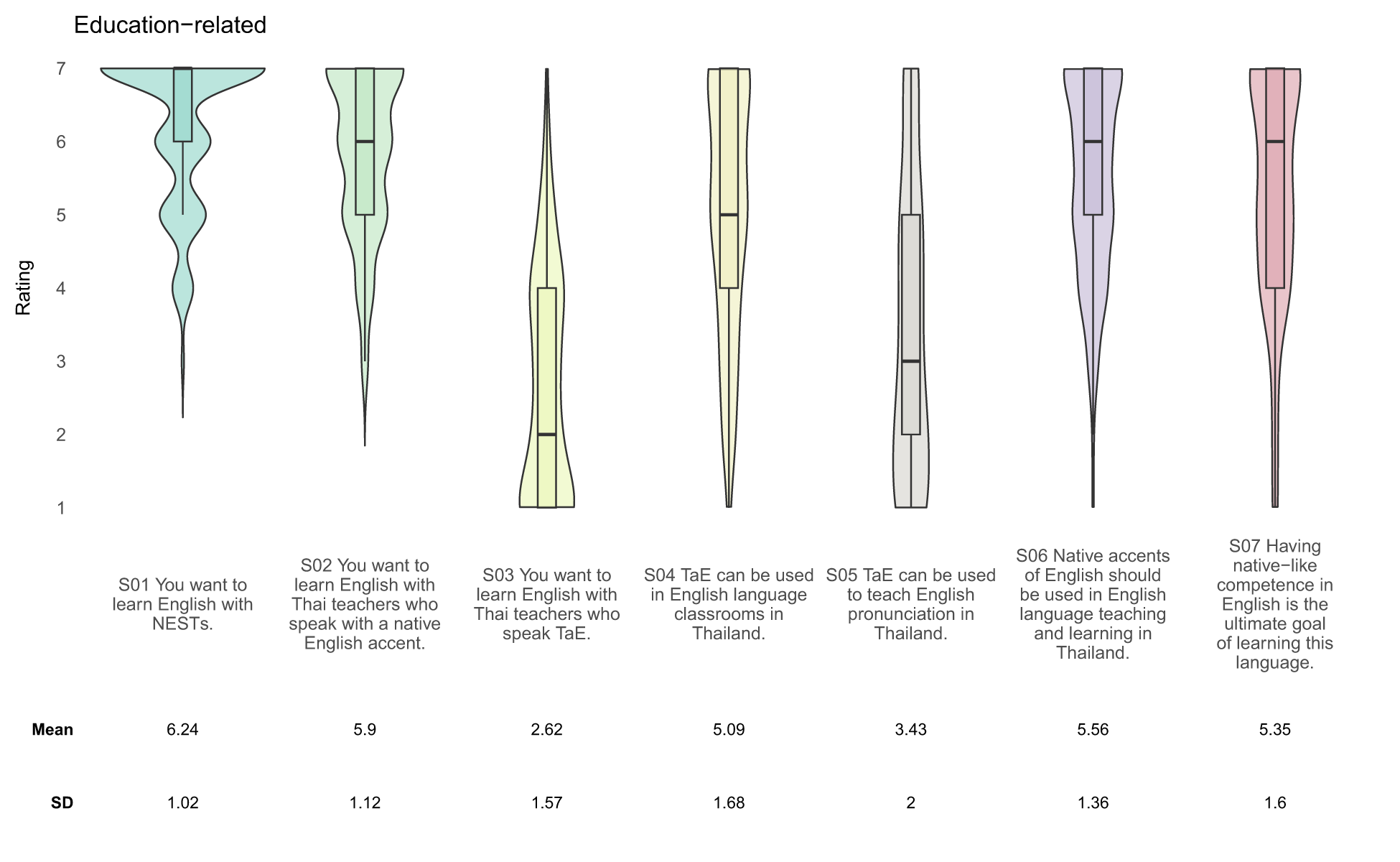
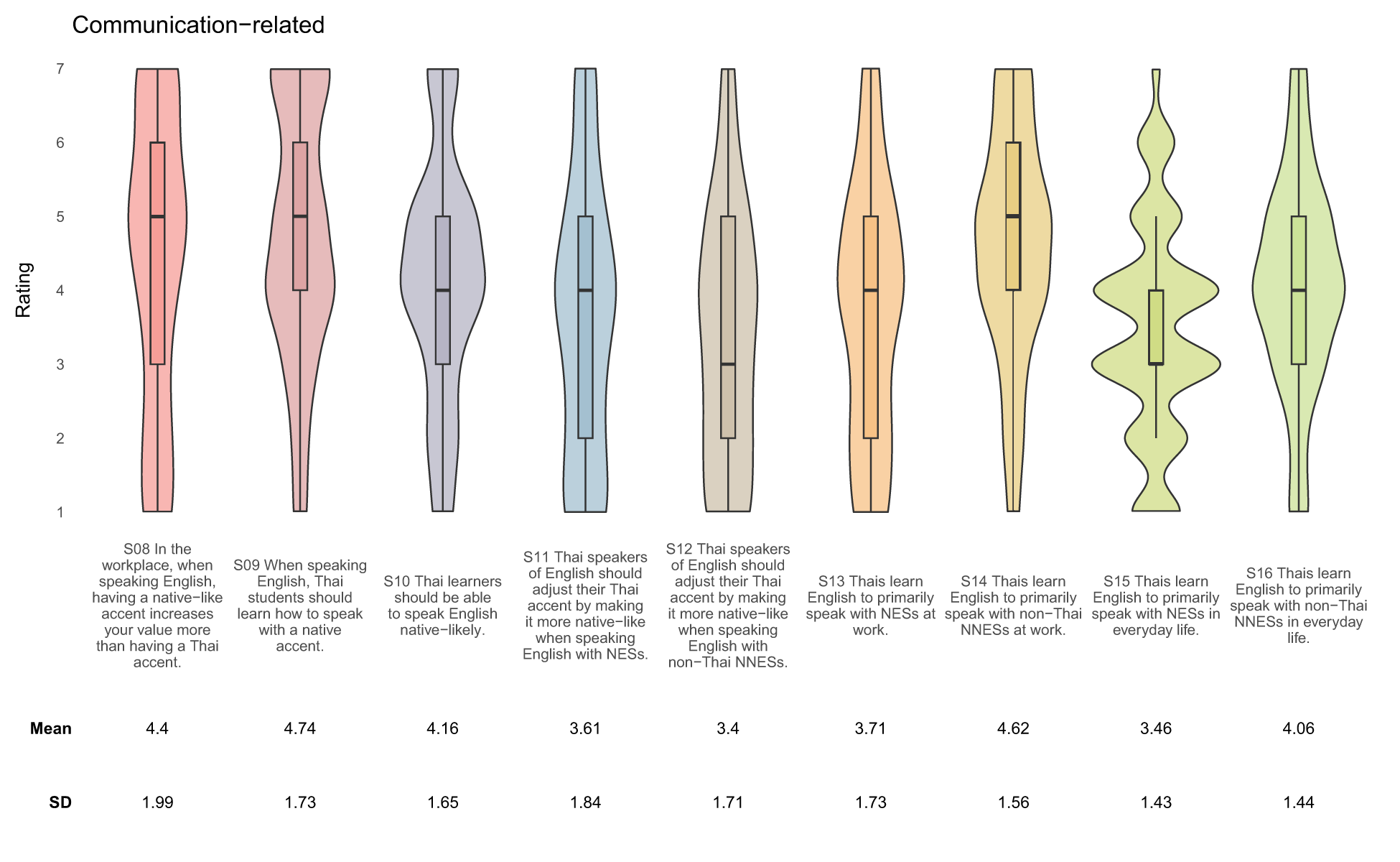
An online questionnaire was administered in Thai on Qualtrics comprising two sections: (1) statements with a rating scale and (2) open-ended questions. The first section contained 16 statements rated on a seven-point Likert scale with 1 indicating ‘strongly disagree’ and 7 indicating ‘strongly agree.’ Statements 1–7 focused on language teaching and learning (Figure 1) whereas Statements 8–16 addressed communication (Figure 2). This part also examined the suitability of NESTs, native-accented Thai teachers (NATTs), and TaE teachers (TaETs) and that of native Englishes and TaE in ELT. The inclusion of both NATTs and TaETs is important in that it allows us to observe potential differences among NNESTs in accent perception and to tease apart nativeness and native-like accent. Notably, NATTs represent a hybrid category between NESTs and TaETs sharing native-like accent with the former and a non-native status with the latter.
Ratings of the education-related statements.

Ratings of the communication-related statements.

The second section comprised four questions:
Q1: Which accent of English do you speak?
Q2: Which accent of English do you want to have? Why?
Q3: What do you think about Thai-accented English?
Q4: Which variety of English should Thai students be taught? Why?
In this part, Questions 1, 2 and 3 asked participants to provide short answers while in Question 4, they first selected one of the six options, i.e., the five Inner Circle varieties and others, and gave a brief explanation. The first three questions targeted accent perception while the last question concerned English(es) in ELT. This part was complementary to the first part as it gathered more detailed responses on which accent was preferred, which English variety was desirable in ELT, and attitudes toward TaE.
While I acknowledge the problematic dichotomy between ‘native’ and ‘non-native’, these terms were intentionally employed as they are considered well-established concepts following Seyranyan and Westphal (Reference Seyranyan and Westphal2021). To minimize varied interpretations, definitions were provided in the instruction: native speakers of English referred individuals whose L1 is English and who reside exclusively in the U.S., the U.K., Canada, Australia, and New Zealand. Likewise, native accents referred to English accents spoken by these speakers.
The complete survey was reviewed by an expert in sociolinguistics for content validity. A pilot study with two Thai speakers confirmed the clarity and relevance of the test items. Consequently, no major modifications were made to the final version of the questionnaire. The limitations of utilizing such direct attitudinal measures are further examined in the Discussion section.
Participants
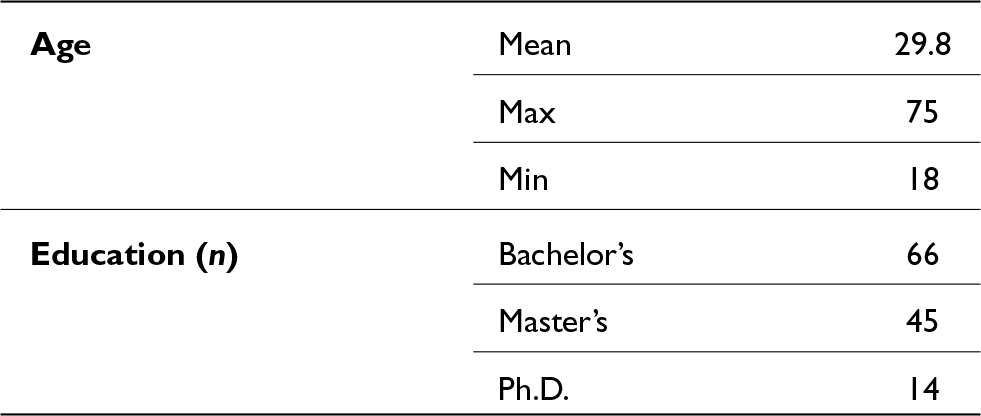
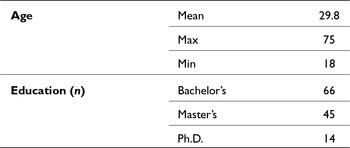
Using convenience and snowball smapling, 125 Thai participants voluntarily completed the survey (Table 2). Participants’ locations at the time of data collection were categorized into three groups: Bangkok, (n = 66), Non-Bangkok (n = 42), and Abroad (n = 17). While data on the duration of overseas stays were not collected, the Abroad group presumably had the highest degree of exposure to Englishes and international interaction, followed by the Bangkok and Non-Bangkok groups. Although the survey was open to individuals aged 18 or older, all participants were currently studying for or had earned at least a bachelor’s degree. While the study aimed for a broad demographic beyond English majors and educational stakeholders, occupation data was not collected.
Demographic information
Findings
Education-related questions
Figure 1 presents means and SDs of the education-related statements. Participants clearly preferred NESTs, closely followed by NATTs, and disapproved of TaETs. While TaE was generally acceptable in ELT, its acceptability decreased in teaching pronunciation. Native accents were slightly more acceptable in ELT than TaE. Finally, participants slightly agreed that native-like competence represented the desired learning outcome. Overall, the pattern in Figure 1 suggests the presence of native-speakerism in education as observed in the concentration of ratings for native Englishes skewed toward the top of the scale
Since the outcome vaiable is ordinal, cumulative link models (CLMs) were conducted as suggested by Liddell and Kruschke (Reference Liddell and Kruschke2018). The clm function in the ordinal package (Christensen Reference Christensen2023) was employed for comparable statements with item as the fixed effect. Detailed statistical results of all regression models are provided in Supplementary Materials. The model on S1–S3 showed statistical significance. NESTs were preferred over both NATTs (p = .0157, d = 0.3) and TaETs (p < .001, d = 2.3). NATTs were also rated higher than TaETs (p < .001, d = 2.4). However, due to the small effect size between NESTs and NATTs, the two teacher groups did not practically differ. In other words, it is likely that a native-like accent effectively minimizes the preference for nativeness. Subsequent comparisons between S4/S5 and between S4/S6 also reached significance. Specifically, TaE was less preferred in teaching pronunciation than in general ELT (p < .001, d = 0.9). Although native accents were more preferred than TaE in general ELT (p = .041, d = 0.3), the small effect size indicates a lack of practical significance.
Communication-related questions
The mean scores of several statements in Figure 2 clustered around the middle of the scale. Participants showed slight agreement that a native-like accent increased their value in the workplace and that Thai students should attain native-like English speech. However, they mildly disagreed that Thai speakers should adjust their English to sound more native-like when interacting with NESs and NNESs. Furthermore, they reported greater likelihood that they learned English to interact with NNESs than with NESs at work and in everyday life.
The same statistical analysis was applied to S11–S16. Participants were more likely to learn English to interact with NNESs at work (S13/S14: p < .001, d = 0.5) and in everyday life (S15/S16: p < .001, d = 0.4). The comparison between S11/S12, by contrast, was not significant (p > .05, d = 0.1). It is noteworthy that all effect sizes are small. The ratings shown in Figure 2 are also clusted in the middle of the scale suggesting that these preferences are relatively modest in practice. Furthermore, subject variance was high as indicated by sparse rating patterns.
Age and location
A cumulative link mixed model (CLMM) was run with location and age as fixed effects and item and subject as random effects. Age emerged as a significant factor (β = −0.02, p = .03) indicating that overall ratings decreased as age increased. Location, by contrast, was not statistically significant. Statement-level analysis showed that age reached statistical significance in S1 (β = −0.05, p = .002) and S2 (β = −0.03, p = .04). Location was significant in S1 and S10, (ps < .05). However, pairwise comparisons revealed a marginal difference between the Abroad and Non-Bangkok groups in S1 only (p = .05). This difference carried a large effect size (d = −0.9) showing that the Abroad group had a substantially lower preference for NESTs.
Open-ended questions
Data from the open-ended questions were analyzed and coded using an inductive thematic approach (Braun and Clarke Reference Braun and Clarke2006). Since the questionnaire was conducted in Thai, most of the responses were written in Thai and thus were translated into English by the researcher. Quantitative data were presented in frequency and percentage.
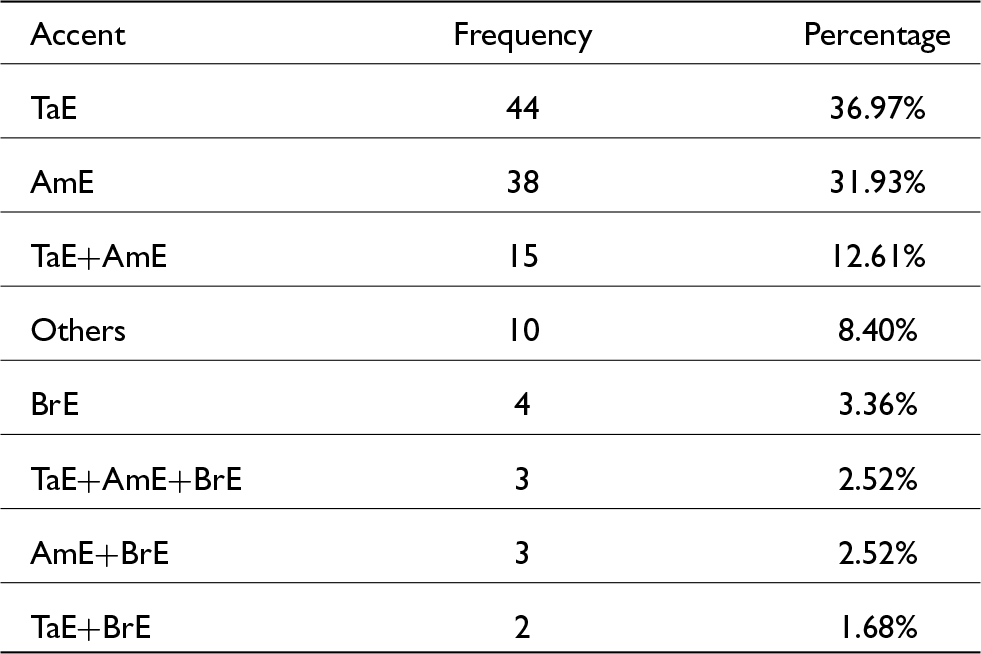
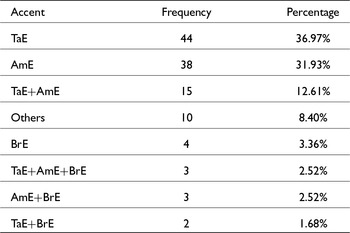
Q1: Which accent of English do you speak?
In Table 3, TaE was the most frequently reported accent, followed by AmE and a combination of both.
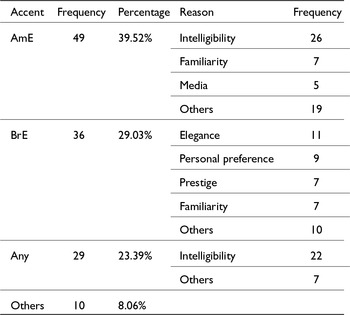
Q2: Which accent of English do you want to have? Why?
Responses to Q1
With one response removed, Table 4 reports 124 responses. Intelligibility and familiarity were cited as reasons for choosing AmE while BrE was associated with elegance, personal preference, and prestige. Since over half of the respondents favored AmE and BrE, the findings revealed a strong favoritism toward native accents, consistent with previous reports of native-speakerism in the Expanding Circle. Note that several responses prioritized intelligibility over a specific native accent.
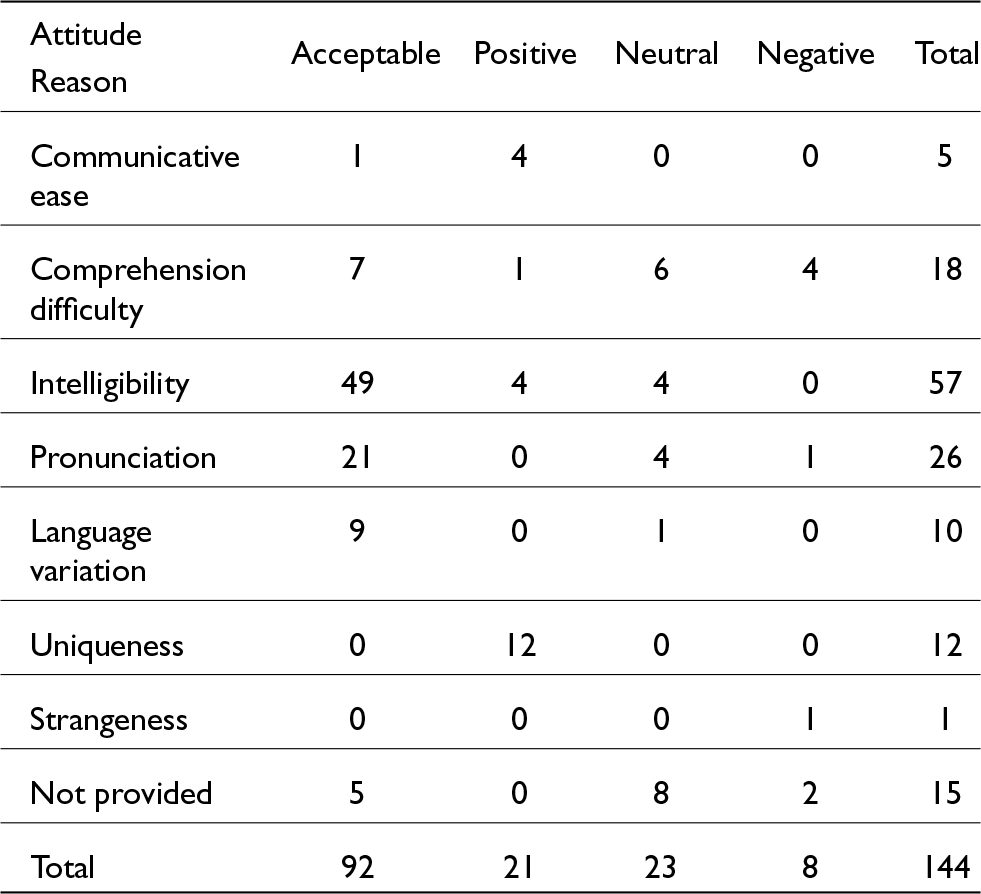
Q3: What do you think about Thai-accented English?
Responses to Q2
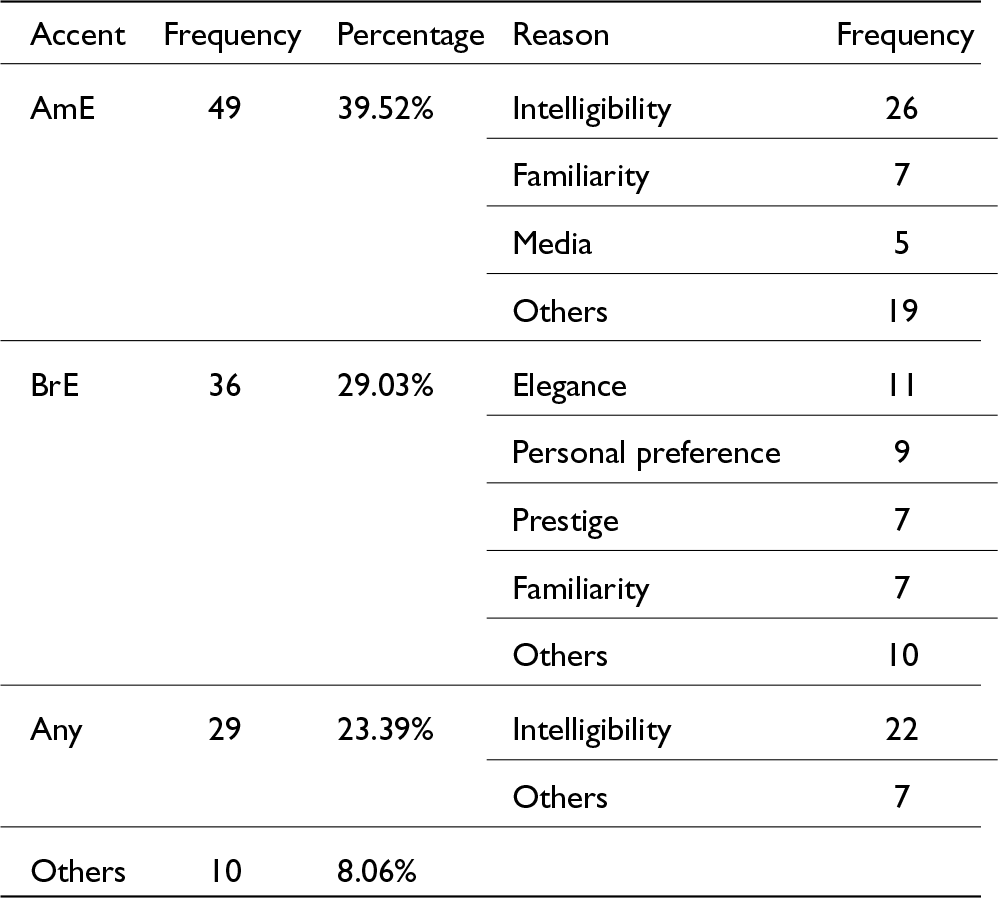
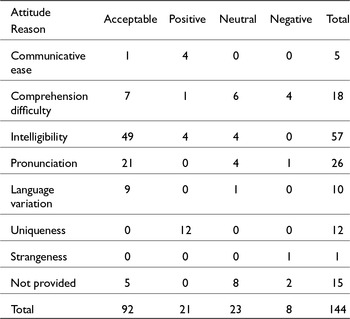
Table 5 reports 144 responses exceeding the total number of participants because some provided multiple answers. Acceptable and positive responses were grouped as acceptance of TaE with the latter group containing positive descriptors. The majority of the responses accepted TaE while only eight responses demonstrated negative attitudes. Within the acceptable category, intelligibility was the most frequently mentioned reason. TaE was also deemed acceptable if the pronunciation was clear. Some respondents mentioned that TaE was a case of language variation as in (1). However, despite accepting TaE, some responses questioned its ease of comprehension as in (2). Positive responses used words such as unique, cute, and cool as in (3). A few positive responses also mentioned that TaE was easy to understand likely due to dialectal familiarity as the majority of respondents reported speaking TaE in Q1. Lastly, neutral responses addressed intelligibility and clear pronunciation but some also raised concerns about comprehension difficulties, the most prominent reason in the negative category.
(1) ‘I view it as linguistic diversity. English is used globally in non-native countries. Speakers then adapt it according to their mother tongue’s pronunciation and familiarity such as Indian and Spanish accents.’ (Participant 7)
Table 5.Responses to Q3

(2) ‘[It is] okay but could be hard to understand for some natives.’ (Participant 60)
(3) ‘I am positive toward this accent. It is unique.’ (Participant 10)
‘I am positive toward this accent. It is unique.’
Q4: Which variety of English should Thai students be taught? Why?
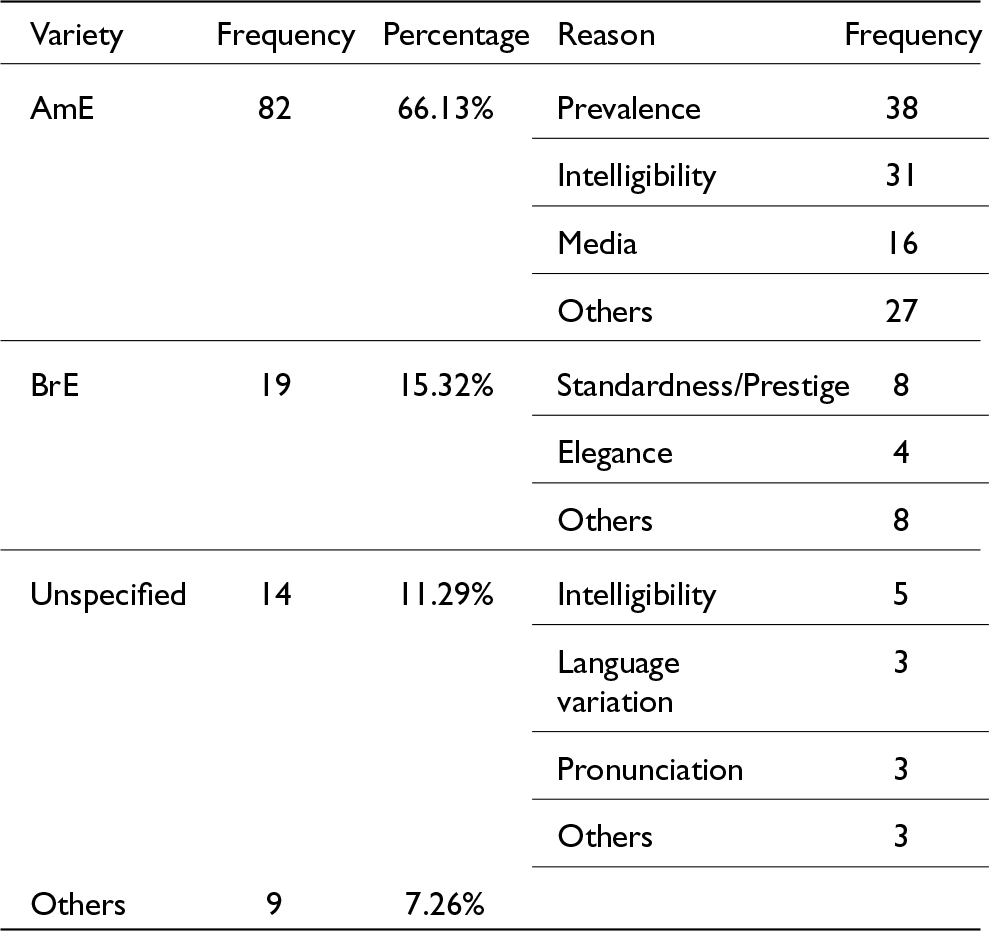
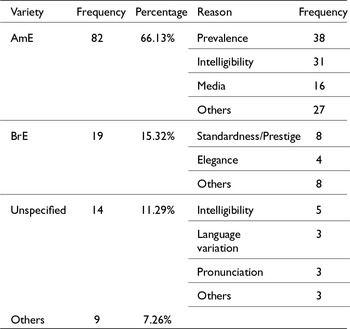
Table 6 reports 124 responses (one excluded). The total number of reasons exceeded that of participants as some provided multiple reasons. AmE and BrE emerged as the top two preferred varieties. Similar to Q2, AmE was selected for its prevalence and intelligibility while prestige and elegance were attributed to BrE. The unspecified category contained responses that did not fall under any Inner Circle variety. These responses likely focused more on intelligibility.
Responses to Q4
Discussion
The present study investigated Thais’ perceptions of TaE and native Englishes. The overall findings reveal that native-speakerism remains pervasive in ELT (Irham 2023; Jindapitak Reference Jindapitak2019; Seyranyan and Westphal Reference Seyranyan and Westphal2021) but exerts a weaker influence in communicative settings. Age emerged as a significant negative predictor in the main model. However, since it reached statistical significance in only two statements, this may reflect a general tendency for older participants to use lower points on the scale. Concerning location, the Abroad group’s lower preference for NESTs than the Non-Bangkok group suggests that greater exposure to Englishes could mitigate native-speakerism.
Given that NATTs and TaETs share the non-native status, the significantly greater preference for NATTs indicates that native-like accent exerts a stronger influence than nativeness on the suitability of English language teachers. This pattern aligns with previous studies, which found that second language (L2) speakers with American and British-accented speech were rated more favorably than those with L1-accented speech (Butler Reference Butler2007; Osatananda and Salarat Reference Osatananda and Salarat2020). As NNESTs could also receive positive attitudes due to learning experience and a shared L1 with learners (Wang and Fang Reference Wang and Fang2020), the high ratings for NATTs, who have both a native-like accent and the non-native status, should be interpreted carefully.
The comparison of the two contexts reveals the flexibility of language attitudes as tied to contextualization. While the educational context was relatively conservative, the communicative one demonstrated weaker native-speakerism corresponding to previous studies (Hänsel et al. Reference Hänsel, Westphal, Meer and Deuber2022; Kang et al. Reference Kang, Yaw and Kostromitina2023). Specifically, TaE was unacceptable for teaching pronunciation, matching perceptions in China (Huang and Hashim Reference Huang and Hashim2020) and Hong Kong (Sung Reference Sung2016b), where learners preferred native models. In the educational context, high expectations of teachers as proficiency models may also demand perceived professionalism and educatedness, qualities perceived as absent in TaE. Because the questionnaire did not address other dimensions such as grammatical competence and fluency, raters may associate nonnative-accented speech with low linguistic competence (Sung Reference Sung2016a; Timmis Reference Timmis2002). Furthermore, TaE is linked to a perceived lack of education (Jocuns Reference Jocuns2022). Such stereotypes drive the disapproval of TaE and TaETs as learners hold high expectations of their pedagogical models (Kang et al. Reference Kang, Yaw and Kostromitina2023). Conversely, intelligibility paramount to communicative settings may mitigate negative evaluations of accented speech.
Most respondents also reported speaking and accepting TaE due to its intelligibility (Ambele and Boonsuk Reference Ambele and Boonsuk2021) and uniqueness (Kangkun Reference Kangkun2018). As Jenkins (Reference Jenkins2009) noted, English users should prioritize accommodation by adjusting their speech to enhance intelligibility. The neutral response toward native-like adjustment in this study may thus be indicative of TaE’s intelligibility. However, since some segmental features remain unintelligible to international tourists (Phuengpitipornchai and Teo Reference Phuengpitipornchai and Teo2021), the reported acceptance likely stems from familiarity rather than inherent intelligibility. Therefore, these results warrant careful interpretation.
Despite the acceptance of TaE, participants’ aspiration to attain a native accent and preference for native Englishes remains strong, clearly reflecting the persistence of native-speakerism in Thailand. This suggests that the acceptance of TaE does not guarantee its perceived suitability in ELT. Consistent with previous studies (Evans and Imai Reference Evans and Imai2011; Irham 2023), BrE and AmE remain the prefer models with the former linked to social status and the latter, which is generally preferred in the present work, associated with utility (Meer et al. Reference Meer, Hartmann and Rumlich2022; Snodin and Young Reference Snodin and Young2015). This preference likely stems from the global influence of American hegemony (Bayard et al. Reference Bayard, Weatherall, Gallois and Pittam2001). In sum, the preference for native-aligned teachers and varieties (NESTs, NATTs, and native Englishes) over Thai alternatives (TaE and TaETs) underscores the resilience of native-speakerism in Thailand. Such preferences persist despite attempts to promote multiple Englishes as these efforts can be undermined by native-centric assessments and institutional norms.
This study is not without limitations. First, the questionnaire relied on direct questions. Such direct measures are criticized for their susceptibility to social desirability bias (Garrett Reference Garrett2010). That is, participants may provide socially appropriate responses. For this reason, future studies could adopt indirect approaches such as a verbal-guise experiment. Second, the questionnaire did not specify which native English was referred to in the rating part. Given that regional Inner Circle varieties are evaluated differently (Levon et al. Reference Levon, Sharma, Watt, Cardoso and Yang2021; Purnell et al. Reference Purnell, Idsardi and Baugh1999), comparing them could illuminate sociolinguistic hierarchies and underlying standard language ideologies. Third, the present study focused exclusively on TaE. To better capture the complexity of Thai speakers’ attitudes, future research should explore a broader range of region and non-native varities to reflect the actual diversity of NESTs and NNESTs in Thailand.
Additionally, the degree of accentedness of TaE can vary across individuals. Unlike Prakaianurat and Kangkun (Reference Prakaianurat and Kangkun2018), this study did not utilize audio stimuli. Its absence could lead to variability concerning how respondents conceptualized both TaE and native-like accents although the definition of native accents was provided. Future studies should employ audio recordings to control for perceptual variability. Furthermore, the survey did not collect data on participants’ occupations, which may obscure key influences. For instance, TaE, particularly when involving Thai final particles, might be viewed as inappropriate by individuals in international corporations or academia, where professionalism is of great importance. By contrast, merchants and tuk-tuk drivers often stereotyped as less educated and linked to TaE (Jocuns Reference Jocuns2022), might offer more favorable evaluations. Lastly, this study did not collect details on the specific foreign countries where the Abroad participants had resided.
The native accent fallacy
Phillipson (Reference Phillipson1992) argued that the native-speakerist ideology in ELT stems from the native speaker fallacy, which frames NESTs as the ideal teachers. This fallacy creates a binary dichotomy between NESTs and NNESTs. However, it fails to capture differences within NNESTs, specifically the distinction between NATTS and TaETs in the current study. Recall that NESTs and NATTs are perceived as minimally different. This implies that the suitability of NNESTs in ELT can become comparable to that of NESTs if the former possess a native-like accent. Acceptance of English language teachers is thus more likely modulated by a native(-like) accent than nativeness.
While the current study found a general acceptance of TaE, its use in teaching pronunciation and TaETs were less favorable than NESTs, NATTs, and native Englishes. The disapproval of TaE for teaching pronunciation along with an aspiration to attain a native accent underscores the privileged status of native accents and NESTs (Colmenero and Lasagabaster Reference Colmenero and Lasagabaster2024). Consequently, I extend the native speaker fallacy to the native accent fallacy which argues that the ideal teachers of English are those with native(-like) accents. This new proposal adds a critical layer to the traditional dichotomy by shifting the focus to how the perceived suitability of language teachers is modulated by accent rather than origin. This does not imply that the two fallacies are mutually exclusive. They co-exist to provide a more profound understanding of language attitudes in ELT. In sum, while the native speaker fallacy defines the broad NEST/NEST divide, the native accent fallacy highlights differences within the NNEST group. Specifically, NNESTs are not equal and should not be treated homogenously: NNESTs with non-native accents likely experience greater prejudice and more discriminatory hiring practices than those with a native-like accent. The current findings highlight potential discrimination against TaETs judged solely on the basis of their non-native accent. This calls for a shift in attitudes toward nonnative-accented English teachers and in recognizing that other qualifications should also be considered (Samuell Reference Samuell2024). This issue can be addressed through GELT which advocates for a change in teacher recruitment practices and will be discussed in the next section.
Since differences also exist among NESTs speaking standard and regional English varieties and despite the two aforementioned fallacies, one could propose the standard native accent fallacy which describes that ideal teachers of English are those with a standard native accent such as Standard or General AmE. While the native accent fallacy highlights differences among NNESTs, the standard native accent fallacy could offer a more thorough understanding of attitudinal differences among NESTs. It should be noted that the current data only support the proposal of the native accent fallacy. Future research could include NESTs with a variety of regional accents to examine their status since the standard native accent fallacy remains speculative. In tandem, while the native speaker fallacy divides NESTs from NNESTs as two separate groups and treats each as a homogenous group, the native accent fallacy and the speculative native standard accent fallacy can demonstrate potential intra-group differences. The three fallacies thus complement each other to reveal the complexity of attitudes toward various groups of English teachers.
Implications
Native-speakerism identified in this study reflects traditional ELT where NES(T)s are viewed as the ideal learning model (Rose and Galloway Reference Rose and Galloway2019). To counter this ideology, the GELT paradigm discussed earlier can serve as a viable alternative. Since exposure to Englishes can enhance intelligibility and foster more positive attitudes (Lee and Lee Reference Lee and Lee2019; Rovetti et al. Reference Rovetti, Sumantry and Russo2023; Wang and Jenkins Reference Wang and Jenkins2016) and intervention research has shown promise in reducing negative attitudes toward L2 speakers (Crowther et al. Reference Crowther, Doyama, Shin and Gilliland2025; Galloway Reference Galloway2017; Miao et al. Reference Miao, Moran and Kang2025), teaching materials should incorporate multiple varieties of English to reduce linguistic bias, raise students’ awareness and familiarity, and strengthen their communicative skills (McKay Reference McKay and Matsuda2012).
As Thailand is an Expanding Circle country, Thai speakers are unlikely to encounter diverse English speakers apart from media. Given the benefits of exposure to and interactions with Englishes, language practitioners could dedicate at least one week to discussing different Englishes using authentic audiovisual materials to expose students to varieties of English through in-class activities, in which they can actively engage, such as debates on standard language ideology (Rose and Galloway Reference Rose and Galloway2017) and student presentations (Galloway and Rose Reference Galloway and Rose2018). In the Thai context, although shifts have been minimal so far (Prabjandee Reference Prabjandee2020), GELT-based professional development initiatives, such as workshops, have yielded positive and promising outcomes (Prabjandee and Fang Reference Prabjandee and Fang2022). Expanding GELT workshops for educators and promoting the implementation of GELT in classrooms can help mitigate native-speakerism. With this practice, it is expected that the preference for NESTs and NATTs will become weaker and the acceptance of TaETs will increase. This also means that TaETs will likely experience less language-based prejudice and discrimination.
A key issue that potentially poses practical challenges for implementing GELT and needs to be addressed is misunderstandings of GELT. Certain language teachers associate a GELT model teacher with someone who is highly proficient in English and well-versed in both theory and pedagogy of GELT (Montakantiwong Reference Montakantiwong2024). By contrast, Rose and Galloway (Reference Rose and Galloway2019) argued that, within the GELT paradigm, language teachers are any qualified teacher who can facilitate the use of English as a Lingua Franca in diverse settings. To effectively implement GELT, teachers first require training that helps them not only grasp its pedagogical implications but also ‘internalize’ and fully comprehend the paradigm’s core tenets (Selvi Reference Selvi, Fang and Widodo2019, 144). However, such teacher training opportunities remain limited. Many university language teachers were exposed to GELT or related paradigms, such as EIL, primarily through their graduate studies (Montakantiwong Reference Montakantiwong2024). Although a graduate program in Teaching English as a Global Language designed to promote and provide training in teacher education and GELT has been developed and offered (Prabjandee Reference Prabjandee2025), not all language teachers pursue or require a postgraduate degree. Therefore, teacher training in GELT should not be limited exclusively to postgraduate programs. An increase in access to GELT trainings for language teachers will result in the implementation of GELT in a wider scale and a decrease in native-speakerism in Thailand.
As discussed earlier, the findings highlight among the difference between NATTs and TaETs suggesting a possibility of hiring discrimination among NNESTs. Hiring practices in ELT should thus shift away from treating NESTs and native-accented NNESTs as providers of authentic English (Rose and Galloway Reference Rose and Galloway2019). In this way, implementing GELT can promote diversity and awareness of Englishes and help eliminate any form of discrimination against NNESTs, specifically those with non-native accents as revealed in the current study. This calls for more implementation of GELT so that Thai speakers, specifically stakeholders in education including students, teachers, parents, school administrators, and policymakers, would view TaE and TaETs more positively. Successful implementation of GELT can be expected to lead to hiring practices that treat NESTs, NATTS, and TaETs equally regardless of accent variation. The construct of native-like accent along with nativeness can also be openly discussed among these stakeholders to foster a clearer understanding of the current global realities of Englishes.
Acknowledgement
I would like to express sincere thanks to the faculty members of the English Language and Linguistics program at the University of Wisconsin-Madison, especially, Prof. Tom Purnell, for their constructive feedback on the earlier stages of this project. I am also grateful to Zach Peterson of the Second Language Acquisition Lab at the University of Wisconsin-Madison for his helpful feedback and careful reading of an earlier version of this manuscript. Finally, I am appreciative of comments from and discussions with attendees at the AAAL 2024 conference.
Competing interests
The author(s) declare none.

VATCHARIT CHANTAJINDA is a PhD candidate in English Language and Linguistics at the University of Wisconsin-Madison. His research interests are generative and psycholinguistic approaches to second/third language acquisition and language attitudes in second language learners. Email: chantajinda@wisc.edu



 Open access

