


Introduction
The idea behind forest certification is simple: a logging company or forest community demonstrates excellent production standards (technically sound, environmentally benign, and socially responsible) thereby earning the seal of approval from a third-party certifying agency and gaining access to consumers willing to pay higher prices for sustainably harvested forest products. The conservation community promotes certification as proof that more and more forests are being sustainably managed. Producers obtain price premiums or secure market access, especially to lucrative export markets. Consumers buy what they want minus the guilt associated with forest destruction. Wedding conservation objectives to market incentives appears to have been a success since the first Forest Stewardship Council (FSC) certifications were approved in 1993. Up to December 2006 over 84 million ha of forests around the world had received independent certification through FSC protocols, c. 8 million of these in tropical regions (FSC, 2005a, 2006). Although total certified area in the tropics remains relatively small, recent acceleration in the rate of new certifications has fuelled optimism about certification's potential for promoting sustainable use of tropical forests (FSC, 2005b; Veríssimo et al., Reference Veríssimo, Smeraldi, Azevedo, Burger, Hess and Lang2005; but see Gullison, Reference Gullison2003, for a less optimistic assessment).
The Brazilian Amazon has been touted as one of certification's regional success stories (FSC, 2004, 2006; Veríssimo et al., Reference Veríssimo, Smeraldi, Azevedo, Burger, Hess and Lang2005). Over 2.8 million hectares of forest divided between 17 private properties and 10 forest communities have earned FSC certification since 1997. While accounting for only a fraction of total exploited area in Brazilian Amazonia, certified logging companies represent progressive forest management in this region (we do not consider certified forest communities here, as these fall beyond our expertise and experience). Operating under legal land title, these companies employ best-practice reduced-impact logging techniques and, generally speaking, respect the law in regard to environmental impacts and labour relations. Any advantages these operations earn, principal among them being improved access to export markets allowing price premiums over the domestic market, are hard-won in the face of cost advantages enjoyed by illegal loggers. Certified and certifiable companies must furthermore negotiate an increasingly fraught socio-political landscape littered with obstacles to improving forest management practices. Among other issues, they face mounting difficulties finding legally titled land holdings for new or expanded activities; institutional problems within IBAMA, the government agency responsible for regulating logging industry activities, creating costly delays; and, perhaps most ominous of all, a recent spate of organized invasions of certified properties by illegal loggers and landless agriculturists, inflicting severe financial losses on certified companies and jeopardizing long-term investment in forest management.
FSC principles, criteria and indicators reflect a broad definition of sustainable forest management that is not limited to merely sustaining timber yields (FSC, 2002; see Table 1 for examples). Maintenance of populations of timber species is an explicit requirement, as is protection of rare species. More general principles, such as maintenance of ecological functions, biodiversity, and socio-economic values, require a balance to be struck between production goals and environmental values to validate certification's green label. A careful reading of FSC principles thus leads to the assumption that certified operations are practising sustained-yield forestry, maintaining populations of commercial species, and avoiding drastic changes in forest composition and structure. Whether a company meets these goals depends on the quality of harvest operations, regulation of harvest parameters, and the application of silvicultural treatments.
Examples of FSC indicators for certification of forestry operations in the Brazilian Amazon that must be ignored to certify forests under current conditions (from FSC, 2002). Emphasis in italics added to indicate relevant text.

* Codes for indicator numbers refer to Principle (P), Criterion (C), and Indicator (I) in FSC standards.
Whereas written FSC standards for Amazonia are remarkably comprehensive, no guidelines indicate which criteria and indicators must be enforced, or to what degree, for certification to be conferred by third-party assessors. A recent review of five systems of criteria, indicators and verifiers for tropical forest management, including FSC standards, found that many elude objective assessment (Pokorny et al., Reference Pokorny, Sabogal, Silva, Bernando, Souza and Zweede2005). Evaluation and enforcement of criteria and indicators are thus dependent on the subjective assessments of individual certifiers, potentially creating inconsistent minimum standards for earning certification.
We recognize that an analysis of the details of certification in Amazonia, even from professionals who support the certification process, could be misconstrued as an attack on the process itself. However, an examination of the minimum technical standards for certification is critical to the continued evolution of certification, and of forest management in general. Here we examine the question of minimum technical standards from three perspectives. Firstly, uncertainty about which certification criteria should be strictly enforced and inconsistent application of minimum standards may blur distinctions among ‘green’ products of widely different pedigree. Secondly, even best-practice forest management in Brazilian Amazonia does not approximate sustainable resource use as frequently promised or implied by marketers of certified timber. Thirdly, much of the forest monitoring burden required by certification is imposed on certified companies themselves, confounding management evaluation with what are, to the logger-businessman, largely irrelevant research questions, and creating obvious conflicts of interest for companies.
We analyse publicly available information on certified industrial-scale logging operations and from certification audits to evaluate the extent to which technical standards are consistently and clearly applied in the Brazilian Amazon, and the degree to which reported certification standards could be considered so-called best-practice forestry. We compare forest management as practised by certified companies to the vision of sustainable forest management implied by FSC standards. Finally, we examine certification's monitoring burden in the context of information needs and monitoring competencies of certified companies. We present this analysis because a central tenet of the certification movement is the principle of continual evolution through revision and improvement of standards. This can only come through clear-eyed examination and discussion of facts. With a proposed 5-year revision of Brazilian certification standards now open for public comment, this movement appears to be nearing a critical juncture of accountability and relevance.
Methods
We reviewed public summary reports by third-party certifiers describing the evaluation process up to December 2006 for 14 certified companies accounting for 17 forest properties in the Brazilian Amazon (Rainforest Alliance, Reference Rainforest2006; SCS, 2006; SGS, 2006). Summary reports were produced by three FSC-sanctioned third-party certifiers (Smartwood–Imaflora, eight; Scientific Certification Systems, eight; SGS Qualifor, one; Table 2 lists certification codes). Our review includes two operations that were certified up to 2005 but not currently. One of these companies declined re-certification after 5 years because of financial problems either precipitated or aggravated by delays in IBAMA approval of 2005 harvest plans. The other company was dropped from certified lists in 2006 without public announcement that we could find. We omit community managed forests from this review because these operations are subject to different socio-economic and logistical constraints than the industrial-scale logging companies that manage the majority (c. 98%) of forest land certified for timber production in Brazil (more than 1.5 million ha of community forest is certified for non-timber forest products only).
Characteristics of certified forest properties in the Brazilian Amazon.
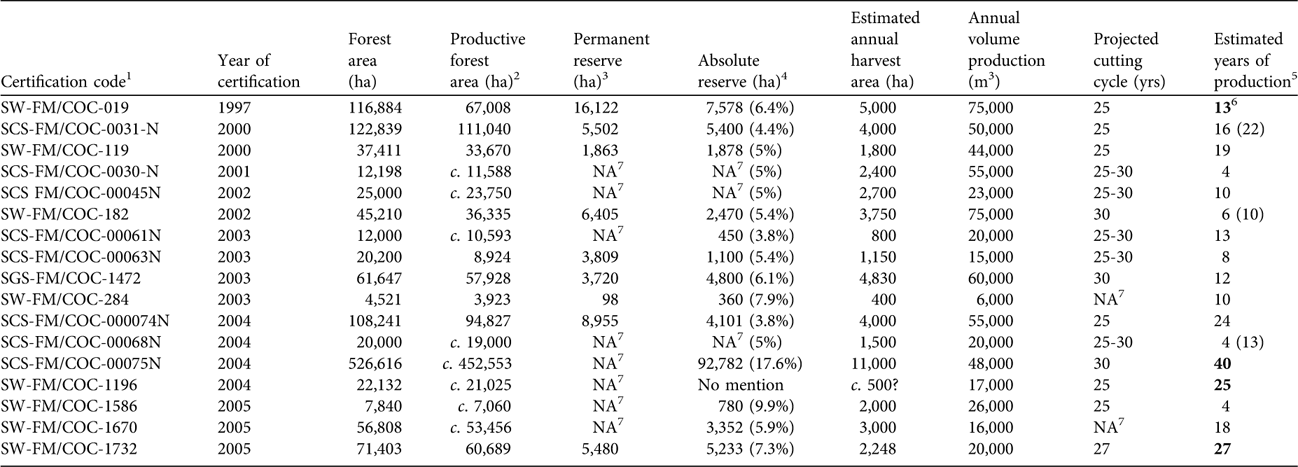
1 SCS, Scientific Certification Systems (2006); SGS, SGS Qualifor (2006); SW, Rainforest Alliance (Reference Rainforest2006)
2 Forest area designated for timber production
3 Buffer zones along watercourses or steep terrain where harvests are legally restricted
4 Legally accessible forest set aside for conservation
5 Estimates are based on productive forest area and annual harvest area, and in some cases are refined using additional information in certification reports. Where estimates are lower than would be predicted by dividing productive area by annual harvest area, unrefined estimates are given in parentheses. Values in bold indicate properties where a full harvest cycle is possible.
6 Recently acquired land being added to certified area would increase potential production to 30 years.
7 Information not available from summary report
Public summary reports describe company management practices at the time of third-party evaluation and operational modifications required by certifiers for certification to be granted. Preconditions and conditions are imposed on companies based on audits conducted prior to certification. Preconditions must be met before certification is awarded. Conditions must be met within a defined period for the company to maintain certification. Corrective action requests are made based on deficiencies found in post-certification audits and must be complied with within a defined period. Recommendations are non-binding.
Our analysis focused on technical aspects of forest management covered primarily by FSC principles 5–9 (FSC, 2002; Table 1). We recognize that the social aspects of sustainable forest management are as important as the ecological or economic, yet these fall outside our expertise and the scope of this assessment. We examined the consistency of technical standards presented in certification reports under three components of forest management: (1) harvest operations and implementation of reduced-impact logging, (2) harvest regulations, and (3) silviculture. We compared standards of best-practice forest management followed by certified companies with minimum requirements of sustained-yield forestry as reported in published literature on sustainable forest management and ecology in Amazonia. Monitoring and research demands placed on companies by third-party certifiers were also extracted from summary reports.
While our analysis was systematic and exhaustive, differences in style and completeness of the summary reports meant that not every component outlined above could be definitively assessed for each property. We note cases of missing information where applicable. Quantitative information (e.g. proportion of operations implementing a certain practice) is presented where possible but in some cases qualitative differences among summaries provide a useful means for evaluating consistency in the application of certification standards. We refrain from citing certification codes or company names when presenting disparities in certification reports, as our focus is on patterns rather than on comparing companies.
Results
Seventeen industrial-scale properties received FSC-standard certification in the Brazilian Amazon during 1997–2005 (Table 2). Properties ranged in size from 4,521 to 526,616 hectares, with productive forest areas representing 44–95% of total area. Nine properties listed permanent forest reserves, i.e. buffer zones along watercourses or in steep terrain where harvests are legally restricted, representing 2–19% of total area; eight reports do not give permanent reserve area. Absolute reserves (legally accessible forests voluntarily set aside for conservation purposes) were 4–18% of total area, with one property making no mention of this category. Estimated annual harvest area and annual timber volume production varied according to total production area.
Technical standards I: harvest operations
The current standard for best-practice forest management in the Brazilian Amazon is reduced-impact logging, an operational system designed to mitigate forest structural and environmental damage incurred during logging while improving profitability through increased efficiency. Since its adaptation from South-east Asian to Amazonian forests in the early 1990s, reduced-impact logging has become the gold standard for forest management and the defining element of certified logging operations. We therefore expect that any certified company will, at a minimum, successfully apply reduced-impact logging techniques.
Pre-certification evaluations indicated deficiencies in reduced-impact logging harvest operations at all properties. These ranged from minor problems in applying one or more procedures to a complete lack of reduced-impact logging harvesting capacity. Deficiencies identified prior to certification generally resulted in preconditions that had to be met before certification would be granted, or conditions that had to be met within a defined period after certification. By meeting preconditions, companies attained a level of compliance that warranted certification. Summary reports generally do not quantify these improvements (in one example of a quantified verifier, a single tree was apparently examined for evidence of correct felling techniques). Instead, qualitative descriptions of modifications (e.g. ‘a significant improvement was noticed with regard to the technical capabilities of workers') justify the decision to certify a given property.
Conditions and corrective action requests listed in public summaries indicate that deficiencies identified in harvest operations continued beyond the initial certification phase. Fourteen companies carried operational conditions into the first year or later of certification. Technical deficiencies involved tree felling (10 companies requested to reduce gap size or improve felling procedures), log skidding (eight companies directed to improve skid trail planning), and road building/maintenance (14 companies cited for deficient road building or excessive erosion and soil damage). Nine companies received corrective action requests concerning deficient harvest operations in the years following certification, indicating that problems associated with reduced-impact logging procedures persisted for years following certification.
Treatment of other operational issues varied among reports. As an example, eight of 17 reports mention rainy season logging. Two companies were banned by certifiers from rainy season logging because of excessive soil damage, whereas two others were asked to reconsider or limit rainy season logging because of observations of excessive damage. Certifiers approved rainy season logging at one property based on the company's assertion that the management area was not prone to flooding.
Technical standards II: harvest regulations
The cutting cycle refers to the number of years between harvests within a given unit area of forest. Whereas projected cutting cycles cited in certification reports all fall within 25–30 years, cutting cycles estimated by dividing productive forest area by annual harvest area are 4–40 years (Table 2). Only four certified properties were large enough to sustain annual timber production levels for the entire cutting cycle projected in certification reports (Fig. 1). Of the 13 properties that were too small to sustain current production, only two received strong demands from certifiers, in the form of conditions, to obtain additional forest land. Another three companies faced restrictions on annual harvest area that adjusted estimated cutting cycles to within 1, 8, and 13 years of projected cutting cycles. Certifiers recommended that the eight remaining companies with insufficient production area increase the forest area under management.
Proportion of certified companies in the Brazilian Amazon possessing legal title to forest land under management (remaining properties are leased), owning or having access to enough forest land to complete a harvest rotation based on projected cutting cycle (25–30 years) and allowable annual harvest area in certification report, and including previously logged forest in estimate of total production forest. Data derived from public certification summaries available up to October 2006. Summaries of certification reports must be made public for all certified companies. Reports for 14 certified companies (17 properties; Table 1) were available at the time this commentary was written (Rainforest Alliance, Reference Rainforest2006; SCS, 2006; SGS, 2006).
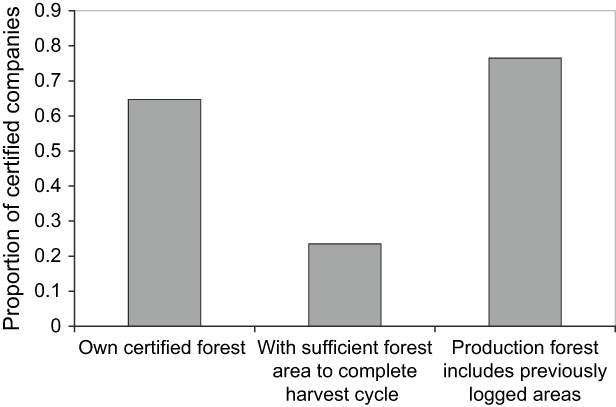
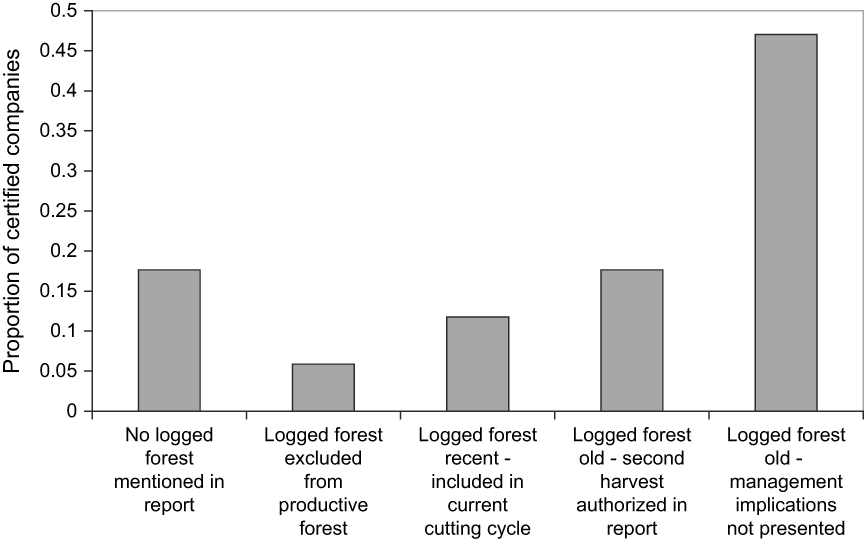
Compounding the problem of inadequate production area to complete cutting cycles is the fact that all but three certified properties include previously logged forest within production areas (6–55% of the total area; Figs 1 & 2). Five reports indicate that much of the forest property has already been selectively logged (high-graded) for a small number of high-value species. In two cases, recently logged forest was included in the current cutting cycle. On one property, forest logged in the 1970s was considered ready for a second harvest; this would be consistent with a 30-year cutting cycle. However, forests logged as recently as the 1990s were declared ready for a second harvest in two cases. In one of these certifiers required the company to develop criteria for seed tree selection that accounted for previous logging. One company removed previously logged forest from the forest area considered productive (a second company may have also done so but the summary report does not provide enough detail to confirm this). In the remaining cases, certification reports do not indicate any special consideration for previously logged forest, or for high-graded timber species.
Proportion of certified companies with previously logged forest included in certified area, and proportion subjected to each of four possible certification outcomes. Source data as for Fig. 1.
The legal minimum diameter felling limit in Brazil was 45 cm at the time all reports were written; this standard was recently raised to 50 cm (BRASIL, 2006). Four companies used a blanket minimum harvest diameter >45cm, the highest being 60 cm. Certifiers set conditions requiring 10 companies to determine minimum felling diameters by species, and recommended that three companies develop species-specific criteria; the remaining four reports made no mention of minimum felling diameters. When species-specific minimum felling diameters were requested, companies were expected to develop standards using company data on species biology and population structures.
Brazilian standards for seed tree retention stipulate that 10% of commercial-sized stems of each species must be left standing. At the time of certification 12 companies had seed tree retention rates of at least 10%. However, six of these companies did not explicitly designate 10% of the commercial stems of each species as seed trees: either the percentage was applied to commercial trees as a whole, or it included trees that were below commercial size. Five companies implemented seed tree retention rates higher than the legal Brazilian standard, the highest rate being 40% by species (Fig. 3a). Five companies either did not have seed tree rules when certified, or seed trees were never mentioned in certification reports. Four of these companies were subjected to conditions regarding seed trees. One was explicitly required to leave at least one seed tree per species per 150 ha management block, a restriction less stringent than the legal standard. The uneven treatment of seed trees in certification reports means that some companies are subjected to dramatically more restricted harvests than others.
Proportion of certified companies with (a) seed tree retention and (b) rare species criteria more conservative than, equal to, and less restrictive than IBAMA regulations at the time of certification. Source data as for Fig. 1.

IBAMA standards during 1997–2005 designated rare tree species as those with a density of 0.05 commercial-sized trees per ha (i.e. five trees in a 100 ha management block). Rare species cannot be logged. Recent changes in forest legislation have lowered the rare tree standard to three trees per 100 ha (BRASIL, 2006) but are not relevant to the current analysis. In summary reports, seven companies were explicitly required to apply the IBAMA rare tree criteria (Fig. 3b). Four companies were authorized to use less restrictive standards (three per 160 ha; one per 150 ha; three per 100 ha, two companies). Six reports made no mention of rare species.
Following the prevailing assumption that Amazonian forests can sustain timber production of 1 m3 ha-1 yr-1 (Silva, Reference Silva1992, Reference Silva2001; Amaral et al., Reference Amaral, Veríssimo, Barreto and Vidal1998; Alder & Silva, Reference Alder, Silva, Silva, Carvalho and Yared2001; SCS, 2006), one would expect maximum allowable harvest intensity in summary reports not to exceed 30 m3 ha-1. Only seven reports presented information on maximum allowable harvest intensity (20–41 m3 ha-1). The highest value, which exceeds the legal limit of 35 m3 ha-1, was from a transitional forest on the southern periphery of Amazonia where a single species accounted for 55% of harvest volume.
Technical standards III: silviculture
Reduced-impact logging is a technical system for improving harvest techniques and efficiency, not a management system integrating harvest regulations with silvicultural practices that ensure sustainable production (Fredericksen et al., Reference Fredericksen, Putz, Pattie, Pariona and Peña-Claros2003). Researchers generally agree that reduced-impact logging is not synonymous with sustainable forest management, which implies careful regulation of harvests and the application of appropriate silvicultural practices.
Summary reports present a view of post-harvest silviculture that ranges between two extremes: concern about negative impacts of any potential silvicultural treatment versus clear desire that silviculture be incorporated into management. In some cases the burden of proof is placed on the company to demonstrate that any silviculture is needed, while in other cases companies are held responsible for developing appropriate silvicultural practices.
Only one company was implementing any type of post-harvest silviculture at the time of certification, consisting of planting seedlings of commercial species along logging roads. In 10 reports no demands were made for development or testing of silvicultural treatments; four of these companies developed tests or silvicultural plans on their own (Fig. 4). Three companies were required to test one or more silvicultural practices. Vague or non-binding requests for tests or silvicultural plans were made of four companies. While a minority of certified companies is pushing forward with tests of silvicultural treatments, certifiers have not adopted a clear or consistent approach to promoting or regulating silviculture in Brazilian Amazonia.
Proportion of certified companies implementing post-harvest silvicultural treatments, testing treatments, considering silviculture, and implicitly authorized by certifiers to ignore silviculture. Hatched areas of graphs indicate four companies not required to test silviculture but who are doing so voluntarily. Source data as for Fig. 1.

Sustainability of current best-practice forest management standards
Criteria and indicators for FSC certification in Brazil include several provisions treating species-level sustained-yield management (Table 1: Principle 5 Criterion 6 Indicator 1, P5C6I3, P6C3I1, P6C3I2). In 10 reports, conditions were imposed on companies requiring development of harvest criteria based on species population biology and structure. Another company received the same request in the form of a recommendation. We are not aware from certification reports or our own experience of any company in Amazonia with a management plan tailored to species or species groups.
Research does not support the assumption that harvests of timber species in Amazonia can be sustained by implementing reduced-impact logging, respecting minimum diameter felling limits, and leaving 10% of commercial-sized trees as seed trees. Legal timber harvest levels for high-value export species such as Tabebuia impetiginosa (ipê), Hymenaea courbaril (jatobá), and Manilkara huberi (maçaranduba) are not sustainable under these protocols (Phillips et al., Reference Phillips, Azevedo, Degen, Thompson, Silva and Van Gardingen2004; Schulze et al., Reference Schulze, Vidal, Grogan, Zweede and Zarin2005; van Gardingen et al., Reference Van Gardingen, Valle and Thompson2006; Zarin et al., Reference Zarin, Schulze, Vidal and Lentini2007). In the absence of silvicultural treatments to encourage seedling regeneration and growth by surviving sub-merchantable trees, future harvests (presumed to occur in 30 years, and 30 years again after that) will yield minimal volumes of today's most highly valued species. These and other less well-studied species with ecological characteristics that confound management based on current seed tree retention rates and minimal to no silvicultural treatment (e.g. populations weighted towards large adults, low seedling stocks, and slow growth) are listed by certified companies as primary harvest species.
Limitations of the current approach to timber species management can be illustrated by the case of the premiere neotropical species, big-leaf mahogany (Swietenia macrophylla). Mahogany's listing in November 2002 under Appendix II of CITES prompted new Brazilian forest legislation raising the minimum felling diameter and seed tree retention rate for mahogany to 60 cm and 20%, respectively (BRASIL, 2003). This legislation further requires gap enrichment planting of mahogany seedlings. However, modelling projections indicate that even these improvements are not sufficient to sustain productive populations (Grogan et al., Reference Grogan, Jennings, Landis, Schulze, Baima and Lopes2008). Current harvest guidelines for Brazil nut Bertholletia excelsa and Virola timber production have also been shown to be unsustainable (Macedo & Anderson, Reference Macedo and Anderson1993; Boot & Gullison, Reference Boot and Gullison1995; Peres et al., Reference Peres, Baider, Zuidema, Wadt, Kainer and Gomes-Silva2003).
Even if we restrict our definition of sustainability to maintaining forest-level timber yield, considerable uncertainty remains. The assumption underlying cutting cycle projections in summary reports (that 30 m3 ha-1 can be harvested at 30-year intervals based on projected commercial volume accumulation of 1 m3 ha-1 yr-1) is derived from limited data from a small number of sites (Silva et al., Reference Silva, Carvalho, Lopes, Almeida, Costa and Oliveira1995; Vidal, Reference Vidal2004; Valle et al., Reference Valle, Schulze, Vidal, Grogan and Sales2006). Evidence exists that today's harvests of 10–30 m3 of roundwood per ha per 30-year cutting cycle can be sustained over multiple cycles only by assuming that high-value, generally slow-growing hardwoods will be replaced during future harvests by fast-growing, low-density species that are of low value in today's market (Alder & Silva, Reference Alder and Silva2000; Keller et al., Reference Keller, Asner, Silva, Palace, Zarin, Alavalapati, Putz and Schmink2004; Phillips et al., Reference Phillips, Azevedo, Degen, Thompson, Silva and Van Gardingen2004; van Gardingen et al., Reference Van Gardingen, Valle and Thompson2006). Moreover, the most optimistic estimates of sustainable timber production potential assume aggressive silvicultural interventions, such as refinement or liberation thinning (de Graaf et al., Reference de Graaf, Poels and Van Rompaey1999; Wadsworth & Zweede, Reference Wadsworth and Zweede2006). Estimates of sustainable cutting cycles in reduced-impact logging systems without post-harvest silviculture, the current management situation in commercial forests in Amazonia, range as high as 100 years (de Graaf et al., Reference de Graaf, Filius and Huesca Santos2003; Vidal, Reference Vidal2004).
Forest monitoring and research
Certification places a substantial monitoring burden on companies. All companies were required to monitor recovery of logged forests using permanent plots. Certifiers expect this information to determine the timing of second harvests, sustainable harvest intensities, and the need for silvicultural interventions. The minimum sampling intensity, when reported, was 0.25–1.0% of the managed area. Fourteen reports mention problems with collecting or analysing data from permanent plots. Even companies complying fully with monitoring obligations raise questions about the potential to produce useful information from these efforts.
Certifiers consistently requested that logging operations be self-monitored. Twelve companies were required to monitor logging damage to soil and/or vegetation. Seven companies were required to monitor harvest operations and harvest volumes. Most companies were also required to conduct detailed biological monitoring, although the demands of certifiers varied widely among reports. Twelve operations were required to implement fauna and flora monitoring, some receiving detailed instructions, such as to monitor all vertebrate classes, whereas others were granted more latitude. Two companies were required to monitor ecological integrity, and another the effect of logging and silvicultural treatments on tree regeneration. Five companies were asked to monitor rare and endemic species. Recommendations included complicated research projects such as developing a database on species biology, including pollination vectors and spatial distribution patterns, and determining important tree species for wildlife and the proportion of these species that could be harvested without affecting wildlife.
It is not clear from reports whether certifiers expect company personnel to have the research expertise necessary to conduct biological monitoring. In 10 cases, companies developed agreements with research institutions to help plan or implement one or more monitoring programmes. In four reports, certifiers specifically requested that companies form such a partnership. Companies approached research institutions without success in at least three cases. In general, the conditions related to monitoring were rarely satisfied within the original period stipulated.
Discussion
FSC criteria and indicators present a vision of forest management consistent with the broadest definition of sustainability. However, if strict compliance with FSC criteria and indicators were necessary for certification of Amazonian forest management sites, no companies would currently qualify. By certifying companies without specifying which criteria and indicators are being used to evaluate forest operations, certifiers promote false impressions about state-of-the-art forest management in Amazonia and the conditions under which certified wood is produced.
Certifiers must agree on which version of sustained timber yield is the current goal and make this clear in evaluation and public outreach. Furthermore, it should be clear to certifiers, producers, and consumers which criteria and indicators are fundamental to current assessments, and which foreshadow future advancements in best-practice forestry. Given technical uncertainties, undervalued timber, and unfair competition with illegal logging, a generous definition of sustained timber yield may be all that is realistic for now in Amazonia. However, explicit statements or implications that more rigorous standards are being enforced than actually are discredit the certification process. Consumers of certified ipê, for example, should pay price premiums based on the knowledge that the product originates from forests managed under current best-practice forestry and what this implies, not on the ill-informed notion that ipê is being actively managed for sustained-yield production.
Quantifiable verifiers of adequate implementation of reduced-impact logging must be developed at regional scales in Amazonia. Many quantitative measures of logging impacts are sensitive to variation in forest structure, and therefore threshold values developed in one forest type may not be directly applicable to others. Acceptable damage thresholds, e.g. gap fraction and number of trees damaged per tree felled, could be defined for each of the major forest types based on sampling stratified by forest and treatment (reduced-impact logging applications judged excellent, adequate and sub-standard by a panel of Amazonian forestry experts). Application of these tolerance limits to certification audits would require systematic field visits. Some parameters, such as canopy opening and soil exposure, may be tracked inexpensively with satellite imagery (Asner et al., Reference Asner, Keller, Pereira and Zweede2002, Reference Asner, Knapp, Broadbent, Oliveira, Keller and Silva2005; Monteiro et al., Reference Monteiro, Souza and Barreto2003; Souza et al., Reference Souza, Barreto and Monteiro2003).
In a region as vast and diverse as Amazonia, perhaps the greatest challenge for forest management monitoring systems is developing objective and quantifiable harvest standards. Certain standards such as minimum seed tree retention levels and allowable species-level harvest intensities can and should be applied consistently across the region, unless populations of a particular species are shown (by credible research) to respond differently to logging in one portion of its range than in another. Synthesis of current information on stand and population dynamics could indicate whether certification standards should be more rigorous than current Brazilian legal requirements.
Strictly quantitative verifiers are not appropriate for all indicators of best-practice forestry. Certifiers could define quasi-quantitative measures of performance where necessary. For example, auditors could be required to examine a minimum number of felling zones (well-distributed within the annual harvest area) to assess whether sawyers employed correct cutting methods and the degree to which directional felling was successful. The decision-making process at each logging gap would be partially subjective, based on the auditor's experience, but would provide a means of quantifying observations. Acceptable levels of error may be low for tree felling techniques (e.g. <1% of trees poorly felled) and relatively high for directional felling (e.g. <30% of directional felling attempts unsuccessful), reflecting the difference between results that are directly under the control of sawyers and those that are combinations of skill, diligence and luck. A similar approach could be applied to most components of reduced-impact logging operations, including stand inventory (e.g. some error in species identification is to be expected but systematic over-representation of valuable species can be a way of circumventing harvest regulations). Even if such verifiers are initially used mainly to buttress conclusions based on less structured observations, they would provide a record that could then be compared to results from future audits of the same property, or to audits of nearby forests with similar structure.
We recognize that quantitative indicators are no substitute for qualified auditors and that some degree of subjectivity is inevitable. However, quantitative baselines are essential for holding companies to minimum standards over time, ensuring that auditors are subjecting all companies to the same level of scrutiny, and justifying close calls on granting certification status. Whatever standards are selected should be clearly and consistently defined in certification reports.
Certification requirements detailed in public summaries place an enormous and uneven burden of monitoring and research on companies. These demands stem from legitimate concerns about the effects of best-practice management on forest health and species populations but it is unreasonable to expect logging operations to conduct detailed and competent biological monitoring, and naive to expect them to do so in good faith. Criteria and indicators evaluating management practices must be distinguished from research questions addressing logging's long-term impacts on biodiversity. While certified companies are clearly responsible for demonstrating that they are conducting best-practice forest management as defined by certification standards, the burden for investigating effects of this best-practice forestry on biodiversity should reside elsewhere.
Moreover, we question the wisdom of accepting company monitoring and research data as the sole supporting evidence for company-proposed cutting cycles, harvest intensities and silvicultural systems. In addition to the conflict of interest inherent in this approach, quality control issues cannot be ignored. Unless certifiers include systematic and rigorous auditing of inventory, data collection and analysis, company data should only be accepted as evidence for increasing the stringency of management parameters (e.g. increasing cutting cycles and reducing harvest intensity) beyond the regional norm.
Forest certification grew out of the laudable goal of promoting improved forest stewardship through market incentives. It has played a key role in providing an incentive for a segment of the Amazonian timber industry to reform harvesting practices. However, in the absence of silvicultural systems addressing sustainability of forest management practices, certifiers have opted for comprehensive standards, criteria and indicators that attempt to address all possible negative consequences of logging (Vogt et al., Reference Vogt, Larson, Vogt, Gordon, Fanzeres, O'Hara, Vogt, Larson, Gordon, Vogt and Fanzeres2000; Putz, Reference Putz2004; Sheil et al., Reference Sheil, Nasi and Johnson2004). This leaves unresolved the problem that best-practice forest management in Amazonia does not currently represent sustainable resource use, and this approach does not serve the cause of providing a consistent system of evaluating forest operations and promoting improvement and adoption of best-practice forestry. Less expansive but quantifiable and rigorously enforced standards would do a better job of regulating certified operations than comprehensive criteria and indicators that promise much more than can be delivered and are therefore largely ignored.
Certification has provided the only reliable means to date of distinguishing companies attempting to adopt best-practice forestry from those continuing predatory practices. The importance of this function cannot be overstated. However, if certification is to serve the equally important role of advancing best-practice forestry towards the elusive goal of sustainable forest management, it must also effectively ensure that all companies granted the FSC label achieve the same minimum performance level. The 5-year revision of criteria and indicators for the Brazilian Amazon presents an opportunity to reconcile goals on paper with realities in the forest.
Acknowledgements
We are grateful for support from the General Administration Office through the Latin America and Caribbean Department of the United States Agency for International Development, under the terms of the International Cooperation Agreement n. 512-A-00-03-00026-00, and from the Milton and Miriam Handler Foundation. The views expressed here are solely those of the authors. We thank two anonymous reviewers for comments that improved the manuscript. We also thank Francis Putz and Marielos Peña-Claros for vigorous and useful critiques of an early version of the manuscript.
Biographical sketches
Mark Schulze has studied the population ecology of high-value timber species in eastern Amazonia and is currently working to extend studies to additional timber species in this region, emphasizing silvicultural solutions to sustained-yield production. James Grogan's research focuses on the life history of big-leaf mahogany in south-eastern and south-western Amazonia and implications for sustainable management. Edson Vidal's research interests are in eastern Amazonia, focusing on forest growth and yield following reduced-impact and conventional logging, including costs and benefits associated with vine management, enrichment planting in logging gaps, and liberation thinnings targeting growth by high-value timber species.



