




1. Introduction
The global integration of digital technologies in second language education has fundamentally transformed pedagogical paradigms, enabling unprecedented personalization and scalability in educational delivery (Eswaran et al., Reference Eswaran, Eswaran, Murali, Eswaran, Stevkovska, Klemenchich and Kavaklı Ulutaş2025; Urbaite, Reference Urbaite2024). This transformation has been particularly pronounced in China, where policy-driven reforms have accelerated technology adoption across higher education institutions (Xia et al., Reference Xia, Shin and Shin2024). The Higher Education Artificial Intelligence Innovation Action Plan (Chinese Ministry of Education, 2018) has mandated intelligent technology integration into curriculum delivery, with blended learning receiving particular emphasis for addressing large-scale language education challenges.
This technological integration is especially significant in College English education, a compulsory course serving approximately 30 million non-English major undergraduates annually (Chinese Ministry of Education, 2020). Traditional face-to-face instruction alone has proven insufficient for this massive population, making blended learning approaches essential rather than merely advantageous. However, despite substantial institutional investment in educational technology infrastructure, systematic evaluation of blended learning effectiveness in Chinese higher education contexts remains fragmentary and theoretically underdeveloped.
Blended learning, conceptualized as the strategic integration of online digital media with traditional classroom methods (Garrison & Kanuka, Reference Garrison and Kanuka2004), has demonstrated significant potential for enhancing language learning (Bouftira et al., Reference Bouftira, El Messaoudi and Li2022; Dan, Reference Dan2025; Qindah, Reference Qindah2018; Ramalingam et al., Reference Ramalingam, Yunus and Hashim2022). However, success depends critically on pedagogical coherence, learner readiness, instructor competency, and sociocultural alignment (Anthony et al., Reference Anthony, Kamaludin, Romli, Mat Raffei, Phon, Abdullah, Ming, Shukor, Nordin and Baba2019; Munawar & Jannah, Reference Munawar and Jannah2025).
Despite recognized benefits and substantial implementation efforts, significant research gaps persist in the holistic evaluation of blended learning ecosystems within EFL contexts, especially in China. Previous research has predominantly focused on isolated platform evaluations (Jiang & Liang, Reference Jiang and Liang2023; Zhang & Zhu, Reference Zhang and Zhu2018), failing to examine how multiple interdependent digital platforms collectively contribute to learning outcomes. More critically, existing evaluation frameworks rely primarily on theoretical models developed in Western contexts, potentially overlooking culturally specific factors influencing educational technology adoption in Chinese EFL settings.
Widely applied frameworks, including the DeLone and McLean Information Systems Success Model (DeLone & McLean, Reference DeLone and McLean1992, Reference DeLone and McLean2003) and Technology Acceptance Model (TAM) (Davis, Reference Davis1989), lack sufficient adaptation to educational contexts. While Al-Fraihat et al. (Reference Al-Fraihat, Joy, Masa’deh and Sinclair2020) developed a more educationally specific multidimensional model incorporating seven quality dimensions, their framework assumes universal applicability across cultural contexts without explicitly accounting for culturally specific factors.
In Chinese higher education, hierarchical teacher–student relationships, examination-centric assessment cultures, and collectivist learning preferences fundamentally shape both instructor behaviors and student expectations regarding educational technology use (Bui, Reference Bui2022; Hu & McGrath, Reference Hu and McGrath2011; Xiang et al., Reference Xiang, Mao and Xiao2023). These cultural dimensions constitute fundamental moderating forces that can amplify or diminish educational technology effectiveness.
Addressing this critical gap, the present study develops and empirically validates a novel Culturally Responsive Blended Learning Success (CR-BLS) model that extends Al-Fraihat et al.’s (Reference Al-Fraihat, Joy, Masa’deh and Sinclair2020) framework through the integration of three culturally grounded moderators: hierarchical instructor–student interaction norms, collective learning orientation, and examination-driven motivation. The CR-BLS model establishes learner satisfaction, perceived usefulness, and system use as mediating variables between quality factors and learning outcomes.
This investigation employs partial least squares structural equation modeling (PLS-SEM) to test the proposed model within a large-scale integrated blended learning ecosystem for College English at a major Chinese university. Three research questions (RQs) guide this investigation:
-
1. What factors significantly influence the success of blended learning systems in Chinese College English education contexts?
-
2. How do these factors interact to affect students’ perceived satisfaction, perceived usefulness, and actual system use?
-
3. To what extent, if any, do perceived satisfaction, perceived usefulness, and system use contribute to learning benefits, and how are these relationships moderated by cultural factors?
2. Literature review and theoretical framework
2.1. Theoretical foundations and blended learning evaluation models
Evaluation frameworks for blended learning extensively draw from information systems research, adapting to the unique integration of online and offline pedagogical environments. The DeLone and McLean Information Systems Success Model (DeLone & McLean, Reference DeLone and McLean1992, Reference DeLone and McLean2003) identifies system quality, information quality, and service quality as primary factors influencing user satisfaction and system use. The TAM (Davis, Reference Davis1989) and its extensions, such as UTAUT (Unified Theory of Acceptance and Use of Technology; Venkatesh et al., Reference Venkatesh, Morris, Davis and Davis2003), emphasize perceived usefulness and ease of use as critical factors driving technology adoption.
However, these traditional models, primarily developed for business contexts, exhibit limitations in educational settings. They predominantly address technological acceptance rather than educational effectiveness, inadequately capturing the complex integration of digital and face-to-face instructional components, pedagogical coherence, and learner–instructor interactions essential to blended learning success. To address these limitations, Al-Fraihat et al. (Reference Al-Fraihat, Joy, Masa’deh and Sinclair2020) proposed a comprehensive blended learning evaluation framework incorporating seven dimensions: technical system quality, information quality, service quality, educational system quality, support system quality, learner quality, and instructor quality. This multidimensional approach explicitly recognizes blended learning’s dual-modal nature and underscores the significance of human factors, offering enhanced explanatory power in educational contexts.
Nevertheless, Al-Fraihat et al.’s (Reference Al-Fraihat, Joy, Masa’deh and Sinclair2020) model assumes universal applicability, presenting challenges in culturally specific educational settings. Particularly in collectivist contexts, cultural factors critically influence how learners and instructors integrate and engage with blended learning modalities.
2.2. Cultural considerations and the culturally responsive blended learning model
Increasing research highlights culture as a significant moderator influencing blended learning implementation and acceptance. Hofstede’s (Reference Hofstede2001) cultural dimensions theory provides a foundational framework for understanding how national culture influences blended learning practices and technology acceptance.
In Chinese educational contexts, several cultural factors emerge as particularly influential in blended learning implementation. Hierarchical teacher–student relationships rooted in Confucian traditions create distinct technology integration patterns where instructor endorsement significantly influences student engagement with both digital platforms and face-to-face collaborative activities (Hu & McGrath, Reference Hu and McGrath2011). Collectivist learning orientations emphasize group harmony and collaborative success, affecting engagement with blended learning features supporting peer interaction across online and offline modalities (Xiang et al., Reference Xiang, Mao and Xiao2023). Examination-driven motivation patterns, reinforced by national testing systems such as CET-4/6, create utilitarian approaches where the perceived integration of blended learning activities with assessment outcomes significantly influences adoption (Bui, Reference Bui2022).
Building on culturally responsive pedagogy principles (Gay, Reference Gay2018) and Al-Fraihat et al.’s (Reference Al-Fraihat, Joy, Masa’deh and Sinclair2020) framework, this study proposes the CR-BLS model (see Figure 1). The CR-BLS model hypothesizes that seven quality factors influence perceived satisfaction, usefulness, and system use within blended learning environments, which mediate their effects on perceived learning benefits. The model incorporates three culturally grounded moderators: (1) hierarchical instructor–student interaction norms, reflecting how power distance influences technology integration across learning modalities; (2) collective learning orientation, capturing how collectivist values influence preferences for collaborative features in blended environments; and (3) examination-driven motivation, reflecting how assessment-centered educational cultures influence evaluation of integrated online/offline learning experiences. The inclusion of cultural moderators enables testing of how cultural factors influence the strength and direction of these relationships, providing insights into the contextual conditions under which educational technology interventions are most effective.
The conceptual framework of Culturally Responsive Blended Learning Success (CR-BLS) model.

2.3. Research gap and contribution
Despite substantial research on educational technology evaluation and a growing recognition of cultural factors’ importance, no existing framework systematically integrates quality-based evaluation approaches with culturally responsive principles specifically for blended learning. Current evaluation models either assume cultural universality or address cultural factors as peripheral considerations rather than central moderating forces. The CR-BLS model addresses this gap by providing a theoretically grounded and empirically testable framework for culturally responsive evaluation of blended learning effectiveness. This theoretical contribution is particularly significant for understanding educational technology effectiveness in collectivist educational environments, which represent a substantial proportion of global educational contexts but have been underrepresented in educational technology theory development.
2.4. Hypotheses development
Drawing upon the CR-BLS theoretical framework and informed by Chinese tertiary EFL education dynamics, this study proposes comprehensive hypotheses examining both direct relationships and culturally moderated effects.
2.4.1. Direct effects of quality dimensions
Technical System Quality: Technical reliability significantly affects user engagement in Chinese educational contexts, where varying internet infrastructure makes system stability critical for communicative activities (Chen et al., Reference Chen, Peng, Yin, Rong, Yang and Cong2020; Zhang & Zhang, Reference Zhang and Zhang2024). Therefore, the researchers hypothesize:
H1a: Technical system quality positively influences perceived satisfaction.
H1b: Technical system quality positively influences perceived usefulness.
H1c: Technical system quality positively influences actual system use.
Information Quality: Content authenticity and cultural appropriateness significantly influence engagement for Chinese EFL learners, with high-quality materials balancing global competencies with local relevance (Wang et al., Reference Wang, Chen, Tai and Zhang2021; Yang & Kuo, Reference Yang and Kuo2023). Accordingly:
H2a: Information quality positively influences perceived satisfaction.
H2b: Information quality positively influences perceived usefulness.
H2c: Information quality positively influences actual system use.
Service Quality: Effective support systems become essential given large class sizes often exceeding 100 students, with culturally sensitive support significantly enhancing satisfaction (He et al., Reference He, Zheng, Di and Dong2019; Lin & Wang, Reference Lin and Wang2024). Thus:
H3a: Service quality positively influences perceived satisfaction.
H3b: Service quality positively influences perceived usefulness.
H3c: Service quality positively influences actual system use.
Educational System Quality: Systems incorporating examination-aligned practice significantly influence perceived usefulness, reflecting assessment-driven Chinese education (Jiang et al., Reference Jiang, Lv, Cheng and Chen2025). Therefore:
H4a: Educational system quality positively influences perceived satisfaction.
H4b: Educational system quality positively influences perceived usefulness.
H4c: Educational system quality positively influences actual system use.
Support System Quality: Clear institutional policies and administrative support significantly affect system acceptance in Chinese universities, where institutional directives strongly influence adoption (Zhang et al., Reference Zhang, Wen, Tong, Chen, Wen, Yang and Liu2022). Consequently:
H5a: Support system quality positively influences perceived satisfaction.
H5b: Support system quality positively influences perceived usefulness.
H5c: Support system quality positively influences actual system use.
Learner Quality: Student digital literacy and autonomous learning capabilities particularly influence satisfaction as Chinese students transition from teacher-centered secondary education (Sidharta & Rahmahwati, Reference Sidharta and Rahmahwati2024; Wang et al., Reference Wang, Qiu, Wang, Jiang and Ran2024). Hence:
H6a: Learner quality positively influences perceived satisfaction.
H6b: Learner quality positively influences perceived usefulness.
H6c: Learner quality positively influences actual system use.
Instructor Quality: Educator technological competence and supportive attitudes strongly influence student acceptance given teachers’ significant authority in Chinese educational culture (Cheng et al., Reference Cheng, Mo and Duan2023). Therefore:
H7a: Instructor quality positively influences perceived satisfaction.
H7b: Instructor quality positively influences perceived usefulness.
H7c: Instructor quality positively influences actual system use.
2.4.2. Mediating relationships
Following established technology acceptance theories, mediating relationships form critical pathways to learning outcomes (Al-Fraihat et al., Reference Al-Fraihat, Joy, Masa’deh and Sinclair2020; Venkatesh & Bala, Reference Venkatesh and Bala2008) and they address RQ2 regarding the interaction effects among key variables:
H8: Perceived satisfaction positively influences learning benefits.
H9a: Perceived usefulness positively influences perceived satisfaction.
H9b: Perceived usefulness positively influences system use.
H9c: Perceived usefulness positively influences learning benefits.
H10: System use positively influences learning benefits.
2.4.3. Cultural moderation effects
The CR-BLS model’s distinctive contribution lies in examining how cultural factors moderate the relationships between quality dimensions and outcomes in the EFL context, directly addressing RQ3.
Hierarchical Instructor–Student Relationships: Strong hierarchical relationships rooted in Confucian traditions shape learning behaviors, strengthening instructor-related influences while potentially moderating learner autonomy (Lee, Reference Lee2022; Zhang, Reference Zhang2014). Therefore, the researchers hypothesize:
H11a: Hierarchical relationships strengthen instructor quality’s effect on perceived satisfaction.
H11b: Hierarchical relationships strengthen instructor quality’s effect on system use.
H11c: Hierarchical relationships moderate learner quality’s effect on system use, with weaker effects in high-hierarchy contexts.
Collective Learning Orientation: Collectivist education emphasizing group harmony moderates how support systems and collaborative features influence outcomes (Chan & Lam, Reference Chan and Lam2023). Thus:
H12a: Collective orientation strengthens support system quality’s effect on perceived usefulness.
H12b: Collective orientation strengthens educational system quality’s effect on system use for collaborative features.
H12c: Collective orientation moderates the system use–learning benefits relationship, with stronger effects for collaborative activities.
Examination-Driven Motivation: Standardized testing prominence creates distinctive motivational patterns influencing technology acceptance, particularly regarding CET-4/6 preparation relevance (Gu, Reference Gu2022; Wang, Reference Wang2023). Accordingly:
H13a: Examination-driven motivation strengthens educational system quality’s effect on perceived usefulness.
H13b: Examination-driven motivation moderates the perceived usefulness–system use relationship, with stronger effects for test-preparation features.
H13c: Examination-driven motivation influences the system use–learning benefits pathway, prioritizing measurable performance improvements.
Figure 2 provides a comprehensive visual representation of the CR-BLS model, operationalizing a framework where seven quality dimensions influence perceived satisfaction, usefulness, and system use, which subsequently affect learning benefits, with cultural factors moderating these relationships for Chinese educational contexts.
The Culturally Responsive Blended Learning Success (CR-BLS) model.

3. Method
This section details the quantitative research design adopted to empirically test the CR-BLS model in Chinese College English education. While the cross-sectional design limits causal inference and the single-institution context constrains generalizability, the study provides foundational validation for culturally responsive evaluation frameworks in collectivist educational environments. Particular care was taken to ensure cultural contextualization, construct validity, and statistical robustness, following recommendations from previous related literature (Al-Fraihat et al., Reference Al-Fraihat, Joy, Masa’deh and Sinclair2020; Walker & Fraser, Reference Walker and Fraser2005).
3.1. Research context and participants
The study was conducted at a large comprehensive university in southwestern China during the fall semester of 2024. Since 2020, the institution has implemented a blended learning ecosystem integrating three interdependent platforms to deliver the mandatory College English curriculum for non-English undergraduates (see Table 1).
Integrated online learning platforms in College English education

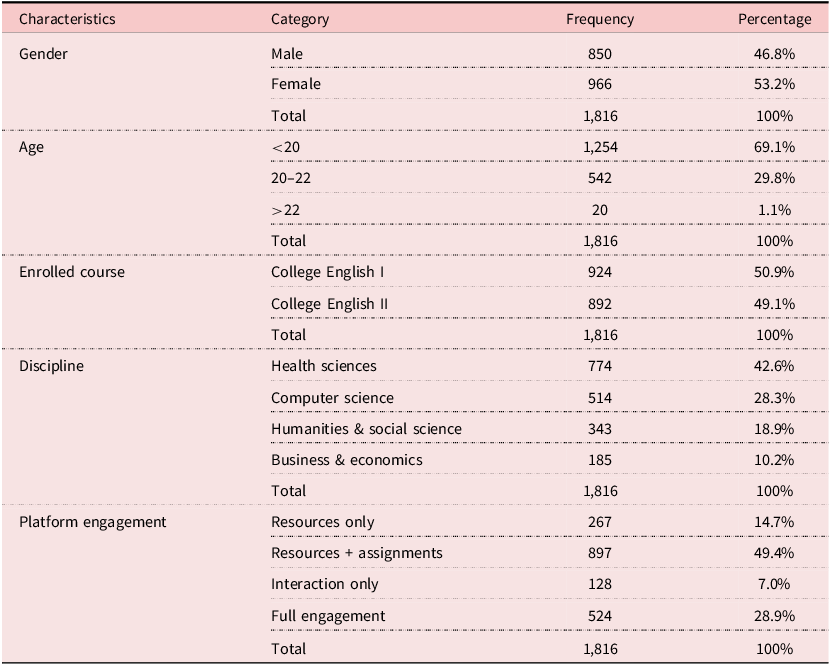
A total of 1,816 valid responses were obtained from undergraduate students across four academic divisions: health sciences, computer science, humanities and social sciences, and business and economics. The online survey was distributed via U-Campus with instructor support. Participant demographics ensured broad representation across multiple dimensions, as shown in Table 2.
Demographic profile of participants (N = 1,816)

This participant profile demonstrates balanced gender representation, concentration among traditional university age groups, even distribution across course levels, diverse disciplinary backgrounds, and varied engagement patterns with the blended learning platforms. The sample composition ensures sufficient statistical power for structural equation modeling (Kline, Reference Kline2016) and enhances generalizability within the target institutional context.
3.2. Instrument
The instrument was adapted from Al-Fraihat et al.’s (Reference Al-Fraihat, Joy, Masa’deh and Sinclair2020) multidimensional framework, modified to incorporate cultural moderators specific to Chinese tertiary education: hierarchical instructor–student dynamics, collective learning orientation, and examination-driven motivation. The quantitative survey consisted of 58 items measuring 11 latent constructs: technical system quality, information quality, service quality, educational system quality, support system quality, learner quality, instructor quality, perceived satisfaction, perceived usefulness, system use, and perceived learning benefits. All items were measured on 5-point Likert scales (1 = strongly disagree to 5 = strongly agree).
The Chinese version underwent back-translation procedures to ensure linguistic equivalence (Brislin, Reference Brislin, Lonner and Berry1986). Content validity was assessed by seven experts, including three educational technology specialists, two College English instructors, and two information systems researchers. A pilot test with 120 students confirmed the internal consistency of all scales (Cronbach’s α > .80). Construct refinement followed item-total correlations and exploratory factor analysis before full deployment. The complete list of measurement items for all 11 constructs in the CR-BLS model is provided in Appendix A (see supplementary material for all appendices referred to in text).
3.3. Data collection procedures
The finalized questionnaire was embedded into the U-Campus platform and disseminated during regular class sessions with instructor facilitation. Students were assured of anonymity and voluntary participation. From an initial pool of 1,952 respondents (85% response rate), 1,816 valid cases were retained after filtering out incomplete or patterned responses.
3.4. Data analysis strategy
This study applied PLS-SEM using SmartPLS 4 software (Ringle et al., Reference Ringle, Wende and Becker2024). PLS-SEM was particularly appropriate given the complexity of the proposed CR-BLS model, comprising 11 latent constructs measured by 58 indicators with three cultural moderating variables, resulting in a framework examining both direct and indirect relationships totaling 36 hypothesized paths.
Following best practices for reflective measurement models (Hair et al., Reference Hair, Risher, Sarstedt and Ringle2019), the analysis proceeded in two stages:
Stage 1: Measurement model evaluation included reliability assessment using Cronbach’s α, composite reliability (CR), and Dijkstra–Henseler’s rho_A; convergent validity evaluation through average variance extracted (AVE) and standardized item loadings; and discriminant validity assessment using heterotrait–monotrait ratios (HTMT) with 10,000 bootstrap samples and cross-loadings examination.
Stage 2: Structural model evaluation encompassed path coefficient significance testing through bootstrapping with 5,000 samples; predictive relevance assessment using R2 coefficients and Q² values via PLSpredict procedures; and effect size evaluation using Cohen’s f² and model fit assessment through standardized root-mean-square residual (SRMR) indicators.
Interaction terms were computed to test moderation effects of the three cultural variables using orthogonalized two-stage procedures to ensure accurate estimation of moderating influences within Chinese educational contexts. Multicollinearity was assessed using variance inflation factor (VIF) thresholds below 5.0 to ensure model stability. The cross-sectional design positions this study as Phase 1 of a longitudinal research program, with future plans for follow-up interviews and cross-institutional validation to enhance generalizability and methodological triangulation.
4. Results
Following the two-stage PLS-SEM approach detailed in Section 3.4, the analysis proceeded with measurement model assessment followed by structural model evaluation. Results demonstrate strong psychometric properties for the CR-BLS model and provide substantial support for the hypothesized relationships within the Chinese College English education context.
4.1. Measurement model assessment
To ensure the psychometric robustness of the measurement model within the CR-BLS framework, a rigorous evaluation of indicator reliability, internal consistency, and construct validity was conducted following established PLS-SEM guidelines (Hair et al., Reference Hair, Risher, Sarstedt and Ringle2019; Henseler et al., Reference Henseler, Ringle and Sarstedt2015). A summary of all measurement model assessment results is provided in Appendix C.
4.1.1. Reliability and convergent validity
Item reliability was assessed by examining outer loadings. Indicators with loadings below 0.70 were scrutinized according to Hair et al.’s (Reference Hair, Hult, Ringle and Sarstedt2022) three-tiered criteria: items with loadings below 0.40 were removed; items above 0.70 were retained; and items between 0.40 and 0.70 were retained only if their inclusion improved construct reliability or AVE. Seven items that failed to meet minimum reliability criteria were eliminated, primarily those pertaining to system availability, personalization, and ease of navigation under Technical System Quality, along with two under the Benefits construct.
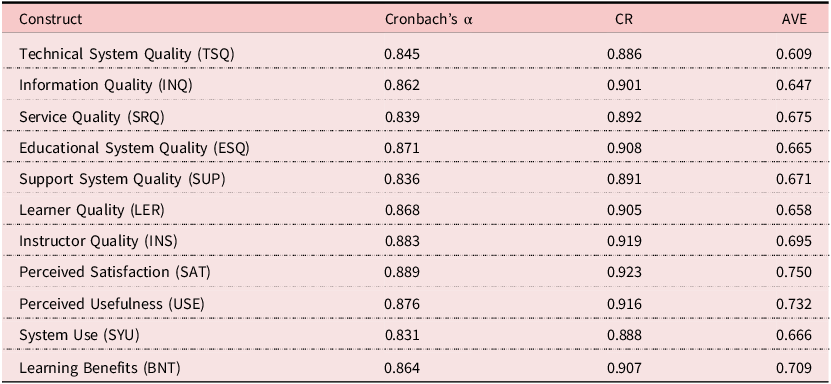
Internal consistency was assessed using Cronbach’s α and CR. As shown in Table 3, all constructs demonstrated acceptable reliability, with values exceeding the threshold of 0.70 (Hair et al., Reference Hair, Risher, Sarstedt and Ringle2019), indicating that the indicators consistently measured their respective latent variables. Convergent validity was evaluated by calculating the AVE for each construct. All AVE values exceeded the recommended benchmark of 0.50, confirming that each latent construct explained more than 50% of the variance in its observed indicators (Fornell & Larcker, Reference Fornell and Larcker1981).
Construct reliability and validity metrics

Note. CR = composite reliability; AVE = average variance extracted.
4.1.2. Discriminant validity
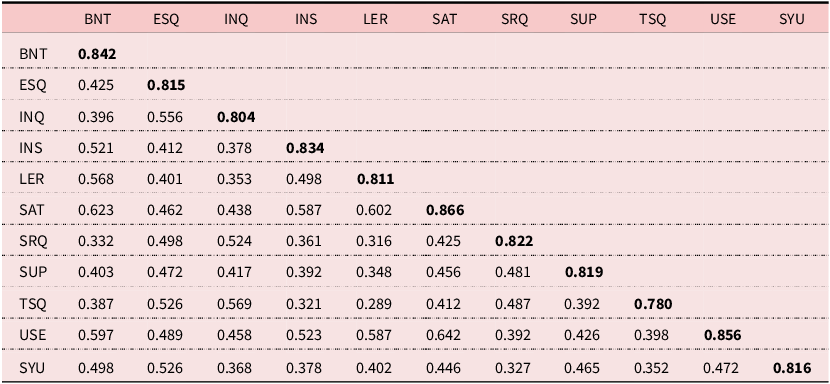
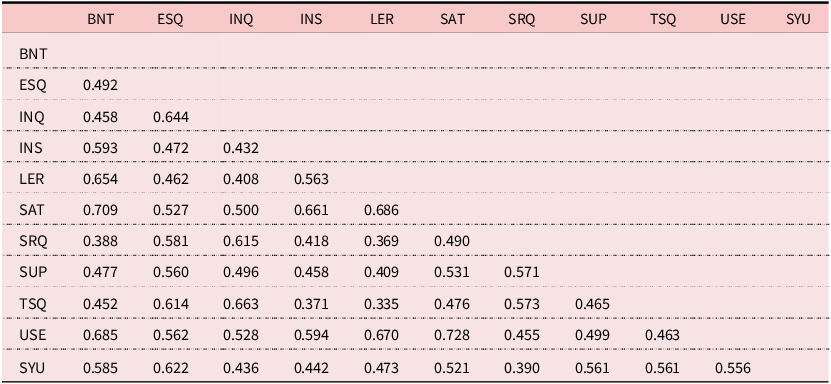
Discriminant validity was assessed using three complementary approaches. First, the Fornell–Larcker criterion confirmed that the square root of each construct’s AVE (diagonal values shown in boldface in Table 4) exceeded its correlations with all other constructs, indicating acceptable discriminant validity (Fornell & Larcker, Reference Fornell and Larcker1981). Second, all HTMT values remained below the conservative threshold of 0.85 (see Table 5), further confirming discriminant validity (Henseler et al., Reference Henseler, Ringle and Sarstedt2015). Third, cross-loadings analysis confirmed that each item’s loading on its assigned construct exceeded its loadings on other constructs. The complete cross-loadings matrix demonstrating discriminant validity for all measurement items is presented in Appendix B.
Fornell–Larcker discriminant validity assessment

Note. BNT = Learning Benefits; ESQ = Educational System Quality; INQ = Information Quality; INS = Instructor Quality; LER = Learner Quality; SAT = Perceived Satisfaction; SRQ = Service Quality; SUP = Support System Quality; TSQ = Technical System Quality; USE = Perceived Usefulness; SYU = System Use.
Heterotrait–monotrait ratio (HTMT) results

Note. BNT = Learning Benefits; ESQ = Educational System Quality; INQ = Information Quality; INS = Instructor Quality; LER = Learner Quality; SAT = Perceived Satisfaction; SRQ = Service Quality; SUP = Support System Quality; TSQ = Technical System Quality; USE = Perceived Usefulness; SYU = System Use.
4.2. Structural model assessment and hypothesis testing
To test the hypothesized relationships within the CR-BLS model, the structural model was evaluated through a multi-step process in accordance with best practices for PLS-SEM (Hair et al., Reference Hair, Risher, Sarstedt and Ringle2019). The evaluation included collinearity diagnostics, path coefficient estimation, explained variance (R²), predictive relevance (Q²), and global model fit assessment.
4.2.1. Collinearity diagnostics
VIF values were first examined to ensure the absence of multicollinearity among predictor constructs. All VIF values ranged between 1.32 and 3.18, remaining well below the recommended threshold of 5.0, suggesting that collinearity was not a concern in this model (Hair et al., Reference Hair, Risher, Sarstedt and Ringle2019).
4.2.2. Hypothesis testing and path coefficients
Figure 3 visualizes the structural model of the CR-BLS framework, displaying the standardized path coefficients (β values) among the seven quality factors (TSQ, INQ, SRQ, ESQ, SUP, LER, INS), three mediating variables (perceived satisfaction, perceived usefulness, system use), and the outcome construct (perceived learning benefits). The model exhibits substantial explanatory power across all endogenous constructs, with coefficient of determination (R²) values of 0.714 for perceived satisfaction (SAT), 0.542 for perceived usefulness (USE), 0.341 for system use (SYU), and 0.647 for perceived learning benefits (BNT).
The path coefficients of the proposed structural model.

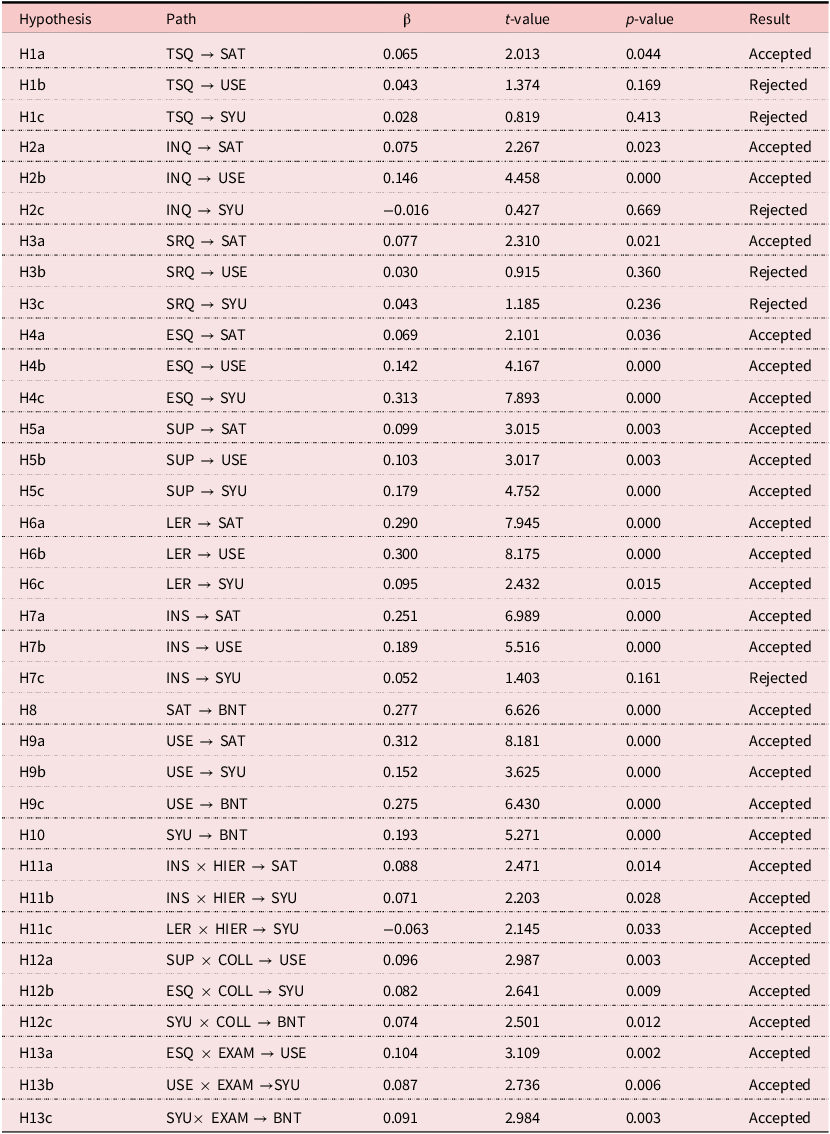
Bootstrapping with 5,000 samples tested hypothesized paths (Table 6). Among system quality factors, Technical System Quality influenced only satisfaction (H1a), while Information and Service Quality showed limited effects beyond satisfaction (H2a, H3a). Educational and Support System Quality demonstrated broad influence across all mediating variables (H4a–H4c, H5a–H5c). Human factors – Learner and Instructor Quality – strongly predicted satisfaction and usefulness (H6a–H6b, H7a–H7b), though only Learner Quality affected system use (H6c). Mediating relationships confirmed that satisfaction, usefulness, and system use predicted learning benefits (H8–H10). Cultural moderators significantly influenced multiple pathways: hierarchical relationships moderated instructor–learner effects (H11a–H11c), collective orientation enhanced support and educational system impacts (H12–H12c), and examination-driven motivation amplified educational system-usefulness-use-benefits relationships (H13a–H13c).
Path coefficients and hypothesis testing results

Note. TSQ = Technical System Quality; SAT = Perceived Satisfaction; USE = Perceived Usefulness; SYU = System Use; INQ = Information Quality; SRQ = Service Quality; ESQ = Educational System Quality; SUP = Support System Quality; LER = Learner Quality; INS = Instructor Quality; BNT = Learning Benefits; HIER = hierarchical instructor–student relationships; COLL = collective learning orientation; EXAM = examination-driven motivation.
4.2.3. Explained variance and predictive relevance
The coefficient of determination (R²) results demonstrated substantial explanatory power across key endogenous constructs. The quality factors explained 71.4% of the variance in perceived satisfaction, 54.2% in perceived usefulness, and 34.1% in system use. Perceived usefulness, satisfaction, and system use collectively accounted for 64.7% of the variance in perceived learning benefits, indicating substantial predictive power in the Chinese College English education context.
Stone–Geisser’s Q² values were calculated using blindfolding procedures with an omission distance of 7. All Q² values exceeded zero, confirming the model’s predictive relevance. Specifically, the model demonstrated strong predictive relevance for satisfaction (Q² = 0.52), usefulness (Q² = 0.39), and benefits (Q² = 0.42), with moderate predictive relevance for system use (Q² = 0.25).
4.2.4 Model fit assessment
Global model fit was evaluated using multiple criteria. The SRMR value of 0.070 fell below the recommended threshold of 0.08, indicating acceptable model fit. The model’s goodness-of-fit (GoF) value of 0.49 exceeded the large effect size threshold of 0.36, demonstrating substantial overall model performance (Wetzels et al., Reference Wetzels, Odekerken-Schröder and van Oppen2009).
4.3. Model performance and cultural moderation effects
Stone–Geisser’s Q² values confirmed the model’s predictive relevance, with all values exceeding zero. The model demonstrated strong predictive relevance for satisfaction (Q² = 0.52), usefulness (Q² = 0.39), and benefits (Q² = 0.42), with moderate predictive relevance for system use (Q² = 0.25). Global model fit assessment revealed an SRMR value of 0.070, below the recommended threshold of 0.08, and a GoF value of 0.49, exceeding the large effect size threshold of 0.36 (Wetzels et al., Reference Wetzels, Odekerken-Schröder and van Oppen2009).
The distinctive contribution of the CR-BLS model lies in its systematic examination of cultural moderators. Results revealed significant moderation effects across all three cultural dimensions, supporting the theoretical premise that cultural factors substantially influence blended learning system effectiveness in collectivist educational environments.
Hierarchical instructor–student relationships significantly strengthened the positive effects of instructor quality on satisfaction (β = 0.088, p = 0.014) and system use (β = 0.071, p = 0.028), while moderating the relationship between learner quality and system use (β = −0.063, p = 0.033). This pattern reflects the authority-oriented nature of Chinese educational culture. Collective learning orientation demonstrated significant positive moderation effects, strengthening support system quality’s influence on usefulness (β = 0.096, p = 0.003), educational system quality’s effect on system use (β = 0.082, p =0.009), and the pathway from system use to benefits (β = 0.074, p = 0.012). Examination-driven motivation significantly amplified the relationships between educational system quality and usefulness (β = 0.104, p = 0.002), usefulness and system use (β = 0.087, p = 0.006), and system use and benefits (β = 0.091, p = 0.003).
5. Discussion
5.1. RQ1: Factors significantly influencing blended learning system success
The investigation revealed human factors as the most influential determinants, with learner quality demonstrating the strongest effects on perceived satisfaction (β = 0.290, p < 0.001), perceived usefulness (β = 0.300, p < 0.001), and system use (β = 0.095, p < 0.05). This finding aligns with research by Sun et al. (Reference Sun, Tsai, Finger, Chen and Yeh2008), Kim and Park (Reference Kim and Park2018), and Kim et al. (Reference Kim, Lee, Yoon and Kim2023), who emphasized learner-related factors in e-learning success, and supports Wang et al.’s (Reference Wang, Qiu, Wang, Jiang and Ran2024) findings regarding student readiness importance in Chinese educational contexts where students transition from teacher-centered secondary education to autonomous university learning.
However, these results contrast sharply with technology-focused studies prioritizing system characteristics over human factors. While Aparicio et al. (Reference Aparicio, Bacao and Oliveira2017) and Mtebe and Raphael (Reference Mtebe and Raphael2018) found technical system quality as a primary determinant, our findings revealed limited effects of technical system quality on outcome variables, suggesting that in language learning contexts within collectivist educational environments, human readiness and interpersonal factors may override technical considerations in determining system effectiveness.
Instructor quality demonstrated substantial influence on perceived satisfaction (β = 0.251, p < 0.001) and perceived usefulness (β = 0.189, p < 0.001), though notably not on system use. This pattern diverges from Cidral et al.’s (Reference Cidral, Oliveira, Di Felice and Aparicio2018) findings, where instructor quality affected all outcome dimensions uniformly, suggesting that in Chinese educational contexts, actual usage behaviors may be more constrained by institutional requirements and course structures rather than instructor endorsement.
Among system-related factors, support system quality influenced all three mediating variables, while educational system quality strongly predicted system use (β = 0.313, p < 0.001). Information quality showed selective effects, influencing satisfaction and usefulness but not system use, partially contradicting Al-Fraihat et al.’s (Reference Al-Fraihat, Joy, Masa’deh and Sinclair2020) original framework assumptions about uniform influence patterns. The limited effects of service quality challenge previous studies by Alam and Mezbah-ul-Islam (Reference Alam and Mezbah-ul-Islam2023) that positioned service responsiveness as a primary success factor, suggesting that in institutional learning environments, service quality may be less critical than in commercial e-learning contexts.
5.2. RQ2: Factor interactions affecting satisfaction, usefulness, and system use
The model demonstrated strong explanatory power, accounting for 71.4% of variance in perceived satisfaction, 54.2% in perceived usefulness, and 34.1% in system use. The differential patterns revealed a dual-pathway model where human factors predominantly influenced perceptual outcomes, while system factors more strongly affected behavioral outcomes, challenging simplified models that assume uniform effects across outcome variables and diverging from studies by Alkhawaja et al. (Reference Alkhawaja, Halim, Abumandil and Al-Adwan2022) that proposed direct relationships between all quality factors and usage behaviors.
Perceived usefulness emerged as a central mediating construct, demonstrating strong effects on both satisfaction (β = 0.312, p < 0.001) and system use (β = 0.152, p < 0.001). While supporting TAM (Davis, Reference Davis1989) and research by Al-Sabawy et al. (Reference Alsabawy, Cater-Steel and Soar2013), the relatively modest effect of perceived usefulness on system use compared to previous TAM studies suggests that in Chinese educational environments, institutional mandates and cultural expectations may constrain the traditional utility–usage relationship, challenging assumptions about voluntary technology adoption models in educational settings.
The lack of significant relationships between several quality dimensions and system use contradicts findings by Widiastuti et al. (Reference Widiastuti, Haryono and Said2019) and Alsabawy et al. (Reference Alsabawy, Cater-Steel and Soar2016), who reported direct effects from technical and information quality to usage behaviors, indicating that in mandatory educational technology contexts within collectivist cultures, usage patterns may be less responsive to quality perceptions than previously assumed.
5.3. RQ3: Mediating variables’ contributions to learning benefits and cultural moderation
All three mediating variables – perceived satisfaction (β = 0.277, p < 0.001), perceived usefulness (β = 0.275, p < 0.001), and system use (β = 0.193, p < 0.001) – significantly predicted learning benefits, collectively explaining 64.7% of the variance. This high explanatory power supports previous studies by Aparicio et al. (Reference Aparicio, Bacao and Oliveira2017), Ancheta and Bocar (Reference Ancheta and Bocar2024), and Cidral et al. (Reference Cidral, Oliveira, Di Felice and Aparicio2018), confirming that learning outcomes emerge through the combined influence of perceptual and behavioral factors. However, the nearly equal contributions of satisfaction and usefulness challenge TAM’s emphasis on perceived usefulness as the primary predictor, suggesting that in language learning contexts, affective responses may carry equal weight to utilitarian evaluations.
The cultural moderation analyses revealed the CR-BLS model’s distinctive contribution. Hierarchical instructor–student relationships significantly moderated multiple pathways, strengthening instructor quality’s influence on satisfaction and system use while weakening learner quality’s effect on usage, reflecting the authority-oriented nature of Chinese education where instructor endorsement can override individual learner characteristics, contradicting Western educational technology research emphasizing learner autonomy and self-directed learning (Luo & Ye, Reference Luo and Ye2021; Zhao et al., Reference Zhao, Blankinship, Duan, Huang, Sun and Bak2020).
Collective learning orientation strengthened relationships between support system quality and usefulness, educational system quality and system use, and system use and learning benefits. While aligning with Zhou and Zhang’s (Reference Zhou and Zhang2022) proposition that collaborative features enhance language learning outcomes, these effects challenge individualistic technology adoption models, suggesting fundamental differences in how collectivist cultures derive value from educational technology.
Examination-driven motivation demonstrated pervasive moderation effects, amplifying relationships between educational system quality and usefulness, usefulness and system use, and system use and learning benefits. This pattern reveals how assessment pressures shape technology evaluation and engagement in Chinese contexts, where students value blended learning systems primarily for examination performance. These findings challenge educational technology research advocating for intrinsic motivation and autonomous learning goals as optimal drivers of technology engagement (Gu, Reference Gu2022; Wang, Reference Wang2023), suggesting that in assessment-centered educational cultures, external motivation may be more effective than intrinsic motivation for promoting technology adoption and learning outcomes.
5.4. Theoretical and practical implications
The study makes significant theoretical contributions through developing and empirically validating the CR-BLS model, extending Al-Fraihat et al.’s (Reference Al-Fraihat, Joy, Masa’deh and Sinclair2020) multidimensional e-learning systems success framework while addressing critical limitations in cultural adaptability. The research reveals a hierarchical influence pattern where human factors predominantly affect satisfaction and usefulness, while system factors more strongly influence behavioral engagement, extending technology acceptance theories by demonstrating that affective and cognitive evaluations operate through distinct pathways from behavioral outcomes.
The most significant theoretical contribution lies in systematically integrating cultural moderators within educational technology evaluation frameworks. The three cultural dimensions demonstrated significant moderation effects across multiple pathways, confirming that technology effectiveness is culturally constructed rather than universally determined, addressing Naveed et al.’s (Reference Naveed, Alam and Tairan2020) call for cultural validation of educational technology models and extending Gay’s (Reference Gay2018) culturally responsive pedagogy framework into digital learning environments.
For practical implementation, the findings provide evidence-based guidance for stakeholders implementing blended learning systems in collectivist educational environments. Educational administrators should prioritize faculty development and student readiness initiatives alongside technological infrastructure development. The significant role of instructor quality indicates that comprehensive faculty preparation programs addressing both technological competencies and cultural sensitivity are essential, building on Park and Son’s (Reference Park and Son2022) emphasis on readiness preparation for language educators. The examination-driven motivation moderator’s effects indicate instructors should explicitly connect blended learning activities to assessment outcomes and career development goals, recognizing utilitarian motivations prevalent in examination-oriented educational systems, as Li and Yoon (Reference Li and Yoon2025) support by demonstrating that successful blended learning implementation requires careful consideration of contextual cultural factors rather than universal approaches.
6. Conclusion
This study developed and validated the CR-BLS model, advancing understanding of how cultural factors shape educational technology effectiveness in collectivist environments. The model successfully integrated seven quality dimensions with three cultural moderators, demonstrating robust explanatory power in Chinese College English education contexts.
Major findings reveal that human factors, particularly learner quality and instructor quality, emerged as primary determinants of blended learning success, highlighting the continued centrality of human elements in technology-enhanced education. The systematic cultural moderation effects across hierarchical instructor–student relationships, collective learning orientation, and examination-driven motivation provide empirical evidence that educational technology effectiveness is culturally constructed rather than universally determined, challenging prevailing assumptions about the universal applicability of evaluation frameworks. The CR-BLS model’s substantial explanatory power – accounting for 64.7% of variance in learning benefits – validates that blended learning success requires multidimensional evaluation incorporating technological, pedagogical, and cultural factors simultaneously.
Several limitations warrant acknowledgment. First, the cross-sectional research design precludes definitive causal inferences, as data were collected at a single time point. While the theoretical framework and bootstrapping procedures provide robust support for the proposed relationships, longitudinal investigations would strengthen claims about causal effects. Second, data collection from a single institution in southwestern China constrains generalizability to other institutional contexts and geographic regions. The participating university’s specific characteristics may not fully represent the diversity of Chinese higher education contexts. Third, reliance on self-reported questionnaire data introduces potential response bias and common method variance, despite statistical remedies applied during analysis.
Future research should extend this framework through multi-institutional and cross-cultural comparative studies to test the model’s transferability and identify culturally specific versus universal determinants. Longitudinal investigations tracking students throughout their blended learning experiences would enable examination of temporal dynamics and causal relationships among constructs. Additionally, qualitative inquiry exploring lived experiences would deepen understanding of how cultural factors manifest in actual learning practices and technology adoption behaviors.
The CR-BLS model offers institutions in collectivist educational environments an empirically validated approach to assess and optimize blended learning implementations, providing both theoretical advancement and practical guidance for developing culturally responsive technology-enhanced learning environments. As educational institutions worldwide continue expanding blended learning adoption, this culturally grounded evaluation framework contributes essential knowledge for designing systems that are both technologically sophisticated and culturally aligned with learner needs and institutional contexts.
Supplementary material
To view supplementary material for this article, please visit https://doi.org/10.1017/S0958344026100500.
Data availability statement
The data that support the findings of this study are available within the supplementary material and also via https://drive.google.com/drive/folders/1nvf4WnGyK1eDxeeNBps7vRRl_b5EZrhb
Authorship contribution statement
Mengjia Liu: Conceptualization, Investigation, Methodology, Data curation, Formal analysis, Writing – original draft, Writing – review & editing; Harwati Hashim: Project administration, Validation, Writing – review & editing, Supervision; Nur Ainil Sulaiman: Data verification, Writing – review & editing, Supervision.
Funding disclosure statement
This research was supported by the Faculty of Education, Universiti Kebangsaan Malaysia, under research grant NO. GG-2024-073.
Competing interests statement
The authors declare no competing interests.
Ethical statement
Ethical approval was not required.
GenAI use disclosure statement
The authors declare no use of generative AI.
About the authors
Mengjia Liu is currently a PhD candidate in TESL at the Faculty of Education, Universiti Kebangsaan Malaysia. She holds an MA in applied linguistics and TESOL (Newcastle University, UK) and served as a university lecturer in China. Her research focuses on TESOL, English speaking, corpus linguistics, and educational technologies.
Harwati Hashim, PhD, is an associate professor at the Centre for Innovation in Teaching and Learning, Faculty of Education, Universiti Kebangsaan Malaysia. Her areas of concentration are mobile learning, mobile-assisted language learning (MALL), innovative pedagogy, and technology in teaching and learning English as a second language (ESL).
Nur Ainil Sulaiman, PhD, is a lecturer at the Faculty of Education, Universiti Kebangsaan Malaysia. Her research and teaching expertise includes second language acquisition, vocabulary development, and sociolinguistics within the broader domain of arts and applied arts education.






 Open access

