


Maternal diet during pregnancy is an important environmental factor influencing the growth and development of the fetus(Reference Koblinsky1, Reference Barker2). Recently, nutrition during gestation has also been postulated as an epigenetic contributor to health in adulthood, influencing bone health and weight status(Reference Yin, Dwyer and Riley3–Reference Metges5). Despite the demonstrated effects of proper diet on the health of both the mother and the offspring, not all pregnant women appear to comply with the nutritional guidelines. In Denmark, two major dietary patterns have been identified in childbearing women, the health-conscious one – consisting of vegetables, fruit, poultry and fish – and the Westernised one – consisting mainly of red and processed meat and high-fat dairy intake(Reference Knudsen, Orozova-Bekkevold and Mikkelsen6). In Poland, pregnant women tend to decrease the intake of fruit and increase the consumption of crops, vegetables and meat products(Reference Bojar, Wdowiak and Humeniuk7). Research in Spain demonstrated that fruit intake is significantly reduced in the third trimester of gestation(Reference Ramón, Ballester and Iňiguez8) and that childbearing women exhibit low diet quality, with inadequate iron and folate consumption(Reference Ortiz-Andrellucchi, Sánchez-Villegas and Ramírez-García9). However, according to a recent follow-up study in Portugal(Reference Pinto, Barros and dos Santos Silva10), these inadequate intakes are the continuation of an unhealthy diet followed during the pre-conceptional period. A three-site European research demonstrated that only 7 % of childbearing women achieve the dietary reference intake (DRI) for folate(Reference Franke, Verwied-Jorky and Campoy11). A large body of evidence pinpoints the need for nutritional counselling during pregnancy. However, a dietary intake record must precede to ensure effective nutritional counselling in a population.
Laraia et al.(Reference Laraia, Bodnar and Siega-Riz12) were the first to demonstrate that pre-gravid weight status affects diet quality during pregnancy and, more recently, research has associated gestational weight status with diet quality(Reference Rifas-Shiman, Rich-Edwards and Kleinman13). In Iceland, excessive weight gain during pregnancy was associated with eating more and drinking more milk(Reference Olafsdottir, Skuladottir and Thorsdottir14). With respect to the weight status before conception, it has been shown that women who were pre-conceptionally overweight have more chances (seven-fold) of gaining excessive weight during pregnancy(Reference Olafsdottir, Skuladottir and Thorsdottir14).
The present cross-sectional study aimed to assess diet quality in relation to pre-gravid and gravid weight status, and delineate some of the sociodemographic parameters affecting diet quality during gestation.
Experimental methods
Sample recruitment
One hundred adult pregnant women (age range: 18–42 years) were recruited randomly from private clinics in Athens, Greece, during December 2007–June 2008. On Tuesdays and Wednesdays, different private clinics were visited by the research team in rotation and all pregnant women who had scheduled appointments on those days were used for sample recruitment. The majority of the sample were free-living women of Greek origin (95 %) and a small proportion were gypsies (5 %). The participants were not diagnosed with any disorder that affects body weight (BW) and/or appetite; neither did they follow any specific dietary programme. The study protocol was approved by the Alexander Technological Educational Institute. Sample demographics are presented in Table 1.
Demographics

*In twelve pregnancies, the child’s sex was not yet known.
Weight status
BW and height before pregnancy were recorded and weight and height during the time of study were measured with a Seca weighing scale with an attached stadiometer (Seca 789; Seca, Hamburg, Germany). Pre-pregnancy BMI categorised the participants as underweight (BMI < 18·5 kg/m2), of normal BW (18·5 ≤ BMI < 24·99 kg/m2), overweight (25 ≤ BMI < 29·99 kg/m2) or obese (BMI > 30·00 kg/m2). During pregnancy, weight status was identified according to the Mardones and Rosso(Reference Mardones and Rosso15) weight gain chart for pregnancy and the participants were divided in the same categories.
Dietary intake
Dietary intake was recorded for three consecutive days with three 24 h previous-day dietary recalls. The first day’s dietary recall was collected at the patient’s visit to the private clinic and the next 2 d were collected through telephone interviews. All interviews were conducted by the same experienced dietitian. The Healthy Eating Index (HEI)(Reference Guenther, Reedy and Krebs-Smith16) was calculated from median intake of each participant. The consumption of twelve food groups/nutrients was used to calculate HEI, each providing 5, 10 or 20 points to the total score: total fruit (including juices; 5 points), whole fruit (5 points), total vegetables (5 points), dark green and orange vegetables and legumes (5 points), total grains (5 points), whole grains (5 points), milk (10 points), meat and beans (10 points), oils (10 points), saturated fat (10 points), sodium (10 points) and energy from solid fats, alcohol and added sugar (SOFAAS; 20 points). HEI score above 80 was considered adequate (high), between 60 and 79·99 average and below 60 low. Intake of certain micronutrients was compared with the DRI(17).
Statistical analyses
Two statistical software packages were used for data analysis, SPSS for Windows version 15·0 (SPSS Inc., Chicago, IL, USA) and MiniTab® 14·0 (MiniTab Inc., State College, PA, USA). Linear regression was used to adjust HEI for the energy intake of participants and the adjusted values were used for statistical analyses. HEI score (as a continuous exposure) and intake of food servings and nutrients between each weight status category were compared with ANOVA and Bonferroni post hoc tests. Pearson’s correlation coefficient was used to evaluate the cross-correlates of HEI and demographic characteristics. The CI were set at 95 % and P values <0·05 were considered significant.
Changes in the weight status of each participant were assessed by Wilcoxon’s rank test. In order to reveal the relationships among the HEI categories and several population characteristics (categorical exposures), we used multivariate statistical techniques. Simple correspondence analysis (SCA) was conducted in MiniTab between HEI score categories and demographic characteristics (gravidity, weight status before pregnancy, weight status during pregnancy and place of residence, education, income and age categories) of the sample in order to associate several parameters with the HEI score.
Logistic regression was also performed between HEI categories and the studied parameters, in order to assess the factors affecting HEI quantitatively. Since HEI has three categories, two models were used: one with high HEI against adequate and low HEI and a second with low HEI against adequate and high HEI. Odds ratios were calculated from the frequency of distribution in each HEI category.
Results
The mean raw HEI score of the sample was 66·9 (sd 7·6) and the mean HEI adjusted to the energy intake of the participants was 66·9 (sd 0·6). No difference was recorded between the adjusted HEI and different gravidities, the embryo’s sex, different income categories or education. When HEI was categorised as low, average and high, living in urban residence increased the odds for demonstrating low HEI score (OR = 10·231, 95 % CI 1·300, 80·487).
HEI score and intake of Food Guide Pyramid servings and nutrients according to the participants’ pre-conceptional weight status are presented in Table 2. HEI score during pregnancy was significantly higher in participants who were either pre-gravidly underweight or of normal BW, in comparison with the overweight ones (P ≤ 0·035 and P ≤ 0·008, respectively). Participants who were underweight before pregnancy showed lower total fruit intake compared with the obese participants (P ≤ 0·036). In addition, the pre-gestationally underweight participants consumed significantly lesser SOFAAS than the rest of the sample (P ≤ 0·001 for all weight categories). Underweight and normal BW women showed higher protein intake (g/kg BW) compared with the obese (P ≤ 0·001). The highest trans fats intake was recorded by overweight women (P ≤ 0·016 compared with the underweight and P ≤ 0·001 compared with the participants with normal BW).
HEI score, intake of Food Guide Pyramid servings and nutrient intake during pregnancy, according to pre-gestational weight status

BW, body weight; HEI, Healthy Eating Index; log, logarithmically transformed; SOFAAS, solid fats, alcohol and added sugar; EI, energy intake; EE, energy expenditure; DRI, dietary reference intake.
Mean value was significantly different from that of participants of normal BW: **P ≤ 0·01; ***P ≤ 0·001.
Mean value was significantly different from that of overweight participants: †P ≤ 0·05; ††P ≤ 0·01; †††P ≤ 0·001.
Mean value was significantly different from that of obese participants: ‡P ≤ 0·05; ‡‡‡P ≤ 0·001.
HEI components and nutrient intake according to the gestational weight status are presented in Table 3. Highest HEI scores and protein intake (g/kg BW) were shown in the underweight and normal BW pregnant women compared with the obese women (P ≤ 0·040 and P ≤ 0·036 for HEI score and P ≤ 0·001 and P ≤ 0·002 for protein intake), but the latter reported consuming more energy (P ≤ 0·003 and P ≤ 0·012). Consumption of meat and trans fats was lower by the women who were obese during pregnancy compared with the women of normal BW (P ≤ 0·003 and P ≤ 0·013).
HEI score, intake of Food Guide Pyramid servings and nutrient intake during pregnancy, according to gestational weight status

BW, body weight; HEI, Healthy Eating Index; log, logarithmically transformed; SOFAAS, solid fats, alcohol and added sugar; EI, energy intake; EE, energy expenditure; DRI, dietary reference intake.
Mean value was significantly different from that of obese participants: *P ≤ 0·05; **P ≤ 0·01; ***P ≤ 0·001.
Changes in weight status before and during pregnancy are presented in Table 4. Pregnancy nearly tripled the prevalence of underweight (300 %) and obesity (272·7 %) and decreased the number of participants who had normal BW (56·5 %) or were overweight (57·9 %). All women who were underweight before pregnancy (n 8) either remained underweight (n 7) or achieved normal BW (n 1) during gestation. A great majority of the women who were within the normal BMI range before conception (n 62) managed to remain in the same weight category during pregnancy (n 34), whereas some became underweight (n 17) and a few became overweight (n 8) and obese (n 3). The majority of pre-gravidly overweight women became obese during pregnancy (n 16) and a small proportion remained overweight (n 3). All participants who entered pregnancy being obese (n 11) remained obese during gestation as well.
Changes in weight status before and during pregnancy (n and %; n 100)
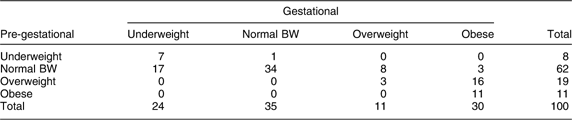
BW, body weight.
P ≤ 0·056 according to the Wilcoxon signed-rank test.
According to the interpretation of the SCA symmetric plot (Fig. 1), three general classifications emerge. The first dimension that displays 79·9 % of the total inertia separates adequate from low HEI, with average HEI in-between. The class located in the left of the plot associated adequate HEI with rural residence and being underweight or having normal BW during pregnancy. In contrast, low HEI that is located in the right of the plot was associated with overweight and obesity during pregnancy, with obesity before pregnancy and living in an urban environment. Average HEI lies near the origin, indicating a close correspondence between average HEI and the average profile of the parameters included in the present study.
Simple correspondence analysis symmetric plot showing relationships between Healthy Eating Index (HEI) score and sample demographics. The first and second dimension display 79·9% and 20·1% of the total inertia, respectively. Dotted lines represent approximate classification

Logistic regression revealed that living in a metropolitan area increased the chances of showing low HEI (β = 2·905, P ≤ 0·026). Weight status before or after conception did not appear to affect maternal HEI according to regression analysis.
HEI was negatively correlated with pre-gestational and gestational BMI (r = −0·298, P ≤ 0·003 and r = −0·345, P ≤ 0·001) and week of gestation (r = −0·285, P ≤ 0·004). Protein consumption as a percentage of energy intake was also correlated to HEI (r = 0·306, P ≤ 0·002). Among the micronutrients that were examined, HEI showed a weak correlation with folate and iron intake (r = 0·222, P ≤ 0·026 and r = 0·205, P ≤ 0·041, respectively) and stronger correlations with vitamin B3 and B6 (r = 0·430, r = 0·383 and P ≤ 0·001 for both). Only 9 % of the participating women achieved the DRI for folate, whereas iron needs were met by 6 % of the sample.
Discussion
Healthy dietary choices during pregnancy appear to be affected by pre-conceptional and gestational weight status, as well as by place of residence. Education, income, gravidity and age did not appear to contribute to the HEI. Women who were either underweight or of normal BW before conception showed higher gestational HEI compared with overweight women. When gestational weight status was accounted for, the greatest HEI scores were achieved by underweight and normal BW pregnant women.
The SCA plot defined three major classifications, classifying adequate (high), average and low HEI. Adequate gestational HEI was associated with living in rural residence and being either underweight or of normal BW during pregnancy. Average gestational HEI was associated with being underweight, of normal BW or overweight before pregnancy. Low gestational HEI was associated with living in urban residence, being obese/overweight during pregnancy and being obese before conception. In our sample, urban residence was also associated with low HEI quality through logistic regression and OR. Ferrer et al.(Reference Ferrer, García-Esteban and Mendez18) postulated that healthier diets are observed in childbearing women of rural residence. This finding has also been shown in Poland(Reference Bojar, Wdowiak and Humeniuk7) and is confirmed by the present study as increased OR for exhibiting low HEI were exhibited by childbearing women living in a metropolitan area. According to our findings, household income was not associated with diet quality during pregnancy as shown in studies conducted in China, the UK and USA(Reference Cheng, Dibley and Zhang19–Reference Bodnar and Siega-Riz21).
Laraia et al.(Reference Laraia, Bodnar and Siega-Riz12) showed that pre-gravid BMI was negatively associated with diet quality during pregnancy. In the present sample, HEI adjusted for the energy intake of the participants was higher in women who were either underweight or of normal BW before and during pregnancy. In conjunction, an obesogenic pre-conceptional and gestational environment was associated with lower diet quality and HEI scores throughout pregnancy. Similar results have also been shown with the use of the diet quality index for pregnancy(Reference Laraia, Bodnar and Siega-Riz12). This finding implies that excessive weight gain in childbearing women is not indicative of adequacy in the diet. SCA further corroborated this theory as the adequate HEI class was associated with being underweight or of normal BW during pregnancy. However, the diet quality–weight status relationship is also reverse, since not only overweight individuals engage in low-quality diets, but also low diet quality induces weight gain, a finding shown in Dutch and Icelandic pregnant women(Reference Olafsdottir, Skuladottir and Thorsdottir14, Reference Althuizen, van Poppel and Seidell22).
Pregnant women from the Canary Islands(Reference Ramón, Ballester and Iňiguez8) have exhibited a lower HEI (54·9) compared to the present sample, whereas in Canada the mean HEI throughout pregnancy was higher, reaching 75·0(Reference Pick, Edwards and Moreau23). Crozier et al.(Reference Crozier, Robinson and Godfrey24) used principal component analysis to assess the differences in women’s dietary patterns before and during pregnancy. He reported that the diet changes very little and suggested the existence of similar diet regimens between pregnant women and the general population. This theory was further verified by Pick et al. (Reference Pick, Edwards and Moreau23) with the use of HEI. According to Inskip et al.(Reference Inskip, Crozier and Godfrey25), the low compliance of women with nutrition recommendations during pregnancy is also due to the fact that the majority of pregnancies are unplanned; thus women do not have adequate time to adapt to the new recommendations promptly.
A plethora of studies have shown the adoption of a fat-dense diet during pregnancy(Reference Watts, Rockett and Baer26), as shown by the results herein. Maternal high-fat diets contribute to the development of an obese phenotype in the offspring, irrespective of postnatal nutrition(Reference Howie, Sloboda and Kamal27). In addition to the induced adiposity, a maternal diet high in fats increases the chances for hyperinsulinaemia and hyperleptinaemia of the offspring(Reference Howie, Sloboda and Kamal27).
Our study is in agreement with similar research in Europe indicating low dietary intake of folate and iron during pregnancy in the UK, Hungary, Spain and Germany(Reference Ortiz-Andrellucchi, Sánchez-Villegas and Ramírez-García9, Reference Franke, Verwied-Jorky and Campoy11, Reference Derbyshire, Davies and Costarelli28). The astonishingly low proportion of childbearing women achieving the recommended intake of folate (9 %) and iron (6 %) has also been reported in China(Reference Cheng, Dibley and Zhang19), Australia(Reference Hure, Young and Smith29) and USA(Reference Bodnar and Siega-Riz21). This finding indicates that the use of dietary supplements during pregnancy is a necessity rather than a suggestion. According to Pinto et al.(Reference Pinto, Barros and dos Santos Silva10), low dietary intake of micronutrients during the pre-conceptional period is continued during pregnancy, although it gradually increases in each trimester; and as far as folate is concerned, the habitual intake occurring during the third trimester is also continued postpartum(Reference Derbyshire, Davies and Costarelli28). Our results revealed weak correlations between HEI, folate and iron intake. Although the mean HEI score of the sample was mediocre, intake of these micronutrients was significantly lower compared with the DRI. This was also noted by Pick et al. who concluded that the HEI fails to pick up micronutrient deficiencies(Reference Pick, Edwards and Moreau23).
The number of underweight and obese participants increased during pregnancy, whereas women with normal BW and overweight women decreased in number. During gestation, there is an increase in the resting metabolic rate, which is partly compensated by a decrease in the activity energy expenditure(Reference Melzer, Schutz and Boulvain30). If these increased energy needs are not met, there is a negative energy equilibrium leading to underweight. In cases in which energy consumption exceeds the energy needs, excessive weight gain is induced. Althuizen et al.(Reference Althuizen, van Poppel and Seidell22) suggested that overweight women tend to gain excessive weight during pregnancy and exhibit perceived elevated food intake, a theory that was corroborated by a study in Icelandic pregnant women(Reference Olafsdottir, Skuladottir and Thorsdottir14). This energy model is further verified by the present results as the majority of pre-conceptionally overweight women developed obesity during pregnancy and the remainder stayed overweight. All participants who entered pregnancy as obese maintained the same weight status during gestation.
The limitations of the present study include its cross-sectional and non-prospective design, the relatively small sample and the lack of stratification during population recruitment. However, this is the first attempt to use the revised HEI in a pregnant population and the study was the first of its kind in Greece.
According to Al-Saleh and Di Renzo(Reference Al-Saleh and Di Renzo31), the health of childbearing mothers is important as it reflects the health status of future generations. Our findings suggest that in Greece, pregnant women consist of a population in need of nutritional counselling, irrespective of their education or income. The need for dietary advice is augmented in overweight/obese women, as they appear to show lower diet quality, possibly as a continuation of their previous dietary habits. Recent research on rats showed that low diet quality during pregnancy induced post-weaning unhealthy dietary choices in the offspring(Reference Mitra, Alvers and Crump32). Although this finding cannot be confirmed in humans as newborns are not left to develop dietary choices alone, the finding itself is important as it adds another link in the obesity development chain. Obese women show low diet quality during pregnancy, a habit linked to post-weaning unhealthy dietary choices in the newborn and, consequently, the initiation of obesity in the younger generation. Thus, proper nutritional counselling and weight control during pregnancy is also a way to interrupt this obesity loop.
Conclusion
Our findings corroborate with previous studies suggesting that the diet of childbearing women is suboptimal and is related to their pre-gravid and gravid weight status. Given the long-term effects of the maternal diet on the health of the offspring and the suboptimal diet exhibited by Greek pregnant women, dietary counselling during pregnancy should be a priority for health practitioners in Greece.
Acknowledgements
The present study received no specific grant from any funding agency in the public, commercial or not-for-profit sectors. The authors have no conflict of interest. M.T. supervised the study and contributed in writing the manuscript. F.V. and K.H. collected the data and analysed the dietary data. C.K. contributed in the statistical analyses and in drafting the manuscript. M.G.G. performed the statistical analyses and wrote the manuscript.



