

Introduction
China is undergoing a profound demographic transition characterised by rapid population ageing and persistently declining fertility. At the time of writing, individuals aged sixty-five and above accounted for 15.6 per cent of the population, classifying China as a moderately aged society (National Bureau of Statistics, 2025). For several decades, the statutory retirement age remained relatively low in China: sixty years for men and fifty or fifty-five years for women, depending on sector of employment. This comparatively young retirement threshold has placed growing strain on the pension system, particularly in the context of rising life expectancy and a shrinking labour force. In response, the Measures on the Gradual Delay of the Statutory Retirement Age (hereafter ‘the Measures’) was released in September 2024, which set out principles for incrementally raising the retirement threshold. Beginning in January 2025, the retirement age for men will be gradually increased from sixty to sixty-three over a fifteen-year period, while the retirement age for women will rise from fifty and fifty-five to fifty-five and fifty-eight, respectively. This reform, commonly referred to as China’s Delayed Retirement Policy, marks a significant institutional shift with far-reaching implications for labour markets, intergenerational relations, and social policyFootnote 1 .
At the same time, China officially ended the one-child policy in 2015 and transitioned to the three-child policy in 2021, which allows couples to have up to three children. However, the total fertility rate among women of childbearing age in China remains low. In 2023, it dropped to just 1.0, far below the replacement level of 2.1 (World Bank, 2024). Scholars attribute this persistent decline to rising childrearing costs, housing and educational expenses, changing gender norms, long-term impact of the one-child policy, and the increasing difficulty of reconciling work and family life in the absence of sufficient childcare support (Ren et al., Reference Ren, Cheng, Niu, Yang and Zheng2024).
From a social policy perspective, the extension of working life and the promotion of childbearing reflect two demographic priorities: securing the sustainability of old-age welfare systems and revitalising population growth. However, the ways in which these policy goals intersect at the family level remain insufficiently examined (McGann et al., Reference McGann, Kimberley, Bowman and Biggs2016; Powell and Taylor, Reference Powell and Taylor2016). In China, formal childcare provision is underdeveloped. By 2024, there were only 2.6 childcare slots available per 1,000 people, leaving families heavily reliant on informal arrangements (Ministry of Education, 2024). More than 50 per cent of grandparents are directly involved in providing regular grandchild care, making intergenerational support a cornerstone of the childcare system (Dai et al., Reference Dai, Zhao, Sui and Xu2025). Against this backdrop, retirement delay may significantly constrain grandparents’ ability to provide care, thereby reshaping household resources and influencing adult children’s fertility intentions (Battistin et al., Reference Battistin, De Nadai and Padula2015; Zhou, Reference Zhou2017; Dai et al., Reference Dai, Zhao, Sui and Xu2025). This study explores whether retirement delay influences adult children’s fertility intentions via its impact on grandparental support, offering new insights into the behavioural consequences of pension reforms.
Literature review
Fertility intentions are shaped by a wide range of demographic, socioeconomic, cultural, and institutional factors. At the individual level, age, parity, health status, and gender norms strongly influence reproductive decisions (Ren et al., Reference Ren, Cheng, Niu, Yang and Zheng2024). Socioeconomic status such as income, employment, educational attainment, and housing conditions also play a critical role, as childbearing often entails long-term financial commitments (ibid). Family dynamics, including spousal relationships, intergenerational support, and the availability of childcare, further condition the feasibility of intended births (Fu et al., Reference Fu, Zhao and Deng2023; Dai et al., Reference Dai, Zhao, Sui and Xu2025). At the broader societal level, cultural values regarding family size, work-family balance, and gender roles intersect with institutional arrangements such as family policies, public childcare provision, and labour market regulations to shape fertility preferences (Bratti et al., Reference Bratti, Frattini and Scervini2018; Yang, Reference Yang2022). Finally, macro-level uncertainties ranging from housing prices and economic downturns to shifts in welfare regimes can either discourage or encourage fertility, depending on how they affect individuals’ perceptions of costs, benefits, and risks associated with childbearing (Matysiak et al., Reference Matysiak, Sobotka and Vignoli2021).
Grandparental childcare in China
In China, the limited availability of public childcare and the enduring cultural expectations surrounding family-based support mean that grandparental childcare plays a particularly important role (Chen et al., Reference Chen, Short and Entwisle2000). Whereas grandparental childcare in Europe and North America tends to be supplementary, Chinese grandparents frequently provide intensive, regular, and often full-time care for young children (Yang, Reference Yang2022). More than half of Chinese grandparents provide some form of childcare (Dai et al., Reference Dai, Zhao, Sui and Xu2025), and qualitative studies show that caregiving hours among active caregivers can exceed forty to seventy hours per week (Zhang, Reference Zhang2019; Ling, Reference Ling2025).
Within this broader landscape, research consistently demonstrates pronounced gender differences in the provision of grandparental care. Empirical evidence shows that the probability of providing grandchild care increases by 34 per cent for mothers but by only 13 per cent for fathers after retirement (Feng and Han, Reference Feng and Han2017). Particularly, grandmothers perform a substantially larger share of hands-on childcare tasks than grandfathers (Zhang, Reference Zhang2019; Ling, Reference Ling2025). Gendered norms of family responsibility, combined with women’s earlier retirement ages and stronger emotional bonds with adult children, contribute to this highly asymmetric caregiving pattern (Luo, Reference Luo2025).
Recent scholarship highlights a shift from traditional patrilineal caregiving norms towards an emergent matrilineal tilt in urban China (Zhang, Reference Zhang2019). Whereas patrilocal traditions once placed primary childcare responsibility on paternal grandmothers, urbanisation, rising female employment, closer mother-daughter relationships and changing housing arrangements have weakened these expectations. Contemporary studies consistently show that maternal grandmothers are more likely than paternal grandmothers to provide full-time childcare (Ling, Reference Ling2025; Luo, Reference Luo2025), marking a significant reconfiguration of intergenerational support and a broader cultural transformation in family caregiving arrangements.
Parental retirement and adult children’s fertility intentions
Given the importance of grandparental care, parental retirement timing may affect adult children’s fertility intentions through its impact on childcare availability. An emerging body of research has specifically examined how parental retirement may influence adult children’s reproductive choices (Battistin et al., Reference Battistin, De Nadai and Padula2015; Zhou, Reference Zhou2017; Feng et al., Reference Feng, Ai and Liu2020; Chen et al., Reference Chen, Cui and Zhao2022). It is generally posited that parental retirement leads to both positive time effects and negative income effects, which positively influence the availability of grandparental childcare and negatively influence financial support, ultimately impacting children’s fertility intentions (Fu et al., Reference Fu, Zhao and Deng2023; Dai et al., Reference Dai, Zhao, Sui and Xu2025).
From the perspective of time effects, analyses based on longitudinal data in China and Europe indicate that after grandparents retire, they possess more time to provide grandparental care. This alleviates the childcare burden on their adult children, consequently enhancing their children’s fertility intentions (Gu et al., Reference Gu, Zhang and Bian2022; Pan and Li, Reference Pan and Li2023; Frattola, Reference Frattola2025). By contrast, parental delayed retirement may reduce the provision of grandparental childcare and postpone the childbearing age of their adult children, thereby exerting a crowding-out effect on children’s fertility intentions (Dai et al., Reference Dai, Zhao, Sui and Xu2025).
From the perspective of income effects, most people’s income levels decrease after retirement compared to their pre-retirement status (Scholz and Seshadri, Reference Scholz and Seshadri2011). Previous research has found that daughters of employed mothers in Italy have a higher probability of childbearing compared to those of retired mothers, as the mother’s employment increases grandparental economic support (Aparicio-Fenoll and Vidal-Fernandez, Reference Aparicio-Fenoll and Vidal-Fernandez2015). Similarly, a study in China indicates that delayed retirement positively influences the adult children’s fertility rates, potentially by increasing the household income (Yan, Reference Yan2016). Based on the above literature, the following hypotheses are proposed:
H1: Parental delayed retirement affects their children’s fertility intentions.
H1a: Time Effect: Parental delayed retirement reduces grandparental caring, thereby decreasing their children’s fertility intentions.
H1b: Income Effect: Parental delayed retirement increases grandparental economic support, thereby enhancing their children’s fertility intentions.
Time effects vs. income effects
In the context of China, is the impact of parental delayed retirement on children’s fertility intentions more significantly driven by the time effect of reduced grandparental care or the income effect of increased financial transfers? Empirical studies in Europe have shown that, compared to Nordic countries with generous family policies, Mediterranean countries which are characterised by less generous family policies, less developed public childcare services, and tighter family bonds place greater importance on grandparental childcare (Martin, Reference Martin and Martin2014). Consequently, retirement delay has a stronger crowding-out effect on fertility behaviour in these contexts (Frattola, Reference Frattola2025). China’s socio-cultural environment, characterised by relatively weak public childcare services and strong family ties, is more similar to that of Mediterranean countries in Europe (Yang, Reference Yang2022). Dai et al. (Reference Dai, Zhao, Sui and Xu2025) find that retirement delay significantly reduces fertility by limiting grandparents’ availability for childcare, rather than by increasing their economic transfers. Taken together, these findings suggest that in China, grandparental caring plays a more critical role in shaping fertility intentions than financial support, providing the basis for the following research hypothesis.
H2: Time Effect outweighs Income Effect: The fertility effects of grandparental caring are greater than those of grandparental economic support.
Heterogeneous effects of parental retirement delay on children’s fertility intentions
The relationships between parental delayed retirement, grandparental support, and children’s fertility intentions may show heterogeneity. A previous study found that the marginal effect of retirement delay on fertility rates decreases with longer postponements, converging when the retirement delay period equals the time spent on grandparental caring (Zhou, Reference Zhou2017). Building on this insight, the current study posits that under the gradual implementation of China’s Delayed Retirement Policy, different lengths of retirement delay may influence children’s fertility intentions differently. When the delay is relatively short (e.g., one year), the impact on children’s reproductive plans may be limited, potentially leading only to a postponement of childbearing. By contrast, when retirement is substantially delayed (e.g., ten years), the constraints on grandparental support are likely to be much stronger, producing a more pronounced deterrent effect on fertility decisions. The following hypothesis is generated:
H3: The effects of grandparental support on children’s fertility intentions differ depending on the duration of the retirement delay.
Additionally, the extent to which adult children’s fertility intentions are affected by the Policy may depend not only on whether one or both parents are subject to delayed retirement, but also on the gender of the parents involved. As discussed, grandmothers are more likely and more intensively involved in childcare than grandfathers (Zhang, Reference Zhang2019; Ling, Reference Ling2025). European evidence shows that grandmothers increase childcare substantially after retirement, whereas grandfathers do not (Eibich, Reference Eibich2015); and women in the Netherlands often take their mothers’ retirement into account when planning childbirth (Ilciukas, Reference Ilciukas2023). Accordingly, the following sub-hypothesis is proposed:
H4a: The negative effect of delayed retirement on adult children’s fertility intentions is stronger when mothers, rather than fathers, are subject to delayed retirement.
H4b: The negative effect of delayed retirement on adult children’s fertility intentions is stronger when both parents are subject to delayed retirement than when only one parent is affected.
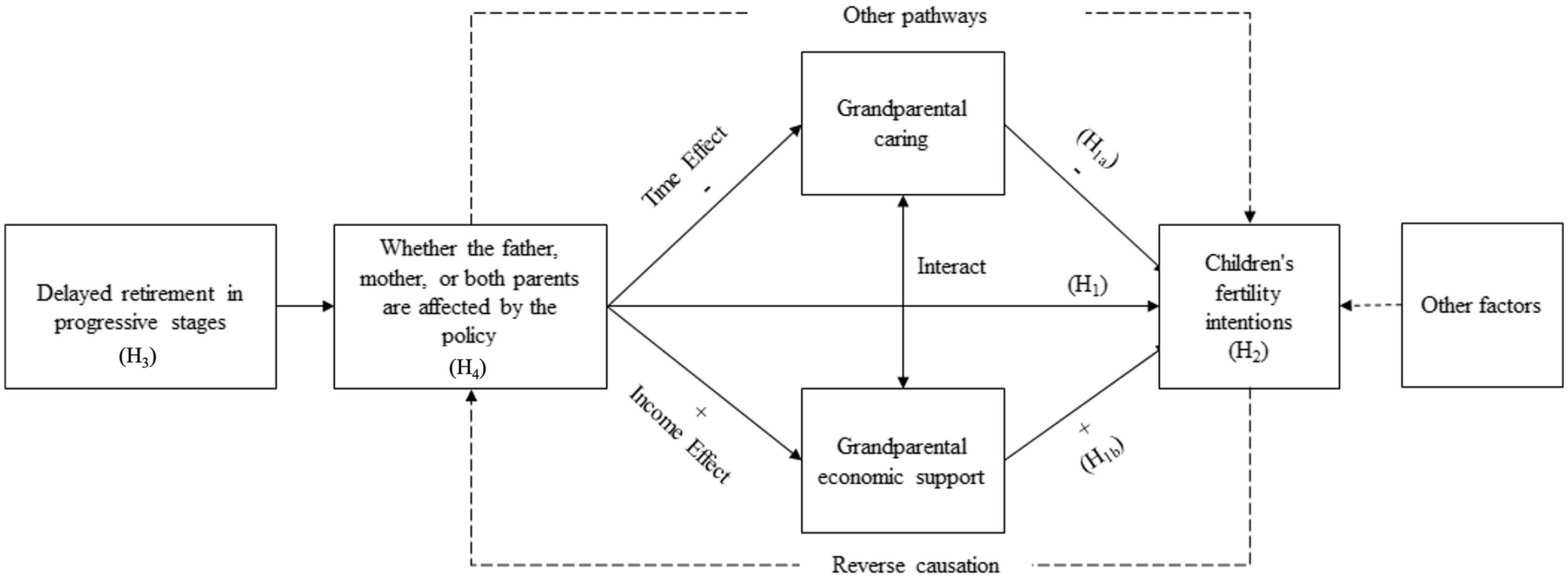
Figure 1 illustrates the theoretical framework of this study. Following the Policy implementation, the negative time effects lead to reduced grandparental childcare (H1a), while the positive income effects result in increased grandparental economic support (H1b). The grandparental caring and economic support changes interact and jointly influence the adult children’s fertility intentions (H1). The negative time effect of delayed retirement outweighs the positive income effect (H2), and this impact is further influenced by the duration of the retirement delay (H3) and whether both parents are subject to the delay (H4). The dashed lines in Figure 1 illustrate that parental retirement delay may affect children’s fertility intentions through pathways beyond grandparental support, and that children’s fertility intentions may also have a reverse causal relationship with parental retirement (Bolano and Bernardi, Reference Bolano and Bernardi2024), which are not the focus of this study.
Theoretical framework of this study.
This figure illustrates the overall analytical framework, showing the key concepts, core variables, and their hypothesised relationships that guide the empirical analysis.

Existing research on the intergenerational effects of retirement delay has primarily examined either the positive income effects or the negative time effects, with limited efforts to compare these effects simultaneously (Dai et al., Reference Dai, Zhao, Sui and Xu2025). Furthermore, no study has systematically investigated how the duration of delayed retirement, whether one or both parents are affected, and the gender of the parents shape adult children’s fertility intentions. The evidence base is also narrow with respect to different dimensions of fertility intentions. For example, outcomes such as the ideal number of children and the timing of childbearing may respond differently to changes in grandparental availability. Methodologically, prior studies in countries where delayed retirement has already been implemented have relied on longitudinal data to assess its intergenerational consequences (Battistin et al., Reference Battistin, De Nadai and Padula2015; Ilciukas, Reference Ilciukas2023). In China, where the policy has yet to take effect, existing scholarship has mainly employed simulation models to estimate its potential impact (Yan, Reference Yan2016; Chen et al., Reference Chen, Cui and Zhao2022; Dai et al., Reference Dai, Zhao, Sui and Xu2025). These limitations point to important research gaps. To address them, the present study adopts a survey experimental design that constructs hypothetical scenarios of parents’ gradual delayed retirement and directly measures changes in grandparental support and adult children’s fertility intentions before and after the policy implementation.
Methods
In this study, survey experiments are used to collect data on the impact of parental delayed retirement on children’s fertility intentions. The survey experiment method is an experimental approach applied to individuals through survey techniques, by constructing randomised virtual scenarios and directly asking individuals to evaluate how specific dimensions influence their judgments, thus enabling causal inference (Sniderman and Druckman, Reference Sniderman, Druckman and Druckman2011). In recent years, survey experimental method has been increasingly applied in areas such as social policy evaluation and decision-making behaviour analysis (Bulmer, Reference Bulmer2021; Gniza and Wrede, Reference Gniza and Wrede2024). This approach is chosen for two main reasons. First, because China’s Delayed Retirement Policy has just been implemented, no directly applicable empirical data exist. Second, survey experiments allow participants to simulate conditions surrounding fertility decisions within virtual scenarios, making it an effective tool for controlling variables and measuring causal effects (Auspurg and Hinz, Reference Auspurg and Hinz2014). This study received ethical approval from the Ethical Review Committee of Xiamen University, under the protocol number XMUSPA2024051203.
Experimental design
The ‘Measures’ outlines that starting from January 2025, the statutory retirement age for male employees and female employees will be delayed gradually. In the future, China may further increase the statutory retirement age, such as a five-year increase for men and ten-year increase for women (Lin, Reference Lin2021; Xiao, Reference Xiao2023). Based on this, this study designs three experiments to simulate the effects of gradual Delayed Retirement Policy under three durations.
-
1. Short Retirement Delay: Parents experience a one-year delay in the retirement age for men and a two-year delay for women.
-
2. Medium Retirement Delay: Parents experience a three-year delay in the retirement age for men and a five-year delay for women.
-
3. Long Retirement Delay: Parents experience a five-year delay in the retirement age for men and a ten-year delay for women.
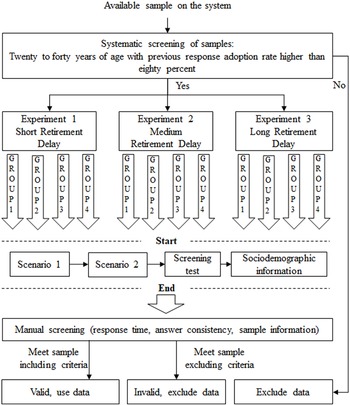
The experimental design is provided in Figure 2. Each experiment consists of Scenarios 1 and 2 materials, measurements, screening questions, and sociodemographic information. Scenario 1 presents a baseline vignette without the Delayed Retirement Policy, incorporating key contextual elements such as socioeconomic settings, marital status, and intergenerational relationships. To minimise the confounding influence of regional variation, the levels of economic development, healthcare services, and childcare provision are standardised to the national average. Participants’ marital status is fixed as married but childless. In addition, an explanation of intergenerational living arrangements is provided to reduce the potential impact of geographic proximity between parents and adult children. The original and translated vignettes for Scenario 1 are included in Supplementary Material 1.
Experimental design of this study.
This figure presents the structure of the experimental setup, including the main components, procedures, and the logical sequence used to test the research hypotheses.

Building upon the same socioeconomic and family settings as in Scenario 1, Scenario 2 introduces the condition where parents are affected by the Policy. The experiment distinguishes four treatment groups according to whether mothers and/or fathers are affected by the Policy: (1) both parents are retired and thus unaffected by the Policy; (2) the mother is retired and unaffected, while the father remains in employment and is affected by the Policy; (3) the father is retired and unaffected, while the mother remains in employment and is affected; and (4) both parents remain in employment and are affected by the Policy. The four groups of parental delayed retirement result in varying impacts on children’s fertility intentions. An example of the added vignette in Scenario 2, Experiment 1 is provided below:
Recently, the government introduced a Delayed Retirement Policy on a voluntary and flexible basis, accompanied by measures to expand employment opportunities for older adults. This policy may affect your parents as they approach retirement age. Under the current gradual reform, the statutory retirement age is extended by one year for men and by two years for womenFootnote 2 . [Randomly insert statements indicating whether one or both parents are affected by the Policy]. In the delayed-retirement scenario, your parents’ wages will remain largely unchanged, but their retirement plans may be postponed. As a result, coordinating schedules and caregiving responsibilities within the family may become more complex, potentially requiring you and your spouse to assume greater household and childcare responsibilities.
Participants and measures
Based on the legal age of marriage, physiological conditions for childbearing and the typical age distribution of childbearing, the participants in this study were restricted to Chinese individuals aged twenty to forty (Li and Wu, Reference Li and Wu2022). The survey experiment was administered via the online survey platform ‘Credamo’ between July and August 2024, with participants randomly assigned to one of the four experimental groups. To ensure the quality of the responses, participants with a response acceptance rate below 80 per cent in past surveys or who failed screening questions were excluded. Additional exclusions were applied where answers were too long or too short, or sociodemographic information were inconsistent. A total of 773 valid responses were retained, resulting in an overall effective response rate of 71.11 per cent. The geographical distribution of participants covered all major economic regions, with the Eastern region accounting for the largest share and the Northeast for the smallest, in a pattern that broadly reflects China’s regional population distribution. Detailed regional proportions are reported in Table S1 of the Supplementary Material.
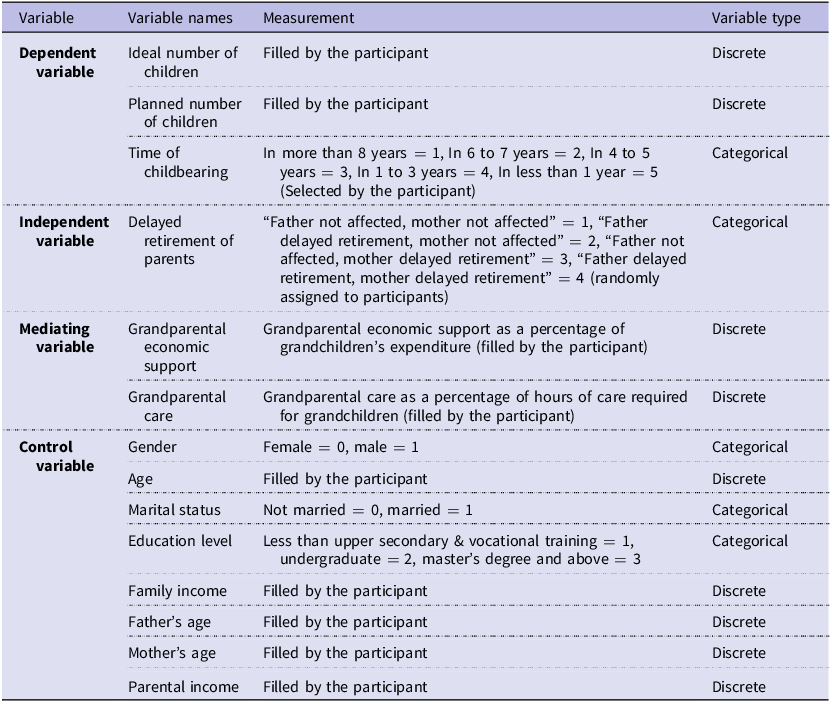
The dependent variable is fertility intentions, measured by three variables: the ideal number of children, the intended number of children, and the planned timing of childbearing (Miller and Pasta, Reference Miller and Pasta1995; Zheng, Reference Zheng2014). The independent variable is parental exposure to the Delayed Retirement Policy, operationalised through four categories that distinguish whether the father, the mother, both, or neither are affected. The mediating variables are grandparental economic and caring support. Previous studies have typically measured economic support by its type, frequency and monetary value, and caregiving support by daily or weekly hours and caregiving frequency (Lu et al., Reference Lu, Yu and Du2017; Yang et al., Reference Yang, Evandrou and Vlachantoni2022). To reduce biases associated with household income and childcare preferences in small-scale surveys, we construct two proportion-based indicators: the share of children’s expenses covered by grandparental economic transfers, and the proportion of grandparental caregiving hours in total childcare time. The empirical analyses indicate that models using these proportion variables achieve better fit compared to those relying solely on absolute amounts and hours. For parsimony, only the results based on the proportion measures are reported. Control variables include the demographic and socioeconomic characteristics of the adult children, such as age, gender, marital status, income, and education. An overview of all key variables is presented in Table 1.
Variable measurements

Descriptive analysis and balance test
The distribution of sample sizes across groups within each experiment is approximately equal. Balance tests were conducted both within the four groups of each experiment and across the three experiments. The results confirm that the participants were randomly assigned within and between Experiment 1, Experiment 2, and Experiment 3 (see Supplementary Material Table S2).
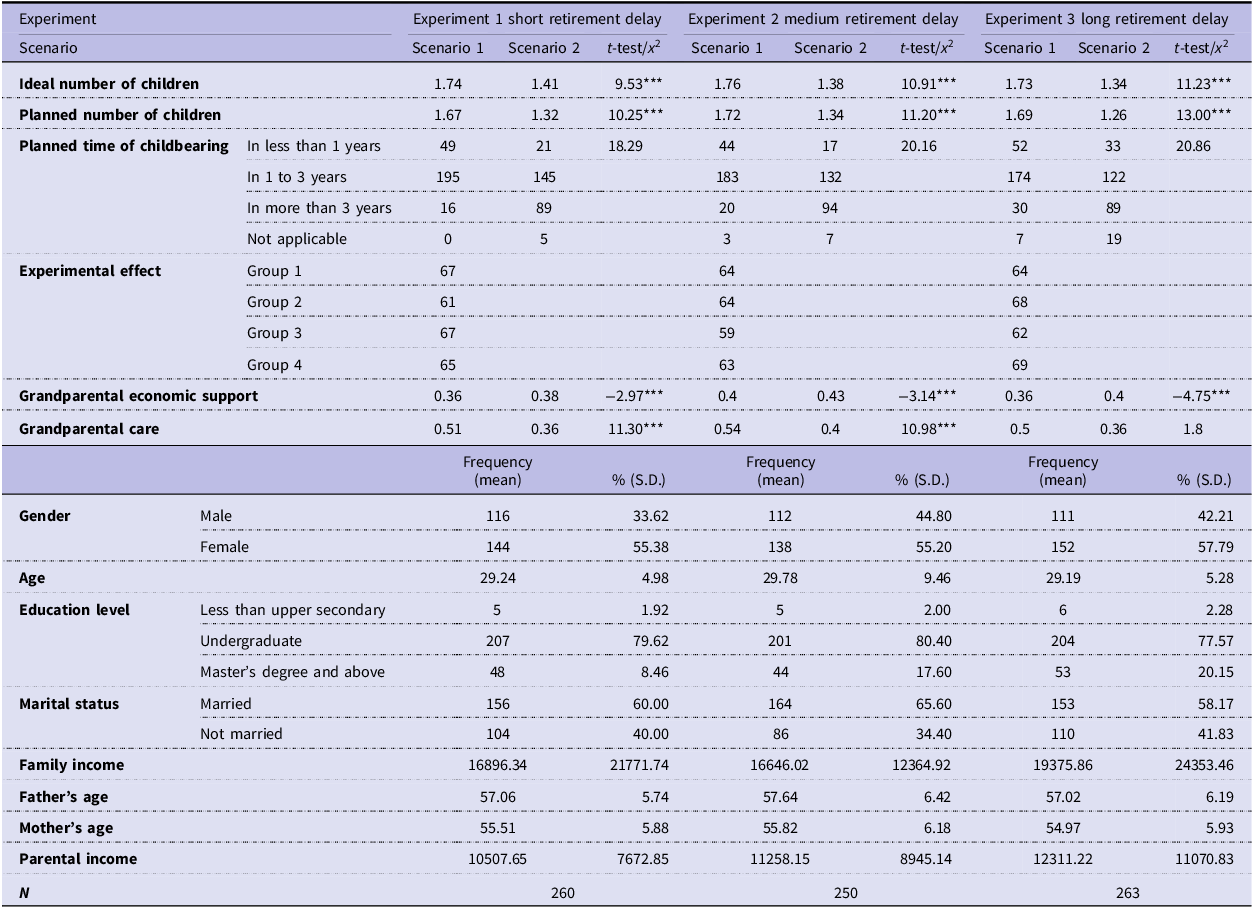
Paired sample t-tests and chi-square tests were used to analyse the changes in fertility intentions, grandparental economic support, and grandparental caring before and after the Policy. As shown in Table 2, across all three experiments, both the ideal number of children and the planned number of children in Scenario 2 are significantly lower compared to Scenario 1. Additionally, a larger share of participants in Scenario 2 indicated plans to postpone childbearing beyond three years, although this difference is not statistically significant. Across all three experiments, the proportion of grandparental economic support significantly increases in Scenario 2 compared to Scenario 1. In Experiments 1 and 2, the proportion of grandparental caring support in Scenario 2 significantly decreases; while in Experiment 3 the decline is smaller and not statistically significant.
Descriptive statistics of the sample
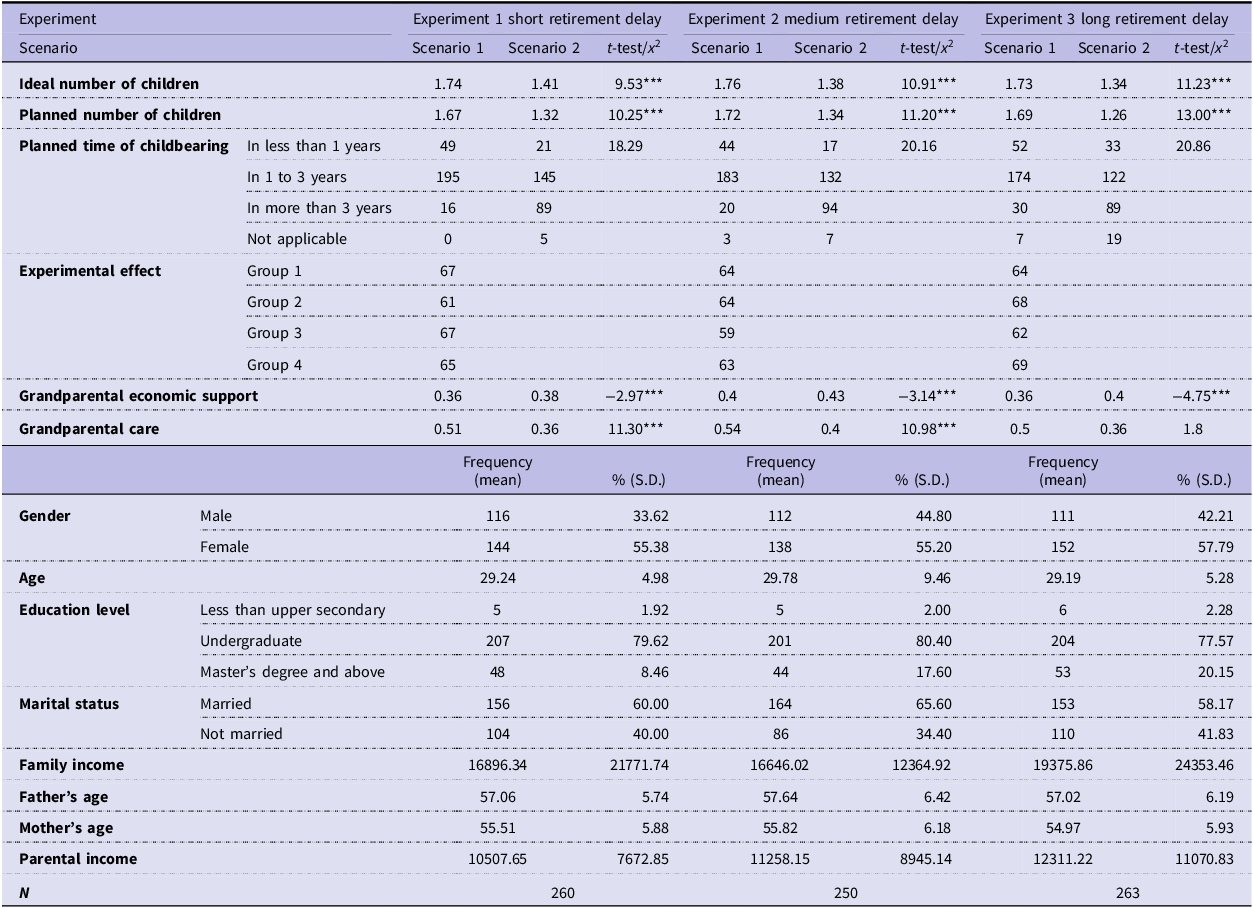
Note: t-values or ${x^2}$
are the results of paired-sample t-tests or chi-square tests between Scenario 1 and Scenario 2 within the three experiments (*p < 0.05, **p < 0.01, ***p < 0.001).
${x^2}$
are the results of paired-sample t-tests or chi-square tests between Scenario 1 and Scenario 2 within the three experiments (*p < 0.05, **p < 0.01, ***p < 0.001).
The demographic characteristics of the samples across the three experiments are largely consistent, e.g., with more females than males, and an average age of approximately twenty-nine years. Most respondents hold associate or bachelor’s degrees, and the impact of the educational attainment will be discussed in the limitations section. A high proportion of the respondents are married. The majority of households have a monthly income exceeding 16,000 yuan. The average age of the fathers in the sample is around fifty-seven years, while the mothers are on average fifty-five years old, with parents’ average monthly income exceeding 10,000 yuan.
Difference-in-differences method
This study employs the Difference-in-Differences (DID) method to evaluate the impact of the implementation of the Policy on changes in the children’s ideal number of children, planned number of children, timing of planned childbearing, as well as on changes in the grandparental economic and caring support. Analyses were conducted using RStudio 4.3.2. The DID method controls for systematic differences by comparing changes between the treatment and control groups before and after the Policy intervention, thereby reducing the estimation bias caused by pre-existing differences in fertility intentions across groups. A more detailed description of the DID methodology is provided in Supplementary Material 2.
Results
The effects of parents’ delayed retirement on children’s fertility intentions
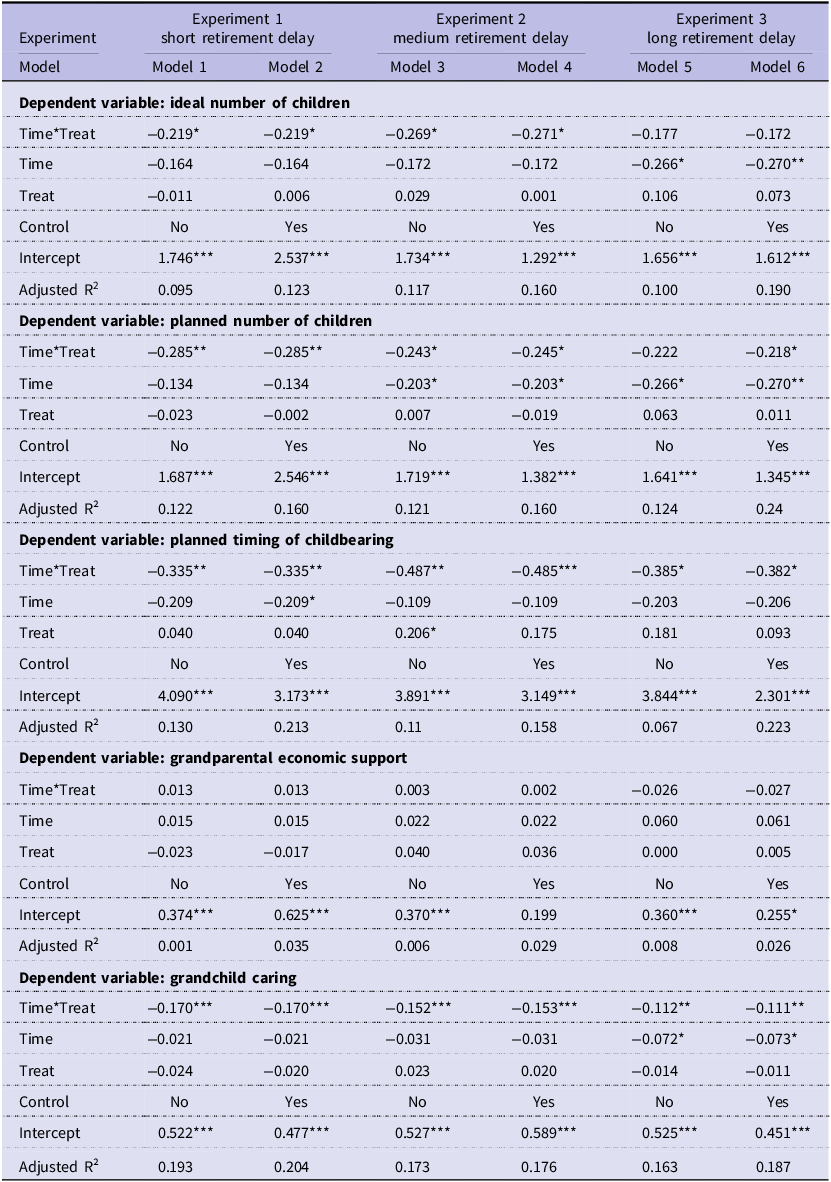
Table 3 presents the DID estimates for Models 1–3 without control variables and Models 4–6 with the full set of controls. The results show that under conditions of short and medium retirement delay conditions, regardless of whether control variables are included, the implementation of the Policy significantly reduces children’s ideal and planned number of children, postponing the timing of planned childbearing and decreasing grandparental caring support (p < 0.05). However, changes in grandparental economic support are not significantly influenced by the parents’ delayed retirement, which is different to the chi-square tests results presented in Table 2.
The effect of parental delayed retirement on grandparental support and children’s fertility intentions (DID models)

Note: Table 3 shows the results of the DID test for the three fertility outcomes and two grandparental support variables between scenarios within the three experiments (*p < 0.05, **p < 0.01, ***p < 0.001).
Under the long retirement delay condition, the implementation of the Policy significantly affects the reduction in the planned number of children (when control variables are included), resulting in delays in the timing of planned childbearing and in the reduction of grandparental caring (p < 0.05). However, changes in the children’s ideal number of children and grandparental economic support are not significantly affected. Taken together, these findings provide empirical support for H1, which posits that parental delayed retirement exerts negative effects on children’s fertility intentions.
Significant mediating effect of grandparental caring, influenced by how both parents are affected by the Policy
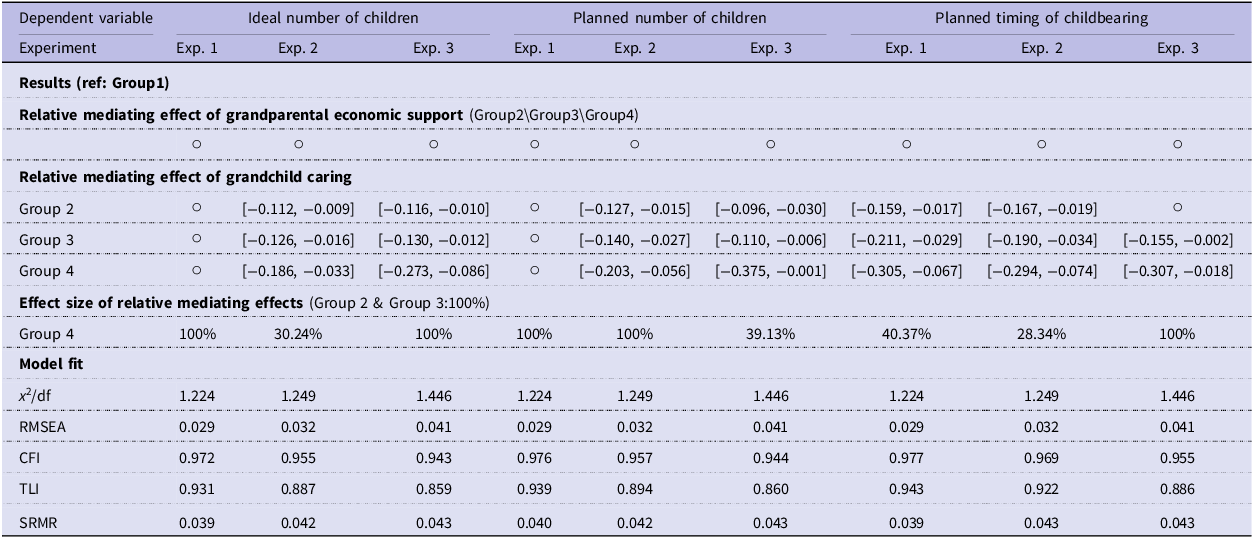
The Bootstrap method with 1,000 iterations is used to test the mediating effect of grandparental support, controlling for the influence of the children’s characteristics (Mplus Version 8.3) (Hu and Bentler, Reference Hu and Bentler1999), and the results are reported in Table 4. First, this study examines the effect of retirement delay on the children’s ideal number of children and the mediating role of grandparental support. In Experiment 1, under the short retirement delay condition, neither grandparental caregiving nor economic support exerts a significant mediating effect. In Experiment 2, under the medium retirement delay condition, the mediating role of grandparental economic support remains insignificant, whereas the mediating effects of grandparental caregiving are statistically significant (with relative effect sizes of −0.044, −0.057, and −0.101, respectively). Additionally, in Group 4, where the father’s retirement is delayed by three years and the mother’s retirement by five years, the relative direct effect on the children’s ideal number of children is significant, with the mediating effect accounting for 30.24 per cent of the total effect. In Experiment 3, under the long retirement delay condition, the relative mediating effects of grandparental caring are significant (with relative mediating effect values of −0.049, −0.051, and −0.158, respectively), while those of grandparental economic support continue to be non-significant. These findings highlight the centrality of caregiving rather than financial transfers in mediating the relationship between delayed retirement and fertility intentions, thereby supporting H1a rejects H1b.
Mediating effect analysis of grandparental economic and caring support

Note: Exp experiment. Experiment 1-3 are experiments under Short Retirement Delay, Medium Retirement Delay, and Long Retirement Delay respectively. Group 1 is “Father not affected, mother not affected”, Group 2 is “Father delayed retirement, mother not affected”, Group 3 is “Father not affected, mother delayed retirement”, Group 4 is “Father delayed retirement, mother delayed retirement”. In Table 4, ‘○’ indicates that the effect is not statistically significant. Square brackets show 95 per cent confidence intervals for the significant effect. “Effect size of relative mediating effects is 100%” indicates that relative direct effect is not significant.
Secondly, the analysis of children’s planned number of children shows a consistent pattern. Under short retirement delays (Experiment 1), neither caregiving nor economic support exerts a significant mediating effect. Under medium (Experiment 2) and long delays (Experiment 3), the mediating role of grandparental caregiving becomes significant, while economic support remains non-significant (with relative mediating effect values of −0.053, −0.069, and −0.124, respectively in Experiment 2; with relative effect sizes of −0.039, −0.040, and −0.126, respectively in Experiment 3). Notably, in Group 4 (father delayed by five years, mother by ten years), the direct effect on children’s planned number of children is significant, with mediation accounting for 39.13 per cent of the total effect.
Finally, with respect to the planned timing of childbearing, grandparental caregiving again emerges as the primary mediating channel. Significant mediating effects are observed under short (Experiment 1) and medium delays (Experiment 2), while economic support remains insignificant. In these conditions, Group 4 consistently shows significant direct effects, with mediating pathways explaining 40.37 per cent and 28.34 per cent of the total effect, respectively. Under long delays (Experiment 3), the results are more mixed: caregiving mediation is non-significant in some configurations, but becomes significant when mothers’ retirement is substantially delayed (e.g., by ten years), with mediation values reaching –0.050 and –0.157. Taken together, these results reinforce H2 and provide further evidence for H3 and H4, underscoring the dominant role of caregiving and the gendered nature of grandparental support in shaping fertility intentions.
Table 4 summarises the results of the mediating effect analysis. Under the short retirement delay condition in Experiment 1, parental delayed retirement postpones the adult children’s planned fertility timing by reducing grandparental care, but does not significantly impact the children’s ideal and planned fertility numbers. In Experiments 2 and 3, under the medium and long retirement delay conditions, parental delayed retirement reduces the ideal and planned numbers of children and postpones the fertility timing through decreased grandparental care provision. In all cases, the mediating effect of economic support is consistently non-significant. These results support hypothesis H1, H1a, and H2, and reject H1b. Furthermore, variation in the duration of retirement delay produces differential effects on grandparental caregiving, which in turn generates heterogeneous impacts on adult children’s fertility intentions (supporting hypothesis H3). Whether one or both parents are affected by the Policy also shapes the influence of grandparental care. Specifically, when mothers or both parents are subject to retirement delay, the effects on the ideal number of children, the intended number of children, and the timing of childbearing are particularly pronounced (supporting hypothesis H4a and H4b).
Discussion
Using data collected with a survey experiment method, this study directly examines the effects of delayed retirement on the children’s ideal number of children, planned number of children, and planned timing of childbearing, as well as the mediating effects of grandparental economic and caring support. In order to validate and interpret the experimental findings, this study incorporates data from in-depth interviews on ‘Delayed Retirement, Intergenerational Support, and Fertility Intentions’ conducted in May 2024 in two cities (see Supplementary Material 3 for details).
This study shows significant changes in grandparental caring and children’s fertility intentions after the implementation of the Delayed Retirement Policy, confirming H1. Specifically, a decrease in grandparental childcare was observed after Policy implementation. At the same time, the children’s ideal and planned number of children declined, and the planned timing of childbearing was postponed. The findings align with conclusions drawn from empirical data in Mediterranean European countries (Battistin et al., Reference Battistin, De Nadai and Padula2015; Frattola, Reference Frattola2025), highlighting the broader applicability of these results to other ageing societies. The research findings further indicate that the Delayed Retirement Policy, regardless of different durations of the parental delayed retirement, significantly reduces their adult children’s fertility intentions.
The second finding confirms a significant negative time effect of grandparental delayed retirement on children’s fertility intentions (confirming H1a), while showing an insignificant income effect pathway (rejecting H1b). In the in-depth interviews, participants also suggest that grandparental delayed retirement reduces the children’s fertility intentions by decreasing grandparental caring: The impact of time far outweighs the impact of money… the negative effect of reduced grandparental caring on fertility is much greater than the economic effect. One possible reason for the insignificant income effect is that delayed retirement may not necessarily lead to a positive impact on the household income. Some studies have found a negative relationship between parental delayed retirement and their children’s employment (Bratti et al., Reference Bratti, Frattini and Scervini2018; Zamarro, Reference Zamarro2020; Shangguan et al., Reference Shangguan, Han and Zhao2024). Hence, if parents are unable to care for their grandchildren due to retirement delay, children may stay home to care for the children, resulting in a reduction in the overall household income (Lu et al., Reference Lu, Yu and Du2017). Additionally, an increase in the parents’ income does not necessarily lead to greater financial support for their grandchildren. As one interviewee pointed out: Those who need to work often cannot provide financial support to their children, or the support is minimal. They are simply earning enough to support themselves. Very few people are working to save extra money for their children over those five years, and by that time, their children may already be earning more than them.
This study confirms H3, demonstrating that the impact of parental delayed retirement on the children’s fertility intentions varies significantly based on the duration of the delay. As the retirement delay lengthens, its effect on the adult children’s fertility intentions initially intensifies and then stabilises, consistent with conclusions from previous economic analyses (Zhou, Reference Zhou2017). When the duration of the retirement delay is short, the children’s planned timing of childbearing is significantly delayed, with an insignificant effect on their ideal or planned number of children. When the duration of the retirement delay is medium or long, parental delayed retirement significantly affects the children’s ideal number of children, planned number of children, and timing of childbearing. The results were supported by the in-depth interviews, for example a respondent noted: I think if the Policy is implemented and my parents retire one or two years later than expected, my fertility intentions may be further delayed. I wouldn’t be inclined to have children soon.…
Finally, when the duration of the retirement delay is short or medium, the retirement postponement of at least one parent leads to delayed childbearing. When the duration of the retirement delay is long, the delayed retirement of the father alone does not result in delayed childbearing, whereas the delayed retirement of the mother or both parents lead to a postponement in the timing of childbearing. These findings support previous research suggesting that children often plan their childbearing timing based on their parents’ retirement schedule (Feng et al., Reference Feng, Ai and Liu2020). The stronger effect of maternal retirement delay lends support to H4a, echoing prior studies showing that women frequently consider their mothers’ retirement age when planning their own fertility (Ilciukas, Reference Ilciukas2023). Moreover, whether one or both parents are affected by delayed retirement has differential impact on the children’s fertility intentions, particularly with respect to the postponement of children’s planned timing of childbearing (confirming H4b).
Conclusions
This study highlights that the implementation of the Delayed Retirement Policy reduces the time available for grandparental caring, leading to decisions by children to have fewer children and delay the childbearing. This effect is particularly pronounced when the duration of delayed retirement is long and when mothers are affected by the Policy, with the strongest impact observed when both parents experience delayed retirement. These results offer valuable insights for designing fertility support policies and implementing the Delayed Retirement Policy in China, emphasising the importance of coordinating various policies in practice (Hartlapp and Schmid, Reference Hartlapp and Schmid2008).
First, it is crucial to allow retirees flexible options in choosing their retirement age to mitigate the cumulative effects of the retirement delay policy. Encouraging retirees to make decisions based on their family’s specific circumstances and providing more opportunities for early or flexible retirement for those involved in grandparental childcare would help alleviate the negative impacts of retirement delay on family caring burden and children’s fertility intentions. Second, it is recommended to expand family-based parental leave policies to help families cope with the crowding-out effect on grandparental caring caused by delayed retirement. Family leave should extend to grandparents and even allow siblings, extended family members, or neighbours of childbearing couples (Wang and Wang, Reference Wang and Wang2022). Such flexible allocation of parental leave would effectively balance the need for grandparental caring with family obligations. Third, a stronger social support system is needed to alleviate the caring burden on families and reduce the crowding-out effect of retirement delay on caring time (Rupert and Zanella, Reference Rupert and Zanella2018). Echoing Powell and Taylor’s (Reference Powell and Taylor2016) argument that extending working lives reallocates risks and produces unintended consequences, our findings highlight the need to coordinate pension reforms with family and childcare policies in order to avoid reducing intergenerational support and suppressing fertility intentions. Enhancing the availability, affordability, and quality of formal childcare, and offering a variety of childcare options, would effectively reduce the burden on childbearing families, facilitate a balance between work and family life, and ultimately boost fertility intentions among individuals of reproductive age.
This study has several limitations. First, the representativeness of the sample is limited. Data was collected through an online platform, which led to a constrained sample size and a sample skewed towards higher income and education levels, potentially introducing bias into the research findings. The supplementary in-depth interview data can partly mitigate this limitation. Second, the analysis of the pathways through which parental delayed retirement affects the children’s fertility intentions may not be comprehensive. Future research could further explore other potential pathways to deepen the understanding of the relationship between parental delayed retirement and fertility intentions.
In summary, this study provides a timely analysis for the implementation of the Delayed Retirement Policy. Although the data are based on China, this study confirms that countries with similar national contexts, such as China and Mediterranean countries, exhibit similar mechanisms in how parental delayed retirement affects their adult children’s fertility intentions. Such results provide empirical evidence contributing to international debates. Methodologically, this study leverages a survey-experimental approach to isolate the impact of delayed parental retirement on fertility intentions. Additionally, relative proportions are used for measuring grandparental caring and economic support, which help reduce potential measurement errors in small-scale surveys. At the same time, fertility intentions are measured through the ideal number of children, planned number of children, and timing of planned childbearing, providing an operable measurement method for small-scale surveys on intergenerational support and fertility intentions.
Supplementary material
The supplementary material for this article can be found at https://doi.org/10.1017/S1474746426101420
Acknowledgements
National Social Science Fund of China Grant 23CRK001 funded this work.
Competing interests
The authors declare none.
Artificial intelligence
AI tools have been used solely for grammar refinement and language checking during the writing process of this manuscript.


 Open access

