



Depressive disorders are a growing public health concern both on a national and international level, and are posing an ever-increasing burden on the health and economy of both developing and developed countries( 1 , Reference Quirk, Williams and Adrienne 2 ). According to the WHO, more than 350 million people of all ages suffer from depression and there is an average of one million deaths from suicide per year on a global scale( 1 ). Depressive disorders account for approximately 20 % of the European burden of disease, while in the Irish context it is estimated that one in ten people will be affected in their lifetime( 3 , 4 ).
Studies have suggested that certain lifestyle behaviours such as a healthy diet, physical activity, moderate alcohol consumption and non-smoking may be linked to positive mental health( Reference O’Neil, Quirk and Housden 5 – Reference Taylor, McNeill and Girling 10 ), while their underlying mechanisms may be explained by a number of different pathways. For example, a high-quality diet may influence molecular activity and lead to a reduction in inflammatory and oxidative stress( Reference Jacka, Mykletun and Berk 7 , Reference Moylan, Maes and Wray 11 , Reference Corley, Kyle and Starr 12 ). Physical activity may contribute to an increase in confidence, self-esteem and optimism, as well as an increase in endorphins in the brain( Reference Rebar, Stanton and Geard 13 – Reference Birkeland, Torsheim and Wold 17 ). Similarly, excessive alcohol consumption and nicotine use are thought to influence the role of neurotransmitter systems( Reference Little 18 , Reference Mineur and Picciotto 19 ), while both are also associated with other non-communicable diseases such as hypertension, myocardial infarction and stroke, which in turn can lead to an increase in depression( Reference Mushtaq and Najam 20 – Reference Epstein, Induni and Wilson 25 ).
The process of linking these isolated behaviours to a condition of complex origin may not always be possible, however, as people tend to engage in several lifestyle choices. As a result, the role of protective lifestyle behaviours (PLB) in combination has been explored( Reference Khaw, Wareham and Bingham 26 , Reference Saneei, Esmaillzadeh and Hassanzadeh Keshteli 27 ) and has been shown to be associated with a reduced odds of chronic diseases such as mental ill health, diabetes, all-cause cancer and cardiovascular morbidity at a population level( Reference Petersen, Johnsen and Olsen 28 – Reference Harrington, Perry and Lutomski 30 ).
Furthermore, in the Irish setting, Harrington et al. have proposed that combining PLB (being a non-smoker, consuming moderate alcohol, being physically active and having an adequate fruit and vegetable intake) is negatively associated with mental health among free-living individuals over the age of 18 years. Results from the Irish study have outlined that those with four PLB were four times as likely to have better mental health, as well as an increased life expectancy( Reference Harrington, Perry and Lutomski 30 ).
However, less is known about the PLB–depression relationship among older adults specifically. Therefore, the aim of the present study was to add to the evidence base that practising a combination of PLB may be associated with positive mental health, with a specific focus on middle-aged Irish men and women in the general population.
Methods
Study design/participants
A secondary analysis of a cross-sectional study conducted in Mitchelstown, North County Cork, Republic of Ireland. The Mitchelstown Cohort( Reference Kearney, Harrington and Mc Carthy 31 ) was originally conducted to examine the association of dietary and lifestyle factors with the risk of diabetes and CVD. Participants were selected at random from a list of patients aged between 50 and 69 years who were registered at the Livinghealth Clinic in Mitchelstown. This clinic has a catchment area of approximately 20 000 people, from a combination of urban and rural areas. A total of 3807 participants were selected as potential participants for the study. However, due to duplications, deaths and those considered ineligible to participate, 3043 were invited to partake. The final study population consisted of 2047 participants, a 67 % response rate.
Exposure: protective lifestyle behaviours
Smoking
Smoking status was defined as follows: (i) never smoked, i.e. having never smoked at least 100 cigarettes (5 packs) in their entire life; (ii) former smoker, i.e. having smoked 100 cigarettes in their entire life and do not smoke at present; and (iii) current smoker, i.e. smoking at present. These definitions were the same as those used in the National Health and Lifestyle Survey (SLÁN 2007)( Reference Ward, McGee and Morgan 32 ). A binary variable was then created: ‘never/former smoker’ or ‘current smoker’. For the purpose of the present analysis, ‘never/former smoker’ was compared with ‘current smoker’ and ‘never/former smoker’ was defined as the PLB.
Alcohol consumption
Alcohol consumption was measured in units of alcohol consumed on a weekly basis and was categorised into the following levels: (i) non-drinker, i.e. <1 drink per week; (ii) moderate drinker, i.e. between 1 and 14 drinks per week; and (iii) heavy drinker, i.e. >14 drinks per week. Moderate drinker was defined on the basis of previous work from the European Prospective Investigation into Cancer and Nutrition (EPIC) in the UK by Khaw et al.( Reference Khaw, Wareham and Bingham 26 ). For the current analysis, these were then re-categorised as ‘moderate/non-drinker’ or ‘heavy drinker’, with the former being defined as the PLB.
Physical activity
Physical activity was assessed by the self-reported International Physical Activity Questionnaire (IPAQ) and categorised as low, moderate and high levels of activity( 33 ). This was then recoded as a dichotomous variable: ‘moderate/high’ or ‘low’ physical activity, with ‘moderate/high’ levels of physical activity being defined as the PLB.
Fruit and vegetable intake
Participants completed a validated self-administered, semi-quantitative FFQ consisting of 150 different foods( Reference Harrington, Perry and Lutomski 34 ). Frequency of consumption of a medium serving or common household unit was asked for each food and later converted into quantities using standard portion sizes. Outliers were excluded using standard methods based on energy intake( Reference Tabachnick and Fidell 35 ). Individual food items were combined into food groups and a dichotomous variable was created indicating if a participant consumed ‘≥5 servings’ of fruit and vegetables per day or ‘<5 servings’; consuming ‘≥5 servings’ of fruit and vegetables per day was considered to be the PLB.
The number of PLB was then summed for each participant (possible scores were between zero and four PLB), with higher scores indicating a more positive lifestyle.
Outcome variable: depression
Participants completed a general health and lifestyle questionnaire which included a self-report depression scale: the Center for Epidemiologic Studies Depression Scale (CESD). In addition, standard instruments to assess lifestyle behaviours and demographic details were also included. Evidence suggests that the CESD is a reliable and valid screening tool for depression( Reference Miller, Anton and Townson 36 – Reference Radloff 38 ), with a sensitivity and specificity of approximately 89 % and 86 % respectively( Reference Head, Stansfeld and Ebmeier 39 ). It comprises twenty well-being questions; the response categories were ‘rarely/none of the time’ (<1 d), ‘some of the time’ (1–2 d), ‘occasionally or a moderate amount of the time’ (3–4 d) and ‘all of the time’ (5–7 d) in the past week. Level of depression was scored 0–3, with the scoring of positive items being reversed. The sum of the twenty questions is the participant’s final score. A score of <15 indicates no symptoms of depression, 15–21 indicates mild to moderate depression and a score of ≥22 indicates a possibility of major depression( Reference Radloff 38 ). For the current analysis, this was then recoded as ‘no depressive symptoms’ or ‘mild/moderate/major depressive symptoms’.
Confounding variables
Based on the literature( Reference Harrington, Perry and Lutomski 30 , Reference Hu, Wu and Chou 40 – Reference Skarupski, Tangney and Li 43 ), potential confounders considered included age, gender, education and BMI. Categories of education included ‘some primary (not complete)’, ‘primary or equivalent’, ‘intermediate/group certificate or equivalent’, ‘leaving certificate or equivalent’, ‘diploma/certificate’, ‘primary university degree’ and ‘postgraduate/higher degree’. These were collapsed and recoded to ‘primary’, ‘secondary’ and ‘tertiary’ categories. BMI was calculated as weight/height2 by a trained researcher by measuring the participant’s weight (in kilograms) and height (in metres), and was characterised into three categories using the WHO definition( 44 ): underweight/normal’ (<18·5 kg/m2/≥18·5–<25 kg/m2); ‘overweight’ (≥25–<30 kg/m2); and ‘obese’ (≥30·00 kg/m2). All covariates were entered as categorical variables, with the exception of age.
Data analysis
Data were analysed using the statistical software package IBM SPSS Statistics Version 20.0. Descriptive analysis, stratified by gender, was used to describe characteristics of study participants. Cross-tabulation with a χ 2 significance test was used to test associations between number of PLB (categorical variable) and demographics (using a 5 % significance level and 80 % power). Binary logistic regression was conducted to assess the relationship between PLB score (categorical variable) and depression. The fully adjusted model was adjusted for age, gender, education and BMI. Results are presented as unadjusted; age- and gender-adjusted; age-, gender- and education-adjusted; and fully adjusted.
Results
Demographics
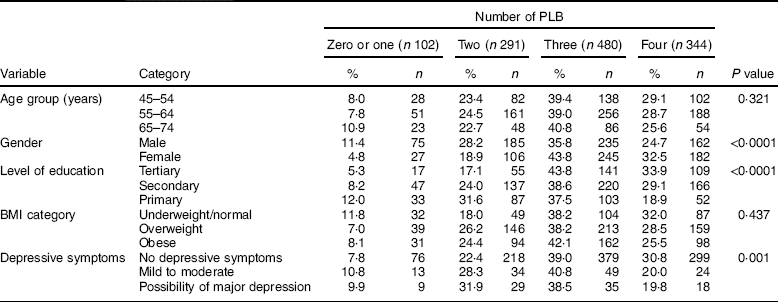
The study consisted of 2047 participants. The current analysis focuses on 1996 after exclusion of outliers based on energy (kcal) intake, assessed in the FFQ. Participants were aged between 50 and 69 years, of whom 49 % (n 978) were male and 51 % (n 1018) were female. Table 1 shows sociodemographic, lifestyle and mental health characteristics of study participants, stratified by gender. Over 8 % of participants engaged in zero or one PLB, 23·9 % and 39·4 % had two and three PLB respectively, while 28·3 % had four PLB. Table 2 shows a breakdown of the age group, gender, level of education, BMI and category of depression by number of PLB adhered to by participants. Those who practised three or four PLB were significantly more likely to be female, have a higher level of education and were categorised as having no depressive symptoms.
Characteristics of study participants by gender: middle-aged men and women, Mitchelstown, North County Cork, Republic of Ireland
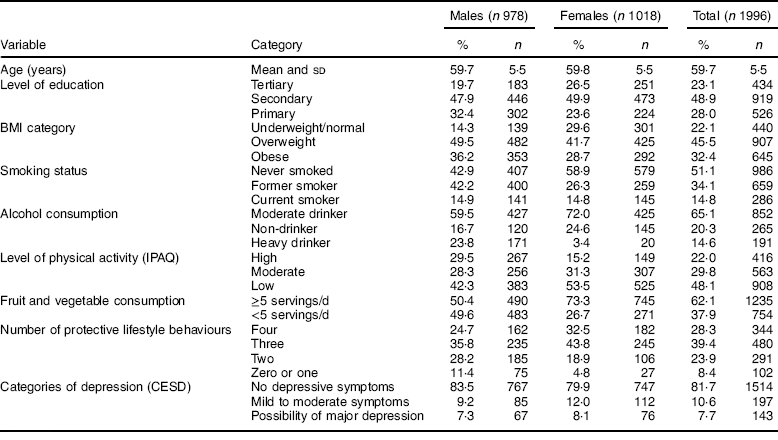
IPAQ, International Physical Activity Questionnaire; CESD, Center for Epidemiologic Studies Depression Scale.
Demographic breakdown by number of protective lifestyle behaviours (PLB) among middle-aged men and women, Mitchelstown, North County Cork, Republic of Ireland
Associations between protective lifestyle behaviours and depression
Table 3 presents the results of the binary logistic regression, examining the association between PLB and depression, adjusted for age, gender, education and BMI. Unadjusted and adjusted models propose that engaging in PLB may be inversely associated with depression. The final adjusted model suggests that those who practise zero or one PLB are over twice as likely to portray depressive symptoms compared with those who practise four PLB (OR=2·2; 95 % CI 1·2, 4·0). All models indicate that as the number of PLB practised increases, the odds of depressive symptoms decrease. Results also indicate that males are less likely to experience depressive symptoms compared with females, with this result remaining significant after further adjustment (OR=0·6; 95 % CI 0·5, 0·9). Models were tested excluding those with a previous doctor-diagnosis of depression and similar results were found (results not shown). Additionally, models were tested excluding non-drinkers and former smokers with similar results in favour of PLB being obtained (results not shown).
Binary logistic regression: associations of protective lifestyle behaviours (PLB), age, gender, education and BMI with depression in middle-aged men and women, Mitchelstown, North County Cork, Republic of Ireland
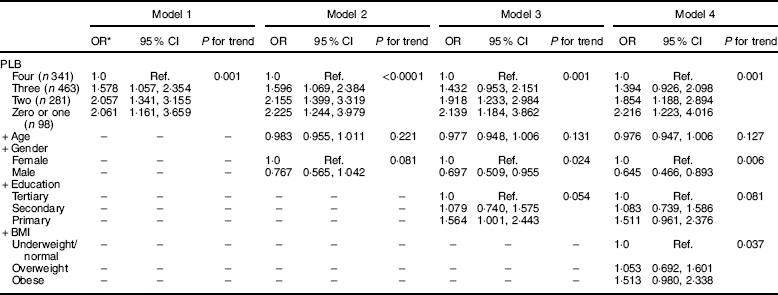
Ref., reference category.
Model 1=unadjusted.
Model 2=adjusted; age, gender.
Model 3=further adjusted; age, gender, education.
Model 4=further adjusted; age, gender, education, BMI.
* No depressive symptoms v. mild/moderate/major depressive symptoms.
Discussion
Principal findings
The aim of the present study was to examine the association between PLB and depression in middle-aged Irish men and women by conducting a secondary analysis of a cross-sectional study. This has yielded three principal findings. First, it appears that engaging in four PLB may be associated with positive mental health. Those who practise zero or one PLB are approximately twice as likely to experience depression when compared with those who practise four PLB. When potential confounders (age, gender, education and BMI) are considered, the odds of depression increase to over 2·2 times when zero or one PLB is compared with four PLB. Results remained statistically significant across all four models of logistic regression. Second, scope for improvement exists with regard to promoting the uptake of PLB, as results suggest that only 28 % of this population-representative sample of 50–69-year-olds engage in four PLB. Finally, results are concordant with the general consensus that gender differences exist with regard to suffering from depression, as females are more likely than males to be depressed( Reference Yao, Yan and Wei 45 , Reference Kessler 46 ). This may be important to consider when designing preventive strategies to combat depression at a population level.
The findings of the study are consistent with what was found in the available literature. Studies that assess the relationship between PLB in isolation and in combination suggest that healthy lifestyle choices may be linked to positive mental health. Furthermore, an association between these healthy behaviours and depression has been found in studies in different settings, genders and age groups( Reference O’Neil, Quirk and Housden 5 , Reference Jacka, Mykletun and Berk 7 – Reference Taylor, McNeill and Girling 10 , Reference Rebar, Stanton and Geard 13 , Reference Cooney, Dwan and Greig 14 , Reference Khaw, Wareham and Bingham 26 , Reference Harrington, Perry and Lutomski 30 , Reference Dinas, Koutedakis and Flouris 47 , Reference Skogen, Sivertsen and Lundervold 48 ), while the presence of an inverse relationship further supports the association between PLB and mental health.
A previous Irish study by Harrington et al. examined the role of similar key lifestyle behaviours and depression among all adults (18 years and over), with results supporting the notion of better mental health if healthy behaviours are adopted( Reference Harrington, Perry and Lutomski 30 ). Our study focuses specifically on 50–69-year-olds in the general population, with benefits of healthy lifestyle behaviours still being observed among this older age group. In a move towards healthy ageing( Reference Landefeld, Winker and Chernof 49 ), the promotion of health-seeking behaviours at this later stage of life may have a significant impact on the health of older populations.
Furthermore, the link between PLB and mental health is biologically plausible. Depressed individuals tend to have higher inflammatory levels of C-reactive protein, which has been linked to the origin of depression( Reference Saneei, Esmaillzadeh and Hassanzadeh Keshteli 27 , Reference Duivis, Vogelzangs and Kupper 50 – Reference Berk, Williams and Jacka 53 ). This elevated level of systemic inflammation has also been observed in those with a poor-quality diet, smokers and those with low levels of physical activity( Reference Dias, Wirfält and Drake 54 – Reference Esteghamati, Morteza and Khalilzadeh 56 ).
An adequate supply of nutrients is necessary for normal brain function. Therefore, a diet that is rich in antioxidants may lead to a reduction in oxidative stress on mental health. Similarly, green vegetables contain folate, which is required for normal central nervous system function, while it is also known to be involved in the synthesis and metabolism of serotonin( Reference Bamber, Stokes and Stephen 57 – Reference McMartin, Jacka and Colman 59 ).
Many hypotheses have been put forward to explain the mechanisms of physical activity’s role in the promotion of positive mental health. For example, physical activity may promote the production of endorphins which are thought to improve mood, it may pose as a distraction from adverse events, while it may also influence self-esteem( Reference Birkeland, Torsheim and Wold 17 ).
Additionally, physical activity is thought to play a role in preventing against other chronic diseases that are sometimes linked to mental ill health. Therefore, maintaining a physically active lifestyle may prevent the onset of depressive symptoms associated with other illnesses( Reference Rangul, Bauman and Holmen 60 , Reference Asare and Danquah 61 ).
Moreover, it is well documented that excess alcohol consumption and nicotine use may lead to the development of chronic conditions that in turn can lead to depression( Reference Mushtaq and Najam 20 – Reference Epstein, Induni and Wilson 25 ), while it is postulated that long-term alcohol and nicotine use may result in changes to neuronal activity, subsequently predisposing individuals to depression( Reference Little 18 , Reference Epstein, Induni and Wilson 25 ).
Study strengths and limitations
The Mitchelstown Cohort consists of a large sample of 50–69-year-olds with a mixture from urban and rural areas. Many potential confounders were considered in the study including age, gender, education and BMI.
However, there are several limitations to the study including methods used to assess dietary quality. The use of a general health and lifestyle questionnaire and FFQ may be subject to certain biases, namely social desirability bias due to the nature of the questions being asked or recall bias as participants attempted to recall information. The use of FFQ as opposed to food diaries, however, tends to bias results towards the null( Reference Schatzkin, Kipnis and Carroll 62 ). Therefore, results are more likely to be an underestimate of the magnitude of the true effect. Findings may also have been limited by non-response bias (response rate=67 %), while there is also a potential for self-report bias. Additionally, cross-sectional studies provide limited evidence for a causal relationship as the directional effect cannot be determined. The adoption of four PLB may in fact be a marker of better than average mental health as opposed to a protective factor and, in particular, the effects observed in the current study and others may operate in both directions.
Conclusion
The present study adds to the available evidence that engaging in key PLB may be protective against depression or, at a minimum, be associated with lower levels of depression. Examining the cumulative effects of PLB, rather than individual lifestyle components in isolation, may be more applicable to public health interventions than the promotion of single lifestyle behaviours, as people tend to live complex and diverse lives.
Contemporary guidelines in many countries promote the practice of PLB analysed herein( 63 , 64 ). Therefore promoting healthy lifestyle changes, such as being a non-smoker, moderate alcohol consumption, engaging in physical activity and eating a healthy diet, for the prevention of mental health disorders would have important public health implications considering the modifiable nature of lifestyle choices and the already available evidence base that healthy behaviours can improve other aspects of health. The promotion of health-seeking behaviours is especially valuable, considering the high prevalence of people who do not receive any form of treatment for mental ill health( 4 ). However, reasons for unhealthy lifestyle behaviours and the assessment of barriers relating to behaviour change are important to consider when researching the lifestyle–mental health relationship as these may also have implications for future policy( Reference Sallis, Franklin and Joy 65 , Reference Katz 66 ).
Acknowledgements
Acknowledgements: The authors wish to thank the Health Research Board, the Department of Epidemiology and Public Health, University College Cork, Republic of Ireland and the participants in the study, the members of the survey team, the study nurses and administrators, and the staff at the Livinghealth Clinic. Financial support: This work was supported by the Health Research Board Ireland (grant number SSS-2014-808), while the Mitchelstown Study was also funded by a research grant from the Health Research Board Ireland (grant number HRC/2007/13). The Health Research Board had no role in the design, analysis or writing of this article. Conflict of interest: None. Authorship: J.M.H. and G.M.M. were involved in formulating the research question, drafting the paper, and analysis and interpretation of data. C.P.P. and I.J.P. revised the paper for important intellectual content. All four authors gave final approval of the version to be published. Ethics of human subject participation: This study was conducted according to the guidelines laid down in the Declaration of Helsinki and all procedures involving human subjects/patients were approved by the Cork Research Ethics Committee. Written informed consent was obtained from all subjects/patients.



