


Introduction
Seabirds, particularly albatrosses and petrels, have experienced a dramatic deterioration of their conservation status (Butchart et al., Reference Butchart, Statterfield, Bennun, Shutes, Akçakaya and Baillie2004), and of the 328 seabird species currently recognized, 31.1% are considered globally threatened (IUCN, 2007). Reasons are the high sensitivity of seabirds to the combination of both terrestrial and marine threats. Most seabirds that are threatened by invasive species on their breeding islands are also concurrently threatened by incidental mortality in commercial fisheries (Donlan & Wilcox, Reference Donlan and Wilcox2008). Unfortunately, for many threatened seabirds demographic and ecological data are sparse, and it is thus difficult to make a reliable assessment of their conservation status (IUCN, 2007).
The yelkouan shearwater Puffinus yelkouan is a medium-size procellarid strictly endemic to the Mediterranean Basin (including the Black Sea). It was previously considered to be a Mediterranean subspecies of the globally distributed Manx shearwater P. puffinus complex (Brooke, Reference Brooke1990; Warham, Reference Warham1990) and later to be the oriental subspecies of the Mediterranean shearwater (Bourne et al., Reference Bourne, Mackrill, Paterson and Yésou1988; Heidrich et al., Reference Heidrich, Amengal and Wink1998). A taxonomic revision elevated the yelkouan shearwater to the rank of species, distinct from both the Manx shearwater and Balearic shearwater P. mauretanicus (Sangster et al., Reference Sangster, Collinson, Helbig, Knox and Parkin2002). Whereas considerable attention has been given to the Balearic shearwater, leading to its categorization as Critically Endangered on the IUCN Red List (Arcos & Oro, Reference Arcos, Oro, Madroño, González and Atienza2004; Oro et al., Reference Oro, Aguilar, Igual and Louzao2004; BirdLife International, 2006a; IUCN, 2007), few studies have dealt with the yelkouan shearwater. Consequently, this species remains the poorest known seabird in the Mediterranean, with little documentation of its distribution, population size and trends. Zotier et al. (Reference Zotier, Thibault and Guyot1992) emphasized this lack of data and suggested that documented population sizes are overestimates.
Despite this paucity of data the yelkouan shearwater is considered to be at low risk of extinction (BirdLife International, 2006b; IUCN, 2007) and its European threat status is Secure (BirdLife International, 2004a), with population estimates of 14,750-52,300 pairs (IUCN, 2007) and 13,000-33,000 pairs (BirdLife International, 2004a). The yelkouan shearwater has only recently (2004) been added to Annex I of the European Union Wild Birds Directive. As a consequence, the attention of conservationists and scientists has not been drawn to this endemic species. Most of the endemic shearwater species formerly included in the Manx shearwater complex have, however, recently been categorized on the IUCN Red List (IUCN, 2007): Near Threatened (Puffinus opisthomelas), Endangered (P. huttoni, P. newelli) and Critically Endangered (P. auricularis, P. mauretanicus).
Here we therefore provide for the yelkouan shearwater a comprehensive review of available data on range, population size and trends, and of threats to the species' existence. This review is based on an intensive literature survey, including grey and local literature (80 references, eight languages), and also includes 3 years of exchanges and personal communications with scientists, conservationists and NGOs from the 24 countries bordering the Mediterranean, Black and Azov Seas, and our own research data. Our aim is to provide an exhaustive compilation of available data concerning the yelkouan shearwater, identify the main gaps in this data, and to discuss the species' conservation status and priorities for its conservation. Finally, we make a plea for more data needed to fill the main gaps identified.
Breeding locations, extent of occurrence and area of occupancy
Seventy-five sites (i.e. islands) distributed among 10 countries were identified as certainly (40 sites) or possibly (35) harbouring yelkouan shearwater breeding colonies (Fig. 1, Appendix). The 40 breeding locations categorized as certain were those for which recent (<70 years old) evidence of breeding (i.e. eggs, chicks) were clearly stated and for which further information indicated clearly that breeding still occurs. The 35 possible breeding sites were considered as such from information linked to at-sea observations but actual breeding is unconfirmed.
Locations of breeding sites of the yelkouan shearwater in the Mediterranean Basin (including the Black Sea), with number of breeding pairs determined by censuses on land or at sea (including sites were breeding is both certain and possible, see text for details), and of the nine sites where the species appears to be extinct.
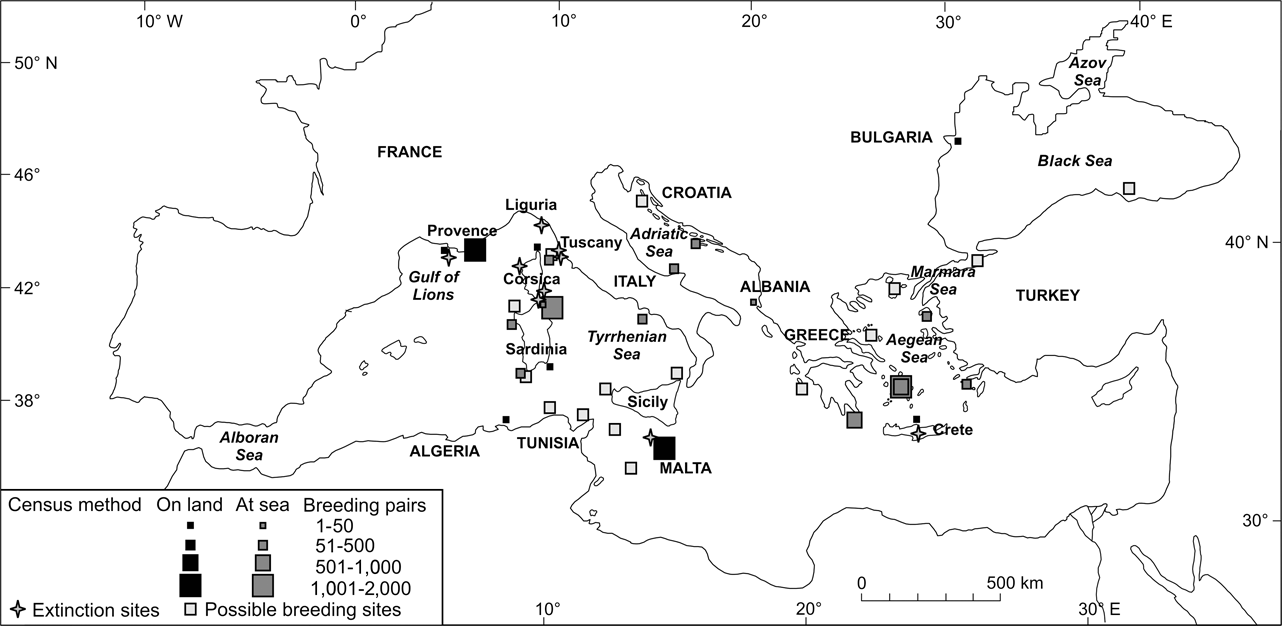
Thus, if we consider only the 40 locations where breeding is certain, the area of occurrence of the yelkouan shearwater extends from the Marseille islands in the west (France; Zotier & Vidal, Reference Zotier, Vidal, Cadiou, Pons and Yésou2004) to Bulgarian islands (Nankinov, Reference Nankinov, Aguilar, Monbailliu and Paterson1993) in the Black Sea in the east, and from the Bulgarian islands in the north to Malta (Borg & Sultana, Reference Borg and Sultana2002) in the south (Fig. 1, Appendix). This gives a yelkouan shearwater extent of occurrence (IUCN, 2001) of c. 1,117,100 km2. With the 35 additional possible breeding locations this could extend to 1,322,100 km2. The area of occupancy (IUCN, 2001) is much smaller because of the patchy insular distribution of the species. Considering the entire surface area of the islands where the species breeds, the area of occupancy ranges from 1,209 km2 (for the 40 certain breeding sites) to 2,147 km2 (when the 35 possible breeding sites are included). However, yelkouan shearwater colonies are restricted to only a small part of the occupied islands (<1%; IMEP, unpubl. data), and based on this the area of occupancy is reduced to 12.1 and 21.5 km2, respectively.
Breeding population estimate
Only 17 of the 40 certain breeding locations have been surveyed (nest and calling bird counts at colonies), with an estimated on-land breeding population of 2,468-3,224 pairs. The other 23 certain breeding locations were only censused approximately by counting flocks at sea, and the authors estimated 3,431-6,185 additional pairs, giving a total of 5,899-9,409 breeding pairs. For 31 of the 35 possible breeding locations, approximate counting at sea indicates a speculative additional breeding population of 5,456-45,115 pairs.
It is important to note that the estimation of shearwater breeding population by counting flocks at sea is questionable because of the risk of strong overestimation, imprecision and error (Bibby et al., Reference Bibby, Burgess and Hill1992; Brichetti & Fracasso, Reference Brichetti and Fracasso2003). For example, flocks of up to 10,000 birds are regularly seen off some French Mediterranean islands but 4 years of intensive terrestrial survey gave a breeding population of <1,600 pairs (IMEP, unpubl. data). Moreover, the presence of shearwaters at sea (on feeding areas, for example) does not guarantee that the species breeds on nearby islands. Thus, the high breeding numbers given for some large populations (Italy, Greece and Turkey) are speculative and could be overestimates of 5–10 times the actual figure. For 77% of all the breeding sites (certain and possible) breeding population estimates are based on counts at sea. These numbers contribute to 78.3-94.1% of the overall population size estimates. Thus the lack of breeding confirmation for many of the possible breeding sites and the imprecision and probable overestimation for most given population sizes suggest that the yelkouan shearwater world population is likely to be at the low end of previous estimate ranges (i.e. <15,000 pairs). Until data is collected from data deficient areas (especially Turkey, Italy and Greece), we cannot exclude the possibility that the global yelkouan shearwater population may consist of only 5,899-9,409 pairs.
Important marine areas
Eight marine areas have been reported as important feeding, moulting or migration areas for yelkouan shearwaters, with regular observations of flocks of thousands of birds (Fig. 2). The first returns to breeding sites occur in late October or early November, egg-laying from mid March to early April, hatching in May and fledging in July to early August (Zotier Reference Zotier1997; K. Bourgeois & E. Vidal, pers. obs.). The Aegean Sea and Marmara-Black-Azov Seas are two areas used throughout the year (Handrinos & Akriotis, Reference Handrinos and Akriotis1997; Nankinov, Reference Nankinov2001). The Gulf of Lions-Provence-Liguria-northern Tyrrhenian Sea, west of Sicily and the Algerian-Tunisian coast can be considered important feeding areas during the breeding season (Thibault & Bonaccorsi, Reference Thibault and Bonaccorsi1999; Conéjéro & Beaubrun, Reference Conéjéro, Beaubrun, Yésou and Sultana2000; Insenmann & Moali, Reference Isenmann and Moali2000; Brichetti & Fracasso, Reference Brichetti and Fracasso2003; Isenmann et al., Reference Isenmann, Gaultier, El Hili, Azafzaf, Dlensi and Smart2005; IMEP, unpubl. data). The Alboran Sea, northern Adriatic Sea and the Israeli coast are important areas for moulting, feeding and passage during the interbreeding period (Markovec, Reference Markovec1995; Shirihai et al., Reference Shirihai, Dovrat and Christie1996; Stipčević & Lukač, Reference Stipčević and Lukač2001; Brichetti & Fracasso, Reference Brichetti and Fracasso2003; Thévenot et al., Reference Thévenot, Vernon and Bergier2003).
Areas of yelkouan shearwater concentration at sea (passage, moulting and/or feeding), with maximum numbers, period of maximum occurrence (not indicated when occurrence is high throughout the year) and areas with decreasing numbers (indicated by an arrow).

Population trends
With the exception of Maltese and French colonies (Borg & Sultana, Reference Borg and Sultana2002; Zotier & Vidal, Reference Zotier, Vidal, Cadiou, Pons and Yésou2004; IMEP, unpubl. data), no yelkouan shearwater populations are monitored either at sea or on land. It is therefore difficult to evaluate a global population trend for this species, in contrast to literature that considers the population to be stable (BirdLife International, 2004, 2006b). There is some evidence of colony extinctions (Fig. 1, Appendix). These may be old, such as in Corsica (Lavezzi Island after the 18th century, France; Vigne et al., Reference Vigne, Lefèvre, Thibault and Guyot1991; Zotier & Vidal, Reference Zotier, Vidal, Cadiou, Pons and Yésou2004) and Crete (Greece, Alcover et al., Reference Alcover, Florit, Mourer-Chauviré and Weesie1992), or recent, such as in Corsica (Forana Island 1908-1982, and Gargalo Island 1947-1980, France; Guyot et al., Reference Guyot, Launay, Vidal, Thibault, Guyot and Cheylan1985; Zotier & Vidal, Reference Zotier, Vidal, Cadiou, Pons and Yésou2004), on French Mediterranean islands (Grand Congloué Islet 1954-1981; Zotier & Vidal, Reference Zotier, Vidal, Cadiou, Pons and Yésou2004), Malta (Filfla Island in the early 1980s; Borg & Sultana, Reference Borg and Sultana2002) and on Italian islands (Palmaria Island; Brichetti et al., Reference Brichetti, De Franceschi and Baccetti1992; Pianosa and Giannutri Islands 1989-2001; Tellini Florenzano et al., Reference Tellini Florenzano, Baccetti, Arcamone, Meschini and Sposimo1997; Arcamone & Sposimo, Reference Arcamone and Sposimo2002; N. Baccetti, pers. comm.). A total of nine extinctions have been documented, probably representing 300-400 breeding pairs, during the last 60 years. The causes of extinction are not clear but the authors suggested harvesting and predation by ship rats Rattus rattus (Vigne et al., Reference Vigne, Lefèvre, Thibault and Guyot1991; Arcamone & Sposimo, Reference Arcamone and Sposimo2002). Breeding populations are also declining in the main breeding sites, with the same causes: Tuscany (Sposimo & Tellini, Reference Sposimo and Tellini1995), Sardinia (vast sectors of Tavolara and Molara islands have been deserted; N. Baccetti, G. Spano & M. Putzu, pers. comm.) and Malta (J.J. Borg, pers. comm.). Combining data for population extinctions and declines, the main yelkouan shearwater populations for which approximate data are available (France, Italy and Malta), may have decreased by 12-15% (i.e. 1,500-2,500 breeding pairs) during the last 60 years.
The number of individuals in marine areas where the species concentrates could also be declining (Fig. 2). In the Alboran Sea large concentrations of up to 6,000 birds regularly occurred in the 1960s and the early 1970s but numbers have decreased to flocks of a maximum of 1,000 in certain years only (Thévenot et al., Reference Thévenot, Vernon and Bergier2003). Hundreds to thousands of yelkouan shearwaters stayed around Corsica (Bonifacio Strait, north of Cape Corse, western gulfs) from December to June during the 1970s and mid 1980s but numbers now fluctuate from several tens to a few hundreds (Thibault & Bonaccorsi, Reference Thibault and Bonaccorsi1999). In the Gulf of Trieste (northern Adriatic Sea) hundreds of yelkouan shearwaters were regularly present from June to October (up to 1,000 in September) but this number has recently decreased (Brichetti & Fracasso, Reference Brichetti and Fracasso2003). These data suggest that the number of yelkouan shearwater at sea may have decreased by >50% over the last 40 years.
Major threats
Table 1 summarizes the generally scarce information about threats to yelkouan shearwaters both at sea and in breeding colonies. The most well-documented and serious threat is the impact of introduced predators, especially feral cats Felis catus. For example, on the Hyères islands (French Mediterranean coast) feral cats have been identified as the primary predator of yelkouan shearwaters: shearwater remains were found in up to 6% of cat scats, representing hundreds of adults killed each year, especially during the pre-breeding period (Tranchant et al., Reference Tranchant, Vidal and Kayser2003; Bonnaud et al., Reference Bonnaud, Bourgeois, Vidal, Kayser, Tranchant and Legrand2007). The ship rat has long been introduced on most of the Mediterranean islands and is now present on all the islands with yelkouan shearwater colonies (Martin et al., Reference Martin, Thibault and Bretagnolle2000). Ship rats may dramatically reduce breeding success of shearwaters during rat population peaks (Vidal, Reference Vidal, Thibault, Guyot and Cheylan1985). Breeding success was zero because of ship rat predation on the Tavolara islands in 2006 and on Montecristo Island in some years (Italy, N. Baccetti, G. Spano & M. Putzu, pers. comm.). Rats are also the main cause of breeding failure in the largest Maltese colony (J.J. Borg, pers. comm.).
Overview of threats to the yelkouan shearwater in breeding colonies and at sea. Data type indicates if causes of mortality were quantified, observed, or only suspected.
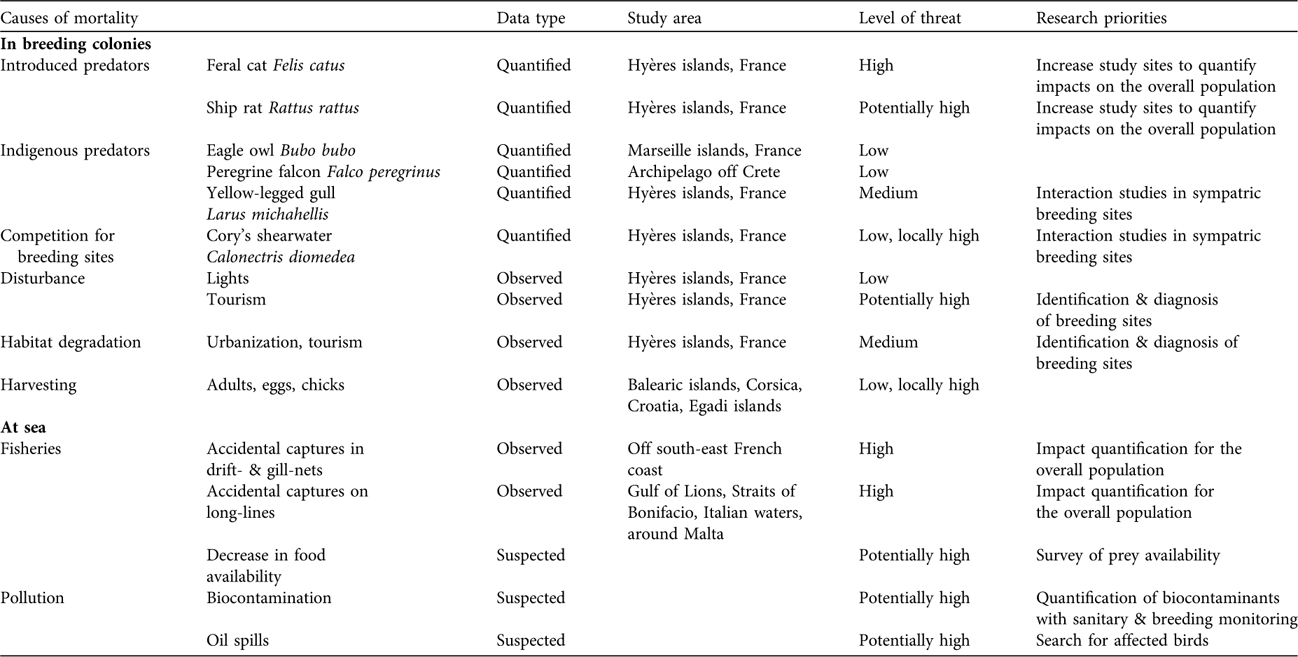
Rare cases of predation by native predators have been reported (Vidal & Bayle, Reference Vidal and Bayle1997; Zotier, Reference Zotier1997; Pieper & Ristow, Reference Pieper and Ristow2002). Competition for breeding habitat with Cory's shearwater Calonectris diomedea seems limited (Bourgeois & Vidal, Reference Bourgeois and Vidal2007). Harvesting of yelkouan shearwaters was frequent until the 1980s on most sites (Krpan, Reference Krpan1970; Vigne et al., Reference Vigne, Lefèvre, Thibault and Guyot1991) but is now limited and the species is legally protected. Increasing tourism and coastal urbanization in the Mediterranean disturbs colonies and damages fragile breeding habitats (James, Reference James1984; Gallo-Orsi, Reference Gallo-Orsi2003; K. Bourgeois & E. Vidal, pers. obs.).
Little is known about mortality of yelkouan shearwaters at sea as a result of accidental bycatch in long-lines and fishing nets. In the 1970s net bycatch of yelkouan shearwaters off the south-east French coast was estimated at 800 per year (Besson, Reference Besson1973) and dead yelkouan shearwaters are regularly found with signs of netting (head and neck without feathers and with net remains; IMEP, unpubl. data). More recently, some yelkouan shearwater deaths from long-lines have also been reported in the Gulf of Lions (J. González-Solís, C.C. Matet & S.R. Moreno, pers. comm.), Straits of Bonifacio, Italian waters and around Malta (Cooper et al., Reference Cooper, Baccetti, Belda, Borg, Oro and Papaconstantinou2003). At-sea mortality could be one of the major causes of the dramatic decline of the Balearic shearwater (Oro et al., Reference Oro, Aguilar, Igual and Louzao2004) and is probably similarly affecting the yelkouan shearwater.
The main fish species caught by fisheries in the Mediterranean (Lleonart & Maynou, Reference Lleonart and Maynou2003) are the main prey items of yelkouan shearwaters (Zotier, Reference Zotier1997; Conéjéro & Beaubrun, Reference Conéjéro, Beaubrun, Yésou and Sultana2000; Stipčević & Lukač, Reference Stipčević and Lukač2001). Such resource competition can induce changes in food availability and may affect seabird breeding success, adult survivorship, colony attendance and prey switching (Furness, Reference Furness2003; Karpouzi, Reference Karpouzi2005). High levels of some contaminants have been detected in Mediterranean seabird tissues, thus weakening adults and decreasing breeding success (Lambertini & Leonzio, Reference Lambertini, Leonzio, MEDMARAVIS and Monbailliu1986; Renzoni & Massa, Reference Renzoni, Massa, Aguilar, Monbailliu and Paterson1993). Intense maritime traffic in the Mediterranean increases the risk of oil spills.
Reappraisal of conservation status
IUCN Red List criteria for determining the degree of threat to species are based on population size, range and trends (IUCN, 2001). Considering the probable decrease in the yelkouan shearwater population by 12-50% (breeding population and at sea) and the fact this reduction and its causes have not ceased and are not fully identified, the species should be considered at least Near Threatened. The Near Threatened classification acknowledges the possibility that future research will qualify the species for inclusion in a threatened category (IUCN, 2001). In the same way, the species’ Secure European threat status (BirdLife International, 2004a) should be reviewed and possibly revised in the light of future research.
Discussion
This review emphasizes the lack of available data for the yelkouan shearwater. Purported yelkouan shearwater breeding sites require confirmation, particularly in Turkey and Greece. Breeding population censuses are needed at colonies, particularly on purported major breeding sites such as in Sardinia, Sicily and Greece. In addition, the biology and ecology of this species are still poorly known and research is therefore required for the design of an appropriate conservation strategy. In particular, demographic monitoring is a prerequisite for assignment of species conservation status. The impact of introduced predators on the yelkouan shearwater has been demonstrated but studied only in small populations. Control and/or eradication of introduced predators (particularly cats and rats) should be a conservation priority. The removal of rabbits and house mice from the Atlantic island of Selvagem Grande, for example, was beneficial to the breeding of Cory's shearwaters Calonectris diomedea borealis (Zino et al., Reference Zino, Hounsome, Buckle and Biscoito2008).
Accidental bycatch in fishing gear has been identified as a major threat for medium and large Procellariforms (Brooke, Reference Brooke2004) but few data are available for the yelkouan shearwater. Consequently, quantification of this impact is required, as is the identification of Marine Important Bird Areas (BirdLife International, 2004b) for this species. Breeding site protection, especially against introduced predators, and at-sea threat prevention, were initiated in France in 2003 (Marseille and Hyères islands) and are beginning in Malta with the help of funding from three EU LIFE Nature programmes. However, the yelkouan shearwater distribution comprises at least 10 countries and international collaboration is necessary for the preservation of this Mediterranean endemic species. We thus encourage such collaborations to assess the global situation for the species and coordinate conservation actions. Finally, we call for more data on the yelkouan shearwater, particularly regarding demography and ecology, and for an evaluation of terrestrial and marine threats. Such data are also lacking for many seabirds, particularly Procellarids (IUCN, 2007), and an effort to complete our knowledge regarding these issues would improve prioritization of conservation actions for seabirds.
Acknowledgements
Funds and support were provided by the European Union, the Direction Régionale de l'Environnement Provence-Alpes-Côte d'Azur, and the Conseil Regional Provence-Alpes-Côte d'Azur through the granting of a Life Nature project to Ligue pour la Protection des Oiseaux Provence-Alpes-Côte d'Azur (ref. LIFE03NAT/F000105). We are very grateful to G. Aplington, H. Azafzaf, N. Baccetti, S. Baris, P. Brichetti, J.J. Borg, G. Bundi, F. Corbi, T. Gaultier, M. Genovart, J. González-Solís, J. Legrand, G. Lukač, A. Maoli, C.C. Matet, S.R. Moreno, D. Oro, M. Putzu, V. Satta, G. Spano, J.C. Thibault and R. Zotier for responding to our correspondence and sharing their information. We also thank the library of the Tour du Valat. Thanks to I. Burfield and an anonymous referee for their valuable comments on the manuscript, G. Lukač for translating some parts of Croatian papers, and to C.M. Suehs for help with English.
Appendix
The appendix for this article is available online at http://journals.cambridge.org
Biographical sketches
Karen Bourgeois has been studying the ecology, biology and conservation of the yelkouan shearwater for 6 years, and previously participated in a LIFE programme on shearwater conservation on the Hyères Islands for 3 years. Her main research interests are the ecology and conservation of seabirds. Eric Vidal researches the ecology and dynamics of seabirds, particularly in the Mediterranean, and the functioning of island ecosystems, especially the role of biotic interactions and the impact of invasive species.



