





1 Introduction
1.1 Motivations
Real numbers can be represented by Cauchy sequences, base-10 expansions, Dedekind cuts, continued fractions and a number of other representations (we will consider quite a few of them in this paper). Our goal is to analyze the computational complexity of converting one representation into another. Let us say that we have access to the Dedekind cut of the real number $\alpha $
. How hard will it be to compute a Cauchy sequence for
$\alpha $
. How hard will it be to compute a Cauchy sequence for $\alpha $
? How hard will it be to compute the continued fraction of
$\alpha $
? How hard will it be to compute the continued fraction of $\alpha $
? Or let us say that we have access to the continued fraction of
$\alpha $
? Or let us say that we have access to the continued fraction of $\alpha $
, how hard will it then be to compute the base-10 expansion of
$\alpha $
, how hard will it then be to compute the base-10 expansion of $\alpha $
? Will there be an efficient algorithm? Can it be done in polynomial time? Exponential time?
$\alpha $
? Will there be an efficient algorithm? Can it be done in polynomial time? Exponential time?
These are very natural questions to ask, but they are also naive, and the way the questions are posed above, does hardly make any sense at all. We will aim at posing such questions in a mathematically satisfactory manner, and then derive reasonably tight upper bounds on the computational complexity of a number of conversions.
At the outset we are mainly interested in classic and historically prominent representations like Cauchy sequences and Dedekind cuts, which are important in the foundation of analysis, or base-b expansions, continued fractions and representations related to the Stern–Brocot tree which have numerous applications in both pure and applied mathematics. In general, we cannot uniformly convert one of these representations into another. This is well known. For example, we cannot uniformly convert a Cauchy sequence into a base-b expansion: No algorithm with oracle access to a Cauchy sequence for a real number $\alpha $
can compute the base-b expansion of
$\alpha $
can compute the base-b expansion of $\alpha $
because it is not possible to determine the digits in such an expansion by examining a finite part of the Cauchy sequence. The conversion is not continuous (see, e.g., [Reference Weihrauch40]), that is, we cannot determine a finite part of the output by examining a finite part of the input. For the same reason, we cannot uniformly convert Dedekind cuts to continued fractions or Cauchy sequences to Dedekind cuts.
$\alpha $
because it is not possible to determine the digits in such an expansion by examining a finite part of the Cauchy sequence. The conversion is not continuous (see, e.g., [Reference Weihrauch40]), that is, we cannot determine a finite part of the output by examining a finite part of the input. For the same reason, we cannot uniformly convert Dedekind cuts to continued fractions or Cauchy sequences to Dedekind cuts.
The computational complexity of an operation is determined by imposing resource bounds on an algorithm (Turing machine) carrying out the operation. The considerations above show that, in general, it may make no sense to talk about the computational complexity of converting one representation of (the set of all) real numbers into another representation. If there does not exists a uniform conversion from one representation to another, then no algorithm can carry out the conversion, and then there is nothing to impose resource bounds on.
The absence of uniform conversions is due to the presence of the rational numbers. If we exclude the rationals and restrict our attention to the irrational numbers, then it is indeed possible to uniformly convert back and forth between any of the classic representations discussed above. We will use this insight to give a formal definition of what a representation of an irrational number is, see Definition 1.2 below. Roughly speaking, the definition states that a class of functions is a representation if it is uniformly computably equivalent to the class of Dedekind cuts of the irrational numbers. In addition to capture the classic representations discussed above, this definition is generous enough to include some representations popular in the practice of numerical computations with exact real arithmetic (Boehm et al. [Reference Boehm, Cartwright, Riggle, O’Donnell, Scherlis, Williams and Gabriel10]) and modern computable analysis (Weihrauch [Reference Weihrauch41], Ko [Reference Ko29]). We will study all sorts of representations captured by our definition, including some representations due to the authors.
We note that there exists a very general and well-developed theory of Type-2 computability, continuity, and representation of sets of continuum cardinality (some references are Weihrauch [Reference Weihrauch42], Kreitz and Weihrauch [Reference Kreitz and Weihrauch30], Brattka et al. [Reference Brattka, Hertling, Weihrauch, Cooper, Löwe and Sorbi12] and Weihrauch [Reference Weihrauch41]). This theory may serve as a foundation for modern computable analysis and allows for a wide range of representations of real and irrational numbers. In the present paper, our definition of the notion of representation (of the irrational numbers) is restrictive in the sense that it excludes some of the representations allowed in Type-2 computability. We do not regard this as a problem as our definition is instrumental rather than foundational, and its purpose is to provide a neat and transparent development of the degree structure depicted in Figure 1.
Subrecursive degrees (equivalence classes) of representations.

1.2 What is a representation?
Formally, a representation of the irrational numbers will be a class of functions with countable domain and codomain (typically $\mathbb {Q}$
or
$\mathbb {Q}$
or $\mathbb {N}$
).Footnote
1
Every function in the class will represent a particular irrational number, and each irrational number will be represented by some function in the class. The class of Dedekind cuts of irrational numbers will be a canonical representation to us.
$\mathbb {N}$
).Footnote
1
Every function in the class will represent a particular irrational number, and each irrational number will be represented by some function in the class. The class of Dedekind cuts of irrational numbers will be a canonical representation to us.
Definition 1.1. The Dedekind cut of an irrational number $\alpha $
is the function
$\alpha $
is the function $\alpha :\mathbb {Q} \longrightarrow \{0,1\}$
where
$\alpha :\mathbb {Q} \longrightarrow \{0,1\}$
where
 $$ \begin{align*}\alpha(q)=\begin{cases} 0 & \mbox{if } q < \alpha \\ 1 & \mbox{if } q> \alpha. \end{cases}\end{align*} $$
Each irrational number has a unique representation in this class, and we can identify an irrational number $\alpha $
with its Dedekind cut
$\alpha $
with its Dedekind cut $\alpha :\mathbb {Q} \longrightarrow \{0,1\}$
.
$\alpha :\mathbb {Q} \longrightarrow \{0,1\}$
.
We will take advantage of the uniqueness of the Dedekind cuts to define what a representation in general is. We refer to the functions in a representation R as R-representations. When f is an R-representation of $\alpha $
, we will require that it is possible to compute the Dedekind cut of
$\alpha $
, we will require that it is possible to compute the Dedekind cut of $\alpha $
in f, that is, we will require that there exists an oracle Turing machine M such that
$\alpha $
in f, that is, we will require that there exists an oracle Turing machine M such that
 $$ \begin{align*}\alpha(q) = \Phi^f_M(q),\end{align*} $$
where $\Phi ^f_M$
is the function computed by M with oracle f. We will also require that at least one R-representation f of
$\Phi ^f_M$
is the function computed by M with oracle f. We will also require that at least one R-representation f of $\alpha $
can be computed in the Dedekind cut of
$\alpha $
can be computed in the Dedekind cut of $\alpha $
, that is, we will require that there exists an oracle Turing machine N and an R-representation f such that
$\alpha $
, that is, we will require that there exists an oracle Turing machine N and an R-representation f such that
 $$ \begin{align*}f(x) = \Phi^\alpha_N(x),\end{align*} $$
where $\Phi ^\alpha _N$
is the function computed by N when the oracle is the Dedekind cut of
$\Phi ^\alpha _N$
is the function computed by N when the oracle is the Dedekind cut of $\alpha $
. We are now ready to give our formal definition.
$\alpha $
. We are now ready to give our formal definition.
Definition 1.2. A class of functions R is a representation (of the irrational numbers) if
-
1. There exists a Turing machine M with the following property: For every $f\in R$
there exists an irrational
$\alpha $
such that
$\alpha = \Phi ^f_M$
. When
$\alpha = \Phi ^f_M$
, we say that f represents
$\alpha $
and that f is an R-representation of
$\alpha $
.
$f\in R$
there exists an irrational
$\alpha $
such that
$\alpha = \Phi ^f_M$
. When
$\alpha = \Phi ^f_M$
, we say that f represents
$\alpha $
and that f is an R-representation of
$\alpha $
. -
2. There exists a Turing machine N with the following property: For every irrational
$\alpha $
there exists an R-representation f of
$\alpha $
such that
$f= \Phi ^\alpha _N$
.


We say that an oracle Turing machine M converts an $R_1$
-representation into an
$R_1$
-representation into an $R_2$
-representation if for any
$R_2$
-representation if for any $f\in R_1$
representing
$f\in R_1$
representing $\alpha $
there exists
$\alpha $
there exists $g\in R_2$
representing
$g\in R_2$
representing $\alpha $
such that
$\alpha $
such that $g = \Phi _M^f$
.
$g = \Phi _M^f$
.
Let us study a few examples in order to see how this definition works. We define a Cauchy sequence for $\alpha $
as a function
$\alpha $
as a function $C:\mathbb {N}^{+} \longrightarrow \mathbb {Q}$
with the property
$C:\mathbb {N}^{+} \longrightarrow \mathbb {Q}$
with the property
 $$ \begin{align*}\vert C(n) - \alpha \vert < n^{-1}. \end{align*} $$
Let $\mathcal {C}$
be the class of all Cauchy sequences for all irrational numbers. We will now argue that
$\mathcal {C}$
be the class of all Cauchy sequences for all irrational numbers. We will now argue that $\mathcal {C}$
is a representation according to the definition above.
$\mathcal {C}$
is a representation according to the definition above.
First we observe that we can compute the Dedekind cut of an irrational $\alpha $
in any Cauchy sequence for
$\alpha $
in any Cauchy sequence for $\alpha $
. In order to compute
$\alpha $
. In order to compute $\alpha (q)$
, we search for the least
$\alpha (q)$
, we search for the least $n>0$
such that
$n>0$
such that $\vert C(n)- q\vert> n^{-1}$
. This search terminates as q is rational and
$\vert C(n)- q\vert> n^{-1}$
. This search terminates as q is rational and $\alpha $
is irrational. If
$\alpha $
is irrational. If $q<C(n)$
, it will be the case that
$q<C(n)$
, it will be the case that $\alpha (q)=0$
(we have
$\alpha (q)=0$
(we have $q<\alpha $
), otherwise, we have
$q<\alpha $
), otherwise, we have $q>C(n)$
, and then it will be case that
$q>C(n)$
, and then it will be case that $\alpha (q)=1$
(we have
$\alpha (q)=1$
(we have $q>\alpha $
). Thus there will be an oracle Turing machine M such that
$q>\alpha $
). Thus there will be an oracle Turing machine M such that $\alpha = \Phi ^f_M$
whenever f is a Cauchy sequence for
$\alpha = \Phi ^f_M$
whenever f is a Cauchy sequence for $\alpha $
. Now, M has the following property: For every
$\alpha $
. Now, M has the following property: For every $f\in \mathcal {C} $
there exists irrational
$f\in \mathcal {C} $
there exists irrational $\alpha $
such that
$\alpha $
such that $\alpha = \Phi ^f_M$
. This shows that clause (1) of Definition 1.2 is satisfied.
$\alpha = \Phi ^f_M$
. This shows that clause (1) of Definition 1.2 is satisfied.
Next we observe that we can compute a Cauchy sequence C for $\alpha $
if we have access to the Dedekind cut of
$\alpha $
if we have access to the Dedekind cut of $\alpha $
. We can use the Dedekind cut to find an integer a such that
$\alpha $
. We can use the Dedekind cut to find an integer a such that $a< \alpha < a+1$
. Thereafter, we can use the Dedekind cut and the equations
$a< \alpha < a+1$
. Thereafter, we can use the Dedekind cut and the equations
 $$ \begin{align*}C(1)= a+ \frac{1}{2} \;\;\; \mbox{ and } \;\;\; C(i+1)= \begin{cases} C(i)- 2^{-i-1} & \mbox{if } C(i)> \alpha \\ C(i)+ 2^{-i-1} & \mbox{if } C(i)< \alpha \end{cases} \end{align*} $$
to compute $C(n)$
for arbitrary n. This is one possible way to compute a Cauchy sequence in a Dedekind cut. There are for sure other ways. Other algorithms may yield Cauchy sequences that converge faster, or slower, than the ones computed by the algorithm suggested above. Anyway, there will be an oracle Turing machine N such that we have
$C(n)$
for arbitrary n. This is one possible way to compute a Cauchy sequence in a Dedekind cut. There are for sure other ways. Other algorithms may yield Cauchy sequences that converge faster, or slower, than the ones computed by the algorithm suggested above. Anyway, there will be an oracle Turing machine N such that we have $C = \Phi ^\alpha _N$
where C is some Cauchy sequence for
$C = \Phi ^\alpha _N$
where C is some Cauchy sequence for $\alpha $
.
$\alpha $
.
Now, in order to see that clause (2) of Definition 1.2 is satisfied, pick an arbitrary irrational $\alpha $
. Then we have
$\alpha $
. Then we have $f = \Phi ^\alpha _N$
for some Cauchy sequence f, moreover, we have
$f = \Phi ^\alpha _N$
for some Cauchy sequence f, moreover, we have $\alpha = \Phi _M^f$
, and hence f is a
$\alpha = \Phi _M^f$
, and hence f is a $\mathcal {C}$
-representation of
$\mathcal {C}$
-representation of $\alpha $
. Hence, N has the following property: For every irrational
$\alpha $
. Hence, N has the following property: For every irrational $\alpha $
there exists a
$\alpha $
there exists a $\mathcal {C}$
-representation f of
$\mathcal {C}$
-representation f of $\alpha $
such that
$\alpha $
such that $f = \Phi ^\alpha _N$
. This shows that also clause (2) is satisfied, and we conclude that
$f = \Phi ^\alpha _N$
. This shows that also clause (2) is satisfied, and we conclude that $\mathcal {C}$
, that is, the class of all Cauchy sequences for all irrational numbers, is a representation.
$\mathcal {C}$
, that is, the class of all Cauchy sequences for all irrational numbers, is a representation.
Let $a_0, a_1, a_2, \ldots $
be an infinite sequence of integers, where
$a_0, a_1, a_2, \ldots $
be an infinite sequence of integers, where $a_1, a_2, a_3, \ldots $
are positive. The continued fraction
$a_1, a_2, a_3, \ldots $
are positive. The continued fraction $[a_0; a_1, a_2, \ldots ]$
is defined by
$[a_0; a_1, a_2, \ldots ]$
is defined by
 $$ \begin{align*}[ \ a_0; a_1, a_2,a_3, \ldots \ ] = a_0 + \frac{\displaystyle 1}{\displaystyle a_1 + \frac{\displaystyle 1}{\displaystyle a_2 + \frac{1}{a_3 + \ldots}}}. \end{align*} $$
It is well known that any irrational number can be uniquely written as an infinite continued fraction, and moreover, each infinite continued fraction equals an irrational number (rationals have finite continued fractions). There is a one-to-one correspondence between the infinite continued fractions and the irrational numbers.
Let $\mathcal {F}$
be the class of all infinite continued fractions where
$\mathcal {F}$
be the class of all infinite continued fractions where $[ \ a_0; a_1, a_2,a_3 \ldots \ ]$
is identified with a function f where
$[ \ a_0; a_1, a_2,a_3 \ldots \ ]$
is identified with a function f where $f(n)=a_n$
. Then
$f(n)=a_n$
. Then $\mathcal {F}$
will be a representation according to Definition 1.2. If we have access to the continued fraction of
$\mathcal {F}$
will be a representation according to Definition 1.2. If we have access to the continued fraction of $\alpha $
, we can compute the Dedekind cut of
$\alpha $
, we can compute the Dedekind cut of $\alpha $
, and if we have access to the Dedekind cut of
$\alpha $
, and if we have access to the Dedekind cut of $\alpha $
, we can compute the continued fraction of
$\alpha $
, we can compute the continued fraction of $\alpha $
. Thus there exist Turing machines M and N such that
$\alpha $
. Thus there exist Turing machines M and N such that
 $$ \begin{align*}\alpha = \Phi^f_M \mbox{ and } f= \Phi^\alpha_N\end{align*} $$
whenever f is the continued fraction of the irrational number $\alpha $
. Each irrational number will have one, and only one,
$\alpha $
. Each irrational number will have one, and only one, $\mathcal {F}$
-representation, and it is easy to see that both clause (1) and clause (2) of Definition 1.2 is fulfilled.
$\mathcal {F}$
-representation, and it is easy to see that both clause (1) and clause (2) of Definition 1.2 is fulfilled.
We will not give a formal definition of a representation of all real numbers, and it is essential that Definition 1.2 is restricted to the irrational numbers. If we involve the rationals, the definition will not serve its purpose as we cannot always uniformly convert one standard representation into another, even if we are dealing with representations of a computable nature. For example, the algorithm above converting a Cauchy sequence C into a Dedekind cut, searches for a number n such that $\vert C(n)- q\vert> n^{-1}$
. This search will not terminate when C is a Cauchy sequence for the rational number q. Thus, if
$\vert C(n)- q\vert> n^{-1}$
. This search will not terminate when C is a Cauchy sequence for the rational number q. Thus, if $\alpha $
might be rational, the algorithm does not yield a Turing machine M such that
$\alpha $
might be rational, the algorithm does not yield a Turing machine M such that $\Phi ^C_M$
is the Dedekind cut of
$\Phi ^C_M$
is the Dedekind cut of $\alpha $
whenever C is a Cauchy sequence for
$\alpha $
whenever C is a Cauchy sequence for $\alpha $
, moreover, it can be proven that no such Turing machine M exists (see Mostowski [Reference Mostowski36]). We cannot uniformly convert Cauchy sequences for real numbers into Dedekind cuts, but we can uniformly convert Cauchy sequences for irrational numbers into Dedekind cuts.
$\alpha $
, moreover, it can be proven that no such Turing machine M exists (see Mostowski [Reference Mostowski36]). We cannot uniformly convert Cauchy sequences for real numbers into Dedekind cuts, but we can uniformly convert Cauchy sequences for irrational numbers into Dedekind cuts.
The purpose of Definition 1.2 is to capture what we intuitively consider as computable representations of the real numbers, and maybe somewhat paradoxically, we enable the study of conversions among such representations by restricting the definition to the irrational numbers.
A sequence of rationals $q_0, q_1, q_2, \ldots $
containing all rational numbers less than
$q_0, q_1, q_2, \ldots $
containing all rational numbers less than $\alpha $
, and nothing but the rationals less than
$\alpha $
, and nothing but the rationals less than $\alpha $
, will not yield a representation according to our definitions. Such a sequence defines a unique real number
$\alpha $
, will not yield a representation according to our definitions. Such a sequence defines a unique real number $\alpha $
, but we cannot use the sequence to compute the Dedekind cut of
$\alpha $
, but we cannot use the sequence to compute the Dedekind cut of $\alpha $
(even if
$\alpha $
(even if $\alpha $
is irrational). By the same token, Cauchy sequences without a modulus of convergence will not yield a representation.
$\alpha $
is irrational). By the same token, Cauchy sequences without a modulus of convergence will not yield a representation.
1.3 An ordering relation on representations
We have seen that there is an algorithm for computing the Dedekind cut of an irrational $\alpha $
in an arbitrary Cauchy sequence for
$\alpha $
in an arbitrary Cauchy sequence for $\alpha $
. The algorithm searches for the least natural number n that fulfills certain criteria. It is easy to see that such an unbounded search is necessary. We cannot convert a Cauchy sequence into a Dedekind cut if we are not allowed to carry out unbounded search. Neither can we convert a base-10 expansion into a base-3 expansion if we are not allowed to carry out unbounded search. Suppose an oracle tells us that the base-10 expansion of an irrational starts with
$\alpha $
. The algorithm searches for the least natural number n that fulfills certain criteria. It is easy to see that such an unbounded search is necessary. We cannot convert a Cauchy sequence into a Dedekind cut if we are not allowed to carry out unbounded search. Neither can we convert a base-10 expansion into a base-3 expansion if we are not allowed to carry out unbounded search. Suppose an oracle tells us that the base-10 expansion of an irrational starts with $0.66666$
. That will not be enough for us to decide if the base-3 expansion starts with
$0.66666$
. That will not be enough for us to decide if the base-3 expansion starts with $0.1$
or
$0.1$
or $0.2$
. Thus, in order to determine which of these two options we should pick, we have to ask the oracle for the next digit of the decimal expansion, but of course, the next digit might also be 6, and so might the next after the next. The oracle may continue for an arbitrarily long time to tell us that the next digit is
$0.2$
. Thus, in order to determine which of these two options we should pick, we have to ask the oracle for the next digit of the decimal expansion, but of course, the next digit might also be 6, and so might the next after the next. The oracle may continue for an arbitrarily long time to tell us that the next digit is $6$
. Since the number is irrational the oracle will eventually yield a digit that allows to determine if the base-3 expansion starts with
$6$
. Since the number is irrational the oracle will eventually yield a digit that allows to determine if the base-3 expansion starts with $0.1$
or
$0.1$
or $0.2$
, but we need to carry out an unbounded search to get that digit.
$0.2$
, but we need to carry out an unbounded search to get that digit.
Algorithms (conversions, computations, etc.) that do not perform unbounded search will be referred to as subrecursive algorithms (conversions, computations, etc.), in general, the word subrecursive signifies absence of unbounded search. This terminology might not be standard, but it will be very convenient.
We will now define an ordering relation $\preceq _{S}$
over the representations. Intuitively, the relation
$\preceq _{S}$
over the representations. Intuitively, the relation $R_1 \preceq _{S} R_2$
will indicate that the representation
$R_1 \preceq _{S} R_2$
will indicate that the representation $R_2$
is more informative than the representation
$R_2$
is more informative than the representation $R_1$
. If
$R_1$
. If $R_1 \preceq _{S} R_2$
holds, a Turing machine with oracle access to an
$R_1 \preceq _{S} R_2$
holds, a Turing machine with oracle access to an $R_2$
-representation of
$R_2$
-representation of $\alpha $
can subrecursively (yes, that means without carrying out unbounded search) compute an
$\alpha $
can subrecursively (yes, that means without carrying out unbounded search) compute an $R_1$
-representation of
$R_1$
-representation of $\alpha $
. Thus, if the relation
$\alpha $
. Thus, if the relation $R_1 \preceq _{S} R_2$
does not hold, it will not make much sense to talk about the computational complexity of converting an
$R_1 \preceq _{S} R_2$
does not hold, it will not make much sense to talk about the computational complexity of converting an $R_2$
-representation into an
$R_2$
-representation into an $R_1$
-representation as such a conversion requires unbounded search, and thus, there will be no upper bound on the running time of a Turing machine undertaking the conversion. On the other hand, if the relation holds, it should make sense to analyze the computational complexity of the conversion. So far we have just indicated our intention with the relation; below we shall give the formal definition. First, however, we need an auxiliary definition. We are going to formulate our definition in terms of time-bounded computation, and there is need to specify what functions we admit as time bounds. We admit time-constructible functions, as defined next. This is a standard choice in complexity theory.
$R_1$
-representation as such a conversion requires unbounded search, and thus, there will be no upper bound on the running time of a Turing machine undertaking the conversion. On the other hand, if the relation holds, it should make sense to analyze the computational complexity of the conversion. So far we have just indicated our intention with the relation; below we shall give the formal definition. First, however, we need an auxiliary definition. We are going to formulate our definition in terms of time-bounded computation, and there is need to specify what functions we admit as time bounds. We admit time-constructible functions, as defined next. This is a standard choice in complexity theory.
Definition 1.3. A function $t:\mathbb {N}\longrightarrow \mathbb {N}$
is a time bound if (i)
$t:\mathbb {N}\longrightarrow \mathbb {N}$
is a time bound if (i) $n\leq t(n)$
, (ii) t is nondecreasing, and (iii) t is time-constructible: there is a single-tape Turing machine that, on input
$n\leq t(n)$
, (ii) t is nondecreasing, and (iii) t is time-constructible: there is a single-tape Turing machine that, on input $1^n$
, computes the binary expansion of
$1^n$
, computes the binary expansion of $t(n)$
in
$t(n)$
in $\Theta (t(n))$
steps.
$\Theta (t(n))$
steps.
Clause (iii) in the definition is needed because there are functions whose computational complexity is disproportionate to the size of their values. We exclude such functions as time bounds, avoiding certain pitfalls in proofs. The class of functions we admit as time bounds includes all the functions familiar from analysis of algorithms such as polynomials (with positive coefficients), exponentials, the tower-functions, and so on.
Definition 1.4. Let t be a time-bound and let R be a representation. Then, $O(t)_R$
denotes the class of all irrational
$O(t)_R$
denotes the class of all irrational $\alpha $
in the interval
$\alpha $
in the interval $(0,1)$
such that at least one R-representation of
$(0,1)$
such that at least one R-representation of $\alpha $
is computable by a Turing machine running in time
$\alpha $
is computable by a Turing machine running in time $O(t(n))$
(where n is the length of the input).
$O(t(n))$
(where n is the length of the input).
Let $R_1$
and
$R_1$
and $R_2$
be representations. The relation
$R_2$
be representations. The relation $R_1 \preceq _{S} R_2$
holds if for any time-bound t there exists a time-bound s such that
$R_1 \preceq _{S} R_2$
holds if for any time-bound t there exists a time-bound s such that
 $$ \begin{align*} O(t)_{R_2} \; \subseteq \; O(s)_{R_1}. \end{align*} $$
If the relation $R_1 \preceq _{S} R_2$
holds, we will say that the representation
$R_1 \preceq _{S} R_2$
holds, we will say that the representation $R_1$
is subrecursive in the representation
$R_1$
is subrecursive in the representation $R_2$
.
$R_2$
.
We will now study a few examples and discuss how the definition above works. Recall that ${\mathcal {C}}$
denotes the representation by Cauchy sequences (see page 4). Let
${\mathcal {C}}$
denotes the representation by Cauchy sequences (see page 4). Let ${\mathcal {D}}$
denote the representation by Dedekind cuts. It turns out that we have
${\mathcal {D}}$
denote the representation by Dedekind cuts. It turns out that we have ${\mathcal {C}}\preceq _{S} {\mathcal {D}}$
and
${\mathcal {C}}\preceq _{S} {\mathcal {D}}$
and ${\mathcal {D}}\not \preceq _{S} {\mathcal {C}}$
. Let us see why.
${\mathcal {D}}\not \preceq _{S} {\mathcal {C}}$
. Let us see why.
Intuitively we have ${\mathcal {C}}\preceq _{S} {\mathcal {D}}$
because a Cauchy sequence for an irrational
${\mathcal {C}}\preceq _{S} {\mathcal {D}}$
because a Cauchy sequence for an irrational $\alpha $
in the interval
$\alpha $
in the interval $(0,1)$
can be subrecursively computed in the Dedekind cut of
$(0,1)$
can be subrecursively computed in the Dedekind cut of $\alpha $
. No unbounded search is required. We simply sets
$\alpha $
. No unbounded search is required. We simply sets $C(1)$
equal to
$C(1)$
equal to $1/2$
, and then we use the Dedekind cut and, e.g., the equations
$1/2$
, and then we use the Dedekind cut and, e.g., the equations
 $$ \begin{align*}C(i+1)= \begin{cases} C(i)- 2^{-i-1} & \mbox{if } C(i)> \alpha \\ C(i)+ 2^{-i-1} & \mbox{if } C(i)< \alpha \end{cases} \end{align*} $$
to compute $C(n)$
. Then
$C(n)$
. Then $C:\mathbb {N}^+ \longrightarrow \mathbb {Q}$
will be a Cauchy sequence for
$C:\mathbb {N}^+ \longrightarrow \mathbb {Q}$
will be a Cauchy sequence for $\alpha $
. Formally we have
$\alpha $
. Formally we have ${\mathcal {C}}\preceq _{S} {\mathcal {D}}$
because for every time-bound t there exists a time-bound s such that
${\mathcal {C}}\preceq _{S} {\mathcal {D}}$
because for every time-bound t there exists a time-bound s such that $O(t)_{{\mathcal {D}}} \; \subseteq \; O(s)_{{\mathcal {C}}}$
. A Turing machine that uses the equations above to compute
$O(t)_{{\mathcal {D}}} \; \subseteq \; O(s)_{{\mathcal {C}}}$
. A Turing machine that uses the equations above to compute $C(n)$
needs to compute the Dedekind cut n times, hence at most
$C(n)$
needs to compute the Dedekind cut n times, hence at most $2^{\Vert n\Vert }$
times where
$2^{\Vert n\Vert }$
times where $\Vert n\Vert $
is the length of the input. Furthermore, assuming numbers are represented in binary form, the Turing machine only needs to compute the Dedekind cut for inputs of size bounded by
$\Vert n\Vert $
is the length of the input. Furthermore, assuming numbers are represented in binary form, the Turing machine only needs to compute the Dedekind cut for inputs of size bounded by $2^{\Vert n\Vert }$
. Hence, if the Dedekind cut of
$2^{\Vert n\Vert }$
. Hence, if the Dedekind cut of $\alpha $
is computable in time
$\alpha $
is computable in time $O(t(m))$
where m is the length of the input and t is a time-bound, then a Turing machine can compute a Cauchy sequence for
$O(t(m))$
where m is the length of the input and t is a time-bound, then a Turing machine can compute a Cauchy sequence for $\alpha $
in time
$\alpha $
in time $O( nt(2^{\Vert n\Vert }))$
. Thus, let s be the time-bound
$O( nt(2^{\Vert n\Vert }))$
. Thus, let s be the time-bound $s(\Vert n\Vert )= nt(2^{\Vert n\Vert })$
, and we have
$s(\Vert n\Vert )= nt(2^{\Vert n\Vert })$
, and we have $O(t)_{{\mathcal {D}}} \subseteq O(s)_{{\mathcal {C}}}$
.
$O(t)_{{\mathcal {D}}} \subseteq O(s)_{{\mathcal {C}}}$
.
Note that the set $O(t)_{{\mathcal {D}}}$
only contains irrationals from the interval
$O(t)_{{\mathcal {D}}}$
only contains irrationals from the interval $(0,1)$
. This is important. When we compute a Cauchy sequence C for an irrational in this interval, we can simply let
$(0,1)$
. This is important. When we compute a Cauchy sequence C for an irrational in this interval, we can simply let $C(1)=1/2$
. We cannot in general compute a Cauchy sequence for an irrational
$C(1)=1/2$
. We cannot in general compute a Cauchy sequence for an irrational $\beta $
subrecursively in the Dedekind cut of
$\beta $
subrecursively in the Dedekind cut of $\beta $
. In order to set the value of
$\beta $
. In order to set the value of $C(1)$
we will need a rational a such that
$C(1)$
we will need a rational a such that $a<\beta < a+1$
, and we cannot get hold of such an a without resorting to unbounded search. Thus, if we do not restrict
$a<\beta < a+1$
, and we cannot get hold of such an a without resorting to unbounded search. Thus, if we do not restrict $O(t)_{{\mathcal {D}}}$
to irrationals in the interval
$O(t)_{{\mathcal {D}}}$
to irrationals in the interval $(0,1)$
, the relation
$(0,1)$
, the relation ${\mathcal {C}}\preceq _{S} {\mathcal {D}}$
will not hold. It is therefore important that we are interested in representations of the fractional part of irrational numbers.
${\mathcal {C}}\preceq _{S} {\mathcal {D}}$
will not hold. It is therefore important that we are interested in representations of the fractional part of irrational numbers.
Now, let us discuss why we have ${\mathcal {D}} \not \preceq _{S} {\mathcal {C}}$
. As explained above, we have
${\mathcal {D}} \not \preceq _{S} {\mathcal {C}}$
. As explained above, we have ${\mathcal {D}} \not \preceq _{S} {\mathcal {C}}$
because we cannot avoid unbounded search when we compute a Dedekind cut in a Cauchy sequence, but what does a formal proof look like? In general it is much harder to prove that the relation
${\mathcal {D}} \not \preceq _{S} {\mathcal {C}}$
because we cannot avoid unbounded search when we compute a Dedekind cut in a Cauchy sequence, but what does a formal proof look like? In general it is much harder to prove that the relation $\preceq _{S}$
does not hold than it is to prove that it holds. In order to prove
$\preceq _{S}$
does not hold than it is to prove that it holds. In order to prove $R_1 \preceq _{S} R_2$
, we just have to come up with a subrecursive algorithm for converting an
$R_1 \preceq _{S} R_2$
, we just have to come up with a subrecursive algorithm for converting an $R_2$
-representation into an
$R_2$
-representation into an $R_1$
-representation. In order to prove
$R_1$
-representation. In order to prove $R_1 \not \preceq _{S} R_2$
, we have, according to our definitions, to prove that there is a time-bound t such that we have
$R_1 \not \preceq _{S} R_2$
, we have, according to our definitions, to prove that there is a time-bound t such that we have $O(t)_{R_2} \not \subseteq O(s)_{R_1}$
for any time-bound s. This might not be all that easy. This might call for involved diagonalization arguments. In some cases we might do with a growth argument, that is, we might be able to prove, for some time-bound t, that for any time-bound s there exists
$O(t)_{R_2} \not \subseteq O(s)_{R_1}$
for any time-bound s. This might not be all that easy. This might call for involved diagonalization arguments. In some cases we might do with a growth argument, that is, we might be able to prove, for some time-bound t, that for any time-bound s there exists $\alpha _s\in O(t)_{R_2}$
such that any Turing machine computing an
$\alpha _s\in O(t)_{R_2}$
such that any Turing machine computing an $R_1$
-representation of
$R_1$
-representation of $\alpha _s$
will have to give very large outputs, that is, outputs whose length is not of order
$\alpha _s$
will have to give very large outputs, that is, outputs whose length is not of order $O(s)$
(and thus the Turing machine cannot run in time
$O(s)$
(and thus the Turing machine cannot run in time $O(s)$
). Growth arguments tend to be easier, or at least less tedious, than diagonalization arguments, and we will present a rather detailed proof based on a growth argument in Section 8. But we cannot prove
$O(s)$
). Growth arguments tend to be easier, or at least less tedious, than diagonalization arguments, and we will present a rather detailed proof based on a growth argument in Section 8. But we cannot prove ${\mathcal {D}} \not \preceq _{S} {\mathcal {C}}$
by a growth argument as a Turing machine computing a Dedekind cut gives outputs of length 1. Let us see how we can prove
${\mathcal {D}} \not \preceq _{S} {\mathcal {C}}$
by a growth argument as a Turing machine computing a Dedekind cut gives outputs of length 1. Let us see how we can prove ${\mathcal {D}} \not \preceq _{S} {\mathcal {C}}$
by a diagonalization argument.
${\mathcal {D}} \not \preceq _{S} {\mathcal {C}}$
by a diagonalization argument.
Let s be an arbitrary time-bound. We will, by standard diagonalization techniques, construct a Cauchy sequence for an irrational $\alpha $
in the interval
$\alpha $
in the interval $(0,1)$
such that
$(0,1)$
such that $\alpha $
becomes different from each
$\alpha $
becomes different from each $\beta \in O(s)_{\mathcal {D}}$
, and hence we will have
$\beta \in O(s)_{\mathcal {D}}$
, and hence we will have $\alpha \not \in O(s)_{\mathcal {D}}$
. Our construction can be carried out by a Turing machine, that is, the Cauchy sequence for
$\alpha \not \in O(s)_{\mathcal {D}}$
. Our construction can be carried out by a Turing machine, that is, the Cauchy sequence for $\alpha $
can be computed by a Turing machine. That Turing machine will run in time
$\alpha $
can be computed by a Turing machine. That Turing machine will run in time $O(t)$
for some time-bound t, and thus we have
$O(t)$
for some time-bound t, and thus we have $\alpha \in O(t)_{\mathcal {C}}$
. Moreover, it will turn out that t does not depend on s. Hence, we have a time-bound t and for every time-bound s there exists
$\alpha \in O(t)_{\mathcal {C}}$
. Moreover, it will turn out that t does not depend on s. Hence, we have a time-bound t and for every time-bound s there exists $\alpha $
such that
$\alpha $
such that $\alpha \in O(t)_{\mathcal {C}}$
and
$\alpha \in O(t)_{\mathcal {C}}$
and $\alpha \not \in O(s)_{\mathcal {D}}$
. Hence, we have t such that
$\alpha \not \in O(s)_{\mathcal {D}}$
. Hence, we have t such that $O(t)_{\mathcal {C}} \not \subseteq O(s)_{\mathcal {D}}$
for every s, and thus, by Definition 1.4, we can conclude that
$O(t)_{\mathcal {C}} \not \subseteq O(s)_{\mathcal {D}}$
for every s, and thus, by Definition 1.4, we can conclude that ${\mathcal {D}}\not \preceq _{S} {\mathcal {C}}$
.
${\mathcal {D}}\not \preceq _{S} {\mathcal {C}}$
.
We will now give an algorithm for computing a Cauchy sequence C such that $\lim _n C(n) \not \in O(s)_{\mathcal {D}}$
where s is an arbitrary time-bound. We will need a standard enumeration
$\lim _n C(n) \not \in O(s)_{\mathcal {D}}$
where s is an arbitrary time-bound. We will need a standard enumeration $\{ e \}_{e\in \mathbb {N}}$
of the Turing machines, and we use
$\{ e \}_{e\in \mathbb {N}}$
of the Turing machines, and we use $\{ e\}(x)$
to denote the execution of the e’th Turing machine on input x. Furthermore, we need a strictly increasing time-bound function S that eventually dominates any time-bound of order
$\{ e\}(x)$
to denote the execution of the e’th Turing machine on input x. Furthermore, we need a strictly increasing time-bound function S that eventually dominates any time-bound of order $O(s)$
, that is, for any
$O(s)$
, that is, for any $s_0$
of order
$s_0$
of order $O(s)$
we have
$O(s)$
we have $s_0(m)< S(m)$
for all sufficiently large m. Such an S will always exist, and, moreover, it can be chosen so that
$s_0(m)< S(m)$
for all sufficiently large m. Such an S will always exist, and, moreover, it can be chosen so that $S(n)> 2n$
for all n. Note that by the definition of time-bound functions, we have a Turing machine that given n, computes
$S(n)> 2n$
for all n. Note that by the definition of time-bound functions, we have a Turing machine that given n, computes $S(n)$
in at most
$S(n)$
in at most $a_S\cdot S(n)$
steps for some constant
$a_S\cdot S(n)$
steps for some constant $a_S$
. We define the sequence
$a_S$
. We define the sequence $d_0,d_1,d_2, \ldots $
by
$d_0,d_1,d_2, \ldots $
by $d_0=2$
and
$d_0=2$
and $d_{i+1} = S(d_i)$
. Finally, we will need a standard computable bijection
$d_{i+1} = S(d_i)$
. Finally, we will need a standard computable bijection $\langle \cdot , \cdot \rangle : \mathbb {N} \times \mathbb {N} \longrightarrow \mathbb {N}$
. For any
$\langle \cdot , \cdot \rangle : \mathbb {N} \times \mathbb {N} \longrightarrow \mathbb {N}$
. For any $i\in \mathbb {N}$
, our algorithm needs to compute the unique
$i\in \mathbb {N}$
, our algorithm needs to compute the unique $j,e\in \mathbb {N}$
such that
$j,e\in \mathbb {N}$
such that $\langle j , e \rangle = i$
.
$\langle j , e \rangle = i$
.
The algorithm sets $C(1):= 1/2$
. If
$C(1):= 1/2$
. If $n>1$
, the algorithm checks if there exists i such that
$n>1$
, the algorithm checks if there exists i such that $n = d_{3i+2}$
. If such an i does not exist, the algorithm simply set
$n = d_{3i+2}$
. If such an i does not exist, the algorithm simply set $C(n):=C(n-1)$
; if such i exists the algorithm finds the unique
$C(n):=C(n-1)$
; if such i exists the algorithm finds the unique $j,e$
such that
$j,e$
such that $\langle j,e\rangle =i$
and sets
$\langle j,e\rangle =i$
and sets
-
•
$C(n):= C(n-1)$
if
$\{ e \}(C(n-1))$
does not terminate within n steps. -
•
$C(n):= C(n-1) - 2^{-n}$
if
$\{ e \}(C(n-1))$
terminates within n steps and outputs 0. -
•
$C(n):= C(n-1) + 2^{-n}$
if
$\{ e \}(C(n-1))$
terminates within n steps and outputs something other than 0.


It is clear that the algorithm indeed computes a Cauchy sequence for a real number in the interval $(0,1)$
, and it is also pretty easy to see that the length of the output
$(0,1)$
, and it is also pretty easy to see that the length of the output $C(n)$
will be bounded by a function of order
$C(n)$
will be bounded by a function of order $O(n)$
if we represent numbers in binary form and code rationals in a reasonable way. We can w.l.o.g. assume that S eventually dominates any function of order
$O(n)$
if we represent numbers in binary form and code rationals in a reasonable way. We can w.l.o.g. assume that S eventually dominates any function of order $O(n)$
(we can just pick an S that increases fast enough). Thus, for all sufficiently large n, we have
$O(n)$
(we can just pick an S that increases fast enough). Thus, for all sufficiently large n, we have
 $$ \begin{align} \Vert C(n)\Vert < S(n). \end{align} $$
Now, let $\alpha = \lim _{n} C(n)$
and let
$\alpha = \lim _{n} C(n)$
and let $\beta \in O(s)_{\mathcal {D}}$
. We will prove that
$\beta \in O(s)_{\mathcal {D}}$
. We will prove that $\alpha \neq \beta $
.
$\alpha \neq \beta $
.
The Dedekind cut of $\beta $
can be computed by a Turing machine
$\beta $
can be computed by a Turing machine $\{ e \}$
running in time
$\{ e \}$
running in time $O(s)$
. Thus,
$O(s)$
. Thus, $S(\Vert x\Vert )$
will be an upper bound on the number of steps in the computation
$S(\Vert x\Vert )$
will be an upper bound on the number of steps in the computation $\{ e \}( x )$
when x is large. Pick a sufficiently large j and let
$\{ e \}( x )$
when x is large. Pick a sufficiently large j and let $i = \langle j,e\rangle $
(we can make
$i = \langle j,e\rangle $
(we can make $d_{3i}$
as big as we want by picking a big j). Our algorithm is designed so that we have
$d_{3i}$
as big as we want by picking a big j). Our algorithm is designed so that we have
 $$ \begin{align} C(d_{3i}) = C(d_{3i+2}-1). \end{align} $$
Hence, by (1.2) and (1.1), the number of steps in the computation $\{ e \}( C(d_{3i+2}-1) )$
will be bounded by
$\{ e \}( C(d_{3i+2}-1) )$
will be bounded by
 $$ \begin{align*}S(\Vert C(d_{3i+2}-1)\Vert) = S(\Vert C(d_{3i})\Vert) < S(S(d_{3i})) = d_{3i+2}. \end{align*} $$
Assume that the output of the computation $\{ e \}( C(d_{3i+2}-1) )$
is 0. Then we have
$\{ e \}( C(d_{3i+2}-1) )$
is 0. Then we have
 $$ \begin{align*}C(d_{3i+2}) = C(d_{3i+2}-1) - 2^{-d_{3i+2}} \end{align*} $$
but as $\{ e \}$
computes the Dedekind cut of
$\{ e \}$
computes the Dedekind cut of $\beta $
, we have
$\beta $
, we have $\beta> C(d_{3i+2}-1)$
. It follows that
$\beta> C(d_{3i+2}-1)$
. It follows that
 $$ \begin{align*}\alpha = \lim_n C(n) \le C(d_{3i+2}-1) - 2^{-d_{3i+2}} + \sum_{n> {3i+2}} 2^{-{d_n}} < C(d_{3i+2}-1) < \beta. \end{align*} $$
Assume that the output of the computation $\{ e \}( C(d_{3i+2}-1) )$
is different from 0. Then we have
$\{ e \}( C(d_{3i+2}-1) )$
is different from 0. Then we have
 $$ \begin{align*}C(d_{3i+2}) = C(d_{3i+2}-1) + 2^{-d_{3i+2}} \end{align*} $$
but as $\{ e \}$
computes the Dedekind cut of
$\{ e \}$
computes the Dedekind cut of $\beta $
, we have
$\beta $
, we have $\beta < C(d_{3i+2}-1)$
. It follows that
$\beta < C(d_{3i+2}-1)$
. It follows that
 $$ \begin{align*} \alpha = \lim_n C(n) \ge C(d_{3i+2}-1) + 2^{-d_{3i+2}} - \sum_{n> {3i+2}} 2^{d_n} > C(d_{3i+2}-1) > \beta. \end{align*} $$
This proves that $\alpha \neq \beta $
.
$\alpha \neq \beta $
.
The same argument can be used to prove that the limit $\alpha $
is irrational: Among the Turing machines enumerated there is a machine e that computes the Dedekind cut of any given rational q; this computation can be done in linear time under a reasonable encoding of rationals, so we may assume that e has running time in
$\alpha $
is irrational: Among the Turing machines enumerated there is a machine e that computes the Dedekind cut of any given rational q; this computation can be done in linear time under a reasonable encoding of rationals, so we may assume that e has running time in $O(s)$
; and we conclude that
$O(s)$
; and we conclude that $\alpha \neq q$
.
$\alpha \neq q$
.
We have proved that our algorithm computes a Cauchy sequence for an irrational number which cannot be in the class $O(s)_{\mathcal {D}}$
. Let us undertake a complexity analysis of a Turing machine M executing the algorithm:
$O(s)_{\mathcal {D}}$
. Let us undertake a complexity analysis of a Turing machine M executing the algorithm:
-
• The input to M is a natural number n (we will estimate an upper bound for M’s running time as a function of n).
-
• First M will recursively compute
$C(n-1)$
. -
• Then M will check if there exists i such that
$n=d_{3i+2}$
. Recall that
$d_0=2$
and
$d_{i+1}= S(d_i)$
where S is a time-bound function. It is possible to check if such an i exists in time
$O(n)$
. Briefly, M computes
$d_0,d_1,d_2\dots $
until it either hits j such that
$n=d_j$
, or j such that
$n<d_j$
, or j such that the computation of
$d_j$
exceeds
$a_S n$
time (the upper bound that we have on this computation time is
$a_S S(d_{j-1})$
). In all cases, the computation of the last
$d_j$
is either completed or stopped after
$O(n)$
steps. The computation of each of the previous elements of the sequence, needed for computing
$C(n)$
, also takes
$O(n)$
steps, and there are at most
$\log n$
such elements, because the sequence
$d_i$
grows at least exponentially. We conclude that this computation runs in
$O(n\log n)$
time. -
• If M finds i such that
$n=d_{3i+2}$
, then M will compute
$j,e$
such that
$\langle j,e\rangle = i$
, check if the computation
$\{ e \}(C(n-1))$
terminates within n steps, and finally, compute the output. All this can be done in time
$O(n^2)$
on a multi-tape Turing machine.


Since the computation of $C(n)$
takes time
$C(n)$
takes time $O(n^2)$
, provided we have
$O(n^2)$
, provided we have $C(n-1)$
, we conclude that M runs in time
$C(n-1)$
, we conclude that M runs in time $O(\sum _{i=1}^n i^2) = O(n^{3})$
, where
$O(\sum _{i=1}^n i^2) = O(n^{3})$
, where $n\in \mathbb {N}$
is the input, and thus in time
$n\in \mathbb {N}$
is the input, and thus in time $O(2^{3\Vert n\Vert })$
where
$O(2^{3\Vert n\Vert })$
where $\Vert n\Vert $
is the length of the input (time complexity is always stated as a function of the input bit-length). This allows us to conclude that M computes a Cauchy sequence for an irrational in the class
$\Vert n\Vert $
is the length of the input (time complexity is always stated as a function of the input bit-length). This allows us to conclude that M computes a Cauchy sequence for an irrational in the class $O(2^{3\Vert n\Vert })_{\mathcal {C}}$
. We also know that this irrational is not in the class
$O(2^{3\Vert n\Vert })_{\mathcal {C}}$
. We also know that this irrational is not in the class $O(s)_{\mathcal {D}}$
, and recall that s was an arbitrary chosen time-bound. Hence, we have
$O(s)_{\mathcal {D}}$
, and recall that s was an arbitrary chosen time-bound. Hence, we have $O(2^{3\Vert n\Vert })_{\mathcal {C}} \not \subseteq O(s)_{\mathcal {D}}$
for any time-bound s (note that the witness for the non-containement depends on s, and further its computation time depends on the constant
$O(2^{3\Vert n\Vert })_{\mathcal {C}} \not \subseteq O(s)_{\mathcal {D}}$
for any time-bound s (note that the witness for the non-containement depends on s, and further its computation time depends on the constant $a_S$
, but it is always in
$a_S$
, but it is always in $O(2^{3\Vert n\Vert })$
). This proves that
$O(2^{3\Vert n\Vert })$
). This proves that ${\mathcal {D}} \not \preceq _{S} {\mathcal {C}}$
.
${\mathcal {D}} \not \preceq _{S} {\mathcal {C}}$
.
Our proof that ${\mathcal {D}} \not \preceq _{S} {\mathcal {C}}$
is meant to illustrate how our definitions work. In the current paper we will in general not formally prove results of the form
${\mathcal {D}} \not \preceq _{S} {\mathcal {C}}$
is meant to illustrate how our definitions work. In the current paper we will in general not formally prove results of the form $R_1\not \preceq _{S} R_2$
, but for the benefit of the reader we will to a certain extent provide informal explanations and intuitive arguments of why it is impossible to subrecursively convert an
$R_1\not \preceq _{S} R_2$
, but for the benefit of the reader we will to a certain extent provide informal explanations and intuitive arguments of why it is impossible to subrecursively convert an $R_2$
-representation into an
$R_2$
-representation into an $R_1$
-representation (full proofs may be long and involved, and they are available elsewhere, see Section 1.4).
$R_1$
-representation (full proofs may be long and involved, and they are available elsewhere, see Section 1.4).
Definition 1.5. Let $R_1$
and
$R_1$
and $R_2$
be representations. The relation
$R_2$
be representations. The relation $R_1 \equiv _S R_2$
holds when
$R_1 \equiv _S R_2$
holds when $R_1 \preceq _{S} R_2$
and
$R_1 \preceq _{S} R_2$
and $R_2 \preceq _{S} R_1$
. If the relation
$R_2 \preceq _{S} R_1$
. If the relation $R_1 \equiv _S R_2$
holds, we will say that the representation
$R_1 \equiv _S R_2$
holds, we will say that the representation $R_1$
is subrecursively equivalent to the representation
$R_1$
is subrecursively equivalent to the representation $R_2$
.
$R_2$
.
The relation $R_1 \prec _S R_2$
holds when
$R_1 \prec _S R_2$
holds when $R_1 \preceq _{S} R_2$
and
$R_1 \preceq _{S} R_2$
and $R_2 \not \preceq _{S} R_1$
.
$R_2 \not \preceq _{S} R_1$
.
The equivalence relation $\equiv _S$
induces a degree structure on the representations. The directed graph in Figure 1 gives an overview of the relationship between some natural degrees (equivalence classes). The nodes depict degrees of representations, and each degree is labeled with one of the most well-known representations in the degree. For two representations
$\equiv _S$
induces a degree structure on the representations. The directed graph in Figure 1 gives an overview of the relationship between some natural degrees (equivalence classes). The nodes depict degrees of representations, and each degree is labeled with one of the most well-known representations in the degree. For two representations $R_1$
and
$R_1$
and $R_2$
, there is a directed path from a node labeled
$R_2$
, there is a directed path from a node labeled $R_1$
to a node labeled
$R_1$
to a node labeled $R_2$
if and only if
$R_2$
if and only if $R_2 \prec _S R_1$
. Thus, if there is a directed path from
$R_2 \prec _S R_1$
. Thus, if there is a directed path from $R_1$
to
$R_1$
to $R_2$
, we can subrecursively convert an
$R_2$
, we can subrecursively convert an $R_1$
-representation into an
$R_1$
-representation into an $R_2$
-representation, and if there is no directed path from
$R_2$
-representation, and if there is no directed path from $R_1$
to
$R_1$
to $R_2$
, we cannot subrecursively convert an
$R_2$
, we cannot subrecursively convert an $R_1$
-representation into an
$R_1$
-representation into an $R_2$
-representation. Unfortunately we are not able to accurately depict the complex relationship between the degrees of the base-b expansions and the degrees of the base-b sum approximations from below and above (for
$R_2$
-representation. Unfortunately we are not able to accurately depict the complex relationship between the degrees of the base-b expansions and the degrees of the base-b sum approximations from below and above (for $b=2,3,4,\ldots )$
, but our graph gives a rough idea of what this world looks like. See Section 5 for more on how these degrees relate to each other.
$b=2,3,4,\ldots )$
, but our graph gives a rough idea of what this world looks like. See Section 5 for more on how these degrees relate to each other.
1.4 Our goals and some references
We present a (degree) theory of representations (of irrational numbers) which is based on Turing machines and standard complexity theory. This theory should be considered as a recast and an improvement of the theory developed in Kristiansen [Reference Kristiansen31] [Reference Kristiansen32] and Georgiev et al. [Reference Georgiev, Kristiansen and Stephan20] which is based on honest functions and subrecursive classes. The two approaches studying representations of reals and conversions between them are essentially the same, even if, e.g., the reducibility relation $\preceq _{S}$
is never formally defined in any other paper. It follows more or less straightforwardly from results proved in [Reference Kristiansen31] [Reference Kristiansen32] [Reference Georgiev, Kristiansen and Stephan20] that the picture drawn in Figure 1 is correct.
$\preceq _{S}$
is never formally defined in any other paper. It follows more or less straightforwardly from results proved in [Reference Kristiansen31] [Reference Kristiansen32] [Reference Georgiev, Kristiansen and Stephan20] that the picture drawn in Figure 1 is correct.
Recently Georgiev [Reference Georgiev, Vedova, Dundua, Lempp and Manea18] has identified some interesting degrees which are not depicted in Figure 1, moreover, Ben-Amram & Kristiansen [Reference Ben-Amram and Kristiansen7] have proved that the structure is a distributive lattice with a minimal and a maximal degree. Two other recent papers which shed light on the degree structure, are Georgiev [Reference Georgiev19] and Hiroshima & Kawamura [Reference Hiroshima, Kawamura, Vedova, Dundua, Lempp and Manea22].
In papers like [Reference Kristiansen31] [Reference Kristiansen32] [Reference Georgiev, Kristiansen and Stephan20], and furthermore Georgiev [Reference Georgiev, Vedova, Dundua, Lempp and Manea18] [Reference Georgiev19] and Kristiansen [Reference Kristiansen, De Mol, Weiermann, Manea and Fernández-Duque33], the authors are just concerned with the existence or inexistence of subrecursive conversions. In cases where the relation $R_1\preceq _{S} R_2$
holds, they never analyze the computational complexity of converting an
$R_1\preceq _{S} R_2$
holds, they never analyze the computational complexity of converting an $R_2$
-representation into an
$R_2$
-representation into an $R_1$
-representation, and they do not make any effort to find efficient conversions. In this paper we will care about such matters. Indeed, from now on such matters will be our primary concern: We will prove that the relation
$R_1$
-representation, and they do not make any effort to find efficient conversions. In this paper we will care about such matters. Indeed, from now on such matters will be our primary concern: We will prove that the relation $R_1\preceq _{S} R_2$
holds by imposing tight upper bounds on the running time of an oracle Turing machine which converts an
$R_1\preceq _{S} R_2$
holds by imposing tight upper bounds on the running time of an oracle Turing machine which converts an $R_2$
-representation into an
$R_2$
-representation into an $R_1$
-representation. We will also give upper bounds on the number of oracle calls required and the size of those calls.
$R_1$
-representation. We will also give upper bounds on the number of oracle calls required and the size of those calls.
We will impose resource bounds on oracle Turing machines that convert irrational numbers in the interval $(0,1)$
. The reader should note that many of our results can be easily generalized to oracle Turing machines converting arbitrary real numbers (including rationals). Moreover, many of these generalizations are trivial. We leave the details to the interested reader.
$(0,1)$
. The reader should note that many of our results can be easily generalized to oracle Turing machines converting arbitrary real numbers (including rationals). Moreover, many of these generalizations are trivial. We leave the details to the interested reader.
1.5 Overview of the paper
In Section 2 we provide the necessary preliminaries on complexity theory, oracle Turing machines and the Stern-Brocot tree. In Section 3, we introduce the representation by Weihrauch intersections. The equivalence class of this representation will be the minimal degree in the degree structure depicted in Figure 1 (a detailed proof can be found in [Reference Ben-Amram and Kristiansen7]).
In Section 4 we study conversions between representations subrecursively equivalent to the representation by Cauchy sequences. In Section 5 we study conversions between representations subrecursively equivalent to representations by base-b expansions and base-b sum approximations. In Section 6 we treat representations subrecursively equivalent to the representation by Dedekind cuts, and thereafter, in Section 7, representations subrecursively equivalent to the representation by left/right best approximations.
The degree structure will be discussed further in Section 8. Finally, in Section 9, we study conversions between representations subrecursively equivalent to the representation by continued fractions. It is proved in [Reference Ben-Amram and Kristiansen7] that equivalence class of the continued fractions is the maximal degree in our degree structure.
2 Preliminaries
2.1 Oracle Turing machines and complexity theory
We assume basic familiarity with computability and computational complexity (standard textbooks are Sipser [Reference Sipser38], Du & Ko [Reference Du and Ko16] and Arora & Barak [Reference Arora and Barak1]).
We will work with Turing machines with oracle access to the representation being converted from. Unless otherwise stated, elements of $\mathbb {N}$
are assumed to be written on input, query, and output tapes in their binary representation, least-significant bit first. Pairs
$\mathbb {N}$
are assumed to be written on input, query, and output tapes in their binary representation, least-significant bit first. Pairs $(p,q)$
of integers are assumed to be written using interleaved notation (i.e., the first bit of the binary representation of p followed by the first bit of the binary representation of q, and so forth). Observe that the length of the representation of a pair
$(p,q)$
of integers are assumed to be written using interleaved notation (i.e., the first bit of the binary representation of p followed by the first bit of the binary representation of q, and so forth). Observe that the length of the representation of a pair $(p,q)$
is then
$(p,q)$
is then $O(\log \max \{p,q\})$
. Elements
$O(\log \max \{p,q\})$
. Elements $p/q \in \mathbb {Q}$
are assumed to be represented by the representation of
$p/q \in \mathbb {Q}$
are assumed to be represented by the representation of $(p,q)$
. We denote the length of the binary representation of x by
$(p,q)$
. We denote the length of the binary representation of x by $\Vert x\Vert $
.
$\Vert x\Vert $
.
Function-oracle machines are in standard use in complexity theory of functions on the set of real numbers (see, e.g., Ko [Reference Ko27]), and the next definition is a standard one.
Definition 2.1. A (parameterized) function-oracle Turing machine is a (multi-tape) Turing machine $M= (Q,q_0,F,\Sigma ,\Gamma ,\delta )$
with initial state
$M= (Q,q_0,F,\Sigma ,\Gamma ,\delta )$
with initial state $q_0 \in Q$
, final states
$q_0 \in Q$
, final states $F \subseteq Q$
, input and tape alphabets
$F \subseteq Q$
, input and tape alphabets $\Sigma $
and
$\Sigma $
and $\Gamma $
(with
$\Gamma $
(with $\Sigma \subseteq \Gamma $
and
$\Sigma \subseteq \Gamma $
and  ), and partial transition function $\delta $
such that M has a special query tape and two distinct states
$\delta $
such that M has a special query tape and two distinct states $q_q, q_a \in Q$
(the query and answer states).
$q_q, q_a \in Q$
(the query and answer states).
To be executed, M is provided with a total function  (the oracle) prior to execution on any input. We write $M^{f}$
for M when f has been fixed. We use
$M^{f}$
for M when f has been fixed. We use $\Phi _M^{f}$
to denote the function computed by
$\Phi _M^{f}$
to denote the function computed by $M^{f}$
.
$M^{f}$
.
The transition relation of $M^{f}$
is defined as usual for Turing machines, except for the query state
$M^{f}$
is defined as usual for Turing machines, except for the query state $q_q$
: If M enters state
$q_q$
: If M enters state $q_q$
with the word x on its query tape, then (i) the contents of the query tape are instantaneously changed to
$q_q$
with the word x on its query tape, then (i) the contents of the query tape are instantaneously changed to $f(x)$
, (ii) the query-tape head is reset to the origin, while other heads do not move, and (iii) M moves to state
$f(x)$
, (ii) the query-tape head is reset to the origin, while other heads do not move, and (iii) M moves to state $q_a$
. The time and space complexity of a function-oracle machine is counted as for usual Turing machines, with the transition between
$q_a$
. The time and space complexity of a function-oracle machine is counted as for usual Turing machines, with the transition between $q_q$
and
$q_q$
and $q_a$
taking
$q_a$
taking $\Vert f(x)\Vert $
time steps. The input size of a query is the number of non-blank symbols on the query tape when M enters state
$\Vert f(x)\Vert $
time steps. The input size of a query is the number of non-blank symbols on the query tape when M enters state $q_q$
.
$q_q$
.
In other work on real number computation, there is a well-developed notion of reducibility between representations that, roughly, requires the representation to be written as an infinite string on one of the input tapes of a type-2 Turing machine [Reference Kreitz and Weihrauch30, Reference Weihrauch40, Reference Weihrauch and Kreitz43]. In that setting, e.g., a function $f : \mathbb {Q} \cap [0,1] \longrightarrow \{0,\ldots ,b-1\}$
is most naturally expressed by imposing a computable ordering on its domain (e.g., rationals appear in non-decreasing order of their denominator), and the function values
$f : \mathbb {Q} \cap [0,1] \longrightarrow \{0,\ldots ,b-1\}$
is most naturally expressed by imposing a computable ordering on its domain (e.g., rationals appear in non-decreasing order of their denominator), and the function values $f(q)$
appear encoded as bit strings in this order. We strongly conjecture that our results carry over to the type-2 setting mutatis mutandis.
$f(q)$
appear encoded as bit strings in this order. We strongly conjecture that our results carry over to the type-2 setting mutatis mutandis.
2.2 Some notation
We write $f(n) = \mathrm {poly}(n)$
if
$f(n) = \mathrm {poly}(n)$
if $f : \mathbb {N} \longrightarrow \mathbb {N}$
is bounded above by a polynomial in n with positive integer coefficients, and
$f : \mathbb {N} \longrightarrow \mathbb {N}$
is bounded above by a polynomial in n with positive integer coefficients, and $f(n) = \mathrm {polylog}(n)$
if f is bounded above by a polynomial in
$f(n) = \mathrm {polylog}(n)$
if f is bounded above by a polynomial in $\log n$
with positive integer coefficients.
$\log n$
with positive integer coefficients.
We use the notation $f^{(n)}$
for the nth iterate of the function
$f^{(n)}$
for the nth iterate of the function $f:\mathbb {N} \longrightarrow \mathbb {N}$
, that is,
$f:\mathbb {N} \longrightarrow \mathbb {N}$
, that is, $f^{(0)}(x) = x$
and
$f^{(0)}(x) = x$
and $f^{(n+1)} = f\circ f^{(n)}$
. Note the parentheses in the superscript position, that distinguish this notation from ordinary exponentiation. This notation is often used in conjunction with
$f^{(n+1)} = f\circ f^{(n)}$
. Note the parentheses in the superscript position, that distinguish this notation from ordinary exponentiation. This notation is often used in conjunction with $\lambda $
-notation, e.g.,
$\lambda $
-notation, e.g.,
 $$ \begin{align*} (\lambda x. g(x))^{(4)}(0) &= (\lambda x. g(x))(\lambda x. g(x))^{(3)}(0) \\ & = g((\lambda x. g(x))^{(3)}(0)) = \dots = g(g(g(g(0)))). \end{align*} $$
2.3 Farey sequences and the Stern–Brocot tree
A Farey sequence is a strictly increasing sequence of fractions between 0 and 1. The Farey sequence of order k, denoted $F_k$
, contains all fractions which when written in their lowest terms, have denominators less than or equal to k. Thus, e.g.,
$F_k$
, contains all fractions which when written in their lowest terms, have denominators less than or equal to k. Thus, e.g., $F_5$
is the sequence
$F_5$
is the sequence
 $$ \begin{align*}0/1 \; , \; 1/5 \; , \; 1/4 \; , \; 1/3 \; , \; 2/5 \; , \; 1/2 \; , \; 3/5 \; , \; 2/3 \; , \; 3/4 \; , \; 4/5 \; , \; 1/1 . \end{align*} $$
The ordered pair of two consecutive fractions in a Farey sequence is called a Farey pair. Let $(a/b, c/d)$
be a Farey pair. The fraction
$(a/b, c/d)$
be a Farey pair. The fraction $(a+c)/(b+d)$
is called the mediant of
$(a+c)/(b+d)$
is called the mediant of $a/b$
and
$a/b$
and $c/d$
. The next theorem was originally proved by Cauchy [Reference Cauchy13, p. 1826].
$c/d$
. The next theorem was originally proved by Cauchy [Reference Cauchy13, p. 1826].
Theorem 2.2. Let $(a/b, c/d)$
be a Farey pair. (i) We have
$(a/b, c/d)$
be a Farey pair. (i) We have $cb -ad = 1$
(or, equivalently
$cb -ad = 1$
(or, equivalently $c/d- a/b = 1/(bd)$
); (ii) The mediant
$c/d- a/b = 1/(bd)$
); (ii) The mediant $(a+c)/(b+d)$
is in its lowest terms and lies strictly between
$(a+c)/(b+d)$
is in its lowest terms and lies strictly between $a/b$
and
$a/b$
and $c/d$
, moreover, every other fraction lying strictly between
$c/d$
, moreover, every other fraction lying strictly between $a/b$
and
$a/b$
and $c/d$
has denominator strictly greater than
$c/d$
has denominator strictly greater than $b+d$
.
$b+d$
.
For example, $(1/3, 2/5)$
is a Farey pair as
$(1/3, 2/5)$
is a Farey pair as $1/3$
and
$1/3$
and $2/5$
are neighbors in the sequence
$2/5$
are neighbors in the sequence $F_5$
(see above). The mediant of
$F_5$
(see above). The mediant of $1/3$
and
$1/3$
and $2/5$
is
$2/5$
is $3/8$
. Thus,
$3/8$
. Thus, $3/8$
lies in the open interval
$3/8$
lies in the open interval $(1/3, 2/5)$
, and any fraction in this open interval, with the exception of
$(1/3, 2/5)$
, and any fraction in this open interval, with the exception of $3/8$
, has denominator strictly greater than
$3/8$
, has denominator strictly greater than $8$
. For more on Farey pairs and Farey sequences, see Hardy & Wright [Reference Hardy and Wright21].
$8$
. For more on Farey pairs and Farey sequences, see Hardy & Wright [Reference Hardy and Wright21].
We arrange the fractions strictly between 0 and 1 in a binary search tree ${\mathcal {T}_{\mathrm {F}}}$
.
${\mathcal {T}_{\mathrm {F}}}$
.
Definition 2.3. The Farey pair tree ${\mathcal {T}_{\mathrm {F}}}$
is the complete infinite binary tree where each node has an associated Farey pair
${\mathcal {T}_{\mathrm {F}}}$
is the complete infinite binary tree where each node has an associated Farey pair $(a/b,c/d)$
defined by recursion on the position
$(a/b,c/d)$
defined by recursion on the position $\sigma \in \{0,1\}^*$
of a node in
$\sigma \in \{0,1\}^*$
of a node in ${\mathcal {T}_{\mathrm {F}}}$
as follows:
${\mathcal {T}_{\mathrm {F}}}$
as follows: ${\mathcal {T}_{\mathrm {F}}}(\epsilon ) = (0/1,1/1)$
, and if
${\mathcal {T}_{\mathrm {F}}}(\epsilon ) = (0/1,1/1)$
, and if ${\mathcal {T}_{\mathrm {F}}}(\sigma ) = (a/b,c/d)$
, then
${\mathcal {T}_{\mathrm {F}}}(\sigma ) = (a/b,c/d)$
, then ${\mathcal {T}_{\mathrm {F}}}(\sigma 0) = (a/b, (a+c)/(b+d))$
and
${\mathcal {T}_{\mathrm {F}}}(\sigma 0) = (a/b, (a+c)/(b+d))$
and ${\mathcal {T}_{\mathrm {F}}}(\sigma 1) = ((a+c)/(b+d),c/d)$
. The depth of a node in
${\mathcal {T}_{\mathrm {F}}}(\sigma 1) = ((a+c)/(b+d),c/d)$
. The depth of a node in ${\mathcal {T}_{\mathrm {F}}}$
is the length of its position (with the depth of the root node being
${\mathcal {T}_{\mathrm {F}}}$
is the length of its position (with the depth of the root node being $0$
).
$0$
).
Abusing notation slightly, we do not distinguish between the pair ${\mathcal {T}_{\mathrm {F}}}(\sigma ) = (a/b,c/d)$
and the open interval
${\mathcal {T}_{\mathrm {F}}}(\sigma ) = (a/b,c/d)$
and the open interval $(a/b,c/d)$
.
$(a/b,c/d)$
.
Thus, we have, for example
 $$ \begin{align*}{\mathcal{T}_{\mathrm{F}}}(0) = \left( \frac{0}{1}, \frac{1}{2} \right) , \, {\mathcal{T}_{\mathrm{F}}}(1) = \left( \frac{1}{2}, \frac{1}{1}\right) , \, {\mathcal{T}_{\mathrm{F}}}(10) = \left( \frac{1}{2}, \frac{2}{3}\right) , \, {\mathcal{T}_{\mathrm{F}}}(0000) = \left( \frac{0}{1}, \frac{1}{5}\right). \end{align*} $$
The infinite binary tree obtained from the Farey pair tree by replacing each Farey pair $(a/b,c/d)$
by its mediant
$(a/b,c/d)$
by its mediant $(a+c)/(b+d)$
, is known as the (left) Stern–Brocot tree
Footnote
2
(we will not use the Stern–Brocot tree directly). Efficient computation of the elements of the Stern–Brocot tree (and hence also the Farey pair tree) is possible, see Bates et al. [Reference Bates, Bunder and Tognetti4]; for our purposes, we simply need the next proposition.
$(a+c)/(b+d)$
, is known as the (left) Stern–Brocot tree
Footnote
2
(we will not use the Stern–Brocot tree directly). Efficient computation of the elements of the Stern–Brocot tree (and hence also the Farey pair tree) is possible, see Bates et al. [Reference Bates, Bunder and Tognetti4]; for our purposes, we simply need the next proposition.
Proposition 2.4. There is a Turing machine M such that for any $\sigma \in \{0,1\}^*$
,
$\sigma \in \{0,1\}^*$
, $\Phi _M(\sigma ) = {\mathcal {T}_{\mathrm {F}}}(\sigma )$
and M runs in time
$\Phi _M(\sigma ) = {\mathcal {T}_{\mathrm {F}}}(\sigma )$
and M runs in time $\mathrm {poly}(1 + \vert \sigma \vert )$
.
$\mathrm {poly}(1 + \vert \sigma \vert )$
.
We round off this section by stating and proving a few properties of the Farey pair tree.
Proposition 2.5. If $(a/b,c/d)$
is a Farey pair at depth h in
$(a/b,c/d)$
is a Farey pair at depth h in ${\mathcal {T}_{\mathrm {F}}}$
, then
${\mathcal {T}_{\mathrm {F}}}$
, then $a+b+c+d\geq h+3$
.
$a+b+c+d\geq h+3$
.
Proof For $h=0$
, we have
$h=0$
, we have $0+1+1+1=3=h+3$
.
$0+1+1+1=3=h+3$
.
Let $h>0$
. Assume the proposition for
$h>0$
. Assume the proposition for $h-1$
and let
$h-1$
and let $(a/b,c/d)$
be an arbitrary pair at depth
$(a/b,c/d)$
be an arbitrary pair at depth $h-1$
. Then a pair at level h is of the form (i)
$h-1$
. Then a pair at level h is of the form (i) $(a/b, (a+c)/(b+d))$
or of the form (ii)
$(a/b, (a+c)/(b+d))$
or of the form (ii) $((a+c)/(b+d), c/d)$
. In case (i), we have
$((a+c)/(b+d), c/d)$
. In case (i), we have
 $$ \begin{align*} a+(a+c)+b+(b+d) = (a+b+c+d)+ &(a+b) \; \ge\; (a+b+c+d)+1 \\ &\qquad\; \ge \; (h+2)+1 = h+3. \end{align*} $$
A symmetric argument will show that the proposition also holds in case (ii).
Proposition 2.6. Let $p/q \in \mathbb {Q} \cap (0,1]$
be a fraction in its lowest terms. Then,
$p/q \in \mathbb {Q} \cap (0,1]$
be a fraction in its lowest terms. Then, $p/q$
is a fraction in a Farey pair at depth at most
$p/q$
is a fraction in a Farey pair at depth at most $p+q-2$
in
$p+q-2$
in ${\mathcal {T}_{\mathrm {F}}}$
.
${\mathcal {T}_{\mathrm {F}}}$
.
Proof By construction, for any depth $n \geq 0$
, the set of intervals
$n \geq 0$
, the set of intervals $[a/b,c/d]$
occurring in
$[a/b,c/d]$
occurring in ${\mathcal {T}_{\mathrm {F}}}$
at depth n covers the unit interval, and each pair of intervals has at most one point in common (which must be an end point). Hence,
${\mathcal {T}_{\mathrm {F}}}$
at depth n covers the unit interval, and each pair of intervals has at most one point in common (which must be an end point). Hence, $p/q$
occurs in some interval
$p/q$
occurs in some interval $[a/b,c/d]$
at any depth n, and by Theorem 2.2 we have
$[a/b,c/d]$
at any depth n, and by Theorem 2.2 we have $cb - ad = 1$
. Assume for the sake of a contradiction that
$cb - ad = 1$
. Assume for the sake of a contradiction that $n \ge p+q-2$
and
$n \ge p+q-2$
and $p/q \notin \{a/b,c/d\}$
. Since
$p/q \notin \{a/b,c/d\}$
. Since $p/q \notin \{a/b,c/d\}$
, we have
$p/q \notin \{a/b,c/d\}$
, we have $a/b < p/q < c/d$
, and thus also
$a/b < p/q < c/d$
, and thus also $1 \leq pb - qa$
and
$1 \leq pb - qa$
and $1 \leq qc - pd$
. Hence
$1 \leq qc - pd$
. Hence
 $$ \begin{align*} a + b + c + d \leq (a + b)(qc - pd) + (c + d)&(pb - qa) \\ &= p(cb- ad) + q(cb - ad) = p + q. \end{align*} $$
This contradicts Proposition 2.5 which implies that $a + b + c + d \geq p+q+1$
. Hence,
$a + b + c + d \geq p+q+1$
. Hence, $p/q$
must occur as an endpoint, and the first level at which
$p/q$
must occur as an endpoint, and the first level at which $p/q$
appears as an endpoint must be at most
$p/q$
appears as an endpoint must be at most $p+q-2$
.
$p+q-2$
.
Lemma 2.7. Let $I = (a_n/b_n,c_n/d_n)$
be a Farey interval at depth n in
$I = (a_n/b_n,c_n/d_n)$
be a Farey interval at depth n in ${\mathcal {T}_{\mathrm {F}}}$
, and for
${\mathcal {T}_{\mathrm {F}}}$
, and for $i=0,\dots ,n$
, let
$i=0,\dots ,n$
, let $(a_i/b_i,c_i/d_i)$
, denote the Farey pairs along the path from the root to I. Then
$(a_i/b_i,c_i/d_i)$
, denote the Farey pairs along the path from the root to I. Then $a_i,b_i,c_i,d_i \le (n+3)(a_n+b_n)$
.
$a_i,b_i,c_i,d_i \le (n+3)(a_n+b_n)$
.
Proof We claim that for all $i\le n$
,
$i\le n$
, $a_i+b_i+c_i+d_i \le (i+3)(a_n+b_n)$
. For
$a_i+b_i+c_i+d_i \le (i+3)(a_n+b_n)$
. For $i=0$
, we have
$i=0$
, we have $a_0+b_0+c_0+d_0 = 3 (a_0+b_0) \le 3 (a_n+b_n)$
. Assume this holds for arbitrary
$a_0+b_0+c_0+d_0 = 3 (a_0+b_0) \le 3 (a_n+b_n)$
. Assume this holds for arbitrary $i<n$
. If the next node is a left child, then
$i<n$
. If the next node is a left child, then
 $$ \begin{align*} a_{i+1}+b_{i+1}+c_{i+1}+d_{i+1} &= a_i+b_i+(a_i+c_i)+(b_i+d_i) \\ & \le a_i+b_i+(i+3)(a_n+b_n) \le (i+4)(a_{n}+b_{n}). \end{align*} $$
If the next node is a right child, then
 $$ \begin{align*} a_{i+1}&+b_{i+1}+c_{i+1}+d_{i+1} = (a_i+c_i)+(b_i+d_i)+c_i+d_i \\ & \ \le (i+3)(a_n+b_n)+c_i+d_i \le (i+3)(a_n+b_n) + a_{i+1}+b_{i+1} \\ &\qquad\qquad\qquad\qquad\qquad\qquad\qquad\qquad\qquad\qquad\le (i+4)(a_n+b_n) . \end{align*} $$
3 Weihrauch intersections
Definition 3.1. A function $I: \mathbb {N} \longrightarrow \mathbb {Q} \times \mathbb {Q}$
is a Weihrauch intersection for the real number
$I: \mathbb {N} \longrightarrow \mathbb {Q} \times \mathbb {Q}$
is a Weihrauch intersection for the real number $\alpha $
if the left component of the pair
$\alpha $
if the left component of the pair $I(i)$
is strictly less than the right component of the pair
$I(i)$
is strictly less than the right component of the pair $I(i)$
(for all
$I(i)$
(for all $i\in \mathbb {N}$
) and
$i\in \mathbb {N}$
) and
 $$ \begin{align*}\{ \ \alpha \ \} = \bigcap_{i=0}^{\infty} I_i^O, \end{align*} $$
where $I_i^O$
denotes the open interval given by the pair
$I_i^O$
denotes the open interval given by the pair $I(i)$
.
$I(i)$
.
Theorem 3.2. Any computable real number can be represented by a polynomial-time computable Weihrauch intersection.
Proof A computable real number $\alpha $
has a computable Cauchy sequence
$\alpha $
has a computable Cauchy sequence $C:\mathbb {N}\longrightarrow \mathbb {Q}$
with the property
$C:\mathbb {N}\longrightarrow \mathbb {Q}$
with the property $\vert C(n)- \alpha \vert < 2^{-n}$
. Let M be a Turing machine computing C. We can w.l.o.g. assume that
$\vert C(n)- \alpha \vert < 2^{-n}$
. Let M be a Turing machine computing C. We can w.l.o.g. assume that $\alpha \in (0,1)$
.
$\alpha \in (0,1)$
.
Compute $I(k)$
by the following algorithm: Find the greatest n such that
$I(k)$
by the following algorithm: Find the greatest n such that $n\leq \Vert k\Vert $
and
$n\leq \Vert k\Vert $
and $C(n)$
can be computed by M in at most
$C(n)$
can be computed by M in at most $\Vert k\Vert $
steps. Let
$\Vert k\Vert $
steps. Let $I(k) = (C(n)-2^{-n},C(n)+2^{-n})$
. Let
$I(k) = (C(n)-2^{-n},C(n)+2^{-n})$
. Let $I(k) =(0,1)$
if no such n exists (it is possible to arrange this so that we have
$I(k) =(0,1)$
if no such n exists (it is possible to arrange this so that we have $I^O_{k+1} \subseteq I^O_{k}$
). This gives a Weihrauch intersection for
$I^O_{k+1} \subseteq I^O_{k}$
). This gives a Weihrauch intersection for $\alpha $
because
$\alpha $
because $I(k)$
assumes values
$I(k)$
assumes values $(C(n) - 2^{-n}, C(n) + 2^{-n})$
for infinitely many n.
$(C(n) - 2^{-n}, C(n) + 2^{-n})$
for infinitely many n.
The representation by Weihrauch intersections is one of the main representations in Weihrauch’s seminal book [Reference Weihrauch41], and it is special among the representations we consider in this paper: There exists a time-bound t such that every computable real has a Weihrauch intersection computable by a Turing machine running in time $O(t)$
(by Theorem 3.2, this will for sure be true for any t that dominates all polynomials). For every other representation R considered in this paper, there will for any time-bound t exist a time bound s such that
$O(t)$
(by Theorem 3.2, this will for sure be true for any t that dominates all polynomials). For every other representation R considered in this paper, there will for any time-bound t exist a time bound s such that $O(t)_R$
is strictly included in
$O(t)_R$
is strictly included in $O(s)_R$
. The degree of the representation by Weihrauch intersections will be the zero degree of the degree structure described in Section 1.
$O(s)_R$
. The degree of the representation by Weihrauch intersections will be the zero degree of the degree structure described in Section 1.
Representation of reals by Weihrauch intersections is also known as representation by nested intervals. In order to simplify our definition, we have not required the intervals to be nested, but any Weihrauch intersection can be easily converted to a nested one. A number of subrecursively equivalent representations can be found in [Reference Weihrauch41], but they are all pretty similar from our point of view, and we will not discuss any of them.
4 Representations subrecursively equivalent to Cauchy sequences
4.1 Cauchy sequences
Definition 4.1. Let $\alpha \in (0,1)$
be an irrational number. Then
$\alpha \in (0,1)$
be an irrational number. Then $C:\mathbb {N}^+ \longrightarrow \mathbb {Q}$
is a Cauchy sequence for
$C:\mathbb {N}^+ \longrightarrow \mathbb {Q}$
is a Cauchy sequence for $\alpha $
if for all
$\alpha $
if for all $n>0$
,
$n>0$
, $\left \vert \alpha - C(n)\right \vert < {n}^{-1}$
.
$\left \vert \alpha - C(n)\right \vert < {n}^{-1}$
.
Lemma 4.2. There is a parameterized function-oracle Turing machine M with the following properties. Let $C : \mathbb {N}^+ \longrightarrow \mathbb {Q}$
be a Cauchy sequence for an irrational number
$C : \mathbb {N}^+ \longrightarrow \mathbb {Q}$
be a Cauchy sequence for an irrational number $\alpha \in (0,1)$
. Then
$\alpha \in (0,1)$
. Then
-
•
$\Phi _M^C :\mathbb {N} \longrightarrow \mathbb {Q} \times \mathbb {Q}$
is a Weihrauch intersection for
$\alpha $
. -
•
$M^C$
on input n runs in time
$\mathrm {polylog}( \max \{C(n),n\})$
and uses exactly one oracle call of input size
$O(\log n)$
.


Proof Let $I(n) = (C(n)- n^{-1},C(n)+ n^{-1})$
. Then, I is a Weihrauch intersection for
$I(n) = (C(n)- n^{-1},C(n)+ n^{-1})$
. Then, I is a Weihrauch intersection for $\alpha $
if C is a Cauchy sequence for
$\alpha $
if C is a Cauchy sequence for $\alpha $
. Hence, only one oracle call to C is needed, and
$\alpha $
. Hence, only one oracle call to C is needed, and $I(n)$
can be obtained by basic arithmetic operations on (the binary representations of)
$I(n)$
can be obtained by basic arithmetic operations on (the binary representations of) $C(n)$
and n.
$C(n)$
and n.
Lemma 4.2 shows that a Cauchy sequence can be subrecursively converted into a Weihrauch intersection. Will it be possible to subrecursively convert a Weihrauch intersection into a Cauchy sequence? In order to give a negative answer to that question, we need a presumably rather well-known theorem.
Theorem 4.3. For any time-bound t there exists a computable irrational number $\alpha $
such that no Cauchy sequence for
$\alpha $
such that no Cauchy sequence for $\alpha $
can be computed by a Turing machine running in time
$\alpha $
can be computed by a Turing machine running in time $O(t)$
.
$O(t)$
.
It is not hard to see that the theorem holds. Let t be an arbitrary time bound, and let $t'(m) = 2^{t(2m+3)}$
. Let A be any set of natural numbers such that membership in A can be decided by a Turing machine, but not by an
$t'(m) = 2^{t(2m+3)}$
. Let A be any set of natural numbers such that membership in A can be decided by a Turing machine, but not by an $O(t')$
-time Turing machine (the existence of such a set can be shown by a standard diagonalization argument). Consider the irrational number
$O(t')$
-time Turing machine (the existence of such a set can be shown by a standard diagonalization argument). Consider the irrational number $\alpha $
given by the base-
$\alpha $
given by the base- $2$
expansion
$2$
expansion $0.a_1 a_2 a_3 \dots $
where the two digits
$0.a_1 a_2 a_3 \dots $
where the two digits $a_{2i-1} a_{2i}$
are
$a_{2i-1} a_{2i}$
are $10$
if
$10$
if $i\in A$
; and
$i\in A$
; and $01$
otherwise. Now,
$01$
otherwise. Now, $\alpha $
will obviously have a computable Cauchy sequence, but no
$\alpha $
will obviously have a computable Cauchy sequence, but no $O(t)$
-time Turing machine can compute such a Cauchy sequence. If a Cauchy sequence for
$O(t)$
-time Turing machine can compute such a Cauchy sequence. If a Cauchy sequence for $\alpha $
can be computed in time
$\alpha $
can be computed in time $O(t)$
, then a Turing machine M can decide if m is in the set A in time
$O(t)$
, then a Turing machine M can decide if m is in the set A in time $O(t')$
: First M computes
$O(t')$
: First M computes $C(2^{2m+2})$
. By assumption this can be done in time
$C(2^{2m+2})$
. By assumption this can be done in time $O(t(\Vert 2^{2m+2}\Vert )) = O(t(2m+3))$
. Thereafter, M determines the digits
$O(t(\Vert 2^{2m+2}\Vert )) = O(t(2m+3))$
. Thereafter, M determines the digits $0.\texttt {D}_1\texttt {D}_2 \ldots $
of the base-2 expansion of
$0.\texttt {D}_1\texttt {D}_2 \ldots $
of the base-2 expansion of $C(2^{2m+2})$
. Observe that
$C(2^{2m+2})$
. Observe that $C(2^{2m+2})$
lies sufficiently close to
$C(2^{2m+2})$
lies sufficiently close to $\alpha $
to ensure that the digit
$\alpha $
to ensure that the digit $\texttt {D}_{2m-1}$
coincides with digit
$\texttt {D}_{2m-1}$
coincides with digit $a_{2m-1}$
, and thus,
$a_{2m-1}$
, and thus, $m\in A$
iff
$m\in A$
iff $\texttt {D}_{2m-1}=1$
. Hence, M can decide if m is a member of A by computing
$\texttt {D}_{2m-1}=1$
. Hence, M can decide if m is a member of A by computing $\texttt {D}_{2m-1}$
, and this can obviously be done in time polynomial in
$\texttt {D}_{2m-1}$
, and this can obviously be done in time polynomial in $t(2m+3)$
, hence in time
$t(2m+3)$
, hence in time $O(t')$
. Since no Turing machine can decide membership in A in time
$O(t')$
. Since no Turing machine can decide membership in A in time $O(t')$
, we can conclude that the theorem holds.
$O(t')$
, we can conclude that the theorem holds.
Theorem 3.2 states that any computable real can be represented by a polynomial-time computable Weihrauch intersection. Thus, any computable real can be represented by a Weihrauch intersection computable in, let us say, time $O(2^n)$
. Now,
$O(2^n)$
. Now, $2^n$
is a fixed time-bound, and if it were possible to subrecursively convert a Weihrauch intersection into a Cauchy sequence, then any computable irrational would be represented by a Cauchy sequence computable in time
$2^n$
is a fixed time-bound, and if it were possible to subrecursively convert a Weihrauch intersection into a Cauchy sequence, then any computable irrational would be represented by a Cauchy sequence computable in time $O(t)$
for some fixed time-bound t. By Theorem 4.3, such a t does not exist, and we can conclude that Weihrauch intersections cannot be subrecursively converted into Cauchy sequences.
$O(t)$
for some fixed time-bound t. By Theorem 4.3, such a t does not exist, and we can conclude that Weihrauch intersections cannot be subrecursively converted into Cauchy sequences.
4.2 Definitions
The next definition gives some representations which are subrecursively equivalent to the representation by Cauchy sequences.
Definition 4.4. Let $\alpha \in (0,1)$
be an irrational number.
$\alpha \in (0,1)$
be an irrational number.
-
1.
$C:\mathbb {N}^+ \longrightarrow \mathbb {Q}$
is a strictly increasing Cauchy sequence for
$\alpha $
if (i) C is a Cauchy sequence for
$\alpha $
and (ii)
$C(n)< C(n+1)$
. -
2. Let
$b\geq 2$
be a natural number. Then,
$A:\mathbb {N}^+ \longrightarrow \mathbb {Z}$
is a converging base-b sequence for
$\alpha $
if
$A(n)b^{-n}$
is a Cauchy sequence for
$\alpha $
. -
3.
$D: \mathbb {Z}\times \mathbb {N}^+ \longrightarrow \{0,1\}$
is a fuzzy (Dedekind) cut for
$\alpha $
if
$$ \begin{align*}D( p, q ) = 0\; \Rightarrow \; \alpha < \frac{p+1}{q} \;\;\;\;\;\;\; \mbox{ and } \;\;\;\;\;\;\; D( p,q ) = 1\; \Rightarrow \; \frac{p-1}{q} < \alpha . \end{align*} $$
-
4.
$S:\mathbb {N}^+ \longrightarrow \{-1,0,1\}$
is a signed digit expansion for
$\alpha $
if
$$ \begin{align*}\alpha = \sum_{i=1}^{\infty} S(i)2^{-i} .\end{align*} $$


Converging base-2 sequences are used in Friedman and Ko [Reference Ko and Friedman28] and also in the monograph Ko [Reference Ko27]. Signed digit expansions also seem to be well known. The representation was introduced for the first time by Avizienis [Reference Avizienis3] and appears in several rather recent papers, e.g., Berger et al. [Reference Berger, Miyamoto, Schwichtenberg, Tsuiki, Probst and Schuster8] and Bauer et al. [Reference Bauer, Hötzel, Simpson, Widmayer, Eidenbenz, Triguero, Morales, Conejo and Hennessy5]. It is also discussed in Weihrauch’s book [Reference Weihrauch41]. The representations by strictly increasing Cauchy sequences and fuzzy Dedekind cuts are discussed for the first time in this paper.
4.3 Cauchy sequences to fuzzy cuts
Let C be a Cauchy sequence for $\alpha $
. We define the map
$\alpha $
. We define the map $D: \mathbb {Z}\times \mathbb {N}^+ \longrightarrow \{0,1\}$
by
$D: \mathbb {Z}\times \mathbb {N}^+ \longrightarrow \{0,1\}$
by
 $$ \begin{align*}D(p,q) = \begin{cases} 0 & \mbox{if } C(q)\leq pq^{-1} \\ 1 & \mbox{if } C(q)> pq^{-1}. \end{cases} \end{align*} $$
Lemma 4.5.
D is a fuzzy cut for $\alpha $
.
$\alpha $
.
Proof First we prove
 $$ \begin{align} D( p, q ) = 0\; \Rightarrow \; \alpha < \frac{p+1}{q}. \end{align} $$
Assume $D ( p, q ) = 0$
. By the definition of a Cauchy sequence, we have
$D ( p, q ) = 0$
. By the definition of a Cauchy sequence, we have $\alpha < C(q) + q^{-1}$
. By the definition of D, we have
$\alpha < C(q) + q^{-1}$
. By the definition of D, we have
 $$\begin{align*}\alpha \; < \; C(q) + \frac{1}{q} \; \leq \; \frac{p}{q} + \frac{1}{q} = \frac{p+1}{q} . \end{align*}$$
This proves (4.1). We also need to prove
 $$ \begin{align} D( p,q ) = 1\; \Rightarrow \; \frac{p-1}{q} < \alpha . \end{align} $$
The proof of (4.2) is symmetric to the proof of (4.1). The lemma follows from (4.1) and (4.2).
Lemma 4.6. There is a parameterized function-oracle Turing machine M with the following properties. Let $C :\mathbb {N}^+ \longrightarrow \mathbb {Q}$
be a Cauchy sequence for an irrational number
$C :\mathbb {N}^+ \longrightarrow \mathbb {Q}$
be a Cauchy sequence for an irrational number $\alpha \in (0,1)$
. Then
$\alpha \in (0,1)$
. Then
-
•
$\Phi ^C_M : \mathbb {Z}\times \mathbb {N}^+ \longrightarrow \{0,1\}$
is a fuzzy Dedekind cut for
$\alpha $
. -
•
$M^C$
on input
$(p,q)$
runs in time
$\mathrm {poly}(\max (\Vert p\Vert ,\Vert q\Vert ,\Vert C(q)\Vert ))$
and uses a single oracle call of input size at most
$O(\log q)$
.


Proof A single call to C on input (the binary representation of) q yields (the binary representation of) $C(q)$
, and by Lemma 4.5, a single comparison of
$C(q)$
, and by Lemma 4.5, a single comparison of $C(q)$
to
$C(q)$
to $pq^{-1}$
yields
$pq^{-1}$
yields $D(p,q)$
. A binary representation of the rational number
$D(p,q)$
. A binary representation of the rational number $pq^{-1}$
can be computed in polynomial time in the size of the representations of p and q (that is, in time
$pq^{-1}$
can be computed in polynomial time in the size of the representations of p and q (that is, in time $\mathrm {polylog}(\max \{p,q\})$
), and the final comparison of
$\mathrm {polylog}(\max \{p,q\})$
), and the final comparison of $C(q)$
and
$C(q)$
and $pq^{-1}$
can be performed in time polynomial in
$pq^{-1}$
can be performed in time polynomial in $\max \{\Vert C(q)\Vert , \Vert pq^{-1}\Vert \}$
.
$\max \{\Vert C(q)\Vert , \Vert pq^{-1}\Vert \}$
.
4.4 Fuzzy cuts to signed digit expansions
Let $\alpha \in (0,1)$
, and let D be a fuzzy cut for
$\alpha \in (0,1)$
, and let D be a fuzzy cut for $\alpha $
. We will use D to define a signed digit expansion S.
$\alpha $
. We will use D to define a signed digit expansion S.
For any map $S:\mathbb {N}^+ \longrightarrow \{-1,0,1\}$
, let
$S:\mathbb {N}^+ \longrightarrow \{-1,0,1\}$
, let $s_n = \sum _{i=1}^n S(i)2^{-i}$
. Furthermore, let
$s_n = \sum _{i=1}^n S(i)2^{-i}$
. Furthermore, let $a_n$
be the unique integer such that
$a_n$
be the unique integer such that $a_n2^{-n}= s_n$
, and let
$a_n2^{-n}= s_n$
, and let $M(r_1,r_2)$
denote the midpoint between the two rationals
$M(r_1,r_2)$
denote the midpoint between the two rationals $r_1$
and
$r_1$
and $r_2$
, that is,
$r_2$
, that is, $M(r_1,r_2)= (r_1 + r_2)/2$
. Observe that
$M(r_1,r_2)= (r_1 + r_2)/2$
. Observe that
 $$ \begin{align*}M\left(s_n-\frac{1}{2^{n+1}} \, , \, s_n \right) = \frac{4a_n-1}{2^{n+2}} \;\;\; \mbox{ and } \;\;\; M\left(s_n \, , \, s_n+\frac{1}{2^{n+1}} \right) = \frac{4a_n+1}{2^{n+2}}. \end{align*} $$
Moreover, observe that $s_n= 2a_n/2^{n+1}$
.
$s_n= 2a_n/2^{n+1}$
.
We define the signed digit expansion S by $S(1)=1$
and
$S(1)=1$
and
 $$ \begin{align*}S(n+1) = \begin{cases} -1 & \mbox{if } D(2a_n,2^{n+1})= 0 \mbox{ and } D(4a_n-1,2^{n+2})= 0 \mbox{ (Case 1)} \\ 0 & \mbox{if } D(2a_n,2^{n+1})= 0 \mbox{ and } D(4a_n-1,2^{n+2})= 1 \mbox{ (Case 2)} \\ 1 & \mbox{if } D(2a_n,2^{n+1})= 1 \mbox{ and } D(4a_n+1,2^{n+2})= 1 \mbox{ (Case 3)} \\ 0 & \mbox{if } D(2a_n,2^{n+1})= 1 \mbox{ and } D(4a_n+1,2^{n+2})= 0 \mbox{ (Case 4).} \end{cases} \end{align*} $$
Lemma 4.7.
 $$ \begin{align*}\alpha = \sum_{i=1}^\infty S(i)2^{-i}. \end{align*} $$
Proof We will prove
 $$ \begin{align} s_n - 2^{-n} < \alpha < s_n + 2^{-n} \end{align} $$
by induction on n. The lemma follows straightforwardly from (4.3). It is obvious that (4.3) holds when $n=1$
(as we have assumed
$n=1$
(as we have assumed $\alpha \in (0,1)$
).
$\alpha \in (0,1)$
).
Assume by induction hypothesis that (4.3) holds. We need to prove that
 $$ \begin{align} \alpha \in ( s_{n+1} - 2^{-(n+1)} \, , \, s_{n+1} + 2^{-(n+1)} ). \end{align} $$
(Case 1.) In this case we have $s_{n+1}= s_n - 2^{-(n+1)}$
. Thus, in order to prove (4.4), we need to prove
$s_{n+1}= s_n - 2^{-(n+1)}$
. Thus, in order to prove (4.4), we need to prove $\alpha \in (s_n - 2^{-n} ,s_n)$
. We have
$\alpha \in (s_n - 2^{-n} ,s_n)$
. We have $s_n - 2^{-n}< \alpha $
by the induction hypothesis (4.3). Moreover, since
$s_n - 2^{-n}< \alpha $
by the induction hypothesis (4.3). Moreover, since $D(4a_n-1,2^{n+2})= 0$
, we have
$D(4a_n-1,2^{n+2})= 0$
, we have
 $$ \begin{align*}\alpha \; < \; \frac{4a_n-1+1}{2^{n+2}} = \frac{a_n}{2^n} = s_n. \end{align*} $$
This proves that (4.4) holds in (Case 1).
(Case 2.) In this case we have $s_{n+1}= s_n$
. Thus, in order to prove (4.4), we need to prove
$s_{n+1}= s_n$
. Thus, in order to prove (4.4), we need to prove $\alpha \in (s_n - 2^{-(n+1)} ,s_n + 2^{-(n+1)})$
. Since
$\alpha \in (s_n - 2^{-(n+1)} ,s_n + 2^{-(n+1)})$
. Since $D(2a_n,2^{n+1})= 0$
, we have
$D(2a_n,2^{n+1})= 0$
, we have
 $$ \begin{align*}\alpha \; < \; \frac{2a_n+1}{2^{n+1}} = \frac{a_n}{2^n} + \frac{1}{2^{n+1}} = s_n + {2^{-(n+1)}}. \end{align*} $$
Since $D(4a_n-1,2^{n+2})= 1$
, we have
$D(4a_n-1,2^{n+2})= 1$
, we have
 $$ \begin{align*}\alpha \;> \; \frac{4a_n-1-1}{2^{n+2}} = \frac{a_n}{2^n} - \frac{1}{2^{n+1}} = s_n - 2^{-(n+1)}. \end{align*} $$
This proves that (4.4) holds in (Case 2).
(Case 3) is symmetric to (Case 1), and (Case 4) is symmetric to (Case 2).
Lemma 4.8. There is a parameterized function-oracle Turing machine M with the following properties. Let $D : \mathbb {Z}\times \mathbb {N}^+ \longrightarrow \{0,1\}$
be a fuzzy cut for an irrational number
$D : \mathbb {Z}\times \mathbb {N}^+ \longrightarrow \{0,1\}$
be a fuzzy cut for an irrational number $\alpha \in (0,1)$
. Then
$\alpha \in (0,1)$
. Then
-
•
$\Phi ^D_M : \mathbb {N}^+ \longrightarrow \{-1,0,1\}$
is a signed digit expansion of
$\alpha $
. -
•
$M^D$
on input n runs in time
$\mathrm {poly}(n)$
and uses
$2(n-1)$
oracle calls of input size at most
$O(n)$
.


Proof By Lemma 4.7, $S(1) = 1$
, and computing
$S(1) = 1$
, and computing $S(n)$
for
$S(n)$
for $n> 1$
can be done by computing the integer
$n> 1$
can be done by computing the integer $a_{n-1}$
satisfying
$a_{n-1}$
satisfying $a_{n-1} 2^{-(n-1)} = s_{n-1} = \sum _{i=1}^{n-1} S(i)2^{-i}$
, and subsequently performing oracle calls returning the values of
$a_{n-1} 2^{-(n-1)} = s_{n-1} = \sum _{i=1}^{n-1} S(i)2^{-i}$
, and subsequently performing oracle calls returning the values of
 $$ \begin{align} D(2a_{n-1},2^{n}) \; \mbox{ and either } \; D(4a_{n-1}-1,2^{n+1}) \; \mbox{ or } \; D(4a_{n-1}+1,2^{n+1}). \end{align} $$
Observe that the binary representations of the rational numbers $2^{-1}, \ldots ,2^{-(n-1)}$
have length
$2^{-1}, \ldots ,2^{-(n-1)}$
have length $O(n)$
, and that each representation can be computed in time
$O(n)$
, and that each representation can be computed in time $\mathrm {poly}(n)$
. Hence, if
$\mathrm {poly}(n)$
. Hence, if $S(1),\ldots ,S(n-1)$
are known, then
$S(1),\ldots ,S(n-1)$
are known, then $s_{n-1}$
can be computed in time
$s_{n-1}$
can be computed in time $\mathrm {poly}(n)$
using standard arithmetical operations. Furthermore, observe that the binary representation of
$\mathrm {poly}(n)$
using standard arithmetical operations. Furthermore, observe that the binary representation of $s_{n-1}$
(and thus
$s_{n-1}$
(and thus $a_{n-1}$
) has length
$a_{n-1}$
) has length $O(n)$
. This implies that (i) the size of the oracle calls in (4.5) is at most
$O(n)$
. This implies that (i) the size of the oracle calls in (4.5) is at most $O(n)$
, and that (ii)
$O(n)$
, and that (ii) $a_{n-1}$
,
$a_{n-1}$
, $2 a_{n-1}$
and
$2 a_{n-1}$
and $4 a_{n-1}$
can be computed in time
$4 a_{n-1}$
can be computed in time $\mathrm {poly}(n)$
.
$\mathrm {poly}(n)$
.
Using the obvious recursive algorithm for $S(n)$
requires computing
$S(n)$
requires computing $S(1),\ldots $
,
$S(1),\ldots $
, $S(n-1)$
, hence time
$S(n-1)$
, hence time $O(n \mathrm {poly}(n)) = \mathrm {poly}(n)$
, and a total of
$O(n \mathrm {poly}(n)) = \mathrm {poly}(n)$
, and a total of $2(n-1)$
oracle calls, each of size
$2(n-1)$
oracle calls, each of size $O(n)$
.
$O(n)$
.
4.5 Signed digit expansions to Cauchy sequences
Let S be a signed digit expansion of an irrational number $\alpha \in (0,1)$
. Then we have
$\alpha \in (0,1)$
. Then we have $\left \vert \alpha - \sum _{i=1}^n S(i)2^{-i} \right \vert \; < \; 2^{-n}$
. Let
$\left \vert \alpha - \sum _{i=1}^n S(i)2^{-i} \right \vert \; < \; 2^{-n}$
. Let
 $$ \begin{align*}C(n) = \sum_{i=1}^{\lceil \log_2 n \rceil} S(i)2^{-i}\end{align*} $$
then we have
 $$ \begin{align*}\left\vert \alpha - C(n) \right\vert = \left\vert \alpha - \sum_{i=1}^{\lceil \log_2 n \rceil} S(i)2^{-i} \right\vert \; < \; 2^{-\lceil \log_2 n \rceil} \; \leq \; n^{-1} .\end{align*} $$
Hence, C is a Cauchy sequence for $\alpha $
.
$\alpha $
.
Lemma 4.9. There is a parameterized function-oracle Turing machine M with the following properties. Let $S:\mathbb {N}^+ \longrightarrow \{-1,0,1\}$
be a signed digit expansion for an irrational number
$S:\mathbb {N}^+ \longrightarrow \{-1,0,1\}$
be a signed digit expansion for an irrational number $\alpha \in (0,1)$
. Then
$\alpha \in (0,1)$
. Then
-
•
$\Phi ^S_M :\mathbb {N}^+ \longrightarrow \mathbb {Q}$
is a Cauchy sequence for
$\alpha $
. -
•
$M^S$
on input n runs in time
$\mathrm {polylog}(n)$
and uses
$\lceil \log _2 n \rceil $
oracle calls of input size at most
$1+\log \log n$
.


Proof The result follows almost immediately from the text just prior to the lemma. Observe that the computation of $C(n) = \sum _{i=1}^{\lceil \log _2 n \rceil } S(i)2^{-i}$
can be performed using
$C(n) = \sum _{i=1}^{\lceil \log _2 n \rceil } S(i)2^{-i}$
can be performed using $\mathrm {poly}(\log n) = \mathrm {polylog}(n)$
operations on rationals whose representation has length at most
$\mathrm {poly}(\log n) = \mathrm {polylog}(n)$
operations on rationals whose representation has length at most $O(\log n)$
, hence in total time
$O(\log n)$
, hence in total time $\mathrm {polylog}(n)$
.
$\mathrm {polylog}(n)$
.
4.6 From Cauchy sequences to strictly increasing Cauchy sequences
Let C be a Cauchy sequence for some real number $\alpha $
. Thus, for all n, we have
$\alpha $
. Thus, for all n, we have
 $$ \begin{align} \alpha \in ( \ C(2^{n})-2^{-n} \, , \, C(2^{n})+2^{-n} \ ). \end{align} $$
We will use $C(n)_\ell $
to denote the left endpoint of the interval in (4.6), that is,
$C(n)_\ell $
to denote the left endpoint of the interval in (4.6), that is, $C(n)_\ell = C(2^{n})-2^{-n}$
, and we define
$C(n)_\ell = C(2^{n})-2^{-n}$
, and we define $\widehat {C}$
by
$\widehat {C}$
by
 $$ \begin{align*}\widehat{C}(n) = C(n+2)_\ell - 2^{-(n+1)} = C(2^{n+2}) - 2^{-(n+2)} - 2^{-(n+1)} .\end{align*} $$
Lemma 4.10. If C is a Cauchy sequence for $\alpha $
, then
$\alpha $
, then $\widehat {C}$
is a strictly increasing Cauchy sequence for
$\widehat {C}$
is a strictly increasing Cauchy sequence for $\alpha $
.
$\alpha $
.
Proof Let C be a Cauchy sequence for $\alpha $
. We will prove
$\alpha $
. We will prove
 $$ \begin{align} \left\vert \alpha - \widehat{C}(n) \right\vert \; < \; 2^{-n} \end{align} $$
and
 $$ \begin{align} \widehat{C}(n)\; < \; \widehat{C}(n+1) \; \end{align} $$
and thus the lemma holds.
First we observe that $\left \vert \alpha - C(n+2)_\ell \right \vert < 2^{-(n+1)}$
, and thus, we have
$\left \vert \alpha - C(n+2)_\ell \right \vert < 2^{-(n+1)}$
, and thus, we have
 $$ \begin{align*} \left\vert \, \alpha - \widehat{C}(n) \, \right\vert &= \left\vert \, \alpha - ( \ C(n+2)_\ell - 2^{-(n+1)} \ ) \, \right\vert \\ & = \left\vert \, \alpha - C(n+2)_\ell \, \right\vert + 2^{-(n+1)} \; < \; 2^{-(n+1)} + 2^{-(n+1)} = 2^{-n}. \end{align*} $$
The first equality holds by the definition of $\widehat {C}$
, and the second equality holds since
$\widehat {C}$
, and the second equality holds since $C(n+2)_\ell $
lies below
$C(n+2)_\ell $
lies below $\alpha $
. This proves that (4.7) holds.
$\alpha $
. This proves that (4.7) holds.
Next we observe that
 $$ \begin{align} \left\vert C(2^{n}) - C(2^{n+1}) \right\vert \; < \; 2^{-n} + 2^{-(n+1)} \end{align} $$
holds for all n. Now, assume for the sake of a contradiction that (4.8) does not hold, that is, assume there exists m such that $\widehat {C}(m) \geq \widehat {C}(m+1)$
. Then we have
$\widehat {C}(m) \geq \widehat {C}(m+1)$
. Then we have
 $$ \begin{align*}\widehat{C}(m)- \widehat{C}(m+1) \geq 0. \end{align*} $$
By the definition of $\widehat {C}$
, we have
$\widehat {C}$
, we have
 $$ \begin{align*}C(m+2)_\ell - 2^{-(m+1)} - ( \ C(m+3)_\ell - 2^{-(m+2)} \ ) \geq 0. \end{align*} $$
Hence
 $$ \begin{align*}C(m+2)_\ell - C(m+3)_\ell \geq 2^{-(m+2)}. \end{align*} $$
By the definition of $C(\cdot )_\ell $
, we have
$C(\cdot )_\ell $
, we have
 $$ \begin{align*}C(2^{m+2}) - 2^{-(m+2)} - ( \ C(2^{m+3}) - 2^{-(m+3)} \ ) \geq 2^{-(m+2)}. \end{align*} $$
Hence, we have
 $$ \begin{align*}C(2^{m+2}) - C(2^{m+3}) \geq 2^{-(m+2)} + 2^{-(m+2)} - 2^{-(m+3)} = 2^{-(m+2)} + 2^{-(m+3)} . \end{align*} $$
This contradicts (4.9), and we have proved that (4.8) holds.
Lemma 4.11. There is a parameterized function-oracle Turing machine M with the following properties. Let $C : \mathbb {N}^+ \longrightarrow \mathbb {Q}$
be a Cauchy sequence for an irrational
$C : \mathbb {N}^+ \longrightarrow \mathbb {Q}$
be a Cauchy sequence for an irrational $\alpha \in (0,1)$
. Then
$\alpha \in (0,1)$
. Then
-
•
$\Phi ^C_M :\mathbb {N}^+ \longrightarrow \mathbb {Q}$
is a strictly increasing Cauchy sequence for
$\alpha $
. -
•
$M^C$
on input n runs in time
$\mathrm {poly}(\max \{\Vert C(2^{n+2})\Vert ,n\})$
and uses a single oracle call of input size
$n+3$
.


Proof On input n, M constructs the number $2^{n+2}$
(representable in
$2^{n+2}$
(representable in $n+3$
bits) and performs the oracle call
$n+3$
bits) and performs the oracle call $C(2^{n+2})$
, and then calculates and outputs the rational number
$C(2^{n+2})$
, and then calculates and outputs the rational number $C(2^{n+2}) - 2^{-(n+2)} - 2^{-(n+1)} = \widehat {C}(n)$
. This calculation involves basic arithmetic on numbers representable in
$C(2^{n+2}) - 2^{-(n+2)} - 2^{-(n+1)} = \widehat {C}(n)$
. This calculation involves basic arithmetic on numbers representable in $\max \{\Vert C(2^{n+2})\Vert ,O(n)\}$
bits, hence in total time
$\max \{\Vert C(2^{n+2})\Vert ,O(n)\}$
bits, hence in total time $\mathrm {poly}(\max \{\Vert C(2^{n+2})\Vert ,n\})$
. By Lemma 4.10,
$\mathrm {poly}(\max \{\Vert C(2^{n+2})\Vert ,n\})$
. By Lemma 4.10, $\widehat {C}$
is a strictly increasing Cauchy sequence for
$\widehat {C}$
is a strictly increasing Cauchy sequence for $\alpha $
.
$\alpha $
.
4.7 From converging base-b sequences to Cauchy sequences
Let A be a converging base-b sequence for $\alpha $
, and let
$\alpha $
, and let $C(n)=A(n)b^{-n}$
. Now, by our definitions, C is a Cauchy sequence for
$C(n)=A(n)b^{-n}$
. Now, by our definitions, C is a Cauchy sequence for $\alpha $
. Thus the proof of the next lemma is straightforward.
$\alpha $
. Thus the proof of the next lemma is straightforward.
Lemma 4.12. Let $b\geq 2$
. There is a parameterized function-oracle Turing machine M with the following properties. Let
$b\geq 2$
. There is a parameterized function-oracle Turing machine M with the following properties. Let $A:\mathbb {N}^+ \longrightarrow \mathbb {Z}$
be a converging base-b sequence for an irrational
$A:\mathbb {N}^+ \longrightarrow \mathbb {Z}$
be a converging base-b sequence for an irrational $\alpha \in (0,1)$
. Then
$\alpha \in (0,1)$
. Then
-
•
$\Phi ^A_M :\mathbb {N}^+ \longrightarrow \mathbb {Q}$
is a Cauchy sequence for
$\alpha $
. -
•
$M^A$
on input n runs in time
$\mathrm {poly}(\max \{\log {A(n)},n\})$
and uses a single oracle call of input size
$O( \Vert n\Vert )$
.


Proof On input $n \in \mathbb {N}^+$
, M queries the oracle for
$n \in \mathbb {N}^+$
, M queries the oracle for $A(n)$
and then computes the rational number
$A(n)$
and then computes the rational number $A(n)b^{-n}$
. All the numbers involved occupy
$A(n)b^{-n}$
. All the numbers involved occupy $O(\max \{\log A(n),n\})$
bits. Hence, M runs in time at most
$O(\max \{\log A(n),n\})$
bits. Hence, M runs in time at most $\mathrm {poly}(\max \{\log {A(n)}, n\})$
.
$\mathrm {poly}(\max \{\log {A(n)}, n\})$
.
4.8 From Cauchy sequences to converging base-b sequences
Let C be a Cauchy sequence for $\alpha $
. We show how to compute
$\alpha $
. We show how to compute $A(n)$
where A is a converging base-b sequence for
$A(n)$
where A is a converging base-b sequence for $\alpha $
.
$\alpha $
.
First we define the sequences $X_0,X_1,X_2,\ldots $
and
$X_0,X_1,X_2,\ldots $
and $Y_0,Y_1,Y_2,\ldots $
. Let
$Y_0,Y_1,Y_2,\ldots $
. Let $p\in \mathbb {Z}$
and
$p\in \mathbb {Z}$
and $q\in \mathbb {N}^{+}$
be arbitrary. Let
$q\in \mathbb {N}^{+}$
be arbitrary. Let $X_0 = p \, \mathrm {div} \, q$
, let
$X_0 = p \, \mathrm {div} \, q$
, let $Y_0 = p \, \mathrm {mod} \, q$
, and let
$Y_0 = p \, \mathrm {mod} \, q$
, and let
 $$ \begin{align*}X_{n+1} = X_{n}\times b + ((Y_{n}\times b) \, \mathrm{div} \, q) \;\;\; \mbox{ and } \;\;\; Y_{n+1} = (Y_{n}\times b) \, \mathrm{mod} \, q,\end{align*} $$
where the operators
-
•
$x \, \mathrm {div} \, y$
(integer division) -
•
$x \, \mathrm {mod} \, y$
(the remainder of integer division, in
$\{0,\dots ,y-1\}$
)


have the property
 $$ \begin{align} ( x \, \mathrm{div} \, y )\times y + (x \, \mathrm{mod} \, y) = x . \end{align} $$
Lemma 4.13. For any n, we have (i) $Y_n < q$
, (ii)
$Y_n < q$
, (ii) $p q^{-1}= X_n b^{-n} + Y_n b^{-n}q^{-1}$
and (iii)
$p q^{-1}= X_n b^{-n} + Y_n b^{-n}q^{-1}$
and (iii) $X_n b^{-n}\leq pq^{-1} < (X_n +1) b^{-n}$
.
$X_n b^{-n}\leq pq^{-1} < (X_n +1) b^{-n}$
.
Proof It is obvious that (i) holds, and (iii) follows straightforwardly from (i) and (ii). We prove (ii) by induction on n. It is obvious that (ii) holds if $n=0$
. Furthermore, we have
$n=0$
. Furthermore, we have
 $$ \begin{align*} X_{n+1} &b^{-(n+1)} + Y_{n+1} b^{-(n+1)}q^{-1} = \\ &\qquad (X_{n} b + ((Y_{n} b) \, \mathrm{div} \, q)) b^{-(n+1)} + ((Y_{n} b) \, \mathrm{mod} \, q) b^{-(n+1)}q^{-1} = \\ &\qquad\quad [X_{n} bq + ((Y_{n} b) \, \mathrm{div} \, q)q + ((Y_{n} b) \, \mathrm{mod} \, q)] b^{-(n+1)}q^{-1} = \\ &\qquad\quad\qquad\quad[X_{n} bq + Y_{n} b] b^{-(n+1)}q^{-1} = X_{n} b^{-n} + Y_{n} b^{-n}q^{-1} = p q^{-1}, \end{align*} $$
where the first equality holds by the definition of $X_{n+1}$
and
$X_{n+1}$
and $Y_{n+1}$
, the third equality holds by (4.10) and the last equality holds by the induction hypothesis.
$Y_{n+1}$
, the third equality holds by (4.10) and the last equality holds by the induction hypothesis.
We may now compute $A(n)$
by the following procedure:
$A(n)$
by the following procedure:
-
• let
$p/q= C(2n)$
where
$p\in \mathbb {Z}$
and
$q\in \mathbb {N}^{+}$
-
• compute
$X_n$
-
• output
$A(n) := X_n$
.


By Lemma 4.13 (iii), we have
 $$ \begin{align*}A(n)b^{-n} \leq C(2n) < (A(n)+1)b^{-n} \end{align*} $$
and thus
 $$ \begin{align*}\left\vert A(n)b^{-n} - C(2n) \right\vert < b^{-n} \leq (2n)^{-1} . \end{align*} $$
Moreover, as C is a Cauchy sequence for $\alpha $
, we have
$\alpha $
, we have $\left \vert \alpha - C(2n) \right \vert < (2n)^{-1}$
, and thus, we also have
$\left \vert \alpha - C(2n) \right \vert < (2n)^{-1}$
, and thus, we also have $\left \vert A(n)b^{-n} - \alpha \right \vert < n^{-1}$
. This proves that A is a converging base-b sequence for
$\left \vert A(n)b^{-n} - \alpha \right \vert < n^{-1}$
. This proves that A is a converging base-b sequence for $\alpha $
.
$\alpha $
.
Lemma 4.14. Let $b \geq 2$
. There is a parameterized function-oracle Turing Machine M with the following properties. Let
$b \geq 2$
. There is a parameterized function-oracle Turing Machine M with the following properties. Let $C : \mathbb {N}^+ \longrightarrow \mathbb {Q}$
be a Cauchy sequence for an irrational
$C : \mathbb {N}^+ \longrightarrow \mathbb {Q}$
be a Cauchy sequence for an irrational $\alpha \in (0,1)$
. Then
$\alpha \in (0,1)$
. Then
-
•
$\Phi ^C_M :\mathbb {N}^+ \longrightarrow \mathbb {Z}$
is a converging base-b sequence for
$\alpha $
. -
•
$M^C$
on input n runs in time
$\mathrm {poly}(n + \Vert C(2n)\Vert )$
and uses a single oracle call of input size
$O(\log n)$
.


Proof The algorithm given above uses $C(2n)$
, and hence an oracle call of input size
$C(2n)$
, and hence an oracle call of input size $O(\log n)$
. Moreover the algorithm uses n iterations involving 5 arithmetical operations in each iteration; it is a straightforward induction to see that each of these operations is applied to integer arguments of size at most
$O(\log n)$
. Moreover the algorithm uses n iterations involving 5 arithmetical operations in each iteration; it is a straightforward induction to see that each of these operations is applied to integer arguments of size at most
 $$ \begin{align*}\Vert C(2n)\Vert+n(\Vert b\Vert+1) = O(n + \Vert C(2n)\Vert)\end{align*} $$
bits. As each arithmetical operation is computable in polynomial time in the size of the representation, the total time used is
 $$ \begin{align*}O(n \, \mathrm{poly}(n + \Vert C(2n)\Vert)) = \mathrm{poly}(n + \Vert C(2n)\Vert).\\[-34pt] \end{align*} $$
4.9 Summary
Recall that $O(t)_R$
denotes the class of all irrational
$O(t)_R$
denotes the class of all irrational $\alpha $
in the interval
$\alpha $
in the interval $(0,1)$
such that at least one R-representation of
$(0,1)$
such that at least one R-representation of $\alpha $
is computable by a Turing machine running in time
$\alpha $
is computable by a Turing machine running in time $O(t(n))$
(n is the length of the input, see Definition 1.4 on page 7). When we combine the results on the complexity of conversions among representations in this section, we get the following theorem.
$O(t(n))$
(n is the length of the input, see Definition 1.4 on page 7). When we combine the results on the complexity of conversions among representations in this section, we get the following theorem.
Theorem 4.15. Consider the representations by (1) Cauchy sequences, (2) increasing Cauchy sequences, (3) fuzzy cuts, (4) signed digit expansions and (5) converging base-b sequences, and let $R_1$
and
$R_1$
and $R_2$
be any two of these five representations. For an arbitrary time-bound t, we have
$R_2$
be any two of these five representations. For an arbitrary time-bound t, we have
 $$ \begin{align*} O(t)_{R_2} \; \subseteq \; O(\mathrm{poly}(2^{2^{n}}\cdot t(2^{n}+3)))_{R_1} .\end{align*} $$
Proof The result is obtained by combining the complexities of the reductions shown in this section; see Figure 2. The complexity figures in this diagram are drawn from the corresponding lemmata, where in case the formula in the lemma uses the size of the result of the oracle call, we substitute it with $t(x)$
where x is the size of the oracle argument. We have also rounded the figures a little (e.g.,
$t(x)$
where x is the size of the oracle argument. We have also rounded the figures a little (e.g., $2n$
instead of
$2n$
instead of $2n-2$
). For example, to compute an increasing Cauchy sequence from an arbitrary Cauchy sequence, according to Lemma 4.11, we need time
$2n-2$
). For example, to compute an increasing Cauchy sequence from an arbitrary Cauchy sequence, according to Lemma 4.11, we need time $\mathrm {poly}(\max \{\Vert C(2^{n+2})\Vert ,n\})$
. We bound
$\mathrm {poly}(\max \{\Vert C(2^{n+2})\Vert ,n\})$
. We bound $\Vert C(2^{n+2})\Vert $
by
$\Vert C(2^{n+2})\Vert $
by $t(\Vert 2^{n+2}\Vert ) = t(n+3) \le t(2^{\Vert n\Vert }+3)$
. We bound n by
$t(\Vert 2^{n+2}\Vert ) = t(n+3) \le t(2^{\Vert n\Vert }+3)$
. We bound n by $2^{\Vert n\Vert }$
. The oracle call has argument
$2^{\Vert n\Vert }$
. The oracle call has argument $2^{n+2}$
whose bit-size is bounded by
$2^{n+2}$
whose bit-size is bounded by $t(2^{\Vert n\Vert }+3)$
.
$t(2^{\Vert n\Vert }+3)$
.
Reductions among representations in the cluster of Cauchy sequences. Next to each arrow representing a reduction is the cost of the reduction (above the line) and the number and size of oracle calls (below).

Note that to get from certain representations to some others, it is necessary to compose reductions; the costliest path leads from base-b sequences to increasing Cauchy sequences via ordinary Cauchy sequences. The calculation proceeds as follows. Assume that the Cauchy sequence is computed in time $t_{CS}$
. Then the computation of the increasing Cauchy sequence takes
$t_{CS}$
. Then the computation of the increasing Cauchy sequence takes $\mathrm {poly}(2^{n}, t_{CS}(2^n+3))$
(here n denotes the input size!). We also know that
$\mathrm {poly}(2^{n}, t_{CS}(2^n+3))$
(here n denotes the input size!). We also know that $t_{CS}(x) = \mathrm {poly}(2^x,t(x))$
where t is the time to compute the base-b sequence and x is the size of the input. In fact, we use this computation as an oracle and the size of the oracle call is
$t_{CS}(x) = \mathrm {poly}(2^x,t(x))$
where t is the time to compute the base-b sequence and x is the size of the input. In fact, we use this computation as an oracle and the size of the oracle call is $2^n+3$
; so it runs in
$2^n+3$
; so it runs in $\mathrm {poly}(2^{2^n+3},t(2^n+3))$
. This stage of the computation dominates, so we conclude that the time to compute the composed reduction is given by the latter formula.
$\mathrm {poly}(2^{2^n+3},t(2^n+3))$
. This stage of the computation dominates, so we conclude that the time to compute the composed reduction is given by the latter formula.
A similar calculation for other paths gives smaller bounds, hence the statement of the theorem.
5 Base-b expansions and sum approximations
5.1 The base-b expansions
The representation of reals by base-b expansions, or perhaps we should say base-10 expansions, is very well known. We are talking about the standard daily-life representation of reals. We will restrict our attention to irrational numbers between 0 and 1.
Definition 5.1. A base is a natural number strictly greater than 1, and a base-b digit is a natural number in the set $\{0,1,\ldots , b-1\}$
.
$\{0,1,\ldots , b-1\}$
.
Let b be a base, and let $\texttt {D}_1,\ldots , \texttt {D}_n$
be base-b digits. We will use
$\texttt {D}_1,\ldots , \texttt {D}_n$
be base-b digits. We will use $(0.\texttt {D}_1\texttt {D}_2\ldots \texttt {D}_n)_b$
to denote the rational number
$(0.\texttt {D}_1\texttt {D}_2\ldots \texttt {D}_n)_b$
to denote the rational number $0 + \sum _{i=1}^n \texttt {D}_i b^{-i}$
.
$0 + \sum _{i=1}^n \texttt {D}_i b^{-i}$
.
Let $\texttt {D}_1,\texttt {D}_2,\ldots $
be an infinite sequence of base-b digits. We say that
$\texttt {D}_1,\texttt {D}_2,\ldots $
be an infinite sequence of base-b digits. We say that $(0.\texttt {D}_1\texttt {D}_2\ldots )_b$
is the base-b expansion of the irrational number
$(0.\texttt {D}_1\texttt {D}_2\ldots )_b$
is the base-b expansion of the irrational number $\alpha $
if we have
$\alpha $
if we have
 $$ \begin{align*} (0.\texttt{D}_1\texttt{D}_2\ldots \texttt{D}_n)_b \;\; \leq \;\; \alpha \;\; < \;\; (0.\texttt{D}_1\texttt{D}_2\ldots \texttt{D}_n)_b + b^{-n} \end{align*} $$
for all $n\geq 1$
. We identify the base-b expansion with the function
$n\geq 1$
. We identify the base-b expansion with the function $E^\alpha _b:\mathbb {N}^+ \longrightarrow \{0,\dots ,b-1\}$
that yields the ith digit of the base-b expansion of
$E^\alpha _b:\mathbb {N}^+ \longrightarrow \{0,\dots ,b-1\}$
that yields the ith digit of the base-b expansion of $\alpha $
, that is,
$\alpha $
, that is, $E^\alpha _b(i) =\texttt {D}_i$
when
$E^\alpha _b(i) =\texttt {D}_i$
when $(0.\texttt {D}_1\texttt {D}_2\ldots )_b$
is the base-b expansion of
$(0.\texttt {D}_1\texttt {D}_2\ldots )_b$
is the base-b expansion of $\alpha $
.
$\alpha $
.
It is easy to see that a base-b expansion can be subrecursively converted into a Cauchy sequence: If $(0.\texttt {D}_1\texttt {D}_2\ldots )_b$
is the base-b expansion of
$(0.\texttt {D}_1\texttt {D}_2\ldots )_b$
is the base-b expansion of $\alpha $
, then
$\alpha $
, then
 $$ \begin{align*}(0.\texttt{D}_1)_b \; , \; (0.\texttt{D}_1\texttt{D}_2)_b \; , \; (0.\texttt{D}_1\texttt{D}_2\texttt{D}_3)_b \; , \; \ldots\end{align*} $$
will be the first elements of a Cauchy sequence for $\alpha $
, and thus, we do not need unbounded search to compute a Cauchy sequence if we have access to the base-b expansion.
$\alpha $
, and thus, we do not need unbounded search to compute a Cauchy sequence if we have access to the base-b expansion.
Lemma 5.2. Let $b>1$
. There is a parameterized function-oracle Turing machine M with the following properties. Let
$b>1$
. There is a parameterized function-oracle Turing machine M with the following properties. Let $E^\alpha _b:\mathbb {N}\longrightarrow \{0,\dots ,b-1\}$
be the base-b expansion of an irrational
$E^\alpha _b:\mathbb {N}\longrightarrow \{0,\dots ,b-1\}$
be the base-b expansion of an irrational $\alpha \in (0,1)$
. Then
$\alpha \in (0,1)$
. Then
-
•
$\Phi ^{E^\alpha _b}_M :\mathbb {N} \longrightarrow \mathbb {Q}$
is a Cauchy sequence for
$\alpha $
. -
•
$M^{E^\alpha _b}$
on input n runs in time
$\mathrm {poly}(n)$
and uses n oracle calls of input size at most
$\log n$
.


Proof On input n, M performs n oracle queries to $E^\alpha _b$
, of size at most
$E^\alpha _b$
, of size at most $\log n$
to obtain the first n digits
$\log n$
to obtain the first n digits $\texttt {D}_1, \ldots , \texttt {D}_n$
of the base-b expansion of
$\texttt {D}_1, \ldots , \texttt {D}_n$
of the base-b expansion of $\alpha $
. Each digit requires
$\alpha $
. Each digit requires $\log b$
space, and computing the rational number
$\log b$
space, and computing the rational number $p/q = \sum _{i=1}^n \texttt {D}_i b^{-i}$
can thus be done in time
$p/q = \sum _{i=1}^n \texttt {D}_i b^{-i}$
can thus be done in time $\mathrm {poly}(n)$
.
$\mathrm {poly}(n)$
.
It turns out that we cannot subrecursively convert a Cauchy sequence into a base-b expansion. Neither can we, in general, subrecursively convert a base-b expansion into a base-a expansion. Let us recall a definition from Kristiansen [Reference Kristiansen32].
Definition 5.3. We will use ${\mathrm {p}}{\mathrm {r}}{\mathrm {i}}{\mathrm {m}}(b)$
to denote the set of prime factors of the base b, that is,
${\mathrm {p}}{\mathrm {r}}{\mathrm {i}}{\mathrm {m}}(b)$
to denote the set of prime factors of the base b, that is, ${\mathrm {p}}{\mathrm {r}}{\mathrm {i}}{\mathrm {m}}(b) = \{ p\mid p \mbox { is a prime and } p|b\}$
.
${\mathrm {p}}{\mathrm {r}}{\mathrm {i}}{\mathrm {m}}(b) = \{ p\mid p \mbox { is a prime and } p|b\}$
.
Let a and b be bases such that ${\mathrm {p}}{\mathrm {r}}{\mathrm {i}}{\mathrm {m}}(a)\subseteq {\mathrm {p}}{\mathrm {r}}{\mathrm {i}}{\mathrm {m}}(b)$
. We will now define the base transition factor from a to b. Let
${\mathrm {p}}{\mathrm {r}}{\mathrm {i}}{\mathrm {m}}(a)\subseteq {\mathrm {p}}{\mathrm {r}}{\mathrm {i}}{\mathrm {m}}(b)$
. We will now define the base transition factor from a to b. Let $b= p_1^{k_1} p_2^{k_2} \ldots p_n^{k_n}$
, where
$b= p_1^{k_1} p_2^{k_2} \ldots p_n^{k_n}$
, where $p_i$
is a prime and
$p_i$
is a prime and $k_i\in \mathbb {N}^+$
(for
$k_i\in \mathbb {N}^+$
(for $i=1,\ldots ,n$
), be the prime factorization of b. Then, a can be written in the form
$i=1,\ldots ,n$
), be the prime factorization of b. Then, a can be written in the form $a= p_1^{j_1} p_2^{j_2} \ldots p_n^{j_n}$
where
$a= p_1^{j_1} p_2^{j_2} \ldots p_n^{j_n}$
where $j_i\in \mathbb {N}$
(for
$j_i\in \mathbb {N}$
(for $i=1,\ldots ,n$
). The base transition factor from a to b is the natural number k such that
$i=1,\ldots ,n$
). The base transition factor from a to b is the natural number k such that
 $$ \begin{align*} k = \max\{\, \left\lceil j_i / k_i \right\rceil \, \mid \,1\leq i \leq n \,\}. \end{align*} $$
Note that the base transition factor from a to b is defined if and only if ${\mathrm {p}}{\mathrm {r}}{\mathrm {i}}{\mathrm {m}}(a) \subseteq {\mathrm {p}}{\mathrm {r}}{\mathrm {i}}{\mathrm {m}}(b)$
(the definition does not make sense when
${\mathrm {p}}{\mathrm {r}}{\mathrm {i}}{\mathrm {m}}(a) \subseteq {\mathrm {p}}{\mathrm {r}}{\mathrm {i}}{\mathrm {m}}(b)$
(the definition does not make sense when ${\mathrm {p}}{\mathrm {r}}{\mathrm {i}}{\mathrm {m}}(a) \not \subseteq {\mathrm {p}}{\mathrm {r}}{\mathrm {i}}{\mathrm {m}}(b)$
). When we assume that the base transition factor from a to b exists, it is understood that we have
${\mathrm {p}}{\mathrm {r}}{\mathrm {i}}{\mathrm {m}}(a) \not \subseteq {\mathrm {p}}{\mathrm {r}}{\mathrm {i}}{\mathrm {m}}(b)$
). When we assume that the base transition factor from a to b exists, it is understood that we have ${\mathrm {p}}{\mathrm {r}}{\mathrm {i}}{\mathrm {m}}(a)\subseteq {\mathrm {p}}{\mathrm {r}}{\mathrm {i}}{\mathrm {m}}(b)$
.
${\mathrm {p}}{\mathrm {r}}{\mathrm {i}}{\mathrm {m}}(a)\subseteq {\mathrm {p}}{\mathrm {r}}{\mathrm {i}}{\mathrm {m}}(b)$
.
Theorem 5.4 (The Base Transition theorem).
Let k be the base transition factor from a to b, and let $(0.\texttt {D}_1\texttt {D}_2\ldots )_a$
and
$(0.\texttt {D}_1\texttt {D}_2\ldots )_a$
and $(0.\dot {\texttt {D}}_1\dot {\texttt {D}}_2\ldots )_b$
be, respectively, the base-a and base-b expansion of the real number
$(0.\dot {\texttt {D}}_1\dot {\texttt {D}}_2\ldots )_b$
be, respectively, the base-a and base-b expansion of the real number $\alpha $
. Then, for all
$\alpha $
. Then, for all $n\in \mathbb {N}$
, we have
$n\in \mathbb {N}$
, we have
 $$ \begin{align} (0.\texttt{D}_1\ldots \texttt{D}_n)_a \;\; \leq \;\; &(0.\dot{\texttt{D}}_1\ldots \dot{\texttt{D}}_{kn})_b \;\; \leq \;\; \alpha \;\; \notag\\ &< \;\; (0.\dot{\texttt{D}}_1\ldots \dot{\texttt{D}}_{kn})_b \; + \; b^{-kn} \;\; \leq \;\; (0.\texttt{D}_1\ldots \texttt{D}_n)_a \; + \; a^{-n} . \end{align} $$
Moreover, for all $n,\ell \in \mathbb {N}$
, we have
$n,\ell \in \mathbb {N}$
, we have
 $$ \begin{align} (0.\dot{\texttt{D}}_1\ldots \dot{\texttt{D}}_{kn})_b \; < \; (0.\dot{\texttt{D}}_1\ldots \dot{\texttt{D}}_{\ell})_b \;\; \Rightarrow \;\; (0.\texttt{D}_1\ldots \texttt{D}_n)_a \; < \; (0.\texttt{D}_1\ldots \texttt{D}_{\ell m})_{a}, \end{align} $$
where $m = \lceil \log _a b\rceil $
.
$m = \lceil \log _a b\rceil $
.
A proof of the Base Transition theorem can be found in [Reference Kristiansen32]. Assume that the base transition factor k from base a to base b exists. Then, by clause (I) of the theorem, the first n fractional digits $0.\texttt {D}_1\ldots \texttt {D}_n$
of the base-a expansion of
$0.\texttt {D}_1\ldots \texttt {D}_n$
of the base-a expansion of $\alpha $
will be determined by the first
$\alpha $
will be determined by the first $kn$
fractional digits
$kn$
fractional digits $0.\dot {\texttt {D}}_1\ldots \dot {\texttt {D}}_{kn}$
of the base-b expansion of
$0.\dot {\texttt {D}}_1\ldots \dot {\texttt {D}}_{kn}$
of the base-b expansion of $\alpha $
, and thus, we can subrecursively convert a base-b expansion into a base-a expansion.
$\alpha $
, and thus, we can subrecursively convert a base-b expansion into a base-a expansion.
Lemma 5.5. Assume that the base transition factor k from base a to base b exists. There is a parameterized function-oracle Turing machine M with the following properties. Let $E^\alpha _b:\mathbb {N}^+ \longrightarrow \{0, \ldots ,b-1\}$
be the base-b expansion of an irrational
$E^\alpha _b:\mathbb {N}^+ \longrightarrow \{0, \ldots ,b-1\}$
be the base-b expansion of an irrational $\alpha \in (0,1)$
. Then
$\alpha \in (0,1)$
. Then
-
•
$\Phi ^{E^\alpha _b}_M :\mathbb {N}^+ \longrightarrow \{0,\ldots ,a-1\} $
is the base-a expansion of
$\alpha $
. -
•
$M^{E^\alpha _b}$
on input n runs in time
$\mathrm {poly}(n)$
and uses
$kn$
oracle calls, each of input size at most
$O(\log n)$
.


Proof Note that the first $kn$
digits of the b-ary expansion of
$kn$
digits of the b-ary expansion of $\alpha $
can be computed using
$\alpha $
can be computed using $kn$
oracle calls, each of size at most
$kn$
oracle calls, each of size at most $\log kn$
=
$\log kn$
= $O(\log n)$
. Converting these
$O(\log n)$
. Converting these $kn$
digits to a number of the form
$kn$
digits to a number of the form $q \cdot b^{-kn}$
can be done in time
$q \cdot b^{-kn}$
can be done in time $\mathrm {poly}(kn) = \mathrm {poly}(n)$
, and hence computing
$\mathrm {poly}(kn) = \mathrm {poly}(n)$
, and hence computing $p = \lfloor a^n \cdot q/b^{kn} \rfloor $
can be done in time
$p = \lfloor a^n \cdot q/b^{kn} \rfloor $
can be done in time $\mathrm {poly}(kn) = \mathrm {poly}(n)$
. By Clause (I) of the Base Transition Theorem,
$\mathrm {poly}(kn) = \mathrm {poly}(n)$
. By Clause (I) of the Base Transition Theorem, $(0.\texttt {D}_1\ldots \texttt {D}_n)_a = p/a^n$
, and as each base-a digit
$(0.\texttt {D}_1\ldots \texttt {D}_n)_a = p/a^n$
, and as each base-a digit $\texttt {D}_1,\ldots ,\texttt {D}_n$
is in
$\texttt {D}_1,\ldots ,\texttt {D}_n$
is in $\{0,\ldots ,a-1\}$
and
$\{0,\ldots ,a-1\}$
and $p/a^n = \sum _{i=1}^n \texttt {D}_i a^{-i}$
, a simple greedy algorithm may compute the digits
$p/a^n = \sum _{i=1}^n \texttt {D}_i a^{-i}$
, a simple greedy algorithm may compute the digits $\texttt {D}_1,\ldots ,\texttt {D}_n$
of
$\texttt {D}_1,\ldots ,\texttt {D}_n$
of $(0.\texttt {D}_1\ldots \texttt {D}_n)_a$
in increasing order in time
$(0.\texttt {D}_1\ldots \texttt {D}_n)_a$
in increasing order in time $\mathrm {poly}(n)$
when p has been computed.
$\mathrm {poly}(n)$
when p has been computed.
If the base transition factor from a to b does not exist, then we cannot compute $E^\alpha _a$
subrecursively in
$E^\alpha _a$
subrecursively in $E^\alpha _b$
even if we assume that
$E^\alpha _b$
even if we assume that $\alpha $
is irrational. This is proved formally in [Reference Kristiansen32], but intuitively it is not very hard to see why this is the case: Consider an irrational
$\alpha $
is irrational. This is proved formally in [Reference Kristiansen32], but intuitively it is not very hard to see why this is the case: Consider an irrational $\alpha $
which lies very close to the rational number
$\alpha $
which lies very close to the rational number $(0.1)_{10}$
. We have
$(0.1)_{10}$
. We have $(0.1)_{10} = (0.0(0011)^*)_2$
, and let us say that the base-2 expansion of
$(0.1)_{10} = (0.0(0011)^*)_2$
, and let us say that the base-2 expansion of $\alpha $
starts with
$\alpha $
starts with
 $$ \begin{align*}\alpha = 0.000110011001100110011001100110011001100110011\ldots \end{align*} $$
Given the digits of the base-2 expansion displayed above, we cannot tell if the first fractional digit of the base-10 expansion should be 0 or 1. We need more digits of the base-2 expansion to the determine the first digit of the base-10 expansion. Now, $\alpha $
cannot equal
$\alpha $
cannot equal $(0.1)_{10}$
since we have assumed that
$(0.1)_{10}$
since we have assumed that $\alpha $
is irrational. Thus, sooner or later we will find a digit in the base-2 expansion which allows to determine the first digit of the base-10 expansion, but we need unbounded search to find that digit.
$\alpha $
is irrational. Thus, sooner or later we will find a digit in the base-2 expansion which allows to determine the first digit of the base-10 expansion, but we need unbounded search to find that digit.
In general, if the base transition factor from a to b does not exist, that is, if ${\mathrm {p}}{\mathrm {r}}{\mathrm {i}}{\mathrm {m}}(a)\not \subseteq {\mathrm {p}}{\mathrm {r}}{\mathrm {i}}{\mathrm {m}}(b)$
, we cannot subrecursively compute
${\mathrm {p}}{\mathrm {r}}{\mathrm {i}}{\mathrm {m}}(a)\not \subseteq {\mathrm {p}}{\mathrm {r}}{\mathrm {i}}{\mathrm {m}}(b)$
, we cannot subrecursively compute $E^\alpha _a$
in
$E^\alpha _a$
in $E^\alpha _b$
. It follows that we cannot compute
$E^\alpha _b$
. It follows that we cannot compute $E^\alpha _b$
subrecursively in a Cauchy sequence for
$E^\alpha _b$
subrecursively in a Cauchy sequence for $\alpha $
(for any base b). Assume for the sake of a contradiction that we can, that is, assume that we can compute
$\alpha $
(for any base b). Assume for the sake of a contradiction that we can, that is, assume that we can compute $E^\alpha _b$
subrecursively in an arbitrary Cauchy sequence for
$E^\alpha _b$
subrecursively in an arbitrary Cauchy sequence for $\alpha $
. Pick a base
$\alpha $
. Pick a base $b_0$
such that
$b_0$
such that ${\mathrm {p}}{\mathrm {r}}{\mathrm {i}}{\mathrm {m}}(b)\not \subseteq {\mathrm {p}}{\mathrm {r}}{\mathrm {i}}{\mathrm {m}}(b_0)$
. By Lemma 5.2, we can subrecursively compute a Cauchy sequence C for
${\mathrm {p}}{\mathrm {r}}{\mathrm {i}}{\mathrm {m}}(b)\not \subseteq {\mathrm {p}}{\mathrm {r}}{\mathrm {i}}{\mathrm {m}}(b_0)$
. By Lemma 5.2, we can subrecursively compute a Cauchy sequence C for $\alpha $
in
$\alpha $
in $E^\alpha _{b_0}$
. By our assumption we can subrecursively compute
$E^\alpha _{b_0}$
. By our assumption we can subrecursively compute $E^\alpha _b$
in C. Hence, we can subrecursively compute
$E^\alpha _b$
in C. Hence, we can subrecursively compute $E^\alpha _{b}$
in
$E^\alpha _{b}$
in $E^\alpha _{b_0}$
which is impossible as the base transition factor from b to
$E^\alpha _{b_0}$
which is impossible as the base transition factor from b to $b_0$
does not exist.
$b_0$
does not exist.
5.2 Base-b sum approximations
Base-b sum approximations (from below and above) were introduced by Kristiansen in [Reference Kristiansen31] and studied further in [Reference Kristiansen32] and, with Georgiev and Stephan, in [Reference Georgiev, Kristiansen and Stephan20].
Definition 5.6. Let $(0.\texttt {D}_1\texttt {D}_2\ldots )_b$
be the base-b expansion of the irrational
$(0.\texttt {D}_1\texttt {D}_2\ldots )_b$
be the base-b expansion of the irrational $\alpha \in (0,1)$
(thus, we have
$\alpha \in (0,1)$
(thus, we have $E^\alpha _b(n)= \texttt {D}_n$
).
$E^\alpha _b(n)= \texttt {D}_n$
).
The base-b sum approximation from below of $\alpha $
is the function
$\alpha $
is the function $\hat {A}^{\alpha }_b:\mathbb {N}\longrightarrow \mathbb {Q}$
defined by
$\hat {A}^{\alpha }_b:\mathbb {N}\longrightarrow \mathbb {Q}$
defined by $\hat {A}^{\alpha }_b(0)= 0$
and
$\hat {A}^{\alpha }_b(0)= 0$
and $ \hat {A}^{\alpha }_b(n+1) = E^\alpha _b(m) b^{-m} $
where m is the least m such that
$ \hat {A}^{\alpha }_b(n+1) = E^\alpha _b(m) b^{-m} $
where m is the least m such that
 $$ \begin{align*} \sum_{i=0}^n \hat{A}^\alpha_b(i) \;\; < \;\; (0.\texttt{D}_1\ldots \texttt{D}_m)_b \end{align*} $$
that is, $\hat {A}^{\alpha }_b(n)$
is the value represented by the nth non-zero digit of the base-b expansion of
$\hat {A}^{\alpha }_b(n)$
is the value represented by the nth non-zero digit of the base-b expansion of $\alpha $
.
$\alpha $
.
Let $\overline {\texttt {D}}$
denote the complement digit of the base-b digit
$\overline {\texttt {D}}$
denote the complement digit of the base-b digit $\texttt {D}$
, that is, let
$\texttt {D}$
, that is, let $\overline {\texttt {D}}= (b-1)-\texttt {D}$
(observe that we have
$\overline {\texttt {D}}= (b-1)-\texttt {D}$
(observe that we have $(0.\texttt {D}_1 \texttt {D}_2 \texttt {D}_3\ldots )_b + (0.\overline {\texttt {D}}_1\overline {\texttt {D}}_2 \overline {\texttt {D}}_3\ldots )_b = 1$
for any base b and any base-b expansion
$(0.\texttt {D}_1 \texttt {D}_2 \texttt {D}_3\ldots )_b + (0.\overline {\texttt {D}}_1\overline {\texttt {D}}_2 \overline {\texttt {D}}_3\ldots )_b = 1$
for any base b and any base-b expansion $(0.\texttt {D}_1 \texttt {D}_2\ldots )_b$
).
$(0.\texttt {D}_1 \texttt {D}_2\ldots )_b$
).
The base-b sum approximation from above of $\alpha $
is the function
$\alpha $
is the function $\check {A}^{\alpha }_b:\mathbb {N}\longrightarrow \mathbb {Q}$
defined by
$\check {A}^{\alpha }_b:\mathbb {N}\longrightarrow \mathbb {Q}$
defined by $\check {A}^{\alpha }_b(0)= 0$
and
$\check {A}^{\alpha }_b(0)= 0$
and $ \check {A}^{\alpha }_b(n+1) = \overline {E^\alpha _b(m)} b^{-m}$
where m is the least m such that
$ \check {A}^{\alpha }_b(n+1) = \overline {E^\alpha _b(m)} b^{-m}$
where m is the least m such that
 $$ \begin{align*} 1 \; - \; \sum_{i=0}^n \check{A}^\alpha_b(n) \;\;> \;\; 1 \; - \; (0.\overline{\texttt{D}}_1\ldots \overline{\texttt{D}}_m)_b . \end{align*} $$
The functions $\hat {A}^{\alpha }_b$
and
$\hat {A}^{\alpha }_b$
and $\check {A}^{\alpha }_b$
are not defined if
$\check {A}^{\alpha }_b$
are not defined if $\alpha $
is rational. When we use the notation it is understood that
$\alpha $
is rational. When we use the notation it is understood that $\alpha $
is irrational. It is fairly straightforward to prove that
$\alpha $
is irrational. It is fairly straightforward to prove that
 $$ \begin{align*} \sum_{i=0}^\infty E^\alpha_b(i)b^{-i} = \sum_{i=0}^\infty \hat{A}^\alpha_b(i) = 1 \; - \; \sum_{i=0}^\infty \check{A}^\alpha_b(i) . \end{align*} $$
A detailed proof can be found in [Reference Kristiansen32].
We cannot subrecursively compute $\hat {A}^\alpha _b$
in
$\hat {A}^\alpha _b$
in $\check {A}^\alpha _b$
, and neither can we subrecursively compute
$\check {A}^\alpha _b$
, and neither can we subrecursively compute $\check {A}^\alpha _b$
in
$\check {A}^\alpha _b$
in $\hat {A}^\alpha _b$
(for any base b). The following growth argument (see page 9) explains why we cannot subrecursively compute
$\hat {A}^\alpha _b$
(for any base b). The following growth argument (see page 9) explains why we cannot subrecursively compute $\hat {A}^\alpha _2$
in
$\hat {A}^\alpha _2$
in $\check {A}^\alpha _2$
: Let t be any time bound, and let
$\check {A}^\alpha _2$
: Let t be any time bound, and let $f:\mathbb {N} \longrightarrow \mathbb {N}$
be a strictly increasing function that grows faster than any function computable in time
$f:\mathbb {N} \longrightarrow \mathbb {N}$
be a strictly increasing function that grows faster than any function computable in time $O(t)$
, moreover, let the graph of f be computable in polynomial time, that is, the relation
$O(t)$
, moreover, let the graph of f be computable in polynomial time, that is, the relation $f(x)=y$
can be decided in time polynomial in the size of the natural numbers x and y. It is straightforward to see that such an f exists, and that we may further assume that
$f(x)=y$
can be decided in time polynomial in the size of the natural numbers x and y. It is straightforward to see that such an f exists, and that we may further assume that $2^x \leq f(x)$
. Consider the irrational number
$2^x \leq f(x)$
. Consider the irrational number $\beta $
given by
$\beta $
given by $\hat {A}^\beta _2(n)=2^{-f(n)}$
. We have
$\hat {A}^\beta _2(n)=2^{-f(n)}$
. We have
 $$ \begin{align*}\beta = (0.0\ldots 010\ldots 010\ldots 010\ldots 010\ldots)_2,\end{align*} $$
where the sequences $0\ldots 0$
of zeros are getting longer and longer. Now
$0\ldots 0$
of zeros are getting longer and longer. Now
 $$ \begin{align*}\beta = (0.0\ldots 010\ldots 010\ldots 010\ldots)_2 = 1 - (0.1\ldots 101\ldots 101\ldots 101\ldots)_2 \end{align*} $$
and thus $\check {A}^\beta _2(n)=2^{-g(n)}$
where
$\check {A}^\beta _2(n)=2^{-g(n)}$
where $g:\mathbb {N} \longrightarrow \mathbb {N}$
is a slow growing function (we have
$g:\mathbb {N} \longrightarrow \mathbb {N}$
is a slow growing function (we have $g(x)\leq 2x$
), indeed,
$g(x)\leq 2x$
), indeed, $g(x)$
is computable in polynomial time as the graph of f is computable in polynomial time. Since we can compute g in polynomial time, we can also compute
$g(x)$
is computable in polynomial time as the graph of f is computable in polynomial time. Since we can compute g in polynomial time, we can also compute $\check {A}^\beta _2$
in polynomial time. Obviously, we cannot compute
$\check {A}^\beta _2$
in polynomial time. Obviously, we cannot compute $\hat {A}^\beta _2$
in time
$\hat {A}^\beta _2$
in time $O(t)$
, if we could, then we could also compute f in time
$O(t)$
, if we could, then we could also compute f in time $O(t)$
, contrary to our assumption.
$O(t)$
, contrary to our assumption.
Hence we conclude that for any time-bound t there exists an irrational $\beta $
such that
$\beta $
such that $\check {A}^\beta _2$
is computable in polynomial time whereas
$\check {A}^\beta _2$
is computable in polynomial time whereas $\hat {A}^\beta _2$
is not computable in time
$\hat {A}^\beta _2$
is not computable in time $O(t)$
. This shows that we cannot subrecursively compute
$O(t)$
. This shows that we cannot subrecursively compute $\hat {A}^\alpha _2$
in
$\hat {A}^\alpha _2$
in $\check {A}^\alpha _2$
. The argument generalizes easily to work for any base b, and hence, we cannot subrecursively compute
$\check {A}^\alpha _2$
. The argument generalizes easily to work for any base b, and hence, we cannot subrecursively compute $\hat {A}^\alpha _b$
in
$\hat {A}^\alpha _b$
in $\check {A}^\alpha _b$
. A symmetric argument will show that we cannot subrecursively compute
$\check {A}^\alpha _b$
. A symmetric argument will show that we cannot subrecursively compute $\check {A}^\alpha _b$
in
$\check {A}^\alpha _b$
in $\hat {A}^\alpha _b$
. Detailed proofs can be found in [Reference Kristiansen32].
$\hat {A}^\alpha _b$
. Detailed proofs can be found in [Reference Kristiansen32].
It is also proved in [Reference Kristiansen32] that the base transition factor from a to b exists, if and only if, we can subrecursively compute $\hat {A}^\alpha _a$
in
$\hat {A}^\alpha _a$
in $\hat {A}^\alpha _b$
, if and only if, we can subrecursively compute
$\hat {A}^\alpha _b$
, if and only if, we can subrecursively compute $\check {A}^\alpha _a$
in
$\check {A}^\alpha _a$
in $\check {A}^\alpha _b$
. We have already argued why we cannot subrecursively compute
$\check {A}^\alpha _b$
. We have already argued why we cannot subrecursively compute $E^\alpha _a$
in
$E^\alpha _a$
in $E^\alpha _b$
when the base transition factor from a to b does not exist (see page 30). The very same argument should also give an intuitive explanation of why we cannot subrecursively compute
$E^\alpha _b$
when the base transition factor from a to b does not exist (see page 30). The very same argument should also give an intuitive explanation of why we cannot subrecursively compute $\hat {A}^\alpha _a$
in
$\hat {A}^\alpha _a$
in $\hat {A}^\alpha _b$
, or
$\hat {A}^\alpha _b$
, or $\check {A}^\alpha _a$
in
$\check {A}^\alpha _a$
in $\check {A}^\alpha _b$
, when the base transition factor from a to b does not exist. In the next subsection we will analyze the complexity of computing
$\check {A}^\alpha _b$
, when the base transition factor from a to b does not exist. In the next subsection we will analyze the complexity of computing $\hat {A}^\alpha _a$
in
$\hat {A}^\alpha _a$
in $\hat {A}^\alpha _b$
when the needed base transition factor is available.
$\hat {A}^\alpha _b$
when the needed base transition factor is available.
5.3 From base-b sum approximations to base-a sum approximations
Assume that the base transition factor k from base a to base b exists. We will now give and explain an algorithm for computing $\hat {A}^\alpha _a$
(
$\hat {A}^\alpha _a$
( $\alpha $
’s base-a sum approximation from below) using
$\alpha $
’s base-a sum approximation from below) using $\hat {A}^\alpha _b$
(
$\hat {A}^\alpha _b$
( $\alpha $
’s base-b sum approximation from below) as an oracle. Of course,
$\alpha $
’s base-b sum approximation from below) as an oracle. Of course, $\alpha $
’s base-a sum approximation from above can be computed from
$\alpha $
’s base-a sum approximation from above can be computed from $\alpha $
’s base-b sum approximation from above by a symmetric algorithm.
$\alpha $
’s base-b sum approximation from above by a symmetric algorithm.
Assume the values of $\hat {A}^\alpha _a(0), \ldots , \hat {A}^\alpha _a(n)$
are already computed. Then, the algorithm computes the value of
$\hat {A}^\alpha _a(0), \ldots , \hat {A}^\alpha _a(n)$
are already computed. Then, the algorithm computes the value of $\hat {A}^\alpha _a(n+1)$
by carrying out the following instructions:
$\hat {A}^\alpha _a(n+1)$
by carrying out the following instructions:
-
• Step 1: Compute the rational number
$\sum _{i=0}^n \hat {A}^\alpha _a(i)$
. The number will be of the form
$(0.\texttt {D}_1\ldots \texttt {D}_p)_a$
for some p. Compute that p. -
• Step 2: Ask the oracle
$\hat {A}^\alpha _b$
for the value of
$\hat {A}^\alpha _b(kp+1)$
(where k is the base transition factor). The oracle will yield a rational number of the form
$\texttt {D} b^{-\ell }$
where
$\ell \geq kp+1$
and
$\texttt {D}$
is a nonzero base b digit. Compute
$\ell $
. -
• Step 3: Use the oracle
$\hat {A}^\alpha _b$
to compute the rational number where k is the base transition factor,
$$ \begin{align*}R = \sum_{i=0}^{k\ell m} \hat{A}^\alpha_b(i),\end{align*} $$
$m = \lceil \log _a b\rceil $
and
$\ell $
is the value computed in Step 2.
-
• Step 4: Compute the least
$i\ge 1$
such that digit number
$p+i$
in the base-a expansion of R is nonzero (where p is the value computed in Step 1 and R is the value computed in Step 3). Give the output
$\texttt {D} a^{-(p+i)}$
where
$\texttt {D}$
is digit number
$p+i$
in the base-a expansion of R, that is, we have
$\hat {A}^\alpha _a(n+1)= \texttt {D} a^{-(p+i)}$
.


We will now argue that the algorithm gives correct output. Let $(0.\texttt {D}_1\texttt {D}_2\ldots )_a$
and
$(0.\texttt {D}_1\texttt {D}_2\ldots )_a$
and $(0.\dot {\texttt {D}}_1\dot {\texttt {D}}_2\ldots )_b$
be, respectively, the base-a and base-b expansion of
$(0.\dot {\texttt {D}}_1\dot {\texttt {D}}_2\ldots )_b$
be, respectively, the base-a and base-b expansion of $\alpha $
. In Step 1, the algorithm computes
$\alpha $
. In Step 1, the algorithm computes $(0.\texttt {D}_1\ldots \texttt {D}_p)_a$
. According to the definition of
$(0.\texttt {D}_1\ldots \texttt {D}_p)_a$
. According to the definition of $\hat {A}^\alpha _a$
, the output should be
$\hat {A}^\alpha _a$
, the output should be $\texttt {D}_{p+i}a^{-(p+i)}$
where i is the least number such that
$\texttt {D}_{p+i}a^{-(p+i)}$
where i is the least number such that
 $$ \begin{align*}(0.\texttt{D}_1\ldots \texttt{D}_p)_a < (0.\texttt{D}_1\ldots \texttt{D}_{p+i})_a .\end{align*} $$
In Step 2, the algorithm computes $\ell $
. By the definition of sum approximations,
$\ell $
. By the definition of sum approximations,
 $$ \begin{align} (0.\dot{\texttt{D}}_1\ldots \dot{\texttt{D}}_{kp})_b < (0.\dot{\texttt{D}}_1\ldots \dot{\texttt{D}}_{\ell})_b . \end{align} $$
Hence, by clause (II) of Base Transition Theorem, we have
 $$ \begin{align} (0.\texttt{D}_1\ldots \texttt{D}_p)_a < (0.\texttt{D}_1\ldots \texttt{D}_{\ell m})_a, \end{align} $$
where $m=\lceil \log _a b \rceil $
. This shows that the denominator of the next term in the base-a sum approximation is at most
$m=\lceil \log _a b \rceil $
. This shows that the denominator of the next term in the base-a sum approximation is at most $a^{\ell m}$
. In Step 3, the algorithm computes R. By (5.2) and clause (I) of the Base Transition theorem, we have
$a^{\ell m}$
. In Step 3, the algorithm computes R. By (5.2) and clause (I) of the Base Transition theorem, we have
 $$ \begin{align} (0.\texttt{D}_1\ldots \texttt{D}_p)_a &< (0.\texttt{D}_1\ldots \texttt{D}_{\ell m})_a \leq (0.\dot{\texttt{D}}_1\ldots \dot{\texttt{D}}_{k \ell m})_b \le R < \alpha \notag \\ &\qquad < (0.\dot{\texttt{D}}_1\ldots \dot{\texttt{D}}_{k \ell m})_b + b^{-k\ell m} \le (0.\texttt{D}_1\ldots \texttt{D}_{\ell m})_a + a^{-\ell m} . \end{align} $$
Now, (5.3) implies that the first $\ell m$
fractional digits of the base-a expansion of
$\ell m$
fractional digits of the base-a expansion of $\alpha $
, that is
$\alpha $
, that is $\texttt {D}_1\ldots \texttt {D}_{\ell m}$
, coincide with the first
$\texttt {D}_1\ldots \texttt {D}_{\ell m}$
, coincide with the first $\ell m$
fractional digits of the base-a expansion of the rational number R. Thus, the algorithm computes a correct result in Step 4.
$\ell m$
fractional digits of the base-a expansion of the rational number R. Thus, the algorithm computes a correct result in Step 4.
Note that in Definition 1.4, the time bound s may depend on the time bound t. Therefore, when we convert a representation to another the time bound of the conversion is allowed to depend on the time it takes to compute the source representation. We use such a bound in the following lemma. In fact, what we need is a bound on the size of the oracle result; we use the rule that the execution time of a Turing machine bounds its output size. Such a bound is necessary here (in contrast to most previous conversion results) because the algorithm does a number of steps that depends on the size of the oracle answer (see Step 3 above).
Lemma 5.7. Assume that the base transition factor k from base a to base b exists. There is a parameterized function-oracle Turing machine M with the following properties. Let $\hat {A}^\alpha _b : \mathbb {N} \longrightarrow \mathbb {Q}$
be the base-b sum approximation from below of an irrational
$\hat {A}^\alpha _b : \mathbb {N} \longrightarrow \mathbb {Q}$
be the base-b sum approximation from below of an irrational $\alpha \in (0,1)$
. Furthermore, assume that
$\alpha \in (0,1)$
. Furthermore, assume that $\hat {A}^\alpha _b$
is computable within a time bound s, and let
$\hat {A}^\alpha _b$
is computable within a time bound s, and let $g(n) = (\lambda x.\Vert m\Vert +s(\Vert k\Vert +x+1))^{(n)}(0)$
where
$g(n) = (\lambda x.\Vert m\Vert +s(\Vert k\Vert +x+1))^{(n)}(0)$
where $m=\lceil \log _a b \rceil $
. Then
$m=\lceil \log _a b \rceil $
. Then
-
•
$\Phi ^{\hat {A}^\alpha _b}_M :\mathbb {N} \longrightarrow \mathbb {Q}$
is the base-a sum approximation from below of
$\alpha $
. -
•
$M^{\hat {A}^\alpha _b}$
on input n runs in time
$\mathrm {poly}(2^{g(n)}+s(\Vert k\Vert +g(n)))$
and uses at most
$k2^{g(n)}$
oracle calls, each of input size at most
$\Vert k\Vert +g(n)$
.


Proof By induction on n, we prove the time bound and also a bound on the exponent of a in the denominator of $\hat {A}^\alpha _a(n)$
.
$\hat {A}^\alpha _a(n)$
.
To compute $\hat {A}^\alpha _a(1)$
, we call the oracle with input 1 and obtain a position
$\hat {A}^\alpha _a(1)$
, we call the oracle with input 1 and obtain a position $\ell $
; we then compute R to obtain from it the first non-zero digit in base a. By assumption,
$\ell $
; we then compute R to obtain from it the first non-zero digit in base a. By assumption, $\hat {A}^\alpha _b(1)$
is computable in time
$\hat {A}^\alpha _b(1)$
is computable in time $s(\Vert 1\Vert )$
; this implies that
$s(\Vert 1\Vert )$
; this implies that $s(\Vert 1\Vert )$
is also a bound on the bit-length of the result of this computation, hence on that of
$s(\Vert 1\Vert )$
is also a bound on the bit-length of the result of this computation, hence on that of $\ell $
(the result of the computation is the binary representation of
$\ell $
(the result of the computation is the binary representation of $c b^{-\ell }$
for some c). The machine has to access values of
$c b^{-\ell }$
for some c). The machine has to access values of $\hat {A}^\alpha _b(i)$
for
$\hat {A}^\alpha _b(i)$
for $i=1,\dots ,k\ell m$
, so it uses
$i=1,\dots ,k\ell m$
, so it uses $k\ell m \le km 2^{s(\Vert 1\Vert )} \le k2^{g(1)}$
oracle calls. Since the size of a result is bounded by its computation time, we have that the size of the largest oracle answer is bounded by
$k\ell m \le km 2^{s(\Vert 1\Vert )} \le k2^{g(1)}$
oracle calls. Since the size of a result is bounded by its computation time, we have that the size of the largest oracle answer is bounded by $s(\Vert k\Vert + g(1))$
. It is routine to verify that the execution time is dominated by the expression
$s(\Vert k\Vert + g(1))$
. It is routine to verify that the execution time is dominated by the expression $k\ell m$
, which is the length of the summation in Step 3, times the size of the largest number returned from an oracle call. We have bounded
$k\ell m$
, which is the length of the summation in Step 3, times the size of the largest number returned from an oracle call. We have bounded $k\ell m$
by
$k\ell m$
by $k2^{g(1)}$
, and the size of the last oracle call is bounded by
$k2^{g(1)}$
, and the size of the last oracle call is bounded by $s(\Vert k\ell m\Vert ) \le s(\Vert k\Vert +g(1))$
, justifying the bound on execution time for
$s(\Vert k\ell m\Vert ) \le s(\Vert k\Vert +g(1))$
, justifying the bound on execution time for $n=1$
. We note that the exponent in the denominator of
$n=1$
. We note that the exponent in the denominator of $\hat {A}^\alpha _a(1)$
is bounded by
$\hat {A}^\alpha _a(1)$
is bounded by $\ell m$
(5.2), hence by
$\ell m$
(5.2), hence by $2^{g(1)}$
.
$2^{g(1)}$
.
We turn to the induction step. Assume $n>1$
, and assume inductively that the position p is bounded by
$n>1$
, and assume inductively that the position p is bounded by $2^{g(n-1)}$
. The value
$2^{g(n-1)}$
. The value $\ell $
will be bounded by
$\ell $
will be bounded by $2^{s(\Vert kp+1\Vert )}$
and the largest input to an oracle call will be
$2^{s(\Vert kp+1\Vert )}$
and the largest input to an oracle call will be
 $$ \begin{align*}k\ell m \; \le \; k m 2^{s(\Vert kp+1\Vert)} \; \le \; km 2^{s(\Vert k\Vert+\Vert p\Vert+1)} \; \le \; km 2^{s(\Vert k\Vert+g(n-1)+1)}\; \le k2^{g(n)}.\end{align*} $$
This also bounds the number of oracle calls, since we can store results of previous queries and therefore never query the oracle on the same input twice. A bound on the bit-length of the result of the oracle call is $s(\Vert k\Vert + g(n))$
. The execution time is polynomial in the sum of this quantity and the number of calls, yielding the bound
$s(\Vert k\Vert + g(n))$
. The execution time is polynomial in the sum of this quantity and the number of calls, yielding the bound $\mathrm {poly}(2^{g(n)}+s(\Vert k\Vert +g(n)))$
, and the position of the last base-a digit is bounded by
$\mathrm {poly}(2^{g(n)}+s(\Vert k\Vert +g(n)))$
, and the position of the last base-a digit is bounded by $\ell m \le 2^{g(n)}$
.
$\ell m \le 2^{g(n)}$
.
We note that the lemma implies that if $\hat {A}^\alpha _b$
is computable by an
$\hat {A}^\alpha _b$
is computable by an $O(s)$
-time Turing machine, then
$O(s)$
-time Turing machine, then $\hat {A}^\alpha _a$
is computable by an
$\hat {A}^\alpha _a$
is computable by an $O(s')$
-time Turing machine where the time-bound
$O(s')$
-time Turing machine where the time-bound $s'$
is primitive recursive in the time bound s.
$s'$
is primitive recursive in the time bound s.
5.4 From base-b sum approximations to base-a expansions
This is very similar to converting base-b expansions to base-a expansions. As in Section 5.2, we argue that if the base transition factor from a to b does not exist, then conversion from base-b sum approximations to base-a expansions cannot be done subrecursively. In the case that the base transition factor exists, we have a straightforward conversion algorithm.
Lemma 5.8. Assume that the base transition factor k from base a to base b exists. There is a parameterized function-oracle Turing machine M with the following properties. Let $\hat {A}^\alpha _b : \mathbb {N} \longrightarrow \mathbb {Q}$
be the base-b sum approximation from below of an irrational
$\hat {A}^\alpha _b : \mathbb {N} \longrightarrow \mathbb {Q}$
be the base-b sum approximation from below of an irrational $\alpha \in (0,1)$
. Then
$\alpha \in (0,1)$
. Then
-
•
$\Phi _M^{\hat {A}^\alpha _b} : \mathbb {N} \longrightarrow \{0,\ldots ,a-1\}$
is the base-a expansion of
$\alpha $
. -
•
$M^{\hat {A}^\alpha _b}$
on input n runs in time
$\mathrm {poly}(\Vert \hat {A}^\alpha _b(kn)\Vert )$
and uses at most
$kn$
oracle calls, each of input size
$O(\log n)$
.


Proof As in the proof of Lemma 5.5, computing the nth digit of $(0.\texttt {D}_1\texttt {D}_2\texttt {D}_3 \cdots )_a$
is possible using the first
$(0.\texttt {D}_1\texttt {D}_2\texttt {D}_3 \cdots )_a$
is possible using the first $kn$
digits of
$kn$
digits of $(0.\texttt {D}_1\texttt {D}_2\texttt {D}_3 \cdots )_b$
. By definition of
$(0.\texttt {D}_1\texttt {D}_2\texttt {D}_3 \cdots )_b$
. By definition of $\hat {A}^\alpha _b$
, if
$\hat {A}^\alpha _b$
, if $\hat {A}^\alpha _b(n) = c b^{-m}$
for some
$\hat {A}^\alpha _b(n) = c b^{-m}$
for some $m \in \mathbb {N}$
and
$m \in \mathbb {N}$
and $c \in \{1,\ldots ,b-1\}$
, then the nth non-zero digit of
$c \in \{1,\ldots ,b-1\}$
, then the nth non-zero digit of $(0.\texttt {D}_1 \texttt {D}_2 \texttt {D}_3 \cdots )_b$
is c. Hence, to find the first
$(0.\texttt {D}_1 \texttt {D}_2 \texttt {D}_3 \cdots )_b$
is c. Hence, to find the first $kn$
digits of the base-b expansion, M may simply query
$kn$
digits of the base-b expansion, M may simply query $\hat {A}^\alpha _b(1),\hat {A}^\alpha _b(2),\ldots $
in order until the first i is found for which
$\hat {A}^\alpha _b(1),\hat {A}^\alpha _b(2),\ldots $
in order until the first i is found for which $\hat {A}^\alpha _b(i) = c_i b^{-m_i}$
with
$\hat {A}^\alpha _b(i) = c_i b^{-m_i}$
with $m_i \geq kn$
. This is obviously a bounded search as such an
$m_i \geq kn$
. This is obviously a bounded search as such an $m_i$
will exist for some
$m_i$
will exist for some $i\leq kn$
. Once we have
$i\leq kn$
. Once we have $(0.\texttt {D}_1 \texttt {D}_2\dots \texttt {D}_{kn})_b$
, we extract
$(0.\texttt {D}_1 \texttt {D}_2\dots \texttt {D}_{kn})_b$
, we extract $(0.\texttt {D}_1 \texttt {D}_2 \texttt {D}_3 \dots \texttt {D}_n)_a$
by repeated multiplication by a and extraction of the integer part. Clearly, this procedure uses at most
$(0.\texttt {D}_1 \texttt {D}_2 \texttt {D}_3 \dots \texttt {D}_n)_a$
by repeated multiplication by a and extraction of the integer part. Clearly, this procedure uses at most $kn$
oracle calls, each of size at most
$kn$
oracle calls, each of size at most $\log kn$
. The time complexity of the procedure is dominated by a polynomial in the size of the result of the last oracle call, i.e.,
$\log kn$
. The time complexity of the procedure is dominated by a polynomial in the size of the result of the last oracle call, i.e., $\mathrm {poly}(\Vert \hat {A}^\alpha _b(kn)\Vert )$
(note that the denominator of this number is at least
$\mathrm {poly}(\Vert \hat {A}^\alpha _b(kn)\Vert )$
(note that the denominator of this number is at least $b^{kn}$
).
$b^{kn}$
).
Lemma 5.8 does of course also hold for sum approximations from above.
5.5 Gray codes
The Gray code representation of real numbers was introduced by Tsuiki [Reference Tsuiki39] and studied further in Berger et al. [Reference Berger, Miyamoto, Schwichtenberg, Tsuiki, Probst and Schuster8]. The representation is subrecursively equivalent to the representation by base-2 expansions.
Definition 5.9. The function $G: \mathbb {N} \longrightarrow \{0,1\}$
is the Gray code of the irrational number
$G: \mathbb {N} \longrightarrow \{0,1\}$
is the Gray code of the irrational number $\alpha $
if
$\alpha $
if $G(i) = 0$
if there is an even number m with
$G(i) = 0$
if there is an even number m with
 $$ \begin{align*}m2^{-i} - 2^{-(i+1)} < \alpha < m 2^{-i} + 2^{-(i+1)} \end{align*} $$
and $G(i) = 1$
if the same holds for an odd number m.
$G(i) = 1$
if the same holds for an odd number m.
Gray codes are usually defined as maps $G: \mathbb {N} \longrightarrow \{0,1,\bot \}$
where
$G: \mathbb {N} \longrightarrow \{0,1,\bot \}$
where $G(i) = \bot $
if
$G(i) = \bot $
if $\alpha $
is of the form
$\alpha $
is of the form $m 2^{-i} - 2^{-(i+1)}$
for some m and i, and hence is rational. As we are only considering irrationals, we do not need
$m 2^{-i} - 2^{-(i+1)}$
for some m and i, and hence is rational. As we are only considering irrationals, we do not need $\bot $
.
$\bot $
.
Lemma 5.10 (Tsuiki [Reference Tsuiki39]).
Let $E_2^\alpha $
and
$E_2^\alpha $
and $G^\alpha $
, respectively, be the base-2 expansion and the Gray code of the irrational
$G^\alpha $
, respectively, be the base-2 expansion and the Gray code of the irrational $\alpha \in (0,1)$
. Then we have
$\alpha \in (0,1)$
. Then we have
 $$ \begin{align*} E_2^\alpha(1) &= G^\alpha(0) \\ E_2^\alpha(n+1) &= E_2^\alpha(n)\oplus G^\alpha(n), \end{align*} $$
where $\oplus $
denotes the XOR function.
$\oplus $
denotes the XOR function.
Lemma 5.11. There is a parameterized function-oracle Turing machine M with the following properties. Let $G : \mathbb {N} \longrightarrow \{0,1\}$
be the Gray code of an irrational
$G : \mathbb {N} \longrightarrow \{0,1\}$
be the Gray code of an irrational $\alpha \in (0,1)$
. Then
$\alpha \in (0,1)$
. Then
-
•
$\Phi ^G_M :\mathbb {N}^+ \longrightarrow \{0,1\}$
is the base-2 expansion of
$\alpha $
. -
•
$M^G$
on input n runs in time
$O(n\log n)$
and uses n oracle calls, each of input size
$O(\log n)$
.


Proof Straightforward from the conversion algorithm expressed by Lemma 5.10.
Lemma 5.12. There is a parameterized function-oracle Turing machine M with the following properties. Let $E : \mathbb {N}^+ \longrightarrow \{0,1\}$
be the base-2 expansion of an irrational
$E : \mathbb {N}^+ \longrightarrow \{0,1\}$
be the base-2 expansion of an irrational $\alpha \in (0,1)$
. Then
$\alpha \in (0,1)$
. Then
-
•
$\Phi ^{E}_M :\mathbb {N} \longrightarrow \{0,1\}$
is the Gray code of
$\alpha $
. -
•
$M^E$
on input n runs in time
$O(\log n)$
and uses
$2$
oracle calls, each of input size
$O(\log n)$
.


Proof A simple rewrite of the equations in Lemma 5.10 gives:
 $$ \begin{align*} G^\alpha(0) &= E_2^\alpha(1) \\ G^\alpha(n+1) &= E_2^\alpha(n+1)\oplus E_2^\alpha(n+2). \end{align*} $$
The implied algorithm has the complexity stated in the lemma.
5.6 Summary
In this section, our main results concerned the representations by base-b expansions (Gray codes being equivalent to base-2 expansions), and the representations by base-b sum approximations. These representations form clusters in which not all representations allow for subrecursive conversion from one to the other. Base-b expansions are convertible to base-a expansions when the base transition factor from a to b exists—and then the overhead of the conversion is exponential in the bit-length of the input. Base-b sum approximations from below (above) are convertible to base-a sum approximations from below (above) when the base transition factor from a to b exists—and then the overhead of the conversion involves iteration, which guaranteed that an $O(t)$
-time computable base-b sum approximation becomes an
$O(t)$
-time computable base-b sum approximation becomes an $O(s)$
-time computable base-a sum approximation with s primitive recursive in t.
$O(s)$
-time computable base-a sum approximation with s primitive recursive in t.
6 Representations subrecursively equivalent to Dedekind cuts
6.1 Dedekind cuts
The representation of irrational numbers by Dedekind cuts is not subrecursively equivalent to the representation by base-b expansions, neither is it subrecursively equivalent to the representation by base-b sum approximations from below or above, for any base b. From now on, we will use $D^\alpha $
to denote the Dedkind cut of
$D^\alpha $
to denote the Dedkind cut of $\alpha $
, see Definition 1.1.
$\alpha $
, see Definition 1.1.
It is fairly easy to see that we can subrecursively compute base-b expansion $E^\alpha _b$
in
$E^\alpha _b$
in $D^\alpha $
, see Section 6.3 below, but it is not possible to subrecursively compute
$D^\alpha $
, see Section 6.3 below, but it is not possible to subrecursively compute $D^\alpha $
in
$D^\alpha $
in $E^\alpha _b$
for any fixed base b. An intuitive explanation of why this is impossible is very similar to our explanation of why we cannot subrecursively compute
$E^\alpha _b$
for any fixed base b. An intuitive explanation of why this is impossible is very similar to our explanation of why we cannot subrecursively compute $E_{10}^\alpha $
in
$E_{10}^\alpha $
in $E_{2}^\alpha $
at page 30: Let
$E_{2}^\alpha $
at page 30: Let $\alpha $
be an irrational whose base-2 expansion starts with
$\alpha $
be an irrational whose base-2 expansion starts with
 $$ \begin{align*}\alpha = 0.000110011001100110011001100110011001100110011\ldots . \end{align*} $$
The period $0011$
may be repeated arbitrarily many times, and thus, we will need unbounded search to determine if
$0011$
may be repeated arbitrarily many times, and thus, we will need unbounded search to determine if $\alpha $
lies above or below
$\alpha $
lies above or below $10^{-1}$
, that is, we need unbounded search to compute
$10^{-1}$
, that is, we need unbounded search to compute $D^\alpha (10^{-1})$
. This simple example should also serve as an intuitive explanation of why we cannot subrecursively compute
$D^\alpha (10^{-1})$
. This simple example should also serve as an intuitive explanation of why we cannot subrecursively compute $D^\alpha $
in
$D^\alpha $
in $\alpha $
’s base-b sum approximation from above or below, that is,
$\alpha $
’s base-b sum approximation from above or below, that is, $\hat {A}^{\alpha }_b$
or
$\hat {A}^{\alpha }_b$
or $\check {A}^{\alpha }_b$
. Neither is it possible to subrecursively compute
$\check {A}^{\alpha }_b$
. Neither is it possible to subrecursively compute $\hat {A}^{\alpha }_b$
, or
$\hat {A}^{\alpha }_b$
, or $\check {A}^{\alpha }_b$
, in
$\check {A}^{\alpha }_b$
, in $D^\alpha $
, but an intuitive explanation of why this is the case is not all that straightforward, and we refer the interested reader to Sections 7 and 8 of Kristiansen [Reference Kristiansen32] for more on the relationship between Dedekind cuts and base-b sum approximations.
$D^\alpha $
, but an intuitive explanation of why this is the case is not all that straightforward, and we refer the interested reader to Sections 7 and 8 of Kristiansen [Reference Kristiansen32] for more on the relationship between Dedekind cuts and base-b sum approximations.
6.2 Definitions
The next definition gives some representations being subrecursively equivalent to the representation by Dedekind cuts.
Definition 6.1. Let $\alpha \in (0,1)$
be an irrational number.
$\alpha \in (0,1)$
be an irrational number.
-
1. The Beatty sequence of
$\alpha $
is the function
$B^\alpha :\mathbb {N}^+ \longrightarrow \mathbb {N}$
given by
$$ \begin{align*}\frac{B^\alpha(n)}{n} \; < \; \alpha \; < \; \frac{B^\alpha(n)+1}{n} .\end{align*} $$
-
2. The general base expansion of
$\alpha $
is the function where
$$ \begin{align*}E^\alpha: (\mathbb{N} \setminus \{0,1\} ) \times \mathbb{N}^+ \longrightarrow \mathbb{N},\end{align*} $$
$E^\alpha (b,n)= E^\alpha _b(n)$
(recall that
$E^\alpha _b$
is the base-b expansion of
$\alpha $
, see Definition 5.1).
-
3. The Hurwitz characteristic of
$\alpha $
is the function
$H^\alpha : \mathbb {N} \longrightarrow \{0,1\}^*$
such that
$H^\alpha (0),H^\alpha (1),H^\alpha (2),\ldots $
is a path in the Farey pair treeFootnote
3
${\mathcal {T}_{\mathrm {F}}}$
, and moreover, for all
$n\in \mathbb {N}$
, we have
$\alpha \in {\mathcal {T}_{\mathrm {F}}}(H^\alpha (n))$
.


Dedekind cuts [Reference Bertrand9, Reference Dedekind15] and Hurwitz characteristics [Reference Hurwitz23] were known in the 19th century or earlier. Use of the Hurwitz characteristic to represent numbers rather than a stepping stone for other material is a much younger invention, see Lehman [Reference Lehman35]. Beatty sequences appear in a problem by Samuel Beatty published in American Mathematical Monthly in 1926 [Reference Finkel, Dunkel and Olson17], but such sequences were used earlier by Bernard Bolzano [Reference Bolzano and Russ11]. The representation by general base expansions might not have been investigated before, but it is very natural.
This section is based on the conference paper Kristiansen & Simonsen [Reference Kristiansen and Simonsen34].
6.3 Conversion between general base expansions and Dedekind cuts
We will compute $E^\alpha (b,n)$
by computing the digits
$E^\alpha (b,n)$
by computing the digits $\texttt {D}_1,\texttt {D}_2, \texttt {D}_3,\ldots $
of
$\texttt {D}_1,\texttt {D}_2, \texttt {D}_3,\ldots $
of $\alpha $
’s base-b expansion one by one. When we have determined the digits
$\alpha $
’s base-b expansion one by one. When we have determined the digits $\texttt {D}_1,\ldots , \texttt {D}_{n}$
, we know that
$\texttt {D}_1,\ldots , \texttt {D}_{n}$
, we know that
 $$ \begin{align*}(0.\texttt{D}_1\ldots \texttt{D}_{n})_b < \alpha < (0.\texttt{D}_1\ldots \texttt{D}_{n})_b + b^{-n} \end{align*} $$
and then we can split the interval
 $$ \begin{align*}( \ (0.\texttt{D}_1\ldots \texttt{D}_{n})_b \, , \, (0.\texttt{D}_1\ldots \texttt{D}_{n})_b + b^{-n} \ ) \end{align*} $$
into b subintervals, each of length $b^{-n-1}$
, and use the Dedekind cut of
$b^{-n-1}$
, and use the Dedekind cut of $\alpha $
to determine the digit
$\alpha $
to determine the digit $\texttt {D}_{n+1}$
.
$\texttt {D}_{n+1}$
.
Lemma 6.2. There is a parameterized function-oracle Turing machine M with the following properties. Let $D: \mathbb {Q} \longrightarrow \{0,1\}$
be the Dedekind cut of an irrational
$D: \mathbb {Q} \longrightarrow \{0,1\}$
be the Dedekind cut of an irrational $\alpha \in (0,1)$
. Then
$\alpha \in (0,1)$
. Then
-
•
$\Phi _M^{D} : (\mathbb {N} \setminus \{0,1\}) \times \mathbb {N}^+ \longrightarrow \mathbb {N}$
is the general base expansion of
$\alpha $
. -
•
$M^D$
on input
$(b,n)$
runs in time
$O(\mathrm {poly}(n)\mathrm {polylog}(b))$
and uses at most
$n \log b$
oracle calls, each of input size at most
$O(n\log b)$
.


Proof
M constructs the sequence $E^{\alpha }_b(1), E^{\alpha }_b(2), \ldots , E^{\alpha }_b(n)$
inductively by maintaining an open interval
$E^{\alpha }_b(1), E^{\alpha }_b(2), \ldots , E^{\alpha }_b(n)$
inductively by maintaining an open interval $I_i = (v_i,w_i)$
with rational endpoints
$I_i = (v_i,w_i)$
with rational endpoints $v_i,w_i \in \mathbb {Q}$
for each
$v_i,w_i \in \mathbb {Q}$
for each $i \in \{0,\ldots ,n-1\}$
such that (i)
$i \in \{0,\ldots ,n-1\}$
such that (i) $\alpha \in I_i$
, (ii)
$\alpha \in I_i$
, (ii) $v_i$
is a multiple of
$v_i$
is a multiple of $b^{-i}$
, and (iii)
$b^{-i}$
, and (iii) $w_i - v_i = b^{-i}$
. Initially,
$w_i - v_i = b^{-i}$
. Initially, $I_0 = (0,1)$
. For each interval
$I_0 = (0,1)$
. For each interval $I_i$
, M splits
$I_i$
, M splits $I_i = (v_i,w_i)$
into b equal-sized intervals
$I_i = (v_i,w_i)$
into b equal-sized intervals
 $$ \begin{align*}(v_i,v_i + b^{-(i+1)}), \ldots, (v_i+(b-1)b^{-(i+1)},v_i+b^{-i}) = (v_i+(b-1)b^{-(i+1)},w_i). \end{align*} $$
The endpoints of all the b intervals do not have to be explicitly computed; in the course of the following binary search we can compute those that we need. This saves some computation time.
For any interval $(r_1,r_2)$
, if
$(r_1,r_2)$
, if $D(r_1) = D(r_2) = 0$
, then
$D(r_1) = D(r_2) = 0$
, then $\alpha> r_2$
, and if
$\alpha> r_2$
, and if $D(r_1) = D(r_2) = 1$
, then
$D(r_1) = D(r_2) = 1$
, then $\alpha < r_1$
(and the case
$\alpha < r_1$
(and the case $D(r_1) = 1 \land D(r_2) = 0$
is not possible). Thus, M can use D to perform binary search on (the endpoints of) the above set of intervals to find the interval
$D(r_1) = 1 \land D(r_2) = 0$
is not possible). Thus, M can use D to perform binary search on (the endpoints of) the above set of intervals to find the interval
 $$ \begin{align} ( \ v_i + jb^{-(i+1)} \, , \, v_i + (j+1)b^{-(i+1)} \ ) \end{align} $$
that contains $\alpha $
(observe that, for this interval,
$\alpha $
(observe that, for this interval, $D(v_i + jb^{-(i+1)}) = 0$
and
$D(v_i + jb^{-(i+1)}) = 0$
and $D(v_i + (j+1)b^{-(i+1)}) = 1$
). We then set
$D(v_i + (j+1)b^{-(i+1)}) = 1$
). We then set $(v_{i+1},w_{i+1})$
to equal the interval (6.1). By construction, we have
$(v_{i+1},w_{i+1})$
to equal the interval (6.1). By construction, we have $E^\alpha (b,i+1) = j$
.
$E^\alpha (b,i+1) = j$
.
Clearly, in each step i, there are at most $\log b$
oracle calls to D, and the construction of each of the b intervals and writing on the query tape can be performed in time polynomial in the binary representation of the numbers involved, hence in time
$\log b$
oracle calls to D, and the construction of each of the b intervals and writing on the query tape can be performed in time polynomial in the binary representation of the numbers involved, hence in time $O(\mathrm {polylog}(b^{i})) = O(\mathrm {poly}(i) \mathrm {polylog}(b))$
. Hence, the total time needed to produce
$O(\mathrm {polylog}(b^{i})) = O(\mathrm {poly}(i) \mathrm {polylog}(b))$
. Hence, the total time needed to produce $E(b,n)$
is at most
$E(b,n)$
is at most $O(\mathrm {poly}(n) \mathrm {polylog}(b))$
with at most
$O(\mathrm {poly}(n) \mathrm {polylog}(b))$
with at most $n \log b$
queries to D. In each oracle call, the rational numbers involved are all endpoints of intervals where the endpoints are sums of negative powers of b and where the exponent of all powers is at most n. Hence, all oracle calls can be represented by rational numbers using at most
$n \log b$
queries to D. In each oracle call, the rational numbers involved are all endpoints of intervals where the endpoints are sums of negative powers of b and where the exponent of all powers is at most n. Hence, all oracle calls can be represented by rational numbers using at most $O(n\log b)$
bits.
$O(n\log b)$
bits.
Our algorithm for converting a general base expansion to a Dedekind cut is based on the following observation: For any $n\in \mathbb {N}$
and
$n\in \mathbb {N}$
and $m\in \mathbb {N}^+$
such that
$m\in \mathbb {N}^+$
such that $0<n/m<1$
, we have
$0<n/m<1$
, we have $D^\alpha (n/m) = 0$
iff
$D^\alpha (n/m) = 0$
iff $n/m<\alpha $
iff
$n/m<\alpha $
iff $n\leq E^\alpha (m,1)$
.
$n\leq E^\alpha (m,1)$
.
Lemma 6.3. There is a parameterized function-oracle Turing machine M with the following properties. Let $E:(\mathbb {N} \setminus \{0,1\} ) \times \mathbb {N}^+ \longrightarrow \mathbb {N}$
be the general base expansion of an irrational
$E:(\mathbb {N} \setminus \{0,1\} ) \times \mathbb {N}^+ \longrightarrow \mathbb {N}$
be the general base expansion of an irrational $\alpha \in (0,1)$
. Then
$\alpha \in (0,1)$
. Then
-
•
$\Phi _M^{E} : \mathbb {Q} \longrightarrow \{0,1\}$
is the Dedekind cut of
$\alpha $
. -
•
$M^E$
on input
$n/m$
runs in time
$O(\log (\max \{n,m\}))$
and uses exactly one oracle call of input size at most
$O(\log m)$
.


Proof On input $n/m \in \mathbb {Q}$
, M first checks if
$n/m \in \mathbb {Q}$
, M first checks if $m = 1$
, and outputs
$m = 1$
, and outputs $0$
if
$0$
if $n \leq 0$
and
$n \leq 0$
and $1$
if
$1$
if $n \geq 1$
. Otherwise,
$n \geq 1$
. Otherwise, $m> 1$
, and M computes
$m> 1$
, and M computes $E(m,1)$
; by definition, this is an element of
$E(m,1)$
; by definition, this is an element of $\{0,\ldots ,m-1\}$
. Thereafter, M outputs
$\{0,\ldots ,m-1\}$
. Thereafter, M outputs $0$
if
$0$
if $n \leq E(m,1)$
, and outputs
$n \leq E(m,1)$
, and outputs $1$
otherwise. M needs to write the (representation of the) pair
$1$
otherwise. M needs to write the (representation of the) pair $(m,1)$
on the oracle tape and perform a single comparison of numbers of magnitude at most
$(m,1)$
on the oracle tape and perform a single comparison of numbers of magnitude at most $\max \{n,m\}$
, hence M uses time
$\max \{n,m\}$
, hence M uses time $O(\log \max \{n,m\})$
for the comparison. M uses exactly one oracle call to E with the pair
$O(\log \max \{n,m\})$
for the comparison. M uses exactly one oracle call to E with the pair $(m,1)$
, the representation of which uses at most
$(m,1)$
, the representation of which uses at most $O(\log m)$
bits.
$O(\log m)$
bits.
6.4 Conversion between Beatty sequences and Dedekind cuts
It is easy to see how we can convert a Dedekind cut $D^\alpha $
into a Beatty sequence
$D^\alpha $
into a Beatty sequence $B^\alpha $
as the value of
$B^\alpha $
as the value of $B^\alpha (n)$
is the natural number m such that
$B^\alpha (n)$
is the natural number m such that $m/n < \alpha < (m+1)/n$
. We may use
$m/n < \alpha < (m+1)/n$
. We may use $D^\alpha $
to search for that unique m.
$D^\alpha $
to search for that unique m.
Lemma 6.4. There is a parameterized function-oracle Turing machine M with the following properties. Let $D: \mathbb {Q} \longrightarrow \{0,1\}$
be the Dedekind cut of an irrational
$D: \mathbb {Q} \longrightarrow \{0,1\}$
be the Dedekind cut of an irrational $\alpha \in (0,1)$
. Then
$\alpha \in (0,1)$
. Then
-
•
$\Phi _M^{D} : \mathbb {N}^+ \longrightarrow \mathbb {N}$
is the Beatty sequence of
$\alpha $
. -
•
$M^D$
on input n runs in time
$O(\mathrm {polylog}(n))$
and uses at most
$\lceil \log n \rceil $
oracle calls, each of input size at most
$O(\log n)$
.


Proof On input n, M finds the least $i \in \{1,\ldots ,n\}$
such that
$i \in \{1,\ldots ,n\}$
such that $D(i/n) = 1$
. As
$D(i/n) = 1$
. As $D(i/n) = 1$
and
$D(i/n) = 1$
and $j>i$
implies
$j>i$
implies $D(j/n) = 1$
, the least i can be found by binary search, halving the search range in each step. This can be done by maintaining two integers l and u ranging in
$D(j/n) = 1$
, the least i can be found by binary search, halving the search range in each step. This can be done by maintaining two integers l and u ranging in $\{0,\ldots ,n\}$
, and requires a maximum of
$\{0,\ldots ,n\}$
, and requires a maximum of $\log n$
halving steps. In each halving step, M finds the midpoint m between l and u, writes the rational number
$\log n$
halving steps. In each halving step, M finds the midpoint m between l and u, writes the rational number $m/n$
on the query tape, queries D, and records the answer. Then, l and u are updated using basic binary arithmetic operations on integers, represented by at most
$m/n$
on the query tape, queries D, and records the answer. Then, l and u are updated using basic binary arithmetic operations on integers, represented by at most $O(\log n)$
bits; if
$O(\log n)$
bits; if $D(m/n) = 1$
, then
$D(m/n) = 1$
, then $u := m$
, and if
$u := m$
, and if $D(m/n) = 0$
, then
$D(m/n) = 0$
, then $l := m$
. Eventually we reach a state where
$l := m$
. Eventually we reach a state where $D(l/n)=0$
and
$D(l/n)=0$
and $D(m/n)=D((l+1)/n)=1$
. Clearly, in each step, the arithmetic and update operations can be performed in time polynomial in the size of the representation of the integers, hence in time
$D(m/n)=D((l+1)/n)=1$
. Clearly, in each step, the arithmetic and update operations can be performed in time polynomial in the size of the representation of the integers, hence in time $\mathrm {polylog}(n)$
. As
$\mathrm {polylog}(n)$
. As $l/n < \alpha < m/n$
, we have
$l/n < \alpha < m/n$
, we have $B(n) = l$
, and
$B(n) = l$
, and $M^{D}$
thus returns l.
$M^{D}$
thus returns l.
In order to see that our algorithm for converting a Beatty sequence $B^\alpha $
into a Dedekind cut
$B^\alpha $
into a Dedekind cut $D^\alpha $
is correct, observe that we have
$D^\alpha $
is correct, observe that we have $D^\alpha (n/m)=0$
iff
$D^\alpha (n/m)=0$
iff $n/m< \alpha $
iff
$n/m< \alpha $
iff $n\leq B^\alpha (m)$
, for any
$n\leq B^\alpha (m)$
, for any $n\in \mathbb {N}$
and any
$n\in \mathbb {N}$
and any $m\in \mathbb {N}^+$
.
$m\in \mathbb {N}^+$
.
Lemma 6.5. There is a parameterized function-oracle Turing machine M with the following properties. Let $B: \mathbb {N}^+ \longrightarrow \mathbb {N}$
be the Beatty sequence of an irrational
$B: \mathbb {N}^+ \longrightarrow \mathbb {N}$
be the Beatty sequence of an irrational $\alpha \in (0,1)$
. Then
$\alpha \in (0,1)$
. Then
-
•
$\Phi _M^{B} : \mathbb {Q} \longrightarrow \{0,1\}$
is the Dedekind cut of
$\alpha $
. -
•
$M^B$
on input
$n/m$
runs in time
$O(\log (\max \{n,m\}))$
and uses exactly one oracle call of input size
$O(\log m)$
.


Proof On input $n/m$
, M performs the oracle call
$n/m$
, M performs the oracle call $B(m)$
, resulting in an integer
$B(m)$
, resulting in an integer $B(m)$
(where
$B(m)$
(where $B(m) \in \{0,1\ldots ,m-1\}$
). If
$B(m) \in \{0,1\ldots ,m-1\}$
). If $n\leq B(m)$
, then M outputs 0, otherwise, M outputs 1. The comparison
$n\leq B(m)$
, then M outputs 0, otherwise, M outputs 1. The comparison $n \leq B(m)$
can be performed bitwise using the binary representations of n and
$n \leq B(m)$
can be performed bitwise using the binary representations of n and $B(m)$
which is clearly linear in
$B(m)$
which is clearly linear in $\log (\max \{n, B(m)\}) \leq \log \max \{n, m\}$
. Writing m on the oracle tape clearly also takes time linear in
$\log (\max \{n, B(m)\}) \leq \log \max \{n, m\}$
. Writing m on the oracle tape clearly also takes time linear in $\log m$
.
$\log m$
.
6.5 Conversion between Hurwitz characteristics and Dedekind cuts
Let us first discuss how we can compute a Dedekind cut $D^\alpha $
using a Hurwitz characteristic
$D^\alpha $
using a Hurwitz characteristic $H^\alpha $
as an oracle.
$H^\alpha $
as an oracle.
Assume $0<n/m<1$
where n and m are relatively prime natural numbers. Let
$0<n/m<1$
where n and m are relatively prime natural numbers. Let $(a/b, c/d)= {\mathcal {T}_{\mathrm {F}}}(H^\alpha (n+m))$
. By Proposition 2.6,
$(a/b, c/d)= {\mathcal {T}_{\mathrm {F}}}(H^\alpha (n+m))$
. By Proposition 2.6, $n/m$
occurs as one of the fractions in a Farey pair in
$n/m$
occurs as one of the fractions in a Farey pair in ${\mathcal {T}_{\mathrm {F}}}$
at depth at most
${\mathcal {T}_{\mathrm {F}}}$
at depth at most $n+m-2$
, and thus exactly one of (i)
$n+m-2$
, and thus exactly one of (i) $n/m \leq a/b$
and (ii)
$n/m \leq a/b$
and (ii) $c/d \leq n/m$
must hold. As
$c/d \leq n/m$
must hold. As $a/b<\alpha < c/d$
, we have
$a/b<\alpha < c/d$
, we have $D^\alpha (n/m)=0$
iff
$D^\alpha (n/m)=0$
iff $n/m \leq a/b$
.
$n/m \leq a/b$
.
Lemma 6.6. There is a parameterized function-oracle Turing machine M with the following properties. Let $H: \mathbb {N} \longrightarrow \{0,1\}^*$
be the Hurwitz characteristic of an irrational
$H: \mathbb {N} \longrightarrow \{0,1\}^*$
be the Hurwitz characteristic of an irrational $\alpha \in (0,1)$
. Then
$\alpha \in (0,1)$
. Then
-
•
$\Phi _M^{H} : \mathbb {Q} \longrightarrow \{0,1\}$
is the Dedekind cut of
$\alpha $
. -
•
$M^H$
on input
$n/m$
runs in time
$\mathrm {poly}(\max \{n,m\})$
and uses exactly one oracle call of input size at most
$O(\log \max \{n,m\})$
.


Proof If $n/m\leq 0$
, then M outputs 0. If
$n/m\leq 0$
, then M outputs 0. If $n/m\geq 1$
, then M outputs 1. Let
$n/m\geq 1$
, then M outputs 1. Let $0< n/m < 1$
. We assume that
$0< n/m < 1$
. We assume that $n/m$
is in its lowest terms. Then M computes
$n/m$
is in its lowest terms. Then M computes $H(n+m)$
using
$H(n+m)$
using $\mathrm {polylog}(\max \{n,m\})$
operations to compute the binary representation of
$\mathrm {polylog}(\max \{n,m\})$
operations to compute the binary representation of $n+m$
, and then performing a single oracle call; note that the result of the oracle
$n+m$
, and then performing a single oracle call; note that the result of the oracle $H(n+m)$
is a bit string of length exactly
$H(n+m)$
is a bit string of length exactly $n+m \le \mathrm {poly}(\max \{n,m\})$
. M then computes
$n+m \le \mathrm {poly}(\max \{n,m\})$
. M then computes ${\mathcal {T}_{\mathrm {F}}}(H(n+m))$
to obtain a Farey pair
${\mathcal {T}_{\mathrm {F}}}(H(n+m))$
to obtain a Farey pair $(a/b,c/d)$
such that
$(a/b,c/d)$
such that $a/b < \alpha < c/d$
. If
$a/b < \alpha < c/d$
. If $n/m\leq a/b$
, then M outputs 0, otherwise, M outputs 1.
$n/m\leq a/b$
, then M outputs 0, otherwise, M outputs 1.
By Proposition 2.4, M can find $(a/b,c/d)$
in time
$(a/b,c/d)$
in time
 $$ \begin{align*}\mathrm{poly}(1 + \vert H(n + m) \vert) = \mathrm{poly}(\max\{n,m\})\end{align*} $$
and whether $n/m\leq a/b$
holds can be tested in time
$n/m\leq a/b$
holds can be tested in time $O(\log \max \{a,b,n,m\})$
. It is an easy induction on the depth d to see that a numerator or denominator in any fraction occurring in a Farey pair at depth d in
$O(\log \max \{a,b,n,m\})$
. It is an easy induction on the depth d to see that a numerator or denominator in any fraction occurring in a Farey pair at depth d in ${\mathcal {T}_{\mathrm {F}}}$
is at most
${\mathcal {T}_{\mathrm {F}}}$
is at most $2^d$
. Hence,
$2^d$
. Hence, $\max \{a,b,n,m\} \leq 2^{n+m}$
, and the test can thus be performed in time
$\max \{a,b,n,m\} \leq 2^{n+m}$
, and the test can thus be performed in time $O(n+m) = O(\max \{n,m\})$
. Thus, M needs a total time of
$O(n+m) = O(\max \{n,m\})$
. Thus, M needs a total time of $\mathrm {poly}(\max \{n,m\})$
.
$\mathrm {poly}(\max \{n,m\})$
.
Our algorithm for converting a Dedekind cut $D^\alpha $
into a Hurwitz characteristic
$D^\alpha $
into a Hurwitz characteristic $H^\alpha $
is not very surprising. The value of
$H^\alpha $
is not very surprising. The value of $H^\alpha (n)$
is determined by a path of length n in the Farey pair tree
$H^\alpha (n)$
is determined by a path of length n in the Farey pair tree ${\mathcal {T}_{\mathrm {F}}}$
where every interval along the path contains
${\mathcal {T}_{\mathrm {F}}}$
where every interval along the path contains $\alpha $
. We can easily compute such a path when we have access to
$\alpha $
. We can easily compute such a path when we have access to $D^\alpha $
.
$D^\alpha $
.
Lemma 6.7. There is a parameterized function-oracle Turing machine M with the following properties. Let $D: \mathbb {Q} \longrightarrow \{0,1\}$
be the Dedekind cut of an irrational
$D: \mathbb {Q} \longrightarrow \{0,1\}$
be the Dedekind cut of an irrational $\alpha \in (0,1)$
. Then
$\alpha \in (0,1)$
. Then
-
•
$\Phi _M^{D} : \mathbb {N} \longrightarrow \{0,1\}^*$
is the Hurwitz characteristic of
$\alpha $
. -
•
$M^D$
on input n runs in time
$\mathrm {poly}(n)$
and uses exactly n oracle calls, each of input size at most
$O(n)$
.


Proof On input n, M constructs a path of length n in ${\mathcal {T}_{\mathrm {F}}}$
. M does this by starting at
${\mathcal {T}_{\mathrm {F}}}$
. M does this by starting at $i=0$
and incrementing i, maintaining a current Farey pair
$i=0$
and incrementing i, maintaining a current Farey pair $(a_i/b_i,c_i/d_i)$
such that
$(a_i/b_i,c_i/d_i)$
such that $\alpha \in (a_i/b_i;c_i/d_i)$
for
$\alpha \in (a_i/b_i;c_i/d_i)$
for $i = 0,\ldots ,n$
. The mediant of
$i = 0,\ldots ,n$
. The mediant of $(a_i/b_i,c_i/d_i)$
gives rise to the two children
$(a_i/b_i,c_i/d_i)$
gives rise to the two children $(a_i/b_i,(a_i+c_i)/(b_i+d_i))$
and
$(a_i/b_i,(a_i+c_i)/(b_i+d_i))$
and $((a_i+c_i)/(b_i+d_i),c_i/d_i)$
of
$((a_i+c_i)/(b_i+d_i),c_i/d_i)$
of $(a_i/b_i,c_i/d_i)$
in
$(a_i/b_i,c_i/d_i)$
in ${\mathcal {T}_{\mathrm {F}}}$
. The irrational number
${\mathcal {T}_{\mathrm {F}}}$
. The irrational number $\alpha $
will be in exactly one of these two open intervals. Clearly,
$\alpha $
will be in exactly one of these two open intervals. Clearly, $\alpha \in (a_i/b_i,(a_i+c_i)/(b_i+d_i))$
iff
$\alpha \in (a_i/b_i,(a_i+c_i)/(b_i+d_i))$
iff $D((a_i+c_i)/(b_i+d_i)) = 1 $
iff the ith bit of
$D((a_i+c_i)/(b_i+d_i)) = 1 $
iff the ith bit of $H(n)$
is
$H(n)$
is $0$
. Hence, M starts with
$0$
. Hence, M starts with $(a_0/b_0,c_0/d_0) = (0/1,1/1)$
, and for
$(a_0/b_0,c_0/d_0) = (0/1,1/1)$
, and for $i = 1,\ldots ,n$
, M constructs the interval
$i = 1,\ldots ,n$
, M constructs the interval $(a_i/b_i,c_i/d_i)$
by computing the mediant and querying D. Observe that the query in step i is the (binary representation of the) mediant of a Farey pair at depth
$(a_i/b_i,c_i/d_i)$
by computing the mediant and querying D. Observe that the query in step i is the (binary representation of the) mediant of a Farey pair at depth $i-1$
, thus its denominator is bounded above by
$i-1$
, thus its denominator is bounded above by $2^{i}$
and its binary representation uses at most
$2^{i}$
and its binary representation uses at most $O(\log 2^i) = O(i)$
bits.
$O(\log 2^i) = O(i)$
bits.
As the numerators and denominators at depth i in ${\mathcal {T}_{\mathrm {F}}}$
are of size at most
${\mathcal {T}_{\mathrm {F}}}$
are of size at most $2^i$
(hence representable by i bits), computing the mediant at step i can be done in time at most
$2^i$
(hence representable by i bits), computing the mediant at step i can be done in time at most $O(i) = O(n)$
by two standard schoolbook additions, and the step i contains exactly one query to D. Hence, the total time needed for M to construct
$O(i) = O(n)$
by two standard schoolbook additions, and the step i contains exactly one query to D. Hence, the total time needed for M to construct $H(n)$
is at most
$H(n)$
is at most $O(n \mathrm {poly}(n)) = \mathrm {poly}(n)$
, with exactly n oracle calls, each of size at most
$O(n \mathrm {poly}(n)) = \mathrm {poly}(n)$
, with exactly n oracle calls, each of size at most $O(\log 2^n) = O(n)$
.
$O(\log 2^n) = O(n)$
.
6.6 Summary
We can now give a summary of our results on the complexity of conversions among representations subrecursively equivalent to the representation by Dedekind cuts.
Theorem 6.8. Consider the representations by (1) Dedekind cuts, (2) general base expansions, (3) Hurwitz characteristics, and (4) Beatty sequences, and let $R_1$
and
$R_1$
and $R_2$
be any two of these four representations. Then, for an arbitrary time-bound t, we have
$R_2$
be any two of these four representations. Then, for an arbitrary time-bound t, we have
 $$ \begin{align*} O(t)_{R_2} \subseteq O(\mathrm{poly}(2^{2^n}+t(O(2^{n}))))_{R_1} .\end{align*} $$
Proof As in the proof of Theorem 4.15, we have to consider composition of reductions. In this case all paths go through the representation by Dedekind cuts (see Figure 3). The formulas next to each arc are justified by the corresponding lemma. For example, computation of a general base expansion from a Dedekind cut is described by Lemma 6.2. It states that on input $(b,n)$
, the machine runs in time
$(b,n)$
, the machine runs in time $\mathrm {poly}(n)\mathrm {polylog}(b)$
. Let x be the size of the input (in Figure 3 it is denoted by n, but we change here to x to avoid a clash). That is,
$\mathrm {poly}(n)\mathrm {polylog}(b)$
. Let x be the size of the input (in Figure 3 it is denoted by n, but we change here to x to avoid a clash). That is, $x = \Vert (b,n)\Vert $
. Then it should be clear that
$x = \Vert (b,n)\Vert $
. Then it should be clear that $\mathrm {poly}(n)\mathrm {polylog}(b) = \mathrm {poly}(2^x)$
. The reduction uses at most
$\mathrm {poly}(n)\mathrm {polylog}(b) = \mathrm {poly}(2^x)$
. The reduction uses at most $n\log b$
oracle calls, this is bounded by
$n\log b$
oracle calls, this is bounded by $2^x$
. The input size to the oracle call is bounded by
$2^x$
. The input size to the oracle call is bounded by $n\log b$
, this is
$n\log b$
, this is $O(2^x)$
.
$O(2^x)$
.
Reductions among representations in the cluster of Dedekind Cuts. Next to each arrow representing a reduction is the cost of the reduction (above the line) and the number and size of oracle calls (below).

Now, consider the conversion from Hurwitz characteristic to a general base expansion via the Dedekind cut—this turns out to be the costliest path. Let $t_D$
be the time required to compute the Dedekind cut from the Hurwitz characteristic. Then computation of the general base expansion takes
$t_D$
be the time required to compute the Dedekind cut from the Hurwitz characteristic. Then computation of the general base expansion takes $\mathrm {poly}(2^n)$
time using
$\mathrm {poly}(2^n)$
time using $2^n$
oracle calls of size
$2^n$
oracle calls of size $O(2^n)$
: we get the formula
$O(2^n)$
: we get the formula
 $$ \begin{align*}\mathrm{poly}(2^n) + 2^n\cdot t_D(O(2^n)).\end{align*} $$
Now we substitute $t_D(x) = O(2^x) + t(x)$
, to get
$t_D(x) = O(2^x) + t(x)$
, to get
 $$ \begin{align*}\mathrm{poly}(2^n) + 2^n\cdot ( 2^{O(2^n)} + t(O(2^n))\end{align*} $$
which simplifies to
 $$ \begin{align*} \mathrm{poly}(2^{2^n}) + 2^n\cdot t(O(2^n)) \end{align*} $$
which again simplifies to $\mathrm {poly}(2^{2^n} +t(O(2^n)))$
.
$\mathrm {poly}(2^{2^n} +t(O(2^n)))$
.
7 Representations equivalent to best approximations
7.1 Best approximations
The representation of real numbers by left (or right) best approximations might not be very well known, but it is a natural representation which is easy to understand, and the next definition should not require any explanations.
Definition 7.1. Let $\alpha $
be an irrational number in the interval
$\alpha $
be an irrational number in the interval $(0,1)$
, and let
$(0,1)$
, and let $r= a/b$
where
$r= a/b$
where $a,b$
are relatively prime natural numbers.
$a,b$
are relatively prime natural numbers.
The rational r is a left best approximant of $\alpha $
if we have
$\alpha $
if we have $c/d\leq a/b<\alpha $
or
$c/d\leq a/b<\alpha $
or $\alpha < c/d$
for any natural numbers
$\alpha < c/d$
for any natural numbers $c,d$
where
$c,d$
where $d\leq b$
. The rational r is a right best approximant of
$d\leq b$
. The rational r is a right best approximant of $\alpha $
if we have
$\alpha $
if we have $\alpha < a/b \leq c/d$
or
$\alpha < a/b \leq c/d$
or $c/d<\alpha $
for any natural numbers
$c/d<\alpha $
for any natural numbers $c,d$
where
$c,d$
where $d\leq b$
.
$d\leq b$
.
A left best approximation of $\alpha $
is a sequence of rationals
$\alpha $
is a sequence of rationals $\{r_i\}_{i\in \mathbb {N}}$
such that
$\{r_i\}_{i\in \mathbb {N}}$
such that
 $$ \begin{align*} 0 = r_0 \; < \; r_1 \; < \; r_2 \; < \; \ldots \end{align*} $$
and each $r_i$
is a left best approximant of
$r_i$
is a left best approximant of $\alpha $
. A right best approximation of
$\alpha $
. A right best approximation of $\alpha $
is a sequence of rationals
$\alpha $
is a sequence of rationals $\{r_i\}_{i\in \mathbb {N}}$
such that
$\{r_i\}_{i\in \mathbb {N}}$
such that
 $$ \begin{align*} 1 = r_0 \;> \; r_1 \; > \; r_2 \; > \; \ldots \end{align*} $$
and each $r_i$
is a right best approximant of
$r_i$
is a right best approximant of $\alpha $
.
$\alpha $
.
Note that there is at most one left (right) best approximant of $\alpha $
for any given denominator, and thus, a left (right) best approximation of
$\alpha $
for any given denominator, and thus, a left (right) best approximation of $\alpha $
will converge to
$\alpha $
will converge to $\alpha $
.
$\alpha $
.
In this section we will study a number of representations subrecursively equivalent to the representation by left best approximations and a number of representations subrecursively equivalent to the representation by right best approximations. These two equivalence classes are incomparable to each other, that is, a representation in one of the classes cannot be subrecursively converted to a representation in the other class. We will explain why in Section 8.
Definition 7.2. A left best approximation $\{r_i\}_{i\in \mathbb {N}}$
of
$\{r_i\}_{i\in \mathbb {N}}$
of $\alpha $
is complete if every left best approximant of
$\alpha $
is complete if every left best approximant of $\alpha $
occurs in the sequence
$\alpha $
occurs in the sequence $\{r_i\}_{i\in \mathbb {N}}$
. A right best approximation
$\{r_i\}_{i\in \mathbb {N}}$
. A right best approximation $\{r_i\}_{i\in \mathbb {N}}$
of
$\{r_i\}_{i\in \mathbb {N}}$
of $\alpha $
is complete if every right best approximant of
$\alpha $
is complete if every right best approximant of $\alpha $
occurs in the sequence.
$\alpha $
occurs in the sequence.
There is a connection between complete best approximations and paths in the Farey pair tree ${\mathcal {T}_{\mathrm {F}}}$
. Let
${\mathcal {T}_{\mathrm {F}}}$
. Let $\alpha $
be an irrational in the interval
$\alpha $
be an irrational in the interval $(0,1)$
, and let
$(0,1)$
, and let $\sigma _1 \sigma _2 \dots \in \{0,1\}^\omega $
be the unique path in
$\sigma _1 \sigma _2 \dots \in \{0,1\}^\omega $
be the unique path in ${\mathcal {T}_{\mathrm {F}}}$
such that
${\mathcal {T}_{\mathrm {F}}}$
such that
 $$ \begin{align} \alpha\in{\mathcal{T}_{\mathrm{F}}}(\sigma_1 \ldots \sigma_n) = (a_n/b_n , c_n/d_n) \end{align} $$
holds for any $n\in \mathbb {N}$
. Then, a fraction
$n\in \mathbb {N}$
. Then, a fraction $p/q$
is a left best approximant of
$p/q$
is a left best approximant of $\alpha $
if and only if
$\alpha $
if and only if $p/q$
occurs in the sequence
$p/q$
occurs in the sequence $a_0/b_0, a_1/b_1, a_2/b_2, \ldots $
.
$a_0/b_0, a_1/b_1, a_2/b_2, \ldots $
.
It is obvious that every $a_i/b_i$
in the sequence is a left best approximant of
$a_i/b_i$
in the sequence is a left best approximant of $\alpha $
as any fraction in the interval
$\alpha $
as any fraction in the interval $(a_i/b_i, c_i/d_i)$
has denominator strictly greater than
$(a_i/b_i, c_i/d_i)$
has denominator strictly greater than $b_i$
(see Theorem 2.2). To see that every left best approximant of
$b_i$
(see Theorem 2.2). To see that every left best approximant of $\alpha $
indeed occurs in the sequence, assume for the sake of contradiction that a left best approximant
$\alpha $
indeed occurs in the sequence, assume for the sake of contradiction that a left best approximant $p/q$
is not there. Then we have
$p/q$
is not there. Then we have
 $$ \begin{align*}\frac{a_i}{b_i} \; < \; \frac{p}{q} \; < \; \frac{a_{i+1}}{b_{i+1}} = \frac{a_{i}+ c_{i}}{b_{i} + d_{i}} \end{align*} $$
for some i. Since $p/q$
is a left best approximant we must have
$p/q$
is a left best approximant we must have $q < b_{i+1} = b_{i} + d_{i}$
. But we also have
$q < b_{i+1} = b_{i} + d_{i}$
. But we also have $p/q \in (a_i/b_i, c_i/d_i)$
, and that contradicts Theorem 2.2 which states that any fraction in the interval
$p/q \in (a_i/b_i, c_i/d_i)$
, and that contradicts Theorem 2.2 which states that any fraction in the interval $(a_i/b_i, c_i/d_i)$
has denominator greater than or equal to
$(a_i/b_i, c_i/d_i)$
has denominator greater than or equal to $b_{i} + d_{i}$
.
$b_{i} + d_{i}$
.
By the same token, $p/q$
is a right best approximant of
$p/q$
is a right best approximant of $\alpha $
if and only if
$\alpha $
if and only if $p/q$
occurs in the sequence
$p/q$
occurs in the sequence $c_0/d_0, c_1/d_1, c_2/d_2, \ldots $
. Hence, we have the next lemma.
$c_0/d_0, c_1/d_1, c_2/d_2, \ldots $
. Hence, we have the next lemma.
Lemma 7.3. Let $\alpha $
be an irrational number such that (7.1) holds. (i) The sequence
$\alpha $
be an irrational number such that (7.1) holds. (i) The sequence $\{ a_i/b_i\}_{i\in \mathbb {N}}$
contains all the left best approximants of
$\{ a_i/b_i\}_{i\in \mathbb {N}}$
contains all the left best approximants of $\alpha $
and nothing but left best approximants of
$\alpha $
and nothing but left best approximants of $\alpha $
. (ii) The sequence
$\alpha $
. (ii) The sequence $\{ c_i/d_i\}_{i\in \mathbb {N}}$
contains all the right best approximants of
$\{ c_i/d_i\}_{i\in \mathbb {N}}$
contains all the right best approximants of $\alpha $
and nothing but right best approximants of
$\alpha $
and nothing but right best approximants of $\alpha $
.
$\alpha $
.
We can use ${\mathcal {T}_{\mathrm {F}}}$
to subrecursively compute the complete left best approximation
${\mathcal {T}_{\mathrm {F}}}$
to subrecursively compute the complete left best approximation $\{a_i/b_i \}_{i\in \mathbb {N}}$
of
$\{a_i/b_i \}_{i\in \mathbb {N}}$
of $\alpha $
from an arbitrary left best approximation
$\alpha $
from an arbitrary left best approximation $\{\hat {a}_i/\hat {b}_i \}_{i\in \mathbb {N}}$
of
$\{\hat {a}_i/\hat {b}_i \}_{i\in \mathbb {N}}$
of $\alpha $
. Observe that we have
$\alpha $
. Observe that we have $a_i / b_i \leq \hat {a}_i/\hat {b}_i < \alpha $
for any
$a_i / b_i \leq \hat {a}_i/\hat {b}_i < \alpha $
for any $i\in \mathbb {N}$
. Thus, there will be at least n left best approximants of
$i\in \mathbb {N}$
. Thus, there will be at least n left best approximants of $\alpha $
that are smaller than or equal to
$\alpha $
that are smaller than or equal to $\hat {a}_n/\hat {b}_n$
. Hence we can find
$\hat {a}_n/\hat {b}_n$
. Hence we can find $a_n/b_n$
by constructing a path
$a_n/b_n$
by constructing a path $\sigma _1\ldots \sigma _{m}$
in
$\sigma _1\ldots \sigma _{m}$
in ${\mathcal {T}_{\mathrm {F}}}$
such that
${\mathcal {T}_{\mathrm {F}}}$
such that $\hat {a}_n/\hat {b}_n$
is the left endpoint of
$\hat {a}_n/\hat {b}_n$
is the left endpoint of ${\mathcal {T}_{\mathrm {F}}}(\sigma _1\ldots \sigma _{m})$
. By Lemma 7.3, every left best approximant of
${\mathcal {T}_{\mathrm {F}}}(\sigma _1\ldots \sigma _{m})$
. By Lemma 7.3, every left best approximant of $\alpha $
smaller than or equal to
$\alpha $
smaller than or equal to $\hat {a}_n/\hat {b}_n$
will occur along the path
$\hat {a}_n/\hat {b}_n$
will occur along the path $\sigma _0\ldots \sigma _{m}$
. We have argued that there will be at least n of them, and thus we can pick the nth one. By Proposition 2.6, we have
$\sigma _0\ldots \sigma _{m}$
. We have argued that there will be at least n of them, and thus we can pick the nth one. By Proposition 2.6, we have $m\leq \hat {a}_n + \hat {b}_n-2$
(except for
$m\leq \hat {a}_n + \hat {b}_n-2$
(except for $\hat {a}_0=0$
where we have
$\hat {a}_0=0$
where we have $m=0$
), and thus, unbounded search is not required. A symmetric algorithm will compute the complete right best approximation from an arbitrary right best approximation.
$m=0$
), and thus, unbounded search is not required. A symmetric algorithm will compute the complete right best approximation from an arbitrary right best approximation.
Lemma 7.4. There is a parameterized function-oracle Turing machine M with the following properties. Let $L : \mathbb {N} \longrightarrow \mathbb {Q}$
be a left best approximation of an irrational
$L : \mathbb {N} \longrightarrow \mathbb {Q}$
be a left best approximation of an irrational $\alpha \in (0,1)$
. Then
$\alpha \in (0,1)$
. Then
-
•
$\Phi ^{L}_M :\mathbb {N} \longrightarrow \mathbb {Q}$
is the complete left best approximation of
$\alpha $
. -
•
$M^L$
on input n runs in time
$\mathrm {poly}(2^{\Vert L(n)\Vert })$
and uses exactly one oracle call of input size
$\Vert n\Vert $
.


Proof By the algorithm shown above, noting that we trace in the Farey tree a path of length at most $\max (0,\hat {a}_n + \hat {b}_n-2)$
. The arithmetic operations performed by the algorithm take polynomial time in the length of the operands.
$\max (0,\hat {a}_n + \hat {b}_n-2)$
. The arithmetic operations performed by the algorithm take polynomial time in the length of the operands.
Given our discussion above, it is not very hard to see that the representation by Dedekind cuts is subrecursive in the representation by left best approximations and also in the representation by right best approximations: If $\{a_i/b_i \}_{i\in \mathbb {N}}$
is a left best approximation of
$\{a_i/b_i \}_{i\in \mathbb {N}}$
is a left best approximation of $\alpha $
, then we have
$\alpha $
, then we have $b_n> n$
, and thus also
$b_n> n$
, and thus also $m/n < \alpha $
iff
$m/n < \alpha $
iff $m/n < a_n/b_n$
. If
$m/n < a_n/b_n$
. If $\{c_i/d_i \}_{i\in \mathbb {N}}$
is a right best approximation of
$\{c_i/d_i \}_{i\in \mathbb {N}}$
is a right best approximation of $\alpha $
, then we have
$\alpha $
, then we have $d_n> n$
, and thus also
$d_n> n$
, and thus also $\alpha < m/n$
iff
$\alpha < m/n$
iff $c_n/d_n < m/n$
.
$c_n/d_n < m/n$
.
Lemma 7.5. There is a parameterized function-oracle Turing machine M with the following properties. Let $L : \mathbb {N} \longrightarrow \mathbb {Q}$
be a left best approximation of an irrational
$L : \mathbb {N} \longrightarrow \mathbb {Q}$
be a left best approximation of an irrational $\alpha \in (0,1)$
. Then
$\alpha \in (0,1)$
. Then
-
•
$\Phi ^{L}_M :\mathbb {Q} \longrightarrow \{0, 1 \}$
is the Dedekind cut of
$\alpha $
. -
•
$M^L$
on input
$m/n$
runs in time
$\mathrm {poly}(\Vert L(n)\Vert )$
and uses exactly one oracle call of input size
$\Vert n\Vert $
.


Proof We ask the oracle for the nth left best approximant $a_n/b_n$
. Then we have
$a_n/b_n$
. Then we have $m/n < a_n/b_n < \alpha $
or
$m/n < a_n/b_n < \alpha $
or $\alpha < m/n$
. Thus, using a single oracle call and a comparison of rationals, we can decide whether
$\alpha < m/n$
. Thus, using a single oracle call and a comparison of rationals, we can decide whether $m/n<\alpha $
.
$m/n<\alpha $
.
7.2 Definitions
We will now define and explain a few representations subrecursively equivalent to left, or right, best approximations.
The base-b sum approximation from below (above) of $\alpha $
, denoted
$\alpha $
, denoted $\hat {A}^{\alpha }_b$
(
$\hat {A}^{\alpha }_b$
( $\check {A}^{\alpha }_b$
), is defined and discussed in Section 5, see Definition 5.6. The general sum approximation from below (above) of
$\check {A}^{\alpha }_b$
), is defined and discussed in Section 5, see Definition 5.6. The general sum approximation from below (above) of $\alpha $
encompasses the base-b sum approximation from below (above) of
$\alpha $
encompasses the base-b sum approximation from below (above) of $\alpha $
for any base b. The formal definition follows.
$\alpha $
for any base b. The formal definition follows.
Definition 7.6. The general sum approximation from below of $\alpha $
is the function
$\alpha $
is the function $\hat {G}^{\alpha }:(\mathbb {N} \setminus \{0,1 \})\times \mathbb {N}\longrightarrow \mathbb {Q}$
given by
$\hat {G}^{\alpha }:(\mathbb {N} \setminus \{0,1 \})\times \mathbb {N}\longrightarrow \mathbb {Q}$
given by $\hat {G}^{\alpha }(b,n)=\hat {A}^{\alpha }_b(n)$
. The general sum approximation from above of
$\hat {G}^{\alpha }(b,n)=\hat {A}^{\alpha }_b(n)$
. The general sum approximation from above of $\alpha $
is the function
$\alpha $
is the function $\check {G}^{\alpha }:(\mathbb {N} \setminus \{0,1 \})\times \mathbb {N}\longrightarrow \mathbb {Q}$
given by
$\check {G}^{\alpha }:(\mathbb {N} \setminus \{0,1 \})\times \mathbb {N}\longrightarrow \mathbb {Q}$
given by $\check {G}^{\alpha }(b,n) = \check {A}^{\alpha }_b(n)$
.
$\check {G}^{\alpha }(b,n) = \check {A}^{\alpha }_b(n)$
.
What we will call a Baire sequence is an infinite sequence of natural numbers. Such a sequence $a_0,a_1, a_2,\ldots $
represents an irrational number
$a_0,a_1, a_2,\ldots $
represents an irrational number $\alpha $
in the interval
$\alpha $
in the interval $(0,1)$
. We split the interval
$(0,1)$
. We split the interval $(0,1)$
into infinitely many open subintervals with rational endpoints. Specifically, we use the splitting
$(0,1)$
into infinitely many open subintervals with rational endpoints. Specifically, we use the splitting
 $$ \begin{align*}(\ 0/1 \; , \; 1/2 \ )\; ( \ 1/2 \; , \; 2/3 \ ) \; ( \ 2/3 \; , \;3/4 \ ) \; \ldots \; ( \ n/(n+1) \; , \; (n+1)/(n+2) \ ) \ldots . \end{align*} $$
The first number of the sequence $a_0$
tells us in which of these intervals we find
$a_0$
tells us in which of these intervals we find $\alpha $
. Thus if
$\alpha $
. Thus if $a_0=17$
, we find
$a_0=17$
, we find $\alpha $
in the interval
$\alpha $
in the interval $(17/18,18/19)$
. Then we split the interval
$(17/18,18/19)$
. Then we split the interval $(17/18,18/19)$
in a similar way. The second number of the sequence
$(17/18,18/19)$
in a similar way. The second number of the sequence $a_1$
tells us in which of these intervals we find
$a_1$
tells us in which of these intervals we find $\alpha $
, and thus we proceed.
$\alpha $
, and thus we proceed.
In general, in order to split the interval $(q,r)$
, we need a strictly increasing sequence of rationals
$(q,r)$
, we need a strictly increasing sequence of rationals $s_0, s_1, s_2, \ldots $
such that
$s_0, s_1, s_2, \ldots $
such that $s_0=q$
and
$s_0=q$
and $\lim _i s_i = r$
. We will use the splitting
$\lim _i s_i = r$
. We will use the splitting $s_i = (a + ic)/ (b + id)$
where
$s_i = (a + ic)/ (b + id)$
where $a,b$
are (the unique) relatively prime natural numbers such that
$a,b$
are (the unique) relatively prime natural numbers such that $q= a/b$
and
$q= a/b$
and $c,d$
are (the unique) relatively prime natural numbers such that
$c,d$
are (the unique) relatively prime natural numbers such that $r= c/d$
(let
$r= c/d$
(let $0= 0/1$
and
$0= 0/1$
and $1= 1/1$
). This particular splitting ensures that every interval induced by a Baire sequence can be found in the Farey pair tree
$1= 1/1$
). This particular splitting ensures that every interval induced by a Baire sequence can be found in the Farey pair tree ${\mathcal {T}_{\mathrm {F}}}$
.
${\mathcal {T}_{\mathrm {F}}}$
.
We will say that the Baire sequences explained above are standard. The standard Baire sequence of the irrational number $\alpha $
will lexicographically precede the standard Baire sequence of the irrational number
$\alpha $
will lexicographically precede the standard Baire sequence of the irrational number $\beta $
iff
$\beta $
iff $\alpha <\beta $
. We will also work with what we call dual Baire sequences. The dual sequence of
$\alpha <\beta $
. We will also work with what we call dual Baire sequences. The dual sequence of $\alpha $
will lexicographically precede the dual sequence of
$\alpha $
will lexicographically precede the dual sequence of $\beta $
iff
$\beta $
iff $\alpha> \beta $
. We get the dual sequences by using decreasing sequences of rationals to split intervals, e.g., the interval
$\alpha> \beta $
. We get the dual sequences by using decreasing sequences of rationals to split intervals, e.g., the interval $(0,1)$
will be split into the intervals
$(0,1)$
will be split into the intervals
 $$ \begin{align*}(\ 1/1 \; , \; 1/2 \ )\; (\ 1/2 \; , \; 1/3 \ ) \; ( \ 1/3 \; , \; 1/4 \ ) \; \ldots \; ( \ 1/n \; , \; 1/(n+1) \ ) \; \ldots \; . \end{align*} $$
Definition 7.7. Let $f:\mathbb {N} \longrightarrow \mathbb {N}$
be any function, and let
$f:\mathbb {N} \longrightarrow \mathbb {N}$
be any function, and let $n\in \mathbb {N}$
. We define the interval
$n\in \mathbb {N}$
. We define the interval $I^n_f$
by
$I^n_f$
by $I^0_f = (0/1, 1/1)$
and
$I^0_f = (0/1, 1/1)$
and
 $$ \begin{align*}I^{n+1}_f = \left( \ \frac{a+ f(n)c}{b+ f(n)d}\; , \; \frac{a+ f(n)c + c}{b+ f(n)d + d} \ \right) \end{align*} $$
if $I^n_f = (a/b,c/d)$
. We define the interval
$I^n_f = (a/b,c/d)$
. We define the interval $J^n_f$
by
$J^n_f$
by $J^0_f = (0/1, 1/1)$
and
$J^0_f = (0/1, 1/1)$
and
 $$ \begin{align*}J^{n+1}_f = \left( \ \frac{a+ f(n)a+ c}{b+ f(n)b+ d}\; , \; \frac{f(n)a+ c}{f(n)b+ d} \ \right) \end{align*} $$
if $J^n_f = (a/b,c/d)$
. The function
$J^n_f = (a/b,c/d)$
. The function $B:\mathbb {N} \longrightarrow \mathbb {N}$
is the standard Baire representation of the irrational number
$B:\mathbb {N} \longrightarrow \mathbb {N}$
is the standard Baire representation of the irrational number $\alpha \in (0,1)$
if we have
$\alpha \in (0,1)$
if we have $\alpha \in I^n_B$
for every n. The function
$\alpha \in I^n_B$
for every n. The function $A:\mathbb {N} \longrightarrow \mathbb {N}$
is the dual Baire representation of the irrational number
$A:\mathbb {N} \longrightarrow \mathbb {N}$
is the dual Baire representation of the irrational number $\alpha \in (0,1)$
if we have
$\alpha \in (0,1)$
if we have $\alpha \in J^n_A$
for every n.
$\alpha \in J^n_A$
for every n.
Unit fractions, that is, fractions with numerator 1, were studied in ancient Egypt, see, e.g., [2], and are also known as Egyptian fractions. In the literature, an Egyptian fraction expansion may refer to any representation of a number as a sum of fractions with numerator 1. The definition we give below ensures that any irrational number in the interval $(0,1)$
has a unique Egyptian fraction expansion, see Cohen [Reference Cohen14].
$(0,1)$
has a unique Egyptian fraction expansion, see Cohen [Reference Cohen14].
Definition 7.8. The function $E^\alpha : \mathbb {N}^{+} \longrightarrow \mathbb {N}$
is the Egyptian fraction expansion for
$E^\alpha : \mathbb {N}^{+} \longrightarrow \mathbb {N}$
is the Egyptian fraction expansion for $\alpha $
if
$\alpha $
if
 $$ \begin{align*}\alpha = \sum_{i = 1}^\infty \left( \prod_{j=1}^i E^\alpha(j) \right)^{-1} \end{align*} $$
and $E^\alpha (i)\leq E^\alpha (i+1)$
(for all
$E^\alpha (i)\leq E^\alpha (i+1)$
(for all $i\in \mathbb {N}^{+}$
).
$i\in \mathbb {N}^{+}$
).
We have e.g.,
 $$ \begin{align*}\sqrt{2} - 1 = \frac{1}{3} + \frac{1}{3 \cdot 5} + \frac{1}{3 \cdot 5 \cdot 5} + \frac{1}{3 \cdot 5 \cdot 5 \cdot 16} + \frac{1}{3 \cdot 5 \cdot 5 \cdot 16 \cdot 18} + \ldots \end{align*} $$
and this is the unique Egyptian fraction expansion of $\sqrt {2} - 1$
. Another possible representation of irrationals based on Egyptian fractions is related to left best approximation, see Beck et al. [Reference Beck, Bleicher and Crowe6]. In fact, from Theorem 2.2 and the relation of left best approximations to the Farey pair tree, (Lemma 7.3) it is easy to deduce that the difference between consecutive fractions in a complete left best approximation is a unit fraction. Thus a complete left best approximation of
$\sqrt {2} - 1$
. Another possible representation of irrationals based on Egyptian fractions is related to left best approximation, see Beck et al. [Reference Beck, Bleicher and Crowe6]. In fact, from Theorem 2.2 and the relation of left best approximations to the Farey pair tree, (Lemma 7.3) it is easy to deduce that the difference between consecutive fractions in a complete left best approximation is a unit fraction. Thus a complete left best approximation of $\alpha $
induces a series of unit fractions that adds up to
$\alpha $
induces a series of unit fractions that adds up to $\alpha $
.
$\alpha $
.
Definition 7.9. A sequence $\{q_i\}_{i\in \mathbb {N}}$
of non-negative unit fractions is the Farey-Egyptian expansion of
$\{q_i\}_{i\in \mathbb {N}}$
of non-negative unit fractions is the Farey-Egyptian expansion of $\alpha \in (0,1)$
if the sequence
$\alpha \in (0,1)$
if the sequence $\{ \, \sum _{i=0}^j q_i \, \}_{j\in \mathbb {N}}$
is a complete left best approximation of
$\{ \, \sum _{i=0}^j q_i \, \}_{j\in \mathbb {N}}$
is a complete left best approximation of $\alpha $
(which entails
$\alpha $
(which entails $\sum _{i=1}^\infty q_i = \alpha $
).
$\sum _{i=1}^\infty q_i = \alpha $
).
For example
 $$ \begin{align*}\sqrt{2} - 1 = \frac{0}{1} + \frac{1}{3} + \frac{1}{15} + \frac{1}{85} + \frac{1}{493} + \ldots \end{align*} $$
is a Farey-Egyptian expansion, associated with the complete left best approximation $0/1,\;1/3,\;2/5,\;7/17,\dots $
.
$0/1,\;1/3,\;2/5,\;7/17,\dots $
.
The representation by Farey-Egyptian expansions is closely related to the representation by complete left best approximations, and it is easy to convert Farey-Egyptian expansion into a complete left best approximation, and vice versa.
General sum approximations (from above and below) were introduced in Kristiansen [Reference Kristiansen31] and studied further in Georgiev et al. [Reference Georgiev, Kristiansen and Stephan20]. Left and right best approximations are studied in [Reference Georgiev, Kristiansen and Stephan20], and standard and dual Baire sequences are studied in Kristiansen [Reference Kristiansen, De Mol, Weiermann, Manea and Fernández-Duque33]. The computational complexity of representations by Egyptian fraction expansions is studied for the first time in this paper.
7.3 Conversion between general sum approximations and best approximations
Let $\{a_i/b_i\}_{i\in \mathbb {N}}$
be a left best approximation of
$\{a_i/b_i\}_{i\in \mathbb {N}}$
be a left best approximation of $\beta $
. We will give an algorithm for computing the general sum approximation from below of
$\beta $
. We will give an algorithm for computing the general sum approximation from below of $\beta $
, that is
$\beta $
, that is $\hat {G}^\beta $
, using
$\hat {G}^\beta $
, using $\{a_i/b_i\}_{i\in \mathbb {N}}$
as an oracle. The ith iteration of the algorithm generates
$\{a_i/b_i\}_{i\in \mathbb {N}}$
as an oracle. The ith iteration of the algorithm generates $\hat {G}^\beta (b,i)$
. Having computed
$\hat {G}^\beta (b,i)$
. Having computed $\hat {G}^\beta (b,i)$
for all
$\hat {G}^\beta (b,i)$
for all $i < n$
, the algorithm will also have computed the sum
$i < n$
, the algorithm will also have computed the sum
 $$ \begin{align*}\frac{c}{d} = \sum_{i=1}^{n-1} \hat{G}^\beta(b,i) . \end{align*} $$
Then the algorithm computes $\hat {G}^\beta (b,n)$
by executing the following instructions:
$\hat {G}^\beta (b,n)$
by executing the following instructions:
-
• Step 1: Ask the oracle for the value of
$a_d/b_d$
. Let
$c'/d' = a_d/b_d$
. Note that d is a power of b; and that we have
$d'>d$
, and
$c/d < c'/d' < \beta $
. -
• Step 2: Compute
$m:= \lceil \log _b d'd \rceil $
. Comment: We have
$c'/d' -c/d> 0$
, and thus also It follows that
$$ \begin{align*}\frac{c'}{d'} - \frac{c}{d} = \frac{c'd - cd'}{d'd} \;\; \geq \;\; \frac{1}{d'd} . \end{align*} $$
$c/d + 1/b^{m} \leq c'/d' < \beta $
.
-
• Step 3: Ask the oracle for the value of
$a_{b^m}/b_{b^m}$
and compute (as further explained below) the least
$ k \le m$
and base-b digit
$\texttt {D}>0$
so that (7.2)Give the output
$$ \begin{align} \frac{c}{d} + \frac{\texttt{D}}{b^k} \;\; < \;\; \beta \;\; < \;\; \frac{c}{d} + \frac{\texttt{D}}{b^k} + \frac{1}{b^k}. \end{align} $$
$\texttt {D}/b^k$
.


Comments on Step 3: We have $i< b_i$
for any left best approximant
$i< b_i$
for any left best approximant $a_i/b_i$
. Hence, for any fraction
$a_i/b_i$
. Hence, for any fraction $p/{b^k}$
, with
$p/{b^k}$
, with $k\le m$
, we have
$k\le m$
, we have $p/{b^k} < \beta $
iff
$p/{b^k} < \beta $
iff $p/{b^k} \le a_{b^m}/b_{b^m}$
, and (7.2) is equivalent, for such k, to
$p/{b^k} \le a_{b^m}/b_{b^m}$
, and (7.2) is equivalent, for such k, to
 $$ \begin{align} \frac{c}{d} + \frac{\texttt{D}}{b^k} \;\; \leq \;\; \frac{a_{b^m}}{b_{b^m}} \;\; < \;\; \frac{c}{d} + \frac{\texttt{D}}{b^k} + \frac{1}{b^k}. \end{align} $$
The least k that satisfies (7.3) for some $\texttt {D}>0$
is the least k that satisfies
$\texttt {D}>0$
is the least k that satisfies
 $$ \begin{align*} \frac{c}{d} + \frac{1}{b^k} \;\; \leq \;\; \frac{a_{b^m}}{b_{b^m}} . \end{align*} $$
In order to find that k, we rewrite the inequality as
 $$ \begin{align*}\frac{1}{b^k} \;\; \leq \;\; \frac{a_{b^m}}{b_{b^m}} - \frac{c}{d} \end{align*} $$
which again can be rewritten as
 $$ \begin{align*}{b^k} \;\; \ge \;\; \frac{d b_{b^m}}{d a_{b^m} - c{b_{b^m}}} .\end{align*} $$
Hence, the desired k is
 $$ \begin{align*}k = \left\lceil \log_b \frac{d b_{b^m}}{d a_{b^m} - c b_{b^m}} \right\rceil . \end{align*} $$
Having computed k, we look for a value of $\texttt {D}$
such that (7.3) holds, and it should be clear that
$\texttt {D}$
such that (7.3) holds, and it should be clear that
 $$ \begin{align*}\texttt{D} = \left\lfloor \left( \frac{a_{b^m}}{b_{b^m}} - \frac{c}{d} \right) \cdot b^k \right\rfloor . \end{align*} $$
The correctness of the algorithm follows straightforwardly from the comments on Steps 1–3 and the definition of a general sum approximation from below. A right best approximation can be converted into a general sum approximation from above by a symmetric algorithm.
Lemma 7.10. There is a parameterized function-oracle Turing machine M with the following properties. Let $L : \mathbb {N} \longrightarrow \mathbb {Q}$
be a left best approximation of an irrational
$L : \mathbb {N} \longrightarrow \mathbb {Q}$
be a left best approximation of an irrational $\alpha \in (0,1)$
. Assume L is computable within a time bound s, and let
$\alpha \in (0,1)$
. Assume L is computable within a time bound s, and let $f(b,n) = (\lambda x.(\Vert b\Vert + 2s(x)))^{(n)}(1)$
. Then
$f(b,n) = (\lambda x.(\Vert b\Vert + 2s(x)))^{(n)}(1)$
. Then
-
•
$\Phi ^{L}_M :(\mathbb {N}\setminus \{0, 1 \} )\times \mathbb {N} \longrightarrow \mathbb {Q}$
is the general sum approximation from below of
$\alpha $
. -
•
$M^L$
on input
$b,n$
runs in time
$\mathrm {poly}(s(f(b,n)))$
and uses at most
$2n$
oracle calls, each of input size at most
$f(b,n)$
.


Proof The proof is, of course, inductive. We claim that the bit-lengths of $d, b^m$
are bounded by
$d, b^m$
are bounded by $f(b,n)$
. Consequently, by assumption and the rule that the running time of a machine bounds the size of its output, we also have that the bit-lengths of the denominators
$f(b,n)$
. Consequently, by assumption and the rule that the running time of a machine bounds the size of its output, we also have that the bit-lengths of the denominators $b_d,b_{b^m}$
are bounded by
$b_d,b_{b^m}$
are bounded by $s(f(b,n))$
. The induction step works as follows: The algorithm first sets
$s(f(b,n))$
. The induction step works as follows: The algorithm first sets $d' = b_d$
. We inductively assume the bound
$d' = b_d$
. We inductively assume the bound $f(b,n-1)$
for the bit-length of the denominators of each of
$f(b,n-1)$
for the bit-length of the denominators of each of $\hat {G}^\alpha (b,i)$
,
$\hat {G}^\alpha (b,i)$
, $i<n$
. The common denominator d is the denominator of the last term, and so its bit-length is bounded by
$i<n$
. The common denominator d is the denominator of the last term, and so its bit-length is bounded by ${f(b,n-1)}$
. Applying our assumption of the time bound s for the computation of
${f(b,n-1)}$
. Applying our assumption of the time bound s for the computation of $b_d$
, we have
$b_d$
, we have $\Vert d'\Vert \le s(\Vert d\Vert ) \le s(f(b,n-1))$
. We bound the size of the next denominator,
$\Vert d'\Vert \le s(\Vert d\Vert ) \le s(f(b,n-1))$
. We bound the size of the next denominator, $d_{b^m}$
as follows. First,
$d_{b^m}$
as follows. First,
 $$ \begin{align*} \Vert b^m\Vert & = \Vert b^{\lceil \log_b(dd')\rceil}\Vert \ \; \le \; \Vert bdd'\Vert \\ &\; \le \; \Vert b\Vert+\Vert d\Vert+\Vert d'\Vert \; \le \; \Vert b\Vert+f(b,n-1)+s(f(b,n-1)) \; \le \\ &\qquad\qquad\qquad\qquad\qquad\qquad\qquad\quad \Vert b\Vert + 2s(f(b,n-1)) = f(b,n) \end{align*} $$
and once more, by the assumption of the time bound s, we have
 $$\begin{align*}\Vert d_{b^m}\Vert \; \le \; s(\Vert b^m\Vert) \; \le \; s(f(b,n)). \end{align*}$$
The execution time is polynomial in the size of the numbers manipulated, hence polynomial in $s(f(b,n))$
.
$s(f(b,n))$
.
Next we give an algorithm for computing a complete left best approximation $\{a_i/b_i\}_{i\in \mathbb {N}}$
of
$\{a_i/b_i\}_{i\in \mathbb {N}}$
of $\beta $
which uses
$\beta $
which uses $\hat {G}^\beta $
(the general sum approximation from below of
$\hat {G}^\beta $
(the general sum approximation from below of $\beta $
) as an oracle. Observe that the oracle makes it easy to compute the Dedekind cut
$\beta $
) as an oracle. Observe that the oracle makes it easy to compute the Dedekind cut $D^\beta $
of
$D^\beta $
of $\beta $
: for
$\beta $
: for $d>1$
, we have
$d>1$
, we have $D^\beta (c/d) = 0$
iff
$D^\beta (c/d) = 0$
iff $\hat {G}^\beta (d,1)\geq c/d$
.
$\hat {G}^\beta (d,1)\geq c/d$
.
To compute $a_0/b_0$
is trivial since we have
$a_0/b_0$
is trivial since we have $a_0/b_0 = 0/1$
by convention. In order to compute
$a_0/b_0 = 0/1$
by convention. In order to compute $a_1/b_1$
the algorithm asks the oracle for the value of
$a_1/b_1$
the algorithm asks the oracle for the value of $\hat {G}^\beta (2,1)$
. We have
$\hat {G}^\beta (2,1)$
. We have $\hat {G}^\beta (2,1)= 1/M$
for some M. Then the algorithm uses the Dedekind cut of
$\hat {G}^\beta (2,1)= 1/M$
for some M. Then the algorithm uses the Dedekind cut of $\beta $
to search for
$\beta $
to search for $N\leq M$
such that
$N\leq M$
such that $1/N < \beta < 1/(N-1)$
and sets
$1/N < \beta < 1/(N-1)$
and sets $a_1/b_1$
to
$a_1/b_1$
to $1/N$
. (Such an N will exist since
$1/N$
. (Such an N will exist since $1/M<\beta $
. Note that
$1/M<\beta $
. Note that $2/N \ge 1/(N-1)> \beta $
, and hence, the algorithm computes
$2/N \ge 1/(N-1)> \beta $
, and hence, the algorithm computes $a_1/b_1$
correctly.)
$a_1/b_1$
correctly.)
When $n\geq 1$
, the algorithm computes
$n\geq 1$
, the algorithm computes $a_{n+1}/b_{n+1}$
by the following procedure:
$a_{n+1}/b_{n+1}$
by the following procedure:
-
• Let
with relatively prime
$$ \begin{align*}\frac{c'}{d'} \; = \; \frac{a_{n}}{b_{n}} \; + \; \hat{G}^\beta(b_n,2)\; \end{align*} $$
$c'$
and
$d'$
. We have
$d'>b_n$
because
$a_n/b_n$
is a best approximant.
-
• Use the Dedekind cut of
$\beta $
to search for c and the smallest d such that
$b_n < d \leq d'$
and
$a_n/b_n < c/d < \beta < (c+1)/d$
. Let
$a_{n+1}/b_{n+1}= c/d$
.


In order to see that the algorithm is correct, observe that $a_{n}/b_{n}= \hat {G}^\beta (b_n,1)$
. Hence, we have
$a_{n}/b_{n}= \hat {G}^\beta (b_n,1)$
. Hence, we have $a_n/b_n < c'/d' < \beta < (c'+1)/d'$
, which ensures that the denominator
$a_n/b_n < c'/d' < \beta < (c'+1)/d'$
, which ensures that the denominator $b_{n+1}$
is at most
$b_{n+1}$
is at most $d'$
. Therefore we find a complete best approximation.
$d'$
. Therefore we find a complete best approximation.
A general sum approximation from above can be converted into a complete right best approximation by a symmetric algorithm.
Lemma 7.11. There is a parameterized function-oracle Turing machine M with the following properties. Let $G :(\mathbb {N}\setminus \{0, 1 \} )\times \mathbb {N} \longrightarrow \mathbb {Q}$
be the general sum approximation from below of an irrational
$G :(\mathbb {N}\setminus \{0, 1 \} )\times \mathbb {N} \longrightarrow \mathbb {Q}$
be the general sum approximation from below of an irrational $\beta \in (0,1)$
. Assume that G is computable within a time bound s, and let
$\beta \in (0,1)$
. Assume that G is computable within a time bound s, and let $f(n) = (\lambda x.s(2x))^{(n)}(1)$
. Then
$f(n) = (\lambda x.s(2x))^{(n)}(1)$
. Then
-
•
$\Phi ^{G}_M :\mathbb {N} \longrightarrow \mathbb {Q}$
is the complete left best approximation of
$\beta $
. -
•
$M^G$
on input n runs in time
$\mathrm {poly}(2^{f(n)})$
and uses at most
$O(2^{f(n)})$
oracle calls, each of input size at most
$f(n)$
.


Proof First we explain the implementation of the search for $c,d$
in the inductive step, when computing
$c,d$
in the inductive step, when computing $a_n/b_n$
. The condition we test is
$a_n/b_n$
. The condition we test is $b_{n-1} < d \leq d'$
and
$b_{n-1} < d \leq d'$
and $a_{n-1}/b_{n-1} < c/d < \beta < (c+1)/d$
. The oracle can be used to replace the second conjunct by
$a_{n-1}/b_{n-1} < c/d < \beta < (c+1)/d$
. The oracle can be used to replace the second conjunct by $a_{n-1}/b_{n-1} < c/d = G(d,1)$
. It follows that to perform the search, we first ask for
$a_{n-1}/b_{n-1} < c/d = G(d,1)$
. It follows that to perform the search, we first ask for $G(b_{n-1},2)$
, then for
$G(b_{n-1},2)$
, then for $G(d,1)$
for successive values of d, from
$G(d,1)$
for successive values of d, from $b_{n-1}$
upwards, and at most up to the denominator of
$b_{n-1}$
upwards, and at most up to the denominator of $G(b_{n-1},2)$
. We conclude that the largest number involved in computing
$G(b_{n-1},2)$
. We conclude that the largest number involved in computing $a_{n}/b_{n}$
is
$a_{n}/b_{n}$
is $G(b_{n-1},2)$
.
$G(b_{n-1},2)$
.
Now, consider the whole process of computing $a_0/b_0,\dots ,a_n/b_n$
: in the process of computing
$a_0/b_0,\dots ,a_n/b_n$
: in the process of computing $a_{i+1}/b_{i+1}$
we make a single oracle call to bound the search, and then we search from
$a_{i+1}/b_{i+1}$
we make a single oracle call to bound the search, and then we search from $b_i+1$
up to
$b_i+1$
up to $b_{i+1}$
using a single oracle call for each test. It is easy to see that the total number of oracle calls is
$b_{i+1}$
using a single oracle call for each test. It is easy to see that the total number of oracle calls is $n + b_n$
. To get a bound in terms of the input to the algorithm, we note that
$n + b_n$
. To get a bound in terms of the input to the algorithm, we note that $d'$
in the induction step is at most the denominator of
$d'$
in the induction step is at most the denominator of $G(b_{n-1},2)$
. By assumption,
$G(b_{n-1},2)$
. By assumption, $G(b_{n-1},2)$
occupies at most
$G(b_{n-1},2)$
occupies at most $s(2\Vert b_{n-1}\Vert )$
bits. Hence
$s(2\Vert b_{n-1}\Vert )$
bits. Hence
 $$ \begin{align*}b_n < 2^{s(2\Vert b_{n-1}\Vert)} \end{align*} $$
so $\Vert b_n\Vert \le s(2\Vert b_{n-1}\Vert )$
. This gives the bound
$\Vert b_n\Vert \le s(2\Vert b_{n-1}\Vert )$
. This gives the bound $f(n)$
on the bit-length of the largest number involved in the computation. The value of this number, bounded by
$f(n)$
on the bit-length of the largest number involved in the computation. The value of this number, bounded by $2^{f(n)}$
, bounds the number of steps in the computation, and hence the execution time up to a polynomial.
$2^{f(n)}$
, bounds the number of steps in the computation, and hence the execution time up to a polynomial.
7.4 Conversion between Baire sequences and best approximations
Lemma 7.12. We have
 $$ \begin{align} I^{n+1}_f = {\mathcal{T}_{\mathrm{F}}}(1^{f(0)}0 1^{f(1)}0 \ldots 1^{f(n)}0) \end{align} $$
and
 $$ \begin{align} J^{n+1}_f = {\mathcal{T}_{\mathrm{F}}}( 0^{f(0)}1 0^{f(1)}1 \ldots 0^{f(n)}1 ) . \end{align} $$
Proof We prove (i). The proof of (ii) is symmetric. Let $\sigma = 1^{f(0)}0 1^{f(1)}0 \ldots 1^{f(n-1)}0$
. Observe that we have
$\sigma = 1^{f(0)}0 1^{f(1)}0 \ldots 1^{f(n-1)}0$
. Observe that we have ${\mathcal {T}_{\mathrm {F}}} (\sigma ) = (0/1,1/1) = I^0_f$
when
${\mathcal {T}_{\mathrm {F}}} (\sigma ) = (0/1,1/1) = I^0_f$
when $\sigma $
is the empty sequence. Assume that
$\sigma $
is the empty sequence. Assume that ${\mathcal {T}_{\mathrm {F}}} (\sigma ) = I^n_f = (a/b, c/d)$
. We need to prove that
${\mathcal {T}_{\mathrm {F}}} (\sigma ) = I^n_f = (a/b, c/d)$
. We need to prove that
 $$ \begin{align} {\mathcal{T}_{\mathrm{F}}} (\sigma 1^{f(n)}0) = I^{n+1}_f . \end{align} $$
Let $k= f(n)$
.
$k= f(n)$
.
Assume $k=0$
. By Definition 2.3, we have
$k=0$
. By Definition 2.3, we have
 $$ \begin{align*}{\mathcal{T}_{\mathrm{F}}} ( \sigma 1^{f(n)}0 ) = {\mathcal{T}_{\mathrm{F}}} ( \sigma 1^{0}0 ) = {\mathcal{T}_{\mathrm{F}}} ( \sigma 0 ) = ( \ a/b \, , \, (a+c)/(b+d) \ ) .\end{align*} $$
By Definition 7.7, we have
 $$ \begin{align*}I^{n+1}_f & = ( (a+ kc)/(b+kd) \, , \, ( a+ kc+c)/(b+kd+d) ) \\ &= ( a/b \, , \, (a+c)/(b+d) ).\end{align*} $$
Thus, (7.4) holds when $f(n)=0$
.
$f(n)=0$
.
Next, we proveby induction on k that
 $$ \begin{align} {\mathcal{T}_{\mathrm{F}}} ( \sigma 1^{k}0 ) = \left( \ \frac{a+kc}{b+kd} \, , \, \frac{a+kc+c}{b+kd+d} \ \right). \end{align} $$
Observe that the right-hand side of (7.5) is the definition of $I^{n+1}_f$
with k for
$I^{n+1}_f$
with k for $f(n)$
. Now, by (7.5) and Definition 2.3, we have
$f(n)$
. Now, by (7.5) and Definition 2.3, we have
 $$ \begin{align} {\mathcal{T}_{\mathrm{F}}} ( \sigma 1^{k} ) = \left( \ \frac{a+kc}{b+kd} \, , \, \frac{c}{d} \ \right). \end{align} $$
Furthermore, by (7.6) and Definition 2.3, we have
 $$ \begin{align} {\mathcal{T}_{\mathrm{F}}} ( \sigma 1^{k+1} ) = \left( \ \frac{a+kc + c}{b+kd + d} \, , \, \frac{c}{d} \ \right) = \left( \ \frac{a+(k+1)c}{b+(k+1)d} \, , \, \frac{c}{d} \ \right) \end{align} $$
and by (7.7) and Definition 2.3, we have
 $$ \begin{align} {\mathcal{T}_{\mathrm{F}}} ( \sigma 1^{k+1}0 ) = \left( \ \frac{a+(k+1)c}{b+(k+1)d} \, , \, \frac{a+(k+1)c + c}{b+(k+1)d +d} \ \right) . \end{align} $$
Observe that the right-hand side of (7.8) is the definition of $I^{n+1}_f$
with
$I^{n+1}_f$
with $k+1$
for
$k+1$
for $f(n)$
. This proves that (7.4) holds.
$f(n)$
. This proves that (7.4) holds.
Given the lemma above it is easy to see how we can convert a standard Baire sequence B into a complete right best approximation. We use B to compute an interval I in the Farey pair tree such that $I = {\mathcal {T}_{\mathrm {F}}}(1^{B(0)}0 1^{B(1)}0 \ldots 1^{B(n)}0)$
. By Lemma 7.12 (i), we have
$I = {\mathcal {T}_{\mathrm {F}}}(1^{B(0)}0 1^{B(1)}0 \ldots 1^{B(n)}0)$
. By Lemma 7.12 (i), we have $I = I^{n+1}_B$
. It follows that the right endpoint of I is the
$I = I^{n+1}_B$
. It follows that the right endpoint of I is the $n+1$
st approximant in the complete right best approximation of
$n+1$
st approximant in the complete right best approximation of $\alpha $
(see Lemma 7.3).
$\alpha $
(see Lemma 7.3).
By Lemma 7.12 (ii), we have a symmetric algorithm for converting a dual Baire sequence into a complete left best approximation.
Lemma 7.13. There is a parameterized function-oracle Turing machine M with the following properties. Let $B : \mathbb {N} \longrightarrow \mathbb {N}$
be the standard Baire sequence of an irrational
$B : \mathbb {N} \longrightarrow \mathbb {N}$
be the standard Baire sequence of an irrational $\alpha \in (0,1)$
. Then
$\alpha \in (0,1)$
. Then
-
•
$\Phi ^{B}_M :\mathbb {N} \longrightarrow \mathbb {Q}$
is the complete right best approximation of
$\alpha $
. -
•
$M^B$
on input
$ n \in \mathbb {N}$
runs in time
$\mathrm {poly}(n+\sum _{i=0}^{n-1} B(i))$
and uses n oracle calls, each of input size
$O(\log n)$
.


Proof We have to compute $I = {\mathcal {T}_{\mathrm {F}}}(1^{B(0)}0 1^{B(1)}0 \ldots 1^{B(n-1)}0)$
. By Proposition 2.4 this is polynomial in
$I = {\mathcal {T}_{\mathrm {F}}}(1^{B(0)}0 1^{B(1)}0 \ldots 1^{B(n-1)}0)$
. By Proposition 2.4 this is polynomial in $n+\sum _{i=0}^{n-1} B(i)$
.Footnote
4
$n+\sum _{i=0}^{n-1} B(i)$
.Footnote
4
Lemma 7.12 (i) also yields an algorithm for converting complete right best approximations into standard Baire sequences: Given the complete right best approximation $\{a_i/b_i\}_{i\in \mathbb {N}}$
of
$\{a_i/b_i\}_{i\in \mathbb {N}}$
of $\alpha $
, we can compute a (unique) string of the form
$\alpha $
, we can compute a (unique) string of the form $1^{k_0}0 1^{k_1}0\ldots 1^{k_n}0$
such that the right endpoint of the interval
$1^{k_0}0 1^{k_1}0\ldots 1^{k_n}0$
such that the right endpoint of the interval ${\mathcal {T}_{\mathrm {F}}}(1^{k_0}0 1^{k_1}0\ldots 1^{k_i}0)$
equals
${\mathcal {T}_{\mathrm {F}}}(1^{k_0}0 1^{k_1}0\ldots 1^{k_i}0)$
equals $a_{i+1}/b_{i+1}$
(for all
$a_{i+1}/b_{i+1}$
(for all $i\leq n$
). By Lemma 7.12 (i), we have
$i\leq n$
). By Lemma 7.12 (i), we have $B(i)= k_i$
where B is the standard Baire sequence of
$B(i)= k_i$
where B is the standard Baire sequence of $\alpha $
. Lemma 7.12 (ii) yields an algorithm for converting complete left best approximations into dual Baire sequences.
$\alpha $
. Lemma 7.12 (ii) yields an algorithm for converting complete left best approximations into dual Baire sequences.
Lemma 7.14. There is a parameterized function-oracle Turing machine M with the following properties. Let $R : \mathbb {N} \longrightarrow \mathbb {Q}$
be the complete right best approximation of an irrational
$R : \mathbb {N} \longrightarrow \mathbb {Q}$
be the complete right best approximation of an irrational $\alpha \in (0,1)$
. Then
$\alpha \in (0,1)$
. Then
-
•
$\Phi ^{R}_M :\mathbb {N} \longrightarrow \mathbb {N}$
is the standard Baire sequence of
$\alpha $
. -
•
$M^R$
on input n runs in time
$\mathrm {poly}(2^{\Vert R(n+1)\Vert })$
and uses n oracle calls, each of input size
$O(\log n).$


Proof The machine has to trace a path in ${\mathcal {T}_{\mathrm {F}}}$
from the root up to the first occurrence of
${\mathcal {T}_{\mathrm {F}}}$
from the root up to the first occurrence of $R(n+1)=a_{n+1}/b_{n+1}$
. By Proposition 2.6, this happens at most at depth
$R(n+1)=a_{n+1}/b_{n+1}$
. By Proposition 2.6, this happens at most at depth $\max (0,a_{n+1}+b_{n+1}-2) < 2^{\Vert R(n+1)\Vert }$
. The branch taken at each level is dictated by the corresponding best approximant, so the machine has to compute
$\max (0,a_{n+1}+b_{n+1}-2) < 2^{\Vert R(n+1)\Vert }$
. The branch taken at each level is dictated by the corresponding best approximant, so the machine has to compute $R(0)$
through
$R(0)$
through $R(n)$
. The work at each level is polynomial in the depth and the size of the numbers involved (see Lemma 2.7), which are all polynomial in
$R(n)$
. The work at each level is polynomial in the depth and the size of the numbers involved (see Lemma 2.7), which are all polynomial in $a_{n+1}+b_{n+1}$
, hence in
$a_{n+1}+b_{n+1}$
, hence in $2^{\Vert R(n+1)\Vert }$
.Footnote
5
$2^{\Vert R(n+1)\Vert }$
.Footnote
5
7.5 From general sum approximation from below to Egyptian fraction expansions
Let $\hat {G}^{\alpha }:(\mathbb {N} \setminus \{0,1 \})\times \mathbb {N}\longrightarrow \mathbb {Q}$
be the general sum approximation from below of
$\hat {G}^{\alpha }:(\mathbb {N} \setminus \{0,1 \})\times \mathbb {N}\longrightarrow \mathbb {Q}$
be the general sum approximation from below of $\alpha \in (0,1)$
. We show how to convert
$\alpha \in (0,1)$
. We show how to convert $\hat {G}^{\alpha }$
to the Egyptian fraction expansion
$\hat {G}^{\alpha }$
to the Egyptian fraction expansion $E^\alpha $
.
$E^\alpha $
.
The algorithm works recursively. For the base case, assume $\hat {G}^\alpha (2,1) = 1/b$
(where b is some power of 2). Then we search for the least
$\hat {G}^\alpha (2,1) = 1/b$
(where b is some power of 2). Then we search for the least $2\le d\le b$
such that the denominator of
$2\le d\le b$
such that the denominator of $\hat {G}^\alpha (d,1)$
equals d. This means that
$\hat {G}^\alpha (d,1)$
equals d. This means that $1/d < \alpha < 1/(d-1)$
, and we set
$1/d < \alpha < 1/(d-1)$
, and we set $E^\alpha (1) = d$
. In the general case, first the algorithm computes
$E^\alpha (1) = d$
. In the general case, first the algorithm computes $E^\alpha (i)$
for all
$E^\alpha (i)$
for all $i\leq n$
, then the algorithm computes
$i\leq n$
, then the algorithm computes $E^\alpha (n+1)$
as follows:
$E^\alpha (n+1)$
as follows:
-
• Step 1: Compute the sum of the first n terms in the Egyptian fraction expansion
$$ \begin{align*}\frac{c}{d} = \sum_{i=1}^n \left( \prod_{j=1}^i E^\alpha(j) \right)^{-1}. \end{align*} $$
-
• Step 2: Let
$c'/d' = \hat {G}^\alpha (d, 1) + \hat {G}^\alpha (d, 2)$
. Now
$d'$
is some power of d, and
$c/d < c'/d' < \alpha $
. -
• Step 3: Search for the least m such that
$c/d + (dm)^{-1} < \alpha $
. This search can be performed by the Dedekind cut of
$\alpha $
, in turn simulated using
$\hat {G}^\alpha $
as already shown. The search is bounded since
$E^\alpha (n)\le m \le d'/d$
. Return m.


Except for the effort to bound the searches, our algorithm is the natural greedy algorithm which is known to compute the Egyptian fraction expansion, see Cohen [Reference Cohen14].
Lemma 7.15. There is a parameterized function-oracle Turing machine M with the following properties. Let $G:(\mathbb {N} \setminus \{0,1 \})\times \mathbb {N}\longrightarrow \mathbb {Q}$
be the general sum approximation from below of an irrational number
$G:(\mathbb {N} \setminus \{0,1 \})\times \mathbb {N}\longrightarrow \mathbb {Q}$
be the general sum approximation from below of an irrational number $\alpha \in (0,1)$
. Assume that G is computable within a time bound s, and let
$\alpha \in (0,1)$
. Assume that G is computable within a time bound s, and let $f(n) = (\lambda x. {s(2x)})^{(n)}(2)$
. Then
$f(n) = (\lambda x. {s(2x)})^{(n)}(2)$
. Then
-
•
$\Phi ^{G}_M :\mathbb {N}^+ \longrightarrow \mathbb {N}$
is the Egyptian fraction expansion of
$\alpha $
. -
•
$M^G$
on input n runs in time
$\mathrm {poly}(2^{f(n)})$
and uses at most
$2^{f(n)+1}$
oracle calls, each of input size at most
$2f(n)$
.


Proof The crucial quantity that determines the complexity of this algorithm is the size (bit-length) of the largest denominator encountered, denoted $d'$
in the above algorithm. We bound the size of
$d'$
in the above algorithm. We bound the size of $d'$
by
$d'$
by $f(n)$
as follows. In the general case,
$f(n)$
as follows. In the general case, $d'$
is obtained by calling
$d'$
is obtained by calling $G(d,2)$
where d comes from the previous iteration, so we assume for induction that
$G(d,2)$
where d comes from the previous iteration, so we assume for induction that $\Vert d\Vert \le f(n-1)$
. The input
$\Vert d\Vert \le f(n-1)$
. The input $d,2$
is represented in twice the bit-length of d (assuming that a pair of integers is represented by zipping two binary numbers, as suggested in Section 2), so the size of the oracle input is bounded by
$d,2$
is represented in twice the bit-length of d (assuming that a pair of integers is represented by zipping two binary numbers, as suggested in Section 2), so the size of the oracle input is bounded by $2f(n-1)$
and the output of the oracle has size bounded by
$2f(n-1)$
and the output of the oracle has size bounded by $s(2f(n-1)) = f(n)$
. In the base case, we query the oracle for
$s(2f(n-1)) = f(n)$
. In the base case, we query the oracle for $G(2,1)$
: the size of the result is bounded by
$G(2,1)$
: the size of the result is bounded by $s(4) = (\lambda x. {s(2x)})(2)$
.
$s(4) = (\lambda x. {s(2x)})(2)$
.
Thus $2f(n)$
bounds the size of any oracle input throughout the algorithm. The number of oracle calls in the last iteration of the general case is bounded by
$2f(n)$
bounds the size of any oracle input throughout the algorithm. The number of oracle calls in the last iteration of the general case is bounded by $1+(E(n)-E(n-1)+1)$
, where the first call is to determine
$1+(E(n)-E(n-1)+1)$
, where the first call is to determine $d'$
, and the rest are in the search for
$d'$
, and the rest are in the search for $E(n)$
. It easily follows that the total number of calls is bounded by
$E(n)$
. It easily follows that the total number of calls is bounded by $2n+E(n)$
, which we bound by
$2n+E(n)$
, which we bound by $2\cdot 2^{f(n)}$
since
$2\cdot 2^{f(n)}$
since $E(n)$
is clearly bounded by
$E(n)$
is clearly bounded by $d' < 2^{f(n)}$
, and
$d' < 2^{f(n)}$
, and $2n\le 2^{f(n)}$
which is easily proved by induction.
$2n\le 2^{f(n)}$
which is easily proved by induction.
7.6 From Egyptian fraction expansions to left best approximations
The next lemma indicates how we can subrecursively convert the representation by Egyptian fraction expansion into a Dedekind cut. Here we shall use the Egyptian fraction expansion of a rational number. A rational number may have two expansions, one finite and one infinite (e.g., $1/9$
is also
$1/9$
is also $1/10+ 1/100 + 1/1000+\dots $
). The algorithm we give uses the finite one. In the proof of the next lemma, we write the expansion as an infinite sequence anyway, for uniformity of notation; assume the missing fractions to be zero, identified with
$1/10+ 1/100 + 1/1000+\dots $
). The algorithm we give uses the finite one. In the proof of the next lemma, we write the expansion as an infinite sequence anyway, for uniformity of notation; assume the missing fractions to be zero, identified with $1/\infty = 0$
(e.g.,
$1/\infty = 0$
(e.g., $1/9 +0+0+\dots $
).
$1/9 +0+0+\dots $
).
Lemma 7.16. Let $x,y$
be two different real numbers (possibly rational) in the interval
$x,y$
be two different real numbers (possibly rational) in the interval $(0,1)$
, and let
$(0,1)$
, and let $E^x$
,
$E^x$
, $E^y$
be their respective Egyptian fraction expansions. Then,
$E^y$
be their respective Egyptian fraction expansions. Then, $x<y$
if and only if
$x<y$
if and only if $E^y$
precedes
$E^y$
precedes $E^x$
in lexicographic order.
$E^x$
in lexicographic order.
Proof Suppose that $E^x(i) = E^y(i)$
for all
$E^x(i) = E^y(i)$
for all $i<n$
, and n is the position of the first difference. Then regarding the nth element we have the following cases: Either one of the sequences terminates, in which case it is clear that the number expressed by the other sequence is larger; or both continue. In the latter case, assume w.l.o.g. that
$i<n$
, and n is the position of the first difference. Then regarding the nth element we have the following cases: Either one of the sequences terminates, in which case it is clear that the number expressed by the other sequence is larger; or both continue. In the latter case, assume w.l.o.g. that $E^y(n) < E^x(n)$
. Denote
$E^y(n) < E^x(n)$
. Denote $d = \prod _{j=1}^{n-1} E^x(j)= \prod _{j=1}^{n-1} E^y(j)$
. Then
$d = \prod _{j=1}^{n-1} E^x(j)= \prod _{j=1}^{n-1} E^y(j)$
. Then
 $$ \begin{align*} y-x &= \sum_{i=n}^\infty \left( \prod_{j=1}^i E^y(j) \right)^{-1} -\ \sum_{i=n}^\infty \left( \prod_{j=1}^i E^x(j) \right)^{-1} \\ &\ge \frac{1}{d E^y(n)} - \sum_{i=n}^\infty \left( \prod_{j=1}^i E^x(j) \right)^{-1} \\ &= \frac{1}{d E^y(n)} - \frac{1}{d}\sum_{i=n}^\infty \left( \prod_{j=n}^i E^x(j) \right)^{-1} \\ &\ge \frac{1}{d E^y(n)} - \frac{1}{d}\sum_{i=n}^\infty (E^x(n))^{n-i-1} = \frac{1}{d E^y(n)} - \frac{1}{d}\cdot\frac{1}{E^x(n)-1} \ge 0 . \end{align*} $$
We conclude that $x\le y$
, but they are known to differ, so
$x\le y$
, but they are known to differ, so $x<y$
.
$x<y$
.
We obtain the following algorithm for computing $D^\alpha (q)$
in
$D^\alpha (q)$
in $E^\alpha $
: Compute the finite Egyptian fraction expansion of q and compare it lexicographically to
$E^\alpha $
: Compute the finite Egyptian fraction expansion of q and compare it lexicographically to $E^\alpha $
. For computing the expansion of q we use the algorithm of [Reference Cohen14], which we review below. Importantly, from the algorithm it is easy to see that the expansion
$E^\alpha $
. For computing the expansion of q we use the algorithm of [Reference Cohen14], which we review below. Importantly, from the algorithm it is easy to see that the expansion $E^{p/q}$
of a rational number
$E^{p/q}$
of a rational number $p/q$
includes at most p terms and each term
$p/q$
includes at most p terms and each term $E^{p/q}(i)$
is bounded by q.
$E^{p/q}(i)$
is bounded by q.
7.6.1 Expansion algorithm:
We define an auxiliary function $Div(q,p)$
that for positive integers
$Div(q,p)$
that for positive integers $q,p$
returns a pair of non-negative integers
$q,p$
returns a pair of non-negative integers $n\le q$
and
$n\le q$
and $r < p$
such that
$r < p$
such that $np$
is the smallest multiple of p with
$np$
is the smallest multiple of p with $np\ge q$
, and
$np\ge q$
, and $r = np -q$
. Given a fraction
$r = np -q$
. Given a fraction $p/q$
, we construct sequences
$p/q$
, we construct sequences $n_1, n_2,\dots $
and
$n_1, n_2,\dots $
and $r_0, r_1,\dots $
by setting
$r_0, r_1,\dots $
by setting $r_0 = p$
and
$r_0 = p$
and $(n_{i+1},r_{i+1}) = Div(q,r_i)$
until we reach
$(n_{i+1},r_{i+1}) = Div(q,r_i)$
until we reach $r_j = 0$
. The Egyptian fraction expansion is given by
$r_j = 0$
. The Egyptian fraction expansion is given by $E^{p/q}(i) = n_i$
for
$E^{p/q}(i) = n_i$
for $i=1,\dots ,j$
.
$i=1,\dots ,j$
.
Lemma 7.17. There is a parameterized function-oracle Turing machine M with the following properties. Let $E :\mathbb {N}^+ \longrightarrow \mathbb {N}$
be the Egyptian fraction expansion of an irrational number
$E :\mathbb {N}^+ \longrightarrow \mathbb {N}$
be the Egyptian fraction expansion of an irrational number $\alpha \in (0,1)$
. Then
$\alpha \in (0,1)$
. Then
-
•
$\Phi ^{E}_M :\mathbb {Q} \longrightarrow \{0,1\}$
is the Dedekind cut of
$\alpha $
. -
•
$M^E$
on input
$m/n$
runs in time
$m\cdot \mathrm {poly}(\Vert n\Vert ,\Vert E(m)\Vert )$
and uses at most m oracle calls, each of input size at most
$1+\log m$
.


Proof The computation of the expansion of $m/n$
, according to [Reference Cohen14], makes at most m iterations, and in each iteration
$m/n$
, according to [Reference Cohen14], makes at most m iterations, and in each iteration $O(1)$
arithmetic operations are performed on numbers bounded by n. For our purpose, we compare the ith number in the expansion,
$O(1)$
arithmetic operations are performed on numbers bounded by n. For our purpose, we compare the ith number in the expansion, $E^{m/n}(i)$
, with
$E^{m/n}(i)$
, with $E(i)$
. Recalling that E is a non-decreasing function, the complexity bounds stated follow.
$E(i)$
. Recalling that E is a non-decreasing function, the complexity bounds stated follow.
Let $E^\alpha $
be the Egyptian fraction expansion of
$E^\alpha $
be the Egyptian fraction expansion of $\alpha $
. We will give an algorithm for computing a complete left best approximation
$\alpha $
. We will give an algorithm for computing a complete left best approximation $L^\alpha $
of
$L^\alpha $
of $\alpha $
, using
$\alpha $
, using $E^\alpha $
as an oracle. The algorithm works recursively. The base case is the trivial approximation
$E^\alpha $
as an oracle. The algorithm works recursively. The base case is the trivial approximation $0/1$
. In the general case, for
$0/1$
. In the general case, for $n \ge 1$
, the algorithm first computes
$n \ge 1$
, the algorithm first computes $a_{n-1}/b_{n-1} = L^\alpha (n-1)$
. Then the algorithm computes
$a_{n-1}/b_{n-1} = L^\alpha (n-1)$
. Then the algorithm computes $L^\alpha (n)$
as follows:
$L^\alpha (n)$
as follows:
-
• Step 1: Compute m terms of the Egyptian Fraction expansion for the least m such that
and let
$$ \begin{align*}\sum_{i=1}^m \left( \prod_{j=1}^i E^\alpha(j) \right)^{-1} \;> \; \frac{a_{n-1}}{b_{n-1}} \end{align*} $$
$d' = \; \prod _{i=1}^{m} E^\alpha (i)$
.
-
• Step 2: Using an implementation of the Dedekind cut
$D^\alpha $
as described above, search for the least
$d> b_{n-1}$
such that for some
$c<d$
, the fraction
$c/d < \alpha $
is closer to
$\alpha $
than
$a_{n-1}/b_{n-1}$
. Choose the largest such c. Return
$c/d$
as
$L^\alpha (n)$
. Note that d will be at most
$d'$
.


Step 1 may seem like an unbounded search. But in fact, since the Egyptian fraction expansion of $a_{n-1}/b_{n-1}$
comprises at most
$a_{n-1}/b_{n-1}$
comprises at most $a_{n-1}$
terms, we know, by Lemma 7.16, that
$a_{n-1}$
terms, we know, by Lemma 7.16, that $m\le a_{n-1}+1$
.
$m\le a_{n-1}+1$
.
Lemma 7.18. There is a parameterized function-oracle Turing machine M with the following properties. Let $E :\mathbb {N}^+ \longrightarrow \mathbb {N}$
be the Egyptian fraction expansion of an irrational number
$E :\mathbb {N}^+ \longrightarrow \mathbb {N}$
be the Egyptian fraction expansion of an irrational number $\alpha \in (0,1)$
. Assume E is computable within a time bound s, and let
$\alpha \in (0,1)$
. Assume E is computable within a time bound s, and let $f(n) = (\lambda x. 2^{x\log x + s(\Vert x\Vert )})^{(n)}(1)$
. Then
$f(n) = (\lambda x. 2^{x\log x + s(\Vert x\Vert )})^{(n)}(1)$
. Then
-
•
$\Phi ^{E}_M :\mathbb {N} \longrightarrow \mathbb {Q}$
is the complete left best approximation of
$\alpha $
. -
•
$M^E$
on input n runs in time
$\mathrm {poly}(f(n))$
and uses at most
$f(n)$
oracle calls, each of input size at most
$\Vert f(n)\Vert $
.


Proof We will see that the crucial quantity in the analysis of this algorithm is $b_n$
. We claim that
$b_n$
. We claim that $b_n \le f(n)$
, which follows by induction from
$b_n \le f(n)$
, which follows by induction from
 $$ \begin{align*}b_n \le 2^{b_{n-1} \log {b_{n-1}} + s(\Vert b_{n-1}\Vert)} . \end{align*} $$
To justify this, note that
 $$ \begin{align} b_n \le d' \le \prod_{i=1}^m E(i) . \end{align} $$
Now $m \le a_{n-1}+1 \le b_{n-1}$
, as argued before the lemma. Moreover, the first
$m \le a_{n-1}+1 \le b_{n-1}$
, as argued before the lemma. Moreover, the first $m-1$
terms
$m-1$
terms $E(1),\dots ,E(m-1)$
are a prefix of the Egyptian fraction expansion of
$E(1),\dots ,E(m-1)$
are a prefix of the Egyptian fraction expansion of $a_{n-1}/b_{n-1}$
, which implies that their value is at most
$a_{n-1}/b_{n-1}$
, which implies that their value is at most $b_{n-1}$
, hence their product at most
$b_{n-1}$
, hence their product at most $b_{n-1}^{b_{n-1}}$
. To bound
$b_{n-1}^{b_{n-1}}$
. To bound $E(m)$
, we recall that
$E(m)$
, we recall that $E(m)$
is computable in time
$E(m)$
is computable in time $s(\Vert m\Vert )$
, and therefore bounded by
$s(\Vert m\Vert )$
, and therefore bounded by $2^{s(\Vert m\Vert )} \le 2^{s(\Vert b_{n-1}\Vert )}$
. We deduce from (7.9) that
$2^{s(\Vert m\Vert )} \le 2^{s(\Vert b_{n-1}\Vert )}$
. We deduce from (7.9) that
 $$ \begin{align*}b_n \le 2^{b_{n-1} \log b_{n-1} + s(\Vert b_{n-1}\Vert)} . \end{align*} $$
This completes the induction.
Now, to bound the oracle input size we claim that $b_n$
bounds the largest value passed to the oracle throughout the algorithm; this is easy enough to verify. The bound on the number of oracle calls also follows, since the Turing machine can record answers from the oracle, and hence, we can avoid querying the same input twice.
$b_n$
bounds the largest value passed to the oracle throughout the algorithm; this is easy enough to verify. The bound on the number of oracle calls also follows, since the Turing machine can record answers from the oracle, and hence, we can avoid querying the same input twice.
To bound the execution time, we bound the time for the last iteration; the total time is polynomial in this quantity, since the bound on the last iteration is the largest. In the last iteration we compute terms of the Egyptian fraction expansion of $a_{n-1}/b_{n-1}$
and compare it lexicographically with the sequence
$a_{n-1}/b_{n-1}$
and compare it lexicographically with the sequence $\{E(i)\}_{i\in \mathbb {N}^+}$
to determine m; this takes
$\{E(i)\}_{i\in \mathbb {N}^+}$
to determine m; this takes $O(m)=O(b_{n-1})$
arithmetic operations on numbers bounded by
$O(m)=O(b_{n-1})$
arithmetic operations on numbers bounded by $b_n$
. We have proved that
$b_n$
. We have proved that $b_n \le f(n)$
, and the time for the computation is polynomial in
$b_n \le f(n)$
, and the time for the computation is polynomial in $\Vert b_n\Vert $
times
$\Vert b_n\Vert $
times $O(b_{n-1})$
. Thus the time required by Step 1 will be
$O(b_{n-1})$
. Thus the time required by Step 1 will be $\mathrm {poly}(f(n-1)\log f(n)) = \mathrm {poly}(f(n))$
.
$\mathrm {poly}(f(n-1)\log f(n)) = \mathrm {poly}(f(n))$
.
Step 2 is implemented as follows: for $d = b_{n-1}+1, b_{n-1}+2, \dots $
we compute
$d = b_{n-1}+1, b_{n-1}+2, \dots $
we compute $c = 1+\lfloor (a_{n-1}d) /b_{n-1} \rfloor $
, as this gives the smallest nominator such that
$c = 1+\lfloor (a_{n-1}d) /b_{n-1} \rfloor $
, as this gives the smallest nominator such that $c/d> a_{n-1}/b_{n-1}$
. We test if
$c/d> a_{n-1}/b_{n-1}$
. We test if $c/d < \alpha $
using the Dedekind cut. The whole process is
$c/d < \alpha $
using the Dedekind cut. The whole process is $\mathrm {poly}(f(n))$
since
$\mathrm {poly}(f(n))$
since $d\le f(n)$
. When we find the first such
$d\le f(n)$
. When we find the first such $c,d$
, we search for the largest c such that
$c,d$
, we search for the largest c such that $c/d$
is still below
$c/d$
is still below $\alpha $
. This involves less than d applications of the Dedekind cut; again we remain within
$\alpha $
. This involves less than d applications of the Dedekind cut; again we remain within $\mathrm {poly}(f(n))$
time.
$\mathrm {poly}(f(n))$
time.
7.7 Summary
We will now give a summary of this section along the lines we have given summaries of Section 4 (page 26) and Section 6 (page 42).
Theorem 7.19. Consider the representations by (1) right best approximations, (2) complete right best approximations (3) standard Baire sequences and (4) general sum approximations from above, and let $R_1$
and
$R_1$
and $R_2$
be any two of these four representations. Then, for an arbitrary time-bound t, there exists a time-bound s primitive recursive in t such that
$R_2$
be any two of these four representations. Then, for an arbitrary time-bound t, there exists a time-bound s primitive recursive in t such that $O(t)_{R_2} \subseteq O(s)_{R_1}$
.
$O(t)_{R_2} \subseteq O(s)_{R_1}$
.
A comment meant for the readers familiar with the Grzegorczyk hierarchy: Our results are a bit stronger than what the theorem above asserts. One can easily check that the time-bound s, for any $i\geq 3$
, will be in the Grzegorczyk class
$i\geq 3$
, will be in the Grzegorczyk class $\mathcal {E}_{i+1}$
if the time-bound t is in the Grzegorczyk class
$\mathcal {E}_{i+1}$
if the time-bound t is in the Grzegorczyk class $\mathcal {E}_{i}$
. The same goes for the next theorem if we leave out the representation by Egyptian fraction expansions.
$\mathcal {E}_{i}$
. The same goes for the next theorem if we leave out the representation by Egyptian fraction expansions.
Theorem 7.20. Consider the representations by (1) left best approximations, (2) complete left best approximations (3) dual Baire sequences, (4) general sum approximations from below and (5) Egyptian fraction expansions, and let $R_1$
and
$R_1$
and $R_2$
be any two of these five representations. Then, for an arbitrary time-bound t, there exists a time-bound s primitive recursive in t such that
$R_2$
be any two of these five representations. Then, for an arbitrary time-bound t, there exists a time-bound s primitive recursive in t such that $O(t)_{R_2} \subseteq O(s)_{R_1}$
.
$O(t)_{R_2} \subseteq O(s)_{R_1}$
.
8 A little bit on the degrees of representations
Recall the definition of the relation $\preceq _{S}$
(Definition 1.4), and recall the definition of the relations
$\preceq _{S}$
(Definition 1.4), and recall the definition of the relations $\equiv _S$
and
$\equiv _S$
and $\prec _S$
(Definition 1.5). Furthermore, recall that the equivalence relation
$\prec _S$
(Definition 1.5). Furthermore, recall that the equivalence relation $\equiv _S$
induces a degree structure on the representations, where a degree is simply an
$\equiv _S$
induces a degree structure on the representations, where a degree is simply an $\equiv _S$
-equivalence class, see page 11. We will use the standard terminology of degree theory and say that a degree
$\equiv _S$
-equivalence class, see page 11. We will use the standard terminology of degree theory and say that a degree $\mathbf {a}$
lies (strictly) below a degree
$\mathbf {a}$
lies (strictly) below a degree $\mathbf {b}$
if we have (
$\mathbf {b}$
if we have ( $R_1 \prec _S R_2$
)
$R_1 \prec _S R_2$
) $R_1 \preceq _{S} R_2$
whenever
$R_1 \preceq _{S} R_2$
whenever $R_1\in \mathbf {a}$
and
$R_1\in \mathbf {a}$
and $R_2 \in \mathbf {b}$
. We say that
$R_2 \in \mathbf {b}$
. We say that $\mathbf {b}$
lies (strictly) above
$\mathbf {b}$
lies (strictly) above $\mathbf {a}$
if
$\mathbf {a}$
if $\mathbf {a}$
lies (strictly) below
$\mathbf {a}$
lies (strictly) below $\mathbf {b}$
. Beware that Figure 1 shows an upside-down picture of the world, that is, if a degree
$\mathbf {b}$
. Beware that Figure 1 shows an upside-down picture of the world, that is, if a degree $\mathbf {a}$
lies below a degree
$\mathbf {a}$
lies below a degree $\mathbf {b}$
, then
$\mathbf {b}$
, then $\mathbf {a}$
is depicted above
$\mathbf {a}$
is depicted above $\mathbf {b}$
in the figure.
$\mathbf {b}$
in the figure.
Figure 1 shows that the degree of the representation by left best approximations is incomparable to, that is, lies neither above nor below, the degree of the representation by right best approximations. That this indeed is the case can be established by a growth argument (see page 9). Let us see how such an argument works.
In Section 7 we saw that the representation by dual Baire sequences is subrecursively equivalent to the representation by left best approximations and that the representation by standard Baire sequences is subrecursively equivalent to the representation by right best approximations. In order to make our growth argument transparent, we will consider dual and standard Baire sequences in place of left and right best approximations. Let ${\mathcal {B}}$
and
${\mathcal {B}}$
and $d{\mathcal {B}}$
denote the representations by standard and dual Baire sequences, respectively. We will argue that
$d{\mathcal {B}}$
denote the representations by standard and dual Baire sequences, respectively. We will argue that ${\mathcal {B}} \not \preceq _{S} d{\mathcal {B}}$
and
${\mathcal {B}} \not \preceq _{S} d{\mathcal {B}}$
and $d{\mathcal {B}} \not \preceq _{S} {\mathcal {B}}$
.
$d{\mathcal {B}} \not \preceq _{S} {\mathcal {B}}$
.
Let s be any time bound. We will prove that there exists an irrational $\alpha $
in the interval
$\alpha $
in the interval $(0,1)$
such that
$(0,1)$
such that
 $$ \begin{align} \mbox{the standard Baire sequence of } \alpha \mbox{ is not computable in time } O(s) \end{align} $$
but still
 $$ \begin{align} \mbox{the dual Baire sequence of } \alpha \mbox{ is computable in time } \mathrm{poly}(2^{2^n}), \end{align} $$
where n is the length of the input.
Consider a very fast increasing function $B:\mathbb {N} \longrightarrow \mathbb {N}$
with a simple graph. Specifically, we assume that the graph of B, that is the relation
$B:\mathbb {N} \longrightarrow \mathbb {N}$
with a simple graph. Specifically, we assume that the graph of B, that is the relation $B(x)=y$
, is decidable in time
$B(x)=y$
, is decidable in time $\mathrm {poly}(\max (x,y))$
, but still, B increases too fast to be computable in time
$\mathrm {poly}(\max (x,y))$
, but still, B increases too fast to be computable in time $O(s)$
. Such a B will always exist, and for convenience, we will also choose B so that
$O(s)$
. Such a B will always exist, and for convenience, we will also choose B so that $2^x\leq B(x)$
and
$2^x\leq B(x)$
and $B(x)\leq B(x+1)$
. Now, B is the standard Baire sequence of some irrational number
$B(x)\leq B(x+1)$
. Now, B is the standard Baire sequence of some irrational number $\alpha $
, and since an irrational number has exactly one standard Baire sequence, the standard Baire sequence of
$\alpha $
, and since an irrational number has exactly one standard Baire sequence, the standard Baire sequence of $\alpha $
is not computable in time
$\alpha $
is not computable in time $O(s)$
. Thus, (8.1) holds. It remains to prove that (8.2) holds.
$O(s)$
. Thus, (8.1) holds. It remains to prove that (8.2) holds.
Let $a_n = B(0) + \sum _{i=1}^n (B(i) + 1)$
. Let
$a_n = B(0) + \sum _{i=1}^n (B(i) + 1)$
. Let $A(x)=1$
if
$A(x)=1$
if $x=a_n$
for some n; otherwise, let
$x=a_n$
for some n; otherwise, let $A(x)=0$
. This defines a function A. We will prove that A is the dual Baire sequence of
$A(x)=0$
. This defines a function A. We will prove that A is the dual Baire sequence of $\alpha $
, but first we will argue that
$\alpha $
, but first we will argue that $A(x)$
is computable in time
$A(x)$
is computable in time $\mathrm {poly}(2^{\Vert x\Vert })$
: Observe that n will be smaller than x whenever
$\mathrm {poly}(2^{\Vert x\Vert })$
: Observe that n will be smaller than x whenever $x=a_n$
holds. Thus, we can check if there exists n such that
$x=a_n$
holds. Thus, we can check if there exists n such that $x=a_n$
by checking
$x=a_n$
by checking
 $$ \begin{align} (\exists n, y_0, \ldots , y_n < x) [ \ B(0)=y_0 \; \wedge \; \ldots \; \wedge \; B&(n)=y_n \notag\\ & \; \wedge \; x = y_0 + \sum_{i=1}^n (y_i + 1) \ ]. \end{align} $$
By assumption we can decide in time $\mathrm {poly}(\max (z_1,z_2))$
if the relation
$\mathrm {poly}(\max (z_1,z_2))$
if the relation $B(z_1)=z_2$
holds. Thus we can check in time
$B(z_1)=z_2$
holds. Thus we can check in time $\mathrm {poly}(x)$
if the matrix of (8.3) holds for given
$\mathrm {poly}(x)$
if the matrix of (8.3) holds for given $y_0,\dots ,y_n$
and a search over all such sequences can be done with at most
$y_0,\dots ,y_n$
and a search over all such sequences can be done with at most $2^x$
such checks (this bounds the number of ordered partitions of x). This shows that
$2^x$
such checks (this bounds the number of ordered partitions of x). This shows that $A(x)$
is computable in time
$A(x)$
is computable in time $2^x\mathrm {poly}(x)$
, and thus in time
$2^x\mathrm {poly}(x)$
, and thus in time $\mathrm {poly}(2^{2^{\Vert x\Vert }})$
, since
$\mathrm {poly}(2^{2^{\Vert x\Vert }})$
, since $A(x)$
equals
$A(x)$
equals $1$
, if (8.3) holds, and
$1$
, if (8.3) holds, and $0$
if (8.3) does not hold.
$0$
if (8.3) does not hold.
For any natural number n, we define the strings $\sigma _n$
and
$\sigma _n$
and $\tau _n$
by
$\tau _n$
by
 $$ \begin{align*}\sigma_n = 0^{A(0)}1 0^{A(1)}1 \ldots 0^{A(a_n-1)}1 0^{A(a_n)} \mbox{ and } \tau_n = 1^{B(0)}0 1^{B(1)}0 \ldots 1^{B(n)}0 .\end{align*} $$
We prove by induction on n that $\sigma _n = \tau _n$
. Let
$\sigma _n = \tau _n$
. Let $n=0$
. We have
$n=0$
. We have $a_0 = B(0)$
, and thus, by the definition of A, we have
$a_0 = B(0)$
, and thus, by the definition of A, we have
 $$ \begin{align*}\sigma_0 = 0^{A(0)}1 0^{A(1)}1 \ldots 0^{A(a_0-1)}1 0^{A(a_0)} = 1^{a_0}0 = 1^{B(0)}0 = \tau_0. \end{align*} $$
Let $n>0$
. By the definition of
$n>0$
. By the definition of $a_n$
, we have
$a_n$
, we have $a_n = a_{n-1}+ B(n) + 1$
, and thus
$a_n = a_{n-1}+ B(n) + 1$
, and thus $B(n)= a_n - (a_{n-1} + 1)$
. Furthermore, we have
$B(n)= a_n - (a_{n-1} + 1)$
. Furthermore, we have
 $$ \begin{align*} \sigma_n \; \stackrel{{\scriptsize (1)}}{=} \; \sigma_{n-1} &10^{A(a_{n-1}+1)}10^{A(a_{n-1}+2)} \cdots 10^{A(a_n-1)}1 0^{A(a_n)} \; \stackrel{{\scriptsize (2)}}{=} \; \\ & \ \sigma_{n-1}1^{ a_n - (a_{n-1} + 1)} 0 \; \stackrel{{\scriptsize (3)}}{=} \; \sigma_{n-1}1^{B(n)} 0 \; \stackrel{{\scriptsize (4)}}{=} \; \tau_{n-1}1^{B(n)} 0 \; \stackrel{{\scriptsize (5)}}{=} \; \tau_{n}, \end{align*} $$
where (1) holds by the definition of $\sigma _n$
; (2) holds by the definition of A; (3) holds by the definition of
$\sigma _n$
; (2) holds by the definition of A; (3) holds by the definition of $a_n$
; (4) holds by the induction hypothesis; and (5) holds by the definition of
$a_n$
; (4) holds by the induction hypothesis; and (5) holds by the definition of $\tau _n$
. This proves that
$\tau _n$
. This proves that $\sigma _n=\tau _n$
for any n, and by Lemma 7.12, we have
$\sigma _n=\tau _n$
for any n, and by Lemma 7.12, we have
 $$ \begin{align*}{\mathcal{T}_{\mathrm{F}}}(\sigma_n) = {\mathcal{T}_{\mathrm{F}}}(\tau_n) = I^n_B\end{align*} $$
and also
 $$ \begin{align*}J^{a_n}_A \; \supseteq \; {\mathcal{T}_{\mathrm{F}}}(\sigma_n) \supseteq J^{a_{n}+1}_A\end{align*} $$
for any n. By the definition of standard and dual Baire sequences (Definition 7.7), it follows that A is the dual Baire sequence of $\alpha $
. This completes our proof of (8.2).
$\alpha $
. This completes our proof of (8.2).
It follows from (8.1) and (8.2) that we have
 $$ \begin{align*}\mathrm{poly}(2^{2^n})_{d{\mathcal{B}}} \; \not\subseteq \; O(s)_{{\mathcal{B}}} \end{align*} $$
for any time bound s, and thus we have ${\mathcal {B}} \not \preceq _{S} d{\mathcal {B}}$
by our definition of the ordering relation
${\mathcal {B}} \not \preceq _{S} d{\mathcal {B}}$
by our definition of the ordering relation $\preceq _{S}$
(Definition 1.4). A symmetric proof yields
$\preceq _{S}$
(Definition 1.4). A symmetric proof yields $d{\mathcal {B}} \not \preceq _{S} {\mathcal {B}}$
.
$d{\mathcal {B}} \not \preceq _{S} {\mathcal {B}}$
.
Our growth argument shows that the degree of the representation by left best approximations (which is also the degree of $d{\mathcal {B}}$
) is incomparable to the degree of the representation by right best approximations (which is also the degree of
$d{\mathcal {B}}$
) is incomparable to the degree of the representation by right best approximations (which is also the degree of ${\mathcal {B}}$
). We have seen that we can subrecursively compute the Dedekind cut of
${\mathcal {B}}$
). We have seen that we can subrecursively compute the Dedekind cut of $\alpha \in (0,1)$
if we have access to a left, or to a right, best approximation of
$\alpha \in (0,1)$
if we have access to a left, or to a right, best approximation of $\alpha $
(Lemma 7.5). Thus our two degrees of representations by best approximations will both lie above the degree of the representation by Dedekind cuts, and since the two degrees are incomparable, they have to lie strictly above. We cannot subrecursively convert the representation by Dedekind cuts into the representation by left, or the representation by right, best approximations. In the next section we will see that both degrees lie below the degree of the representation by continued fractions, and since the two degrees are incomparable, we can conclude that they lie strictly below. We cannot subrecursively convert the representation by left, or the representation by right, best approximations into the representation by continued fractions (but we will see in the next section that we indeed can subrecursively compute the continued fraction of
$\alpha $
(Lemma 7.5). Thus our two degrees of representations by best approximations will both lie above the degree of the representation by Dedekind cuts, and since the two degrees are incomparable, they have to lie strictly above. We cannot subrecursively convert the representation by Dedekind cuts into the representation by left, or the representation by right, best approximations. In the next section we will see that both degrees lie below the degree of the representation by continued fractions, and since the two degrees are incomparable, we can conclude that they lie strictly below. We cannot subrecursively convert the representation by left, or the representation by right, best approximations into the representation by continued fractions (but we will see in the next section that we indeed can subrecursively compute the continued fraction of $\alpha $
if we have access to both a left and a right best approximation of
$\alpha $
if we have access to both a left and a right best approximation of $\alpha $
. See Figure 1.
$\alpha $
. See Figure 1.
9 Representations equivalent to continued fractions
9.1 Continued fractions
We may assume some familiarity with continued fractions, but we will state and explain some of their properties below. For more on continued fractions see Khintchine [Reference Khintchine24] or Richards [Reference Richards37]. The latter is a very readable paper which carefully explains the relationship between continued fractions and Farey pairs.
Let $a_0, a_1, a_2, \ldots $
be an infinite sequence of integers where
$a_0, a_1, a_2, \ldots $
be an infinite sequence of integers where $a_1, a_2, a_3, \ldots $
are positive. The continued fraction
$a_1, a_2, a_3, \ldots $
are positive. The continued fraction $[a_0; a_1, a_2, \ldots ]$
is defined by
$[a_0; a_1, a_2, \ldots ]$
is defined by
 $$ \begin{align*}[ \ a_0; a_1, a_2,a_3,\ldots \ ] = a_0 + \frac{\displaystyle 1}{\displaystyle a_1 + \frac{\displaystyle 1}{\displaystyle a_2 + \frac{1}{a_3 + \ldots}}}. \end{align*} $$
We will work with continued fraction representations of irrational numbers between 0 and 1. Every irrational number $\alpha $
in the interval
$\alpha $
in the interval $(0,1)$
can be written uniquely in the form
$(0,1)$
can be written uniquely in the form $\alpha = [ 0; a_1, a_2, \ldots ]$
where
$\alpha = [ 0; a_1, a_2, \ldots ]$
where $a_1, a_2, a_3, \ldots $
are positive integers. Hence, the next definition makes sense.
$a_1, a_2, a_3, \ldots $
are positive integers. Hence, the next definition makes sense.
Definition 9.1. Let $\alpha $
be an irrational number in the interval
$\alpha $
be an irrational number in the interval $(0,1)$
, and let
$(0,1)$
, and let $\alpha = [ 0; a_1, a_2, \ldots ]$
. The continued fraction of
$\alpha = [ 0; a_1, a_2, \ldots ]$
. The continued fraction of $\alpha $
is the function
$\alpha $
is the function $C:\mathbb {N}^+ \longrightarrow \mathbb {N}$
given by
$C:\mathbb {N}^+ \longrightarrow \mathbb {N}$
given by $C(i)= a_i$
.
$C(i)= a_i$
.
We define $[a_0; a_1,\ldots , a_n ]$
by induction on n. If
$[a_0; a_1,\ldots , a_n ]$
by induction on n. If $n=0$
, let
$n=0$
, let $[a_0; \ ]= a_0$
. If
$[a_0; \ ]= a_0$
. If $n>0$
, let
$n>0$
, let
 $$ \begin{align*}[ \ a_0; a_1,\ldots , a_n \ ] \; = \; a_0 \; + \; \frac{1}{ [ \ a_1; a_2,\ldots , a_n \ ] } .\end{align*} $$
The rational number $[a_0; a_1,\ldots , a_n ]$
is known as the nth convergent of the infinite continued fraction
$[a_0; a_1,\ldots , a_n ]$
is known as the nth convergent of the infinite continued fraction $[a_0; a_1, a_2, \ldots ]$
.
$[a_0; a_1, a_2, \ldots ]$
.
Let
 $$ \begin{align} \frac{p_0}{q_0} = \frac{0}{1} \; , \;\;\; \frac{p_1}{q_1}=\frac{1}{a_1} \;\;\; \mbox{ and } \;\;\; \frac{p_{k+2}}{q_{k+2}} = \frac{p_{k} + a_{k+2}p_{k+1}}{ q_{k} + a_{k+2}q_{k+1} }. \end{align} $$
It is well known that $p_n/q_n$
equals the nth convergent of
$p_n/q_n$
equals the nth convergent of $[ 0; a_1, a_2, a_3, \ldots ]$
, that is,
$[ 0; a_1, a_2, a_3, \ldots ]$
, that is, $p_n / q_n = [ 0; a_1, \ldots , a_n ]$
. It is also well known that
$p_n / q_n = [ 0; a_1, \ldots , a_n ]$
. It is also well known that
 $$ \begin{align*}\frac{p_0}{q_0} \;\;<\;\; \frac{p_2}{q_2} \;\; < \;\; \frac{p_{4}}{q_{4}} \;\; < \;\; \cdots \;\; < \;\; \alpha \;\; < \cdots \;\; < \;\; \frac{p_{5}}{q_{5}} \;\;< \;\; \frac{p_3}{q_3} \;\; < \;\; \frac{p_{1}}{q_{1}}, \end{align*} $$
where $\alpha = [0; a_1, a_2, \ldots ]$
, that is, the even convergents approach the number represented by the continued fraction from below whereas the odd convergents approach it from above. Every convergent is a (left or right) best approximant, but the converse it not true, a best approximant will not necessarily be a convergent. The next theorem relates the convergents of a continued fraction and the Farey pair tree
$\alpha = [0; a_1, a_2, \ldots ]$
, that is, the even convergents approach the number represented by the continued fraction from below whereas the odd convergents approach it from above. Every convergent is a (left or right) best approximant, but the converse it not true, a best approximant will not necessarily be a convergent. The next theorem relates the convergents of a continued fraction and the Farey pair tree ${\mathcal {T}_{\mathrm {F}}}$
.
${\mathcal {T}_{\mathrm {F}}}$
.
Theorem 9.2 (Hurwitz [Reference Hurwitz23]).
Let $[0; a_1, a_2, \ldots ]$
be a continued fraction, and let the convergent
$[0; a_1, a_2, \ldots ]$
be a continued fraction, and let the convergent $p_n/q_n$
be defined by (9.1) above. We have
$p_n/q_n$
be defined by (9.1) above. We have
 $$ \begin{align*}{\mathcal{T}_{\mathrm{F}}}( \ 0^{a_1 - 1} 1^{a_2} \ldots 1^{a_{n-1}} 0^{a_n} \ ) = \left( \ \frac{p_{n-1}}{q_{n-1}} , \frac{p_{n}}{q_{n}} \ \right) = ([0; a_1,\ldots , a_{n-1} ], [0; a_1,\ldots , a_n ]) \end{align*} $$
when n is odd, and we have
 $$ \begin{align*}{\mathcal{T}_{\mathrm{F}}}( \ 0^{a_1 - 1} 1^{a_2} \ldots 0^{a_{n-1}} 1^{a_n} \ ) = \left( \ \frac{p_{n}}{q_{n}} , \frac{p_{n-1}}{q_{n-1}} \ \right) = ([0; a_1,\ldots , a_n ],[0; a_1,\ldots , a_{n-1} ]) \end{align*} $$
when n is even.
9.2 Definitions
We will now define some representations which turn out to be subrecursively equivalent to the representation by continued fractions.
Definition 9.3. A function $T: [0,1] \cap \mathbb {Q} \longrightarrow \mathbb {Q}$
is a trace function for the irrational number
$T: [0,1] \cap \mathbb {Q} \longrightarrow \mathbb {Q}$
is a trace function for the irrational number $\alpha \in (0,1)$
if we have
$\alpha \in (0,1)$
if we have $\left \vert \alpha - r \right \vert> \left \vert \alpha - T(r) \right \vert $
for every
$\left \vert \alpha - r \right \vert> \left \vert \alpha - T(r) \right \vert $
for every $r \in [0,1] \cap \mathbb {Q}$
.
$r \in [0,1] \cap \mathbb {Q}$
.
We will say that a trace function T moves r to the right (left) if $r<T(r)$
(
$r<T(r)$
( $T(r)<r$
). The easiest way to realize that a trace function indeed defines a unique real number, is probably to observe that a trace function T for
$T(r)<r$
). The easiest way to realize that a trace function indeed defines a unique real number, is probably to observe that a trace function T for $\alpha $
yields the Dedekind cut of
$\alpha $
yields the Dedekind cut of $\alpha $
: if T moves r to the right, then we know that r lies below
$\alpha $
: if T moves r to the right, then we know that r lies below $\alpha $
; if T moves r to the left, then we know that r lies above
$\alpha $
; if T moves r to the left, then we know that r lies above $\alpha $
. Obviously, T cannot yield the Dedekind cut for any number other than
$\alpha $
. Obviously, T cannot yield the Dedekind cut for any number other than $\alpha $
.
$\alpha $
.
Intuitively, a contractor is a function that moves two (rational) numbers closer to each other. We will see that contractors can be used to represent irrational numbers.
Definition 9.4. A function $F:[0,1] \cap \mathbb {Q} \longrightarrow (0,1)\cap \mathbb {Q}$
is a contractor if we have
$F:[0,1] \cap \mathbb {Q} \longrightarrow (0,1)\cap \mathbb {Q}$
is a contractor if we have $F(r) \neq r$
and
$F(r) \neq r$
and $\vert F(r_1)- F(r_2) \vert < \vert r_1 - r_2 \vert $
for any rationals
$\vert F(r_1)- F(r_2) \vert < \vert r_1 - r_2 \vert $
for any rationals $r,r_1,r_2$
where
$r,r_1,r_2$
where $r_1\neq r_2$
.
$r_1\neq r_2$
.
Lemma 9.5. Any contractor is a trace function for some irrational number.
Proof Let F be a contractor. If F moves r to the right (left), then F also moves any rational less (greater) than r to the right (left); otherwise F would not be a contractor. We define two sequences $r_0,r_1,r_2, \ldots $
and
$r_0,r_1,r_2, \ldots $
and $s_0,s_1,s_2, \ldots $
of rationals. Let
$s_0,s_1,s_2, \ldots $
of rationals. Let $r_0 = 0$
and
$r_0 = 0$
and $s_0=1$
. Let
$s_0=1$
. Let $r_{i+1} = (r_{i}+s_i)/2$
if F moves
$r_{i+1} = (r_{i}+s_i)/2$
if F moves $(r_{i}+s_i)/2$
to the right; otherwise, let
$(r_{i}+s_i)/2$
to the right; otherwise, let $r_{i+1} = r_{i}$
. Let
$r_{i+1} = r_{i}$
. Let $s_{i+1} = (r_{i}+s_i)/2$
if F moves
$s_{i+1} = (r_{i}+s_i)/2$
if F moves $(r_{i}+s_i)/2$
to the left; otherwise, let
$(r_{i}+s_i)/2$
to the left; otherwise, let $s_{i+1} = s_{i}$
(Definition 9.4 requires that a contractor moves any rational number). Obviously, we have
$s_{i+1} = s_{i}$
(Definition 9.4 requires that a contractor moves any rational number). Obviously, we have $\lim _{i} r_i = \lim _{i} s_i$
, and obviously, this limit is an irrational number
$\lim _{i} r_i = \lim _{i} s_i$
, and obviously, this limit is an irrational number $\alpha $
. It is easy to see that F is a trace function for
$\alpha $
. It is easy to see that F is a trace function for $\alpha $
.
$\alpha $
.
The previous lemma shows that the next definition makes sense.
Definition 9.6. A contractor F is a contractor for the irrational number $\alpha $
if F is a trace function for
$\alpha $
if F is a trace function for $\alpha $
.
$\alpha $
.
The representation by trace functions was introduced in Kristiansen [Reference Kristiansen31], and the representation by contractors was introduced in Kristiansen [Reference Kristiansen, De Mol, Weiermann, Manea and Fernández-Duque33]. Lehman [Reference Lehman35] has studied the representation by continued fractions. He proved that the class real numbers with primitive recursive continued fractions is strictly included in the class of real numbers with primitive recursive Dedekind cuts. Ko [Reference Ko25] [Reference Ko26] has studied conversions between continued fractions and other representations from a complexity-theoretic point of view.
9.3 From complete best approximation to continued fractions
By Theorem 9.2, the continued fraction $[0; x_1, x_2, \ldots ]$
of
$[0; x_1, x_2, \ldots ]$
of $\alpha \in (0,1)$
can be viewed as the infinite path
$\alpha \in (0,1)$
can be viewed as the infinite path $0^{x_1 -1}1^{x_2}0^{x_3}1^{x_4}\ldots $
in the Farey pair tree
$0^{x_1 -1}1^{x_2}0^{x_3}1^{x_4}\ldots $
in the Farey pair tree ${\mathcal {T}_{\mathrm {F}}}$
. By Lemma 7.3, we can construct the path
${\mathcal {T}_{\mathrm {F}}}$
. By Lemma 7.3, we can construct the path $0^{x_1 -1}1^{x_2}0^{x_3}1^{x_4}\ldots $
if we have access to the complete left and the complete right best approximations of
$0^{x_1 -1}1^{x_2}0^{x_3}1^{x_4}\ldots $
if we have access to the complete left and the complete right best approximations of $\alpha $
. This insight yields an algorithm for converting complete best approximations into a continued fraction. The algorithm, which is given by pseudocode in Figure 4, uses the complete left best approximation of
$\alpha $
. This insight yields an algorithm for converting complete best approximations into a continued fraction. The algorithm, which is given by pseudocode in Figure 4, uses the complete left best approximation of $\alpha $
, denoted
$\alpha $
, denoted $\{ a_i/b_i \}_{i\in \mathbb {N}}$
, and the complete right best approximation of
$\{ a_i/b_i \}_{i\in \mathbb {N}}$
, and the complete right best approximation of $\alpha $
, denoted
$\alpha $
, denoted $\{ c_i/d_i \}_{i\in \mathbb {N}}$
, as oracles. The algorithm outputs the nth element
$\{ c_i/d_i \}_{i\in \mathbb {N}}$
, as oracles. The algorithm outputs the nth element $x_n$
of
$x_n$
of $\alpha $
’s continued fraction
$\alpha $
’s continued fraction $[0; x_1, x_2, \ldots ]$
(the input is n). The comments embraced by
$[0; x_1, x_2, \ldots ]$
(the input is n). The comments embraced by $\texttt {(*} \ldots \texttt {*)}$
explain how the algorithm works, and
$\texttt {(*} \ldots \texttt {*)}$
explain how the algorithm works, and $m(a/b, c/d)$
denotes the mediant of the fractions
$m(a/b, c/d)$
denotes the mediant of the fractions $a/b$
and
$a/b$
and $c/d$
, that is,
$c/d$
, that is, $m(a/b, c/d)= (a+c)/(b+d)$
.
$m(a/b, c/d)= (a+c)/(b+d)$
.
Algorithm.

The first while-loop in Figure 4 counts consecutive zeros found in the path $0^{x_1-1}1^{x_2}0^{x_3}1^{x_4}\ldots $
given by the best approximations, whereas the second while-loop counts consecutive ones. It turns out that the actual counting is superfluous and that these two loops can be eliminated: We can directly compute the number of times a while-loop will be executed from values available when the loop starts. Let us consider the first while-loop:
$0^{x_1-1}1^{x_2}0^{x_3}1^{x_4}\ldots $
given by the best approximations, whereas the second while-loop counts consecutive ones. It turns out that the actual counting is superfluous and that these two loops can be eliminated: We can directly compute the number of times a while-loop will be executed from values available when the loop starts. Let us consider the first while-loop:
 $$ \begin{align*}\texttt{WHILE}\;\;\; {\displaystyle m \left(\frac{a_\ell}{b_\ell},\frac{c_r}{d_r}\right)= \frac{c_{r+1}}{d_{r+1}}}\;\;\; \texttt{DO}\;\;\; \texttt{BEGIN} \;\;\; r:= r+1; \; x_i:= x_i+1 \;\;\; \texttt{END}. \end{align*} $$
No variables except r and $x_i$
are modified during the execution of this loop. Let
$x_i$
are modified during the execution of this loop. Let
-
• S be the value of r when the execution of the loop starts.
-
• T be the value of r when the execution of the loop terminates.
-
• X be the value of
$x_i$
when the execution of the loop terminates (observe that
$x_i$
is 1 when the execution starts, and thus
$X=1+T-S$
).


For $r = S,\ldots , T-1$
, we have
$r = S,\ldots , T-1$
, we have
 $$ \begin{align*}\frac{c_{r+1}}{d_{r+1}} = m \left(\frac{a_\ell}{b_\ell},\frac{c_r}{d_r}\right) = \frac{a_\ell + c_{r}}{b_\ell + d_{r}}. \end{align*} $$
Thus, when the loop terminates, we have
 $$ \begin{align} \frac{c_{T}}{d_{T}} = \frac{a_\ell (X-1) + c_{S}}{b_\ell (X-1) + d_{S}}. \end{align} $$
When the loop terminates, we also have
 $$ \begin{align*}\frac{c_{T+1}}{d_{T+1}} \neq m \left(\frac{a_\ell}{b_\ell},\frac{c_T}{d_T}\right) \end{align*} $$
but then, as the mediant $m(a_\ell / b_\ell , c_T / d_T)$
is not the next fraction in the complete list of right best approximants, it will be fraction number
$m(a_\ell / b_\ell , c_T / d_T)$
is not the next fraction in the complete list of right best approximants, it will be fraction number $\ell +1$
in the complete list of left best approximants. That is, we have:
$\ell +1$
in the complete list of left best approximants. That is, we have:
 $$ \begin{align} \frac{a_{\ell+1}}{b_{\ell+1}} \; = \; m \left(\frac{a_\ell}{b_\ell},\frac{c_T}{d_T}\right) = \frac{a_\ell+ c_T}{b_\ell + d_T}. \end{align} $$
 $$ \begin{align} \frac{a_{\ell+1}}{b_{\ell+1}} = \frac{a_\ell+ a_\ell (X-1) + c_{S}}{b_\ell + b_\ell (X-1) + d_{S}}. \end{align} $$
Now, (9.4) yields the equation
 $$ \begin{align*} X = \frac{b_{\ell + 1} - d_S}{b_\ell}, \end{align*} $$
where $d_S$
is the value of
$d_S$
is the value of $d_r$
when the execution of the loop starts and X is the value of
$d_r$
when the execution of the loop starts and X is the value of $x_i$
when the execution of the loop terminates. Hence, the loop above can be replaced by
$x_i$
when the execution of the loop terminates. Hence, the loop above can be replaced by
 $$ \begin{align*} x_i:= (b_{\ell + 1} - d_r)/b_\ell; \; r:= r+(x_i-1) \end{align*} $$
(recall that $x_i$
is 1 when the loop starts and hence r will be incremented exactly
$x_i$
is 1 when the loop starts and hence r will be incremented exactly $x_i-1$
times before the loop terminates). A symmetric argument shows that the loop
$x_i-1$
times before the loop terminates). A symmetric argument shows that the loop
 $$ \begin{align*}\texttt{WHILE}\;\;\; {\displaystyle m \left(\frac{a_\ell}{b_\ell},\frac{c_r}{d_r}\right)= \frac{a_{\ell+1}}{b_{\ell+1}}}\;\;\; \texttt{DO}\;\;\; \texttt{BEGIN} \;\;\; \ell:= \ell+1; \; x_i:= x_i+1 \;\;\; \texttt{END} \end{align*} $$
can be replaced by the program
 $$ \begin{align*}x_i:= (d_{r + 1} - b_\ell)/d_r; \; \ell:= \ell + (x_i -1). \end{align*} $$
Thus, we have the algorithm in Figure 5.
Algorithm.

Lemma 9.7. There is a parameterized function-oracle Turing machine M with the following properties. Let $L: \mathbb {N} \longrightarrow \mathbb {Q}$
and
$L: \mathbb {N} \longrightarrow \mathbb {Q}$
and $R: \mathbb {N} \longrightarrow \mathbb {Q}$
be the complete left and right, respectively, best approximations of an irrational
$R: \mathbb {N} \longrightarrow \mathbb {Q}$
be the complete left and right, respectively, best approximations of an irrational $\alpha \in (0,1)$
. Assume that both L and R are computable within a time-bound s, and let
$\alpha \in (0,1)$
. Assume that both L and R are computable within a time-bound s, and let $f(n)= \lambda x. (s(1+x))^{(n)}(0)$
. Then
$f(n)= \lambda x. (s(1+x))^{(n)}(0)$
. Then
-
•
$\Phi _M^{L,R}: \mathbb {N}^+ \longrightarrow \mathbb {N}$
is the continued fraction of
$\alpha $
. -
•
$M^{L,R}$
on input n runs in time
$\mathrm {poly}(f(n))$
and uses exactly
$2n$
oracle calls, each of input size at most
$f(n-1)+1$
.


Proof The Turing machine M will iterate the body of the loop implemented by the goto-statement in Figure 5 no more than $\lceil n/2 \rceil $
times. To implement Line 2, it asks the oracle L for the values of
$\lceil n/2 \rceil $
times. To implement Line 2, it asks the oracle L for the values of $a_\ell /b_\ell $
and
$a_\ell /b_\ell $
and $a_{\ell +1}/b_{\ell +1}$
. Then M can carry out the assignment as the value of
$a_{\ell +1}/b_{\ell +1}$
. Then M can carry out the assignment as the value of $d_r$
is already known to M and will be stored at the work tape (except for the very first time Line 2 is reached, then we have
$d_r$
is already known to M and will be stored at the work tape (except for the very first time Line 2 is reached, then we have $r=0$
and
$r=0$
and $d_r=1$
by convention). Similarly, to implement Line 5, it asks the oracle R for
$d_r=1$
by convention). Similarly, to implement Line 5, it asks the oracle R for $c_{r}/d_{r}$
and
$c_{r}/d_{r}$
and $c_{r+1}/d_{r+1}$
. The value of
$c_{r+1}/d_{r+1}$
. The value of $b_\ell $
is already known to M. Thus, M consults each oracle twice each time the loop’s body is iterated, and when M outputs
$b_\ell $
is already known to M. Thus, M consults each oracle twice each time the loop’s body is iterated, and when M outputs $x_n$
and halts, exactly
$x_n$
and halts, exactly $2n$
oracle calls have been made.
$2n$
oracle calls have been made.
The time required to perform the arithmetic operations is polynomial in the size of the (representation of) the involved values. We do an induction to prove bounds on the bit-lengths of $\ell ,r$
throughout the algorithm. Our induction claim is the conjunction of the following two statements: (1) whenever Line 6 is reached, we have
$\ell ,r$
throughout the algorithm. Our induction claim is the conjunction of the following two statements: (1) whenever Line 6 is reached, we have
 $$ \begin{align} \ell \; \le \; d_{r+1} \;\;\; \text{ and } \;\;\; \Vert \ell\Vert \;\le \; s( 1 + f(i-1)) \end{align} $$
and (2) whenever Line 3 is reached, we have
 $$ \begin{align} r \; \le \; b_{\ell+1} \;\;\; \text{ and } \;\;\; \Vert r\Vert \; \le \; s( 1 + f(i-1)) . \end{align} $$
Note that these bounds, which we prove next, complete the justification of the lemma regarding the time complexity and oracle input size.
Consider the first tour through the loop body. We reach Line 3 with
 $$ \begin{align*}r = (b_1 - d_0)/b_0 - 1 = (b_1 -1)/1 - 1 = b_1 - 2 \le b_1 \end{align*} $$
and we reach line 6 with $\ell = (d_1 - b_1)/d_0 = d_1 - b_1 \le d_1$
. It is easy to verify that both (9.5) and (9.6) hold.
$\ell = (d_1 - b_1)/d_0 = d_1 - b_1 \le d_1$
. It is easy to verify that both (9.5) and (9.6) hold.
In general, suppose that we have reached Line 6 for the kth time. Now $i=2k$
. Moving on toward Line 2, we increment i and r. The value of
$i=2k$
. Moving on toward Line 2, we increment i and r. The value of $x_i$
computed at Line 2 is bounded by
$x_i$
computed at Line 2 is bounded by
 $$ \begin{align*}x_i = (b_{\ell+1} - d_r)/b_\ell \; \le \; b_{\ell+1} - b_\ell , \end{align*} $$
where the last inequality uses the fact that $(x-1)/y \le x-y$
holds for all integers where
$(x-1)/y \le x-y$
holds for all integers where $x>y>0$
. We compare the new value of r after Line 2 to the value
$x>y>0$
. We compare the new value of r after Line 2 to the value $r'$
which it had when we last visited Line 3. We have
$r'$
which it had when we last visited Line 3. We have
 $$ \begin{align*}r = r' + x_i \le b_{\ell'+1} + b_{\ell+1} - b_\ell \; \le \; b_{\ell+1}, \end{align*} $$
where $\ell '$
is the value
$\ell '$
is the value $\ell $
had when we last visited Line 3 (clearly
$\ell $
had when we last visited Line 3 (clearly $\ell ' \le \ell -1$
).
$\ell ' \le \ell -1$
).
This proves that $r \le b_{\ell +1}$
, and hence the first conjunct of (9.6) holds when Line 3 is reached. In order to verify that the second conjunct of (9.6) also holds, observe that
$r \le b_{\ell +1}$
, and hence the first conjunct of (9.6) holds when Line 3 is reached. In order to verify that the second conjunct of (9.6) also holds, observe that $b_{\ell +1}$
is obtained by an oracle query, and hence we have
$b_{\ell +1}$
is obtained by an oracle query, and hence we have $\Vert b_{\ell +1}\Vert \leq s(\Vert \ell +1\Vert )$
. By our induction hypothesis (9.5), we have
$\Vert b_{\ell +1}\Vert \leq s(\Vert \ell +1\Vert )$
. By our induction hypothesis (9.5), we have $\Vert \ell \Vert \leq s(1 + f(i-2))$
when Line 3 is reached. Thus, as
$\Vert \ell \Vert \leq s(1 + f(i-2))$
when Line 3 is reached. Thus, as $r \le b_{\ell +1}$
, we have
$r \le b_{\ell +1}$
, we have
 $$ \begin{align*} \Vert r \Vert \; \leq \; \Vert b_{\ell+1}\Vert \; \leq \; s(\Vert \ell+1\Vert) \; \leq \; &s(1 +\Vert \ell\Vert) \; \leq \; \\ & s(1 + s(1 + f(i-2))) = s(1 + f(i-1)) \end{align*} $$
(the final equality holds by the definition of f). A symmetric argument justifies (9.5) in the inductive case.
9.4 From continued fractions to complete best approximations
Our algorithm for converting a continued fraction into a complete left (or right) best approximation is pretty straightforward: Let $ [0; x_1, x_2, \ldots ]$
be the continued fraction of
$ [0; x_1, x_2, \ldots ]$
be the continued fraction of $\alpha $
. By Theorem 9.2,
$\alpha $
. By Theorem 9.2, $0^{x_1 - 1}1^{x_2}0^{x_3} \cdots $
is the unique path of
$0^{x_1 - 1}1^{x_2}0^{x_3} \cdots $
is the unique path of $\alpha $
in the Farey pair tree
$\alpha $
in the Farey pair tree ${\mathcal {T}_{\mathrm {F}}}$
. By Lemma 7.3, complete left and right best approximations of
${\mathcal {T}_{\mathrm {F}}}$
. By Lemma 7.3, complete left and right best approximations of $\alpha $
can be read off, in order, from the Farey pairs along the path
$\alpha $
can be read off, in order, from the Farey pairs along the path $0^{x_1 - 1}1^{x_2}0^{x_3} \cdots $
. Every time a 1 occurs in the path (branching right), a new left best approximant will show up; every time a 0 occurs in the path (branching left), a new right best approximant will show up.
$0^{x_1 - 1}1^{x_2}0^{x_3} \cdots $
. Every time a 1 occurs in the path (branching right), a new left best approximant will show up; every time a 0 occurs in the path (branching left), a new right best approximant will show up.
Lemma 9.8. There is a parameterized function-oracle Turing machine M with the following properties. Let $C: \mathbb {N}^+ \longrightarrow \mathbb {N}$
be the continued fraction of the irrational number
$C: \mathbb {N}^+ \longrightarrow \mathbb {N}$
be the continued fraction of the irrational number $\alpha \in (0,1)$
. Then
$\alpha \in (0,1)$
. Then
-
•
$\Phi _M^{C}: \mathbb {N} \longrightarrow \mathbb {Q}$
is the complete left best approximation of
$\alpha $
. -
•
$M^C$
on input n runs in time
$\mathrm {poly}(\sum _{j=1}^{2n} C(j))$
and makes at most
$2n$
oracle calls, each of input size at most
$2 + \log n$
.


Proof Let $\underline {\sigma }$
denote the path
$\underline {\sigma }$
denote the path $0^{C(1) - 1}1^{C(2)}0^{C(3)} \cdots $
. The nth element of the complete best left approximation is obtained by finding the index
$0^{C(1) - 1}1^{C(2)}0^{C(3)} \cdots $
. The nth element of the complete best left approximation is obtained by finding the index $i_n$
such that the nth occurrence of
$i_n$
such that the nth occurrence of $1$
in
$1$
in $\underline {\sigma }$
occurs at index
$\underline {\sigma }$
occurs at index $i_n$
. Thereafter M computes the Farey pair at position
$i_n$
. Thereafter M computes the Farey pair at position $\underline {\sigma }_1 \cdots \underline {\sigma }_{i_n}$
and simply returns that pair’s left component.
$\underline {\sigma }_1 \cdots \underline {\sigma }_{i_n}$
and simply returns that pair’s left component.
Observe that as $C(2),C(4),\ldots \geq 1$
, we have
$C(2),C(4),\ldots \geq 1$
, we have $i_n \leq \sum _{j=1}^{2n} C(j)$
. Hence, M needs to perform at most
$i_n \leq \sum _{j=1}^{2n} C(j)$
. Hence, M needs to perform at most $2n$
oracle calls of input size at most
$2n$
oracle calls of input size at most $1 + \lfloor \log 2n \rfloor \leq 2 + \log n$
(as the input needs to represent numbers of size at most
$1 + \lfloor \log 2n \rfloor \leq 2 + \log n$
(as the input needs to represent numbers of size at most $2n$
). After having found
$2n$
). After having found $i_n$
, M determines the Farey pair at the position
$i_n$
, M determines the Farey pair at the position $\underline {\sigma }_1 \cdots \underline {\sigma }_{i_n}$
. This can be accomplished in time
$\underline {\sigma }_1 \cdots \underline {\sigma }_{i_n}$
. This can be accomplished in time $\mathrm {poly}(i_n) \leq \mathrm {poly}(\sum _{j=1}^{2n} C(j))$
by Proposition 2.4. Now it is easy to see that the total time needed for computing the arguments to the oracle calls, reading off the results, and computing the relevant Farey pair is bounded above by
$\mathrm {poly}(i_n) \leq \mathrm {poly}(\sum _{j=1}^{2n} C(j))$
by Proposition 2.4. Now it is easy to see that the total time needed for computing the arguments to the oracle calls, reading off the results, and computing the relevant Farey pair is bounded above by $\mathrm {poly}(\sum _{j=1}^{2n} C(j))$
.
$\mathrm {poly}(\sum _{j=1}^{2n} C(j))$
.
9.5 Conversion between contractors, trace functions and complete best approximations
Lemma 9.9.
(i) Let $\{\hat r_i\}_{i\in \mathbb {N}}$
be a complete left best approximation of
$\{\hat r_i\}_{i\in \mathbb {N}}$
be a complete left best approximation of $\alpha $
. For any
$\alpha $
. For any $i\in \mathbb {N}$
, we have
$i\in \mathbb {N}$
, we have
 $$ \begin{align*}\hat r_{i+1} - \hat r_i \;> \; \hat r_{i+2} - \hat r_{i+1}. \end{align*} $$
(ii) Let $\{\check r_i\}_{i\in \mathbb {N}}$
be a complete right best approximation of
$\{\check r_i\}_{i\in \mathbb {N}}$
be a complete right best approximation of $\alpha $
. For any
$\alpha $
. For any $i\in \mathbb {N}$
, we have
$i\in \mathbb {N}$
, we have
 $$ \begin{align*}\check r_{i} - \check r_{i+1} \;> \; \check r_{i+1} - \check r_{i+2}. \end{align*} $$
Proof We prove (ii); the proof of (i) is symmetric. By Lemma 7.3, $\check r_i$
will be the right endpoint of some interval in the tree
$\check r_i$
will be the right endpoint of some interval in the tree ${\mathcal {T}_{\mathrm {F}}}$
. We consider the last interval of this kind, that is, we let
${\mathcal {T}_{\mathrm {F}}}$
. We consider the last interval of this kind, that is, we let $\sigma $
be the longest binary string with
$\sigma $
be the longest binary string with $\alpha \in {\mathcal {T}_{\mathrm {F}}}(\sigma )$
and such that
$\alpha \in {\mathcal {T}_{\mathrm {F}}}(\sigma )$
and such that $\check r_i$
is the right endpoint of the interval
$\check r_i$
is the right endpoint of the interval ${\mathcal {T}_{\mathrm {F}}}(\sigma )$
. Let us write
${\mathcal {T}_{\mathrm {F}}}(\sigma )$
. Let us write ${\mathcal {T}_{\mathrm {F}}}(\sigma )= (a/b,c/d)$
. Then
${\mathcal {T}_{\mathrm {F}}}(\sigma )= (a/b,c/d)$
. Then $\check r_i = c/d$
. Furthermore,
$\check r_i = c/d$
. Furthermore, $\alpha \in {\mathcal {T}_{\mathrm {F}}}(\sigma 0) = (a/b,\, (a+c)/(b+d))$
and
$\alpha \in {\mathcal {T}_{\mathrm {F}}}(\sigma 0) = (a/b,\, (a+c)/(b+d))$
and $\check r_{i+1}= (a+c)/(b+d)$
.
$\check r_{i+1}= (a+c)/(b+d)$
.
By Theorem 2.2 we have
 $$ \begin{align} \check r_i - \check r_{i+1} = \frac{c}{d} - \frac{a+c}{b+d} = \frac{1}{d(b+d)}. \end{align} $$
By Lemma 7.3 there exists m such that $\check r_{i+2}$
is the right endpoint of the interval
$\check r_{i+2}$
is the right endpoint of the interval ${\mathcal {T}_{\mathrm {F}}}(\sigma 0 1^m 0)$
. We can assume that
${\mathcal {T}_{\mathrm {F}}}(\sigma 0 1^m 0)$
. We can assume that $m=0$
since this case yields the maximal distance between
$m=0$
since this case yields the maximal distance between $\check r_{i+1}$
and
$\check r_{i+1}$
and $\check r_{i+2}$
. Thus, by the definition of
$\check r_{i+2}$
. Thus, by the definition of ${\mathcal {T}_{\mathrm {F}}}$
, we have
${\mathcal {T}_{\mathrm {F}}}$
, we have
 $$ \begin{align*}{\mathcal{T}_{\mathrm{F}}}( \sigma 00) = \left( \frac{a}{b} \; , \; \frac{2a + c}{2b + d} \right) \;\; \mbox{ and } \;\; \check r_{i+2} = \ \frac{2a + c}{2b + d} .\end{align*} $$
Moreover, again by the definition of ${\mathcal {T}_{\mathrm {F}}}$
, we have
${\mathcal {T}_{\mathrm {F}}}$
, we have
 $$ \begin{align*}{\mathcal{T}_{\mathrm{F}}}( \sigma 0) = \left( \frac{a}{b} \; , \; \frac{a + c}{b + d} \right) \;\; \mbox{ and } \;\; {\mathcal{T}_{\mathrm{F}}}( \sigma 01) = \left( \frac{2a + c}{2b +d} \; , \; \frac{a + c}{b + d} \right) \!.\end{align*} $$
This shows that $((2a + c) / (2b +d), (a + c)/(b + d))$
is an interval in
$((2a + c) / (2b +d), (a + c)/(b + d))$
is an interval in $ {\mathcal {T}_{\mathrm {F}}}$
, and thus, by Theorem 2.2, we have
$ {\mathcal {T}_{\mathrm {F}}}$
, and thus, by Theorem 2.2, we have
 $$ \begin{align} \frac{a + c}{b + d} \; - \; \frac{2a + c}{2b + d} \; = \; \frac{1}{(b + d)(2b + d)} . \end{align} $$
Now we can conclude our proof of (ii) with
 $$ \begin{align*} \check r_i - \check r_{i+1} \; = \; \frac{c}{d} \; - \; \frac{a + c}{b + d} \;\; \stackrel{{\scriptsize ({9.7})}}{=} \;\; &\frac{1}{d(b + d)} \;\;> \;\; \frac{1}{(b + d)(2b + d)} \;\; \stackrel{{\scriptsize ({9.8})}}{=} \;\;\\ &\qquad\quad \frac{a + c}{b + d} \; - \;\frac{2a + c}{2b + d} \; = \; \check r_{i+1} - \check r_{i+2}. \end{align*} $$
It is necessary to assume in Lemma 9.9 that the best approximations are complete. The lemma does not hold for best approximations in general: For example, let $(1000)^{-1}> \alpha > 0$
. Then we have
$(1000)^{-1}> \alpha > 0$
. Then we have $1> 1/2 > 1/3 > 1/99 > \cdots > \alpha $
where
$1> 1/2 > 1/3 > 1/99 > \cdots > \alpha $
where $1/2$
,
$1/2$
, $1/3$
and
$1/3$
and $1/99$
all are right best approximants of
$1/99$
all are right best approximants of $\alpha $
, but it is false that
$\alpha $
, but it is false that $1/2 - 1/3> 1/3 - 1/99$
. A complete right best approximation of
$1/2 - 1/3> 1/3 - 1/99$
. A complete right best approximation of $\alpha $
has the form
$\alpha $
has the form
 $$ \begin{align*}1 \;> \; \frac{1}{2} \; > \; \frac{1}{3} \; > \; \frac{1}{4} \; > \; \cdots \; > \; \frac{1}{i} \; > \; \frac{1}{i+1} \; > \; \cdots \; > \; \frac{1}{1000} \; > \; \cdots \; > \; \alpha . \end{align*} $$
Let $\{\hat {r}_i\}_{i\in \mathbb {N}}$
be a complete left best approximation of
$\{\hat {r}_i\}_{i\in \mathbb {N}}$
be a complete left best approximation of $\alpha $
, and let
$\alpha $
, and let $\{\check {r}_i\}_{i\in \mathbb {N}}$
be a complete right best approximation of
$\{\check {r}_i\}_{i\in \mathbb {N}}$
be a complete right best approximation of $\alpha $
. Furthermore, let
$\alpha $
. Furthermore, let
 $$ \begin{align*}\hat{k}_i= (\hat{r}_{i+2}- \hat{r}_{i+1})/(\hat{r}_{i+1}- \hat{r}_{i}) \;\;\;\mbox{and} \;\;\; \check{k}_i= (\check{r}_{i+1}- \check{r}_{i+2})/(\check{r}_{i}- \check{r}_{i+1}). \end{align*} $$
By the previous lemma we have $\hat {k}_i< 1$
and
$\hat {k}_i< 1$
and $\check {k}_i< 1$
(for all i), and thus we can define a contractor F for
$\check {k}_i< 1$
(for all i), and thus we can define a contractor F for $\alpha $
by
$\alpha $
by
 $$ \begin{align} F(x) = \begin{cases} \hat{r}_{i+1} + \hat{k}_i(x - \hat{r}_i) & \mbox{if } \hat{r}_{i}\leq x < \hat{r}_{i+1} \\ \check{r}_{i+1} + \check{k}_i(x - \check{r}_{i}) & \mbox{if } \check{r}_{i+1}< x \leq \check{r}_{i}. \end{cases} \end{align} $$
It order to verify that F is indeed a contractor for $\alpha $
, we will prove that we have
$\alpha $
, we will prove that we have
 $$ \begin{align} |F(x)- F(y)| \; < \; | x - y| \end{align} $$
whenever $x\neq y$
. The proof splits into several cases. We can w.l.o.g. assume that
$x\neq y$
. The proof splits into several cases. We can w.l.o.g. assume that $x<y$
.
$x<y$
.
Case (i). There exist $i,j$
such that
$i,j$
such that $\hat {r}_i\leq x < \hat {r}_{i+1}$
and
$\hat {r}_i\leq x < \hat {r}_{i+1}$
and $\check {r}_{j+1}< y \leq \check {r}_j$
. Then F moves x to the right and y to the left, and hence (9.10) holds.
$\check {r}_{j+1}< y \leq \check {r}_j$
. Then F moves x to the right and y to the left, and hence (9.10) holds.
Case (ii). There exists i such that $\hat {r}_i\leq x < y <\hat {r}_{i+1}$
. Then we have
$\hat {r}_i\leq x < y <\hat {r}_{i+1}$
. Then we have $|F(x) - F(y)| = \hat {k}_i|x-y|$
, and (9.10) holds since
$|F(x) - F(y)| = \hat {k}_i|x-y|$
, and (9.10) holds since $\hat {k}_i<1$
.
$\hat {k}_i<1$
.
Case (iii). There exist $i,j$
(where
$i,j$
(where $i< j$
) such that
$i< j$
) such that $\hat {r}_i \leq x < \hat {r}_{i+1}$
and
$\hat {r}_i \leq x < \hat {r}_{i+1}$
and $\hat {r}_j \leq y < \hat {r}_{j+1}$
. Now, we form the telescopic sum
$\hat {r}_j \leq y < \hat {r}_{j+1}$
. Now, we form the telescopic sum
 $$\begin{align*}F(y) - F(x) = F(y) - F(\hat{r}_j) + F(\hat{r}_j) - \ldots - F(\hat{r}_{i+1}) + F(\hat{r}_{i+1}) - F(x). \end{align*}$$
Now, since $\hat {r}_j \leq y < \hat {r}_{j+1}$
, we have
$\hat {r}_j \leq y < \hat {r}_{j+1}$
, we have
 $$\begin{align*}F(y) - F(\hat{r}_j) = \hat{r}_{j+1} + \hat{k}_j(y - \hat{r}_j) - \hat{r}_{j+1} < y - \hat{r}_j \end{align*}$$
and similarly for the following differences. So we have
 $$ \begin{align*} F(y) - F(x) &< (y - \hat{r}_{j}) + (\hat{r}_{j} - \hat{r}_{j-1}) + \cdots + (\hat{r}_{i+1} - x) \\ &= y + (-\hat{r}_{j} + \hat{r}_{j} - \hat{r}_{j-1} + \cdots + \hat{r}_{i+1}) - x \\ &= y-x. \end{align*} $$
Case (iv). There exists i such that $\check {r}_{i+1}< x < y \leq \check {r}_{i}$
. This case is symmetric to (ii). Use that
$\check {r}_{i+1}< x < y \leq \check {r}_{i}$
. This case is symmetric to (ii). Use that $\check {k}_i<1$
.
$\check {k}_i<1$
.
Case (v).There exist $i,j$
(where
$i,j$
(where $i<j$
) such that
$i<j$
) such that $\check {r}_{i+1} < x \leq \check {r}_{i}$
and
$\check {r}_{i+1} < x \leq \check {r}_{i}$
and $\check {r}_{j+1} < y \leq \check {r}_{j}$
. This case is symmetric to (iii).
$\check {r}_{j+1} < y \leq \check {r}_{j}$
. This case is symmetric to (iii).
This completes the proof of (9.10).
Lemma 9.10. There is a parameterized function-oracle Turing machine M with the following properties. Let $L: \mathbb {N} \longrightarrow \mathbb {Q}$
and
$L: \mathbb {N} \longrightarrow \mathbb {Q}$
and $R: \mathbb {N} \longrightarrow \mathbb {Q}$
be the complete left and right, respectively, best approximations of an irrational
$R: \mathbb {N} \longrightarrow \mathbb {Q}$
be the complete left and right, respectively, best approximations of an irrational $\alpha \in (0,1)$
. Let
$\alpha \in (0,1)$
. Let $L(i) = a_i/b_i$
and
$L(i) = a_i/b_i$
and $R(i) = c_i/d_i$
. Then
$R(i) = c_i/d_i$
. Then
-
•
$\Phi _M^{L,R} : [0,1] \cap \mathbb {Q} \longrightarrow (0,1)\cap \mathbb {Q}$
is a contractor for
$\alpha $
. -
•
$M^{L,R}$
on input
$n/m$
runs in time
$O(\log m \log ^2\max \{b_{m+1},d_{m+1}\})$
and uses at most
$2+\log m$
oracle calls, each of input size at most
$\Vert m+1\Vert $
.


Proof Define M to be the Turing machine that, when given oracle access to $L,R$
computes the contractor F given by (9.9). On input
$L,R$
computes the contractor F given by (9.9). On input $n/m \in \mathbb {Q}$
, the fact that L and R yield best approximations implies that there is an
$n/m \in \mathbb {Q}$
, the fact that L and R yield best approximations implies that there is an $i < m$
such that
$i < m$
such that
 $$ \begin{align*} L(i) = \frac{a_i}{b_i} \leq \frac{n}{m} < \frac{a_{i+1}}{b_{i+1}} & = L(i+1) \\ &\;\;\; \mbox{ or } \;\;\; R(i+1) = \frac{c_{i+1}}{d_{i+1}} < \frac{n}{m} \leq \frac{c_i}{d_i} = R(i). \end{align*} $$
The machine first queries $L(m)$
which will be above
$L(m)$
which will be above $n/m$
if and only if
$n/m$
if and only if $n/m < \alpha $
. Then we know wether to continue the search with L or with R. As L and R are strictly increasing, resp. decreasing, M can find i as above by binary search, requiring at most
$n/m < \alpha $
. Then we know wether to continue the search with L or with R. As L and R are strictly increasing, resp. decreasing, M can find i as above by binary search, requiring at most $1+\log m$
steps, and each step requires 4 comparisons of rational numbers that can be performed in time
$1+\log m$
steps, and each step requires 4 comparisons of rational numbers that can be performed in time $O(m_0^2)$
where
$O(m_0^2)$
where $m_0$
is the length of the largest binary representation of the integer components of the rational numbers (because
$m_0$
is the length of the largest binary representation of the integer components of the rational numbers (because $n/m < a/b$
iff
$n/m < a/b$
iff $nb < am$
, and schoolbook multiplication can be done in quadratic time in the size of the representation). The largest integer occurring in the comparison above is bounded above by
$nb < am$
, and schoolbook multiplication can be done in quadratic time in the size of the representation). The largest integer occurring in the comparison above is bounded above by
 $$ \begin{align*}\max\{n,m,a_{i+1},b_{i+1},c_{i+1},d_{i+1}\}_{i=1}^{m} \leq \max\{b_{m+1},d_{m+1}\}, \end{align*} $$
where the inequality follows as all fractions are bounded above by $1$
and
$1$
and $\{a_i/b_i\}_{i \in \mathbb {N}}$
and
$\{a_i/b_i\}_{i \in \mathbb {N}}$
and $\{c_i/d_i\}_{i \in \mathbb {N}}$
are best approximations. Hence, the total time needed to compute i is
$\{c_i/d_i\}_{i \in \mathbb {N}}$
are best approximations. Hence, the total time needed to compute i is $O(\log m \log ^2\max \{b_{m+1},d_{m+1} \})$
using
$O(\log m \log ^2\max \{b_{m+1},d_{m+1} \})$
using $1+\log m$
oracle calls, each of size at most
$1+\log m$
oracle calls, each of size at most $\Vert m+1\Vert $
. Once i has been found, M first computes
$\Vert m+1\Vert $
. Once i has been found, M first computes $F(n/m)$
as a fraction (not necessarily in lowest terms) using one additional oracle query (necessary for computing the slope
$F(n/m)$
as a fraction (not necessarily in lowest terms) using one additional oracle query (necessary for computing the slope $\hat k_i$
or
$\hat k_i$
or $\check k_i$
), and a constant number of additions, subtractions, and multiplications of numbers representable by at most
$\check k_i$
), and a constant number of additions, subtractions, and multiplications of numbers representable by at most $\log \max \{b_{m+1},d_{m+1}\}$
bits, hence using at most
$\log \max \{b_{m+1},d_{m+1}\}$
bits, hence using at most $O(\log ^2\max \{b_{m+1},d_{m+1}\})$
operations and resulting in a number representable using
$O(\log ^2\max \{b_{m+1},d_{m+1}\})$
operations and resulting in a number representable using $O(\log \max \{b_{m+1},d_{m+1}\})$
bits. Obtaining a reduced fraction can be done by first computing the gcd of the numerator and the denominator, and then performing the 2 requisite integer divisions, for a total of
$O(\log \max \{b_{m+1},d_{m+1}\})$
bits. Obtaining a reduced fraction can be done by first computing the gcd of the numerator and the denominator, and then performing the 2 requisite integer divisions, for a total of $O(\log ^2\max \{b_{m+1},d_{m+1}\})$
further operations.
$O(\log ^2\max \{b_{m+1},d_{m+1}\})$
further operations.
Before we give our algorithm for converting trace functions (and thus also contractors) into best approximations, we will make a couple of observations. The first observation is trivial: If a trace function for $\alpha $
moves a rational number to the right (left), then the rational number lies below (above)
$\alpha $
moves a rational number to the right (left), then the rational number lies below (above) $\alpha $
. Hence, if we have access to a trace function for
$\alpha $
. Hence, if we have access to a trace function for $\alpha $
, we can easily compute the Dedekind cut
$\alpha $
, we can easily compute the Dedekind cut $D^\alpha $
of
$D^\alpha $
of $\alpha $
. The next observation is slightly more sophisticated: Let
$\alpha $
. The next observation is slightly more sophisticated: Let $T_0(r)= (r + T(r))/2$
where T is a trace function for
$T_0(r)= (r + T(r))/2$
where T is a trace function for $\alpha $
. Then,
$\alpha $
. Then, $T_0$
will also be a trace function for
$T_0$
will also be a trace function for $\alpha $
, moreover, we have
$\alpha $
, moreover, we have
 $$ \begin{align} T_0(r)< \alpha \mbox{ if } r< \alpha \end{align} $$
and
 $$ \begin{align} T_0(r)> \alpha \mbox{ if } r> \alpha. \end{align} $$
In order to see that (9.11) holds, assume that $r<\alpha $
and
$r<\alpha $
and $T_0(r) = (r + T(r))/2 \geq \alpha $
. Then, we have
$T_0(r) = (r + T(r))/2 \geq \alpha $
. Then, we have $T(r) - \alpha \geq \alpha - r> 0$
, and thus
$T(r) - \alpha \geq \alpha - r> 0$
, and thus $ \vert T(r) - \alpha \vert = T(r) - \alpha \ge \alpha - r = \vert \alpha - r \vert $
, contradicting that T is a trace function. A symmetric argument shows that (9.12) holds.
$ \vert T(r) - \alpha \vert = T(r) - \alpha \ge \alpha - r = \vert \alpha - r \vert $
, contradicting that T is a trace function. A symmetric argument shows that (9.12) holds.
Our algorithm for converting a trace function T for $\alpha $
into the complete left best approximation
$\alpha $
into the complete left best approximation $\{ a_i/b_i \}_{i\in \mathbb {N}}$
of
$\{ a_i/b_i \}_{i\in \mathbb {N}}$
of $\alpha $
uses the Dedekind cut
$\alpha $
uses the Dedekind cut $D^\alpha $
and the trace function
$D^\alpha $
and the trace function $T_0$
. When
$T_0$
. When $n=0$
, the algorithm simply lets
$n=0$
, the algorithm simply lets $a_n/b_n=0/1$
. When
$a_n/b_n=0/1$
. When $n>0$
, the algorithm performs the following steps:
$n>0$
, the algorithm performs the following steps:
-
• Step 1: Recursively, compute the value
$a'/b'$
of
$T_0(a_{n-1}/b_{n-1})$
. -
• Step 2: Using
$D^\alpha $
, search for the least natural number
$b"\leq b'$
such that for some
$a"$
,
$a_{n-1}/b_{n-1}< a"/b" < \alpha $
. -
• Step 3: Using
$D^\alpha $
, find the greatest
$a"< b"$
such that
$a"/b" < \alpha $
. -
• Step 4: Set
$a_n/b_n$
to
$a"/b"$
.


Such $a"$
and
$a"$
and $b"$
will for sure exist as, if no
$b"$
will for sure exist as, if no $b" < b'$
satisfies the requirement in Step 2, then
$b" < b'$
satisfies the requirement in Step 2, then $b'$
itself satisfies it. It is easy to see that
$b'$
itself satisfies it. It is easy to see that $a"/b"$
will be the smallest left best approximant of
$a"/b"$
will be the smallest left best approximant of $\alpha $
that is strictly greater than
$\alpha $
that is strictly greater than $a_{n-1}/b_{n-1}$
.
$a_{n-1}/b_{n-1}$
.
A trace function can of course be converted into a right best approximation by a symmetric algorithm.
Lemma 9.11. There is a parameterized function-oracle Turing machine M with the following properties. Let $T : [0,1] \cap \mathbb {Q} \longrightarrow \mathbb {Q}$
be a trace function for an irrational number
$T : [0,1] \cap \mathbb {Q} \longrightarrow \mathbb {Q}$
be a trace function for an irrational number $\alpha \in (0,1)$
. Assume
$\alpha \in (0,1)$
. Assume $T(x)$
is computable in time
$T(x)$
is computable in time $s(\Vert x\Vert )$
, and let
$s(\Vert x\Vert )$
, and let $f(n)= \lambda x .(2s(x))^{(n)}(2)$
. Then
$f(n)= \lambda x .(2s(x))^{(n)}(2)$
. Then
-
•
$\Phi _M^{T}: \mathbb {N} \longrightarrow \mathbb {Q}$
is the complete left best approximation of
$\alpha $
. -
•
$M^T$
on input n runs in time
$O(2^{ f(n) }) + \mathrm {poly}(s( f(n) ))$
and uses
$O(2^{ f(n) })$
oracle calls, each of input size at most
$f(n)$
.


Proof Observe that computing $T_0(r)$
can be performed with a single oracle call to
$T_0(r)$
can be performed with a single oracle call to $T(r)$
followed by three arithmetical operations, hence in time polynomial in the size of the representations of r and
$T(r)$
followed by three arithmetical operations, hence in time polynomial in the size of the representations of r and $T(r)$
; the latter is bounded by
$T(r)$
; the latter is bounded by $s(\Vert r\Vert )$
. We first bound the size of
$s(\Vert r\Vert )$
. We first bound the size of $b'$
: by assumption,
$b'$
: by assumption, $a'/b'$
is computable in time
$a'/b'$
is computable in time $s(\Vert a_{n-1}/b_{n-1}\Vert )$
, so this is also a bound on its size, and the size of
$s(\Vert a_{n-1}/b_{n-1}\Vert )$
, so this is also a bound on its size, and the size of $b"$
is by definition at most that of
$b"$
is by definition at most that of $b'$
; the same goes for
$b'$
; the same goes for $a"$
. A straightforward induction on n will show that
$a"$
. A straightforward induction on n will show that $\Vert a_n/b_n\Vert \leq f(n)$
.
$\Vert a_n/b_n\Vert \leq f(n)$
.
The search for $b"$
in Step 2 requires at most
$b"$
in Step 2 requires at most $b'$
calls to T (in order to compute the Dedekind cut of
$b'$
calls to T (in order to compute the Dedekind cut of $\alpha $
), each with arguments consisting of a rational with representation size at most
$\alpha $
), each with arguments consisting of a rational with representation size at most $2\Vert b'\Vert $
. We use a rough bound on
$2\Vert b'\Vert $
. We use a rough bound on $b'$
, namely
$b'$
, namely $2^{\Vert a'/b'\Vert }$
, to estimate the number of calls. Step 3 has the same bound.
$2^{\Vert a'/b'\Vert }$
, to estimate the number of calls. Step 3 has the same bound.
Regarding execution time: arithmetic operations, tests etc. add an overhead polynomial in the number of oracle calls, and we should also take into account that the result of the call may be bigger than its argument and another application of s is necessary to cover this cost. Hence we arrive at the expression $O(2^{ s(f(n)) } + s(f(n)) )$
. This leads to the conclusions stated in the lemma.
$O(2^{ s(f(n)) } + s(f(n)) )$
. This leads to the conclusions stated in the lemma.
The brute-force search in the proof of Lemma 9.11 can also be performed by using the Stern–Brocot tree, but we have been unable to derive better bounds for this approach.
9.6 Summary
We can now give a summary of our results on the complexity of the conversions presented in this section in the same style as we have done in earlier sections.
Theorem 9.12. Consider the representations by (1) continued fractions, (2) complete left best approximations together with complete right best approximations, (3) trace functions and (4) contractors, and let $R_1$
and
$R_1$
and $R_2$
be any two of these four representations. Then, for an arbitrary time-bound t, there exists a time-bound s primitive recursive in t such that
$R_2$
be any two of these four representations. Then, for an arbitrary time-bound t, there exists a time-bound s primitive recursive in t such that $O(t)_{R_2} \subseteq O(s)_{R_1}$
.
$O(t)_{R_2} \subseteq O(s)_{R_1}$
.
The reader familiar with the Grzegorczyk hierarchy can easily check that the time-bound s in Theorem 9.12, for any $i\geq 3$
, will be in the Grzegorczyk class
$i\geq 3$
, will be in the Grzegorczyk class $\mathcal {E}_{i+2}$
if the time-bound t is in the Grzegorczyk class
$\mathcal {E}_{i+2}$
if the time-bound t is in the Grzegorczyk class $\mathcal {E}_{i}$
.
$\mathcal {E}_{i}$
.
Acknowledgments
The authors are deeply grateful to two anonymous referees for their tremendous jobs. The authors also want to thank Dag Normann for helpful comments and enlightening discussions which gave birth to some of the representations studied in this paper.


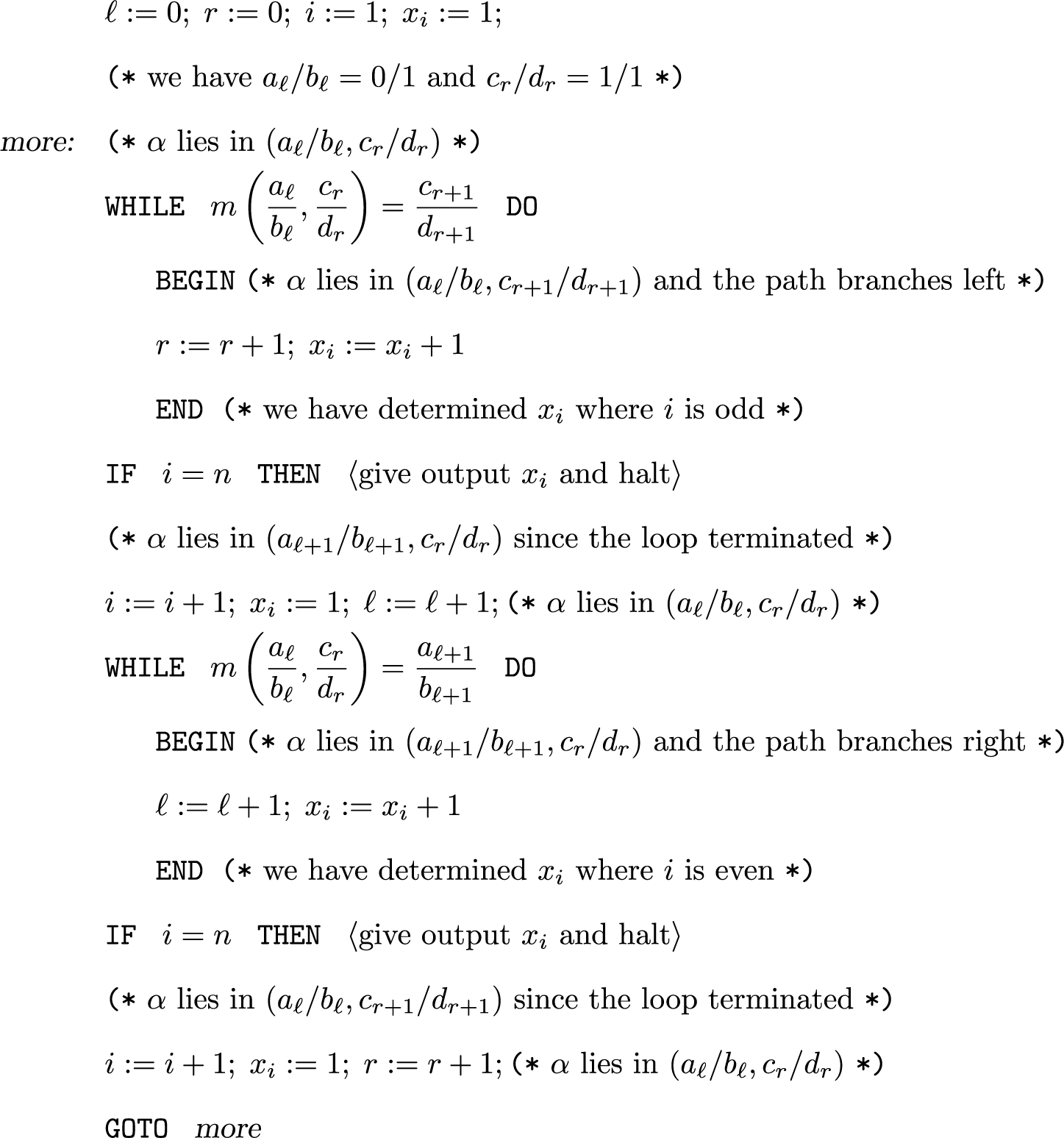


 Open access

