

Today, there is little doubt that gender — defined as a bundle of personality traits, attitudes, and behaviors typically categorized as masculine and feminine (following the terminology suggestions in McDermott and Cassino Reference McDermott and Cassino2025) — is a major driver of political attitudes and behaviors. As McDermott (Reference McDermott2016, 26) argues, we know that personality traits are gendered, and we know that personality traits drive political behaviors and attitudes, so it would be surprising if gender wasn’t a major factor in how people view and interact with the political world. But there has been little research on the long-term stability of these measures, or the extent to which political views might shape how men and women identify as masculine or feminine. The stability of these items and the extent to which they change in the face of changes to political and social context are vitally important to how they are conceptualized and used: fluid measures tell us about the context that individuals perceive, while stable ones tell us about the individuals themselves. Essentially, the balance between stability and responsiveness in these measures informs how they should be conceptualized and used. Given that self-identified gender measures have recently been added to major institutional surveys in the field, the question of how these items should be understood has never been more relevant.
Up until recently, political scientists were generally content to use sex — defined in quasi-biological categories like male and female — as a proxy for gender, in what Forman-Rabinovici and Mandel (Reference Forman-Rabinovici and Mandel2023) refer to as “gender blindness.” The assumption was that for most people, most of the time, sex and gender are related such that most men are more masculine than they are feminine, and most women are more feminine than they are masculine, so sex roughly corresponds to gender. In addition to ignoring the overwhelming evidence for the non-binary nature of gender (as in Alexander, Bolzendahl, and Wängnerud Reference Alexander, Bolzendahl and Wängnerud2021; Hyde et al. Reference Hyde, Bigler, Joel, Tate and van Anders2019), such an approach ignores variation in masculinity and femininity among men and women. As Bittner and Goodyear-Grant (Reference Bittner and Goodyear-Grant2017a) argue, sex might generally be an OK proxy for gender, but it’s not a great one, and as gendered issues become increasingly salient in politics, getting good measures of gender becomes increasingly vital.
I begin this study by reviewing how these self-identification measures fit into the history of how researchers in social science have measured masculinity and femininity, before introducing the two longitudinal measures being analyzed. One is a scalar measure, running from 0 to 100, first measured in 2018; the second is a six-point categorical measure, first measured in 2021. Both measures were repeated on the same respondents in 2025. I analyze the overall stability of each of these measures over time, as well as the extent to which change in self-reported masculinity and femininity is structured by political views, specifically support for Donald Trump.
Measurement of Masculinity and Femininity
While psychologists have been measuring masculinity and femininity since at least noted eugenicist Lewis Terman and Catharine Cox Miles made use of a bewildering variety of measures (including inkblot interpretation, favored childhood games, and knowledge of poetry, among others) in the Terman-Miles M-F test (1936), work in political science has been dominated by two approaches: trait-based measures and self-placement measures.
Trait-based measures rely on lists of attitudes or behaviors that have been judged a priori to be masculine or feminine. The extent to which an individual reports exhibiting the attitudes or behaviors in the list is used to measure how masculine or feminine they are. The most commonly used scales of this type in social science research are the Personal Attributes Questionnaire (PAQ; Spence, Helmreich, and Stapp Reference Spence, Helmreich and Stapp1975) and the Bem Sex Role Inventory (BSRI; Bem Reference Bem1974). While these scales — especially the BSRI — have been criticized (see Choi and Fuqua Reference Choi and Fuqua2003), they have also proven to be useful in modelling political behavior (see Coffé Reference Coffé2019; Hershey Reference Hershey1977; McDermott Reference McDermott2016; Peterson, Palmer, and Bosanko Reference Peterson, Palmer and Bosanko2024). But however useful they may be, they are also lengthy, with even short versions containing 20 items or more: too long for inclusion in non-dedicated surveys.
As an alternative, political scientists have turned to self-placement scales, in which respondents place themselves on uni-dimensional (one scale running between masculine and feminine) or bi-dimensional (two scales, running from not at all to very on both masculinity and femininity) scales of gender. While the recent popularity of such scales emerges from work by Magliozzi, Saperstein, and Westbrook (Reference Magliozzi, Saperstein and Westbrook2016) and Bittner and Goodyear-Grant (Reference Bittner and Goodyear-Grant2017a, Reference Bittner and Goodyear-Grant2017b), there is a long tradition of simply asking respondents how masculine or feminine they are, going all the way back to Terman and Miles (Reference Terman and Miles1936), who used it as one element in their measure, or, more recently, to Stern, Barak, and Gould’s Sexual Identity Scale (Reference Stern, Barak and Gould1987). These self-placement scales have the advantage of brevity, making them more useful for incorporation in non-dedicated surveys.
Of course, the trait-based scales have some advantages: they are likely to be less responsive, and men and women are more likely to give responses that indicate traits not traditionally associated with their sex than they are to assert such traits in a self-description. But it doesn’t follow that they should always be preferred, even if they were equally available. Perhaps the strongest case against such scales comes from Connell (Reference Connell1995, 69), who argues that trait-based measures require that the researcher impose their definitions of masculinity and femininity on the respondents, and flatten the definitions of masculinity and femininity by defining them largely as what men do (or should do), and what women do (or should do). To these objections, I would add the notion that researchers should be circumspect about categorizing individuals, especially with respect to sensitive categories such as gender, in ways that the individuals would not categorize themselves. The BSRI, for instance, classifies a significant number of respondents as “androgynous,” without consideration of whether respondents would categorize themselves as such. Markstedt et al. (Reference Markstedt, Wängnerud, Solevid and Djerf-Pierre2021) link the movement toward self-placement scales with social identity theory. In this view, the question being asked by self-placement scales is not the extent to which an individual exhibits masculine or feminine traits, but the extent to which the individual identifies as masculine or feminine.
However, even within research making use of self-placement scales, there is disagreement as to what form those scales should take. Bittner and Goodyear-Grant (Reference Bittner and Goodyear-Grant2017a) make use of a 0–100 point scale included on the Canadian Election Study (which later moved to separate 0–100 point scales for masculinity and femininity). In previous work, I have advocated (Cassino Reference Cassino2020) for a six-point anchored scale on telephone surveys, where 0–100 point scales might prove unwieldy. Bidimensional scales are more in line with our theoretical understanding of the non-binary nature of gender (someone can have both masculine and feminine traits, an understanding reflected well in the BSRI), though my co-authors and I have argued (Cassino Reference Cassino2020; Cassino and Besen-Cassino Reference Cassino and Besen-Cassino2021a) that unidimensional scales are sufficient for most general population samples. While the current study is based on US samples, the fact that these scales have been developed and deployed in various contexts in North America and Europe suggests that this is an area of concern for scholars globally.
Stability of Self-Report Scales
While self-placement scales have gained popularity and have started to be included in widely used omnibus studies, there are still questions about the utility of what they’re measuring. The underlying assumption of these scales is that they are measuring a stable underlying trait: someone who identifies as “completely feminine” today is also likely to do so next week, next month, or next year. But this is an untested hypothesis, and an important one.
If it is the case that self-placement scales are unstable, that individuals exhibit substantial change in how they identify as masculine or feminine over time, that undercuts the case for using them as an independent variable in models of political and social behavior. When researchers show, for instance, that more masculine respondents have greater political engagement (as in Coffé and Bolzendahl Reference Coffé and Bolzendahl2021, using the BSRI), they are treating gender like a demographic factor, little different from age or education levels. These traits are rightly treated as independent variables in models of political behavior: more educated people may be more likely to support social welfare payments, but it would be strange to argue that support for social welfare payments leads an individual to be more educated. The stability of education, like other demographics, creates a reasonable presumption that it is a cause, rather than an effect. Just so, if we want to treat masculinity and femininity — especially as reported on a self-identification scale — as being predictors of political attitudes and behaviors, it needs to be shown that they are relatively stable within individuals over time.
Given research on the construction of masculinity and femininity, it might be expected that demographics like race, ethnicity, and sexuality would impact the gender individuals identify with (Abreu et al. Reference Abreu, Goodyear, Campos and Newcomb2000; Cazenave Reference Cazenave1984; Chong and Kim Reference Chong and Kim2022; Silva Reference Silva2022; Wong, Horn, and Chen Reference Wong, Horn and Chen2013; Young Jr Reference Young and Alford2021) Similarly, changes in factors that help to constitute or perform gender identity like age, income, or marital status (Coughlin and Wade Reference Coughlin and Wade2012; Gonalons-Pons and Gangl Reference Gonalons-Pons and Gangl2021; MacDonald, Ebert, and Mason Reference MacDonald, Ebert and Mason1987; Munsch Reference Munsch2015; Thébaud Reference Thébaud2010) might lead to systematic change in how people identify with masculine or feminine gender identities. While this is an important issue, longitudinal evidence on the stability of masculinity and femininity is scant and mixed. Naurin et al. (Reference Naurin, Markstedt, Stolle, Elden, Sengpiel and Linden2021) find that pregnancy does not impact self-reported masculinity or femininity among their Swedish panel over the course of two years. Burke and Cast (Reference Burke and Cast1997) find that marriage does change scores on a battery based on the PAQ among their relatively small sample of newly married couples over the course of three years.
This question of long-term stability is especially pressing in light of the observed relationship between gender identity threat and political views. A growing body of research has shown that perceived threats to the masculinity or femininity of individuals (either induced by the researchers or resulting from outside factors like loss of income) can lead to changes in their political preferences (see, for instance, Cassino and Besen-Cassino Reference Cassino and Besen-Cassino2021b; DiMuccio and Knowles Reference DiMuccio and Knowles2021; Linders, Dudink, and Spierings Reference Linders, Dudink and Spierings2023; Mansell et al. Reference Mansell, Harell, Thomas and Gosselin2022; Maricourt and Burrell Reference Maricourt and Burrell2022). Generally, in studies like these, the idea is that individuals can make use of political views as a kind of compensatory action, bolstering a threatened gender identity through the use of political attitudes or behaviors. In Cassino (Reference Cassino2018), for example, an induced gender identity threat in a survey item led men to be more likely to support Donald Trump in an election match-up, but only when he was pitted against a female candidate. The men seemingly responded to threats to their masculinity by doubling down on an action that they believed would be perceived as masculine: announcing that they would not vote for a female candidate for office (in this case, Hillary Clinton).
The relationship between gender identity and support for Donald Trump in US Presidential elections has been the subject of a great deal of recent work in political science (i.e. Carian and Sobotka Reference Carian and Sobotka2018; Deckman and Cassese Reference Deckman and Cassese2021; Long, Dawe, and Suhay Reference Long, Dawe and Suhay2022; Marx-Ferree Reference Marx-Ferree2020; Messerschmidt Reference Messerschmidt2021). Researchers have found that both trait-based (existing prior to the study) and state-based (induced by the researchers) threats to men’s gender identities lead them to a greater likelihood of supporting Trump, and that priming men to think about gender leads to a greater likelihood of support for Trump. Moreover, the extent to which Trump (like some other political leaders) has made naked appeals to masculinity and gender traditionalism more generally (i.e. Bernhard Reference Bernhard2022; Conroy Reference Conroy2018; Johnson and Williams Reference Johnson and Williams2020; Linders, Dudink, and Spierings Reference Linders, Dudink and Spierings2023) raises the possibility that Trump supporters may be prone to changing their reported masculinity or femininity to fit with their support for him. Given the similar relationships between gender and political preferences that have been identified outside of the US context (for instance, Coffé et al Reference Coffé, Fraile, Alexander, Fortin-Rittberger and Banducci2023 in Spain; Cassino and Besen-Cassino Reference Cassino and Besen-Cassino2021a in Mexico; Daddow and Hertner Reference Daddow and Hertner2021 in Germany and the UK; Coffé Reference Coffé2019 in the Netherlands; Bittner and Goodyear-Grant Reference Bittner and Goodyear-Grant2017a in Canada), it seems likely that similar dynamics would be at play in democracies worldwide.
The untested implication is that political attitudes and behaviors can change an individual’s identification with masculinity or femininity, raising the possibility of reciprocal causation. It may be the case that more masculine individuals are more likely to support some candidates or hold some political views, but it also may be the case that those political actions lead the individual to identify more strongly with masculinity or femininity.
These potentially conflicting understandings leave us with two important questions: how stable are these self-placement scales, and how do political views impact that stability?
The Longitudinal Measures
Answering these questions requires longitudinal self-placement measures of gender. Such measures can be found in the Understanding America Survey, an online survey panel maintained by the University of Southern California. A scalar measure of masculinity/femininity was included in a 2018 survey,Footnote 1 and a categorical measure in a 2021 survey.Footnote 2 Both items were then replicated in a 2025 survey,Footnote 3 in which respondents who had completed one of the earlier waves including gender measures were asked to do so again, four or six years after the initial administration.
The UAS is an online panel but has sampling processes that are superior to most such panels. First, respondents are recruited through an address-based sampling procedure, meaning that initially recruited samples are from a probability-based sample. This sample had a strong recruitment rate: across all sample recruitment batches (a total of 163,000 contacts as of 2024), 28 percent (45,830) of contacted potential respondents replied to the invitation; 14 percent (22,422, all sample numbers from Kapteyn et al Reference Kapteyn, Angrisani, Darling and Gutsche2024) completed the initial household information survey and entered the panel. Second, if prospective members of the panel do not have their own internet connections and/or capable devices, they are provided with them by the UAS, eliminating one source of bias common to online samples. The UAS also boasts high response rates, with 70–80 percent of respondents invited to complete a survey generally doing so. Of course, panel attrition means that any sample necessarily loses population validity over time, but UAS panels at least start at a very high level of representativeness.
In total, 3,337 respondents were asked to complete the 2025 follow-up survey: a random sub-sample of respondents to the original surveys, including an oversample of LGBT respondents (which constituted 22 percent of the 2025 sample). Of those invited, 2,511 completed the survey, and 11 started it, but did not finish, for an overall response rate of 75.2 percent. Ninety-four percent of respondents finished the survey in five minutes or less. The analyses that follow exclude the small number of respondents who did not identify as either men or women, as the sample size of this group is too small to allow for substantive analysis.
While the fact that these samples are from an online panel means that there may be concerns about the population validity of the overall sample, there is little indication that the results are being driven by survivorship bias. Of course, the individuals answering the masculinity/femininity items in the initial measurement in 2017 or 2021 may well have been different from respondents who had already dropped out of the sample, but while this would limit the population validity of the sample as a whole, it would not be expected to bias the results of the existing analyses.
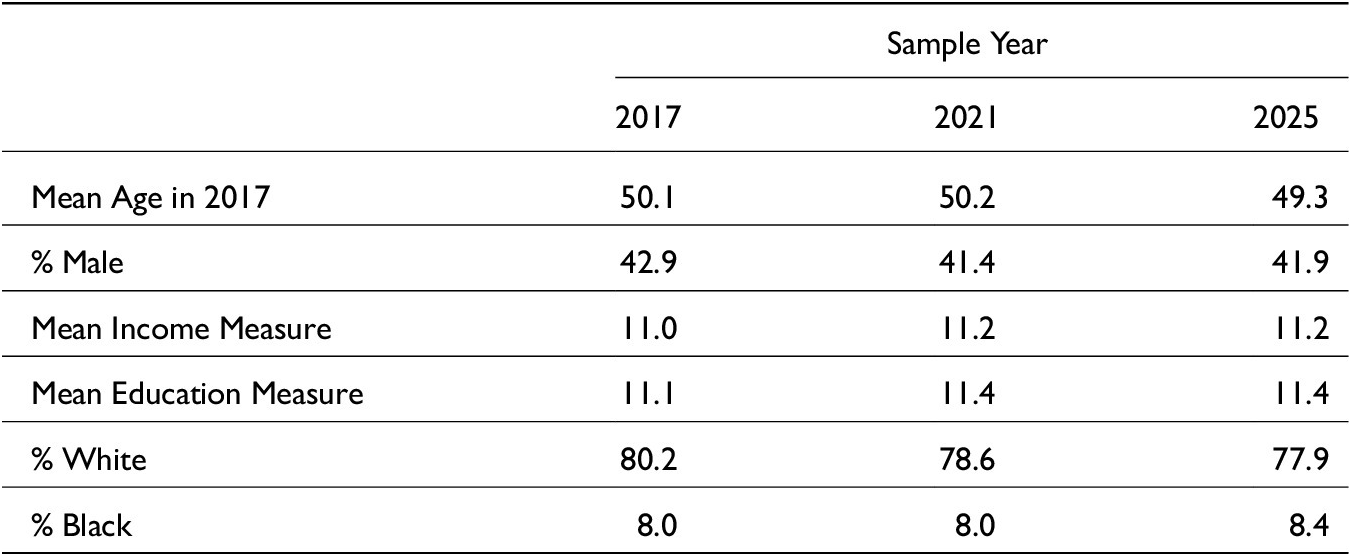
The unweighted (weights were not used in any of the tables or analyses discussed here) demographics of the sample in the 2017, 2021, and 2025 waves (as seen in Table 1) in which gender was measured are all very similar with regard to age, sex, income, and education, with the biggest change being that respondents to the second wave in 2025 were slightly less likely to be white, indicating that white respondents may have been slightly more likely than members of other groups to drop out of the panel. Still, even this difference is only about 2 percentage points.
Unweighted demographic characteristics of samples
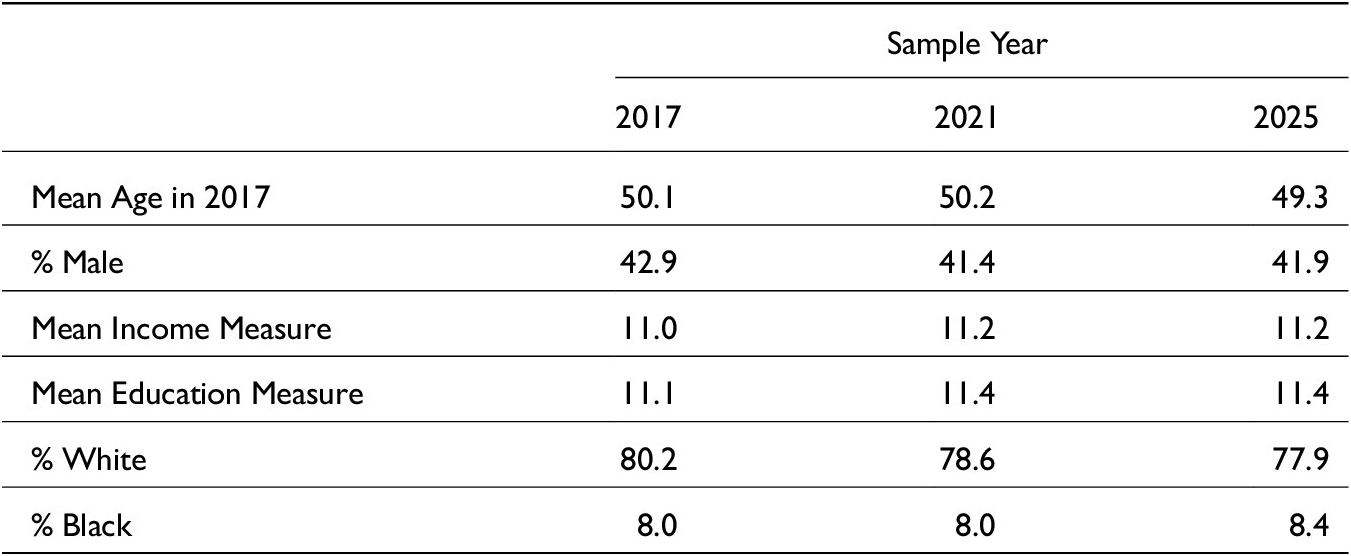
Table 1. Long description
The table consists of four columns. The first column lists demographic variables, while the remaining three columns represent the sample years 2017, 2021, and 2025 respectively.
* Mean Age in 2017: 50.1 in 2017, 50.2 in 2021, and 49.3 in 2025.
* % Male: 42.9 in 2017, 41.4 in 2021, and 41.9 in 2025.
* Mean Income Measure: 11.0 in 2017, 11.2 in 2021, and 11.2 in 2025.
* Mean Education Measure: 11.1 in 2017, 11.4 in 2021, and 11.4 in 2025.
* % White: 80.2 in 2017, 78.6 in 2021, and 77.9 in 2025.
* % Black: 8.0 in 2017, 8.0 in 2021, and 8.4 in 2025.
Research Questions
This data allows me to look at two important questions about these scales. First, how stable is the masculinity/femininity self-placement of individuals over time? Second, how is individual-level self-placement changed by demographic and political factors?
Generally, the smaller number of points in the categorical measure, and the clearer distinctions between categories would lead to the expectation that these measures would be more stable over time than scalar measures with more points and fewer anchors (as per general findings about smaller, anchored scales: Krosnick and Presser Reference Krosnick, Presser, Marsden and Wright2010). However, this is not a distinction that has been tested, and to make for a fair comparison between the two types of scales, responses to both scales have been put into equivalent bins for comparison, as discussed later.
Of course, the contextual nature of gender identity means that we would not expect it to be completely stable over time, as other demographic characteristics like age or education might be. However, to the extent that it is wildly unstable, veering in response to contextual cues, it would be much less useful as a measure than if it were stable. Complete stability is unlikely, but so too is someone identifying as very feminine one day, and very masculine the next. The question is where on that continuum these measures lie, and to what extent these measures represent a stable underlying trait, even if that trait is expressed differently in different contexts. The more stable they prove to be, the more likely they are to be useful as independent variables in analyses of political and social attitudes.
The Categorical Measure
Respondents in the 2025 survey were split about evenly between those who had completed a scalar measure of masculinity/femininity in 2018 and those who had completed a categorical measure in 2021. Some respondents had completed both and were randomly assigned to one or the other for the 2025 wave.
The categorical measure makes use of 1–6 scale, based on the wording used in Cassino (Reference Cassino2020), though with a truncated introduction.
Regardless of their biological sex, some people see themselves as more feminine and others see themselves as more masculine. How masculine or feminine do you see yourself?
-
1 Completely masculine
-
2 Mostly masculine
-
3 Slightly masculine
-
4 Slightly feminine
-
5 Mostly feminine
-
6 Completely feminine
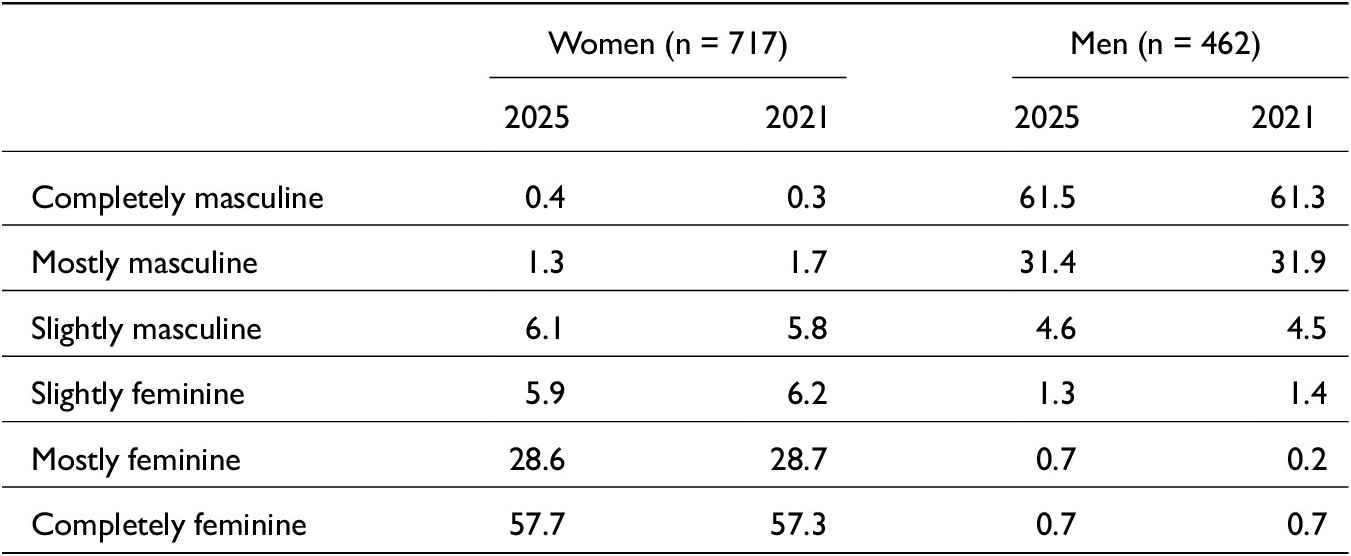
As shown in Table 2, in the scalar measure, women tended to place themselves in the most feminine category, and men in the most masculine category. Among both men and women, most of the rest placed themselves into the next category, “mostly” masculine or feminine, and few identify with the gender not traditionally associated with their sex.
Categorical measure of gender, 2021 and 2025 surveys
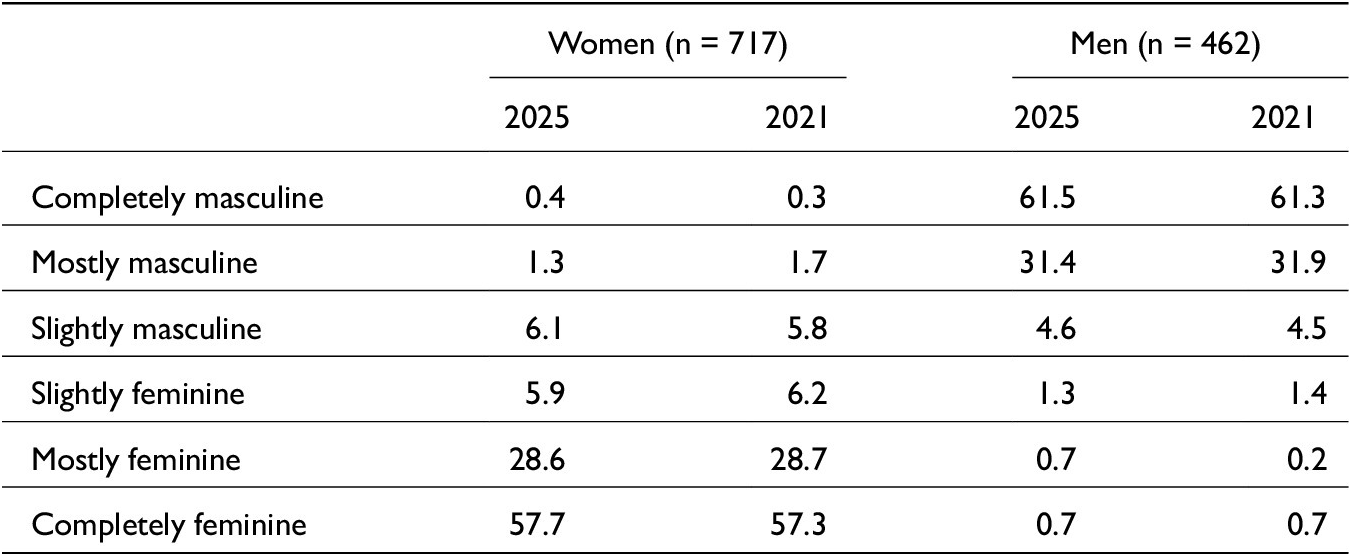
Table 2. Long description
The table is organized into five columns. The first column lists gender identity categories. The next two columns represent Women (n = 717) for the years 2025 and 2021. The final two columns represent Men (n = 462) for the years 2025 and 2021.
* Completely masculine: Women (0.4 in 2025, 0.3 in 2021); Men (61.5 in 2025, 61.3 in 2021).
* Mostly masculine: Women (1.3 in 2025, 1.7 in 2021); Men (31.4 in 2025, 31.9 in 2021).
* Slightly masculine: Women (6.1 in 2025, 5.8 in 2021); Men (4.6 in 2025, 4.5 in 2021).
* Slightly feminine: Women (5.9 in 2025, 6.2 in 2021); Men (1.3 in 2025, 1.4 in 2021).
* Mostly feminine: Women (28.6 in 2025, 28.7 in 2021); Men (0.7 in 2025, 0.2 in 2021).
* Completely feminine: Women (57.7 in 2025, 57.3 in 2021); Men (0.7 in 2025, 0.7 in 2021).
These results broadly align with national surveys using the same categories, though respondents in this panel were more likely to be in the “completely” categories than respondents in weighted representative national surveys. In those surveys, about 50 percent of men and women identify as “completely” masculine or feminine (Cassino Reference Cassino2020).
Stability of the Categorical Measure
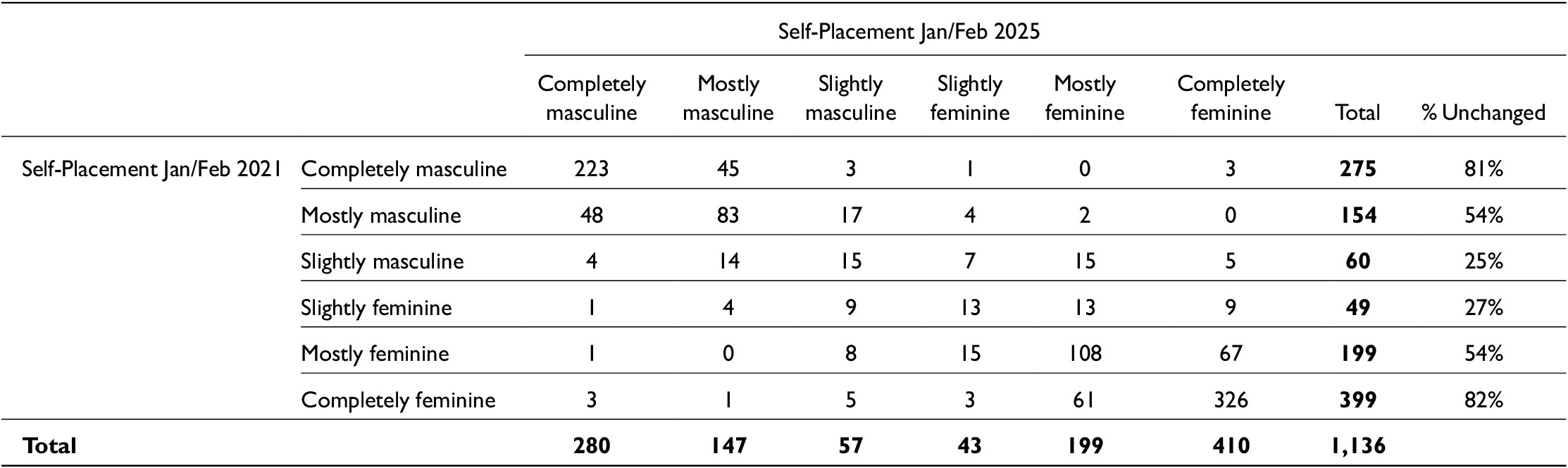
A total of 1,136 respondents answered the six-point categorical self-placement item in January or February of 2021 and again four years later: their responses are shown in Table 3. Of these, 768 (68 percent) gave the exact same response both times; 296 (26 percent) moved by one category in either direction. That leaves a total of 72 (6 percent) respondents who moved more than one category in their self-placement over the four years between surveys.
Categorical masculinity/femininity self-placement, 2021 and 2025
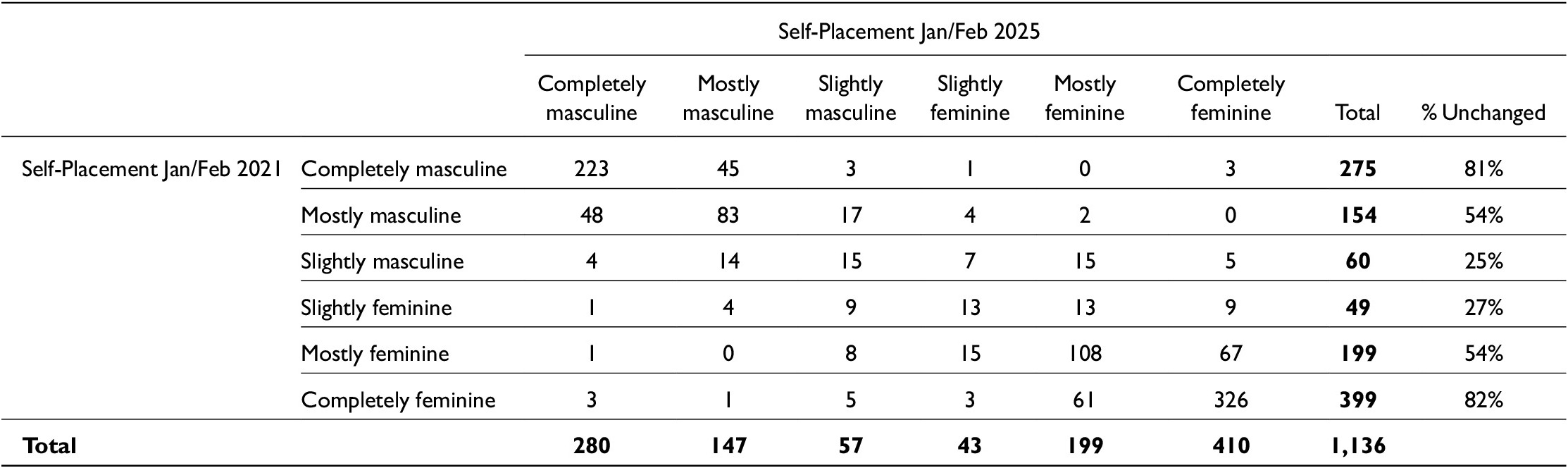
Table 3. Long description
A data table comparing self-placement on a masculinity-femininity scale from January or February 2021 (rows) to January or February 2025 (columns).
Rows and Columns use the same six categories: Completely masculine, Mostly masculine, Slightly masculine, Slightly feminine, Mostly feminine, and Completely feminine.
* Completely masculine (2021): 223 remained unchanged, 45 moved to mostly masculine, 3 to slightly masculine, 1 to slightly feminine, 0 to mostly feminine, and 3 to completely feminine. Total: 275. 81 percent unchanged.
* Mostly masculine (2021): 48 moved to completely masculine, 83 remained unchanged, 17 moved to slightly masculine, 4 to slightly feminine, 2 to mostly feminine, and 0 to completely feminine. Total: 154. 54 percent unchanged.
* Slightly masculine (2021): 4 moved to completely masculine, 14 to mostly masculine, 15 remained unchanged, 7 to slightly feminine, 15 to mostly feminine, and 5 to completely feminine. Total: 60. 25 percent unchanged.
* Slightly feminine (2021): 1 moved to completely masculine, 4 to mostly masculine, 9 to slightly masculine, 13 remained unchanged, 13 to mostly feminine, and 9 to completely feminine. Total: 49. 27 percent unchanged.
* Mostly feminine (2021): 1 moved to completely masculine, 0 to mostly masculine, 8 to slightly masculine, 15 to slightly feminine, 108 remained unchanged, and 67 to completely feminine. Total: 199. 54 percent unchanged.
* Completely feminine (2021): 3 moved to completely masculine, 1 to mostly masculine, 5 to slightly masculine, 3 to slightly feminine, 61 to mostly feminine, and 326 remained unchanged. Total: 399. 82 percent unchanged.
The total counts for 2025 are: 280 Completely masculine, 147 Mostly masculine, 57 Slightly masculine, 43 Slightly feminine, 199 Mostly feminine, and 410 Completely feminine. The grand total sample size is 1,136.
Stability is about equal for self-identified men and women. Of the 691 women with measurements at both points in time, 460 (67 percent) have the same response both times, and only 8 percent move by more than one category. For the 445 men with both measurements, 308 (69 percent) have the same response both times, and only four percent move more than one category.
Among both men and women, stability is highest in the extreme categories of the gender traditionally associated with their sex. Among the 396 women with both measurements who placed themselves as “completely feminine” in 2021, and the 273 men who did the same with “completely masculine,” fully 82 percent placed themselves in the same category four years later. Stability was lowest among individuals who placed themselves outside of the “completely” or “mostly” categories traditionally associated with their sex. For women who described themselves as “slightly feminine” or as at all masculine (constituting a third group), only 28 percent were in the same category four years later. But this group constitutes just 14 percent of the women with two measurements, and 55 percent of the women who were in this group in 2021 are still in it (so not “completely feminine” or “mostly feminine”) four years later. Among men who described themselves as “slightly masculine” or as feminine in 2021, just 21 percent are in the same exact category four years later; but that group is just 7 percent (29 men) of the sample with measurements at both points.
All told, the categorical measure of masculinity and femininity shows a high degree of stability over the four-year period studied, with just six percent of respondents moving more than one category over time, and more than 2/3rds giving the same response four years after the initial administration. The highest rates of instability are among individuals only weakly, or not at all, attached to the gender traditionally associated with their sex, but this group represents a small portion — about 11 percent — of the sample. Even that figure is relatively higher among this sample than among general population samples taken at either point in time.
Scalar Measure
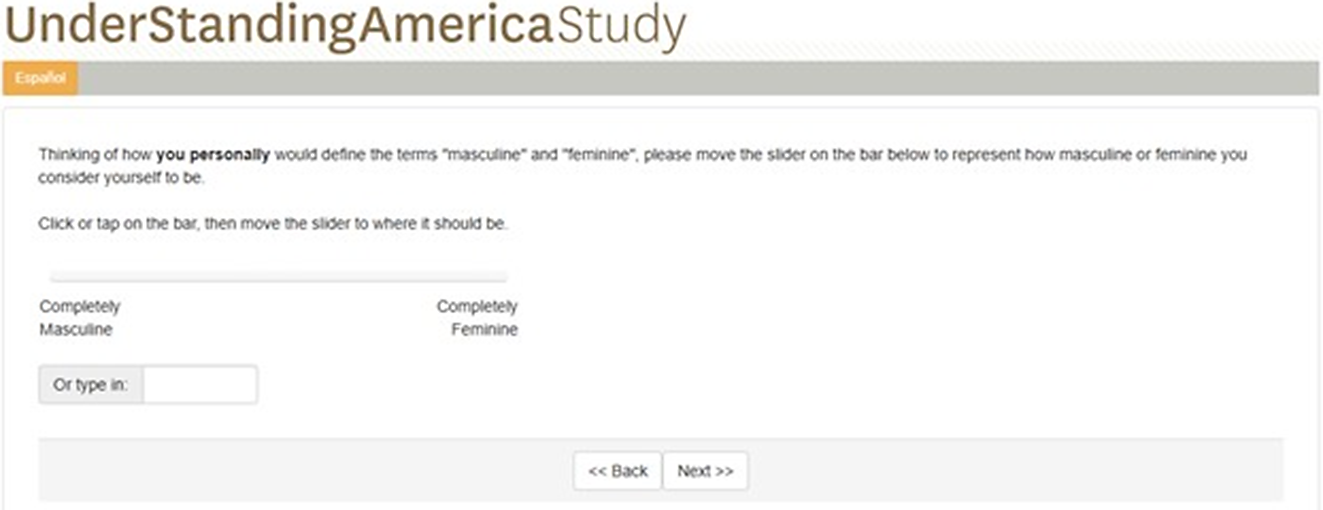
The scalar measure of masculinity/femininity made use of a 0–100 unidimensional scale, in which 0 represents completely masculine and 100 represents completely feminine. Respondents in the 2018 and 2025 surveys were given the prompt seen in Figure 1.
Scalar measure prompt.
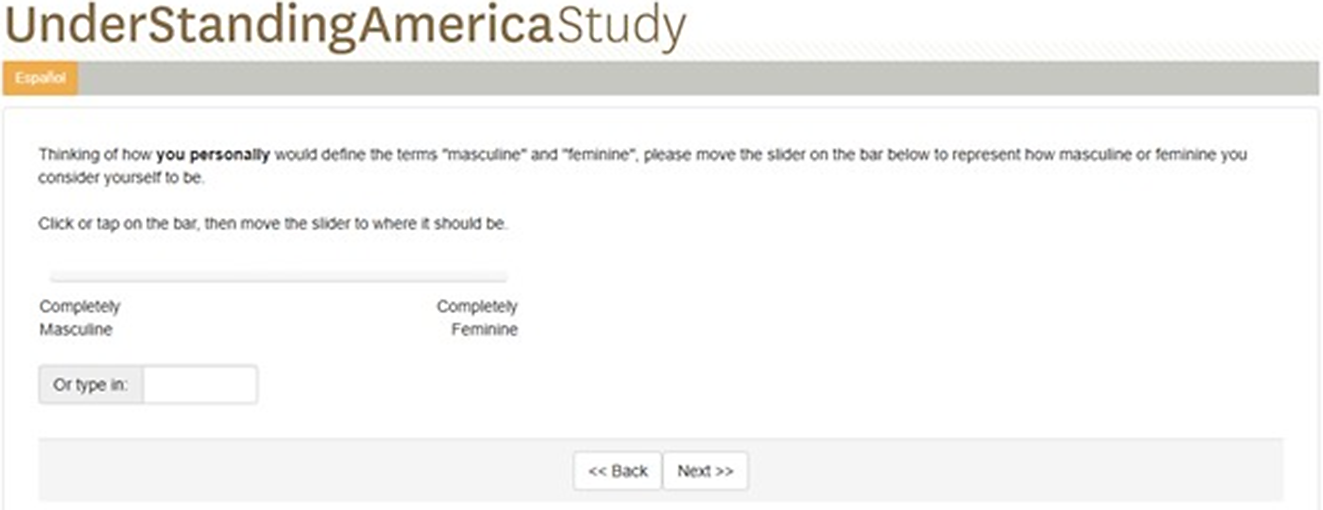
Aside from “completely masculine” at the left side of the scale and “completely feminine” on the right, the scale was unlabeled.
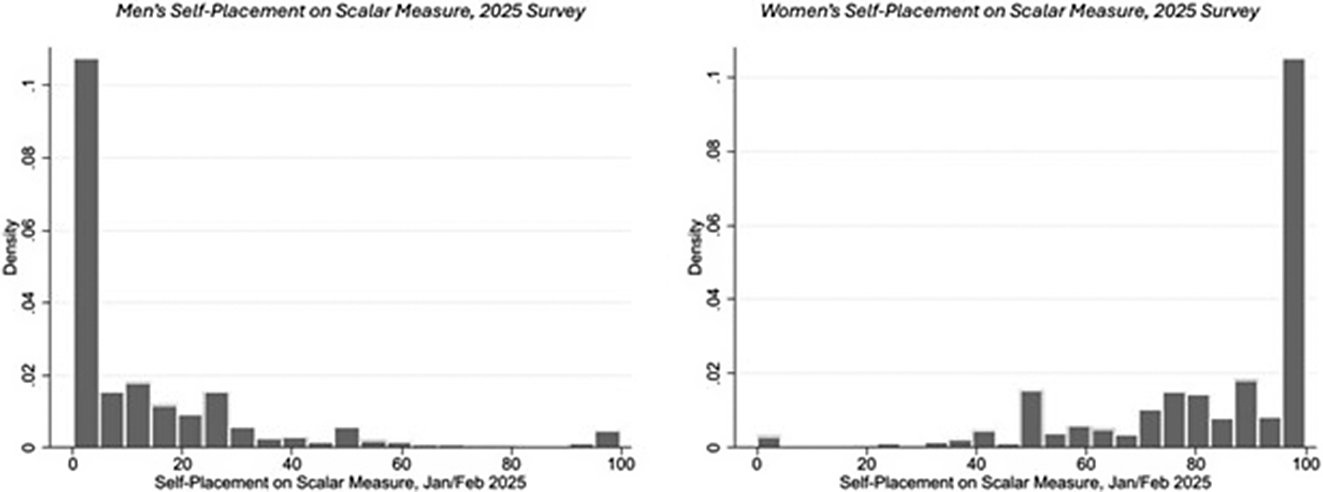
Responses to the scale are shown in Figure 2. Thirty-six percent of the 458 men in the 2025 survey placed themselves at 0 on the scale, and 2/3rds placed themselves at 14 or below. The mean score for men was 14.0, with a median of 4, and a standard deviation of 21.6.
Men’s and women’s self-placement on scalar measure, 2025 survey.
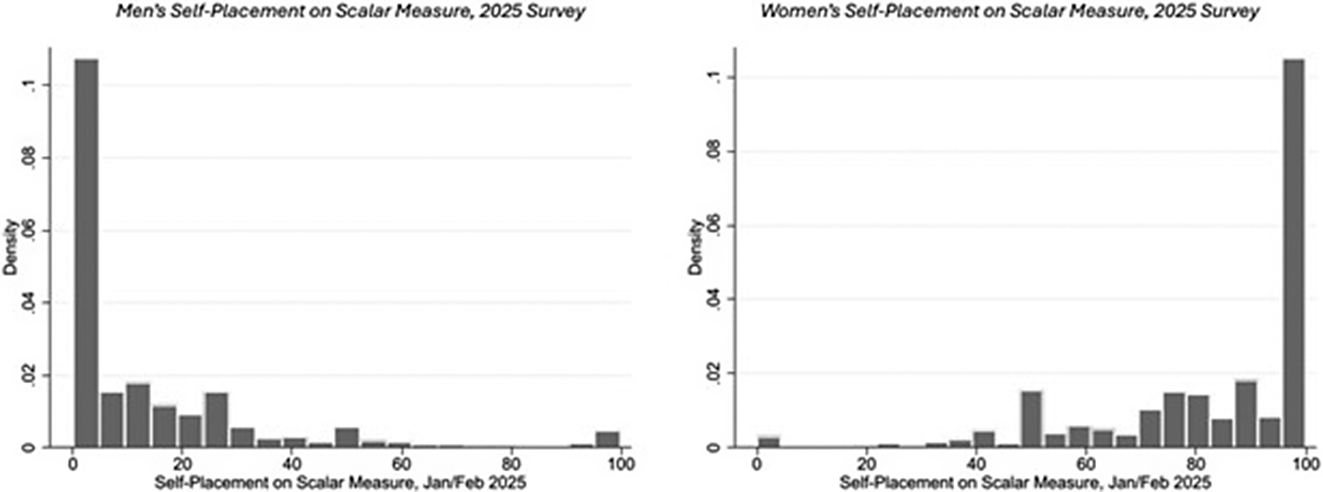
Figure 2. Long description
A two-panel figure showing density distributions.
Left Panel: Men's Self-Placement on Scalar Measure, 2025 Survey.
- The y-axis represents Density, ranging from 0 to 0.1.
- The x-axis represents Self-Placement on Scalar Measure, Jan/Feb 2025, ranging from 0 to 100.
- The data shows a massive peak at the 0 mark, exceeding 0.1 density. The distribution then drops sharply, with minor fluctuations between 10 and 30, and remains very low (near zero density) from 40 to 100.
Right Panel: Women's Self-Placement on Scalar Measure, 2025 Survey.
- The y-axis and x-axis scales are identical to the left panel.
- The data shows the opposite trend. Density is near zero from 0 to 40. There is a slight increase and fluctuation between 50 and 90. A massive peak occurs at the 100 mark, exceeding 0.1 density.
Similarly, thirty-eight percent of the 559 women in the 2025 survey placed themselves at 100 on the scale, and 2/3rds placed themselves at 78 or above. The mean score for women was 82.8, with a median of 91 and a standard deviation of 21.7.
Stability of Scalar Measure
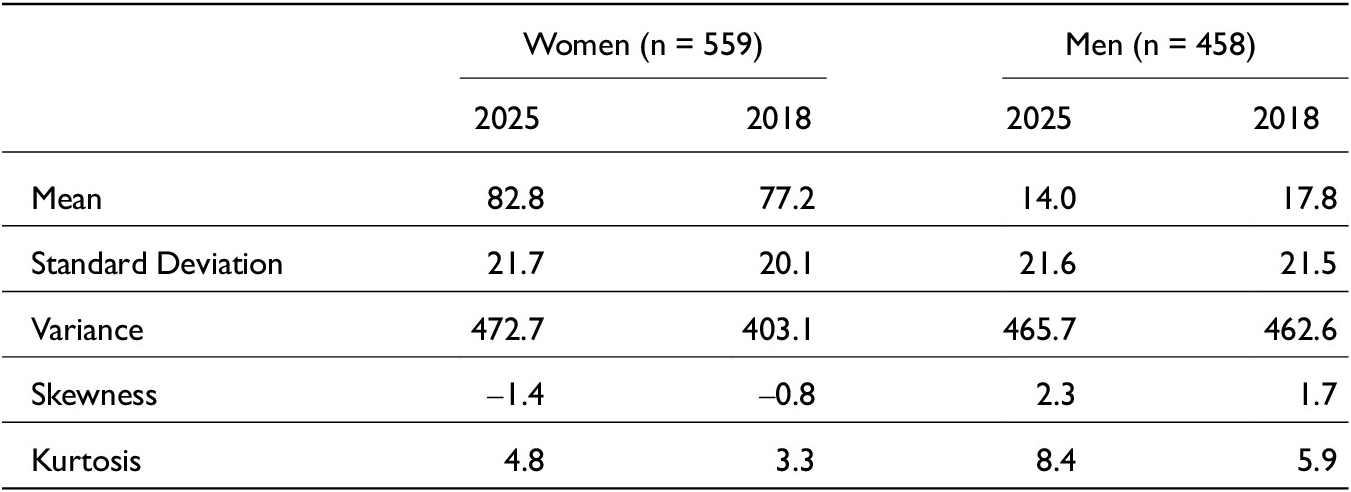
There are 1,017 respondents for whom there is data available for both October/November 2018 and January/February 2025 on the scalar measure. As shown in Table 4, the mean change in this measure (2025 self-rating minus 2018 self-rating) was 1.8 points, with a median change of 0 points. This measure of change was slightly higher among women than men: men in the sample rated themselves, on average, as 3.9 points more masculine (lower) on the scale in 2025 than they did in 2018 (median change -1). For women, the mean change was 6.0 points more feminine (higher), with a median change of 4. The median absolute difference between 2018 and 2025 was 8 points.
Scalar measure of gender, 2018 and 2025 surveys
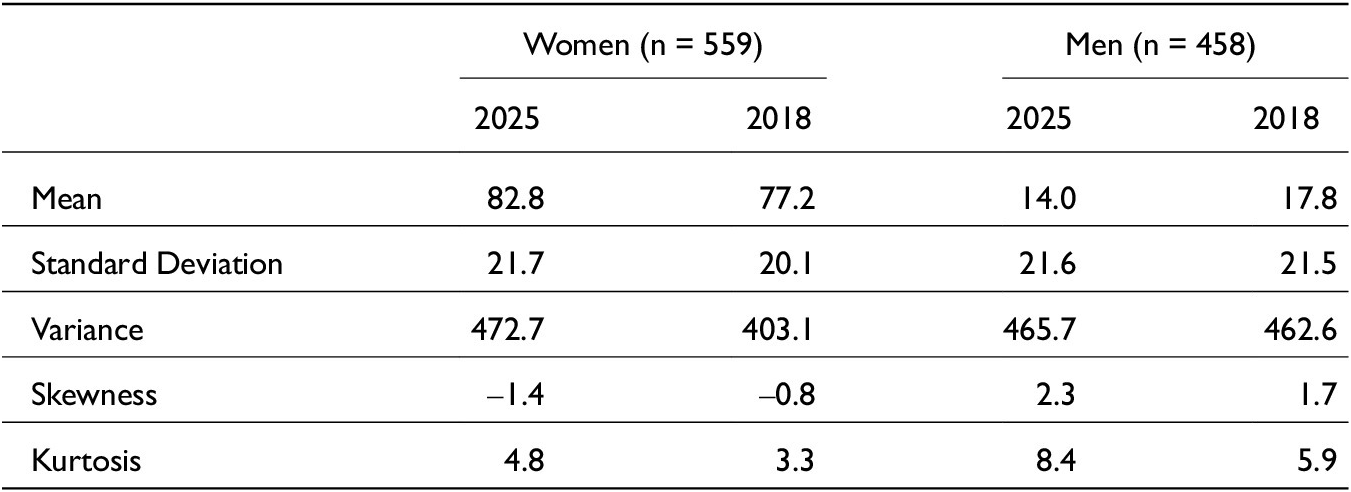
Table 4. Long description
The table is organized into five columns. The first column lists statistical measures, while the remaining four columns are grouped under two main headings: Women (n = 559) and Men (n = 458). Each group is subdivided into the years 2025 and 2018.
* Mean: Women 82.8 in 2025 and 77.2 in 2018. Men 14.0 in 2025 and 17.8 in 2018.
* Standard Deviation: Women 21.7 in 2025 and 20.1 in 2018. Men 21.6 in 2025 and 21.5 in 2018.
* Variance: Women 472.7 in 2025 and 403.1 in 2018. Men 465.7 in 2025 and 462.6 in 2018.
* Skewness: Women minus 1.4 in 2025 and minus 0.8 in 2018. Men 2.3 in 2025 and 1.7 in 2018.
* Kurtosis: Women 4.8 in 2025 and 3.3 in 2018. Men 8.4 in 2025 and 5.9 in 2018.
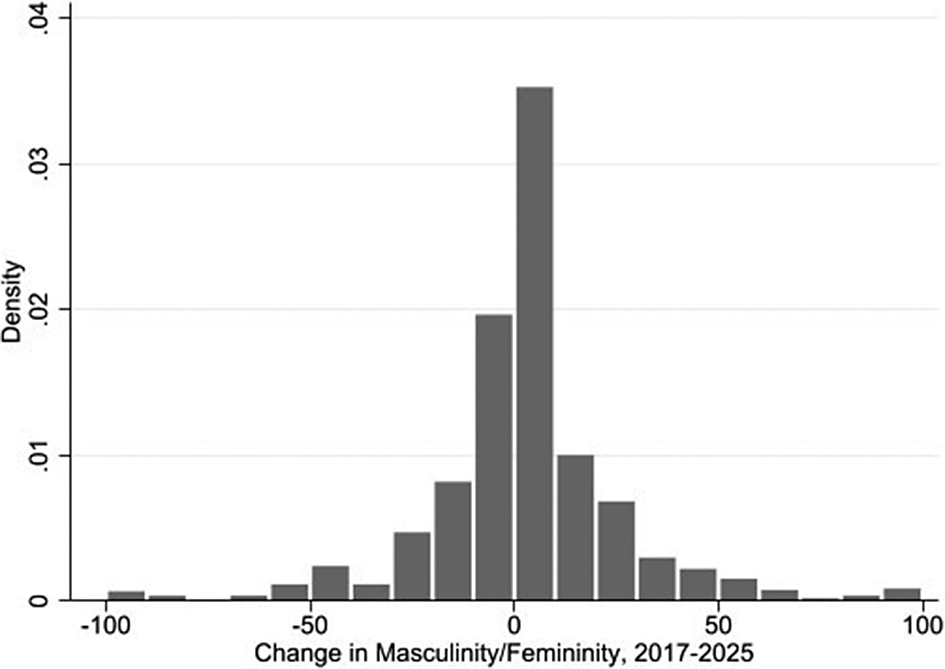
As shown in Figure 3, fourteen percent of respondents gave themselves the exact same score on the 0–100 scale in both 2018 and 2025 (mostly at the extremes of the scale), and 41 percent of respondents (425) had a 2025 rating within 5 points of their 2018 rating; 55 percent were within 10 points, 65 percent within 15, and 74 percent within 20 points. An unexpectedly high number of respondents moved from 0 (most masculine) to 100 (most feminine) or vice versa: this seems to be likely the result of misunderstanding of the scale directions or intentional trolling.
Change in scalar masculinity/femininity measure, 2017–2025.
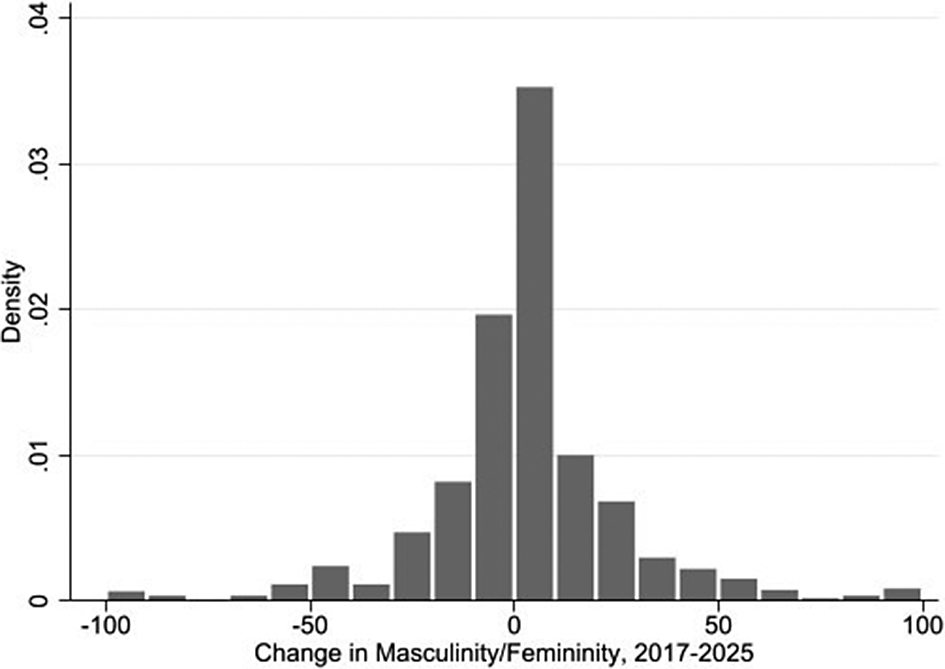
Figure 3. Long description
A histogram with the X-axis labeled Change in Masculinity/Femininity, 2017-2025, ranging from negative 100 to 100. The Y-axis is labeled Density, with increments of 0.01 from 0 to 0.04. The data is concentrated around the center, showing a leptokurtic distribution.
* From negative 100 to negative 25, the bars are very low, mostly below 0.005 density.
* Between negative 25 and 0, the density increases progressively through three bars.
* The highest peak occurs in the bin immediately to the right of 0, reaching a density of approximately 0.035.
* The bin immediately to the left of 0 is the second highest, at approximately 0.02.
* From 0 to 100, the density tapers off, with bars at 25, 50, and 75 showing a steady decline back toward the baseline.
A clearer picture of the overall stability of this measure comes from placing respondents into larger baskets. Dividing men up into three roughly equal groups (matching the number of groups in the categorical measure: there, they represent completely masculine, mostly masculine, and all other placements) depending on their 2025 responses means groups that represent scores of 0 (36 percent), 1–14 (31 percent), and 15 and over (33 percent), respectively. Fifty-two percent of men stayed in the same basket in both 2018 and 2025. As in the categorical measure, stability was higher in the extreme category traditionally associated with their sex (in this case, a score of 0), where 72 percent of the men who placed themselves at 0 in 2018 still did so in 2025. In contrast, only 53 percent of men who were in the third basket in 2018 were in it in 2025, and only 39 percent of men in the second basket in 2018 remained there in 2025.
Among women, equivalent baskets correspond to scores of 100, 76–99, and 75 or below. Just 47 percent were in the same basket in both periods, with the highest stability again coming from women in the extreme category, with 67 percent remaining at 100 at both measures.
In both the categorical and scalar measures, stability is greatest for respondents who identify with a gender identity traditionally associated with their sex, with less stability among respondents who are more weakly tied to that identity. Overall, the categorical measure seems to have greater stability, with respondents much more likely to stay in the same general category over the period studied. They’re also more likely to give the exact same placement but given the difference between a 101-point scale and a 6-point scale, this is hardly a fair comparison. The comparison is also complicated by the different time frames involved: the scalar measure is looking at stability over the course of a little more than six years, as opposed to the four years of the categorical measure. As such, even if the two scales were performing exactly as well over time, we would expect a rather larger variation in the scalar measure: people change more over six years than over four. Still, the difference in change over time between the two measures is enough that it would be reasonable to conclude that the categorical measure is more stable, perhaps because the labels attached to the categories ensure that the meaning remains stable to respondents. In contrast, the scalar measure may do a better job of smaller degrees of variation, especially over the short term, making it more useful in studies looking at state-based change in gender identity.
Structured and Random Variance in These Measures
Individual reports of masculinity and femininity might change over time for one of four reasons. It might be that the unobserved true level of masculinity or femininity within the individual (to the extent that such a construct can be said to exist) is reported only imperfectly, introducing a degree of random variation to responses at both time one and time two. Second, it might be the case that the item or scale is interpreted differently at time one and time two, leading to different responses even if the individual is attempting to give the same response.
Third, changes in the political or social environment may alter the willingness of respondents to assert a particular gender identity, leading to more biased responses at one wave of the study. Fourth, the individual may change in ways that lead them to have a different level of the unobserved true value of masculinity or femininity. Of course, all of these reasons for change may co-exist within an individual, who might, for instance, believe themselves to be more masculine now than in the past, but interpret the item differently, cancelling out or exaggerating the actual change in the underlying construct.
The big difference between these explanations for change is the extent to which we can account for the source of change. To the extent that flawed reporting is driven by a random process, we are unlikely to be able to account for it, and change resulting from it will show up in the error function of any regression model. Similarly, measurement error can be modeled — individuals who spend more time and attention on a survey or have higher levels of education may have lower levels of it — but it is also likely to be mostly subsumed in an error margin. Change driven by changes to the individual, however, can be modelled and accounted for.
As noted earlier, there are several factors that might be expected to lead individuals to consider themselves as more or less feminine or masculine. Men’s perception of their masculinity, for instance, is tied to their incomes, and especially to changes in income levels (i.e. Gonalons-Pons and Gangl Reference Gonalons-Pons and Gangl2021; Kaplan and Offer Reference Kaplan and Offer2022). Men and women’s gender identities may also be impacted by aging or changes in marital status (as in Burke and Cast Reference Burke and Cast1997). Even characteristics that are more resistant to change, like race/ethnicity, sexuality, and education levels, may lead individuals to experience external factors differently than other individuals, leading them to rate themselves differently on a systematic basis over time. To determine the extent to which such factors change the ways in which people rate themselves on the masculinity/femininity scales, regression analysis can be used, modelling the placement at time two as a function of the initial placement and these factors.
The Role of Politics
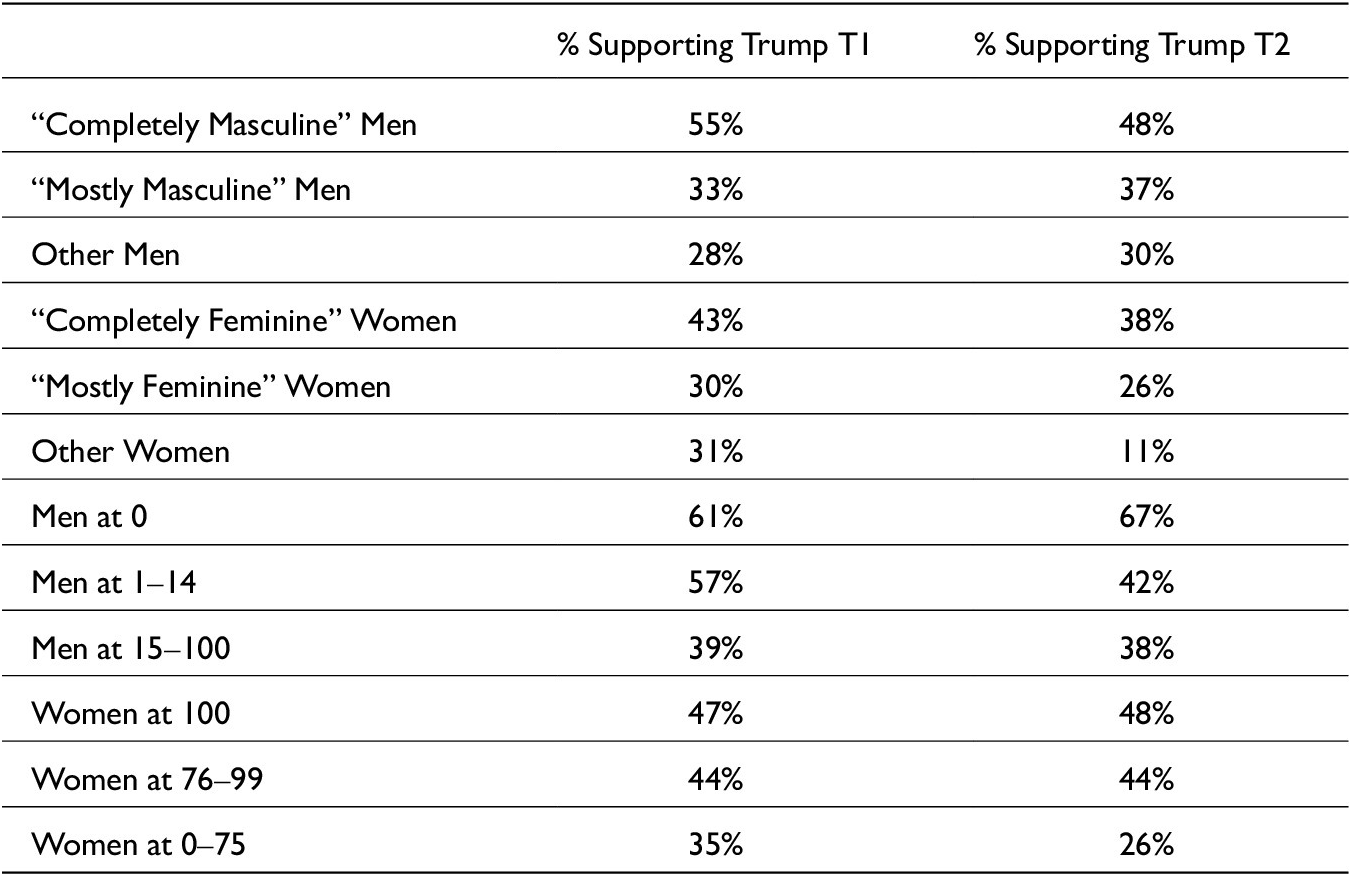
In the current data, men who rate themselves as “completely masculine” on the categorical scale, or at 0 on the 0–100 masculinity/femininity scale, are much more likely to support Trump than other respondents. As shown in Table 5, this relationship between identifying with a gender “completely” in line with that traditionally associated with the respondent’s sex exists among both men and women but is stronger among men (in both T1 and T2, corresponding to 2018 and 2025 or 2021 and 2025, depending on which scale is being analyzed). In general, the relationship between self-placement on either the scalar or categorical scales is relatively stable, though there is some indication that support for Trump (the construction of the Trump support measure is described later) has declined among women in the less feminine placement categories.
Relationship between masculinity/femininity self-placement and Trump support
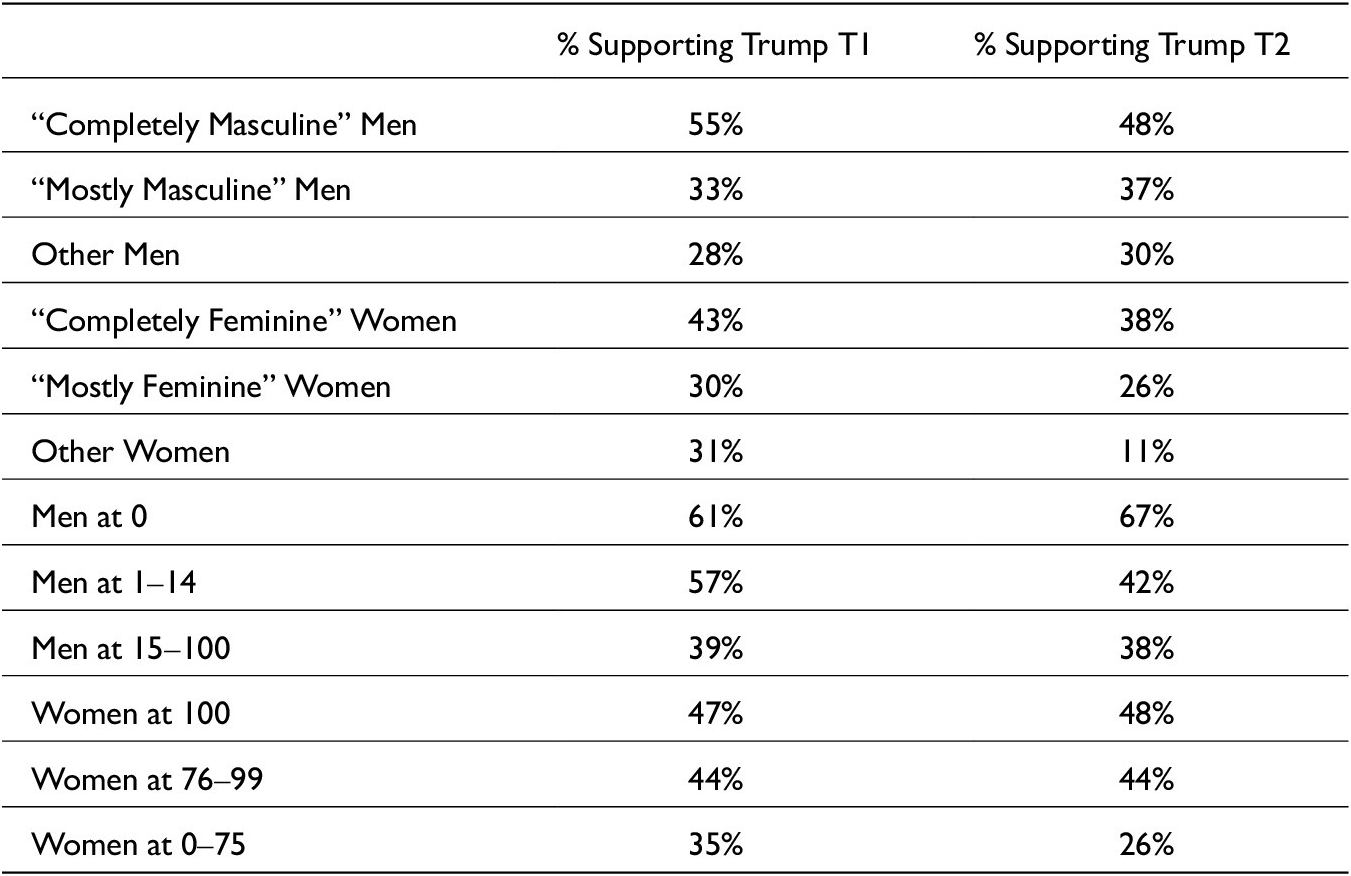
Table 5. Long description
The table contains three columns: the demographic category, percentage supporting Trump at T 1, and percentage supporting Trump at T 2.
* Completely Masculine Men: 55 percent at T 1, 48 percent at T 2.
* Mostly Masculine Men: 33 percent at T 1, 37 percent at T 2.
* Other Men: 28 percent at T 1, 30 percent at T 2.
* Completely Feminine Women: 43 percent at T 1, 38 percent at T 2.
* Mostly Feminine Women: 30 percent at T 1, 26 percent at T 2.
* Other Women: 31 percent at T 1, 11 percent at T 2.
* Men at 0: 61 percent at T 1, 67 percent at T 2.
* Men at 1 to 14: 57 percent at T 1, 42 percent at T 2.
* Men at 15 to 100: 39 percent at T 1, 38 percent at T 2.
* Women at 100: 47 percent at T 1, 48 percent at T 2.
* Women at 76 to 99: 44 percent at T 1, 44 percent at T 2.
* Women at 0 to 75: 35 percent at T 1, 26 percent at T 2.
The point is that there is a real, observed relationship between self-described masculinity/femininity and support for Trump in this data, as in other studies, creating the possibility that Trump support may lead individuals to place themselves in more traditional categories (more masculine for men, more feminine for women) in the 2025 survey wave.
To look at this possibility, I make use of a multinomial regression analysisFootnote 4 of respondents’ masculinity/femininity placement in 2025, as a function of self-placement at T1 (2018 or 2021), demographic factors, changes in those factors as appropriate, and stated intention to vote for Trump (or a report of having voted for him) in 2016, 2020, or 2024.Footnote 5 Because none of the three UAS surveys that include masculinity/femininity measures also include a measure of Trump support or partisanship, results from four different surveys in which some of the respondents indicated their vote choice were used to create the omnibus measure of Trump support. This does mean that Trump support is measured at different times, in different circumstances, and with different questions, but the underlying variable — support for Trump — is the same throughout. There are few respondents who answered Trump support questions more than once, and fewer than ten who gave different responses (for instance, supporting Trump in 2016, and not supporting him in 2024). These respondents were excluded from the analysis; while it would be interesting to analyze them separately, there simply aren’t enough cases to make this possible.
All told, this results in 1,942 respondents who have both a measure of Trump support and a reported masculinity/femininity measure at both Time One and Time Two, split about evenly between those with a categorical and a scalar response. Thirty-eight percent of the sample reported supporting Trump in at least one of the surveys, with a large number of respondents (typically 15–20 percent) reporting either no vote or support for a third-party candidate in the election items, and the Democratic candidates edging Trump in all three races by an average of eight points. Partisanship measures, while available, are asked in relatively inconsistent ways (for instance, registration rather than affiliation in some cases), and their inclusion would substantially reduce the number of respondents available for the regression analyses. Moreover, there is relatively little difference in the 2018–2025 period between Republican affiliation and support for Trump.
Models are run separately for the scalar and categorical models, and separately for men and women,Footnote 6 with both the independent and dependent variable measures of masculinity/femininity standardized to three groups (as described earlier for each: in thirds for the scalar measures, and completely masculine/feminine, mostly masculine/feminine, and other for the categorical).Footnote 7 In addition to Trump support, control variables include household income at T1 (on a 1–16 scale, where 1 is less than $5,000 annually and 16 is $150,000 or more, mean 11.2, median 13, standard deviation 4.0), change in household income between T1 and T2 (mean 0.7, median 0, standard deviation 2.7), age in 2017 (mean 49.3, median 50, standard deviation 14.9), race/ethnicity (included as dummy variables), whether the respondent was widowed (0.5 percent) or divorced (0.8 percent) between T1 and T2, their education level (on a 1–16 scale, where 9 is a high school diploma, 13 is a four-year college degree and 16 is a doctoral degree, mean 11.4, median 11, and standard deviation 2.3). Also included is whether the individual described themselves as being in the LGBTQ community, as a dummy variable. The main variables of interest in these models are self-reported masculinity/femininity at T2 (2025) and Trump support.
Modeling Challenges
The highly skewed distribution of the dependent variable in these models leads to challenges in how to best model them. If the distribution of the placement on either the scalar or categorical models (in either the raw or differenced form) followed something like a normal distribution, analyses as simple as OLS models might be appropriate. Since they do not, and are heavily skewed toward the fringes of the distribution (representing completely traditional gender identities among men and women, or zero change in a differenced form), zero-inflated models, a modeled heteroskedasticity approach, or even censored dependent variable models might be appropriate, but all of these models would require instrumental variables that simply are not available. The model used in the main analyses here (and described in the pre-registration for this study) instead leverages the actual distribution of the data and the apparent symbolic importance of the stated categories. While there is, for instance, only a one point difference in the scalar masculinity-femininity variable between being at 0 (the extreme end of masculinity, rejecting all femininity), and 1 (close to, but not at the extreme end of the scale), that difference is apparently meaningful for respondents, as evidenced by the large number of men placing themselves at 0, rather than 1 (a ratio of more than 5:1 in the 2025 data). However, a one-point shift between one and two on the scale, or five and six, isn’t nearly as meaningful as an assertion of gender identity and is relatively more common.
In addition, while the scalar model in principle has 101 possible choices, respondents simply don’t make use of most of them. More than half of respondents in the 2025 data describe themselves with one of just eight values (in order: 100, 0, 50, 1, 10, 80, 25, and 90). People like numbers divisible by 10, or numbers that correspond to quarters, but literally no one in the 2025 data picked, for instance, 59. This means that this variable is, in effect, an ordinal variable, so the question is not whether it should be treated like a ratio variable, but rather how many baskets it should be separated into. In the pre-registration for this analysis, I specified three baskets for both the scalar and categorical variables, as described previously. This has the benefit of providing roughly equally sized groups (the large number of respondents at 0/100 would necessarily mean that more groups would mean more unequally sized groups) and a fair comparison between the scalar and categorical questions, but does lead to the odd result that a man who moves from zero to one is seen as less stable over time than a man who moves from fifteen to eighty. I would argue that this is reasonable: there simply aren’t a lot of people making shifts like the latter, and moving within the group that describes themselves as not very masculine is less meaningful than moving from “completely” masculine to “mostly” masculine. Still, additional specifications of the model that do not make use of these baskets are presented in the appendix.
Scalar Models
The regression models for the unweighted scalar masculinity/femininity scales demonstrate substantial effects of Trump support on self-placement in 2025.
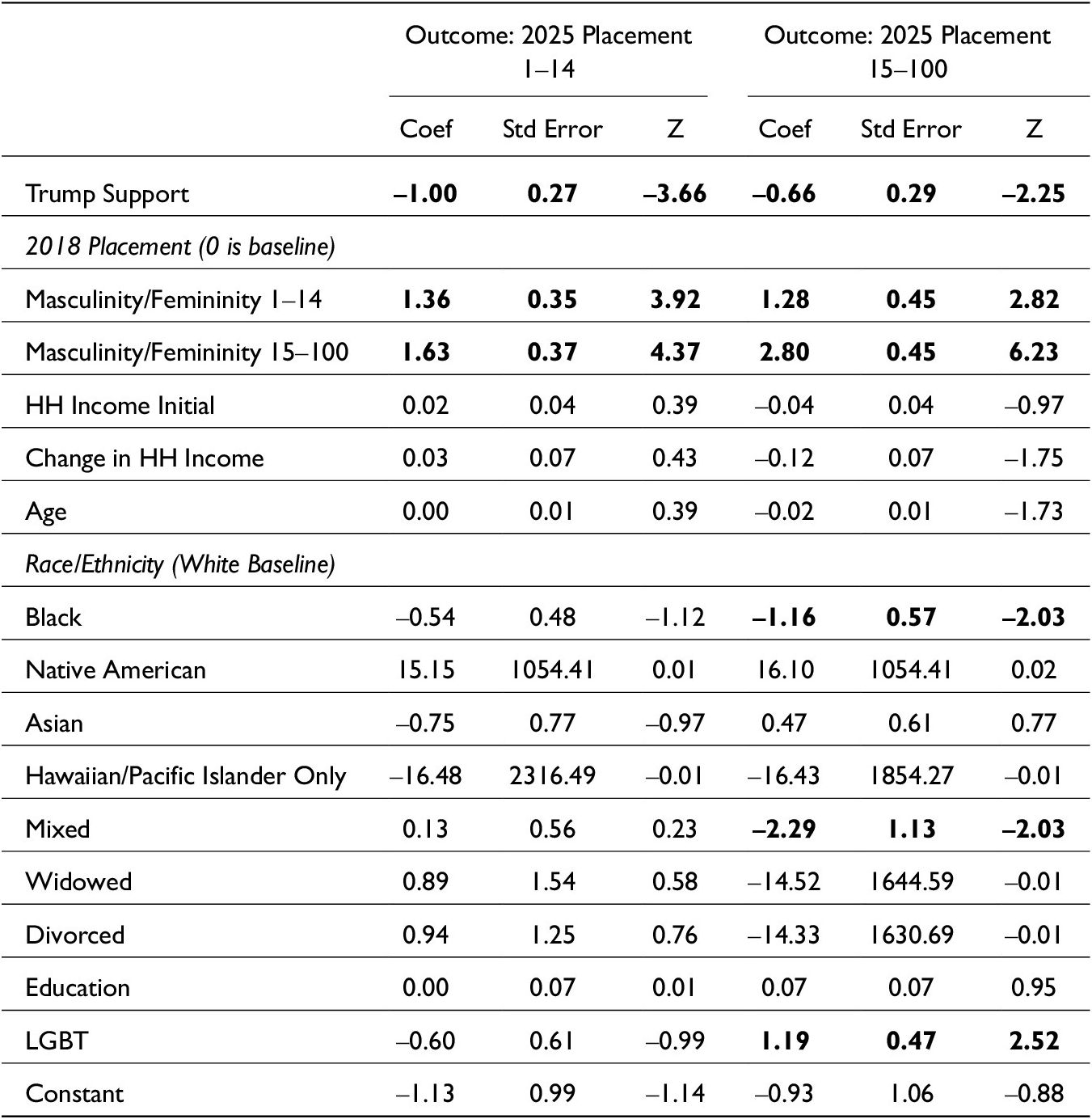
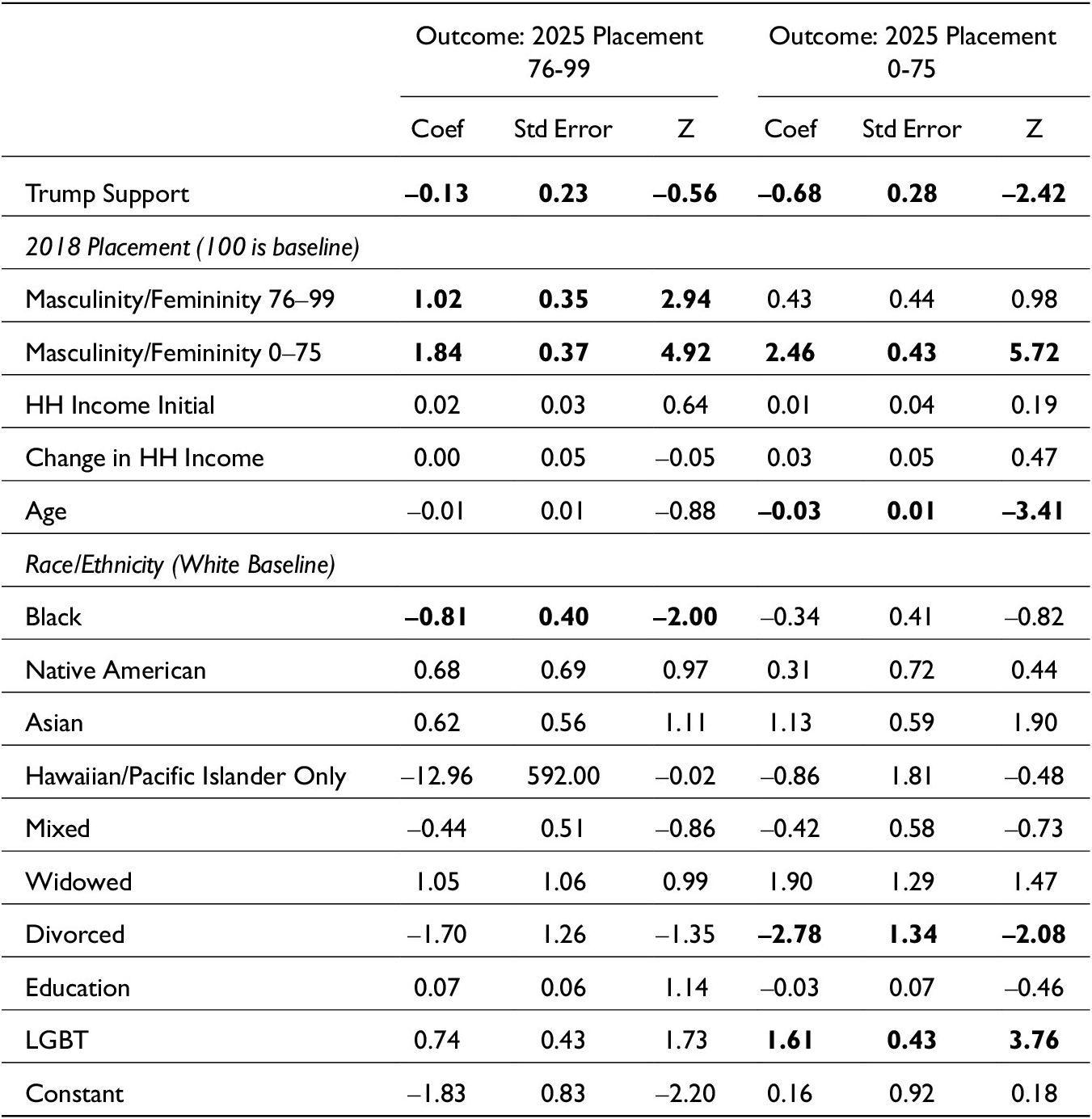
For men, the scalar analysis (shown in Tables 6 and 7) has a sample size of 436, with a pseudo R2 of 0.18. For women, the sample size is 525, with a pseudo R2 of 0.15.
Multinomial regression analysis for 2025 scalar masculinity/femininity among men
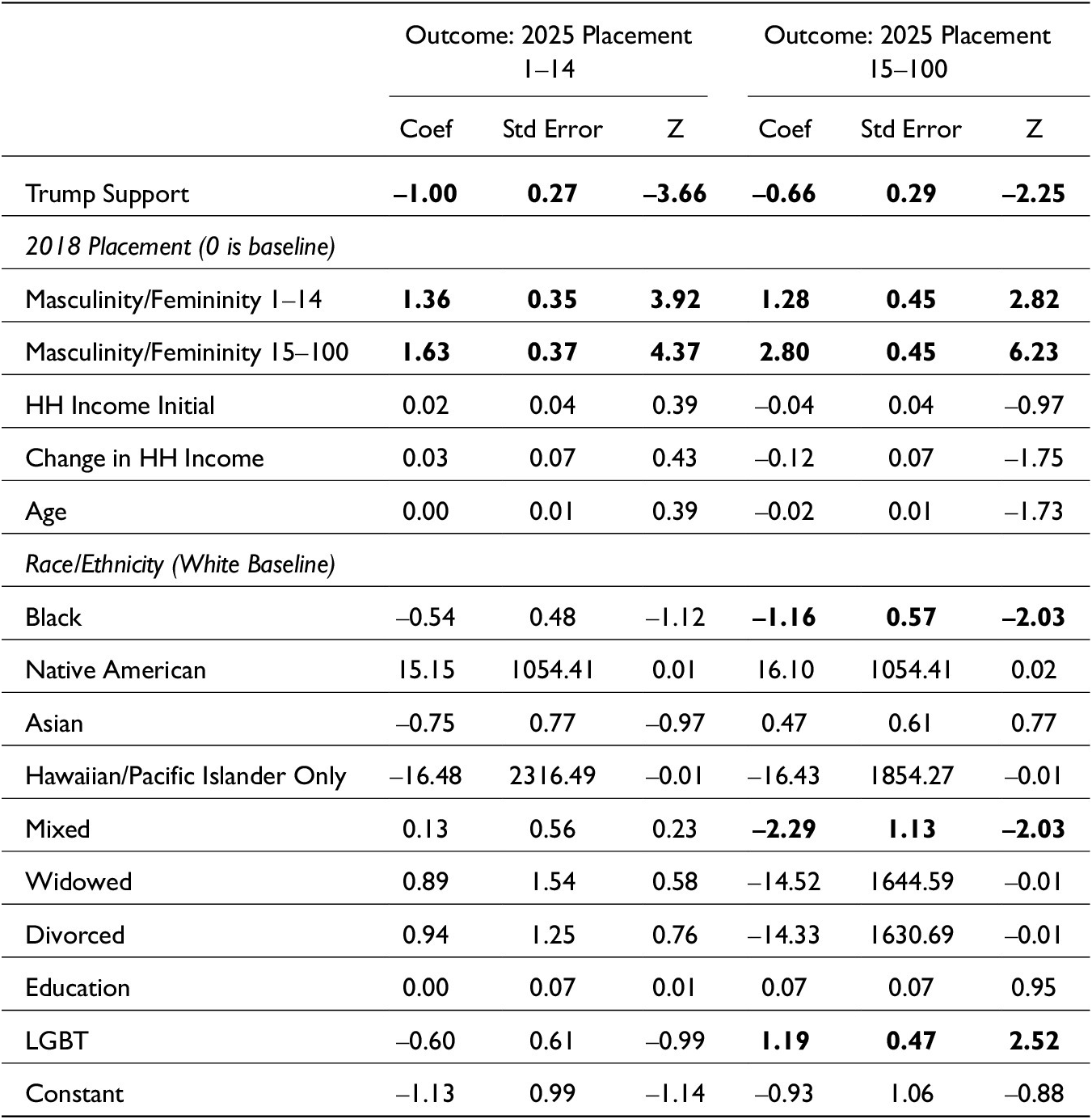
Table 6. Long description
A statistical table with seven columns. The first column lists independent variables, followed by two sets of three columns for ‘Outcome: 2025 Placement 1–14’ and ‘Outcome: 2025 Placement 15–100’. Each outcome group includes columns for Coef, Std Error, and Z.
Key findings include:
* Trump Support: Negative significant coefficients for both outcomes (-1.00 and -0.66).
* 2018 Placement (0 is baseline):
- Masculinity/Femininity 1–14: Positive significant coefficients (1.36 and 1.28).
- Masculinity/Femininity 15–100: Positive significant coefficients (1.63 and 2.80).
* Race/Ethnicity (White Baseline):
- Black: Significant negative coefficient for Placement 15–100 (-1.16).
- Mixed: Significant negative coefficient for Placement 15–100 (-2.29).
* L G B T: Significant positive coefficient for Placement 15–100 (1.19).
Other variables including H H Income Initial, Change in H H Income, Age, Native American, Asian, Hawaiian/Pacific Islander Only, Widowed, Divorced, and Education show non-significant results. Bolded coefficients indicate significance at p < .05.
Bolded coefficients are significant at p<.05.
Multinomial regression analysis for 2025 scalar masculinity/femininity among women.
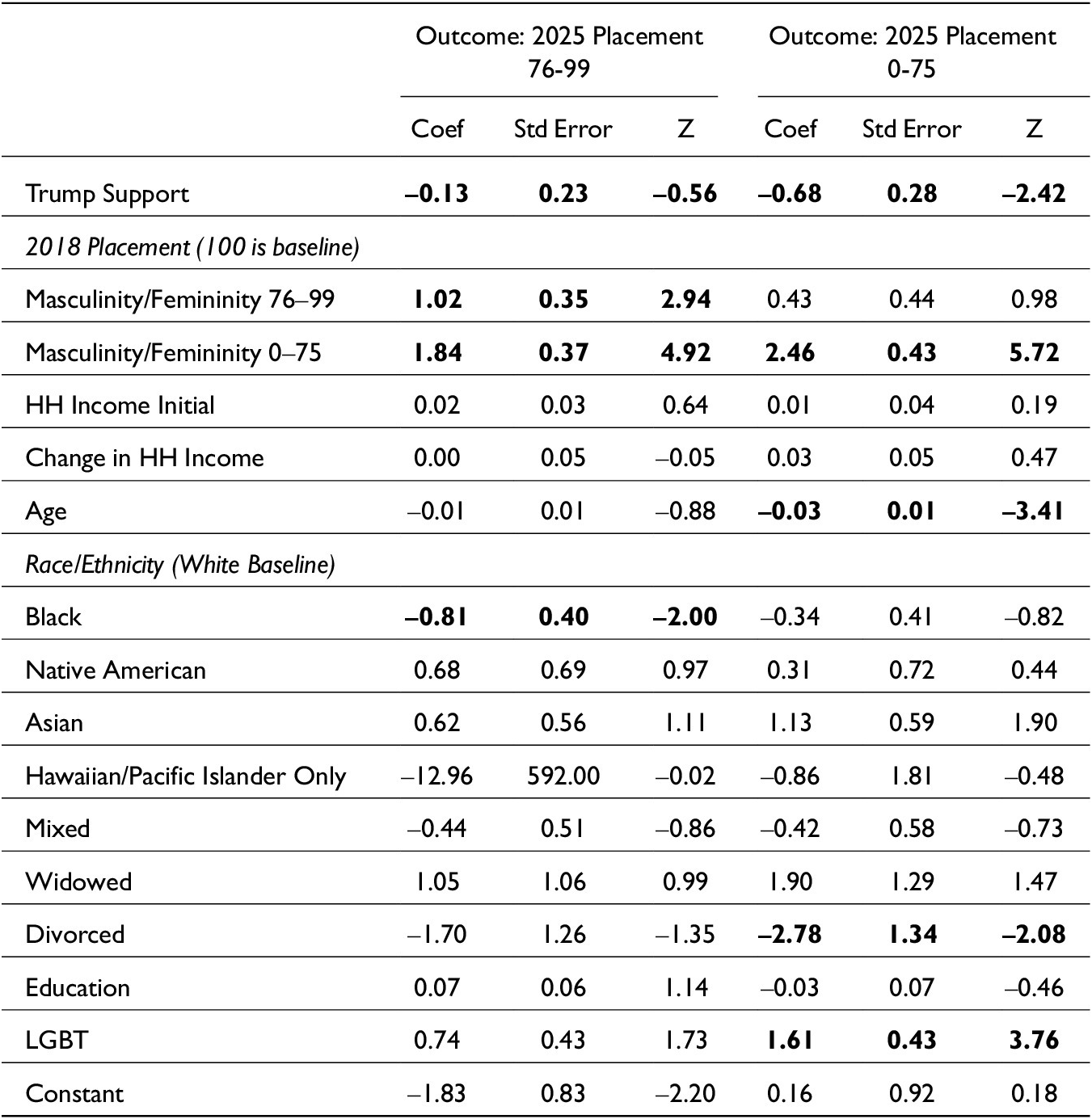
Table 7. Long description
The table presents multinomial regression results for two outcomes: 2025 Placement 76-99 and 2025 Placement 0-75. For each outcome, three columns provide the Coefficient (Coef), Standard Error, and Z-score. Significant values (p < .05) are bolded.
* Trump Support: For Placement 76-99, Coef -0.13, Std Error 0.23, Z -0.56. For Placement 0-75, Coef -0.68, Std Error 0.28, Z -2.42 (significant).
* 2018 Placement (100 is baseline):
- Masculinity/Femininity 76–99: For Placement 76-99, Coef 1.02, Std Error 0.35, Z 2.94 (significant). For Placement 0-75, Coef 0.43, Std Error 0.44, Z 0.98.
- Masculinity/Femininity 0–75: For Placement 76-99, Coef 1.84, Std Error 0.37, Z 4.92 (significant). For Placement 0-75, Coef 2.46, Std Error 0.43, Z 5.72 (significant).
* H H Income Initial: For Placement 76-99, Coef 0.02, Std Error 0.03, Z 0.64. For Placement 0-75, Coef 0.01, Std Error 0.04, Z 0.19.
* Change in H H Income: For Placement 76-99, Coef 0.00, Std Error 0.05, Z -0.05. For Placement 0-75, Coef 0.03, Std Error 0.05, Z 0.47.
* Age: For Placement 76-99, Coef -0.01, Std Error 0.01, Z -0.88. For Placement 0-75, Coef -0.03, Std Error 0.01, Z -3.41 (significant).
* Race/Ethnicity (White Baseline):
- Black: For Placement 76-99, Coef -0.81, Std Error 0.40, Z -2.00 (significant). For Placement 0-75, Coef -0.34, Std Error 0.41, Z -0.82.
- Native American: For Placement 76-99, Coef 0.68, Std Error 0.69, Z 0.97. For Placement 0-75, Coef 0.31, Std Error 0.72, Z 0.44.
- Asian: For Placement 76-99, Coef 0.62, Std Error 0.56, Z 1.11. For Placement 0-75, Coef 1.13, Std Error 0.59, Z 1.90.
- Hawaiian/Pacific Islander Only: For Placement 76-99, Coef -12.96, Std Error 592.00, Z -0.02. For Placement 0-75, Coef -0.86, Std Error 1.81, Z -0.48.
- Mixed: For Placement 76-99, Coef -0.44, Std Error 0.51, Z -0.86. For Placement 0-75, Coef -0.42, Std Error 0.58, Z -0.73.
* Widowed: For Placement 76-99, Coef 1.05, Std Error 1.06, Z 0.99. For Placement 0-75, Coef 1.90, Std Error 1.29, Z 1.47.
* Divorced: For Placement 76-99, Coef -1.70, Std Error 1.26, Z -1.35. For Placement 0-75, Coef -2.78, Std Error 1.34, Z -2.08 (significant).
* Education: For Placement 76-99, Coef 0.07, Std Error 0.06, Z 1.14. For Placement 0-75, Coef -0.03, Std Error 0.07, Z -0.46.
* L G B T: For Placement 76-99, Coef 0.74, Std Error 0.43, Z 1.73. For Placement 0-75, Coef 1.61, Std Error 0.43, Z 3.76 (significant).
* Constant: For Placement 76-99, Coef -1.83, Std Error 0.83, Z -2.20. For Placement 0-75, Coef 0.16, Std Error 0.92, Z 0.18.
Bolded coefficients are significant at p<.05.
Among both men and women, their self-placement in 2018 was by far the most important predictor of 2025 placement, reflecting the general stability of these measures. Just as striking, though, is the general lack of significant effects of factors like income, education, and changes in marital status. Research has shown strong links between how people understand their identity and factors like income and marital status, but as in Naurin et al. (Reference Naurin, Markstedt, Stolle, Elden, Sengpiel and Linden2021), these don’t seem to have large systematic effects on how people describe themselves. There are some systematic predictors of change in masculinity/femininity self-placement: Black men were less likely to place themselves in the15–100 basket in 2025, Black women were less likely to place themselves in the 76–99 basket, LGBT men and women were more likely to place themselves in the third basket, and divorced women were less. While absence of evidence is not evidence of absence, the lack of systematic effects where they might be expected suggests that much of the difference between 2018 and 2025 measurements is due to random, rather than systematic factors.
However, the effects of Trump support are consistent across men and women, with individuals who supported Trump being less likely to place themselves in the 2nd and 3rd baskets in 2025, and more likely to place themselves at the extremes of 100 (for women) or 0 (for men). Among women, these effects are significant, but relatively small. For instance, Trump-supporting women who placed themselves in the most feminine category (100) in 2018 are seven percentage points more likely to place themselves there in 2025 than women who did not support Trump.
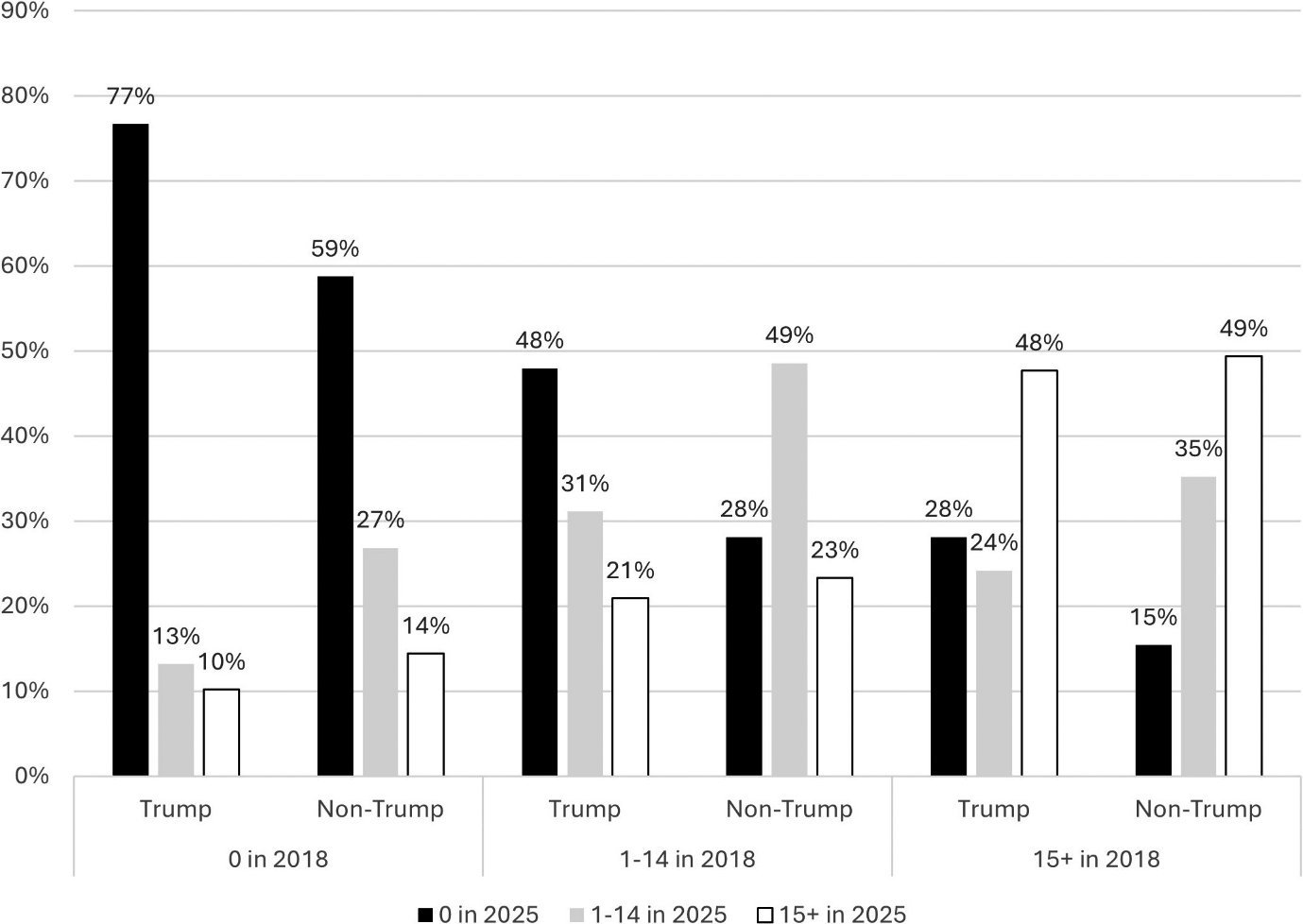
Among men, however, the effects of Trump support are substantial, as shown in Figure 4. Trump-supporting men who placed themselves at 0 in 2018 are 18 points more likely than non-Trump-supporting men to do so again in 2025. Nearly half (48 percent) of Trump-supporting men who placed themselves in the 1–14 basket in 2018 placed themselves at 0 in 2025, compared to just 28 percent of men who didn’t support Trump.
Expected 2025 placement by 2018 placement, Trump support among men.
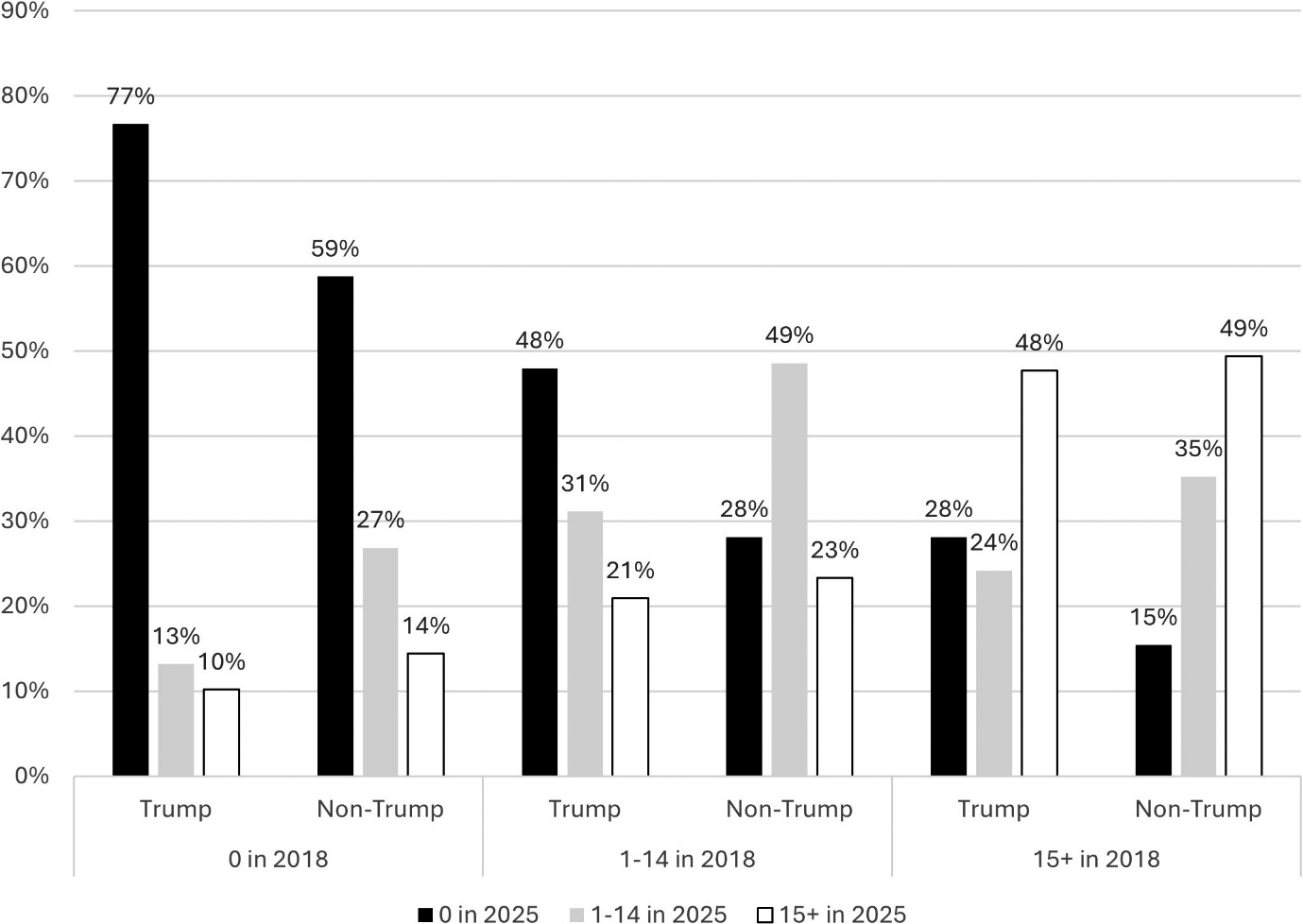
Figure 4. Long description
The y-axis represents percentages from 0 percent to 90 percent. The x-axis is divided into three main 2018 placement groups: 0 in 2018, 1-14 in 2018, and 15+ in 2018. Each group is subdivided into Trump and Non-Trump support categories. Within each category, three bars represent 2025 placement: black for 0 in 2025, grey for 1-14 in 2025, and white with a black outline for 15+ in 2025.
* Group 0 in 2018:
- Trump: 0 in 2025 is 77 percent, 1-14 is 13 percent, 15+ is 10 percent.
- Non-Trump: 0 in 2025 is 59 percent, 1-14 is 27 percent, 15+ is 14 percent.
* Group 1-14 in 2018:
- Trump: 0 in 2025 is 48 percent, 1-14 is 31 percent, 15+ is 21 percent.
- Non-Trump: 0 in 2025 is 28 percent, 1-14 is 49 percent, 15+ is 23 percent.
* Group 15+ in 2018:
- Trump: 0 in 2025 is 28 percent, 1-14 is 24 percent, 15+ is 48 percent.
- Non-Trump: 0 in 2025 is 15 percent, 1-14 is 35 percent, 15+ is 49 percent.
The shift in self-described masculinity between T1 and T2 among Trump supporters could also be read as a difference in willingness to express a “completely masculine” or “completely feminine” gender identity, rather than a shift in the underlying gender identity. That is, rather than changing how they see themselves, Trump supporters might instead be changing in their willingness to assert traditional gender identities, perhaps because they believe these traditional gender identities to be more societally acceptable in 2025 than in 2018. For the same reasons, individuals who do not support Trump might be less willing to assert traditional gender identities over the period studied. Sorting out the difference between a truly held gender identity and an expressed gender identity would be both theoretically and methodologically difficult, but such an explanation is entirely consistent with the results.
Categorical Models
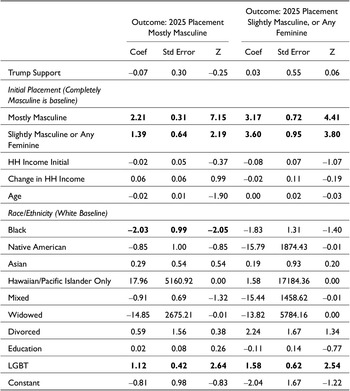
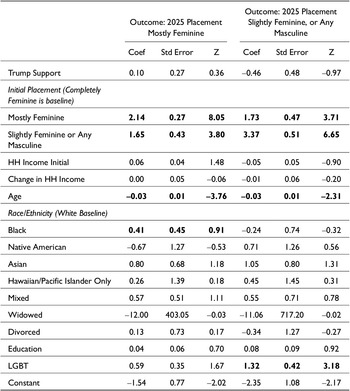
As in the previous results, the regression models (shown in Tables 8 and 9) for the unweighted categorical measures show greater stability than the scalar measures. However, they do not show evidence of differential changes in placement among Trump supporters.
Multinomial regression analysis for 2025 categorical masculinity/femininity among men.
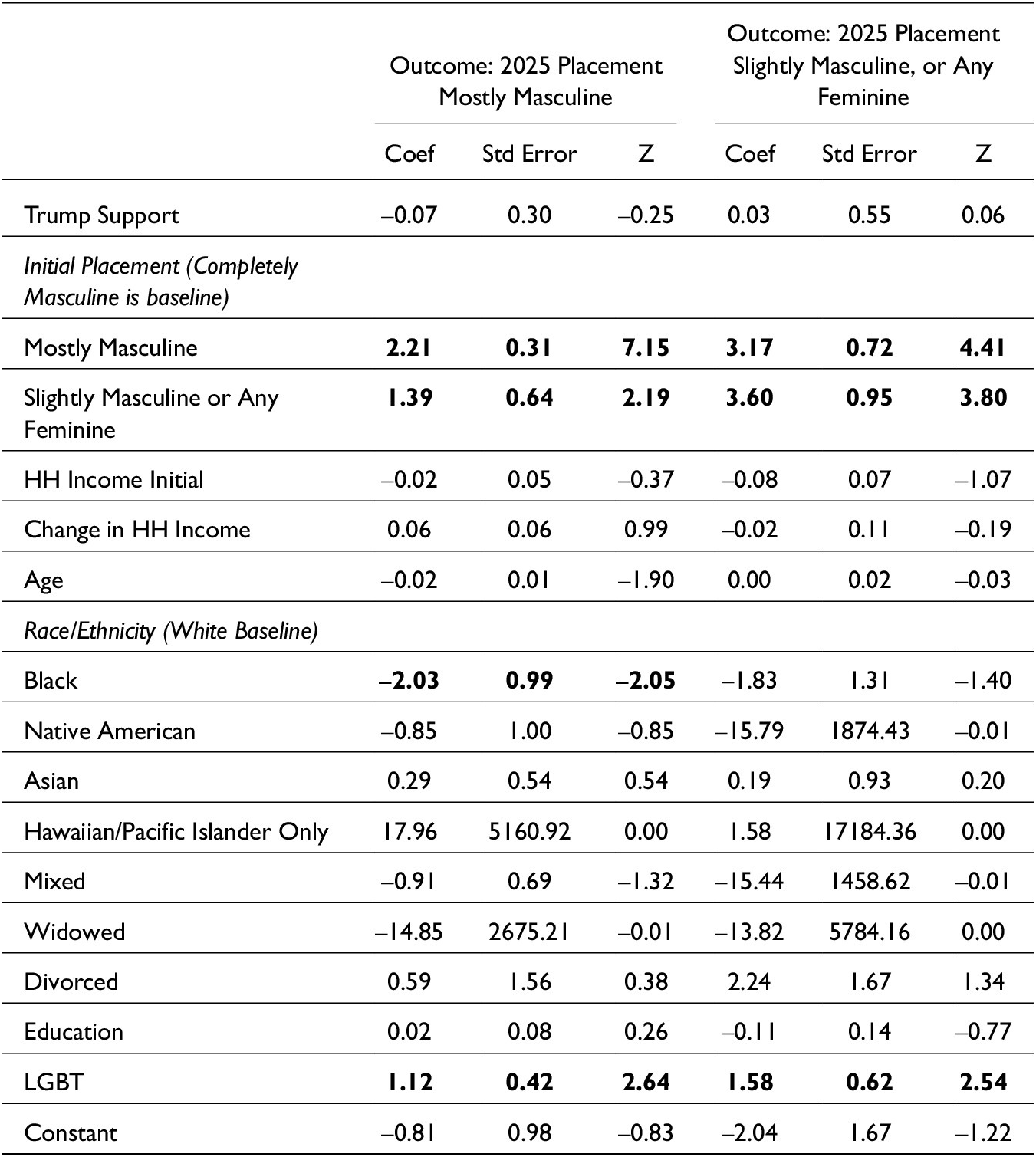
Table 8. Long description
The table presents coefficients, standard errors, and Z-scores for two outcomes: 2025 Placement Mostly Masculine and 2025 Placement Slightly Masculine or Any Feminine.
Key findings include:
* Initial Placement: Using Completely Masculine as a baseline, Mostly Masculine and Slightly Masculine or Any Feminine are significant predictors for both outcomes (p < .05).
* Race/Ethnicity: Using White as a baseline, being Black is a significant negative predictor for the Mostly Masculine outcome (Coef -2.03, Z -2.05).
* L G B T status: This is a significant positive predictor for both the Mostly Masculine outcome (Coef 1.12, Z 2.64) and the Slightly Masculine or Any Feminine outcome (Coef 1.58, Z 2.54).
* Non-significant variables: Trump Support, H H Income Initial, Change in H H Income, Age, and Education do not show statistically significant coefficients in this model.
Bolded coefficients are significant at p<.05.
Multinomial regression analysis for 2025 categorical masculinity/femininity among women.
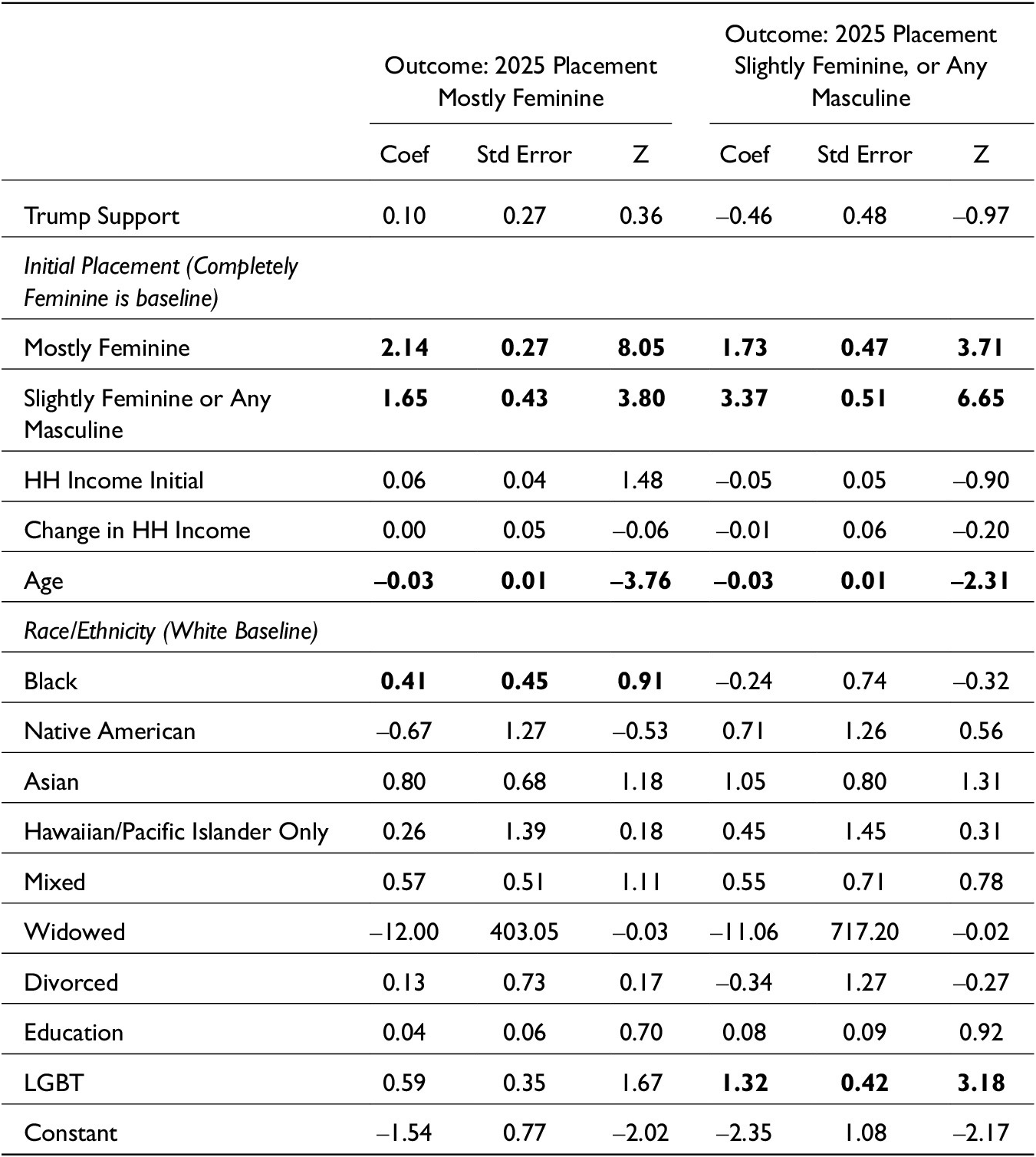
Table 9. Long description
A statistical table with two primary outcome columns: 2025 Placement Mostly Feminine and 2025 Placement Slightly Feminine, or Any Masculine. Each outcome includes sub-columns for Coef, Std Error, and Z.
Key findings based on significant coefficients (p < .05) include:
* Initial Placement (with Completely Feminine as baseline): For the Mostly Feminine outcome, Mostly Feminine has a Coef of 2.14 and Slightly Feminine or Any Masculine has a Coef of 1.65. For the Slightly Feminine/Masculine outcome, Mostly Feminine has a Coef of 1.73 and Slightly Feminine or Any Masculine has a Coef of 3.37.
* Age: Shows a significant negative correlation for both outcomes with a Coef of -0.03.
* L G B T status: Shows a significant positive correlation for the Slightly Feminine or Any Masculine outcome with a Coef of 1.32.
Other variables listed with non-significant results include Trump Support, H H Income Initial, Change in H H Income, Race/Ethnicity (Black, Native American, Asian, Hawaiian or Pacific Islander Only, Mixed), Marital Status (Widowed, Divorced), and Education. The constant for Mostly Feminine is -1.54 and for Slightly Feminine or Any Masculine is -2.35.
Bolded coefficients are significant at p<.05.
As in the scalar models, self-placement at T1 is the biggest driver of self-placement in 2025, and most of the control variables have no significant effect. As before, LGBT individuals are more likely to place themselves in the less traditional buckets, and age has a significant effect not seen in the categorical models, such that older women are more likely to place themselves as “completely feminine.” The most striking difference, though, is the lack of any effects of Trump support on self-placement in 2025. The effects of Trump support are not only non-significant, they’re small in magnitude, and often not in the expected direction. Put simply, there is no sign that Trump support led individuals to place themselves differently in the categorical scales in 2025 relative to 2021.
There are two possible explanations for this difference in the effect of Trump support between the two measures. The first draws on the difference in time frames: the categorical measures run from 2021 to 2025, while the scalar measures run from 2018 to 2025. As such, it may be the case that any significant change in self-described gender identity driven by Trump support took place between late 2018 and 2021, thus showing up in one measure, and not the other.
Given the volume of research linking gender identity with reactions to the COVID-19 pandemic (i.e. Burciu and Hutter Reference Burciu and Hutter2023; Cassese, Farhat, and Miller Reference Cassese, Farhart and Miller2020; Cassino and Besen-Cassino Reference Cassino and Besen-Cassino2020; Deckman et al. Reference Deckman, McDonald, Rouse and Kromer2020; Hennekam and Shymko Reference Hennekam and Shymko2020), sorting effects based on responses to the pandemic seem like a reasonable explanation for these findings. While the data is consistent with a story that the pandemic and resulting government actions led to an alignment of Trump support and gender identity traditionalism over the course of 2020, and little change in it afterwards, there is no direct evidence for it, and given that such an expectation was not included in the study pre-registration, it cannot be regarded as more than a post-hoc explanation, even if it seems to be a compelling one.
This explanation might also account for the apparent greater stability of the categorical measure: it’s not that the categorical measure is inherently more stable, but that it doesn’t include a period of relative instability. Other data sources with consistent measures taken over the period would be needed to test this explanation. The second explanation relies on the apparent greater stability of the categorical measure noted earlier. It might be the case that the greater consistency over time of the categorical measure means that respondents hew more tightly to the gender expressed at T1, making them less likely to change their placement in response to any outside factorFootnote 8.
Limitations
While the data here represents the first time these measures have been taken longitudinally over the course of a long period of time in the US and may thus represent the best data to date on their long-term stability, there are still serious limitations to these findings. Most importantly, the fact that the two measures of gender identity cover different time periods presents a confound for any attempt to compare their stability. Essentially, there are two measures of the same construct differing both in how they measure and when they measure. This makes it impossible to be certain if the differences are driven by one of these factors or the other, or both. It is certainly the case that categorical measures are more stable over the 2021 to 2025 period than scalar measures are over the 2018 to 2025 period, but whether that’s due to the nature of the measures of the period covered cannot be determined from this data. The time between 2018 and 2021 saw not only much of the first Trump administration, but also the beginning of the COVID-19 pandemic, the #MeToo movement, and widespread Black Lives Matter protests. All of these implicated gender to some extent and may well have shaped how people view their own masculinity or femininity, and responses to all of them could well be correlated with both gender identity and support for Trump. The lower levels of observed stability in the scalar measure could be attributed to an accident of history, simply having been in the field during a uniquely turbulent time. I don’t find this explanation terribly compelling — it would require us to believe that the period between 2021 and 2025 was somehow a period of relative stability in gender and politics — but it is consistent with the data. Both measures of gender used here are also unidimensional. While there may be good reasons to prefer unidimensional measures when survey space is at a premium, bidimensional measures looking at masculinity and femininity may be more or less stable over time than those analyzed here.
Differences in data collection mode might also play some role in the findings: respondents to the categorical measure picked one of six boxes; respondents in the scalar measure either typed a response or used a slider to indicate their masculinity/femininity. While it seems unlikely that these differences were determinative, sliders may be more or less stable over time than other response techniques, and differences between respondents using a computer and those using a mobile device could even play a role. This data was also collected entirely within the United States, and the findings may be limited to that well-studied but limited case. While there is no evidence from this study that the same effects pertain outside of the US, there is also no reason to believe that these effects are unique to US residents, when other dynamics of gender and political views can be observed in other states.
These data are also gathered from an online panel. It is a well-constructed online panel with strong recruitment measures and a diverse population of respondents, but it is a panel nonetheless. As such, there may be systematic differences between panel respondents and the general population that simply cannot be accounted for through an analysis of the panel. In addition, the respondents who answered the gender placement questions at T1 and T2 had necessarily been answering survey questions online for at least four years: this degree of practice and sophistication could be changing their responses in ways that cannot easily be measured.
In addition, the 2025 survey which serves as T2 includes an intentional oversample of LGBT individuals. While this is valuable in that it serves to increase the diversity of the sample, the effect of LGBT identification in the regression models suggests that this group is different in important ways from other respondents. Regression models that exclude the LGBT respondents offer similar results to those presented, but the fact that the results draw disproportionately from this group may lead to some non-obvious biases.
The political measures looking at the effect of Trump support on self-placement and changes in self-placement are also limited by the lack of party identification as a control variable. While support for a party’s candidate in Presidential elections and identification with that party are almost coterminous (especially in recent years, with more than 90 percent of partisans supporting their party’s candidate), it is entirely possible that the effects seen here for Trump support are actually picking up unmeasured effects of Republican identification. Similarly, a more compelling causal case could likely be made with data that looked at changes in Trump support over time as a predictor of change in self-described gender; unfortunately, the data used here does not allow for such an analysis.
This data also does not allow for the analysis of the effects of aging. There is reason to believe that the changes in social status and role related with aging substantially alter the ways in which men and women perceive their gender identity. In the data used in this study, age was strongly correlated with gender traditionalism among both men and especially women, but since everyone in the sample aged the same amount between the two measures, aging is a constant, and its effects cannot be analyzed here.Footnote 9
Conclusions
Self-placement measures of masculinity and femininity have become increasingly popular in political science research in the past few years, largely spurred on by the unmistakably gendered implications of the 2016 US Presidential election, and all that has followed it. It seems clear that gender — masculinity and femininity — play a role in political attitudes and behaviors, but most of the work on masculinity, femininity, and political attitudes and behaviors (such as McDermott Reference McDermott2016) draws from trait-based measures, rather than self-placement ones.
Given the recent inclusion of self-placement scales on major institutional surveys like the American National Election Study (in addition to their earlier presence on other surveys, like the Canadian Election Study), such scales are poised to become a major tool in how political scientists conceptualize and measure gender. This makes it all the more urgent that we understand exactly how these scales work, whether they’re relatively stable measures that make sense to use as independent or control variables, or relatively fluid ones that might work best as dependent variables.
Despite the limitations on the analysis, I feel comfortable drawing three conclusions from the results. The first is that the six-item categorical measure tested has strong overall stability, at least in the 2021 to 2025 period. Very few respondents moved more than one category in this measure over the course of four relatively tumultuous years in US politics, supporting the idea that self-placement masculinity/femininity measures are measuring a stable underlying concept that can reasonably be included as a predictor in models of political behavior and attitudes.
Second, it does seem that Trump support led men to consider themselves more masculine over the past eight years, at least in the scalar measure. It is certainly the case that men who consider themselves more masculine are more likely to support Trump, but this is the first evidence that the reverse may be true as well, and support for Trump — and likely other populist leaders in other states — can lead men (and to a lesser extent women), in the long term, to identify with more traditional gender identities. This is an important part of the story we tell as a field about gender and politics. It may well be the case that gender traditionalism set the stage for the rise of a candidate like Trump and the rejection of female candidates in the US. But it also seems to be the case that Trump support creates a feedback loop, both feeding on gender traditionalism among men, and feeding it, creating the environment in which this flavor of populism can thrive.
Third is the consistent lack of effects of control variables that might be expected to push around self-placement of masculinity and femininity. Changes in income or marital status might be expected to change how men and women see themselves — but they generally don’t. Members of racial and ethnic minority groups don’t move more or less than other respondents, nor do more or less educated people. In sum, there is relatively little systematic demographic-based variance in how people describe their masculinity and femininity. While there is a real danger in the interpretation of null effects, the lack of effects is important, as it is consistent with the view that these measures are getting at a relatively stable underlying construct.
These results provide both some answers and some questions. On the whole, self-placement measures of masculinity and femininity, especially the categorical one used here, are stable over a period of several years. It seems possible that events can change these self-placements over the long term, but over the 2021–2025 period, the stability of the self-placements bolsters the argument that these measures are getting at a stable underlying element of respondents’ identities. The findings also suggest a degree of reciprocal causation in the relationship between masculinity and support for Trump. The process by which this happens — and the possible role of destabilizing events in that process — is ripe for further research.
In addition, the results leave open the question of how support for Trump might change the way that individuals express their gender identity. Is it a process of becoming more willing to assert a traditional gender identity? Or a result of the changing meaning of those gender identities in a world where news media is dominated by Trump? Or is it some other unmeasured effect, like exposure to certain websites (as in Ging Reference Ging2019; Van Valkenburgh Reference Van Valkenburgh2021) or other media sources that are correlated with both Trump support and changes in ideas about gender? All studies necessarily place something in the black box, but as the work on political masculinities develops, the question of mechanisms should be addressed.
What is clear now, though, is that as a field we must move beyond the binary in how we conceptualize and measure gender. It was reasonable, at one point, to use sex as a proxy for gender on the basis that measures of masculinity and femininity were too unwieldy for most studies, but this disconnect between theory and practice is no longer supportable. Measures of masculinity and femininity that take up just one or two items in a study are both stable and informative, and it is past time to give up on measures that pretend that sex and gender are the same thing.
Supplementary material
The supplementary material for this article can be found at http://doi.org/10.1017/S1743923X25100524.
Acknowledgements
Data for this publication is derived from surveys administered by the Understanding America Study, which is maintained by the Center for Economic and Social Research (CESR) at the University of Southern California. Funding for this data collection was provided from the Social Security Administration and the National Institute on Aging through the grant U01AG054580 “Toward Next Generation Data on Health and Life Changes at Older Ages” (Kapteyn, PI). The project was reviewed and approved by BRANY IRB (22-030-1044). The content of this paper is solely the responsibility of the authors and does not necessarily represent the official views of USC or CESR.
Competing interests
The author declares that they have no competing interests in this work.


 Open access

