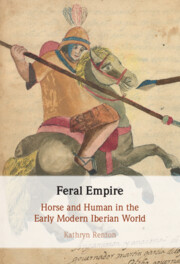


In 1492, the same year that Columbus reached new islands in the Atlantic, the Catholic Monarchs defeated the last Muslim polity in the Iberian Peninsula with their Andalusian cavalry and firepower. The horse’s centrality to conquest from the Iberian frontier already had implications for governing both new people and land. Yet, in the New World, the specter of a scarcity of horses that had motivated the monarchy to insist on the ownership and breeding of horses was no longer rhetorical, but literal. Horses represented an enormously expensive and logistically challenging aspect of early expeditions and colonial settlements, and Spain’s willingness to invest heavily in horses brings the influence of horses on colonial governance into sharper relief.
Hernán Cortés famously wrote to the Spanish king Charles V that, after God, “our only security was the horses.”Footnote 1 Attributing victory to the horse nodded symbolically to the conquering knight, and simultaneously boasted of the novelty of horses on the battlefield against Indigenous American opponents. Many canonical accounts of the conquest echo this idea. Yet, a close reading of these same early conquest accounts also reveals that the horse’s military prowess was less important than its role in the colonial invaders’ power structures. Whereas the tactical use of horses had its limitations, the deeply embedded political language around horses influenced the distribution of land and participation in municipal government, as well as the regulation and negotiation of social status. As Spanish governance moved from the frontier within Iberia to the New World, it mapped this signature imprint of horses onto a new geography.
2.1 Horses in Conquest Narratives
Early accounts from conquistadors are well known for being highly partisan; when read critically, however, the bias within these narratives reveals cultural assumptions of the authors, including those surrounding the horse. Some of these accounts offer the only details of first encounters with the horse. For instance, Bartolomé de Las Casas’s account of the conquest of the island of Hispaniola in A Short Account of the Destruction of the Indies epitomized the image of the powerful new Spanish horses and the fear and widespread damage that conquistadors caused among native settlements. According to his description of the massacre at Higüey in 1503, Spaniards on horseback took down a disproportionately large number of defenseless natives, implying that the horse not only instilled fear in the natives but also gave a concrete and unsurpassable advantage to the Spanish. As ethnohistorians have rightly objected, these accounts presume that Indigenous peoples expressed outright fear or slavish awe in their initial encounters with horses, despite demonstrations of effective resistance and savvy in subsequent events.Footnote 2
Arriving with “guns, germs, and steel,” in the formulation of Jared Diamond, the horse at times has been viewed as an extension of European technological and biological warfare. Describing Pizarro’s infamous betrayal and capture of Atahualpa in Cajamarca, Peru, Diamond portrayed tactical knowledge of horses as a major advantage: “Europeans had known for centuries that foot soldiers stood a good chance against cavalry if they stood firm and repelled the outnumbered mounted troops. But the Inca had no experience of this … Instead, they panicked and tried to flee, allowing the outnumbered conquistadors to run through them with great speed and efficiency.”Footnote 3 Even when conceding that records of such particular encounters were overstated by unreliable narrators, many historians are still struck by the significance of the horse in this equation. Wasn’t it the case, as George Lovell mused in Conquest and Survival in Colonial Guatemala, that the “psychological impact of cavalry on a people who had never before seen a horse and its rider in action was as devastating as the material superiority of steel and firearms over the bow and arrow”?Footnote 4
Historically, the military use of horses has focused on exploiting their defining quality: speed. A horse can not only move up to forty miles per hour at a gallop over distances of a mile or less, but can also sustain the pace of a trot (about ten miles per hour) over longer stretches. This speed would allow small groups of mounted Spaniards to outpace foot soldiers, and the tactical element of surprise starred in many of their plans. Such speed on horseback was conducive to general reconnaissance, cabalgadas (raids), or maneuvers against the outlying flanks of an opposing force to sow confusion and disorder. In addition to speed, a man mounted on horseback had a height advantage to leverage against opponents on the ground. A concentrated cavalry charge used both speed and height advantages to break the ranks of opposing troops, allowing reinforcements to follow into the breach.
Cavalry tactics, however, by their nature were necessarily quick rather than sustained, and deployed at strategic moments in which the cavalry could have a significant influence on the course of events. Top speeds could not be expected over long distances or over long timeframes without enough food and rest to maintain the horse’s fitness. Additionally, given the horse’s need for flat, open ground to run without injury, cavalry charges did not offer a superior hand in all battlefield conditions. Terrain and timing were crucial elements for impact, and thus cavalry never was totally dominant, even on medieval European battlefields.
Horses undoubtedly presented specific advantages for Spanish ambitions – namely, tactical elements of speed and power, and psychological elements of shock and fear. However, the common attribution of conquest victories to horses reflects primary cultural assumptions of the authors more than battlefield realities. When read critically, eyewitness records from Hernán Cortés, Pedro Alvarado, and Bernal Díaz for the Mexico campaigns, and from Francisco Xerez in Peru demonstrate the cultural reasoning behind these attributions – namely, credit accrued to the man on horseback for political and social gains – and offer insight into how Indigenous opponents recognized and responded to this motivation in their own strategies.
Tactical considerations for the physical realities of fighting with horses can be seen in action in many early battle accounts. When Cortés first reached land in the coastal area of Tabasco, his group fought on foot to take refuge in the city of Potonchán. He then chose to meet the gathered Tabascan warriors in an open plain (Battle of Centlan, March 25, 1519) for the purpose of using a surprise cavalry charge. While preparing 300 men on the field, he also reserved his few horses for a flanking move, going “secretly to one side with ten men on horseback.” Cortés’s cavalry did not descend immediately on the opening clash between the Tabascan arrows and Spanish firearms, but rather waited for a key moment to emerge: “After two hours of fighting, the Captain arrived with the horsemen, coming out from the woods at the point where the Indians were surrounding the Spaniards on all sides.”Footnote 5 The horsemen themselves were few, but on the horses’ charge the Spaniards rallied and the Tabascans retreated, leaving Cortés with the field. Cortés had intended to shock his opponents with a surprise charge, and to do so, he needed to scout out specific kinds of terrain suitable for this engagement. Moreover, the impact of this charge relied on a minimum quorum of men on horseback, dependent in this case on the limited number he could bring with him from Cuba. In later campaigns, cavalry impact likewise fluctuated based on the inevitable casualties of war and the tenuous reaches of resupply, when men far outnumbered the available horses.
Horses had strategic impact in battle, certainly, but the persistent attribution of “victory” to horses can also be misleading. A second example comes from Cortés’s forced retreat from Tenochtitlan, known as the Noche Triste, when his exhausted and depleted force fought off the pursuing Aztec armies in Otumba (1520). Cortés stationed twenty horses, divided into four units of five men, at the front, rear, and sides of the men on foot. The fighting tired his horses, however, with the taxing exertions of close-quarter maneuvers for large animals. His men had to form a circle, with their backs to the center, to allow the horses a period of rest, because there were too few horses for any to be expendable. At this vulnerable point, Cortés took advantage of an opportune moment when the leader of the opposing forces appeared in close proximity. Cortés boldly called for a cavalry charge against this key target, and the confusion created by the death of this Indigenous leader created a window for Cortés to disengage and retreat. In recounting this moment, Cortés claimed that this engagement was a success owed to the cavalry charge. Writing about this event, historians have also rhetorically placed the horses in the position of “saving” the Spanish, even though there was not a victory on the battlefield.
For every example of a decisive charge, there is plentiful evidence of its many pitfalls. When Cortés marched south after the rebellious Cristóbal Olid in 1524, he lost sixty-eight of his ninety-three horses in an attempt to cross a mountain pass. He reported that many fell to their deaths due to the footing, and it took three months to allow the surviving horses to recover enough for battle service. Ironically, therefore, despite the great mobility of individual horses, the mass transport of horses was difficult to achieve. There were no corrals to contain the herd, so the chances of losing one at night were high. Swollen rivers that needed to be crossed posed serious dangers and frequently resulted in the loss of mounts.Footnote 6 In swampy or marshy terrain, horses would have to be led by hand in order to not founder in the mud and injure their legs, which could render them useless.Footnote 7 Sheer exhaustion from forced marches took its toll on horses as well.
Despite these potential strategic and tactical liabilities, Spanish narratives persistently emphasize the importance of the horse in accounts of early conquest battles. An excellent example of this narrator bias comes from Pedro de Alvarado y Contreras, who, instructed by Cortés to continue the conquest to the south (first to Oaxaca, and then to Pánuco), brought 180 cavalry, 300 infantry, and thousands of allied Mexican warriors to Guatemala. Although Alvarado attributed an early victory against the K’iche’ warriors to the surprise caused by his horses, this interpretation contrasts with other evidence within his own account that this victory required significant time and setbacks before finding conditions that would favor his cavalry tactics. Initially, Alvarado advanced to Zapotitlán in peace, but remained suspicious of entering the city itself for fear of losing his cavalry advantage in a closed urban setting, where “they might fight us at their convenience.” His reservations were confirmed when his troupe was attacked at a vulnerable river crossing. The mountain pass had provided enormous difficulties for his horses, “as the horses had not been able to keep up with us on account of the roughness of the road,” and the archers and infantry led the way. An ambush set by several thousand warriors in the mountain pass forced Alvarado to retreat. By a saving grace, Alvarado reached flat and open terrain, and had time to rest his travel-weary horses so that he could take advantage of the numbers, which were heavily weighted, by as much as half of his total group, toward cavalry tactics: “I thanked God that there we found some plains, and although the horses were tired and fatigued from the pass, we waited some time for them to arrive and throw arrows at us; and we attacked them.” He chose to stay camped outside the town so that he could pick terrain for battle more advantageous for his remaining cavalry. In the immediate term, the strength of his cavalry did spur the K’iche’ to retreat. Ultimately, however, Alvarado’s victory came from a more notorious trick. Fearing that his cavalry would not be able to maneuver in the narrow streets of the city of Xelajú (modern Quetzaltenango), he invited the leaders out to parlay, took them prisoner, burned them alive, and then proceeded to burn down the city itself. In his letter, Alvarado praises the horse for his success: “As they had never seen horses they showed much fear and we made a very good advance and scattered them.”Footnote 8 On balance, fear of the horse was not the deciding factor in Alvarado’s campaign; nevertheless, his framing makes a clear narrative choice that associates his victory with the horse.
Horses were undoubtedly impressive creatures on first sighting, as they boast upward of 1,200 pounds of muscle and sinew. Indeed, diplomatic encounters often cultivated awe of horses’ physicality, and Iberian traditions of horsemanship emphasize some of the underlying reasons for these narrative frames. For example, when Cortés met the first envoys from Moctezuma on the beaches of Veracruz, he and some of his men performed juegos de cañas (skirmishes) on horseback, a tactic imitated by Pizarro when he recruited Hernando de Soto to do the same before the Inca Atahualpa in Trujillo.Footnote 9 The juego de cañas was a spectacle used in Spain to display prowess on horseback as a statement of wealth and social status, and served as a traditional proxy for conflict.Footnote 10 Spanish use of horses in early encounters mimicked these festival and ritual engagements intended to generate goodwill, in addition to displaying the skill and strength of their horses. The rout of Atahualpa mentioned by Jared Diamond exhibits many of the key characteristics used to showcase horse-related status – including choosing the finest horses from the company, parading and performing tricks before the Inca, and making use of a flat plaza for a surprise cavalry charge. In his account of this encounter, Diamond considers these uses of the horse as examples of its technological superiority in battle. More accurately, however, this choice in Spanish tactics reflects Spanish views of the political and social importance of horses.
In writing about their exploits in New World campaigns to conquer lands for the king, conquistadors found it necessary to reference horses in order to receive greater rewards. Attributing the outcomes of key military engagements to the cavalry was not merely an acknowledgment of the horse’s military usefulness but also a core feature of a relación or probanza de méritos (Proof of Merit and Services to the Crown) that intended to gain favor and social status in return.Footnote 11 The horse’s actual contributions to these campaigns aside, the narrative framing reveals the imprint of the horse in Iberian conquest and frontier society just as surely as the image of the victorious conquistador on horseback references the glory of the mounted knight. The tactical and strategic advantage that the Spanish attributed to the horse was partially representative of outcomes, but more deeply motivated by the symbolism and the political system of rewards associated with Spanish horse culture.
Given this symbolic and political import, the physical and psychological presence of the horse often received the most concerted attention in Spanish accounts of early campaigns. The Spanish attempted to cultivate and manipulate fear in Indigenous people’s encounters with horses, and, in documentary accounts, they interpreted their opponents’ reactions in these terms, crediting themselves with dominance by noting their opponents’ fear of horses. Bernal Díaz described the local Taíno leader Guancanagaríx’s awe at the first horses he saw with a dramatic flourish: He “fixed his eyes most upon the horses … the formidable appearance of these animals was not without terror to the Indians, for they suspected that they fed on human flesh.”Footnote 12 But what could have given the Taíno cacique to believe that these horses were “flesh-eating”? Spanish chroniclers emphasized that the Indigenous peoples of the Americas viewed horses as powerful animals with unknown capabilities and proclivities. This persistent narrative emphasis reveals not the actual fears or reactions of Indigenous residents, but rather the fundamental importance of the horse to the social and political relationships that the Spanish were reconstructing in a new colonial environment.
Most tellingly, Spaniards (and their historians) held strong preconceptions about horses in battle based on their size, strength, and speed. Yet, expectations of their outsize impact could not outlast their evident mortality. It is not unreasonable to suppose that Indigenous people might experience fear when encountering horses for the first time, particularly if the Spanish prioritized the element of surprise on warriors with no experience fighting against enemies on horseback. However, adopting a Spanish justification that this fear derived from Indigenous superstitious or supernatural attributions does not account for the ability of Indigenous opponents to act effectively with existing tactics or adapt from their newly gained experience. Even though Spanish chroniclers attribute the success of Spanish cavalry to the fear inspired in their indigenous opponents, ample evidence also points to a solid understanding of the weak points of horses on campaign. If Indigenous parties demonstrated awe of horses, it was decidedly not static: They quickly realized the advantages of uneven footing or enclosed spaces against mounted fighters, as well as the power of lances and pits to thwart charges. Indeed, Cortés wrote to the king during his campaign to note that the country of Guatemala presented an enormous problem given its difficult terrain for horses and the ingenuity of its Indigenous people for developing tactics against horses: “They have invented pits and other engines to kill the horses; and although Pedro de Alvarado has never ceased making war upon them with upward of 200 horse and 50 foot, all Spaniards, besides 5,000 and at other times even 10,000 Indians, he has hitherto been unable to reduce them under your majesty’s rule.”Footnote 13 Indigenous people certainly viewed horses as novel and even fearsome and mysterious, but by no means as invincible. The Spanish could only achieve this sleight of hand in initial encounters, and it was in their best interest to make the most of this novelty to mobilize fear as a weapon.
Spanish accounts, thus, purposefully emphasized surprise, secrecy, and misinformation as shaping these interspecies encounters. Accounts of the conquest repeatedly note that conquistadors attached bells to Spanish horses, a tactic passed from Cortés to Alvarado and Pizarro; these accounts do not elaborate why, leaving it up to the reader to imagine how a set of bells on a jogging horse would strangely amplify every slight movement. Strategic use of physical awe is evident in the conquest narrative of Bernal Díaz when Cortés tied up a mare within scent of his stallion to induce it to act out – a gesture that indicated the horse’s symbol of Spanish power as much as its potential threat to life and limb. The Spanish also took great pains to conceal the high number of horses that died and the lasting wounds they received, including secretly burying horses that had drowned in landing attempts at Puerto de Caballos and ensuring that only the healthiest and least battle-scarred were presented in the embassy to Atahualpa. Miguel de Estete recorded an even more blatant example of intimidation and misinformation: In order to keep the main plaza clear for maneuvering his cavalry in defense of Jauja, Hernando Pizarro ordered that no Indian should be present in the plaza “because the horses were angry and would kill them.”Footnote 14
Indeed, Spanish records of Indigenous reactions to horses continue to foreground fear long after conquest. Take, for example, the description Garcilaso de la Vega, El Inca, gave: “The Indians are usually greatly afraid of horses, and on seeing one gallop they lose their heads … as soon as they see a horse running they take flight and run backward and forward two or three times across the street …,” a description akin to a squirrel’s behavior on the road in front of a car. He continued: “It would be difficult to exaggerate the panic they used to feel in my time. It is true that even in those days there were many Indian servants of Spaniards who combed and groomed horses, but they never dared to mount them.”Footnote 15 Garcilaso used this story to distinguish the qualities of a mestizo like himself, able to learn how to manage a horse (and who participated in the Spanish cavalry in the Alpujarras revolt in Spain in the 1560s) from the characteristic fearfulness of the average indio. Fear appears to be integral to the constitution of native populations. Ultimately, the horse’s position as a fundamental feature of these conquest accounts underscores that they are written from a Spanish perspective, rather than an Indigenous one.
Other renderings of Indigenous misunderstandings of horses are also plentiful, but not all misunderstandings need to be interpreted in the same register of fear. Such misunderstandings also indicate powers of observation and familiarity, as well as curiosity. For example, the Taíno and Mayan reportedly brought silver and other metals for the horses to eat. Horses were guided by metal bits, attached to leather harnesses and inserted into their mouths. Likewise, Spaniards at times spoke to their animals out loud, leading a chronicler of the conquest of Michoacan to note that the Purépecha thought that the Spanish and their horses shared a language.Footnote 16 In a nonverbal sense, riding used a complex system of signs and body language, with subtle movements of heels, wrists, or shifting weight, that likewise formed a set of nearly invisible communicative practices between the horse and his rider or groom. Such misunderstandings demonstrate insight into what was most noticeable about these new animals.
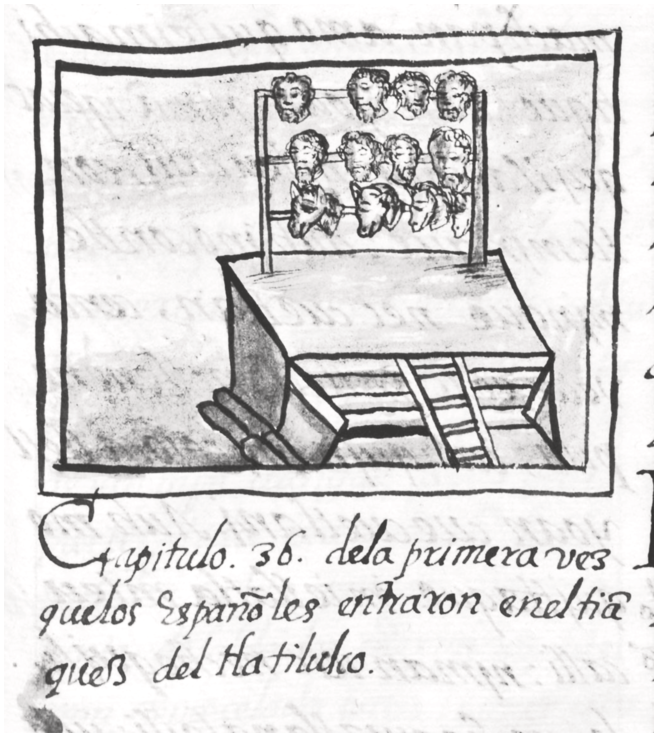
Conversely, Spanish records of Indigenous reactions clearly illustrate an understanding of how crucially symbolic the horse was to their Spanish opponents. The chapters of the Florentine Codex describing the Spanish arrival into Tenochtitlan emphasized the pounding of hooves and the sweat and foam thrown by the horses shaking their heads on parade. The Nahuatl-speaking authors compared the horses to deer “as tall as the roof” with thundering hooves: “As they went they made a beating, throbbing and hoof-pounding like throwing stones.”Footnote 17 The Incan reaction to horses from Titu Cusi’s account in 1570 equally conveys admiration: “Even their sheep, who carry them, are large and wear silver shoes. They throw thunder like the sky.”Footnote 18 The special cultural significance of the horse for the Spanish was clearly apparent to their Indigenous opponents, the Mexica, who displayed horse heads alongside human heads as trophies of battle to intimidate their opponents (Figure 2.1).
A tzompantli or skull trophy rack including a horse head. General History of the Things of New Spain by Fray Bernardino de Sahagún: The Florentine Codex. Book XII: The Conquest of Mexico, sixteenth century, original at the Medicea Laurenziana Library, Florence.
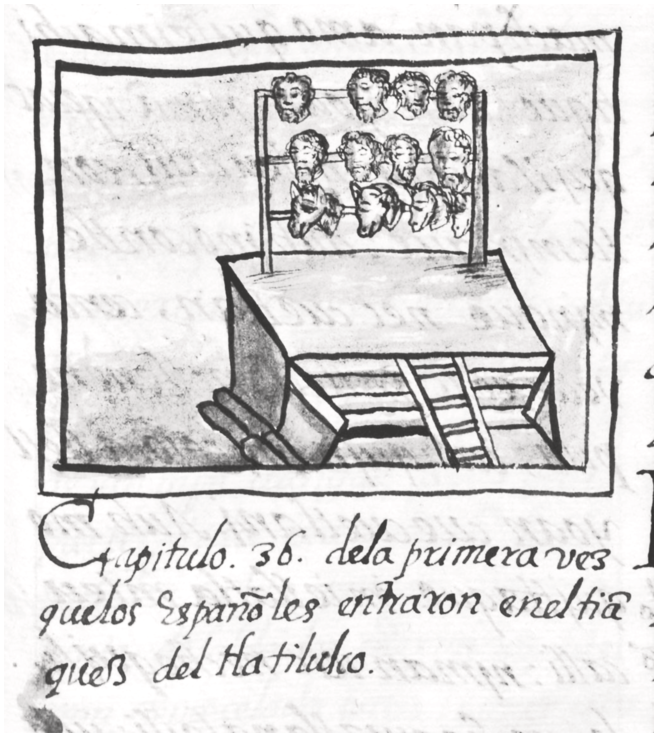
Bernal Díaz also recorded that when Cortés was repulsed from Tenochtitlan, the Mexica leader Guatémoc sent “the heads of the horses and the flayed hands and feet of the soldiers they had sacrificed” to the towns of Matlazingo, Malinalco, and Tulapa to appeal for assistance.Footnote 19 As Indigenous language accounts of the conquest were compiled and written in the generations after, they suggest an important counternarrative – that in addition to being able to adapt military tactics against these animals, Indigenous observers equally had insight into the relationship between the Spanish and their horses and the cultural and political symbolism of this animal.
When contrasting Spanish-language narratives with the outcomes of specific encounters, it is possible to recover a far greater range of Indigenous reactions to and interactions with horses. Given that these texts also suggest that Indigenous people expressed surprise, curiosity, and even courage in response to the horse’s novelty and power, the persistent attribution of fear appears to be the projection of a desired result; that is, Spanish views about horses shaped their own descriptions of these initial encounters. The Spanish played to their own preconceptions by placing tactical emphasis on surprise and speed, creating diplomatic displays of horsemanship, and employing theatrics that amplified the natural strengths of horses and suppressed their weaknesses.
2.2 Horses as a Measure of Colonization
As evidenced earlier, the horse reflected more than the aims of military conquest in a vision of the political and social order that was to be established in new settlements. In the Iberian case, the horse influenced legal language that was used to negotiate noble status, require horse ownership, and regulate horse breeding, all standards of governance in conquered municipalities that would continue to shape social mobility and access to political office. The horse’s role in settlement strategies for new conquest territories included three key elements of possessing land, qualifying for office in municipal government, and supplying horses for further expansion. These would be activated in a practice most central to colonization: laying claim to new territory.
Despite the framework of Iberian frontier traditions, their application in the New World faced the dire issue of an absolute absence of horses. Neither Columbus nor any other early expedition in the Caribbean and Mesoamerica encountered endemic populations of horses. Whereas the fear of a scarcity of horses had shaped political debate in Castile and Andalusia, an actual looming deficit shaped colonialism in the New World. As the following examples illustrate, bringing horses to the Americas and sustaining breeding populations in new colonial settlements was not facilitated by the natural conveniences or advantages of either the animals or the local environments.
Strong motivations for strategically introducing and sustaining horse populations preoccupied many conquistadors and governors. The Spanish introduction of horses to the Americas demonstrates both the nuances of regional environments that challenged the replication of this system, and the forces propelling it as a measure of colonialism. A similar underlying logic impelled the introduction and then implementation of horse breeding throughout new territories in the Americas. The settlements in the Caribbean reproduced the imperative to have a sufficient horse population to guard against the threat to political and social order that a scarcity of horses threatened to bring.
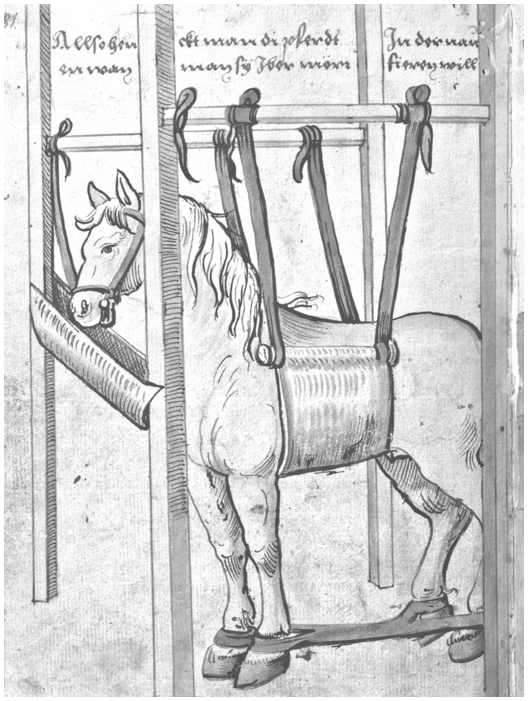
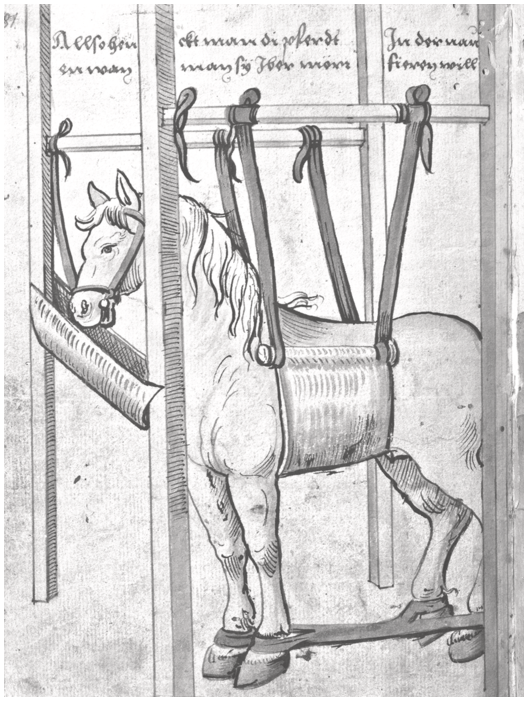
The central importance of horses should be viewed against the difficulty of bringing them across the Atlantic. In fact, in order to protect populations within Spain, it was officially forbidden to export stallions from the peninsula without specific permission from the king to his governors. In the shipment outfitted for Columbus’s second voyage to Hispaniola, Columbus brought twenty-five horses.Footnote 20 About one-third of these horses died in passage, probably from dehydration. Columbus sent a letter via Antonio de Torres complaining that the horses were not worth the 2,000 maravedís paid for them.Footnote 21 These horses were both expensive to ship and were frequently distressed by the voyage itself. After Columbus’s voyages, horses next arrived with the governors Bobadilla (1499–1502) and then Ovando (1502–1509). Río Moreno estimates that a horse that cost ten ducats in Seville would end up costing triple its purchase price to pay for its passage and supplies across the Atlantic.Footnote 22 Shipped in slings or hammocks, the main limiting factor for the horse was water (Figure 2.2). An average-size 1,000 pound horse will eat anywhere from fifteen to twenty-five pounds of food and drink ten to twelve gallons of water per day. Digestion problems from lack of water are serious, as horses do not have a vomit reflex and can quickly suffer from colic, a leading cause of death. Over the course of two to three months of transport, about 50 percent of horses brought as cargo died, according to Denhardt’s estimate.Footnote 23
Horse in a sling for shipping from Christoph Weiditz, Trachtenbuch (ca. 1530–1550), Germanisches Nationalmuseum Nürnberg (Hs 22474, Image 81) Digitale Bibliothek.
In addition to the difficulties of importing horses, the use of horses on expeditions frequently had catastrophic results, further exacerbating their scarcity. Among the series of risky ventures undertaken to search for passage from the first settlements on Hispaniola to the ultimate desired destination of the Pacific Spice Islands, it was not uncommon for entire shipments meant for seeding new settlements to be lost to shipwreck or other disasters. Subsequent shipments of horses from Spain, each containing between thirty to one hundred horses, went to fund major entradas (conquest expeditions) to explore mainland territories, like those of Nicuesa and Ojeda, in the Tierra Firme of Central America in 1508, in which no horses that embarked survived. Losses were frequent, if not catastrophic. Of special note are Ponce de León’s disastrous expedition to Florida in 1521, and Pánfilo Narváez’s to Florida in 1527.Footnote 24 The harsh geography of Peru was no exception in the early expeditions further south. In 1536, Pedro Anzúrez reported being forced to drink the blood of his horses for nourishment on the first expedition from Peru to Chile. The high-altitude crossings of the Almagro and Valdivia expeditions from Peru down to Chile left many dead horses on route. In fact, during Valdivia’s second attempt to cross over in 1540, the trekkers reportedly ate the frozen carcasses of horses left from the first attempt.
Despite the evident difficulty of obtaining, shipping, and then supporting a population of horses in the Caribbean outposts, this cycle repeated itself. To understand the tenacity of these efforts, it is important first to understand that the first horses to set foot on Hispaniola were not brought primarily for battle, nor were they beasts of burden; rather, they were brought as the mounts of the men who would be the face of order in the new colony, from the Hermandad, or royal policing force, of Granada.Footnote 25 This important detail is telling of the horse’s imprint in the liberties and privileges granted to those occupying the posts of municipal government. In the Iberian Peninsula, the kings had developed a system for ensuring their own supply of horses and, in the process, they made the horse a central element to defining claims to upward social status as a measure for distributing land and political office.Footnote 26 In the New World, terms of both land distribution and municipal office were tied to horse ownership and horse breeding, respectively, and consequently shaped how the initial colonial settlements were organized.
Frontier rewards for military service were recognized by titles and land grants that both ensured a supply of horses to defend the land and moderated access to municipal government positions.Footnote 27 Those who had provided service of a horse and arms in the initial conquest were granted a repartimiento (portion) of land, including lots known as caballerías, when a town was founded.Footnote 28 In contrast to the peonía granted for service on foot, the caballería was 4–5 times larger. The specific size varied according to the productivity of the land, but was considered enough for a man to supply a horse and set of arms.Footnote 29
Columbus’s successor, Governor Ovando, oversaw the establishment of colonial settlements following this Andalusian model, instituting the system of encomienda in 1503. Encomienda grants conferred legal jurisdiction over the fruits of the land, rather than direct land ownership, such as rights to demand labor and tribute from the inhabitants of designated towns and villages. In return for their privileges, the so-called encomenderos were obliged to supply a horse from their estates, a responsibility calculated in proportion to the population of indios awarded in their jurisdiction. For an encomienda of 1,000 indios, one was obliged to maintain at least one horse and set of arms.Footnote 30 Rodrigo de Albornoz, accountant of New Spain, wrote to Charles V in 1525 in favor of the encomienda system, noting that each settler should be obliged to plant certain things on their land, and to keep horse and arms according to the number of indios he has. These men were actually inspected for their adherence to the requirements of horse ownership. For example, the third governor, Diego Colón, called for an alarde (inspection) for city residents to present their horses.Footnote 31 As in Castile, these equine obligations ensured access to municipal government positions. In Puerto Rico, for example, a background check on someone nominated for the role of regidor (councilman) requested testimony from a witness to confirm he had maintained his horse and arms accordingly. Witnesses were asked if Hernán Pérez had “assisted and assists in the town with his arms and horse at his own cost.” They confirmed that Pérez had served as a captain, “como buen caballero” (like a good knight) and, moreover, that he had maintained very good horses and arms, all at his own expense.Footnote 32 Thus, as a reward for serving on horseback, encomenderos had the simultaneous privilege and obligation of providing a horse and arms under their governor, and inspections were used to enforce horse ownership.
In the initial period of arrival and settlement in the Caribbean islands, the scarcity of the horse contributed to its immense value. Trade and transport of horses was closely regulated to protect horse populations in Spain, and it was even more rigorously regulated in the New World colonies, shaping the ordinances imposed on individual settlements and the elite status that could be claimed by providing a horse.Footnote 33 Indeed, Columbus had complained as early as 1494 that “the king ought to buy the horses belonging to private individuals in Española because the owners would not permit their use unless they themselves were riding them.” King Ferdinand replied that these men should keep ownership of their horses but gave Columbus, as governor, the authority to commandeer them if it was in the best interest of the colony.Footnote 34 The authority to care for the horses brought over on expeditions defaulted to the acting governor and judges in the courts and city councils. The king, moreover, allocated specific lands for his own equine stock (a caballeriza, or stable for stallions), given in capitulations to the governor to manage on behalf of the Crown. As a result, often the governor or viceroy became responsible for breeding horses on a royal hacienda for the benefit of the public good of his jurisdiction. In this sense, horse breeding, managed under municipal jurisdiction in frontier territories, represented part of the “common good” for colonial settlements. Acknowledging scarcity as an important constraint, these horses were also investments for seeding future supply in new settlements across the Caribbean islands and into the mainland, Tierra Firme.
While the Crown claimed ownership of animals multiplying in its new territories, the governors of each territory controlled the movement of these populations. The capitulations granted for settling newly “discovered” areas typically permitted a specific ratio of supplies, including livestock, and exemptions from a duty tax on imports and exports, known as the almojarifazgo, to assist these enterprises. The link between governors and horse breeding is evident in the king’s command to Bobadillo, who replaced Columbus in office, that he return the broodmares that he had taken from Columbus’s ranch. The governor’s ranch under Ovando had sixty mares, and he brought another ten stallions specifically for breeding on the island, as well as a subsequent shipment with one hundred and six mares for this same purpose. Breeders typically were also governing officials, and the two roles reinforced each other in terms of the privileges of participating in the royal monopoly on supplying entradas with horses. That is, horse breeding was not primarily a commercial enterprise, but a social and political one that economically benefited only a few. Moreover, controls on shipments of horses directly from Spain increased after 1507, and included the need for specific licenses to bring broodmares. These restrictions essentially transferred the monopoly of horse supply from Seville to the Caribbean islands where breeders established themselves to supply expeditions. Livestock remained concentrated in the hands of government officials, who profited from supplying and provisioning these animals.Footnote 35
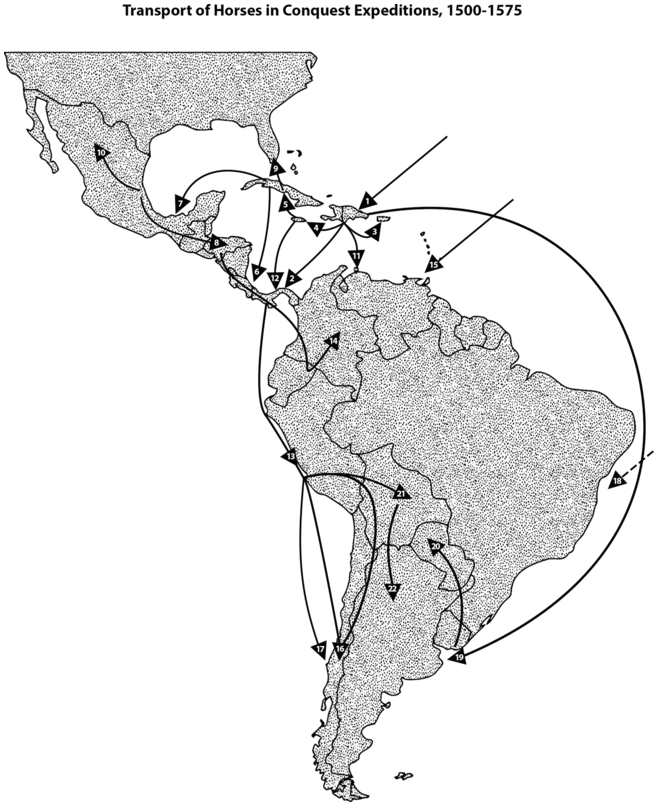
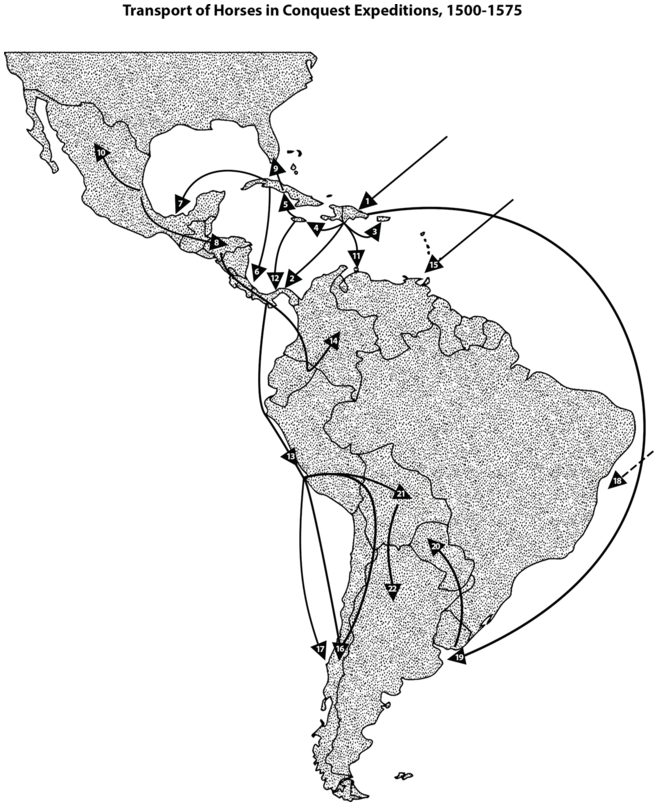
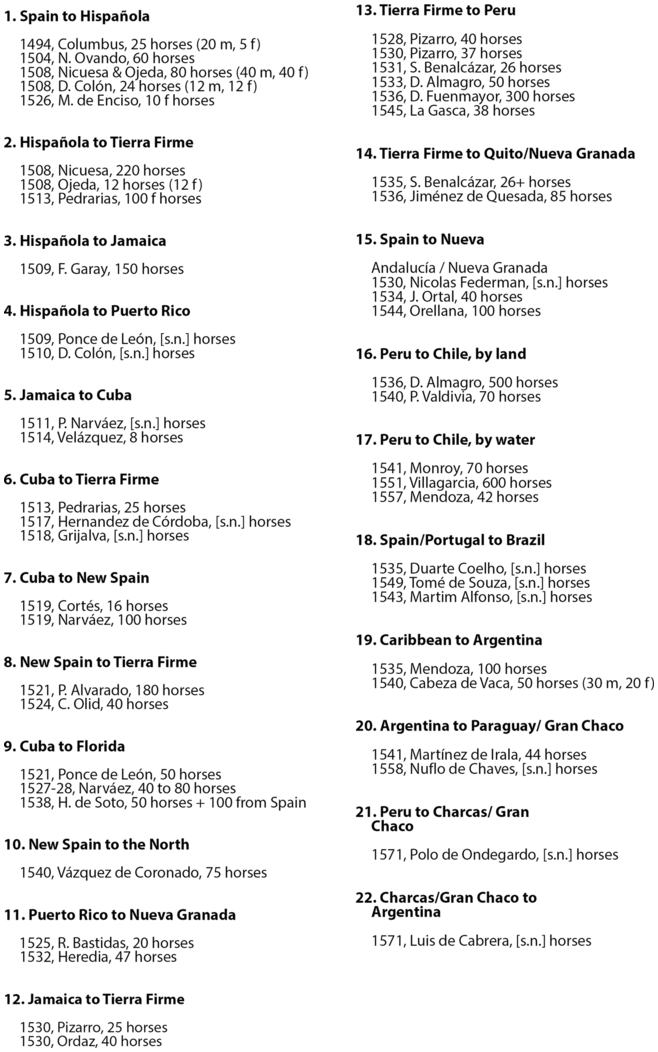
With permissions granted by the Crown to the provincial governor, horses first moved from Hispaniola to other Caribbean islands, in support of expeditions to the mainland Tierra Firme, a designation that also encompassed what would later be divided into Veragua and Castilla de Oro up the coast of Central America to Nicaragua and Honduras, and Nueva Andalucía further inland in Colombia and Venezuela (Figure 2.3). In May 1509, the first governor of Puerto Rico, Juan Ponce de León, brought horses from his hacienda in El Higüey, Hispaniola. Subsequently, Puerto Rico supplied Ponce de León’s two expeditions, with two hundred men in 1514 and fifty horses in 1521.Footnote 36 The Spanish turned to settle Jamaica at nearly the same time they ventured into Puerto Rico. On this expedition, Francisco Garay took 130–150 horses from the encomienda he had received five years earlier in eastern Hispaniola. In the 1530s, Martín Garay continued to manage the supply of livestock from the king’s estates in Jamaica.Footnote 37 Cuba was settled in 1511, by a company of men well known for their later investments in horses, including Hernán Cortés, Pedro de Alvarado, Bernal Díaz del Castillo, Juan de Grijalva, and Francisco Fernández de Córdoba. Velázquez himself personally arrived in Cuba in 1514 with eight horses and imported more from his Hispaniola ranches. He reported that 30,000 hogs and an unspecified number of horses already covered the island savannas in Cuba, evidence of a huge transfer of livestock from Hispaniola.Footnote 38
Transport of horses in conquest expeditions, 1500–1575
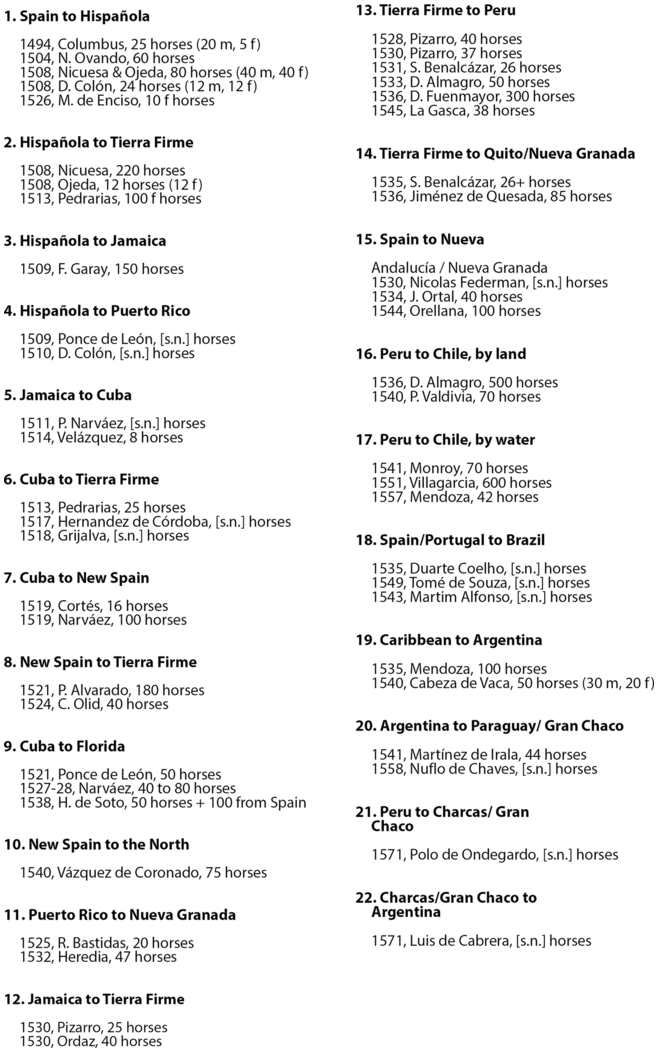
The interest in owning and breeding horses exhibited by the leaders of these expeditions originated from the privilege of transferring livestock without additional import taxes, a privilege that came with appointment to particular municipal offices reserved for those who maintained a horse and arms for the colony. In general, early competition among various ventures led to an initial transfusion of livestock to additional islands; on the other hand, difficulty in securing the island settlements and their eventual depopulation also permitted the growth of the livestock populations. From the perspective of conquistadors, wealth referred almost exclusively to the presence of gold on land granted in encomienda. Hence, depopulation became an increasing cause for concern as they abandoned such holdings for whatever seemed more promising in newer ventures. Nevertheless, trade privileges that were free of import taxes remained an important factor for those who stayed. Wealthy men in the settlement of Hispaniola obtained access to gold found in rivers, and they used the accompanying land for raising livestock to sell meat and to provide horses and mules to expeditions departing from Cuba. Notably, these men also held key official positions. Gonzalo de Guzmán, procurador; Nunez de Guzmán, tesorero; and Pedro de Paz, contador, among other encomenderos, were accused of monopolizing sales to expeditions.
This exemption from import taxes also served as the impetus to provide horses for the entradas to the mainland from Caribbean outposts. Governors were tasked with defense of the new colony, but also offered licenses for further military expeditions that sought to encounter and control new swathes of land. Cuba outfitted Cortés’s expedition to Mexico, as well as the expeditions of Francisco Hernández de Cordóba (1517, Yucatan) and Juan de Grijalva (1518, Costa Rica). As Bernal Díaz noted of the sixteen horses procured for Cortés’s expedition, they were not all of excellent quality – four were not very fast or without training for war, and he described them as “good for nothing.” However, these were the horses that could be found in Cuba, and as Díaz explained, “about this time horses and slaves were only to be purchased for very high prices, which accounts for the small number of the horses we had with us on this expedition.”Footnote 39 Thus, the tax exemption was useful for political leaders to transfer horses to new settlements, but the increase in breeding was offset by the immediate outflow of horses for the next conquest expedition.
Ensuring a supply of horses from the islands formed part of Cortés’s strategy in Mexico, too. A relatively swift campaign generated opportunities for breeding his own horse supply in New Spain shortly thereafter. Even in 1520, before victory was assured, Cortés had already sent Diego de Ordaz and Gregorio de Villalobos to forge a settlement in Veracruz and raise, protect, and manage livestock brought from Jamaica.Footnote 40 Sluyter credits Villalobos with establishing the first ranches in the Veracruz region.Footnote 41 Additionally, after 1521, Cortés fostered the development of agriculture, animal husbandry, and transport of livestock from the Caribbean islands. He was motivated by the high price of horses in Cuba and Hispaniola, which had grown outrageous due to the demand for horses on mainland expeditions. Island breeders, on the other hand, had asked the king for restrictions on exporting breeding stock from the islands to protect their herds, issued on November 24, 1525.Footnote 42 Subsequently, the city council in Mexico City complained to the king that Hispaniola and Cuba would not give the New Spain colonists the horses they needed. Rodrigo de Albornoz, accountant of New Spain, wrote to Charles V in December 1525, asking that “the officers of Española, San Juan and Cuba permit the free shipment of cattle, cows, mares, sheep and rams to this country because there is an abundance there and a lack here …” He also acknowledged, however, the importance of reserving broodmares for replenishing the island stock: “do not let mares leave for these parts.”Footnote 43 The success of these appeals features in the Ordenanzas para Poblaciones in 1525, conceding specific sites of land for raising imported domesticated animals.
Initially, the Caribbean islands of Cuba, Puerto Rico, and Jamaica served as the staging grounds for expeditions to Tierra Firme and New Spain. The next stage aimed to seed mainland stock, as had begun already in central Mexico. Spanish claims to Central America were far more complicated and less thoroughly successful than those to New Spain or Peru. But as the major passageway to the “South Sea” (Pacific) and points further south, mainland Nicaragua and Panama became a second major pivot point for supplying horses for entradas. As with the earlier settlements, the development of horse populations was made possible by privileged access to municipal office, which was reserved for those who were awarded an encomienda or who were otherwise able to provide horses and arms, and by the exemptions and permissions for moving horses (as well as enslaved peoples) reserved for those offices.
A residencia, or formal review of the Governor of Nicaragua, Francisco Castañeda, illustrates how this system functioned, both in terms of the municipal associations between horses and social status, and the colonial ties between holding political office and seeding horse populations for new settlements. An active member of early expeditions to Tierra Firme, Castañeda eventually assumed governorship of Nicaragua from 1531 to 1536, and the official review of his time in office concluded in 1541. The details unveiled in this report provide a neat summary of how the role of horses in identifying social status was underwritten in the riding, breeding, and transport of horses. In other words, extending the physical presence of horses in the New World derived from political motives and vested interests of governors in colonial conquest territories.
Spaniards had encountered firm resistance as well as challenging geographies and complex relations among ethnic and linguistic groups in early expeditions to the Central American mainland, known initially as the Tierra Firme. In 1509, Ojeda sailed with three hundred men and twelve broodmares to explore new coastal mainland regions. Despite finding gold, in just a few days the crew had been decimated. Driven away by Indigenous defenders, the Ojeda expedition sought refuge with another camp led by Nicuesa in San Sebastian (current-day Colombia). Lope de Olaño reported that the Nicuesa-led settlement became so desperate for food that they ate the foals of their mares. In fact, the ill-fated colony ultimately ate all 220 horses they had brought – a fortune of 125,000 pesos.Footnote 44 In 1513, a large and ambitious party of courtiers and officials under the infamous leadership of Pedrarias overtook the pitiful foothold that had been left under Balboa’s guidance to wait for reinforcements. Although this party brought another one hundred mares from Spain, these valuable additions were also subsequently lost.
Castañeda joined Pedrarias’s expedition to Tierra Firme and became a key figure in the trade of horses in the early colonial settlements that branched out of these earlier, unstable claims to territory along the Central Coast. In 1519, Pedrarias was given the license to found a new settlement in Panama (Asunción). Pedrarias’s lieutenant, Hernández de Cordóba, also founded a new settlement (Vila de Bruselas) in 1524, which was later moved and renamed Granada, Nicaragua, in 1526. There, Hernández de Cordóba founded a stock of breeding horses (yeguada) that rivaled those founded by Governor Colón in Santo Domingo. Aware of this competition, Pedrarias wrested control of the region as governor in 1527. A licenciado (lawyer), Castañeda had held posts in Spain and in the Canary Islands before coming to the New World, and under Pedrarias in Nicaragua, he served as contador (treasurer) before being elected alcalde (judge) in León in 1529.
Castañeda used the benefits of his position to the maximum extent in this new settlement of León. The complaints lodged against him in his tenure as contador (1527–1531) under Pedrarias included not collecting the almojarifazgo, or the 7.5 percent import duties on goods shipped between the provinces (from Mexico, Guatemala, and Honduras to Nicaragua), for an outstanding amount of 10,000 pesos. Castañeda asserted that the governor did not order him to value the horses or enslaved Indigenous people that passed from the north into Nicaragua. As alcalde, Castañeda was given permission to leave the province of Nicaragua and to sell both horses and slaves (“yeguas, caballos, y esclavos”), circumventing the typical control over the import and export of goods.Footnote 45 On the death of Pedrarias in 1531, Castañeda was elected – after putting himself forward – as the replacement governor, and he continued these practices during his tenure as governor.
Castañeda profited from his position as governor, which allowed him to arbitrarily decide which animals could come into or leave his province of Nicaragua. In the residencia, one witness, Anton Montero, reported that he had purchased a horse for 150 pesos (from Alonso Lorenzo and Francisco Lopez), but after four months Castañeda decided he liked the horse and would take it at the current price. Because news of gold in Peru had reached Nicaragua, inflating demand for horses, Montero named the price of his horse at 300 pesos, but the governor only gave him, in exchange for his animal, a mare that was worth 130 pesos. Apparently, Montero complained so much about this exchange that Castañeda also gave Montero a license to go to Peru and to bring the mare with him.Footnote 46 Castañeda defended his actions by saying that the demand for going to Peru had depopulated the area and had already taken the best horses. He consequently proclaimed that no one could buy a horse in order to send it out of the province, and if any citizen of León or Granada sold a horse in this way, Castañeda would confiscate it. But a second witness confirmed that Montero’s horse was taken unjustly and, as evidence of this view, reported that it was later seen in possession of Castañeda’s nephew, Vasco de Guevara.Footnote 47
Spanish interest in the wealth of the Incan empire and Pizarro and Almagro’s audacious plans to subjugate it exerted pressure on the local horse population, and also heightened the impact of the governor’s privileges on the import and export of horses. Sea ports were the primary point of entry for goods to South America; although settlements and expeditions had been introduced through Venezuela and even further south in Río de la Plata in the 1520s and 1530s, the difficult terrain limited the supply of horses to sea entries from the Pacific Coast into Ecuador or Peru, and then proceeding overland.Footnote 48 The coastal trade in horses to Peru included actors from Mexico, Nicaragua, and Panama.Footnote 49 Castañeda benefited from the heightened interest in moving people and goods to Peru through the ports of Realejo on the Pacific coast of Nicaragua, or from Nombre de Dios in Panama. To join the rush in Peru, travelers had to pay for passage on one of the ships in port, which might be 200–300 pesos, and over and above that Castañeda would add his own charges for granting his permission to go to Peru from Nicaragua and for permitting the transfer of horses.Footnote 50
In addition to charging fees for granting permission to leave the province, Castañeda used his governing muscle to profit from the shipping of horses itself. In 1536, Gaspar Rodríguez and Diego de Rojas reported on a business venture they had formed involving a ship called San Jorge, which carried cargo from Nicaragua to Peru. But Castañeda would not allow ships to leave the harbor without first taking the merchandise on board intended for sale in Peru. They testified that no ship left the port without Castañeda first taking (at discounted prices) their best horses and merchandise in exchange for permission to leave the port, or else the ship might be held for as long as five months. They complained that this delay and forced sale of merchandise cost them 5,000 pesos.
Castañeda, on the other hand, was involved in sending goods to Peru through several of his own business endeavors or compañías. He profited off his own personal supply of horses, which had been confiscated in the port and bred in the governor’s lands, and also from the choice supply he was able to commandeer from all those moving through his domain. After charging for permission to move horses and retaining the best for himself, in the third act of his swindle he turned around and sold those horses at inflated prices. Based on one charge against him, Castañeda was asked if he had licensed a particular company of three men to take his horses to sell in Peru. Castañeda confirmed that he had given several mares to Rodrigo de Villa Gomez to ship in the San Miguel, but that he had entrusted him to sell them on his behalf for 4,000 pesos, or 800 each – a reasonable price when, at that time in Peru, the mares could have been purchased for 1,000 pesos each. Other testimony, however, stated these same horses would have been worth only 200 pesos in Nicaragua.
The residencia, with nearly one hundred charges to investigate, of which at least ten were specifically related to Castañeda’s trade in horses between Nicaragua and Peru, was concluded in 1541.Footnote 51 As a result of an investigation into gains made from his tenure as governor, Castañeda was ordered to pay fines of over 1.2 million maravedís (2,400 pesos de oro, approximately) plus another 2,000 pesos de oro, in 1543.Footnote 52 The last court records document Castañeda fleeing from his post.Footnote 53 In this case, the documented abuses of the privileges of office vividly illustrate the significance of the horse to Castañeda’s gains, and they demonstrate the horse’s ties to governing new settlements and further conquest. Building on expected arrangements in conquest frontiers, the horse offered an avenue for personal social mobility as it related to the distribution of land and access to political office. The municipal privileges associated with sustaining active horse populations also spread in new colonial settlements from the Caribbean islands to the new mainland jurisdictions. It was a linchpin in colonization ambitions heading south, as it had been in the Caribbean expansion to Tierra Firme. Castañeda’s example of profiting from these arrangements also shows the potential for a modern use of a traditional institution.
2.3 An Equine Imprint in the “New World”
The arrival of horses on the second voyage of Columbus extended Spain’s organization of social status around permissions to own, export, and ride horses into the New World. The horse’s advantage of inducing shock and awe is often described as creating a tipping point of Spanish conquest campaigns – provoking momentary apprehension or confusion that could turn the tide of an encounter. Although Spanish period sources persistently attribute Spanish victories to Indigenous people’s fears of horses, a diverse range of reactions to and interactions with horses can be traced across local contexts. More tellingly, many conquistadors conceived of and recorded their actions in the Americas as intimately tied to a specific social and political relationship with horses based on Iberian precedents.
In Spain’s growing empire, the model frontier institutions for the organization of new territory were extended to new expeditions and settlements. The establishment of towns and their forms of governance, especially the social benefits of encomendero status, drew on practices from conquest settlements in Andalusia in the distribution of land and its uses for livestock breeding. Horses extended the political and social order instilled by conquest strategies as they related to social position, cabildo governance, and land tenure. The almojarifazgo, or exemption from import/export duties that was granted to island officials and individuals in approved expeditions, both bolstered their exclusive access to horses and gave them the incentive to seed horse populations in each new successive venture.
For these same reasons, horses and horse breeding would also become an integral part of conquest and colonization through the organization of colonial settlements in the Americas. While some environments naturally suited horse populations, others were far more challenging and required strategic intervention to support Spanish military and economic interests. Replicating such forms of governance required concerted efforts to build horse breeding capabilities in new colonial settlements. As it was incorporated into the standards of municipal governance, the legal and political presence of horses as the public face for social order would soon find clear expression in new breeding policy and enforcement.
The imprint of the horse in frontier settlements dealt with the rhetoric of scarcity, which in the New World was a reality. In addition to their military uses, horses also became a measure of the orderliness of new colonial settlements. Strategies for introducing horses responded to local and regional environments, as well as to political, economic, and military motivations. As settlers moved from Caribbean outposts to mainland footholds, the imprint of the horse shaped municipal government, and the breeding and trade in horses in turn fueled expansion into further reaches of the Americas. But the horse was also a costly investment and one that could be used to negotiate for one’s individual interests against the monarchy, and additional challenges to this biopolitical frame would also emerge in environmental and indigenous contexts. In this politics of the horse, the horse’s body was a measure of both colonization and its challenges.

 Open access