



Rheumatoid arthritis (RA) is a common autoimmune disease characterised by inflammatory changes in synovial tissue, cartilage, bone and extra-articular areas of the joints(Reference Xu, Chang and Jiang1). RA is widely distributed worldwide, with a global prevalence rate of approximately 0·5–2 %(Reference Yuan, Xiong and Zhang2). As the global population ages, the prevalence of RA continues to increase. Due to the high cost of treatment, disability and mortality of RA, it imposes a serious economic burden on individuals and society(Reference Wu, Luo and Li3). The National Audit Office of the UK has reported that the annual healthcare expenditure for RA in the country amounts to an astonishing £560 million(Reference Fazal, Khan and Nishi4). Despite the advancements in pharmacological interventions for RA, a definitive cure remains elusive, and therapeutic drugs entail inherent risks of infection, tumorigenesis and allergic reactions. Therefore, exploring the risk factors of RA and adopting targeted treatment strategies play an important role in reducing the disease burden.
The aetiology of RA has not yet been fully elucidated, and the interaction of genetic and environmental factors may play an important role in the pathogenesis of RA(Reference Guo, Wang and Peng5). Recently, diet and nutrients have received considerable attention as potential environmental factors influencing disease development(Reference Lucchino, Spinelli and Iannuccelli6). On the one hand, dietary factors may contribute to the development and progression of autoimmune diseases through proinflammatory and autoantibody induction(Reference Petta, Fraussen and Somers7,Reference Camps-Bossacoma, Abril-Gil and Saldaña-Ruiz8) . Observational studies have shown that red meat, salt and excessive caloric intake can exacerbate the symptoms of RA through proinflammatory effects(Reference Jin, Li and Gan9–Reference Manzel, Muller and Hafler11). On the other hand, dietary control is often used as an adjunctive approach to manage RA symptoms, with particular attention given to the Mediterranean diet and anti-inflammatory diets(Reference Schönenberger, Schüpfer and Gloy12–Reference Forsyth, Kouvari and D'Cunha14). Therefore, dietary factors may be directly related to the pathogenesis and treatment strategies of RA. It is of great significance for both clinical doctors and patients with RA to understand whether dietary changes are beneficial.
Mendelian randomisation (MR) uses genetic variation as instrumental variables (IV) and can be used to test for exposure-outcome causality(Reference Sekula, Del Greco and Pattaro15,Reference Emdin, Khera and Kathiresan16) . Compared with observational and randomised controlled studies, MR is effective in reducing the effects of confounding factors, reverse causality and expensive research costs(Reference Emdin, Khera and Kathiresan16). However, there are insufficient MR studies on the causal relationship between dietary factors and RA. Therefore, we conducted this MR analysis to explore the relationship between dietary factors and RA.
Methods
Study design
The study design is shown in Fig. 1. In this study, we conducted a two-sample MR analysis to assess the causal relationship between dietary factors and RA. As the data used in this study were publicly available and anonymised, approval from an ethical review body was not required.
An overview of the study design and assumptions. The MR studies should adhere to the following assumptions: Assumption 1: Instrumental variables (IV) should be robustly associated with exposure factors. Assumption 2: IV must not be associated with any confounding factors related to exposure and outcome. Assumption 3: The selected IV influence the risk of outcomes only through exposure factors. MR, Mendelian randomisation.

Data sources
In order to mitigate the impact of population stratification, all SNP and related data are derived solely from studies analysing individuals of European ancestry. The summary data of RA are derived from a large-scale GWAS meta-analysis, which includes 58 284 European individuals (14 361 cases and 43 923 controls). Study design such as sample collection and quality control procedures are described in the original publication(Reference Ha, Bae and Kim17). The exposure data for this study were obtained from the UK Biobank, which collected genetic and health data from approximately 500 000 individuals across various regions of the UK between 2006 and 2010(Reference Rusk18). The exposure factors involved in the study include meat intake (beef intake, pork intake, poultry intake, Lamb/mutton intake, non-oily fish intake and oily fish intake), vegetable and fruit consumption (dried fruit intake, fresh fruit intake, cooked vegetable intake and salad/raw vegetable intake), beverage consumption (alcohol consumed, alcohol intake frequency, coffee intake and tea intake), dairy product consumption (cheese intake and milk Intake), nut consumption (unsalted nuts intake and salted nuts intake), cooking oil consumption (type of fat/oil used in cooking: butter and type of fat/oil used in cooking: olive oil), as well as other dietary types (cereal intake and type of special diet followed: low energy). Table 1 lists more information about the exposure and outcome datasets.
Sources and characteristics of the RA and dietary factors GWAS pooled data used in this study
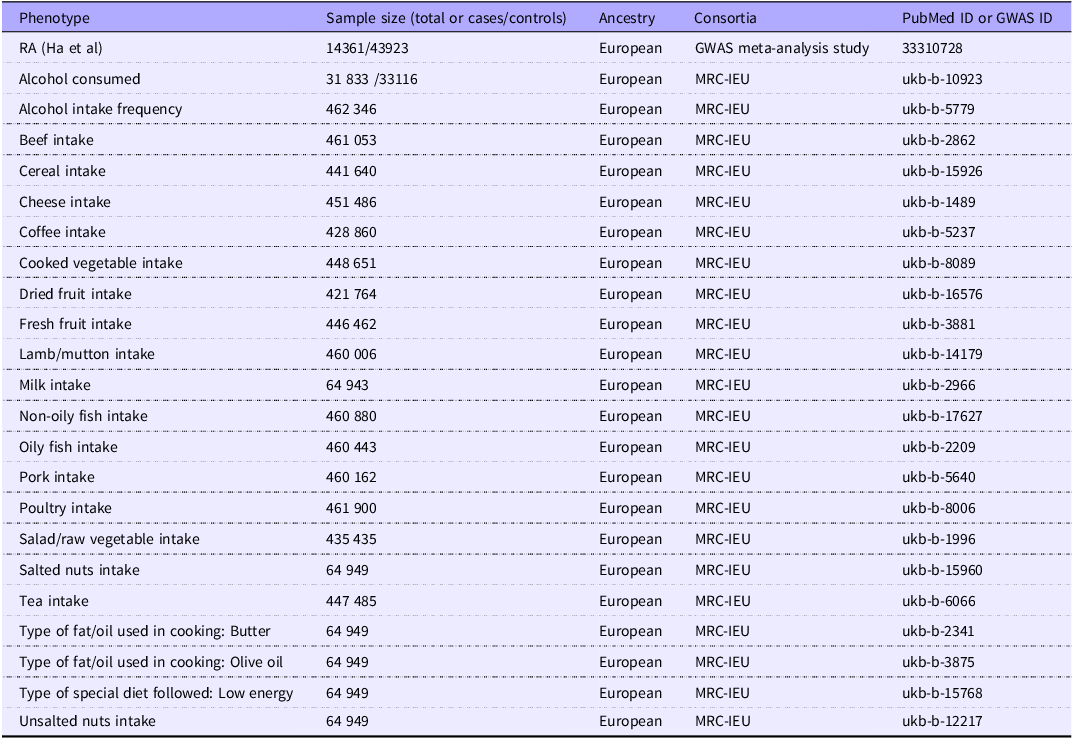
RA, rheumatoid arthritis; GWAS, genome-wide association studies.
Selection of instruments
In order to ensure the integrity and accuracy of the research findings, we employed the following high-quality procedures to select the optimal IV. First, we selected SNP that were significant at a genome-wide level (P < 5 × 10⁻⁸) and independent (r2 < 0·001 and distance > 10000 kb) as the exposure IV. In order to obtain sufficient IV for type of fat/oil used in cooking: butter, type of fat/oil used in cooking: olive oil, alcohol consumed, milk intake, unsalted nuts intake and salted nuts intake, we adjusted the significance level to P < 5 × 10⁻⁶. In addition, SNP highly correlated with the results were excluded in our study (P < 5 × 10⁻⁸). Third, we harmonise the SNP of exposure and outcome by removing or adjusting inconsistent alleles. Finally, the F statistic was used to ensure a strong association between IV and exposure, and SNP with an F statistic (calculated as F = β 2 exposure/SE2 exposure) < 10(Reference Lin, Luo and Yang19) were excluded from the study.
Statistical analyses
Random-effects inverse variance weighted (IVW) was used as the main method to estimate the association between each dietary habit and RA risk. The IVW model combines the Wald ratios of each SNP to obtain a merged causal estimate, making it the most powerful method for detecting causal relationships in two-sample MR analysis(Reference Hartwig, Davey Smith and Bowden20). In addition, MR-Egger, weighted median and MR-PRESSO were applied as complementary methods to improve the reliability of the results. The weighted median allows for no more than 50 % of invalid IV, whereas the MR-Egger method allows for all IV to be invalidated(Reference Luo, Au Yeung and Zuber21,Reference Bowden, Davey Smith and Haycock22) . The MR-PRESSO test is used to explore possible outliers and provide a corrective test by eliminating potential outliers(Reference Verbanck, Chen and Neale23). Heterogeneity in the IVW model was assessed by Cochran's Q test, when Cochran's Q test P < 0·05 indicated the presence of heterogeneity. MR-Egger intercept tests can be used to detect horizontal pleiotropy, with P < 0·05 indicating the presence of horizontal pleiotropy. In addition, to determine the effect of any individual SNP on causal estimates, we performed leave-one-out analyses. Finally, we use the RadialMR method to detect outliers when there is heterogeneity and/or horizontal pleiotropy. Once an outlier is detected, it will be promptly removed and MR analysis will be conducted again. All data analysis was conducted using the two-sample MR and RadialMR packages in R software (version 4.2.3). In this study, a causal effect was considered to exist when all these MR methods agreed in direction.
Results
Causal effects of dietary factors on rheumatoid arthritis
In this study, we analysed the causal relationship between dietary factors and RA using twenty-two different exposure factors. After removing one SNP each for fresh fruit intake (rs586346), non-oily fish intake (rs4318925) and oily fish intake (rs34555420) that were significantly associated with the results (P < 5 × 10⁻⁸), IV were obtained for various dietary factors. F statistics were all greater than 10, suggesting that the IV used in our study fulfill the requirement of a strong association with exposure. For more detailed information, please refer to online Supplementary Table 1.
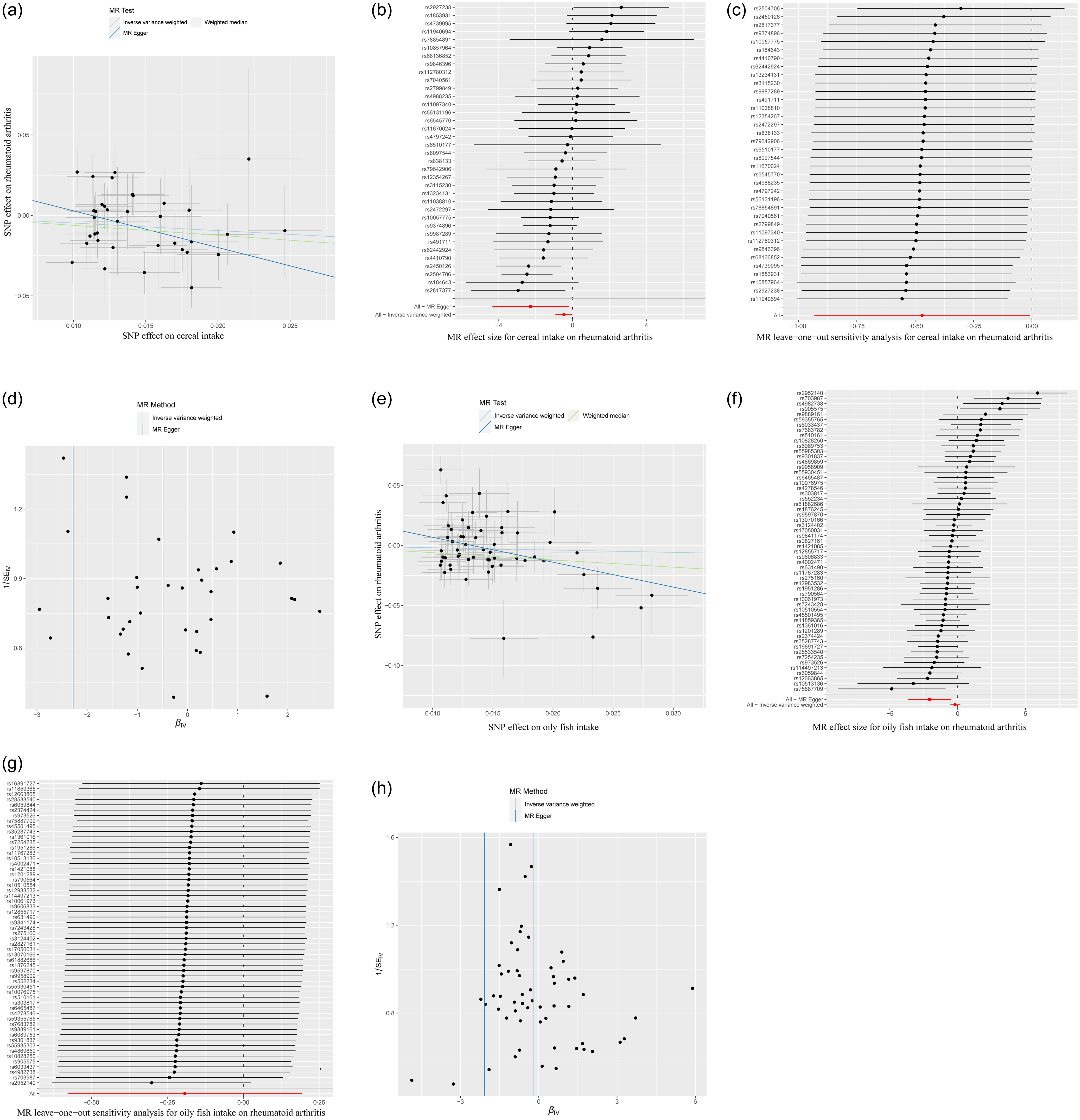
The random-effects IVW analysis revealed a negative genetic causal relationship between cereal intake and RA (OR = 0·62, 95 % CI: 0·39, 0·99, P = 0·046) (Table 2, Fig. 2(a) and (b)). Similar to the IVW results, MR Egger analysis yielded comparable findings (OR = 0·10, 95 % CI: 0·01, 0·81, P = 0·037), while the weighted median approach indicated no evidence of a genetic causal relationship (OR = 0·54, 95 % CI: 0·29, 1·01, P = 0·053) (Table 2, Fig. 2(a)). In addition, the MR Egger model suggested a positive genetic causal relationship between beef intake (OR = 577·13, 95 % CI: 5·41, 61 573·25, P = 0·020) and cheese intake (OR = 5·34, 95 % CI: 1·43, 19·87, P = 0·015) with RA (Table 2). However, both IVW and weighted median analyses indicated no evidence of a causal relationship between beef intake and RA (P > 0·05) (Table 2). The weighted median indicated a positive genetic causal relationship between cheese intake (OR = 1·53, 95 % CI: 1·02, 2·31, P = 0·042) and RA, while the IVW model did not support this causal inference (P > 0·05) (Table 2). In addition, the weighted median (OR = 0·13, 95 % CI: 0·03, 0·62, P = 0·014) and MR Egger (OR = 0·55, 95 % CI: 0·36, 0·84, P = 0·005) models indicated a negative genetic causal relationship between Oily fish intake and RA, while the IVW model did not support this causal inference (P > 0·05) (Table 2, Fig. 2(e) and (f)). Based on the random-effects IVW results, this study also found that pork intake, poultry intake, Lamb/mutton intake, non-oily fish intake, dried fruit intake, fresh fruit intake, cooked vegetable intake, salad/raw vegetable intake, alcohol consumed, alcohol intake frequency, coffee intake, tea intake, milk intake, unsalted nuts intake, salted nuts intake, type of fat/oil used in cooking: butter, type of fat/oil used in cooking: olive oil and type of special diet followed: low energy were not associated with RA and weighted median and MR Egger models supported these inferences (P > 0·05) (Table 2). Although heterogeneity was observed in a considerable number of exposures (Cochran's Q test P < 0·05) (Table 2), it does not necessarily imply that the random-effects IVW results are not robust. MR-Egger intercept tests showed horizontal pleiotropy for beef intake, cheese intake and oily fish intake (P < 0·05) (Table 2). Leave-one-out analyses demonstrated that the association between cereal intake and oily fish intake with RA remained consistent regardless of individual SNP (Fig. 2(c) and (g)), while the symmetry of funnel plots was maintained (Fig. 2(d) and (h)).
Results of Mendelian randomisation analysis: causality, heterogeneity and horizontal pleiotropy (Odds ratios and 95 % confidence intervals)
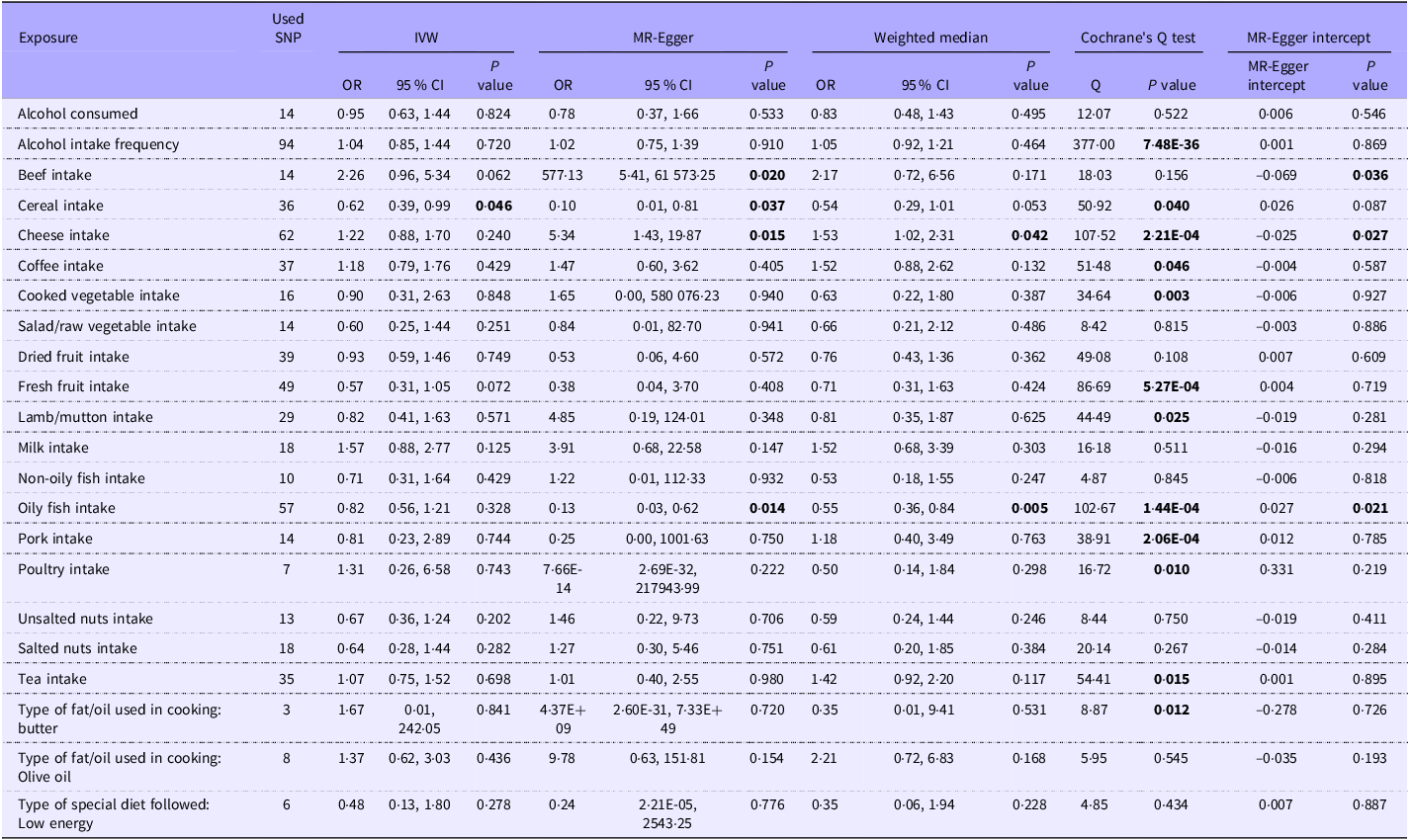
IVW, inverse variance weighted.
The boldface emphasize the statistically significant parts.
MR analysis of cereal intake and oily fish intake and RA risk. (a) and (e) Scatter plot, (b) and (f) forest plot, (c) and (g) leave-one-out analysis, (d) and (h) funnel plot. MR, Mendelian randomisation; RA, rheumatoid arthritis.
Causal effects of dietary factors on rheumatoid arthritis after removing outliers
To assess whether the heterogeneity and horizontal pleiotropy detected in the MR analysis were affected by outliers detected by RadialMR. We conducted MR analysis again after removing the outliers detected by RadialMR (Fig. 3(e) and (j)) to assess the genetic association between dietary factors and RA. For detailed information on outliers, please refer to online Supplementary Table 2.
MR analysis of cereal and oily fish intake and RA risk after removal of outliers. (a) and (f) Scatter plot, (b) and (g) forest plot, (c) and (h) leave-one-out analysis, (d) and (i) funnel plot, (e) and (j) RadialMR plot. MR, Mendelian randomisation. MR, Mendelian randomisation; RA, rheumatoid arthritis.
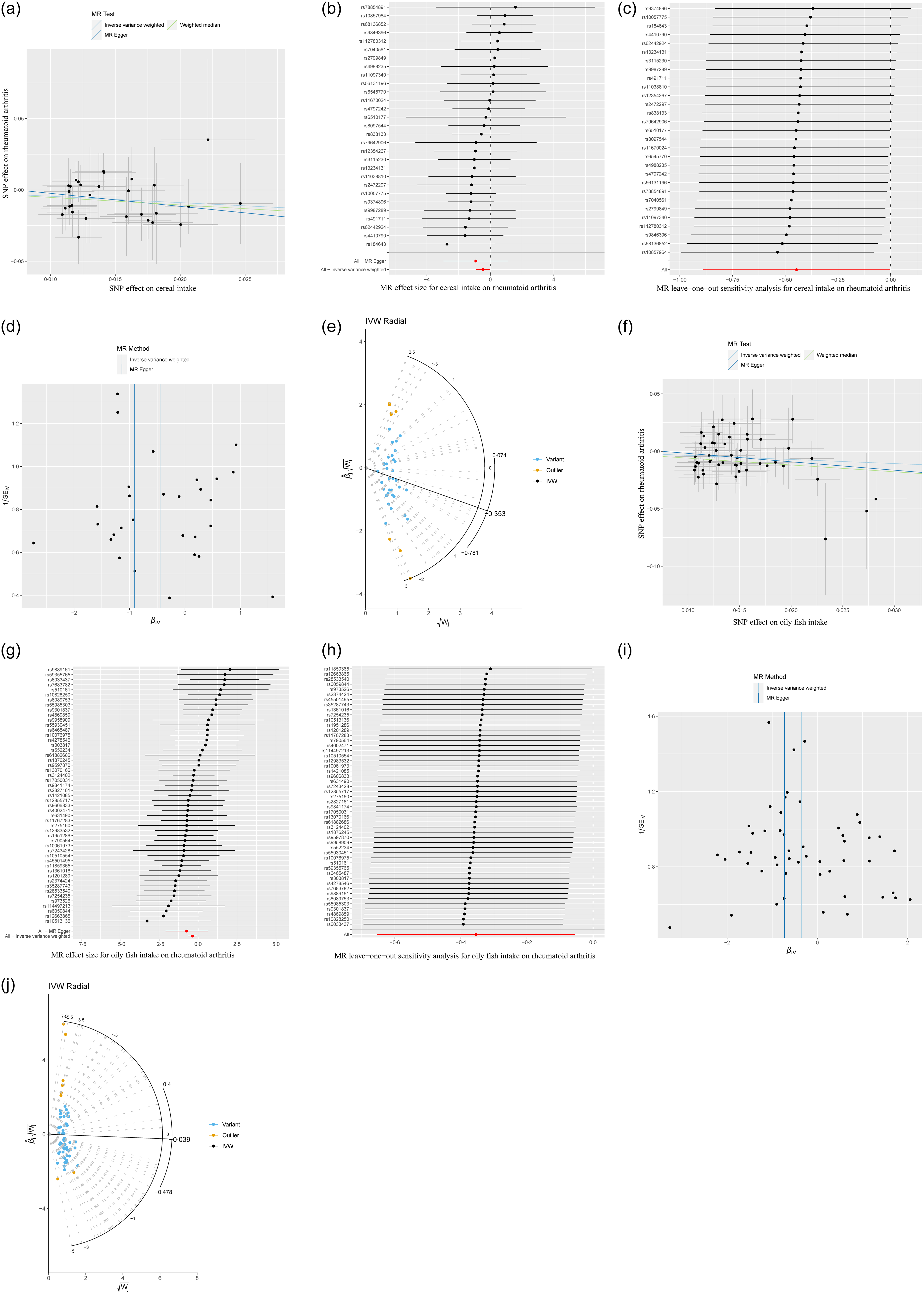
After removing outliers, the IVW analysis revealed a negative genetic causal relationship between cereal intake (OR = 0·64, 95 % CI: 0·41, 0·99, P = 0·048) and RA (Table 3, Fig. 3(a) and (b)). However, both the weighted median and MR Egger models indicated no genetic causal relationship between cereal intake and RA (P > 0·05) (Table 3). IVW results also suggested a negative genetic causality between oily fish intake (OR = 0·70, 95 % CI: 0·52, 0·95, P = 0·020) and RA, and the weighted median supported this inference of causality (OR = 0·55, 95 % CI: 0·36, 0·86, P = 0·008), whereas MR Egger models indicated no genetic causality (P > 0·05) (Table 3, Fig. 3(f) and (g)). The causal estimates obtained by the MR-PRESSO correction method showed consistent results with IVW, and no further outliers were detected (Table 3). Furthermore, random-effects IVW, MR Egger and MR-PRESSO correction methods suggested that genetically determined beef intake was positively associated with RA (P < 0·05). However, due to the presence of horizontal pleiotropy (MR-Egger intercept tests P < 0·05) (Table 3), a causal relationship between beef intake and RA could not be established. After removing outliers, the random-effects IVW results showed that pork intake, poultry intake, lamb/mutton intake, non-oily fish intake, dried fruit intake, fresh fruit intake, cooked vegetable intake, salad/raw vegetable intake, alcohol consumed, alcohol intake frequency, coffee intake, tea intake, milk intake, cheese intake, unsalted nuts intake, salted nuts intake, type of fat/oil used in cooking: butter, type of fat/oil used in cooking: olive oil and type of special diet followed: low energy were not associated with RA, and the weighted median and MR Egger models supported these inferences (P > 0·05) (Table 3). Cochrane's Q test in IVW suggested that there was no heterogeneity except Type of fat/oil used in cooking: butter (P < 0·05) (Table 3). MR-Egger intercept tests showed the presence of horizontal pleiotropy (P < 0·05) for beef intake (Table 3). Leave-one-out analysis demonstrates a robust causal relationship between cereal intake and oily fish intake with RA (Fig. 3(c) and (h)), as evidenced by the symmetrical funnel plots (Fig. 3(d) and (i)).
Results of Mendelian randomization analysis after removal of outliers: causality, heterogeneity and horizontal pleiotropy (Odds ratios and 95 % confidence intervals)
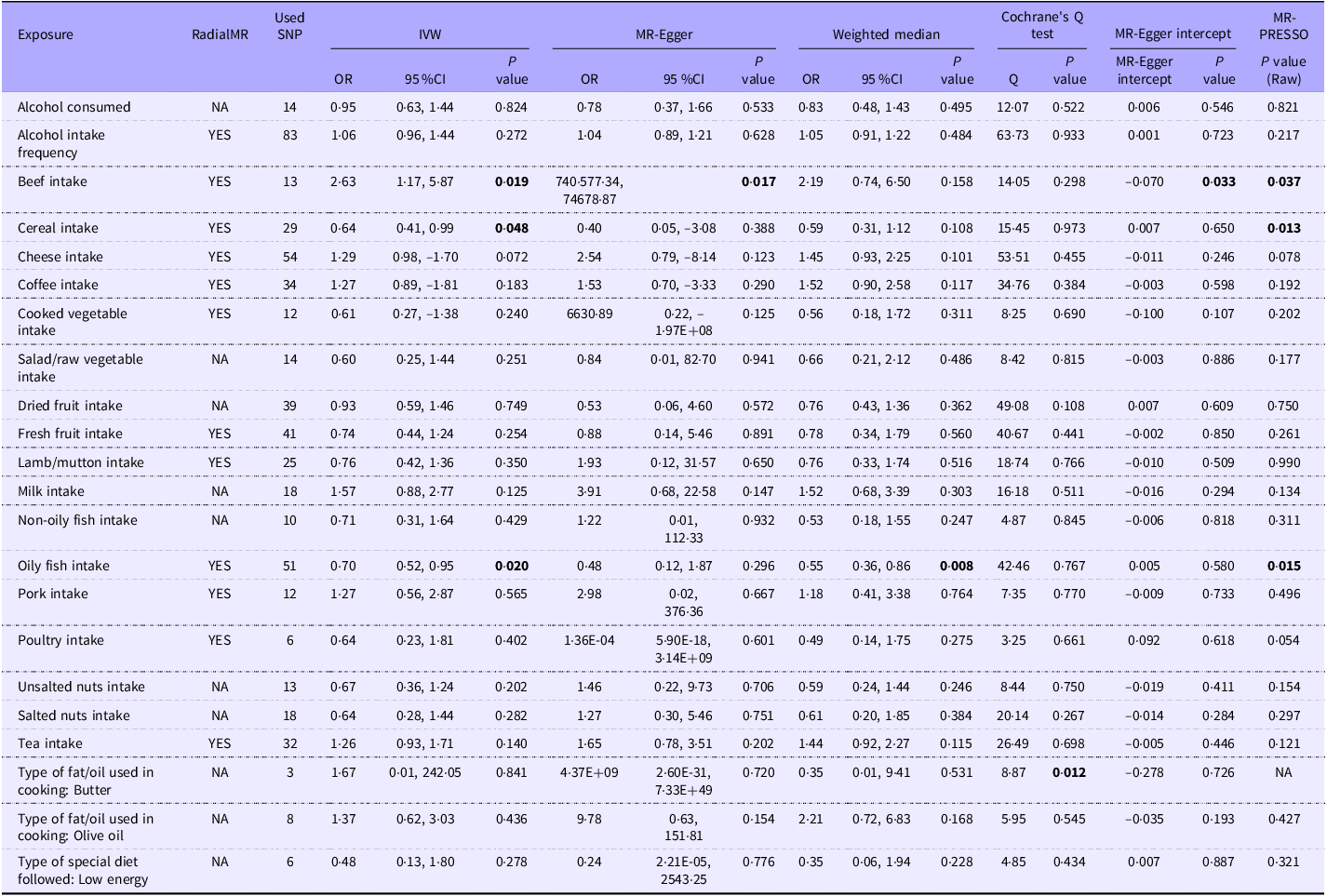
IVW, inverse variance weighted.
The boldface emphasize the statistically significant parts.
Discussion
Our results suggest that cereal intake and oily fish intake are protective factors for RA. Both prior to and subsequent to the exclusion of outliers, the IVW model consistently demonstrated a negative genetic causality between cereal intake and RA, while this causal inference was further supported by MR-PRESSO. When analysing the causal relationship between oily fish intake and RA, previous weighted median (OR = 0·13, 95 % CI: 0·03, 0·62, P = 0·014) and MR Egger (OR = 0·55, 95 % CI: 0·36, 0·84, P = 0·005) models indicated a causal association between oily fish intake and RA. After removing outliers, the IVW method (OR = 0·70, 95 % CI: 0·52, 0·95, P = 0·020), weighted median (OR = 0·55, 95 % CI: 0·36, 0·86, P = 0·008) and MR-PRESSO correction method (P < 0·05) all support this causal inference, while the MR Egger model suggests no genetic causality between oily fish intake and RA (P > 0·05). As for beef intake, although the random-effects IVW, MR Egger and MR-PRESSO correction methods all suggest a positive correlation between genetically determined beef intake and RA (P < 0·05), the presence of horizontal pleiotropy (MR-Egger intercept tests P < 0·05) hinders causal inference. In addition, our results suggest that there is no causal relationship between RA and the other nineteen dietary factors. In this study, we minimised heterogeneity and horizontal pleiotropy in the MR analysis by removing outliers, which suggests that our results are robust. RA joint symptoms and extra-articular complications have always seriously affected the quality of life of RA patients. For individuals at high risk of RA, adjusting dietary habits may help reduce the risk of developing RA. Therefore, this study is of great significance in deepening our understanding of the risk factors and protective factors for RA.
Currently, an increasing number of studies suggest that diet plays a crucial regulatory role in RA, as different diets can impact inflammation response, antigen presentation and redox balance(Reference Rondanelli, Perdoni and Peroni24). Meat intake is often a concern for people with RA, and this includes both red meat (e.g. beef, lamb and pork) and white meat (e.g. poultry and fish). Studies have shown that red meat contains high levels of SFA and heme Fe, while white meat is richer in unsaturated fatty acids, amino acids, vitamin B and Ca than red meat, and the protein composition is closer to that of the human body(Reference Bergeron, Chiu and Williams25,Reference Shi, Huang and Schooling26) . Several observational studies have shown a negative association between fish intake and RA risk, while no significant association was found between poultry intake and RA risk(Reference Hatami, Aghajani and Pourmasoumi27,Reference Asoudeh, Jayedi and Kavian28) . Our MR study showed that oily fish intake was a protective factor for RA, whereas poultry intake was not associated with RA. Compared with non-oily fish, oily fish are rich in n-3 fatty acids(Reference Astore, Nagpal and Gibson29), which serve as lipid mediators involved in limiting and resolving inflammatory responses(Reference Balić, Vlašić and Žužul30). In addition, n-3 fatty acids also participate in immune regulation, manifested by reducing the production of pro-inflammatory eicosanoids by human macrophages and decreasing neutrophil chemotaxis induced by leukotriene as well as adhesion to endothelial cells(Reference Calder31). These factors may be associated with the protective effect of oily fish intake against RA. Compared with white meat, higher intake of red meat is positively associated with inflammatory metabolic markers (such as trimethylamine-N-oxideTNF-α, IL-6 and C-reactive protein) and blood lipid levels(Reference Shiraseb, Hosseininasab and Mirzababaei32,Reference Graff, Vedantam and Parianos33) . Furthermore, the heme Fe present in red meat has been shown to elicit oxidative stress and contribute to the development of chronic ailments(Reference Tappel34). Meanwhile, red meat also affects the human immune system and is associated with the onset of allergic diseases and autoimmune diseases(Reference Löfvenborg, Ahlqvist and Alfredsson35,Reference Reddy, Yi and Shields36) . Studies have shown that excessive consumption of red meat is associated with an increased risk of inflammatory polyarthritis(Reference Pattison, Symmons and Lunt37). In a cross-sectional study involving 707 patients, it was found that compared with RA patients with low red meat intake, those with high red meat consumption had an earlier onset of the disease(Reference Jin, Li and Gan9). However, not all studies indicate a correlation between the consumption of red meat and RA. Asoudeh et al.(Reference Asoudeh, Jayedi and Kavian28) conducted a meta-analysis that revealed no association between red meat intake and the risk of RA, consistent with several convergent studies(Reference Overgaard, Sørensen and Munk10,Reference Hatami, Aghajani and Pourmasoumi27) . Our research indicates that there is no causal relationship between the intake of pork and lamb and the risk of RA. For beef intake, although the IVW, MR Egger and MR-PRESSO methods all suggest a positive genetic correlation between genetically determined beef intake and RA (P < 0·05), we cannot establish a causal relationship between the two due to horizontal pleiotropy. In a recent MR study, Chen et al. found that there was a positive association between beef consumption and an increased risk of RA (OR: 3·05; 95 % CI: 1·11, 8·35; P = 0·030)(Reference Chen, Liu and Huang38). However, leave-one-out analysis showed unstable association between beef intake and RA. Therefore, more skillful MR studies and randomised controlled studies are needed in the future to further reveal the relationship between beef intake and RA.
Fruits and vegetables are known to provide a variety of nutrients with anti-inflammatory and antioxidant properties, which are believed to reduce the risk of RA(Reference Rondanelli, Perdoni and Peroni24). However, a Danish study showed no association between RA risk and intake of citrus fruits and vegetables(Reference Di Giuseppe, Wallin and Bottai39). In addition, a recent study has shown that a high-fibre diet (rich in vegetables and fruits) synergistically interacts with Prevotella bacteria, exacerbating the progression of RA(Reference Jiang, Shang and Yu40). Our study showed that vegetable and fruit intake was not associated with RA risk. In RA, the inflammatory response is often accompanied by NLRP3 inflammasome activation and increased IL-1β expression(Reference Li, Guo and Bi41). Caloric restriction has been shown to exhibit anti-inflammatory effects by reducing the production of IL-1β mediated by NLRP3 inflammasome(Reference Kjeldsen-Kragh, Haugen and Borchgrevink42,Reference Sköldstam, Larsson and Lindström43) . Thus, caloric restriction may have a potentially beneficial effect on RA symptoms and disease activity by inhibiting NLRP3 inflammatory vesicles(Reference Müller, de Toledo and Resch44). However, our study showed no causal relationship between a low-energy diet and RA. In addition, cereals as a part of the Mediterranean diet are believed to have a beneficial effect in alleviating symptoms of RA(Reference Papandreou, Gioxari and Daskalou13). Similarly, in this study, we found a negative correlation between grain intake and the risk of RA, providing strong new evidence for further understanding the relationship between grain intake and RA.
Tea, coffee and alcohol are commonly consumed beverages in daily life. They are believed to be involved in the development of human diseases through inflammatory responses, oxidative stress and gut microbiota(Reference Dey, Cutolo and Nikiphorou45). Despite numerous observational studies on the potential association between tea, coffee and alcohol consumption and the risk of RA, these studies have yielded conflicting results. A large case–control study from Sweden found no significant correlation between coffee consumption and the risk of RA(Reference Westerlind, Dukuzimana and Lu46), while a meta-analysis by Asoudeh et al. indicated that higher coffee intake is associated with an increased risk of RA(Reference Asoudeh, Dashti and Jayedi47). In terms of tea intake, Jin et al. showed that tea intake was associated with reduced disease activity in RA(Reference Jin, Li and Gan48). However, a recent prospective cohort study conducted in France suggests that tea and alcohol intake is not associated with the risk of RA, while coffee consumption is correlated with a higher risk of RA(Reference Ascione, Barde and Artaud49). Our research indicates that there is no causal relationship between the consumption of tea, coffee and alcohol and RA. So far, there is still controversy surrounding the association between milk and dairy products and the risk of RA. The EPI (EPIC-Norfolk) study reported a positive correlation between milk intake and the occurrence of RA(Reference Pattison, Symmons and Lunt37), while a large prospective cohort study in Sweden reported no association between dairy consumption and the development of RA(Reference Sundström, Ljung and Di Giuseppe50). This study found that milk and cheese intake was not associated with RA risk. In addition, although some studies have suggested a negative correlation between olive oil intake and the risk of RA, recommending it as part of the diet for RA patients(Reference Linos, Kaklamani and Kaklamani51,Reference Gioia, Lucchino and Tarsitano52) , our research indicates that there is no association between olive oil or butter consumption and the risk of RA.
Considering that oily fish intake and cereal intake were inversely associated with RA risk, we identified the top three causal SNP and searched their corresponding genes in the PudMed database. It is worth noting that rs184643, rs4410790 and rs62442924 in cereal intake may have a significant impact on reducing the incidence of RA (Fig. 3(b)). (1) rs184643, a single nucleotide variant (SNV) that has not been described in detail in the literature. (2) rs4410790, an SNV of LOC101927609, but its specific role has not yet been reported. (3) rs62442924, a SNV of MAD1L1. MAD1L1 is a checkpoint gene whose expression changes are associated with chromosomal instability(Reference Sun, Zhang and Liu53). rs10513136, rs12663865 and rs6059844 in oily fish intake may have a significant impact on reducing the incidence of RA (Fig. 3(g)). (1) rs10513136, SNV of ZBTB38. ZBTB38 is located on chromosome 3q23 and is a zinc finger transcription factor that affects multiple biological processes such as cell proliferation, differentiation and apoptosis(Reference Oikawa, Matsuda and Nishii54–Reference Jing, Liu and Wang56). (2) rs12663865, an SNV that has not been described in detail in the literature. (3) rs6059844, SNV of ITCH. ITCH is an E3 ubiquitin ligase involved in protein degradation in cells(Reference Rossi, De Laurenzi and Munarriz57). By regulating key molecules in multiple signaling pathways, ITCH plays an important role in cell proliferation, differentiation, apoptosis, immune regulation and inflammatory response(Reference Kong, Gu and Zhang58–Reference Lin, Zhang and Boyce60).
The main advantages of this work include: We use large-scale GWAS aggregate data to demonstrate the causal axis between dietary factors and RA, which effectively avoids the influence of confounding factors and reverse causality. In addition, in order to ensure the accuracy of MR analysis, we carried out sensitivity and multiple effects analysis to make our conclusions more credible. However, our research also has limitations. First, due to the lack of GWAS data on different genders, we are unable to conduct gender-stratified analysis, which may affect the causal estimation of certain exposures (such as alcohol, coffee, and tea). Second, MR analysis provides an overall causal estimation between different exposures and RA, but it cannot be precise for each individual factor (such as each type of fruit and vegetable). Third, diets in daily life are often combinatorial, and we cannot distinguish the effects of different dietary combinations. Fourth, MR analysis reflects the long-term effects of exposure to relevant factors, and short-term exposure may not have clinical significance. Fifth, there is no information on the staging or classification criteria of RA in the original GWAS dataset, which prevents us from conducting relevant analysis. Therefore, further research is needed in the future, and the results should be interpreted with caution. Finally, the population in this study was predominantly European, so the findings may not be generalisable to other ethnic groups.
In conclusion, our study suggests that cereal and oily fish intake are protective factors for RA. These findings may assist clinicians in enhancing health education for patients with RA and encouraging them to modify their dietary habits. However, due to the inherent limitations of the research and the specific mechanisms by which dietary factors affect RA still not fully understood, caution should be exercised in interpreting the results.
Supplementary material
For supplementary material/s referred to in this article, please visit https://doi.org/10.1017/S0007114524002721
Acknowledgements
We are grateful to all studies that released GWAS summary statistics for use in this study.
This work was supported by the Key Research and Development Program of Shaanxi Province (Program No. 2021SF-237), the Key Research and Development Program of Shaanxi Province (Program No. 2021SF-250) and the Cultivation Project of Xi'an Health and Construction Commission (Program No. 2024ms14).
Y. W., S. H., W. Z. and Z. Y. conceived the idea for the study. Y. W. and Z. Y. obtained the genetic data. Y. W., W. Z., and S. H. performed the data analyses. Y. W. and B. Z. interpreted the results of the data analyses. All authors wrote the manuscript. All authors read and approved the final manuscript.
Y. W., S. H., W. Z., B. Z. and Z. Y. declare that they have no conflict of interest.
All data used in this study are publicly available, and the source of the data is described in the main text.
All the exposure and outcome data were released by previous studies that had passed the ethical review of institutional review boards. This study does not require additional ethical review.
Consent for publication not applicable.



