


Brassica vegetables (Brassica oleracea) are known to contain compounds that benefit health including organosulfur compounds( Reference Jahangir, Kim and Choi 1 ); however, these same compounds can have undesirable sensory characteristics and tend to be disliked( Reference Drewnowski and Gomez-Carneros 2 , Reference Reed, Tanaka and McDaniel 3 ). There is considerable evidence that one of the main determinants of food choice is liking (hedonics)( Reference Tuorila, Huotilainen and Lahteenmaki 4 ). Taste is often reported to be the main driver of liking( Reference Schatzer, Rust and Elmadfa 5 ). Innate preferences for sweet taste and innate dislike of bitter taste (fear of alkaloid toxins) and sour taste (aversion towards acids) are determinants of early taste acceptance( Reference Drewnowski and Gomez-Carneros 2 , Reference Reed, Tanaka and McDaniel 3 , Reference Birch 6 – Reference Newcomb, McRae and Ingram 8 ). Change in taste acceptance can be learnt through exposure and/or a wide range of implicit and explicit associative learning through pairings with liked stimuli that can be sensory, post-ingestive effects (e.g. satiation), reward, social acceptance or cognitive (e.g. health information) in nature( Reference de Houwer, Thomas and Baeyens 9 ).
One mechanism for increasing the liking of food is the provision of information reporting the health benefits( Reference Eertmans, Baeyens and van den Bergh 10 ). For example, past research has included health information when seeking to increase vegetable (and fruit) consumption( Reference Anderson, Cox and McKellar 11 , Reference Cox, Anderson and Reynolds 12 ) in clinical trial settings. Other researchers have used health information to effect positive hedonic changes towards novel foods with health benefits( Reference Lucknow, Sheehan and Fitzgerald 13 – Reference Tuorila, Meiselman and Bell 17 ). However, most of these studies used interventions additional to information such as prolonged personal contact, repeated exposure, cookery skills, etc. Nevertheless, Lucknow et al.( Reference Lucknow, Sheehan and Fitzgerald 13 ) suggest that health information had an effect upon liking of a probiotic juice additional to exposure. There is also evidence that simple labelling (e.g. soya content) can have a negative impact upon taste perception( Reference Wansink 18 ). Furthermore, ‘healthy’ or ‘diet’ labelling can have positive effects upon ‘appeal’ and ‘taste’ of palatable (‘hedonic and favourable’) desserts but not upon ‘utilitarian’ savoury dishes( Reference Wansink, van Ittersum and Painter 19 ). It is unknown whether health information alone may influence liking of vegetables thought to be relatively low in palatability.
Furthermore, the source and form of the health information are important( Reference van den Heuvel, van Trijp and van Woerkum 20 ). Reviews by the authors (D.N.C. and D.Z.) considered a wide range of health information pertaining to vegetables and Brassica vegetables in particular. Weak effects for reduction of cancer risk have recently been reported for vegetables in general( Reference Willett 21 ) although measures of the effects of specific vegetables are lacking. In respect to Brassica vegetables, while epidemiological evidence is lacking (possibly due to a lack of tools to measure Brassica intake), the mechanisms and laboratory evidence are unambiguous( Reference Jahangir, Kim and Choi 1 ). In the current study criteria for selection of information were evidence based: lack of ambiguity and a credible and trusted source. As a consequence a recent statement by The Cancer Council Australia was chosen( 22 ). While this pre-dates very recent epidemiological evidence( Reference Willett 21 ), it was a public health message at the time of the study.
Attitudes are known to interact with sensory perception, health attributes and acceptance of foods( Reference Aaron, Mela and Evans 23 ). The Health and Taste Attitude Scale (HTAS) was developed to measure how differing attitudes may influence food choice( Reference Roininen, Lahteenmaki and Tuorila 24 ) and validated across selected European cultures( Reference Roininen, Tuorila and Zandstra 25 ). In the current study three subscales from the HTAS were hypothesized to be relevant: (i) General (Food for) Health interest, (ii) Food for Pleasure and (iii) Food for Reward. The ‘food for health’ attitudes subscale taps into health motivations and those scoring highly on this scale were hypothesized to report increased liking and intention to eat Brassica vegetables. Nevertheless, original reports( Reference Roininen, Lahteenmaki and Tuorila 24 ) found no negative correlation between ‘foods for health’ and ‘foods for pleasure’. In other words, health and pleasure orientation could occur simultaneously. In contrast, those reporting high scores on the ‘foods for reward’ subscale were hypothesized to be oriented more towards hedonic aspects of food choice and therefore negative towards unpalatable vegetables.
Brassica vegetables are not novel and current consumption (exposure and familiarity) is likely to be related to acceptance; hence, current consumption was also considered. In the current study vegetable intake was measured at recruitment screening using a validated measure of portions( Reference Ball, Crawford and Mishra 26 ).
The current study is part of a wider project( Reference Zabaras, Cox and Konczak 27 ) that sought to characterize the taste properties of compounds in Brassica vegetables and the relationships between taste properties and health-promoting properties. In that analysis the chemistry of Brassica vegetables was measured for the purpose of relating acceptance of taste to health-promoting compounds so as to identify compounds that may contribute to sensory acceptance but not to health effects. In the current study perceived basic tastes (sweet, sour, bitter, umami and salt) and overall flavour impact (strength) were measured and hypothesized to be predictors of liking and intentions to consume.
Information that seeks to resolve this dilemma may assist in breeding new cultivars, providing appropriate information to consumers and generally resolve health/palatability issues. Understanding consumers’ trade-offs between health benefits and taste and suggesting options for resolving that dilemma will be beneficial to public health nutrition.
The main hypothesis tested was that if specific information, including protecting against cancer, is known (recalled), then such health knowledge may override any taste aversion to Brassica vegetables and increase acceptance (liking and intention to consume).
The overall aim was to determine the trade-off consumers make between the taste and the health properties of Brassica vegetables. In order to achieve this primary aim several steps were undertaken, including measures of: the liking of Brassica vegetables; intentions to consume Brassica vegetables; differences in responses by current consumption of vegetables (high and low groups); the effects on responses of providing health information to half of the participants; the perceived tastes (sweet, salt, sour, bitter, umami) and overall flavour intensity of Brassica vegetables; and attitudes towards foods for health, pleasure and reward.
General health consciousness and behaviours were controlled across all participants by only recruiting people who reported high–moderate physical activity. This was to enable a focus on the influence of specific health information and sensory perception on the (dependent variables) hedonics and intentions to consume selected Brassica vegetables.
Experimental methods
Vegetables
Brassica vegetables were selected based upon common (popular) and less common (unpopular) types, guaranteed supply from the same growers over the period of testing and reasonable consumer burden (number of samples tasted in one session). Red cabbage, green cabbage, cauliflower, Brussels sprouts, broccoli and brocollini were selected. Vegetables were purchased on a weekly basis, stored at 4°C for a maximum of 5 d, and prepared according to laboratory food handling procedures (CSIRO Risk Assessment Process for Foods for Human Consumption approved). Each vegetable was steamed for 6 min just prior to serving. Approximately 20 g servings of each were presented monadically in a randomized balanced design, minimizing first-order and carry-over effects( Reference Macfie, Bratchell and Greenhoff 28 ).
Information
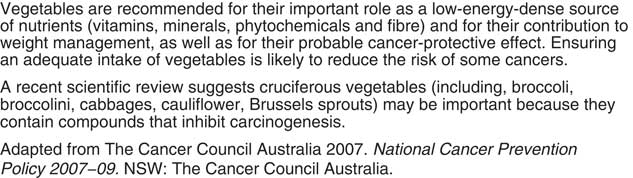
A statement from The Cancer Council Australia( 22 ) was simplified and presented verbally and visually to information treatment groups prior to any responses (Fig. 1). All participants were measured for knowledge regardless of their assignment to groups. For ethical reasons the same information was given to non-information groups after the study.
The health information provided to the information groups in the present study
Participants
An accredited market research company was commissioned to provide participants according to specified inclusion and exclusion criteria (below). Ethical approval was received from CSIRO Human Research Low Risk Review Panel and informed consent was obtained. Central location tests (Adelaide) were undertaken in March 2011. Participants were compensated for their time with a $AU 30 retail voucher.
Sample size
Variation in hedonic responses (the main dependent variable) was unknown; however, past experience in similar domains by the senior researchers suggested that forty to fifty participants per group would be sufficient to detect differences at the 5 % level. Hence 200 consumers were sought to attend one central location session of approximately 1 h.
Inclusion and exclusion criteria
Recruitment was based upon the following inclusion criteria: adult aged 18–55 years (upper limit to control for age-related decline in sensory acuity), 50/50 female/male and reporting moderate–high physical activity. Exclusion criteria were: reporting low physical activity, vegetarians, pregnant women, any allergies to vegetables, residency <3 years and not able to understand English.
All potential participants were screened for physical activity and invited to participate if reporting moderate to high physical activity as defined by the validated (short form) International Physical Activity Questionnaire( Reference Booth 29 , 30 ). The rationale for this was to control for the possible confounder of variation in health-conscious behaviour. Furthermore Wansink( Reference Wansink 18 ) suggested that ‘health orientated’ consumers may be more amenable to ‘health’ labelling.
Design
In a two (low vegetable consumption (L) or high vegetable consumption (H)) by two (information (i) or no information (n)) design, we sought fifty participants in each group (n 200 in total), see Fig. 2.
Design of the present study (L = low vegetable consumption; H = high vegetable consumption; i = information; n = no information)
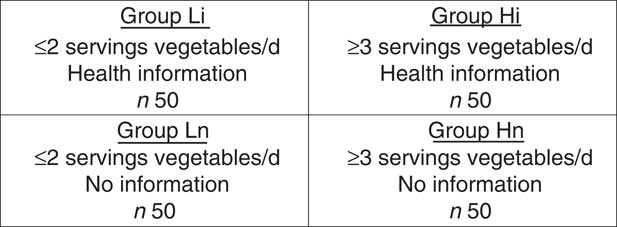
All potential participants were screened and first allocated to one of two groups by vegetable consumption, ensuring that half the numbers of participants were female and half male. Using a validated scale( Reference Ball, Crawford and Mishra 26 ), ≤2 portions/d was considered low and ≥3 portions/d (excluding potatoes and potato products) was considered high. The two consumption groups were then randomly allocated to an information or no-information condition.
Participant tasks
We first sought affective responses (hedonics) to the vegetable samples; then, in a later task, separately sought analytical responses (taste perception). This was thought to be important because analytical thinking tends to diminish hedonic responses( Reference Prescott 31 , Reference Earthy, MacFie and Hedderley 32 ) and is not typical of real-world behaviour.
Detailed administration was as follows. Health information (Fig. 1) was presented to 50 % of participants; hedonic ratings (9-point labelled scale( Reference Peryam and Girardot 33 )) to a randomized presentation of six Brassica vegetable samples were obtained; examples of the five basic tastes were given and taste intensity perception to six vegetable samples by five tastes and flavour ratings were elicited (100 mm line scale) to a second randomized presentation; and, finally, responses were determined to the HTAS health, pleasure and reward subscales( Reference Roininen, Lahteenmaki and Tuorila 24 ), intention to consume each vegetable, sociodemographics and supplement use, and two open questions on recall (knowledge) of health information.
Trained panel assessment
The panel consisted of ten assessors from CSIRO, who had previously been screened for taste and smell acuity and had extensive experience in descriptive sensory analysis across a range of products. All sensory testing took place in the CSIRO Food and Nutritional Sciences, North Ryde sensory laboratory, designed in accordance with International Standards on Sensory Analysis (ISO 6658:198).
The trained panel carried out descriptive analysis to assess the basic taste properties of whole extracts from four Brassica vegetables (broccoli, cauliflower, Brussels sprouts and red cabbage), presented in a randomized order to minimize first-order and carry-over effects, in duplicate in two sessions over 2 d. Further details of the methodology are reported elsewhere( Reference Zabaras, Cox and Konczak 27 ).
Analysis
All analysis was undertaken using the SPSS statistical software package version 17 (SPSS Inc., Chicago, IL, USA) and P < 0·05 chosen as the level of statistical significance.
The open responses to two questions on health were collapsed and analysed so as to determine if the information groups (Hi and Li) recalled the cancer protection message in either/or questions to a greater extent than those in the no-information group (Hn and Ln). Responses were coded (by two researchers for inter-rater reliability) for ‘cancer protection’, ‘general knowledge’, ‘vague’ and ‘incorrect/blank’ categories. The χ 2 test was used to determine if the information groups recalled the cancer protection message statistically significantly more than the no-information groups.
ANOVA was undertaken with hedonic score (for each Brassica vegetable) as a within-subjects factor and information group and reported vegetable intake as between-subjects factors. Similarly ANOVA was undertaken with intention to consume score (for each Brassica vegetable) as a within-subjects factor and information group and reported vegetable intake as between-subjects factors.
Repeated-measures ANOVA with post hoc tests were undertaken between vegetables. Also ANOVA with post hoc tests were undertaken within vegetables and within tastes by group. As a validation of the consumers’ perception of taste, a trained sensory panel assessed whole extracts of a subset of the six Brassica vegetables for the basic tastes using 100 mm scales. Reference taste stimuli (e.g. caffeine solutions representing bitterness) were used (but note these were not provided to consumers).
Prior to entry in multivariate models (below) each of the HTAS subscales used was found to have good to acceptable internal consistency; specifically, ‘food for health’ (Cronbach's α = 0·85), ‘food for pleasure’ (Cronbach's α = 0·77) and ‘food for reward’ (Cronbach's α = 0·57).
In order to capture the wider influences upon hedonics and intentions, a series of hierarchical stepwise multivariate regression analyses was undertaken, placing each independent variable in competition in order to determine significant predictors of the dependent variables: (i) hedonic score and (ii) intention to consume each Brassica vegetable. Independent variables were entered stepwise: in step 1 (sociodemographics) gender, education status and age group; in step 2 (intake and intervention) current vegetable intake (high/low) and information (group); in step 3 (attitudes) ‘food for health’, ‘food for pleasure’ and ‘food for reward’; and in step 4 (sensory perception specific to each Brassica vegetable) perceived bitter, salt, sweet, umami, sour and overall flavour intensity.
Results
Two hundred participants (see Table 1) completed all tasks and all responses.
Characteristics of participants: Australian adults aged 18–55 years (n 200)
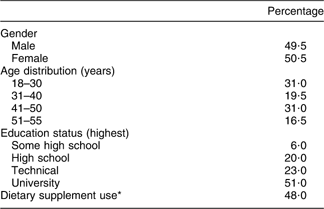
*No relationship between dietary supplement use and reported vegetable intake, i.e. there were equal numbers in both groups (χ 2 P > 0·05).
Table 2 shows that cauliflower and broccoli were the most liked and Brussels sprouts the least liked overall. Furthermore, Table 2 shows statistically significant differences between each Brassica vegetable for intention to consume in the near future. In general hedonic scores were consistent with intentions; however, participants tended to discriminate more between vegetables for intentions than for hedonics.
Overall hedonicFootnote * and intention to consumeFootnote † mean scores with their standard errors and differences by Brassica vegetable: Australian adults aged 18–55 years (n 200)
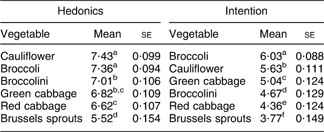
a,b,c,d,e,f Mean values within a column with unlike subscript letters were significantly different (P < 0·05).
* 9-point scales.
† 7-point scales.
The impact of information
Analyses of the distributions of the four response categories across information and no-information groups revealed that a statistically significantly (P < 0·000) greater frequency (45 %) of participants in the information groups recalled (had knowledge of) ‘cancer protection’ compared with participants in the no-information groups (only 4 %). Proportions recalling/knowing ‘general knowledge’ were 47 % for the information groups and 72 % for the no-information groups. Additionally, 22 % in the no-information groups were ‘vague or incorrect’ in contrast to only 5 % in the information groups. While a larger proportion of participants in the no-information groups recalled the general knowledge, cancer protection was not reported (‘unknown’, not salient) among those not informed by the intervention. Hence this ‘new’ or salient knowledge among the information groups has some potential to impact upon hedonic and intention to consume responses (below).
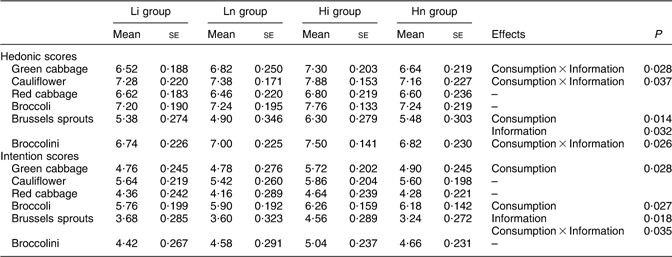
Table 3 shows mean scores and their standard errors for hedonics of each Brassica vegetable by consumer group and the effects of consumption level and information.
Mean scores and their standard errors for hedonics (9-point scales) and intentions to consume (7-point scales) Brassica vegetables in the near future by group (vegetable consumption (L, lowFootnote *; H, highFootnote †) × information (i, information; n, no information)) and effects (P < 0·05) of vegetable consumption and information: Australian adults aged 18–55 years (n 200; fifty in each group)
* Low = ≤2 portions/d (excluding potatoes and potato products).
† High = ≥3 portions/d (excluding potatoes and potato products).
Univariate analysis
In ANOVA, information was found to have an independent effect upon liking of (the least liked) Brussels sprouts (Table 3). For three vegetables, information had an effect on liking when interacting with current vegetable intake. In all three examples (green cabbage, cauliflower and broccolini) information and high consumption interacted to increase liking. In other words, participants who reported high consumption (predisposed to eating vegetables) appeared to be influenced by the health information to report an increase in their liking of three Brassica vegetables. However, all effects were small.
Reported general vegetable consumption had an effect upon intentions to consume two vegetables. Information independently had an effect on the intentions to consume (the least liked) Brussels sprouts. Also an interaction with current consumption was found. In other words, when vegetable intake was reported as high, information had a greater effect on responses to Brussels sprouts. For two other vegetables, current reported vegetable consumption had an effect on intentions to consume. However, all effects were weak.
Sensory perception
No difference in perception of the taste/flavour characteristics of the Brassica vegetables was found by group; hence sensory perception differences across vegetables were tested across the whole sample (Table 4).
Brassica vegetables by perceived taste and flavour (mean scores with their standard errors) and tests across vegetable scores (100 mm scale): Australian adults aged 18–55 years (n 200)

a,b,c,d,eMean values within a row with unlike subscript letters were significantly different (P < 0·05).
Further analysis investigated whether within a vegetable and within a taste there were differences across groups. All ratings were found to be not statistically significantly different (P > 0·05). Hence current general vegetable consumption and health information knowledge would appear to be not directly associated with the perceptions of taste and flavour of selected Brassica vegetables. However, individuals may differ in their perceptions of the tastes/flavour so further analysis was undertaken (below).
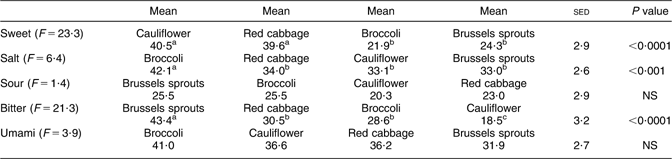
The validity of the consumer perceptions of tastes was supported by a trained sensory panel's descriptive sensory assessment scores. Overall there was generally good agreement (rank order and significant differences), particularly for sweetness, bitterness and salt, between the results from the descriptive assessment of the taste attributes of whole extracts of a subset of the Brassica vegetables using trained panellists (see Table 5) and those obtained from the consumer test.
Trained panel (n 10) sensory ratings of five basic tastes for selected Brassica vegetable whole extracts (100 mm scale) and statistically significant differences (P < 0.05) across vegetables
a,b,cMean values within a row with unlike subscript letters were significantly different (P < 0·05).
Multivariate models
More comprehensive analysis of data was undertaken to address the main research question by placing a wide range of measures (see Experimental methods above) as independent variables (predictors) in competition with one another to determine significant predictors of the dependent variables, hedonics and intentions to consume.
With minimal evidence for differences between groups, the sample was analysed as a whole (n 200). Multivariate regression analysis included a wide range of measured variables, including sociodemographics, information and consumption (as suggested by the univariate analysis), sensory perception and attitudes as independent variables, entered into models in competition with one another, with individual's scores for hedonics (9-point scale) and intentions to consume (7-point scale) selected Brassica vegetables as the dependent variables (Table 6).
Multivariate predictors of hedonics and intentions to consume Brassica vegetables: Australian adults aged 18–55 years (n 200)
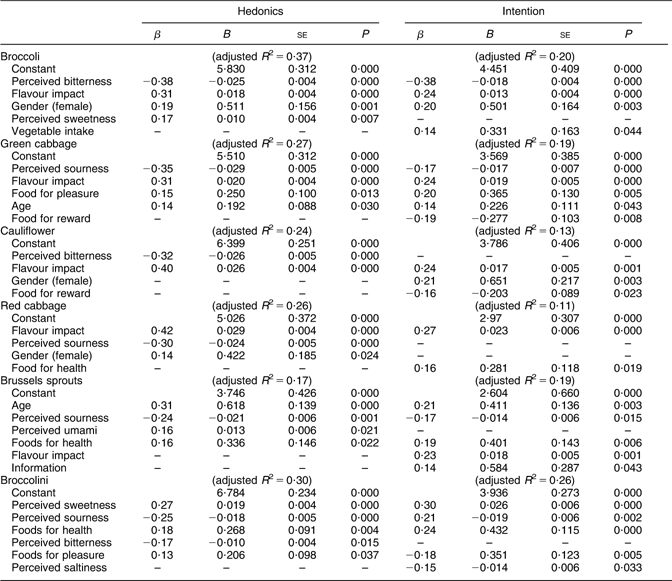
Table 6 shows that sensory perception dominated, with attitudes contributing to a lesser degree to the acceptance of Brassica vegetables. Not surprisingly, being female and of older age were positive predictors of acceptance of some Brassica vegetables. Notably ‘food for pleasure’ and ‘food for health’ were only minor positive predictors for two (different) vegetables. In contrast, ‘food for reward’ was a negative predictor in only one case.
Information had only a small effect upon intentions to consume one vegetable, Brussels sprouts (consistent with univariate analysis), but may be important for this particular vegetable. Additionally this suggests that when a food is unpopular, information has the potential to influence responses positively.
In summary, the multivariate models identified where variation in consumer characteristics and perceptions was associated with the liking and intentions to consume Brassica vegetables. These analyses suggest where interventions may effect successful change.
Discussion
The results do not support the main hypothesis. Specific health information, including protecting against cancer, did not override taste aversion to Brassica vegetables and increase acceptance (liking and intention to consume).
Both the hedonic and intentions data reflected the current market popularity of broccoli and cauliflower( 34 ), suggesting validity of our measures.
The results suggest that the health information had potential to have impact. Both the information and the no-information groups were asked what they thought were the health benefits of vegetables and Brassica vegetables in particular. Information pertaining to the cancer protection afforded by Brassica vegetable consumption was not generally recalled (‘known’) by those not immediately informed (no-information groups) during the study. A recent review of the theoretical basis of information processing pertaining to food labelling( Reference Bialkova and van Trijp 35 ) suggests that the information presented in the current study possessed the novelty (unexpectedness) and structure (salience) necessary for appropriate information processing. Almost all of the intervention group (95 %) could recall or state either specific or general health benefits of vegetables in contrast to participants in the no-information groups, of whom almost one in four could not state any ‘correct’ knowledge. Furthermore, the majority of participants in the no-information groups did not report the specific health (cancer risk reduction) information. A recent Australian qualitative study( Reference Carter, Pollard and Atkins 36 ) also reported general but not specific health knowledge (i.e. no recall of disease risk reduction) pertaining to vegetables (and fruit). This could be valuable information for consumers; however, caution is warranted in the light of other findings (below).
Focusing just upon consumption and information, there would appear to be some influence upon liking and intentions to consume (the least liked) Brussels sprouts. The multivariate models, taking into account a greater number of possible influences, confirm that it is possible that information may have some small effects upon the popularity of Brussels sprouts (intentions to consume). Those with generally higher reported vegetable intakes may be more influenced.
There was generally good agreement between consumer perceptions and the trained sensory panel. Hence it would seem that consumers can give valid measures of their perceptions of the basic tastes. This supports previous observations( Reference Worch, Lê and Punter 37 ) that have found validity of untrained consumers’ reports of sensory perceptions.
While it is notable that the most popular Brassica, broccoli, was not perceived to be particularly relatively sweet on average, multivariate analysis found sweet perception as a predictor of broccoli and broccolini liking and intentions to consume. Identifying, changing or highlighting the sweetness of Brassica vegetables (for example, by changing intrinsic sugar content) may be useful in changing acceptance.
Table 6 shows that the independent variables measured explain moderate variance in liking and intentions to consume Brassica vegetables, with a tendency for liking to be better explained. In this respect the liking models support the original rationale of this study, i.e. that sensory perception is associated with liking. Given the wide range of behaviours and situations (not measured) that could impact upon intention to consume widely reported in the literature( Reference Cox, Anderson and Reynolds 12 , Reference Pollard, Miller and Woodman 38 ), it is not surprising that the intention to consume models explain only a low to moderate amount of variance. For theoretical models with a focus on specific variables, these are nevertheless reasonable and expected. The better models, generally predictors of liking, can explain around one standard deviation in the dependent variables. Importantly, many of the predictors are potentially malleable and reflect the rationale of the project.
Sensory perception seems to dominate liking and, while tastes were not perceived to be particularly strong (mean scores were moderate), their importance as predictors is a reflection of the variance across the participants. What influences that variance is unknown but could include experience and learning (exposure and/or conditioning( Reference de Houwer, Thomas and Baeyens 9 )) and/or genetics( Reference Reed, Tanaka and McDaniel 3 ). The importance of taste supports conclusions drawn from recent survey data( Reference Schatzer, Rust and Elmadfa 5 ) that taste drives vegetable (and fruit) consumption and that taste, not health attributes, should be addressed.
Attitudes towards foods for health were relevant in some cases but tended to be minor predictors. Importantly, it is rare( Reference van den Heuvel, van Trijp and van Woerkum 20 ) for both sensory and attitudinal responses to be included in a single study; hence placing sensory perception in competition with attitudes in the current study is a useful approach. Age and female gender, characteristics that are known to be associated with reported ‘healthy’ eating( Reference Wardle, Haase and Steptoe 39 ), were sometimes positive predictors. Notably, age was the strongest positive predictor of the least liked and most bitter vegetable, Brussels sprouts. Age-related taste dysfunction is less common than smell loss and reports of taste impairment are inconsistent; however, bitter sensitivity appears to be the most affected by age( Reference Nordin 40 ). In the current study the age range was not wide (18–55 years), due to deliberately excluding older participants who may suffer declines in sensory ability, so this age effect is unlikely to be due to age-related physiological changes. Furthermore, it is unknown if this is an age or cohort effect. It is possible that this is a function of exposure and/or conditioning, i.e. a traditional British vegetable. While only a small number of participants identified with that culture (data not shown), British food culture is apparent among some older Australians.
These consumer data are supported by further investigation of objective measures from chemical analysis of tastes, trained panel sensory descriptive analysis, and health compounds and their activity( Reference Zabaras, Cox and Konczak 27 ). Those analyses found that the compounds (glucosinolates and phenolics) that contribute to the tastes bitterness and sourness (and acceptance) are the same as those that contribute to the ‘healthy’ characteristics of Brassica vegetables. Sweetness (intrinsic sugars) was found to offset bitterness and may need to be enhanced to improve acceptability. An alternative or complementary strategy would be to ensure effective exposure and/or conditioning at developmental ages in order to ‘teach’ acceptance( Reference Corsini, Slater and Harrison 41 ).
Limitations
The novelty and saliency achieved in the current study are known to be necessary for effective information processing; however, participants received only one exposure to cautiously framed, evidence-based information and this may be insufficient to test for effect. Whether repeated exposure to less cautiously framed information would have influenced responses is unknown and may be worth testing. Testing for comprehension and personal relevance may also be important in future studies.
Conclusions
Among a large group of health-conscious, well-educated Australian adults, the present study found that sensory characteristics, rather than health benefit information, need to be addressed in order to increase the popularity of Brassica vegetables. To a lesser extent attitudes had some influence and are potentially malleable. Only for responses to one vegetable (the least liked Brussels sprouts) did health information have a small influence.
Acknowledgements
This project was funded by Horticulture Australia Ltd using the vegetable industry levy and matched funds from the Australian Government. There are no conflicts of interest. D.N.C. assisted in the study design, managed the data collection and analysis and drafted the paper. L.M. collected the data, undertook statistical analysis and critically reviewed the manuscript. D.Z. coordinated the larger project, assisted in the study design and critically reviewed the manuscript. C.M.D. initiated the study design and critically reviewed the manuscript. The authors thank Donna Hughes and Raju Krishnamurthy for assistance with data collection and analysis.



