




Introduction
Achieving sustainability in the global food industry is a burning issue of current production and consumption systems (Aschemann-Witzel et al., Reference Aschemann-Witzel, Maroscheck and Hamm2013). In this regard, and particularly in recent years, consumer preferences have shifted toward more sustainable purchasing choices, with increasing number of individuals including more environmentally-friendly products in their diets (Vermeir et al., Reference Vermeir, Weijters, De Houwer, Geuens, Slabbinck, Spruyt, Van Kerckhove, Van Lippevelde, De Steur and Verbeke2020). This is due to the spreading awareness on the impacts of conventional agricultural practices (Moisander, Reference Moisander2007), as well as to the growing interest for healthiness, nutritional and safety food dimensions (Asioli et al., Reference Asioli, Aschemann-Witzel, Caputo, Vecchio, Annunziata, Næs and Varela2017; Migliore et al., Reference Migliore, Borrello, Lombardi and Schifani2018).
Within this scenario, the uptake of organic products has been observed so far as the main sustainable food consumption option (Asian et al., Reference Asian, Hafezalkotob and John2019). Organic food consumption keeps growing consistently worldwide (Willer and Lernoud, Reference Willer and Lernoud2019); with organic produce counting on a market of 90 billion euros in the world, showing the United States as the top market country (40 billion euros), followed by Germany (10 billion euros), France (7.9 billion euros), China (7.6 billion euros) and Italy (3.1 billion euros). Consumers appreciate organic products and attach to them higher quality and nutritional properties, as well as lower environmental impacts and health risks (Govindan et al., Reference Govindan, Azevedo, Carvalho and Cruz-Machado2014; Mota and Oliveira, Reference Mota and Oliveira2014; Panzone et al., Reference Panzone, Di Vita, Borla and D'Amico2016; Pappalardo et al., Reference Pappalardo, Di Vita, Zanchini, La Via and D'Amico2019; Rizzo et al., Reference Rizzo, Borrello, Dara Guccione, Schifani and Cembalo2020). However, while organic standards generate increased environmental performances, they are still a risk for producers in terms of economic gains, and in many contexts, a trade-off between economic and environmental sustainability is necessary (Freda et al., Reference Freda, Borrello and Cembalo2015; Niggli, Reference Niggli2015; Jeswani et al., Reference Jeswani, Espinoza-Orias, Croker and Azapagic2018). For this reason, integrated farming system (IFS) has been proposed, in the last decades, as an alternative to organic production, able to ensure profitability and lower risks for producers, while maintaining the attributes of increased quality in environmental and health terms (Falcone et al., Reference Falcone, Stillitano, De Luca, Di Vita, Iofrida, Strano, Gulisano, Pecorino and D'Amico2020). In this study, IFS should not be confused with integrated livestock/crop farms. Integrated farming is ‘a science-based, decision-making process that identifies and reduces risks from pests and pest management related strategies, coordinates the use of pest biology, environmental information, and available technology to prevent unacceptable levels of pest damage by the most economical means, while minimizing risk to people, property, resources, and the environment’ (NIFA, 2013). Compared to conventional production, integrated production attempts to move the goal from yield maximization to cost reduction and product quality (Tamis and Van Den Brink, Reference Tamis and Van den Brink1999) by implementing management strategies that limit as much as possible the use of synthetic compounds and the production of hazardous waste. In a nutshell, integrated agriculture reduces the use of chemicals by integrating both organic and conventional farming systems (Reganold et al., Reference Reganold, Glover, Andrews and Hinman2001). Albeit IFS has not gained so far the same traction of organic agriculture and its environmental performances are inherently lower than those of organic productions, in many circumstances, it is the only feasible option for some producers (Reganold et al., Reference Reganold, Glover, Andrews and Hinman2001). Farmers’ implementation of integrated agriculture has been widely investigated in the scholarly literature, identifying various adoption determinants, such as financial aspects (Lavik et al., Reference Lavik, Hardaker, Lien and Berge2020), pesticides knowledge (Bagheri et al., Reference Bagheri, Bondori, Allahyari and Damalas2019), access to highly demanding market segments (Buurma and Van der Velden, Reference Buurma and Van Der Velden2017), perceived complexity (Peshin, Reference Peshin2013) and positive contact with agricultural extension agents (Stallman and James, Reference Stallman and James2015). However, an overarching interpretation of these drivers is hard to reach, due to context-specific issues depending on diverse IFS approaches, crops, agricultural systems and geographical areas (Stallman and James, Reference Stallman and James2015; Midega et al., Reference Midega, Murage, Pittchar and Khan2016; Zhang et al., Reference Zhang, Potts, Breeze and Bailey2018; Sadique Rahman, Reference Sadique Rahman2020), leading for instance to a wider adoption in developed countries compared to developing nations (Alwang et al., Reference Alwang, Norton and Larochelle2019).
While plenty of studies have analyzed consumer aspects related to organic agriculture (Rana and Paul, Reference Rana and Paul2017; Annunziata et al., Reference Annunziata, Mariani and Vecchio2019a; Katt and Meixner, Reference Katt and Meixner2020), only a few studies have addressed consumers’ preferences for fruit and vegetable products produced with integrated management system (Loureiro et al., Reference Loureiro, McCluskey and Mittelhammer2001, Scarpa et al., Reference Scarpa, Philippidis and Spalatro2005), with limited results and often reporting contrasting evidences. For instance, some studies show that consumers who have knowledge of sustainable practices and have made previous purchases of such products are more likely to buy and willing to pay a premium price for fruit and vegetables grown under integrated farming (Govindasamy and Italia, Reference Govindasamy and Italia1998; Cranfield and Magnusson, Reference Cranfield and Magnusson2003), and that willingness to pay for these products is higher than for conventional and organic ones (Yi, Reference Yi2019); while other studies found that having prior familiarity with integrated management system concepts decreases the probability of buying these products (Blend and Van Ravenswaay, Reference Blend and Van Ravenswaay1999), and that there is a strong negative relationship between the intention to buy these products and the concern for the impact of agricultural practices (Stranieri et al., Reference Stranieri, Ricci and Banterle2017).
The current study complements this literature addressing preferences for IFS in Italy, where 17.133 farms (covering 286.255 total ha) devote part of their surface to integrated farming (RRNa, 2020). Citrus fruits—and particularly clementines—were applied as the contextual opportunity for the study. Italy is the second European country in terms of the area dedicated to the production of citrus fruits (Falcone et al., Reference Falcone, Stillitano, De Luca, Di Vita, Iofrida, Strano, Gulisano, Pecorino and D'Amico2020). Particularly, with about 17.9% of the total surface dedicated to citrus cultivation (25,000 ha), about 17.1% of the total citrus production (450,000 tons) and a production growth of 5.9% in the years 2018–2019, clementine (Citrus clementine) is the second most cultivated citrus species in Italy (RRNb, 2020). The great surface dedicated in Italy to citrus fruits (140,000 ha) justifies recent efforts to reduce the environmental impacts of these production by means of alternative production methods such as organic farming and IFS (Nicolò et al., Reference Nicolò, De Salvo, Ramirez-Sanz, Estruch, Sanjuan, Falcone and Strano2018). Consistently, the organic citrus surface in Italy has increased throughout time, reaching in 2018 the 25% of the overall Italian agricultural surface (35,660 ha) (Sinab, 2019).
Despite the expansion in the cultivated areas and the increasing appreciation of these products in the Italian market, only a few studies have addressed consumers’ preferences for fresh citrus fruits (Di Vita et al., Reference Di Vita, Borrello, Vecchio, Gulisano and D'Amico2020).
The current explorative research provides a contribution to sustainable production and consumption of citrus fruits by investigating the potential of clementines produced under integrated agriculture as an alternative to organic and conventional ones, and whether consumers respond positively to this production method. Clementines were chosen for their wide consumption in the Italian fresh fruit market, grown in recent years compared to other citrus fruits (RRNb, 2020). More specifically, this study seeks to answer the following two research questions: (1) Is there among clementine consumers a defined preference hierarchy among IFS, organic and conventional production methods and which of the three production methods is more capable to differentiate clementines on the market? (2) Are there well-established market segments among consumers that could suggest ad hoc promotional strategies?
Answers to these research questions could have important implications for the market valorization of clementines produced with sustainable methods by citrus producers. Particularly, insights will provide practical information on the potential of clementines carrying different quality labels, as well as providing suggestions for targeted interventions aimed at prompting clementines consumption.
Contextualization in sustainable agricultural approaches: three ways to produce clementines
The current study focuses on comparing the following three cultivation methods adopted in clementine production: conventional, organic and integrated farming. These three different farming systems are characterized by specific practices and regulations related to the use of fertilizers, pesticides, fungicides, herbicides and fito-regulators.
It is widely known that different types of sustainable farming methods are proposed as an alternative to countervail the impacts of conventional farming. Conventional farming, also known as industrial agriculture, is characterized by the use of synthetic chemical fertilizers, pesticides, herbicides and other continual inputs, genetically modified organisms (GMOs), concentrated animal feeding operations, heavy irrigation and intensive tillage. Thus, conventional agriculture demands high external inputs in terms of resource and energy, but it is also highly productive. Conventional farming system allows the use of all chemical products authorized by European and national regulations. In particular, the use of fertilizers is regulated in Europe by Council Regulation (EC) no. 2003/2003, while the use of phytoiatric compounds is regulated by Council Regulation (EC) no. 1107/2009.
Due to the environmental impacts of conventional agriculture, there is an ongoing debate among scientists, policy makers and other stakeholders about future agri-food systems at different geographical scales. Providing enough food for the increasing world population, reducing food waste, make diets healthy, preserve natural resources, mitigate and adapt to climate change are not trivial tasks to pursue simultaneously. In this regard, different approaches are proposed by different stakeholder groups. Besides those relying on increased technology adoption, such as precision farming, automatization/mechanization and the use of GMOs—which fall beyond the contents of this work—there is broad consensus on the potential to achieve higher sustainability by means of ‘ecologically based’ farming systems. Considering this approach to its widest declination, the disciplines of agroecology and regenerative agriculture can provide conceptual foundations for ecologically based agricultural solutions. On the one hand, agroecology can be defined as a set of agricultural practices that seek ‘to improve agricultural systems by imitating natural processes, creating beneficial biological interactions and synergies among the components of the agroecosystems, and valorizing ecological processes and ecosystem services’ (Migliorini and Wezel, Reference Migliorini and Wezel2017, p.63). On the other hand, regenerative agriculture suggests the adoption of certain practices (e.g., use of cover crops, the integration of livestock and reducing or eliminating tillage), to achieve certain outcomes (e.g., to improve soil health, to sequester carbon and to increase biodiversity) (Newton et al., Reference Newton, Civita, Frankel-Goldwater, Bartel and Johns2020).
At present and considering market adoption as the benchmark, the most successful implementation of ecological principles in agriculture is organic farming. Giving space not only to a set of suggested practices and scientifically based solutions, but entailing also a philosophical approach to food production often interpreted as a cultural movement (Migliorini and Wezel, Reference Migliorini and Wezel2017), agroecology and regenerative agriculture are disciplines of broad theoretical interest. However, the lack of recognized standards makes them prone to nuanced interpretations and greenwashed commercial activities. Contrariwise, organic farming has clear and rigorous regulations and restrictions and farms lose certification when they violate its standards. Organic farming is ‘a production system that sustains the health of soils, ecosystems, and people. It relies on ecological processes, biodiversity, and cycles adapted to local conditions, limiting the use of inputs with potential adverse effects. Organic agriculture combines tradition, innovation, and science to benefit the shared environment and promote fair relationships and a good quality of life for all involved’ (IFOAM, 2005). Organic production method is aimed to protect a whole agricultural agro-ecosystem, promoting agricultural practices that capitalize on natural soil fertility, environmental biodiversity and limiting or excluding damaging chemical products (Mäder et al., Reference Mäder, Fliessbach, Dubois, Gunst, Fried and Niggli2002). According to Council Regulation (EC) no. 834/2007, it is characterized by the use of organic fertilizers, biological control of pests, low-impact mechanical operations and reduced presence of copper compounds in the soil. Furthermore, a regulation on labeling limits the types of product certifiable as organic. Lastly, national audit bodies monitor for frauds and guarantee compliance with production and labeling rules. The regulative infrastructure and the possibility to provide consumers with reliable certification on the sustainability of production methods are the reasons for the market success of organic food production.
The third production method proposed to consumers in this study is integrated farming. First conceptualized in the ‘50s, adopting ecological practices on conventional farms has a long history and is the object of systematic scholarly research since the ‘80s (e.g., Vereijken, Reference Vereijken1989; El Titi, Reference El Titi1992; Morris and Winter, Reference Morris and Winter1999). Even though there is no agreement on the definition of IFS (El Titi, Reference El Titi1992; Wibberley, Reference Wibberley1995; Morris and Winter, Reference Morris and Winter1999; Randall and James, Reference Randall and James2012), it is not contested that it aims to respond to the negative environmental impacts of farming, while maintaining a focus on the economic viability of the agricultural productions (Cook et al., Reference Cook, Collier, Clarke and Lillywhite2009; EISA, 2012). Integrated farm management is sustained importantly by Linking Environment and Farming (LEAF), a farming organization working mostly in the UK and Africa. According to LEAF (2017), IFS entails the use of modern technologies, traditional methods, and continuous context and farm-specific adaptations. Its potential to provide environmental benefits while preserving farmers’ income has been recognized as a ‘third way’ (Morris and Winter, Reference Morris and Winter1999) or a ‘middle course’ (Wibberley, Reference Wibberley1995) between the extreme constraints of organic farming standards and the increasingly unacceptable pursuit of intensive farming practices. At present, integrated farming is defined as ‘a science-based, decision-making process that identifies and reduces risks from pests and pest management related strategies, coordinates the use of pest biology, environmental information, and available technology to prevent unacceptable levels of pest damage by the most economical means, while minimizing risk to people, property, resources, and the environment’ (NIFA, 2013). IFS adopts techniques that guarantee lower environmental impact through the integration of synthetic chemical substances with natural input; chemical compounds are allowed only in specific formulations and in limited quantities. Furthermore, IFS implies specific tillage recommendations that favor soft operations, low energy consumption and conservative ploughings to promote soil fertility and biodiversity. IFS is regulated at the local level by specific procedural guidelines of regional authorities, which describe the most appropriate cultivation techniques for single species and fix the typology and the quantity of inputs allowed (Di Vita et al., Reference Di Vita, Stillitano, Falcone, de Luca, D'Amico, Strano and Gulisano2018). Integrated farming is disciplined by UNI 11233 scheme, accredited by Accredia in compliance with ISO/IEC17065/2012 standard. Most integrated schemes in Italy are operated at the regional level, in many cases under Regulation 1257/99. Some regions have a regional brand, which requires producers to use integrated production techniques. To illustrate, IFS guidelines for citrus cultivation in the Calabria Region detail the active ingredients allowed for each disease, the period of treatments and the maximum amount allowed. However, different interpretations and regulations entail that the adoption of integrated farming changes significantly from country to country. Furthermore, when IFS is not regulated by case-specific standards, it is prone to be used as ‘greenwashing tool’, thus misleading consumers searching for more sustainable food products.
Methods
Data collection
Trained interviewers administered a questionnaire to a convenience sample of 345 individuals via face-to-face interviews. Data collection was performed outside retail stores of two major northern Italian cities; namely, Turin and Milan. Respondents were recruited after their grocery shopping, during the months of October and November, by random walk recruitment. Screening of respondents was performed to ensure that participants in the survey were responsible for household food expenditures and fruit consumers.
The questionnaire consisted of three separate and consecutive sections. The first section focused on general aspects of clementine consumption, such as purchase frequency and consumption habits, included closed-ended questions both binary (yes/no answer) and multiple answer questions (organized in seven-point anchored scales ranging from 1 = not important to 7 = very important). The second section included questions on socio-demographic characteristics of the sampled consumers such as age, gender, education, household size and monthly income. The third section represented the core of the research, included a conjoint experiment with a full profile conjoint (nine cards).
Socio-demographic characteristics of the sample are shown in Table 1. As for the age group, we adopted the classification proposed by Brosdahl and Carpenter (Reference Brosdahl and Carpenter2011), where ‘Millennials’ generation represents individuals born between 1982 and 2000 (30.4% of the sample), ‘Generation X’ represents respondents born between 1961 and 1981 (45.5%), and ‘over 58’ includes the age cohorts of Baby Boomers and Silent generation, respectively, born between 1943 and 1960 and before 1943 (24.1%). Most respondents (51.6%) belonged to households including more than two individuals and were highly educated (55.9%). In addition, Table 1 shows socio-demographic characteristics of the Italian population provided by the National Institute of Statistics databases (ISTAT, 2021). Concerning Italian household income, the latest updates are not provided through frequency classes but only through the average value which was €31.393 per year. For this reason, the household income was not included in the table.
Socio-demographic characteristics of the sample (N = 345)

Data analysis
Data analysis was conducted in two steps. In the first step, a full-profile conjoint analysis was used to obtain the mean relative importance attached to three clementine attributes [price, production method and presence of a certification of protected geographical origin (PGI)]—with respective attribute levels—(Table 2) and the estimated utility for each attribute level. The conjoint analysis is a widespread method in consumer research, often adopted to quantify the utility of consumers for food product attributes (Schnettler et al., Reference Schnettler, Vidal, Silva, Vallejos and Sepúlveda2009; Saba et al., Reference Saba, Vassallo, Shepherd, Lampila, Arvola, Dean, Winkelmann, Claupein and Lähteenmäkicf2010; Di Vita et al., Reference Di Vita, Blanc, Brun, Bracco and D'Amico2019). The three selected attributes were identified as the most relevant in consumer clementines’ choice, based on market data analysis and review of recent scientific literature (Di Vita et al., Reference Di Vita, Borrello, Vecchio, Gulisano and D'Amico2020; RRNb, 2020; Verain et al., Reference Verain, Sijtsema, Taufik, Raaijmakers and Reinders2020). The price levels were chosen according to the average clementine prices observed in different retail stores in Turin and Milan, at the time of the research.
Attributes and levels used in the conjoint analysis

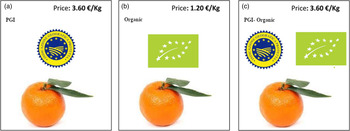
To limit the cognitive effort requested to participants, the number of conjoint cards was reduced to nine by means of an orthogonal design; this design allowed also to reduce the collinearity among cards (Annunziata and Vecchio, Reference Annunziata and Vecchio2013; Di Vita et al., Reference Di Vita, Salvo, Bracco, Gulisano and D'Amico2016). The cards generated by the orthogonal design are presented in Table 3. The figure presents an example of the first three profiles (A, B, C) from the conjoint experiment presented during consumer interviews (Fig. 1). Respondents were asked to assume they were buying clementines during an ordinary shopping occasion and to order the cards according to their preferences (from 1 = most preferred to 9 = least preferred). After data gathering, an OLS regression model was applied to obtain utility scores for each attribute levels (Wong et al., Reference Wong, Chan, Da Silva Cardoso, Lam and Miller2004).
Cards profile obtained from orthogonal design

Cards employed during the conjoint experiment (example).

Following conjoint analysis, the sample was clustered based on individuals’ part-worth estimates obtained for any attribute levels using the Ward's method. In fact, respondents are characterized by a typical utility pattern that distinguishes them from each other (Annunziata et al., Reference Annunziata, Pomarici, Vecchio and Mariani2016). This method uses the Euclidean squared distance to measure the distance between objects (Strauss and Von Maltitz, Reference Strauss and von Maltitz2017) and allows to generate clusters by minimizing the sum of the square errors, thus increasing the within-group homogeneity (Shan et al., Reference Shan, De Brún, Henchion, Li, Murrin, Wall and Monahan2017). The appropriate number of clusters has been identified on the basis of the agglomeration schedule and the dendrogram (Garone et al., Reference Garone, Pynoo, Tondeur, Cocquyt, Vanslambrouck, Bruggeman and Struyven2019; Aschemann-Witzel et al., Reference Aschemann-Witzel, de Hooge and Almli2020). Using the agglomeration coefficients, and comparing them with the dendrogram, it was possible to identify the maximum increase in heterogeneity when an additional cluster was created or removed (Yim and Ramdeen, Reference Yim and Ramdeen2015; Islam, Reference Islam2020). The agglomeration program allowed us to identify the four-cluster solution as the most suitable.
Following previous literature (Hailu et al., Reference Hailu, Boecker, Henson and Cranfield2009; Annunziata et al., Reference Annunziata, Pomarici, Vecchio and Mariani2016), we employed one-way analysis of variance (ANOVA) to evaluate whether significant differences among cluster's part-worth utility exist. Moreover, for a deeper understanding of differences among the four clusters, a Bonferroni post hoc test was applied (Shan et al., Reference Shan, De Brún, Henchion, Li, Murrin, Wall and Monahan2017). Bonferroni post hoc test is a multiple comparison analysis that consists of a series of t-tests for each pair of means, which allows to understand which means are significantly different from the others, considering per-comparison error rate as: (α/(1/2))k(k − 1) (Rafter et al., Reference Rafter, Abell and Braselton2002). Finally, a χ2 test was used for frequency analysis, in order to evaluate significant differences among the socio-demographic characteristics of clusters. The χ2 test is widely adopted in conjoint analysis studies (Annunziata et al., Reference Annunziata, Pomarici, Vecchio and Mariani2016; Shan et al., Reference Shan, De Brún, Henchion, Li, Murrin, Wall and Monahan2017); it verifies the null hypothesis of independence among investigated variables, or when is used to compare two or more groups, the similarity in the proportions between groups (Franke et al., Reference Franke, Ho and Christie2012), as in the present research. All analyses were carried out applying IBM SPSS Statistics 25.
Results
Conjoint analysis
The results of the conjoint analysis are shown in Table 4. Price is the most important attribute for consumers, obtaining an importance higher than the production method and the PGI certification. Among price levels, the lowest price level provides the highest positive utility. The second most important attribute is the production method. Among the levels investigated, organic attribute is the only production method that provides positive utility; instead, the IFS and conventional production method show a slightly negative level of utility for consumers. The last attribute in terms of relative importance for respondents is the PGI certification, whose preference provides positive utility.
Conjoint results (N = 345)

Cluster analysis
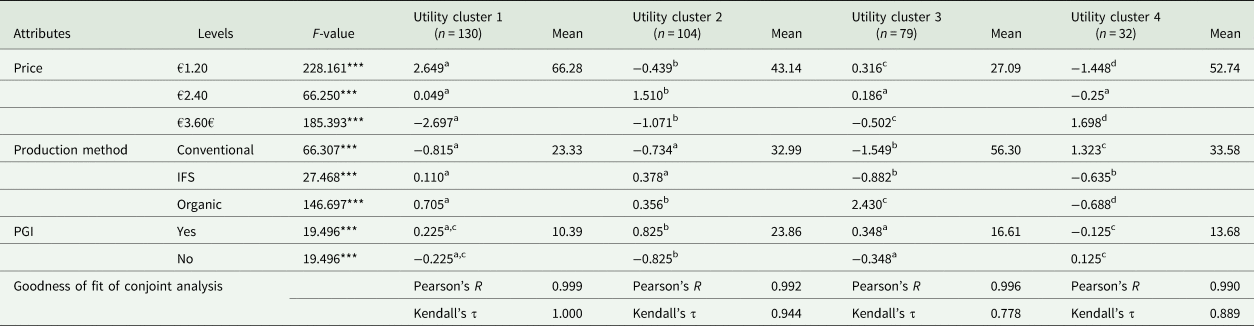
Results of the cluster analysis are shown in Table 5. The analysis identified four clusters on the basis of part-worth utilities for each attribute level. A one-way ANOVA on the attribute levels was performed. The analysis shows significant differences among the clusters for each level considered. Different superscripts reported in Table 5 indicate significant differences between clusters according to Bonferroni post hoc tests (P-value 0.05). Table 6 presents the distribution of consumers and the socio-demographic characteristics for each cluster. The analysis of the differences between the socio-demographics characteristics of the clusters can be assimilated to a frequency analysis, thus the χ2 test was used. In the description of the clusters, only statistically significant socio-demographic variables are reported.
Conjoint results based on cluster analysis (N = 345): utility estimate and mean relative importance
***P < 0.01.
Clusters socio-demographic characteristics (%)

*P < 0.1; **P < 0.05.
Cluster 1—‘Price sensitive’: The first cluster of consumers (37.7% of the sample) rated the price attribute significantly higher than other attributes, as shown by the mean relative importance of this attribute (66.2%). Among the three different price levels, the lowest level price (€1.2) received the highest importance in term of utility. In fact, according to the Bonferroni post hoc test, this value appears to be significantly higher than the others. With regard to the other price levels, they seem to be held in low esteem by this group of consumers.
In addition, the other attributes such as organic, IFS and PGI positively affect the utility of these consumers. Socio-demographic characteristics show a high frequency of individuals with high education level (College and PhD). Finally, this cluster is characterized by Millennials and reports a low frequency of older generation consumers.
Cluster 2—‘Geographical origin and mild sustainability-concerned’: In the second cluster (30.1% of the sample), consumers rated price as the first preferred attribute, followed by production method and presence of PGI label. Considering the relative average importance of PGI and IFS products, these labels assume a higher value in this cluster compared to the other groups. With regard to the utility provided from attribute levels, PGI is significantly higher than in the other clusters. Conversely, IFS is highest in terms of absolute value, but it is statistically different only from clusters 3 and 4. Among the price levels, the medium level price (€2.4) received the highest utility being significantly different from all the other clusters. With regard to socio-demographic characteristics, generation X and older generations are associated with this group. Lastly, this cluster is characterized by a high frequency of individuals with low education level.
Cluster 3—‘Pro-organic’: Pro-organic consumers (22.9% of the sample) rated production method attributes more important than consumers in the other clusters. In particular, consumers belonging to this cluster attach the highest importance, to the organic method production. In fact, in terms of utility, the value attributed to organic production is significantly higher than that of the other groups. This group is also characterized by the relative moderate importance attributed to the price; whilst the utility attached to the middle price (€2.4) is not statistically different when compared with clusters 1 and 4, significant differences among clusters are observed in the utilities regarding the low and high price ranges. With regard to socio-demographic characteristics, well-educated individuals (education equal to or higher than higher school) have, in this cluster, the highest frequency. At the same time, the category primary school education presents the lowest frequency compared to the other cluster groups. As for age, the group of generation X is quite frequent in this cluster.
Cluster 4—‘Skeptics’: The fourth cluster (9.3% of the sample) associates negative utility to organic, IFS and PGI labels. Taking into account the IFS attribute, the utility revealed by consumers is significantly lower than that of clusters 1 and 2, being fairly similar only to cluster 3. On the contrary, PGI certification has reached the lowest value when compared to the other groups. Among the price levels, products with a high price range are highly appreciated as it is shown in terms of utility. In fact, this is the only cluster that associates positive utility with the high price of the product. With regard to the production methods, particular importance is attached to the conventional one, it obtained the highest value among all the other groups. Participants included in this cluster are likely to be traditional consumers, not interested in more sustainable production methods and who attach product quality to highest price. This cluster is highly characterized by Millennials with a medium level of education.
Discussion
Based on a survey of Italian urban consumers, the study assessed their preferences for clementines (Citrus clementina) in a two-step analysis; main outcomes were presented and discussed.
In the first part, the conjoint experiment allowed to estimate consumer utility attached to the three different clementine attributes. Findings reveal that price is the main determinant of consumer preferences, over production method and PGI. In particular, among price levels, the lower price level provides positive utility and is preferred by consumers. This result is consistent with the research performed on many lowly differentiated agro-food products (Gunden and Thomas, Reference Gunden and Thomas2012). Several authors reveal a crucial role of price attribute in citrus fruit consumer motivations (Poole and Martínez-Carrasco, Reference Poole and Martínez-Carrasco2007; Baldwin et al., Reference Baldwin, Bai, Plotto and Ritenour2014; Ingrassia et al., Reference Ingrassia, Sgroi, Tudisca and Chironi2017). In addition, previous studies have specifically shown that consumers were likely to purchase low-priced satsuma mandarins, revealing a large price-sensitive segment.
Production method was detected as the second most important attribute by consumers. Among the available options, only the organic production method provides positive utility to individuals. On the contrary, the IFS and conventional production method show a slightly negative level of utility, which means that they are not perceived as a desirable alternative to the organic one. It follows that the assumed existence of market potential for clementines produced under integrated agriculture method has been only partially corroborated by current findings. Indeed, the demand for IFS clementine appears more as a niche market than a defined market segment. These latter findings partially support our intuition, namely that a well-established market segment for sustainable clementine is quite defined only for organic production (ensuring a positive utility for respondents). This result is consistent with a previous study on Greek consumers’ awareness toward agro-food products obtained through the integrated management system (Botonaki et al., Reference Botonaki, Polymeros, Tsakiridou and Mattas2006). Similarly, the certified product has been poorly evaluated by consumers due to the limited availability on the market, the inadequate level of information and the low visibility of label (Botonaki et al., Reference Botonaki, Polymeros, Tsakiridou and Mattas2006; Annunziata et al., Reference Annunziata, Agovino and Mariani2019b).
The last attribute in terms of relative importance for respondents is the PGI designation; the presence of such a certification provides positive utility to a limited amount of consumers. This result is not surprising, as previous researches on citrus fruit consumption (Poole and Baron, Reference Poole and Baron1996) have shown that consumers are not strongly affected by EU quality labels, especially for clementines (Ingrassia et al., Reference Ingrassia, Sgroi, Tudisca and Chironi2017). Furthermore, the limited importance attached to PGI-labeled fruit is also highlighted by current statistics, which reveal a diminishing trend in consumption values of PDO and PGI fruits in Italy between 2014 and 2018 (Statista, 2020). In addition, the outcomes confirm that PGI certification plays a marginal role in consumers’ choices since they are more concerned with sustainability attributes (Di Vita et al., Reference Di Vita, Zanchini, Falcone, D'Amico, Brun and Gulisano2021).
Concerning the second step of analysis, a hierarchical cluster analysis allowed to detect four distinct market segments based on part-worth estimates. Even in this case, the price attribute proved to be the most important for three clusters, with a differentiation of the utility assigned to different price levels among the four groups of individuals. Particularly, we observed a dichotomy between ‘price-sensitive’ and ‘skeptic’ consumers, focused on opposite price levels, low and high respectively; revealing price as a top-down attribute. This implies that in the absence of other information, high price is often closely associated with the high-quality dimension of citrus products (Ingrassia et al., Reference Ingrassia, Sgroi, Tudisca and Chironi2017). Conversely, when consumers are not particularly attracted to quality attributes, or whether these latter are not recognized as a source of added value, the lowest price level can be viewed as the most important factor to determine their preferences for clementines, also considering that citrus fruits with low prices are not usually perceived as low-grade quality (Gao et al., Reference Gao, Wong, House and Spreen2014).
As a consequence, the first cluster, ‘price-sensitive’, is characterized by attaching low importance to production method and the PGI designation. Conversely, the second cluster ‘Geographical origin and mild sustainability -concerned‘, give the PGI attribute greater importance than the other groups, and recognize also the relevance of IFS certification, perceiving this method in a middle way between organic and conventional farming. Consumers of this group are the most interesting in integrated production management (IFS) clementine, revealing the existence of a niche market that could develop in the next future, also bearing in mind that individuals included in this cluster prefer medium price range products. This finding is in line with the literature on fresh fruit Italian (Migliore et al., Reference Migliore, Galati, Romeo, Crescimanno and Schifani2015) whereby consumers are willing to pay a moderate additional premium price for fruits and food products with more sustainable characteristics (Boccaletti and Nardella, Reference Boccaletti and Nardella2000; Lanfranchi et al., Reference Lanfranchi, Schimmenti, Campolo and Giannetto2019). The results are also similar to those of Skreli et al. (Reference Skreli, Imami, Chan, Canavari, Zhllima and Pire2017) whereby the price-sensitive cluster showed high utility toward low price products and moderate to low utility toward other attributes such as origin and organic production method.
Concerning the ‘Pro-organic’ segment, our research highlighted that consumers give major importance to the organic attribute and do not positively evaluate the conventional method production. This result does not appear easily comparable with previous literature since the only studies that found a positive correlation between citrus fruit productions and organic method production concerned citrus fruit juices (Knudsen et al., Reference Knudsen, de Almeida, Langer, de Abreu and Halberg2011). In fact, previous studies revealed that organic label did not represent an important driver in citrus consumption (Campbell et al., Reference Campbell, Nelson, Ebel, Dozier, Adrian and Hockema2004). Nevertheless, our survey highlighted that citrus fruit consumers positively perceive organic production method, particularly among individuals with a high level of education. Similar to other research on organic food purchases (Zimmer et al., Reference Zimmer, Stafford and Stafford1994; Singh and Verma, Reference Singh and Verma2017), a high level of education is a crucial determinant of consumers’ attitudes toward the organic label, also due to a higher understanding of ecological issues (Diamantopoulos et al., Reference Diamantopoulos, Schlegelmilch, Sinkovics and Bohlen2003). Indeed, this cluster is in line with the one identified by Sampalean et al. (Reference Sampalean, de-Magistris and Rama2020) where consumers with high education level showed positive attitudes toward organic products (and superior compared to GIs).
As for ‘skeptic’ consumers, they attach greater importance to high prices and conventional production. This combination of preferences might indicate skepticism toward sustainable production techniques, with consumers of this cluster likely to perceive higher prices as the main cue of clementine quality. It is worth noting that the preference for conventional production in this cluster could be caused by intrinsic attributes of clementines: being protected by a thick peel, this fruit is probably always considered by consumers as not hazardous, as the peel protects it by residues of chemical compounds. Consistently, the general perception among consumers of clementines and other citrus fruits is that they are a very healthy food (Di Vita et al., Reference Di Vita, Borrello, Vecchio, Gulisano and D'Amico2020; Iofrida et al., Reference Iofrida, Nicolò, Falcone, Stillitano, Gulisano and Di Vita2019). Taking into consideration other agri-food products, our research is consistent with the cluster identified by Massaglia et al. (Reference Massaglia, Merlino, Borra, Bargetto, Sottile and Peano2019), which revealed how some consumers attached importance to high-quality and high-priced products, while they were not interested in sustainability and origin attributes.
Taking into account the low level of attention of these consumers for certifications, and their high interest toward price; this cluster could represent a very important channel for the sustainable citrus market expansion.
Finally, the relationship between sustainable fruit preferences and socio-demographic characteristics of the sample reveals the presence of two clusters more responsive to sustainable and organic production methods. These groups are prevalently characterized by individuals with an age between 38 and 58 years old and with a higher educational level. These results are consistent with previous studies analyzing the influence of socio-demographic characteristics on consumer behavior for sustainable products (e.g., Vanhonacker et al., Reference Vanhonacker, Van Loo, Gellynck and Verbeke2013; Chen et al., Reference Chen, Gao and McFadden2020; Funk et al., Reference Funk, Sütterlin and Siegrist2020; Lago et al., Reference Lago, Marcon, Ribeiro, de Medeiros, Brião and Antoni2020).
Conclusion
Main outcomes
Based on a survey of household food responsible, preferences for selected clementine attributes were identified together with the main drivers of consumer choice of the product. In addition, conjoint ratings of product's attributes were used to identify, first, the utility attached to the attributes under investigation, and then, market clusters of respondents. This study is also one of the first attempts to identify the role of the IFS production method in consumer choices and to compare it with other production systems such as organic and conventional agriculture.
Findings reveal that price is the most important attribute, while only organic farming provided positive utility to consumers, more than IFS and conventional. In fact, only half of the sample showed a moderately positive propensity to clementines produced by means of integrated pest management.
Focusing on the two research questions, our study found that a quality preference hierarchy among different production methods of clementine exists. In addition, among the attribute levels of production methods; conventional, integrated and organic, the latter represents the best driver of product differentiation. Furthermore, as for the second research question, there is a well-established market segment for organic and conventional clementine, while the intermediate level of sustainability, expressed by IFS, is not clearly recognized by Italian consumers. Nevertheless, some promising under-served spaces in the fresh citrus market for integrated farming productions and new market opportunities can be reasonably expected.
Managerial and policy implications
Current results have important implications for the valorization of clementines for producers and marketers. Findings showed the importance of sustainable consumer preferences and their segmentation for developing tailor-made market strategies.
There also exists a heterogeneous market segment including consumer's categories potentially sustainability-involved, but not well defined. In this market space, attributes with weak elements of differentiation, such as PGI and IFS, should try to gain consumers’ visibility.
The organic label is currently a more effective marketing tool than IFS for producers; nevertheless, IFS can be viewed as a product differentiation strategy for companies that could use this quality signal to develop sustainable productions with fewer normative constraints.
Our insights are also important for policymakers who are interested in incentivizing the use of quality certifications to convey information to consumers. When a certification is well recognized by consumers, it can be used to enhance the value of the product and encourage producers toward the use of more sustainable production methods (Polenzani et al., Reference Polenzani, Riganelli and Marchini2020). The limited interest in IFS products, in fact, may be due to consumers’ lack of knowledge about integrated production. Therefore, from a policy perspective, results also suggest a more in-depth information campaign to address more sustainable citrus fruit choices by increasing familiarity among specific market segments and provide higher visibility of sustainability labels, such as IFS.
Limitations and future research avenues
The present study faces several, important limitations. First, the applied sample is not representative of the national population; it is narrow in terms of sample size and geographical area of respondents (urban Northern Italy). For these reasons, future research could investigate the role of IFS in consumer choices by investigating a national sample and comparing the results obtained in different regions of Italy. Secondly, the attributes investigated in this research are only three and thus further analysis should include a larger variety of clementine characteristics to better depict the full outline of consumer preferences and the hierarchical relationship among attributes and attributes’ levels. Moreover, the survey is prone to hypothetical bias and social desirability, due to the stated preference elicitation method. Finally, consumer interest toward IFS could be analyzed on other agri-food products, such as wine and olive oil.
Notwithstanding these important considerations, the current research is the first to consider IFS in consumer citrus fruits preferences and to highlight the relevance of the organic attribute in choosing these fruits.
Acknowledgements
This research is funded by the Italian Ministry of University and Research (MIUR) within the research project ‘Distretto ad alta tecnologia agroindustrale della Calabria AGRIFOODTECH (PON03PE_00090_2) Modelli sostenibili e nuove tecnologie per la valorizzazione delle olive e dell'olio extravergine di oliva prodotto in Calabria’, coordinated by the Department of Agriculture, Mediterranean University of Reggio Calabria, Italy.
Appendix
Total area cultivated with clementine and citrus fruit in Italy (hectares).
Source: Ismea on ISTAT data.

Total production of clementine and citrus in Italy (tons).
Source: Ismea on ISTAT data.

Certified citrus production with geographical indication (tons).
Source: Ismea on ISTAT data.




 Open access

