
Hostname: page-component-6766d58669-bp2c4 Total loading time: 0 Render date: 2026-05-16T05:08:08.019Z Has data issue: false hasContentIssue false

Erdős–Ko–Rado for Random Hypergraphs: Asymptotics and Stability

Published online by Cambridge University Press:  29 March 2017

MARCELO M. GAUY
Affiliation:
Institute of Theoretical Computer Science, ETH Zürich, 8092 Zürich, Switzerland
HIÊP HÀN
Affiliation:
Instituto de Matemáticas, Pontificia Universidad Católica de Valparaíso, Blanco Viel 596, Cerro Barón, Valparaíso, Chile
IGOR C. OLIVEIRA
Affiliation:
Faculty of Mathematics and Physics, Charles University in Prague, Sokolovska 83, 186 75 Prague 8, Czech Republic

Abstract

We investigate the asymptotic version of the Erdős–Ko–Rado theorem for the random k-uniform hypergraph $\mathcal{H}$ k (n, p). For 2⩽k(n) ⩽ n/2, let $N=\binom{n}k$ and $D=\binom{n-k}k$ . We show that with probability tending to 1 as n → ∞, the largest intersecting subhypergraph of $\mathcal{H}$ has size

$$(1+o(1))p\ffrac kn N$$
for any
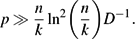
$$p\gg \ffrac nk\ln^2\biggl(\ffrac nk\biggr)D^{-1}.$$
This lower bound on p is asymptotically best possible for k = Θ(n). For this range of k and p, we are able to show stability as well.

A different behaviour occurs when k = o(n). In this case, the lower bound on p is almost optimal. Further, for the small interval D −1p ⩽ (n/k)1−ϵ D −1, the largest intersecting subhypergraph of $\mathcal{H}$ k (n, p) has size Θ(ln(pD)ND −1), provided that $k \gg \sqrt{n \ln n}$ .

Together with previous work of Balogh, Bohman and Mubayi, these results settle the asymptotic size of the largest intersecting family in $\mathcal{H}$ k , for essentially all values of p and k.

Information

Type
Paper
Copyright
Copyright © Cambridge University Press 2017 

Access options

Get access to the full version of this content by using one of the access options below. (Log in options will check for institutional or personal access. Content may require purchase if you do not have access.)

Article purchase

Temporarily unavailable