





Introduction
In the hard tick family Ixodidae, there are currently 763 recognized species that includes 18 extant genera (Guglielmone et al., Reference Guglielmone, Nava and Robbins2023; Barker et al., Reference Barker, Kelava, Mans, Apanaskevich, Seeman, Gofton, Shao, Teo, Evasco, Soennichsen, Barker and Nakao2024; Kelava et al., Reference Kelava, Apanaskevich, Shao, Gofton, Mans, Teo, Norval, Barker, Nakao and Barker2024; Apanaskevich et al., Reference Apanaskevich, Greiman, Goodman, Apanaskevich, Ahmed and Barker2025). For 5 of these genera, extinct species have been recognized in Burmese amber, namely Alloceraea (this study), Amblyomma, Archaeocroton, Bothriocroton and Ixodes (Chitimia-Dobler et al., Reference Chitimia-Dobler, Araujo, Ruthensteiner, Pfeffer and Dunlop2017, Reference Chitimia-Dobler, Mans, Handschuh and Dunlop2022, Reference Chitimia-Dobler, Dunlop, Pfeffer, Würzinger, Handschuh and Mans2023). Two extinct hard tick genera have also been described from Burmese amber (Upper Cretaceous, ca. 99 mya), namely Compluriscutula Poinar and Buckley, 2008 and Cornupalpatum Poinar and Brown, 2003 (Poinar and Brown, Reference Poinar and Brown2003; Poinar and Buckley, Reference Poinar and Buckley2008). A Cornupalpatum burmanicum Poinar and Brown, 2003 nymph entangled in a pennaceous feather suggested that it may have fed on feathered avian or non-avian dinosaurs (Peñalver et al., Reference Peñalver, Arillo, Delclòs, Peris, Grimaldi, Anderson, Nascimbene and Pérez-de la Fuente2017). This finding is supported by the description of an additional C. burmanicum female associated with a dinosaur feather in Burmese amber (Chitimia-Dobler et al., Reference Chitimia-Dobler, Mans, Handschuh and Dunlop2022). Numerous larvae of Compluriscutula vetulum Poinar and Buckley, 2008 were found in the Burmese amber, which suggests that it may have been relatively common in the Burmese amber forest, perhaps preferring arboricolous hosts (Chitimia-Dobler et al., Reference Chitimia-Dobler, Pfeffer, Würzinger, Handschuh and Dunlop2024a). In addition to these recent species there is a single fossil from the mid-Cretaceous Burmese (or Kachin) amber of Myanmar which was initially described as Haemaphysalis (Alloceraea) cretacea Chitimia-Dobler, Pfeffer and Dunlop, 2018 (Chitimia-Dobler et al., Reference Chitimia-Dobler, Pfeffer and Dunlop2018).
Haemaphysalis CL Koch, 1844 is the second largest genus in the Ixodidae, comprising 173 described species (Guglielmone et al., Reference Guglielmone, Nava and Robbins2023; Chitimia-Dobler et al., Reference Chitimia-Dobler, Barboutis, Bounas, Kassara, Mans and Saratsis2024b; Robbins et al., Reference Robbins, Nava, Ronai, Ghong and Guglielmone2025). This genus occurs in all 6 zoogeographic regions, but the greatest species diversity is found in south-eastern Asia while species numbers are much lower in the Nearctic and the Neotropics (Guglielmone et al., Reference Guglielmone, Nava and Robbins2023). The best represented area for Haemaphysalis is the Oriental region, with 64 species.
Haemaphysalis was traditionally divided into 11 subgenera that can be broadly classified into 3 groups: (1) the structurally primitive, (2) structurally intermediate, and (3) structurally advanced species (Hoogstraal and Kim, Reference Hoogstraal, Kim and Kim1985). ‘Structurally primitive’ Haemaphysalis comprised of 4 subgenera: Alloceraea Schulze, 1919, Allophysalis Hoogstraal, 1959, Aboimisalis Santos Dias, 1963, and Sharifiella Santos Dias, 1958 (Hoogstraal and Kim, Reference Hoogstraal, Kim and Kim1985; Geevarghese and Mishra, Reference Geevarghese and Mishra2011). Using mitochondrial systematics, Allophysalis and Aboimisalis was shown to group within Haemaphysalis sensu stricto (Kelava et al., Reference Kelava, Apanaskevich, Shao, Gofton, Mans, Teo, Norval, Barker, Nakao and Barker2024), leaving only Alloceraea and Sharifiella as potential basal lineages. Similarly, Sharifiella was recently elevated to genus level since mitochondrial systematics indicated grouping outside Haemaphysalis, within the Rhipicephalinae (Apanaskevich et al., Reference Apanaskevich, Greiman, Goodman, Apanaskevich, Ahmed and Barker2025). As such, it does not share a relationship with any of the Haemaphysalinae. Conversely, Alloceraea was recently shown to group within its own clade within the Haematobothrion and was re-validated as a distinct genus based on mitochondrial systematics (Kelava et al., Reference Kelava, Apanaskevich, Shao, Gofton, Mans, Teo, Norval, Barker, Nakao and Barker2024). Molecular analysis defined the Haematobothrion as being comprised of 5 genera, Bothriocroton and Cryptocroton forming one potentially basal clade, while Archaecroton and Alloceraea forms a sister clade to Haemaphysalis sensu strictu (Barker et al., Reference Barker, Kelava, Mans, Apanaskevich, Seeman, Gofton, Shao, Teo, Evasco, Soennichsen, Barker and Nakao2024; Kelava et al., Reference Kelava, Apanaskevich, Shao, Gofton, Mans, Teo, Norval, Barker, Nakao and Barker2024).
Alloceraea contains species with distributions mainly in Asia and the Orient and only 1 species is found in Europe. In detail, Alloceraea aponommoides (Warburton, 1913) comes from India, Alloceraea inermis (Birula, 1895) from Europe and Asia, Alloceraea kitaokai (Hoogstraal, 1969) and Alloceraea primitiva (Teng, 1982) from Asia, and Alloceraea colasbelcouri (Santos Dias, 1958) and Alloceraea kolonini (Du, Sun, Xu and Shao, 2018) are from the Orient (Feider, Reference Feider1965; Filippova, Reference Filippova1997; Geevarghese and Mishra, Reference Geevarghese and Mishra2011; Guglielmone et al., Reference Guglielmone, Robbins, Apanaskevich, Petney, Estrada-Peña and Horak2014).
The elevation of Alloceraea to genus level implies that H. cretaceae should also be transferred to Alloceraea as Alloceraea cretacea comb. nov. However, some studies have questioned the assignment of this fossil to Haemaphysalis and Alloceraea (Guglielmone et al., Reference Guglielmone, Petney and Robbins2020; Kelava et al., Reference Kelava, Apanaskevich, Shao, Gofton, Mans, Teo, Norval, Barker, Nakao and Barker2024). Here, we re-describe A. cretacea to address the critiques raised previously regarding its taxonomic placement and describe a new representative fossil nymph of the same species using µCT data and digital imaging. In addition, implications of the fossil record for the evolution of the Haematobothrion lineage, composed of Alloceraea, Archaeocroton, Bothriocroton, and Haemaphysalis are discussed.
Materials and methods
Two fossil ticks, both nymphs, originate from the collection of Patrick Müller bearing the original inventory numbers BUB 990 and BUB 2779. Both specimens are from Burmese amber that come from the Hukawng Valley in northern Myanmar and have been deposited in the Museum für Naturkunde, Berlin. Light microscopy images were taken with a Keyence VHX-900 Microscope (Keyence Itasca, IL, USA) with 100× to 200× magnification) for the morphological description. In addition, high-resolution μCT scans were carried out with synchrotron radiation at the German Electron Synchrotron (DESY). A precise comparison was carried out using the models subsequently created by editing the 3D digital models. Synchrotron radiated micro-computed tomography (SRmCT) was performed at the imaging beamline P05 (IBL) operated by Helmholtz-Zentrum Hereon at PETRA III at Deutsches Elektronen-Synchrotron in Hamburg, Germany (Greving et al., Reference Greving, Wilde, Ogurreck, Herzen, Hammel, Hipp, Friedrich, Lottermoser, Dose, Burmester, Müller and Beckmann2014; Wilde et al., Reference Wilde, Ogurreck, Greving, Hammel, Beckmann, Hipp, Lottermoser, Khokhriakov, Lytaev, Dose, Burmester, Müller and Schreyer2016). Scanning occurred using a custom-built CMOS camera (Lytaev et al., Reference Lytaev, Hipp, Lottermoser, Herzen, Greving, Khokhriakov, Meyer-Loges, Plewka, Burmester, Caselle, Vogelgesang, Chilingaryan, Kopmann, Balzer, Schreyer and Beckmann2014) with a photon energy of 18 keV. Raw projections were binned twice, and a reconstruction was made by applying a transport of intensity phase retrieval approach using the Filtered Back Project algorithm, implemented in a custom reconstruction pipeline (Moosmann et al., Reference Moosmann, Ershov, Weinhardt, Baumbach, Prasad, La-Bonne, Xiao, Kashef and Hoffmann2014) with Matlab (Math-Works) and Astra Toolbox (Palenstijn et al., Reference Palenstijn, Batenburg and Sijbers2011; van Aarle et al., Reference van Aarle, Palenstijn, De Beenhouwer, Altantzis, Bals, Batenburg and Sijbers2015, Reference van Aarle, Palenstijn, Cant, Janssens, Bleichrodt, Dabravolski, De Beenhouwer, Joost Batenburg and Sijbers2016). Segmentation was performed in Amira (v.6.0.1; FEI Company, Hillsboro, OR, USA) by selecting the specimen in every 20th or 30th image to generate a label, which was then used to interpolate all intervening images with the program Biomedisa (Lösel et al., Reference Lösel, Monchanin, Lebrun, Jayme, Relle, Devaud, Heuveline and Lihoreau2023: https://biomedisa.org/). A 3D-rendering was then exported and deposited in MorphoSource (https://www.morphosource.org/; Project ID: 000583128).
Moreover, 5 extant Haemaphysalis from different life stages (larva, nymph, 2 female and male) and species were scanned and used for comparative purposes to define morphological characteristics for this genus. This include Haemaphysalis (Allophysalis) danieli Černý and Hoogstraal, 1977 female (Pakistan), Haemaphysalis (Haemaphysalis) concinna Koch, 1844 female (Collections of the Museum of Nature Hamburg, Germany), Haemaphysalis (Rhipistoma) leachi (Audouin, 1826) male (Collections of the Museum of Nature Hamburg, Germany), Haemaphysalis (Ornithophysalis) eleonorae Chitimia-Dobler, Mans and Saratsis, 2024 nymph (Greece), and A. inermis larva (Italy).
Recent comparative material of ticks is lodged at the following institutions: Leibniz Institute for Evolution and Biodiversity Science (MfN), Museum of Nature Hamburg – Zoology (ZMH), Leibniz Institute for the Analysis of Biodiversity Change, Private collection of Lidia Chitima-Dobler (Munich, Germany).
Results
Systematic palaeontology
Ixodida, Leach, (1815)
Alloceraea, Schulze, (1919)
Alloceraea cretacea comb. nov. Chitimia-Dobler, Pfeffer and Dunlop, 2018
Material: Holotype BUB990 and additional material BUB2779 (coll. P. Müller). Burmese amber, Myanmar, Late Cretaceous (Cenomanian).
Emended diagnosis: Body oval-elongate, scutum broader than long with margins broadly rounded, palpi elongate and clavate, hypostome with well-marked transversal ridges of denticles connected by crenulations and 4 stout denticles on each side, cornua and eyes absent, 11 festoons, anal groove ‘V’ shape, spiracle plates oval-elongate, coxae with a broadly sub-triangular spur, trochanter spurs lacking.
Remarks: Herein, the holotype was re-analysed using novel synchrotron tomographic scanning images taken at the Deutsches Eletronen-Synchrotron (DESY). Moreover, another specimen (additional material BUB2779) from the same original collection was investigated. As the new specimen shares the same morphology as the holotype, we will further refer only to the new morphological features and clarify the controversial discussions and critique raised against the original type description.
The hypostome is spatulate and longer than chelicera and hypostomal denticles can be seen dorsally and clarified with the DESY images and videos. The hypostomal denticles have a special arrangement: 8 well-marked transversal ridges of 6 (proximal) to 8–10 (distal) denticles connected by crenulations and on each side 4 stout denticles; not separated in the middle (1A, B). Such structures are hard to see using light microscopy or reproduced in drawings, especially of nymphs. Such crenulations were also observed in DESY scans of the extant species H. (A.) danieli, H. (H.) concinna, H. (R.) leachi, H. (O.) eleonorae and A. inermis (2A, B, C, D, E). The crenulations are less developed in larval instars and become more pronounced during subsequent life stages. The amber fossils have no spur on the palps, but they do have an anterior process and a small blunt spur angular on the basis capituli (3A, B). DESY scans of the fossils show that the scapulae are in fact blunt and round and not long and sharp as it was originally described (Chitimia-Dobler et al., Reference Chitimia-Dobler, Pfeffer and Dunlop2018). The sharp aspect described in the original description derived from a spur on the distal part of coxae I in both specimens (BUB-990, BUB-2779) (Figure 4). Each coxa has a broadly sub-triangular spur extending slightly (I–III) beyond the coxal margin, IV spur small (Figure 5). Anal groove has a ‘V’ shape, although not well visible (Figure 6).
Alloceraea cretacea (BUB-990) – A, capitulum ventral (DESY image), hypostome crenulations, palp, and basis capituli are marked with red arrows; B, capitulum ventral (light microscopy Keyence VH900), hypostome crenulations, palp and basis capituli are marked with red arrows.

Figure 1 Long description
The image A showing a grayscale micrograph on a black background. A central upright structure is labeled “Hypostome,” with an arrow pointing to the upper end. The top edge of the central structure is labeled “Hypostome crenulations,” with an arrow pointing to the upper margin. Two lateral structures extend outward from the central structure; the left lateral structure is labeled “Palp,” with an arrow pointing to it. The lower central region is labeled “Basis capituli,” with an arrow pointing to the base. A scale bar at the lower right reads “100 µm.” The image B showing a brown-toned micrograph on a dark background. A central upright structure is labeled “Hypostome,” with an arrow pointing to the upper portion. A lateral structure on the left is labeled “Palp,” with an arrow pointing to it. The lower central region is labeled “Basis capituli,” with an arrow pointing to the base.
Ventral view of capituli and coxa I of different life stage and species of extant Haemaphysalis, focusing on hypostome structure: A, Alloceraea inermis larva (Italy); B, Haemaphysalis (Ornithophysalis) eleonorae nymph (Greece); C, Haemaphysalis (A.) Danieli female (Pakistan); D, Haemaphysalis (Haemaphysalis) concinna female (Collections of the Museum of Nature Hamburg, Germany) and E, Haemaphysalis (Rhipistoma) leachi male (Collections of the Museum of Nature Hamburg, Germany).
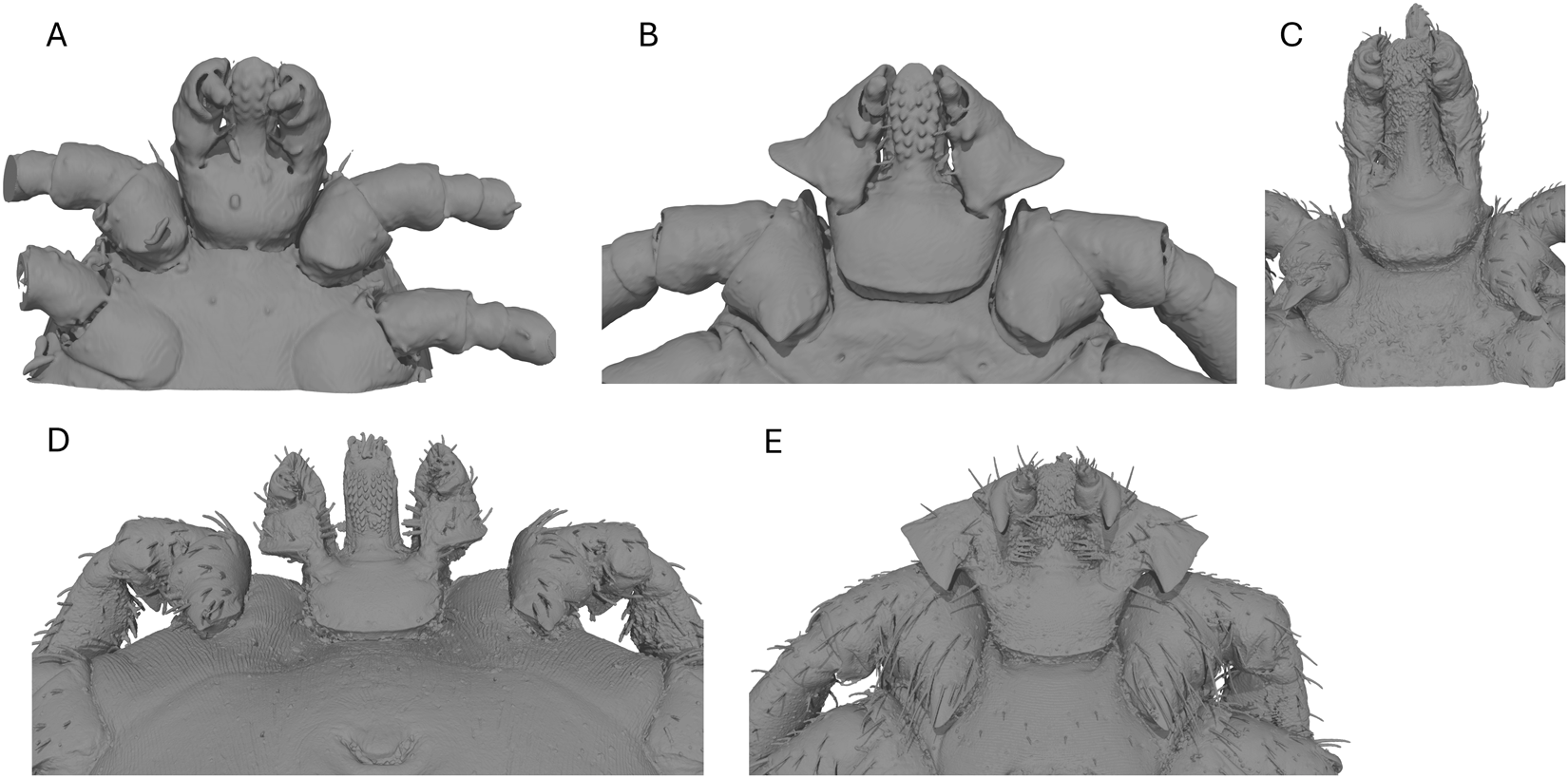
Figure 2 Long description
A five-part scientific figure arranged in two rows, with labels A, B, C on the top row and D, E on the bottom row. Each part shows a ventral view centered on the capituli and the first pair of coxae, with the hypostome in the middle. A shows a compact central capituli with two short lateral appendages and two coxa I structures extending outward. B shows a broader capituli with wider lateral extensions than A and coxa I extending to both sides. C shows a narrower, more elongated central capituli region than A and B, with coxa I partly shown at the sides. D shows a larger field of view than A to C, with the capituli near the top center and coxa I extending outward; the lateral appendages appear thicker and more textured. E shows a wide capituli with prominent lateral extensions and many short, hair-like projections around the margins; coxa I extends outward on both sides. No scale bar or measurement text is shown.
Alloceraea cretacea (BUB-990) – A, capitulum dorsal (DESY image), chelicera, palp, anterior process and basis capituli are marked with red arrows; B, capitulum dorsal (light microscopy Keyence VH900), chelicera, palp, anterior process and basis capituli are marked with red arrows.

Figure 3 Long description
Image A shows a dorsal view of the capitulum with chelicera, palp, anterior process and basis capituli marked with arrows. The scale bar indicates 100 micrometers. Image B also shows a dorsal view of the capitulum with chelicera, palp, anterior process and basis capituli marked with arrows. Both images highlight similar anatomical features with different imaging techniques.
Alloceraea cretacea (BUB-2779) – capitulum ventral (DESY image), hypostome crenulations, palp, basis capituli and spur on the coxa I are marked with red arrows.

Figure 4 Long description
The 3D scan displays a detailed view of a structure with several anatomical features marked by arrows. The hypostome crenulations are indicated at the top, showing intricate patterns. Below, the palp is marked, highlighting its position in the structure. The basis capituli is identified in the central region, providing a reference point for the anatomy. At the bottom, the coxal spur is marked, showing its distinct shape and location. The scan provides a comprehensive view of these features, emphasizing their spatial relationships and structural details.
Alloceraea cretacea (BUB-2779) – coxae (DESY image), internal spur of coxae I-III and apical spurs are marked with red arrows.

Figure 5 Long description
Insufficient visual information to describe this element accurately.
Comparison of the anal grooves – A, extant Haemaphysalis (Ornithophysalis) eleonorae nymph; B, Alloceraea cretacea (BUB-2779) nymph. Festoons are also clearly seen for both nymphs.

Figure 6 Long description
The image A showing a grayscale micrograph with a curved outer edge and a central circular structure near the top. Two red arrows with white text labels are present: one arrow labeled “Anal groove” points toward a curved groove near the center; one arrow labeled “Festoons” points toward the scalloped outer margin. The image B showing a grayscale micrograph with a broad curved band of textured material and a lighter curved region inside it. Two red arrows with white text labels are present: one arrow labeled “Anal groove” points toward a curved groove near the inner side of the band; one arrow labeled “Festoons” points toward the scalloped outer margin.
Alloceraea cretacea (BUB-2779) – A, dorsal view, capitulum, scutum, festoon, marked with red arrows; B, ventral view, capitulum, coxa I internal spur and spiracle, marked with red arrows (light microscopy Keyence VH900).

Figure 7 Long description
The image A showing an arthropod body with multiple legs on a pale brown background. Black text labels read Capitulum, Scutum and Festoons, each with a red arrow pointing to the corresponding body region. A blue scale bar at the lower right reads 1.50mm. The image B showing an arthropod body with multiple legs on a pale brown background. Black text labels read Capitulum, Coxal internal spur and Spiracle, each with a red arrow pointing to the corresponding body region. A blue scale bar at the lower right reads 1.50mm.
Discussion
The current study adds a new nymphal fossil which we assign to A. cretacea (7A, B). The elongate body, typical hypostomal structure, very long setae on the palps, a well-developed dorsal anterior process of the palps that extends laterally from the basis capituli, simple coxa I, long spur on the distal part of coxae I, a small sub-triangular spur, and the absence of laterally projections of the basis capituli are the most relevant features to identify the 2 fossils as conspecific and to argue that they can be assigned to Haemaphysalis sensu lato based on general characteristics typical for this genus such as the lack of eyes, the number of festoons, and the ‘V’ anal groove shape which place them within the Metastriata and not Prostriata.
Alloceraea classification and dubious taxonomic assignments
We note in this context that the A. cretacea fossil described by Chitimia-Dobler et al. (Reference Chitimia-Dobler, Pfeffer and Dunlop2018) elicited significant critique in the literature. Guglielmone et al. (Reference Guglielmone, Petney and Robbins2020) commented that the morphological structures from Chitimia-Dobler et al. (Reference Chitimia-Dobler, Pfeffer and Dunlop2018) do not support inclusion in the genus Haemaphysalis. They argue that while the authors indicate that the basis capituli is slightly wider than long or 2.6 times wider than long, the accompanying figures show a basis capituli that is obviously longer than broad. Also, that the second article of the palps is 1.6 times longer than the third article, but that the figures show a second article almost 4 times longer than the third article. They then cite Hoogstraal and Kim (Reference Hoogstraal, Kim and Kim1985) to indicate that ‘the most basic criterion of the 17 “primitive” Haemaphysalis is the presence, in each stage, or only in larvae and nymphs, of a lateral convexity of the basis capituli or of a projection from each side of the basis capituli’, indicating that this is not met in the nymph described by Chitimia-Dobler et al. (Reference Chitimia-Dobler, Pfeffer and Dunlop2018). The current study argues that Guglielmone et al. (Reference Guglielmone, Petney and Robbins2020) did not recognize that the measurements were made from the palp insertion and did not include the basis capituli anterior process. The anterior process was not included in the anterior description, as it never appeared in the Haemaphysalis species description or in other species. Furthermore, the basis capituli posterior have straight margins, while dorsally the lateral margins display concavity and a blunt slightly angular shape, which does not extend over the scapula and is only slightly visible ventral (1A, 3A). The lateral margin concavity was observed in larva and females of A. inermis, which is considered a distinct morphologic feature. The second concavity is on the side of the anterior process, at the level of the first palpal segment, a character rendering the fossil different from A. inermis. Hoogstraal (Reference Hoogstraal1966a) stipulated that the capitulum of larva and nymphs is more like that of Rhipicephalus and Dermacentor immatures than of most other Haemaphysalis. The Alloceraea also do not have lateral projections, either dorsally or ventrally, on the basis capituli. For example, see A. aponommoides (Geevarghese and Mishra, Reference Geevarghese and Mishra2011). In the current study, this type of projection was not observed on basis capituli or palps of A. inermis scanned larva (2A). Another general morphological aspect for the ‘structurally primitive’ group was the absence of cornua. This morphological aspect is characteristic only for Alloceraea and not found in Haemaphysalis sensu stricto (Hoogstraal, Reference Hoogstraal1966a; Geevarghese and Mishra, Reference Geevarghese and Mishra2011).
Alloceraea – A ‘structurally primitive’ genus
Recently, Alloceraea was considered the only remaining ‘structurally primitive’ genus, given that molecular data place the other ‘primitive’ groups in Haemaphysalis sensu stricto (Kelava et al., Reference Kelava, Apanaskevich, Shao, Gofton, Mans, Teo, Norval, Barker, Nakao and Barker2024). This study also critiqued Chitimia-Dobler et al. (Reference Chitimia-Dobler, Pfeffer and Dunlop2018) raising a number of morphological issues, notably that the palps from A. cretacea are considerably narrower and longer, with exceptionally long setae compared with other known nymphs of Alloceraea. That the first palpal segment of A. cretacea is more developed than any other known Alloceraea species. That the basis capitulum is different in shape from other Alloceraea with a distinct anterior process, absent in extant Alloceraea. That the shape of the scutum and the long and sharp scapulae are different from extant Alloceraea. That the legs are long and slender, while extant Alloceraea have short and robust legs. That the idiosoma of the unfed fossil is narrowly oval whereas extant Alloceraea this is widely oval. That the hypostome, the shape of the dorsal basis capitulum, the coxal spurs on coxa, anal groove and eyes is not visible.
To address these quite substantial critiques, we re-evaluated the amber specimens using tomographic images and videos of both available specimens. None of the morphological aspects discussed in Chitimia-Dobler et al. (Reference Chitimia-Dobler, Pfeffer and Dunlop2018) are included here, since repetition is not necessary. Our focus here is on new morphological aspects of the 2 specimens as they relate to the critiques raised and towards the classification of A. cretacea within the ‘structurally primitive’ genus Alloceraea.
Haemaphysalis ticks are generally small, inornate, and have short mouthparts: the brevirostrata condition. Hoogstraal and Kim (Reference Hoogstraal, Kim and Kim1985) divided them into the ‘structurally primitive’, ‘structurally intermediate’ and ‘structurally advanced’ groups. It was emphasized that ‘the most basic criterion of the 17 “primitive” Haemaphysalis is the presence, in each stage, or only in larvae and nymphs, of a lateral convexity of the basis capitulum, or of a projection from each side of the basis capitula’. Kelava et al. (Reference Kelava, Apanaskevich, Shao, Gofton, Mans, Teo, Norval, Barker, Nakao and Barker2024) indicated that the basis capituli in A. cretacea has a very distinct anterior process, whereas all extant ex-Alloceraea species lack this. Here, we would add that some Haemaphysalis species, especially from the earlier ‘structurally primitive’ group, do have an anterior process, small in A. aponommoides and more evident in other Haemaphysalis (Allophysalis) species, e.g. H. (Allophysalis) garhwalensis (Geevarghese and Mishra, Reference Geevarghese and Mishra2011), H. (Allophysalis) pospelovashtromae Hoogstraal, 1966 (Hoogstraal, Reference Hoogstraal1966a).
We accept that the exceptionally long setae in the 2 amber fossils are not comparable with any extant Alloceraea nymphs, but beyond A. inermis, other species with long setae include H. (A.) pospelovashtromae (Hoogstraal, Reference Hoogstraal1966a). Long setae may therefore be a morphological aspect for some Haemaphysalis species. Many of the earlier ‘structurally primitive group’ species have nymphal palps described as elongate and clavate (Hoogstraal and Kim, Reference Hoogstraal, Kim and Kim1985), similar to the amber fossils. Another aspect should be noted here, the position of the nymphal palps in extant ‘structurally primitive’ species which extend posterior from the basis capituli and laterally from the basis capituli in the fossil (Figure 3).
The precise dental formula of the hypostome in the new specimen was not entirely clear under light microscopy. However, numerous denticles and a corona were distal visible. The hypostome is spatulate and longer than the chelicera, and hypostomal denticles can be seen dorsally (Figures 1 and 3) as clarified by the DESY images and videos. Additionally, in A. cretacea (e.g. BUB-990) the hypostomal denticles have a special arrangement: 8 well-marked transversal ridges of 6 (proximal) to 8—10 (distal) denticles connected by crenulations and on each side 4 stout denticles; not separated in the middle (1A). This morphology is difficult to observe under light microscopy or to reproduce in drawings, especially for nymphs. However, in Geevarghese et al. (Reference Geevarghese, Mandke and Mishra2009) the drawing of Haemaphysalis (Kaiseriana) aculeata Lavarra, 1904 partially shows the denticles connected by crenulations in the middle, even if the dental formula is 2/2. To clarify this, we chose 5 extant species: H. (A.) danieli, H. (H.) concinna and H. (R.) leachi, H. (O.) eleonorae and A. inermis and scanned them at the DESY (2A, B, C). We conclude now that crenulations, or denticles connected by crenulations, are a specific morphological feature for A. cretacea, which could be an ancestral state for Haemaphysalis sensu lato, as crenulations were observed in scanned extant species. Alloceraea inermis larvae has less crenulations maybe due to its 2/2 denticles, the host and the short time feeding (Nosek, Reference Nosek, Daniel and Rosický1973; Filippova, Reference Filippova1997). Haemaphysalis (O.) eleonorae nymphs show increased crenulations compared to larvae and explains why its denticle formula looks confusing (Chitimia-Dobler et al., Reference Chitimia-Dobler, Handschuh, Dunlop, Pienaar and Mans2024c). Female H. (A.) danieli presents more evident crenulations, and female H. (H.) concinna shows some reminiscence of crenulations in the middle and distal of the hypostome, while male H. (R.) leachi has evident crenulations. It seems that the presence of crenulations on the hypostome is an ancestral morphological aspect maintained during the evolution and development of the genus Haemaphysalis sensu lato which we consider it to be associated with the hosts of the different life stages and species.
‘Structurally primitive’ Haemaphysalis, and the other non-rhipicephaline ixodids, differ distinctly from other haemaphysaline species. It has been suggested that life stages from Alloceraea have a laterally convex or otherwise laterally projecting basis capituli, lacking cornua, and elongate (clavate) and compact palpi, but not basolaterally salient, lacking a ventral spur (Geevarghese and Mishra, Reference Geevarghese and Mishra2011). Our fossils have Alloceraea characteristics, such as elongate palpi, absence of a ventral spur on the palps and lack cornua, but can be differentiated from the living species. Allophysalis immatures have short, broadly angular basis capituli, but the palpi remain elongate as in Alloceraea. Bearing a small ventral spur on the palpi suggests Allophysalis is close to the structurally advanced Ornithophysalis subgenus (Geevarghese and Mishra, Reference Geevarghese and Mishra2011). Presence of spurs on the palps is considered to be a bird-parasitizing or primitive mammal parasitizing adaptation for the structurally advanced subgenus Ornithophysalis (Hoogstraal and Kim, Reference Hoogstraal, Kim and Kim1985; Geevarghese and Mishra, Reference Geevarghese and Mishra2011).
Larvae of the subgenus Herpetobia, which is classed as ‘structurally intermediate’, lack cornua and a discrete coxal spur which is taken as evidence of reptile-parasitizing progenitors (Hoogstraal and Kim, Reference Hoogstraal, Kim and Kim1985; Geevarghese and Mishra, Reference Geevarghese and Mishra2011). Immatures and adults from the Haemaphysalis subgenus have palps which are only slightly advanced, compact, slightly elongate, either broader posteriorly (as in Herpetobia nymphs), or elongate with moderate flange, characterizing Herpetobia and the ‘structurally primitive’ lineages (Hoogstraal and Kim, Reference Hoogstraal, Kim and Kim1985).
Regarding the long and sharp scapulae of A. cretacea, the synchrotron scans show that the original description was incorrect with the scapulae blunt and round. The ‘sharp’ aspect was misinterpreted from a spur on the distal part of coxae I. Interestingly, such a spur, albeit smaller, was observed on A. inermis larva, which could be a characteristic for Alloceraea.
Regarding coxal spurs, scans show that each coxa bears a broadly sub-triangular spur extending slightly (I–III) beyond the coxal margin, with the IV spur small. The A. inermis larva has the same spurs on their coxae, just smaller. The anus and anal groove were unclear in the original description due to an artefact or insufficient contrast. In the new fossil nymph (BUB2779), the anal groove can be seen as a ‘V’ shape with a little tail (Figure 6). The anal groove matches the condition observed in Haemaphysalis sensu lato, including Alloceraea. Some authors describe the anal groove as ‘V’ shaped (Feider, Reference Feider1965), while other authors do not comment on the shape but their figures indicate a ‘Y’ shaped anal groove (Hoogstraal, Reference Hoogstraal1966b; Hoogstraal et al., Reference Hoogstraal, Saito, Dhanda and Bhat1971). The ‘Y’ shaped anal groove can be observed in the H. (O.) eleonorae nymph we used for comparison (Figure 6).
The typical hypostomal structure, simple coxa I, long spur on the distal part of coxae I with a small triangular spur are the most relevant features to define Haemaphysalis sensu lato together with being eyeless, presence of festoons, and a ‘V’ shaped anal groove. In conclusion, we remain confident that both fossils are best placed in the genus Alloceraea.
Taxonomic re-definition of Alloceraea
Based on the new findings presented above, we redefine the morphological features which characterize Alloceraea, primarily based on a combination of (1) oval body shape, (2) the absence of eyes, (3) the presence of festoons, (4) a dental formula with 8–10 denticles in a file, (5) absence of lateral projections of the basis capituli, (6) a small dorsal anterior process of basis capituli, (7) lack of cornua, (8) the absence of trochanter spurs and (9) segment III of palps lacking a ventral spur and segment IV being an apical pit. Regarding character 5: in contrast to Alloceraea, Allophysalis and Aboimisalis have lateral protections of the basis capituli on larvae and nymphs and cornua in adults.
Evolution and biogeography of Haematobothrion lineages
Developments in our knowledge of the Burmese amber fossils since the initial description of A. cretacea allow new insights regarding the evolution of the Haematobothrion lineages. The presence of extant Bothriocroton in Australasia (Klompen et al., Reference Klompen, Dobson and Barker2002; Guglielmone et al., Reference Guglielmone, Nava and Robbins2023) as well as fossils in Burmese amber (Chitimia-Dobler et al., Reference Chitimia-Dobler, Dunlop, Pfeffer, Würzinger, Handschuh and Mans2023), suggest that the Burma terrane (BT) was colonized by this lineage before it rifted from Proto-Australia; events that may have occurred between ∼170 and 150 MYA (Westerweel et al., Reference Westerweel, Roperch, Win and DuPont-Nivet2025). Its absence in Asia is consistent with the hypothesis that the lineage went extinct during the BT journey that lasted from ∼150 to 40 MYA (Westerweel et al., Reference Westerweel, Roperch, Win and DuPont-Nivet2025). Conversely, the presence of living Alloceraea in the Palearctic and Oriental regions and as fossils in Burmese amber, but the absence of this genus in Australasia (Guglielmone et al., Reference Guglielmone, Nava and Robbins2023), could imply that the lineage ancestral to Alloceraea, Archaeocroton and Haemaphysalis evolved after rifting from Australia. In this scenario, further divergence of lineages that formed Haemaphysalis and Alloceraea-Archaeocroton occurred during the migration of the BT towards Asia, followed subsequent divergence of Alloceraea and Archaeocroton. It is plausible that the ancestral Achaeocroton lineage dispersed from the BT terrane to the Polynesian islands to eventually end up as a single extant species in New Zealand (Heath, Reference Heath2006), also suggesting significant extinction events in the Cenozoic. Cryptocroton shows a deep divergence with Bothriocroton (Barker et al., Reference Barker, Kelava, Mans, Apanaskevich, Seeman, Gofton, Shao, Teo, Evasco, Soennichsen, Barker and Nakao2024). This likely indicates that divergence occurred on the Australasian mainland, which may suggest that Cryptocroton fossils may also be found in Burmese amber. This divergence of the lineages is consistent with our current understanding of Haematobothrion systematics (Barker et al., Reference Barker, Kelava, Mans, Apanaskevich, Seeman, Gofton, Shao, Teo, Evasco, Soennichsen, Barker and Nakao2024; Kelava et al., Reference Kelava, Apanaskevich, Shao, Gofton, Mans, Teo, Norval, Barker, Nakao and Barker2024).
Molecular dating using mitochondrial genome data also supports this scenario with previous divergence times for Bothriocroton and the rest of the Haematobothrion estimated at ∼155 MYA (Mans et al., Reference Mans, Featherston, Kvas, Pillay, de Klerk, Pienaar, de Castro, Schwan, Lopez, Teel, Pérez de León, Sonenshine, Egekwu, Bakkes, Heyne, Kanduma, Nyangiwe, Bouattour and Latif2019; Chitimia-Dobler et al., Reference Chitimia-Dobler, Dunlop, Pfeffer, Würzinger, Handschuh and Mans2023), the split between Haemaphysalis and Alloceraea-Archaeocroton at ∼151 MYA and Alloceraea and Archaeocroton at ∼139 MYA (Mans et al., Reference Mans, Featherston, Kvas, Pillay, de Klerk, Pienaar, de Castro, Schwan, Lopez, Teel, Pérez de León, Sonenshine, Egekwu, Bakkes, Heyne, Kanduma, Nyangiwe, Bouattour and Latif2019; Chitimia-Dobler et al., Reference Chitimia-Dobler, Dunlop, Pfeffer, Würzinger, Handschuh and Mans2023). The timing for these events thus correlates with divergence after the BT rifting and during the BT journey. It would also imply that Alloceraea and Haemaphysalis survived the journey from Australia to Asia to colonize the Palearctic Region (including Europe, most parts of Asia and northern Africa). Evidence that other lineages survived the BT journey has been offered for spiders and fresh-water mussels (Bolotov et al., Reference Bolotov, Pasupuleti, Subba Rao, Unnikrishnan, Chan, Lunn, Win, Gofarov, Kondakov, Konopleva, Lyubas, Tomilova, Vikhrev, Pfenninger, Düwel, Feldmeyer, Nesemann and Nagel2022; Wood and Wunderlich, Reference Wood and Wunderlich2023). This would make ticks another lineage to survive the passage with the implication that vertebrate hosts also had to survive to maintain these lineages.
In the case of Alloceraea the colonization event was not very successful, with only 6 extant species described to date, of which 5 are restricted to the Orient and 1 to the Palearctic (Guglielmone et al., Reference Guglielmone, Nava and Robbins2023). Haemaphysalis, however, is considered one of the more successful genera, comprising ∼21% of ixodid tick species of which ∼47% occur in the Oriental region (Guglielmone et al., Reference Guglielmone, Nava and Robbins2023). This would suggest divergence of the lineage once it reached the new continent and potentially found new hosts. This scenario is congruent with other suggestions for an origin for Haemaphysalis in the Oriental region with subsequent dispersal to other biomes (Geevarghese and Mishra, Reference Geevarghese and Mishra2011). It is also supported by the basal position of the Oriental lineages, with more derived lineages from the Australasian region in a more terminal position (Kelava et al., Reference Kelava, Apanaskevich, Shao, Gofton, Mans, Teo, Norval, Barker, Nakao and Barker2024). This hypothesis explains the phylogenetic pattern seen for the Haematobothrion lineage and finally makes sense of some puzzling geographic patterns when systematic sister-group relationships are considered. If A. cretacea does not belong to Alloceraea sensu stricto, as some authors suggested, but rather represents a direct ancestor to Haemaphysalis, or groups within the general Haematobothrion clade, this would still not change the general hypothesis that links the geographically distinct Bothriocroton, Cryptocroton, Alloceraea, Archaeocroton and Haemaphysalis together via vicariance and divergence precipitated by the BT rifting and journey to Asia.
Summary
The present study showcases the usefulness of Burmese amber fossils to help understand deep evolutionary relationships between modern tick genera. In the same context, Burmese amber fossils have provided insights into the evolution of prostriates (Chitimia-Dobler et al., Reference Chitimia-Dobler, Dunlop, Pfeffer, Würzinger, Handschuh and Mans2023) and the Nuttalliellidae family (Chitimia-Dobler et al., Reference Chitimia-Dobler, Handschuh, Dunlop, Pienaar and Mans2024c). The implication of the current study is that Burmese fossils will continue to contribute to our understanding of tick evolution, in this case specifically that fossils belonging to Haemaphysalis sensu stricto may be expected to be found in Cretaceous ambers as well.
Acknowledgements
We thank Patrick Müller for making these materials available for study.
Author contribution
LCD took the photos and described the species; BJM contributed to the description and interpreted the tick evolution; CM took the DESY photos, DH, JH, UK, took care of the DESY scanning. LCD, BJM and JAD wrote the manuscript. All authors read and proofed the final version of the manuscript.
Financial support
Funding was provided by the German Science Foundation award HA 8785/5 and KO 3944/10 to Danilo Harms and Ulrich Kotthoff.
Competing interests
The authors declare there are no conflicts of interest.
Ethical standards
Not applicable


 Open access

