


Jeju Island, a volcanic island in South Korea, comprises mountainous, semi-mountainous, low-lying, and coastal zones around the 1,950-m-high Mt Halla, a UNESCO Biosphere Reserve since 2002 (Hong et al., Reference Hong, Kim, Lee and Lee2021; UNESCO, 2021). Forty-three per cent of plants categorized nationally as threatened occur on the island (Korea National Arboretum, 2021), and 84 plant species on the island are endemic, including Salix blinii H. Lév, a low-growing shrub (Chung et al., Reference Chung, Jang, Chang, Choi, Kim, Kim and Son2023). Little was previously known about the population demographics of S. blinii other than that it grows in valleys above 1,200 m on Mt Halla (Kim et al., Reference Kim, Koh, Moon, Song, Kim and Kim2008; Lee, Reference Lee2014). Nevertheless, this species is categorized as Vulnerable on the IUCN Red List because of its restricted range (Kim et al., Reference Kim, Kim and Son2016). In this study, we aimed to acquire quantitative information on the population demographics of S. blinii, to re-evaluate its conservation status and determine its conservation needs.
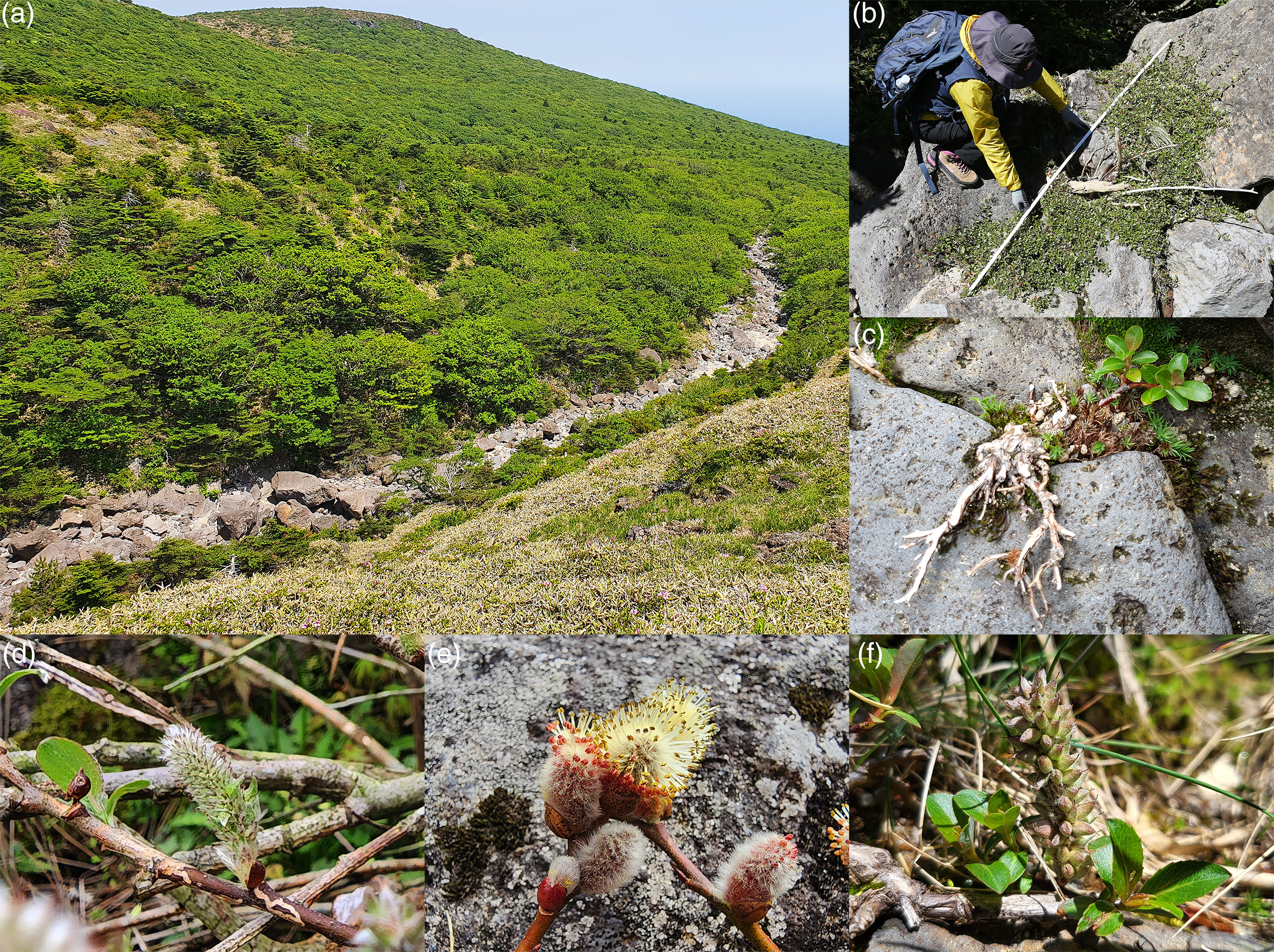
During 2019–2022, we investigated habitats suitable for S. blinii in all valley areas (i.e. Gwangnyeong-cheon, Dongheung-cheon, Young-cheon, and Han-cheon) on Mt Halla above 1,200 m, recording all individuals and their stage structure (Plate 1a). The maturity of each individual was determined based on whether it was flowering, and we recorded the location and altitude of each individual, and the total length of surveyed sections in each valley.
Salix blinii, showing (a) its typical habitat, (b) its growth pattern and canopy measurement, (c) a non-flowering plant, (d) female plant with catkin, (e) male plant with catkins, and (f) fruiting stage. Photos: (a,b) Sungwon Son, (c) Sodam Kim, (d–f) Jong-Gab Kim.

Structured population models are an essential tool for plant management and conservation (Chu & Alder, Reference Chu and Adler2014), but plant life cycles are complex and vegetative reproduction is common, and therefore stage structure based on individual size, rather than age structure, is frequently used (Ogden, Reference Ogden1970; Chu & Alder, Reference Chu and Adler2014). We measured the canopy diameter of all identified individuals, as S. blinii grows horizontally in the thin soil that forms in rock crevices (Plate 1b,c), and classified individuals into five stages (S1, S2, S3, S4, and S5 for < 5, 6–50, 51–100, 101–150, and > 150 cm canopy diameter, respectively).
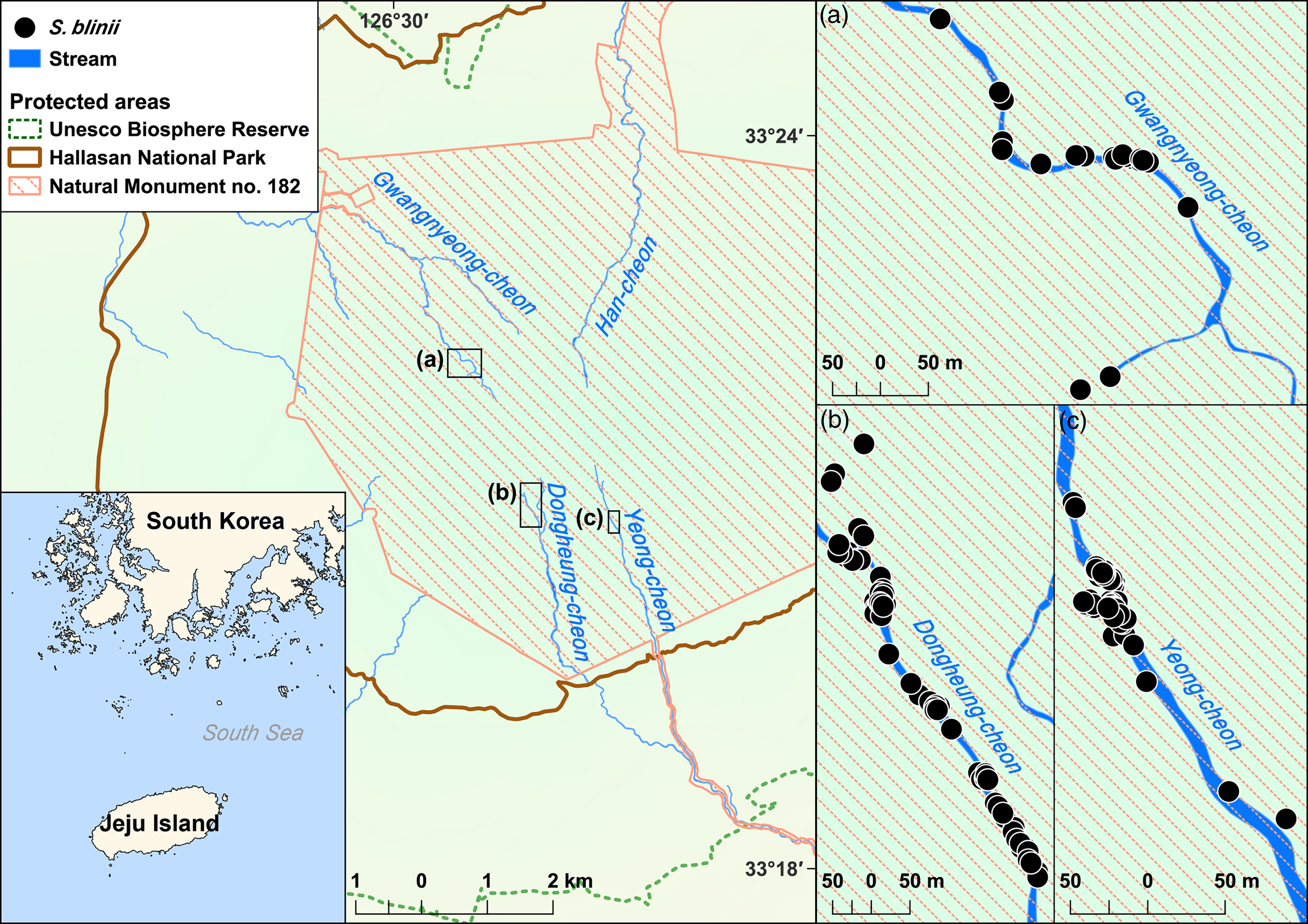
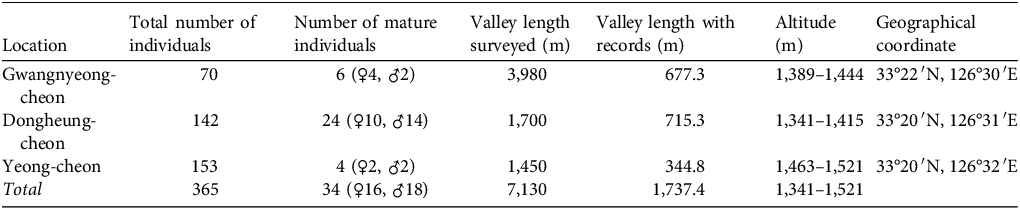
We recorded a total of 365 individuals of S. blinii in three of the four valleys, but none in Han-cheon (Fig. 1). Only 34 individuals were flowering, 16 female and 18 male. The total length of the valleys inhabited by S. blinii was 1,737 m (Table 1).
The locations in which we recorded Salix blinii in three valleys on Mt Halla, Jeju Island, South Korea, with the locations of Hallasan National Park, Natural Monument No. 182, and the UNESCO Biosphere Reserve.

The three valleys in which we recorded Salix blinii during 2019–2022 on Mt Halla, Jeju Island, South Korea (Fig. 1), with total number of individuals and number of mature (flowering) individuals, length of valley surveyed and of valley with records, altitude and a representative geographical coordinate for each valley.

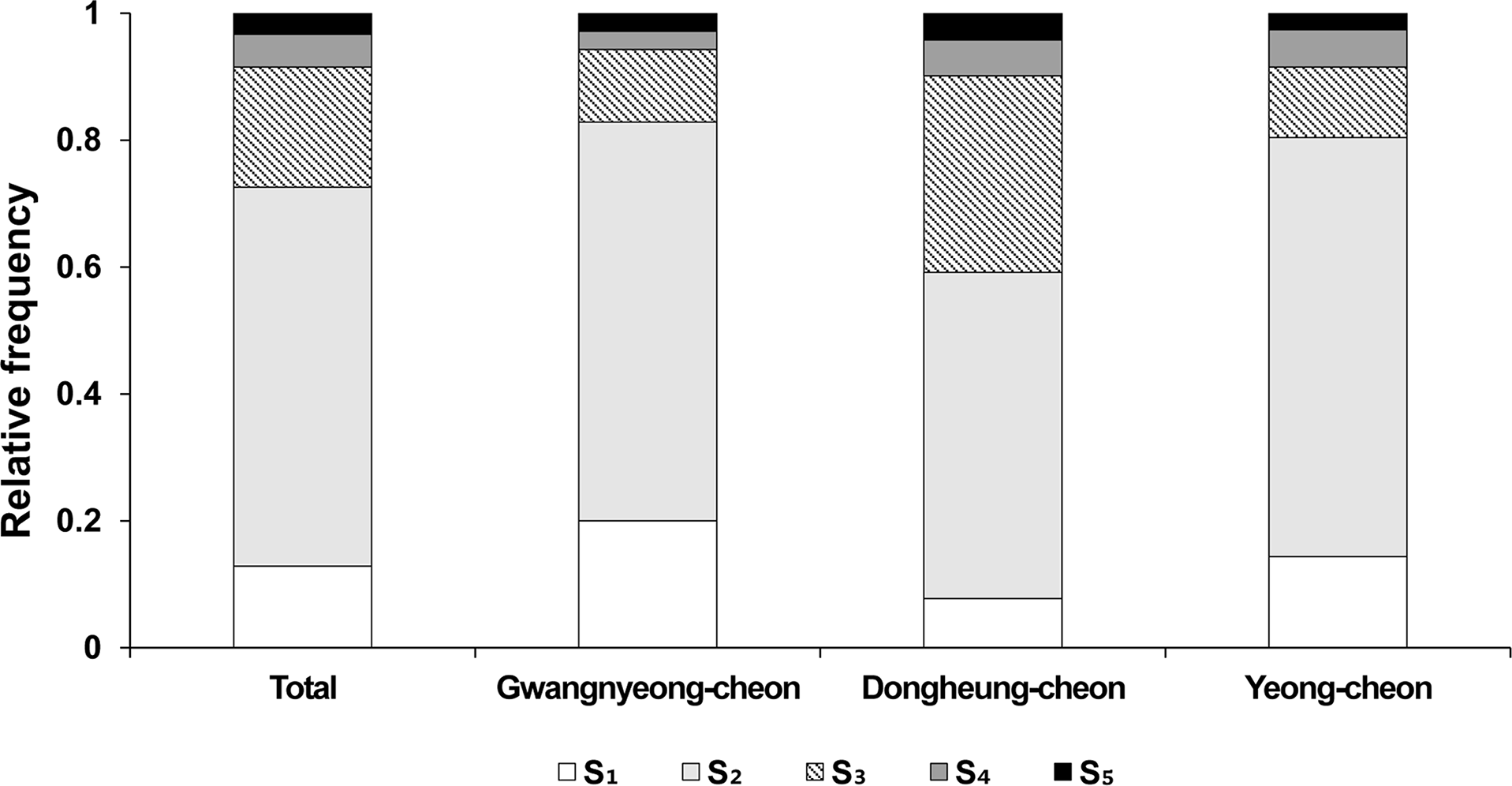
The proportion of small individuals (S1 and S2) was higher than that of larger individuals (S4 and S5; Fig. 2). We infer, therefore, that sexual reproduction occurs only rarely in the population of S. blinii, with vegetative reproduction predominant in maintaining the population. Vegetative reproduction plays a crucial role in the spread of Salix species along valleys and rivers (Budde et al., Reference Budde, Gallo, Marchelli, Mosner, Liepelt and Ziegenhagen2010; Asaeda et al., Reference Asaeda, Gomes, Sakamoto and Rashid2011; Thomas et al., Reference Thomas, Tölle, Ziegenhagen and Leyer2012). The valleys where S. blinii grows on Mt Halla have extreme environmental dynamics, such as flooding and rock movement, especially in summer. The breakup of vegetative fragments during this season presumably plays a role in the spread of S. blinii.
The stage-structure of S. blinii expressed as the relative frequency of individuals of each canopy diameter stage (S1, < 5 cm; S2, 6–50 cm; S3, 51–100 cm; S4, 101–150 cm; S5, > 150 cm) in the three valleys on Mt Halla (Fig. 1), and overall.

The current categorization of S. blinii as Vulnerable on the IUCN Red List is based on criterion D2, because of the small population and plausible threats that could potentially result in categorization as Critically Endangered or Extinct within a short time (Kim et al., Reference Kim, Kim and Son2016). From the information collected in this study, we calculated an area of occupancy (AOO) of c. 16 km2 and an extent of occurrence (EOO) of 1.8 km2, but following IUCN guidelines (IUCN Standards and Petitions Committee, 2022) the EOO has to be increased to the value of the AOO, to ensure consistency with the definition of the AOO as an area within the EOO. However, to apply criteria B (geographical range) or C (small population size and decline), a continuous decline or extreme fluctuation in the population should be confirmed, and we have no evidence for either. The use of criterion D can nevertheless be reconsidered using the data on the number of mature individuals. In trees, vegetative clones and apomictic and self-fertilizing individuals can be considered mature if they can reproduce and survive independently, unlike other clones (IUCN Standards and Petitions Committee, 2022). Although we recorded only 34 S. blinii individuals flowering, all 365 individuals surveyed were recognized as mature individuals capable of independent survival and reproduction as vegetative reproduction is presumed to play a crucial role for this species. We therefore reassess S. blinii as Vulnerable based on criteria D1 + 2; i.e. a very small or restricted population (D) with < 1,000 individuals (1) and restricted AOO and plausible future threat (2).
An extremely small population is more likely to become extinct than a large population because of demographic stochasticity (Harmon & Braude, Reference Harmon, Braude, Braude and Low2010). Nonetheless, small plant populations with moderate stress levels are more likely to maintain higher heterozygosity than predicted in a model assuming selective neutrality; thus, they may have high conservation value (Lesica & Allendorf, Reference Lesica and Allendorf1992). Therefore, the conservation of small plant populations that grow in extreme environments, such as S. blinii, should be prioritized. The habitat of S. blinii on Mt Halla is designated as Hallasan National Park, Natural Monument No. 182 and a UNESCO Biosphere Reserve. However, multiple smaller reserves are more effective than a single large reserve in conserving biodiversity (Reznicek, Reference Reznicek1987; Götmark & Thorell, Reference Götmark and Thorell2003). Therefore, for the in situ conservation of the small population of S. blinii, it is necessary to designate narrowly defined micro-reserves within the alpine valleys of Mt Halla, where the species occurs, and to implement continuous management and monitoring of these areas.
Author contributions
Study design: SS; fieldwork: SS, SK, JGK; data analysis: SS, SK, SYK; writing: all authors.
Acknowledgements
This research was supported by the Study on Population Characteristics and Conservation Management Strategies of Rare Plants (KNA1-2-37, 20-4), conducted by the Korea National Arboretum.
Conflicts of interest
None.
Ethical standards
This research abided by the Oryx guidelines on ethical standards.
Data availability
Because of the highly restricted distribution and conservation sensitivity of Salix blinii, the primary location and altitude data collected in this study are not publicly available. However, data can be provided by the corresponding author upon reasonable request.

 Open access

