


Vietnam hosts two pangolin species: the Sunda pangolin Manis javanica and the Chinese pangolin Manis pentadactyla (Newton et al., Reference Newton, Nguyen, Roberton and Bell2008; Gray et al., Reference Gray, Crudge, Nguyen, Frank, Hunt, Guntoro and Daltry2023). Habitat destruction and hunting (especially using snare traps) for local consumption and international trade are pushing these species to the brink of extinction (Belecky & Gray, Reference Belecky and Gray2020). Both species are categorized as Critically Endangered on the IUCN Red List, but M. pentadactyla is less abundant in Vietnam. Approximately 1,500 M. javanica and 24 M. pentadactyla were rescued from illegal hunting and trade by the Cuc Phuong National Park conservation programme during 1995–2023 (Challender et al., Reference Challender, Willcox, Panjang, Lim, Nash, Heinrich and Chong2019a,Reference Challender, Wu, Kaspal, Khatiwada, Ghose and Ching-Minb; Save Vietnam’s Wildlife, unpubl. data). The degree of overlap of the two species is unclear. Most M. javanica records are from central through to southern Vietnam, and M. pentadactyla has been reported in northern and central provinces, but with no unambiguous evidence such as photographs (Newton et al., Reference Newton, Nguyen, Roberton and Bell2008).
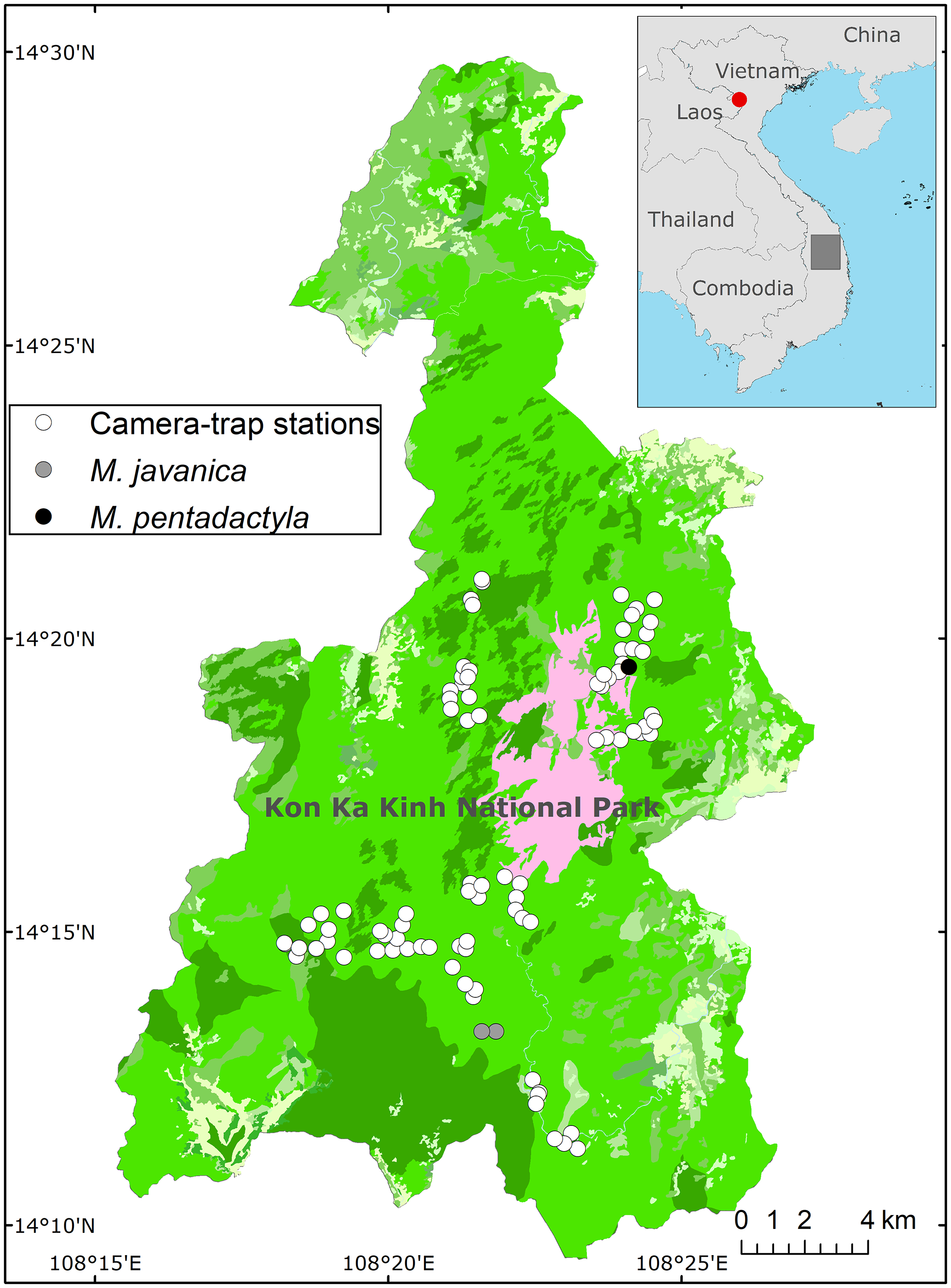
Here we present an opportunistically obtained camera-trap record of M. pentadactyla from Kon Ka Kinh National Park in Gia Lai province in the Central Highlands. The tropical forest of this Park is characterized by a mix of broadleaf and coniferous trees at an altitude of 400–1,700 m (Ha, Reference Ha2009). This record was obtained during a survey for rare animals in the Park during January–November 2022. The camera traps were set randomly, 500 m apart (Fig. 1), mounted on trees at 30–40 cm above the ground. We used 13 camera traps and rotated them to a total of 57 locations over six field trips. We set the cameras to capture three photographs per trigger, with a 3 s interval between consecutive photographs. This resulted in a total of 1,305 camera-trap nights (each camera trap was deployed for c. 23 days).
Camera-trap locations and records of the Chinese pangolin Manis pentadactyla and Sunda pangolin Manis javanica in 2022 in Kon Ka Kinh National Park, Vietnam. The filled circle on the inset map indicates the only other camera-trap records of M. pentadactyla in Vietnam, c. 950 km north, obtained in 2022 in Thanh Hoa province, bordering Lao PDR (see text for details). The shading on the main map depicts the various forest types and landforms.

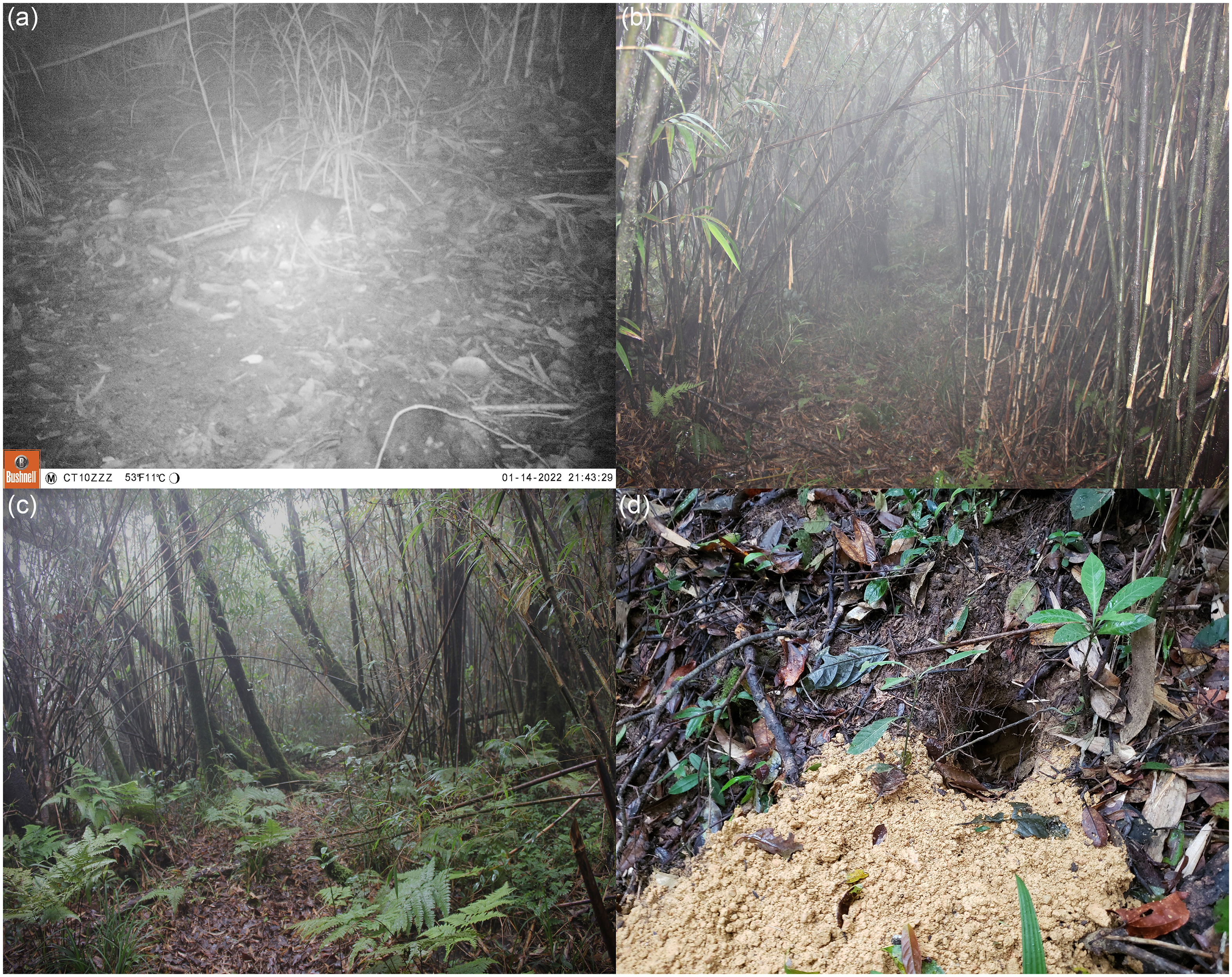
The survey yielded 3,430 photographs, from which we identified 39 species. Three images of M. pentadactyla were recorded by one camera trap at 1,600 m (Plate 1a) in forest compartment 86 on 14 January 2022. The three photographs were taken within 3 seconds, and we presume they were of a single individual. Based on the morphological characteristics, such as the short tail with c. 15 rows of scales (the Chinese pangolin has < 20 rows of scales on the tail, whereas the Sunda pangolin typically has 20–29 rows), the visible skin on the face and large ears (Cota, Reference Cota2017), we conclude this individual was a Chinese pangolin. Three experts (Nguyen Van Thai and Tran Van Truong, director and head keeper, respectively, at Save Vietnam’s Wildlife, and Ching Min Sun, Pingtung University of Science and Technology, Taiwan) confirmed the photographs were of M. pentadactyla. Manis javanica was not detected in this survey.
(a) The Chinese pangolin Manis pentadactyla recorded in Kon Ka Kinh National Park, Vietnam, in 2022. (b,c) Typical habitat at the camera-trap location. (d) A burrow of the Chinese pangolin in the same locality.

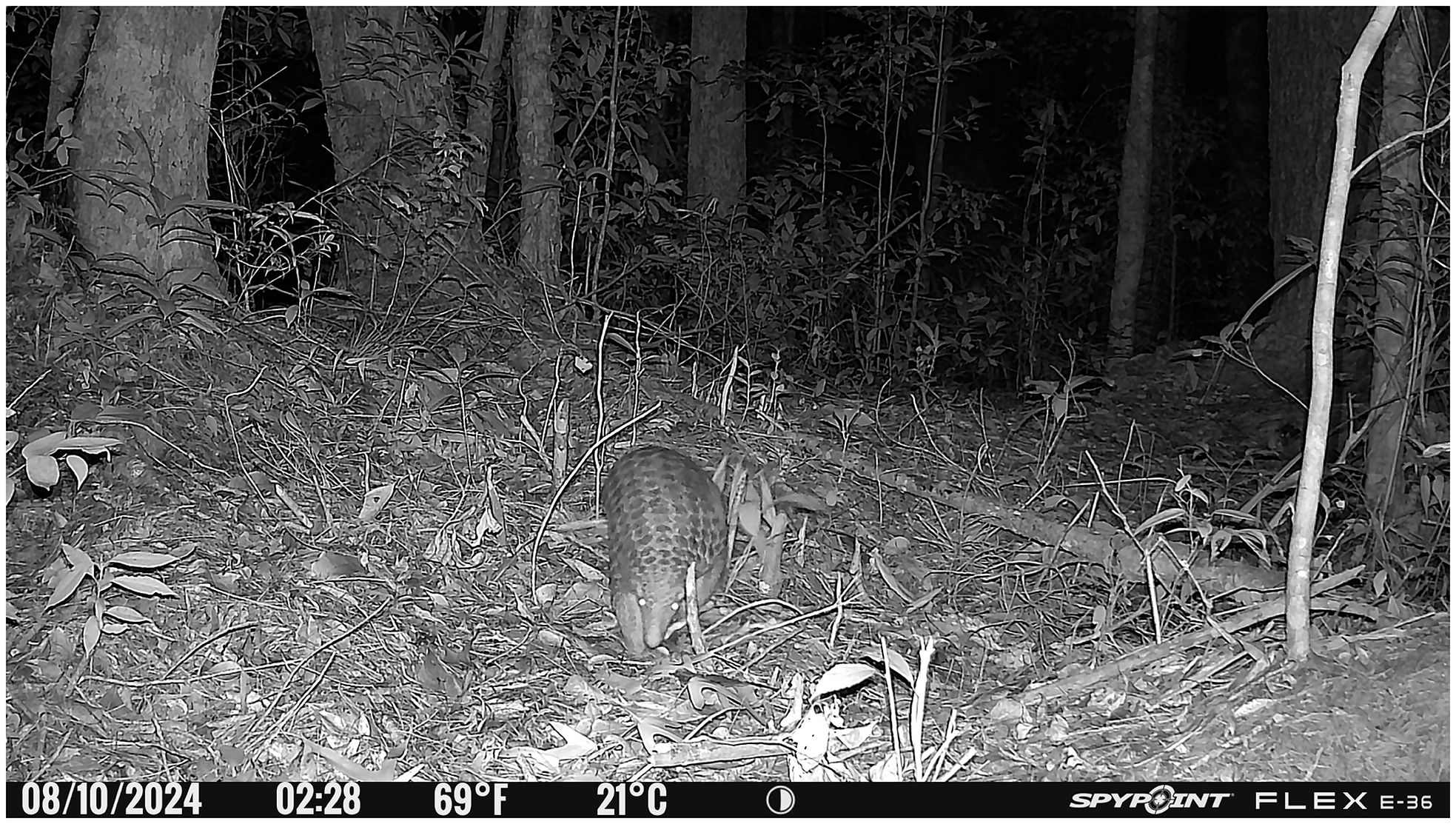
In a second camera-trap survey during April–November 2024, we recorded a total of six photographs of M. javanica (Plate 2) at two camera-trap stations 500 m apart (Fig. 1) but none of M. pentadactyla. This record of M. javanica is c. 11.7 km from the record of M. pentadactyla obtained in 2022 (Fig. 1).
The Sunda pangolin Manis javanica recorded in Kon Ka Kinh National Park in 2024.

The camera-trap locations were characterized by slopes > 25o with a thick carpet of leaves. We observed an absence of tree regeneration. The local microhabitat is influenced by cold night temperatures and daytime fog, leading to high humidity and promoting dense vegetation growth under the canopy. The microhabitat where M. pentadactyla was recorded in January, during the dry season, experiences a mean minimum temperature of c. 10°C and a mean relative humidity of > 85%. The dense vegetation includes orchids and mosses. The site where M. pentadactyla was observed had a thick layer of leaf litter on the forest floor, much of which had not decomposed despite the moist environment. The habitat primarily consists of small trees with diameters of 6–12 cm, interspersed with bamboo (Plate 1b,c). During installation of the camera traps, local people accompanying us pointed out several burrows that they claimed to be of pangolins, as they had previously caught pangolins from similar burrows (Plate 1d).
An earlier summary of records of M. pentadactyla in Vietnam (Newton et al., Reference Newton, Nguyen, Roberton and Bell2008) was based on sightings, tracks and burrows, and the reliability of these records is unclear. For example, a record of M. pentadactyla in Ba Na-Nui Chua Nature Reserve, Da Nang City, based on a sighting reported by Frontier Vietnam (Reference Vietnam1994), is questionable as it may have been misidentified by non-experts. The only other camera-trap records of M. pentadactyla in Vietnam, with four records in 2022, are from 1,000–1,200 m altitude in western Thanh Hoa province, bordering Houaphan Province in Lao PDR, which were obtained by Save Vietnam’s Wildlife, an NGO focused on pangolins (Save Vietnam’s Wildlife, unpubl. data).
Our new record of M. pentadactyla is the southernmost, c. 950 km from those in Thanh Hoa province (Fig. 1). The northernmost locality of M. javanica is uncertain, as a recent record of the species in Xuan Lien Nature Reserve, Thanh Hoa Province is questionable and may have resulted from a release by the reserve (Nguyen et al., Reference Nguyen, Luu, Pham, Nguyen, Pham and Nguyen2024). However, the presence of M. javanica has been confirmed in Pu Mat National Park, Nghe An Province (Gray et al., Reference Gray, Crudge, Nguyen, Frank, Hunt, Guntoro and Daltry2023). Therefore, the area of overlap of the two species may extend from Nghe An Province to Gia Lai Province (Gray et al., Reference Gray, Crudge, Nguyen, Frank, Hunt, Guntoro and Daltry2023).
Manis pentadactyla is a habitat generalist, occurring in mixed coniferous forest, shrub forest, evergreen broadleaf forest, coniferous forest, primary and secondary tropical forest, bamboo, hill forest, grasslands and agricultural fields (Trageser et al., Reference Trageser, Ghose, Faisal, Mro, Mro and Rahman2017; Dorji et al., Reference Dorji, Chong and Dorji2020; Wu et al., Reference Wu, Liu, Ma, Tang, Chen, Xu, Challender, Nash and Waterman2020). It has been recorded at altitudes ranging from < 100 m in Taiwan to 3,000 m in Nepal (Dorji et al., Reference Dorji, Chong and Dorji2020; Wu et al., Reference Wu, Liu, Ma, Tang, Chen, Xu, Challender, Nash and Waterman2020). Our record was at a higher altitude than the records in Thanh Hoa province, but it falls within the altitude range for records in Nepal and Bhutan (Wu et al., Reference Wu, Liu, Ma, Tang, Chen, Xu, Challender, Nash and Waterman2020; Acharya et al., Reference Acharya, Sharma, Bhattarai, Poudyal, Sharma and Upadhaya2021). This new record of the species potentially indicates a larger range for the Chinese pangolin, extending into central Vietnam. Despite being strictly protected by national law in Vietnam, more conservation attention and research needs to be focused on Kon Ka Kinh National Park to monitor and protect this Critically Endangered species.
Author contributions
Study design, fieldwork: NVT, NAT, NTKY, HTL; data analysis, writing: NVT, PVT.
Acknowledgements
We thank the Kon Ka Kinh National Park Management Board for their support; the ASEAN Centre for Biodiversity–Small Grants Programme for funding; and the forest guards and staff from Forest Stations and the Rescue and Development Center of Kon Ka Kinh National Park, who joined the field team.
Conflicts of interest
None.
Ethical standards
This research abided by the Oryx guidelines on ethical standards. Our camera traps in Kon Ka Kinh National Park were deployed under permit number 664/QĐ UBND. All incidental photographs of people are stored securely, with limited access, and no images will be shared publicly.
Data availability
All data supporting the findings are available within the paper.

 Open access

