





Introduction
Trypanosomatids (Euglenozoa: Kinetoplastea: Trypanosomatidae) are eukaryotic flagellated protozoans present in numerous vertebrate and invertebrate hosts (Lukeš et al., Reference Lukeš, Skalický, Týč, Votýpka and Yurchenko2014; Frolov et al., Reference Frolov, Kostygov and Yurchenko2021). To date, the family Trypanosomatidae is divided into 7 subfamilies, in a total of 19 genera where 17 are considered monoxenous (one host; external transmission) and 4 dixenous (two hosts; direct transmission) (Kostygov et al., Reference Kostygov, Albanaz, Butenko, Gerasimov, Lukeš and Yurchenko2024). While human infective trypanosomatids causing devastating diseases such as Leishmaniosis, Chagas disease or Sleeping Sickness have been the focus of an extensive research, still little is known about other livestock infections, especially infections of the Western honeybee, Apis mellifera (Hymenoptera: Apidae), a keystone species with an outstanding ecological and economic value.
Bees are one of the major pollinators involved in the maintenance of all terrestrial ecosystems. Wild and managed honeybees ensure and enhance the reproduction of a large fraction of the world’s wild flora and ∼85% of the agricultural crops (Zattara and Aizen, Reference Zattara and Aizen2021). The economic value of honeybee services is estimated to be from $180 billion to $351 billion USD/year globally (Zattara and Aizen, Reference Zattara and Aizen2021). Honeybees are eusocial, multivoltine and polylectic insects organized in multiple castes (drones, queens, and workers) within a colony (Bauer and Wing, Reference Bauer and Wing2010; Khalifa et al., Reference Khalifa, Elshafiey, Shetaia, El-Wahed, Algethami, Musharraf, AlAjmi, Zhao, Masry, Abdel-Daim, Halabi, Kai, Al Naggar, Bishr, Diab and El-Seedi2021). Honeybees are essential for ecosystem functioning and apiculture and are useful biological models for studying microbiota and gut pathogens such as trypanosomatid parasites (Wang et al., Reference Wang, Zhang, Zhang, Lang and Zheng2018). Despite the scarcity of research on trypanosomatids of honeybee for most of the 20th century (Figure 1 and Box 1), advances in trypanosomatid molecular detection (Arismendi et al., Reference Arismendi, Bruna, Zapata and Vargas2016a; Xu et al., Reference Xu, Palmer-Young, Skyrm, Daly, Sylvia, Averill and Rich2018a; Buendía-Abad et al., Reference Buendía-Abad, Higes, Martín-Hernández, Barrios, Meana, Fernández Fernández, Osuna and De Pablos2021; Barranco-Gómez et al., Reference Barranco-Gómez, De Paula, Parada, Gómez-Moracho, Marfil, Zafra, Orantes Bermejo, Osuna and De Pablos2023), genetics and cell culture (Buendía-Abad et al., Reference Buendía-Abad, Higes, Martín-Hernández, Barrios, Meana, Fernández Fernández, Osuna and De Pablos2021; Palmer-Young et al., Reference Palmer-Young, Raffel and Evans2021; Carreira De Paula et al., Reference Carreira De Paula, García Olmedo, Gómez-Moracho, Buendía-Abad, Higes, Martín-Hernández, Osuna and De Pablos2024; Markowitz et al., Reference Markowitz, Nearman, Zhao, Boncristiani, Butenko, De Pablos, Marin, Xu, Machado, Schwarz, Palmer-Young and Evans2024), together with an increased evidence for an association with honeybee colony mortality (Ravoet et al., Reference Ravoet, Maharramov, Meeus, De Smet, Wenseleers, Smagghe and de Graaf2013a), have greatly increased the scientific community’s attention to these parasites and its implications in honeybee health. In this review, we will explore the current knowledge and existing gaps on trypanosomatid infections of honeybees using bumblebees as models for comparisons, particularly the ecology, epidemiology, cell biology and environmental conditions responsible for their dispersion, transmission and proliferation in honeybees.
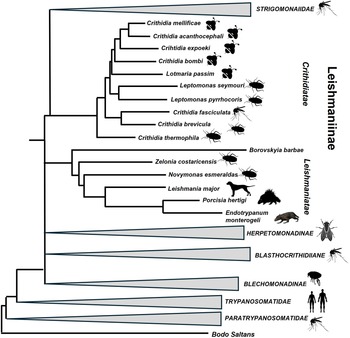
Phylogenomic tree of Leishmaniinae adapted from a previously published study, with the permission of the authors (Kostygov et al., Reference Kostygov, Albanaz, Butenko, Gerasimov, Lukeš and Yurchenko2024).

Figure 1 Long description
The diagram is a phylogenomic tree illustrating the evolutionary relationships among various species within the Leishmaniinae subfamily. The tree is oriented vertically, with branches extending from left to right. At the top, the Crithidiidae family is represented, including species such as Crithidia mellificae, Crithidia acanthocephali, Crithidia expoeki, Crithidia bombi and Lotmaria passim. Each species is depicted with an insect icon next to its name. Moving down the tree, Leptomonas seymouri and Leptomonas pyrrhocoris are shown, followed by Crithidia fasciculata, Crithidia brevicula and Crithidia thermophila. The Leishmaniinae subfamily is labeled on the right side, with Borovskyia barvae leading to Zelonia costaricensis, Novymonas esmeraldas and Leishmania major. Each of these species is represented with an insect or animal icon. Further down, Porcisia heritgli is depicted with a mammal icon and Endotrypanum monterogeii is shown with a primate icon. The tree visually represents the branching and divergence of species within the Leishmaniinae subfamily, highlighting their evolutionary connections.
Trypanosomatid species and prevalence
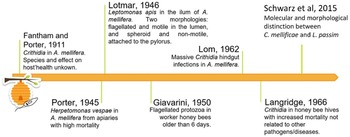
Trypanosomatid of bees are classified within the subfamily Leishmaniinae in a taxonomic group termed as Crithidiatae of highly sequence-related species of the genus Crithidia, Lotmaria and Leptomonas (Maslov et al., Reference Maslov, Votýpka, Yurchenko and Lukeš2013; Kostygov and Yurchenko, Reference Kostygov and Yurchenko2017; Kostygov et al., Reference Kostygov, Albanaz, Butenko, Gerasimov, Lukeš and Yurchenko2024) (Figure 1). Early trypanosomatid detections in honey bees were first reported by Fantham and Porter in 1912 (Fantham and Porter, Reference Fantham and Porter1912; Figure 2). Afterwards, first experimental infections performed by Langridge and McGhee (Reference Langridge and McGHEE1967) with the trypanosomatid species Crithidia mellificae reported no effects on mortality, even in cases when nearly all inoculated honeybees became infected (Table 1; Langridge and McGhee, Reference Langridge and McGHEE1967). This lack of evidence for harmful effects in honeybees made trypanosomatids largely overlooked for decades. In contrast, the trypanosomatid species Crithidia bombi, described in the bumblebees Bombus terrestris in 1988 (Lipa and Trigiani, Reference Lipa and Trigiani1988), received much more attention and served as a model of trypanosomatids in bumblebees ever since.
Historical milestones of the 20th century in studying trypanosomatid infections in Apis mellifera.

Figure 2 Long description
A timeline illustrating key research milestones in the study of trypanosomatid infections in honey bees from 1911 to 2015. Starting from the left, in 1911, Fantham and Porter reported on Crithidia in A. mellifera, with species and health effects unknown. In 1945, Porter noted Herpetomonas vespae in A. mellifera from apiaries with high mortality. In 1946, Lotmar described Leptomonas apis in the ileum of A. mellifera, identifying two morphotypes: flagellated and motile in the lumen and spherical and non-motile, attached to the pylorus. In 1950, Giavarini found flagellated protozoa in worker honey bees older than 8 days. In 1962, Lom reported massive Crithidia hindgut infections in A. mellifera. In 1966, Langridge noted Crithidia in honey bee hives with increased mortality not related to other pathogens or diseases. Finally, in 2015, Schwarz et al. distinguished molecular and morphological differences between C. mellificae and L. passim.
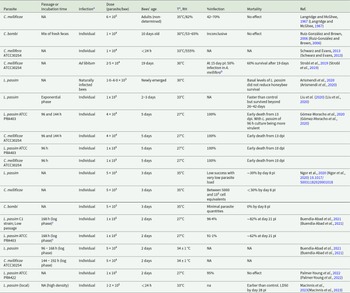
Experimental infections with trypanosomatids in the honey bee Apis mellifera. Only single infections, with no treatments, were included in the table

Table 1 Long description
The table compiles experimental single-parasite infections of adult honey bees, listing parasite identity and strain, culture passage or incubation time, infection method, dose per bee, bee age, temperature and humidity, infection success, and mortality outcomes with citations. Infection success varies widely: Crithidia mellificae in an older study produced moderate infection rates and no mortality effect, while several later individual-dose trials report complete infection for Labile passim and Crithidia mellificae ATCC strains under cooler rearing conditions. Mortality outcomes also differ by parasite and protocol: some studies report no survival impact, others report earlier death beginning around ten to thirteen days after infection, and one ad libitum exposure reports partial survival by about three weeks. Labile passim results span from “basal levels did not reduce survival” in naturally infected bees to faster mortality than controls in high-dose individual infections, including a study reporting a median lethal time around four weeks. Crithidia bombi shows inconsistent or minimal establishment in honey bees, including inconclusive infection in one study and no detectable infection by about one week in another. Across studies, differences in strain, culture age, dose, bee age at exposure, and environmental conditions likely contribute to the mixed infection and mortality patterns, so direct cross-study comparisons should be made cautiously.
a Infection: individual vs ad libitum.
b Only data about A. mellifera is included.
c Date on parasite cell density in the culture used in the infection.
In the early 2000s, several metagenomic analysis and microarrays of honeybees consistently detected the presence of trypanosomatids (Cox-Foster et al., Reference Cox-Foster, Conlan, Holmes, Palacios, Evans, Moran, Quan, Briese, Hornig, Geiser, Martinson, vanEngelsdorp, Kalkstein, Drysdale, Hui, Zhai, Cui, Hutchison, Simons, Egholm, Pettis and Lipkin2007; Texeira et al., Reference Texeira, Message, Cheng, Pettis and Evans2008; Runckel et al., Reference Runckel, Flenniken, Engel, Ruby, Ganem, Andino and DeRisi2011), coinciding with increased with a rise in global honeybee mortality (Ravoet et al., Reference Ravoet, Maharramov, Meeus, De Smet, Wenseleers, Smagghe and de Graaf2013a; Goulson et al., Reference Goulson, Nicholls, Botias and Rotheray2015). Afterwards, trypanosomatids began to attract attention in honey bee research. Research using specific molecular targets, based on single copy loci genes, led to the description of a second trypanosomatid species in honeybees named as Lotmaria passim (in honour of pioneer researcher Ruth Lotmar who described the presence of this parasites in the middle of the 20th century) (Schwarz et al., Reference Schwarz, Bauchan, Murphy, Ravoet, de Graaf and Evans2015). This finding highlighted the need for species-specific detection techniques to accurately determine which species infect which hosts, and their prevalence in different bee hosts.
As mentioned before, up to four trypanosomatid species of honeybees have been identified: C. mellificae, C. acanthocephali, C. bombi and L. passim (Schwarz et al., Reference Schwarz, Bauchan, Murphy, Ravoet, de Graaf and Evans2015; Bartolomé et al., Reference Bartolomé, Buendía-Abad, Ornosa, De la Rúa, Martín-Hernández, Higes and Maside2022; Buendía-Abad et al., Reference Buendía-Abad, García-Palencia, de Pablos, Martín-Hernández and Higes2022b). C. bombi, initially thought to be host-specific of bumblebees, thus evidencing cross-infection events, having been reported in A. mellifera (Bartolomé et al., Reference Bartolomé, Buendía, Benito, De la Rúa, Ornosa, Martín-Hernández, Higes and Maside2018), where may persists at moderate levels (Ngor et al., Reference Ngor, Palmer-Young, Burciaga Nevarez, Russell, Leger, Giacomini, Pinilla-Gallego, Irwin and McFrederick2020)], but without reducing honeybee’s longevity (Ruiz-González and Brown, Reference Ruiz-González and Brown2006). Similarly, L. passim has been detected in bumblebees (Michalczyk and Sokół, Reference Michalczyk and Sokół2022) and solitary bees (Strobl et al., Reference Strobl, Yañez, Straub, Albrecht and Neumann2019). In addition, these parasites can occur as both single or mixed infections, suggesting the potential for interactions within different bee hosts (Schwarz et al., Reference Schwarz, Bauchan, Murphy, Ravoet, de Graaf and Evans2015; Bartolomé et al., Reference Bartolomé, Buendía, Benito, De la Rúa, Ornosa, Martín-Hernández, Higes and Maside2018).
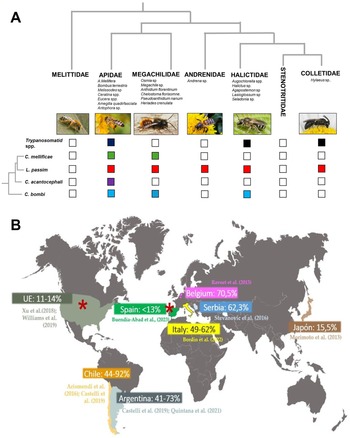
Within the diversity of bees in nature (more than 20 000 species described thus far), trypanosomatids have been found thriving in 6 out of 7 families on practically all continents (Figure 3A and Supplementary Table 1; Bartolomé et al., Reference Bartolomé, Buendía, Benito, De la Rúa, Ornosa, Martín-Hernández, Higes and Maside2018, Reference Bartolomé, Buendía-Abad, Ornosa, De la Rúa, Martín-Hernández, Higes and Maside2022; Strobl et al., Reference Strobl, Yañez, Straub, Albrecht and Neumann2019; Figueroa et al., Reference Figueroa, Compton, Grab and McArt2021; Tuerlings et al., Reference Tuerlings, Hettiarachchi, Joossens, Geslin, Vereecken, Michez, Smagghe and Vandamme2023; Tiritelli et al., Reference Tiritelli, Cilia and Gómez-Moracho2025). This widespread radiation would suggest that sociality is neither necessary nor the only factor for transmission, while not discounting that frequent contact among individuals could increase the chances for transmission and infection. Moreover, the presence of more than one circulating trypanosomatid species and even mixed co-infections with trypanosomatid species in different wild bees (Supplementary Table 1) indicates the possibility of bidirectional transmission between managed and wild bees. For more details, potential intra- and interspecies transmission mechanisms have been previously reviewed (Tiritelli et al., Reference Tiritelli, Cilia and Gómez-Moracho2025). This wide competence for hosting trypanosomatid parasites across wild and managed bees is an indicator of the successful adaptation of these parasites to these hymenopteran insects and thus for transmission. However, more data would be needed from underrepresented groups, especially from the family Stenotritidae with fewer wild bee species described.
Diversity and prevalence of trypanosomatid species in bees. (A). Bee species with detected presence of trypanosomatid parasites. The bee species were included as sp., if more than one species of the same genus was described. If the bee description was only provided at genus level, spp. was as added. Bee phylogeny tree was adapted from the figure included in Danforth et al., (Reference Danforth, Minckley and Neff2019). Trypanosomatid phylogeny tree was adapted from figure included in (Bartolomé et al., Reference Bartolomé, Buendía-Abad, Benito, Sobrino, Amigo, Carracedo, Martín-Hernández, Higes and Maside2020) (Bartolomé et al., Reference Bartolomé, Buendía-Abad, Benito, Sobrino, Amigo, Carracedo, Martín-Hernández, Higes and Maside2020). For more information about the species hosting trypanosomatid parasites please check supplementary Table 1. Note that the diversity of trypanosomatid species is underestimated given that the bulk of the research have been conducted in A. Mellifera and Bombus spp. Pictures of bees were picked from free repositories: USGS Bee Inventory and Monitoring Lab (https://www.Usgs.Gov/centers/eesc/science/native-bee-inventory-and-monitoring-lab) and VistaCreate (https://create.vista.com/es/). More details are provided in Supplementary data 1. (B) Prevalence of reported L. passim in honeybee colonies since 2015. Asterisks marks the detection of Crithidia mellificae.

Figure 3 Long description
The infographic consists of two parts. Part A displays a phylogenetic tree of bee families: Melittidae, Apidae, Megachilidae, Andrenidae, Halictidae, Stenotritidae and Colletidae. Each family is associated with images of bees and lists of genera, such as Apis, Bombus and others. Below each image, there are boxes indicating the presence of trypanosomatid species: Trypanosomatid spp., C. mellificae, L. passim, C. acanthocephali and C. bombi. The presence is marked by filled boxes. Part B shows a world map highlighting the prevalence of trypanosomatid infections in honeybee colonies across different countries. The map includes prevalence percentages and references for each country: USA (11-14 percent), Spain (<13 percent), Chile (44-92 percent), Argentina (41-73 percent), Italy (49-62 percent), Belgium (70.5 percent), Serbia (62.3 percent) and Japan (15.5 percent). Each country is marked with asterisks and associated with specific studies or authors.
In honeybees, L. passim has been confirmed as the most prevalent trypanosomatid species worldwide, being frequently identified with variable yields in various regions and years, ranging from 13% and up to 85% (Stevanovic et al., Reference Stevanovic, Schwarz, Vejnovic, Evans, Irwin, Glavinic and Stanimirovic2016; Arismendi et al., Reference Arismendi, Bruna, Zapata and Vargas2016b; Xu et al., Reference Xu, Palmer-Young, Skyrm, Daly, Sylvia, Averill and Rich2018b; Castelli et al., Reference Castelli, Branchiccela, Invernizzi, Tomasco, Basualdo, Rodriguez, Zunino and Antúnez2019; Williams et al., Reference Williams, Tripodi and Szalanski2019; Quintana et al., Reference Quintana, Plischuk, Brasesco, Revainera, Genchi García, Bravi, Reynaldi, Eguaras and Maggi2021; Bordin et al., Reference Bordin, Zulian, Granato, Caldon, Colamonico, Toson, Trevisan, Biasion and Mutinelli2022; Buendía-Abad et al., Reference Buendía-Abad, Martín-Hernández and Higes2023; Yamamoto et al., Reference Yamamoto, Nakamura, Nakayama, Kusakisako, Watanabe, Ikadai and Tanabe2023; Tiritelli et al., Reference Tiritelli, Cilia and Gómez-Moracho2025; Figure 3B). In contrast, the reported prevalence of C. mellificae differs significantly between studies, with reports ranging from complete absence (Tiritelli et al., Reference Tiritelli, Flaminio, Zavatta, Ranalli, Giovanetti, Grasso, Leonardi, Bonforte, Boni, Cargnus, Catania, Coppola, Di Santo, Pusceddu, Quaranta, Bortolotti, Nanetti and Cilia2024), to low detection rates such as 0.2% (Xu et al., Reference Xu, Palmer-Young, Skyrm, Daly, Sylvia, Averill and Rich2018b) and 1% (Bordin et al., Reference Bordin, Zulian, Granato, Caldon, Colamonico, Toson, Trevisan, Biasion and Mutinelli2022), increasing up to 34% (Mráz et al., Reference Mráz, Hýbl, Kopecký, Bohatá, Hoštičková, Šipoš, Vočadlová and Čurn2021), and even as high as 61% (Bartolomé et al., Reference Bartolomé, Buendía-Abad, Benito, Sobrino, Amigo, Carracedo, Martín-Hernández, Higes and Maside2020). Despite there is no clear explanation yet, these contrasted patterns could be due to differences in the parasite’s abilities or strategies to thrive within the honeybee gut and/or from variations in the development of infective or resistant forms that affect their survival outside their hosts and, consequently their transmissibility among bees.
The development of diagnostic tools including species-specific primers for qPCR based on the cytochrome b gene of L. passim and C. mellificae (Xu et al., Reference Xu, Palmer-Young, Skyrm, Daly, Sylvia, Averill and Rich2018b) or based on the RNA polymerase II large subunit, the glyceraldehyde-3-phosphate dehydrogenase and the DNA topoisomerase II of L. passim, C. mellificae and C. bombi, respectively (Bartolomé et al., Reference Bartolomé, Buendía, Benito, De la Rúa, Ornosa, Martín-Hernández, Higes and Maside2018), capable of estimating parasitic load in bees, has been essential for analysing fluctuating infection levels, both in experimental infections and in the field. Thus, higher L. passim loads have been found in honeybee colonies during spring in north hemisphere areas such as Spain, Serbia or Italy (Vejnovic et al., Reference Vejnovic, Stevanovic, Schwarz, Aleksic, Mirilovic, Jovanovic and Stanimirovic2018; Buendía-Abad et al., Reference Buendía-Abad, Martín-Hernández and Higes2023; Tiritelli et al., Reference Tiritelli, Flaminio, Zavatta, Ranalli, Giovanetti, Grasso, Leonardi, Bonforte, Boni, Cargnus, Catania, Coppola, Di Santo, Pusceddu, Quaranta, Bortolotti, Nanetti and Cilia2024), while in New Zealand or Chile L. passim peaks during autumn and winter months (Vargas et al., Reference Vargas, Arismendi, Riveros, Zapata, Bruna, Vidal, Rodríguez and Gerding2017; Hall et al., Reference Hall, Pragert, Phiri, Fan, Li, Parnell, Stanislawek, McDonald, Ha, McDonald and Taylor2021). However, other works reported a peak in trypanosomatid prevalence in autumn in Italy (Tafi et al., Reference Tafi, Capano, Nanetti and Cilia2025), indicating that temporal variations throughout the year are not necessarily linked to the geographical location. Besides, variations in trypanosomatid’s prevalence have been also attributed to either climate conditions or agricultural management (Tiritelli et al., Reference Tiritelli, Flaminio, Zavatta, Ranalli, Giovanetti, Grasso, Leonardi, Bonforte, Boni, Cargnus, Catania, Coppola, Di Santo, Pusceddu, Quaranta, Bortolotti, Nanetti and Cilia2024).
Several reports indicate that worker honeybees could be infected with highly variable parasite loads. For instance, studies of colonies in Serbia reported parasite loads ranging from 2.7 × 10⁴ to 4 × 10⁵ parasites per bee (Vejnovic et al., Reference Vejnovic, Stevanovic, Schwarz, Aleksic, Mirilovic, Jovanovic and Stanimirovic2018), 10 to 7.2 × 10⁵ parasites per bee in Switzerland (Tritschler et al., Reference Tritschler, Retschnig, Yañez, Williams and Neumann2017) and 10 to up to 7 × 10⁷ parasites per bee in Spain (Barranco-Gómez et al., Reference Barranco-Gómez, De Paula, Parada, Gómez-Moracho, Marfil, Zafra, Orantes Bermejo, Osuna and De Pablos2023). Although this disparity of parasite loads of a particular honeybee could be simply due to the differences in the infection timings after initial contact, it could also be due to different factors such as pesticides, nutritional deprivation, co-infections or different genetic background, which could results in superspreader hosts that facilitate transmission within and between colonies.
To avoid sacrificing bees and to facilitate the epidemiological follow-up of trypanosomatids, the use of honey has been implemented as an alternative non-invasive method to determine the presence of pathogens of honeybees. For instance, two nation-wide surveys performed in 102 honey samples from different European countries (Ribani et al., Reference Ribani, Utzeri, Taurisano and Fontanesi2020) and 164 from the north of Italy (Ribani et al., Reference Ribani, Utzeri, Taurisano, Galuppi and Fontanesi2021) revealed the presence of L. passim environmental DNA (eDNA) in a range between 50% and 78% of the samples tested. Given the urgent need of non-destructive and non-invasive methods, eDNA is an alternative approach for either detection or to evaluate the risks for parasite transmission within honeybee colonies.
Trypanosomatid effects on honeybee health
As mentioned above, monoxenous trypanosomatid parasites are highly distributed across the class Insecta. Although the ‘true’ parasitic nature of every trypanosomatid in nature is still under study, numerous phenotypic effects leading in some cases to the loss of fitness and even the death of the host have been already described. For instance, Herpetomonas muscarum increases mortality of larvae and reduces adult mosquitoes lifespan (Bailey and Brooks, Reference Bailey and Brooks1972), Leishmania mexicana influences feeding patterns of sandflies (Rogers et al., Reference Rogers, Chance and Bates2002), Jaenimonas drosophilae decreases fly fecundity (Hamilton et al., Reference Hamilton, Votýpka, Dostálová, Yurchenko, Bird, Lukeš, Lemaitre and Perlman2015) or Leptomonas wallacei induces mortality and morphological alterations in firebugs (Vasconcellos et al., Reference Vasconcellos, Carvalho, Silveira, Gonçalves, Coelho, Talyuli, Alves E Silva, Bastos, Sorgine, Reis, Dias, Struchiner, Gazos-Lopes and Lopes2019).
The impact of trypanosomatids on bee health has primarily focused on the host-parasite model involving bumblebees and C. bombi. This flagellate could reduce bumblebees’ lifespan (Brown et al., Reference Brown, Loosli and Schmid-Hempel2000) as well as activates bumblebees’ immune system (Brown et al., Reference Brown, Moret and Schmid-Hempel2003a), impairs colony foundation by queens (Brown et al., Reference Brown, Schmid-Hempel and Schmid-Hempel2003b), reduces cognitive abilities, such as visual learning (Gegear et al., Reference Gegear, Otterstatter and Thomson2006), or decreases foraging rates (Otterstatter et al., Reference Otterstatter, Gegear, Colla and Thomson2005). Nevertheless, these effects are poorly characterized in honeybees. Thus far, experimental infections of honeybees with controlled doses of choanomastigotes or promastigotes of either C. mellificae or L. passim have provided valuable insights into the ultrastructural and morphological differences between these species, the stages they undergo during their life cycles, and their distribution within the honeybee gut (Schwarz et al., Reference Schwarz, Bauchan, Murphy, Ravoet, de Graaf and Evans2015; Buendía-Abad et al., Reference Buendía-Abad, García-Palencia, De Pablos, Alunda, Osuna, Martín-Hernández and Higes2022a). However, there is no evidence to date that these parasites may cause any histological damage in the honeybees gut (Langridge and McGhee, Reference Langridge and McGHEE1967; Buendía-Abad et al., Reference Buendía-Abad, García-Palencia, De Pablos, Alunda, Osuna, Martín-Hernández and Higes2022a).
The implications of C. mellificae and L. passim on honeybee longevity remain inconclusive (Table 1). Some artificial infections indicate that these trypanosomatids reduce the survival of infected bees, leading to increased mortality from day 10 post-infection onwards (Gómez-Moracho et al., Reference Gómez-Moracho, Buendía-Abad, Benito, García-Palencia, Barrios, Bartolomé, Maside, Meana, Jiménez-Antón, Olías-Molero, Alunda, Martín-Hernández and Higes2020; Buendía-Abad et al., Reference Buendía-Abad, Higes, Martín-Hernández, Barrios, Meana, Fernández Fernández, Osuna and De Pablos2021, Reference Buendía-Abad, García-Palencia, De Pablos, Alunda, Osuna, Martín-Hernández and Higes2022a). In contrast, other reports highlighted higher survival rates, such as 60% survival after 19 days (Strobl et al., Reference Strobl, Yañez, Straub, Albrecht and Neumann2019) or survival extending beyond 26–46 days (Liu et al., Reference Liu, Lei, Darby and Kadowaki2020). Such disparity in the results could be related to several factors. For instance, high number of cell culture passages may reduce parasite virulence, which has been demonstrated between low passage C1 strain and high passage L. passim PRA-403 strain (Buendía-Abad et al., Reference Buendía-Abad, Higes, Martín-Hernández, Barrios, Meana, Fernández Fernández, Osuna and De Pablos2021). In vitro growth conditions, such as the incubation temperature, nutrition and a potential modification of pH (Palmer-Young et al., Reference Palmer-Young, Raffel and Evans2021), may cause differences in parasite growth dynamics within the host. During in vivo experiments, the age of the bees may be another key determinant, as older bees have a well-developed microbiota (Koch and Schmid-Hempel, Reference Koch and Schmid-Hempel2012) contrary to larvae or newly emerged bees (Martinson et al., Reference Martinson, Moy and Moran2012), which would display a protective role against the establishment of other microbes or parasites. This has been shown in bumblebees transplanted with conspecific microbiota, which exhibited lower infection intensity of C. bombi (Koch and Schmid-Hempel, Reference Koch and Schmid-Hempel2012).
In the field, naturally L. passim infected bees have been associated with only basal levels of mortality (Arismendi et al., Reference Arismendi, Caro, Castro, Vargas, Riveros and Venegas2020), although trypanosomatids have been also linked with honeybee winter mortality (Ravoet et al., Reference Ravoet, Maharramov, Meeus, De Smet, Wenseleers, Smagghe and de Graaf2013a). Co-infections of naturally L. passim infected colonies with spores of Nosema ceranae showed a slight increase in honeybee mortality but not a synergistic effect (Arismendi et al., Reference Arismendi, Caro, Castro, Vargas, Riveros and Venegas2020). This might be due to the different infection targets in the gut, where N. ceranae infecting proventricular midgut (Martín-Hernández et al., Reference Martín-Hernández, Bartolomé, Chejanovsky, Le Conte, Dalmon, Dussaubat, García-Palencia, Meana, Pinto, Soroker and Higes2018) and L. passim the pylorus and rectum at the hindgut (Buendía-Abad et al., Reference Buendía-Abad, García-Palencia, De Pablos, Alunda, Osuna, Martín-Hernández and Higes2022a).
Trypanosomatids have been shown to impact various physiological and behavioural traits that could potentially impair honeybee dynamics at both the individual and colony levels. For instance, when infected with L. passim, honeybees exhibit increased sucrose sensitivity and earlier onset foraging, which aligns with a reduced expression of vitellogenin (Vg), a hormone associated with honeybee aging (MacInnis et al., Reference MacInnis, Luong and Pernal2024). However, other cognitive traits (i.e. olfactive learning, visual learning or memory) have not yet been explored in honeybees, despite some precedents found in bumblebees, which have shown impaired visual learning and a reduced ability to handle flowers when infected with C. bombi (Gegear et al., Reference Gegear, Otterstatter and Thomson2006).
Parasite strain and host-parasite genotypic combination could also contribute to the differential expression of parasite-derived virulence factors in their secretions and immune-related genes in the host, potentially leading to different virulence (Barribeau et al., Reference Barribeau, Sadd, Du Plessis and Schmid-Hempel2014). A common effect of trypanosomatid infection in bees is the increased transcription of immune-related genes encoding antimicrobial peptides (Schlüns et al., Reference Schlüns, Sadd, Schmid-Hempel and Crozier2010; Schwarz and Evans, Reference Schwarz and Evans2013; Deshwal and Mallon, Reference Deshwal and Mallon2014; Marxer et al., Reference Marxer, Vollenweider and Schmid-Hempel2016; Liu et al., Reference Liu, Lei, Darby and Kadowaki2020). For example, Defensin 1 is upregulated in honeybees infected with either C. mellificae (Schwarz and Evans, Reference Schwarz and Evans2013; Liu et al., Reference Liu, Lei, Darby and Kadowaki2020) or L. passim (Liu et al., Reference Liu, Lei, Darby and Kadowaki2020). Additionally, C. mellificae has been shown to activate the Toll signalling pathway in honeybees (Schwarz and Evans, Reference Schwarz and Evans2013).
In some instances, the negative effects of trypanosomatids in honeybee health could be worsened by interactions with other stressors, such as other pathogens or pesticides. So far, it is unexplored how coinfections involving different trypanosomatid species may affect honeybee traits. However, co-infections with L. passim and the microsporidia N. ceranae has been shown to exacerbate the negative effect of these parasite by increasing honeybee mortality (Runckel et al., Reference Runckel, Flenniken, Engel, Ruby, Ganem, Andino and DeRisi2011; Ravoet et al., Reference Ravoet, Maharramov, Meeus, De Smet, Wenseleers, Smagghe and de Graaf2013b; Cepero et al., Reference Cepero, Ravoet, Gómez-Moracho, Bernal, Del Nozal, Bartolomé, Maside, Meana, González-Porto, de Graaf, Martín-Hernández and Higes2014; Castelli et al., Reference Castelli, Branchiccela, Invernizzi, Tomasco, Basualdo, Rodriguez, Zunino and Antúnez2019), increasing sucrose sensitivity and altering foraging behaviour (MacInnis et al., Reference MacInnis, Luong and Pernal2024). In addition, pesticides, which have been shown to produce dysbiosis and impair honeybee immune function (Motta et al., Reference Motta, Powell and Moran2022), increase pathogen susceptibility (O’Neal et al., Reference O’Neal, Anderson and Wu-Smart2018), potentially by facilitating easier gut colonization. For example, the neonicotinoid imidacloprid has been shown to increase parasite loads of L. passim in infected honeybees (Erban et al., Reference Erban, Parizkova, Sopko, Talacko, Markovic, Jarosova and Votypka2023).
Although the primary role as parasites has not been challenged, dual action as commensal and parasite depending on trypanosomatid threshold numbers could be hypothesized, since human gut parasites such as Blastocystis hominis or Dientamoeba fragilis or Tritrichomonas sp. (Dubik et al., Reference Dubik, Pilecki and Moeller2022; Sardinha-Silva et al., Reference Sardinha-Silva, Alves-Ferreira and Grigg2022) in mice could switch between symbiont relationships. An influence of health status (e.g. immunocompromised patients) or strain-dependent variation in virulence could trigger the emergence of clinical manifestations leading to an increase in parasite numbers (Dubik et al., Reference Dubik, Pilecki and Moeller2022; Sardinha-Silva et al., Reference Sardinha-Silva, Alves-Ferreira and Grigg2022). However, colonization with Blastocystis sp. have been also reported as beneficial, leading to a more richness microbiota and/or faster recovery from intestinal inflammation (Dubik et al., Reference Dubik, Pilecki and Moeller2022). Similarly, the fate of the bee-trypanosomatid tandem could be subjected to different bee health markers (e.g. nutrition, co-infections or pesticide exposure) that may dictate the symbiotic relation of trypanosomatid parasites with their bee hosts, developing into either superspreader and/or highly tolerant bees that maybe mixed in same colony. In this regard, infectious diseases can follow over-dispersed patterns, named as 20/80 rule of thumb, where 20% of primary cases can cause 80% of onward transmission (Woolhouse et al., Reference Woolhouse, Dye, Etard, Smith, Charlwood, Garnett, Hagan, Hii, Ndhlovu, Quinnell, Watts, Chandiwana and Anderson1997). Whether or not trypanosomatids are transmitted homogeneously or heterogeneously within a colony, the minimum infectious doses and the variables where trypanosomatids generates loss of fitness in honeybees are still a matter of future research.
Tissue and cell biology of trypanosomatid parasite infections in honeybees
The main target of trypanosomatids for thriving is the honeybee hindgut (Langridge and McGhee, Reference Langridge and McGHEE1967; Schwarz et al., Reference Schwarz, Bauchan, Murphy, Ravoet, de Graaf and Evans2015; Buendía-Abad et al., Reference Buendía-Abad, Higes, Martín-Hernández, Barrios, Meana, Fernández Fernández, Osuna and De Pablos2021; Carreira De Paula et al., Reference Carreira De Paula, García Olmedo, Gómez-Moracho, Buendía-Abad, Higes, Martín-Hernández, Osuna and De Pablos2024). This region is divided into the pylorus, ileum and rectum and plays a role in the homeostasis of the bee’s haemolymph, as it receives the primary urine produced in the Malpighian tubules and selectively reabsorbs water and ions (Phillips et al., Reference Phillips, Hanrahan, Chamberlin and Thomson1987). Although not completely characterized, it is reasonable to think that trypanosomatids find a productive milieu at this location due to the constant flow of carbon sources, water and/or monovalent ions.
The hindgut has an ectodermal origin (as the outer surface and the foregut) and is organized in an integument consisting of a layer of epidermal cells and a cuticle. The cuticle is composed of two main layers: a chitinous inner layer or the procuticle (divided into a lower endocuticle and an upper exocuticle) and an outer non-chitinous layer or the epicuticle composed of an inner and outer epicuticle and outer-surface wax layer. The latter is exposed to the environment by a highly hydrophobic thin (<1 µm) non-chitinous mixture of lipids including straight-chain, methyl-branched and unsaturated hydrocarbon components with 21–40+ carbons (Neville, Reference Neville1975; Howard and Blomquist, Reference Howard and Blomquist2005), which would contact the surface of parasite flagella and cell body (Figure 4).
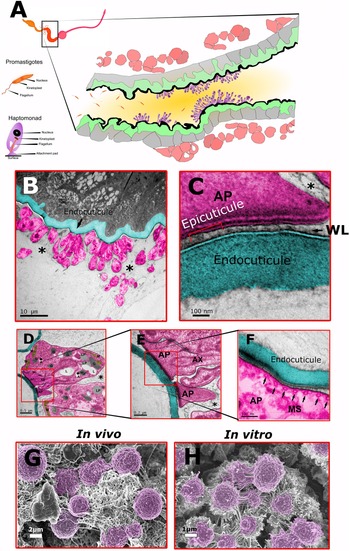
Trypanosomatid attachment and developmental differentiation into biofilms at the honeybee hindgut. (A) Cartoons indicating the main morphological characteristics of the unicellular promastigote forms and the surface-attached haptomonad forms. In the left a representation of the biofilm microcolonies adhered and attached to the cuticular surface of the honeybee hindgut. In (B), (C), (D) and (E), different magnifications of the attachment process by transmission electron microscopy. WL stands for wax layer and the asterisk EPS secretion. In (G) and (H), a scanning electron microscopy of the biofilm architecture in vivo and in vitro. EPS, extracellular polymeric substances.

Figure 4 Long description
A multi-panel scientific figure combining a colored schematic and electron micrographs to show trypanosomatid attachment and biofilm formation at the honeybee hindgut cuticle. Parasites attach via a structure called the attachment pad and form microcolonies on the cuticular surface, shown across schematic and microscopy panels. Image A is a colored schematic showing two cell forms. The promastigote form is labeled with nucleus, kinetoplast and flagellum. The haptomonad form is labeled with nucleus, kinetoplast, flagellum and attachment pad. To the left, a representation shows biofilm microcolonies adhered to the cuticular surface of the hindgut, with layered tissue structures visible beneath. Image B is a transmission electron microscopy image showing the endocuticle layer with attached microorganisms. Asterisks mark areas of extracellular polymeric substances secretion. Image C is a close-up transmission electron microscopy image showing the epicuticle and endocuticle layers. The label AP marks the attachment pad, WL marks the wax layer and an asterisk marks extracellular polymeric substances secretion. Image D is a transmission electron microscopy image showing a wider view of the attachment zone, with asterisks marking secretion areas. Image E is a close-up transmission electron microscopy image with labels for AP (attachment pad) and AX (axoneme). Image F is a transmission electron microscopy image showing the endocuticle with labels for AP (attachment pad) and MS, with dashed lines indicating structural boundaries. Image G is a scanning electron microscopy image labeled In vivo, showing the surface texture and arrangement of biofilm structures at a scale bar of 2 micrometers. Image H is a scanning electron microscopy image labeled In vitro, showing a comparable biofilm surface arrangement at a scale bar of 1 micrometer.
Early microscopic descriptions of trypanosomatid infections in the honeybee gut, extensively found the presence of rounded cells with reduced flagella (Langridge and McGhee, Reference Langridge and McGHEE1967) initially termed spheroids (Schwarz et al., Reference Schwarz, Bauchan, Murphy, Ravoet, de Graaf and Evans2015), attached to the outer surface of the hindgut. Further work, defined the capacity of these parasites to stably bind to the hindgut surface activating a developmental differentiation program from long-flagellated unicellular forms into surface-attached haptomonad biofilm microcolonies adhered to the wax layer of both the ileum and rectum of honeybees (Figure 4) (Buendía-Abad et al., Reference Buendía-Abad, Higes, Martín-Hernández, Barrios, Meana, Fernández Fernández, Osuna and De Pablos2021, Reference Buendía-Abad, García-Palencia, de Pablos, Martín-Hernández and Higes2022b; Carreira De Paula et al., Reference Carreira De Paula, García Olmedo, Gómez-Moracho, Buendía-Abad, Higes, Martín-Hernández, Osuna and De Pablos2024). Although the freely navigating unicellular stage differs between species (e.g. choanomastigote forms in the genus Crithidia and promastigotes in L. passim), the developmental differentiation into trypanosomatid biofilms is a common feature in all four species, indicating that this lifestyle is essential and necessary for trypanosomatid infections of honeybees (Lipa and Triggiani, Reference Lippa and Triggiani1988; Buendía-Abad et al., Reference Buendía-Abad, Higes, Martín-Hernández, Barrios, Meana, Fernández Fernández, Osuna and De Pablos2021, Reference Buendía-Abad, García-Palencia, de Pablos, Martín-Hernández and Higes2022b; Carreira De Paula et al., Reference Carreira De Paula, García Olmedo, Gómez-Moracho, Buendía-Abad, Higes, Martín-Hernández, Osuna and De Pablos2024). The hydrophobicity of the wax layer of the epicuticle would facilitate a highly stable attachment of the parasites, which activates an extensive remodelling of the parasite flagellum, leading to the formation of a parasite attachment plaque (Figure 4) (Buendía-Abad et al., Reference Buendía-Abad, Higes, Martín-Hernández, Barrios, Meana, Fernández Fernández, Osuna and De Pablos2021, Reference Buendía-Abad, García-Palencia, de Pablos, Martín-Hernández and Higes2022b; Carreira De Paula et al., Reference Carreira De Paula, García Olmedo, Gómez-Moracho, Buendía-Abad, Higes, Martín-Hernández, Osuna and De Pablos2024). Here, the flagellar structure retracts as the anterior cell tip, accompanied with an expansion of the flagellum that would likely serve to generate a broader contact surface and thus contributing to the stabilization of the cell bodies over the hindgut. Besides, honeybee trypanosomes have also been found to interact with the cell body, which could also mediate in the attachment.
Although the precise composition of this wax layer in bees and/or other insect vectors of trypanosomatids has not been described, it must have a role in the parasite-to-host stable and/or reversible interactions. In insects, the epicuticle is composed by more than 100 types of lipids including a matrix of alcohols, esters, aldehydes, ketones, triacylglycerols, free fatty acids and long chain hydrocarbons of 21 to >40 carbon atoms and waxes (O’Donnell, Reference O’Donnell2022). In addition, depending on the developmental stage and the body part, the composition and function of the cuticle changes (Moussian, Reference Moussian2010). The nanometre scale of the wax-to-flagella attachment would favour the formation of surface attached biofilms that could resist peristaltic movements and other physical impact movements within the honeybee hindgut.
Besides, ultrastructural analysis of sections from the ileum and rectum in infected honeybees described the frequent presence of dense fibre-like structures surrounding parasites (Buendía-Abad et al., Reference Buendía-Abad, Higes, Martín-Hernández, Barrios, Meana, Fernández Fernández, Osuna and De Pablos2021, Reference Buendía-Abad, García-Palencia, de Pablos, Martín-Hernández and Higes2022b). Subcellular analysis of in vitro cell cultures has resulted in the description of secreted polymeric matrixes compatible with extracellular polymeric substances (EPS) by promastigote forms of L. passim (Carreira De Paula et al., Reference Carreira De Paula, García Olmedo, Gómez-Moracho, Buendía-Abad, Higes, Martín-Hernández, Osuna and De Pablos2024). This highly hydrated heterogenous secretion composed of polysaccharides, proteins, extracellular nucleotides, lipids, divalent cations and other metabolites is necessary for the formation of biofilms in a wide range of microorganisms such as bacteria, fungi or microalgae (Sauer et al., Reference Sauer, Stoodley, Goeres, Hall-Stoodley, Burmølle, Stewart and Bjarnsholt2022). EPS confers new properties to the surrounding ecological milieu of the free forms because being primarily responsible for the structural and functional integrity of biofilms as well as the physicochemical and biological properties. Indeed, the 50–90% of the total organic matter in the biofilm is usually composed by EPS (Nielsen et al., Reference Nielsen, Jahn and Palmgreen1997). The fundamental functions of EPS are cell aggregation, adhesion to surfaces, floc and biofilm formation as basic structural elements of them, cell–cell recognition, protective barrier for cells and water retention to minimize cell desiccation, absorption of exogenous organic compounds and uptake of inorganic ions, and enzymatic activities (Wingender et al., Reference Wingender, Neu and Flemming1999).
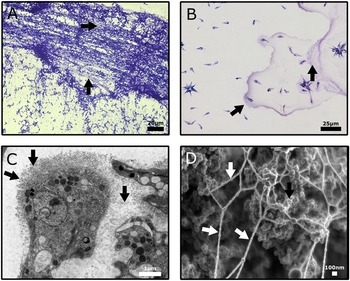
These EPS can be observed under optical microscopy on L. passim cell cultures in vitro forming a network structure intercalating between the different promastigote-producing forms (Figure 5A and 5B). Purified EPS analysed under scanning electron microscopy (SEM) and transmission electron microscopy (TEM) reveals its most basic structure consisting of repeated spherulitic structures organized in long fibre chains (Figure 5C and 5D).
The secreted EPS of honeybee trypanosomatid parasites. (A) L. passim cell culture at exponential growth phase and stained with crystal violet. Black arrows show long fibres interconnecting the promastigote forms which could correspond to EPS. (B) L. passim culture at exponential growth phase stained with Giemsa where promastigote forms appear embedded in a matrix marked with black arrows that might be EPS. (C) TEM image of a thin section of a haptomonad form at stationary phase cell culture. Black arrows show a fibrous electrodense region between haptomonad that could correspond to the existence of EPS overlying these cells. (D) SEM image of purified EPS purified by ethanolic precipitation of the cell culture supernatant during the exponential growth phase (for more detailed method, check Carreira De Paula et al., Reference Carreira De Paula, García Olmedo, Gómez-Moracho, Buendía-Abad, Higes, Martín-Hernández, Osuna and De Pablos2024), where it can be observed that the fibrous structure indicated with a black arrow is formed by long fibre chains like a bead necklace, marked with white arrows. EPS, extracellular polymeric substances; TEM, transmission electron microscopy; SEM, scanning electron microscopy.

Figure 5 Long description
The image A showing a blue and white micrograph with dense blue regions forming broad, irregular bands across the field. Two black arrows point to separate areas within the blue-stained region. A scale bar at the lower right reads 20 micrometers. The image B showing a pale background micrograph with scattered small blue elongated marks across the field. A large, faint, irregular pale shape occupies the right side. Two black arrows point to separate features near the lower left and near the right side. Several dark blue star-like shapes are present. A scale bar at the lower right reads 25 micrometers. The image C showing a grayscale electron micrograph with granular texture and multiple rounded and irregular structures. Three black arrows point to separate locations near the upper left, upper center and right side. A scale bar is present at the lower right, with the numeric text not legible. The image D showing a grayscale electron micrograph with a dense mesh of thin, branching, interconnected strands across the field. Three white arrows point to separate strands near the left and center. A scale bar at the lower right reads 500 nanometers.
In bacteria, EPS secretion acts a virulence factor as its production is key to the survival or maintenance of the biofilm-forming colony (Rudolph et al., Reference Rudolph, Gross, Ebrahim-Nesbat, Nöllenburg, Zomorodian, Wydra, Neugebauer, Hettwer, El-Shouny, Sonnenberg, Klement, Kado and Crosa1994), either by enabling the adhesion to the substrate, conferring protection against the host immune system and desiccation or offering defence against other bacteria living in the same environment. Moreover, EPS was studied to act as a key factor for biofilm formation and the change from motile to sessile forms, as described in Bacillus subtilis (Nagórska et al., Reference Nagórska, Ostrowski, Hinc, Holland and Obuchowski2010). Despite that the role of trypanosomatid EPS as a virulence factor or as a key factor in the differentiation towards biofilm colonies is still unknown, these secretions would facilitate trypanosomatid colonization of the honeybee hindgut, and also would modulate the micro-ecological conditions at this particular location.
Modulators of growth and infection success of trypanosomatid parasites in honeybees
Since trypanosomatids of honey bees are extracellular, these parasites must constantly crosstalk and respond to stimuli including symbionts, molecules from the bee diet, pesticides and/or the particular physicochemical environment of the hindgut. As it has been demonstrated in vitro, L. passim, and C. mellificae have a precise capacity to match their cell culture peaks with the pH (≈5.2) (Zheng et al., Reference Zheng, Powell, Steele, Dietrich and Moran2017; Palmer-Young et al., Reference Palmer-Young, Raffel and Evans2021) of the ileum and rectum and also to find their maximum proliferation in the range of 33–35 °C (Palmer-Young et al., Reference Palmer-Young, Raffel and Evans2021) coincident with honeybee brood nest temperatures (around 33–36 °C; Kleinhenz et al., Reference Kleinhenz, Bujok, Fuchs and Tautz2003). This relatively high tolerance to high temperatures and acidic environments is of importance for establishment within socially endothermic honeybees, which maintain a high colony temperature and low gut pH relative to other insects (Swingle, Reference Swingle1931; Esch, Reference Esch1960). Moreover, when compared to other monoxenous (Leptomonas pyrrhocoris) or dixenous (Leishmania major or Trypanosoma cruzi) species, trypanosomatids, parasites of bees and specially their unicellular flagellated forms showed the highest adaptive capacity to changes in solute concentrations. This resistance could be due to the continuous influx of metabolites from bee diet, the activity of the Malpighian tubules and/or the presence of fecal content in the rectum (Carreira De Paula et al., Reference Carreira De Paula, García Olmedo, Gómez-Moracho, Buendía-Abad, Higes, Martín-Hernández, Osuna and De Pablos2024). Finally, thermotolerance in these parasites also includes a striking capacity to resist cold-shock when subjected to temperatures below 4 °C (nearly 100% survival), which indicates the resilience of these cells in light of harsh conditions both inside and outside of their hosts (Carreira De Paula et al., Reference Carreira De Paula, García Olmedo, Gómez-Moracho, Buendía-Abad, Higes, Martín-Hernández, Osuna and De Pablos2024).
To counteract pathogen growth, bees use the ‘medicinal’ properties of phytochemical compounds in foraged nectar and pollen as a source of antimicrobial activity. Pollen and nectar composition are highly variable depending on plant sources but is generally composed by proteins, specialized (secondary) metabolites and metals (Schmitt et al., Reference Schmitt, Roy and Carter2021). Some such metabolites can influence C. bombi infection in bumble bees, as can different floral nectar and pollen source (Richardson et al., Reference Richardson, Adler, Leonard, Andicoechea, Regan, Anthony, Manson and Irwin2015; Koch et al., Reference Koch, Woodward, Langat, Brown and Stevenson2019). To search for plant-based molecules with anti-trypanosome activities, Palmer Young and collaborators developed a screening which resulted in the identification of at least 10 compounds with inhibitory effects of honeybee parasite growth (Palmer-Young et al., Reference Palmer-Young, Schwarz, Chen and Evans2022) and three with activity in experimentally infected honeybees, especially eugenol which decreased infection intensity by two orders of magnitude (Palmer-Young et al., Reference Palmer-Young, Markowitz, Grubbs, Zhang, Corona, Schwarz, Chen and Evans2022). Interestingly, the same work identified minimal inhibition by the flavonoid chrysin, a compound found at high concentrations in pollen and propolis with strong antiparasitic activity in the close relative human-infective Leishmania sp., as well as in the mosquito-associated trypanosomatid parasite C. fasciculata. In this regard, the same authors have hypothesized that the differential tolerance to nectar phytochemicals could have shaped and selected positively the honeybee-associated trypanosomatid community of parasites (Palmer-Young et al., Reference Palmer-Young, Schwarz, Chen and Evans2022).
Finally, the hindgut is also the niche of the core bacterial microbiome of honeybees. This microbiota is relatively simple, dominated by five core bacterial lineages. Microbiota is a strong determinant of C. bombi infections in bumble bees, with bacterial symbionts overall providing resistance to parasite establishment (Mockler et al., Reference Mockler, Kwong, Moran and Koch2018). Moreover, because social bee gut bacteria are considerably more heat-tolerant than are most trypanosomatids, their growth and antagonistic activities are potentiated by high temperatures, which can also reduce C. bombi infection (Palmer-Young et al., Reference Palmer-Young, Ngor, Burciaga Nevarez, Rothman, Raffel and McFrederick2019; Palmer-Young et al., Reference Palmer-Young, Raffel and McFrederick2019). C. mellificae and L. passim showed a reduced parasite growth when co-cultured with Lactobacillus, an effect probably done by the acidification of the extracellular milieu by the bacteria (Palmer-Young et al., Reference Palmer-Young, Markowitz, Huang and Evans2023). This effect was augmented when culture temperatures raised a range between 35 and 40 °C, which could represent a physiological mechanism of parasite control in homeothermic organisms such as honeybees (Palmer-Young et al., Reference Palmer-Young, Markowitz, Huang and Evans2023). The anti-parasitic role of a healthy microbiota was also demonstrated in experiments where stressed bees with poor nutrition (no protein), asocial context, and lack of exposure to microbiota from the hive were much more susceptible to L. passim infections. In contrast, experimental pre-treatments with Snodgrassella alvi (a biofilm-making bacteria of core honeybee microbiome) prior to L. passim infection, lead to an increase of parasite loads (Schwarz et al., Reference Schwarz, Moran and Evans2016). Therefore, parasite/microbiota crosstalk and homeostatic balance of bacterial agonists and/or antagonist symbionts in the hindgut form part of the parasite conundrum that led to success or eradication of trypanosomatid infections in honeybees.
Genetics and genomics of trypanosomatid species of honeybees
Trypanosomatid genomics is a growing field that has expanded beyond its initial focus on human-parasitic species to include many insect-specific taxa as well (Kostygov et al., Reference Kostygov, Albanaz, Butenko, Gerasimov, Lukeš and Yurchenko2024). Thus far, there is genome drafts of 5 different strains of L. passim at different levels of resolution (from chromosome level to contig level) deposited at NCBI (Accession numbers: PRJNA1049372; PRJNA863431; PRJNA863431; PRJNA78249; PRJNA319529 PRJNA319530) with the genome of C. bombi also described (Schmid-Hempel et al., Reference Schmid-Hempel, Aebi, Barribeau, Kitajima, Du Plessis, Schmid-Hempel and Zoller2018). The availability of these sequences and their amenability for genetic transformation make this parasites and excellent biological model for study host–parasite interactions. For instance, L. passim fluorescent and knockout cell lines have been generated using plasmid-based (Liu et al., Reference Liu, Lei and Kadowaki2019; Yuan et al., Reference Yuan, Sun and Kadowaki2024) and PCR-based approaches are also been developed (Unpublished data from De Pablos lab)) that could help for disentangle the basis for trypanosomatid development in honeybee hosts. This field has been expanding due to a growing interest in the evolutionary origins of parasitism within the trypanosomatid family, from free-living ancestors to insect-parasitic forms and eventually the multi-host life cycles of human – and plant-infecting forms (Frolov et al., Reference Frolov, Kostygov and Yurchenko2021). The finding that the trypanosomatid species thus far associated with honey and bumble bees form a distinct 5-species clade suggests that genomic analyses could help clarify radiation into the bee gut niche as well.
Intraspecific genetic variation of honeybee parasites is likely of high biological importance, but remains to be elucidated in detail. In C. bombi, populations are genetically diverse, and different parasite genotypes vary strongly in infectivity (Salathé et al., Reference Salathé, Tognazzo, Schmid-Hempel and Schmid-Hempel2012; Barribeau et al., Reference Barribeau, Sadd, Du Plessis and Schmid-Hempel2014; Gerasimov et al., Reference Gerasimov, Zemp, Schmid-Hempel, Schmid-Hempel and Yurchenko2019). In addition, multi-locus genotyping of C. bombi in field surveys of bumblebees showed that variables such as geography, identity of the host and the overlap of foraging niches between hosts (shared flower visits) could be responsible for the observed genotypic structure of populations (Salathé and Schmid-Hempel, Reference Salathé and Schmid-Hempel2011). Furthermore, genetic exchange between C. bombi strains has also been demonstrated using microsatellite markers, providing evidence for not only clonal but also sexual recombination events that could contribute to the diversity of strains found in natural populations (Schmid-Hempel et al., Reference Schmid-Hempel, Salathé, Tognazzo and Schmid-Hempel2011).
In honeybees, the only population-genetic study performed to date has been on C. mellificae, L. passim and C. bombi from 7 individual honeybee (Bartolomé et al., Reference Bartolomé, Buendía-Abad, Ornosa, De la Rúa, Martín-Hernández, Higes and Maside2022). This study revealed that L. passim and C. mellificae have higher polymorphism in the sequences of three targeted genes (topII, rpb1 and gapdh), suggesting recent demographic expansion into new geographic areas. Moreover, haplotype analysis performed on L. passim and C. mellificae identified probable recombination events between these two parasites (Bartolomé et al., Reference Bartolomé, Buendía-Abad, Ornosa, De la Rúa, Martín-Hernández, Higes and Maside2022), with both capable of colonizing the honeybee hindgut. Meanwhile, a new genome assembly of the BRL type strain (ATCC PRA-422) of L. passim has revealed a chromosomal duplication event within chromosomes 5 and 6 and provides evidence for a high level of aneusomy in this strain, consistent with the strain-specific variations in somy found in C. bombi (Gerasimov et al., Reference Gerasimov, Zemp, Schmid-Hempel, Schmid-Hempel and Yurchenko2019) and the closely related L. pyrrhocoris (Grünebast and Clos, Reference Grünebast and Clos2020; Markowitz et al., Reference Markowitz, Nearman, Zhao, Boncristiani, Butenko, De Pablos, Marin, Xu, Machado, Schwarz, Palmer-Young and Evans2024). These findings open the door for investigating the role of genomic fluctuations in terms of Single Nucleotide Polymorphisms (SNPs), Copy Number Variations (CNVs) or ploidy in trypanosomatids that could explain the widespread presence of these parasites and the biodiversity and genetic structure of intra- or interspecific infecting trypanosomatids in different host communities.
Beyond honeybee boundaries: Similarities and differences within the family Trypanosomatidae
Although there are substantial morphological differences between trypanosomatid species, developmental differentiation into surface-attached haptomonad life cycle stages have been shown in at least 8 species of Leishmaniinae subfamily such as Crithidia fasciculata in mosquitoes (Filosa et al., Reference Filosa, Berry, Ruthel, Beverley, Warren, Tomlinson, Myler, Dudkin, Povelones and Povelones2019), Novymonas esmeralda in rhopalid bugs or scentless plant bugs (Kostygov et al., Reference Kostygov, Dobáková, Grybchuk-Ieremenko, Váhala, Maslov, Votýpka, Lukeš and Yurchenko2016), Leishmania mexicana and Porcisia hertigi in the foregut of sandflies (Sadlova et al., Reference Sadlova, Bacikova, Becvar, Vojtkova, England, Shaw and Volf2022; Yanase et al., Reference Yanase, Moreira-Leite, Rea, Wilburn, Sádlová, Vojtkova, Pružinová, Taniguchi, Nonaka, Volf and Sunter2023), C. bombi in the hindgut of bumblebees (Koch et al., Reference Koch, Woodward, Langat, Brown and Stevenson2019) and L. passim, C. mellificae or C. acanthocephali in the hindgut of honeybees (Buendía-Abad et al., Reference Buendía-Abad, Higes, Martín-Hernández, Barrios, Meana, Fernández Fernández, Osuna and De Pablos2021, Reference Buendía-Abad, García-Palencia, de Pablos, Martín-Hernández and Higes2022b; Carreira De Paula et al., Reference Carreira De Paula, García Olmedo, Gómez-Moracho, Buendía-Abad, Higes, Martín-Hernández, Osuna and De Pablos2024). Haptomonads have been also found in other species outside the Leishmaniinae subfamily such as Paratrypanosoma confusum (Skalický et al., Reference Skalický, Dobáková, Wheeler, Tesařová, Flegontov, Jirsová, Votýpka, Yurchenko, Ayala and Lukeš2017), demonstrating that these forms are a highly successful within the Trypanosomatidae family. Moreover, the reduction of the flagellar length coupled with the formation of an attachment plaque seems a universal feature of haptomonads, since it has been also described in L. mexicana (Yanase et al., Reference Yanase, Moreira-Leite, Rea, Wilburn, Sádlová, Vojtkova, Pružinová, Taniguchi, Nonaka, Volf and Sunter2023) or P. confusum (Skalický et al., Reference Skalický, Dobáková, Wheeler, Tesařová, Flegontov, Jirsová, Votýpka, Yurchenko, Ayala and Lukeš2017) with a stunning similarity to those structures formed by trypanosomatids of honeybees. In vitro cell cultures in different models such as L. passim, C. mellificae or L. mexicana have shown differentiation from unicellular promastigote and/or choanomastigote forms towards surface-attached haptomonad biofilms (Yanase et al., Reference Yanase, Moreira-Leite, Rea, Wilburn, Sádlová, Vojtkova, Pružinová, Taniguchi, Nonaka, Volf and Sunter2023; Carreira De Paula et al., Reference Carreira De Paula, García Olmedo, Gómez-Moracho, Buendía-Abad, Higes, Martín-Hernández, Osuna and De Pablos2024). Thus, the fundamentals of trypanosomatid differentiation from free-swimming promastigote or choanomastigote forms to surface-attached haptomonad forms are achievable in different biological models.
Another building block for survival of trypanosomatid parasites within bees would be the capacity for secretion of organized and highly-dense polymeric gels and fibre-like matrixes, generally defined as EPS and that are an integral constituent of biofilm-making trypanosomatid parasites. Despite the scarcity of descriptions of EPS in trypanosomatids outside bee hosts, Alexei Yu Kostigov and cols (Reference Kostygov, Frolov, Malysheva, Ganyukova, Drachko, Yurchenko and Agasoi2022) have clearly imaged dense fiber-like material emerging from T. theileri adhered cells at the ilem of tabanid host (Kostygov et al., Reference Kostygov, Frolov, Malysheva, Ganyukova, Drachko, Yurchenko and Agasoi2022). Moreover the Leishmania promastigote secretory gel (PSG), has been also proposed as a type of trypanosomatid EPS, being the constitutive part of the surface-attached and pellicular biofilm formed by Leishmania at the stomodeal valve of infected sandflies (Rogers et al., Reference Rogers, De Pablos and Sunter2024). This PSG was discovered in early 90s and is composed by a dense matrix of fibrils of packed lipophosphoglycans (LPGs) and secreted acid phosphatases being a constitutive part of Leishmania biofilm (Rogers et al., Reference Rogers, De Pablos and Sunter2024). The possible role of these secretions for parasite attachment in the insect gut has been demonstrated in L. pyrrhocoris, since this parasite is defective for secreting LPGs losing the ability for attachment to the firebug midgut (Butenko et al., Reference Butenko, Da Silva Vieira, Frolov, Opperdoes, Soares, Kostygov, Lukes and Yurchenko2018). Given their different host physiology and behaviours, it is plausible that the composition of trypanosomatid EPS-producing trypanosomatids could be strongly affected by the energetic and carbon source preferences of their hosts varying from nectarivorous (e.g. Diptera, Hemiptera), palynivorous (e.g. Hemiptera, Diptera), necrophagous (e.g. Diptera, Hemiptera), frugivorous (e.g. Hemiptera) and/or hematophagous (e.g. Diptera, Siphonaptera). On top, EPS secretions may be also transformed by different microbiota at the foregut and/or the hindgut of the insect hosts. Trans-kingdom interactions among trypanosomatids and other symbionts could lead to mixed biofilms, which is the most common form of biofilm in nature (Sadiq et al., Reference Sadiq, Hansen, Burmølle, Heyndrickx, Flint, Lu, Chen and Zhang2022), where resources and space are shared and determining highly dynamic changes of the host gut micro-environment modifying the functionality of host microbiota. Besides, lifespan of the host and other physiological conditions within a context of climate change would generate structural and chemical compositions as shown in Yersinia pestis biofilms that selects biofilm-forming phenotypes under dried and cold conditions in the foregut of fleas (Cui et al., Reference Cui, Schmid, Cao, Dai, Du, Ryan Easterday, Fang, Guo, Huang, Liu, Qi, Song, Tian, Wang, Wu, Xu, Yang, Yang, Yang, Zhang, Jakobsen, Zhang, Stenseth and Yang2020). The extension of trypanosomatid biofilms (either pellicular or surface-attached) within the Trypanosomatidae family as successful lifestyle still needs to be explored and would explain the success of these parasites in nature.
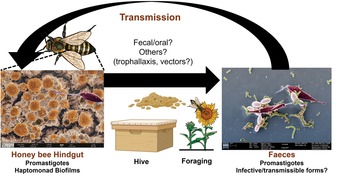
Since trypanosomatid parasites of honeybees thrive in the hindgut, the fecal/oral route appears to be the most probable transmission among individuals and colonies (Figure 6). Examples of this mode of horizontal transmission have been shown in monoxenous C. bombi of bumblebees (Durrer and Schmid-Hempel, Reference Durrer and Schmid-Hempel1994; Schmid-Hempel, Reference Schmid-Hempel2001), L. pyrrhocoris in firebugs (Frolov et al., Reference Frolov, Kostygov and Yurchenko2021) and the dixenous parasite T. cruzi which is transmitted via fecal deposition on the mammalian definitive host during the bite of several bug species of the Triatominae subfamily (Moretti et al., Reference Moretti, Mortara and Schenkman2020). Since parasites are exposed to extreme changes in their environment outside their hosts, they must undergo differentiation into resistant/transmissible forms. The only examples reported have been provided in L. pyrrhocoris, Blastocrithidia and Obscuromonas genus where this parasites differentiate into specialized recalcitrant resistant amastigote-like cyst forms (Almeida Takata et al., Reference Almeida Takata, Camargo and Milder1996; Dias et al., Reference Dias, Vasconcellos, Romeiro, Attias, Souto-Padrón and Lopes2014; Lukeš et al., Reference Lukeš, Tesařová, Yurchenko and Votýpka2021) and the differentiation into metacyclic trypomastigotes in T. cruzi (Jimenez, Reference Jimenez2014) that successfully overcomes changes in osmolarity, pH, temperature and/or nutrient availability outside their hosts. Thus far only promastigote forms have been observed in experimentally infected honeybees with L. passim (Carreira De Paula et al., Reference Carreira De Paula, García Olmedo, Gómez-Moracho, Buendía-Abad, Higes, Martín-Hernández, Osuna and De Pablos2024; Figure 6). However, promastigote forms have been found after the infection with high numbers of parasites (6 × 10⁵) and after 6 days post-infection which would not guarantee that those released forms come from the initial inoculum and not from natural release. Since honeybees develop in overcrowded colonies of thousands of individuals, the identification of the transmissible/infective forms in this parasites would be essential to understand how these parasites get transmitted and thus to generate prevention and control measures.
The life cycle of trypanosomatid parasites of honeybees. Picture on the left corresponds to a false coloured SEM image showing a trypanosomatid biofilm composed by haptomonad forms (orange) and unicellular promastigote forms (purple). Picture on the right corresponds to a false coloured SEM image showing a unicellular promastigote forms (purple) released in feces together with yeast (grey) and bacteria (green). Question marks correspond with possible transmission routes and the released infective/transmissible forms that still need to be discovered. These images have been created with BioRender (https://www.biorender.com/) and NHI BioArt (https://bioart.niaid.nih.gov/). SEM, scanning electron microscopy.

Figure 6 Long description
The diagram illustrates the transmission cycle of trypanosomatid parasites in honeybees. On the left, an image labeled 'Honey bee Hindgut' shows promastigotes and haptomonad biofilms. An arrow labeled 'Transmission' points from a honeybee to the right, indicating possible transmission routes such as fecal/oral, trophallaxis and vectors. In the center, icons of a hive and a flower labeled 'Foraging' are shown. On the right, an image labeled 'Faeces' depicts promastigotes and questions their infective or transmissible forms. The diagram suggests a cycle involving the hindgut, hive, foraging and feces stages in the transmission process.
Finally, the unique environment of the honeybee hindgut in which these parasites establish further suggests their use as models of the potential for host shift and exploration of a dixenous, mammal-infecting lifestyle by insect-associated trypanosomatid species. The factors enabling such shifts are of both academic and clinical concern (Lukeš et al., Reference Lukeš, Skalický, Týč, Votýpka and Yurchenko2014). Honeybees are more strongly thermoregulatory and homeothermic than most insects, capable of maintaining nest temperatures similar to mammalian body temperatures for long periods of time. In addition, the acidic hindgut pH of honeybees parallels the acidic environment of phagolysosomes (Zilberstein and Shapira, Reference Zilberstein and Shapira1994) faced by Leishmania species during sand fly-vectored infection of mammals, with a combination of elevated temperature and reduced pH being used to induce differentiation to the mammalian stage in vitro. The isolation species with high sequence identity to C. mellificae (Dario et al., Reference Dario, Furtado, Lisboa, De Oliveira, Santos, D’Andrea, Roque, Xavier and Jansen2022) from a variety of warm-blooded mammals in Brazil furthers the case for parallels between colonization of honeybee and mammalian bloodstream niches.
Concluding remarks and future perspectives
The work performed during the past decades has demonstrated the tremendous ubiquity of trypanosomes in honeybee colonies placing these actors as one of the major colonizers of the honeybee hindgut. Moreover, these parasites have been shown to be present in a wide diversity in wild and manged bees which indicates their tremendous dispersal capacity in these hymenopteran insects and thus their probabilities of emergence and re-emergence within honeybee colonies. Despite that the trypanosomatid morphotypes and developmental transitions within the honeybee hindgut have been precisely described by microscopy, there is still many aspects of the trypanosomatid that remains elusive. Given that axenic in vitro cell cultures (Runckel et al., Reference Runckel, Flenniken, Engel, Ruby, Ganem, Andino and DeRisi2011; Schwarz et al., Reference Schwarz, Bauchan, Murphy, Ravoet, de Graaf and Evans2015; Ribani et al., Reference Ribani, Utzeri, Taurisano and Fontanesi2020; Buendía-Abad et al., Reference Buendía-Abad, Higes, Martín-Hernández, Barrios, Meana, Fernández Fernández, Osuna and De Pablos2021; Rudelli et al., Reference Rudelli, Isani, Andreani, Tedesco and Galuppi2023) and genetic modification of trypanosomatid parasites (Liu et al., Reference Liu, Lei and Kadowaki2019) has been successfully achieved, a wide number of research questions could be now answered. These includes the precise definition of transmissible stages and the developmental regulation to generate trypanosomatid biofilms within their hosts, the role of trypanosomatid secretions for their survival and impact on hindgut symbiont counterparts and/or the full definition of the signals for developmental differentiation of from unicellular flagellates to haptomonad biofilms. Besides, molecules coming from honeybee diet or agrochemicals as well as the diversity of bee symbionts interacting and regulating the presence or absence of trypanosomatid parasites would clarify the impact of these protozoan cells in different bee health markers. These unknowns make worth the study the biotic and abiotic determinants of honeybee trypanosomatid life cycles to precisely define the effects of this protozoan cells in colonies and individual and hence on honeybee health.
Supplementary material
The supplementary material for this article can be found at https://doi.org/10.1017/S0031182025100917.
Table with bee species where a trypanosomatid parasite has been detected thus far (25-04-2025).
Data availability statement
There is no extra data for this paper.
Acknowledgements
Authors would like to thank to technology facilities at the University of Granada and Pilar Valencia from Universidad Complutense de Madrid for Transmission Electron Images. We would also to acknowledge the incredible work performed by early of the paper. For the work done in the last century by pioneering authors such as the zoologists Annie Porter or Ruth Lotmar and the high value of discussions performed with Professor Antonio Osuna.
Author contributions
TGM, MB, MH, RGH and LMDP wrote the Introduction, Trypanosomatid species prevalence and Trypanosomatid effects on bee health sections. PGO, JCDP, JDE, EPY and LMDP wrote tissue and cell biology of trypanosomatid parasite infections in honeybees, modulators of growth and infection success of trypanosomatid parasites in honeybees, genetics and genomics of trypanosomatid species of honeybees, beyond honeybee boundaries: similarities and differences within the family Trypanosomatidae. PGO, JCDP and MH have provided the original images on this paper. All authors have inputs in concluding remarks and future perspectives section and contributed to full revision of the manuscript prior to submission.
Financial support
Work at De Pablos’s lab was supported by the Spanish Programme for Knowledge Generation and Scientific and Technological Strengthening of the R+D+I System, grant PID2021-126938OB-I00 funded by MCIN/AEI/10.13039/501100011033 and by ‘ERDF/EU’ as well as the grant PGC2018-098929-A-I00 funded by MCIN/AEI/10.13039/501100011033 and by ‘ERDF A way of making Europe’. Dr Tamara Gómez Moracho was supported by Maria Zambrano postdoctoral fellowship program of the Spanish Ministry of Science, Innovation and Universities (RD289/2021) funding from the European Union’s Horizon 2020 research and innovation programme under the Marie Skłodowska-Curie grant agreement (ROLEPS 101105500). The review is part of the PhD thesis of D. Pedro García Olmedo. Doctoral Program in Fundamental and Systems Biology (University of Granada, UGR). Dr Jay D. Evans and Dr Evan Palmer Young have been funded by USDA-NIFA Pollinator Health Grant 2020-67013-31861 to JDE and ECPY, USDA-NIFA Postdoctoral Fellowship 2022-67012-37482, an Eva Crane Trust Grant to JDE and ECPY, the USDA Agricultural Research Service Beltsville Bee Research Laboratory in-house funds.
Competing interests
The authors declare there are no conflicts of interest.
Ethical standards
Not applicable.
Appendix
Glossary of terms
Attachment plaque: Hemidesmosomal-like structure formed by a modified flagellum forming a large bulge at the base of the flagella and attachment pads that stably binds haptomonad forms to the cuticular surface of an insect.
Choanomastigote forms: Extracellular trypanosomatid forms with a kinetoplast anterior to the nucleus and adjacent to the flagellar pocket where emergence of an elongated flagellum can be observed.
Eusocial insects: All those animals that meet these three conditions: (i) adults take care of the offspring; (ii) two or more generations of adults live together in the same nest; (iii) the members of each colony are divided into a ‘royal’ reproductive caste and a non-reproductive ‘worker’ cast.
Extracellular Polymeric Substances: Secreted biopolymers that form a matrix of polysaccharides, proteins, extracellular nucleic acids, lipids and other molecules and used for biofilm formation.
Haptomonad form: Extracellular trypanosomatid forms with a kinetoplast anterior to the nucleus and characterized by a reduced flagella used for adhesion to host surfaces. These forms are non-motile and replicative.
Multievoltine: It is a species that has two or more broods of offspring per year.
Polylectic: Insect which collects pollen from the flowers of a variety of unrelated plants.
Promastigote form: Extracellular trypanosomatid forms with a kinetoplast anterior to the nucleus. These are liberforms with an elongated flagella extending out from a flagellar pocket located in central position. These forms are highly motile and replicative.


 Open access

