


Lessons from history on sustainability, collapse and resilience are the ultimate goal of the Byzantine Bio-Archaeology Research Program of the Negev (BYBAN) (Tepper et al. Reference Tepper, Weissbrod and Bar-Oz2015). Addressing the unprecedented flourishing and collapse of the Byzantine Negev agricultural settlements (fourth–seventh centuries AD), the BYBAN project offers a unique and original approach. It focuses on ancient middens and domestic contexts, which provide an exceptional focus on the materiality of daily life. Archaeobotanical research is central to this project because the copious plant remains retrieved are a reflection of the region's agricultural economy and its environmental sustainability. This approach will enable us to answer important research questions about the Byzantine–Islamic transition in the Negev: what were the major cash and subsistence crops? Which were grown locally, and which, if any, were imported? How, if at all, did the agricultural economy change during the Byzantine–Islamic transition? Were there any major changes in climatic conditions, and, if so, can they be implicated as a cause for agricultural collapse?
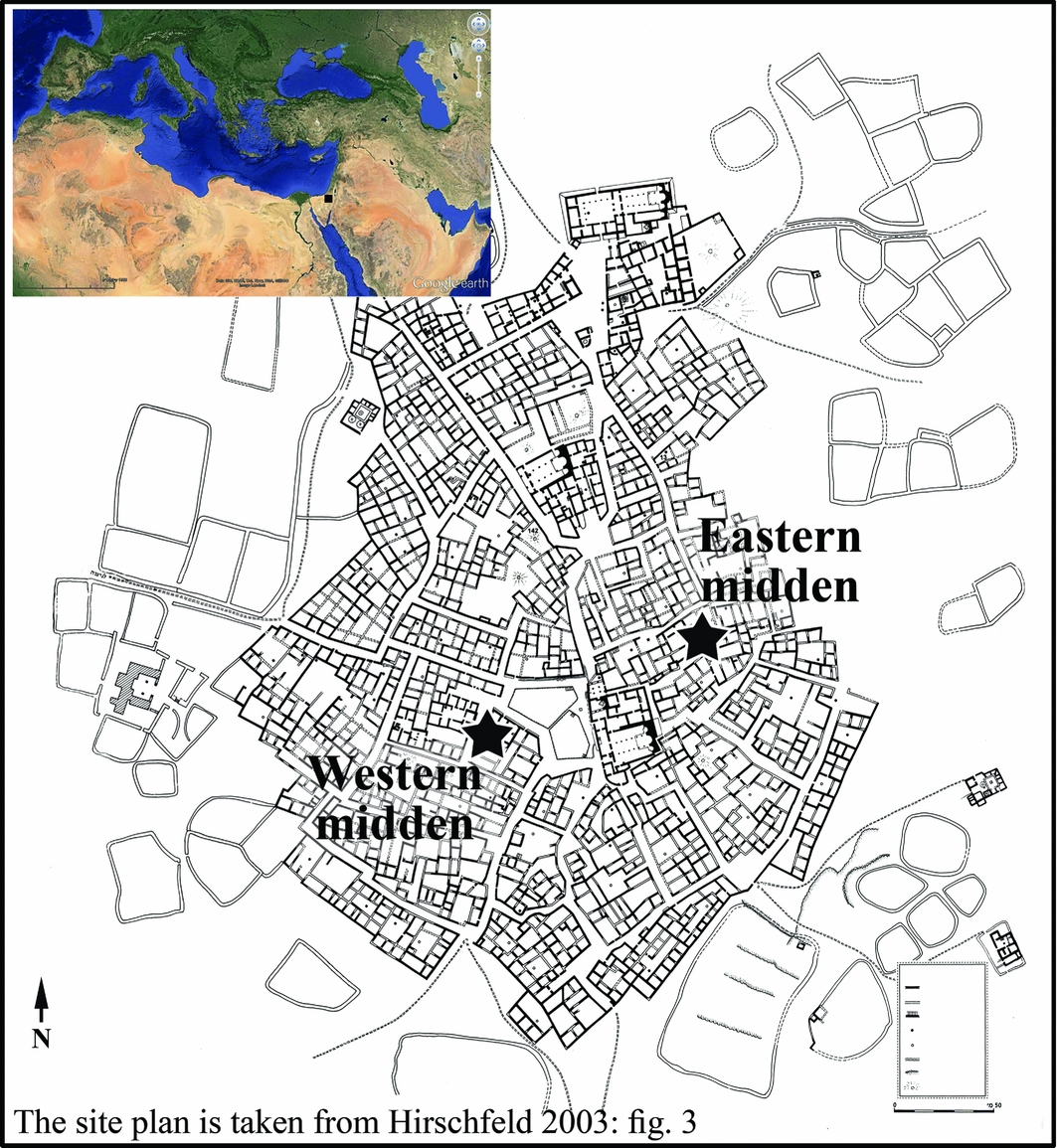
Previous surveys and excavations have shown that at its peak the Byzantine site of Shivta (Sobata/Esbeita) was a thriving agricultural village (Segal Reference Segal1983; Figure 1). These investigations have documented three large communal winepresses, an olive press, four dovecotes and numerous runoff irrigation channels and catchment terraces (Evenari et al. Reference Evenari, Shanan and Tadmor1982; Hirschfeld & Tepper Reference Hirschfeld and Tepper2006; Tepper Reference Tepper and Conan2007). Papyri from nearby Nitzana (Nessana/Auja el-Hafir) refer to the cultivation of wheat, barley, the legume aracus, grapes, figs, olives and dates (Mayerson Reference Mayerson and Colt1962: 227, 229, 259–62); grapes, figs, olives and dates have also been recovered from one of the Shivta dovecotes (Ramsay & Tepper Reference Ramsay and Tepper2010).
Shivta in geographic context. Situated in the central Negev, Shivta was part of the Byzantine Empire until the Islamic conquest. The site plan shows the location of two middens within the settlement.
Recent and ongoing excavations at Shivta have produced a rich set of plant material from Late Byzantine and Early Islamic contexts. The relatively high level of preservation allows for identification to species, enabling a degree of economic and environmental reconstruction that has not yet been attempted for these periods and sites. Preliminary observations of the material enable us to draw some generalisations on the importance and status of different cultigens.
Cereals and pulses appear to be the staple foodstuffs at Shivta, and are common in nearly all samples (Figure 2); ear fragments and legume pods attest to the local cultivation of these crops. Grape pips are also well represented in the samples. We assume that vines were cultivated primarily for the production of wine for export, as local demand could have been easily met by a relatively small number of vines (Safrai Reference Safrai1994: 131). The grapes would have been processed at the attested winepresses within the immediate perimeter of Shivta, packaged in ‘Gaza ware’ amphorae and transported throughout the Mediterranean and beyond (Mayerson Reference Mayerson1985). Other major fruit species found at Shivta include olives, dates and figs (Figure 3).
Staple crops: 1) cultivated barley (Hordeum vulgare) grain; 2) six-row barley rachis fragment; 3) bitter vetch (Vicia ervilia) seed with seed coat; 4–6) bread wheat (Triticum aestivum) grain. All remains carbonised.

Fruit crops: 1) Date (Phoenix dactylifera) stone; 2) olive (Olea europaea) stone; 3) grape (Vitis vinifera) pip; 4) fig (Ficus carica) nutlet. All remains were carbonised.

Many specific questions related to ancient desert agriculture and the Byzantine–Islamic transition will be addressed with continued archaeobotanical research. These include the extent and variety of legume cultivation, and chronological changes in the relative frequency of different cultivars. For instance, as wheat and barley are dietary substitutes, with barley more resistant to drought but generally considered inferior (Zohary et al. Reference Zohary, Hopf and Weiss2012: 52), changes in their relative frequencies may indicate climatic or economic stress. Similarly, the relative frequency of grape pips vs cereal grains should also be an indicator of the level of agricultural sophistication and commercial production. With the help of precision dating, such comparisons will enable us to trace the magnitude and time frameof the region's agricultural decline. In addition, the influence of protracted climatic change, if it occurred, ought to appear as variation in the species composition of crops and wild plant remains. Meanwhile, the species composition of weeds, which grow alongside cultivated crops, may point to local cultivation or to the importation of crops. The seeds of the Byzantine Negev villages hold great promise for fruitful research on sustainability, collapse and resilience.
Acknowledgements
This study was conducted in Shivta National Park under the licence of the Israel Antiquities Authority (G-87/2015, G-4/2016). We are grateful for the assistance of Shivta National Park manager Avi Biton and his personnel, Ami and Dina Oach of Shivta Farm; Yael Mahler-Slasky for photography, Anat Regev-Gisis for graphics; Nahshon Roche for proofreading and processing samples; and to Ruti Roche, Gabriel Fuks, Uri Yehuda and countless volunteers who helped excavate, sift and process archaeological samples. This project has received funding from the European Research Council under the EU's Horizon 2020 research and innovation programme (648427), the Israel Science Foundation (340–14), Bar-Ilan University's Doctoral Fellowships of Excellence Program, and the Molcho Fund for agricultural research in the Negev.



