


1. Introduction
Determinacy is a kinematic feature of the states that a physical theory associates with systems at an instant. Classical mechanics provides the hallmark of a theory in which all observables are fully determinate at all times. The determinacy consists in the fact that the observables of classical mechanics all take on values which are specified with real number precision. There is no more precise kinematically allowed way for the states to be, and hence, by ascribing a real number value for each observable, one makes the states of affairs described by the theory fully determinate. Determinism is a dynamical feature of the collections of states that a physical theory associates with systems over the course of their histories. If we set aside a class of models which is typically regarded as exceptional,Footnote 1 classical mechanics also provides the paradigmatic example of a deterministic theory. The determinism of classical mechanics consists in the fact that when we specify an initial condition with real number precision, we uniquely fix the exact values of every observable with real number precision for all subsequent times. In this way, the determinism of classical mechanics is connected to its full determinacy.
In quantum mechanics the status of determinacy and determinism becomes fraught. Whether or not determinacy and determinism obtain depends on which interpretation of the theory one adopts and whether or not that interpretation postulates hidden variables or wavefunction collapse. Without hidden variables, the theory exhibits indeterminacy with respect to at least some of its observables. Without departure from the time evolution generated by the Schrödinger equation, the theory exhibits determinism. However, if we introduce some form of wavefunction collapse to resolve the quantum measurement problem, the theory exhibits indeterminism.
So, standardly understood, classical mechanics exhibits determinacy and determinism, but in quantum mechanics these features are interpretation-dependent. In a series of recent papers, Del Santo and Gisin have raised a number of doubts about this orthodoxy.Footnote 2 On their view, an appropriately formulated classical mechanics would exhibit indeterminism, and this indeterminism arises due to a failure of determinacy. They argue on multiple distinct grounds that physical quantities can only contain a finite amount of information. However, all but a special class of real numbers contain infinite information. A classical failure of determinacy must result, they suggest, because there fail to be physical facts about the observables of classical mechanics with full real number precision. By treating such observables with real number precision in classical mechanics we are adopting a hidden variable model that restores determinacy, and as a consequence, determinism. They argue, moreover, that once we attend to the presence of this classical indeterminacy, we can see that classical mechanics exhibits an analog of the quantum mechanical measurement problem.
We expect that this package of claims will be met by incredulous stares from some quarters. It would be a mistake, however, to reject their view out of hand as it raises several important matters of principle. In order to properly evaluate their claims, a theory-independent characterization of indeterminacy is required. We employ a characterization of metaphysical indeterminacy in terms of determinable and determinate properties due to WilsonFootnote 3 to capture what it means for a physical quantity to exhibit indeterminacy. Then, building on a proposal due to Calosi and Wilson,Footnote 4 we show that quantum indeterminacy is an instance of this form of metaphysical indeterminacy, and that a properly reformulated version of Del Santo and Gisin’s classical indeterminacy is as well. Pursuing this approach allows us to retain the standard mathematical expression of classical and quantum mechanics while still faithfully capturing the kind of indeterminacy at issue in Del Santo and Gisin’s view.
Once the nature of the metaphysical indeterminacy at issue is made precise, it becomes clear that the classical indeterminacy of Del Santo and Gisin is different in kind from the indeterminacy arising in quantum theory. While both are instances of Wilson’s conception of metaphysical indeterminacy, classical indeterminacy can be consistently rendered fully determinate whereas quantum indeterminacy cannot. This observation problematizes their claim that real numbers are hidden variables for classical mechanics in direct analogy with hidden variable models of quantum mechanics. Nonetheless, critical engagement with their view yields a better understanding of the relationship between the concepts of precision, determinacy, and hidden variables.
2. Classical Indeterminacy
The package of claims that Del Santo and Gisin defend which we aim to evaluate is as follows:Footnote 5
-
Classical Indeterminacy: Classical physical systems exhibit indeterminacy. This indeterminacy involves observable physical quantities about which there are facts of the matter up to some level of precision in their decimal expansion, but about which there fail to be facts of the matter for all subsequent digits.
-
Classical Indeterminism: This classical indeterminacy is responsible for making the dynamical evolution of classical physical systems indeterministic. A classical observable which is indeterminate beyond some level of precision has propensities for its indeterminate digits to become determinate as the state dynamically evolves in time. As these propensities together with the determined digits at a time do not uniquely fix the value at future times, the classical indeterminacy leads to indeterminism.
-
Real Number Hidden Variables: The standard mathematical formalism for classical mechanics represents observables with real number precision. These real numbers function as hidden variables which give a fully determinate representation of the indeterminate classical systems. This fully determinate theoretical description is dynamically deterministic.
-
Classical Measurement Problem: If the indeterminacy of classical physical systems is properly accounted for in our theoretical representation of those systems, the resulting theory exhibits a classical analog of the quantum measurement problem. In particular, if one measures an indeterminate classical observable with greater precision than the determinacy of that observable at the time of measurement, in order to obtain a determinate outcome, some of the digits which were indeterminate pre-measurement must become determinate post-measurement. That is, the measurement process induces more determinacy in the value of the measured observable than was present before the measurement.
Evaluating these claims is complicated by the fact that while indeterminism has a well-regimented theory-independent meaning, indeterminacy, hidden variables, and the measurement problem are concepts arising from discussions of quantum mechanics and it is not immediately obvious what they are supposed to mean outside of that context. The notion of indeterminacy as it arises in quantum mechanics is typically glossed as the failure of a system to have a “determinate” or “definite” or “well-defined” or “fully precise” value of an observable. This kind of talk is regimented by appeal to the eigenstate-eigenvalue link which holds that a system has a determinate value of an observable just in case the state is an eigenstate of the operator representing that observable, and fails to have a determinate value of that observable otherwise. This sharpening of the concept of indeterminacy leans on the Hilbert space formalism of quantum mechanics in a manner that cannot be directly exported to other theoretical contexts. The situation is similar for the concept of hidden variables and for the measurement problem as both are bound up with what we mean by quantum indeterminacy.
Del Santo and Gisin rely on an intuitive generalization of the concept of indeterminacy. For them, an observable exhibits indeterminacy just in case there fail to be physical facts of the matter concerning its value after a given level of precision in its decimal expansion. For example, consider the position ${\rm{\Gamma }}$
of a structureless particle as it moves in one spatial dimension. The kinematically allowed values of
${\rm{\Gamma }}$
of a structureless particle as it moves in one spatial dimension. The kinematically allowed values of ${\rm{\Gamma }}$
, denoted
${\rm{\Gamma }}$
, denoted $\gamma $
, are represented as decimal expansions
$\gamma $
, are represented as decimal expansions $\gamma = {\gamma _1}{\gamma _2} \ldots {\gamma _m}.{\gamma _{m + 1}} \ldots {\gamma _i} \ldots $
, with the first
$\gamma = {\gamma _1}{\gamma _2} \ldots {\gamma _m}.{\gamma _{m + 1}} \ldots {\gamma _i} \ldots $
, with the first $m$
digits occuring before the decimal point. A state of affairs involving such a particle would be fully determinate if there was a fact of the matter concerning the value of
$m$
digits occuring before the decimal point. A state of affairs involving such a particle would be fully determinate if there was a fact of the matter concerning the value of ${\gamma _i}$
for all
${\gamma _i}$
for all $i$
. Del Santo and Gisin introduce indeterminacy by stipulating that at time
$i$
. Del Santo and Gisin introduce indeterminacy by stipulating that at time $t$
, only the values of the first
$t$
, only the values of the first $N\left( t \right)$
digits are determinate and that there is no fact of the matter concerning the value of
$N\left( t \right)$
digits are determinate and that there is no fact of the matter concerning the value of ${\gamma _i}$
for
${\gamma _i}$
for $i \gt N\left( t \right)$
. That
$i \gt N\left( t \right)$
. That $N$
is a function of
$N$
is a function of $t$
reflects the fact that on their view, the digits of
$t$
reflects the fact that on their view, the digits of $\gamma $
beyond this place in the expansion are subject to propensities to become determinate as a consequence of the dynamics.
$\gamma $
beyond this place in the expansion are subject to propensities to become determinate as a consequence of the dynamics.
It is important to note that when Del Santo and Gisin suggest that there is no fact of the matter concerning the position of the particle beyond some level of precision, they are not suggesting that the only possible values of ${\rm{\Gamma }}$
are rational numbers. The rationals are a subset of the reals, so taking a rational value would still amount to full determinacy. A decimal expansion with a cutoff only corresponds to a rational number if one supposes that after the finite initial segment of specified digits, all subsequent digits are zero.
${\rm{\Gamma }}$
are rational numbers. The rationals are a subset of the reals, so taking a rational value would still amount to full determinacy. A decimal expansion with a cutoff only corresponds to a rational number if one supposes that after the finite initial segment of specified digits, all subsequent digits are zero.
But Del Santo and Gisin are explicit that there is no matter of fact about the digits after ${\gamma _{N\left( t \right)}}$
: they are all indeterminate. According to their view, what follows
${\gamma _{N\left( t \right)}}$
: they are all indeterminate. According to their view, what follows ${\gamma _{N\left( t \right)}}$
is a finite sequence of propensities that determine how likely it is that subsequent positions in the series will take on particular values at a later time under the action of the dynamics. In order to ensure that the entire decimal expansion for
${\gamma _{N\left( t \right)}}$
is a finite sequence of propensities that determine how likely it is that subsequent positions in the series will take on particular values at a later time under the action of the dynamics. In order to ensure that the entire decimal expansion for $\gamma $
only contains finite information, they further stipulate that following the propensities there is an infinite tail of digits each of which takes on the value denoted by the symbol “?”. This value is supposed to indicate that not only does
$\gamma $
only contains finite information, they further stipulate that following the propensities there is an infinite tail of digits each of which takes on the value denoted by the symbol “?”. This value is supposed to indicate that not only does $\gamma $
fail to take on a particular value to those levels of precision, but there is not even a non-trivial propensity which might bias the value those digits will take on when they become determinate under the action of the dynamics.
$\gamma $
fail to take on a particular value to those levels of precision, but there is not even a non-trivial propensity which might bias the value those digits will take on when they become determinate under the action of the dynamics.
This proposed structure for the values of $\gamma $
successfully secures the finiteness of their information content, and it avoids collapsing into full determinacy. Achieving these desiderata comes at a substantial cost, however. Our first worry is that while it is clear what role each component of the values are supposed to play, and there is an intuitive sense in which this expresses a way in which a quantity could exhibit indeterminacy, it is not at all clear that the resulting objects will in fact be numbers in any standard mathematical sense.Footnote 6 This leads naturally to our second worry, which concerns how the values of
$\gamma $
successfully secures the finiteness of their information content, and it avoids collapsing into full determinacy. Achieving these desiderata comes at a substantial cost, however. Our first worry is that while it is clear what role each component of the values are supposed to play, and there is an intuitive sense in which this expresses a way in which a quantity could exhibit indeterminacy, it is not at all clear that the resulting objects will in fact be numbers in any standard mathematical sense.Footnote 6 This leads naturally to our second worry, which concerns how the values of $\gamma $
interface with the dynamics of the theory. Dynamical evolution acts uniformly on the full structure of the object that one enters as input: standard approaches to dynamics do not treat some part of the input one way and other parts of the input in a different way. But Del Santo and Gisin seem to need a notion of dynamics which can do precisely that. Moreover, the validity of their claims about the existence of classical indeterminism and a classical analog of the measurement problem will hinge on how precisely one goes about filling in the dynamics. While we think that there are options available to advocates of Del Santo and Gisin’s approach to address these worries, these difficulties might instead be interpreted as an indication that we should reconceptualize how indeterminacy is represented in physical theories. In the next section we show that in quantum mechanics, indeterminacy consists of a pattern in the properties instantiated in a given quantum system.
$\gamma $
interface with the dynamics of the theory. Dynamical evolution acts uniformly on the full structure of the object that one enters as input: standard approaches to dynamics do not treat some part of the input one way and other parts of the input in a different way. But Del Santo and Gisin seem to need a notion of dynamics which can do precisely that. Moreover, the validity of their claims about the existence of classical indeterminism and a classical analog of the measurement problem will hinge on how precisely one goes about filling in the dynamics. While we think that there are options available to advocates of Del Santo and Gisin’s approach to address these worries, these difficulties might instead be interpreted as an indication that we should reconceptualize how indeterminacy is represented in physical theories. In the next section we show that in quantum mechanics, indeterminacy consists of a pattern in the properties instantiated in a given quantum system.
3. Quantum Indeterminacy
On a view due to Wilson, metaphysical indeterminacy consists in the patterns of instantiation of determinable properties and their determinates in a given state of affairs.Footnote 7 In particular, a state of affairs is metaphysically indeterminate if some determinable property is instantiated but no unique determinate of that determinable is instantiated. Calosi and Wilson have argued that Wilson’s determinables-based view of metaphysical indeterminacy naturally captures the phenomenon of quantum indeterminacy.Footnote 8 Here we show how to generalize their view in a manner which can be applied in the context of classical physics as well.
Capturing quantum indeterminacy using Wilson’s account of metaphysical indeterminacy requires specifying the determinables and determinates appropriate for quantum systems and the conditions under which they are instantiated. The determinable properties of quantum theory are represented by Hermitian operators on Hilbert spaces and the determinates of these determinables are just their eigenvalues. This suffices to specify the relevant classes of determinables and determinates. One must also specify when a quantum system in a particular state instantiates those determinables and determinates. On our view, a quantum system in state $|\psi \rangle \in {\cal H}$
instantiates the determinable property represented by the Hermitian operator
$|\psi \rangle \in {\cal H}$
instantiates the determinable property represented by the Hermitian operator $\hat O$
just in case
$\hat O$
just in case $\hat O$
is defined on
$\hat O$
is defined on ${\cal H}$
, and that system instantiates the determinate property represented by the
${\cal H}$
, and that system instantiates the determinate property represented by the $\hat O$
-eigenvalue
$\hat O$
-eigenvalue $\lambda $
just in case
$\lambda $
just in case $|\psi \rangle $
is an eigenstate of
$|\psi \rangle $
is an eigenstate of $\hat O$
with eigenvalue
$\hat O$
with eigenvalue $\lambda $
. A state of affairs consisting of a quantum system in the state
$\lambda $
. A state of affairs consisting of a quantum system in the state $|\psi \rangle \in {\cal H}$
is then metaphysically indeterminate just in case there is some observable
$|\psi \rangle \in {\cal H}$
is then metaphysically indeterminate just in case there is some observable $\hat O$
defined on
$\hat O$
defined on ${\cal H}$
of which
${\cal H}$
of which $|\psi \rangle $
is not an eigenstate. This captures the conditions under which a quantum system instantiates one of its determinables but no determinate of that determinable, and hence is the natural application of Wilson’s view of indeterminacy to quantum mechanics.
$|\psi \rangle $
is not an eigenstate. This captures the conditions under which a quantum system instantiates one of its determinables but no determinate of that determinable, and hence is the natural application of Wilson’s view of indeterminacy to quantum mechanics.
Consider an electron whose spin state is represented on the Hilbert space ${\mathbb{C}^2}$
. According to the property ascription scheme just articulated, the electron instantiates the determinables associated with all and only the Hermitian operators on
${\mathbb{C}^2}$
. According to the property ascription scheme just articulated, the electron instantiates the determinables associated with all and only the Hermitian operators on ${\mathbb{C}^2}$
. That is, the electron instantiates the determinables we standardly associate with spin-
${\mathbb{C}^2}$
. That is, the electron instantiates the determinables we standardly associate with spin- $1/2$
systems, but it does not instantiate any of the determinables associated with higher or lower spin systems as the corresponding operators are defined on distinct Hilbert spaces. Among the determinables an electron instantiates are the “being a spin-
$1/2$
systems, but it does not instantiate any of the determinables associated with higher or lower spin systems as the corresponding operators are defined on distinct Hilbert spaces. Among the determinables an electron instantiates are the “being a spin- $1/2$
system” determinable represented by the identity operator
$1/2$
system” determinable represented by the identity operator $\hat I$
, the “spin in the
$\hat I$
, the “spin in the $z$
-direction” and “spin in the
$z$
-direction” and “spin in the $x$
-direction” determinables represented by the Pauli operators
$x$
-direction” determinables represented by the Pauli operators ${\hat \sigma _z}$
and
${\hat \sigma _z}$
and ${\hat \sigma _x}$
, respectively, and the “spin up in the
${\hat \sigma _x}$
, respectively, and the “spin up in the $z$
-direction” determinable represented by the projection operator
$z$
-direction” determinable represented by the projection operator $\left| {{ \uparrow _z}\rangle \langle { \uparrow _z}} \right|$
.
$\left| {{ \uparrow _z}\rangle \langle { \uparrow _z}} \right|$
.
The $\hat I$
operator has only one eigenvalue, 1, and every state in
$\hat I$
operator has only one eigenvalue, 1, and every state in ${\mathbb{C}^2}$
is an eigenstate with that eigenvalue. This captures the fact that there is only one determinate way to instantiate the determinable property of being a spin-
${\mathbb{C}^2}$
is an eigenstate with that eigenvalue. This captures the fact that there is only one determinate way to instantiate the determinable property of being a spin- $1/2$
system, and every electron instantiates that determinate regardless of its state. Suppose an electron is in the state
$1/2$
system, and every electron instantiates that determinate regardless of its state. Suppose an electron is in the state $|{ \uparrow _z}\rangle $
. Such an electron is in an eigenstate of
$|{ \uparrow _z}\rangle $
. Such an electron is in an eigenstate of ${\sigma _z}$
with eigenvalue
${\sigma _z}$
with eigenvalue $1$
, and thus instantiates the determinate of spin in the
$1$
, and thus instantiates the determinate of spin in the $z$
-direction associated with being spin up. That is, while every electron, regardless of its state, instantiates the determinable property of having spin in the
$z$
-direction associated with being spin up. That is, while every electron, regardless of its state, instantiates the determinable property of having spin in the $z$
-direction, if an electron is in the state
$z$
-direction, if an electron is in the state $|{ \uparrow _z}\rangle $
, it additionally instantiates this determinable in a particular way, namely, it instantiates the determinate property of being spin up in the
$|{ \uparrow _z}\rangle $
, it additionally instantiates this determinable in a particular way, namely, it instantiates the determinate property of being spin up in the $z$
-direction. Indeed, this system instantiates the
$z$
-direction. Indeed, this system instantiates the $1$
determinate of the projection operator
$1$
determinate of the projection operator $\left| {{ \uparrow _z}\rangle \langle { \uparrow _z}} \right|$
as well. If, instead, an electron is in the state
$\left| {{ \uparrow _z}\rangle \langle { \uparrow _z}} \right|$
as well. If, instead, an electron is in the state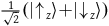 ${1 \over {\sqrt 2 }}\left( {\left| {{ \uparrow _z}\rangle + } \right|{ \downarrow _z}\rangle } \right)$
, it is not an eigenstate of
${1 \over {\sqrt 2 }}\left( {\left| {{ \uparrow _z}\rangle + } \right|{ \downarrow _z}\rangle } \right)$
, it is not an eigenstate of ${\hat \sigma _z}$
, and therefore fails to instantiate any of the
${\hat \sigma _z}$
, and therefore fails to instantiate any of the ${\hat \sigma _z}$
-determinates; it has spin in the
${\hat \sigma _z}$
-determinates; it has spin in the $z$
-direction, but it fails to have any specific value of spin in the
$z$
-direction, but it fails to have any specific value of spin in the $z$
-direction. A state of affairs in which an electron takes on such a state is metaphysically indeterminate in virtue of the fact that no determinate of spin in the
$z$
-direction. A state of affairs in which an electron takes on such a state is metaphysically indeterminate in virtue of the fact that no determinate of spin in the $z$
-direction is instantiated. However, since
$z$
-direction is instantiated. However, since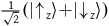 ${1 \over {\sqrt 2 }}\left( {\left| {{ \uparrow _z}\rangle + } \right|{ \downarrow _z}\rangle } \right)$
is an eigenstate of the
${1 \over {\sqrt 2 }}\left( {\left| {{ \uparrow _z}\rangle + } \right|{ \downarrow _z}\rangle } \right)$
is an eigenstate of the ${\hat \sigma _x}$
operator with eigenvalue
${\hat \sigma _x}$
operator with eigenvalue $1$
, an electron in such a state, while indeterminate with respect to spin in the
$1$
, an electron in such a state, while indeterminate with respect to spin in the $z$
-direction, nevertheless instantiates spin in the
$z$
-direction, nevertheless instantiates spin in the $x$
-direction in a particular way: it instantiates the “spin up in the
$x$
-direction in a particular way: it instantiates the “spin up in the $x$
-direction” determinate.
$x$
-direction” determinate.
This way of thinking about property instantiation leads to a natural characterization of the sense in which some quantum mechanical properties precisify others. In particular, we can encode the relative precision of different properties entirely in terms of structure on the set of determinable properties. A determinable ${\hat O_A}$
is a precisification of another
${\hat O_A}$
is a precisification of another ${\hat O_B}$
, which we will write as
${\hat O_B}$
, which we will write as ${\hat O_A} \preceq {\hat O_B}$
, if the eigenspaces of
${\hat O_A} \preceq {\hat O_B}$
, if the eigenspaces of ${\hat O_A}$
are all subspaces of the eigenspaces of
${\hat O_A}$
are all subspaces of the eigenspaces of ${\hat O_B}$
. Thus, for example,
${\hat O_B}$
. Thus, for example, $\hat I$
is precisified by both
$\hat I$
is precisified by both ${\hat \sigma _z}$
and
${\hat \sigma _z}$
and ${\hat \sigma _x}$
, that is,
${\hat \sigma _x}$
, that is, ${\hat \sigma _z} \preceq \hat I$
and
${\hat \sigma _z} \preceq \hat I$
and ${\hat \sigma _x} \preceq \hat I$
, and
${\hat \sigma _x} \preceq \hat I$
, and ${\hat \sigma _z}$
is precisified by
${\hat \sigma _z}$
is precisified by $\left| {{ \uparrow _z}\rangle \langle { \uparrow _z}} \right|$
, while neither
$\left| {{ \uparrow _z}\rangle \langle { \uparrow _z}} \right|$
, while neither ${\hat \sigma _z}$
nor
${\hat \sigma _z}$
nor ${\hat \sigma _x}$
is a precisification of the other. In order to establish the connection to Del Santo and Gisin’s view, we need to generalize this notion of precisification so that it applies to the case of continuous valued determinables like position.
${\hat \sigma _x}$
is a precisification of the other. In order to establish the connection to Del Santo and Gisin’s view, we need to generalize this notion of precisification so that it applies to the case of continuous valued determinables like position.
This can be achieved by treating the quantum mechanical position of a particle in one dimension not as a single determinable property but, rather, as a hierarchy of determinables. Suppose the space in which a particle moves is represented as $\mathbb{R}$
and let
$\mathbb{R}$
and let $P$
be a partition of
$P$
be a partition of $\mathbb{R}$
into intervals. There exists a self-adjoint operator of the form
$\mathbb{R}$
into intervals. There exists a self-adjoint operator of the form ${\hat O_P} = \mathop \sum \nolimits_{A \in P} {\lambda _A}{{\rm{\hat \Pi }}_A}$
where
${\hat O_P} = \mathop \sum \nolimits_{A \in P} {\lambda _A}{{\rm{\hat \Pi }}_A}$
where ${{\rm{\hat \Pi }}_A}$
is the projection onto region
${{\rm{\hat \Pi }}_A}$
is the projection onto region $A$
and each
$A$
and each ${\lambda _A}$
is a distinct real number. Call every such
${\lambda _A}$
is a distinct real number. Call every such ${\hat O_P}$
a region determinable. If a partition
${\hat O_P}$
a region determinable. If a partition $P{\rm{'}}$
is a refinement of the partition
$P{\rm{'}}$
is a refinement of the partition $P$
, then
$P$
, then ${\hat O_{P{\rm{'}}}}$
is a precisification of
${\hat O_{P{\rm{'}}}}$
is a precisification of ${\hat O_P}$
. For example, if
${\hat O_P}$
. For example, if $P$
is the partition of
$P$
is the partition of $\mathbb{R}$
into unit intervals, there is a region determinable associated with
$\mathbb{R}$
into unit intervals, there is a region determinable associated with $P$
given by
$P$
given by
 $${{\hat O}_P} = \mathop \sum \limits_{n \in {\mathbb Z}} n{{{\rm{\hat \Pi }}}_{\left[ {n,n + 1} \right)}}.$$
One refinement of $P$
is the partition
$P$
is the partition $P{\rm{'}}$
which divides each interval in
$P{\rm{'}}$
which divides each interval in $P$
into 10 intervals; its associated region determinable is
$P$
into 10 intervals; its associated region determinable is
 $${{\hat O}_{P'}} = \mathop \sum \limits_{n \in {\mathbb{Z}}} {n \over {10}}{{{\rm{\hat \Pi }}}_{\left[ {{n \over {10}},{{\left( {n + 1} \right)} \over {10}}} \right)}}.$$ ${\hat O_{P{\rm{'}}}}$
is a precisification of
${\hat O_{P{\rm{'}}}}$
is a precisification of ${\hat O_P}$
in the sense that specifying that the particle is located in the interval [0,0.1) is more precise than specifying that it is located in the interval [0,1). A general expression for the class of quantum region determinables associated with refinements of
${\hat O_P}$
in the sense that specifying that the particle is located in the interval [0,0.1) is more precise than specifying that it is located in the interval [0,1). A general expression for the class of quantum region determinables associated with refinements of $P$
of this form is given by
$P$
of this form is given by
 $${{\hat O}_{{P_k}}} = \mathop \sum \limits_{n \in {\mathbb Z}} \left( {{n \over {{{10}^k}}}} \right){{{\rm{\hat \Pi }}}_{\left[ {{n \over {{{10}^k}}},{{n + 1} \over {{{10}^k}}}} \right)}}{\rm{for}} \; k \in {\mathbb Z}.$$
Increasing values of $k$
result in determinables composed of projections onto elements of finer partitions of the line and hence determinables that precisify region determinables generated by smaller values of
$k$
result in determinables composed of projections onto elements of finer partitions of the line and hence determinables that precisify region determinables generated by smaller values of $k$
. As we will show in the next section, the classical analogs of these properties provide the class of determinables required to articulate Del Santo and Gisin’s classical indeterminacy.
$k$
. As we will show in the next section, the classical analogs of these properties provide the class of determinables required to articulate Del Santo and Gisin’s classical indeterminacy.
4. And Back
In the previous section we showed how to capture the phenomenon of quantum indeterminacy by identifying how the theory represents determinable and determinate properties and how it specifies the conditions under which they are instatiated by a particular system at a time. On this approach, indeterminacy occurs whenever a system instantiates a determinable but none of the determinates of that determinable. In addition to providing what we think is a helpful regimentation of what is meant by indeterminacy in the context of quantum mechanics, the generalization of Calosi and Wilson’s approach that we have introduced here has the advantage that it also naturally captures the classical mechanical case. We simply need to specify how the determinables and determinates are represented in classical mechanics and the conditions under which a classical mechanical system instantiates those determinables and determinates.
Before providing our characterization of classical indeterminacy, it will be helpful to express the standard approach to property ascription in classical mechanics using the language of determinables and determinates. The determinable properties of classical mechanics are represented by functions $f:{\cal S} \to \mathbb{R}$
from a phase space
$f:{\cal S} \to \mathbb{R}$
from a phase space ${\cal S}$
to the real numbers
${\cal S}$
to the real numbers $\mathbb{R}$
. The determinates of a determinable
$\mathbb{R}$
. The determinates of a determinable $f$
are the values in its image
$f$
are the values in its image ${\rm{Im}}\left( f \right) \subseteq \mathbb{R}$
. The state of a classical mechanical system at time
${\rm{Im}}\left( f \right) \subseteq \mathbb{R}$
. The state of a classical mechanical system at time $t$
is represented by a point in that system’s phase space
$t$
is represented by a point in that system’s phase space $s\left( t \right) \in {\cal S}$
. The system instantiates a determinable
$s\left( t \right) \in {\cal S}$
. The system instantiates a determinable $f$
if and only if
$f$
if and only if $f$
is defined on
$f$
is defined on ${\cal S}$
, and it instantiates the determinate
${\cal S}$
, and it instantiates the determinate $\lambda \in {\rm{Im}}\left( f \right)$
if and only if
$\lambda \in {\rm{Im}}\left( f \right)$
if and only if $f\left( {s\left( t \right)} \right) = \lambda $
. On this standard approach to classical mechanical property ascription, there is no indeterminacy: fixing a state
$f\left( {s\left( t \right)} \right) = \lambda $
. On this standard approach to classical mechanical property ascription, there is no indeterminacy: fixing a state $s\left( t \right)$
uniquely determines which determinate of each determinable is instantiated.
$s\left( t \right)$
uniquely determines which determinate of each determinable is instantiated.
One can introduce indeterminacy into this standard property ascription scheme by expanding the space of determinables and modifying the condition for determinate instantiation. In the case of a particle moving in one dimension the requisite additional determinables can be constructed from the characteristic functions on the intervals we used to partition the line in the quantum mechanical case:
 $${\chi _{n,k}}\left( {s\left( t \right)} \right) = \left\{ {\matrix{ 1 \hfill & {{\rm{if}}\; s\left( t \right) \in \left[ {{n \over {{{10}^k}}},{{n + 1} \over {{{10}^k}}}} \right)} \hfill \cr 0 \hfill & {{\rm{otherwise}}} \hfill \cr } } \right.$$
The region determinables are then given by:
 $${X_k}\left( {s\left( t \right)} \right) = \mathop \sum \limits_{n \in {\mathbb Z}} {n \over {{{10}^k}}}{\chi _{n,k}}\left( {s\left( t \right)} \right)$$
The observables of classical mechanics are standardly assumed to be represented by smooth functions and so unlike in the quantum mechanical case, we are adding new determinables to the theory. To express the alternative determinate instantiation condition we need to introduce a precisification relation between classical determinables: a classical determinable $f$
is a precisification of
$f$
is a precisification of $g$
,
$g$
, $f \preceq g$
, if for any
$f \preceq g$
, if for any $\lambda \in {\rm{Im}}\left( f \right)$
, there is some
$\lambda \in {\rm{Im}}\left( f \right)$
, there is some $\tau \in {\rm{Im}}\left( g \right)$
such that
$\tau \in {\rm{Im}}\left( g \right)$
such that ${f^{ - 1}}\left( \lambda \right) \subseteq {g^{ - 1}}\left( \tau \right)$
. If
${f^{ - 1}}\left( \lambda \right) \subseteq {g^{ - 1}}\left( \tau \right)$
. If $k{\rm{'}} \gt k$
, then we have that
$k{\rm{'}} \gt k$
, then we have that ${X_{k{\rm{'}}}} \preceq {X_k}$
which captures the intuitive idea that being located in an interval which is contained in another interval is a more precise way of being located than being located in the containing interval.
${X_{k{\rm{'}}}} \preceq {X_k}$
which captures the intuitive idea that being located in an interval which is contained in another interval is a more precise way of being located than being located in the containing interval.
This precisification relation introduces a partial ordering on the set of classical determinables ${\cal D}$
. There are different ways to cut this order into disjoint upper and lower sets of determinables containing the more and less precise determinables, respectively. A cut of the partial order
${\cal D}$
. There are different ways to cut this order into disjoint upper and lower sets of determinables containing the more and less precise determinables, respectively. A cut of the partial order $\langle {\cal D}, \preceq \rangle $
is a partition
$\langle {\cal D}, \preceq \rangle $
is a partition $\langle L,U\rangle $
of
$\langle L,U\rangle $
of ${\cal D}$
such that for all
${\cal D}$
such that for all $f \in L$
and
$f \in L$
and $g \in U$
,
$g \in U$
, $f \preceq g$
. Classical indeterminacy is introduced by stipulating the existence of a time-dependent precision cut
$f \preceq g$
. Classical indeterminacy is introduced by stipulating the existence of a time-dependent precision cut $\pi \left( t \right) = \langle L\left( t \right),U\left( t \right)\rangle $
which distinguishes which determinables have determinates instantiated and which determinables do not. In particular, suppose we stipulate that a system in state
$\pi \left( t \right) = \langle L\left( t \right),U\left( t \right)\rangle $
which distinguishes which determinables have determinates instantiated and which determinables do not. In particular, suppose we stipulate that a system in state $s\left( t \right)$
instantiates the determinate
$s\left( t \right)$
instantiates the determinate $\lambda $
of the determinable
$\lambda $
of the determinable $f$
at time
$f$
at time $t$
if and only if
$t$
if and only if $f \in U\left( t \right)$
and
$f \in U\left( t \right)$
and $f\left( {s\left( t \right)} \right) = \lambda $
. Then the system will exhibit determinacy with respect to all of the determinables in
$f\left( {s\left( t \right)} \right) = \lambda $
. Then the system will exhibit determinacy with respect to all of the determinables in $U\left( t \right)$
, but it will exhibit indeterminacy with respect to all of the determinables in
$U\left( t \right)$
, but it will exhibit indeterminacy with respect to all of the determinables in $L\left( t \right)$
.
$L\left( t \right)$
.
These modifications to the property ascription scheme of classical mechanics are sufficient to recover the classical indeterminacy of Del Santo and Gisin. To see this note that having determinate values only for the first $N\left( t \right)$
digits of
$N\left( t \right)$
digits of ${\rm{\Gamma }}$
is equivalent to the claim the most precise location fact about the particle is that it is located in a particular interval of width
${\rm{\Gamma }}$
is equivalent to the claim the most precise location fact about the particle is that it is located in a particular interval of width ${10^{ - \left( {N\left( t \right) - m} \right)}}$
. In particular, Del Santo and Gisin say that the value of
${10^{ - \left( {N\left( t \right) - m} \right)}}$
. In particular, Del Santo and Gisin say that the value of ${\rm{\Gamma }}$
is
${\rm{\Gamma }}$
is $\gamma = {\gamma _1}{\gamma _2} \ldots {\gamma _m}.{\gamma _{m + 1}} \ldots {\gamma _{N\left( t \right)}}$
exactly when the most precise location fact about the particle is that is located in the interval
$\gamma = {\gamma _1}{\gamma _2} \ldots {\gamma _m}.{\gamma _{m + 1}} \ldots {\gamma _{N\left( t \right)}}$
exactly when the most precise location fact about the particle is that is located in the interval $\left[ {\gamma, \gamma + {{10}^{ - \left( {N\left( t \right) - m} \right)}}} \right)$
, which occurs if and only if
$\left[ {\gamma, \gamma + {{10}^{ - \left( {N\left( t \right) - m} \right)}}} \right)$
, which occurs if and only if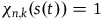 ${\chi _{n,k}}\left( {s\left( t \right)} \right) = 1$
for
${\chi _{n,k}}\left( {s\left( t \right)} \right) = 1$
for $n = \gamma \cdot {10^{N\left( t \right) - m}}$
and
$n = \gamma \cdot {10^{N\left( t \right) - m}}$
and $k = N\left( t \right) - m$
. If one generates the precision cut
$k = N\left( t \right) - m$
. If one generates the precision cut $\pi \left( t \right)$
so that
$\pi \left( t \right)$
so that ${X_k}$
is the most precise region determinable in
${X_k}$
is the most precise region determinable in $U\left( t \right)$
, then
$U\left( t \right)$
, then ${X_k}\left( {s\left( t \right)} \right) = {\gamma _1}{\gamma _2} \ldots {\gamma _m}.{\gamma _{m + 1}} \ldots {\gamma _{N\left( t \right)}}000 \ldots $
is the instantiated determinate associated with the most precise region determinable above the cutoff. This is how our revised property ascription scheme for classical mechanics recovers the classical indeterminacy of Del Santo and Gisin.
${X_k}\left( {s\left( t \right)} \right) = {\gamma _1}{\gamma _2} \ldots {\gamma _m}.{\gamma _{m + 1}} \ldots {\gamma _{N\left( t \right)}}000 \ldots $
is the instantiated determinate associated with the most precise region determinable above the cutoff. This is how our revised property ascription scheme for classical mechanics recovers the classical indeterminacy of Del Santo and Gisin.
If one generates the precision cut $\pi \left( t \right)$
in a way that makes
$\pi \left( t \right)$
in a way that makes ${X_k}$
the most precise determinable in the upper set, then
${X_k}$
the most precise determinable in the upper set, then $\gamma $
, understood as a rational number, is the numerical label of the instantiated determinate associated with the most precise determinable above the cutoff. This is the sense in which our revised property ascription scheme for classical mechanics recovers the classical indeterminacy of Del Santo and Gisin.
$\gamma $
, understood as a rational number, is the numerical label of the instantiated determinate associated with the most precise determinable above the cutoff. This is the sense in which our revised property ascription scheme for classical mechanics recovers the classical indeterminacy of Del Santo and Gisin.
Having treated quantum and classical indeterminacy as instances of the same general phenomenon of metaphysical indeterminacy, we now will argue that there is an important difference in kind between these two instances of metaphysical indeterminacy: classical indeterminacy can be consistently filled in, whereas quantum indeterminacy cannot. The distinction at issue here is the distinction between shallow and deep indeterminacy established in (Skow Reference Skow2010). Cashed out in terms of determinables and determinates, an indeterminate state of affairs exhibits shallow indeterminacy if one can consistently assign determinates to each of the determinables that exhibits indeterminacy. It exhibits deep indeterminacy if any attempt to fill in determinates yields a valuation which is inconsistent with the prediction of the theory.
The fact that quantum indeterminacy is deep follows from the Kochen-Specker theorem. The theorem states that under mild conditions, quantum mechanics does not admit of a non-contextual, value definite, hidden variable theory. In the language of determinables and determinates this means that there is no way to assign a unique determinate to each determinable in a way that preserves the predictions of quantum mechanics: quantum states of affairs necessarily involve metaphysical indeterminacy and cannot be filled in to restore metaphysical determinacy without altering the predictions of the theory. The structural feature of quantum mechanics responsible for this result is the representation of determinables as Hilbert space operators. This introduces functional relationships between the assignments of determinates to the determinables which prevent the assignment of a unique determinate to each determinable without changing the predictions of the theory. In the case of classical mechanical determinables there are no such functional constraints and so the classical indeterminacy we have introduced can be filled in without changing the predictions of the theory. This makes classical indeterminacy shallow rather than deep.
We are now in a position to complete our evaluation of Del Santo and Gisin’s package of claims. We have shown that their concept of classical indeterminacy can be integrated into the standard property ascription scheme of classical mechanics by expanding the space of determinables and modifying the condition for determinate instantiation. We have also shown that while there is a sense in which real number values can be thought of as hidden variables for indeterminate classical quantities, these hidden variables are importantly different from hidden variables for indeterminate quantum mechanical quantities. The approach to classical indeterminacy we have developed here does not involve a modification to the dynamics of classical mechanics and so even when modified to exhibit indeterminacy, the theory will still be deterministic. To arrive at a version of classical mechanics that exhibits indeterminism, Del Santo and Gisin must modify the dynamics to incorporate the propensities for the indeterminate digits to take on a particular determinate value. The situation is similar for their claim about the classical measurement problem: the underlying dynamics will remain deterministic unless they introduce an explicit modification that determines how systems evolve during a measurement which is indeterministic.
5. Conclusion
We employed a theory independent characterization of indeterminacy to express both quantum and classical indeterminacy as instances of the same phenomenon. This allowed for an appraisal of the package of claims argued for by Del Santo and Gisin. While many of our conclusions have been critical, their view raises important matters of principle about the status of observables characterized with real number precision, and the relationship of full precision to the determinacy of physical quantities. By characterizing precisification as a relation on a set of determinables, we have developed the requisite conceptual tool for developing a systematic theory of the relationship between precision and determinacy.
Acknowledgments
The authors are grateful to Flavio del Santo and Nicolas Gisin for helpful discussions.
Funding information
This work was supported by grants from the Social Sciences and Humanities Research Council of Canada and the Centre National de la Recherche Scientifique.

 Open access

