




Crossref Citations

This article has been cited by the following publications. This list is generated based on data provided by Crossref.
Wang, Han
and
Bühler, Oliver
2021.
Anisotropic Statistics of Lagrangian Structure Functions and Helmholtz Decomposition.
Journal of Physical Oceanography,
Vol. 51,
Issue. 5,
p.
1375.
Young, William R.
2021.
Inertia-gravity waves and geostrophic turbulence.
Journal of Fluid Mechanics,
Vol. 920,
Issue. ,
Li, Ziyi
Wei, Junhong
Bao, Xinghua
and
Sun, Y. Qiang
2023.
Intercomparison of tropospheric and stratospheric mesoscale kinetic energy resolved by the high‐resolution global reanalysis datasets.
Quarterly Journal of the Royal Meteorological Society,
Vol. 149,
Issue. 757,
p.
3738.
Kouhen, Salah
Storer, Benjamin A.
Aluie, Hussein
Marshall, David P.
and
Christensen, Hannah M.
2024.
Convective and Orographic Origins of the Mesoscale Kinetic Energy Spectrum.
Geophysical Research Letters,
Vol. 51,
Issue. 21,
Zhang, Wei
Peng, Jun
Zhang, Weimin
Li, Zongheng
and
Wu, Hanyan
2024.
The Rotational and Divergent Kinetic Energy Spectra of Geostrophic Vortices and Inertia‐Gravity Waves.
Journal of Geophysical Research: Atmospheres,
Vol. 129,
Issue. 7,
Li, Zongheng
Peng, Jun
Zhang, Lifeng
Wu, Hanyan
Zhang, Wei
and
Zhu, Juan
2025.
Exploring the differences in atmospheric mesoscale kinetic energy spectra between AI based and physics based models.
Scientific Reports,
Vol. 15,
Issue. 1,
1 Introduction
For the last few decades, the shape of the atmospheric mesoscale kinetic energy spectrum has presented a mystery. Nastrom & Gage (Reference Nastrom and Gage1985) found that the spectrum has a double power law: at large scales, the spectral slope is -3 in agreement with quasi-geostrophic (QG) turbulence theory; but in the mesoscale, from scales of a few to a few hundred kilometres, the spectrum shallows to - 5/3. This slope suggests an energy cascade, but what kind of cascade? Not isotropic three-dimensional turbulence: mesoscale flows are anisotropic due to stratification, rotation and small aspect ratio. But the mesoscale is also not two-dimensional, since vertical shear is strong. The challenge of explaining the mesoscale spectrum has inspired a significant amount of research on rotating–stratified turbulence, and is a major unresolved problem in geophysical turbulence. This problem has practical implications: the small-scale end of this cascade is not resolved in numerical weather prediction models, and therefore part of the cascade must be parameterized. But parameterizations require an understanding of the dynamics, which is lacking.
The atmosphere, as a rotating stratified fluid, has two distinct linear modes of motion: inertia–gravity waves and vortices. Waves have high frequencies and divergent horizontal velocities; vortices evolve more slowly and, at least in a linear sense on an $f$-plane, have purely rotational horizontal velocity. Hypotheses for the mesoscale cascade include waves (Dewan Reference Dewan1979), stratified (Lilly Reference Lilly1983) and QG (Tulloch & Smith Reference Tulloch and Smith2009) vortices and stratified turbulence (Lindborg Reference Lindborg2006). While observations indicate that the energy cascade is downscale at scales below 100 km (Lindborg & Cho Reference Lindborg and Cho2001), the cascade mechanism is still not fully understood. To evaluate the proposed theories, it is necessary to decompose the mesoscale spectrum into contributions from waves and vortices. But how?
Linear methods for identifying waves and vortices include Helmholtz decomposition of the horizontal velocity and separation of the velocity and temperature into wave and vortical modes (e.g. Bartello Reference Bartello1995). Linear decompositions of the mesoscale spectrum have been performed with models (e.g. Skamarock & Klemp Reference Skamarock and Klemp2008) and one-dimensional aircraft data (Callies, Bühler & Ferrari Reference Callies, Bühler and Ferrari2016; Li & Lindborg Reference Li and Lindborg2018). These studies show that the mesoscale energy spectrum has a comparable level of (linear) wave and vortical energy in the upper troposphere, which seems to rule out a cascade based entirely on waves. By contrast, waves dominate over vortices in the lower stratosphere. However, because of the linearity of these decompositions, the conclusions are not so clear. Even QG vortices have a small balanced ageostrophic flow, which linear methods incorrectly attribute to waves. Deep in the mesoscale, the distinction between linear and nonlinear waves and vortices is even greater. At small but finite Rossby number, techniques for nonlinearly decomposing flows into waves and vortices include the omega equation, which yields the QG ageostrophic velocity (e.g. Hoskins, Draghici & Davies Reference Hoskins, Draghici and Davies1978), and more sophisticated approaches like nonlinear normal mode initialization (e.g. Kafiabad & Bartello Reference Kafiabad and Bartello2016). These methods work well on model output, but there are issues with mesoscale spectra in models, including dependence on vertical resolution (Waite Reference Waite2016). As a result, there is a need to apply such nonlinear methods to observations.
2 Overview
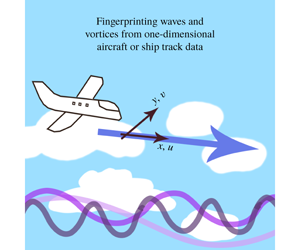
Wang & Bühler (Reference Wang and Bühler2020) present a first attempt at a nonlinear wave–vortex decomposition of spectra from one-dimensional aircraft data. This paper builds on earlier linear work (Bühler, Callies & Ferrari Reference Bühler, Callies and Ferrari2014; Callies et al. Reference Callies, Bühler and Ferrari2016) to determine how much of the linear wave energy in the mesoscale spectrum is actually due to vortices. In doing so, this paper tackles a key ambiguity of the linear work: is the equipartition of wave and vortical energy in the upper troposphere real, or is it an artifact of the linear decomposition? The authors derive a statistical omega equation that computes the energy spectrum of the QG ageostrophic flow, and adapts it for use with one-dimensional aircraft data. This is no easy task! With this nonlinear correction, their approach properly attributes the energy of the QG ageostrophic motion to vortices rather than waves. After overcoming some theoretical and computational challenges, the authors apply their method to synthetic and real atmospheric data.
The omega equation is a Poisson equation for the potential of the QG ageostrophic velocity. A spectral omega equation is derived assuming independence of Fourier modes. Application to one-dimensional aircraft data requires additional assumptions, since velocities are only known along a single horizontal track and there is no information about vertical gradients. These challenges are overcome by assuming horizontal isotropy and a simple vertical structure. This last assumption is the most severe: the authors assume that the vertical structure is due to a single vertical mode. With these assumptions they can, in principle, solve for the energy spectrum of the ageostrophic QG flow. Numerical solution presents challenges in the presence of noise, which are overcome with a careful formulation of the equations. Finally, the authors apply their method to two datasets, MOZAIC (Nastrom & Gage Reference Nastrom and Gage1985) and START08 (Zhang et al. Reference Zhang, Wei, Zhang, Bowman, Pan, Atlas and Wofsy2015). They try a range of vertical modes to check the dependence of their results on the assumed vertical wavelength.
Vortical and wave energy spectra in the (a) lower stratosphere and (b) upper troposphere using the linear (solid) and nonlinear (dashed) decompositions. Spectra are wave (red), vortical (blue), total (green) and ageostrophic QG (magenta). The assumed vertical structure is the fourth baroclinic mode, and the associated deformation wavenumber is indicated with the vertical line. Adapted from Wang & Bühler (Reference Wang and Bühler2020).
The nonlinear correction has a different impact on the energy spectra at different levels. In the lower stratosphere, the nonlinear effect is tiny: the mesoscale energy spectrum is dominated by waves with and without the nonlinear correction (figure 1a). This finding is not particularly surprising, since the QG ageostrophic energy is diagnosed to be much smaller than the total energy. Reclassifying this small amount of wave energy as vortical has a negligible effect on the wave spectrum. By contrast, the nonlinear correction has a more significant effect on spectra in the upper troposphere. The effect depends on the assumed vertical structure, and is greatest for the largest mode number considered (figure 1b). Near the deformation wavenumber, the nonlinear correction reclassifies a significant amount of linear wave energy as vortical, and transforms the approximate equipartition of linear wave and vortical energy into a spectrum dominated by vortices. Equipartition recovers at smaller scales and persists down to scales of around 10 km.
3 Future
The picture of the mesoscale spectrum in the lower stratosphere is increasingly clear: waves dominate the spectrum, and Wang & Bühler (Reference Wang and Bühler2020) have shown that this interpretation is robust to nonlinear effects. But the situation in the upper troposphere is still not resolved. While the authors are cautious about making broad interpretations here, the evidence does seem to point away from a wave-based cascade. The nonlinear decomposition shows a spectrum dominated by vortices at large scales when the assumed vertical mode number is large, possibly transitioning to equipartition of wave and vortical energy at smaller scales. The sensitivity of this equipartition to nonlinear effects is unclear and needs further analysis. Equipartition is an important result because it suggests that the underlying dynamics may be something other than waves and vortices, such as stratified turbulence, that projects onto both kinds of motion. Does equipartition hold at small scales when nonlinear effects are computed with a more realistic vertical structure? More work is required to say for sure.
The authors have made an ambitious effort to extract nonlinear information from one-dimensional aircraft data. Further progress requires knowledge of three-dimensional structures, which is missing from such data. Numerical simulations can help with this. While there are several idealized numerical studies on this topic (e.g. Deusebio, Vallgren & Lindborg Reference Deusebio, Vallgren and Lindborg2013; Kafiabad & Bartello Reference Kafiabad and Bartello2016), there is a need for well-resolved numerical weather prediction model simulations of the mesoscale energy cascade near the tropopause. Comparison of atmospheric and model data, coupled with nonlinear decompositions such as that described by Wang & Bühler (Reference Wang and Bühler2020), may finally lead to a definitive explanation for the cascade in the upper troposphere.
Declaration of interests
The authors report no conflict of interest.