


Socio-economic differences in diet have been reported in all age groups. Previous studies conducted in developed countries, focusing on childrenReference Cooke, Wardle, Gibson, Sapochnik, Sheiham and Lawson1, adultsReference De Irala-Estevez, Groth, Johansson, Oltersdorf, Prattala and Martinez-Gonzalez2–Reference Groth, Fagt and Brondsted7 or elderly peopleReference Van Rossum, van de Mheen, Witteman, Grobbee and Mackenbach8, have demonstrated associations particularly between fruit, vegetable, meat and fat consumption, on one hand, and different socio-economic indicators, on the other. These former findings generally supported the presumption that people from higher socio-economic classes have higher intakes of healthy foods, such as fruit and vegetables, and at the same time lower intakes of foods related to dietary habits supposed to be less healthy, such as meat and fat.
Various measures of socio-economic position have been applied to investigate their association with food and nutrient intake, including education, occupation and income. The majority of these studies were performed using only one single variable as an indicator of socio-economic status or using more socio-economic determinants, but failing to assess the independent contribution of each indicator. Two previous investigations demonstrated that education, occupation and income may affect food consumption in different ways due to different underlying social processes and thus do not serve as adequate proxies for one anotherReference Turrell, Hewitt, Patterson and Oldenburg9, Reference Galobardes, Morabia and Bernstein10. Therefore, they highlighted the need for multiple indicator approaches coupled with simultaneous adjustment, so that the independent associations with food intake can be seen. The potential independence of socio-economic indicators was also confirmed by results of a large survey carried out in Germany that showed relatively weak correlations between income and education and between income and occupation, respectivelyReference Geyer and Peter11.
Studies in children examining the relationship between socio-economic status and intake of single food items are in general scarce. As far as we know, they also have never used multiple indicator approaches. Thus, our aim in the present study was to determine whether there are differences by parental education and income in food intake among 2-year-old children and whether or not the influence of both socio-economic indicators is independent.
Methods
Subjects
We analysed data from the LISA Study on ‘Influences of lifestyle-related factors on the immune system and the development of allergies in childhood’. The design and objective of this prospective birth cohort study have been described in detail elsewhereReference Heinrich, Bolte, Holscher, Douwes, Lehmann and Fahlbusch12. In brief, 3097 newborns were initially recruited between November 1997 and January 1999 in the four German cities of Munich, Leipzig, Wesel and Bad Honnef. Data on lifestyle factors, including socio-economic status and diet, were collected by repeated parental-completed questionnaires at regular time intervals during the first two years (6, 12, 18 and 24 months of child's age).
The analysis presented in this paper is based on 2664 subjects who participated in the follow-up after 2 years (86% of the baseline population) between 1999 and 2001. From those, we excluded children without information about parental education (n = 27). Equivalent income could not be calculated in 281 cases (10.7%), but subjects were not excluded from the analysis. Thus, the final study population consisted of 2637 children.
The local ethics committees approved the study protocol, and informed consent was obtained from the parents.
Dietary assessment
Data on dietary intake were gathered by means of a semi-quantitative food-frequency questionnaire. In terms of fruit and vegetable consumption, parents estimated the child's habitual intake during the last six months using a 7-point scale comprising the following categories: several times a day, (almost) daily, several times a week, about once a week, two to three times a month, once in a month or less, (almost) never. Information on milk consumption was derived from the questions ‘Does your child drink milk?’ and ‘If yes, how much?’ The following categories were given: more than two cups per day, two cups per day, one cup per day, less than one cup per day, no milk. The intake of butter, margarine, vegetable oils, cream, mayonnaise and processed salad dressing was evaluated from questions on the use of these foods for meal preparation at home and was reported as: (almost) daily, several times a week, about once a week, two to three times a month, once a month or less, (almost) never.
Socio-economic status
Parental education was determined based on information about school education according to the German educational system, and was defined by the highest grade completed by either the mother or the father. Thus, children were assigned to the group of low (less than 10th grade), medium (10th grade) or high (more than 10th grade) level of parental education.
Net household income per month was reported on an 11-point scale ranging from less than 511 € to more than 3068 €. Because the income levels were originally reported in DM, their conversion into Euro generated these odd-numbered income limits. As this income measure does not account for the total number of household members and consequently does not reflect the actual amount that is available for each person, adjustment for family size and family composition was needed. The calculation of equivalent income according to the new OECD (Organisation for Economic Cooperation and Development) guidelinesReference Hauser13 was performed by dividing the net household income by an equivalence factor, which gives a weight of 1.0 to the first adult, 0.5 to all other adult persons and children above 14 years, and 0.3 to all children upto 14 years. As income was measured categorically, we took the mid-point of each income class to calculate the income level. For the lowest income level (less than 511 €) we calculated two-thirds of this limit, and for the highest income level (more than 3068 €) four-thirds, as done previouslyReference Mackenbach, Martikainen, Looman, Dalstra, Kunst and Lahelma14. Finally, the new variable was collapsed into three groups each containing approximately an equal number of subjects. This resulted in the following groups of equivalent income: 160 €–913 € (low), 914 €–1339 € (medium), 1340 €–3146 € (high).
Statistical methods
Food frequency variables were transformed into dichotomous variables by first computing quintiles for each food item. Subsequently, the four upper quintiles (Q2–Q5) were pooled. If there were more than 20% of children in the lowest intake category, this procedure was not possible and the lower four quintiles (Q1–Q4) were summarised. Thus, we contrasted either low intake (Q1) (in terms of fresh fruit, salad and raw vegetables, cooked vegetables, milk, butter, sunflower oil, olive oil and cream) versus higher intake (Q2–Q5), or high intake (Q5) (in terms of canned vegetables or fruit, margarine, rape oil, safflower oil, hardened vegetable fat, mayonnaise, processed salad dressing and yoghurt for dressings) against lower intake (Q1–Q4). This kind of classification was carried out because it allowed comparing children with common food intake (about 80% of the study population) to children with uncommon food intake (about 20% of the study population).
Depending on the intake distribution of each food item, low intake (Q1) and high intake (Q5) each referred to different consumption frequencies. Q1 is corresponding to food consumption not exceeding ‘several times a week’ (fresh fruit), ‘two to three times a month’ (salad and raw vegetables, cooked vegetables, cream), ‘once in a month or less’ (butter), ‘(almost) never’ (sunflower oil, olive oil) or ‘less than one cup per day’ (milk). Concerning high intake, Q5 includes children who consumed foods at least ‘(almost) daily’ (margarine), ‘once a week’ (canned vegetables or fruit, yoghurt for dressing), ‘two to three times a month’ (safflower oil, hardened vegetable fat, mayonnaise, processed salad dressing) or ‘once in a month or less’ (rape oil).
The relationship of food intake with parental education and equivalent income was first examined via contingency table analysis. In addition, the association between equivalent income and food intake was estimated for each group of parental education. For this specific analysis, low and medium levels of parental education were pooled, due to small numbers in the group of low parental education. The Cochran–Armitage test for trend was used to test for linear trends in food intake across categories of both parental education and equivalent income.
We further applied multiple logistic regression analyses to investigate the association of parental education and equivalent income with food intake. Odds ratios (OR) with corresponding 95% confidence intervals (CI) were computed for three different models. First, we examined the crude association of food intake with parental education and equivalent income. Then we calculated these effects adjusted for study area (Munich/Leipzig/Wesel and Bad Honnef), and finally we applied a model that simultaneously adjusted for study area and both socio-economic indicators. For each socio-economic variable the highest group (high parental education/high equivalent income) was used as reference category. An independent influence on food intake was presumed if at least in one group the effect estimate was statistically significant, and if the effect estimates showed the same direction across all categories of socio-economic status.
We additionally analysed the effect when maternal education was included in the model instead of parental education.
The correlation coefficient between parental education and equivalent income was 0.43. Thus, there should be no concern to include both variables in one model.
All computations were performed using the statistical analysis package SAS for Windows version 8.2 (SAS Institute, Cary, NC, USA). Two-sided P-values < 0.05 were considered statistically significant for all analyses.
Results
Characteristics of the study population
Among 2637 children included in the present analysis, equivalent income could not be calculated for 281 subjects (10.7%). No significant differences in mean maternal age at delivery (31.3 vs. 31.7 years; P = 0.15), living together with a partner (94.6 vs. 93.0%; P = 0.26), being a single parent (8.5 vs. 9.6%; P = 0.54), being married (81.8 vs. 85.3%; P = 0.16) and high level of parental education (67.8 vs. 67.6%; P = 0.94) could be observed between those who reported household income and those who did not. Those who answered the questions on household income had slightly fewer household members (3.7 vs. 3.8; P = 0.005) and were slightly less likely to have a childminder (92.5 vs. 96.1%; P = 0.03).
Table 1 shows the socio-economic characteristics of the study population according to study area. Altogether, 50.1 and 29.7% of all children lived in the urban areas of Munich (West Germany) and Leipzig (East Germany), respectively, while the rest lived in the more rural areas of Wesel and Bad Honnef (both West Germany). High levels of parental education were seen more often in the study area of Munich (79.4%) than in the areas of Leipzig (53.1%) and Wesel/Bad Honnef (60.7%). Similarly, high income was most prevalent in Munich (49.2%) in contrast to Leipzig (16.7%) and Wesel/Bad Honnef (23.7%).
Socio-economic characteristics of the study population according to study area

* Low – 160 €–913 €; medium – 914 €–1339 €; high – 1340 €–3146 €.
Food intake also varied between East and West Germany, in particular between Leipzig and Munich. We observed statistically significant higher intakes of cream, butter, olive oil, safflower oil and hardened vegetable fat in Munich than in Leipzig (data not shown). Parents in Leipzig in turn more frequently indicated a high intake of fresh fruit, cooked vegetables, milk, canned vegetables or fruit, margarine and processed salad dressing.
Association between food intake and level of parental education
Table 2 shows the proportion of children in the intake categories of selected food items by level of parental education. We observed some significant linear trends: with increasing parental education, low intake of fresh fruit, cooked vegetables and butter decreased. The percentage of children with high intakes of margarine, mayonnaise and processed salad dressing also decreased with increasing parental education.
Consumption frequencies of selected food items according to level of parental education

* Cochran–Armitage trend test.
† Q1 – lowest quintile of consumption distribution; Q5 – highest quintile of consumption distribution.
Education also seemed to have a great impact on olive oil consumption, as low intake was reported more than twice as often in the group of low or medium level of parental education than by highly educated parents. Further, significant parental educational differences were observed for the intake of cream, canned vegetables or fruit, safflower oil and hardened vegetable fat. According to the P-value for the trend test, these associations were indeed significant but the trend direction not that clear.
Association between food intake and equivalent income
Equivalent income also affected the consumption of many individual food items (Table 3). Subjects less likely reported low intakes of fresh fruit, cooked vegetables, cream, butter and olive oil, and high intakes of canned vegetables or fruit, margarine, mayonnaise and processed salad dressing, when equivalent income increased. High intake of safflower oil emerged to be more prevalent in medium- and high-income families than in low-income families.
Consumption frequencies of selected food items according to equivalent income

* Low – 160 €–913 €; medium – 914 €–1339 €; high – 1340 €–3146 €.
† Cochran–Armitage trend test.
‡ Q1 – lowest quintile of consumption distribution; Q5 – highest quintile of consumption distribution.
Association of food intake and equivalent income according to level of parental education
Stratification of the association between food intake and equivalent income by level of parental education again showed some significant associations (Table 4).
Consumption frequencies of selected food items according to level of parental education and equivalent income

* Lower – low and medium level of parental education.
† Low – 160 €–781 €; medium – 782 €–1034 €; high – 1035 €–3146 €.
‡ Low – 182 €–1065 €; medium – 1066 €–1562 €; high – 1563 €–3146 €.
§ Cochran–Armitage trend test.
¶ Q1 – lowest quintile of consumption distribution; Q5 – highest quintile of consumption distribution.
While in the group of lower parental education the percentage of children with low intake of fresh fruit and cooked vegetables decreased with increasing equivalent income, no significant influence of equivalent income could be assessed in children of higher educated parents.
Irrespective of parental education, positive relationships emerged between equivalent income and intake of cream and olive oil, while the association with intake of canned vegetables or fruit, and margarine was negative. Each of these associations was similarly strong in both education groups, except for margarine, where the influence of income seemed to be substantially stronger in children of highly educated parents.
Some significant income differences in food intake were restricted to children with high parental education. In terms of low butter intake, a linear trend was shown to decrease with increasing equivalent income, whereas for the intake of sunflower oil an inverse association could be demonstrated. Moreover, children from the low-income group tended to consume more mayonnaise and processed salad dressing than did children in the high-income group.
Logistic regression analysis
The crude and adjusted OR calculated for the associations between food intake, on one hand, and level of parental education and equivalent income, on the other, are presented in Tables 5 and 6, respectively. Only the significant relationships are discussed here in more detail. Overall, most of the associations identified by contingency tables were confirmed in multivariate analysis.
Logistic regression results describing the association between food consumption and level of parental education

OR – odds ratio; CI – confidence interval.
* Reference category.
† Q1 – lowest quintile of consumption distribution; Q5 – highest quintile of consumption distribution.
‡ Crude OR.
§ OR adjusted for study area.
¶ OR adjusted for study area and equivalent income.
Logistic regression results describing the association between food consumption and equivalent income

OR – odds ratio; CI – confidence interval.
* Reference category; low – 160 €–913 €; medium – 914 €–1339 €; high – 1340 €–3146 €.
† Q1 – lowest quintile of consumption distribution; Q5 – highest quintile of consumption distribution.
‡ Crude OR.
§ OR adjusted for study area.
¶ OR adjusted for study area and equivalent income.
Low intake of fresh fruit, cooked vegetables and butter, and at the same time high intake of margarine and mayonnaise, steadily increased with decreasing levels of parental education when considering unadjusted effects. The risk estimates for intake of cream, olive oil, canned vegetables or fruit, hardened vegetable fat and processed salad dressing differed significantly between levels of parental education, but without a clear linear relationship. In terms of milk consumption, it turned out that children with low parental education had significantly decreased intakes compared with children of highly educated parents.
Study area was shown to have a weak influence on the consumption of fresh fruit, cooked vegetables, butter, mayonnaise and processed salad dressing, but a very strong one on the intake of cream, olive oil, canned vegetables and margarine, even though not consistent across all levels of parental education. Indeed, risk estimates diminished but remained statistically significant. Even after adjusting for equivalent income, the majority of risk estimates became only slightly smaller; the effects of parental education on butter intake attenuated to non-significance.
When analysing the influence of maternal education on food intake, trends across the levels of maternal education were more stable compared with parental education. For foods such as fresh fruit, milk, cream, hardened vegetable fat and processed salad dressing, the OR increased and became partially significant. For other foods the effect estimates decreased slightly, but none of the associations changed their direction.
The adjusted effects of equivalent income showed that low intake of fresh fruit, cooked vegetables, butter and olive oil, and high intake of margarine, steadily increased with decreasing equivalent income. In terms of high intake of canned vegetables or fruit, mayonnaise and processed salad dressing, a slight tendency to rise across declining levels of equivalent income could also be detected, but the strength of associations was weak and hence the conclusion less clear.
Discussion
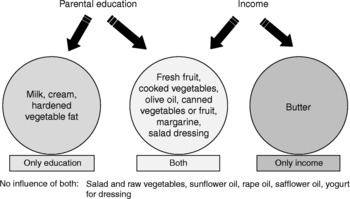
The results of the present study suggest that both parental education and equivalent income affect the intake of certain food items in 2-year-old children. As summarised in Fig. 1, the intake of fresh fruit, cooked vegetables, olive oil, canned vegetables or fruit, margarine, mayonnaise and processed salad dressing seemed to be influenced by parental education and equivalent income in a similar manner. Parental education turned out to be the only independent predictor for the intake of milk, cream and hardened vegetable fat, while an independent influence of equivalent income alone could be observed for butter intake.
Summary of the influence of parental education and equivalent income on food intake
In the past, a few studies have been conducted describing the relationship between socio-economic determinants and childhood nutrition. A study carried out in Germany, being part of the World Health Organization's cross-sectional survey HBSC (Health Behaviour in School-Aged Children), analysed this association in 11- to 15-year-old childrenReference Klocke, Kohler, Feichtinger, Barlosius and Dowler15. They observed that the impact of social situation was particularly strong for healthy foods, such as raw vegetables, fruit and whole wheat bread. Apart from studies that applied principal components analysisReference Weber Cullen, Baranowski, Rittenberry, Cosart, Owens and Hebert16, Reference North and Emmett17 or determined the degree of compliance with dietary recommendationsReference Serra-Majem, Ribas, Perez-Rodrigo, Garcia-Closas, Pena-Quintana and Aranceta18, Reference Watt, Dykes and Sheiham19, other researchers have primarily paid attention to the socio-economic status of the mother, particularly maternal education. For example, in a Spanish study investigating the association between level of maternal education and food consumption in pre-school children, consumption of added sugars, fruit and fish increased with increasing maternal education, while snacking was more frequent with decreasing maternal educationReference Navia, Ortega, Requejo, Perea, Lopez-Sobaler and Faci20. Among several demographic characteristics examined in a cross-sectional survey in 2–6-year-old children in England, high maternal education was positively associated with higher vegetable intake, but not with fruit intakeReference Cooke, Wardle, Gibson, Sapochnik, Sheiham and Lawson1. A Belgian study demonstrated that differences in children's consumption of fruit and vegetables between levels of maternal education could be largely explained by the food intake of the motherReference Vereecken, Keukelier and Maes21.
Furthermore, socio-economic status has been defined according to the father's education level, his occupation and the family incomeReference Laitinen, Rasanen, Viikari and Akerblom22. In this way, a study carried out in Finland observed that children with higher socio-economic status consumed more fruit, low-fat milk and margarine, and less high-fat milk, butter, rye products and coffee, than did children in the lower socio-economic group. However, they did not investigate the independent influence of each single socio-economic indicator.
Before the implications of these findings are discussed, several limitations of our analysis need to be considered. First, fruit, salad, vegetable and milk intakes were reported specifically for children, whereas fats, oils, cream, mayonnaise and salad dressing used for meal preparation at home were assessed as consumption frequencies of the whole household. We cannot prove that household consumption frequencies are a valid surrogate for the food intake in 2-year-old children in general, but assume that even if children do not consume all meals prepared at home, it is unlikely that their own meal is prepared with other fats than the reported ones. As we analysed only qualitative food intake, we suggest that even if the surrogate variables are imprecise, they do not introduce any bias to our finding. Second, parents of participating children have reached a comparatively high level of education. In 2002, the Federal Statistical Office in Germany estimated that 31% of all adults aged between 20 and 39 years have completed more than 10th grade according to the German educational system23. Thus, in our study, more than twice as many subjects reached high levels of education compared with the total German population. Therefore, it is likely that we have under-represented children from lower social classes, even if we consider the urban over-representation of our study population. In this context, it also has to be taken into account that, although we proved a low correlation between parental education and income level (r = 0.43), both socio-economic variables are not independent. The income categories within the groups of lower and higher parental education have different lower and upper limits. Therefore, we cannot completely rule out that the impact of parental education on food intake is partly affected by income. Third, we investigated how often children consumed various food items, but did not consider portion sizes. As a result, children were assigned to different intake categories based on food consumption frequencies only, which might have led to some misclassification in outcome measurement. Fourth, the food frequency method is highly dependent on the participant's ability to recall usual consumption frequencies of specific foods during the last six months. Since recall ability has been shown to differ between socio-economic groupsReference Gallacher, Elwood, Hopkinson, Rabbitt, Stollery and Sweetnam24, we were unable to determine whether the same degree of validity was achieved in each socio-economic group. Some previous studies also considered the fact that overreporting of healthy foods mainly occurs among subjects with higher levels of education, as they have a greater knowledge about healthy diet and therefore might tend to overstate their true consumptionReference De Irala-Estevez, Groth, Johansson, Oltersdorf, Prattala and Martinez-Gonzalez2, Reference Hulshof, Brussaard, Kruizinga, Telman and Lowik6. This would introduce some bias. However, in our opinion it cannot completely explain the variation in food intake by level of parental education seen in our analysis. One further statistical problem is due to the use of the Cochran–Armitage test for trend when comparing the proportions of food intake among the groups of socio-economic status. This test is appropriate when a linear dose–response relationship is assumed, but is known to lack in power for other shapesReference Neuhauser and Hothorn25. Our assumption of a linear relationship between food intake and socio-economic status seems plausible to us. However, when comparing only three groups, the results of these tests for linear trends might be vague and should be interpreted cautiously.
The most notable strength of this study is its large sample size. Previous investigations with comparable study designs have mostly analysed data of fewer children than we did. More importantly, studies dealing with nutrition-related issues in early childhood are scarce, particularly those concerning the association between social determinants and diet. Some researchers have tried to determine the impact of maternal education on children's diet. As far as we know, the association between income level and intake of single food items in children has never been investigated. This indicates the need to assess the independent contribution of parental education and equivalent income on individual food intake in children.
The key findings of the present study highlight that the impact of socio-economic determinants on food intake exists even among very young children. Not all foods seem to be influenced by both parental education and income level. Thus, it would be profitable to further investigate the association between more foods consumed by children and socio-economic factors. This could help to develop more targeted programmes addressing the diet of children.
Acknowledgements
This work was supported by grants 01 EG 9732 and 01 EG 9705/2 from the Federal Ministry for Education, Science, Research and Technology.
Appendix – LISA Study Group
GSF – National Research Center for Environment and Health, Institute of Epidemiology, Neuherberg (Wichmann HE, Heinrich J, Bolte G, Belcredi P, Jacob B, Schoetzau A, Mosetter M, Schindler J, Höhnke A); University of Leipzig, Department of Pediatrics (Borte M, Schulz R, Sierig G, Mirow K, Gebauer C, Schulze B, Hainich J), Institute of Clinical Immunology and Transfusion Medicine (Sack U, Emmrich F); Marien-Hospital Wesel, Department of Pediatrics (von Berg A, Schaaf B, Scholten C, Bollrath C); UFZ – Centre for Environmental Research Leipzig-Halle Ltd, Department of Human Exposure Research and Epidemiology (Herbarth O, Diez U, Lehmann I, Rehwagen M, Schlink U); Ludwig-Maximilians-University Munich, Dr von Haunersches Kinderspital, Division of Pediatric Infectious Diseases and Immunology (Weiss M, Albert M); Friedrich-Schiller-University Jena, Institute of Clinical Immunology (Fahlbusch B), Institute of Occupational, Social and Environmental Medicine (Bischof W, Koch A).



