


As emphasised by the present global strategy of the WHO(1), both a healthy diet and adequate physical activity are major factors in the prevention of chronic diseases and the promotion of good health throughout the entire lifespan. This is also reflected at a national level in many countries, with recommendations ‘to engage in regular physical activity and reduce sedentary activities to promote health’ in the dietary guidelines(2).
Common types of physical activities consist of leisure-time (including sports), occupational, transport and at-home or domestic physical activity(3). Studies in adult populations have shown that the specific domain of leisure-time physical activity, in contrast to occupational physical activity, is associated with healthier food intake(Reference Oppert, Thomas and Charles4, Reference Camoes and Lopes5). In an attempt to overcome the limitations of traditional methods focusing on single nutrients or foods, analyses of overall dietary patterns have been proposed. By considering how foods are consumed in combination, dietary pattern analyses may provide a more comprehensive approach to food consumption and its relationship with other health behaviours or outcomes(Reference Hu6–Reference Newby and Tucker9). In a previous study, we reported, in a middle-aged French population, a negative relationship between a dietary pattern characterised by ‘alcohol and meat’ consumption and physical activity(Reference Kesse-Guyot, Bertrais and Peneau10). However, only an overall physical index across all contexts was used, and little is known about the association of dietary patterns with specific types of habitual physical activity in adults.
Another important component of a healthy lifestyle lies in limiting sedentary behaviour. Sedentary time is the duration of an occupation that expends very little energy above the RMR, e.g. sitting or watching a screen(Reference Pate, O'Neill and Lobelo11–Reference Biddle13). It is generally agreed that sedentary behaviour and low physical activity levels are complementary aspects of human movement behaviour(Reference Biddle13) and are independent risk factors for major chronic diseases such as obesity and type 2 diabetes, cardiometabolic risk and mortality(Reference Pate, O'Neill and Lobelo11–Reference Dunstan, Barr and Healy14). Sedentary behaviour was found to be associated with consumption of unhealthy foods in youth(Reference Platat, Perrin and Oujaa15–Reference Rosenberg, Norman and Sallis18). In adults, evidence of such an association is rare(Reference Jeffery and French19, Reference Rehm, Matte and Van Wye20).
A more thorough understanding of the relationship between dietary habits, physical activity and sedentary behaviour is needed to better define a healthy lifestyle and target at-risk groups in nutrition prevention programmes. Therefore, the aim of the present study was to investigate the differential relationship of dietary patterns with various types of physical activity and with time spent watching television (TV), used as an indicator of sedentary behaviour, in middle-aged French subjects.
Methods
Subjects and study design
Subjects were participants in the SUpplémentation en VItamines et Minéraux AntioXydants (SU.VI.MAX) study. This study is a randomised, double-blind, placebo-controlled primary prevention trial designed to evaluate the impact of daily antioxidant supplementation at nutritional doses on the incidence of CVD and cancer(Reference Hercberg, Preziosi and Briancon21, Reference Hercberg, Galan and Preziosi22). A total of 5028 men aged 45–60 years and 7713 women aged 35–60 years from throughout France were included between October 1994 and June 1995, with a planned follow-up of 8 years. The present study was conducted according to the guidelines laid down in the Declaration of Helsinki and all procedures involving human subjects were approved by the Ethical Committee for Studies with Human Subjects at the Paris-Cochin Hospital (CCPPRB no. 706) and the Commission Nationale Informatique et Liberté (CNIL no. 334641). Written informed consent was obtained from all subjects.
For the present study, only subjects with available data on leisure-time and occupational physical activities in 1998 and who had also completed at least six 24 h dietary records during the same period were included. In order to obtain a similar age range in both sexes, the sample was further restricted to subjects aged 45 years or older in 1998. We also excluded subjects who had had a major health event (CVD and cancer) and/or had been confined to bed for more than 1 month during the period covered by the physical activity questionnaire. Analyses in the present report were based on data from 701 men and 658 women.
Dietary assessment
Subjects were asked to provide a 24 h dietary record every 2 months for a total of six records per year. Dietary data were collected using the Minitel Telematic Network(Reference Hercberg, Preziosi and Briancon21). This specific tool was a small terminal widely used in France during the 1990s, at the beginning of the SU.VI.MAX study(Reference Hercberg, Preziosi and Briancon21). At enrolment, participants received this tool and a validated instruction manual of photographs to assist in coding food portions(Reference Le Moullec, Deheeger and Preziosi23). Dietary nutrient intakes, based on the average daily intake for each subject, were estimated using a French food composition table(Reference Hercberg24).
Dietary patterns
Dietary patterns were defined by factor analysis using a principal component analysis method that has been previously reported(Reference Kesse-Guyot, Bertrais and Peneau10). Among 900 recorded food items, thirty-seven food groups were defined according to the type of food or nutrient content (see the Supplementary material of Kesse-Guyot et al.)(Reference Kesse-Guyot, Bertrais and Peneau10) and each food group was energy-adjusted using the residual method(Reference Willett and Stampfer25). PROC FACTOR in SAS version 9.1 (SAS Institute, Inc., Cary, NC, USA) with the SAS ‘Varimax’ option was applied by sex to derive dietary patterns on the basis of food groups. The number of retained patterns was determined according to several criteria: Eigenvalue >1, screen test (the plot of the total variance related to each factor) and interpretability. Dietary patterns were labelled on the basis of food groups that were found to be strongly correlated with each extracted pattern (factor loading coefficient >0·30). In a final step for each participant, a factor score was calculated for each pattern by summing up the energy-adjusted food group intakes, which were weighted by its scoring coefficient.
Assessment of physical activity and sedentary behaviour
Physical activity and sedentary behaviour were assessed using the French self-administered version of the modifiable activity questionnaire(Reference Vuillemin, Oppert and Guillemin26). The modifiable activity questionnaire, developed by Kriska et al. (Reference Kriska, Knowler and LaPorte27), assesses past 12-month physical activity during leisure time and work. Physical activity assessment using the Modifiable Activity Questionnaire has been validated against energy expenditure measurements, using the double-labelled technique; the test–retest properties of the questionnaire have been demonstrated(Reference Pereira, FitzerGerald and Gregg28). The questionnaire has been described in detail elsewhere(Reference Vuillemin, Oppert and Guillemin26–Reference Pereira, FitzerGerald and Gregg28). Briefly, for leisure-time physical activity, subjects were asked to report all leisure-time physical activities performed at least ten times for 10 min/session over the past 12 months. Detailed information was collected concerning the type of leisure activity (walking, cycling, swimming, gardening, etc.). The frequency (average number of times/month) and duration (average number of minutes each time) of each activity were reported. Minutes per week for all leisure-time activities were summed up to obtain an indicator expressed in h/week. An energy expenditure indicator was also calculated by multiplying the number of h/week of each physical activity by its estimated metabolic cost(Reference Ainsworth, Haskell and Whitt29). This indicator was expressed in metabolic equivalent task (MET)-h/week of leisure-time activity.
Assessment of occupational physical activity was based on the number of hours during which an individual participated in physically demanding activities during an average work day for each job held over the past year. The number of hours in each of three categories of occupational physical activity (low, moderate and vigorous) was multiplied by an average group MET value (2, 4 and 7 MET, respectively)(Reference Vuillemin, Oppert and Guillemin26) and then summed up, resulting in a final occupational activity estimate expressed in MET-h/week. Total physical activity over the past year was determined as the sum of leisure-time and occupational activity indicators (expressed in h/week and in MET-h/week of activity). The questionnaire also includes information about time spent daily watching TV that was measured using a question: ‘in general, how many hours a day do you spend viewing TV?’ (h/d). TV viewing time was categorised into four classes ( < 1, 1–2, 2–3 and ≥ 3 h/d).
Covariates
Socio-demographic data (sex, age and level of education) and smoking status were obtained through self-administered questionnaires at study entry and with specific questionnaires during the follow-up (smoking status). The level of education was coded into three categories according to the highest certification obtained (primary school, high school and university or equivalent). Three classes were used for smoking status (never smokers, present smokers and former smokers).
Statistical analyses
All analyses were performed separately for men and women because we expected that women and men would have different physical activities and dietary patterns. Means were compared using Student's t tests, while χ2 tests were used to compare frequencies and Wilcoxon–Mann–Whitney tests for scoring variables. Spearman's correlations were used to examine the associations between the different physical activity domains and TV viewing. In further analyses, scores for leisure-time, occupational and total physical activities were categorised into three equal groups by using tertile cut-offs. Comparisons of dietary patterns across tertiles of the leisure-time physical activity score, tertiles of the occupational physical activity score, tertiles of total physical activity and TV viewing were assessed by ANCOVA (using the general linear model), controlling for age, education level and smoking status.
Additional adjustments for physical activity domains were applied: the relationship between leisure-time physical activity and dietary patterns was adjusted for occupational physical activity and TV viewing; that between occupational physical activity and dietary patterns was adjusted for leisure-time physical activity and TV viewing; that between TV viewing and dietary patterns was adjusted for both physical activity domains. Statistical analyses were performed using SAS package version 9.1. The level of significance for acceptance was P < 0·05.
Results
Characteristics of the study population
Table 1 presents the characteristics of the study subjects. Compared with men, women were younger, better educated, smoked less, had lower total energy and alcohol intake and had lower levels of leisure-time, occupational and total physical activities. The mean total physical activity was higher in men than in women (23·3 and 19·5 h/week, 83·8 and 59·9 MET-h/week in men and women, respectively).
General characteristics of the study subjects (Mean values and standard deviations or percentages)

MET, metabolic equivalent task; TV, television.
* Comparison between men and women by Student's t test.
† Comparison between men and women by the χ2 test.
‡ Comparison between men and women by the Wilcoxon–Mann–Whitney test.
Dietary patterns
Three major dietary patterns were identified in both sexes and accounted for 17·6 % of the total initial variance of food intakes in men and 16·3 % in women. Table 2 describes factor loadings for these three patterns. The first pattern was labelled ‘alcohol/meat’ in men and ‘alcohol/appetisers’ in women. It was characterised by a high consumption of alcohol (wine and other alcoholic beverages) in both sexes. This pattern was also characterised by a high consumption of meat (‘meat and poultry’ group and ‘processed meat’ group) in men and by a high consumption of appetisers (salted crackers, chips and olives) in women. The second pattern, which was a ‘healthy food’ pattern, was identified in both sexes. It had positive coefficients for intake of vegetables, vegetable oil and fat-free or low-fat sauces, and a negative coefficient for butter intake. More specifically, in men, this pattern was also characterised by a high consumption of fruits, starch, fish and seafood, breakfast cereals and dairy products. In women, the ‘healthy food’ pattern was also characterised by a high consumption of reduced-fat products and cheese and a low consumption of sweetened products, bread and crisps. The third dietary pattern was labelled ‘convenience food’ in both sexes. It was characterised by positive coefficients for ready-to-eat products, desserts, candy, cookies and croissants, and negative coefficients for vegetables, vegetable oil, meat and poultry.
Factor loadings for the three dietary patterns derived from factor analysis*

* Absolute values < 0·30 were not represented in the table for simplicity.
Association between dietary patterns, physical activity and sedentary behaviour
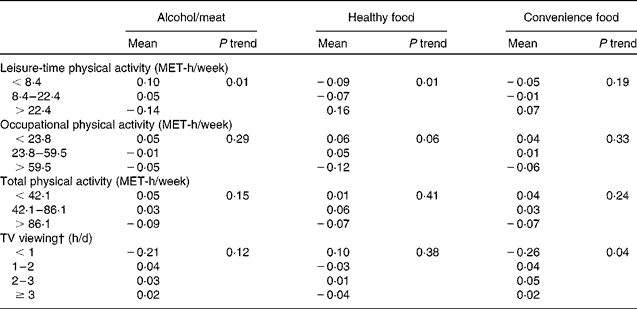
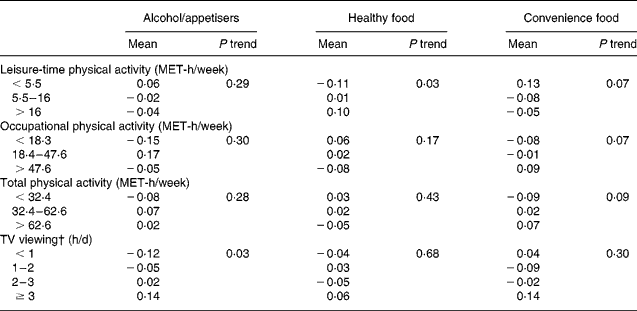
Relationships between dietary patterns, leisure-time, occupational and total physical activities and TV viewing are shown separately for men (Table 3) and women (Table 4). In contrast to the results for each physical activity domain, there was no significant association between dietary patterns and total physical activity in either sex. In men, the ‘alcohol/meat’ pattern was negatively associated with leisure-time physical activity and was not associated with occupational physical activity or with TV viewing. In women, the ‘alcohol/appetisers’ pattern was positively associated with TV viewing. For the ‘healthy food’ pattern, significant positive associations were observed with leisure-time physical activity in men and women. In men, there was a trend (non-significant) towards an inverse association between the ‘healthy food’ pattern and occupational physical activity. In both sexes, there was no association between the ‘healthy food’ pattern and TV viewing. In men, the ‘convenience food’ pattern was positively associated with TV viewing. In women, there was a trend (non-significant) towards an inverse relationship between the ‘convenience food’ pattern and leisure-time physical activity, whereas that same dietary pattern tended to be positively related to occupational physical activity and no association was found with TV viewing. In addition, none of the correlations between a given physical activity domain and TV viewing was significant, either in men or in women (coefficients ranged from r − 0·04 to 0·04).
Relationship of dietary patterns with physical activity and television (TV) viewing in men (Adjusted* mean values and significant association using ANCOVA)
MET, metabolic equivalent task.
* Adjustment analysis: controlling for age, educational level and smoking status and additional adjustment for other physical activity domains and TV viewing.
† Adjustment analysis: additional adjustment for both leisure-time and occupational physical activities.
Relationship of dietary patterns with physical activity and television (TV) viewing in women (Adjusted* mean values and significant association using ANCOVA)
MET, metabolic equivalent task.
* Adjustment analysis: controlling for age, educational level and smoking status and additional adjustment for other physical activity domains.
† Adjustment analysis: additional adjustment for both leisure-time and occupational physical activities.
Discussion
In a population of middle-aged French men and women, we identified three dietary patterns in both sexes. Although we observed some sex differences in consumption of specific foods such as appetisers for women and meat for men, two of these patterns were broadly similar in each sex (‘healthy food’ and ‘convenience food’ patterns). Leisure-time physical activity was consistently and positively associated with the ‘healthy food’ pattern in both sexes. Associations between physical activity at work and dietary patterns seemed less consistent in both sexes. TV viewing was found to be associated with less healthy dietary habits, as it was related to the ‘alcohol/meat’ pattern in men and the ‘convenience food’ pattern in women. The relationships between TV viewing and different physical activity domains (leisure, occupational and total) were non-significant, both in men and women.
Previous research investigating the relationship between diet and physical activity behaviour mainly focused on the effects of individual nutrients and/or specific foods or food groups(Reference Camoes and Lopes5, Reference Duvigneaud, Wijndaele and Matton30). To better account for the complexity of an individual diet combining various nutrients or foods(Reference Schulze, Hoffmann and Kroke31, Reference Roman-Vinas, Ribas Barba and Ngo32), we used the dietary pattern approach(Reference Kesse-Guyot, Bertrais and Peneau10) to investigate its relationship with the types of physical activity and sedentary behaviour. A strength of the present study was the use of a detailed physical activity questionnaire that enabled us to analyse the differential association of leisure-time and occupational physical activities with various dietary profiles. In the subjects of the present study, independently of age, educational level, smoking status or occupational physical activity, a high level of leisure-time physical activity was found to be associated with a high consumption of healthy foods such as fruits (in men) and vegetables (in both sexes). In adults, comparable relationships between leisure-time physical activity and a healthy diet (characterised by intakes of specific macronutrients or food groups) have been reported in previous studies(Reference Oppert, Thomas and Charles4, Reference Eaton, McPhillips and Gans33–Reference Tormo, Navarro and Chirlaque36). In adult subjects, in the Worcester Area Trial for Counseling in Hyperlipidemia study(Reference Matthews, Hebert and Ockene34), individuals active during leisure time consumed more fruits and vegetables and less fat from dairy products than inactive subjects(Reference Matthews, Hebert and Ockene34). Among adult participants in the Harvard Pilgrim Health Care, Gillman et al. (Reference Gillman, Pinto and Tennstedt35) found that increased physical activity was significantly associated with a higher consumption of healthy food and that ‘non-exercisers or only occasional exercisers’ had suboptimal dietary intakes. The present study extends these findings of a positive relationship between leisure-time physical activity and healthy dietary patterns to a middle-aged French population.
In contrast, an inverse association was found between leisure-time physical activity and the alcohol (alcoholic beverages and wine) and meat (meat, processed meat and poultry) pattern in men. Fung et al. (Reference Fung, Hu and Yu37) also previously reported that a dietary pattern characterised by higher intakes of red meat, high-fat dairy products, beer and liquor (‘Western pattern’) in men was associated with less leisure-time physical activity. However, in that study, only leisure-time physical activity was assessed.
In the present analyses, the associations between occupational physical activity and dietary patterns were less consistent than with leisure-time physical activity, as none reached statistical significance, despite borderline trends suggesting an association of occupational physical activity with the ‘healthy food’ pattern in men (inverse association) and with the ‘convenience food’ pattern in women (positive association). In a recent study, Camoes & Lopes(Reference Camoes and Lopes5) also reported less association between dietary intake and occupational physical activity than with leisure-time physical activity, and only a significant positive association of occupational physical activity with energy intake was observed in men. This result may be explained, at least in part, by the difficulty in assessing the different aspects of occupational physical activity and reporting the number of hours of physical activities during an average workday. Occupational physical activity appears in itself to include a combination of various activities that might be differentially associated with health behaviours(Reference Fransson, De Faire and Ahlbom38).
One original aspect of the present study is that we analysed the association between time spent watching TV and dietary patterns accounting for both leisure-time and occupational physical activities. Overall, the results show that TV viewing was positively related to unhealthy dietary patterns characterised by the ‘convenience food’ pattern in men (a high consumption of sweetened beverages, ready-to-eat products, croissants, desserts, candy and cookies) and the ‘alcohol/appetisers’ pattern in women, independently of physical activity. Similar associations between high levels of sedentary behaviour and high consumption of snack foods(Reference Cleland, Schmidt and Dwyer39), sugar-sweetened soda(Reference Rehm, Matte and Van Wye20) and fast foods(Reference Scully, Dixon and Wakefield40) have been observed in previous studies. Altogether, these findings of an association between unhealthy dietary patterns and sedentary behaviour may help explain, at least in part, the relationship between sedentary behaviour and body-weight gain during adulthood(Reference Cleland, Schmidt and Dwyer39). In children, the data from a recent study suggested that the association between TV viewing and body fatness was likely to be due to an association with increased energy intake since the effect of TV viewing on fatness was not mediated by physical activity(Reference Jackson, Djafarian and Stewart41). In adults, the absence of correlations between TV viewing and domains of physical activity, in agreement with previous investigations(Reference Biddle13, Reference Pettee, Ham and Macera42–Reference Bertrais, Preziosi and Mennen45), means that physical activity and sedentary behaviour represent distinct domains requiring specific assessments and interventions.
Interestingly, we observed no significant relationship between total physical activity and dietary patterns. These results are in line with previous recent reports in which few relationships were evidenced when using only an overall physical activity variable(Reference Camoes and Lopes5, Reference Kesse-Guyot, Bertrais and Peneau10). Except for energy intake in men, Camoes & Lopes reported no difference in the relationship between total physical activity and dietary intake in active v. sedentary subjects. Likewise, in an adult population in the European Union, relationships were found between health indicators (self-rated health and BMI) and leisure-time physical activities, but not with occupational physical activity or total physical activity(Reference Abu-Omar and Rutten46). This reinforces the importance of analysing in detail the different domains of habitual physical activity to better delineate their relationships with dietary and health outcomes.
Our findings have several limitations. First, the present study used a cross-sectional design. Thus, it was not possible to establish causal relationships. Second, our subjects were participants in a nutritional intervention study who generally had a higher education level and occupational status, along with a healthier lifestyle than the general population(Reference Hercberg, Preziosi and Briancon21, Reference Hercberg, Galan and Preziosi22). Thus, caution may be needed when extrapolating these findings to the general population. In addition, although in the SU.VI.MAX study the number of participants lost to follow-up was relatively low(Reference Hercberg, Galan and Preziosi22), a large number of participants were excluded from the present analyses because of missing dietary records or physical activity questionnaires. Data were also collected some years ago (1998) and behavioural patterns may have changed since then.
Third, the measurements of physical activity and TV viewing were derived from self-reporting, which might be a source of potential misclassification bias (especially over-reporting of duration and frequency for physical activity)(Reference Shephard47). In addition, TV viewing represents only one aspect of sedentary behaviour and remains insufficient for determining all aspects of sedentary behaviour(Reference Biddle13, Reference Clark, Sugiyama and Healy48), such as sitting down while travelling(Reference Frank, Andresen and Schmid49) or time spent watching videos, playing video games and using a computer during leisure time. However, as noted by Sugiyama et al. (Reference Sugiyama, Healy and Dunstan50), TV viewing time can be considered a robust marker of overall sedentary behaviour only in women.
In summary, the present results indicate that TV viewing, leisure-time and occupational physical activities are unrelated and are differentially associated with dietary patterns. The data emphasise the relationship between leisure-time physical activity and healthy food patterns, whereas TV viewing, a typical sedentary behaviour, appears to be related to unhealthy food habits. Therefore, identification of relationships between dietary patterns, physical activity and sedentary behaviour can enable us to better define healthy lifestyle patterns. The data from the present study on these relationships could provide information for targeting risk groups and defining health promotion and prevention programmes.
Acknowledgements
We thank the staff of the SU.VI.MAX study and also the volunteers who participated in this cohort. The present study was supported by the Institut National de la Santé et de la Recherche Médicale (Inserm), the Conservatoire National des Arts et Métiers (CNAM) and Paris 13 University. The present study is part of the Environmental LInks to physical Activity, Nutrition and hEalth (ELIANE) study. ELIANE is a project supported by the French National Research Agency (Agence Nationale de la Recherche, ANR-07-PNRA-004). The authors declare no conflict of interest. H. C. contributed to interpreting the results, drafted the manuscript and performed the final editing. E. K.-G. contributed to analysing dietary patterns and interpreting the results. S. B. performed the statistical analyses and contributed to designing the study, interpreting the results and writing the manuscript. C. S., B. C., C. W., M. T. and P. G. contributed to interpreting the results and editing the manuscript. S. H. is coordinator of the SU.VI.MAX study and contributed to interpreting the results and editing the manuscript. J.-M. O. supervised the design, analysis and interpretation of data as well as writing of the manuscript. All authors critically reviewed the manuscript and approved the final version.



