


Introduction
The role of harvesting in conservation of species has long been the subject of debate (Hutton & Leader-Williams, Reference Hutton and Leader-Williams2003). People have exploited wildlife throughout human history, causing extinction of numerous species in the process. Such exploitation continues to be one of the principal threats to species (Mace & Reynolds, Reference Mace, Reynolds, Reynolds, Mace, Redford and Robinson2001). The scientific principles of sustainable resource management are relatively well established, particularly for economically valuable resources such as fisheries, but there has been a widespread failure to apply these principles to wild populations (Milner-Gulland & Mace, Reference Milner-Gulland and Mace1998; Ludwig, Reference Ludwig, Reynolds, Mace, Redford and Robinson2001). For these reasons, the active promotion of sustainable use as a conservation strategy has been highly controversial (Hutton & Leader-Williams, Reference Hutton and Leader-Williams2003).
Most research on the exploitation of species has focused on vertebrate animals, particularly mammals and fish, and relatively little on trees. This is despite their high socio-economic importance: the global trade in forest products is now worth c. USD 159 billion annually (FAO, 2005). However, in recent years the conservation-through-use (or use it or lose it) approach (Plotkin & Famolare, Reference Plotkin and Famolare1992; Johnson & Cabarle, Reference Johnson and Cabarle1993; Richards, Reference Richards1993; Dickinson et al., Reference Dickinson, Dickinson and Putz1996; Neumann & Hirsch, Reference Neumann and Hirsch2000) has attracted interest in the context of tropical forest conservation. This approach is based on the contention that forests can be conserved if rural communities gain some direct economic benefit from harvesting forest products (Dickinson et al., Reference Dickinson, Dickinson and Putz1996; Freese, Reference Freese and Freese1997). Based on this idea, the commercial development of tropical forest resources has been widely promoted by conservation and development organizations (Neumann & Hirsch, Reference Neumann and Hirsch2000; Sheil & Wunder, Reference Sheil and Wunder2002). Only recently, however, has the effectiveness of this approach been critically examined (Marshall et al., Reference Marshall, Newton and Schreckenberg2003, Reference Marshall, Schreckenberg and Newton2006; Kusters et al., Reference Kusters, Achdiawan, Belcher and Ruiz Pérez2006).
Millions of people depend on exploitation of wildlife to support their livelihoods and this dependence is likely to continue. The integration of conservation and use is therefore not an option but an imperative. Consequently, research is needed to define how conservation and use of species can be successfully combined (Milner-Gulland & Mace, Reference Milner-Gulland and Mace1998; Hutton & Leader-Williams, Reference Hutton and Leader-Williams2003). Research on animal species has indicated that the sustainability of use, whether for subsistence or commercial purposes, depends on human institutions as much as the biological characteristics of the species concerned (Hutton & Dickson, Reference Hutton, Dickson, Reynolds, Mace, Redford and Robinson2001). Furthermore, the concept of sustainable use has itself been variously interpreted, depending on what is being sustained: wild populations of species, ecosystem structure or function, or human livelihoods (Robinson, Reference Robinson, Reynolds, Mace, Redford and Robinson2001). Here, the term sustainable use refers to the maintenance of viable populations of species that are harvested by humans.
Trees differ from animals in a number of characteristics that influence their potential for sustainable use: as trees are stationary and generally less cryptic than animals, exploitation may be relatively easy to observe (Peters, Reference Peters, Reynolds, Mace, Redford and Robinson2001); many species are hermaphroditic, reducing dependence on the presence of a mate for reproduction (although many are dependent on outcrossing); typically, trees have high reproductive output and some are able to reproduce vegetatively (Peters, Reference Peters, Reynolds, Mace, Redford and Robinson2001); many products (such as leaves, fruits, nuts and latex) can be harvested without killing individuals. Together with extreme longevity of individuals, these characteristics confer relatively high potential for sustainable use.
As with many animal groups, over-exploitation is a major threat to tree species. In a global assessment of the threats affecting 4,585 tree taxa that are considered threatened with extinction (Oldfield et al., Reference Oldfield, Lusty and MacKinven1998), 1,683 (36.7%) were found to be threatened by some form of use, a similar proportion to that recorded for birds and mammals (Mace & Reynolds, Reference Mace, Reynolds, Reynolds, Mace, Redford and Robinson2001). Some 25% of threatened tree species have at least one recorded use, the most common of which is harvesting for timber (Oldfield et al., Reference Oldfield, Lusty and MacKinven1998). However, tree species are subjected to a variety of threats that often act in combination. Widespread threats include conversion of forest to agricultural land, urban expansion, habitat fragmentation, browsing by livestock, invasive species and the use of fire (Oldfield et al., Reference Oldfield, Lusty and MacKinven1998; Newton, Reference Newton2007). For conservation action to be effective, all threats must be addressed.
A number of authors have considered the factors that influence the conservation of exploited populations, e.g. the importance of specific management goals (Robinson, Reference Robinson, Reynolds, Mace, Redford and Robinson2001), the provision of financial incentives (Hutton & Leader-Williams, Reference Hutton and Leader-Williams2003), political will and governance, and the overriding importance of market forces (Milner-Gulland & Mace, Reference Milner-Gulland and Mace1998). Here I critically examine whether the conservation-through-use approach, which has been widely promoted as a means of conserving tropical forests, can contribute to the conservation of tree species. I propose that for this to occur, the following five conditions need to be met: (1) harvesting of forest products must be sustainable, in terms of maintaining viable populations of the tree species being harvested; (2) harvesting of forest products must not interact positively with other threats; (3) commercialization of the forest product must be economically viable; (4) the economic benefits from commercialization must be received by those harvesting the wild resource; (5) the income received from commercialization must act as an incentive to conserve the tree species being harvested.
Each of these five conditions is considered with reference to case studies. The focus here is on conservation of tree species, and not on forests. These two objectives do not necessarily coincide. Also, the focus here is on the role of commercial exploitation rather than on subsistence use, because it is only trade in a forest product that can increase the income received by harvesters. The conservation-through-use approach considered here is equivalent to the conservation through sustainable use concept as defined in relation to animal species (Webb, Reference Webb2002).
(1) Sustainable harvesting
The concept of sustainable management has broadened beyond sustained yield concepts to encompass the wider environmental and socio-economic impacts of harvesting (Weddell, Reference Weddell2002). In forestry this broader concept is referred to as sustainable forest management, which has been the central focus of international forest policy initiatives since 1992 (Wiersum, Reference Wiersum1995; Nussbaum & Simula, Reference Nussbaum and Simula2005).
It should not be assumed that all species sourced from a forest considered to be sustainably managed will necessarily themselves be sustainably harvested, in terms of maintaining viable populations. For example, management of peat swamp forests in Sarawak achieved a sustainable yield in terms of total timber volume but the most valuable timber species in this forest type (ramin Gonystylus bancana) was severely overcut (ITTO, 1990). Similarly, in the forests of Quintana Roo, Mexico, regeneration of mahogany Swietenia macrophylla is inadequate to maintain current population size, despite having been certified as sustainable (Snook, Reference Snook1996, Reference Snook, Lugo, Figueroa-Colón and Alayón2003).
Mahogany provides an instructive example of how the use of an individual species can conflict with the broader aim of sustainable forest management. The species is generally considered to require large-scale disturbance to regenerate successfully because it is light-demanding as a young tree (Gullison et al., Reference Gullison, Panfil, Strouse and Hubbell1996; Gullison, Reference Gullison, Milner-Gulland and Mace1998; Snook, Reference Snook, Lugo, Figueroa-Colón and Alayón2003; but see Brown et al., Reference Brown, Jennings and Clements2003). Selective logging typically does not create sufficient disturbance to provide opportunities for seedling establishment (Gullison et al., Reference Gullison, Panfil, Strouse and Hubbell1996; Snook, Reference Snook, Lugo, Figueroa-Colón and Alayón2003). The disturbance required to secure substantial regeneration would have major negative impacts on other species in the community. Other threatened tree species such as Fitzroya cupressoides, Pilgerodendron uviferum and Pinus chiapensis (Table 1) similarly depend on major disturbance for regeneration, limiting scope for their sustainable management.
Ten examples of tree species of conservation concern that are subjected to human use, with area of origin, any CITES Appendix listing (CITES, 2008) and IUCN Red List status (IUCN, 2007), principal uses, sustainability and threats. These species were selected here as case studies as each has been the focus of recent research in which the author has been personally involved. Further information on the conservation ecology of a number of these species is presented in Newton (Reference Newton2007).

1 VU, Vulnerable; EN, Endangered
2 Not yet listed on IUCN (2007) but considered VU by Williams-Linera et al. (Reference Williams-Linera, Rowden and Newton2003).
3 Not yet listed on IUCN (2007) but considered EN by Cicuzza et al. (Reference Cicuzza, Newton and Oldfield2007).
4 Red List assessment currently in progress; preliminary assessment indicates EN.
Of the 10 species considered here (Table 1), for only four is use sustainable in at least some situations. Significantly, in each of these cases the product being harvested is a non-timber forest product (NTFP). This supports the general view that the potential for sustainable use is higher for many NTFPs than for timber, as the individual plants are often able to survive the harvesting process (Peters, Reference Peters, Reynolds, Mace, Redford and Robinson2001). However, in practice many NTFPs are also harvested destructively, leading to declines in abundance of many economically valuable species (Peters, Reference Peters, Ruiz Pérez and Arnold1996).
How then can sustainable use of a tree species be achieved in practice? I propose that this occurs by three principal means: (a) Serendipity (for example, if the amount harvested is low relative to the size of the resource, or if harvesting has little impact on the individual plant). (b) Static harvest controls (involving control of harvest without any reference to monitoring information; examples include community norms, culture or tradition, and protective legislation such as harvest quotas and licences). (c) Dynamic harvest controls (involving the regulation of the amount harvested in response to appropriate monitoring of the status of the resource; this is a key component of adaptive management).
Case studies (Table 1) provide examples of these different approaches. For example, harvesting of Magnolia sharpii leaves for wrapping food, or Ternstroemia lineata fruit for making beverages (Marshall & Newton, Reference Marshall and Newton2003), are examples of the first approach. In both cases, impacts of harvesting are relatively slight, and are unlikely to threaten tree populations significantly. Araucaria araucana provides an example of the second category, as some care is taken to limit the amount of seed harvested, although no formal monitoring of the resource is carried out (Herrmann, Reference Herrmann2006). The amounts of seed harvested for trade have little impact on population viability (Bekessy et al., Reference Bekessy, Newton, Fox, Lara, Premoli, Cortes, Açkakaya, Burgman, Kindval, Sjögren-Gulve, Hatfield and McCarthy2004). A. araucana is listed on CITES Appendix I and is also protected by national regulations designed to prevent exploitation for timber.
Aquilaria malaccensis is listed on CITES Appendix II and, as a consequence, trade is regulated by imposition of quotas and licences. However, harvest quotas are not based on accurate inventories of remaining stocks (Newton & Soehartono, Reference Newton and Soehartono2001). The case of A. malaccensis is informative in another way. Traditional approaches to harvesting gaharu from this species involved carefully selecting the target trees and felling only a proportion of them, a process guided by consultation with ancestral spirits. In recent years this method of harvesting has declined, associated with an increase in harvesting by incomers. As a result, over-exploitation is now widespread (Soehartono & Newton, Reference Soehartono and Newton2002; see also Jensen & Meilby (Reference Jensen and Meilby2008), for the related A. crassna).
Ideally, for sustainable harvesting of a tree species to be achieved, the third of these approaches should be adopted, involving some form of adaptive management (Webb, Reference Webb2002). Peters (Reference Peters1994) describes the main features of such an approach, highlighting the importance of monitoring the impact of harvesting on tree populations and adjusting the amount harvested in the light of the monitoring results. Such an approach is rarely, if ever, implemented (Peters, Reference Peters, Ruiz Pérez and Arnold1996). Arguably, without an adaptive management approach harvesting can never be genuinely sustainable. Hellier et al. (Reference Hellier, Newton and Ochoa Gaona1999) provide an example of how traditional patterns of use, without any formal monitoring, can lead to local extinction of valuable timber species such as mahogany.
(2) Interactions between threats
Effective conservation depends on identifying and countering threats that increase the risk of extinction. Considered in these terms, the conservation-through-use approach can be seen as a trade-off between two threats: an increase in one threat (i.e. use) should reduce risk of another (i.e. conversion of forest to some other land use). In reality, tree species are typically subjected to multiple threats simultaneously (Table 1), and it is the dynamics and interactions of these threats that will determine their survival.
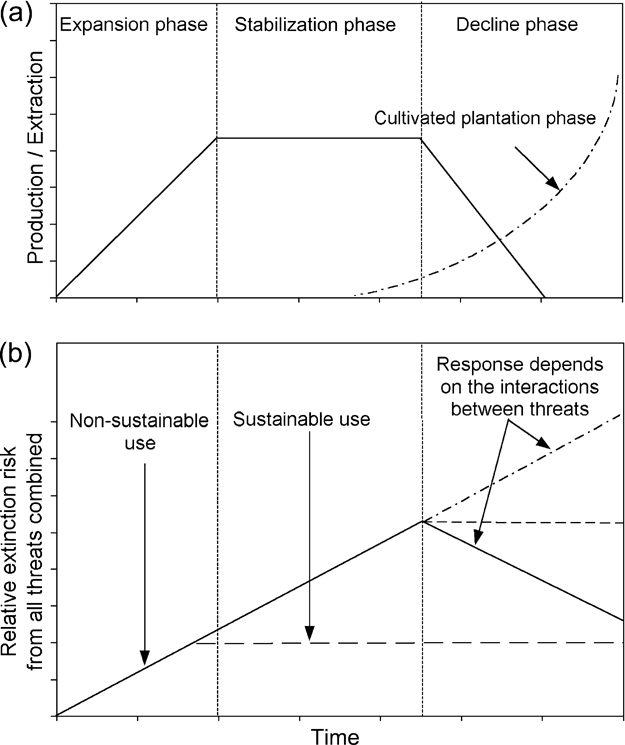
Homma (Reference Homma, Ruiz Pérez and Arnold1996) provides a conceptual model describing the economic dynamics of forest products, which describes the typical boom and bust cycle of commercial exploitation (Fig. 1a). This model also provides a framework for considering the dynamics of different threats that can occur as a forest product is commercially exploited, an issue not considered previously (Fig. 1b). This illustrates the possibility that extinction risk could continue to rise throughout the exploitation process if a positive interaction occurs between exploitation and another threat. The most likely such interaction is between harvesting and conversion of forest to agriculture. Timber harvesting can increase access to forest areas, and provide an opportunity for further colonization and agricultural expansion (Fearnside, Reference Fearnside1997; Fredericksen & Putz, Reference Fredericksen and Putz2003). Harvesting and agricultural conversion can potentially interact throughout the exploitation cycle, resulting in a higher risk of extinction than would be caused by harvesting alone. For the conservation-through-use approach to be successful, there must be no such positive interaction: increased production should decrease the risk of agricultural conversion by increasing the value of the forest resource.
(a) The historical cycle of forest production developed by Homma (Reference Homma, Ruiz Pérez and Arnold1996), based on observations in Amazonia. In the model, four phases are differentiated. The expansion phase is characterized by growth in extraction, which is encouraged by the existence of a substantial resource and the demand for a product. This is followed by the stabilization phase, when supply and demand reach an equilibrium and production is constant. The decline phase is characterized by declining production, caused by a reduction in quality and quantity of the resource base as a result of over-exploitation, and increased cost of harvest. Homma (Reference Homma, Ruiz Pérez and Arnold1996) lists a number of Amazonian forest products that are currently at different stages of this cycle, including timber species such as mahogany in the expansion phase, Brazil nut Bertholletia excelsa in the stabilization phase, and cocoa in the decline phase. For some species, decline in the wild resource may be accompanied by development of an alternative, cultivated resource (the cultivation phase) if the species is amenable to domestication. Cocoa provides an example of a species currently harvested from both wild and domesticated resources. (b) A conceptual model of the dynamics of extinction risk during the exploitation cycle. During the expansion phase, as the volumes of harvested product increase, this is likely to increase progressively the extinction risk of populations of the species being harvested. Extinction risk is likely to continue to rise during the stabilization phase as a result of over-exploitation, as it is supply and demand that are in equilibrium during this phase, not the amount harvested and productive capacity. Over-exploitation is therefore likely, leading to the decline phase. At this point, extinction risk may display different subsequent trajectories. For example, as production collapses, harvesting may decline and the resource may recover, if it still retains the capacity to do so. This would result in a decline in extinction risk. If exploitation has occurred to such an extent that recovery is impossible, extinction risk would remain stable. There is also a third possibility: that extinction risk will continue to rise because of a positive interaction between exploitation and another threat.
Other threats may also interact positively with exploitation. For example, development of a road or track network in a forested area may improve access by livestock as well as people, resulting in browsing impacts, and may also lead to increases in other threats such as fire (Holdsworth & Uhl, Reference Holdsworth and Uhl1997). Research in Mexico and Chile has highlighted a complex series of interactions between infrastructural development, harvesting, forest fragmentation, browsing by livestock and fire, producing positive feedback loops of forest degradation caused by human activity (Newton, Reference Newton2007).
(3) Success of commercialization
Commercial use refers to sale of a product in exchange for cash (Marshall et al., Reference Marshall, Schreckenberg and Newton2006). Although commercialization of NTFPs has been widely promoted as a means of developing tropical forest resources, the approach has often failed (Neumann & Hirsch, Reference Neumann and Hirsch2000; Sheil & Wunder, Reference Sheil and Wunder2002; Ros-Tonen & Wiersum, Reference Ros-Tonen and Wiersum2005; see also Gubbi & MacMillan, Reference Gubbi and MacMillan2008). This failure can take many forms. Here I focus on the commercial viability of the trade in forest products.
The viability of any commercial enterprise depends on there being a demand for a particular product and on being able to supply the product to consumers at a price they are prepared to pay. Profitability depends on achieving sufficient income at the point of sale to more than cover the costs of production, processing, transport and marketing. The marketing networks for forest products can be highly dynamic and complex (Neumann & Hirsch, Reference Neumann and Hirsch2000), and how marketing networks function has a critical bearing on the commercial viability of the enterprise, as well as on the distribution of benefits between the people involved.
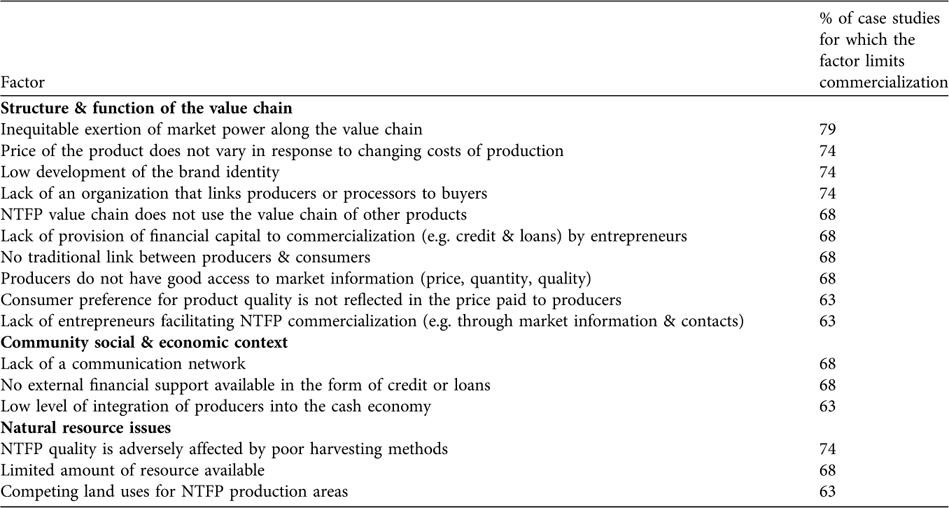
An examination of 19 case studies in Mexico and Bolivia showed that a wide range of factors influenced the success of NTFP commercialization (Marshall et al., Reference Marshall, Schreckenberg and Newton2006; Newton et al., Reference Newton, Marshall, Schreckenberg, Golicher, Te Velde and Edouard2006), the most important of which related to product marketing (Table 2). These results support Homma's (Reference Homma, Ruiz Pérez and Arnold1996) suggestion that producers often have little market information about products, prices or consumer preferences. Another important finding was that most NTFP value chains are demand driven; attempts to develop a new enterprise solely on the basis of existing supply are unlikely to succeed (Marshall et al., Reference Marshall, Schreckenberg and Newton2006). Many forest products are of relatively low value and can readily be substituted by other products. Steps towards domestication of the traded species were reported in 45% of the case studies (Marshall et al., Reference Marshall, Schreckenberg and Newton2006), something that is known to be a likely response to over-exploitation of a wild resource (Homma, Reference Homma, Ruiz Pérez and Arnold1996). Successful domestication can make a positive contribution to the commercial viability of forest products but because of biological or technological constraints many tree species are difficult to domesticate (Leakey & Newton, Reference Leakey and Newton1994). Whether the domestication of a tree species affects its conservation status in the wild has not been researched. Proponents of tree domestication frequently suggest that successful cultivation may reduce pressure on natural resources but the evidence is scant (Newton, Reference Newton1996). The problems of achieving conservation-through-use by domestication are illustrated by cultivation of Abies guatemalensis (Strandby, Andersen et al., Reference Strandby Andersen, Córdova, Nielsen, Olsen, Nielsen, Sørensen and Kollmann2008); even when the technical and socio-economic challenges of domesticating a forest tree can be overcome, there may still be a need for awareness-raising among consumers and prevention of illegal harvesting. Conversion to plantation forestry can also be a major factor causing loss of natural forests, as in Chile (Newton, Reference Newton2007). Whatever the relationship between domestication and conservation status, there is no doubt that domestication could undermine the conservation-through-use approach by providing a competing source of the product, or by promoting forest clearance.
Factors limiting successful NTFP commercialization in more than 60% of NTFP case studies examined in Mexico and Bolivia (from Marshall et al., Reference Marshall, Schreckenberg and Newton2006). The case studies included a range of products derived from different fungal and plant species that are currently being exploited commercially. Products derived from tree species included cocoa beans and paste derived from Theobroma cacao, natural rubber derived from Hevea brasiliensis, incense (copal) derived from Clusia and Protium spp., and leaves/fibre from Brahea dulcis.
(4) Economic benefits to producers
The commercial trade in forest products often provides limited economic returns to harvesters (Neumann & Hirsch, Reference Neumann and Hirsch2000; see also Gubbi & MacMillan, Reference Gubbi and MacMillan2008). The reasons for this lie in the structure and function of market networks (or chains) and in the relationships between different bodies involved in the network, which may involve exploitation, cooperation, collusion or resistance (Neumann & Hirsch, Reference Neumann and Hirsch2000). Exploitation of producers by intermediaries appears to be widespread. For Aquilaria, for example, collectors typically borrow money from intermediaries to finance collecting trips. The amounts can be substantial (USD 1,000-2,000) and many (73%) collectors struggle to repay their loans (Soehartono & Newton, Reference Soehartono and Newton2002). This is a form of debt peonage, which is widespread in forest product market chains (Neumann & Hirsch, Reference Neumann and Hirsch2000). Inequitable exertion of market power along the value chain was cited by producers as the most widespread problem in the 19 case studies examined in Mexico and Bolivia (Marshall et al., Reference Marshall, Schreckenberg and Newton2006; Table 2).
The solution to this issue lies partly in improved organization, which can decrease economic vulnerability, help share costs, and improve a community's chances of attracting traders. Producer organizations can strengthen negotiations with traders, reducing the risk of exploitation (Marshall et al., Reference Marshall, Schreckenberg and Newton2006). The importance of such organizations is widely recognized. For example, in the case of T. lineata (Table 1), 93% of women supported the formation of a cooperative gathering and selling organization (Marshall & Newton, Reference Marshall and Newton2003).
(5) Income from trade as an incentive for conservation
It is difficult to evaluate whether or not the income derived from sale of forest products acts as an incentive for the conservation of tree species, or of forest, as required by the conservation-through-use approach. This requires an understanding of the decision-making process by rural communities regarding their livelihood options, an issue that has been little researched. However, given that the financial returns from the sale of forest products are often low, their contribution to conservation is likely to be limited. In Mexico and Bolivia resource decline was identified in 75% of cases (Marshall et al., Reference Marshall, Schreckenberg and Newton2006). In at least 15%, income from NTFP sale was insufficient to prevent forest clearance.
Patterns of land tenure and forest ownership can have a major influence on decisions to harvest, and to invest in future harvests. Aquilaria is typical of many forest products in being treated as an open access resource, and therefore there is little incentive or opportunity for producers to allocate a proportion of income to conservation activities. Where forests are privately or communally owned, the potential for such an allocation is much higher (Table 3), although there is limited evidence for this occurring in practice. Some tree species are afforded a degree of protection because of their socio-economic or cultural value, such as communally owned groves of A. araucana maintained for seed collection (Aagesen, Reference Aagesen1998; Herrmann, Reference Herrmann2005, Reference Herrmann2006).
Simplified assessment of the scope for conservation-through-use, with reference to selected tree species (Table 1), based on consideration of the five conditions required for the approach to be successful (see text for details).
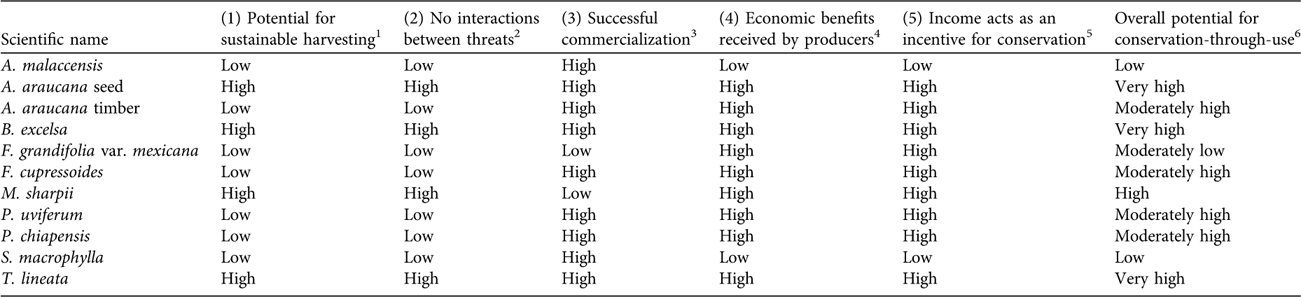
1 Low, where harvesting kills the tree; high, where the individual tree may survive harvesting
2 Low, where harvesting is likely to lead to increased access to the forest (e.g. through road construction), leading to increased risk of conversion; high, where harvesting is unlikely to increase access to the forest
3 Low, where the product is of low value or demand; high, where the product is of high value or demand (considered in the absence of legal constraints to harvesting, such as CITES or national legislation, which currently reduce or entirely prevent trade in some species)
4 Low, where there is inequitable distribution of profit along the market chain, and/or where producers do not have property rights to the resource; high, where there is equitable distribution of profit along the market chain, and/or where the producers have property rights to the resource (considered in the absence of legal constraints to harvesting, such as CITES or national legislation, which currently reduce or entirely prevent trade in some species)
5 Low, where producers do not have property rights to the resource; high, where the producers generally do have property rights to the resource
6 Based on a combined assessment of the five conditions listed above. This is a summary of the potential for the approach to be successful, based on these five conditions, not a summary of whether or not conservation-through-use is currently being achieved in practice.
Forest products generally have much lower economic value than agricultural products. It is therefore difficult for forest to compete economically with agricultural land use. Estimates suggesting that the economic value of forest products can exceed that of alternative agricultural land uses have proved to be misleading (Sheil & Wunder, Reference Sheil and Wunder2002). The potential for conservation-through-use is therefore likely to be highest where the demand for agricultural land is low, as in the case of natural rubber in Bolivia (Marshall et al., Reference Marshall, Schreckenberg and Newton2006).
For conservation to be effective all threats must be countered, not solely the risk of agricultural conversion. Few examples are available of income from the sale of forest products being used to support practical conservation action, for example the fencing of forest stands to exclude browsing herbivores, or management for fire protection. A. araucana provides an example of why this is necessary. Although the species is of high socio-economic and cultural value, many stands are deteriorating because of the effects of fire and browsing by livestock (Burns, Reference Burns1993; Aagesen, Reference Aagesen1998; Bekessy et al., Reference Bekessy, Allnutt, Premoli, Lara, Ennos and Burgman2002, 2004). Effectively, the species is being threatened by neglect.
One approach that is explicitly designed to provide a financial incentive for forest conservation is certification, which aims to promote sustainable forestry practices by assessment of forest management operations against a set of standards (Nussbaum & Simula, Reference Nussbaum and Simula2005). Consumer preference for certified products should increase market share, resulting in higher returns to the producer communities. More than 100 million ha of forest have now been certified worldwide, under a variety of different certification schemes (Gullison, Reference Gullison2003). However, there is little direct evidence that forest certification has actually contributed to conservation (Rametsteiner & Simula, Reference Rametsteiner and Simula2003), partly because application of certification standards is sometimes inadequate (Schulze et al., Reference Schulze, Grogan and Vidal2008), and current incentives provided by certification are often insufficient to prevent over-harvesting or deforestation (Gullison, Reference Gullison2003). Unsustainable harvesting (‘liquidation logging’) is typically much more profitable than sustainable forest management, particularly in tropical countries, where high discount rates, insecure land tenure, and economic uncertainty often prevail (Gullison, Reference Gullison2003).
Discussion — achieving conservation through use
As a result of their ecological characteristics and life history attributes, tree species offer higher potential for sustainable use than do many other organisms (Peters, Reference Peters, Reynolds, Mace, Redford and Robinson2001). Yet, in practice, trees appear to be little different from other species in being subjected to widespread over-exploitation. Despite initiatives such as forest certification and NTFP commercialization, there are still few successful examples of conservation-through-use being achieved for tree species.
Conservation-through-use clearly presents a challenging strategy for the conservation of tree species. Gullison (Reference Gullison2003) suggested that financial resources may be better directed towards supporting alternative conservation approaches such as protected areas. However, as there are limits to the forest area that can be protected, conservation strategies are required for forests where trees are harvested (Fredericksen & Putz, Reference Fredericksen and Putz2003). Rice et al. (Reference Rice, Gullison and Reid1997, 2001) suggest protecting forest that has been lightly logged; once valuable timber species have been removed, the value of the land and hence the cost of protection can be considerably reduced (Rice et al., Reference Rice, Sugal, Ratay and Fonseca2001). While this approach could contribute to the conservation of a forest, it contributes nothing to the conservation of the tree species being logged. To suggest that this is equivalent to dehorning the rhino (Gullison, Reference Gullison2003) is therefore misleading; whereas the individual rhino can survive dehorning, the tree species may not survive logging.
A wide range of factors prevent harvested species from being effectively conserved (Milner-Gulland & Mace, Reference Milner-Gulland and Mace1998; Robinson, Reference Robinson, Reynolds, Mace, Redford and Robinson2001; Hutton & Leader-Williams, Reference Hutton and Leader-Williams2003). All of the tree species considered here are at risk from conversion of forest to agriculture, and many are being harvested illegally (Table 1). These examples suggest that even in those situations where harvesting is sustainable and successful commercialization is providing economic returns to producer communities, these returns are not being used to support practical conservation actions designed to counter other threats to the species.
Therefore, under what circumstances could conservation-through-use be effective for tree species? Based on the results of Marshall et al. (Reference Marshall, Schreckenberg and Newton2006) and Newton et al. (Reference Newton, Marshall, Schreckenberg, Golicher, Te Velde and Edouard2006), I propose five interventions:
Provision of external assistance External organizations, such as NGOs or government agencies, have a crucial role in supporting communities wishing to exploit their forest resources sustainably. In particular, producers require assistance in accessing market information and making links with traders and consumers. Assistance may be financial, in the form of credit or investment, or involve training and capacity building in areas such as forest inventory and management, business development and marketing.
Development of community organizations The importance of developing organizations to collect, process, transport and market forest products is widely appreciated by producers. Benefits include improved product quality and quantity, more cost-effective transportation and increased negotiating ability. Support to producer organizations, such as cooperatives or commercial networks, provides a useful focus for external assistance.
Implementation of assessment and monitoring A resource inventory is a fundamental component of a forest management plan. Monitoring harvesting impacts is an essential component of adaptive management approaches but there has been little attention to monitoring in the hundreds of projects aiming to conserve tropical forest through commercial exploitation (Peters, Reference Peters, Ruiz Pérez and Arnold1996). Approaches are required that enable producer communities themselves to perform monitoring, rather than depending on external support.
Provision of incentives The conservation-through-use approach ultimately depends on the value of the forest product, market demand, and the structure and function of market chains. Forest certification offers a potential mechanism to increase value, as do other niche-marketing approaches such as organic cocoa Theobroma cacao and fair trade initiatives (Marshall et al., Reference Marshall, Schreckenberg and Newton2006). However, certification represents an additional cost to producers, and therefore external financial support or subsidies may be required for the approach to be effective (Gullison, Reference Gullison2003; see also Schulze et al., Reference Schulze, Grogan and Vidal2008).
Protection against other threats Sustainable use, by itself, is insufficient to conserve a species, and Milner-Gulland & Mace (Reference Milner-Gulland and Mace1998) are incorrect in asserting that ‘if use is sustainable then conservation is, by definition, being achieved’. This is because a species is typically exposed to threats other than solely use, and these threats may interact. Crucially, financial income from commercial exploitation of the resource is rarely used to support practical conservation action designed to counter other threats.
Sustainable forestry management does not guarantee sustainable use of a tree species. Conversely, managing for a sustainable harvest of a particular tree species does not guarantee sustainable forest management. There is therefore a tension between species conservation and forest conservation. This can best be understood in terms of the threats affecting an individual species versus those affecting the entire forest. The case of mahogany in Quintana Roo illustrates why it is important to understand these relationships. This example has benefited from the first four of the five interventions listed above but is still failing to conserve the main tree species being harvested (Kiernan, Reference Kiernan2000; Snook, Reference Snook, Lugo, Figueroa-Colón and Alayón2003, Reference Snook2005). Species conservation efforts are being undermined by the additional threat of widespread illegal logging. Here, the problem is a lack of financial resources to address this threat by enforcing the legal controls that are in place (Kiernan, Reference Kiernan2000).
If forest certification is failing to provide sufficient financial benefits for conservation to be effective (Gullison, Reference Gullison2003) then alternative types of incentive are required. Possibilities include payment for provision of ecosystem services (Balmford et al., Reference Balmford, Bruner, Cooper, Costanza, Farber and Green2002), such as carbon sequestration, as envisaged under the Kyoto protocol. Whatever services are provided, if incentive-driven conservation (Hutton & Leader-Williams, Reference Hutton and Leader-Williams2003) is ever to be successful the financial rewards need to be large enough to support the conservation action required to ensure that all threats are adequately addressed.
Acknowledgements
I gratefully acknowledge the contributions made by collaborators involved in the research projects in which I have been involved, particularly the participants of CEPFOR, BIOCORES and SUCRE projects, and the various sponsors that supported this research.
Biographical sketch
Adrian Newton has more than 20 years’ experience researching forest conservation ecology, including the conservation and sustainable use of threatened tree species. He is currently Director of the Centre for Conservation Ecology and Environmental Change at Bournemouth University, UK, and is also Vice-Chair of the IUCN/SSC Global Tree Specialist Group. His current research interests include the restoration of tropical dry forests and analysis of species loss in fragmented forest landscapes.



