


The Mare de Déu de Montserrat (Black Madonna of Montserrat) or La Moreneta (literally, The Little Black One) is the name given in Catalonia to the statue of the Mother of God who, according to a well-known local legend, appeared in the Montserrat mountains, some 70 kilometers from Barcelona, during the twelfth century. The Black Madonna of Montserrat is an example of the countless cases of Marian appearances from all around the world. Many of the narrations and meanings associated with this figure refer to very common mythological patterns in the Christian tradition.Footnote 1
However, the Black Madonna of Montserrat (figure 1) presents three particular characteristics that we will discuss in this article. Firstly, she is a black virgin or black Madonna, a statue in which Mary and the infant Jesus are represented with “dark” skin. Especially from the nineteenth century onward, the existence of black Madonnas led to an intense debate within the religious community and among religious art researchers. These debates focused on establishing the origin and the theological meaning of a set of sacred representations which, at least partially, moved away from the dominant norm of Christian iconology according to which Mary and her son are represented with white skin.
Statue of La Mare de Déu de Montserrat. Montserrat, Catalonia. Roger Canals photo, 2018.
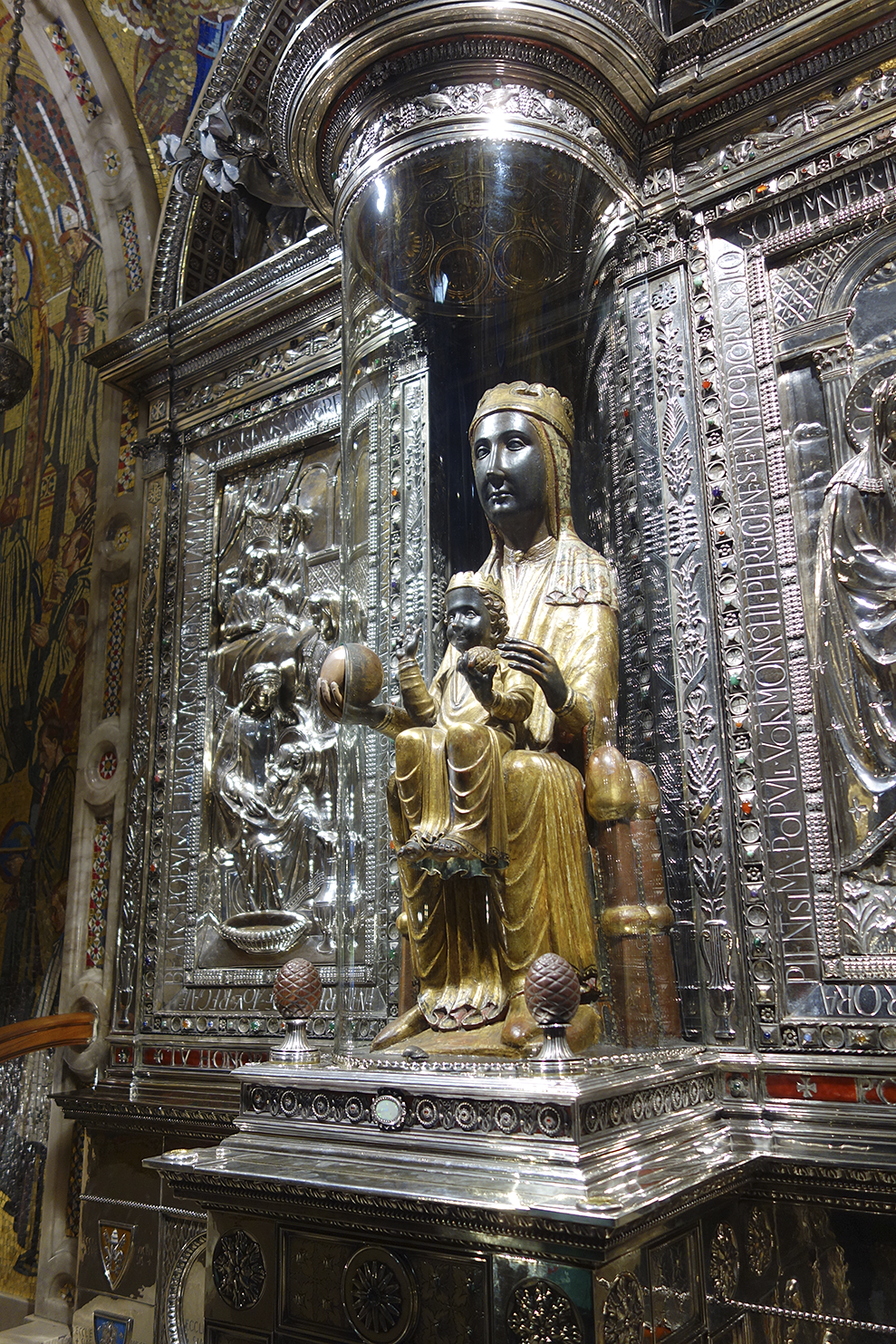
The second notable aspect of the figure of the Black Madonna of Montserrat is her value as a national symbol of Catalonia. She is one of Catalonia’s main patriotic figures, and since the beginning of the nineteenth century has played a key role in many political and social events there. The political conflict over the independence of Catalonia, reignited in 2012,Footnote 2 has intensified, and given new meaning to this image as a powerful icon of Catalan nationalism.
The third remarkable element of this black Madonna is the vast number of copies and versions of her image, especially in the form of statues and altarpieces, which for centuries have been found in Catalonia and beyond. In addition to her many material versions, countless digital images of her, often anonymous and fleeting, circulate the internet. Numerous “memes” or visual jokes appear on there about the black Madonna and the Catalan political process. These are particularly relevant given their wide dissemination on official and non-official platforms, from journals to private chat groups, and their extreme popularity, including among young people. It is online, too, that we today find the most transgressive and irreverent images of the Black Madonna of Montserrat.
The plurality of visual representations forces us to think of the figure not as an image but rather as a dynamic network of images in which each term, or each visual representation, must be interpreted in relation to the other existing representations, and to the political and historical context in which it appears.
This article will analyze, from both historical and anthropological perspectives, the political and social role of the different representations of the Black Madonna of Montserrat in Catalonia and beyond. More specifically, we will compare some of the past and current meanings of this icon in Catalonia with the evolution it has experienced in Equatorial Guinea, Sardinia, and Puerto Rico, three countries where we have carried out fieldworkFootnote 3 and where this black Madonna has had and continues to have a presence.
This comparative study of religious iconology between different historical and cultural contexts—Catalonia, Africa, the Mediterranean, and the Caribbean—provides a better understanding of the evolution and current situation of the icon of the Black Madonna of Montserrat from a global perspective, transcending the localism of most studies. This study also opens the door to reassessing some key aspects of the past and present of Catalonia, which today finds itself in a key moment in its history due to the independence process. We pursue an original strategy of exploring hidden historical connections between Catalonia, Equatorial Guinea, Sardinia, and Puerto Rico. Lastly, this research seeks to illuminate the types of “lives” that religious images (and, by extension, images in general) establish throughout history. In this regard, we propose a processual and performative approach to the study of images that emphasizes their dynamic and ever-changing nature, as well as the active roles they play in the configuration of historical transformations.
The article has four parts. The first examines the historical importance of the black Madonna image in the Catalan context from the nineteenth century through the independence process that began in 2012. Two subsequent sections address the presence and evolution of this icon in Puerto Rico and Equatorial Guinea, and in Sardinia, respectively. We will conclude by reflecting on the lives of images based on the concept of “iconic path” (Canals Reference Canals2021).
Since this concept will appear throughout this article, let us provide a short definition. The notion of “iconic path” refers to the particular itineraries that images follow through history: sinuous and unpredictable journeys, during which they are constantly recreated, acquiring new meanings, functions, and appearances. As we will show, these “iconic paths” do not necessarily follow a linear, causative, or unidirectional logic. Nor are they “individual paths,” since the social existence of any image is only conceivable with reference to the existence of others. In other words, as a practice-based category, the notion of “iconic path” focuses on the particular relations that individuals establish with images as well as the relations that images maintain with other images, and the individuals engaged with them. Even more importantly, it assumes that these relations, and the conceptualizations and narratives that surround them, are historical artefacts, permanently open to being reimagined and transformed (ibid.: 205).
Before addressing these issues, we need to briefly situate this research in the field of what is known as “material religion” and other studies of the black Madonnas.
Material Religion and the “Mystery” of the Black Madonnas
Since its beginnings, anthropology has been interested in the study of religious images and, more specifically, in the social relationship that “believers” establish with them within and outside of ritual processes (Lévy-Bruhl Reference Lévy-Bruhl1927; Tylor Reference Tylor1994). In recent decades, this field of study has generated a vast and fascinating body of literature that falls under the generic term “material religion” and highlights the importance of objects, senses, and bodies in religious experience (McDannell Reference McDannell1995; Morgan Reference Morgan2010, Houtman and Meyer Reference Houtman and Meyer2012).
A key idea we can extract from this vast debate is that, counterintuitively, “religious images”—images that seek to depict divinities or spirits and operate as mediums with the hereafter, and thus acquire a value in terms of presence—are highly problematic, multiple, and unstable objects (Engelke Reference Engelke2007; Belting Reference Belting and Jephcott1994). One thing that makes religious images problematic objects is the ambiguity of the semiotic relation they maintain with their “referent”—the supernatural being represented through the image (Feedberg Reference Feedberg1989). As classic authors such as Tylor and Lévi-Bruhl indicated, it is often difficult if not impossible to determine whether believers conceive of images (more or less consciously) as the divinities themselves or “only” as their representations (Belting Reference Belting2011). What we observe is that religious images constantly oscillate between one paradigm and another depending on the relations established and the context in which interactions occur. In any case, religious images always have the potential to become an image-person; that is, to fully identify with what they depict (Malamoud and Vernant Reference Malamoud and Vernant1986).
It is also important to point out that religious images are ontologically multiple objects, defined differently depending on the social agents with whom they interact. We can take the example of the Black Madonna of Montserrat, which is a religious image, a political symbol, a national icon, an example of cultural heritage, a work of art, and a tourist attraction, among other meanings. All of these ways of conceiving the black Madonna coexist today, often overlapping yet without contradictions. This characteristic is not exclusive to religious images, and anthropology teaches us that any “object” or “subject” can, at least potentially, be “interpreted” in different ways depending on the individual or culture. Our stance, however, is that, due to their singular and ambiguous nature, as well as their high social and symbolic value, religious images are particularly “suitable” for this type of ontological pluralism.
Finally, as historical objects, religious images are intrinsically unstable and changing.Footnote 4 They undergo a constant process of transformation and reinvention from both an aesthetic point of view (today, for example, we encounter comic representations of the black Madonna unthinkable only a few years ago) and in terms of their uses and meanings (as demonstrated by the current use of the Black Madonna of Montserrat by some in the LGTBI movement).
Further, as noted, the black Madonna is a paradigmatic example of “black virgins,” or Vierges Noires in the French tradition.Footnote 5 We should briefly address the “mystery” surrounding this type of representation. Most authors who have studied these images (Huynen Reference Huynen1972) have started with the same question: why are there images in which the Virgin Mary appears (in some cases, with her son) as a black woman? The recurrence of the question seems to suggest a racial bias that associates whiteness with the norm and blackness with otherness: because they are conceptualized as black, these are the “other” virgins and, as “others,” they needed to be explained and justified. What is the origin of these representations, which are found in different Roman Catholic regions such as Eastern Europe, the Mediterranean, and Latin America?
A classic trend, today very questioned, maintains that black virgins are Christian reinterpretations of pagan divinities associated with the land, fertility, and female power, in the majority of cases of Phoenician or Egyptian origin (Durand-Lefebvre Reference Durand-Lefebvre1937; Emile Saillens Reference Saillens1945). Others have examined them from a psychoanalytical perspective (Gustafson Reference Gustafson1990), conceiving them as an expression of unconscious elements inherent to the Christian tradition. A widespread theory maintains that what we today call “black virgins” (at least in the European context) were originally images in which Mary appeared with white skin which blackened over time as a result of smoke, incense, and dirt (Scheer Reference Scheer2002: 1418). What is interesting about this theory is that the majority of the blackened Madonnas were later painted black, as the blackening was understood as a “decision” made by the image itself. Some scholars (Oleszkiewicz-Peralba Reference Oleszkiewicz-Peralba2007; Moss and Cappannari Reference Moss and Cappannari1953) combine both perspectives, recognizing the existence of both virgins that were originally black and virgins that were originally white and later blackened and repainted.
Within the analysis of black virgins, it is important to add the “non-European” or “non-Western” versions of the images of Mary in which she appears as a Black, indigenous, or mestiza woman. This is the case of the Latin American or African versions of the virgin that in many cases present autochthonous “ethnic” or “cultural” traits (such as in Equatorial Guinea). The “autochthonous” population tends to reclaim the “authenticity” of these images, seeing them as an example of the universality of Mary, capable of appearing in different places and under different types of “humanity.” Yet the majority of sacred art experts interpret them as examples of “syncretism” resulting from colonization processes.
The most accepted hypothesis today in relation to the image of La Verge de Montserrat states that it was originally a white image that blackened very quickly and was subsequently repainted as black.Footnote 6 As we will show, the blackness that defines her has played a key role in the meanings attributed to this image in different periods of her history.
La Verge de Montserrat in Catalonia
In Catalonia the term “Montserrat” has a double meaning: First, it refers to the mountain of Montserrat, a place also known as “the magic mountain” (la muntanya màgica)Footnote 7 and characterized by a particular orography that explains the etymology of the word [mont: mountain; serrat: serrated]. But “Montserrat” also refers to the Mother of God, who since 1881 has been named the patron saint of Catalonia and whose image has been located since the twelfth century in the monastery situated on the mountain. Also important is that the name “Montserrat” has been used since the 1920s in Catalan female anthroponomy, and has become one of the fifteen most common names in the principality.Footnote 8 This sheds light on the close relation between the icon, the country, and its people.
Since the end of the nineteenth century, Catalan society, and particularly political Catalan nationalism, has raised the image of the Black Madonna of Montserrat to the rank of national symbol (Impériali Reference Impériali2008), to the degree that it is difficult to understand the evolution of the phenomenon of contemporary Catalan nationalism without reference to the “life” of this image. In historical terms, the social and patriotic significance that this Madonna has acquired today, and her role in social conflicts during the nineteenth and twentieth centuries, stem from the emergence of Romanticism and the subsequent rise of Catalan nationalism. What follows is a brief historical overview of this era.
From the outset, Catalan nationalism was divided into two opposing models: one linked to Catholicism and the other to laicism, two extremes still common today. The first model is clearly in evidence in the insignia “Catalonia will be Christian or it will not be at all,” which dominates the Monastery of Montserrat’s main facade. This phrase is attributed to the Bishop Torres i Bages (1846–1916), a driving force of the politically conservative, Catholic Catalan nationalism that was constructed in the principality during the last third of the nineteenth century as a result of the Renaixença.Footnote 9 In the weekly paper La Veu de Montserrat (1878), odes were published to the Black Madonna of Montserrat and the country was urged to defend a model of religious regionalism. The first national appropriation of the Madonna appeared as part of this trend.
The Catholic and regionalist model of Catalan nationalism was opposed to a laic, progressive, and republican Catalan movement. This second model revolved around the figure of Valentí Almirall (1941–1904), who had served in the Federal Democratic Republican Party (Partit Republicà Democràtic Federal) before the First Spanish Republic (1873–1874). This movement opposed the monarchy and the central role of religion, which distanced it from Torres i Bages’ Catalan nationalism.
In addition to these two currents, at the end of the nineteenth century an anti-Christian Catalonia developed within working class movements, which starting at the beginning of the twentieth century stirred up anticlerical revolts. The city of Barcelona took on a somewhat mythological meaning for the working-class movement, especially the anarchist movement, and became known as the “rose of fire” (Rosa de Foc), or the “city of bombs,” on account of its attacks on political, religious, and bourgeois institutions. The contemporary history of Catalonia is defined, to a large extent, by its conflictual relationship with the church (Delgado Reference Delgado2002).
Within this context, the Black Madonna of Montserrat became, from the end of the nineteenth century, an icon arousing feelings of both devotion and subversion, often simultaneously, acquiring a double organic and disruptive dimension: As a spiritual national saint associated with Catalan nationalist claims, she invokes the idea of national community for the majority, including among progressive movements. Yet, as a figure fundamentally linked to the church and to the conservative Catalan nationalism dominant among the middle-class, she is targeted by anticlerical movements and appears at the center of revolutions, iconoclastic acts, and class struggles.
Bearing in mind this context, we will structure our discussion of the evolution of the Black Madonna of Montserrat in Catalonia around three closely linked concepts: national appropriation, mutual protection, and creative subversion.
National Appropriation
The first public display of the symbolization of the image in national terms occurred on 11 September 1881, when she was proclaimed the patron saint of Catalonia. This date commemorates the anniversary of the fall of Barcelona during the final siege of the Spanish War of Succession (1701–1714), which meant the principality’s loss of its own constitution and its submission to direct rule by the kingdom of Spain. Since 1881, 11 September has been a key date for Catalan nationalism,Footnote 10 and starting in 1886 it began to be regularly celebrated in public commemorations that continue today (Anguera Reference Anguera2008). Therefore, the act of proclaiming this black Madonna Catalonia’s patron saint is linked to the entrenchment of a new national calendar and the establishment of a historical memory of the country’s losses of liberties.
This imbrication between Montserrat and Catalan nationalism became evident during the Franco dictatorship (1939–1975). Up to that point, La Moreneta was an image associated with conservative Catalan nationalism, but from this period on it was adopted as a symbol of all nationalist families, including the abovementioned progressive movements. This dictatorship was the longest period of Catholic Church hegemony in Spain both in sociological and political terms. For Catalan nationalism, however, it was an ill-fated period, which once again brought the suppression of self-governing Catalan institutions, as well as the Catalan language, and the persecution of Catalan nationalist leaders, who were imprisoned, murdered, or exiled. The president of Catalonia, Lluís Companys (1882–1940), was executed by the new regime, and the Generalitat Footnote 11 was exiled for almost forty years.
In 1947, only six years after the Civil War ended, the enthronement of what was known as the “Verge Bruna”Footnote 12 took place in the Benedictine Monastery of Montserrat. There, defying the regime, attendees and organizers used Catalan in a public event for the first time since the beginning of the dictatorship (Dowlyng Reference Dowlyng2006). The consecration of the icon provided a place for political opposition. That day, the crowd interrupted the speech of the regime’s Minister for Foreign Affairs by singing “el Virolai” and they used the opportunity to read letters from Catalan exiles such as the cellist Pau Casals (who died an exile in Puerto Rico in 1973). Finally, two mountaineers from the clandestine Front Nacional de Catalunya, a Catalan nationalist party that dissolved in 1990, hung a senyera (Catalan flag) on one of the peaks of the mountain of Montserrat, and flyers in defense of Catalan were distributed among the fifty thousand attendees (Bardolet Reference Bardolet1997).
In 1956, as a consequence of these events, writers from the Països Catalans (Catalan countries)Footnote 13 offered a literary coronation to the Black Madonna of Montserrat to thank her for her “courage,” in another political act praising Catalanness linked consubstantially to the cult to the image. Taking part were authors such as Salvador Espriu, Joan Fuster, and Pere Quart, all renowned figures in the cultural sphere of the Catalan language during the twentieth century’s second half.
Again, the Black Madonna of Montserrat as a national symbol initially appeared in association with the Catholic and conservative Catalan nationalism of Torres i Bages. However, the enthronement event in 1947, exploited by opponents of Franco’s regime, led to the use of the icon in secular sectors, which turned La Moreneta into a core symbol of the Catalan nationalist movement. This is a sheer example of what Hank Johnson has aptly named “religio-oppositional subcultures” (Reference Johnson1989). These two attitudes in relation to the black Madonna can still be perceived today.
As a result of Catalonia’s independence process, the strong inter-classist and inter-confessional nature of the image’s use has become still more evident. Thus, the Monastery of Montserrat has become the stage for secessionist protests that have assembled all types of political sensitivities (from the CUP to the more conservative wing of the PDCATFootnote 14). The missals of the monastery have openly discussed the freeing of Catalan political prisoners, thereby defying the episcopal conference, the Catholic Church’s highest body in the Spanish state, which opposes the Catalan independence movement. The Catalan National Assembly and Òmnium, the main civil entities of Catalan sovereignty, promoted an event in support of the political prisoners in which a human chain was formed to carry photos of the prisoners to the replica of the virgin at the summit of Cavall Bernat, one peak of the Montserrat range (figure 2). All of these examples reveal that the mythification of the space and the icon of the Black Madonna of Montserrat by political and cultural Catalan nationalism is the most defining and long-standing element of the image. This political aspect can also be observed in many of the image’s diasporas, such as that in Alghero.
Independentist pilgrimage to Montserrat, 2018. @FaranelCIM.

Nevertheless, the image of this black Madonna has also been used since the Civil War by sectors opposing Catalan nationalism. Aware of its symbolic potential, they have tried to imbue it with new ideological content associated with Spanish nationalism. The first notable such display was by the regiment of Tercio de Requetés de la Virgen de Montserrat, a military unit made up of Catalans who participated in the Francoist uprising in 1936. For a more recent example, in 2018, during the independence conflict, a Spanish nationalist group placed a Spanish flag at the feet of the black Madonna. A digital channel that reported on the events did not hold back and labeled the offering an “offense.”Footnote 15 This type of “national desecration” shows the nature of the icon as an image-person (Mitchell Reference Mitchell2005) and the metonymical relation between the black Madonna and Catalonia. It also illustrates how the real political rivalry surrounding this image no longer takes place between the different sectors of Catalan nationalism, as was the case at the end of the twentieth century, but between those in favor of and those against political Catalan nationalism.
Mutual Protection
The history of the Black Madonna of Montserrat is closely linked to the idea of “protection.” This concept must be understood in two ways because she is both the subject and the object of protection—she has protected, and has had to be protected. CatalansFootnote 16 have historically asked the image for help in facing all types of adversities, both natural (earthquakes, floods, plagues) and political (sieges, wars, invasions). One recent example was in 2018 when the exiled former President of Catalunya, Carles Puigdemont, was repeatedly photographed in Belgium with the image of the virgin, stating that he had asked her to help him face his litigation with the Spanish state.Footnote 17
The image of the Black Madonna of Montserrat, then, protects, but more interestingly, it has often had to be protected.Footnote 18 For example, the image has been cared for during wars and revolutions since the nineteenth century, which were pervaded by the laicism established during what was known as the “Age of Enlightenment.” Three paradigmatic examples illustrate this well: The Peninsular War (La Guerra del Francès), the Tragic Week (La Setmana Tràgica), and the Civil War.Footnote 19
The Peninsular War (1808–1814) was the result of a new paradigm in Spain and Europe, marked by the rise of laicism, the fall of the Old Regime, and the appearance of the liberal state. With the spread of ideas from the French Revolution came the Napoleonic invasions, which in turn provoked a strong reactionary rejection of the supposed anti-religious ideas that they spread (Barnosell Reference Barnosell2012). During this conflict, the resistance toward the French in Catalonia was supported by the Monastery of Montserrat, which provided refuge to the military. The mountain of Montserrat became a battlefield, and this meant hiding and protecting the image of its black Madonna from the Napoleonic troops. This episode was doubly exceptional: it was the first time the image had to be safeguarded for “political” reasons, and it is the only case we know of where it had to be protected from an external enemy. Subsequent episodes of violence toward the image came from within Catalan society.
The first example of the internal conflict between supporters and detractors of the ecclesiastical institution were the anticlerical revolts that took place at the end of the nineteenth century, when dozens of monasteries were destroyed and desecrated, hundreds of icons were ruined, and monks were murdered.Footnote 20 In 1835, this led to the image of the Black Madonna of Montserrat being hidden for nine years in El Bruc, a town near the monastery, in the house of a farmer named Pau Jorba (Albareda Reference Albareda1977). Later, during the Tragic Week (1909), a popular revolt against recruitments for the Rif War (Dalmau Reference Dalmau2009), the Verge Bruna was “exiled” again, far from her natural environment, to escape anticlerical iconoclasm.Footnote 21
This was not the last forced exile of this black Madonna. During the Spanish Civil War (1936–1939), religious persecution by anti-fascist militias reached a critical point. Again, the virgin, as well as most of the religious heritage, had to be protected, this time by the Mossos d’Esquadra, the Catalonian police corps. A copy of the image was put in its place in the monastery during the three-year conflict. During this same period a new form of worship of the black Madonna was born: a small copy was hung in a hidden corner of the Plaça Catalunya, right in the center of Barcelona. Devotees used this image to defy the antifascist militia and crossed themselves publicly in front of it. Still visible today, it thus became an image of anti-revolutionary political resistance.
To understand the significance of these acts to protect the icon, which involved removing the image from its “natural” environment, one must know the most popular myth about the image, which says it was found in 880 by some shepherds in a cave in Montserrat mountain (though we know the sculpture is from the twelfth century). They decided to take it to Monistrol, a nearby town. The icon resisted leaving the mountain, however, indicating that she wanted to be worshipped in that space, where she remained hidden in a cave. The image has always been linked to the interiority of the mountain, and it is never taken out in processions.Footnote 22
The idea of protection is also present in stories that combine myth and history. The legend of the “Timbaler del Bruc” (the Drummer of El Bruc) is the best-known. It tells the story of a child from El Bruc who during the Peninsular War played his drum in the mountain of Montserrat, using the echo to simulate the presence of a large army. The terrifying sound of the drums apparently scared the French and made them turn back. Today there is a statue of the drummer at the El Bruc’s entrance, and each year on 6 June a celebration commemorates this episode. In addition to the idea of protection, both the myth about the image’s origin and the legend of the drummer show how the Black Madonna of Montserrat with Catalan overlaps national historyFootnote 23 as well as the inseparability of the icon and the space where she resides.
The enormous number of all types of visitors to the mountain today has meant that the icon must be “protected” again, this time from mass tourism, sportspeople, and even the fans of football clubs such as Barça. Access to the image has had to be regulated, as are the conditions for taking photos; the use of flashes is strictly prohibited so the statue’s pigment will not be further damaged.
Creative Subversion
The third key category with which to understand the evolution of the image of the Black Madonna of Montserrat is that of “subversion.” We use this term to refer to a set of transgressive, and often creative practices around the icon that first emerged in 1975, coinciding with the end of the dictatorship. These practices, which often mix politics with artistic experimentation, update and reinvent the iconoclastic and anticlerical impulse that has flourished in Catalonia since the beginning of the Civil War. In this new anticlericalism, imbued with political satire, the black Madonna becomes subject to diverse claims and discourses.
One example of this newer wave of subversion of the image took place in 1987 when a group of rock climbers seized it at the summit of Cavall Bernat.Footnote 24 In several anonymous letters they demanded ransom and threatened to violate the figure. It was never returned, and soon after a replica replaced the stolen one.
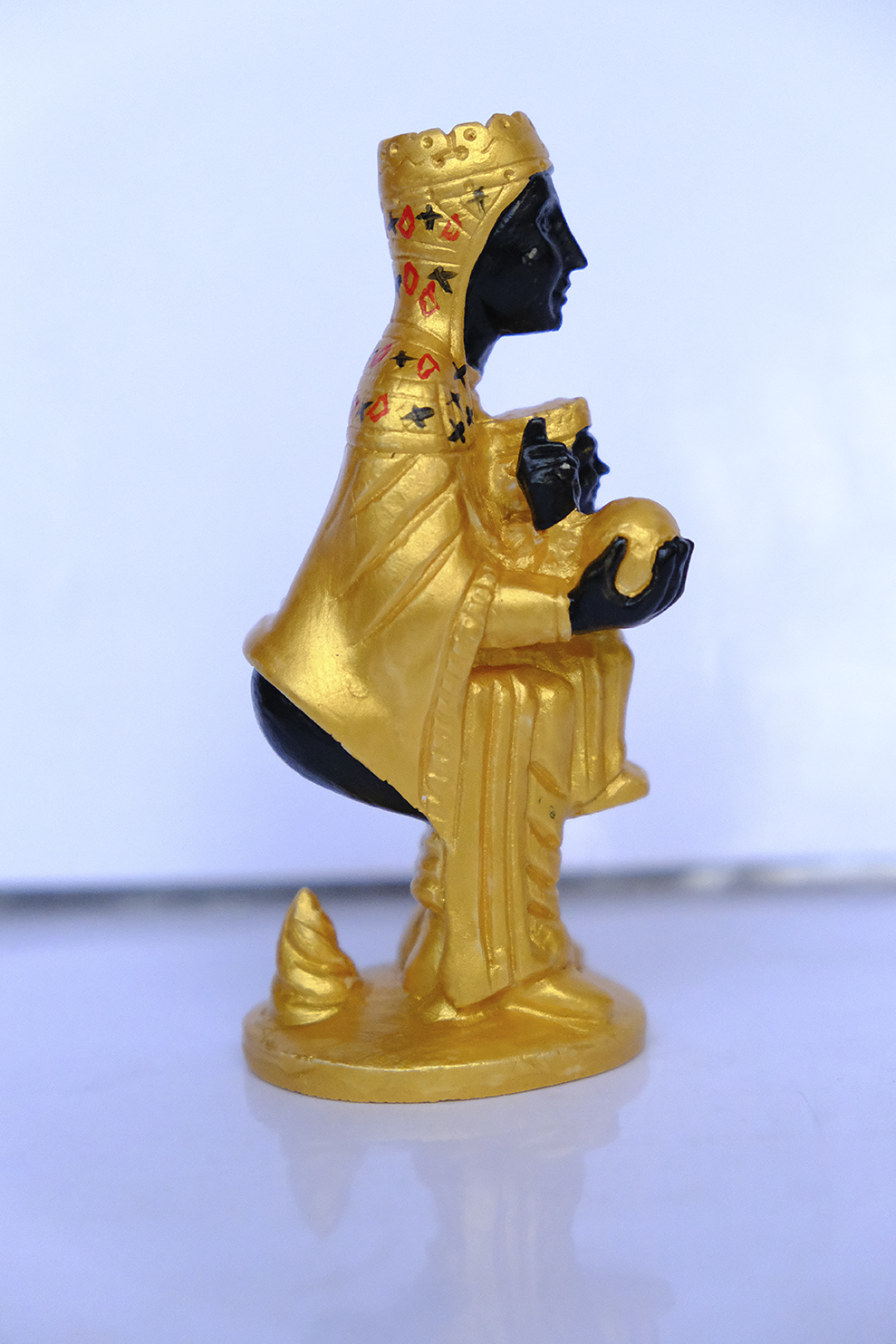
In 2013 another controversy arose over what the episcopal conference deemed an “inappropriate” use of the icon. The trigger was the Christmastime sale of a black Madonna caganera,Footnote 25 a figure of a shepherd defecating, by traditional Catalan nativity scene makers. The event raised such a commotion that they were taken to court for offending religious sentiment. That year the controversial figure was the second most sold in Catalonia, after a pro-independence caganer (figure 3).
Moreneta caganera. Canals personal collection. Roger Canals photo, 2021.
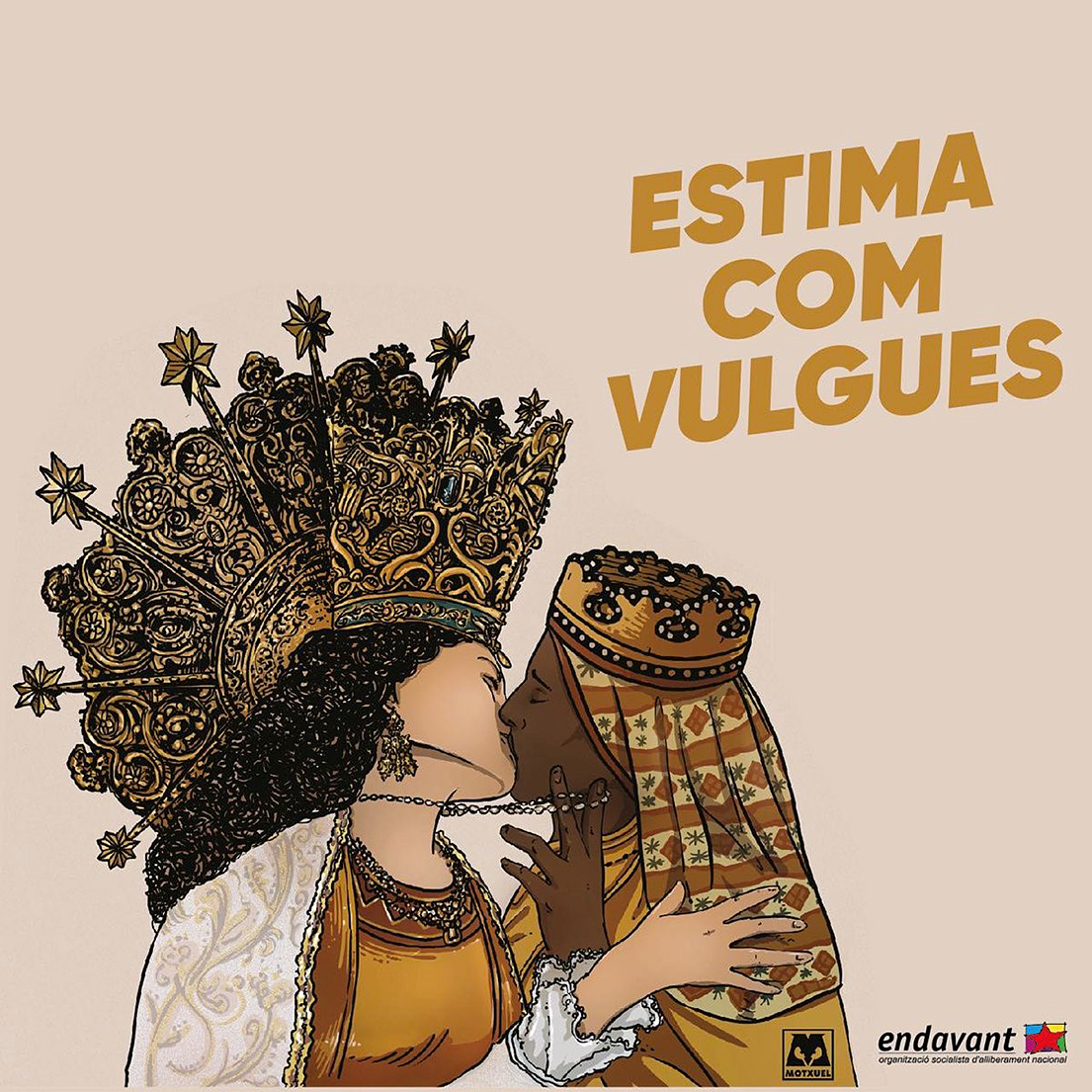
The most controversial event in recent times was when the Socialist Organisation of National Liberation—Endavant (OSAN)—deployed the image for a campaign supporting the LGTBI community, an explicitly transgressive and at the same time openly pro-independence act. In their campaign poster, the black Madonna and Our Lady of the Forsaken—patroness of Valencia, with white skin—kiss under the slogan, “Against religious oppression, love however you want,” a claim that was both anti-religious and pan-Catalan.Footnote 26 This campaign ignited criticism from religious entities that considered it a desecration, and they promoted further compensatory masses in the city of Valencia. One year later, in response to the angry reactions, the independence and anti-capitalist youth organization ARRAN decided to animate the poster further and filmed a performance in which two girls kissed in front of the image at the Monastery of Montserrat. This film was widely shared on social media on 26 April, the day of LGTB visibility (figure 4).
Poster from ENDAVANT. Estima com vulgues (Love however you want). Used with maker’s permission.
On 11 September 2013, anarchist collectives used the image satirically as part of their boycott of the main activities that the independence movement had planned for Catalonia’s national day. This date has always been one for holding sovereignty protests, which have been mass protests since the movement’s beginning in 2012. Since then, the protests have made the most of the human potential gathered, organizing large performances. In 2013, protesters were called to form a giant 11-kilometer-long V in Barcelona, called “Via Catalana.” It could be seen from the sky with the colors of the Catalan flag and was used by anarchist collectives who converted it into a giant A, adding a second protest to the central intersections. They employed an image of the Virgin of Montserrat wearing an anarchist militia hat bearing the motto “Catalunya will always be blacker than the black Madonna” (the color black defines anarchism). This is yet another example of subversion and iconic appropriation, in this case by a third community that does not, theoretically, fall under Catalan or Spanish nationalism.
We can add to these examples the countless memes and visual jokes about the black Madonna circulating on the internet.Footnote 27 In one, with a notable Spanish nationalist tone, she appears as a Marian figure crushing the urns used in the first independence consultation in 2014. Others show the national police detaining her for being “black” and a Jihadist, because she wears a veil. These volatile and often anonymous memes are related to the long iconoclast tradition we have noted, taking it to extremes and adapting it to new digital formats and language modes. These new images have, recursively, contributed to the icon of La Moreneta’s meaning.
This brief historical overview shows that, since the nineteenth century’s end, the image of the black Madonna has been subjected to a constant process of re-mythification. It has been appropriated by different political movements and subjected to antagonistic twists that have altered what it has come to represent and how it has been used through a process of iconic appropriations, instrumentalizations, and subversions. In contemporary Catalonia, we are witnessing a struggle of legitimacies taking place around how the image is used and defined. All of the actors involved seem to take for granted the consubstantial link between the virgin and the country, though implicitly. It is as if everyone accepted the idea that redefining the virgin opens doors to reinventing the nation’s identity; or, on the contrary, that devising a “new” Catalonia must entail transforming the meanings and uses of the black Madonna’s image. Furthermore, we can perceive in this iconic dispute that the black Madonna has always been “more than an image.” Along the lines of Pina-Cabral (Reference Pina-Cabral2019), we can say that La Verge de Montserrat is a “meta-person,” or rather a meta-image: she is kidnapped, offended, worshipped, and even threatened with violation, but is also capable of protecting the country and guiding its national destiny. She has suffered the tragedies of the “Catalan people” while also being a transcendent entity that has situated itself above historical contingencies. For the black Madonna, image, person, and country become blurred: Montserrat does not only represent or “symbolize” Catalonia, but makes it, at least partially.
The intimate link of mutuality between Catalonia and the black Madonna inspired us to compare the evolution of the image there with its presence in other territories. The sections that follow will explore some of these iconic paths, examining the lives of La Moreneta in Puerto Rico, Equatorial Guinea, and Alghero. This exercise of comparison is of interest both analytically and politically. Our non-Eurocentric approach will challenge well-established analytical categories such as “original” and “copy,” and “center” and “periphery.” Our stance is not just that all images of La Moreneta are equally legitimate (that is, all are “original”), but that the figure’s complexity can only be grasped by assuming a relational stance that can pull its multiple versions into dialogue. La Moreneta is not an image, but rather a set of heterogenous yet mutually related copies that are always in motion.
We have not chosen these three countries randomly; they represent three different cultural areas—the Caribbean, the Eastern Mediterranean, and Africa—and therefore, three potential models of “local reappropriation” (Muñoz and Canals Reference Muñoz and Canals2020). We will show that these models range from iconic dissociation (Guinea and, partly, Puerto Rico) to iconic identification (Alghero).
Colonial Paths: From Puerto Rico to Equatorial Guinea
We have seen that La Mare de Déu de Montserrat is an image deeply rooted in Catalonia. It is also a universal image, present on four continents. According to data provided by the Monastery of Montserrat, in 2018 150 replicas of La Moreneta were recorded in churches outside of Catalonia, in twenty-nine countries (though this number is not definitive).Footnote 28 The iconic paths of these images are diverse and range from missionary exportations during colonial occupations to the establishment of replicas in new locations for political or individual, personal reasons. Here we will analyze two colonial episodes: sixteenth-century Puerto Rico and twentieth-century Equatorial Guinea.
The image of the black Madonna is found widely across Latin America and the Caribbean due to historical interactions between Catalonia and the lands of the badly named “New World,” and more specifically, to evangelization policies pursued there starting in the sixteenth century.Footnote 29 In Puerto Rico, the cult of the Virgin of Montserrat centers mainly on the town of Hormigueros, where she is the local patron saint, though La Montserrate (as she is known there) is considered a national divinity and is well-known by the entire population. The main festival devoted to her takes place on 8 September. Hormigueros, in the west of the island, lies at the foot of a high hill upon which sits the Basílica Menor de la Virgen de Montserrate (Basilica of Our Lady of Montserrate).
The history of the cult and the La Montserrate image here is relatively unknown and there has been much confusion.Footnote 30 The most plausible hypothesis is that the cult to the black Madonna arrived on the island during the sixteenth century through the actions of Catalan Benedictine monks, in a context in which the indigenous population was nearly exterminated and the European settler-colonists were benefiting from the labor of enslaved Africans (Picó Reference Picó1986). The first historical evidence of the construction of the temple that bears her name dates to the sixteenth century. The oldest written canonical account of the myth of La Montserrate in Hormigueros and the cult associated with her appears in the 1644 writings of Diego de Torres Vargas (1615–1670), a priest from the San Juan Cathedral.Footnote 31 The oldest wooden sculptures that have been found devoted to her on the island, and specifically in the zone of Hormigueros, are from the eighteenth century (Mac Coy Jordán Reference Mac Coy Jordán2011: 145). As in other places in Latin America, the wooden sculptures and holy print images were key to the spread of the cult of Montserrat in Puerto Rico (Quintero Rivera Reference Quintero Rivera2003). Put differently, La Montserrate became popular in the Caribbean not only through images but rather as an image.
The most widely known myth about what is known as “the miracle” of La Montserrate relates the story of Giraldo (or Gerardo) González, a sixteenth-century farmer. One day, at the foot of Hormigueros mountain, he found himself alone facing a bull ready to attack him. The farmer beseeched the virgin for help, and she appeared with her son and miraculously stopped the beast, which kneeled before the apparition. Some versions say this farmer was of Catalan origin, and others say he was blind. In any case, many ex-votos, wooden sculptures (talla de madera), and paintings refer to this miracle (figure 5). The most popular is from the late eighteenth or early nineteenth century and can be seen in the Cathedral of Hormigueros.Footnote 32 A second myth attributed to this virgin tells how, years after the first apparition, Giraldo González’ daughter became lost in the woods for three days and three nights. Everyone in the town searched for her in vain. Finally, the Virgin of Montserrat found her and took her back to her parents. The version of this story compiled by the local historian Cayetano Coll Toste describes the goddess as a woman with coffee-colored skin and black eyes (Reference Coll Toste2007), and many versions and ecclesial writings portray her as a “trigueña” (dark-skinned).
Top left: the miracle of La Montserrate in Puerto Rico, Roger Canals photo, 2011. Bottom left: La Montserrate, Basilica Menor de Nuestra Señora de Montserrate (Hormigueros, Puerto Rico), Roger Canals photo, 2011. Right: La Montserrate with the mountains of Montserrat in the background, main painting of the Basilica Menor de Nuestra Señora de Montserrate (Hormigueros, Puerto Rico).

Among people from Hormigueros, an idea circulates that during the seventeenth and eighteenth centuries the Virgin of Montserrat’s image was accepted and reappropriated by freed black slaves on the island. That it was a black virgin would likely have encouraged this appropriation. We have no historical evidence of this, however, beyond the indisputable popularity of the image among the Afro-descendent population in the region and the fact that she is popularly known as La Virgen Cimarrona (Zayas Micheli Reference Zayas Micheli1990).Footnote 33 This term suggests the strong association between this figure and the experience of enslaved communities and their descendants, in a manner analogous to how La Virgen de la Regla may encapsulate the experiences of Afro-descendant women in Cuba (Pérez Reference Pérez2010). For this reason, the image of the Virgin of Montserrat, also known in Puerto Rico as “La Virgen Morena,” is often present in religious altars of what are known as “Afro-American religions,” widely practiced on the island.Footnote 34
One main characteristic of the representation of the Black Madonna of Montserrat in Puerto Rico is her iconographic plurality. The goddess is represented through different ethnic traits, “white,” “Black,” “mestiza,” or “Indian.” This is common in the Caribbean, a region historically marked by intense “racial” and cultural fusion (McDannell Reference McDannell1995). We can identify at least four canonical representations of the Virgin of Montserrat on the island. The first is as the black virgin, often with features reminiscent of Romanesque art, found mainly in the ex-votos and the wooden sculptures, and more resembling the “original” image from Catalonia. The second corresponds to an eighteenth-century painting in which the virgin appears as a white woman, with the mountains of Montserrat in the background. One hypothesis is that the image of the Mother of God corresponds to the Virgin of Oriola, in Valencia (Spain), and the mountains of Montserrat were likely represented by holy print images from Catalonia brought over by Benedictine monks. In a third representation, in the basilica of Hormigueros we find the Virgin of Montserrat depicted as a white woman. This image became popular in the late nineteenth century and is the most official representation of this figure, used by the church for processions and institutional announcements. Lastly, in esoteric shops one encounters an image of the Virgin of Montserrat as a black divinity but with a white son. It is difficult to date the origin of this representation, but we can easily interpret it as a more or less conscious materialization of “whitening” policies, in which the whitening of the Latin American population was seen as a historical duty in the name of social, moral, and cultural progress. In addition to these representations, we find images that local people (sellers of the botánicas) have described to us as “Indian” or “mulatto.”
During our fieldwork we found that some believers were unaware of the figure’s Catalan origin, or else questioned it, stating that “their” divinity had mistakenly received the name of a Catalan virgin but that she was originally a Puerto-Rican Marian apparition.Footnote 35 This was the stance taken by one of the monks who dwelled in the church, who reinforced in his speech the “authenticity” and “locality” of La Montserrate. In another case, a young inhabitant of Hormigueros, who defined himself as having African roots, stated that La Montserrate was originally an “African divinity” (without specifying which oneFootnote 36) with no relation to Catholicism, and even less with the Catalan world, and that enslaved people had intentionally “syncretized” the deity with the Virgin Mary so as to protect their cults from the control of the missionaries. These alternative narratives regarding the iconic path of the La Verge de Montserrat image reveal how the proliferation of versions of the “initial” image led to in a process of iconic dissociation. According to these narratives, what we understand as a “copy” of the image no longer refers to the alleged original image but to another entity, which remains somehow “hidden” beneath the apparent uniformity of different versions.
These processes of iconic dissociation, which we find also in the Equatorial Guinean case, are neither homogeneous nor irreversible. They are not homogeneous because there are Puerto Rican believers who link La Montserrate with Montserrat, and in Catalonia some claim that the Black Madonna of Montserrat is of African origin.Footnote 37 They are not irreversible because, as historical products, the myths associated with images can change in varying contexts.
The Equatorial Guinean case reveals another example of a colonial iconic path, though its similarities with the Puerto Rican case are few, due especially to the way in which religion, and especially the Catholicism, is conceived there. The colonization of Equatorial Guinean occurred much later, and its duration was far shorter. Catholicism was introduced in Africa much more recently, excepting the case of Aksum and the Congo (Ki Zerbo Reference Ki Zerbo1985). Although the new faith became deeply rooted through the missions and colonial violence, its practice has always remained multiform and permeable to local “religions,” probably because the missionization of the African population was much less effective than in Puerto Rico. Yet, unlike the Latin American cases, in Africa the Catholic religion and traditional religions coexisted more in practice, depending on uses and contexts.
Another huge gap between Central Africa and Latin America is found in the presence and centrality of the images. Generally, in religions of the former the cult of spirits is not conveyed through a material representation. Probably for this reason, despite the evident presence of virgins in the territory of Equatorial Guinea and the devotion to these images, autochthonous virgins have not proliferated, nor has their material aspect become an essential element for devotion. The only black virgin that has emerged on the African continent is that of Bisila, an image related to the exportation of Montserrat to that territory (Muñoz and Canals Reference Muñoz and Canals2020).
To understand the Black Madonna of Montserrat’s presence in the Gulf of Guinea, we must grasp the importance of the missions as institutions there during the colonial period. The Spanish state arrived on the island of Bioko around 1858, but it was not definitively occupied until the early twentieth century. The 1883 arrival of the Claretian order, of Catalan origin, gave a definitive boost to the colonization. Three years later the Claretians represented half of the white population on the island (Creus Reference Creus1996), which was mainly inhabited by Bubis, a Bantu ethnic group.Footnote 38 The Claretian strategy, based on missions and agrarian colonization, was justified by the discourse of civilization. Through the educational system, Claretians introduced Christianity via various strategies, including religious replacement. This is a crucial aspect of how the Virgin of Montserrat took root there.
However, contrary to what we might suppose, it is unclear that the Claretians introduced the Black Madonna of Montserrat because they thought the colonized populations would accept it because it was black. Analysis of the primary sources the order published at the time indicates there were many different reasons. The local journal of the Catholic Church in Equatorial Guinea (La Guinea Española) shows that the black Madonna was introduced at the same time as other virgins, such as La Verge del Pilar and La Verge de la Mercè. We think the Black Madonna of Montserrat evoked the colonial Catalan community’s sentiment of national identity, mainly among missionaries and businesspeople. The first altar devoted to La Moreneta in Equatorial Guinea was in San Carlos, today’s Luba. Although we do not know exactly when the virgin was established as a patron saint, we know that the image arrived after that, on 13 December 1904. So, initially there was no physical image in the territory, and what we see is an iconic path marked by a dissociation between cult and image. This dissociation undoubtedly went against Catholic norms, and it has endured until today.
Again, there appears to have been no religious strategy behind establishing the black Madonna in Equatorial Guinea. Missionaries and businesspeople of the territory organized a collection to purchase the image in the peninsula.Footnote 39 Twenty-five people made donations, most of them Catalan. Its arrival in 1904 inaugurated the cult of the icon. Through the image, Catalan communities living in Bioko were appealing to their identity, in theory with no nationalist connotation, although, again, there were at that time connections between conservative Catalan nationalism and the church. All the missionaries would sing these verses when they left the port of Barcelona for tropical territories, entrusting their fate to the Virgin of Montserrat: “Tomorrow on a fragile boat / I must sail out to sea / I will say goodbye to my country / the last goodbye, perhaps / If God does not want me to return / I will leave my heart to you, / Virgin of Montserrat” (García, Nogué, and Zusman Reference Garcia, Nogué and Zusman2008: 134).
Later, her image and patronage arrived in Rebola, in the island territory of Las Palmas, and in the continental region of Efulan. The story of the latter icon reveals the unique process through which the Black Madonna of Montserrat was transformed in Equatorial Guinea and its syncretic relationship with the indigenous identities from which new cults and transmuted figures appeared. This initiative was not local but came from the colonist community. At the origin of this path, we find Modest Gené (1914–1983), a Catalan sculptor who arrived at Francoist Guinea in 1957. His publicly funded artistic mission was a commission at the service of imperialism, to model indigenous prototypes within the scope of what is known as “scientific racism” (Sánchez Arteaga Reference Sánchez Arteaga2006).Footnote 40 During this same period he also worked for the missions, sculpting religious imagery.
His first sacred work in Equatorial Guinea was a new reproduction of the Black Madonna of Montserrat for the church of San Carlos. That was his last replica of the icon, and he then decided to transform the figure and “make her African.” He created several black Mothers of God for different equatorial locations, the most unique being the one he made in Efulan in 1966. The sculpture is very large, wears local clothing, and has facial features of the Fang ethnic group, the majority population in the area.Footnote 41 Two years later, in 1968, he sculpted the Virgin of Bisila (figure 6), inspired by his work on the Virgin of Montserrat and representing a creative fusion of the Virgin Mary and the Bubi spirit Bisila. With this icon, a new cult based on religious replacement began, but it incorporated elements of the “traditional” religion of the local Bubi communities. The missionaries tried to liken the Bubi fertility spirit Bisila to the Catholic virgin, and created an image based on the imagery of Western virgins, which up to that point had no material appearance. The image inaugurated the new Bubi cult. The cult recognized the legitimacy of Catholic rites in Equatorial Guinea, because there were many Christians due to the colonial project and because Bisila was the first and only African virgin to be recognized by the Vatican, in 1987. The Bubi cult remains active today.Footnote 42
Version of the statue of Bisila belonging the the Associació catalano-guineana Verge de Bisila (Barcelona). Roger Canals photo, 2017.
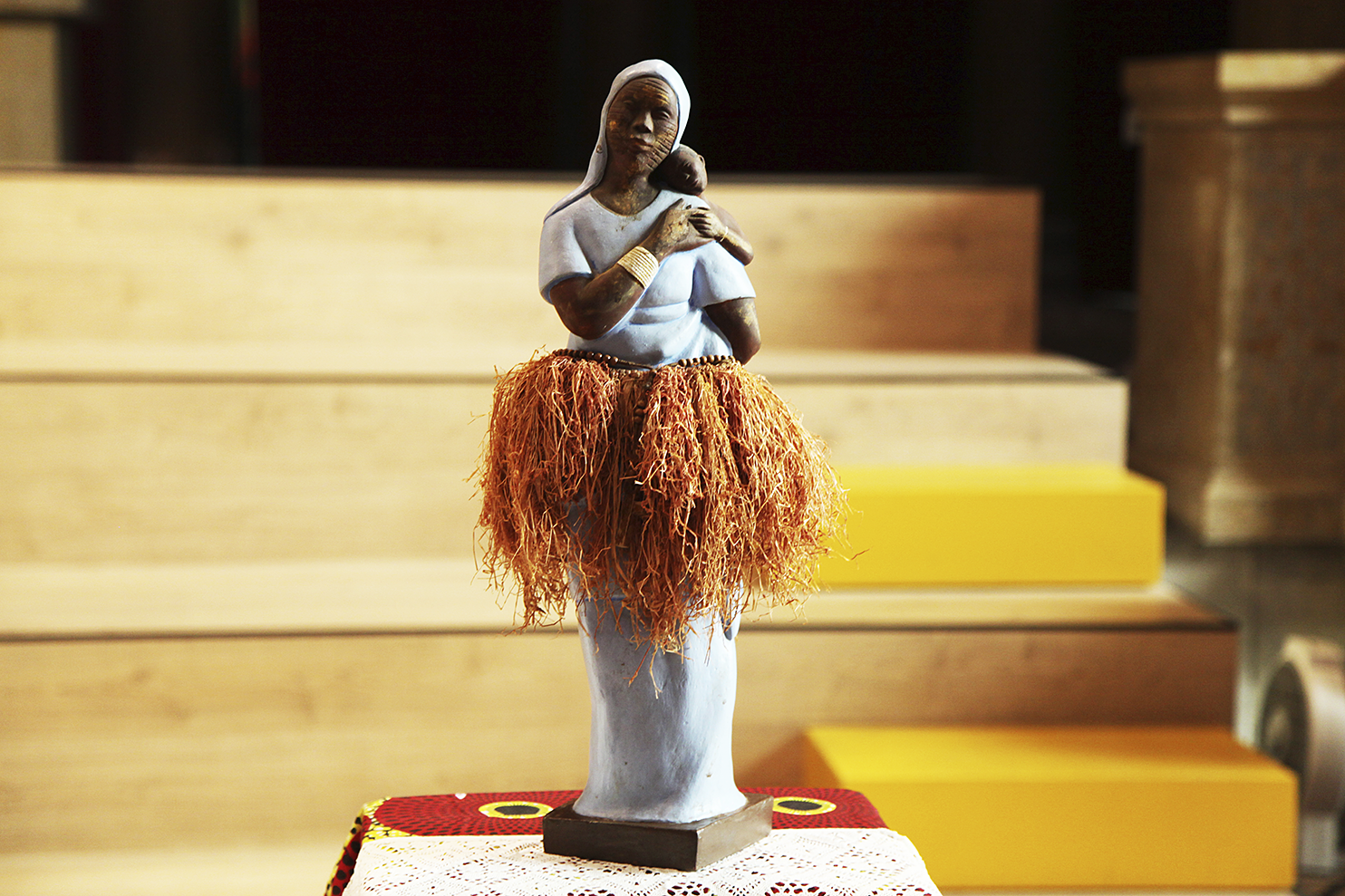
In the images of Montserrat and Bisila we observe a dialogue between two complementary icons, and their paths share many features. The sculptor who defined Bisila was clearly inspired by the La Moreneta and explored ways to make her face and body African. Moreover, the Virgin of Montserrat was already present on many altars on the island during the twentieth century. These circumstances explain the complementarity of the two figures in both cults and the frequent transmutation between the two icons. We observed this in 2017 during the celebration of the day of Bisila in the town of Rebola on 15 August, in the church of Montserrat.Footnote 43 The black Madonna’s image presided over the altar beside Bisila. That day, some of the popos Footnote 44 clothing that people wore sported the image of the black Madonna in the form of a holy print image, and the mass mixed references to the two virgins.
Today, the cults complement each other. The Virgin of Montserrat in Equatorial Guinea arrived on the request of a Catalan community that longed for its home symbols, and indirectly it highlighted the violent process of acculturation and missionary Christianization. Further, the rise of the Catholic cult of Bisila responded to the church’s need to transform the “pagan” religion through religious replacement—a process that led to a new cult, without banishing precolonial sacred practices—with a figure created by a sculptor clearly inspired by the Black Madonna of Montserrat. After independence the two images took separate paths and today, they are accepted and worshipped both in Equatorial Guinea and in the diaspora. The two virgins in both contexts generate new dialogues and forms of rituality, because just as Montserrat arrived in Equatorial Guinea more than one hundred years ago, Bisila arrived in Catalonia in the 1970s and gained ground as an icon of African communities in the city of Barcelona.
The Reencounter of Alghero
The last iconic path of the Black Madonna of Montserrat that we will describe is located in the Mediterranean. The history of La Montserrat in Alghero dates to 1960, although on the island of Sardinia it goes back further. To understand this iconic path we must begin at the time of the Catalan-Aragonese crown, which Sardinia was under.Footnote 45 During the Catalan control of the island from the fourteenth through the eighteenth centuries, the northeastern city of Alghero was repopulated by Catalans and the Sardinian population was expelled from the region, which explains the different linguistic roots in the island’s ethnic map (Caria Reference Caria1990).Footnote 46 Between 1706 and 1715, during the Spanish War of Succession (1701–1715), the crown lost the majority of these territories, including the city of Alghero. This milestone marks the end of any effective Catalan presence in the city with the cessation of sovereignty to the House of Savoy. Then began a forgotten period that lasted until the Renaixença, when this small territory that had preserved the Catalan language was “rediscovered.” At the end of the nineteenth century a national consciousness linked to language and traditions was born in Catalonia, and a new contact was initiated, almost by chance, to reestablish historical links. This is known as the first “reencounter” (el retrobament).
It began in 1864, when a Sardinian filing clerk named Ignazio Pillito took part in the Jocs Florals de Barcelona, a literary exhibition to promote the Catalan language, established in mid-nineteenth century Catalonia. Manuel Milà i Fontanals, one of the notable intellectuals of the Renaixença present at the exhibition, asked Pillito where he had learned Catalan, and he replied that he had always known how to speak it at home, in the city of Alghero. Catalan intellectuals thus discovered that the language was used there, and began a series of trips that culminated in a visit by Eduard Toda in 1888. He was responsible for this reencounter, and the popular interest it generated on the shores of both sides of the Mediterranean Sea through his two books Un poble català d’Itàlia: L’Alguer (1888), and Records catalans de Sardenya (1903). Toda also promoted the Algherese creation of a Catalan cultural institution called La Palmavera (also the name of a Catalan nationalist group founded in 1966), which solidified the new cultural awareness. The impact of Renaixença was not limited to the local scene, and it initiated a larger process of cultural links and transmissions between the “Catalan Countries,” which in Alghero culminated in the arrival of the Black Madonna of Montserrat in 1960.
Despite the numerous contacts and trips between the two territories and a mutual curiosity, from the 1910s, when La Palmavera closed, Alghero once again became isolated from the Catalan countries. The survival of Catalan in the territory remained exceptional, being spoken by as an isolated linguistic minority. And, as one would expect, the city’s linkage with Italy meant that it followed a politically different course, within tumultuous circumstances. The disconnection can be explained by the impact of both world wars and Mussolini’s long dictatorship. Not until after the Second World War did a second Algherese Renaixença occur, with a revived appreciation of the language and culture and the creation of new associations such as the Centre d’Estudis Algueresos (today, Obra Cultural l’Alguer).Footnote 47 Yet, in this context, Catalonia and the other Catalan-speaking territories, apart from the French Roussillon, suffered the darkness of the Franco dictatorship and the Spanish state’s repression of subnational identities. Paradoxically, this is why in 1960 the definitive event of territorial “town twinning” occurred, an act of resistance that had the Black Madonna of Montserrat as its icon and protagonist.
On 24 August 1960, a boat with 139 intellectuals from Catalan-speaking territories arrived at Alghero from Barcelona. They found the festive port packed with welcoming Catalan exiles and thousands of Algherese. As a prominent part of the joining of the towns, a replica of the Black Madonna of Montserrat was taken from the boat and carried in procession through the city to the cathedral, where she remains to this day. It is said that the image guided the boat on the crossing and protected it from a storm. The popular fervor that accompanied the event is still recalled in the Sardinian city, and it was the culmination of the contacts between two separate realities that had been forced to live separately. The trip was possible because of Pere Català, who had “rediscovered” Alghero in 1957 and that same year published the essay Invitació a l’Alguer Actual (Reference Català Roca1957). It was through that contact, and the work carried out with the Centre d’Estudis Algueresos, that this cultural voyage was organized, inspected and overseen though it was by the Franco regime. The evident exaltation of Catalan nationalism led the regime to send a threatening notice to participants, and the Spanish press completely ignored its success. The idea of having the black Madonna participate was suggested during the preparations for the voyage when Abbot Aureli Escarré, a monk from the monastery and a renowned Catalan nationalist and Franco opponent,Footnote 48 offered a replica of the Virgin of Montserrat for the crossing. This image was taken from the Monastery of Montserrat to Barcelona and stored in the Mercè Church until the departure date. The image was moved from the sanctuary to the Algherese Cathedral, a trip which had explicit mythological connotations—it was presented by intellectuals from La Renaixença as a type of return to Ithaca to inaugurate the revival of Catalonia—that could not be explained so much by religious reasons as by the political opposition and nationalist demands expressed through a symbol—the black Madonna—that had taken on a national sacredness.
One year after this journey to the city of Alghero, the Catalan Jocs florals took place there. Since 1941, this event had been held in exile and had drawn large numbers of Catalan nationalists and Franco opponents.Footnote 49 It led to a rebirth of the local culture, the editing of magazines and books in Catalan, and the creation of an activist space for the entire Catalan-speaking community, in one of the few Catalan countries not occupied by the dictatorship.
Today, the black Madonna of Montserrat dominates the cathedral of Alghero. With her are crests representing the mountain of Montserrat, recalling the inseparable link between the icon and that landscape. The local population clearly knows the image, although only the Catalan nationalist minority still elevate it to the rank of national icon. In this regard, it is important to observe that Alghero exemplifies the iconic closeness between black virgins. One of the most popular virgins in Alghero, who arrived before the Black Madonna of Montserrat, is the Madonna of Vallverd. In Sardinia, the latter divinity is more popular than the former and is associated with the fields, shepherds, and Sardinian culture. Her chapel is on the city’s outskirts amid grazing fields. A seventeenth-century legend tells how, at that time, people wanted to take Vallverd to the cathedral but the image “refused to go,” wanting to remain in the rural setting.Footnote 50 Several attempts to take the image to the city center failed. Since the “restoration” of the Black Madonna of Montserrat in the 1960s, a relationship has developed between the two virgins, with the Montserrat virgin being associated with the Catalan culture and urban life and Vallverd with the Sardinian world and rural life. This complementarity has led to exchanges of images—iconic gift and counter-gift—between Alghero and Catalonia. In reciprocity for the trip from Montserrat to Alghero in 1960, in 2002 a replica of the Madonna of Vallverd was gifted to Montserrat. These image exchanges have helped weave together both political relationships and national identities. They also display the value of the replica, which appears as an extension of the original, with which it retains a relationship of continuity. We see that the copy acts like an extension of the original image, while the original image is an extension of the divinity and also of the nation’s landscape and population. Between the territories, images, and people a series of relationships of participation and alliance have been established, which link objects, subjects, and places, through which unfolds history, understood as a non-linear process produced in the social field.
Conclusions
Throughout this article, we have surveyed some of the iconic paths of the Black Madonna of Montserrat. All of these paths, which are closely linked, must be conceived as one, with multiple crossroads and ramifications.
We conclude with three reflections. The first relates to the black Madonna’s political significance. Today, a true “war of images” (Gruzinski Reference Gruzinski1990) surrounds this representation. Both supporters and opponents of Catalan nationalism use the icon to express their discourses. Even detractors of Catalan nationalism recognize, if only implicitly, the image’s sacred dimension and its consubstantial relation with the national identity. It is the paradox of iconoclasts, who acknowledge the value of images even as they disparage them for lacking transcendence (Boldrick and Clay Reference Boldrick and Clay2007; Latour and Weibel Reference Latour and Weibel2002).
Our second reflection relates to the blackness of the virgins. In the entire history of the Black Madonna of Montserrat, or rather, in the set of stories comprising it, its blackness plays a key role, and in all cases it helps define its symbolic content and its uses. In Catalonia, the “mystery” that has always surrounded the Black Madonna of Montserrat’s blackness helps us understand her popularity. Her blackness has also played a key role in the three iconic paths we have described. In Puerto Rico, the image’s color has clearly bolstered her popularity among the Afro-descendent population, something that led the ecclesiastical powers to propose another virgin with the same name but with white skin. In Equatorial Guinea, it is undoubtedly the image’s blackness that favors the relationship between Montserrat and the spirit of Bisila. Finally, in Sardinia the Virgin of Montserrat’s blackness opened the door to a relation of analogy with other black virgins of the Mediterranean, such as the Virgin of Vallverd, with whom she maintains a complementary relationship.
We want to end with a brief discussion of the concept of “iconic path.” The cases analyzed in this article highlight that the iconic paths here should not be conceived as simply linear or unidirectional. This is evident, for example, in the relationships the black Madonna of Montserrat has with other divinities. In Puerto Rico the Virgin of Montserrat has experienced a differentiation process as different versions of the patron saint exist on the island (white, Black, mestiza, and Indian), only some of which are linked with the “Catalan” image. Nor is it clear whether all of these images refer to the divinity herself or to different divinities. Some say, for instance, that the white Montserrate is the Catalan one and the black one is the Puerto Rican one, and that, though both are versions of the Virgin Mary, they are not the same. This internal differentiation process is quite different from the mechanism of partial assimilation that took place in Equatorial Guinea between the Virgin of Montserrat and the autochthonous Bubi divinity Bisila. A third pattern occurred in Alghero between the Black Madonna of Montserrat and the Madonna of Vallverd: here we find neither a partial identification as with Bisila nor a differentiation process, but rather an iconic alliance between two images that refer to the city’s Catalan and Sardinian origins, respectively.
These iconic paths, then, are neither homogeneous nor linear. In Catalonia, for example, the Black Madonna of Montserrat continues to be seen as a symbol of Catalanness by both defenders and detractors of Catalan nationalism. This dimension associated with Catalan nationalism is also found in Alghero but appears to be absent in the cases of Puerto Rico and Equatorial Guinea. However, migratory movements have entailed a partial process of iconic reconnection. Thus, some of the Bubis whom we interacted with during our fieldwork in Barcelona have subsequently reassociated the Virgin of Bisila with the Black Madonna of Montserrat, thereby reinforcing a historically consolidated analogy between Bubi nationalism and Catalan nationalism. It is fair to state that our research has contributed, to some extent, to the establishment of these reconnections.Footnote 51 Since our research has a highly visual component, it is important to acknowledge that we have not only studied the iconic paths but have been, and still are, active agents in their development. Studying images entails taking part in the reinvention of their iconic paths.
Therefore, one of the main ideas that can be drawn from this article is that images have no “meaning” or “function” per se. They cannot be “analyzed” or “interpreted” abstractly, independently of the relations that individuals establish with them in specific cultural contexts and in particular historical periods. Therefore, the anthropological and historical study of images must be approached from both a synchronic and diachronic relational perspective. Here, “relational” refers both to the relations that people establish with images (that is, how images are “practiced”) and to the relations maintained between images, including the ways in which such connections are imagined and conceptualized by different social actors.
Images, especially religious ones, are changing, multiple, and unstable objects. They are not found in situations of exteriority in relation to the context in which they are found, merely reflecting them: images, taking on new meanings, and recreating and complementing themselves mutually, make history, and are made by it.


 Open access

