












1 Introduction
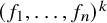
Suppose R is a ring and
$J = (f_1, \dots , f_n)$
 is an ideal. In [Reference Skoda and BriançonSB74] analytic methods were used to show the famous Briançon-Skoda theorem, namely that

for all
$k\in \mathbb {N}$
 if R is the coordinate ring of a smooth variety over
$\mathbb {C}$
if R is the coordinate ring of a smooth variety over
$\mathbb {C}$
 and where
$\overline {(-)}$
and where
$\overline {(-)}$
 denotes integral closure. This was generalized to all regular rings in [Reference Lipman and SathayeLS81]. Alternate proofs and improvements in various cases can be found for instance in [Reference Aberbach and HunekeAH93, Reference LipmanLip94, Reference Aberbach, Huneke and TrungAHT95, Reference HyryHVU98, Reference Ein and LazarsfeldEL99, Reference SchoutensSch03a, Reference AnderssonAnd06, Reference SznajdmanSzn10]. There have been many such results for singular rings as well. For many Noetherian ringsFootnote
1
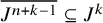
, Huneke proved that there exists some integer m such that
$\overline {J^{m+k}} \subseteq J^k$
denotes integral closure. This was generalized to all regular rings in [Reference Lipman and SathayeLS81]. Alternate proofs and improvements in various cases can be found for instance in [Reference Aberbach and HunekeAH93, Reference LipmanLip94, Reference Aberbach, Huneke and TrungAHT95, Reference HyryHVU98, Reference Ein and LazarsfeldEL99, Reference SchoutensSch03a, Reference AnderssonAnd06, Reference SznajdmanSzn10]. There have been many such results for singular rings as well. For many Noetherian ringsFootnote
1
, Huneke proved that there exists some integer m such that
$\overline {J^{m+k}} \subseteq J^k$
 for all ideals
$J\subseteq R$
for all ideals
$J\subseteq R$
 ; this is the so-called uniform Briançon-Skoda theorem [Reference HunekeHun92] (cf. [Reference HunekeHun00, Reference Andersson, Samuelsson and SznajdmanASS10, Reference SznajdmanSzn18, Reference Cid-Ruiz and JeffriesCRJ25, Reference Katz and PolstraKP25]). He then used this to prove a uniform Artin-Rees
theorem for these rings, namely for each containment of finitely generated R-modules
$N \subseteq M$
; this is the so-called uniform Briançon-Skoda theorem [Reference HunekeHun92] (cf. [Reference HunekeHun00, Reference Andersson, Samuelsson and SznajdmanASS10, Reference SznajdmanSzn18, Reference Cid-Ruiz and JeffriesCRJ25, Reference Katz and PolstraKP25]). He then used this to prove a uniform Artin-Rees
theorem for these rings, namely for each containment of finitely generated R-modules
$N \subseteq M$
 , there exists an integer
$\ell $
, there exists an integer
$\ell $
 such that for all ideals
$I\subseteq R$
such that for all ideals
$I\subseteq R$
 , we have
$I^kM \cap N \subseteq I^{k-\ell } M$
, we have
$I^kM \cap N \subseteq I^{k-\ell } M$
 for all
$k\geq \ell $
for all
$k\geq \ell $
 (cf. [Reference Eisenbud and HochsterEH79, Reference O’CarrollO’C87, Reference Duncan and O’CarrollDO89, Reference WangWan97]). We will prove such a uniform Artin-Rees and uniform Briançon-Skoda theorem for all excellent (resp. excellent reduced) rings of finite dimension, resolving Huneke’s conjectures [Reference HunekeHun92, Conjecture 1.3 and Conjecture 1.4].
On the more precise side, Lipman-Teissier [Reference Lipman and TeissierLT81] proved that
$\overline {J^{\dim R+k-1}} \subseteq J^k$
 if the ambient ring R has pseudo-rational singularities (a characteristic-free version of rational singularities); compared with the nonsingular case, one notes that n was replacedFootnote
2
by
$\dim R$
if the ambient ring R has pseudo-rational singularities (a characteristic-free version of rational singularities); compared with the nonsingular case, one notes that n was replacedFootnote
2
by
$\dim R$
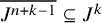
 , so this statement is not quite optimal. Inspired by [Reference Lipman and TeissierLT81], Aberbach-Huneke [Reference Aberbach and HunekeAH01] proved the full version of the Briançon-Skoda theorem, namely that
$\overline {J^{n+k-1}} \subseteq J^k$
, so this statement is not quite optimal. Inspired by [Reference Lipman and TeissierLT81], Aberbach-Huneke [Reference Aberbach and HunekeAH01] proved the full version of the Briançon-Skoda theorem, namely that
$\overline {J^{n+k-1}} \subseteq J^k$
 , for excellent F-rational rings (a characteristic
$p> 0$
, for excellent F-rational rings (a characteristic
$p> 0$
 analog of rational singularities which are pseudo-rational by [Reference SmithSmi97]). This implies that
$\overline {J^{n+k-1}} \subseteq J^k$
analog of rational singularities which are pseudo-rational by [Reference SmithSmi97]). This implies that
$\overline {J^{n+k-1}} \subseteq J^k$
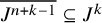 for rational singularities in characteristic zero via reduction mod
$p \gg 0$
for rational singularities in characteristic zero via reduction mod
$p \gg 0$
 [Reference HaraHar98, Reference Mehta and SrinivasMS97], see also [Reference LiLi21]. However, it was unclear whether the full bound holds for pseudo-rational rings in positive or mixed characteristic. Below, in Corollary A, we obtain the full version of the Briançon-Skoda theorem for generalizations of pseudo-rational singularities.
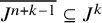
For sufficiently singular rings, it is not always the case that
$\overline {J^{n+k-1}} \subseteq J^k$
 . However, Hochster-Huneke showed in [Reference Hochster and HunekeHH90] that

assuming R is a Noetherian ring of characteristic
$p> 0$
 and where
$(-)^*$
and where
$(-)^*$
 denotes the tight closure, a way to slightly enlarge the ideal – a trivial operation if the ring has sufficiently mild singularities. Related results can then be deduced in equal characteristic zero via reduction mod
$p \gg 0$
denotes the tight closure, a way to slightly enlarge the ideal – a trivial operation if the ring has sufficiently mild singularities. Related results can then be deduced in equal characteristic zero via reduction mod
$p \gg 0$
 , see [Reference Hochster and HunekeHH06, Reference SchoutensSch03b, Reference Aschenbrenner and SchoutensAS07, Reference BrennerBre03]. Back in characteristic
$p> 0$
, see [Reference Hochster and HunekeHH06, Reference SchoutensSch03b, Reference Aschenbrenner and SchoutensAS07, Reference BrennerBre03]. Back in characteristic
$p> 0$
 , the tight closure Briançon-Skoda theorem was improved to the plus closure version in [Reference Hochster and HunekeHH95]. Analogous closure related mixed characteristic results can be found in [Reference HeitmannHei97, Reference HeitmannHei01, Reference Heitmann and MaHM21, Reference Ma, Schwede, Tucker, Waldron and WitaszekMST+22, Reference Rodríguez-Villalobos and SchwedeRS24] the last of which utilizes [Reference BhattBha20].
Our first main theorem, which has a remarkably simple proof, implies, strengthens and unifies many of the results above.
Main Theorem (Theorem 2.2)
Suppose R is a ring and
$J = (f_1, \dots , f_n)$
 is an ideal. Set
$Y \to \mathrm {Spec} \, R$
is an ideal. Set
$Y \to \mathrm {Spec} \, R$
 to be the blowup of
$\overline {J^{n+k-1}}$
to be the blowup of
$\overline {J^{n+k-1}}$
 (or any map that dominates it, such as the normalized blowup of J in
$\mathrm {Spec} \, R$
(or any map that dominates it, such as the normalized blowup of J in
$\mathrm {Spec} \, R$
 if R is reduced and has finitely many minimal primesFootnote
3
). Then
$\overline {J^{n+k-1}}$
if R is reduced and has finitely many minimal primesFootnote
3
). Then
$\overline {J^{n+k-1}}$
 maps to zero in

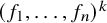
where
$L^k(\underline {f})$
 is the Buchsbaum-Eisenbud L-complex associated to
$(f_1, \dots , f_n)^k$
is the Buchsbaum-Eisenbud L-complex associated to
$(f_1, \dots , f_n)^k$
 .
.
In fact, setting
$J \mathcal {O}_Y = \mathcal {O}_Y(-E)$
 , we even have that the canonical map

is zero in the derived category.
The point is that if
$r \in J^k$
 , or equivalently if
$r \in R$
, or equivalently if
$r \in R$
 maps to zero in
$R/J^k$
maps to zero in
$R/J^k$
 , then r also maps to zero in
$H_0( L^k(\underline {f}) \otimes ^{{\mathbb L}} {\mathbb R} \Gamma (Y, \mathcal {O}_{Y}))$
, then r also maps to zero in
$H_0( L^k(\underline {f}) \otimes ^{{\mathbb L}} {\mathbb R} \Gamma (Y, \mathcal {O}_{Y}))$
 as we discuss below. But it turns out that mapping to zero in
$H_0( L^k(\underline {f}) \otimes ^{{\mathbb L}} {\mathbb R} \Gamma (Y, \mathcal {O}_{Y}))$
as we discuss below. But it turns out that mapping to zero in
$H_0( L^k(\underline {f}) \otimes ^{{\mathbb L}} {\mathbb R} \Gamma (Y, \mathcal {O}_{Y}))$
 is quite close to, and sometimes equivalent to, actually being in
$J^k$
is quite close to, and sometimes equivalent to, actually being in
$J^k$
 . An interesting aspect of the proof of this result is that it does not use any vanishing theorems or Cohen-Macaulayness, unlike many proofs of Briançon-Skoda-type results. Let us briefly explain the complex
$L^k(\underline {f})$
. An interesting aspect of the proof of this result is that it does not use any vanishing theorems or Cohen-Macaulayness, unlike many proofs of Briançon-Skoda-type results. Let us briefly explain the complex
$L^k(\underline {f})$
 . If
$f_1, \dots , f_n$
. If
$f_1, \dots , f_n$
 is a regular sequence on R, then
$L^k(\underline {f})$
is a regular sequence on R, then
$L^k(\underline {f})$
 resolves
$R/J^k$
resolves
$R/J^k$
 , that is, it is isomorphic to
$\mathbb{Z}[x_1, \dots , x_n]/(x_1, \dots , x_n)^k \otimes ^{{\mathbb L}}_{\mathbb{Z}[x_1, \dots , x_n]} R$
, that is, it is isomorphic to
$\mathbb{Z}[x_1, \dots , x_n]/(x_1, \dots , x_n)^k \otimes ^{{\mathbb L}}_{\mathbb{Z}[x_1, \dots , x_n]} R$
 in the derived category where
$x_i \mapsto f_i$
in the derived category where
$x_i \mapsto f_i$
 . In general,
$L^k(\underline {f})$
. In general,
$L^k(\underline {f})$
 is isomorphic to a specialization of the Eagon-Northcott complex. In particular, for
$k = 1$
is isomorphic to a specialization of the Eagon-Northcott complex. In particular, for
$k = 1$
 , it is simply the Koszul complex. See Section 2.2 and [Reference Eagon and NorthcottEN62, Reference Buchsbaum and EisenbudBE75, Reference SrinivasanSri86, Reference SrinivasanSri89] for more details about this complex.
A Noetherian reduced ring R is said to be a birational derived splinter if
$R \to {\mathbb R} \Gamma (Y, \mathcal {O}_Y)$
 splits for all proper birational maps
$\pi : Y \to \mathrm {Spec} \, R$
splits for all proper birational maps
$\pi : Y \to \mathrm {Spec} \, R$
 . That is, if there exists
$\varphi : {\mathbb R} \Gamma (Y, \mathcal {O}_Y) \to R$
. That is, if there exists
$\varphi : {\mathbb R} \Gamma (Y, \mathcal {O}_Y) \to R$
 such that
$ R \to {\mathbb R} \Gamma (Y, \mathcal {O}_Y) \xrightarrow {\varphi } R $
such that
$ R \to {\mathbb R} \Gamma (Y, \mathcal {O}_Y) \xrightarrow {\varphi } R $
 is an isomorphism, see [Reference LyuLyu22, Reference BhattBha12, Reference KovácsKov00, Reference De Deyn, Lank, Manali-Rahul and VenkateshDLMV25]. We observe below in Lemma 3.9 that every pseudo-rational local ring is a birational derived splinter via an argument of Kovács (the converse holds in the Cohen-Macaulay analytically unramified case). If R is a birational derived splinter, we see that

As a consequence we obtain the following result.
Corollary A (Theorem 3.12)
Suppose R is a birational derived splinter (e.g., R is pseudo-rational, or R is excellent and one of F-rational, BCM-rational or
$+$
 -rational, see Remark 3.10), then

for any n-generated ideal J. The result also holds for any ideal which locally has analytic spread
$\leq n$
 .
.
This recovers the main result of [Reference Aberbach and HunekeAH01] and proves its analog in mixed characteristic. It provides simple proofs of the main results in [Reference Lipman and SathayeLS81, Reference Lipman and TeissierLT81] and generalizes them to pseudo-rational singularities and beyond.
More generally, suppose R is a Noetherian integral domain and
$Y \to \mathrm {Spec} \, R$
 is an alteration with Y integral and nonsingular. After picking a map
$\psi : {\mathbb R}\Gamma (Y, \mathcal {O}_Y) \to R$
is an alteration with Y integral and nonsingular. After picking a map
$\psi : {\mathbb R}\Gamma (Y, \mathcal {O}_Y) \to R$
 such that
$R \to {\mathbb R}\Gamma (Y, \mathcal {O}_Y) \xrightarrow {\psi } R$
such that
$R \to {\mathbb R}\Gamma (Y, \mathcal {O}_Y) \xrightarrow {\psi } R$
 is multiplication by
$c \neq 0$
is multiplication by
$c \neq 0$
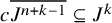
 (which always exists), our method combined with the fact that Y is a global birational derived splinter shows that
$c \overline {J^{n+k-1}} \subseteq J^k$
(which always exists), our method combined with the fact that Y is a global birational derived splinter shows that
$c \overline {J^{n+k-1}} \subseteq J^k$
 independent of J. Having such a uniform c was exactly the missing piece needed to prove the uniform Artin-Rees theorem for excellent rings of finite dimension or to prove the uniform Briançon-Skoda theorem for excellent reduced rings of finite dimension. While we do not know the existence of regular alterations in this level of generality, Gabber’s weak local uniformization ([Reference Illusie, Laszlo and OrgogozoILO14, Exposé VII, Theorem 1.1]) provides a local variant of regular alterations. Utilizing Gabber’s result together with an intricate construction of nonsingular diagrams of schemes and derived splitting techniques, we obtain a
$c\neq 0$
independent of J. Having such a uniform c was exactly the missing piece needed to prove the uniform Artin-Rees theorem for excellent rings of finite dimension or to prove the uniform Briançon-Skoda theorem for excellent reduced rings of finite dimension. While we do not know the existence of regular alterations in this level of generality, Gabber’s weak local uniformization ([Reference Illusie, Laszlo and OrgogozoILO14, Exposé VII, Theorem 1.1]) provides a local variant of regular alterations. Utilizing Gabber’s result together with an intricate construction of nonsingular diagrams of schemes and derived splitting techniques, we obtain a
$c\neq 0$
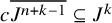
 such that
$c \overline {J^{n+k-1}} \subseteq J^k$
such that
$c \overline {J^{n+k-1}} \subseteq J^k$
 independent of J, see Theorem 5.3. Then, combining Huneke’s work [Reference HunekeHun92] with [Reference ZhouZho07, Reference LyuLyu25], we obtain the following.
Main Application (Corollary 5.6, Corollary 5.4, cf. [Reference HunekeHun92, Conjectures 1.3 and 1.4])
Suppose R is a quasi-excellent Noetherian ring of finite dimension and
$N \subseteq M$
 are finitely generated R-modules. Then there exists an integer
$\ell $
are finitely generated R-modules. Then there exists an integer
$\ell $
 depending on N and M such that for all ideals
$I\subseteq R$
depending on N and M such that for all ideals
$I\subseteq R$
 and all
$n \geq \ell $
and all
$n \geq \ell $
 , we have that

If, in addition, R is reduced, then there exists an integer k depending only on R so that for all ideals
$I\subseteq R$
 and all
$n \geq k$
and all
$n \geq k$
 , we have

Returning to our more precise Briançon-Skoda theorem, a slight variation of our method also yields the following result.
Corollary B (Theorem 3.18)
If R is Du Bois, or lim-perfectoid pure (e.g., F-pure), or Cohen-Macaulay and lim-perfectoid injective (e.g., Cohen-Macaulay and F-injective), then

for any n-generated ideal J. The result also holds for any ideal which locally has analytic spread
$\leq n$
 .
.
In fact, our Theorem 3.18 works for any reduced blowup-square splinter, a characteristic-free weakening of Du Bois singularities, so it generalizes [Reference Huneke and WatanabeHW15, Reference Wheeler and ZhangWZ25] and extends them to mixed characteristic. In a related direction, we also obtain in Corollary 3.20 that
$J_{\operatorname {\mathrm {{perfd}}}}\overline {J^{n+k-1}} \subseteq J^k$
 for an n-generated ideal J in any perfectoid (so not Noetherian) ring.
Finally, our result also implies and unifies several ideal-closure versions of the Briançon-Skoda theorem. Via the canonical map
${L^k(\underline {f}) \to R/J^{k}}$
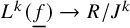 , we have
$ \overline {J^{n+k-1}} \subseteq \ker \Big (R \to H_0( R/J^k \otimes ^{{\mathbb L}} {\mathbb R} \Gamma (Y, \mathcal {O}_Y)) \Big ).$
, we have
$ \overline {J^{n+k-1}} \subseteq \ker \Big (R \to H_0( R/J^k \otimes ^{{\mathbb L}} {\mathbb R} \Gamma (Y, \mathcal {O}_Y)) \Big ).$
 If R is Noetherian and reduced, consider the union over all proper birational maps
$Y \to \mathrm {Spec} \, R$
If R is Noetherian and reduced, consider the union over all proper birational maps
$Y \to \mathrm {Spec} \, R$


which we call the birational preclosure of
$J^k$
 . We view it as an analog of the
$+$
. We view it as an analog of the
$+$
 -closure of an ideal but in the birational direction. In positive (respectively mixed) characteristic,
$R \to {\mathbb R}\Gamma (Y, \mathcal {O}_Y)$
-closure of an ideal but in the birational direction. In positive (respectively mixed) characteristic,
$R \to {\mathbb R}\Gamma (Y, \mathcal {O}_Y)$
 factors the map
$R \to R^+$
factors the map
$R \to R^+$
 (respectively
$R \to \widehat {R^+}$
(respectively
$R \to \widehat {R^+}$
 ), see [Reference BhattBha12, Reference BhattBha20, Reference Hochster and HunekeHH92, Reference Huneke and LyubeznikHL07]. Thus we immediately obtain the following.
Corollary C (Proposition 4.10, Proposition 4.11)
Suppose R is a Noetherian reduced ring with p in its Jacobson radical and I and
$J = (f_1, \dots , f_n)$
 are ideals. Then
$I^{\operatorname {\mathrm {Bir}}} \subseteq I \widehat {R^+} \cap R$
are ideals. Then
$I^{\operatorname {\mathrm {Bir}}} \subseteq I \widehat {R^+} \cap R$
 and so
$\overline {J^{n+k-1}} \subseteq (J^k \widehat {R^+}) \cap R$
and so
$\overline {J^{n+k-1}} \subseteq (J^k \widehat {R^+}) \cap R$
 , recovering [Reference Hochster and HunekeHH95, Theorem 7.1] in characteristic p and [Reference Rodríguez-Villalobos and SchwedeRS24, Corollary 5.1] in mixed characteristic. These then imply that
$\overline {J^{n+k-1}} \subseteq (J^k)^*$
, recovering [Reference Hochster and HunekeHH95, Theorem 7.1] in characteristic p and [Reference Rodríguez-Villalobos and SchwedeRS24, Corollary 5.1] in mixed characteristic. These then imply that
$\overline {J^{n+k-1}} \subseteq (J^k)^*$
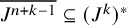 of [Reference Hochster and HunekeHH90, Theorem 5.4] and that
$\overline {J^{n+k-1}} \subseteq (J^k)^{\mathrm {ep}}$
of [Reference Hochster and HunekeHH90, Theorem 5.4] and that
$\overline {J^{n+k-1}} \subseteq (J^k)^{\mathrm {ep}}$
 of [Reference HeitmannHei01, Theorem 4.2].
1.1 History of this paper and strategy of the proof
This paper came out of [Reference Epstein, McDonald, Rebecca and SchwedeEMRS25] as an attempt to find a Briançon-Skoda theorem for the Hironaka-closure in characteristic zero. The starting point was [Reference Lipman and TeissierLT81], where Lipman-Teissier showed that if
$h \in \overline {J^n}$
 for
$J = (f_1, \dots , f_n)$
for
$J = (f_1, \dots , f_n)$
 , then the Čech class
$[{h \over f_1 \cdots f_n}]$
, then the Čech class
$[{h \over f_1 \cdots f_n}]$
 is zero in
$H^n_J({\mathbb R}\Gamma (Y, \mathcal {O}_Y))$
is zero in
$H^n_J({\mathbb R}\Gamma (Y, \mathcal {O}_Y))$
 where Y is the normalized blowup of J. As Koszul homology limits to local cohomology, we began by trying to show the stronger statement that
$h \mapsto 0 \in H_0\big (\text {Kos}(\underline {f}, {\mathbb R} \Gamma (Y, \mathcal {O}_Y))\big )$
where Y is the normalized blowup of J. As Koszul homology limits to local cohomology, we began by trying to show the stronger statement that
$h \mapsto 0 \in H_0\big (\text {Kos}(\underline {f}, {\mathbb R} \Gamma (Y, \mathcal {O}_Y))\big )$
 ; indeed for small values of n this is easy to see quite explicitly, and we were able to prove it in general. Replacing the Koszul complex with a Buchsbaum-Eisenbud complex (or equivalently an Eagon-Northcott complex), we obtained our main result by a direct computation of the double complex
$L^k(\underline {f}) \otimes {\mathbb R}\Gamma (Y, \mathcal {O}_Y)$
; indeed for small values of n this is easy to see quite explicitly, and we were able to prove it in general. Replacing the Koszul complex with a Buchsbaum-Eisenbud complex (or equivalently an Eagon-Northcott complex), we obtained our main result by a direct computation of the double complex
$L^k(\underline {f}) \otimes {\mathbb R}\Gamma (Y, \mathcal {O}_Y)$
 . Finally, we discovered our less computational proof of the main theorem, also compare with [Reference Lazarsfeld and LeeLL07, Proof of Theorem B]. The proof of the main application came after we realized that our result yielded a short proof that
$\mathrm {T}(R) \neq 0$
. Finally, we discovered our less computational proof of the main theorem, also compare with [Reference Lazarsfeld and LeeLL07, Proof of Theorem B]. The proof of the main application came after we realized that our result yielded a short proof that
$\mathrm {T}(R) \neq 0$
 assuming the existence of regular alterations.
2 Integral closure and the Buchsbaum-Eisenbud complex
In this section, we show our main result. We begin with some preliminaries on Čech covers.
2.1 Partially normalized blowups and Čech covers
We begin by discussing partially normalized blowups of
$J \subseteq R$
 . For more information, we refer the reader to [Sta25, Tag 052P] and [Sta25, Tag 01OF]. For those most interested in the geometric case, what follows below becomes easier to contemplate if R is a domain and so we invite the reader to think in that case if they prefer. Suppose that
$J = (f_1, \dots , f_n)$
. For more information, we refer the reader to [Sta25, Tag 052P] and [Sta25, Tag 01OF]. For those most interested in the geometric case, what follows below becomes easier to contemplate if R is a domain and so we invite the reader to think in that case if they prefer. Suppose that
$J = (f_1, \dots , f_n)$
 . Then the blowup of J,
$Y \to \mathrm {Spec} \, R$
. Then the blowup of J,
$Y \to \mathrm {Spec} \, R$
 is covered by affine charts corresponding to each
$f_i$
is covered by affine charts corresponding to each
$f_i$
 ,
$Y_i := \mathrm {Spec} \, R[{f_1 \over f_i}, \dots , {f_n \over f_i}]$
,
$Y_i := \mathrm {Spec} \, R[{f_1 \over f_i}, \dots , {f_n \over f_i}]$
 where here we view
$R_i := R[{f_1 \over f_i}, \dots , {f_n \over f_i}]$
where here we view
$R_i := R[{f_1 \over f_i}, \dots , {f_n \over f_i}]$
 as a subring of
$R[{1 \over f_i}]$
as a subring of
$R[{1 \over f_i}]$
 (in particular, if
$g f_i = 0$
(in particular, if
$g f_i = 0$
 , then g becomes zero in this ring). We remind the reader of the following.
-
(a) The blowups of J and $J^m$
 agree for any integer
$m> 0$
. This follows either via the universal property of blowups or direct computation. In particular, for the blowup of
$J^m$
, one only needs the charts
$Y_i$
which correspond to
$f_i^m \in J^m$
.
agree for any integer
$m> 0$
. This follows either via the universal property of blowups or direct computation. In particular, for the blowup of
$J^m$
, one only needs the charts
$Y_i$
which correspond to
$f_i^m \in J^m$
. -
(b) Suppose $h \in \overline {J}$
with associated ideal-integral closure relation
$h^d + a_1 h^{d-1} + \dots + a_d = 0$
with
$a_i \in J^i$
, then we see that
$h/f_i$
satisfies the ring-integral closure relation $$\begin{align*}\left({h \over f_i}\right)^d + {a_1 \over f_i} \left({h \over f_i}\right)^{d-1} + \dots + {a_d \over f_i^d} \in R_i. \end{align*}$$
Furthermore, if we blowup $(J, h)$
, the chart corresponding to inverting h is redundant. Indeed, in the Rees algebra
$R[(J, h)t]$
(with t a dummy variable) we see, by utilizing the original integral equation for h, that a homogeneous prime containing
$ft$
for all
$f \in J$
must contain
$ht$
. Hence we see that the blowup of
$(J, h)$
is integral over the blowup of J. Taking a limit, the blowup of
$\overline {J^{n+k-1}}$
has an integral map to the blowup of J.





In what follows, we set
$Y \to \mathrm {Spec} \, R$
 to be the blowup of
$\overline {J^{n+k-1}}$
to be the blowup of
$\overline {J^{n+k-1}}$
 with the affine cover whose charts
$Y_i$
with the affine cover whose charts
$Y_i$
 correspond to
$f_i$
correspond to
$f_i$
 as above. Since
$Y \to \mathrm {Spec} \, R$
as above. Since
$Y \to \mathrm {Spec} \, R$
 factors through the blowup of J, we have that
$J \mathcal {O}_Y = \mathcal {O}_Y(-E)$
factors through the blowup of J, we have that
$J \mathcal {O}_Y = \mathcal {O}_Y(-E)$
 where E is an effective Cartier divisor (E is not necessarily a Weil divisor in our generality as Y may not be normal). Observe also that
$\overline {J^{n+k-1}} \mathcal {O}_Y = \mathcal {O}_Y(-(n+k-1)E)$
where E is an effective Cartier divisor (E is not necessarily a Weil divisor in our generality as Y may not be normal). Observe also that
$\overline {J^{n+k-1}} \mathcal {O}_Y = \mathcal {O}_Y(-(n+k-1)E)$
 .
.
2.2 The Buchsbaum-Eisenbud complex
In this subsection, we provide some background on the Buchsbaum-Eisenbud complex, first introduced in [Reference Buchsbaum and EisenbudBE75]. It is isomorphic to an appropriate Eagon-Northcott complex [Reference Eagon and NorthcottEN62]. We largely follow the exposition in [Reference SrinivasanSri89, Section 1].
Let
$J=(f_1,\dots ,f_n)$
 be an ideal and let
$F\to R$
be an ideal and let
$F\to R$
 be a map of free modules where F has basis
$e_1,\dots ,e_n$
be a map of free modules where F has basis
$e_1,\dots ,e_n$
 and
$e_i\mapsto f_i$
and
$e_i\mapsto f_i$
 . The Buchsbaum-Eisenbud complex for
$J^k$
. The Buchsbaum-Eisenbud complex for
$J^k$
 is then the complex

where
$L_i^k(F)$
 is the image of the natural map

It easily follows that the
$0$
 th homology of
$L^k(\underline {f})$
th homology of
$L^k(\underline {f})$
 is
$R/J^k$
is
$R/J^k$
 . Indeed, if
$f_1,\dots , f_n$
. Indeed, if
$f_1,\dots , f_n$
 form a regular sequence, then
$L^k(\underline {f})$
form a regular sequence, then
$L^k(\underline {f})$
 is a free resolution of
$R/J^k$
is a free resolution of
$R/J^k$
 .
.
We now globalize this perspective to the blowup of our ideal. Let
$Y\to \mathrm {Spec} \, R$
 be a (partially) normalized blowup of
$J=(f_1,\dots ,f_n)$
be a (partially) normalized blowup of
$J=(f_1,\dots ,f_n)$
 as above and recall that
$J\mathcal {O}_Y=\mathcal {O}_Y(-E)$
as above and recall that
$J\mathcal {O}_Y=\mathcal {O}_Y(-E)$
 . It is standard to create an exact Koszul-type complex of locally free sheaves on such a blowup (see for instance [Reference LazarsfeldLaz04, Proof of 9.6.31]); we explain the generalization of this to the Buchsbaum-Eisenbud complex or Eagon-Northcott complex. Let
$\{Y_i\}_{i=1}^n$
. It is standard to create an exact Koszul-type complex of locally free sheaves on such a blowup (see for instance [Reference LazarsfeldLaz04, Proof of 9.6.31]); we explain the generalization of this to the Buchsbaum-Eisenbud complex or Eagon-Northcott complex. Let
$\{Y_i\}_{i=1}^n$
 be the standard affine charts and consider
$L^k(R_j)$
be the standard affine charts and consider
$L^k(R_j)$
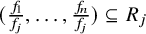
 , the Buchsbaum-Eisenbud complex associated to the kth power of the (unit) ideal
$(\frac {f_1}{f_j},\dots ,\frac {f_n}{f_j})\subseteq R_j$
, the Buchsbaum-Eisenbud complex associated to the kth power of the (unit) ideal
$(\frac {f_1}{f_j},\dots ,\frac {f_n}{f_j})\subseteq R_j$
 :
:

Note that
$\partial _1\colon R_j^{b_1}\to R_j$
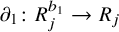 has as its entries the degree k monomials in
$\frac {f_1}{f_j},\dots ,\frac {f_n}{f_j}$
has as its entries the degree k monomials in
$\frac {f_1}{f_j},\dots ,\frac {f_n}{f_j}$
 (which includes
$\frac {f_j}{f_j}=1$
(which includes
$\frac {f_j}{f_j}=1$
 ) while the remaining differentials are matrices whose entries are
$\pm \frac {f_i}{f_j}$
) while the remaining differentials are matrices whose entries are
$\pm \frac {f_i}{f_j}$
 . Furthermore, this complex is exact as its homologies are annihilated by the unit ideal. We next consider the following map of complexes:

By design, this map is an isomorphism. Furthermore, the differentials of the bottom complex are simply matrices whose entries are
$\pm f_i$
 (except for
$f_j^k\partial _1$
(except for
$f_j^k\partial _1$
 whose entries are the degree k monomials in
$f_1,\dots ,f_n$
whose entries are the degree k monomials in
$f_1,\dots ,f_n$
 ) and thus its differentials are independent of j. Therefore, we can glue these complexes on the charts
$\{Y_i\}_{i=1}^n$
) and thus its differentials are independent of j. Therefore, we can glue these complexes on the charts
$\{Y_i\}_{i=1}^n$
 together to obtain the following exact complex:

Twisting by
$\mathcal {O}_Y(-(n-1)E)$
 , we obtain an exact complex

which can be viewed as a subcomplex of the Buchsbaum-Eisenbud complex for
$(f_1,\dots ,f_n)^k$
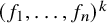 on Y:
on Y:

Remark 2.1. Note that the Buchsbaum-Eisenbud complex is isomorphic to the so-called Eagon-Northcott complex by [Reference Buchsbaum and EisenbudBE75, Cor. 3.2]. We chose to work with the Buchsbaum-Eisenbud complex here, as it gives the obvious generating set for
$(f_1,\dots ,f_n)^k$
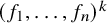 and is generally easier to describe than the Eagon-Northcott complex. Readers familiar with the Eagon-Northcott complex can also check that there is a map from an exact Eagon-Northcott complex
$\text {EN}_2$
and is generally easier to describe than the Eagon-Northcott complex. Readers familiar with the Eagon-Northcott complex can also check that there is a map from an exact Eagon-Northcott complex
$\text {EN}_2$
 on Y to the pullback
$\text {EN}_1$
on Y to the pullback
$\text {EN}_1$
 of an Eagon-Northcott complex on
$\mathrm {Spec} \, R$
of an Eagon-Northcott complex on
$\mathrm {Spec} \, R$
 to Y, where

while

These two complexes are both constructed from the
$k\times (n+k-1)$
 matrix:

2.3 The main result
In this subsection, we prove our derived version of the Briançon-Skoda theorem. The proof is remarkably simple and short.
Theorem 2.2. Suppose R is a ring and
$J = (f_1, \dots , f_n)\subseteq R$
 is an ideal. Suppose that
$\pi : Y \to \mathrm {Spec} \, R$
is an ideal. Suppose that
$\pi : Y \to \mathrm {Spec} \, R$
 is the blowup of
$\overline {J^{n+k-1}}$
is the blowup of
$\overline {J^{n+k-1}}$
 (or any map that dominates it) with
$J\mathcal {O}_Y=\mathcal {O}_Y(-E)$
(or any map that dominates it) with
$J\mathcal {O}_Y=\mathcal {O}_Y(-E)$
 for E an effective Cartier divisor. Then the canonical map

is the zero map in the derived category. In fact, even
$\mathcal {O}_Y(-(n+k-1)E) \to L^k(\underline {f}) \otimes \mathcal {O}_Y$
 is zero. In particular, by taking zeroth cohomology, the map

is zero.
Proof. By viewing
$\mathcal {O}_Y(-(n+k-1)E)$
 as a complex in degree zero, we have a natural map
$\mathcal {O}_Y(-(n+k-1)E) \to \text {BE}_2$
as a complex in degree zero, we have a natural map
$\mathcal {O}_Y(-(n+k-1)E) \to \text {BE}_2$
 and hence a natural composition map

SinceFootnote
4
$\text {BE}_2$
 is exact and hence zero in the derived category,
$\mathcal {O}_Y(-(n+k-1)E) \to \text {BE}_1 = L^k(\underline {f})\otimes \mathcal {O}_Y$
is exact and hence zero in the derived category,
$\mathcal {O}_Y(-(n+k-1)E) \to \text {BE}_1 = L^k(\underline {f})\otimes \mathcal {O}_Y$
 is zero in the derived category. Now simply apply the derived functor
${\mathbb R}\Gamma (Y, -)$
is zero in the derived category. Now simply apply the derived functor
${\mathbb R}\Gamma (Y, -)$
 and use the projection formula to obtain the conclusion. The final assertion follows by taking the zeroth cohomology and noticing that
$\overline {J^{n+k-1}}\subseteq \Gamma (Y, \mathcal {O}_Y(-(n+k-1)E))$
and use the projection formula to obtain the conclusion. The final assertion follows by taking the zeroth cohomology and noticing that
$\overline {J^{n+k-1}}\subseteq \Gamma (Y, \mathcal {O}_Y(-(n+k-1)E))$
 .
.
Remark 2.3. There is another short argument explaining Theorem 2.2. For any invertible ideal sheaf
$\mathcal {I}\subseteq \mathcal {O}_Y$
 that is globally generated by n elements
$(f_1,\dots ,f_n)$
that is globally generated by n elements
$(f_1,\dots ,f_n)$
 , the
$\mathcal {O}_Y$
, the
$\mathcal {O}_Y$
 -module structure on the
$\mathcal {O}_Y$
-module structure on the
$\mathcal {O}_Y$
 -algebra
$\text {Kos}(f_1,\dots ,f_n; \mathcal {O}_Y)$
-algebra
$\text {Kos}(f_1,\dots ,f_n; \mathcal {O}_Y)$
 factors over
$\mathcal {O}_Y/\mathcal {I}^n$
factors over
$\mathcal {O}_Y/\mathcal {I}^n$
 : it has n cohomology groups (that sit in cohomological degrees
$[-(n-1),0]$
: it has n cohomology groups (that sit in cohomological degrees
$[-(n-1),0]$
 ), each of which is annihilated by
$\mathcal {I}$
), each of which is annihilated by
$\mathcal {I}$
 , and thus
$\mathcal {I}^{n}$
, and thus
$\mathcal {I}^{n}$
 annihilates
$\text {Kos}(f_1,\dots ,f_n; \mathcal {O}_Y)$
annihilates
$\text {Kos}(f_1,\dots ,f_n; \mathcal {O}_Y)$
 in
$D(Y)$
in
$D(Y)$
 by [Reference BhattBha12, Lemma 3.2]. In general, by comparing with the exact complex
$\text {BE}_2$
by [Reference BhattBha12, Lemma 3.2]. In general, by comparing with the exact complex
$\text {BE}_2$
 one sees that
$H^{i}(\text {BE}_1)$
one sees that
$H^{i}(\text {BE}_1)$
 is annihilated by
$\mathcal {I}$
is annihilated by
$\mathcal {I}$
 for
$-(n-1)\leq i\leq -1$
for
$-(n-1)\leq i\leq -1$
 while
$H^0(\text {BE}_1)$
while
$H^0(\text {BE}_1)$
 is annihilated by
$\mathcal {I}^k$
is annihilated by
$\mathcal {I}^k$
 . Thus
$\mathcal {I}^{n+k-1}$
. Thus
$\mathcal {I}^{n+k-1}$
 annihilates
$\text {BE}_1$
annihilates
$\text {BE}_1$
 in
$D(Y)$
in
$D(Y)$
 by [Reference BhattBha12, Lemma 3.2]. We would like to thank Bhargav Bhatt for pointing this out to us.
Remark 2.4. The statement and proof of Theorem 2.2 also work verbatim if
$\overline {J^{n+k-1}}$
 is replaced, wherever it occurs, by any ideal I such that
$J^{n+k-1} \subseteq I \subseteq \overline {J^{n+k-1}}$
is replaced, wherever it occurs, by any ideal I such that
$J^{n+k-1} \subseteq I \subseteq \overline {J^{n+k-1}}$
 .
.
3 Generalizations of rational and Du Bois singularities
Suppose
$\pi : Y \to X$
 is a map of reduced Noetherian schemes. We say
$\pi $
is a map of reduced Noetherian schemes. We say
$\pi $
 is birational if
$\pi $
is birational if
$\pi $
 induces a bijection between the generic points of X and Y and furthermore induces an isomorphism between the residue fields at those generic points, see [Sta25, Tag 01RO]. If
$\pi $
induces a bijection between the generic points of X and Y and furthermore induces an isomorphism between the residue fields at those generic points, see [Sta25, Tag 01RO]. If
$\pi $
 is of finite type, this is equivalent to the condition that
$\pi $
is of finite type, this is equivalent to the condition that
$\pi $
 induces a bijection between the irreducible components of Y and of X, and
$\pi $
induces a bijection between the irreducible components of Y and of X, and
$\pi $
 induces an isomorphism on a dense open set on each such irreducible component, see [Sta25, Tag 0BAC].
We recall the definition of pseudo-rational rings, noting that regular rings are pseudo-rational [Reference Lipman and TeissierLT81, Section 4].
Definition 3.1 [Reference Lipman and TeissierLT81, Section 2]
Suppose
$(R, \mathfrak {m})$
 is a d-dimensional Noetherian local ring. We say that R has pseudo-rational singularities if the following conditions hold.
-
(a) R is normal.
-
(b) R is Cohen-Macaulay.
-
(c) The $\mathfrak {m}$
-adic completion
$\widehat {R}$
is reduced (that is, R is analytically unramified). -
(d) For every proper birational map $\pi : Y \to \mathrm {Spec} \, R$
from a normal and integral Y, the induced $$\begin{align*}H^d_{\mathfrak{m}}(R) \to H^d_{\mathfrak{m}}({\mathbb R} \Gamma(Y, \mathcal{O}_Y)) \end{align*}$$
is injective. If R has a dualizing module $\omega _R$
, this just means that
$\Gamma (Y, \omega _Y) \to \omega _R$
is surjective.






We say that a Noetherian scheme is pseudo-rational if its stalks are pseudo-rational.
The earlier conditions of the definition imply that there are many normal Y with
$\pi : Y \to \mathrm {Spec} \, R$
 proper birational. In fact, for each proper birational
$Y \to \mathrm {Spec} \, R$
proper birational. In fact, for each proper birational
$Y \to \mathrm {Spec} \, R$
 with Y integral, the normalization map
$Y^{\mathrm {N}} \to Y$
with Y integral, the normalization map
$Y^{\mathrm {N}} \to Y$
 is finite, see the discussion [Reference Lipman and TeissierLT81, Pages 102, 103].
Our next goal is to study a weakening of the pseudo-rational hypothesis. For that we need a definition and some basic facts about pure maps in the derived category.
Definition 3.2 [Reference ChristensenChr98],[Reference Bhatt, Ma, Patakfalvi, Schwede, Tucker, Waldron and WitaszekBMP+24, Proposition 2.10]
A map
$M \to N$
 in
$D(R)$
in
$D(R)$
 with cone Q is pure if for each perfect complex P with a map
$P \to Q$
with cone Q is pure if for each perfect complex P with a map
$P \to Q$
 , the composition
$P \to M[1]$
, the composition
$P \to M[1]$
 is zero. In other words, this means that
$Q \to M[1]$
is zero. In other words, this means that
$Q \to M[1]$
 is phantom in the sense of [Reference ChristensenChr98], see [Reference KrauseKra22, Chapter 5].
Equivalently,
$M \to N$
 is pure if
$M \to N$
is pure if
$M \to N$
 can be written as a filtered colimit of split maps
$M \to N_i$
can be written as a filtered colimit of split maps
$M \to N_i$
 (in the derived
$\infty $
(in the derived
$\infty $
 -category).
Lemma 3.3 (cf. [Reference LyuLyu22, Proposition 3.10])
Suppose R is a ring and
$R \to S$
 is faithfully flat. Suppose
$M \to N$
is faithfully flat. Suppose
$M \to N$
 is a map in
$D(R)$
is a map in
$D(R)$
 such that the base change
$M \otimes _R S=: M_S \to N_S := N \otimes _R S$
such that the base change
$M \otimes _R S=: M_S \to N_S := N \otimes _R S$
 is pure. Then
$M \to N$
is pure. Then
$M \to N$
 is also pure.
Proof. Let Q denote the cone of
$M \to N$
 and let
$P \to Q$
and let
$P \to Q$
 be a map from a perfect complex to Q. Our assumption implies that the base change
$Q_S \to P_S \to M_S[1]$
be a map from a perfect complex to Q. Our assumption implies that the base change
$Q_S \to P_S \to M_S[1]$
 is zero. But
$\operatorname {\mathrm {Hom}}_{D(R)}(P, Q) \to \operatorname {\mathrm {Hom}}_{D(S)}(P_S, Q_S)$
is zero. But
$\operatorname {\mathrm {Hom}}_{D(R)}(P, Q) \to \operatorname {\mathrm {Hom}}_{D(S)}(P_S, Q_S)$
 is injective since P is perfect [Sta25, Tag 0A6A] and so the result follows.
The following result generalizes the fact that a map of modules
$f : M \to N$
 with
$N/f(M)$
with
$N/f(M)$
 finitely presented is pure if and only if it is split injective ([Reference Hochster and RobertsHR76, Corollary 5.2], [Sta25, Tag 058K]).
Lemma 3.4. Suppose R is Noetherian,
$M \to N \to C \xrightarrow {+1}$
 is a triangle in
$D(R)$
is a triangle in
$D(R)$
 with
$M\in D^+(R)$
with
$M\in D^+(R)$
 and
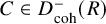
$C \in D^-_{\mathrm {coh}}(R)$
and
$C \in D^-_{\mathrm {coh}}(R)$
 . Then
$M \to N$
. Then
$M \to N$
 is pure if and only if
$M \to N$
is pure if and only if
$M \to N$
 has a left inverse in
$D(R)$
has a left inverse in
$D(R)$
 .
.
Proof. Obviously if the map is split, then it is pure. Srikanth Iyengar pointed out that the converse can be deduced from [Reference KrauseKra22, Proposition 5.2.8] but we provide a proof for the reader’s convenience. First note that since
$M\in D^+(R)$
 , there exists n so that
$\operatorname {\mathrm {Hom}}_{D(R)}(K, M)=\operatorname {\mathrm {Hom}}_{D(R)}(\tau ^{\geq -n}K, M)$
, there exists n so that
$\operatorname {\mathrm {Hom}}_{D(R)}(K, M)=\operatorname {\mathrm {Hom}}_{D(R)}(\tau ^{\geq -n}K, M)$
 for all
$K\in D(R)$
for all
$K\in D(R)$
 . Since
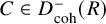
$C \in D^-_{\mathrm {coh}}(R)$
. Since
$C \in D^-_{\mathrm {coh}}(R)$
 , we can write C as a colimit of perfect complexes
$C_i$
, we can write C as a colimit of perfect complexes
$C_i$
 so that
$\tau ^{\geq -n}C_i\simeq \tau ^{\geq -n}C$
so that
$\tau ^{\geq -n}C_i\simeq \tau ^{\geq -n}C$
 for all i. To show
$M\to N$
for all i. To show
$M\to N$
 is split in
$D(R)$
is split in
$D(R)$
 , we need to show that
$\mathrm {Ext}^1(C, M)=H^1({\mathbb R}\lim {\mathbb R}\operatorname {\mathrm {Hom}}(C_i, M))=0$
, we need to show that
$\mathrm {Ext}^1(C, M)=H^1({\mathbb R}\lim {\mathbb R}\operatorname {\mathrm {Hom}}(C_i, M))=0$
 . By the Milnor exact sequence [Sta25, Tag 0CQE], we have

The right term above vanishes because
$M\to N$
 is pure and
$C_i$
is pure and
$C_i$
 is perfect, and the left term above also vanishes since
$\operatorname {\mathrm {Hom}}(C_i, M) = \operatorname {\mathrm {Hom}}(\tau ^{\geq -n}C_i, M)=\operatorname {\mathrm {Hom}}(\tau ^{\geq -n}C, M)$
is perfect, and the left term above also vanishes since
$\operatorname {\mathrm {Hom}}(C_i, M) = \operatorname {\mathrm {Hom}}(\tau ^{\geq -n}C_i, M)=\operatorname {\mathrm {Hom}}(\tau ^{\geq -n}C, M)$
 and thus
$\{\operatorname {\mathrm {Hom}}(C_i, M)\}$
and thus
$\{\operatorname {\mathrm {Hom}}(C_i, M)\}$
 is a constant system. Thus
$\mathrm {Ext}^1(C, M)=0$
is a constant system. Thus
$\mathrm {Ext}^1(C, M)=0$
 as we wanted.
Lyu coined the following term, also see [Reference KovácsKov00, Reference MurayamaMur25, Reference De Deyn, Lank, Manali-Rahul and VenkateshDLMV25].
Definition 3.5 [Reference LyuLyu22]
A Noetherian reduced ring R is a birational derived splinter if for each proper birational
$\pi : Y \to \mathrm {Spec} \, R$
 , we have that
$R \to {\mathbb R} \Gamma (Y, \mathcal {O}_Y)$
, we have that
$R \to {\mathbb R} \Gamma (Y, \mathcal {O}_Y)$
 has a left inverse. More generally, a Noetherian reduced scheme X is a global birational derived splinter if for each proper birational
$\pi : Y \to X$
has a left inverse. More generally, a Noetherian reduced scheme X is a global birational derived splinter if for each proper birational
$\pi : Y \to X$
 , we have that
$\mathcal {O}_X \to {\mathbb R} \pi _* \mathcal {O}_Y$
, we have that
$\mathcal {O}_X \to {\mathbb R} \pi _* \mathcal {O}_Y$
 has a left inverse.
Remark 3.6. By Chow’s lemma, to show that R is a birational derived splinter, it suffices to consider projective and birational
$\pi $
 , hence simply consider blowups. See [Reference LiuLiu02, Chapter 8, Theorem 8.1.24].
Remark 3.7. Birational derived splinters are easily seen to be normal. Indeed, if
$R \to S$
 is a finite birational extension, then
$R \to S$
is a finite birational extension, then
$R \to S$
 is not pure (equivalently split), unless
$S = R$
is not pure (equivalently split), unless
$S = R$
 (as the conductor of the map is the image of
$\operatorname {\mathrm {Hom}}_R(S, R) \to R$
(as the conductor of the map is the image of
$\operatorname {\mathrm {Hom}}_R(S, R) \to R$
 ). Hence, restricting birational derived splinters to domains is harmless since if R has minimal primes
$Q_1, \dots , Q_n$
). Hence, restricting birational derived splinters to domains is harmless since if R has minimal primes
$Q_1, \dots , Q_n$
 , then
$R \to \prod R/Q_i$
, then
$R \to \prod R/Q_i$
 is a finite extension.
Remark 3.8. In what follows, it will often be helpful to replace our local ring
$(R,\mathfrak {m})$
 with its strict Henselization
$R^{\operatorname {\mathrm {{sh}}}}$
with its strict Henselization
$R^{\operatorname {\mathrm {{sh}}}}$
 in order to guarantee that R has an infinite residue field. As such, we want to ensure that if R is a birational derived splinter (or a reduced blowup-square splinter, see Definition 3.15) then so is
$R^{\operatorname {\mathrm {{sh}}}}$
in order to guarantee that R has an infinite residue field. As such, we want to ensure that if R is a birational derived splinter (or a reduced blowup-square splinter, see Definition 3.15) then so is
$R^{\operatorname {\mathrm {{sh}}}}$
 . This follows because proper birational maps to
$\mathrm {Spec} \, R^{\operatorname {\mathrm {{sh}}}}$
. This follows because proper birational maps to
$\mathrm {Spec} \, R^{\operatorname {\mathrm {{sh}}}}$
 can be dominated by the base change of a proper birational map to
$\mathrm {Spec} \, R$
can be dominated by the base change of a proper birational map to
$\mathrm {Spec} \, R$
 by [Reference LyuLyu22, Theorem 5.1]. Alternatively, a similar reduction to the infinite residue field case can be obtained with
$R[t]_{\mathfrak {m}[t]}$
by [Reference LyuLyu22, Theorem 5.1]. Alternatively, a similar reduction to the infinite residue field case can be obtained with
$R[t]_{\mathfrak {m}[t]}$
 , see for instance [Reference Lipman and TeissierLT81, Example (c) before Theorem 2.1].
We believe the following is known to experts; indeed, the argument can be found in the proof of [Reference KovácsKov00, Lemma 2]. In the case that X is regular, it also follows from [Reference Lank and VenkateshLV24, Lemma 3.16].
Lemma 3.9. Suppose
$(R, \mathfrak {m})$
 is a pseudo-rational local ring of dimension d, then R is a birational derived splinter. Even more, if X is a pseudo-rational scheme with a canonical sheaf, then X is a global birational derived splinter.
Proof. Suppose
$\pi : Y \to \mathrm {Spec} \, R$
 is a proper birational map with Y normal. We work with the completion
$\widehat {R}$
is a proper birational map with Y normal. We work with the completion
$\widehat {R}$
 to gain access to a canonical module. By Lemma 3.3 and Lemma 3.4, it suffices to show
$ \widehat {R} \to \widehat {R} \otimes ^{{\mathbb L}} {\mathbb R}\Gamma (Y, \mathcal {O}_Y) \cong {\mathbb R} \Gamma (Y_{\widehat {R}}, \mathcal {O}_{Y_{\widehat {R}}}) $
to gain access to a canonical module. By Lemma 3.3 and Lemma 3.4, it suffices to show
$ \widehat {R} \to \widehat {R} \otimes ^{{\mathbb L}} {\mathbb R}\Gamma (Y, \mathcal {O}_Y) \cong {\mathbb R} \Gamma (Y_{\widehat {R}}, \mathcal {O}_{Y_{\widehat {R}}}) $
 is pure where
$Y_{\widehat {R}} := Y \times _{\mathrm {Spec} \, R} \mathrm {Spec} \, \widehat {R}$
is pure where
$Y_{\widehat {R}} := Y \times _{\mathrm {Spec} \, R} \mathrm {Spec} \, \widehat {R}$
 . We will show that
$ \widehat {R} \to {\mathbb R} \Gamma (Y_{\widehat {R}}, \mathcal {O}_{Y_{\widehat {R}}})$
. We will show that
$ \widehat {R} \to {\mathbb R} \Gamma (Y_{\widehat {R}}, \mathcal {O}_{Y_{\widehat {R}}})$
 is split.
Now,
$\widehat {R}$
 is Cohen-Macaulay and has a normalized dualizing complex
$\omega _{\widehat {R}}[d]$
is Cohen-Macaulay and has a normalized dualizing complex
$\omega _{\widehat {R}}[d]$
 . Since
$H^d_{\mathfrak {m}}(R) \to H^d_{\mathfrak {m}}({\mathbb R} \Gamma (Y, \mathcal {O}_Y))$
. Since
$H^d_{\mathfrak {m}}(R) \to H^d_{\mathfrak {m}}({\mathbb R} \Gamma (Y, \mathcal {O}_Y))$
 injects, we see that the Matlis dual
$ \Gamma (Y_{\widehat {R}}, \omega _{Y_{\widehat {R}}}) \to \omega _{\widehat {R}} $
injects, we see that the Matlis dual
$ \Gamma (Y_{\widehat {R}}, \omega _{Y_{\widehat {R}}}) \to \omega _{\widehat {R}} $
 surjects and so is an isomorphism (both sides are rank-1 torsion-free). This yields a composition
![omega sub R-hat [d] tilde-arrow Gamma (Y sub R-hat, omega sub Y sub R-hat) [d] arrow R Gamma (Y sub R-hat, omega dot sub Y sub R-hat) arrow omega dot sub R-hat is isomorphic to omega sub R-hat [d]](https://static.cambridge.org/binary/version/id/urn:cambridge.org:id:binary:20260715090159137-0549:S2050508626100353:S2050508626100353_eqnu27.png?pub-status=live)
that one sees is an isomorphism (it is a map between S2-modules that is an isomorphism outside a set of codimension
$\geq 2$
 ). Applying Grothendieck duality produces a composition

that is also an isomorphism. This proves that
$\widehat {R} \to {\mathbb R} \Gamma (Y_{\widehat {R}}, \mathcal {O}_{Y_{\widehat {R}}})$
 is split, as desired.
For the scheme case, since one may assume X is integral, we may assume that
![omega dot sub x equals omega sub x [0]](https://static.cambridge.org/binary/version/id/urn:cambridge.org:id:binary:20260715090159137-0549:S2050508626100353:S2050508626100353_inline279.png?pub-status=live) is a dualizing complex. Set
is a dualizing complex. Set
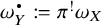 . As above, we have a composition

which is the identity. Then dualize and argue as above.
Remark 3.10. Excellent local rings that are F-rational or BCM-rational (or even
$+$
 -rational: i.e.,
$(R,\mathfrak {m},k)$
-rational: i.e.,
$(R,\mathfrak {m},k)$
 is a Cohen-Macaulay local domain with
$\mathrm {char}\,k> 0$
is a Cohen-Macaulay local domain with
$\mathrm {char}\,k> 0$
 , such that
$H^{\dim R}_{\mathfrak {m}}(R) \to H^{\dim R}_{\mathfrak {m}}(S)$
, such that
$H^{\dim R}_{\mathfrak {m}}(R) \to H^{\dim R}_{\mathfrak {m}}(S)$
 injects for all finite
$R \subseteq S$
injects for all finite
$R \subseteq S$
 ) are birational derived splinters, as all are pseudo-rational [Reference SmithSmi97, Reference Ma and SchwedeMS21]. Regular rings are derived splinters in general [Reference BhattBha18], but the argument above that they are birational derived splinters is much simpler than the fact that finite maps
$R \to S$
) are birational derived splinters, as all are pseudo-rational [Reference SmithSmi97, Reference Ma and SchwedeMS21]. Regular rings are derived splinters in general [Reference BhattBha18], but the argument above that they are birational derived splinters is much simpler than the fact that finite maps
$R \to S$
 split in mixed characteristic [Reference AndréAnd18].
Remark 3.11. We note that excellent local Cohen-Macaulay birational derived splinters are pseudo-rational as condition (d) of Definition 3.1 is clear from the splinter condition. However, without the Cohen-Macaulay condition, this is not true.
Suppose
$R \subseteq S$
 is a pure inclusion of Noetherian domains and S is a birational derived splinter, then it is not difficult to see that R is a birational derived splinter as well, see [Reference LyuLyu22, Corollary 3.12]. But now by [Reference Ma and PolstraMP25, Example 8.6] (which utilizes the examples of [Reference KovácsKov18]), there exists such a split extension
$R \subseteq S$
is a pure inclusion of Noetherian domains and S is a birational derived splinter, then it is not difficult to see that R is a birational derived splinter as well, see [Reference LyuLyu22, Corollary 3.12]. But now by [Reference Ma and PolstraMP25, Example 8.6] (which utilizes the examples of [Reference KovácsKov18]), there exists such a split extension
$R \subseteq S$
 so that S is F-rational and hence pseudo-rational but R is not Cohen-Macaulay. In particular, in this example, R is a birational derived splinter but is not pseudo-rational.
3.1 Briançon-Skoda theorem for birational derived splinters
Our discussion so far yields the following result.
Theorem 3.12. Suppose that a Noetherian ring R is a birational derived splinter (for instance if R is pseudo-rational, or excellent and one of F-rational, BCM-rational or
$+$
 -rational). Suppose that
$J \subseteq R$
-rational). Suppose that
$J \subseteq R$
 is an ideal that locally has analytic spread
$\leq n$
is an ideal that locally has analytic spread
$\leq n$
 . Then for every integer
$k> 0$
. Then for every integer
$k> 0$


Proof. We may assume that R is a normal local domain. Let Y denote the blowup of
$\overline {J^{n+k-1}}$
 . We may also assume that R is strictly Henselian (see [Reference Huneke and SwansonHS06, Proposition 1.6.2] and Remark 3.8, and note that blowups commute with flat base change) and so assume R has infinite residue field.
By [Reference Huneke and SwansonHS06, Proposition 8.3.7], J has a minimal reduction
$J' = (f_1, \dots , f_n) \subseteq J$
 whose powers have the same integral closures as the powers of J. Hence we may replace J by
$J'$
whose powers have the same integral closures as the powers of J. Hence we may replace J by
$J'$
 to assume that J is n-generated. Now by Theorem 2.2 and using that
$R \to {\mathbb R}\Gamma (Y, \mathcal {O}_Y)$
to assume that J is n-generated. Now by Theorem 2.2 and using that
$R \to {\mathbb R}\Gamma (Y, \mathcal {O}_Y)$
 splits, we have that
$\overline {J^{n+k-1}}$
splits, we have that
$\overline {J^{n+k-1}}$
 maps to zero in
$H_0(L^k(\underline {f})) \otimes R = R/J^k$
maps to zero in
$H_0(L^k(\underline {f})) \otimes R = R/J^k$
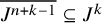
 , that is,
$\overline {J^{n+k-1}} \subseteq J^k$
, that is,
$\overline {J^{n+k-1}} \subseteq J^k$
 .
.
Remark 3.13. Suppose that
$Y \to \mathrm {Spec} \, R$
 is the blowup of
$\overline {J^{n+k-1}}$
is the blowup of
$\overline {J^{n+k-1}}$
 and that there exists some map
$\varphi : {\mathbb R}\Gamma (Y, \mathcal {O}_Y) \to R$
and that there exists some map
$\varphi : {\mathbb R}\Gamma (Y, \mathcal {O}_Y) \to R$
 such that the composition
$R \to {\mathbb R}\Gamma (Y, \mathcal {O}_Y) \xrightarrow {\varphi } R$
such that the composition
$R \to {\mathbb R}\Gamma (Y, \mathcal {O}_Y) \xrightarrow {\varphi } R$
 is multiplication by c (see [Reference Epstein, McDonald, Rebecca and SchwedeEMRS25, Definition 2.21] and [Reference LyuLyu22, Section 2.4]). The proof above shows that

For more discussion in this direction, see Section 5.
Remark 3.14. Suppose R is a normal domain essentially of finite type over
$\mathbb{C}$
 . If R has rational singularities, then we know from [Reference Aberbach and HunekeAH01] that the Briançon-Skoda theorem holds. In [Reference LiLi21], the author gave another proof of this fact in the analytic setting, and also showed that
$ \overline {\mathcal {J}^{n+k-1}}\cdot \omega _R\subset \mathcal {J}^k\cdot \omega _R$
. If R has rational singularities, then we know from [Reference Aberbach and HunekeAH01] that the Briançon-Skoda theorem holds. In [Reference LiLi21], the author gave another proof of this fact in the analytic setting, and also showed that
$ \overline {\mathcal {J}^{n+k-1}}\cdot \omega _R\subset \mathcal {J}^k\cdot \omega _R$
 assuming that
$\omega _R = \Gamma (X, \omega _X)$
assuming that
$\omega _R = \Gamma (X, \omega _X)$
 for
$X \to \mathrm {Spec} \, R$
for
$X \to \mathrm {Spec} \, R$
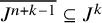
 a resolution of singularities (roughly, R is pseudo-rational without the Cohen-Macaulay hypothesis). It was also claimed that one only needed this weakening of rational singularities without the Cohen-Macaulay condition to deduce that
$\overline {J^{n+k-1}} \subseteq J^k$
a resolution of singularities (roughly, R is pseudo-rational without the Cohen-Macaulay hypothesis). It was also claimed that one only needed this weakening of rational singularities without the Cohen-Macaulay condition to deduce that
$\overline {J^{n+k-1}} \subseteq J^k$
 generally.
We believe this final statement is false in the algebraic category. Explicitly, let E denote the elliptic curve defined by
$x^3+y^3+z^3 = 0$
 in
$\mathbb {P}^2_{\mathbb {C}}$
in
$\mathbb {P}^2_{\mathbb {C}}$
 and set
$X = E \times \mathbb {P}^1_{\mathbb {C}}$
and set
$X = E \times \mathbb {P}^1_{\mathbb {C}}$
 Segre embedded in
$\mathbb {P}^5_{\mathbb {C}}$
Segre embedded in
$\mathbb {P}^5_{\mathbb {C}}$
 . Set R to be the affine cone over X. It is well-known that R is not Cohen-Macaulay (use the Künneth formula to see that
$H^1(X, \mathcal {O}_X)\neq 0$
. Set R to be the affine cone over X. It is well-known that R is not Cohen-Macaulay (use the Künneth formula to see that
$H^1(X, \mathcal {O}_X)\neq 0$
 ). We explain why
$\omega _R = {\mathbb R}\Gamma (Y, \omega _Y)$
). We explain why
$\omega _R = {\mathbb R}\Gamma (Y, \omega _Y)$
 where
$Y \to \mathrm {Spec} \, R$
where
$Y \to \mathrm {Spec} \, R$
 is the blowup of the origin. By [Reference UrbinatiUrb12, Theorem 4.1] and [Reference De Fernex and HaconDH09, Theorem 8.2] we see that
$\omega _R \cdot \mathcal {O}_Y \subseteq \omega _Y$
is the blowup of the origin. By [Reference UrbinatiUrb12, Theorem 4.1] and [Reference De Fernex and HaconDH09, Theorem 8.2] we see that
$\omega _R \cdot \mathcal {O}_Y \subseteq \omega _Y$
 . Hence we have a sequence of maps

But these are nonzero maps of rank-1 torsion-free modules and hence they are injective. Furthermore, these maps are the identity outside of the origin and hence the composition is an isomorphism as
$\omega _R$
 is reflexive. It follows that
$\Gamma (Y, \omega _Y) \to \omega _R$
is reflexive. It follows that
$\Gamma (Y, \omega _Y) \to \omega _R$
 is an isomorphism.
Now, it is well-known that R is the Segre product
$\mathbb {C}[x,y,z]/(x^3+y^3+z^3) \# \mathbb {C}[u,v]$
 . Let
$J = ((xu)^2, (zu)^2) \subseteq R$
. Let
$J = ((xu)^2, (zu)^2) \subseteq R$
 and
$J' = ((xu)^2, (xu)(zu),(zu)^2) \subseteq \overline {J}$
and
$J' = ((xu)^2, (xu)(zu),(zu)^2) \subseteq \overline {J}$
 . Then we have
$h := (xu)(yu)^2(zu) \in \overline {J'^2}=\overline {J^2}$
. Then we have
$h := (xu)(yu)^2(zu) \in \overline {J'^2}=\overline {J^2}$
 (use
$h^3 \in J'^6$
(use
$h^3 \in J'^6$
 for the first containment). On the other hand, if
$h\in J$
for the first containment). On the other hand, if
$h\in J$
 , then after specializing
$u=v=1$
, then after specializing
$u=v=1$
 , we would have
$xy^2z\in (x^2,z^2)S$
, we would have
$xy^2z\in (x^2,z^2)S$
 where
$S=\mathbb {C}[x,y,z]/(x^3+y^3+z^3)$
where
$S=\mathbb {C}[x,y,z]/(x^3+y^3+z^3)$
 . But since
$x, z$
. But since
$x, z$
 is a regular sequence in S, this would imply
$y^2\in (x,z)S$
is a regular sequence in S, this would imply
$y^2\in (x,z)S$
 which is a contradiction. Thus
$h\notin J$
which is a contradiction. Thus
$h\notin J$
 . We found this example with the help of Macaulay2 [Reference Grayson and StillmanGS].
3.2 A characteristic-free weakening of Du Bois singularities
Suppose R is reduced and
$Y \to \mathrm {Spec} \, R$
 is the blowup of an ideal
$J \subseteq R$
is the blowup of an ideal
$J \subseteq R$
 . Consider the reduced blowup square

with F the reduced preimage of
$V(\sqrt {J})$
 . We have the following triangle defining
 :
:

Definition 3.15. Suppose R is a Noetherian reduced ring. We say that R is a reduced blowup-square splinter if for each ideal
$J\subseteq R$
 and
and
 as above, the induced map
 has a left inverse.
Suppose R is essentially of finite typeFootnote
5
over a field of characteristic zero. Then, for instance by [Reference Du BoisDB81, Reference Guillén, Navarro Aznar, Pascual Gainza and PuertaGNPP88], we have functorial maps
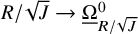
$R \to {\underline \Omega {}^0_{R}}, \mathcal {O}_Y \to {\underline \Omega {}^0_{Y}}, \mathcal {O}_F \to {\underline \Omega {}^0_{F}}, $
 and
$R/\sqrt {J} \to {\underline \Omega {}^0_{R/\sqrt {J}}}$
and
$R/\sqrt {J} \to {\underline \Omega {}^0_{R/\sqrt {J}}}$
 where
${\underline \Omega {}^0_{}}$
where
${\underline \Omega {}^0_{}}$
 is the
$0$
is the
$0$
 th-graded piece of the Deligne-Du Bois complex. Hence from the triangle (see [Reference Du BoisDB81, Proposition 3.9])
$ {\underline \Omega {}^0_{R}} \to {\mathbb R}\Gamma (Y, {\underline \Omega {}^0_{Y}}) \oplus {\underline \Omega {}^0_{R/\sqrt {J}}} \to {\mathbb R}\Gamma (Y, {\underline \Omega {}^0_{F}}) \xrightarrow {+1} $
th-graded piece of the Deligne-Du Bois complex. Hence from the triangle (see [Reference Du BoisDB81, Proposition 3.9])
$ {\underline \Omega {}^0_{R}} \to {\mathbb R}\Gamma (Y, {\underline \Omega {}^0_{Y}}) \oplus {\underline \Omega {}^0_{R/\sqrt {J}}} \to {\mathbb R}\Gamma (Y, {\underline \Omega {}^0_{F}}) \xrightarrow {+1} $
 we have a factorization

This factorization also follows from hyperresolution constructions [Reference Guillén, Navarro Aznar, Pascual Gainza and PuertaGNPP88] or from [Reference Huber and JörderHJ14].
Proposition 3.16. The following singularities are reduced blowup-square splinters.
-
(a) R is essentially of finite type over a field of characteristic zero and is Du Bois.
-
(b) R has p in its Jacobson radical and is lim-perfectoid pure (e.g., R is F-pure).
-
(c) R has p in its Jacobson radical and is Cohen-Macaulay and lim-perfectoid injective (e.g., R is Cohen-Macaulay and F-injective).
Proof. For (a), recall that R having Du Bois singularities means exactly that
$R \to {\underline \Omega {}^0_{R}}$
 is an isomorphism. Thus (2) gives a left inverse of
 .
.
For lim-perfectoid pure singularities, we have a factorization

see for instance [Reference Bhatt, Ma, Patakfalvi, Schwede, Tucker, Waldron and WitaszekBMP+24, Lemma 5.3]. Thus by the definition of lim-perfectoid purity,
$R\to R_{\operatorname {\mathrm {{perfd}}}}$
 is pure and thus
 is pure in
$D(R)$
is pure in
$D(R)$
 . Hence the latter is split in
$D(R)$
. Hence the latter is split in
$D(R)$
 by Lemma 3.4 (note that in characteristic p, lim-perfectoid purity is precisely F-purity by [Reference Bhatt, Ma, Patakfalvi, Schwede, Tucker, Waldron and WitaszekBMP+24, Remark 4.3]).
Now we assume R is Cohen-Macaulay and lim-perfectoid injective (by [Reference Bhatt, Ma, Patakfalvi, Schwede, Tucker, Waldron and WitaszekBMP+24, Remark 4.3], in characteristic p this is equivalent to F-injective). By considering the factorization
 as above and the definition of lim-perfectoid injective, we have that
 is injective for each maximal ideal
$\mathfrak {m}$
is injective for each maximal ideal
$\mathfrak {m}$
 . After base changing to the
$\mathfrak {m}$
. After base changing to the
$\mathfrak {m}$
 -adic completion
$\widehat {R}$
-adic completion
$\widehat {R}$
 , we have that
 is injective. Hence by local duality, we have a surjection

where
 is Grothendieck duality and
 is a normalized dualizing complex.
Claim 3.17. The map
 is an injection.
Proof of claim
The strategy is the same as [Reference Kovács, Schwede and SmithKSS10, Proposition 4.10]. If we consider the triangle
 it suffices to show that
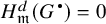 . From the spectral sequence
 , it suffices to show that
 for every i.
Now, as R is weakly normal (see [Reference Datta and MurayamaDM24, Reference Bhatt, Ma, Patakfalvi, Schwede, Tucker, Waldron and WitaszekBMP+24]), by taking the zeroth cohomology of the sequence (1), we see that
 . In particular,
 for
$i> 0$
for
$i> 0$
 and
and
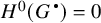 . From (1) we see that there is a triangle

It follows that
 for
$i> 0$
for
$i> 0$
 . Finally,
$\dim \operatorname {\mathrm {Supp}} H^i(Y, I_F) \leq d-i-1$
. Finally,
$\dim \operatorname {\mathrm {Supp}} H^i(Y, I_F) \leq d-i-1$
 as
$Y \to \mathrm {Spec} \, R$
as
$Y \to \mathrm {Spec} \, R$
 has fiber dimension
$\leq \dim (R_Q) -1$
has fiber dimension
$\leq \dim (R_Q) -1$
 at every localization
$R_Q$
at every localization
$R_Q$
 of R. This proves the claim.
Finally, we have a composition which is an isomorphism as in the pseudo-rational case:
![omega sub R-hat [d] is isomorphic to H super minus d (D (D sub J dot tensor R-hat)) [d] yields D (D sub J dot tensor R-hat) yields omega sub R-hat [d].](https://static.cambridge.org/binary/version/id/urn:cambridge.org:id:binary:20260715090159137-0549:S2050508626100353:S2050508626100353_eqnu37.png?pub-status=live)
Dualizing proves that
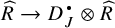 splits for each maximal ideal
$\mathfrak {m}$
splits for each maximal ideal
$\mathfrak {m}$
 . Using Lemma 3.3, Lemma 3.4 and [Sta25, Tag 0D0C], similar to [Reference LyuLyu22, 2.4, Proposition 3.5], completes the proof.
Our next result generalizes [Reference Huneke and WatanabeHW15, Theorem 3.2(2)] and several results in [Reference Wheeler and ZhangWZ25] and answers some questions therein.
Theorem 3.18. Suppose R is a reduced ring and
$J = (f_1, \dots , f_n) \subseteq R$
 is an ideal. Let
$\pi : Y \to \mathrm {Spec} \, R$
is an ideal. Let
$\pi : Y \to \mathrm {Spec} \, R$
 denote the blowup of
$I := \overline {J^{n+k-1}}$
denote the blowup of
$I := \overline {J^{n+k-1}}$
 with
$J \mathcal {O}_Y = \mathcal {O}_Y(-E)$
with
$J \mathcal {O}_Y = \mathcal {O}_Y(-E)$
 so that
$I \mathcal {O}_Y = \mathcal {O}_Y(-(n+k-1)E)$
so that
$I \mathcal {O}_Y = \mathcal {O}_Y(-(n+k-1)E)$
 . Then the canonical map

is zero in the derived category. Hence if R is a Noetherian reduced blowup-square splinter (e.g., Du Bois, lim-perfectoid pure, or Cohen-Macaulay and lim-perfectoid injective), then for every integer
$k> 0$
 ,
,

The same holds if
$J \subseteq R$
 is an ideal that locally has analytic spread
$\leq n$
is an ideal that locally has analytic spread
$\leq n$
 .
.
Furthermore, if R is additionally normal and Nagata (e.g., excellent), one obtains that

where the left side is the fractional power integral closure as in [Reference Huneke and SwansonHS06, Definition 10.5.3].
Proof. Set
$F = E_{\operatorname {\mathrm {{red}}}}$
 with associated ideal sheaf
$I_F$
with associated ideal sheaf
$I_F$
 , and note it may not be a divisor since Y need not be normal or even Noetherian. Since
$ \mathcal {O}_Y(-(n+k-1)E) \to L^k(\underline {f}) \otimes \mathcal {O}_Y $
, and note it may not be a divisor since Y need not be normal or even Noetherian. Since
$ \mathcal {O}_Y(-(n+k-1)E) \to L^k(\underline {f}) \otimes \mathcal {O}_Y $
 is zero in
$D(Y)$
is zero in
$D(Y)$
 by Theorem 2.2, so is the map

We have a canonical map
 and now we see that the composition

is zero in the derived category, proving the first statement. For the second statement, use the splitting
 and take zeroth cohomology. The analytic spread statement follows as in the proof of Theorem 3.12 as blowups, and hence
 , commute with base change to the strict Henselization.
For the final statement in the normal Nagata case, replace Y by the blowup of
$\overline {J^m}$
 for
$m \gg 0$
for
$m \gg 0$
 , which dominates the original Y and is also normal. Note that F is a reduced Weil divisor and we have

is zero in
$D(Y)$
 (note that while
$\mathcal {O}_Y(-F)$
(note that while
$\mathcal {O}_Y(-F)$
 may not be locally free, every other term is). Arguing as above, we obtain that the composition

is zero in the derived category and hence we see that
$\Gamma (Y, \mathcal {O}_Y(-(n+k-1)E - F)) \subseteq J^k$
 . But the left side is
$J_{>n+k-1}$
. But the left side is
$J_{>n+k-1}$
 as R and Y are normal.
The following immediate corollary recovers and generalizes the multiplicity bound of rational, F-rational, F-pure and Du Bois singularities established in [Reference Huneke and WatanabeHW15, Reference ShibataShi17, Reference ParkPar25].
Corollary 3.19. Let
$(R,\mathfrak {m})$
 be a Noetherian reduced local ring of dimension d and embedding dimension e.
-
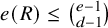
(a) If R is a birational derived splinter (e.g., pseudo-rational), then $e(R)\leq \binom {e-1}{d-1}$
. -
(b) If R is a reduced blowup-square splinter (e.g., Du Bois, lim-perfectoid pure, or Cohen-Macaulay and lim-perfectoid injective), then $e(R)\leq \binom {e}{d}$
.

Proof. The proof is essentially the same as that of [Reference Huneke and WatanabeHW15, Theorem 3.1]. Without loss of generality, we may assume
$R/\mathfrak {m}$
 is infinite (see Remark 3.8). Let
$J:=(x_1,\dots , x_d)$
is infinite (see Remark 3.8). Let
$J:=(x_1,\dots , x_d)$
 be a minimal reduction of
$\mathfrak {m}$
be a minimal reduction of
$\mathfrak {m}$
 and we extend it to a minimal generating set
$(x_1,\dots ,x_d,x_{d+1},\dots ,x_e)$
and we extend it to a minimal generating set
$(x_1,\dots ,x_d,x_{d+1},\dots ,x_e)$
 of
$\mathfrak {m}$
of
$\mathfrak {m}$
 . By Theorem 3.12 and Theorem 3.18, we know that
$\mathfrak {m}^d\subseteq J$
. By Theorem 3.12 and Theorem 3.18, we know that
$\mathfrak {m}^d\subseteq J$
 in case (a) and
$\mathfrak {m}^{d+1}\subseteq J$
in case (a) and
$\mathfrak {m}^{d+1}\subseteq J$
 in case (b). It follows that
$R/J$
in case (b). It follows that
$R/J$
 is generated by monomials in
$x_{d+1},\dots ,x_e$
is generated by monomials in
$x_{d+1},\dots ,x_e$
 of degree
$\leq d-1$
of degree
$\leq d-1$
 in case (a) and
$\leq d$
in case (a) and
$\leq d$
 in case (b). In particular, we have

3.3 Briançon-Skoda theorem for perfectoid rings
Since our Theorem 2.2 does not require R to be Noetherian, it has the following interesting consequence on integral closure of ideals in perfectoid rings. We refer the reader to [Reference Bhatt and ScholzeBS22] for unexplained terminology in what follows.
Corollary 3.20. Let R be a perfectoid ring and
$J=(f_1,\dots ,f_n) \subseteq R$
 . Then for every
$k\geq 1$
. Then for every
$k\geq 1$
 , we have

Furthermore, for every
$k\geq 1$
 , we have

Proof. Let
$Y\to \mathrm {Spec} \,(R)$
 be the blowup of
$\overline {J^{n+k-1}}$
be the blowup of
$\overline {J^{n+k-1}}$
 . By Theorem 2.2,
$\overline {J^{n+k-1}}$
. By Theorem 2.2,
$\overline {J^{n+k-1}}$
 maps to zero in

As R is perfectoid,
$Y^{\text {pfd}}\to \mathrm {Spec} \,(R)^{\text {pfd}}=\mathrm {Spec} \,(R)$
 is a J-almost isomorphism ([Reference Bhatt and ScholzeBS22, Corollary 8.12]). Hence
$R\to {\mathbb R}\Gamma (Y,\mathcal {O}_Y)$
is a J-almost isomorphism ([Reference Bhatt and ScholzeBS22, Corollary 8.12]). Hence
$R\to {\mathbb R}\Gamma (Y,\mathcal {O}_Y)$
 is J-almost split (since it factors the map to
${\mathbb R}\Gamma (Y^{\text {pfd}},\mathcal {O}_{Y, \text {perfd}})$
is J-almost split (since it factors the map to
${\mathbb R}\Gamma (Y^{\text {pfd}},\mathcal {O}_{Y, \text {perfd}})$
 which is J-almost isomorphic to R). Therefore,
$\overline {J^{n+k-1}}$
which is J-almost isomorphic to R). Therefore,
$\overline {J^{n+k-1}}$
 has J-almost zero image in
$H_0(L^k(\underline {f}))=R/J^k$
has J-almost zero image in
$H_0(L^k(\underline {f}))=R/J^k$
 as wanted.
For the second statement, note that since perfectoidization is an arc-sheaf, we know that R is a direct summand of
 (see [Reference Bhatt, Ma, Patakfalvi, Schwede, Tucker, Waldron and WitaszekBMP+24, Lemma 5.3]). By Theorem 3.18 (whose first statement does not assume R is Noetherian),

is zero in
$D(R)$
 . Now use the splitting
 and take zeroth cohomology to obtain that
$\overline {J^{n+k}}\subseteq J^k$
and take zeroth cohomology to obtain that
$\overline {J^{n+k}}\subseteq J^k$
 .
.
4 Connections with closure operations
Inspired by [Reference Epstein, McDonald, Rebecca and SchwedeEMRS25], we make the following definition.
Definition 4.1. Suppose that R is a reduced Noetherian ring and
$J \subseteq R$
 is an ideal. We define the birational preclosure of J, denoted
$J^{\operatorname {\mathrm {Bir}}}$
is an ideal. We define the birational preclosure of J, denoted
$J^{\operatorname {\mathrm {Bir}}}$
 , to be the union

where
$Y \to \mathrm {Spec} \, R$
 varies over all proper birational maps. As the set of proper birational morphisms is filtered, we see that this union is in fact an ideal.
Remark 4.2. For general non-Noetherian R, we expect that one should replace the birational condition of the birational preclosure with the M-morphisms of [Reference LyuLyu22].
Since R is Noetherian,
$J^{\operatorname {\mathrm {Bir}}}$
 is computed by a single Y or, by Chow’s lemma, a single blowup. Furthermore, the formation of
$J^{\operatorname {\mathrm {Bir}}}$
is computed by a single Y or, by Chow’s lemma, a single blowup. Furthermore, the formation of
$J^{\operatorname {\mathrm {Bir}}}$
 commutes with localization since blowups can be spread out. If
$R \to S$
commutes with localization since blowups can be spread out. If
$R \to S$
 is finite birational, we may take our Y factoring through
$\mathrm {Spec} \, S \to \mathrm {Spec} \, R$
is finite birational, we may take our Y factoring through
$\mathrm {Spec} \, S \to \mathrm {Spec} \, R$
 . Hence we obtain:
Lemma 4.3. Suppose R is a reduced Noetherian ring, and
$R \hookrightarrow S$
 is a finite extension such that the induced
$\mathrm {Spec} \, S \to \mathrm {Spec} \, R$
is a finite extension such that the induced
$\mathrm {Spec} \, S \to \mathrm {Spec} \, R$
 is birational (e.g., if
$S = \prod _i R/Q_i$
is birational (e.g., if
$S = \prod _i R/Q_i$
 where the
$Q_i$
where the
$Q_i$
 are the minimal primes of R). Then
$ J^{\operatorname {\mathrm {Bir}}} = (JS)^{\operatorname {\mathrm {Bir}}} \cap R. $
are the minimal primes of R). Then
$ J^{\operatorname {\mathrm {Bir}}} = (JS)^{\operatorname {\mathrm {Bir}}} \cap R. $

We note the following immediate consequence of the definition of birational derived splinters.
Lemma 4.4. If R is a birational derived splinter, then
$J^{\operatorname {\mathrm {Bir}}} = J$
 for every ideal
$J \subseteq R$
for every ideal
$J \subseteq R$
 .
.
Given a resolution of singularities,
$J^{\operatorname {\mathrm {Bir}}}$
 is computed by that resolution.
Lemma 4.5. Suppose
$\pi : X \to \mathrm {Spec} \, R$
 is a proper birational map with X a global birational derived splinter. If
$J \subseteq R$
is a proper birational map with X a global birational derived splinter. If
$J \subseteq R$
 is an ideal, then

Proof. For the main statement, it suffices to consider proper birational maps
$Y \xrightarrow {\rho } X \xrightarrow {\pi } \mathrm {Spec} \, R$
 , but
$\mathcal {O}_X \to {\mathbb R}\rho _* \mathcal {O}_Y$
, but
$\mathcal {O}_X \to {\mathbb R}\rho _* \mathcal {O}_Y$
 splits.
Remark 4.6. We saw that pseudo-rational schemes with a canonical sheaf are birational derived splinters by Lemma 3.9, and hence such X can be used in Lemma 4.5. Furthermore, if
$X \to \mathrm {Spec} \, R$
 is a resolution of singularities with X of finite dimension, one can use that X in Lemma 4.5. In fact, the finite dimensional hypothesis is not needed to prove that regular X is a derived splinter via an argument of Bhatt ([Reference Ma and SchwedeMS20, Remark 3.4], [Reference Lank and VenkateshLV24, Lemma 3.16]); we shall repeat Bhatt’s argument within the proof of Theorem 5.3 below. Recall resolutions of singularities are known to exist if R is excellent and either
$\dim R \leq 3$
is a resolution of singularities with X of finite dimension, one can use that X in Lemma 4.5. In fact, the finite dimensional hypothesis is not needed to prove that regular X is a derived splinter via an argument of Bhatt ([Reference Ma and SchwedeMS20, Remark 3.4], [Reference Lank and VenkateshLV24, Lemma 3.16]); we shall repeat Bhatt’s argument within the proof of Theorem 5.3 below. Recall resolutions of singularities are known to exist if R is excellent and either
$\dim R \leq 3$
 [Reference AbhyankarAbh66, Reference LipmanLip78, Reference CutkoskyCut09, Reference Cossart and PiltantCP08, Reference Cossart and PiltantCP09, Reference Cossart and PiltantCP19] or R has characteristic zero [Reference HironakaHir64, Reference TemkinTem08].
It is not clear to us whether or not
$J^{\operatorname {\mathrm {Bir}}}$
 is a closure operation. In other words:
Question 4.7. With notation as above, is
$(J^{\operatorname {\mathrm {Bir}}})^{\operatorname {\mathrm {Bir}}} = J^{\operatorname {\mathrm {Bir}}}$
 ?
?
However, we obtain the following result.
Proposition 4.8. Suppose R is a reduced Noetherian ring and
$J = (f_1, \dots , f_n)$
 is an ideal. Then
$\overline {J^{n+k-1}} \subseteq (J^k)^{\operatorname {\mathrm {Bir}}}$
is an ideal. Then
$\overline {J^{n+k-1}} \subseteq (J^k)^{\operatorname {\mathrm {Bir}}}$
 for any
$k \geq 1$
for any
$k \geq 1$
 . The same holds if
$J \subseteq R$
. The same holds if
$J \subseteq R$
 is an ideal that locally has analytic spread
$\leq n$
is an ideal that locally has analytic spread
$\leq n$
 .
.
Proof. As both integral closure and birational closure can be computed modulo minimal primes, we may assume that R is a domain. If
$J = 0$
 , then the statement is clear. Set
$Y \to \mathrm {Spec} \, R$
, then the statement is clear. Set
$Y \to \mathrm {Spec} \, R$
 to be the blowup of
$\overline {J^{n+k-1}}$
to be the blowup of
$\overline {J^{n+k-1}}$
 . This map is proper and birational since R is a domain and J is nonzero. We see there is a map from
$L^k(\underline {f})$
. This map is proper and birational since R is a domain and J is nonzero. We see there is a map from
$L^k(\underline {f})$
 to its bottom homology,
$L^k(\underline {f}) \to R/J^k$
to its bottom homology,
$L^k(\underline {f}) \to R/J^k$
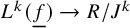 . Hence we see

For the second statement, as the statement is local (indeed, the formation of
$J^{\operatorname {\mathrm {Bir}}}$
 commutes with localization), we assume that R is local. Then one argues again as in Theorem 3.12 to replace J by its minimal reduction.
Proposition 4.8 implies many other well-known closure-versions of the Briançon-Skoda theorem.
4.1 Characteristic zero
In combination with Lemma 4.5, Proposition 4.8 gives the following answer to [Reference Epstein, McDonald, Rebecca and SchwedeEMRS25, Question 6.7].
Corollary 4.9. Let R be an excellent ring of characteristic zero and
$J=(f_1,\dots ,f_n)$
 . Then

where
$X \to \mathrm {Spec} \, R$
 is any resolution of singularities. Hence
$\overline {J^{n+k-1}}\subseteq (J^k)^{\operatorname {\mathrm {Hir}}} $
is any resolution of singularities. Hence
$\overline {J^{n+k-1}}\subseteq (J^k)^{\operatorname {\mathrm {Hir}}} $
 for all
$k\geq 1$
for all
$k\geq 1$
 .
.
Statements for other characteristic zero closures follow from the characteristic
$p> 0$
 results below.
4.2 Characteristic
$p> 0$

Suppose R is a reduced Noetherian ring of characteristic
$p> 0$
 . Let
$R^+ = \prod _Q (R/Q)^+$
. Let
$R^+ = \prod _Q (R/Q)^+$
 where Q runs over the minimal primes of R. For any ideal
$J \subseteq R$
where Q runs over the minimal primes of R. For any ideal
$J \subseteq R$
 , we denote by
$J^+ := (J R^+) \cap R$
, we denote by
$J^+ := (J R^+) \cap R$
 . Note
$J^+ \subseteq J^*$
. Note
$J^+ \subseteq J^*$
 by [Reference Hochster and HunekeHH90, Lemma 4.11].
Proposition 4.10 [Reference Hochster and HunekeHH95, Theorem 7.1]
Suppose R is a reduced Noetherian ring and
$I \subseteq R$
 is any ideal. Then
$I^{\operatorname {\mathrm {Bir}}} \subseteq I^+$
is any ideal. Then
$I^{\operatorname {\mathrm {Bir}}} \subseteq I^+$
 . As a consequence, if
$J = (f_1, \dots , f_n) \subseteq R$
. As a consequence, if
$J = (f_1, \dots , f_n) \subseteq R$
 , then we have

for every integer
$k> 0$
 . Hence we also obtain
$\overline {J^{{n+k-1}}} \subseteq (J^k)^*$
. Hence we also obtain
$\overline {J^{{n+k-1}}} \subseteq (J^k)^*$
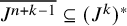 recovering [Reference Hochster and HunekeHH90, Theorem 5.4].
Proof. As R is Noetherian, we may fix
$\pi : Y \to X$
 proper birational computing
$J^{\operatorname {\mathrm {Bir}}}$
proper birational computing
$J^{\operatorname {\mathrm {Bir}}}$
 . By [Reference BhattBha12, Theorem 0.4], there is a map
${\mathbb R}\Gamma (Y, \mathcal {O}_Y) \to R^+$
. By [Reference BhattBha12, Theorem 0.4], there is a map
${\mathbb R}\Gamma (Y, \mathcal {O}_Y) \to R^+$
 factoring the inclusion
$R \to R^+$
factoring the inclusion
$R \to R^+$
 . Hence we immediately see that

The second and third statements follow immediately.
4.3 Mixed characteristic
The same argument goes through without substantial change in the mixed characteristic case thanks to [Reference BhattBha20]. In fact, Proposition 4.11 below strictly contains Proposition 4.10 since the p-adic completion is a trivial operation in characteristic p.
Let R denote a Noetherian reduced ring with p in its Jacobson radical. By
$\widehat {R^+}$
 , we mean the p-adic completion of
$R^+ = \prod _Q (R/Q)^+$
, we mean the p-adic completion of
$R^+ = \prod _Q (R/Q)^+$
 where again Q runs over the minimal primes of R.
Proposition 4.11 [Reference Rodríguez-Villalobos and SchwedeRS24, Reference HeitmannHei01]
Suppose R is a reduced Noetherian ring with p in its Jacobson radical and suppose that
$I \subseteq R$
 is an ideal. Then
$I^{\operatorname {\mathrm {Bir}}} \subseteq I\widehat {R^+} \cap R \subseteq I^{\mathrm {epf}}$
is an ideal. Then
$I^{\operatorname {\mathrm {Bir}}} \subseteq I\widehat {R^+} \cap R \subseteq I^{\mathrm {epf}}$
 where
$\widehat {R^+}$
where
$\widehat {R^+}$
 denotes the p-adic completion of
$R^+$
denotes the p-adic completion of
$R^+$
 and
$\operatorname {\mathrm {epf}}$
and
$\operatorname {\mathrm {epf}}$
 denotes the full extended plus closure.
As a consequence, if
$J = (f_1, \dots , f_n) \subseteq R$
 , then

recovering [Reference Rodríguez-Villalobos and SchwedeRS24, Theorem 4.1]. Hence in an arbitrary ring, we also recover
$\overline {J^{n+k-1}} \subseteq (J^k)^{\operatorname {\mathrm {ep}}}$
 of [Reference HeitmannHei01, Theorem 4.2] where
$\operatorname {\mathrm {ep}}$
of [Reference HeitmannHei01, Theorem 4.2] where
$\operatorname {\mathrm {ep}}$
 denotes the extended plus closure.
Proof. We may assume that R is a domain as all objects can be computed modulo minimal primes. We then assume that R has mixed characteristic
$(0, p>0)$
 as the equal characteristic
$p> 0$
as the equal characteristic
$p> 0$
 case was done above. Suppose
$Y \to \mathrm {Spec} \, R$
case was done above. Suppose
$Y \to \mathrm {Spec} \, R$
 is proper birational. By [Reference BhattBha20, Theorem 3.12] and derived Nakayama, the derived completion of
${\mathbb R}\Gamma (Y^+, \mathcal {O}_{Y^+})$
is proper birational. By [Reference BhattBha20, Theorem 3.12] and derived Nakayama, the derived completion of
${\mathbb R}\Gamma (Y^+, \mathcal {O}_{Y^+})$
 coincides with
$\widehat {R^+}$
coincides with
$\widehat {R^+}$
 . Hence we have a factorization

The first result follows. Note
$I \widehat {R^+} \cap R \subseteq I^{\operatorname {\mathrm {epf}}}$
 essentially by definition of full extended plus closure in [Reference HeitmannHei01]. For the statement about extended plus closure
$(-)^{\operatorname {\mathrm {ep}}}$
essentially by definition of full extended plus closure in [Reference HeitmannHei01]. For the statement about extended plus closure
$(-)^{\operatorname {\mathrm {ep}}}$
 , by using [Reference HeitmannHei01, Proposition 1.2 and Lemma 2.3] we may reduce to the case of a local domain essentially of finite type over
$\mathbb {Z}$
, by using [Reference HeitmannHei01, Proposition 1.2 and Lemma 2.3] we may reduce to the case of a local domain essentially of finite type over
$\mathbb {Z}$
 with some prime
$p> 0$
with some prime
$p> 0$
 in its maximal ideal. In particular,
$\operatorname {\mathrm {ep}}$
in its maximal ideal. In particular,
$\operatorname {\mathrm {ep}}$
 coincides with
$\operatorname {\mathrm {epf}}$
coincides with
$\operatorname {\mathrm {epf}}$
 in this case.
5 Uniform Briançon-Skoda and uniform Artin-Rees
In this section, we prove two conjectures of Huneke [Reference HunekeHun92, Conjecture 1.3 and Conjecture 1.4] as a major application of our results and methods in previous sections. We first give an outline of the strategy. Suppose R is a domain and
$\pi : X \to \mathrm {Spec} \, R$
 is a proper surjective map with X an integral global birational derived splinter (e.g.,
$\pi $
is a proper surjective map with X an integral global birational derived splinter (e.g.,
$\pi $
 could be a regular alteration). Suppose we have a map
$\psi : {\mathbb R}\Gamma (X, \mathcal {O}_X) \to R$
could be a regular alteration). Suppose we have a map
$\psi : {\mathbb R}\Gamma (X, \mathcal {O}_X) \to R$
 such that the composition

is multiplication by
$c \neq 0$
 (such maps always exist since
${\mathbb R}\Gamma (X, \mathcal {O}_X) \in D^b_{\operatorname {\mathrm {coh}}}(R)$
(such maps always exist since
${\mathbb R}\Gamma (X, \mathcal {O}_X) \in D^b_{\operatorname {\mathrm {coh}}}(R)$
 and since such maps exist generically). Let
$I = (f_1, \dots , f_n)\subseteq R$
and since such maps exist generically). Let
$I = (f_1, \dots , f_n)\subseteq R$
 and set
$Y' \to X$
and set
$Y' \to X$
 to be the blowup of
$\overline {I^{n+k-1}} \mathcal {O}_X$
to be the blowup of
$\overline {I^{n+k-1}} \mathcal {O}_X$
 (so that the composition
$Y' \to \mathrm {Spec} \, R$
(so that the composition
$Y' \to \mathrm {Spec} \, R$
 factors through
$Y \to \mathrm {Spec} \, R$
factors through
$Y \to \mathrm {Spec} \, R$
 , the blowup of
$\overline {I^{n+k-1}}$
, the blowup of
$\overline {I^{n+k-1}}$
 ), then the argument from Remark Remark 3.13 immediately implies that we have
$ c \overline {I^{n+k-1}} \subseteq I^k. $
), then the argument from Remark Remark 3.13 immediately implies that we have
$ c \overline {I^{n+k-1}} \subseteq I^k. $
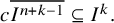 Of particular importance here is that c does not depend on I and k. The existence of such a uniform c, which forces
$\mathrm {T}_n(R) := \bigcap _{m,I} (I^{m - n} : \overline {I^m})$
Of particular importance here is that c does not depend on I and k. The existence of such a uniform c, which forces
$\mathrm {T}_n(R) := \bigcap _{m,I} (I^{m - n} : \overline {I^m})$
 to be nonzero for some n (which could be taken as
$\dim R$
to be nonzero for some n (which could be taken as
$\dim R$
 eventually, by our method), is one of Huneke’s key tools for proving uniform Briançon-Skoda and uniform Artin-Rees properties in [Reference HunekeHun92].
It was known, for rings that are quotients of regular rings, that the existence of projective resolutions of singularities implies these uniformity statements via a different argument, see [Reference HunekeHun00]. Furthermore, in unpublished work, Datta showed that Huneke’s argument also goes through assuming only that projective regular alterations exist [Reference DattaDat25].
However, the existence of regular alterations is not known in full generality for excellent domains. Instead, we adapt the argument above to use Gabber’s weak local uniformization ([Reference Illusie, Laszlo and OrgogozoILO14, Exposé VII, Theorem 1.1]), and instead of using regular alterations, we use a certain diagram of schemes. The other key ingredient in Huneke’s recipe, that
$0 \neq \mathrm {CM}(R)$
 , where
$\mathrm {CM}(R)$
, where
$\mathrm {CM}(R)$
 is the set of elements of R that annihilate the homology of complexes of finitely generated free modules satisfying the standard conditions on height and rank, was proven in [Reference ZhouZho07]. Alternatively, this also follows quickly by combining [Reference LyuLyu25] and [Reference KawasakiKaw00] up to a faithfully flat extension which is enough for us.
We begin with a lemma about truncated hypercovers in the alteration topology.
Lemma 5.1. Let X be an irreducible, quasi-excellent Noetherian scheme. Then for every integer
$n\geq 0$
 , we can construct a commutative diagram

where
${^n}V\to X$
 is an alteration,
${^n}V_{\bullet }\to {^n}V$
is an alteration,
${^n}V_{\bullet }\to {^n}V$
 is a Zariski hypercover and
$X_{\bullet }\to X$
is a Zariski hypercover and
$X_{\bullet }\to X$
 is a hypercover in the alteration topology with each
$X_i$
is a hypercover in the alteration topology with each
$X_i$
 regular. Here
$V_{\leq n}$
regular. Here
$V_{\leq n}$
 and
$X_{\leq n}$
and
$X_{\leq n}$
 are the n-truncations of
${^n}V_{\bullet }$
are the n-truncations of
${^n}V_{\bullet }$
 and
$X_{\bullet }$
and
$X_{\bullet }$
 respectively.
Proof. We will repeatedly use Gabber’s weak local uniformization theorem [Reference Illusie, Laszlo and OrgogozoILO14, Exposé VII, Theorem 1.1]. We begin by selecting a cover
$\{X_0^i\to X\}$
 in the alteration topology so that each
$X_0^i$
in the alteration topology so that each
$X_0^i$
 is regular by weak local uniformization. By [Reference Illusie, Laszlo and OrgogozoILO14, Exposé II, Theorem 3.2.1], there exists an alteration
${^0}V\to X$
is regular by weak local uniformization. By [Reference Illusie, Laszlo and OrgogozoILO14, Exposé II, Theorem 3.2.1], there exists an alteration
${^0}V\to X$
 and a Zariski open cover
${^0}V^i$
and a Zariski open cover
${^0}V^i$
 of
${^0}V$
of
${^0}V$
 which fits into the following commutative diagram

Next, we find a cover
$\{{^0}Y^j\to {^0}V\}$
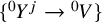 in the alteration topology so that each
${^0}Y^j$
in the alteration topology so that each
${^0}Y^j$
 is regular by weak local uniformization. Again by [Reference Illusie, Laszlo and OrgogozoILO14, Exposé II, Theorem 3.2.1], there exists an alteration
${^1}V\to {^0}V$
is regular by weak local uniformization. Again by [Reference Illusie, Laszlo and OrgogozoILO14, Exposé II, Theorem 3.2.1], there exists an alteration
${^1}V\to {^0}V$
 and a Zariski open cover
${^1}\widetilde {V}^j$
and a Zariski open cover
${^1}\widetilde {V}^j$
 of
${^1}V$
of
${^1}V$
 which fits into the following commutative diagram

At this point, we note that each
${{}^{0}V^{a}} \times _{{{}^0}V} {{{}^0}V{^b}}$
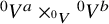 admits a regular cover in the alteration topology

Now, we set
${}{{}^1}V^{i}:= {{}^0}V^{i}\times _{{{}^0}V}^{1}V$
 (a Zariski open subset of
${{}^1}V$
(a Zariski open subset of
${{}^1}V$
 ). By the commutative diagram above and base change, we find that

is a Zariski open cover and that each
${{}^1}\widetilde {V}^j \times _{{{}^1}V}({{}^1}V^{a} \times _{{{}^1}V} {{}^1}V^{b})$
 factors through the regular scheme
${{}^0}Y^j\times _{{{}^0}V}({{}^0}V^{a} \times _{{{}^0}V} {{}^0}V^{b})$
factors through the regular scheme
${{}^0}Y^j\times _{{{}^0}V}({{}^0}V^{a} \times _{{{}^0}V} {{}^0}V^{b})$
 , which in turn maps to
$X_0^a \times ^{\text {alt}}_X X_0^b$
, which in turn maps to
$X_0^a \times ^{\text {alt}}_X X_0^b$
 (which is the closed subscheme of
$X_0^a\times _XX_0^b$
(which is the closed subscheme of
$X_0^a\times _XX_0^b$
 made up of components that dominate X; in particular, it maps to
$X_0^a\times _XX_0^{b}$
made up of components that dominate X; in particular, it maps to
$X_0^a\times _XX_0^{b}$
 ).Footnote
6
In sum, we find that
${{}^1}V$
).Footnote
6
In sum, we find that
${{}^1}V$
 has a
$1$
has a
$1$
 -truncated Zariski hypercover
${{}^1}V_{\leq 1} \to {{}^1}V$
-truncated Zariski hypercover
${{}^1}V_{\leq 1} \to {{}^1}V$
 with
with

Moreover, this
${{}^1}V_{\leq 1}$
 dominates the following
$1$
dominates the following
$1$
 -truncated alteration hypercover
$X_{\leq 1}$
-truncated alteration hypercover
$X_{\leq 1}$
 by regular schemes, where

Note that as written, the above is not technically a hypercover, as it only has face maps and no degeneracy maps, and hypercovers are simplicial objects. However, using the notion of a split simplicial object (see for instance [Reference DeligneDel71, 6.2.2], [SGA72, ex Vbis 5.1] and [Reference LeeLee09, Remark 2.14]), we only need to specify the nondegenerate simplices appearing in any degree in order to define a unique simplicial object. More precisely, in the language of [Reference ConradCon03, Theorem 4.12], given a split n-truncated simplicial scheme W and a collection N that we would like to adjoin as nondegenerate
$(n+1)$
 -simplices and a map
$N\to (\text {cosk}_nW)_{n+1}$
-simplices and a map
$N\to (\text {cosk}_nW)_{n+1}$
 , there is a unique, up to isomorphism, split
$(n+1)$
, there is a unique, up to isomorphism, split
$(n+1)$
 -truncated simplicial scheme
$W'$
-truncated simplicial scheme
$W'$
 such that
$W^{\prime }_{\leq n}=W_{\leq n}$
such that
$W^{\prime }_{\leq n}=W_{\leq n}$
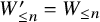 and the nondegenerate
$(n+1)$
and the nondegenerate
$(n+1)$
 simplices of
$W'$
simplices of
$W'$
 are N. Thus, we will abuse notation and specify only the nondegenerate simplices in each degree in what follows.
We will now essentially repeat this procedure to inductively construct
${^m}V$
 ,
$m\geq 1$
,
$m\geq 1$
 , with an m-truncated Zariski hypercover
${{}^m}V_{\leq m} \to {{}^m}V$
, with an m-truncated Zariski hypercover
${{}^m}V_{\leq m} \to {{}^m}V$
 that dominates an m-truncated alteration hypercover
$X_{\leq m}$
that dominates an m-truncated alteration hypercover
$X_{\leq m}$
 so that each
$X_i$
so that each
$X_i$
 is regular. Indeed, suppose
${{}^m}V$
is regular. Indeed, suppose
${{}^m}V$
 is constructed, we use weak local uniformization to obtain a regular cover
$\{{{}^m}Y^j\to {{}^m}V\}$
is constructed, we use weak local uniformization to obtain a regular cover
$\{{{}^m}Y^j\to {{}^m}V\}$
 in the alteration topology, and find
${{}^{m+1}}V$
in the alteration topology, and find
${{}^{m+1}}V$
 an alteration over
${{}^m}V$
an alteration over
${{}^m}V$
 together with a Zariski open cover
$\{{{}^{m+1}}\widetilde {V}^j\}$
together with a Zariski open cover
$\{{{}^{m+1}}\widetilde {V}^j\}$
 dominating
$\{{{}^m}Y^j\}$
dominating
$\{{{}^m}Y^j\}$
 . The m-truncated Zariski hypercover
${{}^m}V_{\leq m}$
. The m-truncated Zariski hypercover
${{}^m}V_{\leq m}$
 pulls back to an m-truncated Zariski hypercover
${{}^{m+1}}V_{\leq m}$
pulls back to an m-truncated Zariski hypercover
${{}^{m+1}}V_{\leq m}$
 of
${{}^{m+1}}V$
of
${{}^{m+1}}V$
 . For each element
$U \in (\text {cosk}_{m}({{}^{m+1}}V_{\leq m}))_{m+1}$
. For each element
$U \in (\text {cosk}_{m}({{}^{m+1}}V_{\leq m}))_{m+1}$
 , noting it is the pullback of some
$U' \in (\text {cosk}_{m}({{}^{m}}V_{\leq m}))_{m+1}$
, noting it is the pullback of some
$U' \in (\text {cosk}_{m}({{}^{m}}V_{\leq m}))_{m+1}$
 , consider the open cover

The collection of all these
$\{{{}^{m+1}}\widetilde {V}^j\times _{{{}^{m+1}}V}U\}_{U,j}$
 thus form a Zariski open cover of
$(\text {cosk}_{m}({{}^{m+1}}V_{\leq m}))_{m+1}$
thus form a Zariski open cover of
$(\text {cosk}_{m}({{}^{m+1}}V_{\leq m}))_{m+1}$
 . Moreover, each
${{}^{m+1}}\widetilde {V}^j\times _{{{}^{m+1}}V}U$
. Moreover, each
${{}^{m+1}}\widetilde {V}^j\times _{{{}^{m+1}}V}U$
 maps to the regular scheme
${{}^m}Y^j \times _{{{}^m}V}U'$
maps to the regular scheme
${{}^m}Y^j \times _{{{}^m}V}U'$
 . In sum, we have

Here
$(\text {cosk}_{m}({}^{m}X_{\leq m}))_{m+1}$
 is computed in the alteration topology (so it is built by fiber products in the alteration topology), and the dotted arrow above is a cover in the alteration topology. We now set
${{}^{m+1}}V_{m+1} := \{{{}^{m+1}}\widetilde {V}^j\times _{{{}^{m+1}}V}U\}_{U,j}$
is computed in the alteration topology (so it is built by fiber products in the alteration topology), and the dotted arrow above is a cover in the alteration topology. We now set
${{}^{m+1}}V_{m+1} := \{{{}^{m+1}}\widetilde {V}^j\times _{{{}^{m+1}}V}U\}_{U,j}$
 and
$X_{m+1}:= \{{{}^m}Y^j \times _{{{}^m}V}U'\}_{U', j}$
and
$X_{m+1}:= \{{{}^m}Y^j \times _{{{}^m}V}U'\}_{U', j}$
 . It is then readily checked that we have the following commutative diagram

Finally, we set
${{}^n}V_{\bullet } := \text {cosk}_{n}({}^nV_{\leq n})$
 and we extend
$X_{\leq n}$
and we extend
$X_{\leq n}$
 to an alteration hypercover
$X_{\bullet }$
to an alteration hypercover
$X_{\bullet }$
 so that each
$X_i$
so that each
$X_i$
 is regular by weak local uniformization. Note that
${}^nV_{\bullet }$
is regular by weak local uniformization. Note that
${}^nV_{\bullet }$
 is a Zariski hypercover of
${}^nV$
is a Zariski hypercover of
${}^nV$
 . We obtain the desired commutative diagram

Note that there might not be a map from
${}^nV_{\bullet }\to X_{\bullet }$
 fitting the commutative diagram above though, since we built
${}^nV_{\bullet }$
fitting the commutative diagram above though, since we built
${}^nV_{\bullet }$
 out of
$V_{\leq n}$
out of
$V_{\leq n}$
 while one might need further simplices to build
$X_{\bullet }$
while one might need further simplices to build
$X_{\bullet }$
 to keep the terms nonsingular.
Remark 5.2. In the proof of Lemma 5.1, instead of writing a Zariski open cover
$\{{{}^{m+1}}\widetilde {V}^j\}$
 in each step, we could use a single cover
${{}^{m+1}}\widetilde {V}:= \coprod _j{{}^{m+1}}\widetilde {V}^j$
in each step, we could use a single cover
${{}^{m+1}}\widetilde {V}:= \coprod _j{{}^{m+1}}\widetilde {V}^j$
 to reduce the excess of indices and simplify the notation (the proof will not be altered too much). We decided to write down the open cover and keep the additional index j to make the construction clear and to remind ourselves that each
${{}^{m+1}}\widetilde {V}^j$
to reduce the excess of indices and simplify the notation (the proof will not be altered too much). We decided to write down the open cover and keep the additional index j to make the construction clear and to remind ourselves that each
${{}^{m+1}}\widetilde {V}^j$
 dominates a
${{}^{m}}{Y}^j$
dominates a
${{}^{m}}{Y}^j$
 (which is based on Gabber’s weak local uniformization).
We are now ready to prove our main result which will be the key ingredient in proving Huneke’s conjecture.
Theorem 5.3. Let R be an excellent domain of dimension d. Then
${\mathrm T}_{d}(R) \neq 0$
 .
.
Proof. First, note that we can replace R by
$R\otimes _{\mathbb {Z}}\mathbb {Z}(t)$
 (where
$\mathbb {Z}(t)$
(where
$\mathbb {Z}(t)$
 denotes
$\mathbb {Z}[t]$
denotes
$\mathbb {Z}[t]$
 localized at the multiplicative set of all elements not contained in any
$p \mathbb {Z}[t]$
localized at the multiplicative set of all elements not contained in any
$p \mathbb {Z}[t]$
 ) to assume that all residue fields of R are infinite.
Showing that
$\text {T}_{d}(R)=\bigcap _{I, n}(I^{n-d}: \overline {I^n})$
 is nonzero is the same as showing that
$\bigcap _{I, k\geq 1}(I^{k}: \overline {I^{d+k}})$
is nonzero is the same as showing that
$\bigcap _{I, k\geq 1}(I^{k}: \overline {I^{d+k}})$
 is nonzero. Since R has infinite residue fields, every ideal
$I\subseteq R$
is nonzero. Since R has infinite residue fields, every ideal
$I\subseteq R$
 admits a minimal reduction J generated by at most
$d+1$
admits a minimal reduction J generated by at most
$d+1$
 elements by [Reference Huneke and SwansonHS06, Theorem 8.7.3]. By Theorem 2.2, if Y is the normalized blowup of J (which agrees with the blowup of
$\overline {J^N}$
elements by [Reference Huneke and SwansonHS06, Theorem 8.7.3]. By Theorem 2.2, if Y is the normalized blowup of J (which agrees with the blowup of
$\overline {J^N}$
 for some
$N\gg 0$
for some
$N\gg 0$
 ), then the natural map

is the zero map in
$D(R)$
 .
.
Let
$X=\mathrm {Spec} \, R$
 . Applying Lemma 5.1 with
$n=d+2$
. Applying Lemma 5.1 with
$n=d+2$
 and setting
$V:={}^{d+2}V$
and setting
$V:={}^{d+2}V$
 and
$V_{\bullet }:= {}^{d+2}V_{\bullet }$
and
$V_{\bullet }:= {}^{d+2}V_{\bullet }$
 , we have a commutative diagram

where
$V_{\bullet }$
 is a Zariski hypercover of V,
$V\to X$
is a Zariski hypercover of V,
$V\to X$
 is an alteration, and
$X_{\bullet }\to X$
is an alteration, and
$X_{\bullet }\to X$
 is an alteration hypercover of X with each
$X_i$
is an alteration hypercover of X with each
$X_i$
 regular.
Let
$Y_i$
 be the blowup of
$\overline {J^N}\mathcal {O}_{X_i}$
be the blowup of
$\overline {J^N}\mathcal {O}_{X_i}$
 for each
$X_i$
for each
$X_i$
 . We have a commutative diagram of diagrams of schemes:

which induces a commutative diagram:

In particular, the diagram guarantees that the natural map

is zero in
$D(R)$
 .
.
We now repeat an argument of Bhatt’s ([Reference Ma and SchwedeMS20, Remark 3.4], [Reference Lank and VenkateshLV24, Lemma 3.16]). We note that since each
$X_i$
 is regular, each
${\mathbb R}{\pi _i}_*\mathcal {O}_{Y_i} \in D_{\text {perf}}(X_i)$
is regular, each
${\mathbb R}{\pi _i}_*\mathcal {O}_{Y_i} \in D_{\text {perf}}(X_i)$
 and is a commutative algebra object in
$D(X_i)$
and is a commutative algebra object in
$D(X_i)$
 (here
$\pi _i$
(here
$\pi _i$
 denotes the map
$Y_i\to X_i$
denotes the map
$Y_i\to X_i$
 ). Therefore, we have canonical maps

where s comes from the commutative algebra structure on
${\mathbb R}{\pi _i}_*\mathcal {O}_{Y_i}$
 and t is the trace map coming from the perfectness of
${\mathbb R}{\pi _i}_*\mathcal {O}_{Y_i}$
and t is the trace map coming from the perfectness of
${\mathbb R}{\pi _i}_*\mathcal {O}_{Y_i}$
 . Moreover, the composition map is generically the identity and hence the identity map (note that by construction, all the (irreducible components of)
$X_i$
. Moreover, the composition map is generically the identity and hence the identity map (note that by construction, all the (irreducible components of)
$X_i$
 ’s and
$Y_i$
’s and
$Y_i$
 ’s are generically finite over and dominate
$X = \mathrm {Spec} \, R$
’s are generically finite over and dominate
$X = \mathrm {Spec} \, R$
 ). As s and t are functorial, these induce maps

such that the composition is the identity. It follows that the canonical map
${\mathbb R}\Gamma (X_{\bullet }, \mathcal {O}_{X_{\bullet }}) \to {\mathbb R}\Gamma (Y_{\bullet }, \mathcal {O}_{Y_{\bullet }})$
 splits in
$D(R)$
splits in
$D(R)$
 . As a consequence, the natural map

is zero in
$D(R)$
 . We thus see that the composition

is zero in
$D(R)$
 . Since J is generated by at most
$d+1$
. Since J is generated by at most
$d+1$
 elements, the Buchsbaum-Eisenbud complex
$L^k(J)$
elements, the Buchsbaum-Eisenbud complex
$L^k(J)$
 has length at most
$d+1$
has length at most
$d+1$
 . It follows that (since
$V_{\bullet }\to V$
. It follows that (since
$V_{\bullet }\to V$
 is a Zariski hypercover)

where the second isomorphism follows from a simple spectral sequence argument. Thus after taking
$H_0(-)$
 , we find that the map

is zero. However, since V is proper surjective over X, we can pick
$c\neq 0$
 so that multiplication by c on R factors through
${\mathbb R}\Gamma (V,\mathcal {O}_{V})$
so that multiplication by c on R factors through
${\mathbb R}\Gamma (V,\mathcal {O}_{V})$
 (since
$R\to {\mathbb R}\Gamma (V,\mathcal {O}_{V})$
(since
$R\to {\mathbb R}\Gamma (V,\mathcal {O}_{V})$
 splits after tensoring with the fraction field of R and
${\mathbb R}\Gamma (V,\mathcal {O}_{V})\in D^b_{\text {coh}}(R)$
splits after tensoring with the fraction field of R and
${\mathbb R}\Gamma (V,\mathcal {O}_{V})\in D^b_{\text {coh}}(R)$
 ). Note that c depends only on V and does not depend on I or k. We thus find that
$c\overline {I^{d+k}}\subseteq J^k\subseteq I^k$
). Note that c depends only on V and does not depend on I or k. We thus find that
$c\overline {I^{d+k}}\subseteq J^k\subseteq I^k$
 for all I and all
$k\geq 1$
for all I and all
$k\geq 1$
 , that is,
$\text {T}_{d}(R)\ni c\neq 0$
, that is,
$\text {T}_{d}(R)\ni c\neq 0$
 as desired.
Corollary 5.4 (Uniform Briançon-Skoda)
Suppose R is a quasi-excellent reduced Noetherian ring of finite dimension. Then there exists a positive integer k such that for all ideals
$I\subseteq R$
 ,
$\overline {I^n}\subseteq I^{n-k}$
,
$\overline {I^n}\subseteq I^{n-k}$
 for all integers
$n\geq k$
for all integers
$n\geq k$
 .
.
Proof. First of all, we can replace R by
$R\otimes _{\mathbb {Z}}\mathbb {Z}(t)$
 (where
$\mathbb {Z}(t)$
(where
$\mathbb {Z}(t)$
 denotes
$\mathbb {Z}[t]$
denotes
$\mathbb {Z}[t]$
 localized at the multiplicative set of all elements not contained in any
$p \mathbb {Z}[t]$
localized at the multiplicative set of all elements not contained in any
$p \mathbb {Z}[t]$
 ) to assume that all residue fields of R are infinite. Secondly, by replacing R by a faithfully flat étale cover, we may assume that R is excellent by [Reference LyuLyu25, Corollary 6.6] (Lyu pointed out to us this generalization from excellent to quasi-excellent).
By [Reference HunekeHun92, Proposition 3.7], it is enough to show that
$\text {CM}(R/P)\neq 0$
 and that
$\text {T}(R/P) := \bigcup _k \mathrm {T}_k(R/P) \neq 0$
and that
$\text {T}(R/P) := \bigcup _k \mathrm {T}_k(R/P) \neq 0$
 for all prime ideals
$P\in \mathrm {Spec} \,(R)$
for all prime ideals
$P\in \mathrm {Spec} \,(R)$
 . We have just shown in Theorem 5.3 that
$\text {T}(R/P)\neq 0$
. We have just shown in Theorem 5.3 that
$\text {T}(R/P)\neq 0$
 . We know
$\text {CM}(R/P) \neq 0$
. We know
$\text {CM}(R/P) \neq 0$
 by [Reference ZhouZho07]. Alternatively, by replacing R by a faithfully flat étale cover (which we already may have done when reducing to the excellent case), we may assume that R admits a dualizing complex by [Reference LyuLyu25, Theorem 6.5], and thus
$R/P$
by [Reference ZhouZho07]. Alternatively, by replacing R by a faithfully flat étale cover (which we already may have done when reducing to the excellent case), we may assume that R admits a dualizing complex by [Reference LyuLyu25, Theorem 6.5], and thus
$R/P$
 is a homomorphic image of a Gorenstein ring of finite dimension by [Reference KawasakiKaw00, Theorem 1.2] and so
$\text {CM}(R/P)\neq 0$
is a homomorphic image of a Gorenstein ring of finite dimension by [Reference KawasakiKaw00, Theorem 1.2] and so
$\text {CM}(R/P)\neq 0$
 by [Reference HunekeHun92, Proposition 4.5 (i)].
Remark 5.5. For any Noetherian local ring
$(R,\mathfrak {m})$
 of dimension d and any system of parameters
$x_1,\dots ,x_d$
of dimension d and any system of parameters
$x_1,\dots ,x_d$
 , it is easy to see that

In particular, one cannot expect the conclusion of Corollary 5.4 to hold for infinite dimensional excellent rings (such examples exist, see [Reference TanakaTan19]): for if such k exists, then localizing at a prime of height
$k+1$
 would contradict the noncontainment above.
Corollary 5.6 (Uniform Artin-Rees)
Suppose R is a quasi-excellent Noetherian ring of finite dimension and
$N \subseteq M$
 are finitely generated R-modules. Then there exists an integer
$\ell $
are finitely generated R-modules. Then there exists an integer
$\ell $
 depending on N and M such that for all ideals
$I\subseteq R$
depending on N and M such that for all ideals
$I\subseteq R$
 and all
$n \geq \ell $
and all
$n \geq \ell $
 , we have that

Proof. By base change, we can again replace R by
$R\otimes _{\mathbb {Z}}\mathbb {Z}(t)$
 and so assume R has infinite residue fields and, as above, assume that R is excellent by [Reference LyuLyu25, Corollary 6.6]. For all
$P\in \mathrm {Spec} \, R$
and so assume R has infinite residue fields and, as above, assume that R is excellent by [Reference LyuLyu25, Corollary 6.6]. For all
$P\in \mathrm {Spec} \, R$
 , we know that
${\mathrm {CM}}(R/P) \neq 0$
, we know that
${\mathrm {CM}}(R/P) \neq 0$
 by [Reference ZhouZho07] (or alternatively as above). By Theorem 5.3, we see that
$\mathrm {T}(R/P) \neq 0$
by [Reference ZhouZho07] (or alternatively as above). By Theorem 5.3, we see that
$\mathrm {T}(R/P) \neq 0$
 . Hence the result follows from [Reference HunekeHun92, Theorem 3.4].
Acknowledgments
This paper grew out of studying the Hironaka closure in [Reference Epstein, McDonald, Rebecca and SchwedeEMRS25] where Neil Epstein is also an author. We deeply thank Neil Epstein for many valuable conversations on the topic of this paper. The authors would also like to thank Rahul Ajit, Bhargav Bhatt, Rankeya Datta, Daniel Erman, Federico Galetto, Sean Howe, Craig Huneke, Annette Huber-Klawitter, Srikanth Iyengar, Sándor Kovács, Robert Lazarsfeld, Zhenqian Li, Shiji Lyu, Wenbo Niu, Thomas Polstra, Claudiu Raicu, Ilya Smirnov, Shunsuke Takagi and Keller VandeBogert for valuable discussions related to this project and comments on earlier drafts. We particularly thank Keller VandeBogert for explaining the Buchsbaum-Eisenbud complex to us, and especially thank Bhargav Bhatt for several conversations related to hypercovers. Finally, we thank the referee for numerous useful comments and suggestions.
Competing interests
The authors have no competing interests to declare.
Funding statement
The first author received support from NSF grants DMS-2302430 and DMS-2424441. The second author would like to acknowledge the support of the Pacific Institute for the Mathematical Sciences and a grant from the Simons Foundation International [SFI-MPS-T-Institutes-00020822, OY]. The third author received support from NSF grant DMS-2424326. The fourth author received support from NSF grants DMS-2101800, DMS-2501903 and Simons Foundation Travel Support for Mathematicians SFI-MPS-TSM00013051 while working on this project. Work on this project was done by all the authors at the BIRS workshop “Notions of Singularity in Different Characteristics” in Banff, Canada, in October 2025.






 Open access

