


The Global Burden of Disease Study for 2000 estimated that up to 2·7 million deaths worldwide and 1·8 % of the global disease burden may be attributed to inadequate levels of fruit and vegetable consumption (figures for disease burden in New Zealand, Australia and the European Union were respectively 2·4 %, 2·8 % and 3·5 %), and the authors suggested scope to reduce IHD by 31 % and ischaemic stroke by 19 % through dietary change. For stomach, oesophageal, lung and colorectal cancer the estimated reductions were 19 %, 20 %, 12 % and 2 %, respectively( Reference Lock, Pomerleau and Causer 1 – Reference Tobias, Jackson and Yeh 4 ).
In the UK, the Scottish Diet Report in 1993 provided the first quantified fruit and vegetable targets to double consumption to increase the average in the population to 400 g/d( 5 ). A year later, the report by the Committee on Medical Aspects of Food Policy( 6 ) recommended that fruit and vegetable intake nationally be increased by 50 % (from an average of 3 up to 6 portions per day( 5 )). The Scottish Diet Action Plan( 7 ) and the recommendations of the Nutrition Task Force( 8 ) represent the key policy drivers for change during the decade preceding the gathering effort through the WHO European Office and the First Action Plan for Food and Nutrition Policy, WHO European Region( 9 ).
Previous analyses of the 1986–1987 cohort participating in the Dietary and Nutritional Surveys of British Adults drew attention to the wide variation in fruit and vegetable consumption among British adults( Reference Billson, Pryer and Nichols 10 , Reference Hunt, Nichols and Pryer 11 ). Being younger, being single, divorced or separated, belonging to a manual social class, being in receipt of benefits and living in the North of England and Scotland were all associated with a lower intake of fruit, and focused attention on the need to address consumption, access and attitudes in groups that included low consumers of fruit and vegetables.
The aim of the present paper is to examine the impact of a key phase of nutrition policy on compliance with fruit and vegetable goals in the population overall and more particularly across subgroups where differentials have previously been identified. We base our research on analyses of data from the Dietary and Nutritional Surveys of British Adults that allows us to compare and contrast who complied with the fruit and vegetables goals in the UK in 1986–1987 and then in 2000–2001.
Methods
The definition of fruit and vegetables used in our analysis is that established by the UK government Nutrition Task Force as discussed by Williams( Reference Williams 12 ). Fruit and vegetables include frozen and canned fruit and vegetables, those used as the main ingredients in recipes, baked beans, dried fruit and fruit juice. The definition excludes potatoes and nuts. Portions are taken to approximate 80 g( Reference Williams 13 ). In 2002, an Expert Consultation for the WHO and the FAO assessed the strength of the evidence for the relationship between fruit and vegetable intake and health and recommended a daily intake of fruit and vegetables of at least 400 to 500 g( 14 ). The World Cancer Research Fund subsequently recommended a population average consumption of non-starchy vegetables and fruit of at least 600 g/d and a personal consumption of at least 400 g/d( 15 ). We interpret these recommendations as consistent and equivalent to 5 servings per day (excluding potatoes and tubers).
The databases used were the Dietary and Nutritional Survey of British Adults (DNSBA) 1986–1987 and 2000–2001. The conduct and results of the surveys have been described in detail elsewhere( Reference Gregory, Foster and Tyler 16 , Reference Hoare, Bates and Prentice 17 ). Briefly, for both surveys fieldwork was carried out in four waves (July–September, October–December, January–March and April–June). The sample was recruited using a multistage random probability design, with recruitment balanced across the four waves to account for seasonality. For 1986–1987 the electoral roll was used as the sampling frame. The frame was stratified by region, and, within each major stratum, electoral wards were ranked by the proportion of heads of households in different socio-economic groups using census data. A total of 120 wards were selected as first stage units, with probability proportional to the total electorate in each ward. In each ward, thirty-three addresses were selected and one individual from each household was selected using the technique developed by Kish( Reference Kish 18 ). In total, 1087 men and 1110 women aged 16–64 years completed the full dietary survey, a response rate of 70 %( Reference Gregory, Foster and Tyler 16 ).
For 2000–2001 postal sectors were selected as the first stage units. The sampling frame included all postal sectors within mainland Great Britain. The frame was stratified using 1991 census data. A total of 152 postal sectors were selected as first stage units, with probability proportion to the number of postal delivery points, and thirty-eight sectors were allocated to each of the four waves. For each postal sector forty addresses were randomly selected. Eligibility was defined as being aged between 19 and 64 years and not pregnant or breast-feeding. In total 1724 adults (766 men and 958 females) completed the 7 d weighed intake, a 47 % response rate( Reference Hoare, Bates and Prentice 17 ).
The surveys used closely comparable approaches, designed so that an interview could provide information about sociodemographic circumstances of the respondent and their families (including the Registrar General's Social Class( 19 ) from the occupation of the head of household); their medication and eating and drinking habits; a weighed dietary record of all food and drink consumed over seven consecutive days; physical measurements of the respondent (weight and height for 1986–1987 and also waist and hip measurements for the 2000–2001 survey); and blood pressure measurements, a 24 h urine collection and a blood sample.
For the dietary record, each respondent was issued with a set of accurately calibrated Soehnle digital food scales and was asked to keep a weighed record of all food and drink consumed over the 7 d. The respondent was also provided with a ‘eating and drinking away from home’ diary, for use when foods could not be weighed, and was asked to record a description of the portion size and type of food eaten. All home food recipes were collected, and if the respondent ate in the workplace then the interviewer was required to visit the canteen and speak to the catering manager about portion sizes, cooking information and fats and recipes used.
A food code list of 3500 items and a full description of each item was prepared by nutritionists at the Food Standards Agency. As interviews continued more codes were added. The diary was checked by computer for completeness and consistency. Information from the diet records were linked to the nutrient databank, so that nutrients could be calculated from the diet records. The data sets for 1986–1987 and 2000–2001 were checked systematically to ensure consistency of labels and necessary adjustments were made to units of measurement to allow comparisons.
Statistical analysis
The group of interest was those who complied with fruit and vegetable goals.
Study participants were classified as ‘compliers’ if they consumed at least 5 portions (80 g per portion) of fruit and vegetables per day. The definition of fruit and vegetables includes frozen and canned fruit and vegetables, those used as the main ingredients in recipes, baked beans, dried fruit and only 80 g of fruit juice. The definition excludes potatoes and nuts. With portions taken as 80 g, 5 or more portions per day would be at least 400 g/d. ‘Non-compliers’ were those who ate less than 5 portions per day.
Descriptive analyses were conducted to describe the two samples in terms of demographic and socio-economic variables, and also in terms of demographic and socio-economic variables by ‘compliers’ and ‘non-compliers’, for 1986–1987 and for 2000–2001, using the svy t tests and svy χ 2 tests equivalents for survey data in the STATA statistical software package version 10 (StataCorp LP, College Station, TX, USA), which adjusts for the clustering sample effect associated with selection of electoral wards in 1986–1987 and postcode sectors in 2000–2001.
Logistic regression analyses were conducted with adjustment for clustering (svy logistic regression)( Reference StataCorp 20 ). The variables listed below were those which we hypothesized would be related to ‘compliers’ of fruit and vegetable goals, so that the regression model was hypothesis driven. The variables for the model were: age group, social class, employment status, region, marital status and household type, gender, whether receiving benefits, whether receiving food supplements, smoking and year of the survey.
Results
Sociodemographic profile of the two samples – 1986–1987 and 2000–2001
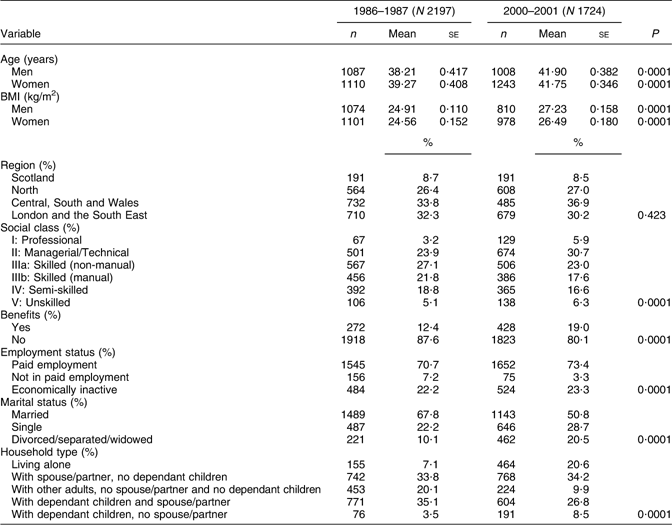
Table 1 describes demographic and socio-economic characteristics of the samples for 1986–1987 and 2000–2001.
Demographic and socio-economic characteristics of the samples in 1986–1987 and 2000–2001
| 1986–1987 (N 2197) | 2000–2001 (N 1724) | ||||||
| Variable | n | Mean | se | n | Mean | se | P |
| Age (years) | |||||||
| Men | 1087 | 38·21 | 0·417 | 1008 | 41·90 | 0·382 | 0·0001 |
| Women | 1110 | 39·27 | 0·408 | 1243 | 41·75 | 0·346 | 0·0001 |
| BMI (kg/m2) | |||||||
| Men | 1074 | 24·91 | 0·110 | 810 | 27·23 | 0·158 | 0·0001 |
| Women | 1101 | 24·56 | 0·152 | 978 | 26·49 | 0·180 | 0·0001 |
| % | % | ||||||
| Region (%) | |||||||
| Scotland | 191 | 8·7 | 191 | 8·5 | |||
| North | 564 | 26·4 | 608 | 27·0 | |||
| Central, South and Wales | 732 | 33·8 | 485 | 36·9 | |||
| London and the South East | 710 | 32·3 | 679 | 30·2 | 0·423 | ||
| Social class (%) | |||||||
| I: Professional | 67 | 3·2 | 129 | 5·9 | |||
| II: Managerial/Technical | 501 | 23·9 | 674 | 30·7 | |||
| IIIa: Skilled (non-manual) | 567 | 27·1 | 506 | 23·0 | |||
| IIIb: Skilled (manual) | 456 | 21·8 | 386 | 17·6 | |||
| IV: Semi-skilled | 392 | 18·8 | 365 | 16·6 | |||
| V: Unskilled | 106 | 5·1 | 138 | 6·3 | 0·0001 | ||
| Benefits (%) | |||||||
| Yes | 272 | 12·4 | 428 | 19·0 | |||
| No | 1918 | 87·6 | 1823 | 80·1 | 0·0001 | ||
| Employment status (%) | |||||||
| Paid employment | 1545 | 70·7 | 1652 | 73·4 | |||
| Not in paid employment | 156 | 7·2 | 75 | 3·3 | |||
| Economically inactive | 484 | 22·2 | 524 | 23·3 | 0·0001 | ||
| Marital status (%) | |||||||
| Married | 1489 | 67·8 | 1143 | 50·8 | |||
| Single | 487 | 22·2 | 646 | 28·7 | |||
| Divorced/separated/widowed | 221 | 10·1 | 462 | 20·5 | 0·0001 | ||
| Household type (%) | |||||||
| Living alone | 155 | 7·1 | 464 | 20·6 | |||
| With spouse/partner, no dependant children | 742 | 33·8 | 768 | 34·2 | |||
| With other adults, no spouse/partner and no dependant children | 453 | 20·1 | 224 | 9·9 | |||
| With dependant children and spouse/partner | 771 | 35·1 | 604 | 26·8 | |||
| With dependant children, no spouse/partner | 76 | 3·5 | 191 | 8·5 | 0·0001 | ||
The mean age of the sample was significantly greater in 2000–2001 compared with 1986–1987 (P < 0·0001) and the mean BMI was also significantly greater in 2000–2001 compared with 1986–1987 (P < 0·0001), for both men and women. There was no difference in the sample selected by region between 1986–1987 and 2000–2001. There were significant differences in social class distribution by year (P < 0·0001), with 1986–1987 having lower proportions of social classes I and II compared with 2000–2001 and a higher proportion of social class IV. Significantly more people reported they were receiving benefits in 2000–2001 compared with 1986–1987 (P < 0·0001) although a higher proportion reported they were in employment (P < 0·0001). There were significant differences in marital status (P < 0·0001), with a higher proportion being married in 1986–1987 compared with 2000–2001 and lower proportions being single and divorced/separated/widowed. There were substantial differences in household type between the two periods (P < 0·0001) with a higher proportion living alone and a higher proportion of single parents in 2000–2001 than in 1986–1987, as well as a lower proportion of households with dependant children and spouse.
Sociodemographic profile of ‘compliers’ and ‘non-compliers’ in 1986–1987 and 2000–2001
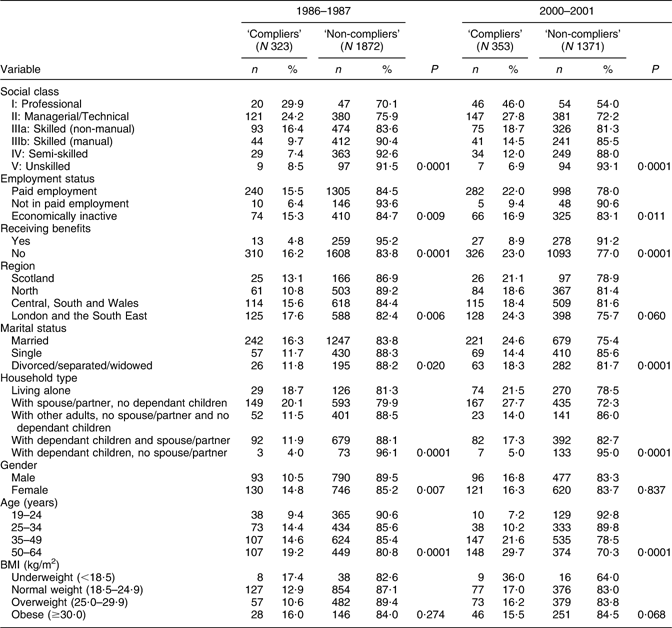
Table 2 presents demographic and socio-economic data for ‘compliers’ and ‘non-compliers’ in 1986–1987 and 2000–2001.
Demographic and socio-economic characteristics of ‘compliers’ and ‘non-compliers’ in 1986–1987 and 2000–2001
| 1986–1987 | 2000–2001 | |||||||||
| ‘Compliers’ (N 323) | ‘Non-compliers’ (N 1872) | ‘Compliers’ (N 353) | ‘Non-compliers’ (N 1371) | |||||||
| Variable | n | % | n | % | P | n | % | n | % | P |
| Social class | ||||||||||
| I: Professional | 20 | 29·9 | 47 | 70·1 | 46 | 46·0 | 54 | 54·0 | ||
| II: Managerial/Technical | 121 | 24·2 | 380 | 75·9 | 147 | 27·8 | 381 | 72·2 | ||
| IIIa: Skilled (non-manual) | 93 | 16·4 | 474 | 83·6 | 75 | 18·7 | 326 | 81·3 | ||
| IIIb: Skilled (manual) | 44 | 9·7 | 412 | 90·4 | 41 | 14·5 | 241 | 85·5 | ||
| IV: Semi-skilled | 29 | 7·4 | 363 | 92·6 | 34 | 12·0 | 249 | 88·0 | ||
| V: Unskilled | 9 | 8·5 | 97 | 91·5 | 0·0001 | 7 | 6·9 | 94 | 93·1 | 0·0001 |
| Employment status | ||||||||||
| Paid employment | 240 | 15·5 | 1305 | 84·5 | 282 | 22·0 | 998 | 78·0 | ||
| Not in paid employment | 10 | 6·4 | 146 | 93·6 | 5 | 9·4 | 48 | 90·6 | ||
| Economically inactive | 74 | 15·3 | 410 | 84·7 | 0·009 | 66 | 16·9 | 325 | 83·1 | 0·011 |
| Receiving benefits | ||||||||||
| Yes | 13 | 4·8 | 259 | 95·2 | 27 | 8·9 | 278 | 91·2 | ||
| No | 310 | 16·2 | 1608 | 83·8 | 0·0001 | 326 | 23·0 | 1093 | 77·0 | 0·0001 |
| Region | ||||||||||
| Scotland | 25 | 13·1 | 166 | 86·9 | 26 | 21·1 | 97 | 78·9 | ||
| North | 61 | 10·8 | 503 | 89·2 | 84 | 18·6 | 367 | 81·4 | ||
| Central, South and Wales | 114 | 15·6 | 618 | 84·4 | 115 | 18·4 | 509 | 81·6 | ||
| London and the South East | 125 | 17·6 | 588 | 82·4 | 0·006 | 128 | 24·3 | 398 | 75·7 | 0·060 |
| Marital status | ||||||||||
| Married | 242 | 16·3 | 1247 | 83·8 | 221 | 24·6 | 679 | 75·4 | ||
| Single | 57 | 11·7 | 430 | 88·3 | 69 | 14·4 | 410 | 85·6 | ||
| Divorced/separated/widowed | 26 | 11·8 | 195 | 88·2 | 0·020 | 63 | 18·3 | 282 | 81·7 | 0·0001 |
| Household type | ||||||||||
| Living alone | 29 | 18·7 | 126 | 81·3 | 74 | 21·5 | 270 | 78·5 | ||
| With spouse/partner, no dependant children | 149 | 20·1 | 593 | 79·9 | 167 | 27·7 | 435 | 72·3 | ||
| With other adults, no spouse/partner and no dependant children | 52 | 11·5 | 401 | 88·5 | 23 | 14·0 | 141 | 86·0 | ||
| With dependant children and spouse/partner | 92 | 11·9 | 679 | 88·1 | 82 | 17·3 | 392 | 82·7 | ||
| With dependant children, no spouse/partner | 3 | 4·0 | 73 | 96·1 | 0·0001 | 7 | 5·0 | 133 | 95·0 | 0·0001 |
| Gender | ||||||||||
| Male | 93 | 10·5 | 790 | 89·5 | 96 | 16·8 | 477 | 83·3 | ||
| Female | 130 | 14·8 | 746 | 85·2 | 0·007 | 121 | 16·3 | 620 | 83·7 | 0·837 |
| Age (years) | ||||||||||
| 19–24 | 38 | 9·4 | 365 | 90·6 | 10 | 7·2 | 129 | 92·8 | ||
| 25–34 | 73 | 14·4 | 434 | 85·6 | 38 | 10·2 | 333 | 89·8 | ||
| 35–49 | 107 | 14·6 | 624 | 85·4 | 147 | 21·6 | 535 | 78·5 | ||
| 50–64 | 107 | 19·2 | 449 | 80·8 | 0·0001 | 148 | 29·7 | 374 | 70·3 | 0·0001 |
| BMI (kg/m2) | ||||||||||
| Underweight (<18·5) | 8 | 17·4 | 38 | 82·6 | 9 | 36·0 | 16 | 64·0 | ||
| Normal weight (18·5–24·9) | 127 | 12·9 | 854 | 87·1 | 77 | 17·0 | 376 | 83·0 | ||
| Overweight (25·0–29·9) | 57 | 10·6 | 482 | 89·4 | 73 | 16·2 | 379 | 83·8 | ||
| Obese (≥30·0) | 28 | 16·0 | 146 | 84·0 | 0·274 | 46 | 15·5 | 251 | 84·5 | 0·068 |
In 1986–1987 12·7 % of participants were classified as ‘compliers’ (consuming 5 or more portions of fruit and vegetables per day). In 2000–2001 16·5 % were classified as ‘compliers’, a modest but statistically significant increase in the proportion consuming 5 or more portions of fruit and vegetables per day (χ 2 = 6·969, P = 0·0083).
Social class was significantly associated with daily consumption of 5 portions of fruit and vegetables in both 1986–1987 and 2000–2001, with larger proportions of ‘compliers’ in social classes I and II, and lower proportions in social classes IIIb, IV and V (P < 0·0001). ‘Non-compliers’ were over-represented among those receiving benefits in both 1986–1987 and 2000–2001 (P < 0·0001). There were differences between regions in 1986–1987, with more ‘non-compliers’ in Scotland and the North (P = 0·006), but there were no significant differences in 2000–2001 (P = 0·06).
Compared with single and divorced/separated/widowed, there was a greater proportion of ‘compliers’ among married people in both 1986–1987 and 2000–2001 (P < 0·0001). Regarding household type, in 1986–1987 those who were living alone and those living with a spouse and no dependant children were ‘compliers’ whereas those in households with dependant children and a spouse, those living with other adults and single-parent households were more likely to be in the ‘non-compliers’ group (P < 0·0001). The results were similar in 2000–2001 (P < 0·0001).
There was significant gender difference in 1986–1987 with 10·5 % of men being ‘compliers’ compared with 14·8 % of women (P = 0·007), whereas there was no significant difference in 2000–2001, with both genders having 16–17 % of ‘compliers’ (P = 0·837). ‘Compliers’ were more likely to be in the older age groups, compared with the younger age groups, in both 1986–1987 and 2000–2001 (P < 0·0001).
Logistic regression model
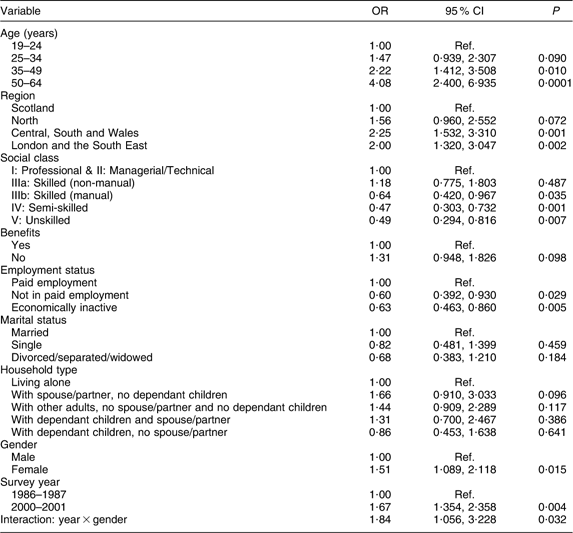
Table 3 presents the logistic regression model for those who complied, according to demographic and socio-economic variables, controlled for cluster sampling.
Logistic regression model for compliance with 5 or more portions of fruit and vegetables per day according to demographic and socio-economic variables
| Variable | OR | 95 % CI | P |
| Age (years) | |||
| 19–24 | 1·00 | Ref. | |
| 25–34 | 1·47 | 0·939, 2·307 | 0·090 |
| 35–49 | 2·22 | 1·412, 3·508 | 0·010 |
| 50–64 | 4·08 | 2·400, 6·935 | 0·0001 |
| Region | |||
| Scotland | 1·00 | Ref. | |
| North | 1·56 | 0·960, 2·552 | 0·072 |
| Central, South and Wales | 2·25 | 1·532, 3·310 | 0·001 |
| London and the South East | 2·00 | 1·320, 3·047 | 0·002 |
| Social class | |||
| I: Professional & II: Managerial/Technical | 1·00 | Ref. | |
| IIIa: Skilled (non-manual) | 1·18 | 0·775, 1·803 | 0·487 |
| IIIb: Skilled (manual) | 0·64 | 0·420, 0·967 | 0·035 |
| IV: Semi-skilled | 0·47 | 0·303, 0·732 | 0·001 |
| V: Unskilled | 0·49 | 0·294, 0·816 | 0·007 |
| Benefits | |||
| Yes | 1·00 | Ref. | |
| No | 1·31 | 0·948, 1·826 | 0·098 |
| Employment status | |||
| Paid employment | 1·00 | Ref. | |
| Not in paid employment | 0·60 | 0·392, 0·930 | 0·029 |
| Economically inactive | 0·63 | 0·463, 0·860 | 0·005 |
| Marital status | |||
| Married | 1·00 | Ref. | |
| Single | 0·82 | 0·481, 1·399 | 0·459 |
| Divorced/separated/widowed | 0·68 | 0·383, 1·210 | 0·184 |
| Household type | |||
| Living alone | 1·00 | Ref. | |
| With spouse/partner, no dependant children | 1·66 | 0·910, 3·033 | 0·096 |
| With other adults, no spouse/partner and no dependant children | 1·44 | 0·909, 2·289 | 0·117 |
| With dependant children and spouse/partner | 1·31 | 0·700, 2·467 | 0·386 |
| With dependant children, no spouse/partner | 0·86 | 0·453, 1·638 | 0·641 |
| Gender | |||
| Male | 1·00 | Ref. | |
| Female | 1·51 | 1·089, 2·118 | 0·015 |
| Survey year | |||
| 1986–1987 | 1·00 | Ref. | |
| 2000–2001 | 1·67 | 1·354, 2·358 | 0·004 |
| Interaction: year × gender | 1·84 | 1·056, 3·228 | 0·032 |
Ref., referent category.
Those aged 35–49 years (P = 0·01) and 50–64 years (P < 0·001) were significantly more likely to be ‘compliers’, compared with younger ages. There was a significant association by region, with Central, South and Wales and London and the South East having higher proportions of ‘compliers’ compared with Scotland and the North (P = 0·001 and P = 0·002, respectively). Regarding social class, the odds ratios indicated that a participant was less likely to be a ‘complier’ if in social class IIIb (P = 0·035) and below (P = 0·001 and P = 0·007 for social class IV and V, respectively).
The odds of being a ‘complier’ was less in those with no paid work or inactive compared with being in paid employment (P = 0·029 and P = 0·005, respectively). There was no significant relationship between marital status or household type and being a ‘complier’, nor was there a relationship with receipt of benefits. The likelihood of being a ‘complier’ was greater for females (P = 0·015).
There was a significant period effect with an increase in ‘compliers’ from 1986–1987 to 2000–2001 (P = 0·004) and a significant interaction between the year and the relationship with gender (P = 0·032). In 1986–1987, the odds of being a ‘complier’ was 1·58 for women compared with men (P = 0·013) and in 2000–2001 the odds was 0·84 (P = 0·475). The odds of a man being a ‘complier’ in the second compared with the first survey was 2·25 (P = 0·001) and for women the odds was 1·21 (P = 0·259; stratified subgroup analyses available on request).
Discussion
In the present study, based on comparison of data from the Dietary and Nutritional Surveys of British Adults, there was an increase in the proportion of adults who consumed 5 or more portions of fruit and vegetables per day from 12·7 % in 1986–1987 to 16·5 % in 2000–2001. Improvements were seen across social class groups. Differences between men and women and between regions reduced between 1986–1987 and 2000–2001. Those on benefits, those unemployed or economically inactive and couples or lone parents with dependant children were less likely to comply than their comparators in 1986–1987 and 2000–2001.
The survey data are of high quality, being based on nationally representative samples, weighed dietary records and validated methods. Our observations were based in the first instance on comparison of findings in two cross-sectional surveys and subsequently strengthened by formal testing in logistic regression analysis including survey year as a variable. The sample from 2000–2001 contained a greater proportion of older people and people in upper social classes than did the 1986–1987 sample. In both surveys response rates were calculated for the number of respondents completing full 7 d weighed dietary records as a proportion of the number of eligible respondents. As the response rate fell from 70 % to 47 %, bias introduced by self-selection of participants pursuing a healthier lifestyle is possible. Extensive analysis of response rates by sociodemographic group, region and recruitment waves showed consistent changes in response rates across the entire population( Reference Gregory, Foster and Tyler 16 , Reference Hoare, Bates and Prentice 17 ); and we note that the changes in age distribution and social class are consistent with demographic trends and that independent effects for age, region, employment status, marital status and survey year are confirmed in logistic regression analyses. In both years surveys were conducted in four rounds across spring, summer, autumn and winter. It was not possible to formally adjust for seasonality as date of the survey was only made available for the later data set. However, given the systematic sampling approach which included consideration of geographic units and similar response rates across rounds in each survey, we are not anticipating that a residual seasonality effect will have caused an important bias in our results.
A study comparable to ours is that of Roos et al.( Reference Roos, Talala and Laaksonen 21 ) looking at socio-economic differences in daily vegetable intake from 1979 to 2002 among Finish adults. In that study, daily consumption of vegetables was more common among those with higher income or higher education level, and among women, during the whole study period. However, the increase was higher in the lower educational and lower income groups during the study period, meaning that the socio-economic divide narrowed for vegetable intake during this period. In contrast, analyses of the Dutch National Food Consumption Surveys for 1987–1988, 1992 and 1997–1998 demonstrated a decrease in consumption of fruit and vegetables over the period( Reference Hulshof, Brussard and Kruizinga 22 ). Socio-economic differentials were present at baseline, which were more marked in women than in men, and changes towards lower consumption of fruit and vegetables were seen in all socio-economic groups in later years.
Meanwhile, in the USA the proportion complying with fruit and vegetable goals appears to have remained static through the same time period. Casagrande et al.( Reference Casagrande, Wang and Anderson 23 ) examined data from the National Health and Nutrition Examination Survey and found that 24·3 % complied with the recommended 5 or more portions of fruit and vegetables per day in 1988–1994 and 23·6 % in 1999–2002. Blanck et al.( Reference Blanck, Gillespie and Kimmons 24 ) used a different data source (the Behavioral Risk Factor Surveillance System) to show for both men and women that the percentage who met 5 or more per day did not change: 20·6 % in 1994 and 20·3 % in 2005. Complementary analyses of the same data indicated that there were actually increases in fruit and vegetable consumption in 1990–1996( Reference Ruowei, Serdula and Balnd 25 ), but these fell away in 1994–2000( Reference Serdula, Gillespie and Kettel-Kahan 26 ).
The years between the Dietary and Nutritional Surveys of 1986–1987 and 2000–2001 were at the beginning of a phase of food policy direction reinforced by statements of explicit recommendations( 7 , 8 ) and characterised by early selective and universalist approaches towards improving fruit and vegetable consumption in the UK. The former were driven by and large by the voluntary sector and public sector groups, and ranged in character from supplying food to teaching cooking and budgeting skills. At the same time various retailers were beginning to accept a notion of social responsibility and introduce economy ranges of food and business models that did not depend exclusively on out-of-town supermarkets( 8 ). In England, there was little by way of centrally coordinated food policy, with the Department of Health and the Ministry of Agriculture, Fisheries and Food adopting principally a monitoring role( Reference Nelson 27 ). Lack of leadership could be less true for the devolved administration in Scotland and it is interesting to speculate whether the changes in regional differentials between the two surveys reflect the effective implementation of elements of the Scottish Diet Action Plan( 7 ).
Some encouragement should be taken from the findings of our research in that there has been an increase in the proportion of ‘compliers’ between 1986–1987 and 2000–2001 and closure of the gender gap. The data also indicate the continuing challenge of social class, where a fourfold difference in the proportion of ‘compliers’ persists between social class I and social class V. The evidence base for interventions directed towards individuals and groups has grown considerably in the last decade and policy can be framed around selective and universalist interventions that are evidence based( Reference Pommerleau, Lock and Knai 28 ) and/or can build on work that has gone before in communicating messages to the public and to specific segments of the population in particular circumstances( Reference Pollard, Miller and Daly 29 , Reference Bremner, Dalziel and Evans 30 ).
We hope that momentum has not been lost since 2001 and note that Dowler( Reference Dowler 31 ) has recently presented a framework for addressing households’ nutritional needs, summarising the range of policy responses in the UK to inequalities in diet and nutrition broadly under the remit of ‘health’, ‘education’ and ‘commercial food access’. Data from the Dietary and Nutritional Survey for 2008–2009 are now available and early indications are that there has been a further improvement in compliance with fruit and vegetable goals( 32 ). We hope it may be possible eventually to see an extended analysis similar to the work presented here, using systematic methods to examine trends across all three surveys.
Acknowledgements
This research received no specific grant from any funding agency in the public, commercial or not-for-profit sectors. This paper has not been published elsewhere in part or in full or been submitted elsewhere. There are no financial or other relationships that lead to competing interests. Both authors have read and approved the revised paper for publication, both have been involved in the conception, writing and revising of the paper. J.A.P. did the analysis and S.R. wrote the paper.



