





1. Introduction
Cluster algebras were invented by Fomin and Zelevinsky around 2001 [Reference Fomin and Zelevinsky18] in order to create a combinatorial framework for the study of canonical bases in quantum groups and the study of total positivity in algebraic groups. By construction, a cluster algebra is a commutative ring endowed with distinguished generators (cluster variables) grouped in subsets of the same cardinality (clusters). Since the combinatorics of cluster algebras is complicated, it is useful to model them categorically, so that more conceptual tools become available. For a cluster algebra
${\mathcal A}$
 defined by an acyclic quiver Q, Buan–Marsh–Reineke–Reiten–Todorov [Reference Buan, Marsh, Reineke, Reiten and Todorov4] introduced the cluster category
${\mathcal C}_{Q}$
defined by an acyclic quiver Q, Buan–Marsh–Reineke–Reiten–Todorov [Reference Buan, Marsh, Reineke, Reiten and Todorov4] introduced the cluster category
${\mathcal C}_{Q}$
 . In order to generalize the representation-theoretic approach to cluster algebras from acyclic quivers to quivers with oriented cycles, Derksen–Weyman–Zelevinsky [Reference Derksen, Weyman and Zelevinsky13], [Reference Derksen, Weyman and Zelevinsky14] extended the mutation operation from quivers to quivers with potential and their representations. In the case where the quiver with potential is Jacobi-finite, Amiot [Reference Amiot1] generalized the construction of the cluster category [Reference Buan, Marsh, Reineke, Reiten and Todorov4]. The cluster character constructed by Palu in [Reference Palu33] induces a bijection [Reference Irelli, Keller, Labardini-Fragoso and Plamondon23] from the isoclasses of the reachable rigid indecomposables of the (generalized) cluster category to the cluster variables of the associated cluster algebra. Plamondon [Reference Plamondon35] generalized Amiot’s and Palu’s constructions to arbitrary quivers with potential.
Cluster algebras with coefficients are important since they appear in nature as coordinate algebras of varieties like Grassmannians, double Bruhat cells, unipotent cells, etc. The work of Geiss–Leclerc–Schröer often yields Frobenius exact categories which allow us to categorify such cluster algebras. In [Reference Wu39], we have generalized the construction of (higher) cluster categories by Claire Amiot and by Lingyan Guo to the relative context. We proved the existence of an n-cluster-tilting object in a Frobenius extriangulated category, namely, the Higgs category, which is stably n-Calabi–Yau and Hom-finite, arising from a left
$(n+1)$
 -Calabi–Yau morphism. Higgs categories generalize the Frobenius categories used by Geiss–Leclerc–Schröer but are no longer exact categories in the sense of Quillen in general. They serve to categorify cluster algebras with non-invertible coefficients whereas relative cluster categories serve to categorify their localizations at the coefficients.
However, the theory of Fomin–Zelevinsky accommodates more general seeds defined by skew-symmetrizable matrices. For instance, cluster algebras associated with Lie groups of types B, C, F, and G are skew-symmetrizable, as are cluster algebras with principal coefficients of these types.
The aim of this article is to generalize the results of Demonet [Reference Demonet12] to the setting of ice quivers with potentials. By using G-orbit mutations on the set of G-stable cluster-tilting objects in the Higgs category and an appropriate cluster character, we categorify certain skew-symmetrizable cluster algebras with coefficients, including, in particular, cluster algebras with principal coefficients in the non-simply-laced case. We remark that Azzurra Ciliberti has recently provided a categorification of cluster algebras of types B and C with principal coefficients via symmetric quivers [Reference Ciliberti8].
The structure of the article is as follows. In Section 2, we give some background material on dg algebras and relative Calabi–Yau completions. Let k be field and
$f\colon B\rightarrow A$
 a dg morphism between smooth dg algebras over k. Let G be a finite group acting on f, that is, G acts on B and A, and f is G-equivariant. We assume that
$\mathrm {char}(k)\nmid \mathrm {Card}(G)$
a dg morphism between smooth dg algebras over k. Let G be a finite group acting on f, that is, G acts on B and A, and f is G-equivariant. We assume that
$\mathrm {char}(k)\nmid \mathrm {Card}(G)$
 . Let n be a positive integer and
$\xi $
. Let n be a positive integer and
$\xi $
 an element of
$H\!H_{n-2}(f)^{G}\subseteq H\!H_{n-2}(f)$
an element of
$H\!H_{n-2}(f)^{G}\subseteq H\!H_{n-2}(f)$
 . Denote by
$\xi _{B}$
. Denote by
$\xi _{B}$
 the element in
$H\!H_{n-3}(B)$
the element in
$H\!H_{n-3}(B)$
 induced by
$\xi $
induced by
$\xi $
 under the map
$H\!H_{n-2}(f)\rightarrow H\!H_{n-3}(B)$
under the map
$H\!H_{n-2}(f)\rightarrow H\!H_{n-3}(B)$
 .
.
In Section 3, we show that the deformed relative 3-Calabi–Yau completion

has a natural G-action, that is, G acts on
$\boldsymbol {\Pi }_{n-1}(B,\xi _{B})$
 and
$\boldsymbol {\Pi }_{n}(A,B,\xi )$
and
$\boldsymbol {\Pi }_{n}(A,B,\xi )$
 and
$\tilde {f}$
and
$\tilde {f}$
 is G-equivariant. Moreover, if
$\xi $
is G-equivariant. Moreover, if
$\xi $
 lifts to
$H\!N_{n-2}(f)$
lifts to
$H\!N_{n-2}(f)$
 , then the associated dg functor between skew group dg algebras

has a canonical left n-Calabi–Yau structure (see Theorem 3.8). Let
$(Q,F)$
 be a graded ice quiver and W a homogeneous potential on Q of degree
$3-n$
be a graded ice quiver and W a homogeneous potential on Q of degree
$3-n$
 . Suppose that Assumption 1 in Section 3.5 is satisfied. Then there exists a graded ice quiver with potential
$(Q_{G},F_{G},W_{G})$
. Suppose that Assumption 1 in Section 3.5 is satisfied. Then there exists a graded ice quiver with potential
$(Q_{G},F_{G},W_{G})$
 such that we have the following commutative diagram (Proposition 3.17):

where
$\boldsymbol {\Pi }_{n-1}(F)$
 is the
$(n-1)$
is the
$(n-1)$
 -Calabi–Yau completion of
$kF$
-Calabi–Yau completion of
$kF$
 (see Definition 3.10) and
$\boldsymbol {\Gamma }_{n}(Q,F,W)$
(see Definition 3.10) and
$\boldsymbol {\Gamma }_{n}(Q,F,W)$
 is the n-dimensional relative Ginzburg dg algebra (see Definition 3.9). And the restriction-of-scalars functors induce equivalences of triangulated categories

and

In Section 4, we recall some facts on separable monads and the construction of the comparison functor associated with an adjoint pair. Let A be a dg k-algebra and G a finite group acting on A by dg algebra automorphisms. Then G naturally acts on
$\mathrm {per}(A)$
 and
$\mathrm {pvd}(A)$
and
$\mathrm {pvd}(A)$
 . Let
$\mathrm {per}(A)^G$
. Let
$\mathrm {per}(A)^G$
 and
$\mathrm {pvd}(A)^G$
and
$\mathrm {pvd}(A)^G$
 be the corresponding categories of G-equivariant objects. Then we show the following triangle equivalences (see Proposition 4.3):

In Section 5, we present the main construction of the G-equivariant relative cluster category and the G-equivariant Higgs category. Let
$(Q,F)$
 be an ice quiver and W a potential on Q of degree 0. Denote by
$ \boldsymbol {\Gamma } $
be an ice quiver and W a potential on Q of degree 0. Denote by
$ \boldsymbol {\Gamma } $
 the corresponding relative Ginzburg algebra, that is, the three-dimensional relative Ginzburg dg algebra. Let
$\overline {Q}$
the corresponding relative Ginzburg algebra, that is, the three-dimensional relative Ginzburg dg algebra. Let
$\overline {Q}$
 be the quiver obtained from Q by deleting all vertices in F and all arrows incident with vertices in F. Let
$\overline {W}$
be the quiver obtained from Q by deleting all vertices in F and all arrows incident with vertices in F. Let
$\overline {W}$
 be the potential on Q obtaining by deleting all cycles passing through vertices of F in W.
Let
$\overline {\boldsymbol {\Gamma }}$
 be the Ginzburg algebra associated with
$(\overline {Q},\overline {W})$
be the Ginzburg algebra associated with
$(\overline {Q},\overline {W})$
 . Let
$ e=\sum _{i\in F}e_{i} $
. Let
$ e=\sum _{i\in F}e_{i} $
 be the idempotent associated with the set of frozen vertices. Suppose that Assumptions 1 and 2 (see Sections 3.5 and 5, respectively) are satisfied. By our assumption,
$\overline {\boldsymbol {\Gamma }}$
be the idempotent associated with the set of frozen vertices. Suppose that Assumptions 1 and 2 (see Sections 3.5 and 5, respectively) are satisfied. By our assumption,
$\overline {\boldsymbol {\Gamma }}$
 has an induced G-action. Then the G-equivariant relative cluster category
${\mathcal C}(\boldsymbol {\Gamma }*G)$
has an induced G-action. Then the G-equivariant relative cluster category
${\mathcal C}(\boldsymbol {\Gamma }*G)$
 is defined as the idempotent completion of the Verdier quotient of triangulated categories

where we view
$\mathrm {pvd}(\overline {\boldsymbol {\Gamma }}*G)$
 as a triangulated subcategory of
$\mathrm {per}(\boldsymbol {\Gamma }*G)$
as a triangulated subcategory of
$\mathrm {per}(\boldsymbol {\Gamma }*G)$
 through

Then Proposition 5.4 shows that the
${\mathcal C}(\boldsymbol {\Gamma }*G)$
 is triangle equivalent to the equivariant category
${\mathcal C}(\boldsymbol {\Gamma })^{G}=(\mathrm {per}\boldsymbol {\Gamma }/\mathrm {pvd}_{e}(\boldsymbol {\Gamma }))^{G}$
is triangle equivalent to the equivariant category
${\mathcal C}(\boldsymbol {\Gamma })^{G}=(\mathrm {per}\boldsymbol {\Gamma }/\mathrm {pvd}_{e}(\boldsymbol {\Gamma }))^{G}$
 . By Definition 3.13 and Corollary 3.21, there exists an ice quiver with potential
$(Q_{G},F_{G},W_{G})$
. By Definition 3.13 and Corollary 3.21, there exists an ice quiver with potential
$(Q_{G},F_{G},W_{G})$
 such that
$ {\mathcal C}(\boldsymbol {\Gamma }*G) $
such that
$ {\mathcal C}(\boldsymbol {\Gamma }*G) $
 is equivalent to the relative cluster category
${\mathcal C}(\boldsymbol {\Gamma }_{G})$
is equivalent to the relative cluster category
${\mathcal C}(\boldsymbol {\Gamma }_{G})$
 associated with
$(Q_{G},F_{G},W_{G})$
associated with
$(Q_{G},F_{G},W_{G})$
 . Then we define the G-equivariant Higgs category to be
${\mathcal H}(\boldsymbol {\Gamma }_G)$
. Then we define the G-equivariant Higgs category to be
${\mathcal H}(\boldsymbol {\Gamma }_G)$
 , that is, the Higgs category associated with
$(Q_{G},F_{G},W_{G})$
, that is, the Higgs category associated with
$(Q_{G},F_{G},W_{G})$


where
${\mathcal P}'=\mathrm {add}(e_{G}\boldsymbol {\Gamma }_G)$
 , that is, the additive subcategory of
${\mathcal C}(\boldsymbol {\Gamma }_G)$
, that is, the additive subcategory of
${\mathcal C}(\boldsymbol {\Gamma }_G)$
 generated by
$e_{G}\boldsymbol {\Gamma }_G=\displaystyle \oplus _{k\in F_{G}}e_{k}\boldsymbol {\Gamma }_{G}$
generated by
$e_{G}\boldsymbol {\Gamma }_G=\displaystyle \oplus _{k\in F_{G}}e_{k}\boldsymbol {\Gamma }_{G}$
 . We show that the triangle equivalence
${\mathcal C}(\boldsymbol {\Gamma }*G)\xrightarrow {\sim }{\mathcal C}(\boldsymbol {\Gamma })^{G}$
. We show that the triangle equivalence
${\mathcal C}(\boldsymbol {\Gamma }*G)\xrightarrow {\sim }{\mathcal C}(\boldsymbol {\Gamma })^{G}$
 induces an equivalence of Frobenius extriangulated categories

where the category of projective–injective objects of
${\mathcal H}^{G}$
 is
${\mathcal P}^{G}=\mathrm {add}(e\boldsymbol {\Gamma })^{G}$
is
${\mathcal P}^{G}=\mathrm {add}(e\boldsymbol {\Gamma })^{G}$
 and
$\boldsymbol {\Gamma }[G]=(\oplus _{h\in G}\,^{h}\boldsymbol {\Gamma },\mathrm {Id})$
and
$\boldsymbol {\Gamma }[G]=(\oplus _{h\in G}\,^{h}\boldsymbol {\Gamma },\mathrm {Id})$
 is a canonical cluster-tilting object of
${\mathcal H}^{G}$
is a canonical cluster-tilting object of
${\mathcal H}^{G}$
 (see Theorem 5.9).
In the final section, we construct an appropriate cluster character for the Higgs category, enabling us to connect this data to a skew-symmetrizable cluster algebra with coefficients. As a specific example, the Higgs category together with the set of G-stable cluster-tilting objects provides an additive categorification of cluster algebras with principal coefficients in the non-simply-laced case.
2. Preliminaries
Let
$ k $
 be a field. A differential graded k-algebra (or simply dg
$ k $
be a field. A differential graded k-algebra (or simply dg
$ k $
 -algebra) is a graded
$ k $
-algebra) is a graded
$ k $
 -algebra
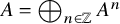
$ {A=\bigoplus _{n\in \mathbb {Z}}A^{n} }$
-algebra
$ {A=\bigoplus _{n\in \mathbb {Z}}A^{n} }$
 equipped with a
$ k $
equipped with a
$ k $
 -linear homogeneous map
$ d_{A}:A\rightarrow A $
-linear homogeneous map
$ d_{A}:A\rightarrow A $
 of degree 1 such that
$ d_{A}^{2}=0 $
of degree 1 such that
$ d_{A}^{2}=0 $
 and the graded Leibniz rule
$ d_{A}(ab)=(d_{A}a)b+(-1)^{n}ad_{A}(b) $
and the graded Leibniz rule
$ d_{A}(ab)=(d_{A}a)b+(-1)^{n}ad_{A}(b) $
 holds, where
$ a\in A^{n} $
holds, where
$ a\in A^{n} $
 and
$ b\in A $
and
$ b\in A $
 . The map
$ d_{A} $
. The map
$ d_{A} $
 is called the differential of
$ A $
is called the differential of
$ A $
 . We can view an ordinary
$ k $
. We can view an ordinary
$ k $
 -algebra as a dg
$ k $
-algebra as a dg
$ k $
 -algebra concentrated in degree
$ 0 $
-algebra concentrated in degree
$ 0 $
 whose differential is trivial. A graded
$ k $
whose differential is trivial. A graded
$ k $
 -algebra can be viewed as a dg
$ k $
-algebra can be viewed as a dg
$ k $
 -algebra with the zero differential. Let A be a dg k-algebra.
Definition 2.1. A right dg module over
$ A $
 is a graded right
$ A $
is a graded right
$ A $
 -module
$ M=\bigoplus _{n\in \mathbb {Z}}M^{n} $
-module
$ M=\bigoplus _{n\in \mathbb {Z}}M^{n} $
 equipped with a
$ k $
equipped with a
$ k $
 -linear homogeneous map
$ d_{M}:M\rightarrow M $
-linear homogeneous map
$ d_{M}:M\rightarrow M $
 of degree 1 such that
$ d_{M}^{2}=0 $
of degree 1 such that
$ d_{M}^{2}=0 $
 and the graded Leibniz rule

holds for all
$ m\in M^{n} $
 and
$ a\in A $
and
$ a\in A $
 . The map
$ d_{M} $
. The map
$ d_{M} $
 is called the differential of
$ M $
is called the differential of
$ M $
 .
.
Given two dg
$ A $
 -modules
$ M $
-modules
$ M $
 and
$ N $
and
$ N $
 , we define the morphism complex to be the graded
$ k $
, we define the morphism complex to be the graded
$ k $
 -vector space
$ {\mathcal H} om_{A}(M,N) $
-vector space
$ {\mathcal H} om_{A}(M,N) $
 whose
$ i $
whose
$ i $
 th component
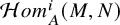
$ {\mathcal H} om^{i}_{A}(M,N) $
th component
$ {\mathcal H} om^{i}_{A}(M,N) $
 is the subspace of the product
$ \prod _{j\in \mathbb {Z}}\mathrm {Hom}_{k}(M^{j},N^{j+i}) $
is the subspace of the product
$ \prod _{j\in \mathbb {Z}}\mathrm {Hom}_{k}(M^{j},N^{j+i}) $
 consisting of morphisms
$ f $
consisting of morphisms
$ f $
 such that
$ f(ma)=f(m)a $
such that
$ f(ma)=f(m)a $
 for all
$ m $
for all
$ m $
 in
$ M $
in
$ M $
 and all
$ a $
and all
$ a $
 in
$ A $
in
$ A $
 , together with the differential
$ d $
, together with the differential
$ d $
 given by

for a homogeneous morphism
$ f $
 of degree
$ |f| $
of degree
$ |f| $
 .
.
The category
$ {\mathcal C}(A) $
 of dg
$ A $
of dg
$ A $
 -modules is the category whose objects are the right dg
$ A $
-modules is the category whose objects are the right dg
$ A $
 -modules, and whose morphisms are the 0-cycles of the morphism complexes. It is an abelian category and a Frobenius category for the conflations which are split exact as sequences of graded
$ A $
-modules, and whose morphisms are the 0-cycles of the morphism complexes. It is an abelian category and a Frobenius category for the conflations which are split exact as sequences of graded
$ A $
 -modules (see [Reference Keller25]). Its stable category
$ {\mathcal H}(A) $
-modules (see [Reference Keller25]). Its stable category
$ {\mathcal H}(A) $
 is called the homotopy category of right dg
$ A $
is called the homotopy category of right dg
$ A $
 -modules. It can be equivalently defined as the category whose objects are the dg
$ A $
-modules. It can be equivalently defined as the category whose objects are the dg
$ A $
 -modules and whose morphism spaces are the 0th cohomology groups of the morphism complexes.
The homotopy category
$ {\mathcal H}(A) $
 is a triangulated category whose suspension functor
$ \Sigma $
is a triangulated category whose suspension functor
$ \Sigma $
 is the shift of dg modules
$ M\mapsto \Sigma M $
is the shift of dg modules
$ M\mapsto \Sigma M $
 . The derived category
$ {\mathcal D}(A) $
. The derived category
$ {\mathcal D}(A) $
 of dg
$ A $
of dg
$ A $
 -modules is the localization of
$ {\mathcal H}(A) $
-modules is the localization of
$ {\mathcal H}(A) $
 at the full subcategory of acyclic dg
$ A $
at the full subcategory of acyclic dg
$ A $
 -modules.
A dg
$ A $
 -module
$ P $
-module
$ P $
 is cofibrant if, for every surjective quasi-isomorphism
$ L\rightarrow M $
is cofibrant if, for every surjective quasi-isomorphism
$ L\rightarrow M $
 , every morphism
$ P\rightarrow M $
, every morphism
$ P\rightarrow M $
 factors through
$ L $
factors through
$ L $
 . For example, the dg algebra
$ A $
. For example, the dg algebra
$ A $
 considered as a right module over itself is cofibrant. A dg
$ A $
considered as a right module over itself is cofibrant. A dg
$ A $
 -module
$ I $
-module
$ I $
 is fibrant if, for every injective quasi-isomorphism
$ L\rightarrow M $
is fibrant if, for every injective quasi-isomorphism
$ L\rightarrow M $
 , every morphism
$ L\rightarrow I $
, every morphism
$ L\rightarrow I $
 extends to
$ M $
extends to
$ M $
 .
.
Proposition 2.2 [Reference Keller25]
-
a) For each dg A-module $ M $
 , there is a quasi-isomorphism
$ \mathbf {p}M\rightarrow M $
with cofibrant
$ \mathbf {p}M $
and a quasi-isomorphism
$ M\rightarrow \mathbf {i}M $
with fibrant
$ \mathbf {i}M $
.
, there is a quasi-isomorphism
$ \mathbf {p}M\rightarrow M $
with cofibrant
$ \mathbf {p}M $
and a quasi-isomorphism
$ M\rightarrow \mathbf {i}M $
with fibrant
$ \mathbf {i}M $
. -
b) The projection functor $ {\mathcal {H}}(A)\rightarrow {\mathcal {D}}(A) $
admits a fully faithful left adjoint given by
$ M\mapsto \mathbf {p}M$
and a fully faithful right adjoint given by
$ M\mapsto \mathbf {i}M $
.


We call
$ \mathbf {p}M\rightarrow M $
 a cofibrant resolution of
$ M $
a cofibrant resolution of
$ M $
 and
$ M\rightarrow \mathbf {i}M $
and
$ M\rightarrow \mathbf {i}M $
 a fibrant resolution of
$ M $
a fibrant resolution of
$ M $
 . We can compute morphisms in
$ {\mathcal D}(A) $
. We can compute morphisms in
$ {\mathcal D}(A) $
 via
via

The perfect derived category
$ \mathrm {per} A $
 is the smallest full subcategory of
$ {\mathcal D}(A) $
is the smallest full subcategory of
$ {\mathcal D}(A) $
 containing
$ A $
containing
$ A $
 which is stable under taking shifts, extensions, and direct summands. An object
$ M $
which is stable under taking shifts, extensions, and direct summands. An object
$ M $
 of
$ {\mathcal D}(A) $
of
$ {\mathcal D}(A) $
 belongs to
$ \mathrm {per}(A) $
belongs to
$ \mathrm {per}(A) $
 if and only if it is compact, that is, the functor
$ \mathrm {Hom}_{{\mathcal D}(A)}(M,-) $
if and only if it is compact, that is, the functor
$ \mathrm {Hom}_{{\mathcal D}(A)}(M,-) $
 commutes with arbitrary (set-indexed) direct sums (see [Reference Keller25, Section 5]). The perfectly valued derived category
$ \mathrm {pvd}(A) $
commutes with arbitrary (set-indexed) direct sums (see [Reference Keller25, Section 5]). The perfectly valued derived category
$ \mathrm {pvd}(A) $
 is the full subcategory of
$ {\mathcal D}(A) $
is the full subcategory of
$ {\mathcal D}(A) $
 consisting of those dg
$ A $
consisting of those dg
$ A $
 -modules whose underlying dg
$ k $
-modules whose underlying dg
$ k $
 -module is perfect, that is, the total dimension
$\sum _{i\in \mathbb {Z}}\dim H^{i}(A)$
-module is perfect, that is, the total dimension
$\sum _{i\in \mathbb {Z}}\dim H^{i}(A)$
 is finite.
Let
$ f:B\rightarrow A $
 be a morphism of dg algebras. Then
$ f $
be a morphism of dg algebras. Then
$ f $
 induces the restriction functor
$ f_{*}: {\mathcal C}(A)\rightarrow {\mathcal C}(B) $
induces the restriction functor
$ f_{*}: {\mathcal C}(A)\rightarrow {\mathcal C}(B) $
 . It fits into the usual triple of adjoint functors
$ (f^{*} , f_{*},f^{!}) $
. It fits into the usual triple of adjoint functors
$ (f^{*} , f_{*},f^{!}) $
 between
$ {\mathcal D}(A) $
between
$ {\mathcal D}(A) $
 and
$ {\mathcal D}(B) $
and
$ {\mathcal D}(B) $
 .
.
Denote by
$A^{op}$
 the opposite dg algebra of A. The enveloping dg algebra
$A^{e}$
the opposite dg algebra of A. The enveloping dg algebra
$A^{e}$
 of A is defined as
$A\otimes _{k}A^{op}$
of A is defined as
$A\otimes _{k}A^{op}$
 with product
$(a\otimes b)\cdot (c\otimes f):= (-1)^{\deg (b)\cdot (\deg (c)+\deg (f))}ac\otimes fb$
with product
$(a\otimes b)\cdot (c\otimes f):= (-1)^{\deg (b)\cdot (\deg (c)+\deg (f))}ac\otimes fb$
 for all (homogeneous)
$a, b, c, d\in A$
for all (homogeneous)
$a, b, c, d\in A$
 . The category of dg A-bimodules is equivalent to the category of right
$A^{e}$
. The category of dg A-bimodules is equivalent to the category of right
$A^{e}$
 -modules.
In particular, A is a dg
$A^{e}$
 -module for the following structure map:

We say that A is (homologically) smooth if A belongs to
$\mathrm {per}(A^{e})$
 and A is proper if
$A\in \mathrm {pvd}(A)$
and A is proper if
$A\in \mathrm {pvd}(A)$
 , that is, the total dimension
$\sum _{l\in \mathbb {Z}}\dim _{l} H^{l}(A)$
, that is, the total dimension
$\sum _{l\in \mathbb {Z}}\dim _{l} H^{l}(A)$
 is finite.
Definition 2.3. For a dg
$A^{e}$
 -module M, the derived bimodule dual
$M^{\vee }$
-module M, the derived bimodule dual
$M^{\vee }$
 of M is defined as
$\mathrm {\mathbf {R}Hom}_{A^{e}}(M,A^{e})$
of M is defined as
$\mathrm {\mathbf {R}Hom}_{A^{e}}(M,A^{e})$
 .
.
Definition 2.4. A graded quiver Q consists of a finite set
$Q_{0}$
 and a graded set
$Q_{1}$
and a graded set
$Q_{1}$
 (i.e., a set
$Q_{1}$
(i.e., a set
$Q_{1}$
 together with a degree map
$|\,\,|\colon Q_{1}\rightarrow \mathbb {Z}$
together with a degree map
$|\,\,|\colon Q_{1}\rightarrow \mathbb {Z}$
 ), together with two maps
$s,t\colon Q_{1}\rightarrow Q_{0}$
), together with two maps
$s,t\colon Q_{1}\rightarrow Q_{0}$
 . We will often simply say that Q is a graded quiver over
${\mathcal O}$
. We will often simply say that Q is a graded quiver over
${\mathcal O}$
 . The associated graded path algebra is defined as the graded tensor algebra
$T_{kQ_{0}}(kQ_{1})$
. The associated graded path algebra is defined as the graded tensor algebra
$T_{kQ_{0}}(kQ_{1})$
 .
.
A dg algebra A is said to be semi-free if its underlying graded vector space (forgetting the differential) is isomorphic to
$T_{kQ_{0}}(kQ_{1})$
 for some graded quiver
$(Q_{0},Q_{1})$
for some graded quiver
$(Q_{0},Q_{1})$
 .
.
A semi-free dg algebra
$A=T_{kQ_{0}}(kQ_{1})$
 is said to be cellular if the set
$Q_{1}$
is said to be cellular if the set
$Q_{1}$
 has a filtration
$Q^{\prime }_{1}\subset Q^{\prime }_{2}\subset \cdots $
has a filtration
$Q^{\prime }_{1}\subset Q^{\prime }_{2}\subset \cdots $
 such that
$Q_{1}=\bigcup Q^{\prime }_{i}$
such that
$Q_{1}=\bigcup Q^{\prime }_{i}$
 and that, for each
$f\in Q^{\prime }_{i} , i=1, 2,\ldots $
and that, for each
$f\in Q^{\prime }_{i} , i=1, 2,\ldots $
 , the differential
$df$
, the differential
$df$
 lies in the
$T_{kQ_{0}}(kQ^{\prime }_{i-1})\subset T_{kQ_{0}}(kQ_{1})$
lies in the
$T_{kQ_{0}}(kQ^{\prime }_{i-1})\subset T_{kQ_{0}}(kQ_{1})$
 . It is said to be finitely cellular if
$Q_{1}$
. It is said to be finitely cellular if
$Q_{1}$
 is also finite.
2.1. Hochschild and cyclic homology
Let
$ \Lambda $
 be the dg algebra generated by an indeterminate
$ \epsilon $
be the dg algebra generated by an indeterminate
$ \epsilon $
 of cohomological degree
$ -1 $
of cohomological degree
$ -1 $
 with
$ \epsilon ^{2}=0 $
with
$ \epsilon ^{2}=0 $
 and
$ d\epsilon =0 $
and
$ d\epsilon =0 $
 . The underlying complex of
$ \Lambda $
. The underlying complex of
$ \Lambda $
 is
is

Then a mixed complex over
$ k $
 is a dg right
$ \Lambda $
is a dg right
$ \Lambda $
 -module whose underlying dg
$ k $
-module whose underlying dg
$ k $
 -module is
$ (M,b) $
-module is
$ (M,b) $
 and where
$ \epsilon $
and where
$ \epsilon $
 acts by a closed endomorphism
$ B $
acts by a closed endomorphism
$ B $
 . Suppose that
$ M=(M,b,B) $
. Suppose that
$ M=(M,b,B) $
 is a mixed complex. Then the shifted mixed complex
$ \Sigma M $
is a mixed complex. Then the shifted mixed complex
$ \Sigma M $
 is the mixed complex such that
$ (\Sigma M)^{p}=M^{p-1} $
is the mixed complex such that
$ (\Sigma M)^{p}=M^{p-1} $
 for all
$ p $
for all
$ p $
 ,
$ b_{\Sigma M}=-b, $
,
$ b_{\Sigma M}=-b, $
 and
$ B_{\Sigma M}=B $
and
$ B_{\Sigma M}=B $
 . Let
$ f:M\rightarrow M' $
. Let
$ f:M\rightarrow M' $
 be a morphism of mixed complexes. Then the mapping cone over
$ f $
be a morphism of mixed complexes. Then the mapping cone over
$ f $
 is the mixed complex

We denote by
$ {\mathcal M} ix $
 the category of mixed complexes and by
$ {\mathcal D}{\mathcal M} ix $
the category of mixed complexes and by
$ {\mathcal D}{\mathcal M} ix $
 the derived category of the dg algebra
$ \Lambda $
the derived category of the dg algebra
$ \Lambda $
 .
.
Let
$ A $
 be a dg
$ k $
be a dg
$ k $
 -algebra. We associate a precyclic chain complex
$ C(A) $
-algebra. We associate a precyclic chain complex
$ C(A) $
 (see [Reference Loday31, Definition 2.5.1]) with
$ A $
(see [Reference Loday31, Definition 2.5.1]) with
$ A $
 as follows: For each
$ n\in \mathbb {N} $
as follows: For each
$ n\in \mathbb {N} $
 , its
$ n $
, its
$ n $
 th term is

The degeneracy maps are given by

where
$ \sigma =(\mathrm {deg}a_{0})(\mathrm {deg}a_{1}+\cdots +\mathrm {deg}a_{n-1}) $
 . The cyclic operator is given by

Then the corresponding total complex
$ (H\!H(A),b) $
 of
$ (C(A),b=\sum _{i=0}^{n}(-1)^{i}d_{i}) $
of
$ (C(A),b=\sum _{i=0}^{n}(-1)^{i}d_{i}) $
 is called the Hochschild complex of
$ A $
is called the Hochschild complex of
$ A $
 and b is called the Hochschild differential of A. The Hochschild homology of
$ A $
and b is called the Hochschild differential of A. The Hochschild homology of
$ A $
 is defined to be the cohomology of this complex. By [Reference Van den Bergh37, Proposition B.1], the Hochschild complex is quasi-isomorphic to
$ A\overset {\mathbf {L}}{\otimes }_{A^{e}}A $
is defined to be the cohomology of this complex. By [Reference Van den Bergh37, Proposition B.1], the Hochschild complex is quasi-isomorphic to
$ A\overset {\mathbf {L}}{\otimes }_{A^{e}}A $
 in
$ {\mathcal D}(k) $
in
$ {\mathcal D}(k) $
 .
.
We associate a mixed complex
$ (M(A),b,B) $
 with this precyclic chain complex as follows: Consider the total complex
$ (H\!H(A),b') $
with this precyclic chain complex as follows: Consider the total complex
$ (H\!H(A),b') $
 of
$ (C(A),b'=\sum _{i=0}^{n-1}(-1)^{i}d_{i}) $
of
$ (C(A),b'=\sum _{i=0}^{n-1}(-1)^{i}d_{i}) $
 . The underlying dg module of
$ M(A) $
. The underlying dg module of
$ M(A) $
 is the mapping cone over
$ (1-t) $
is the mapping cone over
$ (1-t) $
 viewed as a morphism of complexes

where
$ b=\sum _{i=0}^{n}(-1)^{i}d_{i} $
 and
$ b'=\sum _{i=0}^{n-1}(-1)^{i}d_{i} $
and
$ b'=\sum _{i=0}^{n-1}(-1)^{i}d_{i} $
 . Its underlying module is
$ H\!H(A)\oplus H\!H(A) $
. Its underlying module is
$ H\!H(A)\oplus H\!H(A) $
 ; it is endowed with the grading whose
$ n $
; it is endowed with the grading whose
$ n $
 th component is
$ H\!H(A)_{n}\oplus H\!H(A)_{n-1} $
th component is
$ H\!H(A)_{n}\oplus H\!H(A)_{n-1} $
 and the differential is

The operator
$ B\colon M\rightarrow M $
 is
is

where
$ N=\sum _{i=0}^{n}t^{i} $
 .
.
Let
$ A' $
 be an other dg
$ k $
be an other dg
$ k $
 -algebra. Let
$ f $
-algebra. Let
$ f $
 be a morphism from
$ A' $
be a morphism from
$ A' $
 to
$ A $
to
$ A $
 . Then
$ f $
. Then
$ f $
 induces a canonical morphism between their Hochschild complexes

Definition 2.5. The Hochschild homology
$ H\!H_{\bullet }(f) $
 of
$ f $
of
$ f $
 is the cohomology of the relative Hochschild complex which is defined as follows:

Remark 2.6. By definition, a closed element
$ \xi =(s\xi _{A'},\xi _{A})\in \mathrm {Cone}(\gamma _{f}\colon H\!H(A')\rightarrow H\!H(A)) $
 of degree
$ -n $
of degree
$ -n $
 consists of an element
$ \xi _{A'} \in HH(B) $
consists of an element
$ \xi _{A'} \in HH(B) $
 of degree
$ -n+1 $
of degree
$ -n+1 $
 , together with an element
$ \xi _{A}\in H\!H(A) $
, together with an element
$ \xi _{A}\in H\!H(A) $
 of degree
$ -n $
of degree
$ -n $
 , such that
$ b_{A'}(\xi _{A'})=0 $
, such that
$ b_{A'}(\xi _{A'})=0 $
 and
$ b_{A}(\xi _{A})+\gamma _{f}(\xi _{A'})=0 $
and
$ b_{A}(\xi _{A})+\gamma _{f}(\xi _{A'})=0 $
 , where
$ b_{A'} $
, where
$ b_{A'} $
 and
$ b_{A} $
and
$ b_{A} $
 are the Hochschild differentials of
$ A' $
are the Hochschild differentials of
$ A' $
 and
$ A, $
and
$ A, $
 respectively.
Definition 2.7. The cyclic homology
$ H\!C_{\bullet }(A) $
 of
$ A $
of
$ A $
 is defined to be the cohomology of the cyclic chain complex of
$ A $
is defined to be the cohomology of the cyclic chain complex of
$ A $


The negative cyclic homology
$ H\!N_{\bullet }(A) $
 of
$ A $
of
$ A $
 is defined to be the cohomology of the negative cyclic chain complex of
$ A $
is defined to be the cohomology of the negative cyclic chain complex of
$ A $


The augmentation morphism
$ \Lambda \to k $
 induces natural morphisms in
$ {\mathcal D}(k) $
induces natural morphisms in
$ {\mathcal D}(k) $


The morphism
$ f $
 also induces a canonical morphism between their mixed complexes

We denote by
$ M(f) $
 the mapping cone over
$ \gamma _{f} $
the mapping cone over
$ \gamma _{f} $
 .
.
Definition 2.8. The cyclic homology
$ H\!C_{\bullet }(f) $
 of
$ f\colon A'\rightarrow A $
of
$ f\colon A'\rightarrow A $
 is defined to be the cohomology of the cyclic chain complex group of
$ f $
is defined to be the cohomology of the cyclic chain complex group of
$ f $


The negative cyclic homology
$ H\!N_{\bullet }(f) $
 of
$ f\colon B\rightarrow A $
of
$ f\colon B\rightarrow A $
 is defined to be the cohomology of the negative cyclic chain complex of
$ f $
is defined to be the cohomology of the negative cyclic chain complex of
$ f $


2.2. Relative deformed Calabi–Yau completions
Given a dg algebra B, let
$(\mathrm {dga}_{k})_{B/}$
 be the category of dg algebras under B. The forgetful functor
$(\mathrm {dga}_{k})_{B/}\rightarrow {\mathcal C}(B^{e})$
be the category of dg algebras under B. The forgetful functor
$(\mathrm {dga}_{k})_{B/}\rightarrow {\mathcal C}(B^{e})$
 , sending a dg morphism
$B\rightarrow A$
, sending a dg morphism
$B\rightarrow A$
 to the B-bimodule A, has a left adjoint
$T_{B}\colon {\mathcal C}(B^{e})\rightarrow (\mathrm {dga}_{k})_{B/}$
to the B-bimodule A, has a left adjoint
$T_{B}\colon {\mathcal C}(B^{e})\rightarrow (\mathrm {dga}_{k})_{B/}$
 , that can be described as follows.
-
Let M be a B-bimodule. The tensor algebra $T_{B}M$
is defined as $$ \begin{align*}T_{B}M=B\oplus M\oplus (M\otimes_{B}M)\oplus\cdots.\end{align*} $$
The dg structure on $T_{B}M$
is given by the differentials of B and M and the multiplication is given by the concatenation product and we have a canonical morphism
$B\rightarrow T_{B}M$
of dg algebras.


This is a Quillen adjunction and thus induces an adjunction between their homotopy categories. We will denote by
$\mathbf {L} T_{B}$
 the left derived functor.
Let
$ f\colon B\rightarrow A $
 be a morphism (not necessarily unital) between smooth dg algebras. Let
$ [\xi ] $
be a morphism (not necessarily unital) between smooth dg algebras. Let
$ [\xi ] $
 be an element in
$ H\!H_{n-2}(f) $
be an element in
$ H\!H_{n-2}(f) $
 . In this section, we recall the construction of the deformed relative
$ n $
. In this section, we recall the construction of the deformed relative
$ n $
 -Calabi–Yau completion of
$ f\colon B\rightarrow A $
-Calabi–Yau completion of
$ f\colon B\rightarrow A $
 with respect to the Hochschild homology class
$ \xi \in H\!H_{n-2}(f) $
with respect to the Hochschild homology class
$ \xi \in H\!H_{n-2}(f) $
 . For more details, we refer the reader to [Reference Yeung41].
The morphism
$ f $
 induces a morphism in
$ {\mathcal D}(A^{e}) $
induces a morphism in
$ {\mathcal D}(A^{e}) $


After taking the derived bimodule dual (Definition 2.3), using the smoothness of
$ B $
 , we get a morphism

Let
$ \Xi $
 be the cofiber of
$ m_{f}^{\vee } $
be the cofiber of
$ m_{f}^{\vee } $
 . The dualizing bimodule
$ \Theta _{f}=(\mathrm {cof}(B\overset {\mathbf {L}}{\otimes }_{B^{e}}A^{e}\rightarrow A))^{\vee } $
. The dualizing bimodule
$ \Theta _{f}=(\mathrm {cof}(B\overset {\mathbf {L}}{\otimes }_{B^{e}}A^{e}\rightarrow A))^{\vee } $
 of
$ f $
of
$ f $
 is quasi-isomorphic to
$ \Sigma ^{-1}\Xi $
is quasi-isomorphic to
$ \Sigma ^{-1}\Xi $
 .
.
By the definition of Hochschild homology of
$ f $
 , we have the following long exact sequence:

Thus, the Hochschild homology class
$ \xi \in H\!H_{n-2}(f) $
 induces an element
$ \xi _{B} $
induces an element
$ \xi _{B} $
 in
$ H\!H_{n-3}(B) $
in
$ H\!H_{n-3}(B) $
 .
.
Notice that since
$ B,A $
 are smooth, we have the following isomorphisms:
$\colon $
are smooth, we have the following isomorphisms:
$\colon $


Thus, the homology class
$ [\xi ] $
 induces a morphism in
$ {\mathcal D}(A^{e}) $
induces a morphism in
$ {\mathcal D}(A^{e}) $


and the homology class
$ [\xi _{B}] $
 induces a morphism in
$ {\mathcal D}(B^{e}) $
induces a morphism in
$ {\mathcal D}(B^{e}) $


Moreover, we have the following commutative diagram in
$ {\mathcal D}(A^{e}): $


Therefore, the morphism
$ \xi _{B} $
 gives rise to a “deformation”

of
$ \boldsymbol {\Pi }_{n-1}(B)=\mathbf {L} T_{B}(\Sigma ^{n-2}B^{\vee }) $
 , obtained by adding
$ \xi _{B} $
, obtained by adding
$ \xi _{B} $
 to the differential of
$ \boldsymbol {\Pi }_{n-1}(B) $
to the differential of
$ \boldsymbol {\Pi }_{n-1}(B) $
 ; the morphism
$ \xi $
; the morphism
$ \xi $
 gives rise to a “deformation”

of
$ \boldsymbol {\Pi }_{n}(A,B)=\mathbf {L} T_{A}(\Sigma ^{n-2}\Xi ) $
 , obtained by adding
$ \xi $
, obtained by adding
$ \xi $
 to the differential of
$ \mathbf {L} T_{A}(\Sigma ^{n-2}\Xi ) $
to the differential of
$ \mathbf {L} T_{A}(\Sigma ^{n-2}\Xi ) $
 ; and the commutative diagram above gives rise to a morphism

A standard argument shows that up to weak equivalence, the morphism
$ \tilde {f} $
 and the deformations
$ \boldsymbol {\Pi }_{n-1}(B,\xi _{B}) $
and the deformations
$ \boldsymbol {\Pi }_{n-1}(B,\xi _{B}) $
 ,
$ \boldsymbol {\Pi }_{n}(A,B,\xi ) $
,
$ \boldsymbol {\Pi }_{n}(A,B,\xi ) $
 only depend on the class
$ \xi $
only depend on the class
$ \xi $
 .
.
Definition 2.9 [Reference Yeung41, Definition 3.14]
The dg functor
$ \tilde {f} $
 defined above is called the deformed relative n-Calabi–Yau completion of
$ f\colon B\rightarrow A $
defined above is called the deformed relative n-Calabi–Yau completion of
$ f\colon B\rightarrow A $
 with respect to the Hochschild homology class
$ \xi \in H\!H_{n-2}(f) $
with respect to the Hochschild homology class
$ \xi \in H\!H_{n-2}(f) $
 .
.
Theorem 2.10 [Reference Bozec, Calaque and Scherotzke3, Theorem 5.36] and [Reference Yeung41, Theorem 3.23]
If
$ \xi $
 has a negative cyclic lift, then each choice of such a lift gives rise to a canonical left
$ n $
has a negative cyclic lift, then each choice of such a lift gives rise to a canonical left
$ n $
 -Calabi–Yau structure on the morphism

3. Group actions on Calabi–Yau completions
3.1. Group actions on dg morphisms
Let
$ G $
 be a finite group. Denote by
$ \mathbf {1} $
be a finite group. Denote by
$ \mathbf {1} $
 the neutral element of
$ G $
the neutral element of
$ G $
 and by
$ k[G] $
and by
$ k[G] $
 the group algebra of
$ G $
the group algebra of
$ G $
 . Let
$ A $
. Let
$ A $
 be a dg algebra over
$ k $
be a dg algebra over
$ k $
 .
.
Definition 3.1. An action of G on A by dg automorphisms is a morphism of complexes
$\beta _{G}\colon k[G]\otimes _{k} A\rightarrow A $
 , where
$ k[G] $
, where
$ k[G] $
 is a complex in degree
$ 0 $
is a complex in degree
$ 0 $
 and with zero differential, such that, denoting by
$ ^{g}a $
and with zero differential, such that, denoting by
$ ^{g}a $
 the image of
$ g\otimes a $
the image of
$ g\otimes a $
 , for all
$ g\in G $
, for all
$ g\in G $
 and
$ a\in A $
and
$ a\in A $
 , then
-
• $^g(ab) = \,^ga\,^gb$
for all
$ a,b\in A $
and
$ g\in G, $
and -
• $ ^{\mathbf {1}}a=a $
and
$ ^{gh}a=\,^{g}(^{h}a) $
for all
$ a\in A $
and
$ g,h\in G $
.


Let
$ f\colon B\rightarrow A $
 be a dg morphism (not necessarily unital). We say that f is G-equivariant if G acts on both B and A, and for each
$b\in B$
be a dg morphism (not necessarily unital). We say that f is G-equivariant if G acts on both B and A, and for each
$b\in B$
 and
$g\in G$
and
$g\in G$
 , we have
$f(^{g}b)=\,^{g}\!f(b)$
, we have
$f(^{g}b)=\,^{g}\!f(b)$
 .
.
Now suppose that
$ G $
 acts on
$ A $
acts on
$ A $
 by dg automorphisms. For a dg A-module M, a compatible action of G on M by dg automorphisms is a morphism of complexes
$k[G]\otimes _{k} M\rightarrow M $
by dg automorphisms. For a dg A-module M, a compatible action of G on M by dg automorphisms is a morphism of complexes
$k[G]\otimes _{k} M\rightarrow M $
 such that, denoting by
$ ^{g}m $
such that, denoting by
$ ^{g}m $
 the image of
$ g\otimes m $
the image of
$ g\otimes m $
 , for all
$ g\in G $
, for all
$ g\in G $
 and
$ m\in M $
and
$ m\in M $
 , then
-
• $^g(m+n) = \,^gm+\,^gn$
for all
$ m,n\in M $
and
$ g\in G. $
-
• $ ^{\mathbf {1}}m=m $
and
$ ^{gh}m=\,^{g}(^{h}m) $
for all
$ m\in M $
and
$ g,h\in G $
. -
• $^{g}(m\cdot a)=\,^{g}m\cdot \,^{g}a $
for all
$g\in G$
,
$m\in M$
and
$a\in A$
.





Definition 3.2. The skew group dg algebra
$A*G$
 is the dg algebra defined as follows:
-
• The underlying complex of vector spaces equal to $ A\otimes _{k}k[G] $
, where any tensor
$ a\otimes g $
with
$ a\in A $
and
$ g\in G $
is denoted by
$ a*g $
. -
• Multiplication is given by
$$ \begin{align*}(x* g)\cdot(y* h)=x\,^{g}\!y* gh\end{align*} $$
for all $ x,y\in A $
and
$ g,h\in G $
.


Remark 3.3. When
$ A $
 is a usual algebra, that is,
$ A=A^{0} $
is a usual algebra, that is,
$ A=A^{0} $
 , the above definition coincides with the classical definition in [Reference Reiten and Riedtmann36].
The action of G on A induces an action of G on
$ A^{e}$
 which is defined as follows:


The corresponding skew group dg algebra is denoted by
$A^{e}*G$
 . Moreover, the action of G on
$A^{e}$
. Moreover, the action of G on
$A^{e}$
 is compatible with the canonical right
$A^{e}$
is compatible with the canonical right
$A^{e}$
 -module structure on
$A^{e}$
-module structure on
$A^{e}$
 .
.
Proposition 3.4 [Reference Amiot and Plamondon2, Proposition 2.2 and Corollary 2.3]
The algebra
$ A*G $
 is a dg algebra. Moreover,
$ G $
is a dg algebra. Moreover,
$ G $
 also acts on
$ H^{0}(A) $
also acts on
$ H^{0}(A) $
 and
$ H^{0}(A)*G=H^{0}(A*G) $
and
$ H^{0}(A)*G=H^{0}(A*G) $
 and the cohomology
$H^{i}(A*G)$
and the cohomology
$H^{i}(A*G)$
 is isomorphic to
$H^{i}(A)\otimes _{k}k[G]$
is isomorphic to
$H^{i}(A)\otimes _{k}k[G]$
 for each
$i\in \mathbb {Z}$
for each
$i\in \mathbb {Z}$
 .
.
Denote by
$\Lambda _{A}$
 the skew group dg algebra
$A*G$
the skew group dg algebra
$A*G$
 . We have a canonical morphism of dg algebras


3.2. The dg algebra
$\triangle $
and its dg modules

Let
$\triangle _{A}$
 be the following dg subalgebra of
$\Lambda _{A}^{e}$
be the following dg subalgebra of
$\Lambda _{A}^{e}$
 :
:

Let M be a dg
$\triangle _{A}$
 -module. We can regard M as a dg
$A^{e}$
-module. We can regard M as a dg
$A^{e}$
 -module with a compatible G-action as follows:
-
• for all $a,b\in A$
, define
$m\cdot (a\otimes b):= m\cdot ((a*\mathbf {1})\otimes (b*\mathbf {1}))$
; -
• for all $g\in G$
, define
$^{g}m:= m\cdot ((1*g^{-1})\otimes (1*g))$
.


Conversely, let N be a dg
$A^{e}$
 -module with a compatible G-action. The structure of dg
$\triangle _{A}$
-module with a compatible G-action. The structure of dg
$\triangle _{A}$
 -module on M is given by
$m\cdot ((a*g)\otimes (a*g^{-1})):= (\,^{g^{-1}}m)\cdot \,(^{g^{-1}}a\otimes b)$
-module on M is given by
$m\cdot ((a*g)\otimes (a*g^{-1})):= (\,^{g^{-1}}m)\cdot \,(^{g^{-1}}a\otimes b)$
 .
.
Lemma 3.5 [Reference Le Meur29, Section 3.1]
The above shows that the category of
$\triangle _{A}$
 -modules is equivalent to the category of dg
$A^{e}$
-modules is equivalent to the category of dg
$A^{e}$
 -modules with compatible G-actions.
For a dg
$\triangle _{A}$
 -module N, we associate a dg
$\Lambda _{A}^{e}$
-module N, we associate a dg
$\Lambda _{A}^{e}$
 -module
$M*G$
-module
$M*G$
 with underlying complex of vector spaces
$M\otimes _{k}k[G]$
with underlying complex of vector spaces
$M\otimes _{k}k[G]$
 and with action of
$\Lambda _{A}^{e}$
and with action of
$\Lambda _{A}^{e}$
 such that
$(m*g)\cdot (a*h\otimes b*k):= (\,^{k}m\cdot (^{kg}a\otimes b))*kgh$
such that
$(m*g)\cdot (a*h\otimes b*k):= (\,^{k}m\cdot (^{kg}a\otimes b))*kgh$
 for all
$m\in M$
for all
$m\in M$
 ,
$a,b\in A,$
,
$a,b\in A,$
 and
$g,h,k\in G$
and
$g,h,k\in G$
 .
.
Notice that A can be endowed with the following dg
$\triangle _{A}$
 -module structure:


It is easy to see that the resulting dg
$\Lambda _{A}^{e}$
 -module
$A*G$
-module
$A*G$
 is
$\Lambda _{A}$
is
$\Lambda _{A}$
 .
.
Proposition 3.6 [Reference Le Meur29, Lemmas 3.1.1 and 3.3.1 and Proposition 3.3.2]
We have an isomorphism of dg algebras


Moreover, we have
-
(1) $\triangle _{A}\simeq (A^{e})^{\mathrm {Card}(G)}$
as dg
$A^{e}$
-modules;
$\Lambda _{A}^{e}\simeq \triangle _{A}^{\mathrm {Card}(G)}$
as dg
$\triangle _{A}$
-modules. -
(2) Let $M\in \mathrm {Mod}(\triangle _{A})$
, then-
(a) (a) the following mapping is an isomorphism of dg $\Lambda _{A}^{e}$
-modules $$ \begin{align*}M\otimes_{\triangle_{A}}\Lambda_{A}^{e}\rightarrow M*G\end{align*} $$
$$ \begin{align*}\hspace{1.8cm}m\otimes(a*g\otimes b*h)\mapsto (m\cdot(a*h^{-1}\otimes b*h))*hg.\end{align*} $$
-
(b) M is a direct summand of $M\otimes _{\triangle _{A}}\Lambda _{A}^{e}$
in
$\mathrm {Mod}(\triangle _{A})$
. If
$\mathrm {char}(k)\nmid \mathrm {Card}(G),$
then M is a direct summand of
$M\otimes _{A^{e}}\triangle _{A}$
in
$\mathrm {Mod}(\triangle _{A})$
.
-
-
(3) The restriction-of-scalars functor $\mathrm {Mod}(\triangle _{A})\rightarrow \mathrm {Mod}(A^{e})$
maps cofibrant objects to cofibrant objects. Moreover, for all cofibrant resolution
$X\rightarrow A$
in
$\mathrm {Mod}(\triangle _{A})$
, the composite morphism $$ \begin{align*}X*G\simeq X\otimes_{\triangle_{A}}\Lambda_{A}^{e}\rightarrow A\otimes_{\triangle_{A}}\Lambda_{A}^{e}\rightarrow A*G=\Lambda_{A}\end{align*} $$is a cofibrant resolution in $\mathrm {Mod}(\Lambda _{A}^{e})$
.
-
(4) The functor $\mathrm {Hom}_{A^{e}}(-,A^{e})\colon \mathrm {Mod}(A^{e})\rightarrow \mathrm {Mod}(A^{e})$
induces a functor
$\mathrm {Mod}(\triangle _{A})\rightarrow \mathrm {Mod}(\triangle _{A})$
also denoted by
$\mathrm {Hom}_{A^{e}}(-,A^{e})$
and whose total derived functor
$\mathrm {\mathbf {R}Hom}_{A^{e}}(-,A^{e})$
is such that $$ \begin{align*}\mathrm{\mathbf{R}Hom}_{A^{e}}(-,A^{e})\otimes_{\triangle_{A}}\Lambda_{A}^{e}\simeq\mathrm{\mathbf{R}Hom}_{\Lambda_{A}^{e}}(-\otimes_{\triangle_{A}}\Lambda_{A}^{e},\Lambda_{A}^{e}).\end{align*} $$In particular, we have
$$ \begin{align*}A^{\vee}*G=\mathrm{\mathbf{R}Hom}_{A^{e}}(A,A^{e})\otimes_{\triangle_{A}}\Lambda_{A}^{e}\simeq\mathrm{\mathbf{R}Hom}_{\Lambda_{A}^{e}}(A\otimes_{\triangle_{A}}\Lambda_{A}^{e},\Lambda_{A}^{e})\simeq\mathrm{\mathbf{R}Hom}_{\Lambda_{A}^{e}}(\Lambda_{A},\Lambda_{A}^{e}).\end{align*} $$





3.3. Equivariant Cuntz–Quillen resolutions
Let
$\Omega ^{1}(A)$
 be the dg
$A^{e}$
be the dg
$A^{e}$
 -module
$\ker (A\otimes _{k}A\xrightarrow {m}A)$
-module
$\ker (A\otimes _{k}A\xrightarrow {m}A)$
 , where
$m\colon A\otimes _{k}A\rightarrow A$
, where
$m\colon A\otimes _{k}A\rightarrow A$
 is the multiplication map. Then
$\Omega ^{1}(A)$
is the multiplication map. Then
$\Omega ^{1}(A)$
 is generated by
$D(f):= f\otimes 1-1\otimes f$
is generated by
$D(f):= f\otimes 1-1\otimes f$
 and it has a compatible G-action defined as
$\,^{g}D(f):= D(^{g}f)$
and it has a compatible G-action defined as
$\,^{g}D(f):= D(^{g}f)$
 . Hence, there is a short exact sequence of dg
$\triangle _{A}$
. Hence, there is a short exact sequence of dg
$\triangle _{A}$
 -modules

Denote by
${\mathcal S}(A)\in \mathrm {Mod}(\triangle _{A})$
 the cone

called the Cuntz–Quillen resolution. Clearly, there is a quasi-isomorphism in
$\mathrm {Mod}(\triangle _{A})$


induced by the multiplication map. The underlying graded space of
${\mathcal S}(A)$
 is
$\Sigma \Omega ^{1}(A)\oplus (A\otimes _{k}A)$
is
$\Sigma \Omega ^{1}(A)\oplus (A\otimes _{k}A)$
 . An element in
$\Sigma \Omega ^{1}(A)$
. An element in
$\Sigma \Omega ^{1}(A)$
 has the form
$sD(f)$
has the form
$sD(f)$
 .
.
If A is finitely cellular, that is, there exists a finite graded quiver Q such that
$A=T_{kQ_0}(kQ_1)$
 , then
${\mathcal S}(A)$
, then
${\mathcal S}(A)$
 is cellular of finite rank, with basis
$\{sD(f)\,|\,f\in Q_1\}\cup \{E_x\,|\,x\in Q_0\},$
is cellular of finite rank, with basis
$\{sD(f)\,|\,f\in Q_1\}\cup \{E_x\,|\,x\in Q_0\},$
 where
$E_x=e_x\otimes e_x$
where
$E_x=e_x\otimes e_x$
 are the basis elements in
$A\otimes _k A$
are the basis elements in
$A\otimes _k A$
 .
.
In particular, it is cofibrant and perfect [Reference Yeung41, Corollary 2.19]. By Proposition 3.6, the canonical morphism
${\mathcal S}(A)*G\rightarrow A*G$
 is a cofibrant replacement of
$A*G$
is a cofibrant replacement of
$A*G$
 .
.
Moreover, the
$ A $
 -bimodule
$ {\mathcal S}(A)^{\vee } $
-bimodule
$ {\mathcal S}(A)^{\vee } $
 is also cellular of finite rank, with basis
$ \{g^{\vee }|g\in Q_{1}\} \cup \{c_{y}|y\in Q_{0}\}, $
is also cellular of finite rank, with basis
$ \{g^{\vee }|g\in Q_{1}\} \cup \{c_{y}|y\in Q_{0}\}, $
 where the arrow
$ g^{\vee } $
where the arrow
$ g^{\vee } $
 has degree
$ |g^{\vee }| =1-|g|$
has degree
$ |g^{\vee }| =1-|g|$
 , and points in the opposite direction to
$ g $
, and points in the opposite direction to
$ g $
 ; the loop
$ c_{y} $
; the loop
$ c_{y} $
 has degree
$ |c_{y}|=0 $
has degree
$ |c_{y}|=0 $
 and is based at
$ y $
and is based at
$ y $
 . In particular, it is cofibrant and perfect.
3.4. Equivariant relative Calabi–Yau completions
Let G be a finite group. Let
$ f\colon B\rightarrow A $
 be a dg morphism (not necessarily unital) between finitely cellular dg algebras such that f is G-equivariant. By [Reference Yeung40, Remark 24.2.8], we can assume that
$ f\colon B \to A$
be a dg morphism (not necessarily unital) between finitely cellular dg algebras such that f is G-equivariant. By [Reference Yeung40, Remark 24.2.8], we can assume that
$ f\colon B \to A$
 is a semi-free extension, that is, there is a finite graded quiver
$ Q $
is a semi-free extension, that is, there is a finite graded quiver
$ Q $
 and a subquiver
$ F\subseteq Q $
and a subquiver
$ F\subseteq Q $
 such that the underlying graded
$ k $
such that the underlying graded
$ k $
 -categories of
$ B $
-categories of
$ B $
 and
$ A $
and
$ A $
 are isomorphic to
$ T_{kF_{0}}(kF_{1}) $
are isomorphic to
$ T_{kF_{0}}(kF_{1}) $
 and
$ T_{kQ_{0}}(kQ_{1}) $
and
$ T_{kQ_{0}}(kQ_{1}) $
 , respectively. In particular, B and A are smooth [Reference Yeung41, Corollary 2.22].
Let
$r_{B}\colon {\mathcal S}(B)\rightarrow B$
 (resp.
$r_{A}\colon {\mathcal S}(A) \rightarrow A$
(resp.
$r_{A}\colon {\mathcal S}(A) \rightarrow A$
 ) be the Cuntz–Quillen resolution of B (resp. A) in
$\mathrm {Mod}(\triangle _{B})$
) be the Cuntz–Quillen resolution of B (resp. A) in
$\mathrm {Mod}(\triangle _{B})$
 (resp.
$\mathrm {Mod}(\triangle _{A})$
(resp.
$\mathrm {Mod}(\triangle _{A})$
 ). Then there exists a morphism
$r_{f}\colon {\mathcal S}(B)\rightarrow {\mathcal S}(A)$
). Then there exists a morphism
$r_{f}\colon {\mathcal S}(B)\rightarrow {\mathcal S}(A)$
 of
$\triangle _{B}$
of
$\triangle _{B}$
 -modules such that the following square commutes in
$\mathrm {Mod}(\triangle _{B }):$
-modules such that the following square commutes in
$\mathrm {Mod}(\triangle _{B }):$


Notice that
${\mathcal S}(B)$
 and
${\mathcal S}(A)$
and
${\mathcal S}(A)$
 are also cofibrant in
$\mathrm {Mod}(B^{e})$
are also cofibrant in
$\mathrm {Mod}(B^{e})$
 and
$\mathrm {Mod}(A^{e}),$
and
$\mathrm {Mod}(A^{e}),$
 respectively (see [Reference Le Meur29, Lemma 3.1.1]). By the above diagram (2), we obtain a morphism of Hochschild chain complexes

Moreover, it is G-equivariant provided that
${\mathcal S}(B)\otimes _{B^{e}}B$
 and
$ {\mathcal S}(A)\otimes _{A^{e}}A$
and
$ {\mathcal S}(A)\otimes _{A^{e}}A$
 are endowed with the following actions of
$G:$
are endowed with the following actions of
$G:$

-
• for all $g\in G$
,
$x\in {\mathcal S}(B),$
and
$b\in B$
, let
$^{g}(x\otimes b)=\,^{g}x\otimes \,^{g}b$
; -
• similar action for ${\mathcal S}(A)\otimes _{A^{e}}A$
.


Then Hochschild homology
$ H\!H_{\bullet }(f) $
 of
$ f $
of
$ f $
 is computed by
$\mathrm {Cone}(\Theta _{f})$
is computed by
$\mathrm {Cone}(\Theta _{f})$
 and G also acts on
$H\!H_{\bullet }(f)$
and G also acts on
$H\!H_{\bullet }(f)$
 . For each
$k\in \mathbb {Z}$
. For each
$k\in \mathbb {Z}$
 , denote by
$H\!H_{k}(B)^{G}$
, denote by
$H\!H_{k}(B)^{G}$
 ,
$H\!H_{k}(A)^{G}$
,
$H\!H_{k}(A)^{G}$
 ,
$H\!H_{k}(f)^{G}$
,
$H\!H_{k}(f)^{G}$
 the corresponding G-invariant subspace.
By the definition of
$H\!H_{\bullet }(f)$
 , we have the following long exact sequence:

And
$\delta $
 induces a map between the G-invariant subspaces

The morphism
$r_{f}\colon {\mathcal S}(B)\rightarrow {\mathcal S}(A)$
 of dg
$\triangle _{B}$
of dg
$\triangle _{B}$
 -modules in (2) induces a morphism
$m_{f}\colon {\mathcal S}(B)\otimes _{\triangle _{B}}\triangle _{A}\rightarrow {\mathcal S}(A)$
-modules in (2) induces a morphism
$m_{f}\colon {\mathcal S}(B)\otimes _{\triangle _{B}}\triangle _{A}\rightarrow {\mathcal S}(A)$
 of dg
$\triangle _{A}$
of dg
$\triangle _{A}$
 -modules. After taking the bimodule dual, we get a morphism in
$\mathrm {Mod}(\triangle _{A})$
-modules. After taking the bimodule dual, we get a morphism in
$\mathrm {Mod}(\triangle _{A})$


Equivalently, we get a morphism of dg
$A^{e}$
 -modules

which is compatible with G-actions on
${\mathcal S}(A)^{\vee }$
 and
${\mathcal S}(B)^{\vee }\otimes _{B^{e}}A^{e}$
and
${\mathcal S}(B)^{\vee }\otimes _{B^{e}}A^{e}$
 (see Lemma 3.5).
Notice that
${\mathcal S}(A)^{\vee }$
 and
${\mathcal S}(B)^{\vee }\otimes _{B^{e}}A^{e}$
and
${\mathcal S}(B)^{\vee }\otimes _{B^{e}}A^{e}$
 are also cofibrant. Let
$ \Xi $
are also cofibrant. Let
$ \Xi $
 be the cone of
$ s_{f}^{\vee } $
be the cone of
$ s_{f}^{\vee } $
 . Then
$\Xi $
. Then
$\Xi $
 is a dg
$A^{e}$
is a dg
$A^{e}$
 -module with a compatible G-action, that is,
$\Xi $
-module with a compatible G-action, that is,
$\Xi $
 is a
$\triangle _{A}$
is a
$\triangle _{A}$
 -module.
Remark 3.7. The
$ B $
 -bimodule
$ {\mathcal S}(B)^{\vee } $
-bimodule
$ {\mathcal S}(B)^{\vee } $
 is cellular of finite rank, with basis
$ \{f^{\vee }|f\in F_{1}\} \cup \{c_{x}|x\in F_{0}\}, $
is cellular of finite rank, with basis
$ \{f^{\vee }|f\in F_{1}\} \cup \{c_{x}|x\in F_{0}\}, $
 where the arrow
$ f^{\vee } $
where the arrow
$ f^{\vee } $
 has degree
$ |f^{\vee }| =1-|f|$
has degree
$ |f^{\vee }| =1-|f|$
 , and points in the opposite direction to
$ f $
, and points in the opposite direction to
$ f $
 ; the loop
$ c_{x} $
; the loop
$ c_{x} $
 has degree
$ |c_{x}|=0 $
has degree
$ |c_{x}|=0 $
 and is based at
$ x $
and is based at
$ x $
 . Similarly, the
$ A $
. Similarly, the
$ A $
 -bimodule
$ {\mathcal S}(A)^{\vee } $
-bimodule
$ {\mathcal S}(A)^{\vee } $
 is also cellular of finite rank, with basis
$ \{g^{\vee }|g\in Q_{1}\} \cup \{c_{y}|y\in Q_{0}\}, $
is also cellular of finite rank, with basis
$ \{g^{\vee }|g\in Q_{1}\} \cup \{c_{y}|y\in Q_{0}\}, $
 where the arrow
$ g^{\vee } $
where the arrow
$ g^{\vee } $
 has degree
$ |g^{\vee }| =1-|g|$
has degree
$ |g^{\vee }| =1-|g|$
 , and points in the opposite direction to
$ g $
, and points in the opposite direction to
$ g $
 ; the loop
$ c_{y} $
; the loop
$ c_{y} $
 has degree
$ |c_{y}|=0 $
has degree
$ |c_{y}|=0 $
 and is based at
$ y $
and is based at
$ y $
 . The map

is surjective. Let
${\mathcal K}$
 be the kernel of
$s_{f}^{\vee }$
be the kernel of
$s_{f}^{\vee }$
 . Then
$\Xi $
. Then
$\Xi $
 is quasi-isomorphic to
$\Sigma {\mathcal K}$
is quasi-isomorphic to
$\Sigma {\mathcal K}$
 [Reference Wu39, Section 3.6].
Let
$\xi $
 be an element of
$H\!H_{n-2}(f)^{G}\subseteq H\!H_{n-2}(f)$
be an element of
$H\!H_{n-2}(f)^{G}\subseteq H\!H_{n-2}(f)$
 and let
$ \xi _{B}=\delta ^{G}(\xi )\in H\!H_{n-3}(B)^{G}\subseteq H\!H_{n-3}(B) $
and let
$ \xi _{B}=\delta ^{G}(\xi )\in H\!H_{n-3}(B)^{G}\subseteq H\!H_{n-3}(B) $
 , where
$\delta ^{G}$
, where
$\delta ^{G}$
 is the map (3).
The homology class
$ \xi \in H\!H_{n-2}(f)^{G}\subseteq H\!H_{n-2}(f) $
 induces a morphism in
$ {\mathcal D}(A^{e}) $
induces a morphism in
$ {\mathcal D}(A^{e}) $


which is compatible with the G-actions, and the homology class
$ \xi _{B} $
 induces a morphism in
$ {\mathcal D}(B^{e}) $
induces a morphism in
$ {\mathcal D}(B^{e}) $


which is also compatible with the G-actions. Moreover, we have the following commutative diagram in
$ {\mathcal D}(A^{e}): $


Therefore, the morphism
$ \xi _{B} $
 gives rise to a “deformation”

of
$ \boldsymbol {\Pi }_{n-1}(B)=T_{B}(\Sigma ^{n-2}{\mathcal S}(B)^{\vee }) $
 , obtained by adding
$ \xi _{B} $
, obtained by adding
$ \xi _{B} $
 to the differential of
$ T_{B}(\Sigma ^{n-2}{\mathcal S}(B)^{\vee }) $
to the differential of
$ T_{B}(\Sigma ^{n-2}{\mathcal S}(B)^{\vee }) $
 ; the morphism
$ \xi $
; the morphism
$ \xi $
 gives rise to a “deformation”

of
$ \boldsymbol {\Pi }_{n}(A,B)=T_{A}(\Sigma ^{n-2}\Xi ) $
 , obtained by adding
$ \xi $
, obtained by adding
$ \xi $
 to the differential of
$ T_{A}(\Sigma ^{n-2}\Xi ) $
to the differential of
$ T_{A}(\Sigma ^{n-2}\Xi ) $
 ; and the commutative diagram above gives rise to a morphism

Hence, by constructions, the dg algebras
$\boldsymbol {\Pi }_{n-1}(B,\xi _{B})$
 and
$\boldsymbol {\Pi }_{n}(A,B,\xi )$
and
$\boldsymbol {\Pi }_{n}(A,B,\xi )$
 have natural G-actions. Moreover, the dg morphism
$\tilde {f}$
have natural G-actions. Moreover, the dg morphism
$\tilde {f}$
 is compatible with G-actions, that is, G acts on
$\tilde {f}$
is compatible with G-actions, that is, G acts on
$\tilde {f}$
 . Therefore, we obtain a dg morphism between the corresponding skew group dg algebras

given by
-
• for each $g\in G$
and
$b\in B$
, we have
$(\tilde {f}*G)(b*g)=f(b)*g$
; -
• for each $g\in G$
and
$\alpha _1\otimes \alpha _2\otimes \cdots \otimes \alpha _n$
in
$(\Sigma ^{n-1}{\mathcal S}(B)^{\vee })^{\otimes ^{n}}$
, we have $$ \begin{align*}(\tilde{f}*G)((\alpha_1\otimes\alpha_2\otimes\cdots\otimes\alpha_n)*g)=(l(\alpha_1)\otimes l(\alpha_2)\cdots\otimes l(\alpha_n))*g,\end{align*} $$
where l is the map in (4).







On the other hand, the action of
$\alpha $
 on f also induces a dg morphism between the corresponding skew group dg algebras

given by

If
$\mathrm {char}(k)\nmid \mathrm {Card}(G)$
 , by [Reference Le Meur29, Proposition 3.2.1], the skew group dg algebras
$B*G$
, by [Reference Le Meur29, Proposition 3.2.1], the skew group dg algebras
$B*G$
 and
$A*G$
and
$A*G$
 are smooth.
By the functoriality of the Hochschild homology, we have the following commutative diagram:

Theorem 3.8. Let G be a finite group. Let
$ f\colon B\rightarrow A $
 be a dg morphism (not necessarily unital) between finitely cellular dg algebras such that G acts on f. Suppose that
$\mathrm {char}(k)$
be a dg morphism (not necessarily unital) between finitely cellular dg algebras such that G acts on f. Suppose that
$\mathrm {char}(k)$
 doesn’t divide
$\mathrm {Card}(G)$
doesn’t divide
$\mathrm {Card}(G)$
 .
.
-
(1) The dg morphism $ \boldsymbol {\Pi }_{n}(B)*G\rightarrow \boldsymbol {\Pi }_{n+1}(A,B)*G $
is equivalent to $$ \begin{align*}\boldsymbol{\Pi}_{n}(B*G)\rightarrow\boldsymbol{\Pi}_{n+1}(A*G),\end{align*} $$that is, the relative $ (n+1) $
-Calabi–Yau completion of
$ B*G\rightarrow A*G $
.
-
(2) Let $\xi $
be an element of
$H\!H_{n-2}(f)^{G}$
and
$ \xi _{B}=\delta ^{G}(\xi )\in H\!H_{n-3}(B)^{G} $
. Let
$\varepsilon =\phi (\xi )$
and
$\varepsilon _B=\omega (\varepsilon )$
. Then the dg morphism
$ \boldsymbol {\Pi }_{n}(B,\xi _B)*G\rightarrow \boldsymbol {\Pi }_{n+1}(A,B,\xi )*G $
is equivalent to
$ \boldsymbol {\Pi }_{n}(B*G,\varepsilon _B)\rightarrow \boldsymbol {\Pi }_{n+1}(A*G,\varepsilon ) $
, that is, the relative deformed
$ (n+1) $
-Calabi–Yau completion of
$ B*G\rightarrow A*G $
with respect to
$\varepsilon \in H\!H_{n-2}(f*G)$
. In particular, if
$\xi $
lifts to
$H\!N_{n-2}(f)$
, then $$ \begin{align*}\boldsymbol{\Pi}_{n}(B,\xi_{B})*G\rightarrow\boldsymbol{\Pi}_{n+1}(A,B,\xi)*G\end{align*} $$has a canonical left $(n+1)$
-Calabi–Yau structure.






Proof. The proof is similar in spirit to [Reference Le Meur29, Theorem 3.5.4].
3.5. Application to Ginzburg dg functors
Let
$Q=(Q_{0},Q_{1})$
 be a finite graded k-quiver. Recall that the space of potentials on Q is the graded vector space

Therefore, potentials are expressed as linear combinations of oriented cycles in Q, with each cycle being considered up to cyclic permutation with Koszul-type signs. Moreover, a homogeneous potential of degree
$-d$
 on Q can be viewed as an element of
$H\!H_d(kQ)$
on Q can be viewed as an element of
$H\!H_d(kQ)$
 . Let
$F=(F_{0},F_{1})$
. Let
$F=(F_{0},F_{1})$
 be a graded subquiver of Q (which may not be full). Let n be a positive integer. Let W be a homogeneous potential on Q of degree
$3-n$
be a graded subquiver of Q (which may not be full). Let n be a positive integer. Let W be a homogeneous potential on Q of degree
$3-n$
 .
.
Definition 3.9. Let
$ \widetilde {Q} $
 be the graded quiver with the same vertices as
$ Q $
be the graded quiver with the same vertices as
$ Q $
 and whose arrows are
-
• the arrows of $ Q $
; -
• an arrow $ a^{\vee }:j\to i $
of degree
$ 2-n-|a| $
for each unfrozen arrow
$ a\colon i\rightarrow j $
; -
• a loop $ t_{i}:i\to i $
of degree
$ 1-n $
for each unfrozen vertex
$ i $
.


Define the n-dimensional relative Ginzburg dg algebra
$ \boldsymbol {\Gamma }_{n}(Q,F,W) $
 as the dg algebra whose underlying graded space is the completed graded path algebra
$k\widetilde {Q} $
as the dg algebra whose underlying graded space is the completed graded path algebra
$k\widetilde {Q} $
 . Its differential is the unique
$ k $
. Its differential is the unique
$ k $
 -linear continuous endomorphism of degree 1 which satisfies the Leibniz rule

for all homogeneous
$ u $
 of degree
$ p $
of degree
$ p $
 and all
$ v $
and all
$ v $
 and takes the following values on the arrows of
$ \widetilde {Q} $
and takes the following values on the arrows of
$ \widetilde {Q} $
 :
:
-
• $ d(a)=0 $
for each arrow
$ a $
of
$ Q $
; -
• $d(a^{\vee })=\partial _{a}W$
for each unfrozen arrow
$ a $
; -
• $ d(t_{i})=e_{i}(\sum _{a\in Q_{1}}[a,a^{\vee }])e_{i} $
for each unfrozen vertex
$ i $
, where
$ e_{i} $
is the lazy path corresponding to the vertex
$ i $
and
$[\,,\,]$
denotes the supercommutator.





Definition 3.10. Let
$ \widetilde {F} $
 be the graded quiver with the same vertices as
$ F $
be the graded quiver with the same vertices as
$ F $
 and whose arrows are
-
• the arrows of $ F $
; -
• an arrow $ \tilde {a}:j\to i $
of degree
$ 3-n-|a|$
for each arrow
$ a $
of
$ F $
; -
• a loop $ r_{i}:i\to i $
of degree
$ 2-n $
for each vertex
$ i $
of
$ F $
.


Define derived preprojective algebra
$ \boldsymbol {\Pi }_{n-1}(F) $
 as the dg algebra whose underlying graded space is the completed graded path algebra
$ k\widetilde {F} $
as the dg algebra whose underlying graded space is the completed graded path algebra
$ k\widetilde {F} $
 . Its differential is the unique
$ k $
. Its differential is the unique
$ k $
 -linear continuous endomorphism of degree 1 which satisfies the Leibniz rule

for all homogeneous
$ u $
 of degree
$ p $
of degree
$ p $
 and all
$ v $
and all
$ v $
 , and takes the following values on the arrows of
$ \widetilde {F} $
, and takes the following values on the arrows of
$ \widetilde {F} $
 :
:
-
• $ d(a)=0 $
for each arrow
$ a $
of
$ F $
; -
• $d(\tilde {a})=0 $
for each arrow
$ a $
in
$ F $
; -
• $ d(r_{i})=e_{i}(\sum _{a\in F_{1}}[a,\tilde {a}])e_{i} $
for each vertex
$ i $
of
$ F $
, where
$ e_{i} $
is the lazy path corresponding to the vertex
$ i $
.


Let c be the image of W under Connes’ boundary in Hochschild homology
$H\!H_{n-3} (kQ) \rightarrow H\!H_{n-2}(kQ)$
 (see [Reference Keller26, Section 6.1]). Let
$ \pi \colon kF\hookrightarrow kQ $
(see [Reference Keller26, Section 6.1]). Let
$ \pi \colon kF\hookrightarrow kQ $
 be the canonical dg inclusion. Then
$ \xi =(0,c) $
be the canonical dg inclusion. Then
$ \xi =(0,c) $
 is an element of
$ H\!H_{n-2}(G) $
is an element of
$ H\!H_{n-2}(G) $
 . Via the deformed relative n-Calabi–Yau completion of
$ G $
. Via the deformed relative n-Calabi–Yau completion of
$ G $
 with respect to the class
$ \xi $
with respect to the class
$ \xi $
 , we get a dg functor

which has a canonical left
$ n $
 -Calabi–Yau structure (see [Reference Bozec, Calaque and Scherotzke3, Theorem 5.36] and [Reference Yeung41, Theorem 3.23]).
Proposition 3.11 [Reference Wu39, Proposition 3.18]
We have the following commutative diagram (up to homotopy) in the category of pseudocompact dg algebras:

where
$ i $
 is a quasi-equivalent dg inclusion and
$ \boldsymbol {G}_{rel} $
is a quasi-equivalent dg inclusion and
$ \boldsymbol {G}_{rel} $
 is given explicitly as follows:
-
• $ \boldsymbol {G}_{rel}(i)=i $
for each frozen vertex
$ i\in F_{0} $
; -
• $ \boldsymbol {G}_{rel}(a)=a $
for each arrow
$ a\in F_{1} $
; -
• $ \boldsymbol {G}_{rel}(\tilde {a})=-\partial _{a}W $
for each arrow
$ a\in F_{1} $
; -
• $ \boldsymbol {G}_{rel}(r_{i})=e_{i}(\sum _{a\in Q_{1}\setminus F_{1}}[a,a^{\vee }])e_{i} $
for each frozen vertex
$ i\in F_{0} $
.





Thus, the functor
$ \boldsymbol {G}_{rel}: \boldsymbol {\Pi }_{n-1}(F)\rightarrow \boldsymbol {\Gamma }_{n}(Q,F,W) $
 has a canonical left
$ n $
has a canonical left
$ n $
 -Calabi–Yau structure.
We call
$ \boldsymbol {G}_{rel}\colon \boldsymbol {\Pi }_{n-1}(F)\rightarrow \boldsymbol {\Gamma }_{n}(Q,F,W) $
 the n-dimensional Ginzburg functor associated with
$ (Q,F,W) $
the n-dimensional Ginzburg functor associated with
$ (Q,F,W) $
 .
.
Let G be a finite group such that
$\mathrm {char}(k) \nmid \mathrm {Card}(G)$
 . We make the following assumption.
Assumption 1.
-
• G acts on $kQ$
by degree preserving automorphisms in such a way that both the set of vertices and the graded vector space generated by the arrows of Q are stabilized by the action, and
$F=(F_{0},F_{1})$
is also stable under the G-action. And the two G-actions are compatible under the inclusion
$F\subseteq Q$
. -
• W is G-invariant up to cyclic permutation.


Proposition 3.12 [Reference Le Meur29, Lemma 4.3.1]
Assume that W is G-invariant up to cyclic permutation. Then the n-dimensional Ginzburg functor
$ G_{rel}\colon \boldsymbol {\Pi }_{n-1}(kF)\rightarrow \boldsymbol {\Gamma }_{n}(Q,F,W) $
 is G-equivariant.
Proof. This follows from a similar discussion in [Reference Le Meur29, Section 4.3].
Definition 3.13 [Reference Demonet11] and [Reference Le Meur29, Definition 4.4.1]
Let
$[G\backslash Q_0]$
 be a complete set of representatives of the G-orbits of vertices of Q. For each
$i \in Q_0$
be a complete set of representatives of the G-orbits of vertices of Q. For each
$i \in Q_0$
 , denote by
$G_i$
, denote by
$G_i$
 the stabilizer of i and let
$[G/G_i]$
the stabilizer of i and let
$[G/G_i]$
 be a complete set of representatives of the cosets of G modulo
$G_i$
be a complete set of representatives of the cosets of G modulo
$G_i$
 . Finally, for all
$i \in Q_0$
. Finally, for all
$i \in Q_0$
 , let
$\text {irr}(G_i)$
, let
$\text {irr}(G_i)$
 be a complete set of representatives of the isomorphism classes of the irreducible representations of
$G_i$
be a complete set of representatives of the isomorphism classes of the irreducible representations of
$G_i$
 ; it is convenient to assume that
$\rho = kG_i e_\rho $
; it is convenient to assume that
$\rho = kG_i e_\rho $
 for some primitive idempotent
$e_\rho $
for some primitive idempotent
$e_\rho $
 of
$kG_i$
of
$kG_i$
 , for all
$\rho \in \text {irr}(G_i)$
, for all
$\rho \in \text {irr}(G_i)$
 .
.
-
(1) Let $\epsilon $
be the following idempotent of
$kQ*G:$
$$\begin{align*}\epsilon = \sum_{i \in [G\backslash Q_0], \rho \in \text{irr}(G_i)} e_i * e_\rho\,,\end{align*}$$where $e_i$
ranges over a complete set of representatives of the G-orbits of vertices of Q and
$\rho $
ranges over a complete set of representatives of the isomorphism classes of the irreducible representations of
$G_i$
.
-
(2) Let $Q_{G}$
be the quiver defined as follows:-
⋆ Its vertices are the pairs $(i, \rho ),$
where
$i \in [G\backslash Q_0]$
and
$\rho \in \text {irr}(G_i)$
. -
⋆ For all vertices $(i, \rho )$
and
$(j, \tau )$
, denote by
$M(i, j; \tau )$
the following vector subspace of
$kQ*G:$
$$\begin{align*}M(i, j; \tau) = \bigoplus_{y\in[G/G_{j}]} (e_i (kQ_1) e_{y\cdot j}) * (y (kG_j) e_\tau). \end{align*}$$
Note that $kQ*G$
is a representation of G through left multiplication and, by restriction, it is a representation of
$G_i$
; then
$M(i, j; \tau )$
is a sub-representation of this left
$G_i$
-module. -
⋆ The vector space spanned by the set of arrows in $Q_{G}$
from
$(i, \rho )$
to
$(j, \tau )$
is
$\text {Hom}_{G_i}(\rho , M(i, j; \tau ))$
.
-



By [Reference Le Meur29, Section 4.4], there exists an isomorphism of algebras

given as follows:
-
• For all vertices $(i,\rho )$
of
$Q_{G}$
, the corresponding idempotent of
$kQ_{G}$
is mapped onto
$e_i * e_\rho $
. -
• For all vertices $(i, \rho )$
and
$(j,\tau )$
of
$Q_{G}$
, and for all
$f \in \text {Hom}_{G_i}(\rho , M(i, j; \tau ))$
, then f is mapped onto
$f(e_\rho )$
. The arrow
$f : (i, \rho ) \rightarrow (j,\tau )$
of
$Q_{G}$
can be identified with the corresponding element
$f(e_\rho )$
of
$(e_i * e_\rho ) \cdot (kQ*G) \cdot (e_j * e_\tau )$
.


Similarly, let
$\theta $
 be the following idempotent of
$kF*G$
be the following idempotent of
$kF*G$
 :
:

Let
$F_{G}$
 be the quiver defined as follows:
-
⋆ Its vertices are the pairs $(i, \rho ),$
where
$i \in [G\backslash F_0]$
and
$\rho \in \text {irr}(G_i)$
. -
⋆ For all vertices $(i, \rho )$
and
$(j, \tau )$
, denote by
$N(i, j; \tau )$
the following vector subspace of
$kF*G$
: $$\begin{align*}N(i, j; \tau) = \bigoplus_{y\in[G/G_{j}]} (e_i (kF_1) e_{y\cdot j})*(y (kG_j) e_\tau). \end{align*}$$
-
⋆ The vector space spanned by the set of arrows in $Q_{G}$
from
$(i, \rho )$
to
$(j, \tau )$
is
$\text {Hom}_{G_i}(\rho , N(i, j; \tau ))$
.


By [Reference Le Meur29, Section 4.4], we also have an isomorphism of algebras

given as follows:
-
• For all vertices $(i,\rho )$
of
$F_{G}$
, the corresponding idempotent of
$kF_{G}$
is mapped onto
$e_i * e_\rho $
. -
• For all vertices $(i, \rho )$
and
$(j,\tau )$
of
$F_{G}$
, and for all
$f \in \text {Hom}_{G_i}(\rho , N(i, j; \tau ))$
, then f is mapped onto
$f(e_\rho )$
. The arrow
$f\colon (i, \rho ) \rightarrow (j,\tau )$
of
$F_{G}$
can be identified with the corresponding element
$f(e_\rho )$
of
$(e_i * e_\rho ) \cdot (kQ*F) \cdot (e_j * e_\tau )$
.


It is not hard to see that
$F_{G}$
 is a graded sub-quiver of
$Q_{G}$
is a graded sub-quiver of
$Q_{G}$
 . And the inclusion of algebras

induces the following commutative diagram:

Lemma 3.14 [Reference Le Meur29, Lemma 4.4.2]
Under Assumption 1, there exists a homogeneous potential
$W_G$
 of degree
$3-n$
of degree
$3-n$
 on
$Q_{G}$
on
$Q_{G}$
 such that the image of W under the mapping
$H\!H_{n-3}(kQ) \to H\!H_{n-3}(kQ*G)$
such that the image of W under the mapping
$H\!H_{n-3}(kQ) \to H\!H_{n-3}(kQ*G)$
 induced by the natural embedding
$kQ \to kQ*G$
induced by the natural embedding
$kQ \to kQ*G$
 is equal to the image of
$W_{G}$
is equal to the image of
$W_{G}$
 under the isomorphism
$H\!H_{n-3}(kQ_{G}) \to H\!H_{n-3}(kQ*G)$
under the isomorphism
$H\!H_{n-3}(kQ_{G}) \to H\!H_{n-3}(kQ*G)$
 induced by
$kQ_{G} \to kQ*G$
induced by
$kQ_{G} \to kQ*G$
 .
.
Remark 3.15 [Reference Le Meur29, Lemma 4.4.2, Section 4.5]
The computation of a potential
$W_G$
 such as above is made in two steps:
-
(Step 1) Express $W_G$
as an element of
$\epsilon (kQ*G) \epsilon $
. In fact, there exists a complete family
$(\epsilon _{i})_{j\in J}$
of primitive pairwise orthogonal idempotents of
$kQ*G$
and there exists a subset
$I\subseteq J$
such that-
• the image of the map $kQ_{G} \to kQ * G$
is equal to
$\epsilon (kQ \ast G) \epsilon $
, where
$\epsilon $
denotes
$\sum _{i \in I} \epsilon _i$
, and -
• for all $j \in J$
, there exists a unique
$\alpha (j) \in I$
such that
$\epsilon _j \cdot (kQ \ast G) \cong \epsilon _{\alpha (j)} (kQ * G)$
as graded
$kQ*G$
-modules.
For all $j\in J$
, there exist homogeneous
$a_{j}, b_{j}\in kQ*G$
such that
$\epsilon _{j}=a_{j}b_{j}$
and
$\epsilon _{\alpha (j)}= b_{j} a_{j}$
. Then $$ \begin{align*} W=&\mathbf{1}_{kQ*G}\cdot W\cdot\mathbf{1}_{kQ*G}\\ =&\sum_{j \in J} \epsilon_j W \epsilon_j \\ =&\sum_{j \in J} a_j b_j W a_j b_j a_j b_j \\ =&\sum_{i \in I} \epsilon_i (\sum_{\substack{j\,\text{s.t.}\alpha(j) = i}}\pm b_j W a_j) \epsilon_i, \end{align*} $$
where the sign is $(-1)^{\deg (b_{j})\cdot (\deg (a_{j})+\deg (W))}$
. -
-
(Step 2) Express the result of the first step as a linear combination of paths in $Q_{G}$
.


Remark 3.16. The ice quiver
$(Q_{G},F_{G})$
 itself can be computed for any finite group using the work of [Reference Demonet11]. In the case where the group is of order
$2$
itself can be computed for any finite group using the work of [Reference Demonet11]. In the case where the group is of order
$2$
 , the potential
$W_{G}$
, the potential
$W_{G}$
 was computed in [Reference Amiot and Plamondon2] where they used this to describe the cluster category of a triangulated surface with punctures. More recently,
$W_G$
was computed in [Reference Amiot and Plamondon2] where they used this to describe the cluster category of a triangulated surface with punctures. More recently,
$W_G$
 was computed in [Reference Giovannini and Pasquali20] for G any cyclic group under some assumptions on the action. For any finite abelian group G, [Reference Giovannini, Pasquali and Plamondon21] gave an explicit construction of the potential
$W_G$
was computed in [Reference Giovannini and Pasquali20] for G any cyclic group under some assumptions on the action. For any finite abelian group G, [Reference Giovannini, Pasquali and Plamondon21] gave an explicit construction of the potential
$W_G$
 as a linear combination of cycles in
$Q_G$
as a linear combination of cycles in
$Q_G$
 . Finally, an algorithm to compute
$W_{G}$
. Finally, an algorithm to compute
$W_{G}$
 for any finite group was given in [Reference Le Meur30].
Proposition 3.17 [Reference Le Meur29, Corollary 4.4.3]
Under Assumption 1, we have
-
(1) The actions of G on $kQ$
and
$kF$
extend to an action of G on
$\boldsymbol {\Gamma }_{n}(Q,F,W)$
by dg automorphisms. -
(2) The action of G on $kF$
extends to an action of G on
$\boldsymbol {\Pi }_{n-1}(F)$
by dg automorphisms. And the Ginzburg functor
$ \boldsymbol {G}_{rel}\colon \boldsymbol {\Pi }_{n-1}(F)\rightarrow \boldsymbol {\Gamma }_{n}(Q,F,W) $
is G-equivariant. -
(3) The induced functor $\boldsymbol {\Pi }_{n-1}(F)*G\rightarrow \boldsymbol {\Gamma }_{n}(Q,F,W)*G$
has a canonical left n-Calabi–Yau structure. -
(4) The morphisms $kQ_{G}\xrightarrow {\simeq }{\epsilon (kQ*G)\epsilon }\hookrightarrow kQ*G$
and
$kF_{G}\xrightarrow {\simeq }{\theta (kF*G)\theta }\hookrightarrow kF*G$
extend to (non-unital) dg algebra homomorphisms $$\begin{align*}\boldsymbol{\Pi}_{n-1}(F_{G}) \rightarrow \boldsymbol{\Pi}_{n-1}(F)*G \end{align*}$$and
$$\begin{align*}\boldsymbol{\Gamma}_{n}(Q_{G},F_{G},W_G) \rightarrow \boldsymbol{\Gamma}_{n}(Q,F,W)*G \end{align*}$$
such that we have the following commutative diagram:
and the restriction-of-scalars functors induce equivalences of triangulated categories
$$\begin{align*}{\mathcal D}(\boldsymbol{\Gamma}_{n}(Q,F,W)*G)\simeq{\mathcal D}(\boldsymbol{\Gamma}_{n}(Q_{G},F_{G},W_G)) \end{align*}$$
and
$$\begin{align*}{\mathcal D}(\boldsymbol{\Pi}_{n-1}(F)*G)\simeq{\mathcal D}(\boldsymbol{\Pi}_{n-1}(F_{G})) .\end{align*}$$





Remark 3.18. The equivalence
${\mathcal D}(\boldsymbol {\Gamma }_{n}(Q_{G},F_{G},W_G))\rightarrow {\mathcal D}(\boldsymbol {\Gamma }_{n}(Q,F,W)*G)$
 maps
$\boldsymbol {\Gamma }_{n}(Q_{G},F_{G},W_G)$
maps
$\boldsymbol {\Gamma }_{n}(Q_{G},F_{G},W_G)$
 to
$\epsilon (\boldsymbol {\Gamma }_{n}(Q,F,W)*G)$
to
$\epsilon (\boldsymbol {\Gamma }_{n}(Q,F,W)*G)$
 .
.
Corollary 3.19. The equivalence
$ {\mathcal D}(\boldsymbol {\Gamma }_{n}(Q_{G},F_{G},W_G))\xrightarrow {\sim }{\mathcal D}(\boldsymbol {\Gamma }_{n}(Q,F,W)*G)$
 restricts to equivalences

and

Example 3.20. Let
$ (Q,F,W) $
 be the following ice quiver with potential:

By [Reference Wu39, Corollary 8.7], the relative Ginzburg algebra
$\boldsymbol {\Gamma }_{3}(Q,F,W)$
 is quasi-isomorphic to
$H^{0}(\boldsymbol {\Gamma }_{3}(Q,F,W))$
is quasi-isomorphic to
$H^{0}(\boldsymbol {\Gamma }_{3}(Q,F,W))$
 . We define a
$ \mathbb {Z}/2\mathbb {Z}=\langle \sigma \rangle $
. We define a
$ \mathbb {Z}/2\mathbb {Z}=\langle \sigma \rangle $
 -action on
$ (Q,F) $
-action on
$ (Q,F) $
 as follows:
-
• $\sigma (1)=1$
,
$\sigma (2)=3$
,
$\sigma (4)=4,$
and
$\sigma (5)=6$
. -
• $\sigma (a)=-b$
,
$\sigma (c)=c$
,
$\sigma (e)=d$
,
$\sigma (s)=r,$
and
$\sigma (f)=-g$
.


It is clear that W is invariant up to cyclic permutation. We compute the following data to define
$Q_{G} $
 :
:
-
• $[G\setminus Q_{0}]=\{1,2,4,5\}$
,
$G_{1}=G=G_{4}$
, and
$G_{2}=\{\mathbf {1}\}=G_{5}$
. -
• $[G/G_{1}]=\{\mathbf {1}\}=[G/G_{4}]$
and
$[G/G_{2}]=G=[G/G_{5}]$
. -
• The irreducible representations of $G_1$
and
$G_4$
consist of the trivial representation
$\rho _+$
given by
$kG \cdot (\mathbf {1} +\sigma )$
and the non-trivial one
$\rho _-$
given by
$kG \cdot (\mathbf {1}-\sigma )$
. -
• The irreducible representations of $G_2$
and
$G_{5}$
consist of the trivial representation
$\mathbb {K}$
of
$\{\mathbf {1}\}$
.


Then we have
$\epsilon =\epsilon _{1}^{+}+\epsilon _{1}^{-}+\epsilon _{4}^{+}+\epsilon _{4}^{-}+\epsilon _{2}+\epsilon _{5}$
 , where
$\epsilon ^{+}_{1} = \frac {1}{2} (e_1 \ast \mathbf {1} + e_1 \ast \sigma )=\epsilon ^{+}_{4}$
, where
$\epsilon ^{+}_{1} = \frac {1}{2} (e_1 \ast \mathbf {1} + e_1 \ast \sigma )=\epsilon ^{+}_{4}$
 ,
$\epsilon ^{-}_{1} = \frac {1}{2} (e_1 \ast \mathbf {1} - e_1 \ast \sigma )=\epsilon ^{-}_{4}$
,
$\epsilon ^{-}_{1} = \frac {1}{2} (e_1 \ast \mathbf {1} - e_1 \ast \sigma )=\epsilon ^{-}_{4}$
 , and
$\epsilon _2 = e_2 \ast \mathbf {1}=\epsilon _5$
, and
$\epsilon _2 = e_2 \ast \mathbf {1}=\epsilon _5$
 . Hence,


Then the quiver
$Q_{G}$
 is given as follows:

The potential
$W_G$
 on
$Q_{G}$
on
$Q_{G}$
 is given by
$x_{12}^{+}x_{41}^{+}x_{24}-x_{52}x_{45}^{+}x_{24}+x_{45}^{-}x_{24}x_{52}-x_{24}x_{12}^{-}x_{41}^{-}$
is given by
$x_{12}^{+}x_{41}^{+}x_{24}-x_{52}x_{45}^{+}x_{24}+x_{45}^{-}x_{24}x_{52}-x_{24}x_{12}^{-}x_{41}^{-}$
 .
.
Similarly, the quiver
$F_{G}$
 is given by the following full sub-quiver of
$Q_{G}$
is given by the following full sub-quiver of
$Q_{G}$
 :
:

We thus obtain an ice quiver with potential
$(Q_{G},F_{G},W_G)$
 and
$\boldsymbol {\Gamma }_{3}(Q,F,W)*G$
and
$\boldsymbol {\Gamma }_{3}(Q,F,W)*G$
 is derived Morita equivalent to
$ \boldsymbol {\Gamma }_{3}(Q_{G},F_{G},W_G)$
is derived Morita equivalent to
$ \boldsymbol {\Gamma }_{3}(Q_{G},F_{G},W_G)$
 .
.
Let
$\overline {Q}$
 be the quiver obtained from Q by deleting all vertices in F and all arrows incident with vertices in F. Let
$\overline {W}$
be the quiver obtained from Q by deleting all vertices in F and all arrows incident with vertices in F. Let
$\overline {W}$
 be the potential on Q obtaining by deleting all cycles passing through vertices of F in W. We define
$(\overline {Q_{G}},\overline {W_{G}})$
be the potential on Q obtaining by deleting all cycles passing through vertices of F in W. We define
$(\overline {Q_{G}},\overline {W_{G}})$
 similarly.
Corollary 3.21 [Reference Le Meur29, Corollary 4.4.3]
There is a non-unital dg algebra homomorphism

and the restriction-of-scalars functor induces the following equivalences of triangulated categories:


Remark 3.22. Let
$\mathbf {S_{w}}$
 be a weighted marked surface [Reference Christ, Haiden and Qiu7, Definition 2.1] and
$\mathbb {A}$
be a weighted marked surface [Reference Christ, Haiden and Qiu7, Definition 2.1] and
$\mathbb {A}$
 a mixed-angulation of
$\mathbf {S_{w}}$
a mixed-angulation of
$\mathbf {S_{w}}$
 [Reference Christ, Haiden and Qiu7, Definition 2.3]. There is a branching covering
$p\colon \widetilde {\mathbf {S_{w}}} \to \mathbf {S_{w}}$
[Reference Christ, Haiden and Qiu7, Definition 2.3]. There is a branching covering
$p\colon \widetilde {\mathbf {S_{w}}} \to \mathbf {S_{w}}$
 such that
$\mathbb {A}$
such that
$\mathbb {A}$
 lifts to an n-angulation
$\widetilde {\mathbb {A}}$
lifts to an n-angulation
$\widetilde {\mathbb {A}}$
 of
$\widetilde {\mathbf {S_{w}}}$
of
$\widetilde {\mathbf {S_{w}}}$
 , where the quotient group H is finite [Reference Christ, Haiden and Qiu7, Proposition 3.25]. Let
$\mathbb {S}$
, where the quotient group H is finite [Reference Christ, Haiden and Qiu7, Proposition 3.25]. Let
$\mathbb {S}$
 and
$\tilde {\mathbb {S}}$
and
$\tilde {\mathbb {S}}$
 be the corresponding S-graph of
$(\mathbf {S_{w}},\mathbb {A})$
be the corresponding S-graph of
$(\mathbf {S_{w}},\mathbb {A})$
 and
$(\widetilde {\mathbf {S_{w}}},\widetilde {\mathbb {A}),}$
and
$(\widetilde {\mathbf {S_{w}}},\widetilde {\mathbb {A}),}$
 respectively [Reference Christ, Haiden and Qiu7, Definition 2.5]. Denote by
$A(\mathbb {S},n)$
respectively [Reference Christ, Haiden and Qiu7, Definition 2.5]. Denote by
$A(\mathbb {S},n)$
 the associated relative graded Brauer graph algebra (RGB algebra) of
$(\mathbb {S},n)$
the associated relative graded Brauer graph algebra (RGB algebra) of
$(\mathbb {S},n)$
 [Reference Christ, Haiden and Qiu7, Definition 2.8]. Let
$G(\mathbb {S},n)$
[Reference Christ, Haiden and Qiu7, Definition 2.8]. Let
$G(\mathbb {S},n)$
 be the dg algebra constructed in [Reference Christ, Haiden and Qiu7, Construction 3.17] which is isomorphic to the Koszul dual of
$A(\mathbb {S},n)$
be the dg algebra constructed in [Reference Christ, Haiden and Qiu7, Construction 3.17] which is isomorphic to the Koszul dual of
$A(\mathbb {S},n)$
 .
.
By [Reference Christ, Haiden and Qiu7, Proposition 3.25], the dg algebra
$ G(\mathbb {S},n) $
 is obtained as the quotient of the relative Ginzburg dg algebra
$ G(\widetilde {\mathbb {S}},n) $
is obtained as the quotient of the relative Ginzburg dg algebra
$ G(\widetilde {\mathbb {S}},n) $
 associated with
$ \widetilde {\mathbb {A}} $
associated with
$ \widetilde {\mathbb {A}} $
 by the action of
$ H $
by the action of
$ H $
 . Hence,
$ G(\mathbb {S},n) $
. Hence,
$ G(\mathbb {S},n) $
 is derived Morita equivalent to the skew-group dg algebra
$ G(\widetilde {\mathbb {S}},n) * H $
is derived Morita equivalent to the skew-group dg algebra
$ G(\widetilde {\mathbb {S}},n) * H $
 .
.
4. Equivariant categories
Let
$ A $
 be a smooth dg
$ k $
be a smooth dg
$ k $
 -algebra and
$ G $
-algebra and
$ G $
 a finite group acting on
$ A $
a finite group acting on
$ A $
 by dg algebra automorphisms. We assume that
$\mathrm {char}(k)\nmid \mathrm {Card}(G)$
by dg algebra automorphisms. We assume that
$\mathrm {char}(k)\nmid \mathrm {Card}(G)$
 . Let
$ {\mathcal C}(A) $
. Let
$ {\mathcal C}(A) $
 be the category of right dg
$ A $
be the category of right dg
$ A $
 -modules. For each
$g\in G,$
-modules. For each
$g\in G,$
 denote the restriction of scalars along the dg automorphism
$A\rightarrow A, a\mapsto \,^{g}a$
denote the restriction of scalars along the dg automorphism
$A\rightarrow A, a\mapsto \,^{g}a$
 as follows:


This defines a strict action of G on
${\mathcal C}(A)$
 on the right by automorphisms of abelian categories.
Recall that a G-equivariant object [Reference Chen6, Subsection 4.2] in
$ {\mathcal C}(A) $
 is a pair
$ (M,\alpha ) $
is a pair
$ (M,\alpha ) $
 , where
$ M $
, where
$ M $
 is an object in
$ {\mathcal C}(A) $
is an object in
$ {\mathcal C}(A) $
 and
$ \alpha $
and
$ \alpha $
 assigns for each
$ g\in G $
assigns for each
$ g\in G $
 an isomorphism
$ \alpha _{g}\colon \,^{g}M\rightarrow M $
an isomorphism
$ \alpha _{g}\colon \,^{g}M\rightarrow M $
 subject to the relations
$ \alpha _{g}\circ \,^{g}(\alpha _{g'})=\alpha _{gg'} $
subject to the relations
$ \alpha _{g}\circ \,^{g}(\alpha _{g'})=\alpha _{gg'} $
 . We denote by
$ {\mathcal C}(A)^{G} $
. We denote by
$ {\mathcal C}(A)^{G} $
 the category of
$ G $
the category of
$ G $
 -equivariant objects in
${\mathcal C}(A)$
-equivariant objects in
${\mathcal C}(A)$
 .
.
Lemma 4.1 [Reference Demonet12, Proposition 2.48]
There is an equivalence of abelian categories

Remark 4.2. The image of
$A*G$
 under the equivalence
${\mathcal C}(A*G)\rightarrow {\mathcal C}(A)^{G}$
under the equivalence
${\mathcal C}(A*G)\rightarrow {\mathcal C}(A)^{G}$
 is isomorphic to
$(A[G],\mathrm {Id})$
is isomorphic to
$(A[G],\mathrm {Id})$
 , where
$A[G]$
, where
$A[G]$
 is the direct sum
$\oplus _{h\in G}\,^{h}A$
is the direct sum
$\oplus _{h\in G}\,^{h}A$
 as a right A-module and for each
$g\in G$
as a right A-module and for each
$g\in G$
 ,
$\mathrm {Id}_{g}$
,
$\mathrm {Id}_{g}$
 is the unique structural isomorphism from
$^{g}(\oplus _{h\in G}\,^{h}A)$
is the unique structural isomorphism from
$^{g}(\oplus _{h\in G}\,^{h}A)$
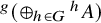 to
$\oplus _{h\in G}\,^{h}A$
to
$\oplus _{h\in G}\,^{h}A$
 .
.
Let
$ {\mathcal C} $
 be a category. Recall from [Reference Mac Lane32, Chapter VI] that a monad on
$ {\mathcal C} $
be a category. Recall from [Reference Mac Lane32, Chapter VI] that a monad on
$ {\mathcal C} $
 is a triple
$ (M, \eta , \mu ) $
is a triple
$ (M, \eta , \mu ) $
 consisting of an endofunctor
$ M\colon {\mathcal C}\rightarrow {\mathcal C} $
consisting of an endofunctor
$ M\colon {\mathcal C}\rightarrow {\mathcal C} $
 and two natural transformations, the unit
$ \eta \colon \mathbf {1}_{{\mathcal C}}\rightarrow M $
and two natural transformations, the unit
$ \eta \colon \mathbf {1}_{{\mathcal C}}\rightarrow M $
 and the multiplication
$ \mu \colon M\circ M\rightarrow M $
and the multiplication
$ \mu \colon M\circ M\rightarrow M $
 , subject to the relations
$ \mu \circ M\mu =\mu \circ \mu M $
, subject to the relations
$ \mu \circ M\mu =\mu \circ \mu M $
 and
$ \mu \circ M\eta =\mathbf {1}_{M}=\mu \circ \eta M $
and
$ \mu \circ M\eta =\mathbf {1}_{M}=\mu \circ \eta M $
 . We sometimes denote the monad by
$ M $
. We sometimes denote the monad by
$ M $
 when
$ \eta $
when
$ \eta $
 and
$ \mu $
and
$ \mu $
 are understood.
For a monad
$ (M,\eta ,\mu ) $
 on
$ {\mathcal C} $
on
$ {\mathcal C} $
 , an M-module is a pair
$ (X, \lambda ) $
, an M-module is a pair
$ (X, \lambda ) $
 consisting of an object
$ X $
consisting of an object
$ X $
 in
$ {\mathcal C} $
in
$ {\mathcal C} $
 and a morphism
$ \lambda \colon M(X)\rightarrow X $
and a morphism
$ \lambda \colon M(X)\rightarrow X $
 subject to the conditions
$ \lambda \circ M\lambda =\lambda \circ \mu _{X} $
subject to the conditions
$ \lambda \circ M\lambda =\lambda \circ \mu _{X} $
 and
$ \lambda \circ \eta _{X}=\mathbf {1}_{X} $
and
$ \lambda \circ \eta _{X}=\mathbf {1}_{X} $
 ; the object
$ X $
; the object
$ X $
 is said to be the underlying object of the module. A morphism
$ f\colon (X,\lambda )\rightarrow (X',\lambda ') $
is said to be the underlying object of the module. A morphism
$ f\colon (X,\lambda )\rightarrow (X',\lambda ') $
 of two
$ M $
of two
$ M $
 -modules is a morphism
$ f\colon X\rightarrow X' $
-modules is a morphism
$ f\colon X\rightarrow X' $
 in
$ {\mathcal C} $
in
$ {\mathcal C} $
 satisfying
$ f\circ \lambda =\lambda '\circ M(f) $
satisfying
$ f\circ \lambda =\lambda '\circ M(f) $
 . This defines the category
$ M $
. This defines the category
$ M $
 -
$ \mathrm {Mod}_{{\mathcal C}} $
-
$ \mathrm {Mod}_{{\mathcal C}} $
 of
$ M $
of
$ M $
 -modules.
For each object
$ X $
 in
$ {\mathcal C} $
in
$ {\mathcal C} $
 , we have the corresponding
$ M $
, we have the corresponding
$ M $
 -module
$ (M(X),\mu _{X}) $
-module
$ (M(X),\mu _{X}) $
 , the free module. This gives rise to a functor
$ F_{M}\colon {\mathcal C}\rightarrow M$
, the free module. This gives rise to a functor
$ F_{M}\colon {\mathcal C}\rightarrow M$
 -
$\mathrm {Mod}_{{\mathcal C}} $
-
$\mathrm {Mod}_{{\mathcal C}} $
 sending
$ X $
sending
$ X $
 to the free module
$ (M(X),\mu _{X}) $
to the free module
$ (M(X),\mu _{X}) $
 , and a morphism
$ f\colon X\rightarrow Y $
, and a morphism
$ f\colon X\rightarrow Y $
 to the morphism
$ M(f)\colon (M(X),\mu _{X})\rightarrow (M(Y),\mu _{Y}) $
to the morphism
$ M(f)\colon (M(X),\mu _{X})\rightarrow (M(Y),\mu _{Y}) $
 . Let
$ G_{M}\colon M\text {-}\mathrm {Mod}_{{\mathcal C}}\rightarrow {\mathcal C} $
. Let
$ G_{M}\colon M\text {-}\mathrm {Mod}_{{\mathcal C}}\rightarrow {\mathcal C} $
 be the forgetful functor. Then we have an adjoint pair
$ (F_{M}, G_{M};\eta _{M},\epsilon _{M}) $
be the forgetful functor. Then we have an adjoint pair
$ (F_{M}, G_{M};\eta _{M},\epsilon _{M}) $
 . This adjoint pair
$ (F_{M},G_{M};\eta _{M},\epsilon _{M}) $
. This adjoint pair
$ (F_{M},G_{M};\eta _{M},\epsilon _{M}) $
 defines the given monad
$ M $
defines the given monad
$ M $
 , that is,
$ M=G_{M}\circ F_{M} $
, that is,
$ M=G_{M}\circ F_{M} $
 . Moreover, it satisfies the following universal property.
For any adjoint pair
$ (F,G;\eta ,\epsilon ) $
 on
$ {\mathcal C} $
on
$ {\mathcal C} $
 and
$ {\mathcal D} $
and
$ {\mathcal D} $
 that defines
$ M $
that defines
$ M $
 , there is a unique functor
$ J\colon {\mathcal D}\rightarrow M\text {-}\mathrm {Mod}_{{\mathcal C}} $
, there is a unique functor
$ J\colon {\mathcal D}\rightarrow M\text {-}\mathrm {Mod}_{{\mathcal C}} $
 such that
$ J\circ F=F_{M} $
such that
$ J\circ F=F_{M} $
 and
$ G_{M}\circ J=G $
and
$ G_{M}\circ J=G $
 (see [Reference Mac Lane32, Theorem 1, Section VI.3]). This unique functor
$ J $
(see [Reference Mac Lane32, Theorem 1, Section VI.3]). This unique functor
$ J $
 is given by
$ J(D)=(G(D),G\epsilon _{D}) $
is given by
$ J(D)=(G(D),G\epsilon _{D}) $
 for any object
$ D $
for any object
$ D $
 and
$ J(f)=G(f) $
and
$ J(f)=G(f) $
 for any morphism
$ f $
for any morphism
$ f $
 , and we call
$ J $
, and we call
$ J $
 the comparison functor associated with the adjoint pair
$ (F,G;\eta ,\epsilon ) $
the comparison functor associated with the adjoint pair
$ (F,G;\eta ,\epsilon ) $
 .
.
In our situation, let U be the forgetful functor


It admits a left adjoint


where for each
$g\in G$
 ,
$\mathrm {Id}_{g}\colon ^{g}(\oplus _{h\in G}\,^{h}X)\rightarrow \,\oplus _{h\in G}\,^{h}X$
,
$\mathrm {Id}_{g}\colon ^{g}(\oplus _{h\in G}\,^{h}X)\rightarrow \,\oplus _{h\in G}\,^{h}X$
 is the unique structural isomorphism. Denote by
$(M=UK,\eta ,\mu =U\epsilon F)$
is the unique structural isomorphism. Denote by
$(M=UK,\eta ,\mu =U\epsilon F)$
 the monad on
${\mathcal C}(A)$
the monad on
${\mathcal C}(A)$
 defined by the adjoint pair
$(K, U)$
defined by the adjoint pair
$(K, U)$
 , where
$\eta \colon \mathbf {1}_{{\mathcal C}(A)}\rightarrow UK$
, where
$\eta \colon \mathbf {1}_{{\mathcal C}(A)}\rightarrow UK$
 is the unit and
$\epsilon \colon KU\rightarrow \mathbf {1}_{{\mathcal C}(A)}$
is the unit and
$\epsilon \colon KU\rightarrow \mathbf {1}_{{\mathcal C}(A)}$
 is the counit. By [Reference Chen6, Lemma 4.3], we can identify
${\mathcal C}(A)^{G}$
is the counit. By [Reference Chen6, Lemma 4.3], we can identify
${\mathcal C}(A)^{G}$
 with
$M\text {-}\mathrm {Mod}_{{\mathcal C}(A)}$
with
$M\text {-}\mathrm {Mod}_{{\mathcal C}(A)}$
 . Since K and U are both exact, they extend to triangle functors
$\tilde {K}\colon {\mathcal D}(A)\rightarrow {\mathcal C}(A)^{G}[\mathrm {quasi}^{-1}]$
. Since K and U are both exact, they extend to triangle functors
$\tilde {K}\colon {\mathcal D}(A)\rightarrow {\mathcal C}(A)^{G}[\mathrm {quasi}^{-1}]$
 and
$\tilde {U}\colon {\mathcal C}(A)^{G}[\mathrm {quasi}^{-1}]\rightarrow {\mathcal D}(A)$
and
$\tilde {U}\colon {\mathcal C}(A)^{G}[\mathrm {quasi}^{-1}]\rightarrow {\mathcal D}(A)$
 . They still form an adjoint pair and the associated monad is denoted by
$\tilde {M}$
. They still form an adjoint pair and the associated monad is denoted by
$\tilde {M}$
 . Therefore, we have the following comparison functor associated with the adjoint pair
$(\tilde {K},\tilde {U}):$
. Therefore, we have the following comparison functor associated with the adjoint pair
$(\tilde {K},\tilde {U}):$


The G-action on
${\mathcal C}(A)$
 preserves both projective and injective model structures of
${\mathcal C}(A)$
preserves both projective and injective model structures of
${\mathcal C}(A)$
 , and hence defines a strict action of G on
${\mathcal D}(A)$
, and hence defines a strict action of G on
${\mathcal D}(A)$
 by strict automorphisms of triangulated category. Then we have the forgetful functor
$U'\colon {\mathcal D}(A)^G \rightarrow {\mathcal D}(A)$
by strict automorphisms of triangulated category. Then we have the forgetful functor
$U'\colon {\mathcal D}(A)^G \rightarrow {\mathcal D}(A)$
 and its left adjoint
$K'\colon {\mathcal D}(A) \rightarrow {\mathcal D}({\mathcal C}(A))^G$
and its left adjoint
$K'\colon {\mathcal D}(A) \rightarrow {\mathcal D}({\mathcal C}(A))^G$
 . Observe that the associated monad
$M'$
. Observe that the associated monad
$M'$
 coincides with
$\tilde {M}$
coincides with
$\tilde {M}$
 . Therefore,
${\mathcal D}(A)^{G}$
. Therefore,
${\mathcal D}(A)^{G}$
 can be identified with
$\tilde {M}\text {-}\mathrm {Mod}_{{\mathcal D}(A)}$
can be identified with
$\tilde {M}\text {-}\mathrm {Mod}_{{\mathcal D}(A)}$
 by [Reference Chen6, Lemma 4.3] and the comparison functor (7) is equivalent to

It is clear that the strict action of G on
${\mathcal D}(A)$
 induces a strict action of G on
$\mathrm {per}(A)$
induces a strict action of G on
$\mathrm {per}(A)$
 and
$\mathrm {pvd}(A),$
and
$\mathrm {pvd}(A),$
 respectively. Then
$\tilde {K}$
respectively. Then
$\tilde {K}$
 induces the following commutative diagram:

Proposition 4.3. We have the following equivalences of triangulated categories:

Moreover, the image
$\tilde {K}(A*G)$
 is isomorphic to
$(\oplus _{h\in G}\,^{h}A,\mathrm {Id})$
is isomorphic to
$(\oplus _{h\in G}\,^{h}A,\mathrm {Id})$
 .
.
Proof. Let us first show the equivalence
$\tilde {K}\colon \mathrm {per}(A*G)\xrightarrow {\sim }\mathrm {per}(A)^{G}$
 . Since
$\mathrm {per}(A*G)$
. Since
$\mathrm {per}(A*G)$
 is a triangulated category which is idempotent complete, by [Reference Chen6, Lemma 4.4], the category
$\mathrm {per}(A)^{G}$
is a triangulated category which is idempotent complete, by [Reference Chen6, Lemma 4.4], the category
$\mathrm {per}(A)^{G}$
 has a unique pre-triangulated structure (a triangulated structure possibly without the octahedral axiom) such that the forgetful functor
$U'\colon \mathrm {per}(A)^{G}\rightarrow \mathrm {per}(A)$
has a unique pre-triangulated structure (a triangulated structure possibly without the octahedral axiom) such that the forgetful functor
$U'\colon \mathrm {per}(A)^{G}\rightarrow \mathrm {per}(A)$
 is a triangle functor. It follows that functor
$\tilde {K}\colon \mathrm {per}(A*G)\rightarrow \mathrm {per}(A)^{G}$
is a triangle functor. It follows that functor
$\tilde {K}\colon \mathrm {per}(A*G)\rightarrow \mathrm {per}(A)^{G}$
 is a triangle functor.
By our assumption
$\mathrm {char}(k)\nmid \mathrm {Card}(G)$
 and [Reference Chen6, Lemma 4.4(2)], the monad
$\tilde {M}$
and [Reference Chen6, Lemma 4.4(2)], the monad
$\tilde {M}$
 on
$\mathrm {per}(A*G)$
on
$\mathrm {per}(A*G)$
 is separable. Then the result follows from [Reference Chen6, Proposition 4.1]. The proof of the equivalence
$\tilde {K}\colon \mathrm {pvd}(A*G)\rightarrow \mathrm {pvd}(A)^{G}$
is separable. Then the result follows from [Reference Chen6, Proposition 4.1]. The proof of the equivalence
$\tilde {K}\colon \mathrm {pvd}(A*G)\rightarrow \mathrm {pvd}(A)^{G}$
 is similar.
Let
$ e $
 be an idempotent of
$ A $
be an idempotent of
$ A $
 . Suppose that it admits a finite primitive orthogonal idempotents decomposition
$ e=\sum _{i\in I}e_{i} $
. Suppose that it admits a finite primitive orthogonal idempotents decomposition
$ e=\sum _{i\in I}e_{i} $
 and the set
$ \{e_{i}|\,i\in I\} $
and the set
$ \{e_{i}|\,i\in I\} $
 is stable under the action of
$ G $
is stable under the action of
$ G $
 . Hence, the G-action on A induces a G-action on the dg subalgebra
$eAe$
. Hence, the G-action on A induces a G-action on the dg subalgebra
$eAe$
 .
.
Recall that Drinfeld’s construction of the homotopy cofiber of
$i\colon eAe\hookrightarrow A$
 is given as follows [Reference Kalck and Yang24, Section 7.2].
Define a dg
$ k $
 -category
$ {\mathcal A} $
-category
$ {\mathcal A} $
 with two objects
$ \epsilon $
with two objects
$ \epsilon $
 and
$ \gamma $
and
$ \gamma $
 such that the morphism spaces are given by

and the composition of morphisms is induced from the multiplication of A. Let
$ {\mathcal A}' $
 be the dg subcategory of
$ {\mathcal A} $
be the dg subcategory of
$ {\mathcal A} $
 consisting of the object
$ \epsilon $
consisting of the object
$ \epsilon $
 . We form the dg quotient
$ {\mathcal A} / {\mathcal A}' $
. We form the dg quotient
$ {\mathcal A} / {\mathcal A}' $
 by formally adjoining a morphism
$ x: \epsilon \to \epsilon $
by formally adjoining a morphism
$ x: \epsilon \to \epsilon $
 of degree
$-1$
of degree
$-1$
 such that
$ d(x) = \text {id}_{\epsilon } = e $
such that
$ d(x) = \text {id}_{\epsilon } = e $
 . Then the dg algebra
$ \overline {A} = \text {End}_{{\mathcal A} / {\mathcal A}'}(\gamma ) $
. Then the dg algebra
$ \overline {A} = \text {End}_{{\mathcal A} / {\mathcal A}'}(\gamma ) $
 is a homotopy cofiber of
$i\colon eAe\hookrightarrow A$
is a homotopy cofiber of
$i\colon eAe\hookrightarrow A$
 . As a total complex,
$ \overline {A} $
. As a total complex,
$ \overline {A} $
 has the form

where the rightmost term is in degree 0 and the term
$ Ae \otimes (eAe)^{\otimes p} \otimes eA $
 is in degree
$-p - 1$
is in degree
$-p - 1$
 . The differentials are given by

The multiplication of
$ \overline {A} $
 is induced from that of
$ A $
is induced from that of
$ A $


For each
$p\geqslant 0$
 , define a G-action on
$Ae \otimes (eAe)^{\otimes p} \otimes eA$
, define a G-action on
$Ae \otimes (eAe)^{\otimes p} \otimes eA$
 by the following formula:

It is easy to see that this defines a G-action on
$\overline {A}$
 and the canonical morphism
$A\rightarrow \overline {A}$
and the canonical morphism
$A\rightarrow \overline {A}$
 is G-equivariant. Moreover, if A is a dg quiver
$(kQ,d)$
is G-equivariant. Moreover, if A is a dg quiver
$(kQ,d)$
 , that is, Q is a graded quiver with finitely many vertices and the differential d takes all trivial paths to
$0$
, that is, Q is a graded quiver with finitely many vertices and the differential d takes all trivial paths to
$0$
 , then
$\overline {A}$
, then
$\overline {A}$
 is quasi-equivalent to
$A/AeA$
is quasi-equivalent to
$A/AeA$
 [Reference Kalck and Yang24, Theorem 7.1].
Let
$ \mathrm {pvd}_{e}(A) $
 be the full triangulated subcategory of
$ \mathrm {pvd}(A) $
be the full triangulated subcategory of
$ \mathrm {pvd}(A) $
 defined as the kernel of the restriction functor
$ i_{*}\colon {\mathcal D}(A)\to {\mathcal D}(eAe) $
defined as the kernel of the restriction functor
$ i_{*}\colon {\mathcal D}(A)\to {\mathcal D}(eAe) $
 . By the recollement in [Reference Wu39, Corollary 4.6],
$ \mathrm {pvd}_{e}(A) $
. By the recollement in [Reference Wu39, Corollary 4.6],
$ \mathrm {pvd}_{e}(A) $
 is triangle equivalent to
$\mathrm {pvd}(\overline {A})$
is triangle equivalent to
$\mathrm {pvd}(\overline {A})$
 . Hence,
$\mathrm {pvd}_{e}(A)$
. Hence,
$\mathrm {pvd}_{e}(A)$
 admits a G-action induced from the G-action on
${\mathcal D}(A)$
admits a G-action induced from the G-action on
${\mathcal D}(A)$
 .
.
Corollary 4.4. The triangle equivalence
$\mathrm {pvd}(A)^{G}\simeq \mathrm {pvd}(A*G)$
 restricts to the following equivalence of triangulated categories:

Proof. It follows from the equivalence
$\mathrm {pvd}_{e}(A)\simeq \mathrm {pvd}(\overline {A})$
 and Proposition 4.3.
5. Equivariant relative cluster categories and equivariant Higgs categories
Let
$ {\mathcal T} $
 be any triangulated category. Let
$ {\mathcal T}' $
be any triangulated category. Let
$ {\mathcal T}' $
 be a full subcategory of
$ {\mathcal T} $
be a full subcategory of
$ {\mathcal T} $
 . We denote by
$ \mathrm {pr}_{{\mathcal T}}{\mathcal T}' $
. We denote by
$ \mathrm {pr}_{{\mathcal T}}{\mathcal T}' $
 the full subcategory of
$ {\mathcal T} $
the full subcategory of
$ {\mathcal T} $
 whose objects are cones of morphisms in
$ \mathrm {add}{\mathcal T}' $
whose objects are cones of morphisms in
$ \mathrm {add}{\mathcal T}' $
 . Similarly, we denote by
$ \mathrm {copr}_{{\mathcal T}}{\mathcal T}' $
. Similarly, we denote by
$ \mathrm {copr}_{{\mathcal T}}{\mathcal T}' $
 the full subcategory of
$ {\mathcal T} $
the full subcategory of
$ {\mathcal T} $
 whose objects are those
$ X $
whose objects are those
$ X $
 such that
$ \Sigma X $
such that
$ \Sigma X $
 is in
$ \mathrm {pr}_{{\mathcal T}}{\mathcal T}' $
is in
$ \mathrm {pr}_{{\mathcal T}}{\mathcal T}' $
 . If
$ {\mathcal T}'=\mathrm {add} T $
. If
$ {\mathcal T}'=\mathrm {add} T $
 for some object
$ T\in {\mathcal T} $
for some object
$ T\in {\mathcal T} $
 , the categories
$ \mathrm {pr}_{{\mathcal T}}{\mathcal T}' $
, the categories
$ \mathrm {pr}_{{\mathcal T}}{\mathcal T}' $
 and
$ \mathrm {copr}_{{\mathcal T}}{\mathcal T}' $
and
$ \mathrm {copr}_{{\mathcal T}}{\mathcal T}' $
 will be simply denoted by
$ \mathrm {pr}_{{\mathcal T}}T $
will be simply denoted by
$ \mathrm {pr}_{{\mathcal T}}T $
 and
$ \mathrm {copr}_{{\mathcal T}}T $
and
$ \mathrm {copr}_{{\mathcal T}}T $
 , respectively.
Let
$ (Q,F,W) $
 be an ice quiver with potential and
$ G $
be an ice quiver with potential and
$ G $
 a finite group acting on
$ (Q,F,W) $
a finite group acting on
$ (Q,F,W) $
 , that is, Assumption 1 is satisfied. Denote by
$ \boldsymbol {\Gamma } $
, that is, Assumption 1 is satisfied. Denote by
$ \boldsymbol {\Gamma } $
 the corresponding relative Ginzburg algebra, that is, the three-dimensional relative Ginzburg dg algebra. Let
$ e=\sum _{i\in F}e_{i} $
the corresponding relative Ginzburg algebra, that is, the three-dimensional relative Ginzburg dg algebra. Let
$ e=\sum _{i\in F}e_{i} $
 be the idempotent associated with the set of frozen vertices and
$ {\mathcal P} $
be the idempotent associated with the set of frozen vertices and
$ {\mathcal P} $
 the additive subcategory
$ \mathrm {add}(e\boldsymbol {\Gamma }) $
the additive subcategory
$ \mathrm {add}(e\boldsymbol {\Gamma }) $
 of
$ \mathrm {per}\boldsymbol {\Gamma } $
of
$ \mathrm {per}\boldsymbol {\Gamma } $
 . The action of
$ G $
. The action of
$ G $
 on
$ (Q,F,W) $
on
$ (Q,F,W) $
 induces an action of
$ G $
induces an action of
$ G $
 on
$ \boldsymbol {\Gamma } $
on
$ \boldsymbol {\Gamma } $
 by dg algebra automorphisms, and the dg subalgebra
$e\boldsymbol {\Gamma } e$
by dg algebra automorphisms, and the dg subalgebra
$e\boldsymbol {\Gamma } e$
 is invariant under this G-action.
Let
$\overline {Q}$
 be the quiver obtained from Q by deleting all vertices in F and all arrows incident with vertices in F. Let
$\overline {W}$
be the quiver obtained from Q by deleting all vertices in F and all arrows incident with vertices in F. Let
$\overline {W}$
 be the potential on Q obtaining by deleting all cycles passing through vertices of F in W. We make the following assumption.
Assumption 2.
-
• The quiver with potential $(\overline {Q},\overline {W})$
is Jacobi-finite, that is, the corresponding Jacobian algebra
$H^{0}(\boldsymbol {\Gamma }(\overline {Q},\overline {W}))$
is finite dimensional. -
• The additive subcategory ${\mathcal P}=\mathrm {add}(e\boldsymbol {\Gamma })$
is functorially finite in
$\mathrm {add}(\boldsymbol {\Gamma })$
.


In particular, if
$(Q,F,W)$
 is relative Jacobi-finite, that is,
$H^{0}(\boldsymbol {\Gamma }(Q,F,W))$
is relative Jacobi-finite, that is,
$H^{0}(\boldsymbol {\Gamma }(Q,F,W))$
 is finite dimensional, then the assumption above holds.
Lemma 5.1. If
$(Q,F,W)$
 satisfies Assumption 2, then the ice quiver with potential
$(Q_{G},F_{G},W_G)$
satisfies Assumption 2, then the ice quiver with potential
$(Q_{G},F_{G},W_G)$
 constructed in Definition 3.13 also satisfies the corresponding assumption.
Definition 5.2 [Reference Keller and Wu27, Definition 3.1]
The relative cluster category
$ {\mathcal C}(Q,F,W) $
 (or denoted by
$ {\mathcal C}(\boldsymbol {\Gamma }) $
(or denoted by
$ {\mathcal C}(\boldsymbol {\Gamma }) $
 ) of
$ (Q,F,W) $
) of
$ (Q,F,W) $
 is defined as the idempotent completion of the Verdier quotient of triangulated categories

If
$ F=\emptyset $
 , the cluster category associated with
$ (Q,W) $
, the cluster category associated with
$ (Q,W) $
 is defined as
$ {\mathcal C}(Q,\emptyset ,W) $
is defined as
$ {\mathcal C}(Q,\emptyset ,W) $
 and we denote it by
$ {\mathcal C}(Q,W) $
and we denote it by
$ {\mathcal C}(Q,W) $
 .
.
Let
$\boldsymbol {\Gamma }(\overline {Q},\overline {W})$
 (or denote by
$\overline {\boldsymbol {\Gamma }}$
(or denote by
$\overline {\boldsymbol {\Gamma }}$
 ) be the Ginzburg algebra associated with quiver with potential
$(\overline {Q},\overline {W})$
) be the Ginzburg algebra associated with quiver with potential
$(\overline {Q},\overline {W})$
 . By [Reference Wu39, Proposition 7.8], we have the following homotopy cofiber sequence of dg categories:

The G-action on
$(Q,F,W)$
 also induces an action on
$\overline {\boldsymbol {\Gamma }}$
also induces an action on
$\overline {\boldsymbol {\Gamma }}$
 by dg algebra automorphisms.
Definition 5.3. The G-equivariant relative cluster category
$ {\mathcal C}(\boldsymbol {\Gamma }(Q,F,W)*G) $
 (or denoted by
$ {\mathcal C}(\boldsymbol {\Gamma }*G) $
(or denoted by
$ {\mathcal C}(\boldsymbol {\Gamma }*G) $
 ) of
$ (Q,F,W) $
) of
$ (Q,F,W) $
 is defined as the idempotent completion of the Verdier quotient of triangulated categories

where we view
$\mathrm {pvd}(\overline {\boldsymbol {\Gamma }}*G)$
 as a triangulated subcategory of
$\mathrm {per}(\boldsymbol {\Gamma }*G)$
as a triangulated subcategory of
$\mathrm {per}(\boldsymbol {\Gamma }*G)$
 through

Let
$(Q_{G},F_{G},W_G)$
 be the ice quiver constructed in Definition 3.13 and
$\boldsymbol {\Gamma }_G$
be the ice quiver constructed in Definition 3.13 and
$\boldsymbol {\Gamma }_G$
 the associated three-dimensional Ginzburg dg algebra. Denote by
$ e_{G}=\sum _{i\in F_{G}}e_{i} $
the associated three-dimensional Ginzburg dg algebra. Denote by
$ e_{G}=\sum _{i\in F_{G}}e_{i} $
 . By Corollary 3.21, we see that
$ {\mathcal C}(\boldsymbol {\Gamma }*G) $
. By Corollary 3.21, we see that
$ {\mathcal C}(\boldsymbol {\Gamma }*G) $
 is equivalent to
${\mathcal C}(\boldsymbol {\Gamma }_G)=\mathrm {per}(\boldsymbol {\Gamma }_G)/\mathrm {pvd}_{e_{G}}(\boldsymbol {\Gamma }_G)$
is equivalent to
${\mathcal C}(\boldsymbol {\Gamma }_G)=\mathrm {per}(\boldsymbol {\Gamma }_G)/\mathrm {pvd}_{e_{G}}(\boldsymbol {\Gamma }_G)$
 , that is, the relative cluster category of
$(Q_{G},F_{G},W_G)$
, that is, the relative cluster category of
$(Q_{G},F_{G},W_G)$
 .
.
If
$ F=\emptyset $
 , the G-equivariant cluster category associated with
$ (Q,W) $
, the G-equivariant cluster category associated with
$ (Q,W) $
 is given as

(cf. [Reference Amiot and Plamondon2], [Reference Paquette and Schiffler34]).
By Proposition 4.3 and commutative diagram (8), the action of
$ G $
 on
$ \boldsymbol {\Gamma } $
on
$ \boldsymbol {\Gamma } $
 induces an action on relative cluster category
$ {\mathcal C}(\boldsymbol {\Gamma }) $
induces an action on relative cluster category
$ {\mathcal C}(\boldsymbol {\Gamma }) $
 .
.
Proposition 5.4. We have the following equivalence of triangulated categories:

Proof. The relative cluster category
${\mathcal C}(\boldsymbol {\Gamma })$
 has a canonical dg-enhancement. By [Reference Elagin16, Corollary 6.10], the corresponding equivariant category
${\mathcal C}(\boldsymbol {\Gamma })^{G}$
has a canonical dg-enhancement. By [Reference Elagin16, Corollary 6.10], the corresponding equivariant category
${\mathcal C}(\boldsymbol {\Gamma })^{G}$
 is still a triangulated category.
The shift functor on
$ {\mathcal C}(\boldsymbol {\Gamma })^{G} $
 is defined as
$\colon $
is defined as
$\colon $
 on objects

on morphisms in
$ {\mathcal C}(\boldsymbol {\Gamma })^{G} $
 shift is the same as on morphisms in
$ {\mathcal C}(\boldsymbol {\Gamma }) $
shift is the same as on morphisms in
$ {\mathcal C}(\boldsymbol {\Gamma }) $
 . A triangle

in
$ {\mathcal C}(\boldsymbol {\Gamma })^{G} $
 is distinguished if and only if the triangle

is distinguished in
$ {\mathcal C}(\boldsymbol {\Gamma }) $
 . Then it is easy to see that the quotient functor
$\mathrm {per}\boldsymbol {\Gamma }\rightarrow {\mathcal C}(\boldsymbol {\Gamma })$
. Then it is easy to see that the quotient functor
$\mathrm {per}\boldsymbol {\Gamma }\rightarrow {\mathcal C}(\boldsymbol {\Gamma })$
 induces a triangulated functor

Let
${\mathcal S}$
 be the subcategory of
$\mathrm {per}\boldsymbol {\Gamma }$
be the subcategory of
$\mathrm {per}\boldsymbol {\Gamma }$
 formed by the modules
$S_{i}$
formed by the modules
$S_{i}$
 associated with unfrozen vertices
${i\in Q_{0}\setminus F_{0}}$
associated with unfrozen vertices
${i\in Q_{0}\setminus F_{0}}$
 . Then
${\mathcal S}$
. Then
${\mathcal S}$
 is stable under the action of G.
Consider the following subcategory of
$\mathrm {per}\boldsymbol {\Gamma }$
 :
:

By [Reference Keller and Wu27, Proposition 3.14], the following composition

induces a k-linear equivalence

Note that
${\mathcal W}$
 is stable under the action of G and the functor
$\Psi $
is stable under the action of G and the functor
$\Psi $
 mentioned above is G-equivariant. By [Reference Chen, Chen and Ruan5, Lemma 2.1], the functor
$\Psi $
mentioned above is G-equivariant. By [Reference Chen, Chen and Ruan5, Lemma 2.1], the functor
$\Psi $
 also induces an equivalence of k-linear categories

By Lemma 5.5 below,
${\mathcal W}^{G}$
 is equivalent to
$(\Sigma ^{\geqslant 0} {\mathcal S}^{G})^\perp \cap {}^\perp (\Sigma ^{\leqslant 0}{\mathcal S}^{G})\subseteq \mathrm {per}(\boldsymbol {\Gamma })^{G}.$
is equivalent to
$(\Sigma ^{\geqslant 0} {\mathcal S}^{G})^\perp \cap {}^\perp (\Sigma ^{\leqslant 0}{\mathcal S}^{G})\subseteq \mathrm {per}(\boldsymbol {\Gamma })^{G}.$

Let
$(Q_{G},F_{G},W_G)$
 be the ice quiver constructed in Definition 3.13 and
$\boldsymbol {\Gamma }_G$
be the ice quiver constructed in Definition 3.13 and
$\boldsymbol {\Gamma }_G$
 the associated three-dimensional Ginzburg dg algebra. Let
${\mathcal S}'$
the associated three-dimensional Ginzburg dg algebra. Let
${\mathcal S}'$
 be the additive subcategory of
$\mathrm {per}\boldsymbol {\Gamma }_G$
be the additive subcategory of
$\mathrm {per}\boldsymbol {\Gamma }_G$
 formed by the simple modules
$S_{i}$
formed by the simple modules
$S_{i}$
 associated with unfrozen vertices
$i\in Q_{G,0}\setminus F_{G,0}$
associated with unfrozen vertices
$i\in Q_{G,0}\setminus F_{G,0}$
 . Consider the following subcategory of
$\mathrm {per}\boldsymbol {\Gamma }_G$
. Consider the following subcategory of
$\mathrm {per}\boldsymbol {\Gamma }_G$
 :
:

Again by [Reference Keller and Wu27, Proposition 3.14], the following composition

induces a k-linear equivalence

The equivalence
$\mathrm {per}(\boldsymbol {\Gamma }_G)\simeq \mathrm {per}(\boldsymbol {\Gamma }*G)\simeq \mathrm {per}(\boldsymbol {\Gamma })^{G}$
 induces a k-linear equivalence
${\mathcal S}'\simeq {\mathcal S}^{G} $
induces a k-linear equivalence
${\mathcal S}'\simeq {\mathcal S}^{G} $
 . Hence,
${\mathcal W}'$
. Hence,
${\mathcal W}'$
 is equivalent to
${\mathcal W}^{G}$
is equivalent to
${\mathcal W}^{G}$
 and we have the following commutative diagram:

Therefore,
$\Phi \colon \mathrm {per}(\boldsymbol {\Gamma })^{G}/\mathrm {pvd}_{e}(\boldsymbol {\Gamma })^{G}\longrightarrow {\mathcal C}(\boldsymbol {\Gamma })^{G}$
 is an equivalence of triangulated categories.
Lemma 5.5. Let
${\mathcal A}$
 be a k-linear additive category and
${\mathcal B}$
be a k-linear additive category and
${\mathcal B}$
 a full additive subcategory. Let G be a finite group acting on
${\mathcal A}$
a full additive subcategory. Let G be a finite group acting on
${\mathcal A}$
 such that
${\mathcal B}$
such that
${\mathcal B}$
 is stable under this action. Then we have the following identities of k-linear categories:


Proof. It is clear that we have an inclusion
$({\mathcal B}^{\perp })^{G}\subseteq ({\mathcal B}^{G})^{\perp }$
 . Let
$(X,\alpha )$
. Let
$(X,\alpha )$
 be an object of
$({\mathcal B}^{G})^{\perp }$
be an object of
$({\mathcal B}^{G})^{\perp }$
 , that is, we have
$\mathrm {Hom}_{{\mathcal A}^{G}}((Y,\theta ),(X,\alpha ))=0$
, that is, we have
$\mathrm {Hom}_{{\mathcal A}^{G}}((Y,\theta ),(X,\alpha ))=0$
 for any object
$(Y,\theta )$
for any object
$(Y,\theta )$
 in
${\mathcal B}^{G}$
in
${\mathcal B}^{G}$
 . We will show that X belongs to
${\mathcal B}^{\perp }$
. We will show that X belongs to
${\mathcal B}^{\perp }$
 .
.
Recall that the forgetful functor
$U\colon {\mathcal A}^{G}\rightarrow {\mathcal A}$
 admits a left adjoint
$K\colon {\mathcal A}\rightarrow {\mathcal A}^{G}, X\mapsto (\oplus _{h\in G}\,^{h}X,\mathrm {Id})$
admits a left adjoint
$K\colon {\mathcal A}\rightarrow {\mathcal A}^{G}, X\mapsto (\oplus _{h\in G}\,^{h}X,\mathrm {Id})$
 , where
$\mathrm {Id}_{g}\colon \,^{g}(\oplus _{h\in G}\,^{h}X)\rightarrow \oplus _{h\in G}\,^{h}X$
, where
$\mathrm {Id}_{g}\colon \,^{g}(\oplus _{h\in G}\,^{h}X)\rightarrow \oplus _{h\in G}\,^{h}X$
 is the unique structural isomorphism for any
$g\in G$
is the unique structural isomorphism for any
$g\in G$
 . For each object
$B\in {\mathcal B}$
. For each object
$B\in {\mathcal B}$
 , we have

It is clear that
$K(B)$
 lies in
${\mathcal B}^{G}$
lies in
${\mathcal B}^{G}$
 . Therefore,
$\mathrm {Hom}_{{\mathcal A}}(B,X)$
. Therefore,
$\mathrm {Hom}_{{\mathcal A}}(B,X)$
 vanishes. Hence, we see that X belongs to
${\mathcal B}^{\perp }$
vanishes. Hence, we see that X belongs to
${\mathcal B}^{\perp }$
 , and so
$(X,\alpha )$
, and so
$(X,\alpha )$
 lies in
$({\mathcal B}^{\perp })^{G}$
lies in
$({\mathcal B}^{\perp })^{G}$
 . The proof for the second identity is similar.
Let
$ \mathrm {pr}^{F}_{{\mathcal D}}\boldsymbol {\Gamma } $
 be the following subcategory of
$ \mathrm {pr}_{{\mathcal D}}\boldsymbol {\Gamma } $
be the following subcategory of
$ \mathrm {pr}_{{\mathcal D}}\boldsymbol {\Gamma } $
 :
:

Then we have
$ \mathrm {pr}^{F}_{{\mathcal D}}\boldsymbol {\Gamma }=\mathrm {pr}_{{\mathcal D}}\boldsymbol {\Gamma }\cap ^{\perp }\!(\Sigma ^{>0}{\mathcal P})\cap (\Sigma ^{<0}{\mathcal P})^{\perp } $
 , where
$ {\mathcal P}=\mathrm {add}(e\boldsymbol {\Gamma }) $
, where
$ {\mathcal P}=\mathrm {add}(e\boldsymbol {\Gamma }) $
 (see [Reference Keller and Wu27, p. 12]).
Dually, we define
$ \mathrm {copr}_{{\mathcal D}}^{F}\boldsymbol {\Gamma } $
 as the following subcategory of
$ \mathrm {copr}_{{\mathcal D}}\boldsymbol {\Gamma } $
as the following subcategory of
$ \mathrm {copr}_{{\mathcal D}}\boldsymbol {\Gamma } $
 :
:

And we have
$ \mathrm {copr}^{F}_{{\mathcal D}}\boldsymbol {\Gamma }=\mathrm {copr}_{{\mathcal D}}\boldsymbol {\Gamma }\cap {\mathcal Z} $
 . Similarly, we define subcategories

and

of
$ {\mathcal C} $
 , where

Definition 5.6 [Reference Keller and Wu27, Definition 3.21]
The Higgs category
$ {\mathcal H}(Q,F,W) $
 (or denoted by
$ {\mathcal H}(\boldsymbol {\Gamma }) $
(or denoted by
$ {\mathcal H}(\boldsymbol {\Gamma }) $
 ) is defined as the full subcategory of
$ \mathrm {pr}^{F}_{{\mathcal C}}\boldsymbol {\Gamma }\cap \mathrm {copr}^{F}_{{\mathcal C}}\boldsymbol {\Gamma } $
) is defined as the full subcategory of
$ \mathrm {pr}^{F}_{{\mathcal C}}\boldsymbol {\Gamma }\cap \mathrm {copr}^{F}_{{\mathcal C}}\boldsymbol {\Gamma } $
 whose objects are those
$ X $
whose objects are those
$ X $
 such that
$ \mathrm {Hom}_{{\mathcal C}}(\Sigma ^{-1}\boldsymbol {\Gamma },X) $
such that
$ \mathrm {Hom}_{{\mathcal C}}(\Sigma ^{-1}\boldsymbol {\Gamma },X) $
 is finite-dimensional.
Under Assumption 2, we have the following results.
Theorem 5.7 [Reference Keller and Wu27, Theorems 4.14 and 4.18]
-
• The Higgs category $\mathcal {H}$
is equal to the full subcategory
$\mathcal {E}$
of
$\mathcal {C}(Q, F, W)$
defined by $$\begin{align*}\mathcal{E} = \{ X \in {\mathcal C}(\boldsymbol{\Gamma}) \mid \operatorname{Hom}_{{\mathcal C}(\boldsymbol{\Gamma})}(X, \Sigma^{>0} \mathcal{P}) = 0 = \operatorname{Hom}_{{\mathcal C}(\boldsymbol{\Gamma})}(\Sigma^{<0} \mathcal{P}, X) \}. \end{align*}$$
-
• The Higgs category ${\mathcal H}(\boldsymbol {\Gamma })$
is a Frobenius extriangulated category with projective–injective objects
${\mathcal P}=\mathrm {add}(e\boldsymbol {\Gamma })$
. Its stable category
$\underline {{\mathcal H}}={\mathcal H}/[{\mathcal P}]$
is equivalent to
${\mathcal C}(\overline {Q},\overline {W})$
. Moreover,
$\boldsymbol {\Gamma }$
a canonical cluster-tilting object of
${\mathcal H}$
with endomorphism algebra
$J(Q,F,W)$
.


The G-equivariant relative cluster category
${\mathcal C}(\boldsymbol {\Gamma }*G)$
 is equivalent to
${\mathcal C}(\boldsymbol {\Gamma }_G)=\mathrm {per}(\boldsymbol {\Gamma }_G)/\mathrm {pvd}_{e'}(\boldsymbol {\Gamma }_G)$
is equivalent to
${\mathcal C}(\boldsymbol {\Gamma }_G)=\mathrm {per}(\boldsymbol {\Gamma }_G)/\mathrm {pvd}_{e'}(\boldsymbol {\Gamma }_G)$
 (see Definition 5.3). We make the following definition.
Definition 5.8 [Reference Wu39]
The G-equivariant Higgs category is defined to be
${\mathcal H}(\boldsymbol {\Gamma }_G)$
 , that is, the following full subcategory of
${\mathcal C}(\boldsymbol {\Gamma }_G):$
, that is, the following full subcategory of
${\mathcal C}(\boldsymbol {\Gamma }_G):$


where
${\mathcal P}'=\mathrm {add}(e_{G}\boldsymbol {\Gamma }_G)$
 , that is, the additive subcategory of
${\mathcal C}(\boldsymbol {\Gamma }_G)$
, that is, the additive subcategory of
${\mathcal C}(\boldsymbol {\Gamma }_G)$
 generated by
$e_{G}\boldsymbol {\Gamma }_G$
generated by
$e_{G}\boldsymbol {\Gamma }_G$
 .
.
Since the category
${\mathcal P}=\mathrm {add}(e\boldsymbol {\Gamma })=\mathrm {add}((\sum _{i\in Q_{0}\setminus F_{0}}e_{i})\boldsymbol {\Gamma })$
 is stable under the G-action, by Theorem 5.7, the G-action on
${\mathcal C}(\boldsymbol {\Gamma })$
is stable under the G-action, by Theorem 5.7, the G-action on
${\mathcal C}(\boldsymbol {\Gamma })$
 induces a G-action on Higgs category
${\mathcal H}(\boldsymbol {\Gamma })$
induces a G-action on Higgs category
${\mathcal H}(\boldsymbol {\Gamma })$
 .
.
Theorem 5.9. The triangle equivalence
${\mathcal C}(\boldsymbol {\Gamma }*G)\xrightarrow {\sim }{\mathcal C}(\boldsymbol {\Gamma })^{G}$
 in Proposition 5.4 induces an equivalence of Frobenius extriangulated categories

The category of projective–injective objects of
${\mathcal H}^{G}$
 is
${\mathcal P}^{G}=\mathrm {add}(e\boldsymbol {\Gamma })^{G}$
is
${\mathcal P}^{G}=\mathrm {add}(e\boldsymbol {\Gamma })^{G}$
 and
$\boldsymbol {\Gamma }[G]$
and
$\boldsymbol {\Gamma }[G]$
 is a canonical cluster-titling object of
${\mathcal H}^{G}$
is a canonical cluster-titling object of
${\mathcal H}^{G}$
 . And
$\boldsymbol {\Gamma }_{G}$
. And
$\boldsymbol {\Gamma }_{G}$
 is a basic generator of
$\mathrm {add}(\boldsymbol {\Gamma }_{G})\simeq \mathrm {add}(\boldsymbol {\Gamma }[G])$
is a basic generator of
$\mathrm {add}(\boldsymbol {\Gamma }_{G})\simeq \mathrm {add}(\boldsymbol {\Gamma }[G])$
 .
.
Proof. For each
$h\in G$
 , the functor
$^{h}()\colon {\mathcal H}(\boldsymbol {\Gamma })\rightarrow {\mathcal H}(\boldsymbol {\Gamma })$
, the functor
$^{h}()\colon {\mathcal H}(\boldsymbol {\Gamma })\rightarrow {\mathcal H}(\boldsymbol {\Gamma })$
 is exact. Then
${\mathcal H}(\boldsymbol {\Gamma })^{G}$
is exact. Then
${\mathcal H}(\boldsymbol {\Gamma })^{G}$
 is an extriangulated category with
$\mathbb {E}$
is an extriangulated category with
$\mathbb {E}$
 -extensions of the form

such that

is an
$\mathbb {E}$
 -extension in
${\mathcal H}(\boldsymbol {\Gamma })$
-extension in
${\mathcal H}(\boldsymbol {\Gamma })$
 . By a similar argument in [Reference Demonet12, Corollary 2.41], we see that
${\mathcal H}(\boldsymbol {\Gamma })^{G}$
. By a similar argument in [Reference Demonet12, Corollary 2.41], we see that
${\mathcal H}(\boldsymbol {\Gamma })^{G}$
 is a Frobenius extriangulated category with projective–injective objects
${\mathcal P}^{G}=\mathrm {add}(e\boldsymbol {\Gamma })^{G}$
is a Frobenius extriangulated category with projective–injective objects
${\mathcal P}^{G}=\mathrm {add}(e\boldsymbol {\Gamma })^{G}$
 . Moreover, it is stably 2-Calabi–Yau.
The equivalence
${\mathcal C}(\boldsymbol {\Gamma }_G)\simeq {\mathcal C}(\boldsymbol {\Gamma }*G)\xrightarrow {\sim }{\mathcal C}(\boldsymbol {\Gamma })^{G}$
 induces a k-linear equivalence
${\mathcal P}'\xrightarrow {\sim }{\mathcal P}^{G}$
induces a k-linear equivalence
${\mathcal P}'\xrightarrow {\sim }{\mathcal P}^{G}$
 . By Lemma 5.5, we get an equivalence
${\mathcal H}(\boldsymbol {\Gamma }_{G})\xrightarrow {\sim }{\mathcal H}^{G}$
. By Lemma 5.5, we get an equivalence
${\mathcal H}(\boldsymbol {\Gamma }_{G})\xrightarrow {\sim }{\mathcal H}^{G}$
 of k-linear categories. It is clear that this equivalence preserves extriangulated structures. Hence, it is an equivalence of Frobenius extriangulated categories.
Corollary 5.10. The quotient functor
${\mathcal H}\rightarrow \underline {{\mathcal H}}={\mathcal H}/[{\mathcal P}]$
 induces an equivalence of triangulated categories

Proof. We have the following commutative diagram:

Hence, we get the following equivalences of triangulated categories:

By Proposition 5.9 above, the triangulated category
$\underline {{\mathcal H}^{G}}$
 is equivalent to
$({\mathcal H}/[{\mathcal P}])^{G}=(\underline {{\mathcal H}})^{G}$
is equivalent to
$({\mathcal H}/[{\mathcal P}])^{G}=(\underline {{\mathcal H}})^{G}$
 .
.
5.1.
$ G $
-stable cluster-tilting subcategories

Definition 5.11. Let
$({\mathcal C},\mathbb {E},\mathfrak {s})$
 be an extriangulated category. A subcategory
${\mathcal T}$
be an extriangulated category. A subcategory
${\mathcal T}$
 of
${\mathcal C}$
of
${\mathcal C}$
 is said to be cluster-tilting subcategory if it satisfies the following conditions
$\colon $
is said to be cluster-tilting subcategory if it satisfies the following conditions
$\colon $

-
• ${\mathcal T}$
is functorially finite in
${\mathcal C}$
; -
• $X\in {\mathcal T}$
if and only if
$\mathbb {E}(X,{\mathcal T})=0$
; -
• $X\in {\mathcal T}$
if and only if
$\mathbb {E}({\mathcal T},X)=0$
.


A subcategory
${\mathcal R}$
 of
${\mathcal C}$
of
${\mathcal C}$
 is said to be rigid if there are no non-trivial extensions between its objects. If moreover every rigid category
${\mathcal R}'$
is said to be rigid if there are no non-trivial extensions between its objects. If moreover every rigid category
${\mathcal R}'$
 containing
${\mathcal R}$
containing
${\mathcal R}$
 is equal to
${\mathcal R}$
is equal to
${\mathcal R}$
 , then we say that
${\mathcal R}$
, then we say that
${\mathcal R}$
 is maximal rigid.
The action of G on
${\mathcal D}(\boldsymbol {\Gamma })$
 stabilizes
$\mathrm {per}(\boldsymbol {\Gamma })$
stabilizes
$\mathrm {per}(\boldsymbol {\Gamma })$
 and
$\mathrm {pvd}_{e}(\boldsymbol {\Gamma })$
and
$\mathrm {pvd}_{e}(\boldsymbol {\Gamma })$
 . It induces a strict action of G on
${\mathcal C}(\boldsymbol {\Gamma })$
. It induces a strict action of G on
${\mathcal C}(\boldsymbol {\Gamma })$
 by strict automorphisms of triangulated categories and also on
${\mathcal H}$
by strict automorphisms of triangulated categories and also on
${\mathcal H}$
 by strict automorphisms of Frobenius extriangulated categories.
It is easy to see that the adjoint pair of triangle functors

induces the following adjoint pair of extriangulated functors:

Definition 5.12. Let
${\mathcal C}$
 be an extriangulated category, we define
$\mathfrak {Add}({\mathcal C})$
be an extriangulated category, we define
$\mathfrak {Add}({\mathcal C})$
 to be the class of all full k-linear subcategories of
${\mathcal C}$
to be the class of all full k-linear subcategories of
${\mathcal C}$
 which are stable under isomorphisms and direct summands. If E is a collection of objects of
${\mathcal C}$
which are stable under isomorphisms and direct summands. If E is a collection of objects of
${\mathcal C}$
 , one denotes by
$\mathrm {add}(E)$
, one denotes by
$\mathrm {add}(E)$
 the smallest category of
$\mathfrak {Add}({\mathcal C})$
the smallest category of
$\mathfrak {Add}({\mathcal C})$
 containing E.
A category
${\mathcal T} \in \mathfrak {Add}({\mathcal C})$
 is said to be finitely generated if
${\mathcal T}$
is said to be finitely generated if
${\mathcal T}$
 is of the form
$\mathrm {add}(M)$
is of the form
$\mathrm {add}(M)$
 for some object
$M\in {\mathcal C}$
for some object
$M\in {\mathcal C}$
 . The subclass of
$\mathfrak {Add}({\mathcal C})$
. The subclass of
$\mathfrak {Add}({\mathcal C})$
 consisting in all finitely generated categories will be denoted by
$\mathfrak {add}({\mathcal C})$
consisting in all finitely generated categories will be denoted by
$\mathfrak {add}({\mathcal C})$
 . If H is an exact functor from
${\mathcal C}$
. If H is an exact functor from
${\mathcal C}$
 to another extriangulated category
${\mathcal C}'$
to another extriangulated category
${\mathcal C}'$
 and
${\mathcal T}\in \mathfrak {Add}({\mathcal C})$
and
${\mathcal T}\in \mathfrak {Add}({\mathcal C})$
 ,
$H({\mathcal T})$
,
$H({\mathcal T})$
 will denote
$\mathrm {add}({H(X)\,|\,X\in {\mathcal T} } )$
will denote
$\mathrm {add}({H(X)\,|\,X\in {\mathcal T} } )$
 .
.
If a finite group G acts on
${\mathcal C}$
 , we denote by
$\mathfrak {Add}({\mathcal C})^{G}$
, we denote by
$\mathfrak {Add}({\mathcal C})^{G}$
 (resp.
$\mathfrak {add}({\mathcal C})^{G}$
(resp.
$\mathfrak {add}({\mathcal C})^{G}$
 ) the class of elements of
$\mathfrak {Add}({\mathcal C})$
) the class of elements of
$\mathfrak {Add}({\mathcal C})$
 (resp.
$\mathfrak {add}({\mathcal C})$
(resp.
$\mathfrak {add}({\mathcal C})$
 ) which are G-stable objects of
$\mathfrak {Add}({\mathcal C})$
) which are G-stable objects of
$\mathfrak {Add}({\mathcal C})$
 (resp.
$\mathfrak {add}({\mathcal C})$
(resp.
$\mathfrak {add}({\mathcal C})$
 ).
).
If
${\mathcal C}$
 is an
${\mathcal M}$
is an
${\mathcal M}$
 -module category for some monoidal category
${\mathcal M}$
-module category for some monoidal category
${\mathcal M}$
 , we denote by
$\mathfrak {Add}({\mathcal C})^{{\mathcal M}}$
, we denote by
$\mathfrak {Add}({\mathcal C})^{{\mathcal M}}$
 (resp.
$\mathfrak {add}({\mathcal C})^{{\mathcal M}}$
(resp.
$\mathfrak {add}({\mathcal C})^{{\mathcal M}}$
 ) the class of elements of
$\mathfrak {Add}({\mathcal C})$
) the class of elements of
$\mathfrak {Add}({\mathcal C})$
 (resp.
$\mathfrak {add}({\mathcal C})$
(resp.
$\mathfrak {add}({\mathcal C})$
 ) which are sub-
${\mathcal M}$
) which are sub-
${\mathcal M}$
 -module categories of
${\mathcal C}$
-module categories of
${\mathcal C}$
 .
.
Proposition 5.13. The adjunction
$(\mathrm {Ten},\mathrm {Res})$
 induces reciprocal bijections between
$\colon $
induces reciprocal bijections between
$\colon $

-
• $\mathfrak {Add}({\mathcal H})^{G}$
and
$\mathfrak {Add}({\mathcal H}(\boldsymbol {\Gamma }*G))^{\mathrm {Ten}\circ \mathrm {Res}}=\{{\mathcal T}\in \mathfrak {Add}({\mathcal H}(\boldsymbol {\Gamma }*G))\,|\,\mathrm {Ten}\circ \mathrm {Res}({\mathcal T})\subseteq {\mathcal T}\}$
; -
• the set of rigid ${\mathcal T}\in \mathfrak {Add}({\mathcal H})^{G}$
and the set of rigid
${\mathcal T}\in \mathfrak {Add}({\mathcal H}(\boldsymbol {\Gamma }*G))^{\mathrm {Ten}\circ \mathrm {Res}}$
; -
• the set of maximal G-stable rigid ${\mathcal T}\in \mathfrak {Add}({\mathcal H})^{G}$
and the set of maximal rigid
${\mathcal T}\in \mathfrak {Add}({\mathcal H}^{G})^{\mathrm {Ten}\circ \mathrm {Res}}$
; -
• the set of cluster-tilting ${\mathcal T}\in \mathfrak {Add}({\mathcal H})^{G}$
and the set of cluster-tilting
${\mathcal T}\in \mathfrak {Add}({\mathcal H}(\boldsymbol {\Gamma }*G))^{\mathrm {Ten}\circ \mathrm {Res}}$
.


Moreover, all these bijections restrict to bijections between the corresponding finitely generated classes.
Proof. The proof is similar in spirit to [Reference Le Meur29, Corollary 5.2.2].
6. Categorification of skew-symmetrizable cluster algebras with coefficients
The aim of this section is to generalize Demonet’s result [Reference Demonet12] to the setting of ice quivers with potentials. Let
$(Q,F,W)$
 be an ice quiver with potential satisfies Assumption 2. Let G be a finite group acting on
$(Q,F,W)$
be an ice quiver with potential satisfies Assumption 2. Let G be a finite group acting on
$(Q,F,W)$
 , where the G-action satisfies Assumption 1. Additionally, we assume that
$\mathrm {char}(k)\nmid \mathrm {Card}(G)$
, where the G-action satisfies Assumption 1. Additionally, we assume that
$\mathrm {char}(k)\nmid \mathrm {Card}(G)$
 .
.
6.1. A
$\mathrm {mod} (k[G])$
-linear structure on the equivariant Higgs category

We denote by
$k[G]$
 the group algebra of G. It is a Hopf algebra, hence
$\mathrm {mod} (k[G]) $
the group algebra of G. It is a Hopf algebra, hence
$\mathrm {mod} (k[G]) $
 is a monoidal category. An object of
$\mathrm {mod} (k[G]) $
is a monoidal category. An object of
$\mathrm {mod} (k[G]) $
 will be denoted by
$(V,r)$
will be denoted by
$(V,r)$
 , where V is a finite-dimensional k-vector space, and
$r\colon G\rightarrow \mathrm {GL}(V)$
, where V is a finite-dimensional k-vector space, and
$r\colon G\rightarrow \mathrm {GL}(V)$
 a group homomorphism.
Proposition 6.1 [Reference Demonet12, Proposition 2.12]
The equivariant Higgs category
${\mathcal H}^{G}$
 is a
$\mathrm {mod} (k[G]) $
is a
$\mathrm {mod} (k[G]) $
 -module category in a natural way.
Let
$(X,\psi )$
 and
$(Y,\chi )$
and
$(Y,\chi )$
 be objects of
${\mathcal H}^{G}$
be objects of
${\mathcal H}^{G}$
 , Let
, Let

If
$ g \in G $
 and
$ f \in \mathrm {\textbf {Hom}}_{{\mathcal H}^{G}}((X,\psi ),(Y,\chi )) $
and
$ f \in \mathrm {\textbf {Hom}}_{{\mathcal H}^{G}}((X,\psi ),(Y,\chi )) $
 , define
$ gf \in \mathrm {\textbf {Hom}}_{{\mathcal H}^{G}}((X,\psi ),(Y,\chi )) $
, define
$ gf \in \mathrm {\textbf {Hom}}_{{\mathcal H}^{G}}((X,\psi ),(Y,\chi )) $
 by the following commutative diagram:

This defines a structure of a
$\mathrm {mod}(k[G])$
 structure on
$\mathrm {\textbf {Hom}}_{{\mathcal H}^{G}}((X,\psi ),(Y,\chi ))$
structure on
$\mathrm {\textbf {Hom}}_{{\mathcal H}^{G}}((X,\psi ),(Y,\chi ))$
 (see [Reference Demonet11, Proposition 2.17]).
Recall from Section 4 that the G-action on the Higgs category
${\mathcal H}(\boldsymbol {\Gamma })$
 induces the following adjoint pair of extriangulated functors (see also [Reference Demonet12, Section 2.4]):

where U is the forgetful functor and K maps an object X to
$X[G]=(\oplus _{h\in G}\,^{h}X,\mathrm {Id}).$
 Here,
$\mathrm {Id}_{g}\colon \oplus _{h\in G}\,^{h}X\rightarrow \,^{g}(\oplus _{h\in G}\,^{h}X)$
Here,
$\mathrm {Id}_{g}\colon \oplus _{h\in G}\,^{h}X\rightarrow \,^{g}(\oplus _{h\in G}\,^{h}X)$
 is the identity map for any
$g\in G$
is the identity map for any
$g\in G$
 .
.
Proposition 6.2 [Reference Demonet12, Proposition 2.22]
There is an isomorphism of functors from
$ {\mathcal H}(\boldsymbol {\Gamma })^{G} $
 to itself:

where
$ U\colon {\mathcal H}(\boldsymbol {\Gamma })^{G} \rightarrow {\mathcal H}(\boldsymbol {\Gamma }) $
 is the forgetful functor and
$ k[G] $
is the forgetful functor and
$ k[G] $
 denotes the regular representation of
$ G $
denotes the regular representation of
$ G $
 .
.
Definition 6.3. A subcategory
${\mathcal T}$
 of
${\mathcal H}(\boldsymbol {\Gamma })$
of
${\mathcal H}(\boldsymbol {\Gamma })$
 (resp. of
${\mathcal H}^{G}$
(resp. of
${\mathcal H}^{G}$
 ) is said to be rigid if there are no non-trivial extensions between its objects. If moreover every rigid category
${\mathcal T}'$
) is said to be rigid if there are no non-trivial extensions between its objects. If moreover every rigid category
${\mathcal T}'$
 containing
${\mathcal T}$
containing
${\mathcal T}$
 is equal to
${\mathcal T}$
is equal to
${\mathcal T}$
 , then we say that
${\mathcal T}$
, then we say that
${\mathcal T}$
 is maximal rigid.
Proposition 6.4 [Reference Demonet12, Proposition 3.5]
The adjunction
$(K,U)$
 induces reciprocal bijections between
$\colon $
induces reciprocal bijections between
$\colon $

-
• $\mathfrak {Add}({\mathcal H})^{G}$
and
$\mathfrak {Add}({\mathcal H}^{G})^{\mathrm {mod}(k[G])}$
; -
• the set of rigid ${\mathcal T}\in \mathfrak {Add}({\mathcal H})^{G}$
and the set of rigid
${\mathcal T}\in \mathfrak {Add}({\mathcal H}^{G})^{\mathrm {mod}(k[G])}$
; -
• the set of maximal G-stable rigid ${\mathcal T}\in \mathfrak {Add}({\mathcal H})^{G}$
and the set of maximal
$\mathrm {mod}(k[G])$
-stable rigid
${\mathcal T}\in \mathfrak {Add}({\mathcal H}^{G})^{\mathrm {mod}(k[G])}$
; -
• the set of cluster-tilting ${\mathcal T}\in \mathfrak {Add}({\mathcal H})^{G}$
and the set of cluster-tilting
${\mathcal T}\in \mathfrak {Add}({\mathcal H}^{G})^{\mathrm {mod}(k[G])}$
.


Moreover, all these bijections restrict to bijections between the corresponding finitely generated classes.
Proof. The proof is similar in spirit to [Reference Demonet12, Proposition 3.5].
Definition 6.5. Let
${\mathcal D}$
 be a
$\mathrm {mod}(k[G])$
be a
$\mathrm {mod}(k[G])$
 -stable cluster-tilting subcategory of
${\mathcal H}(\boldsymbol {\Gamma })^{G}$
-stable cluster-tilting subcategory of
${\mathcal H}(\boldsymbol {\Gamma })^{G}$
 and let
$X\in {\mathcal D}$
and let
$X\in {\mathcal D}$
 be indecomposable. A
$\mathrm {mod}(k[G])$
be indecomposable. A
$\mathrm {mod}(k[G])$
 -loop of
${\mathcal D}$
-loop of
${\mathcal D}$
 at X is an irreducible morphism
$X\rightarrow X'$
at X is an irreducible morphism
$X\rightarrow X'$
 of
${\mathcal D,}$
of
${\mathcal D,}$
 where
$X'\in \mathrm {add}(k[G]\otimes X)$
where
$X'\in \mathrm {add}(k[G]\otimes X)$
 is indecomposable. A
$\mathrm {mod}(k[G])$
is indecomposable. A
$\mathrm {mod}(k[G])$
 -2-cycle of
${\mathcal D}$
-2-cycle of
${\mathcal D}$
 at X is a pair of irreducible morphisms
$X\rightarrow Y$
at X is a pair of irreducible morphisms
$X\rightarrow Y$
 and
$Y\rightarrow X'$
and
$Y\rightarrow X'$
 of
${\mathcal D,}$
of
${\mathcal D,}$
 where
$X'\in \mathrm {add}(k[G]\otimes X)$
where
$X'\in \mathrm {add}(k[G]\otimes X)$
 is indecomposable.
Definition 6.6. Let
${\mathcal T}$
 be a G-stable cluster-tilting subcategory of
${\mathcal H}(\boldsymbol {\Gamma })$
be a G-stable cluster-tilting subcategory of
${\mathcal H}(\boldsymbol {\Gamma })$
 and let
$X\in {\mathcal T}$
and let
$X\in {\mathcal T}$
 be indecomposable. A G-loop of
${\mathcal T}$
be indecomposable. A G-loop of
${\mathcal T}$
 at X is an irreducible morphism
$X\rightarrow \, ^{g}X$
at X is an irreducible morphism
$X\rightarrow \, ^{g}X$
 of
${\mathcal D,}$
of
${\mathcal D,}$
 where
$g\in G$
where
$g\in G$
 . A G-2-cycle of
${\mathcal T}$
. A G-2-cycle of
${\mathcal T}$
 at X is a pair of irreducible morphisms
$X\rightarrow Y$
at X is a pair of irreducible morphisms
$X\rightarrow Y$
 and
$Y\rightarrow \,^{g}X$
and
$Y\rightarrow \,^{g}X$
 of
${\mathcal D}$
of
${\mathcal D}$
 where
$g\in G$
where
$g\in G$
 .
.
Lemma 6.7 [Reference Demonet12, Lemma 3.24]
Let
${\mathcal D}$
 be a
$\mathrm {mod}(k[G])$
be a
$\mathrm {mod}(k[G])$
 -stable cluster-tilting subcategory of
${\mathcal H}(\boldsymbol {\Gamma })^{G}$
-stable cluster-tilting subcategory of
${\mathcal H}(\boldsymbol {\Gamma })^{G}$
 . Let
$X\in {\mathcal D}$
. Let
$X\in {\mathcal D}$
 be indecomposable and
$X'$
be indecomposable and
$X'$
 be a direct summand of
$U(X)$
be a direct summand of
$U(X)$
 . Then
${\mathcal D}$
. Then
${\mathcal D}$
 has no
$\mathrm {mod}(k[G])$
has no
$\mathrm {mod}(k[G])$
 -loops (resp.
$\mathrm {mod}(k[G])$
-loops (resp.
$\mathrm {mod}(k[G])$
 -2-cycles) at X if and only if
$U({\mathcal D})$
-2-cycles) at X if and only if
$U({\mathcal D})$
 has no G-loops (resp. G-2-cycles) at
$X'$
has no G-loops (resp. G-2-cycles) at
$X'$
 .
.
Since
$\mathrm {add}(\boldsymbol {\Gamma })$
 is a canonical G-stable cluster-tilting subcategory of
${\mathcal H}(\boldsymbol {\Gamma })$
is a canonical G-stable cluster-tilting subcategory of
${\mathcal H}(\boldsymbol {\Gamma })$
 , by Proposition 6.4, the subcategory
$K(\mathrm {add}(\boldsymbol {\Gamma }))=\mathrm {add}(K(\boldsymbol {\Gamma }))=\mathrm {add}(\boldsymbol {\Gamma }[G])$
, by Proposition 6.4, the subcategory
$K(\mathrm {add}(\boldsymbol {\Gamma }))=\mathrm {add}(K(\boldsymbol {\Gamma }))=\mathrm {add}(\boldsymbol {\Gamma }[G])$
 is a canonical
$\mathrm {mod}(k[G])$
is a canonical
$\mathrm {mod}(k[G])$
 -stable cluster-tilting subcategory of
${\mathcal H}(\boldsymbol {\Gamma })^{G}$
-stable cluster-tilting subcategory of
${\mathcal H}(\boldsymbol {\Gamma })^{G}$
 and
and

Let
$(Q_{G},F_{G})$
 be the ice quiver constructed in Definition 3.13.
Corollary 6.8. The
$\mathrm {mod}(k[G])$
 -stable cluster-tilting subcategory
$\mathrm {add}(K(\boldsymbol {\Gamma }))$
-stable cluster-tilting subcategory
$\mathrm {add}(K(\boldsymbol {\Gamma }))$
 has no
$\mathrm {mod}(k[G])$
has no
$\mathrm {mod}(k[G])$
 -loops (resp.
$\mathrm {mod}(k[G])$
-loops (resp.
$\mathrm {mod}(k[G])$
 -2-cycles) at each indecomposable object if and only if
$Q_{G}$
-2-cycles) at each indecomposable object if and only if
$Q_{G}$
 has no loops (resp. 2-cycles).
Proof. By the lemma above,
$\mathrm {add}(K(\boldsymbol {\Gamma }))$
 has no
$\mathrm {mod}(k[G])$
has no
$\mathrm {mod}(k[G])$
 -loops (resp.
$\mathrm {mod}(k[G])$
-loops (resp.
$\mathrm {mod}(k[G])$
 -2-cycles) at each indecomposable object if and only if
$\mathrm {add}(\boldsymbol {\Gamma })$
-2-cycles) at each indecomposable object if and only if
$\mathrm {add}(\boldsymbol {\Gamma })$
 has no G-loops (resp. G-2-cycles). By the construction of
$Q_{G}$
has no G-loops (resp. G-2-cycles). By the construction of
$Q_{G}$
 , this is equivalent to
$Q_{G}$
, this is equivalent to
$Q_{G}$
 having no loops (resp. 2-cycles).
6.2. Exchange matrices and cluster characters
In this section, we assume that the characteristic of the field k is zero and Q has no loops or 2-cycles.
Definition 6.9 [Reference Dupont15]
We say that the G-action on Q is admissible if Q has no G-loops or G-2-cycles. The pair
$(Q,G)$
 is then called an admissible pair.
We assume that the G-action on Q is admissible and the G-invariant potential W is non-degenerate [Reference Derksen, Weyman and Zelevinsky13, Definition 7.2]. The Gabriel quiver of
$\boldsymbol {\Gamma }$
 in
${\mathcal H}(\boldsymbol {\Gamma })$
in
${\mathcal H}(\boldsymbol {\Gamma })$
 is isomorphic to Q. Suppose that the number of vertices of Q is n. One denotes by
$\boldsymbol {\Gamma }_{1}, \boldsymbol {\Gamma }_{2},\ldots , \boldsymbol {\Gamma }_{n}$
is isomorphic to Q. Suppose that the number of vertices of Q is n. One denotes by
$\boldsymbol {\Gamma }_{1}, \boldsymbol {\Gamma }_{2},\ldots , \boldsymbol {\Gamma }_{n}$
 the indecomposable objects of
$\mathrm {add}(\boldsymbol {\Gamma })$
the indecomposable objects of
$\mathrm {add}(\boldsymbol {\Gamma })$
 up to isomorphism, the
$\boldsymbol {\Gamma }_{i}$
up to isomorphism, the
$\boldsymbol {\Gamma }_{i}$
 for
$i\in [r+1,n]$
for
$i\in [r+1,n]$
 being the projective–injective objects. There is a canonical bijection between the sets
$Q_{0}$
being the projective–injective objects. There is a canonical bijection between the sets
$Q_{0}$
 and
$\{\boldsymbol {\Gamma }_{1},\ldots ,\boldsymbol {\Gamma }_{n}\}$
and
$\{\boldsymbol {\Gamma }_{1},\ldots ,\boldsymbol {\Gamma }_{n}\}$
 . The action of G on
$\boldsymbol {\Gamma }$
. The action of G on
$\boldsymbol {\Gamma }$
 induces an action on
$I=[1,n]$
induces an action on
$I=[1,n]$
 . Denote by
$I_{uf}=\{1,\ldots ,r\}$
. Denote by
$I_{uf}=\{1,\ldots ,r\}$
 and by
$I_{f}=\{r+1,\ldots ,n\}$
and by
$I_{f}=\{r+1,\ldots ,n\}$
 .
.
If
$i\in I$
 , we denote by
$\boldsymbol {i}=G\cdot i$
, we denote by
$\boldsymbol {i}=G\cdot i$
 the corresponding orbit set. Define
$\overline {I}=\{\boldsymbol {1},\ldots \boldsymbol {m}\}$
the corresponding orbit set. Define
$\overline {I}=\{\boldsymbol {1},\ldots \boldsymbol {m}\}$
 to be the set of these orbit sets. Denote by
$\overline {I}_{uf}=\{\boldsymbol {1},\ldots ,\boldsymbol {s}\}$
to be the set of these orbit sets. Denote by
$\overline {I}_{uf}=\{\boldsymbol {1},\ldots ,\boldsymbol {s}\}$
 the set of unfrozen equivalence classes and by
$\overline {I}_{f}=\{\boldsymbol {s+1},\ldots ,\boldsymbol {m}\}$
the set of unfrozen equivalence classes and by
$\overline {I}_{f}=\{\boldsymbol {s+1},\ldots ,\boldsymbol {m}\}$
 the set of frozen equivalence classes.
Let
$\boldsymbol {i}\in \overline {I}_{uf}$
 . Assume that
$\boldsymbol {i}=\{i_{1},\ldots ,i_{s}\}$
. Assume that
$\boldsymbol {i}=\{i_{1},\ldots ,i_{s}\}$
 . Since Q has no G-loops, we have
$\mu _{i_{u}}\circ \mu _{i_{v}}=\mu _{i_{v}}\circ \mu _{i_{u}}$
. Since Q has no G-loops, we have
$\mu _{i_{u}}\circ \mu _{i_{v}}=\mu _{i_{v}}\circ \mu _{i_{u}}$
 for each
$i_{u},i_{v}$
for each
$i_{u},i_{v}$
 in
$\boldsymbol {i}$
in
$\boldsymbol {i}$
 . We define the orbit mutation
$\mu _{\boldsymbol {i}}(Q)$
. We define the orbit mutation
$\mu _{\boldsymbol {i}}(Q)$
 of Q at
$\boldsymbol {i}$
of Q at
$\boldsymbol {i}$
 as
$\mu _{i_{s}}\circ \mu _{i_{s-1}}\circ \cdots \circ \mu _{i_{1}}(Q)$
as
$\mu _{i_{s}}\circ \mu _{i_{s-1}}\circ \cdots \circ \mu _{i_{1}}(Q)$
 .
.
Definition 6.10 [Reference Dupont15, Definition 2.19]
We say that the G-action on Q is stable if for any finite sequence of unfrozen G-orbits
$(\boldsymbol {k_{1}},\ldots ,\boldsymbol {k_{r}})$
 , each of the pairs
$(\mu _{\boldsymbol {k_{1}}}(Q), G), (\mu _{{\boldsymbol {k_{2}}}} \circ \mu _{\boldsymbol {k_{1}}}(Q), G), \dots , (\mu _{\boldsymbol {k_{n}}}\circ \cdots \circ \mu _{\boldsymbol {k_{1}}}(Q), G)$
, each of the pairs
$(\mu _{\boldsymbol {k_{1}}}(Q), G), (\mu _{{\boldsymbol {k_{2}}}} \circ \mu _{\boldsymbol {k_{1}}}(Q), G), \dots , (\mu _{\boldsymbol {k_{n}}}\circ \cdots \circ \mu _{\boldsymbol {k_{1}}}(Q), G)$
 is admissible.
Remark 6.11. If the relative Ginzburg dg algebra
$\boldsymbol {\Gamma }(Q, F, W)$
 is concentrated in degree zero, then the Higgs category
${\mathcal H}$
is concentrated in degree zero, then the Higgs category
${\mathcal H}$
 is a usual Frobenius exact category, as shown in [Reference Keller and Wu27, Theorem 4.18]. Then we can use a similar proof to that of [Reference Demonet12, Theorem 3.33] to show that the admissible G-action on Q is stable.
Now we assume that
$(Q,G)$
 is an admissible pair.
Definition 6.12 [Reference Demonet12, Definition 3.36]
Let
$\boldsymbol {i}\in \overline {I}$
 and
$\boldsymbol {j}\in \overline {I}_{uf}$
and
$\boldsymbol {j}\in \overline {I}_{uf}$
 . We define

Denote by
$B(\boldsymbol {\Gamma })=(b_{\boldsymbol {i},\boldsymbol {j}})_{i\in \overline {I},j\in \overline {I}_{uf}}$
 the matrix having these entries. It is called the exchange matrix of
$\kern1.2pt\boldsymbol {\Gamma }$
the matrix having these entries. It is called the exchange matrix of
$\kern1.2pt\boldsymbol {\Gamma }$
 with respect to the group action G.
Remark 6.13.
-
• As Q has no G-2-cycles, we have $\sharp \{a\in Q_{1}\,|\,s(a)\in \boldsymbol {i},t(a)\in \boldsymbol {j}\}=0$
or
$\sharp \{a\in Q_{1}\,|\,s(a)\in \boldsymbol {j},t(a)\in \boldsymbol {i}\}=0$
. -
• As Q has no G-loops, we have $b_{\boldsymbol {i},\boldsymbol {i}}=0$
for each
$\boldsymbol {i}\in \overline {I}$
. -
• It is easy to see that
$$ \begin{align*}b_{\boldsymbol{i},\boldsymbol{j}}=\sharp\{a\in Q_{1}\,|\,s(a)\in\boldsymbol{i},t(a)=j\}-\sharp\{a\in Q_{1}\,|\,s(a)=j,t(a)\in\boldsymbol{i}\}\end{align*} $$for each $\boldsymbol {i},\boldsymbol {j}\in \overline {I}$
. Hence,
$B(\boldsymbol {\Gamma })$
has integer coefficients.
-
• The exchange matrix is clearly skew-symmetrizable with with symmetrizer $D=(d_{\boldsymbol {i}})_{\boldsymbol {i}\in \overline {I}_{uf}}$
, where
$d_{\boldsymbol {i}}=\sharp (\mathrm {stab}(i))$
. Here,
$\mathrm {stab}(i)$
denotes the stabilizer of i for the G-action.


Denote by
$\tilde {B}(\boldsymbol {\Gamma })=(\tilde {b}_{i,j})_{i\in I,j\in I_{uf}}$
 the usual exchange matrix of Q, that is,

Lemma 6.14. Let
$\boldsymbol {i},\boldsymbol {j}\in \overline {I}$
 . For each
$j\in \boldsymbol {j}$
. For each
$j\in \boldsymbol {j}$
 , we have
$b_{\boldsymbol {i},\boldsymbol {j}}=\sum _{k\in \boldsymbol {i}}\tilde {b}_{k,j}$
, we have
$b_{\boldsymbol {i},\boldsymbol {j}}=\sum _{k\in \boldsymbol {i}}\tilde {b}_{k,j}$
 .
.
Proof. It is clear from the definition.
Example 6.15. Let
$(Q,F)$
 be the following ice quiver:

on which
$G=\mathbb {Z}/2\mathbb {Z} $
 acts in the only non-trivial possible way. Then
$\overline {I}=Q_{0}/G=\{\boldsymbol {1},\boldsymbol {2},\color {blue}{\boldsymbol {4}},\color {blue}{\boldsymbol {5}}\} $
acts in the only non-trivial possible way. Then
$\overline {I}=Q_{0}/G=\{\boldsymbol {1},\boldsymbol {2},\color {blue}{\boldsymbol {4}},\color {blue}{\boldsymbol {5}}\} $
 and we obtain matrix
$B(\boldsymbol {\Gamma })$
and we obtain matrix
$B(\boldsymbol {\Gamma })$


which is the initial exchange matrix of cluster algebra type
$B_{2}$
 (or
$C_{2}$
(or
$C_{2}$
 ) with principal coefficients. The corresponding valued ice quiver is

Example 6.16. Let
$(Q,F)$
 be the following ice quiver:

with a
$ \mathbb {Z}/2\mathbb {Z}$
 -action which is the reflection along middle horizontal line. Then
$\overline {I}=\{\boldsymbol {4},\boldsymbol {5},\boldsymbol {9},\color {blue}{\boldsymbol {1}},\color {blue}{\boldsymbol {2}},\color {blue}{\boldsymbol {7}}\}$
-action which is the reflection along middle horizontal line. Then
$\overline {I}=\{\boldsymbol {4},\boldsymbol {5},\boldsymbol {9},\color {blue}{\boldsymbol {1}},\color {blue}{\boldsymbol {2}},\color {blue}{\boldsymbol {7}}\}$
 and the matrix
$B(\boldsymbol {\Gamma })$
and the matrix
$B(\boldsymbol {\Gamma })$
 is
is

which is the initial exchange matrix of cluster algebra structure on the maximal unipotent subgroup of a Lie group of type
$B_{3}$
 [Reference Demonet12, Example 4.22].
Let v be an unfrozen vertex of Q. Define
$\mu ^{+}(\boldsymbol {\Gamma })=\bigoplus _{i\neq v}\boldsymbol {\Gamma }_{i}\oplus \boldsymbol {\Gamma }^{\prime }_{v}$
 , where
$\boldsymbol {\Gamma }^{\prime }_{v}$
, where
$\boldsymbol {\Gamma }^{\prime }_{v}$
 is given by the cone of

whose components are given by left multiplication by
$\alpha $
 .
.
Similarly, define
$\mu ^{-}(\boldsymbol {\Gamma })=\bigoplus _{i\neq v}\boldsymbol {\Gamma }_{i}\oplus \boldsymbol {\Gamma }^{\prime \prime }_{v}$
 , where
$\boldsymbol {\Gamma }^{\prime \prime }_{v}$
, where
$\boldsymbol {\Gamma }^{\prime \prime }_{v}$
 is given by the cocone of

whose components are given by left multiplication by
$\beta $
 . By [Reference Wu38, Remark 5.5],
$\mu _{v}^{+}(\boldsymbol {\Gamma })$
. By [Reference Wu38, Remark 5.5],
$\mu _{v}^{+}(\boldsymbol {\Gamma })$
 and
$\mu _{v}^{-}(\boldsymbol {\Gamma })$
and
$\mu _{v}^{-}(\boldsymbol {\Gamma })$
 are isomorphic in the Higgs category
${\mathcal H}$
are isomorphic in the Higgs category
${\mathcal H}$
 . Then the mutation
$\mu _{v}(\boldsymbol {\Gamma })$
. Then the mutation
$\mu _{v}(\boldsymbol {\Gamma })$
 of
$\boldsymbol {\Gamma }$
of
$\boldsymbol {\Gamma }$
 at v is denoted as
$\mu _{v}^{+}(\boldsymbol {\Gamma })$
at v is denoted as
$\mu _{v}^{+}(\boldsymbol {\Gamma })$
 or
$\mu _{v}^{-}(\boldsymbol {\Gamma })$
or
$\mu _{v}^{-}(\boldsymbol {\Gamma })$
 . Denote by
$\mu ^{FZ}_{v}$
. Denote by
$\mu ^{FZ}_{v}$
 the Fomin–Zelevinsky’s mutation of quiver or matrix. Then the Gabriel quiver of
$\mathrm {End}_{{\mathcal H}}(\mu _{i}\boldsymbol {\Gamma })$
the Fomin–Zelevinsky’s mutation of quiver or matrix. Then the Gabriel quiver of
$\mathrm {End}_{{\mathcal H}}(\mu _{i}\boldsymbol {\Gamma })$
 is isomorphic to
$\mu ^{FZ}_{v}(Q)$
is isomorphic to
$\mu ^{FZ}_{v}(Q)$
 since W is non-degenerate.
For each
$\boldsymbol {i}\in \overline {I}_{uf}$
 , assume that
$\boldsymbol {i}=\{i_{1},\ldots ,i_{s}\}$
, assume that
$\boldsymbol {i}=\{i_{1},\ldots ,i_{s}\}$
 , we define the orbit mutation
$\mu _{\boldsymbol {i}}(\boldsymbol {\Gamma })$
, we define the orbit mutation
$\mu _{\boldsymbol {i}}(\boldsymbol {\Gamma })$
 of
$\boldsymbol {\Gamma }$
of
$\boldsymbol {\Gamma }$
 at
$\boldsymbol {i}$
at
$\boldsymbol {i}$
 as
$\mu _{i_{s}}\circ \mu _{i_{s-1}}\circ \cdots \circ \mu _{i_{1}}(\boldsymbol {\Gamma })$
as
$\mu _{i_{s}}\circ \mu _{i_{s-1}}\circ \cdots \circ \mu _{i_{1}}(\boldsymbol {\Gamma })$
 . For each
$i_{u},i_{v}$
. For each
$i_{u},i_{v}$
 in
$\boldsymbol {i}$
in
$\boldsymbol {i}$
 , since Q has no G-loops, we have
$\mu _{i_{u}}\circ \mu _{i_{v}}=\mu _{i_{v}}\circ \mu _{i_{u}}$
, since Q has no G-loops, we have
$\mu _{i_{u}}\circ \mu _{i_{v}}=\mu _{i_{v}}\circ \mu _{i_{u}}$
 . Hence, the object
$\mu _{\boldsymbol {i}}(\boldsymbol {\Gamma })$
. Hence, the object
$\mu _{\boldsymbol {i}}(\boldsymbol {\Gamma })$
 is well defined and G also naturally acts on it.
Remark 6.17. The orbit mutation of
$\boldsymbol {\Gamma }$
 in
${\mathcal H}$
in
${\mathcal H}$
 corresponds to the mutation of
$\mathrm {mod} k[G]$
corresponds to the mutation of
$\mathrm {mod} k[G]$
 -stable cluster-tilting subcategory
$\mathrm {add}(\boldsymbol {\Gamma }[G])$
-stable cluster-tilting subcategory
$\mathrm {add}(\boldsymbol {\Gamma }[G])$
 in
${\mathcal H}^{G}$
in
${\mathcal H}^{G}$
 [Reference Demonet12, Theorem 3.35 and Proposition 3.40].
Proposition 6.18 [Reference Demonet12, Theorem 3.42]
Let
$\boldsymbol {i}\in \overline {I}_{uf}$
 and assume that
$\boldsymbol {i}=\{i_{1},\ldots ,i_{s}\}$
and assume that
$\boldsymbol {i}=\{i_{1},\ldots ,i_{s}\}$
 . Then

Proof. Let
$\tilde {B}=(\tilde {b}_{k,l})$
 be the associated skew-symmetric matrix of Q. Then the matrix
$B(\boldsymbol {\Gamma })=(b_{\boldsymbol {k},\boldsymbol {l}})$
be the associated skew-symmetric matrix of Q. Then the matrix
$B(\boldsymbol {\Gamma })=(b_{\boldsymbol {k},\boldsymbol {l}})$
 has coefficients

The associated skew-symmetric matrix
$\tilde {B}(\mu _{\boldsymbol {i}}(\boldsymbol {\Gamma }))=(\tilde {b}^{s}_{k,l})$
 is equal to
$\mu _{\boldsymbol {i}}(\tilde {B})=\mu _{i_{s}}\circ \mu _{i_{s-1}}\circ \cdots \circ \mu _{i_{1}}(\tilde {B}).$
is equal to
$\mu _{\boldsymbol {i}}(\tilde {B})=\mu _{i_{s}}\circ \mu _{i_{s-1}}\circ \cdots \circ \mu _{i_{1}}(\tilde {B}).$

By induction, one can show that

Suppose that
$B(\mu _{i}(\boldsymbol {\Gamma }))=(b^{s}_{\boldsymbol {k},\boldsymbol {l}})$
 . By Lemma 6.14, we have

If
$\boldsymbol {k}=\boldsymbol {i}$
 or
$\boldsymbol {l}=\boldsymbol {i}$
or
$\boldsymbol {l}=\boldsymbol {i}$
 , we obtain
$b^{s}_{\boldsymbol {k},\boldsymbol {l}}=-\sum _{r\in \boldsymbol {k}}\tilde {b}_{r,l}.$
, we obtain
$b^{s}_{\boldsymbol {k},\boldsymbol {l}}=-\sum _{r\in \boldsymbol {k}}\tilde {b}_{r,l}.$

Otherwise, if
$\boldsymbol {k},\boldsymbol {l}\neq \boldsymbol {i}$
 , then

On the other hand, the coefficients
$c_{\boldsymbol {k},\boldsymbol {l}}$
 of
$\mu ^{FZ}_{\boldsymbol {i}}(B(\boldsymbol {\Gamma }))=(c_{\boldsymbol {k},\boldsymbol {l}})$
of
$\mu ^{FZ}_{\boldsymbol {i}}(B(\boldsymbol {\Gamma }))=(c_{\boldsymbol {k},\boldsymbol {l}})$
 are
are

Thus, if
$\boldsymbol {k}=\boldsymbol {i}$
 or
$\boldsymbol {l}=\boldsymbol {i}$
or
$\boldsymbol {l}=\boldsymbol {i}$
 , we have
$c_{\boldsymbol {k},\boldsymbol {l}}=-b_{\boldsymbol {k},\boldsymbol {l}}=-\sum _{a\in \boldsymbol {k}}\tilde {b}_{a,l}=b^{s}_{\boldsymbol {k},\boldsymbol {l}}$
, we have
$c_{\boldsymbol {k},\boldsymbol {l}}=-b_{\boldsymbol {k},\boldsymbol {l}}=-\sum _{a\in \boldsymbol {k}}\tilde {b}_{a,l}=b^{s}_{\boldsymbol {k},\boldsymbol {l}}$
 . If
$\boldsymbol {k},\boldsymbol {l}\neq \boldsymbol {i}$
. If
$\boldsymbol {k},\boldsymbol {l}\neq \boldsymbol {i}$
 , we can check that

Then it is not hard to see that
$c_{\boldsymbol {k},\boldsymbol {l}}$
 is equal to
$b^{s}_{\boldsymbol {k},\boldsymbol {l}}$
is equal to
$b^{s}_{\boldsymbol {k},\boldsymbol {l}}$
 .
.
For each
$ X $
 in
$ \mathrm {pr}_{{\mathcal C}(Q,F,W)}\boldsymbol {\Gamma } $
in
$ \mathrm {pr}_{{\mathcal C}(Q,F,W)}\boldsymbol {\Gamma } $
 , define the index with respect to
$ \boldsymbol {\Gamma } $
, define the index with respect to
$ \boldsymbol {\Gamma } $
 as the element of
$ K_{0}(\mathrm {add}\boldsymbol {\Gamma }) $
as the element of
$ K_{0}(\mathrm {add}\boldsymbol {\Gamma }) $
 given by

where
$ T_{1}^{X}\rightarrow T_{0}^{X}\rightarrow X\rightarrow \Sigma T_{1}^{X} $
 is an
$ (\mathrm {add}\boldsymbol {\Gamma }) $
is an
$ (\mathrm {add}\boldsymbol {\Gamma }) $
 -presentation of
$ X $
-presentation of
$ X $
 . It does not depend on the choice of a presentation [Reference Palu33].
For a dimension vector
$ e\in \mathbb {N}^{Q_{0}} $
 , we denote by
$ l(e) $
, we denote by
$ l(e) $
 the sum
$ \mathrm {ind}_{\boldsymbol {\Gamma }}X+\mathrm {ind}_{\boldsymbol {\Gamma }}\Sigma X $
the sum
$ \mathrm {ind}_{\boldsymbol {\Gamma }}X+\mathrm {ind}_{\boldsymbol {\Gamma }}\Sigma X $
 , where
$ \underline {\dim }\mathrm {Ext}^{1}_{{\mathcal C}}(\boldsymbol {\Gamma },X)=e $
, where
$ \underline {\dim }\mathrm {Ext}^{1}_{{\mathcal C}}(\boldsymbol {\Gamma },X)=e $
 . By [Reference Keller and Wu27, Lemma 5.2], this does not depend on the choice of such
$ X $
. By [Reference Keller and Wu27, Lemma 5.2], this does not depend on the choice of such
$ X $
 . The G-action on
$(Q,F,W)$
. The G-action on
$(Q,F,W)$
 induces a G-action on
$\mathbb {N}^{Q_{0}}$
induces a G-action on
$\mathbb {N}^{Q_{0}}$
 .
.
Let
$\pi $
 be the following canonical projection:


Lemma 6.19.
-
• For each $M\in \mathrm {pr}_{{\mathcal C}(Q,F,W)}\boldsymbol {\Gamma }$
, the polynomial $$ \begin{align*}\pi(x^{\mathrm{ind}_{\boldsymbol{\Gamma}}(M)})=\pi\left(\prod_{i=1}^{n}x_{i}^{[\mathrm{ind}_{\boldsymbol{\Gamma}}(M):\boldsymbol{\Gamma}_{i}]}\right)\end{align*} $$only depends on the class of M modulo G.
-
• For each $ e\in \mathbb {N}^{Q_{0}} $
, the polynomial
$\pi (x^{-l(e)})$
only depends on the class of e modulo G.


Proof. Since
$\boldsymbol {\Gamma }$
 is G-invariant, for every
$g\in G$
is G-invariant, for every
$g\in G$
 , we have

Then it is clear that
$\pi (x^{\mathrm {ind}_{\boldsymbol {\Gamma }}(M)})=\pi (x^{\mathrm {ind}_{\boldsymbol {\Gamma }}(^{g}\!M)})$
 for each
$g\in G$
for each
$g\in G$
 . This proves the first statement.
For each
$e\in \mathbb {N}^{Q_{0}}$
 ,
$g\in G,$
,
$g\in G,$
 and
$X\in {\mathcal H}$
and
$X\in {\mathcal H}$
 such that
$\underline {\dim }\mathrm {Ext}^{1}_{{\mathcal C}}(\boldsymbol {\Gamma },X)=e$
such that
$\underline {\dim }\mathrm {Ext}^{1}_{{\mathcal C}}(\boldsymbol {\Gamma },X)=e$
 , we have

Hence,
$\underline {\dim }(\mathrm {Ext}^{1}_{{\mathcal C}}(\boldsymbol {\Gamma },^{g}\!X))=\,^{g^{-1}}\!e$
 . Therefore,
$\pi (x^{-l(e)})$
. Therefore,
$\pi (x^{-l(e)})$
 only depends on the class of e modulo G.
Define the map [Reference Keller and Wu27]
![C C sub minus colon obj (H) maps to Q [x sub r+1, ..., x sub n] [x sub 1 plus or minus 1, x sub 2 plus or minus 1, ..., x sub r plus or minus 1]](https://static.cambridge.org/binary/version/id/urn:cambridge.org:id:binary:20260622143332010-0505:S0027763026101123:S0027763026101123_eqn9.png?pub-status=live)
as follows: for any object
$ M $
 of
$ {\mathcal H} $
of
$ {\mathcal H} $
 , we put

where the sum ranges over all the elements of the Grothendieck group; for a
$ J_{rel} $
 -module
$ L $
-module
$ L $
 , the notation
$ \mathrm {Gr}_{e}(L) $
, the notation
$ \mathrm {Gr}_{e}(L) $
 denotes the projective variety of submodules of
$ L $
denotes the projective variety of submodules of
$ L $
 whose class in the Grothendieck group is
$ e $
whose class in the Grothendieck group is
$ e $
 ; for an algebraic variety
$ V $
; for an algebraic variety
$ V $
 over
$ \mathbb {C} $
over
$ \mathbb {C} $
 , the notation
$ \chi (V) $
, the notation
$ \chi (V) $
 denotes the Euler characteristic.
Theorem 6.20 [Reference Keller and Wu27, Theorem 5.4]
The map
$ CC_{-} $
 defined above is a cluster character on
$ {\mathcal H} $
defined above is a cluster character on
$ {\mathcal H} $
 with respect to
$ \boldsymbol {\Gamma } $
with respect to
$ \boldsymbol {\Gamma } $
 .
.
Definition 6.21. For an object M in
${\mathcal H}$
 , we define the Laurent polynomial
$P_{M}$
, we define the Laurent polynomial
$P_{M}$
 of
$\mathbb {Q}[x_{\boldsymbol {i}}^{\pm }]_{\boldsymbol {i}\in \overline {I}}$
of
$\mathbb {Q}[x_{\boldsymbol {i}}^{\pm }]_{\boldsymbol {i}\in \overline {I}}$
 by
by


Proposition 6.22. The map
$P_{-}\colon \mathrm {obj}({\mathcal H})\rightarrow \mathbb {Q}[x_{r+1},\ldots ,x_{n}][x^{\pm 1}_{1},x_{2}^{\pm 1},\ldots ,x_{r}^{\pm 1}]$
 is G-equivariant, that is, for each M of
$ {\mathcal H}$
is G-equivariant, that is, for each M of
$ {\mathcal H}$
 ,
$P_{M}$
,
$P_{M}$
 only depends on the class of M modulo G.
Proof. It follows from Lemma 6.19 and the following isomorphism [Reference Demonet12, Lemma 3.4]:

One will denote

where
$\overline {M}$
 is the G-orbit of M.
Proposition 6.23.
-
(i) For $\boldsymbol {i} \in I, P_{\overline {\boldsymbol {\Gamma }_i}}= x_i$
. -
(ii) If $X, Y \in \mathcal {H}, P_{\overline {X} \oplus \overline {Y}}= P_{\overline {X}} P_{\overline {Y}}$
. -
(iii) If $X, Y \in \mathcal {H}$
and
$\dim \mathrm {Ext}^1_{\mathcal {C}}(X, Y) = 1$
, and if one fixes two non-split admissible short exact sequences $$\begin{align*}0 \to X \to Z \to Y \to 0 \quad \text{and} \quad 0 \to Y \to Z' \to X \to 0 \end{align*}$$then $P_{\overline {X}} P_{\overline {Y}} = P_{\overline {Z}} + P_{\overline {Z'}}$
.


Proof. This follows from [Reference Keller and Wu27, Theorem 5.4] by applying the ring morphism
$\pi $
 .
.
Denote by
$\mathcal {A}( \mathcal {H},G)$
 the subalgebra of
$\mathbb {Q}(x_i)_{i \in \overline {I}}$
the subalgebra of
$\mathbb {Q}(x_i)_{i \in \overline {I}}$
 generated by the
$P_{\overline {X}}$
generated by the
$P_{\overline {X}}$
 where
$\overline {X}$
where
$\overline {X}$
 goes over all G-orbits of objects of
$\mathcal {H}$
goes over all G-orbits of objects of
$\mathcal {H}$
 such that
$\bigoplus _{X \in \overline {X}} X$
such that
$\bigoplus _{X \in \overline {X}} X$
 is rigid. Denote by
$\mathcal {A}( \mathcal {H})$
is rigid. Denote by
$\mathcal {A}( \mathcal {H})$
 the subalgebra of
$\mathbb {Q}(x_i)_{i \in I}$
the subalgebra of
$\mathbb {Q}(x_i)_{i \in I}$
 generated by the
$CC_{X}$
generated by the
$CC_{X}$
 where X goes over the rigid objects of
$\mathcal {H}$
where X goes over the rigid objects of
$\mathcal {H}$
 .
.
Denote by
$\mathcal {A}_0(\mathcal {H},G)$
 the subalgebra of
$\mathbb {Q}(x_i)_{i \in \overline {I}}$
the subalgebra of
$\mathbb {Q}(x_i)_{i \in \overline {I}}$
 generated by the
$P_{\overline {X}}$
generated by the
$P_{\overline {X}}$
 where
$\overline {X}$
where
$\overline {X}$
 goes over the G-orbits of objects of
$\mathcal {H}$
goes over the G-orbits of objects of
$\mathcal {H}$
 . Denote by
$\mathcal {A}_0( \mathcal {H})$
. Denote by
$\mathcal {A}_0( \mathcal {H})$
 the subalgebra of
$\mathbb {Q}(x_i)_{i \in I}$
the subalgebra of
$\mathbb {Q}(x_i)_{i \in I}$
 generated by the
$CC_X$
generated by the
$CC_X$
 where X goes over
$\mathcal {H}$
where X goes over
$\mathcal {H}$
 .
.
Let
${\mathcal A}(B(\boldsymbol {\Gamma }))$
 be the cluster algebra with coefficients whose initial seed is
$(B(\boldsymbol {\Gamma }),\{x_{\boldsymbol {i}}\,|\,\boldsymbol {i}\in \overline {I}\})$
be the cluster algebra with coefficients whose initial seed is
$(B(\boldsymbol {\Gamma }),\{x_{\boldsymbol {i}}\,|\,\boldsymbol {i}\in \overline {I}\})$
 and
${\mathcal A}(\tilde {B}(\boldsymbol {\Gamma }))$
and
${\mathcal A}(\tilde {B}(\boldsymbol {\Gamma }))$
 the cluster algebra with coefficients whose initial seed is
$(\tilde {B}(\boldsymbol {\Gamma }),\{x_{i}\,|\,i\in I\})$
the cluster algebra with coefficients whose initial seed is
$(\tilde {B}(\boldsymbol {\Gamma }),\{x_{i}\,|\,i\in I\})$
 .
.

Example 6.25. (Cluster algebras with principal coefficients in the non-simply laced case)
Let
$B_{n\times n}$
 be a skew-symmetrizable matrix such that the corresponding Cartan matrix has type of
$B_{n}$
be a skew-symmetrizable matrix such that the corresponding Cartan matrix has type of
$B_{n}$
 ,
$C_{n}$
,
$C_{n}$
 ,
$F_{4}$
,
$F_{4}$
 , or
$G_{2}$
, or
$G_{2}$
 . Let
$\tilde {B}=\begin {bmatrix} B\\ I_{n\times n} \end {bmatrix}$
. Let
$\tilde {B}=\begin {bmatrix} B\\ I_{n\times n} \end {bmatrix}$
 . Let
${\mathcal {A}}^{\text {prin}}_{B}$
. Let
${\mathcal {A}}^{\text {prin}}_{B}$
 be the principal coefficient cluster algebra such that the initial matrix is
$\tilde {B}$
be the principal coefficient cluster algebra such that the initial matrix is
$\tilde {B}$
 . There exist an ice quiver
$(Q,F)$
. There exist an ice quiver
$(Q,F)$
 and a finite group G (cf. Example 6.15), such that (see [Reference Demonet12, Section 4.2]):
-
• The quiver Q is acyclic and G acts on $(Q,F)$
such that Q has no arrows between any two vertices of the same orbit. The G-invariant non-degenerate potential W on Q is the zero potential. -
• The corresponding skew-symmetrizable matrix defined in Definition 6.12 is $\tilde {B}$
.


By [Reference Dupont15, Proposition 2.22 and Theorem 2.23] (or [Reference Demonet12, Theorem 4.47] and [Reference Huang and Li22, Theorem 6.7]), the pair
$(Q, G)$
 is a stable admissible pair. We obtain the Higgs category
${\mathcal H}(Q,F)$
is a stable admissible pair. We obtain the Higgs category
${\mathcal H}(Q,F)$
 which equipped with a G-action and the canonical cluster-tilting object
$\boldsymbol {\Gamma }(Q,F)$
which equipped with a G-action and the canonical cluster-tilting object
$\boldsymbol {\Gamma }(Q,F)$
 is G-stable. And the map

and the G-orbit mutations provide an additive categorification of
${\mathcal A}^{\mathrm {prin}}_{B}$
 . Notice that the corresponding relative Ginzburg dg algebra is not concentrated in degree zero in this case. We can still categorify cluster algebras with principal coefficients in the non-simply laced case by using a group action on a Frobenius extriangulated category.
Example 6.26. Let Q be a finite quiver such that the underlying unoriented graph is a Dynkin diagram of type A,
$D,$
 or E. Let G be a group acting on Q in such a way that Q has no arrow between any two vertices of the same orbit (cf. [Reference Demonet12, Section 4.2]). Consider the following inclusion of algebras:

where
$\mathrm {Aus}(kQ)$
 is the Auslander algebra of
$kQ$
is the Auslander algebra of
$kQ$
 . It is clear that G acts on f.
There exists an ice quiver with potential
$(Q',F',W')$
 such that the relative
$3$
such that the relative
$3$
 -Calabi–Yau completion
$\tilde {f}\colon \Pi _2(kQ)\rightarrow \Pi _{3}(\mathrm {Aus}(kQ),kQ) $
-Calabi–Yau completion
$\tilde {f}\colon \Pi _2(kQ)\rightarrow \Pi _{3}(\mathrm {Aus}(kQ),kQ) $
 of f is isomorphic to the Ginzburg functor

Moreover, the group G acts on
$(Q',F',W')$
 , that is, Assumption 1 is satisfied and
$W'$
, that is, Assumption 1 is satisfied and
$W'$
 is non-degenerate (see [Reference Geiß, Leclerc and Schreröer19], [Reference Wu39]). In Example 6.16, the
$\mathbb {Z}/2\mathbb {Z}$
is non-degenerate (see [Reference Geiß, Leclerc and Schreröer19], [Reference Wu39]). In Example 6.16, the
$\mathbb {Z}/2\mathbb {Z}$
 -invariant non-degenerate potential can be chosen as the alternating sum of the triangles in Q.
By [Reference Wu39, Corollary 8.7], the relative Ginzburg algebra
$\boldsymbol {\Gamma }(Q',F',W')$
 is concentrated in degree 0. The corresponding Higgs category is equivalent to
$\mathrm {mod}(\Pi _{2}(kQ))$
is concentrated in degree 0. The corresponding Higgs category is equivalent to
$\mathrm {mod}(\Pi _{2}(kQ))$
 , that is, the module category of the preprojective algebra of
$kQ$
, that is, the module category of the preprojective algebra of
$kQ$
 [Reference Wu39, Theorem 8.17]. The G-stable cluster-tilting object in
$\mathrm {mod}(\Pi _{2}(kQ))$
[Reference Wu39, Theorem 8.17]. The G-stable cluster-tilting object in
$\mathrm {mod}(\Pi _{2}(kQ))$
 (or the
$\mathrm {mod} k[G]$
(or the
$\mathrm {mod} k[G]$
 -stable cluster-tilting subcategory of the G-equivariant category
$\mathrm {mod}(\Pi _{2}(kQ))^{G}$
-stable cluster-tilting subcategory of the G-equivariant category
$\mathrm {mod}(\Pi _{2}(kQ))^{G}$
 ) and the map
$P_{-}$
) and the map
$P_{-}$
 together provide an additive categorification of the cluster structure on the function algebras
$\mathbb {C}[N]$
together provide an additive categorification of the cluster structure on the function algebras
$\mathbb {C}[N]$
 , where N is a maximal unipotent subgroup of a simple Lie group in the non-simply-laced case, as studied by Demonet (see [Reference Demonet9], [Reference Demonet10], [Reference Demonet12]).
Example 6.27. Let
$\Sigma $
 be a topological surface with boundary. Let M be a finite set of marked points on the boundary of
$\Sigma $
be a topological surface with boundary. Let M be a finite set of marked points on the boundary of
$\Sigma $
 such that there is at least one marked point on each boundary component of
$\Sigma $
such that there is at least one marked point on each boundary component of
$\Sigma $
 . Let P be a finite set of marked points in the interior of
$\Sigma $
. Let P be a finite set of marked points in the interior of
$\Sigma $
 , called punctures. Assume that:
$\colon $
, called punctures. Assume that:
$\colon $

-
• the set of punctures P is non-empty;
-
• $(\Sigma ,M,P)$
is not a once-punctured monogon.

Let
$\tau $
 be an ideal triangulation of
$(\Sigma ,M,P)$
be an ideal triangulation of
$(\Sigma ,M,P)$
 of
$\Sigma $
of
$\Sigma $
 (in the sense of [Reference Fomin, Shapiro and Thurston17, Definition 2.6]) such that each puncture belongs to a self-folded triangle and such that no triangle shares a side with two self-folded triangles.
There are exactly six different types of triangles in
$\tau $
 which are not self-folded ([Reference Amiot and Plamondon2, Section 3.1] and [Reference Fomin, Shapiro and Thurston17]). The corresponding adjacency ice quiver
$(Q(\tau ),F(\tau ))$
which are not self-folded ([Reference Amiot and Plamondon2, Section 3.1] and [Reference Fomin, Shapiro and Thurston17]). The corresponding adjacency ice quiver
$(Q(\tau ),F(\tau ))$
 is built by gluing blocks corresponding to each kind of triangle:

Any two triangles can only be glued by identifying two vertices of type
$\color{red}{\bullet} $
 and one block cannot be glued to itself. The non-degenerate potential
$W(\tau )$
and one block cannot be glued to itself. The non-degenerate potential
$W(\tau )$
 [Reference Labardini-Fragoso28] associated with
$\tau $
[Reference Labardini-Fragoso28] associated with
$\tau $
 is defined as

Hence, we obtain an ice quiver with potential
$(Q(\tau ),F(\tau ),W(\tau ))$
 .
.
In [Reference Amiot and Plamondon2, Section 3], Amiot–Plamondon constructed a new unpunctured marked surface
$(\tilde {\Sigma },\tilde {M})$
 together with a triangulation
$\tilde {\tau }$
together with a triangulation
$\tilde {\tau }$
 such that the associated ice quiver with potential
$(\tilde {Q},\tilde {F},\tilde {W})$
such that the associated ice quiver with potential
$(\tilde {Q},\tilde {F},\tilde {W})$
 has a
$G=\mathbb {Z}/2\mathbb {Z}$
has a
$G=\mathbb {Z}/2\mathbb {Z}$
 -action. Moreover, the corresponding ice quiver with potential
$(\tilde {Q}_{G},\tilde {F}_{G},\tilde {W}_{G})$
-action. Moreover, the corresponding ice quiver with potential
$(\tilde {Q}_{G},\tilde {F}_{G},\tilde {W}_{G})$
 defined in Definition 3.13 is right equivalent to
$(Q(\tau ),F(\tau ),W(\tau ))$
defined in Definition 3.13 is right equivalent to
$(Q(\tau ),F(\tau ),W(\tau ))$
 [Reference Amiot and Plamondon2, Theorem 3.5].
By Theorem 5.9, we have the following equivalence of Frobenius extriangulated categories

Acknowledgements
The author is very grateful to Bernhard Keller for many helpful comments and suggestions. He is also grateful to Xiao-Wu Chen and Guodong Zhou for their constant support and encouragement. He would also like to thank Peigen Cao, Xiaofa Chen, and Dong Yang for stimulating discussions. Furthermore, the author thanks Sarah Scherotzke for her support and the excellent working conditions during his postdoctoral stay at the University of Luxembourg. Finally, the author is grateful to the referees for their careful work and constructive suggestions.
Funding statement
This work is supported by the China Postdoctoral Science Foundation (2023M733405 and 2024T170871) and the Fundamental Research Funds for the Central Universities.

 Open access

