





The notion of a metric is ubiquitous in mathematics. This is no doubt due to its great versatility for capturing information of topological, geometrical and order-theoretical nature.
The first abstract definitions of metric spaces given by Fréchet (see [Reference Fréchet8, p.772], [Reference Fréchet9, p.18]) and Hausdorff (see [Reference Hausdorff11, p.211]) had as a goal to capture the notion of convergence. This lead to the notion of a topology or of a uniformity induced by a metric and is certainly the main focus of research concerning metric spaces.
Geometrical aspects of abstract metric spaces were first treated by Menger (see [Reference Menger19]). He studied convexity of metric spaces, and he examined the basic properties of betweenness relations. A complete axiomatization of betweenness relations in metric spaces was given only recently by Chvátal (see [Reference Chvátal6]).
As an example of an order-theoretic aspect of metric spaces, we mention the phenomenon of boundedness. The notion of abstract boundedness (now better known as bornology) was introduced and studied by Hu (see [Reference Hu13]). In particular, Hu characterized metrizable bornologies.
Last but not least, every metric space gives rise to a (bounded) coarse structure in the sense of Roe (see [Reference Roe24]). Roughly speaking, such a coarse structure captures geometric properties of the space on a large scale (i.e., up to a uniformly bounded error).
All the structures mentioned above have one thing in common: they are definable from metric spaces while the actual numerical distance between two points is of no great importance. For instance, a metric may be scaled by a positive real number without making any difference concerning convergence, boundedness or convexity. For topological considerations, only the very small distances are of interest; for coarse geometries, large distances are relevant; and for geometrical considerations, mainly qualitative properties like collinearity stand in the focus. Finally, in bornological considerations the order relation between distances is crucial.
Motivated by these observations, in this paper, we introduce echeloned spaces. These are spaces in which the closeness between pairs of points cannot be measured but only compared. Echeloned spaces appear to capture very well the order-theoretic aspects of metric spaces.
It should be mentioned that a notion similar to echeloned spaces was suggested by Pestov when discussing nearest neighbor classifiers in machine learning [Reference Pestov23, Observação 5.4.40]. In contrast to our approach, Pestov compares distances of points to a given point.
When finishing this paper, we became aware of the work [Reference Keller and Petrov16], in which Keller and Petrov, motivated by the use of ordinal data analysis in machine learning, introduced a notion equivalent to echeloned spaces, under the name ordinal spaces. Their results cover, among others, balls in echeloned spaces and embeddings into Euclidean spaces and are rather different than ours. As the term ‘ordinal space’ is already in use in general topology (denoting a well-ordered set with the interval topology; see, for example, [Reference Dugundji7, Chapter 3, §3]), we use the term ‘echeloned space’ to avoid confusions.
In Section 1, after the basic definitions, we settle the question of metrizability of echeloned spaces (see Proposition 1.11).
Section 2 is concerned with morphisms between metrizable echeloned spaces. The main result of this section is a characterization of the automorphisms of echeloned spaces induced by metric spaces with midpoints (see Proposition 2.8).
Section 3 contains the proof of the existence of a countable universal homogeneous echeloned space $\mathbf {F}$
(using Fraïssé’s Theorem). It is shown that this space is not the echeloned space induced by the countable universal homogeneous rational metric space, a.k.a. the rational Urysohn space (see Corollary 3.6). We proceed to showing that the edge-coloured graph induced by
$\mathbf {F}$
(using Fraïssé’s Theorem). It is shown that this space is not the echeloned space induced by the countable universal homogeneous rational metric space, a.k.a. the rational Urysohn space (see Corollary 3.6). We proceed to showing that the edge-coloured graph induced by $\mathbf {F}$
is in fact universal and homogeneous as an edge-coloured graph (see Theorem 3.17), and we give a probabilistic construction of this graph (see Proposition 3.19).
$\mathbf {F}$
is in fact universal and homogeneous as an edge-coloured graph (see Theorem 3.17), and we give a probabilistic construction of this graph (see Proposition 3.19).
In Section 4, we show that the class of finite ordered echeloned spaces has the Ramsey property in the sense of [Reference Nešetřil20] (see Theorem 4.6). The proof combines a combinatorial result by Hubička and Nešetřil [Reference Hubička and Nešetřil14] with the Kechris-Pestov-Todorčević correspondence [Reference Kechris, Pestov and Todorčević15].
In Section 5, it is shown that the category of finite echeloned spaces with embeddings may be endowed with a Katětov functor in the sense of [Reference Kubiś and Mašulović17]. As a direct consequence, we obtain that the automorphism group of the countable universal homogeneous echeloned space contains the full symmetric group on a countable set as a closed topological subgroup.
Throughout the paper, we use standard model-theoretic notation and notions; see [Reference Hodges12]. For additional notions and notation concerning homogeneous structures, we refer to [Reference Macpherson18].
1 Echeloned spaces
We define echeloned spaces as structures whose pairs of points are comparable.
Definition 1.1. Let X be a nonempty set. Then, a pair $\mathbf {X}=(X,\leqslant _{\mathbf {X}})$
is called an echeloned space if
$\mathbf {X}=(X,\leqslant _{\mathbf {X}})$
is called an echeloned space if $(X^2,\leqslant _{\mathbf {X}})$
is a prechainFootnote 1 satisfying
$(X^2,\leqslant _{\mathbf {X}})$
is a prechainFootnote 1 satisfying
-
(i) for all $x, y, z \in X$
:
$(x,x) \leqslant _{\mathbf {X}} (y, z)$
,
$x, y, z \in X$
:
$(x,x) \leqslant _{\mathbf {X}} (y, z)$
, -
(ii) for all
$x, y, z \in X$
, if
$(y, z) \leqslant _{\mathbf {X}} (x,x)$
, then
$y = z$
, and -
(iii) for all
$x, y \in X$
:
$(x, y) \leqslant _{\mathbf {X}} (y,x)$
.


The relation $\leqslant _{\mathbf {X}}$
is called an echelon on X.
$\leqslant _{\mathbf {X}}$
is called an echelon on X.
Given an echelon $\leqslant _{\mathbf {X}}$
on a set X, we introduce
$\leqslant _{\mathbf {X}}$
on a set X, we introduce $\sim _{\mathbf {X}}\, \subseteq X^2$
as follows:
$\sim _{\mathbf {X}}\, \subseteq X^2$
as follows:
 $$\begin{align*}(x_1, y_1) \sim_{\mathbf{X}} (x_2, y_2) \quad :\Longleftrightarrow \quad (x_1, y_1) \leqslant_{\mathbf{X}} (x_2, y_2) \quad \textrm{ and } \quad (x_2, y_2) \leqslant_{\mathbf{X}} (x_1, y_1).\end{align*}$$
Remark 1.2. Formally, one could have introduced echeloned spaces as relational structures over a signature $\{\lesssim \}$
, where
$\{\lesssim \}$
, where $\operatorname {ar}(\lesssim ) = 4$
. Then, an echeloned space
$\operatorname {ar}(\lesssim ) = 4$
. Then, an echeloned space $(X, \leqslant _{\mathbf {X}})$
would in fact be a
$(X, \leqslant _{\mathbf {X}})$
would in fact be a $\{\lesssim \}$
-structure
$\{\lesssim \}$
-structure $\mathbf {X} = (X, \lesssim _{\mathbf {X}})$
where
$\mathbf {X} = (X, \lesssim _{\mathbf {X}})$
where $(x_1, y_1, x_2, y_2) \in {} \lesssim _{\mathbf {X}}$
if and only if
$(x_1, y_1, x_2, y_2) \in {} \lesssim _{\mathbf {X}}$
if and only if $(x_1, y_1) \leqslant _{\mathbf {X}} (x_2, y_2)$
. This translation suggests a natural definition for homomorphisms and embeddings between echeloned spaces: if
$(x_1, y_1) \leqslant _{\mathbf {X}} (x_2, y_2)$
. This translation suggests a natural definition for homomorphisms and embeddings between echeloned spaces: if $\mathbf {X}$
and
$\mathbf {X}$
and $\mathbf {Y}$
are two echeloned spaces, then a map
$\mathbf {Y}$
are two echeloned spaces, then a map $f\colon X\to Y$
is going to be called a homomorphism (embedding) from
$f\colon X\to Y$
is going to be called a homomorphism (embedding) from $\mathbf {X}$
to
$\mathbf {X}$
to $\mathbf {Y}$
if and only if it is a homomorphism (embedding) between their corresponding
$\mathbf {Y}$
if and only if it is a homomorphism (embedding) between their corresponding $\{\lesssim \}$
-structures
$\{\lesssim \}$
-structures $(X,\lesssim _{\mathbf {X}})$
and
$(X,\lesssim _{\mathbf {X}})$
and $(Y,\lesssim _{\mathbf {Y}})$
.
$(Y,\lesssim _{\mathbf {Y}})$
.
Clearly, for any echeloned space $\mathbf {X} = (X, \leqslant _{\mathbf {X}})$
, the relation
$\mathbf {X} = (X, \leqslant _{\mathbf {X}})$
, the relation $\sim _{\mathbf {X}}$
is an equivalence relation on
$\sim _{\mathbf {X}}$
is an equivalence relation on $X^2$
. The echelon
$X^2$
. The echelon $\leqslant _{\mathbf {X}}$
naturally induces a linear ordering on the quotient set
$\leqslant _{\mathbf {X}}$
naturally induces a linear ordering on the quotient set ${X^2}/{\sim _{\mathbf {X}}}$
, written in symbols as
${X^2}/{\sim _{\mathbf {X}}}$
, written in symbols as $\leqslant _{E(\mathbf {X})}$
, as follows:
$\leqslant _{E(\mathbf {X})}$
, as follows:
 $$\begin{align*}\quad [(x_1, x_2)]_{\sim_{\mathbf{X}}} \leqslant_{E(\mathbf{X})} [(y_1, y_2)]_{\sim_{\mathbf{X}}} \quad :\Longleftrightarrow \quad (x_1, x_2) \leqslant_{\mathbf{X}} (y_1, y_2). \end{align*}$$
We shall refer to  as the echeloning of $\mathbf {X}$
. Lastly, let
$\mathbf {X}$
. Lastly, let $\eta _{\mathbf {X}} \colon X^2 \twoheadrightarrow E(\mathbf {X})$
be the quotient map.
$\eta _{\mathbf {X}} \colon X^2 \twoheadrightarrow E(\mathbf {X})$
be the quotient map.
Lemma 1.3. Let $\mathbf {X}$
and
$\mathbf {X}$
and $\mathbf {Y}$
be two echeloned spaces. Then, a map
$\mathbf {Y}$
be two echeloned spaces. Then, a map $h \colon X \to Y$
is a homomorphism from
$h \colon X \to Y$
is a homomorphism from $\mathbf {X}$
to
$\mathbf {X}$
to $\mathbf {Y}$
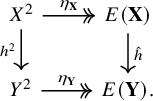
if and only if there exists a (necessarily unique) homomorphism of ordered sets
$\mathbf {Y}$
if and only if there exists a (necessarily unique) homomorphism of ordered sets $\hat {h} \colon E(\mathbf {X}) \to E(\mathbf {Y})$
for which
$\hat {h} \colon E(\mathbf {X}) \to E(\mathbf {Y})$
for which $\hat {h} \circ \eta _{\mathbf {X}} = \eta _{\mathbf {Y}} \circ h^2$
; that is, the diagram below commutes:
$\hat {h} \circ \eta _{\mathbf {X}} = \eta _{\mathbf {Y}} \circ h^2$
; that is, the diagram below commutes:
Proof. ‘ $\Rightarrow $
’: First, assume that
$\Rightarrow $
’: First, assume that $h \colon X \to Y$
is a homomorphism between the echeloned spaces
$h \colon X \to Y$
is a homomorphism between the echeloned spaces $\mathbf {X}$
and
$\mathbf {X}$
and $\mathbf {Y}$
. Define
$\mathbf {Y}$
. Define $\hat {h} \colon {X^2}/{\sim _{\mathbf {X}}} \to {Y^2}/{\sim _{\mathbf {Y}}},\, [(x_1, x_2)]_{\sim _{\mathbf {X}}} \mapsto [(h(x_1), h(x_2))]_{\sim _{\mathbf {Y}}}$
. First, we show that it is well defined. Let
$\hat {h} \colon {X^2}/{\sim _{\mathbf {X}}} \to {Y^2}/{\sim _{\mathbf {Y}}},\, [(x_1, x_2)]_{\sim _{\mathbf {X}}} \mapsto [(h(x_1), h(x_2))]_{\sim _{\mathbf {Y}}}$
. First, we show that it is well defined. Let $x_1, x_2, x_1^{\prime }, x_2^{\prime } \in X$
and
$x_1, x_2, x_1^{\prime }, x_2^{\prime } \in X$
and $(x_1, x_2) \sim _{\mathbf {X}} (x_1^{\prime }, x_2^{\prime })$
; that is,
$(x_1, x_2) \sim _{\mathbf {X}} (x_1^{\prime }, x_2^{\prime })$
; that is, $[(x_1, x_2)]_{\sim _{\mathbf {X}}} = [(x_1^{\prime }, x_2^{\prime })]_{\sim _{\mathbf {X}}}$
. Then,
$[(x_1, x_2)]_{\sim _{\mathbf {X}}} = [(x_1^{\prime }, x_2^{\prime })]_{\sim _{\mathbf {X}}}$
. Then, $(h(x_1), h(x_2)) \sim _{\mathbf {Y}} (h(x_1^{\prime }), h(x_2^{\prime }))$
since h preserves
$(h(x_1), h(x_2)) \sim _{\mathbf {Y}} (h(x_1^{\prime }), h(x_2^{\prime }))$
since h preserves $\leqslant _{\mathbf {X}}$
. Consequently,
$\leqslant _{\mathbf {X}}$
. Consequently,
 $$\begin{align*}\hat{h}([(x_1, x_2)]_{\sim_{\mathbf{X}}}) = [(h(x_1), h(x_2))]_{\sim_{\mathbf{Y}}} = [(h(x_1^{\prime}), h(x_2^{\prime}))]_{\sim_{\mathbf{Y}}} = \hat{h}([(x_1^{\prime}, x_2^{\prime})]_{\sim_{\mathbf{X}}}). \end{align*}$$
Next, we prove that $\hat {h}$
preserves
$\hat {h}$
preserves $\leqslant _{E(\mathbf {X})}$
. Take any
$\leqslant _{E(\mathbf {X})}$
. Take any $x_1, x_2, x_1^{\prime }, x_2^{\prime } \in X$
such that
$x_1, x_2, x_1^{\prime }, x_2^{\prime } \in X$
such that $[(x_1, x_2)]_{\sim _{\mathbf {X}}} \leqslant _{E(\mathbf {X})} [(x_1^{\prime }, x_2^{\prime })]_{\sim _{\mathbf {X}}}$
. By definition, this means that
$[(x_1, x_2)]_{\sim _{\mathbf {X}}} \leqslant _{E(\mathbf {X})} [(x_1^{\prime }, x_2^{\prime })]_{\sim _{\mathbf {X}}}$
. By definition, this means that $(x_1, x_2) \leqslant _{\mathbf {X}} (x_1^{\prime }, x_2^{\prime })$
. Consequently, given that h is a homomorphism, it holds that
$(x_1, x_2) \leqslant _{\mathbf {X}} (x_1^{\prime }, x_2^{\prime })$
. Consequently, given that h is a homomorphism, it holds that $(h(x_1), h(x_2)) \leqslant _{\mathbf {Y}} (h(x_1^{\prime }), h(x_2^{\prime }))$
. So,
$(h(x_1), h(x_2)) \leqslant _{\mathbf {Y}} (h(x_1^{\prime }), h(x_2^{\prime }))$
. So,
 $$\begin{align*}\hat{h}([(x_1, x_2)]_{\sim_{\mathbf{X}}}) = [(h(x_1), h(x_2))]_{\sim_{\mathbf{Y}}} \leqslant_{E(\mathbf{Y})} [(h(x_1^{\prime}), h(x_2^{\prime}))]_{\sim_{\mathbf{Y}}} = \hat{h}([(x_1^{\prime}, x_2^{\prime})]_{\sim_{\mathbf{X}}}).\end{align*}$$
Finally, we show that for our choice of $\hat {h}$
, the above diagram commutes. Take any
$\hat {h}$
, the above diagram commutes. Take any $x_1, x_2 \in X$
. Then,
$x_1, x_2 \in X$
. Then,
 $$\begin{align*}\hat{h} \circ \eta_{\mathbf{X}} (x_1, x_2) = \hat{h} ([(x_1, x_2)]_{\sim_{\mathbf{X}}}) = [(h(x_1), h(x_2))]_{\sim_{\mathbf{Y}}} = \eta_{\mathbf{Y}}(h(x_1), h(x_2)) = \eta_{\mathbf{Y}} \circ h^2 (x_1, x_2), \end{align*}$$
which is what we needed to show.
‘ $\Leftarrow $
’: Assume
$\Leftarrow $
’: Assume $\hat {h} \colon E(\mathbf {X}) \to E(\mathbf {Y})$
is a homomorphism and
$\hat {h} \colon E(\mathbf {X}) \to E(\mathbf {Y})$
is a homomorphism and $h \colon X \to Y$
a map such that
$h \colon X \to Y$
a map such that $\hat {h} \circ \eta _{\mathbf {X}} = \eta _{\mathbf {Y}} \circ h^2$
. We prove h is a homomorphism from
$\hat {h} \circ \eta _{\mathbf {X}} = \eta _{\mathbf {Y}} \circ h^2$
. We prove h is a homomorphism from $\mathbf {X}$
to
$\mathbf {X}$
to $\mathbf {Y}$
. Take any
$\mathbf {Y}$
. Take any $x_1, x_2,x_1^{\prime }, x_2^{\prime } \in X$
such that
$x_1, x_2,x_1^{\prime }, x_2^{\prime } \in X$
such that $(x_1, x_2) \leqslant _{\mathbf {X}} (x_1^{\prime }, x_2^{\prime })$
. This is equivalent to saying that
$(x_1, x_2) \leqslant _{\mathbf {X}} (x_1^{\prime }, x_2^{\prime })$
. This is equivalent to saying that
 $$\begin{align*}\eta_{\mathbf{X}}(x_1, x_2) = [(x_1, x_2)]_{\sim_{\mathbf{X}}} \leqslant_{E(\mathbf{X})} [(x_1^{\prime}, x_2^{\prime})]_{\sim_{\mathbf{X}}} = \eta_{\mathbf{X}}(x_1^{\prime}, x_2^{\prime}), \end{align*}$$
by definition of $\leqslant _{E(\mathbf {X})}$
. It follows that
$\leqslant _{E(\mathbf {X})}$
. It follows that
 $$\begin{align*}\hat{h}\circ \eta_{\mathbf{X}} (x_1, x_2) = \hat{h} ([(x_1, x_2)]_{\sim_{\mathbf{X}}}) \leqslant_{E(\mathbf{Y})} \hat{h}([(x_1^{\prime}, x_2^{\prime})]_{\sim_{\mathbf{X}}}) = \hat{h}\circ \eta_{\mathbf{X}} (x_1^{\prime}, x_2^{\prime}).\end{align*}$$
Now, from the commutativity of the given diagram, that is equivalent to
 $$\begin{align*}\eta_{\mathbf{Y}}(h(x_1), h(x_2)) = \eta_{\mathbf{Y}} \circ h^2 (x_1, x_2) \leqslant_{E(\mathbf{Y})} \eta_{\mathbf{Y}} \circ h^2 (x_1^{\prime}, x_2^{\prime}) = \eta_{\mathbf{Y}}(h(x_1^{\prime}), h(x_2^{\prime})).\end{align*}$$
In other words, $[(h(x_1), h(x_2))]_{\sim _{\mathbf {Y}}} \leqslant _{E(\mathbf {Y})} [(h(x_1^{\prime }), h(x_2^{\prime }))]_{\sim _{\mathbf {Y}}}$
or better yet,
$[(h(x_1), h(x_2))]_{\sim _{\mathbf {Y}}} \leqslant _{E(\mathbf {Y})} [(h(x_1^{\prime }), h(x_2^{\prime }))]_{\sim _{\mathbf {Y}}}$
or better yet, $(h(x_1), h(x_2)) \leqslant _{\mathbf {Y}} (h(x_1^{\prime }), h(x_2^{\prime }))$
, so h does preserve
$(h(x_1), h(x_2)) \leqslant _{\mathbf {Y}} (h(x_1^{\prime }), h(x_2^{\prime }))$
, so h does preserve $\leqslant _{\mathbf {X}}$
and is thus a homomorphism.
$\leqslant _{\mathbf {X}}$
and is thus a homomorphism.
Corollary 1.4. Let $\mathbf {X}$
and
$\mathbf {X}$
and $\mathbf {Y}$
be two echeloned spaces. Then,
$\mathbf {Y}$
be two echeloned spaces. Then, $h \colon \mathbf {X} \to \mathbf {Y}$
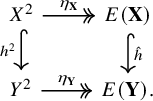
is an embedding if and only if there exists an embedding of ordered sets
$h \colon \mathbf {X} \to \mathbf {Y}$
is an embedding if and only if there exists an embedding of ordered sets $\hat {h} \colon E(\mathbf {X}) \hookrightarrow E(\mathbf {Y})$
for which
$\hat {h} \colon E(\mathbf {X}) \hookrightarrow E(\mathbf {Y})$
for which $\hat {h} \circ \eta _{\mathbf {X}} = \eta _{\mathbf {Y}} \circ h^2$
; that is, the diagram below commutes:
$\hat {h} \circ \eta _{\mathbf {X}} = \eta _{\mathbf {Y}} \circ h^2$
; that is, the diagram below commutes:
Proof. ‘ $\Rightarrow $
’: Assume h is an embedding from
$\Rightarrow $
’: Assume h is an embedding from $\mathbf {X}$
to
$\mathbf {X}$
to $\mathbf {Y}$
. Then by Lemma 1.3, there exists such a homomorphism
$\mathbf {Y}$
. Then by Lemma 1.3, there exists such a homomorphism $\hat {h} \colon E(\mathbf {X}) \to E(\mathbf {Y})$
for which
$\hat {h} \colon E(\mathbf {X}) \to E(\mathbf {Y})$
for which $\hat {h} \circ \eta _{\mathbf {X}} = \eta _{\mathbf {Y}} \circ h^2$
. In order to prove that it does not only preserve, but also reflects
$\hat {h} \circ \eta _{\mathbf {X}} = \eta _{\mathbf {Y}} \circ h^2$
. In order to prove that it does not only preserve, but also reflects $\leqslant _{E(\mathbf {X})}$
, take any
$\leqslant _{E(\mathbf {X})}$
, take any $x_1, x_2, x_1^{\prime }, x_2^{\prime } \in X$
such that
$x_1, x_2, x_1^{\prime }, x_2^{\prime } \in X$
such that $\hat {h}([(x_1, x_2)]_{\sim _{\mathbf {X}}}) \leqslant _{E(\mathbf {Y})} \hat {h}([(x_1^{\prime }, x_2^{\prime })]_{\sim _{\mathbf {X}}})$
. Put differently,
$\hat {h}([(x_1, x_2)]_{\sim _{\mathbf {X}}}) \leqslant _{E(\mathbf {Y})} \hat {h}([(x_1^{\prime }, x_2^{\prime })]_{\sim _{\mathbf {X}}})$
. Put differently,
 $$\begin{align*}\eta_{\mathbf{Y}} \circ h^2 (x_1, x_2) = \hat{h} \circ \eta_{\mathbf{X}} (x_1, x_2) \leqslant_{E(\mathbf{Y})} \hat{h} \circ \eta_{\mathbf{X}} (x_1^{\prime}, x_2^{\prime}) = \eta_{\mathbf{Y}} \circ h^2 (x_1^{\prime}, x_2^{\prime}), \end{align*}$$
that is, $[(h(x_1), h(x_2))]_{\sim _{\mathbf {Y}}} \leqslant _{E(\mathbf {Y})} [(h(x_1^{\prime }), h(x_2^{\prime }))]_{\sim _{\mathbf {Y}}}$
. By definition of
$[(h(x_1), h(x_2))]_{\sim _{\mathbf {Y}}} \leqslant _{E(\mathbf {Y})} [(h(x_1^{\prime }), h(x_2^{\prime }))]_{\sim _{\mathbf {Y}}}$
. By definition of $\leqslant _{E(\mathbf {Y})}$
, we actually get
$\leqslant _{E(\mathbf {Y})}$
, we actually get $(h(x_1), h(x_2)) \leqslant _{\mathbf {Y}} (h(x_1^{\prime }), h(x_2^{\prime }))$
. Finally, as h reflects
$(h(x_1), h(x_2)) \leqslant _{\mathbf {Y}} (h(x_1^{\prime }), h(x_2^{\prime }))$
. Finally, as h reflects $\leqslant _{\mathbf {X}}$
, then
$\leqslant _{\mathbf {X}}$
, then $(x_1, x_2) \leqslant _{\mathbf {X}} (x_1^{\prime }, x_2^{\prime })$
, which is what we wanted. What remains is to show that
$(x_1, x_2) \leqslant _{\mathbf {X}} (x_1^{\prime }, x_2^{\prime })$
, which is what we wanted. What remains is to show that $\hat {h}$
is injective. Take any
$\hat {h}$
is injective. Take any $x_1, x_2, x_1^{\prime }, x_2^{\prime } \in X$
such that
$x_1, x_2, x_1^{\prime }, x_2^{\prime } \in X$
such that $\hat {h}([(x_1, x_2)]_{\sim _{\mathbf {X}}}) = \hat {h}([(x_1^{\prime }, x_2^{\prime })]_{\sim _{\mathbf {X}}})$
. Similarly as before, by the commutativity of the diagram, we get that
$\hat {h}([(x_1, x_2)]_{\sim _{\mathbf {X}}}) = \hat {h}([(x_1^{\prime }, x_2^{\prime })]_{\sim _{\mathbf {X}}})$
. Similarly as before, by the commutativity of the diagram, we get that $(h(x_1), h(x_2)) = (h(x_1^{\prime }), h(x_2^{\prime }))$
. As h itself is injective, it follows immediately that
$(h(x_1), h(x_2)) = (h(x_1^{\prime }), h(x_2^{\prime }))$
. As h itself is injective, it follows immediately that $(x_1, x_2) = (x_1^{\prime }, x_2^{\prime })$
.
$(x_1, x_2) = (x_1^{\prime }, x_2^{\prime })$
.
‘ $\Leftarrow $
’: Let
$\Leftarrow $
’: Let $h \colon X \to Y$
be a map and assume the existence of such an
$h \colon X \to Y$
be a map and assume the existence of such an $\hat {h}$
as described in the statement of the right-hand side of the corollary. First, by Lemma 1.3, we get that h is a homomorphism from
$\hat {h}$
as described in the statement of the right-hand side of the corollary. First, by Lemma 1.3, we get that h is a homomorphism from $\mathbf {X}$
to
$\mathbf {X}$
to $\mathbf {Y}$
. Then, take any
$\mathbf {Y}$
. Then, take any $x_1, x_2, x_1^{\prime }, x_2^{\prime } \in X$
for which
$x_1, x_2, x_1^{\prime }, x_2^{\prime } \in X$
for which $(h(x_1), h(x_2)) \leqslant _{\mathbf {Y}} (h(x_1^{\prime }), h(x_2^{\prime }))$
. Notice how this leads to
$(h(x_1), h(x_2)) \leqslant _{\mathbf {Y}} (h(x_1^{\prime }), h(x_2^{\prime }))$
. Notice how this leads to $[(h(x_1), h(x_2))]_{\sim _{\mathbf {Y}}} \leqslant _{E(\mathbf {Y})} [(h(x_1^{\prime }), h(x_2^{\prime }))]_{\sim _{\mathbf {Y}}}$
, which in turn translates to
$[(h(x_1), h(x_2))]_{\sim _{\mathbf {Y}}} \leqslant _{E(\mathbf {Y})} [(h(x_1^{\prime }), h(x_2^{\prime }))]_{\sim _{\mathbf {Y}}}$
, which in turn translates to
 $$\begin{align*}\hat{h} \circ \eta_{\mathbf{X}} (x_1, x_2) = \eta_{\mathbf{Y}} \circ h^2 (x_1, x_2) \leqslant_{E(\mathbf{Y})} \eta_{\mathbf{Y}} \circ h^2 (x_1^{\prime}, x_2^{\prime}) = \hat{h} \circ \eta_{\mathbf{X}} (x_1^{\prime}, x_2^{\prime}), \end{align*}$$
that is, $[(x_1, x_2)]_{\sim _{\mathbf {X}}} \leqslant _{E(\mathbf {X})} [(x_1^{\prime }, x_2^{\prime })]_{\sim _{\mathbf {X}}}$
. Thus,
$[(x_1, x_2)]_{\sim _{\mathbf {X}}} \leqslant _{E(\mathbf {X})} [(x_1^{\prime }, x_2^{\prime })]_{\sim _{\mathbf {X}}}$
. Thus, $(x_1, x_2) \leqslant _{\mathbf {X}} (x_1^{\prime }, x_2^{\prime })$
. Lastly, we show that h is injective. Take any
$(x_1, x_2) \leqslant _{\mathbf {X}} (x_1^{\prime }, x_2^{\prime })$
. Lastly, we show that h is injective. Take any $x_1, x_2 \in X$
, for which
$x_1, x_2 \in X$
, for which $h(x_1) = h(x_2)$
. Then
$h(x_1) = h(x_2)$
. Then $(h(x_1), h(x_2)) = (h(x_2), h(x_2))$
, and so
$(h(x_1), h(x_2)) = (h(x_2), h(x_2))$
, and so
 $$\begin{align*}\hat{h}([(x_1, x_2)]_{\sim_{\mathbf{X}}}) = \eta_{\mathbf{Y}} (h(x_1), h(x_2)) = \eta_{\mathbf{Y}} (h(x_2), h(x_2)) = \hat{h}([(x_2, x_2)]_{\sim_{\mathbf{X}}}). \end{align*}$$
As a result of $\hat {h}$
being injective, we get that
$\hat {h}$
being injective, we get that $(x_1, x_2) \sim _{\mathbf {X}} (x_2, x_2)$
. However, by the axioms of an echeloned space, this leads to
$(x_1, x_2) \sim _{\mathbf {X}} (x_2, x_2)$
. However, by the axioms of an echeloned space, this leads to $x_1 = x_2$
. This concludes the proof.
$x_1 = x_2$
. This concludes the proof.
As the next lemma shows, every metric space induces an echeloned space on the same set of points.
Lemma 1.5. Let $(M, d_M)$
be a metric space. Define a binary relation
$(M, d_M)$
be a metric space. Define a binary relation $\leqslant _{\mathbf {M}}$
on
$\leqslant _{\mathbf {M}}$
on $M^2$
such that for every
$M^2$
such that for every $(x_1, y_1), (x_2, y_2) \in M^2$
,
$(x_1, y_1), (x_2, y_2) \in M^2$
,
 $$\begin{align*}(x_1, y_1) \leqslant_{\mathbf{M}} (x_2, y_2) \quad \Longleftrightarrow \quad d_M(x_1, y_1) \leqslant d_M(x_2, y_2).\end{align*}$$
Then $(M, \leqslant _{\mathbf {M}})$
is an echeloned space.
$(M, \leqslant _{\mathbf {M}})$
is an echeloned space.
Proof. We proceed to prove that $\leqslant _{\mathbf {M}}$
is an echelon on M. As
$\leqslant _{\mathbf {M}}$
is an echelon on M. As $\leqslant $
is a linear order on
$\leqslant $
is a linear order on $\mathbb {R}$
,
$\mathbb {R}$
, $\leqslant _{\mathbf {M}}$
is trivially a prechain on
$\leqslant _{\mathbf {M}}$
is trivially a prechain on $M^2$
by its definition. For any
$M^2$
by its definition. For any $x, y, z \in M$
,
$x, y, z \in M$
,
-
(i)
$d_M(x,x) = 0 \leqslant d_M(y, z)$
; thus,
$(x,x) \leqslant _{\mathbf {M}} (y, z)$
. -
(ii) if
$(y, z) \leqslant _{\mathbf {M}} (x, x)$
, then
$d_M(y, z) \leqslant d_M(x, x) = 0$
. So
$d_M(y, z) = 0$
, and so
$y = z$
. -
(iii)
$d_M(x, y) = d_M(y, x)$
, so
$(x, y) \leqslant _{\mathbf {M}} (y, x)$
.


Remark 1.6. By Lemma 1.3, two metric spaces $(X, d_X)$
and
$(X, d_X)$
and $(Y, d_Y)$
are isomorphic as echeloned spaces if and only if there exist a bijection
$(Y, d_Y)$
are isomorphic as echeloned spaces if and only if there exist a bijection $f\colon X \to Y$
and an automorphism
$f\colon X \to Y$
and an automorphism $\hat {f}$
of
$\hat {f}$
of $(\mathbb {R}^+, <)$
such that
$(\mathbb {R}^+, <)$
such that $d_Y (f(x), f(x'))$
=
$d_Y (f(x), f(x'))$
= $\hat {f} (d_X (x, x'))$
for all
$\hat {f} (d_X (x, x'))$
for all $x, x' \in X$
. This kind of equivalence relation between metric spaces has been considered by several authors; see, for example, [Reference Gregorio, Fugacci, Memoli and Vaccarino10] and the references therein.
$x, x' \in X$
. This kind of equivalence relation between metric spaces has been considered by several authors; see, for example, [Reference Gregorio, Fugacci, Memoli and Vaccarino10] and the references therein.
Remark 1.7. The proof of Lemma 1.5 does not make use of the triangle inequality. Thus, the statement remains true if $(M, d_M)$
is merely a semimetric space. This was already noted in [Reference Keller and Petrov16, Example 1.4].
$(M, d_M)$
is merely a semimetric space. This was already noted in [Reference Keller and Petrov16, Example 1.4].
Obviously, not every echeloned space is induced by a metric space in this way. A necessary condition for $\mathbf {X}$
to be induced by a metric space is that
$\mathbf {X}$
to be induced by a metric space is that $E(\mathbf {X})$
embeds into the chain of reals; see Examples 1.13 and 1.14. The question when a linear order can be embedded into the chain of reals was settled by Birkhoff. Recall that a subset S of a prechain
$E(\mathbf {X})$
embeds into the chain of reals; see Examples 1.13 and 1.14. The question when a linear order can be embedded into the chain of reals was settled by Birkhoff. Recall that a subset S of a prechain $(C,\leqslant )$
is called order-dense in C if and only if, for every
$(C,\leqslant )$
is called order-dense in C if and only if, for every $a < b$
in
$a < b$
in $C\setminus S$
, there exists
$C\setminus S$
, there exists $s\in S$
such that
$s\in S$
such that $a \le s \le b$
.
$a \le s \le b$
.
Theorem 1.8 [Reference Birkhoff2, Theorem VIII.24]Footnote 2
A linearly ordered set embeds into $(\mathbb {R},\le )$
if and only if it contains a countable order-dense subset.
$(\mathbb {R},\le )$
if and only if it contains a countable order-dense subset.
Definition 1.9. A metric space $(X, d_X)$
is called dull if
$(X, d_X)$
is called dull if $d_X(x,x') \leqslant d_X(y,y') + d_X(z, z')$
holds, for all
$d_X(x,x') \leqslant d_X(y,y') + d_X(z, z')$
holds, for all $x, x', y, y', z, z' \in X$
with
$x, x', y, y', z, z' \in X$
with $y \not = y'$
and
$y \not = y'$
and $z \not = z'$
.
$z \not = z'$
.
Recall that a metric space is called uniformly discrete if all nonzero distances in it are bounded from below by some constant $c>0$
.
$c>0$
.
Lemma 1.10. Any dull metric space is both bounded and uniformly discrete.
Proof. Let $(X, d_X)$
be a dull metric space. Define
$(X, d_X)$
be a dull metric space. Define  . Clearly, the diameter of $(X,d_X)$
is not larger than
$(X,d_X)$
is not larger than $2 \tau $
, due to dullness. Thus, any distance within
$2 \tau $
, due to dullness. Thus, any distance within $(X, d_X)$
is bounded by
$(X, d_X)$
is bounded by $2 \tau $
.
$2 \tau $
.
Without loss of generality, assume $|X| \not = 1$
. In other words, there exist such
$|X| \not = 1$
. In other words, there exist such $x, y \in X$
that
$x, y \in X$
that $d_X(x, y) \not = 0$
. As
$d_X(x, y) \not = 0$
. As $\tau \leqslant d_X(x, y) \leqslant 2 \tau $
, it follows that
$\tau \leqslant d_X(x, y) \leqslant 2 \tau $
, it follows that $\tau> 0$
. Consequently, as
$\tau> 0$
. Consequently, as $0 < \tau \leqslant d_X(x, y)$
for all distinct
$0 < \tau \leqslant d_X(x, y)$
for all distinct $x, y \in X$
,
$x, y \in X$
, $(X, d_X)$
is uniformly discrete.
$(X, d_X)$
is uniformly discrete.
Proposition 1.11 (cf. [Reference Keller and Petrov16, Proposition 1.5])
Let $(X,\leqslant _{\mathbf {X}})$
be an echeloned space. Then the following are equivalent:
$(X,\leqslant _{\mathbf {X}})$
be an echeloned space. Then the following are equivalent:
-
(i)
$\leqslant _{\mathbf {X}}$
is induced by a metric space, -
(ii)
$\leqslant _{\mathbf {X}}$
is induced by a dull metric space, -
(iii)
$(X^2,\leqslant _{\mathbf {X}})$
contains a countable order-dense subset, -
(iv)
$E(\mathbf {X})$
embeds into
$(\mathbb {R},\le )$
.


Proof. We show $(ii)\Rightarrow (i)\Rightarrow (iv)\Rightarrow (ii)$
, and
$(ii)\Rightarrow (i)\Rightarrow (iv)\Rightarrow (ii)$
, and $(iii)\iff (iv)$
. It is clear that
$(iii)\iff (iv)$
. It is clear that $(ii)\Rightarrow (i)$
.
$(ii)\Rightarrow (i)$
.
‘ $(i)\Rightarrow (iv)$
’: Let X be a set and
$(i)\Rightarrow (iv)$
’: Let X be a set and $\leqslant _{\mathbf {X}}$
an echelon on it induced by a metric space
$\leqslant _{\mathbf {X}}$
an echelon on it induced by a metric space $(X, d_X)$
. Clearly,
$(X, d_X)$
. Clearly, $\operatorname {\mathrm {im}} d_X$
is order-embeddable into the reals, given that
$\operatorname {\mathrm {im}} d_X$
is order-embeddable into the reals, given that $d_X$
is a metric. Observe that
$d_X$
is a metric. Observe that $E(\mathbf {X}) \cong (\operatorname {\mathrm {im}} d_X, \leqslant )$
.
$E(\mathbf {X}) \cong (\operatorname {\mathrm {im}} d_X, \leqslant )$
.
‘ $(iv)\Rightarrow (ii)$
’: Let f be an embedding of
$(iv)\Rightarrow (ii)$
’: Let f be an embedding of $E(\mathbf {X})$
into
$E(\mathbf {X})$
into $(\mathbb {R},\le )$
. Without loss of generality, we may assume that the image of f is contained in
$(\mathbb {R},\le )$
. Without loss of generality, we may assume that the image of f is contained in $(\{0\} \cup (1, 2), \leqslant )$
, and that f maps the smallest element of
$(\{0\} \cup (1, 2), \leqslant )$
, and that f maps the smallest element of $E(\mathbf {X})$
(containing all reflexive pairs) to
$E(\mathbf {X})$
(containing all reflexive pairs) to $0$
.
$0$
.
Now we define a map $d_X$
on
$d_X$
on $X^2$
as follows: for any
$X^2$
as follows: for any $(x, y) \in X^2$
, let
$(x, y) \in X^2$
, let  . It remains to show that it is a well-defined metric.
To begin with, notice that for any $x \in X$
, the distance
$x \in X$
, the distance $d_X(x, x) = f ([(x,x)]_{\sim _{\mathbf {X}}}) = 0$
. For any
$d_X(x, x) = f ([(x,x)]_{\sim _{\mathbf {X}}}) = 0$
. For any $x, y \in X$
,
$x, y \in X$
, $d_X (x, y) \geqslant 0$
. Also, since
$d_X (x, y) \geqslant 0$
. Also, since $(x, y) \sim _{\mathbf {X}} (y, x)$
, then
$(x, y) \sim _{\mathbf {X}} (y, x)$
, then $d_X (x, y) = d_X (y, x)$
. At last, take any
$d_X (x, y) = d_X (y, x)$
. At last, take any $x, y, z \in X$
. If x, y, and z are pairwise distinct, then
$x, y, z \in X$
. If x, y, and z are pairwise distinct, then
 $$\begin{align*}d_X(x, y) = f([(x, y)]_{\sim_{\mathbf{X}}}) < 2 = 1 + 1 < f([(x, z)]_{\sim_{\mathbf{X}}}) + f([(z, y)]_{\sim_{\mathbf{X}}}) = d_X(x, z) + d_X(z, y).\end{align*}$$
Otherwise, if $x=y$
, then
$x=y$
, then $d_X(x, y) = 0 \leqslant d_X(x, z) + d_X(z, y)$
; whereas if
$d_X(x, y) = 0 \leqslant d_X(x, z) + d_X(z, y)$
; whereas if $x=z$
or
$x=z$
or $y=z$
, then the triangle inequality trivially holds.
$y=z$
, then the triangle inequality trivially holds.
Overall, $(X, d_X)$
is indeed a metric space (inducing the echeloned space
$(X, d_X)$
is indeed a metric space (inducing the echeloned space $(X, \leqslant _{\mathbf {X}})$
). Moreover, by definition, it is dull.
$(X, \leqslant _{\mathbf {X}})$
). Moreover, by definition, it is dull.
‘ $(iii)\Rightarrow (iv)$
’: Let S be a countable order-dense subset of
$(iii)\Rightarrow (iv)$
’: Let S be a countable order-dense subset of $X^2$
. Consider
$X^2$
. Consider

Clearly, $S_{E(\mathbf {X})}$
is a countable order-dense subset of
$S_{E(\mathbf {X})}$
is a countable order-dense subset of $E(\mathbf {X})$
. By Theorem 1.8,
$E(\mathbf {X})$
. By Theorem 1.8, $E(\mathbf {X})$
embeds into
$E(\mathbf {X})$
embeds into $(\mathbb {R},\le )$
.
$(\mathbb {R},\le )$
.
‘ $(iv)\Rightarrow (iii)$
’: By Theorem 1.8,
$(iv)\Rightarrow (iii)$
’: By Theorem 1.8, $E(\mathbf {X})$
contains a countable order-dense subset
$E(\mathbf {X})$
contains a countable order-dense subset $S_{E(\mathbf {X})}$
. Let T be a transversal of
$S_{E(\mathbf {X})}$
. Let T be a transversal of $\sim _{\mathbf {X}}$
. Consider
$\sim _{\mathbf {X}}$
. Consider

Then it is easy to see that S is countable and order-dense in $(X^2,\le _{\mathbf {X}})$
.
$(X^2,\le _{\mathbf {X}})$
.
An echeloned space that is induced by a metric space will be called metrizable. As a direct consequence of Proposition 1.11 we obtain the following:
Corollary 1.12. Every echeloned space on a countable set is metrizable.
What follows are two examples of non-metrizable echeloned spaces.
Example 1.13. Observe the following chain $C = \mathbb {R}_0^+ \odot \mathbf {2}$
, where
$C = \mathbb {R}_0^+ \odot \mathbf {2}$
, where $\mathbb {R}_0^+$
is the set of nonnegative real numbers, and where
$\mathbb {R}_0^+$
is the set of nonnegative real numbers, and where $\mathbf {2} = \{0,1\}$
is the ordinal number 2. Recall that the lexicographic product
$\mathbf {2} = \{0,1\}$
is the ordinal number 2. Recall that the lexicographic product $X \odot Y$
, of two disjoint posets X and Y, is the set of all ordered pairs
$X \odot Y$
, of two disjoint posets X and Y, is the set of all ordered pairs $(x, y)$
(where
$(x, y)$
(where $x \in X, y \in Y$
), ordered lexicographically – that is, by the rule that
$x \in X, y \in Y$
), ordered lexicographically – that is, by the rule that $(x,y) < (x', y')$
if and only if
$(x,y) < (x', y')$
if and only if $x < x'$
or
$x < x'$
or $x = x' \land y < y'$
. Clearly, the lexicographic product of any two chains is again a chain. Take any countable subset S of C. As there exist uncountably many irrational numbers, there has to be some
$x = x' \land y < y'$
. Clearly, the lexicographic product of any two chains is again a chain. Take any countable subset S of C. As there exist uncountably many irrational numbers, there has to be some $a \in \mathbb {R}_0^+ \setminus \mathbb {Q}$
such that neither
$a \in \mathbb {R}_0^+ \setminus \mathbb {Q}$
such that neither $(a, 0)$
nor
$(a, 0)$
nor $(a, 1)$
are in S. Due to the lexicographical ordering, there is no element of C, let alone of S, in between the formerly mentioned two. Therefore, S cannot be order-dense in C. Since the choice of S was arbitrary, by [Reference Birkhoff2, Theorem VIII.24], C is not embeddable into
$(a, 1)$
are in S. Due to the lexicographical ordering, there is no element of C, let alone of S, in between the formerly mentioned two. Therefore, S cannot be order-dense in C. Since the choice of S was arbitrary, by [Reference Birkhoff2, Theorem VIII.24], C is not embeddable into $\mathbb {R}$
.
$\mathbb {R}$
.
Now, consider an echelon $\leqslant _{\mathbb {R}}$
on the set of reals defined as follows:
$\leqslant _{\mathbb {R}}$
on the set of reals defined as follows:
 $$ \begin{align*} (x,y) <_{\mathbb{R}} (u,v) \quad :\Longleftrightarrow \quad &\text{ either } \bigl||x|-|y|\bigr| < \bigl||u|-|v|\bigr|,\\ &\text{ or } \bigl||x|-|y|\bigr| = \bigl||u|-|v|\bigr|, \text{ but }\operatorname{\mathrm{sgn}}(x) = \operatorname{\mathrm{sgn}}(y),\, \operatorname{\mathrm{sgn}}(u) \not= \operatorname{\mathrm{sgn}}(v), \end{align*} $$
for any $(x, y), (u, v) \in \mathbb {R}^2$
. Observe that the chain
$(x, y), (u, v) \in \mathbb {R}^2$
. Observe that the chain $({\mathbb {R}^2}/{\sim _{\mathbb {R}}}, \leqslant _{\mathbb {R}})$
is isomorphic to
$({\mathbb {R}^2}/{\sim _{\mathbb {R}}}, \leqslant _{\mathbb {R}})$
is isomorphic to $(\mathbb {R}^+_0 \odot \mathbf {2}, \leqslant )$
. As a result of Proposition 1.11, the latter echelon could not have been induced by a metric space.
$(\mathbb {R}^+_0 \odot \mathbf {2}, \leqslant )$
. As a result of Proposition 1.11, the latter echelon could not have been induced by a metric space.
Example 1.14. Let  . Further, we define a map $f_{\mathbf {X}} \colon X^2 \to \omega _1^+$
as follows. Let
$f_{\mathbf {X}} \colon X^2 \to \omega _1^+$
as follows. Let $\mathbf {x} = (x_i)_{i \in \omega _1}$
,
$\mathbf {x} = (x_i)_{i \in \omega _1}$
, $\mathbf {y} = (y_i)_{i \in \omega _1} \in X$
. Then if
$\mathbf {y} = (y_i)_{i \in \omega _1} \in X$
. Then if $\mathbf {x} \not = \mathbf {y}$
, we set
$\mathbf {x} \not = \mathbf {y}$
, we set  , where k is the smallest index for which $x_k \not = y_k$
; otherwise,
$x_k \not = y_k$
; otherwise,  . Moreover, we define a binary relation $\leqslant _{\mathbf {X}}$
on
$\leqslant _{\mathbf {X}}$
on $X^2$
so that
$X^2$
so that
 $$\begin{align*}(\mathbf{x}, \mathbf{y}) \leqslant_{\mathbf{X}} (\mathbf{s}, \mathbf{t}) \quad :\Longleftrightarrow\quad f_{\mathbf{X}}(\mathbf{x}, \mathbf{y}) \geqslant f_{\mathbf{X}}(\mathbf{s}, \mathbf{t}).\end{align*}$$
Clearly, $\leqslant _{\mathbf {X}}$
is a well-defined echelon on X. Given that
$\leqslant _{\mathbf {X}}$
is a well-defined echelon on X. Given that $f_{\mathbf {X}}$
is surjective, the chain
$f_{\mathbf {X}}$
is surjective, the chain $\left ({X^2}/{\sim _{\mathbf {X}}}, \leqslant _{\mathbf {X}}~\!\right )$
is isomorphic to
$\left ({X^2}/{\sim _{\mathbf {X}}}, \leqslant _{\mathbf {X}}~\!\right )$
is isomorphic to $(\omega _1^+, \geqslant )$
. As already
$(\omega _1^+, \geqslant )$
. As already $\omega _1$
does not order-embed into the reals,Footnote 3 neither does
$\omega _1$
does not order-embed into the reals,Footnote 3 neither does $\omega _1^+$
. By [Reference Birkhoff2, Theorem VIII.24],
$\omega _1^+$
. By [Reference Birkhoff2, Theorem VIII.24], $(\omega _1^+, \geqslant )$
does not have a countable order-dense subset. Consequently, by Proposition 1.11, the echelon
$(\omega _1^+, \geqslant )$
does not have a countable order-dense subset. Consequently, by Proposition 1.11, the echelon $\leqslant _{\mathbf {X}}$
is not induced by a metric space.
$\leqslant _{\mathbf {X}}$
is not induced by a metric space.
We have already provided a full characterisation of metrizable echeloned spaces; cf. Proposition 1.11.
For any two metric spaces $\mathcal {M} = (M, d_M)$
and
$\mathcal {M} = (M, d_M)$
and $\mathcal {N} = (N, d_N)$
, we define
$\mathcal {N} = (N, d_N)$
, we define $\operatorname {\mathrm {Hom}}(\mathcal {M}, \mathcal {N})$
as the set of all
$\operatorname {\mathrm {Hom}}(\mathcal {M}, \mathcal {N})$
as the set of all $1$
-Lipschitz maps from
$1$
-Lipschitz maps from $\mathcal {M}$
to
$\mathcal {M}$
to $\mathcal {N}$
. Note that not every homomorphism between metric spaces is at the same time a homomorphism between the echeloned spaces induced by them; cf. Example 1.16.
$\mathcal {N}$
. Note that not every homomorphism between metric spaces is at the same time a homomorphism between the echeloned spaces induced by them; cf. Example 1.16.
Let $\operatorname {\mathrm {Lip}}^{\leqslant }_1(\mathcal {M}, \mathcal {N})$
denote the set of all 1-Lipschitz maps between the metric spaces
$\operatorname {\mathrm {Lip}}^{\leqslant }_1(\mathcal {M}, \mathcal {N})$
denote the set of all 1-Lipschitz maps between the metric spaces $\mathcal {M}$
and
$\mathcal {M}$
and $\mathcal {N}$
that preserve the echelon relations of
$\mathcal {N}$
that preserve the echelon relations of $\mathcal {M}$
and
$\mathcal {M}$
and $\mathcal {N}$
.
$\mathcal {N}$
.
Proposition 1.15. Let $\mathbf {M} = (M, \leqslant _{\mathbf {M}})$
and
$\mathbf {M} = (M, \leqslant _{\mathbf {M}})$
and $\mathbf {N} = (N, \leqslant _{\mathbf {N}})$
be two metrizable echeloned spaces. Then, there exist metric spaces,
$\mathbf {N} = (N, \leqslant _{\mathbf {N}})$
be two metrizable echeloned spaces. Then, there exist metric spaces, $\mathcal {M}$
and
$\mathcal {M}$
and $\mathcal {N}$
, that induce
$\mathcal {N}$
, that induce $\mathbf {M}$
and
$\mathbf {M}$
and $\mathbf {N}$
, respectively, and for which
$\mathbf {N}$
, respectively, and for which
 $$\begin{align*}\operatorname{\mathrm{Hom}}(\mathbf{M}, \mathbf{N}) = \operatorname{\mathrm{Lip}}^{\leqslant}_1(\mathcal{M}, \mathcal{N}).\end{align*}$$
Proof. The proof of Proposition 1.11 provides us with the existence of dull metrics $d_M$
and
$d_M$
and $d_N$
on M and N which induce the echelons
$d_N$
on M and N which induce the echelons $\leqslant _{\mathbf {M}}$
and
$\leqslant _{\mathbf {M}}$
and $\leqslant _{\mathbf {N}}$
. By rescaling
$\leqslant _{\mathbf {N}}$
. By rescaling $d_M$
, we may assume that
$d_M$
, we may assume that $\operatorname {\mathrm {im}} d_M \subseteq \{0\} \cup (2, 4)$
and that
$\operatorname {\mathrm {im}} d_M \subseteq \{0\} \cup (2, 4)$
and that $\operatorname {\mathrm {im}} d_N \subseteq \{0\} \cup (1,2)$
. Now, take any
$\operatorname {\mathrm {im}} d_N \subseteq \{0\} \cup (1,2)$
. Now, take any $f \in \operatorname {\mathrm {Hom}}(\mathbf {M}, \mathbf {N})$
. As for any two distinct
$f \in \operatorname {\mathrm {Hom}}(\mathbf {M}, \mathbf {N})$
. As for any two distinct $x, y \in M$
,
$x, y \in M$
,
 $$\begin{align*}d_N (f(x), f(y)) < 2 < d_M (x,y),\end{align*}$$
f is trivially a $1$
-Lipschitz map between the metric spaces
$1$
-Lipschitz map between the metric spaces $\mathcal {M}$
and
$\mathcal {M}$
and $\mathcal {N}$
. Therefore,
$\mathcal {N}$
. Therefore, $f\in \operatorname {\mathrm {Lip}}^{\leqslant }_1(\mathcal {M}, \mathcal {N})$
. The reverse inclusion holds trivially.
$f\in \operatorname {\mathrm {Lip}}^{\leqslant }_1(\mathcal {M}, \mathcal {N})$
. The reverse inclusion holds trivially.
Already for finite echeloned spaces, there are $1$
-Lipschitz maps that do not preserve the echelons, as can be seen from the example below.
$1$
-Lipschitz maps that do not preserve the echelons, as can be seen from the example below.
Example 1.16. Consider the metric spaces $\mathcal {M}$
and
$\mathcal {M}$
and $\mathcal {N}$
, given by
$\mathcal {N}$
, given by $M = \{x_1, x_2, x_3\}$
and
$M = \{x_1, x_2, x_3\}$
and $N = \{y_1, y_2, y_3\}$
, and the metrics
$N = \{y_1, y_2, y_3\}$
, and the metrics $d_M$
and
$d_M$
and $d_N$
such that
$d_N$
such that
 $$ \begin{align*} d_M(x_1, x_2) &= 2 \quad \text{and} \quad d_M (x_1, x_3) = d_M (x_2, x_3) = 4\\ d_N(y_1, y_3) &= d_N (y_2, y_3) = 1 \quad \text{and} \quad d_N(y_1, y_2) = 2.\\[-48pt] \end{align*} $$
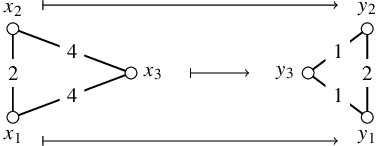
Any map $f\colon \mathcal {M}\to \mathcal {N}$
is
$f\colon \mathcal {M}\to \mathcal {N}$
is $1$
-Lipschitz, but there are maps that do not preserve echelons – for instance,
$1$
-Lipschitz, but there are maps that do not preserve echelons – for instance, $f\colon x_i\mapsto y_i$
.
$f\colon x_i\mapsto y_i$
.
Proposition 1.17. Let $\mathbf {X}$
be an echeloned space with
$\mathbf {X}$
be an echeloned space with $E(\mathbf {X})$
well-ordered. If f is an automorphism of
$E(\mathbf {X})$
well-ordered. If f is an automorphism of $\mathbf {X}$
, then
$\mathbf {X}$
, then $\hat {f}\colon E(\mathbf {X})\to E(\mathbf {X})$
is the identity embedding.
$\hat {f}\colon E(\mathbf {X})\to E(\mathbf {X})$
is the identity embedding.
Proof. Let f be an automorphism of $\mathbf {X}$
. As a consequence of Corollary 1.4,
$\mathbf {X}$
. As a consequence of Corollary 1.4, $\hat {f}$
is an automorphism of the echeloning
$\hat {f}$
is an automorphism of the echeloning $E(\mathbf {X})$
. Since
$E(\mathbf {X})$
. Since $E(\mathbf {X})$
is well-ordered, a standard induction argument shows that
$E(\mathbf {X})$
is well-ordered, a standard induction argument shows that $\hat {f}=\mathrm {id}_{E(\mathbf {X})}$
.
$\hat {f}=\mathrm {id}_{E(\mathbf {X})}$
.
Corollary 1.18. Let $(X, d_X)$
be a metric space with
$(X, d_X)$
be a metric space with $(d_X[X^2], \leqslant )$
well-ordered. Then the automorphism group of the induced echeloned space is the same as its isometry group, i.e.
$(d_X[X^2], \leqslant )$
well-ordered. Then the automorphism group of the induced echeloned space is the same as its isometry group, i.e. $\operatorname {\mathrm {Aut}}(X, \leqslant _{\mathbf {X}}) = \operatorname {\mathrm {Iso}}(X, d_X)$
.
$\operatorname {\mathrm {Aut}}(X, \leqslant _{\mathbf {X}}) = \operatorname {\mathrm {Iso}}(X, d_X)$
.
Corollary 1.19. Let $\mathbf {X}$
be a finite echeloned space induced by a metric space
$\mathbf {X}$
be a finite echeloned space induced by a metric space $(X, d_X)$
. Then
$(X, d_X)$
. Then $\operatorname {\mathrm {Aut}}(\mathbf {X}) = \operatorname {\mathrm {Iso}}(X, d_X)$
.
$\operatorname {\mathrm {Aut}}(\mathbf {X}) = \operatorname {\mathrm {Iso}}(X, d_X)$
.
Proof. Since every finite linear order is a well-order, this follows immediately from Corollary 1.18.
Despite Corollaries 1.18 and 1.19, we shall see in Section 3 that the Fraïssé limit of the class of all finite echeloned spaces is not induced by the Fraïssé limit of the class of all finite rational metric spaces – namely, the rational Urysohn metric space.
2 Echeloned structure of metric spaces
In this section, we take a little detour by studying the echeloned structure of some nicely behaved metric spaces. We start by showing that under some mild restriction, homomorphisms are uniformly continuous.
Proposition 2.1. Let $(X, d_X)$
and
$(X, d_X)$
and $(Y, d_Y)$
be metric spaces inducing echelons
$(Y, d_Y)$
be metric spaces inducing echelons $\leqslant _{\mathbf {X}}$
and
$\leqslant _{\mathbf {X}}$
and $\leqslant _{\mathbf {Y}}$
, respectively. Let
$\leqslant _{\mathbf {Y}}$
, respectively. Let $f \colon (X, \leqslant _{\mathbf {X}}) \to (Y, \leqslant _{\mathbf {Y}})$
be such a homomorphism for which the metric space
$f \colon (X, \leqslant _{\mathbf {X}}) \to (Y, \leqslant _{\mathbf {Y}})$
be such a homomorphism for which the metric space $(f[X], d_Y \mathord {\upharpoonright }_{f[X]})$
is not uniformly discrete. Then, f is uniformly continuous.
$(f[X], d_Y \mathord {\upharpoonright }_{f[X]})$
is not uniformly discrete. Then, f is uniformly continuous.
Proof. Let $\varepsilon> 0$
. Without loss of generality, assume
$\varepsilon> 0$
. Without loss of generality, assume $|X|> 1$
. As
$|X|> 1$
. As $(f[X], d_Y \mathord {\upharpoonright }_{f[X]})$
is not uniformly discrete, there exist
$(f[X], d_Y \mathord {\upharpoonright }_{f[X]})$
is not uniformly discrete, there exist $x_0, y_0 \in X$
such that
$x_0, y_0 \in X$
such that $0 \not = d_Y(f(x_0), f(y_0)) \leqslant \varepsilon $
. Note that
$0 \not = d_Y(f(x_0), f(y_0)) \leqslant \varepsilon $
. Note that  . We will show that for any $x, y \in X$
for which
$x, y \in X$
for which $d_X(x, y) < \delta $
, it follows that
$d_X(x, y) < \delta $
, it follows that $d_Y(f(x), f(y)) < \varepsilon $
.
$d_Y(f(x), f(y)) < \varepsilon $
.
Thus, take any $x, y \in X$
, such that
$x, y \in X$
, such that $d_X(x, y) < d_X(x_0, y_0)$
. The latter is equivalent to
$d_X(x, y) < d_X(x_0, y_0)$
. The latter is equivalent to $(x, y) <_{\mathbf {X}} (x_0, y_0)$
. As f is a homomorphism between the induced echeloned spaces,
$(x, y) <_{\mathbf {X}} (x_0, y_0)$
. As f is a homomorphism between the induced echeloned spaces, $(f(x), f(y)) <_{\mathbf {Y}} (f(x_0), f(y_0))$
, which in turn is equivalent to
$(f(x), f(y)) <_{\mathbf {Y}} (f(x_0), f(y_0))$
, which in turn is equivalent to
 $$\begin{align*}d_Y((f(x), f(y))) < d_Y(f(x_0), f(y_0)) \leqslant \varepsilon.\\[-34pt] \end{align*}$$
Corollary 2.2. Let $(X, d_X)$
be a metric space inducing the echelon
$(X, d_X)$
be a metric space inducing the echelon $\leqslant _{\mathbf {X}}$
. Then any automorphism of
$\leqslant _{\mathbf {X}}$
. Then any automorphism of $(X, \leqslant _{\mathbf {X}})$
is uniformly continuous.
$(X, \leqslant _{\mathbf {X}})$
is uniformly continuous.
Proof. If $(X, d_X)$
is not uniformly discrete, we obtain the claim by Proposition 2.1. Otherwise, the statement is trivial.
$(X, d_X)$
is not uniformly discrete, we obtain the claim by Proposition 2.1. Otherwise, the statement is trivial.
The corollary above implies that the isometry group of a metric space $(X, d_X)$
is a subgroup of the automorphism group of the echeloned space
$(X, d_X)$
is a subgroup of the automorphism group of the echeloned space $(X, \leqslant _{\mathbf {X}})$
, which in turn is a subgroup of the automorphism group of the uniformity space induced by
$(X, \leqslant _{\mathbf {X}})$
, which in turn is a subgroup of the automorphism group of the uniformity space induced by $(X, d_X)$
.
$(X, d_X)$
.
The example below shows that homomorphisms between echeloned spaces need not to be uniformly continuous, even if the echeloned spaces in question are induced by metric spaces.
Example 2.3. Let  be endowed with the usual metric. Let
  be endowed with the ${\ell }^{1}$
metric (where
${\ell }^{1}$
metric (where $\delta _i$
denotes the sequence with all entries
$\delta _i$
denotes the sequence with all entries $0$
, except for the i th which is
$0$
, except for the i th which is $1$
). Then the map
$1$
). Then the map $f \colon X \to Y$
defined so as to map
$f \colon X \to Y$
defined so as to map $0$
to
$0$
to $\delta _{-1}+\delta _0$
and
$\delta _{-1}+\delta _0$
and $\frac {1}{n}$
to
$\frac {1}{n}$
to $\left (1 + \frac {1}{n}\right ) \delta _0 + \delta _n$
is bijective and also preserves the echelon induced by the metric since
$\left (1 + \frac {1}{n}\right ) \delta _0 + \delta _n$
is bijective and also preserves the echelon induced by the metric since $d_Y(f(x),f(x'))=d_X(x,x')+2$
, for every
$d_Y(f(x),f(x'))=d_X(x,x')+2$
, for every $x\neq x'$
. However, it is not continuous, let alone uniformly continuous.
$x\neq x'$
. However, it is not continuous, let alone uniformly continuous.
Recall that a metric space is called Cantor-connected if for all $\varepsilon>0$
and any two points x and y, there exist
$\varepsilon>0$
and any two points x and y, there exist $n\ge 0$
and a sequence
$n\ge 0$
and a sequence $x_0,\dots , x_n$
such that
$x_0,\dots , x_n$
such that $x_0=x$
,
$x_0=x$
, $x_n=y$
, and
$x_n=y$
, and $d(x_i,x_{i+1})\le \varepsilon $
, for all
$d(x_i,x_{i+1})\le \varepsilon $
, for all $0\le i <n$
(such a sequence is called an
$0\le i <n$
(such a sequence is called an $\varepsilon $
-chain from x to y). The following observation provides an interesting dichotomy for homomorphisms between echeloned spaces whose domain is induced by a Cantor-connected metric space:
$\varepsilon $
-chain from x to y). The following observation provides an interesting dichotomy for homomorphisms between echeloned spaces whose domain is induced by a Cantor-connected metric space:
Observation 2.4. Let $(Y,\le _{\mathbf {Y}})$
be an echeloned space and let
$(Y,\le _{\mathbf {Y}})$
be an echeloned space and let $(X, d_X)$
be a metric space inducing the echelon
$(X, d_X)$
be a metric space inducing the echelon $\leqslant _{\mathbf {X}}$
. Let
$\leqslant _{\mathbf {X}}$
. Let $f \colon (X, \leqslant _{\mathbf {X}}) \to (Y, \leqslant _{\mathbf {Y}})$
be a homomorphism. If
$f \colon (X, \leqslant _{\mathbf {X}}) \to (Y, \leqslant _{\mathbf {Y}})$
be a homomorphism. If $(X, d_X)$
is Cantor-connected, then f is constant or injective.
$(X, d_X)$
is Cantor-connected, then f is constant or injective.
Proof. Assume f is not injective. That means that there exist distinct $x_0, y_0 \in X$
such that
$x_0, y_0 \in X$
such that $f(x_0) = f(y_0)$
. Let
$f(x_0) = f(y_0)$
. Let  . Take any $x, y \in X$
and let
$x, y \in X$
and let $x=m_0,m_1, m_2, \dots , m_n=y$
be an
$x=m_0,m_1, m_2, \dots , m_n=y$
be an $\varepsilon $
-chain from x to y. Consequently, for all
$\varepsilon $
-chain from x to y. Consequently, for all $i \in \{0, 1, \dots , n-1\}$
, we have
$i \in \{0, 1, \dots , n-1\}$
, we have $(m_i, m_{i+1}) \leqslant _{\mathbf {X}} (x_0, y_0)$
. Since f is a homomorphism, it follows that
$(m_i, m_{i+1}) \leqslant _{\mathbf {X}} (x_0, y_0)$
. Since f is a homomorphism, it follows that $(f(m_i), f(m_{i+1})) \leqslant _{\mathbf {Y}} (f(x_0), f(y_0)) = (f(x_0), f(x_0))$
. Thus,
$(f(m_i), f(m_{i+1})) \leqslant _{\mathbf {Y}} (f(x_0), f(y_0)) = (f(x_0), f(x_0))$
. Thus, $f(m_i) = f(m_{i+1})$
for all
$f(m_i) = f(m_{i+1})$
for all $i \in \{0, 1, \dots , n-1\}$
, leading to
$i \in \{0, 1, \dots , n-1\}$
, leading to $f(x) = f(y)$
. From the arbitrary choice of x and y, we conclude that f is constant.
$f(x) = f(y)$
. From the arbitrary choice of x and y, we conclude that f is constant.
We turn our attention to a class of Cantor-connected metric spaces for which the automorphisms of the induced echelon are exactly the dilations; see Proposition 2.8.
Definition 2.5. Let $(X, d_X)$
be a metric space. A point
$(X, d_X)$
be a metric space. A point $z \in X$
is called a midpoint of x and y, where
$z \in X$
is called a midpoint of x and y, where $x, y \in X$
, if
$x, y \in X$
, if
 $$\begin{align*}d_X(z, x) = d_X(z, y) = \frac{1}{2}d_X(x, y).\end{align*}$$
The set of all midpoints of points $x, y \in X$
is denoted by
$x, y \in X$
is denoted by $\operatorname {\mathrm {Mid}}_X(x, y)$
. The metric space itself is said to have midpoints if for any
$\operatorname {\mathrm {Mid}}_X(x, y)$
. The metric space itself is said to have midpoints if for any $x, y \in X$
, there exists a midpoint of x and y.
$x, y \in X$
, there exists a midpoint of x and y.
Lemma 2.6. Let $(X, d_X)$
and
$(X, d_X)$
and $(Y, d_Y)$
be metric spaces inducing echelons
$(Y, d_Y)$
be metric spaces inducing echelons $\leqslant _{\mathbf {X}}$
and
$\leqslant _{\mathbf {X}}$
and $\leqslant _{\mathbf {Y}}$
, respectively. Let
$\leqslant _{\mathbf {Y}}$
, respectively. Let $f \colon (X, \leqslant _{\mathbf {X}}) \to (Y, \leqslant _{\mathbf {Y}})$
be a surjective homomorphism. If
$f \colon (X, \leqslant _{\mathbf {X}}) \to (Y, \leqslant _{\mathbf {Y}})$
be a surjective homomorphism. If $(X, d_X)$
and
$(X, d_X)$
and $(Y, d_Y)$
have midpoints, then for all
$(Y, d_Y)$
have midpoints, then for all $x, y \in X$
,
$x, y \in X$
,
 $$\begin{align*}f\left[\operatorname{\mathrm{Mid}}_X(x, y)\right] \subseteq \operatorname{\mathrm{Mid}}_Y(f(x), f(y)).\end{align*}$$
Proof. Take any $x, y \in X$
and denote by m a midpoint of x and y. Then we have that
$x, y \in X$
and denote by m a midpoint of x and y. Then we have that $d_X(x, m) = d_X(m, y) = \frac {1}{2} d_X(x, y)$
. Thus,
$d_X(x, m) = d_X(m, y) = \frac {1}{2} d_X(x, y)$
. Thus, $(x, m) \sim _{\mathbf {X}} (m, y)$
, and so
$(x, m) \sim _{\mathbf {X}} (m, y)$
, and so $(f(x), f(m)) \sim _{\mathbf {Y}} (f(m), f(y))$
; that is,
$(f(x), f(m)) \sim _{\mathbf {Y}} (f(m), f(y))$
; that is, $d_Y(f(x), f(m)) = d_Y(f(m), f(y))$
. Now, from the triangle inequality, we know that
$d_Y(f(x), f(m)) = d_Y(f(m), f(y))$
. Now, from the triangle inequality, we know that $d_Y(f(x), f(y)) \leqslant d_Y(f(x), f(m)) + d_Y(f(m), f(y)) = 2 d_Y(f(x), f(m))$
. Hence,
$d_Y(f(x), f(y)) \leqslant d_Y(f(x), f(m)) + d_Y(f(m), f(y)) = 2 d_Y(f(x), f(m))$
. Hence, $\frac {1}{2} d_Y(f(x), f(y)) \leqslant d_Y(f(x), f(m))$
.
$\frac {1}{2} d_Y(f(x), f(y)) \leqslant d_Y(f(x), f(m))$
.
In what follows, we shall show that $f(m)$
is in fact a midpoint of
$f(m)$
is in fact a midpoint of $f(x)$
and
$f(x)$
and $f(y)$
. As
$f(y)$
. As $(Y,d_Y)$
has midpoints and f is surjective, there exists
$(Y,d_Y)$
has midpoints and f is surjective, there exists $m'\in X$
such that
$m'\in X$
such that $f(m')\in \operatorname {\mathrm {Mid}}(f(x),f(y))$
. Next, we show that
$f(m')\in \operatorname {\mathrm {Mid}}(f(x),f(y))$
. Next, we show that
 $$\begin{align*}d_Y(f(x),f(m)) \le d_Y(f(x),f(m'))=\tfrac{1}{2} d_Y(f(x),f(y)). \end{align*}$$
Without loss of generality, we may assume that $d_X(x,m')\le d_X(m',y)$
. Then
$d_X(x,m')\le d_X(m',y)$
. Then $d_X(m,y)=d_X(x,m)\le d_X(m',y)$
since
$d_X(m,y)=d_X(x,m)\le d_X(m',y)$
since
 $$\begin{align*}2d_X(x,m)= d_X(x,y)\le d_X(x,m')+d_X(m',y)\le 2 d_X(m',y). \end{align*}$$
Now, in case that $d_X(x,m)\le d_X(x,m')$
, we have that
$d_X(x,m)\le d_X(x,m')$
, we have that $d_Y(f(x),f(m))\le d_Y(f(x),f(m'))$
. If, on the other hand,
$d_Y(f(x),f(m))\le d_Y(f(x),f(m'))$
. If, on the other hand, $d_X(x,m')\le d_X(x,m)$
, then
$d_X(x,m')\le d_X(x,m)$
, then
 $$ \begin{align*} d_Y(f(x),f(m')) \le d_Y(f(x),f(m))\le d_Y(f(m'),f(y)) = d_Y(f(x),f(m')). \end{align*} $$
In both cases, we arrive at the conclusion that $f(m)\in \operatorname {\mathrm {Mid}}(f(x),f(y))$
, as desired.
$f(m)\in \operatorname {\mathrm {Mid}}(f(x),f(y))$
, as desired.
Remark 2.7. Let $(X,d_X)$
be a metric space. Recall that a triple
$(X,d_X)$
be a metric space. Recall that a triple $(a,b,c)\in X^3$
is said to be collinear if
$(a,b,c)\in X^3$
is said to be collinear if
 $$\begin{align*}d_X(a,b)+d_X(b,c) = d_X(a,c). \end{align*}$$
Furthermore, it is well known and easy to see that for any four points $a,b,c,d\in X$
, joint collinearity of
$a,b,c,d\in X$
, joint collinearity of $(a,b,d)$
and
$(a,b,d)$
and $(b,c,d)$
implies the collinearity of
$(b,c,d)$
implies the collinearity of $(a,b,c)$
and of
$(a,b,c)$
and of $(a,c,d)$
(see [Reference Menger19, Section 2]; cf. [Reference Chvátal6, Section 6]).
$(a,c,d)$
(see [Reference Menger19, Section 2]; cf. [Reference Chvátal6, Section 6]).
Proposition 2.8. Let f be an automorphism of the echeloned space $(X, \leqslant _{\mathbf {X}})$
, induced by a metric space
$(X, \leqslant _{\mathbf {X}})$
, induced by a metric space $(X, d_X)$
that has midpoints. Then f is a dilation; that is, there exists a positive real number t such that for all
$(X, d_X)$
that has midpoints. Then f is a dilation; that is, there exists a positive real number t such that for all $x, y \in X$
, we have that
$x, y \in X$
, we have that $d_X(f(x), f(y)) = t \cdot d_X(x, y)$
.
$d_X(f(x), f(y)) = t \cdot d_X(x, y)$
.
Proof. Let $\hat {f}$
be the action of f on the echeloning of
$\hat {f}$
be the action of f on the echeloning of $(X, \leqslant _{\mathbf {X}})$
(cf. Corollary 1.4). Define
$(X, \leqslant _{\mathbf {X}})$
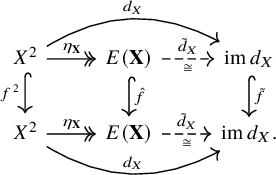
(cf. Corollary 1.4). Define $\tilde {d}_X \colon E(X)\to \operatorname {\mathrm {im}} d_X,\, [(x,y)]_{\sim _{\mathbf {X}}}\mapsto d_X(x,y)$
. Since
$\tilde {d}_X \colon E(X)\to \operatorname {\mathrm {im}} d_X,\, [(x,y)]_{\sim _{\mathbf {X}}}\mapsto d_X(x,y)$
. Since $\leqslant _{\mathbf {X}}$
is induced by
$\leqslant _{\mathbf {X}}$
is induced by $d_X$
, it is easy to see that
$d_X$
, it is easy to see that $\tilde {d}_X$
is an order isomorphism (cf. Lemma 1.5). Let
$\tilde {d}_X$
is an order isomorphism (cf. Lemma 1.5). Let  . In particular, for all $a,b\in X$
, we have
$a,b\in X$
, we have $\tilde {f}(d_X (a,b))=d_X (f(a),f(b))$
, and the following diagram commutes:
$\tilde {f}(d_X (a,b))=d_X (f(a),f(b))$
, and the following diagram commutes:
We will show that for every $\delta \in \operatorname {\mathrm {im}} d_X\setminus \{0\}$
, the restriction of
$\delta \in \operatorname {\mathrm {im}} d_X\setminus \{0\}$
, the restriction of $\tilde {f}$
to the initial segment
$\tilde {f}$
to the initial segment  is linear. Since, for any $0 < \delta < \delta ' \in \operatorname {\mathrm {im}} d_X$
, we have
$0 < \delta < \delta ' \in \operatorname {\mathrm {im}} d_X$
, we have $\{0\} \neq I(\delta ) \subseteq I(\delta ')$
, it will follow that
$\{0\} \neq I(\delta ) \subseteq I(\delta ')$
, it will follow that $\tilde {f}$
as a whole is linear; that is, f is a dilation.
$\tilde {f}$
as a whole is linear; that is, f is a dilation.
Let  . Let
. Let $a, c \in X$
with
$a, c \in X$
with $ d_X(a, c) = \delta $
, and therefore with
$ d_X(a, c) = \delta $
, and therefore with $t = \tfrac { d_X (f(a), f(c))}{ d_X (a, c)}$
. Let b be a midpoint of a and c.
$t = \tfrac { d_X (f(a), f(c))}{ d_X (a, c)}$
. Let b be a midpoint of a and c.
Let $s\in I(\delta )$
. Since
$s\in I(\delta )$
. Since $\tilde {f}(0)=0=t\cdot 0$
, we may and will assume that
$\tilde {f}(0)=0=t\cdot 0$
, we may and will assume that $s\neq 0$
. We choose recursively a sequence
$s\neq 0$
. We choose recursively a sequence $(b_n,c_n)_{n\in \mathbb {N}}$
in
$(b_n,c_n)_{n\in \mathbb {N}}$
in $X^2$
with
$X^2$
with
 $$\begin{align*}\forall n\in\mathbb{N}\,:\, s\le d_X(a,c_n), \text{ and } (a,b_n,c_n) \text{ is collinear.} \end{align*}$$
We proceed as follows:  . If
. If $(b_n,c_n)$
has been chosen, then
$(b_n,c_n)$
has been chosen, then $(b_{n+1},c_{n+1})$
is chosen according to the following cases:
$(b_{n+1},c_{n+1})$
is chosen according to the following cases:
Case 1: if $s=d_X(a,c_n)$
, then put
$s=d_X(a,c_n)$
, then put  ,
,
Case 2: if $d_X(a,b_n)<s<d_X(a,c_n)$
, then choose
$d_X(a,b_n)<s<d_X(a,c_n)$
, then choose $m\in \operatorname {\mathrm {Mid}}(b_n,c_n)$
and put
$m\in \operatorname {\mathrm {Mid}}(b_n,c_n)$
and put

Case 3: if $d_X(a,b_n)=s$
, then put
$d_X(a,b_n)=s$
, then put  ,
,
Case 4: if $0< s < d_X(a,b_n),$
then choose
$0< s < d_X(a,b_n),$
then choose $m\in \operatorname {\mathrm {Mid}}(a,b_n)$
and put
$m\in \operatorname {\mathrm {Mid}}(a,b_n)$
and put  .
.
Let us call a pair $(x,y)\in X^2$
homothetic if
$(x,y)\in X^2$
homothetic if
-
1)
$(a,x,y)$
is collinear, -
2)
$(f(a),f(x),f(y))$
is collinear, -
3)
$d_X(f(a),f(x))=t\cdot d_X(a,x),\quad d_X(f(x),f(y)) = t\cdot d_X(x,y)$
.


A straightforward induction using Remark 2.7 and Lemma 2.6 shows that for every $n\in \mathbb {N}$
, the pair
$n\in \mathbb {N}$
, the pair $(b_n,c_n)$
is homothetic. Furthermore,
$(b_n,c_n)$
is homothetic. Furthermore,
 $$\begin{align*}s = \lim_{n\to\infty} d_X(a,b_n) = \lim_{n\to\infty} d_X(a,c_n). \end{align*}$$
Note that since $s>0$
, for all but finitely many n, we have
$s>0$
, for all but finitely many n, we have $d_X(a,b_n)\le s$
.
$d_X(a,b_n)\le s$
.
Since $\tilde {f}(d_X(a,b_n)) = t\cdot d_X(a,b_n)$
and
$\tilde {f}(d_X(a,b_n)) = t\cdot d_X(a,b_n)$
and $\tilde {f}(d_X(a,c_n)) = t\cdot d_X(a,c_n)$
for all
$\tilde {f}(d_X(a,c_n)) = t\cdot d_X(a,c_n)$
for all $n\in \mathbb {N}$
, monotonicity of
$n\in \mathbb {N}$
, monotonicity of $\tilde {f}$
implies that
$\tilde {f}$
implies that $\tilde {f}(s)=t\cdot s$
, as desired.
$\tilde {f}(s)=t\cdot s$
, as desired.
What follows is an example of a metric space and an automorphism of the induced echeloned space which is not a dilation.
Example 2.9. We define a subspace X of the Euclidean line $\mathbb {R}$
as follows. Let
$\mathbb {R}$
as follows. Let $a> 2$
and
$a> 2$
and $0 < \varepsilon < \tfrac {a}{2} - 1$
. Let
$0 < \varepsilon < \tfrac {a}{2} - 1$
. Let $x_0 = 1 + \varepsilon $
and, for any
$x_0 = 1 + \varepsilon $
and, for any $k \in \mathbb {Z} \setminus \{0\}$
,
$k \in \mathbb {Z} \setminus \{0\}$
, $x_k = a^k$
. Let finally
$x_k = a^k$
. Let finally $X = \{x_k\mid k \in \mathbb {Z}\}$
be endowed with the usual Euclidean metric. Observe that X does not have midpoints since it is discrete.
$X = \{x_k\mid k \in \mathbb {Z}\}$
be endowed with the usual Euclidean metric. Observe that X does not have midpoints since it is discrete.
We claim that the shift $\sigma \colon X \rightarrow X,\, x_k \mapsto x_{k + 1}$
is an automorphism of the echelon relation
$\sigma \colon X \rightarrow X,\, x_k \mapsto x_{k + 1}$
is an automorphism of the echelon relation $\leqslant _{\mathbf {X}}$
of X. Obviously,
$\leqslant _{\mathbf {X}}$
of X. Obviously, $\sigma $
is not a dilation, since
$\sigma $
is not a dilation, since $\varepsilon \neq 0$
.
$\varepsilon \neq 0$
.
To check that it is indeed an automorphism, let us consider two distinct pairs of distinct points $\{x_k, x_\ell \}$
and
$\{x_k, x_\ell \}$
and $\{x_{k'}, x_{\ell '}\}$
. We may assume without loss of generality that
$\{x_{k'}, x_{\ell '}\}$
. We may assume without loss of generality that $k> \ell $
and
$k> \ell $
and $k'> \ell '$
, and moreover,
$k'> \ell '$
, and moreover, $k \geqslant k'$
. Two cases are to be considered:
$k \geqslant k'$
. Two cases are to be considered:
-
(i) If
$k = k'$
, then
$(x_{k'}, x_{\ell '}) \leqslant _{\mathbf {X}} (x_k, x_\ell )$
if and only if
$\ell \leqslant \ell '$
. This is obviously equivalent to
$k + 1 = k' + 1$
and
$\ell + 1 \leqslant \ell ' + 1$
, that is, to
$(\sigma (x_{k'}), \sigma (x_{\ell '})) \leqslant _{\mathbf {X}} (\sigma (x_k), \sigma (x_\ell ))$
. -
(ii) If
$k> k'$
, then necessarily
$(x_{k'}, x_{\ell '}) < (x_k, x_\ell )$
. Indeed, we have And therefore,
$$ \begin{align*} d_X (x_k, x_\ell) \geqslant d_X (x_k, x_{k - 1}) &= \begin{cases} a^{k - 1} (a - 1) & \text{if } k \neq 1, \\ a - 1 - \varepsilon & \text{if } k = 1, \end{cases} \\d_X (x_{k'}, x_{\ell'}) \leqslant x_{k'} \leqslant x_{k - 1} &= \begin{cases} a^{k - 1} & \text{if } k \neq 1, \\ 1 + \varepsilon & \text{if } k = 1. \end{cases} \end{align*} $$
$ d_X (x_k, x_\ell )> d_X (x_{k'}, x_{\ell '})$
whatever k, thanks to our choice of
$\varepsilon $
and a. Since obviously
$k + 1> k' + 1$
, the same argument would hold for the images by the shift; that is,
$(\sigma (x_{k'}), \sigma (x_{\ell '})) <_{\mathbf {X}} (\sigma (x_k), \sigma (x_\ell ))$
.


3 The Fraïssé limit of the class of finite echeloned spaces
We now turn our attention to the proof of the existence of a countable universal homogeneous echeloned space.
Proposition 3.1. The class of finite echeloned spaces has the amalgamation property.
Proof. Consider any three finite echeloned spaces $\mathbf {A}, \mathbf {B}_1, \mathbf {B}_2$
together with embeddings
$\mathbf {A}, \mathbf {B}_1, \mathbf {B}_2$
together with embeddings $f_1 \colon \mathbf {A} \hookrightarrow \mathbf {B}_1$
and
$f_1 \colon \mathbf {A} \hookrightarrow \mathbf {B}_1$
and $f_2 \colon \mathbf {A} \hookrightarrow \mathbf {B}_2$
. By Corollary 1.4, we obtain embeddings
$f_2 \colon \mathbf {A} \hookrightarrow \mathbf {B}_2$
. By Corollary 1.4, we obtain embeddings $\hat {f}_1 \colon E(\mathbf {A}) \hookrightarrow E(\mathbf {B}_1)$
and
$\hat {f}_1 \colon E(\mathbf {A}) \hookrightarrow E(\mathbf {B}_1)$
and $\hat {f}_2 \colon E(\mathbf {A}) \hookrightarrow E(\mathbf {B}_2)$
, for which the following equations hold:
$\hat {f}_2 \colon E(\mathbf {A}) \hookrightarrow E(\mathbf {B}_2)$
, for which the following equations hold:
 $$\begin{align*}\hat{f_1} \circ \eta_{\mathbf{A}} = \eta_{\mathbf{B}_1} \circ {f_1}^2 \quad \text{and} \quad \hat{f_2} \circ \eta_{\mathbf{A}} = \eta_{\mathbf{B}_2} \circ {f_2}^2.\end{align*}$$
Notice that $E(\mathbf {A})$
,
$E(\mathbf {A})$
, $E(\mathbf {B}_1)$
and
$E(\mathbf {B}_1)$
and $E(\mathbf {B}_2)$
are all (finite) linear orders. Given that the class of finite linear orders has the amalgamation property, there exist a linear order
$E(\mathbf {B}_2)$
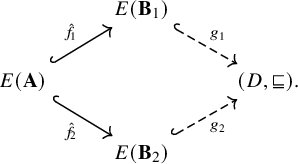
are all (finite) linear orders. Given that the class of finite linear orders has the amalgamation property, there exist a linear order $(D, \sqsubseteq )$
and embeddings
$(D, \sqsubseteq )$
and embeddings
 $$\begin{align*}{g}_1 \colon E(\mathbf{B}_1) \hookrightarrow (D, \sqsubseteq) \quad \text{and} \quad {g}_2 \colon E(\mathbf{B}_2) \hookrightarrow (D, \sqsubseteq)\end{align*}$$
for which ${g}_1 \circ \hat {f}_1 = {g}_2 \circ \hat {f}_2$
, that is, for which this diagram commutes:
${g}_1 \circ \hat {f}_1 = {g}_2 \circ \hat {f}_2$
, that is, for which this diagram commutes:
For each $i\in \{1,2\}$
, observe that
$i\in \{1,2\}$
, observe that $\min E(\mathbf {B}_i)=\hat {f}_i (\min E(\mathbf {A}))$
, and therefore, without loss of generality, we can assign
$\min E(\mathbf {B}_i)=\hat {f}_i (\min E(\mathbf {A}))$
, and therefore, without loss of generality, we can assign $g_i(\min E(\mathbf {B}_i))=\min (D, \sqsubseteq )$
. Moreover, we may assume that
$g_i(\min E(\mathbf {B}_i))=\min (D, \sqsubseteq )$
. Moreover, we may assume that $\min (D, \sqsubseteq )\neq \max (D, \sqsubseteq )$
. Now, define
$\min (D, \sqsubseteq )\neq \max (D, \sqsubseteq )$
. Now, define  and
and $\eta \colon C^2 \to (D, \sqsubseteq )$
as
$\eta \colon C^2 \to (D, \sqsubseteq )$
as
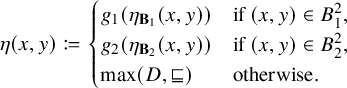
Observe that $\eta $
is well defined. Now, we define a binary relation
$\eta $
is well defined. Now, we define a binary relation $\leqslant _{\mathbf {C}}$
on
$\leqslant _{\mathbf {C}}$
on $C^2$
as follows:
$C^2$
as follows:
 $$\begin{align*}(c_1, c_2) \leqslant_{\mathbf{C}} (c_1^{\prime}, c_2^{\prime}) \quad :\Longleftrightarrow \quad \eta(c_1, c_2) \sqsubseteq \eta(c_1^{\prime}, c_2^{\prime}).\end{align*}$$
What we need to show now is that  is indeed an echeloned space. The only nontrivial point to show is axiom (ii) from Definition 1.1. Take any $c_0, c_1, c_2 \in C$
. Let us assume that
$c_0, c_1, c_2 \in C$
. Let us assume that $(c_1, c_2) \leqslant _{\mathbf {C}} (c_0, c_0)$
. Then
$(c_1, c_2) \leqslant _{\mathbf {C}} (c_0, c_0)$
. Then $\eta (c_1, c_2) \sqsubseteq \eta (c_0, c_0) = \min (D, \sqsubseteq )$
, and so
$\eta (c_1, c_2) \sqsubseteq \eta (c_0, c_0) = \min (D, \sqsubseteq )$
, and so $\eta (c_1, c_2) = \min (D, \sqsubseteq )$
. In other words,
$\eta (c_1, c_2) = \min (D, \sqsubseteq )$
. In other words, $(c_1, c_2) \in \mathbf {B}_i^2$
for some
$(c_1, c_2) \in \mathbf {B}_i^2$
for some $i \in \{1, 2\}$
. Therefore, axiom (ii) for
$i \in \{1, 2\}$
. Therefore, axiom (ii) for $\mathbf {B}_1$
or
$\mathbf {B}_1$
or $\mathbf {B}_2$
implies
$\mathbf {B}_2$
implies $c_1=c_2$
. Thus,
$c_1=c_2$
. Thus, $\mathbf {C}$
is a well-defined finite echeloned space.
$\mathbf {C}$
is a well-defined finite echeloned space.
It remains to show that the dashed arrows in the following commuting diagram are embeddings:
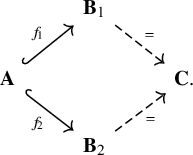
Indeed, for any choice of $b_1, b_2, b_1^{\prime }, b_2^{\prime } \in \mathbf {B}_i$
, for
$b_1, b_2, b_1^{\prime }, b_2^{\prime } \in \mathbf {B}_i$
, for $i \in \{1, 2\}$
,
$i \in \{1, 2\}$
, $(b_1, b_2) \leqslant _{\mathbf {B}_i} (b_1^{\prime }, b_2^{\prime })$
is equivalent to
$(b_1, b_2) \leqslant _{\mathbf {B}_i} (b_1^{\prime }, b_2^{\prime })$
is equivalent to $\eta _{\mathbf {B}_i} (b_1, b_2) \leqslant _{E(\mathbf {B}_i)} \eta _{\mathbf {B}_i} (b_1^{\prime }, b_2^{\prime })$
, which in turn is equivalent to
$\eta _{\mathbf {B}_i} (b_1, b_2) \leqslant _{E(\mathbf {B}_i)} \eta _{\mathbf {B}_i} (b_1^{\prime }, b_2^{\prime })$
, which in turn is equivalent to $\eta (b_1, b_2) \sqsubseteq \eta (b_1^{\prime }, b_2^{\prime })$
, that is, to
$\eta (b_1, b_2) \sqsubseteq \eta (b_1^{\prime }, b_2^{\prime })$
, that is, to $(b_1, b_2) \leqslant _{\mathbf {C}} (b_1^{\prime }, b_2^{\prime })$
. This concludes the proof.
$(b_1, b_2) \leqslant _{\mathbf {C}} (b_1^{\prime }, b_2^{\prime })$
. This concludes the proof.
Remark 3.2. The proof of Proposition 3.1 actually shows that the class of finite echeloned spaces has the strong amalgamation property (in the sense of [Reference Macpherson18, page 1602]).
Proposition 3.3. The class of finite echeloned spaces is a Fraïssé class.
Proof. What we need to show is that the class of finite echeloned spaces has the hereditary property ( $\operatorname {HP}$
), the joint embedding property (
$\operatorname {HP}$
), the joint embedding property ( $\operatorname {JEP}$
) and the amalgamation property (
$\operatorname {JEP}$
) and the amalgamation property ( $\operatorname {AP}$
), and that up to isomorphism, there exist just countably many finite echeloned spaces.
$\operatorname {AP}$
), and that up to isomorphism, there exist just countably many finite echeloned spaces.
The $\operatorname {AP}$
was already established in Proposition 3.1. With regards to establishing the
$\operatorname {AP}$
was already established in Proposition 3.1. With regards to establishing the $\operatorname {JEP}$
, observe that, by definition, an echeloned space is defined on a nonempty set. Note that the trivial one element echeloned space is embeddable into any echeloned space. Therefore, in this case, the
$\operatorname {JEP}$
, observe that, by definition, an echeloned space is defined on a nonempty set. Note that the trivial one element echeloned space is embeddable into any echeloned space. Therefore, in this case, the $\operatorname {JEP}$
follows from the
$\operatorname {JEP}$
follows from the $\operatorname {AP}$
. Any subset of an echeloned space induces an echeloned space. Thus, this class has the
$\operatorname {AP}$
. Any subset of an echeloned space induces an echeloned space. Thus, this class has the $\operatorname {HP}$
. Having been defined over a finite relational signature, it clearly has only countably many isomorphism classes.
$\operatorname {HP}$
. Having been defined over a finite relational signature, it clearly has only countably many isomorphism classes.
Proposition 3.3, together with Fraïssé’s theorem, asserts the existence of a unique (up to isomorphism) countable universal homogeneous echeloned space. We will denote this Fraïssé limit by $\mathbf {F} = (F, \leqslant _{\mathbf {F}})$
and the smallest element of its echeloning by
$\mathbf {F} = (F, \leqslant _{\mathbf {F}})$
and the smallest element of its echeloning by $\bot _{\mathbf {F}}$
.
$\bot _{\mathbf {F}}$
.
We proceed by examining the structure of $\mathbf {F}$
in more detail.
$\mathbf {F}$
in more detail.
Lemma 3.4. $E(\mathbf {F}) \cong (\mathbb {Q}^+_0, \leqslant )$
.
$E(\mathbf {F}) \cong (\mathbb {Q}^+_0, \leqslant )$
.
Proof. What we will show is that excluding $\bot _{\mathbf {F}}$
from the echeloning of
$\bot _{\mathbf {F}}$
from the echeloning of $\mathbf {F}$
leaves us with a countable dense linear order without endpoints. In other words, the original structure is isomorphic to the set of nonnegative rational numbers equipped with the natural order.
$\mathbf {F}$
leaves us with a countable dense linear order without endpoints. In other words, the original structure is isomorphic to the set of nonnegative rational numbers equipped with the natural order.
As $\mathbf {F}$
is an echeloned space,
$\mathbf {F}$
is an echeloned space, $E(\mathbf {F})$
is a linear order. Take any
$E(\mathbf {F})$
is a linear order. Take any $u_1, u_2, u_3, u_4 \in F$
such that
$u_1, u_2, u_3, u_4 \in F$
such that $(u_1, u_2) <_{\mathbf {F}} (u_3, u_4)$
. Define
$(u_1, u_2) <_{\mathbf {F}} (u_3, u_4)$
. Define  and let $\mathbf {U}$
be the echeloned subspace of
$\mathbf {U}$
be the echeloned subspace of $\mathbf {F}$
induced by U. Further, let
$\mathbf {F}$
induced by U. Further, let $v \not \in F$
be a new point and
$v \not \in F$
be a new point and  . We define an echeloned superspace of $\mathbf {U}$
on V, and call it
$\mathbf {U}$
on V, and call it $\mathbf {V}$
, for which
$\mathbf {V}$
, for which $(u_1, u_2) <_{\mathbf {V}} (v, u_i)\sim _{\mathbf {V}} (v,u_j) <_{\mathbf {V}} (u_3, u_4)$
, for any
$(u_1, u_2) <_{\mathbf {V}} (v, u_i)\sim _{\mathbf {V}} (v,u_j) <_{\mathbf {V}} (u_3, u_4)$
, for any $i,j \in \{1, 2, 3, 4\}$
.
$i,j \in \{1, 2, 3, 4\}$
.
Since $\mathbf {F}$
is homogeneous, it is also weakly homogeneous in the sense of [Reference Hodges12, p. 326]. Consequently, as
$\mathbf {F}$
is homogeneous, it is also weakly homogeneous in the sense of [Reference Hodges12, p. 326]. Consequently, as $\mathbf {F}$
is also universal, there exists
$\mathbf {F}$
is also universal, there exists $\iota \colon \mathbf {V}\to \mathbf {F}$
, such that the following diagram commutes:
$\iota \colon \mathbf {V}\to \mathbf {F}$
, such that the following diagram commutes:
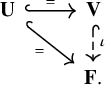
Let  . Then, $(u_1, u_2) <_{\mathbf {F}} (u_1, u_5) <_{\mathbf {F}} (u_3, u_4)$
. Thus,
$(u_1, u_2) <_{\mathbf {F}} (u_1, u_5) <_{\mathbf {F}} (u_3, u_4)$
. Thus, $E(\mathbf {F})$
is indeed dense.
$E(\mathbf {F})$
is indeed dense.
Similarly, one can prove the nonexistence of both the smallest and the greatest element of $E(\mathbf {F}) \setminus \{\bot _{\mathbf {F}}\}$
.
$E(\mathbf {F}) \setminus \{\bot _{\mathbf {F}}\}$
.
Proposition 3.5. Every metric space that induces $\leqslant _{\mathbf {F}}$
is dull (and consequently bounded and uniformly discrete).
$\leqslant _{\mathbf {F}}$
is dull (and consequently bounded and uniformly discrete).
Proof. Let $(F, d)$
be some metric space which induces
$(F, d)$
be some metric space which induces $\mathbf {F}$
. Further, let
$\mathbf {F}$
. Further, let $\varphi \colon \operatorname {\mathrm {im}} d \to E(\mathbf {F})$
be the naturally induced order-isomorphism. Define
$\varphi \colon \operatorname {\mathrm {im}} d \to E(\mathbf {F})$
be the naturally induced order-isomorphism. Define  . Recall that being dull is equivalent to $\operatorname {\mathrm {im}} d\subseteq [\tau ,2\tau ]\cup \{0\}$
(see the proof of Lemma 1.10).
$\operatorname {\mathrm {im}} d\subseteq [\tau ,2\tau ]\cup \{0\}$
(see the proof of Lemma 1.10).
Fix distinct $x_0, y_0 \in F$
. Recall that
$x_0, y_0 \in F$
. Recall that $\mathbf {F}$
is universal; thus, for any choice of distinct
$\mathbf {F}$
is universal; thus, for any choice of distinct $x, y \in F$
, there have to exist
$x, y \in F$
, there have to exist $u, v, w \in F$
such that
$u, v, w \in F$
such that
 $$\begin{align*}(u, v) \sim_{\mathbf{F}} (x, y), \quad (u, w) \sim_{\mathbf{F}} (v, w) \sim_{\mathbf{F}} (x_0, y_0).\end{align*}$$
Put differently, $ d(u, v) = c$
and
$ d(u, v) = c$
and $d(u, w) = d(v, w) = c_0$
, where
$d(u, w) = d(v, w) = c_0$
, where  and
and  :
:
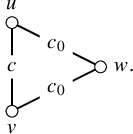
By the triangle inequality, we get $c\leqslant 2c_0$
.
$c\leqslant 2c_0$
.
Since $(x,y)$
(and hence c) was arbitrary, we have
$(x,y)$
(and hence c) was arbitrary, we have $\operatorname {\mathrm {im}} d\subseteq [0,2c_0]$
.
$\operatorname {\mathrm {im}} d\subseteq [0,2c_0]$
.
By letting $c_0$
converge to
$c_0$
converge to $\tau $
, we obtain that
$\tau $
, we obtain that $\operatorname {\mathrm {im}} d\subseteq [0,2\tau ]$
. By the definition of
$\operatorname {\mathrm {im}} d\subseteq [0,2\tau ]$
. By the definition of $\tau $
, we actually have
$\tau $
, we actually have $\operatorname {\mathrm {im}} d\subseteq \{0\}\cup [\tau ,2\tau ]$
. Hence,
$\operatorname {\mathrm {im}} d\subseteq \{0\}\cup [\tau ,2\tau ]$
. Hence, $(F, d)$
is dull.
$(F, d)$
is dull.
Corollary 3.6. $\mathbf {F}$
is not isomorphic to the echeloned space induced by the (bounded) rational Urysohn space.
$\mathbf {F}$
is not isomorphic to the echeloned space induced by the (bounded) rational Urysohn space.
Proof. As the (bounded) rational Urysohn space is not dull, it follows by Proposition 3.5 that it cannot induce $\mathbf {F}$
.
$\mathbf {F}$
.
However, the echeloned space $\mathbf {F}$
is indeed induced by a dull Urysohn space, as we now explain.
$\mathbf {F}$
is indeed induced by a dull Urysohn space, as we now explain.
Let $S = \{0\} \cup (1, 2) \cap \mathbb {Q}$
. Consider the S-Urysohn space
$S = \{0\} \cup (1, 2) \cap \mathbb {Q}$
. Consider the S-Urysohn space $\mathbf {U}_S = (U, d_{\mathbf {U}_S})$
, that is, the Fraïssé limit of all finite metric spaces with distances in S (see [Reference Sauer26, Theorem 1.4]). Let
$\mathbf {U}_S = (U, d_{\mathbf {U}_S})$
, that is, the Fraïssé limit of all finite metric spaces with distances in S (see [Reference Sauer26, Theorem 1.4]). Let $\mathbf {M} = (U, \leqslant _{\mathbf {M}})$
be the echeloned space induced on U by
$\mathbf {M} = (U, \leqslant _{\mathbf {M}})$
be the echeloned space induced on U by $ d_{\mathbf {U}_S}$
.
$ d_{\mathbf {U}_S}$
.
Proposition 3.7. The echeloned space $\mathbf {M}$
is isomorphic to
$\mathbf {M}$
is isomorphic to $\mathbf {F}$
.
$\mathbf {F}$
.
Proof. By the uniqueness of Fraïssé limits, it is enough to prove that $\mathbf {M}$
is weakly homogeneous and universal for the class of all finite echeloned spaces.
$\mathbf {M}$
is weakly homogeneous and universal for the class of all finite echeloned spaces.
-
Universality Obviously, every finite substructure of
$\mathbf {M}$
is a finite echeloned space. Conversely, let
$\mathbf {A} = (A, \leqslant _{\mathbf {A}})$
be a finite echeloned space. By Proposition 1.11, we can realize
$\leqslant _{\mathbf {A}}$
by a (dull) metric
$ d_{\mathbf {A}}$
, whose image is in
$\{0\} \cup (1, 2)$
. Since this image is finite, we can moreover assume that
$ d_{\mathbf {A}}$
only takes rational values (up to applying an order-automorphism of
$\{0\} \cup (1, 2)$
). We have therefore realized
$\mathbf {A}$
as a metric space with distances in S. By the universality of the Urysohn space
$\mathbf {U}_S$
, there exists an isometric embedding f of
$(A, d_{\mathbf {A}})$
into
$(U, d_{\mathbf {U}_S})$
. Such an embedding is also an embedding of the respective induced echeloned spaces; that is,
$\mathbf {A}$
indeed embeds into
$\mathbf {M}$
. -
Weak homogeneity Let
$\mathbf {A} =(A, \leqslant _{\mathbf {A}})$
and
$\mathbf {B} = (B, \leqslant _{\mathbf {B}})$
be two finite echeloned spaces such that
$\mathbf {A}\le \mathbf {B}$
. Let f be an embedding of
$\mathbf {A}$
into
$\mathbf {M}$
. We can realize
$\mathbf {A}$
as a metric space by using the metric inducing
$\leqslant _{\mathbf {M}}$
, that is, by defining This trivially makes f an isometric embedding of
$(A, d_{\mathbf {A}})$
into
$(U, d_{\mathbf {U}_S})$
. Now choose any metric
$ d_{\mathbf {B}}$
on B, extending
$ d_{\mathbf {A}}$
, with image in S and inducing
$\leqslant _{\mathbf {B}}$
(such a metric exists since
$\mathbf {B}$
is finite and the order of
$(1, 2) \cap \mathbb {Q}$
is dense and without minimum nor maximum). By the universality and the weak homogeneity of the Urysohn space
$\mathbf {U}_S$
, there exists an isometric embedding g of
$\mathbf {B}$
into
$\mathbf {U}_S$
such that the diagram commutes. Obviously, g is also an embedding of the induced echeloned space.


Remark 3.8. Let $\tau _1, \tau _2> 0$
and, for
$\tau _1, \tau _2> 0$
and, for $i = 1, 2$
, let
$i = 1, 2$
, let $T_i = T_i^{\prime } \cup \{0\}$
, where
$T_i = T_i^{\prime } \cup \{0\}$
, where $T_i^{\prime }$
is any countably infinite subset of
$T_i^{\prime }$
is any countably infinite subset of $(\tau _i, 2 \tau _i)$
which is order-dense and without maximum nor minimum. As shown by the above proposition, the
$(\tau _i, 2 \tau _i)$
which is order-dense and without maximum nor minimum. As shown by the above proposition, the $T_i$
-Urysohn space
$T_i$
-Urysohn space $\mathbf {U}_{T_i}$
induces the echeloned space
$\mathbf {U}_{T_i}$
induces the echeloned space $\mathbf {F}$
, independently of i. It follows that the isometry groups
$\mathbf {F}$
, independently of i. It follows that the isometry groups $\operatorname {\mathrm {Iso}}(\mathbf {U}_{T_1})$
and
$\operatorname {\mathrm {Iso}}(\mathbf {U}_{T_1})$
and $\operatorname {\mathrm {Iso}}(\mathbf {U}_{T_2})$
are isomorphic (since they are nothing but the subgroup of
$\operatorname {\mathrm {Iso}}(\mathbf {U}_{T_2})$
are isomorphic (since they are nothing but the subgroup of $\operatorname {\mathrm {Aut}}(\mathbf {F}, \leqslant _{\mathbf {F}})$
that fixes the echeloning), whereas the spaces
$\operatorname {\mathrm {Aut}}(\mathbf {F}, \leqslant _{\mathbf {F}})$
that fixes the echeloning), whereas the spaces $\mathbf {U}_{T_1}$
and
$\mathbf {U}_{T_1}$
and $\mathbf {U}_{T_2}$
are not isometric as soon as
$\mathbf {U}_{T_2}$
are not isometric as soon as $T_1 \neq T_2$
.
$T_1 \neq T_2$
.
Echeloned spaces naturally give rise to edge coloured graphs where every edge is coloured by its equivalence class in the corresponding echeloning. We describe now this graph for $\mathbf {F}$
.
$\mathbf {F}$
.
Definition 3.9. Let C be a nonempty set. A C-coloured graph $\Gamma $
is an ordered pair
$\Gamma $
is an ordered pair $(V, \chi )$
, where V is a set and
$(V, \chi )$
, where V is a set and $\chi \colon [V]^2 \to C$
(here and in the following, we adopt the standard notation that
$\chi \colon [V]^2 \to C$
(here and in the following, we adopt the standard notation that $[V]^2$
refers to the set of
$[V]^2$
refers to the set of $2$
-element subsets of V). V is called the set of vertices and
$2$
-element subsets of V). V is called the set of vertices and $\chi $
is called the edge-colouring function of
$\chi $
is called the edge-colouring function of $\Gamma $
.
$\Gamma $
.
Let us stress that C-coloured graphs are by definition complete graphs.
Definition 3.10. Let $\Gamma _1 = (V_1, \chi _1)$
and
$\Gamma _1 = (V_1, \chi _1)$
and $\Gamma _2 = (V_2, \chi _2)$
be two C-coloured graphs, where C is a fixed set of colours. Then a homomorphism from
$\Gamma _2 = (V_2, \chi _2)$
be two C-coloured graphs, where C is a fixed set of colours. Then a homomorphism from $\Gamma _1$
to
$\Gamma _1$
to $\Gamma _2$
is an injective map
$\Gamma _2$
is an injective map $f\colon V_1\to V_2$
such that
$f\colon V_1\to V_2$
such that
 $$\begin{align*}\forall \{x, y\} \in [V_1]^2\,:\, \chi_1(\{x, y\}) = \chi_2(\{f(x), f(y)\}).\end{align*}$$
Every C-coloured graph $\Gamma = (V, \chi )$
may be defined equivalently as a relational structure
$\Gamma = (V, \chi )$
may be defined equivalently as a relational structure $\mathbf {\Gamma }$
over the signature
$\mathbf {\Gamma }$
over the signature $\{\varrho _c \mid c \in C\}$
consisting solely of binary relation symbols, where
$\{\varrho _c \mid c \in C\}$
consisting solely of binary relation symbols, where  . In particular, a function $h \colon V_1 \to V_2$
is a homomorphism from
$h \colon V_1 \to V_2$
is a homomorphism from $\Gamma _1$
to
$\Gamma _1$
to $\Gamma _2$
if and only if it is a homomorphism from
$\Gamma _2$
if and only if it is a homomorphism from $\mathbf {\Gamma }_1$
to
$\mathbf {\Gamma }_1$
to $\mathbf {\Gamma }_2$
. This allows us to identify every C-coloured graph
$\mathbf {\Gamma }_2$
. This allows us to identify every C-coloured graph $\Gamma $
with its associated relational structure
$\Gamma $
with its associated relational structure $\mathbf {\Gamma }$
. We shall freely do so without any further notice.
$\mathbf {\Gamma }$
. We shall freely do so without any further notice.
What follows is a characterisation of homogeneous universal countable C-coloured graphs, for countable C, following [Reference Truss28] and [Reference Tarzi27].
Definition 3.11. Let $\Gamma = (V, \chi )$
be a C-coloured graph, and let k be a positive integer. We say that
$\Gamma = (V, \chi )$
be a C-coloured graph, and let k be a positive integer. We say that $\Gamma $
has the
$\Gamma $
has the $(\ast _k)$
-property if for any
$(\ast _k)$
-property if for any $(c_1, c_2, \ldots , c_k) \in C^k$
and any choice of k finite, pairwise disjoint subsets of V, denoted
$(c_1, c_2, \ldots , c_k) \in C^k$
and any choice of k finite, pairwise disjoint subsets of V, denoted $U_1, U_2, \ldots , U_k$
, there exists a vertex
$U_1, U_2, \ldots , U_k$
, there exists a vertex $z \in V$
such that for all
$z \in V$
such that for all $i \in \{1, 2, \dots , k\}$
and all
$i \in \{1, 2, \dots , k\}$
and all $u \in U_i$
:
$u \in U_i$
: $\chi (\{z, u\}) = c_i$
.
$\chi (\{z, u\}) = c_i$
. $\Gamma $
is said to have the
$\Gamma $
is said to have the $(\ast _\infty )$
-property if it has the
$(\ast _\infty )$
-property if it has the $(\ast _k)$
-property for all
$(\ast _k)$
-property for all $k \in \mathbb {N}^+$
.
$k \in \mathbb {N}^+$
.
Note that for every $k\in \mathbb {N}^+$
, the
$k\in \mathbb {N}^+$
, the $(\ast _{k+1})$
-property implies the
$(\ast _{k+1})$
-property implies the $(\ast _k)$
-property.
$(\ast _k)$
-property.
It is straightforward to check that the class of all finite C-coloured graphs enjoys the amalgamation property, so we obtain the following:
Lemma 3.12. Let C be a countable set of colours. Then the class of all finite C-coloured graphs is a Fraïssé class.
For every countable C, we will denote the universal homogeneous C-coloured graph, that is, the Fraïssé limit of the class of all finite C-coloured graphs, by $\mathcal {T}_C = (V_C, \chi _C)$
.
$\mathcal {T}_C = (V_C, \chi _C)$
.
Proposition 3.13. Let C be countable. Then, a countable C-coloured graph has the $(\ast _\infty )$
-property if and only if it is homogeneous and universal for the class of finite C-coloured graphs.
$(\ast _\infty )$
-property if and only if it is homogeneous and universal for the class of finite C-coloured graphs.
Proof. ‘ $\Rightarrow $
’: Let
$\Rightarrow $
’: Let $\Gamma = (V, \chi )$
be a countable C-coloured graph for which the
$\Gamma = (V, \chi )$
be a countable C-coloured graph for which the $(\ast _\infty )$
-property holds.
$(\ast _\infty )$
-property holds.
Let us start by showing that $\Gamma $
is universal. We proceed by induction on the size
$\Gamma $
is universal. We proceed by induction on the size $\ell $
of the C-coloured graph to be embedded. The empty C-coloured graph embeds to
$\ell $
of the C-coloured graph to be embedded. The empty C-coloured graph embeds to $\Gamma $
trivially. Suppose that
$\Gamma $
trivially. Suppose that $\Delta =(W,\eta )$
is a C-coloured graph of size
$\Delta =(W,\eta )$
is a C-coloured graph of size $\ell +1$
. Let
$\ell +1$
. Let $v\in W$
. Let
$v\in W$
. Let $\Delta '$
be the C-coloured subgraph of
$\Delta '$
be the C-coloured subgraph of $\Delta $
induced by
$\Delta $
induced by $W\setminus \{v\}$
, and suppose that
$W\setminus \{v\}$
, and suppose that $\Delta '$
embeds into
$\Delta '$
embeds into $\Gamma $
by an embedding
$\Gamma $
by an embedding $\iota $
. Let
$\iota $
. Let $c_1,\dots ,c_k$
be all the (pairwise distinct) colours appearing as a colour of an edge from v in
$c_1,\dots ,c_k$
be all the (pairwise distinct) colours appearing as a colour of an edge from v in $\Delta $
. For each
$\Delta $
. For each $i\in \{1,\dots ,k\}$
, let
$i\in \{1,\dots ,k\}$
, let  . Note that $\iota (U_1),\dots ,\iota (U_k)$
are pairwise disjoint. By the
$\iota (U_1),\dots ,\iota (U_k)$
are pairwise disjoint. By the $(*_{\infty })$
-property (and, therefore,
$(*_{\infty })$
-property (and, therefore, $(*_{k})$
-property), there exists a vertex
$(*_{k})$
-property), there exists a vertex $z\in V$
such that for all
$z\in V$
such that for all $i\in \{1,\dots ,k\}$
and all
$i\in \{1,\dots ,k\}$
and all $u\in \iota (U_i)\,:\, \chi (\{z,u\})=c_i$
. Hence, the map
$u\in \iota (U_i)\,:\, \chi (\{z,u\})=c_i$
. Hence, the map $\hat {\iota }\colon W\to V$
extending
$\hat {\iota }\colon W\to V$
extending $\iota $
and sending v to z is an embedding of
$\iota $
and sending v to z is an embedding of $\Delta $
into
$\Delta $
into $\Gamma $
. This finishes the proof that
$\Gamma $
. This finishes the proof that $\Gamma $
is universal. By iterating the argument above, it becomes clear that
$\Gamma $
is universal. By iterating the argument above, it becomes clear that $\Gamma $
is also weakly homogeneous in the sense of [Reference Hodges12], and hence homogeneous.
$\Gamma $
is also weakly homogeneous in the sense of [Reference Hodges12], and hence homogeneous.
‘ $\Leftarrow $
’: Consider any universal homogenous countable C-coloured graph
$\Leftarrow $
’: Consider any universal homogenous countable C-coloured graph $\Gamma = (V, \chi )$
. Fix any positive integer k and a tuple
$\Gamma = (V, \chi )$
. Fix any positive integer k and a tuple $(c_1, \dots , c_k) \in C^k$
. Then choose k finite, pairwise disjoint subsets
$(c_1, \dots , c_k) \in C^k$
. Then choose k finite, pairwise disjoint subsets $U_1, \dots , U_k$
of V. Define a finite C-coloured graph on the set of vertices
$U_1, \dots , U_k$
of V. Define a finite C-coloured graph on the set of vertices  , where $u \not \in V$
is a new vertex, with the edge-colouring function
$u \not \in V$
is a new vertex, with the edge-colouring function $\chi _2$
which maps
$\chi _2$
which maps $\{u, v\}$
to
$\{u, v\}$
to $c_i$
for any
$c_i$
for any $v \in U_i$
and
$v \in U_i$
and $\{v_1, v_2\}$
to
$\{v_1, v_2\}$
to $\chi (\{v_1, v_2\})$
for any two distinct
$\chi (\{v_1, v_2\})$
for any two distinct $v_1, v_2 \in V_2 \setminus \{u\}$
. Let
$v_1, v_2 \in V_2 \setminus \{u\}$
. Let $\Gamma _1$
be the C-coloured subgraph of
$\Gamma _1$
be the C-coloured subgraph of $\Gamma $
induced by
$\Gamma $
induced by $\bigcup \limits _{i = 1}^n U_i$
. Clearly, there exist identity embeddings
$\bigcup \limits _{i = 1}^n U_i$
. Clearly, there exist identity embeddings $\iota _1 \colon \Gamma _1 \hookrightarrow \Gamma $
and
$\iota _1 \colon \Gamma _1 \hookrightarrow \Gamma $
and $\iota _2 \colon \Gamma _1 \hookrightarrow (V_2, \chi _2)$
. Since
$\iota _2 \colon \Gamma _1 \hookrightarrow (V_2, \chi _2)$
. Since $\Gamma $
is homogeneous, it is weakly homogeneous in the sense of [Reference Hodges12]. Hence, as
$\Gamma $
is homogeneous, it is weakly homogeneous in the sense of [Reference Hodges12]. Hence, as $\Gamma $
is also universal, there exists an embedding
$\Gamma $
is also universal, there exists an embedding $f \colon (V_2, \chi _2)\to \Gamma $
for which
$f \colon (V_2, \chi _2)\to \Gamma $
for which $\iota _1 = f \circ \iota _2$
. As a result, we get that
$\iota _1 = f \circ \iota _2$
. As a result, we get that $\chi (\{f(u), f(\iota _2(v))\}) = \chi (\{f(u), \iota _1(v)\})=\chi (\{f(u), v\})=c_i$
for all
$\chi (\{f(u), f(\iota _2(v))\}) = \chi (\{f(u), \iota _1(v)\})=\chi (\{f(u), v\})=c_i$
for all $i \in \{1, \dots , k\}$
. Thus, the
$i \in \{1, \dots , k\}$
. Thus, the $(\ast _k)$
-property of
$(\ast _k)$
-property of $\Gamma $
holds.
$\Gamma $
holds.
Observation 3.14. When a C-coloured graph $\Gamma = (V, \chi )$
, for
$\Gamma = (V, \chi )$
, for $|C| = 2$
, has the
$|C| = 2$
, has the $(\ast _2)$
-property, then the graph
$(\ast _2)$
-property, then the graph $(V, E)$
, with the set of edges E defined for a fixed
$(V, E)$
, with the set of edges E defined for a fixed $c \in C$
as follows:
$c \in C$
as follows:
 $$\begin{align*}(u,v) \in E \quad :\Longleftrightarrow \quad \chi(\{u, v\}) = c, \end{align*}$$
is isomorphic to the Rado graph.
We now establish a connection between the Fraïssé limit $\mathbf {F}$
of finite echeloned spaces and the Fraïssé limit
$\mathbf {F}$
of finite echeloned spaces and the Fraïssé limit $\mathcal {T}_C$
of finite C-coloured graphs:
$\mathcal {T}_C$
of finite C-coloured graphs:
Proposition 3.15. Fix $k \in \mathbb {N}^+$
and choose pairwise distinct
$k \in \mathbb {N}^+$
and choose pairwise distinct $c_1, \dots , c_k\in E(\mathbf {F})\setminus \{\bot _{\mathbf {F}}\}$
. Define
$c_1, \dots , c_k\in E(\mathbf {F})\setminus \{\bot _{\mathbf {F}}\}$
. Define  , with $c_\ast \not \in E(\mathbf {F})$
. Then
$c_\ast \not \in E(\mathbf {F})$
. Then  is isomorphic to $\mathcal {T}_C$
, where
$\mathcal {T}_C$
, where
 $$\begin{align*}\chi \colon [F]^2 \to C,\, \{u, v\} \mapsto \begin{cases} \eta_{\mathbf{F}}(u, v)& \text{if } \eta_{\mathbf{F}}(u, v) \in \{c_1, \dots, c_k\},\\ c_\ast& \text{otherwise}. \end{cases} \end{align*}$$
Proof. By Proposition 3.13, $\Gamma _C $
is isomorphic to
$\Gamma _C $
is isomorphic to $\mathcal {T}_C$
if it has the
$\mathcal {T}_C$
if it has the $(\ast _\infty )$
-property. As
$(\ast _\infty )$
-property. As $|C| = k + 1$
, it suffices to show that
$|C| = k + 1$
, it suffices to show that $\Gamma _C$
has the
$\Gamma _C$
has the $(\ast _{k+1})$
-property. Consider thus the
$(\ast _{k+1})$
-property. Consider thus the $(k+1)$
–tuple
$(k+1)$
–tuple $(c_1, \dots , c_k, c_\ast )$
. Without loss of generality, assume
$(c_1, \dots , c_k, c_\ast )$
. Without loss of generality, assume $c_1 <_{E(\mathbf {F})} c_2 <_{E(\mathbf {F})} \dots <_{E(\mathbf {F})} c_k$
.
$c_1 <_{E(\mathbf {F})} c_2 <_{E(\mathbf {F})} \dots <_{E(\mathbf {F})} c_k$
.
Let $U_1, \dots , U_k, U_* \subseteq F$
be finite and pairwise disjoint. Set
$U_1, \dots , U_k, U_* \subseteq F$
be finite and pairwise disjoint. Set  . Further, let U be a finite superset of $U'$
such that for all
$U'$
such that for all $i \in \{1 \dots , k\}$
, there exist
$i \in \{1 \dots , k\}$
, there exist $v_1, v_2 \in U$
for which
$v_1, v_2 \in U$
for which $\chi (\{v_1, v_2\}) = c_i$
. Further, let
$\chi (\{v_1, v_2\}) = c_i$
. Further, let $w \not \in F$
be a new point,
$w \not \in F$
be a new point,  , and let $\mathbf {U}$
be the echeloned subspace of
$\mathbf {U}$
be the echeloned subspace of $\mathbf {F}$
induced by U. We define an echelon
$\mathbf {F}$
induced by U. We define an echelon $\leqslant _{\mathbf {V}}$
on V such that
$\leqslant _{\mathbf {V}}$
on V such that
-
○
$\leqslant _{\mathbf {V}} \cap ~U^2 =\ \leqslant _{\mathbf {U}} (=\ \leqslant _{\mathbf {F}} \cap ~U^2)$
, -
○ for all
$i\in \{1,\dots ,k\}$
, for any
$v_1,v_2 \in V$
such that
$\chi (\{v_1,v_2\})=c_i$
, and for all
$u\in U_i$
,
$(w, u) \sim _{\mathbf {V}} (v_1, v_2)$
, -
○ for any
$u_1,u_2 \in U_*$
and
$(x, y) \in U^2$
,
$(x, y) <_{\mathbf {V}} (w, u_1)\sim _{\mathbf {V}} (w,u_2)$
.


By the construction $\mathbf {U}$
is a subspace of
$\mathbf {U}$
is a subspace of $\mathbf {V}$
. Since
$\mathbf {V}$
. Since $\mathbf {F}$
is universal and weakly homogeneous, there exists an embedding
$\mathbf {F}$
is universal and weakly homogeneous, there exists an embedding $h \colon \mathbf {V} \hookrightarrow \mathbf {F}$
such that the following diagram commutes:
$h \colon \mathbf {V} \hookrightarrow \mathbf {F}$
such that the following diagram commutes:
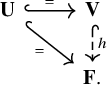
Let  . It remains to show that $\chi (\{z, u\}) = c_i$
, whenever
$\chi (\{z, u\}) = c_i$
, whenever $u \in U_i$
for any
$u \in U_i$
for any $i \in \{1, \dots , k\} \cup \{*\}$
.
$i \in \{1, \dots , k\} \cup \{*\}$
.
First, fix $i \in \{1, \dots , k\}$
and
$i \in \{1, \dots , k\}$
and $u \in U_i$
. Recall that there exist some
$u \in U_i$
. Recall that there exist some $v_1, v_2 \in U$
such that
$v_1, v_2 \in U$
such that $\chi (\{v_1, v_2\})=c_i$
. In particular, we have
$\chi (\{v_1, v_2\})=c_i$
. In particular, we have $\eta _{\mathbf {F}}(v_1, v_2) = \chi (\{v_1, v_2\}) =c_i$
. By construction, we have
$\eta _{\mathbf {F}}(v_1, v_2) = \chi (\{v_1, v_2\}) =c_i$
. By construction, we have $(w,u) \sim _{\mathbf {V}} (v_1, v_2)$
. Thus,
$(w,u) \sim _{\mathbf {V}} (v_1, v_2)$
. Thus, $(h(w), h(u)) \sim _{\mathbf {F}} (h(v_1), h(v_2))$
. By the commutativity of diagram (†), we obtain that
$(h(w), h(u)) \sim _{\mathbf {F}} (h(v_1), h(v_2))$
. By the commutativity of diagram (†), we obtain that $(z,u)\sim _{\mathbf {F}} (v_1,v_2)$
. As a result,
$(z,u)\sim _{\mathbf {F}} (v_1,v_2)$
. As a result, $\chi (\{z, u\}) = \eta _{\mathbf {F}}(z, u) = \eta _{\mathbf {F}}(v_1, v_2) = c_i$
.
$\chi (\{z, u\}) = \eta _{\mathbf {F}}(z, u) = \eta _{\mathbf {F}}(v_1, v_2) = c_i$
.
It remains to show that $\chi (\{z, u\}) = c_\ast $
for all
$\chi (\{z, u\}) = c_\ast $
for all $u \in U_*$
. Let
$u \in U_*$
. Let $u \in U_*$
be arbitrary. Then by definition of
$u \in U_*$
be arbitrary. Then by definition of $\leqslant _{\mathbf {V}}$
, we know that for
$\leqslant _{\mathbf {V}}$
, we know that for $i \in \{1, \dots , k\}$
and any
$i \in \{1, \dots , k\}$
and any $(v_1, v_2) \in U^2$
with
$(v_1, v_2) \in U^2$
with $\chi (\{v_1, v_2\}) = c_i$
, we have
$\chi (\{v_1, v_2\}) = c_i$
, we have $(v_1, v_2) <_{\mathbf {V}} (w, u)$
. We get that
$(v_1, v_2) <_{\mathbf {V}} (w, u)$
. We get that $(h(v_1), h(v_2)) <_{\mathbf {F}} (h(w), h(u))$
, and hence, by the commutativity of diagram (†),
$(h(v_1), h(v_2)) <_{\mathbf {F}} (h(w), h(u))$
, and hence, by the commutativity of diagram (†), $(v_1, v_2) <_{\mathbf {F}} (z, u)$
. In particular,
$(v_1, v_2) <_{\mathbf {F}} (z, u)$
. In particular, $\eta _{\mathbf {F}}(z, u) \not = \eta _{\mathbf {F}}(v_1, v_2) = c_i$
for any
$\eta _{\mathbf {F}}(z, u) \not = \eta _{\mathbf {F}}(v_1, v_2) = c_i$
for any $i \in \{1, \dots , k\}$
. Consequently,
$i \in \{1, \dots , k\}$
. Consequently, $\chi (\{z, u\}) = c_\ast $
.
$\chi (\{z, u\}) = c_\ast $
.
Corollary 3.16. For any $c \in E(\mathbf {F}) \setminus \{\bot _{\mathbf {F}}\}$
, the graph
$c \in E(\mathbf {F}) \setminus \{\bot _{\mathbf {F}}\}$
, the graph $(F, E)$
with the set of edges defined by
$(F, E)$
with the set of edges defined by
 $$\begin{align*}\{u, v\} \in E \quad :\Longleftrightarrow \quad \eta_{\mathbf{F}}(u, v) = c\end{align*}$$
is isomorphic to the Rado graph.
Proof. Fix a $c \in E(\mathbf {F}) \setminus \{\bot _{\mathbf {F}}\}$
and pick any
$c \in E(\mathbf {F}) \setminus \{\bot _{\mathbf {F}}\}$
and pick any $c_\ast \not \in E(\mathbf {F})$
. Define
$c_\ast \not \in E(\mathbf {F})$
. Define
 $$\begin{align*}\chi \colon [F]^2 \to \{c, c_\ast\},\, \{u, v\} \mapsto \begin{cases} c& \text{if } \eta_{\mathbf{F}}(u, v) = c,\\ c_\ast& \text{otherwise}. \end{cases} \end{align*}$$
By Proposition 3.15, $(F, \chi ) \cong \mathcal {T}_C$
, with
$(F, \chi ) \cong \mathcal {T}_C$
, with $C = \{c, c_\ast \}$
. Consequently, by Observation 3.14,
$C = \{c, c_\ast \}$
. Consequently, by Observation 3.14, $(F, E)$
is then isomorphic to the Rado graph.
$(F, E)$
is then isomorphic to the Rado graph.
Theorem 3.17. Fix  . Then, the C-coloured graph $(F, \chi )$
with
$(F, \chi )$
with
 $$\begin{align*}\chi \colon [F]^2 \to C,\quad \{u, v\} \mapsto \eta_{\mathbf{F}}(u, v) \end{align*}$$
is isomorphic to $\mathcal {T}_C$
.
$\mathcal {T}_C$
.
Proof. Fix a positive integer $k \geqslant 2$
. Pick any k colours from C and enumerate them as
$k \geqslant 2$
. Pick any k colours from C and enumerate them as $\{c_1, c_2, \dots , c_k\}$
. Also, choose any k pairwise disjoint finite sets of points
$\{c_1, c_2, \dots , c_k\}$
. Also, choose any k pairwise disjoint finite sets of points $U_1, U_2, \dots , U_k$
from F. Let
$U_1, U_2, \dots , U_k$
from F. Let $c_{k+1}\in C\setminus \{c_1,\dots , c_k\}$
. Define
$c_{k+1}\in C\setminus \{c_1,\dots , c_k\}$
. Define  and a colouring
 $$\begin{align*}\chi_{C'} \colon [F]^2 \to C',\quad \{u,v\} \mapsto \begin{cases} c_i& \text{if } \eta_{\mathbf{F}}(u, v) = c_i, i \in \{1, 2, \dots, k\},\\ c_{k+1}& \text{otherwise}. \end{cases} \end{align*}$$
By Proposition 3.15, $(F, \chi _{C'})$
is isomorphic to
$(F, \chi _{C'})$
is isomorphic to $\mathcal {T}_{C'}$
. In particular, it enjoys the
$\mathcal {T}_{C'}$
. In particular, it enjoys the $(\ast _{k})$
-property. Therefore, there exists a vertex
$(\ast _{k})$
-property. Therefore, there exists a vertex $z \in F$
such that for any
$z \in F$
such that for any $i \in \{1, 2, \dots , k\}$
,
$i \in \{1, 2, \dots , k\}$
, $\chi _{C'}(\{u, z\}) =\chi (\{u,z\})= c_i$
for all
$\chi _{C'}(\{u, z\}) =\chi (\{u,z\})= c_i$
for all $u \in U_i$
. Owing to the arbitrary choice of
$u \in U_i$
. Owing to the arbitrary choice of $U_i$
’s, we get that
$U_i$
’s, we get that $(F, \chi )$
itself has the
$(F, \chi )$
itself has the $(\ast _k)$
-property. Due to the arbitrary choice of k,
$(\ast _k)$
-property. Due to the arbitrary choice of k, $(F, \chi )$
has the
$(F, \chi )$
has the $(\ast _\infty )$
-property and so by Proposition 3.13, it is indeed isomorphic to
$(\ast _\infty )$
-property and so by Proposition 3.13, it is indeed isomorphic to $\mathcal {T}_C$
.
$\mathcal {T}_C$
.
From this point on, $\mathcal {T}_{\mathbf {F}}$
will always stand for the C-coloured graph described in Theorem 3.17.
$\mathcal {T}_{\mathbf {F}}$
will always stand for the C-coloured graph described in Theorem 3.17.
Corollary 3.18. Let $\mathbf {H}$
be a finite echeloned space. Let
$\mathbf {H}$
be a finite echeloned space. Let $\bot _{\mathbf {H}}<c_1<\cdots <c_k$
be an enumeration of
$\bot _{\mathbf {H}}<c_1<\cdots <c_k$
be an enumeration of $E(\mathbf {H})$
. Then for all
$E(\mathbf {H})$
. Then for all $d_1<\cdots <d_k\in E(\mathbf {F}) \setminus \{\bot _{\mathbf {F}}\}$
, there exists an embedding
$d_1<\cdots <d_k\in E(\mathbf {F}) \setminus \{\bot _{\mathbf {F}}\}$
, there exists an embedding $\iota \colon H\hookrightarrow F$
such that
$\iota \colon H\hookrightarrow F$
such that $\hat {\iota }(c_i)=d_i$
for all
$\hat {\iota }(c_i)=d_i$
for all $i\in \{1,\dots ,k\}$
.
$i\in \{1,\dots ,k\}$
.
Proof. Let  . Let
. Let $\Gamma $
be the C-coloured graph
$\Gamma $
be the C-coloured graph $(H,\chi )$
with
$(H,\chi )$
with $\chi (\{u,v\})=d_i$
if
$\chi (\{u,v\})=d_i$
if $\eta _{\mathbf {H}}(u,v)=c_i$
. By the universality of
$\eta _{\mathbf {H}}(u,v)=c_i$
. By the universality of $\mathcal {T}_{\mathbf {F}}$
established in Theorem 3.17, there exists an embedding
$\mathcal {T}_{\mathbf {F}}$
established in Theorem 3.17, there exists an embedding $\kappa \colon \Gamma \hookrightarrow \mathcal {T}_{\mathbf {F}}$
of C-coloured graphs. It induces an embedding
$\kappa \colon \Gamma \hookrightarrow \mathcal {T}_{\mathbf {F}}$
of C-coloured graphs. It induces an embedding $\iota \colon \mathbf {H}\hookrightarrow \mathbf {F}$
with
$\iota \colon \mathbf {H}\hookrightarrow \mathbf {F}$
with $\hat {\iota }(c_i)=d_i$
.
$\hat {\iota }(c_i)=d_i$
.
Below, we show that universal homogeneous C-coloured graphs, for countable C, can be constructed probabilistically.
Proposition 3.19. Let C be a countable set of colours, let V be a countably infinite set, and let $\mu \in \ell ^1(C)$
be a probability measure such that
$\mu \in \ell ^1(C)$
be a probability measure such that $\mu (c)> 0$
for any colour
$\mu (c)> 0$
for any colour $c \in C$
. Let
$c \in C$
. Let $\chi : [V]^2 \to C$
be a random colouring that assigns independently the colour c with probability
$\chi : [V]^2 \to C$
be a random colouring that assigns independently the colour c with probability $\mu (c)$
; that is,
$\mu (c)$
; that is,
 $$\begin{align*}\forall u,v,\,u\neq v\colon P[\chi (\{u,v\})=c]=\mu(c). \end{align*}$$
Then, with probability 1, the graph $(V,\chi )$
is isomorphic to
$(V,\chi )$
is isomorphic to $\mathcal {T}_C$
.
$\mathcal {T}_C$
.
Proof. We show that $(V,\chi )$
has the
$(V,\chi )$
has the $(\ast _\infty )$
-property with probability
$(\ast _\infty )$
-property with probability $1$
. Thus, we fix some integer
$1$
. Thus, we fix some integer $k \geqslant 2$
.
$k \geqslant 2$
.
Let $U_1,\dots ,U_k$
be disjoint finite subsets of V. Let
$U_1,\dots ,U_k$
be disjoint finite subsets of V. Let $c_1,\dots ,c_k\in C$
. Take arbitrary
$c_1,\dots ,c_k\in C$
. Take arbitrary $z\in V$
. We compute the probability that z is not eligible for the
$z\in V$
. We compute the probability that z is not eligible for the $(\ast _\infty )$
-property; that is,
$(\ast _\infty )$
-property; that is,
 $$\begin{align*}P\left[\exists j\in \{1,\dots, k\}\; \exists u\in U_j\colon \chi(\{u,z\})\neq c_j\right] = 1 - \prod_{\ell = 1}^k \mu(c_\ell)^{|U_\ell|} < 1. \end{align*}$$
Since edges are coloured independently, we have
 $$\begin{align*}P[\forall z\in V\;\exists j\in \{1,\dots, k\}\; \exists u\in U_j\colon \chi(\{u,z\})\neq c_j]=0. \end{align*}$$
There are only countably many choices for $U_j$
and
$U_j$
and $c_j$
, so
$c_j$
, so
 $$\begin{align*}P[(\ast_\infty)\text{-property fails}]=0. \end{align*}$$
Hence, our observed graph is isomorphic to $\mathcal {T}_C$
(with probability
$\mathcal {T}_C$
(with probability $1$
).
$1$
).
4 The Ramsey property
Let $\mathcal {K}$
be a class of relational structures. For
$\mathcal {K}$
be a class of relational structures. For $\mathbf {A}, \mathbf {B} \in \mathcal {K}$
, denote by
$\mathbf {A}, \mathbf {B} \in \mathcal {K}$
, denote by $\binom {\mathbf {B}}{\mathbf {A}}$
the set of all substructures of
$\binom {\mathbf {B}}{\mathbf {A}}$
the set of all substructures of $\mathbf {B}$
isomorphic to
$\mathbf {B}$
isomorphic to $\mathbf {A}$
. Then a class
$\mathbf {A}$
. Then a class $\mathcal {C}$
is a Ramsey class if for every two structures
$\mathcal {C}$
is a Ramsey class if for every two structures $\mathbf {A} \in \mathcal {C}$
and
$\mathbf {A} \in \mathcal {C}$
and $\mathbf {B} \in \mathcal {C}$
and every
$\mathbf {B} \in \mathcal {C}$
and every $k \in \mathbb {N}^+$
, there exists a structure
$k \in \mathbb {N}^+$
, there exists a structure $\mathbf {C} \in \mathcal {C}$
such that the following holds: For every partition of
$\mathbf {C} \in \mathcal {C}$
such that the following holds: For every partition of $\binom {\mathbf {C}}{\mathbf {A}}$
into k classes, there is
$\binom {\mathbf {C}}{\mathbf {A}}$
into k classes, there is $\tilde {\mathbf {B}} \in \binom {\mathbf {C}}{\mathbf {B}}$
such that
$\tilde {\mathbf {B}} \in \binom {\mathbf {C}}{\mathbf {B}}$
such that $\binom {\tilde {\mathbf {B}}}{\mathbf {A}}$
belongs to a single class of the partition. A countable relational structure
$\binom {\tilde {\mathbf {B}}}{\mathbf {A}}$
belongs to a single class of the partition. A countable relational structure $\mathcal {F}$
has the Ramsey property if
$\mathcal {F}$
has the Ramsey property if $\operatorname {Age}(\mathcal {F})$
is a Ramsey class.
$\operatorname {Age}(\mathcal {F})$
is a Ramsey class.
Naturally, the question of whether or not the class of finite echeloned spaces is a Ramsey class arises. Homogeneous structures do not necessarily have the Ramsey property. For ordered homogeneous structures, the Kechris-Pestov-Todorčević Theorem gives a necessary and sufficient criterion. It connects the Ramsey property with topological dynamics. Before stating this Theorem, let us recall some key notions:
Let G be a topological group – that is, a group equipped with a topology with respect to which both, multiplication and inverse map are continuous functions. A G-flow is a continuous action $G \times X \to X$
, where X is a nonempty compact Hausdorff space. We say that G is extremely amenable if every G-flow has a fixed point. Recall also that a structure
$G \times X \to X$
, where X is a nonempty compact Hausdorff space. We say that G is extremely amenable if every G-flow has a fixed point. Recall also that a structure $\mathbf {A}$
whose signature contains a distinguished binary relation symbol
$\mathbf {A}$
whose signature contains a distinguished binary relation symbol $\preceq $
is said to be ordered if
$\preceq $
is said to be ordered if $\preceq _{\mathbf {A}}$
is a linear order.
$\preceq _{\mathbf {A}}$
is a linear order.
Theorem 4.1 (Kechris, Pestov, Todorčević [Reference Kechris, Pestov and Todorčević15])
Let $\mathcal {K}$
be a Fraïssé class of ordered structures and let
$\mathcal {K}$
be a Fraïssé class of ordered structures and let $\mathbf {A}$
be its Fraïssé limit. Then
$\mathbf {A}$
be its Fraïssé limit. Then $\operatorname {\mathrm {Aut}}(\mathbf {A})$
is extremely amenable if and only if
$\operatorname {\mathrm {Aut}}(\mathbf {A})$
is extremely amenable if and only if $\mathcal {K}$
is Ramsey.
$\mathcal {K}$
is Ramsey.
Now, we begin our exposition by observing that the key feature of a Fraïssé class – namely, the amalgamation property – holds for our class of interest.
Proposition 4.2. The classes of ordered finite echeloned spaces and of ordered finite C-coloured graphs (for countable C) are Fraïssé classes.
Proof. The classes of finite echeloned spaces, finite C-coloured graphs and finite linear orders are all Fraïssé classes with the strong amalgamation property (for the case of finite echeloned spaces, see Remark 3.2). This immediately implies the result (see [Reference Cameron5, Section 3.9, p. 59]).
The Fraïssé limit of the class of finite ordered echeloned spaces is actually obtained from $\mathbf {F}$
by the addition of an appropriate linear order
$\mathbf {F}$
by the addition of an appropriate linear order $\preceq _{\mathbf {F}}$
isomorphic to the natural order on
$\preceq _{\mathbf {F}}$
isomorphic to the natural order on $\mathbb {Q}$
. We will denote this Fraïssé limit by
$\mathbb {Q}$
. We will denote this Fraïssé limit by $(\mathbf {F}, \preceq _{\mathbf {F}})$
.
$(\mathbf {F}, \preceq _{\mathbf {F}})$
.
Lemma 4.3. Let  . Then $(\mathcal {T}_{\mathbf {F}},\preceq _{\mathbf {F}})$
is a universal homogeneous ordered C-coloured graph.
$(\mathcal {T}_{\mathbf {F}},\preceq _{\mathbf {F}})$
is a universal homogeneous ordered C-coloured graph.
Proof. Let $(\mathbf {H},\preceq _{\mathbf {H}})$
be the ordered echeloned space whose echelon
$(\mathbf {H},\preceq _{\mathbf {H}})$
be the ordered echeloned space whose echelon $\leqslant _{\mathbf {H}}$
is defined by
$\leqslant _{\mathbf {H}}$
is defined by
 $$\begin{align*}(x,y)\leqslant_{\mathbf{H}} (u,v) \quad :\Longleftrightarrow \quad \chi_{\mathbf{H}}(\{x,y\})\leqslant \chi_{\mathbf{H}}(\{u,v\}), \end{align*}$$
from the edge colouring $\chi _{\mathbf {H}}\colon [H]^2\to C$
of a countable homogeneous ordered C-coloured graph
$\chi _{\mathbf {H}}\colon [H]^2\to C$
of a countable homogeneous ordered C-coloured graph $(H,\chi _{\mathbf {H}},\preceq _{\mathbf {H}})$
. We aim to show that
$(H,\chi _{\mathbf {H}},\preceq _{\mathbf {H}})$
. We aim to show that $(\mathbf {H}, \preceq _{\mathbf {H}})$
is a universal homogeneous ordered echeloned space. To this end, it suffices to show that
$(\mathbf {H}, \preceq _{\mathbf {H}})$
is a universal homogeneous ordered echeloned space. To this end, it suffices to show that $(\mathbf {H},\preceq _{\mathbf {H}})$
is universal and weakly homogeneous. Let
$(\mathbf {H},\preceq _{\mathbf {H}})$
is universal and weakly homogeneous. Let $(\mathbf {A},\preceq _{\mathbf {A}})$
be a finite ordered echeloned subspace of
$(\mathbf {A},\preceq _{\mathbf {A}})$
be a finite ordered echeloned subspace of $(\mathbf {H},\preceq _{\mathbf {H}})$
, let
$(\mathbf {H},\preceq _{\mathbf {H}})$
, let $(\mathbf {B},\preceq _{\mathbf {B}})$
be a finite ordered echeloned space, and let
$(\mathbf {B},\preceq _{\mathbf {B}})$
be a finite ordered echeloned space, and let $\iota \colon (\mathbf {A},\preceq _{\mathbf {A}})\hookrightarrow (\mathbf {B},\preceq _{\mathbf {B}})$
be an embedding. Note that
$\iota \colon (\mathbf {A},\preceq _{\mathbf {A}})\hookrightarrow (\mathbf {B},\preceq _{\mathbf {B}})$
be an embedding. Note that $\kappa \colon E(\mathbf {A})\setminus \{\bot _{\mathbf {A}}\}\to C,\, [(x,y)]_{\sim _{\mathbf {A}}}\mapsto \chi _{\mathbf {H}}(\{x,y\})$
is an order embedding. The same holds for
$\kappa \colon E(\mathbf {A})\setminus \{\bot _{\mathbf {A}}\}\to C,\, [(x,y)]_{\sim _{\mathbf {A}}}\mapsto \chi _{\mathbf {H}}(\{x,y\})$
is an order embedding. The same holds for $\hat \iota \colon E(\mathbf {A})\hookrightarrow E(\mathbf {B})$
. Let
$\hat \iota \colon E(\mathbf {A})\hookrightarrow E(\mathbf {B})$
. Let $\tilde \iota \colon E(\mathbf {A})\setminus \{\bot _{\mathbf {A}}\}\hookrightarrow E(\mathbf {B})\setminus \{\bot _{\mathbf {B}}\}$
be the appropriate restriction of
$\tilde \iota \colon E(\mathbf {A})\setminus \{\bot _{\mathbf {A}}\}\hookrightarrow E(\mathbf {B})\setminus \{\bot _{\mathbf {B}}\}$
be the appropriate restriction of $\hat \iota $
. Recall that C is isomorphic to
$\hat \iota $
. Recall that C is isomorphic to $\mathbb {Q}$
. In other words, it is a universal homogeneous chain. Thus, there exists an order embedding
$\mathbb {Q}$
. In other words, it is a universal homogeneous chain. Thus, there exists an order embedding $\tilde \kappa \colon E(\mathbf {B})\setminus \{\bot _{\mathbf {B}}\}\hookrightarrow C$
that makes the following diagram commutative:
$\tilde \kappa \colon E(\mathbf {B})\setminus \{\bot _{\mathbf {B}}\}\hookrightarrow C$
that makes the following diagram commutative:
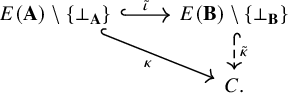
Next we define
 $$ \begin{align*} \chi_{\mathbf{A}}&\colon [A]^2\to C, & \{x,y\} &\mapsto \kappa(\eta_{\mathbf{A}}(x,y)) = \chi_{\mathbf{H}}(\{x,y\}),\\ \chi_{\mathbf{B}}&\colon [B]^2\to C, & \{u,v\}&\mapsto \tilde\kappa(\eta_{\mathbf{B}}(u,v)). \end{align*} $$
Then $\iota \colon (A,\chi _{\mathbf {A}},\preceq _{\mathbf {A}})\to (B,\chi _{\mathbf {B}},\preceq _{\mathbf {B}})$
is an embedding of ordered C-coloured graphs. Indeed,
$\iota \colon (A,\chi _{\mathbf {A}},\preceq _{\mathbf {A}})\to (B,\chi _{\mathbf {B}},\preceq _{\mathbf {B}})$
is an embedding of ordered C-coloured graphs. Indeed, $\iota $
preserves
$\iota $
preserves $\preceq $
, and
$\preceq $
, and
 $$ \begin{align*} \forall \{x,y\}\in[A]^2\,:\, \chi_{\mathbf{B}}(\{\iota(x),\iota(y)\}) & = \tilde\kappa (\eta_{\mathbf{B}}(\iota(x),\iota(y)))\\ &= \tilde\kappa(\tilde\iota(\eta_{\mathbf{A}}(x,y))) = \kappa(\eta_{\mathbf{A}}(x,y)) = \chi_{\mathbf{A}}(\{x,y\}). \end{align*} $$
Next, note that $(A,\chi _{\mathbf {A}},\preceq _{\mathbf {A}})$
is an ordered C-coloured subgraph of
$(A,\chi _{\mathbf {A}},\preceq _{\mathbf {A}})$
is an ordered C-coloured subgraph of $(H,\chi _{\mathbf {H}},\preceq _{\mathbf {H}})$
. Indeed,
$(H,\chi _{\mathbf {H}},\preceq _{\mathbf {H}})$
. Indeed, $A\subseteq H$
,
$A\subseteq H$
, ${\preceq _{\mathbf {A}}}\subseteq {\preceq _{\mathbf {H}}}$
, and
${\preceq _{\mathbf {A}}}\subseteq {\preceq _{\mathbf {H}}}$
, and
 $$\begin{align*}\forall\{x,y\}\in[A]^2\,:\, \chi_{\mathbf{A}}(\{x,y\}) = \kappa(\eta_{\mathbf{H}}(x,y)) = \chi_{\mathbf{H}}(\{x,y\}), \end{align*}$$
by the definition of $\kappa $
.
$\kappa $
.
Since $(H,\chi _{\mathbf {H}},\preceq _{\mathbf {H}})$
is universal and weakly homogeneous, there exists
$(H,\chi _{\mathbf {H}},\preceq _{\mathbf {H}})$
is universal and weakly homogeneous, there exists $\varepsilon \colon (B,\chi _{\mathbf {B}},\preceq _{\mathbf {B}})\hookrightarrow (H,\chi _{\mathbf {H}},\preceq _{\mathbf {H}})$
, such that the following diagram commutes:
$\varepsilon \colon (B,\chi _{\mathbf {B}},\preceq _{\mathbf {B}})\hookrightarrow (H,\chi _{\mathbf {H}},\preceq _{\mathbf {H}})$
, such that the following diagram commutes:
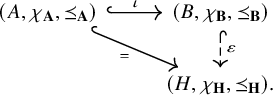
We claim that $\varepsilon \colon (\mathbf {B},\preceq _{\mathbf {B}})\to (\mathbf {H},\preceq _{\mathbf {H}})$
is an embedding. Clearly,
$\varepsilon \colon (\mathbf {B},\preceq _{\mathbf {B}})\to (\mathbf {H},\preceq _{\mathbf {H}})$
is an embedding. Clearly, $\varepsilon \colon (B,\preceq _{\mathbf {B}})\hookrightarrow (H,\preceq _{\mathbf {H}})$
is an order embedding. So let
$\varepsilon \colon (B,\preceq _{\mathbf {B}})\hookrightarrow (H,\preceq _{\mathbf {H}})$
is an order embedding. So let $(x,y)\leqslant _{\mathbf {B}}(u,v)$
. If
$(x,y)\leqslant _{\mathbf {B}}(u,v)$
. If $x=y$
, then
$x=y$
, then $\varepsilon (x)=\varepsilon (y)$
, and thus,
$\varepsilon (x)=\varepsilon (y)$
, and thus, $(\varepsilon (x),\varepsilon (y))\leqslant _{\mathbf {H}}(\varepsilon (u),\varepsilon (v))$
. If, however,
$(\varepsilon (x),\varepsilon (y))\leqslant _{\mathbf {H}}(\varepsilon (u),\varepsilon (v))$
. If, however, $x\neq y$
, then we compute
$x\neq y$
, then we compute
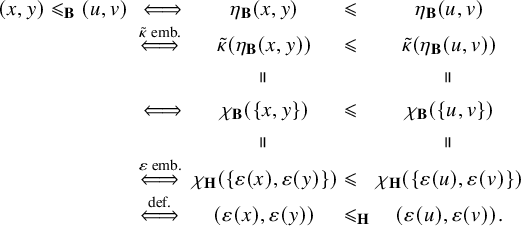
From (4.1), we obtain that
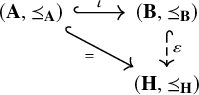
commutes. This shows that $(\mathbf {H},\preceq _{\mathbf {H}})$
is universal and weakly homogeneous.
$(\mathbf {H},\preceq _{\mathbf {H}})$
is universal and weakly homogeneous.
By the uniqueness of Fraïssé limits, there exists an isomorphism $\varphi \colon (\mathbf {F},\preceq _{\mathbf {F}})\to (\mathbf {H},\preceq _{\mathbf {H}})$
. Since
$\varphi \colon (\mathbf {F},\preceq _{\mathbf {F}})\to (\mathbf {H},\preceq _{\mathbf {H}})$
. Since
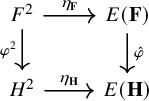
commutes, by the definition of $\chi _{\mathbf {F}}$
and
$\chi _{\mathbf {F}}$
and $\chi _{\mathbf {H}}$
, also the following diagram commutes:
$\chi _{\mathbf {H}}$
, also the following diagram commutes:
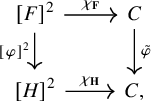
where $[\varphi ]^2\colon \{x,y\}\mapsto \{\varphi (x),\varphi (y)\}$
, and where
$[\varphi ]^2\colon \{x,y\}\mapsto \{\varphi (x),\varphi (y)\}$
, and where $\tilde \varphi $
is the appropriate restriction of
$\tilde \varphi $
is the appropriate restriction of $\hat \varphi $
to C.
$\hat \varphi $
to C.
However, this means that $(\mathcal {T}_{\mathbf {F}},\preceq _{\mathbf {F}})$
and
$(\mathcal {T}_{\mathbf {F}},\preceq _{\mathbf {F}})$
and $(H,\chi _{\mathbf {H}},\preceq _{\mathbf {H}})$
are practically equal, up to names of vertices and names of colours. In other words,
$(H,\chi _{\mathbf {H}},\preceq _{\mathbf {H}})$
are practically equal, up to names of vertices and names of colours. In other words, $(\mathcal {T}_{\mathbf {F}},\preceq _{\mathbf {F}})$
is a universal homogeneous C-coloured graph, too.
$(\mathcal {T}_{\mathbf {F}},\preceq _{\mathbf {F}})$
is a universal homogeneous C-coloured graph, too.
Lemma 4.4. $\operatorname {\mathrm {Aut}}(\mathcal {T}_{\mathbf {F}}, \preceq _{\mathbf {F}})$
is extremely amenable.
$\operatorname {\mathrm {Aut}}(\mathcal {T}_{\mathbf {F}}, \preceq _{\mathbf {F}})$
is extremely amenable.
Proof. By Theorem 4.1, it suffices to prove that the class of finite ordered C-coloured graphs is Ramsey. In order to show this, we consider the class of all finite ordered C-coloured graphs, where  . Let
. Let $c\in C$
.
$c\in C$
.
Note that there exists a canonical bijection $\Phi $
between the class of all ordered C-coloured graphs and all ordered
$\Phi $
between the class of all ordered C-coloured graphs and all ordered $C\setminus \{c\}$
-edge-coloured (simple) graphs such that, for all ordered C-coloured graphs
$C\setminus \{c\}$
-edge-coloured (simple) graphs such that, for all ordered C-coloured graphs $\mathbf {A}$
and
$\mathbf {A}$
and $\mathbf {B}$
,
$\mathbf {B}$
,
-
(i)
$\Phi (\mathbf {A})$
has the same vertex set as
$\mathbf {A}$
, and -
(ii) the set of embeddings from
$\mathbf {A}$
to
$\mathbf {B}$
coincides with the set of embeddings from
$\Phi (\mathbf {A})$
to
$\Phi (\mathbf {B})$
.


In particular, $\Phi (\mathbf {A})$
is obtained from
$\Phi (\mathbf {A})$
is obtained from $\mathbf {A}$
through replacing all c-coloured edges by non-edges.
$\mathbf {A}$
through replacing all c-coloured edges by non-edges.
Clearly, the class of finite $C\setminus \{c\}$
-edge-coloured graphs has the free amalgamation property (in the sense of [Reference Macpherson18, page 1602]); thus, the class of finite ordered
$C\setminus \{c\}$
-edge-coloured graphs has the free amalgamation property (in the sense of [Reference Macpherson18, page 1602]); thus, the class of finite ordered $C\setminus \{c\}$
-edge-coloured graphs is a Ramsey class, by a result of Hubička and Nešetril [Reference Hubička and Nešetřil14, Corollary 4.2, p. 51].
$C\setminus \{c\}$
-edge-coloured graphs is a Ramsey class, by a result of Hubička and Nešetril [Reference Hubička and Nešetřil14, Corollary 4.2, p. 51].
Thanks to the properties of $\Phi $
(
$\Phi $
( $\Phi $
is an isomorphism between the category of C-coloured graphs with embeddings and the category of
$\Phi $
is an isomorphism between the category of C-coloured graphs with embeddings and the category of $C\setminus \{c\}$
-edge-coloured graphs with embeddings), the class of finite ordered C-coloured graphs is Ramsey, too. So
$C\setminus \{c\}$
-edge-coloured graphs with embeddings), the class of finite ordered C-coloured graphs is Ramsey, too. So $\operatorname {\mathrm {Aut}} (\mathcal {T}_{\mathbf {F}},\preceq _{\mathbf {F}})$
is extremely amenable due to Theorem 4.1.
$\operatorname {\mathrm {Aut}} (\mathcal {T}_{\mathbf {F}},\preceq _{\mathbf {F}})$
is extremely amenable due to Theorem 4.1.
For the notation used in the following lemma, see Corollary 1.4.
Lemma 4.5. Let $\beta $
be a local isomorphism of
$\beta $
be a local isomorphism of $E(\mathbf {F})\setminus \{\bot _{\mathbf {F}}\}$
, with
$E(\mathbf {F})\setminus \{\bot _{\mathbf {F}}\}$
, with  . Then, there exists an automorphism $\alpha $
of
$\alpha $
of $(\mathbf {F}, \preceq _{\mathbf {F}})$
such that
$(\mathbf {F}, \preceq _{\mathbf {F}})$
such that $\hat {\alpha }\mathord {\upharpoonright }_{T} = \beta $
.
$\hat {\alpha }\mathord {\upharpoonright }_{T} = \beta $
.
Proof. Recall from Lemma 4.3 that $(\mathcal {T}_{\mathbf {F}},\preceq _{\mathbf {F}}) = (F,\chi ,\preceq _{\mathbf {F}})$
is a universal homogeneous ordered C-coloured graph, where
$(\mathcal {T}_{\mathbf {F}},\preceq _{\mathbf {F}}) = (F,\chi ,\preceq _{\mathbf {F}})$
is a universal homogeneous ordered C-coloured graph, where  . Denote the elements of $\operatorname {\mathrm {dom}}\beta $
by
$\operatorname {\mathrm {dom}}\beta $
by $c_1,\dots ,c_k$
and let
$c_1,\dots ,c_k$
and let  for each $i\in \{1,\dots ,k\}$
. Let
$i\in \{1,\dots ,k\}$
. Let $c_\ast \in C$
be strictly greater than any element of
$c_\ast \in C$
be strictly greater than any element of $\{c_1,\dots ,c_k,c_{k+1},\dots ,c_{2k}\}$
. Consider the ordered C-coloured graphs
$\{c_1,\dots ,c_k,c_{k+1},\dots ,c_{2k}\}$
. Consider the ordered C-coloured graphs $(\Delta ,\preceq _\Delta )=(D,\chi _{\Delta },\preceq _\Delta )$
and
$(\Delta ,\preceq _\Delta )=(D,\chi _{\Delta },\preceq _\Delta )$
and $(\tilde \Delta ,\preceq _{\tilde \Delta })=(\tilde {D},\chi _{\tilde \Delta },\preceq _{\tilde \Delta })$
given by
$(\tilde \Delta ,\preceq _{\tilde \Delta })=(\tilde {D},\chi _{\tilde \Delta },\preceq _{\tilde \Delta })$
given by
-
○
$D=\{v_1,\dots ,v_{k}\}\mathrel {\dot \cup } \{w_1,\dots ,w_{k}\}$
,
$v_1\preceq _\Delta \dots \preceq _\Delta v_k\preceq _\Delta w_1\preceq _\Delta \dots \preceq _\Delta w_k$
, and -
○
$\chi _{\Delta }(\{x,y\})=\begin {cases} c_i & \text {if } \{x,y\}=\{v_i,w_i\} \text { for some } i\in \{1,\dots ,k\},\\ c_\ast & \text {else}. \end {cases}$
-
○
$\tilde {D}=\{\tilde {v}_1,\dots ,\tilde {v}_{k}\}\mathrel {\dot \cup } \{\tilde {w}_1,\dots ,\tilde {w}_{k}\}$
,
$\tilde {v}_1\preceq _\Delta \dots \preceq _\Delta \tilde {v}_k\preceq _\Delta \tilde {w}_1\preceq _\Delta \dots \preceq _\Delta \tilde {w}_k$
, and -
○
$\chi _{\tilde \Delta }(\{x,y\})=\begin {cases} c_{k+i} & \text {if } \{x,y\}=\{\tilde {v}_i,\tilde {w}_i\} \text { for some } i\in \{1,\dots ,k\},\\ c_\ast & \text {else}. \end {cases}$


Since $(\mathcal {T}_{\mathbf {F}},\preceq _{\mathbf {F}})$
is universal, both
$(\mathcal {T}_{\mathbf {F}},\preceq _{\mathbf {F}})$
is universal, both $(\Delta ,\preceq _\Delta )$
and
$(\Delta ,\preceq _\Delta )$
and $(\tilde \Delta ,\preceq _{\tilde \Delta })$
embed into it. Without loss of generality, we may assume that
$(\tilde \Delta ,\preceq _{\tilde \Delta })$
embed into it. Without loss of generality, we may assume that $(\Delta ,\preceq _\Delta )$
and
$(\Delta ,\preceq _\Delta )$
and $(\tilde \Delta ,\preceq _{\tilde \Delta })$
are substructures of
$(\tilde \Delta ,\preceq _{\tilde \Delta })$
are substructures of $(\mathcal {T}_{\mathbf {F}},\preceq _{\mathbf {F}})$
. Consider
$(\mathcal {T}_{\mathbf {F}},\preceq _{\mathbf {F}})$
. Consider
 $$\begin{align*}\varphi\colon D\to F \text{ given by } v_i\mapsto\tilde{v}_i,\, w_i\mapsto\tilde{w}_i,\, i=1,\dots, k. \end{align*}$$
We claim that $\varphi $
is an embedding of the ordered echeloned space
$\varphi $
is an embedding of the ordered echeloned space  into
into $(\mathbf {F},\preceq _{\mathbf {F}})$
. Clearly,
$(\mathbf {F},\preceq _{\mathbf {F}})$
. Clearly, $\varphi $
is an order-embedding from
$\varphi $
is an order-embedding from $(D,\preceq _\Delta )$
into
$(D,\preceq _\Delta )$
into $(F,\preceq _{\mathbf {F}})$
. Let
$(F,\preceq _{\mathbf {F}})$
. Let $(x,y),(u,v)\in D^2$
. Then
$(x,y),(u,v)\in D^2$
. Then

By the homogeneity of $(\mathbf {F},\preceq _{\mathbf {F}})$
, there exists an automorphism
$(\mathbf {F},\preceq _{\mathbf {F}})$
, there exists an automorphism $\alpha $
of
$\alpha $
of $(\mathbf {F},\preceq _{\mathbf {F}})$
that makes the following diagram commutative:
$(\mathbf {F},\preceq _{\mathbf {F}})$
that makes the following diagram commutative:

From the previous calculations, it is clear that $\hat \alpha \mathord {\upharpoonright }_T=\beta $
.
$\hat \alpha \mathord {\upharpoonright }_T=\beta $
.
Prior to stating and proving the main result of this section, we recall a natural family of topological groups. Let X be a set. Then the corresponding full symmetric group $\operatorname {Sym}(X)$
, that is, the group of all self-bijections of X, together with the topology of pointwise convergence associated with the discrete topology on X is a topological group. In turn, if G is a subgroup of
$\operatorname {Sym}(X)$
, that is, the group of all self-bijections of X, together with the topology of pointwise convergence associated with the discrete topology on X is a topological group. In turn, if G is a subgroup of $\operatorname {Sym}(X)$
, then G, endowed with the relative topology inherited from
$\operatorname {Sym}(X)$
, then G, endowed with the relative topology inherited from $\operatorname {Sym}(X)$
, is a topological group, and the sets of the form
$\operatorname {Sym}(X)$
, is a topological group, and the sets of the form

constitute a neighborhood basis at the identity in G. If X is countable, then $\operatorname {Sym}(X)$
, as well as any of its closed topological subgroups, is Polish.
$\operatorname {Sym}(X)$
, as well as any of its closed topological subgroups, is Polish.
The proof of the following result will make use of Theorem 4.1 along with the persistence of extreme amenability of topological groups under extensions (see [Reference Pestov22, Corollary 6.2.10]).
Theorem 4.6. $(\mathbf {F}, \preceq _{\mathbf {F}})$
has the Ramsey property.
$(\mathbf {F}, \preceq _{\mathbf {F}})$
has the Ramsey property.
Proof. Due to Theorem 4.1, $(\mathbf {F}, \preceq _{\mathbf {F}})$
has the Ramsey property if and only if
$(\mathbf {F}, \preceq _{\mathbf {F}})$
has the Ramsey property if and only if $\operatorname {\mathrm {Aut}} (\mathbf {F}, \preceq _{\mathbf {F}})$
is extremely amenable.
$\operatorname {\mathrm {Aut}} (\mathbf {F}, \preceq _{\mathbf {F}})$
is extremely amenable.
Let  . Let
. Let $\mathcal {T}_{\mathbf {F}}=(F,\chi )$
be the C-coloured graph constructed in Proposition 3.17. Recall that
$\mathcal {T}_{\mathbf {F}}=(F,\chi )$
be the C-coloured graph constructed in Proposition 3.17. Recall that $(\mathbf {F},\preceq _{\mathbf {F}})$
is the Fraïssé limit of the class of finite ordered echeloned spaces. Therefore,
$(\mathbf {F},\preceq _{\mathbf {F}})$
is the Fraïssé limit of the class of finite ordered echeloned spaces. Therefore, $\operatorname {\mathrm {Aut}}(\mathcal {T}_{\mathbf {F}}, \preceq _{\mathbf {F}})$
is a subgroup of
$\operatorname {\mathrm {Aut}}(\mathcal {T}_{\mathbf {F}}, \preceq _{\mathbf {F}})$
is a subgroup of $\operatorname {\mathrm {Aut}}(\mathbf {F}, \preceq _{\mathbf {F}})$
– namely, the one of automorphisms that setwise preserve each equivalence class of
$\operatorname {\mathrm {Aut}}(\mathbf {F}, \preceq _{\mathbf {F}})$
– namely, the one of automorphisms that setwise preserve each equivalence class of $\sim _{\mathbf {F}}$
. Let
$\sim _{\mathbf {F}}$
. Let $\pi \colon \operatorname {\mathrm {Aut}}(\mathbf {F}, \preceq _{\mathbf {F}}) \to \operatorname {\mathrm {Aut}}(E(\mathbf {F})) ,\, \alpha \mapsto \hat {\alpha }$
. Clearly,
$\pi \colon \operatorname {\mathrm {Aut}}(\mathbf {F}, \preceq _{\mathbf {F}}) \to \operatorname {\mathrm {Aut}}(E(\mathbf {F})) ,\, \alpha \mapsto \hat {\alpha }$
. Clearly, $\ker (\pi ) = \operatorname {\mathrm {Aut}}(\mathcal {T}_{\mathbf {F}}, \preceq _{\mathbf {F}})$
, which is extremely amenable by Lemma 4.4.
$\ker (\pi ) = \operatorname {\mathrm {Aut}}(\mathcal {T}_{\mathbf {F}}, \preceq _{\mathbf {F}})$
, which is extremely amenable by Lemma 4.4.
Claim 1. ${\pi }$
is continuous.
${\pi }$
is continuous.
Proof of the claim
It suffices to note that, for every $c \in E(\mathbf {F})$
, we have
$c \in E(\mathbf {F})$
, we have $\pi [V_{\operatorname {\mathrm {Aut}}(\mathbf {F}, \preceq _{\mathbf {F}})}(\{x,y\})] \subseteq V_{\operatorname {\mathrm {Aut}}(E(\mathbf {F}))}(\{c\})$
, where
$\pi [V_{\operatorname {\mathrm {Aut}}(\mathbf {F}, \preceq _{\mathbf {F}})}(\{x,y\})] \subseteq V_{\operatorname {\mathrm {Aut}}(E(\mathbf {F}))}(\{c\})$
, where $x,y\in F$
such that
$x,y\in F$
such that $\eta _{\mathbf {F}}(x,y)=c$
.
$\eta _{\mathbf {F}}(x,y)=c$
.
Claim 2. ${\pi }$
is open onto its image.
${\pi }$
is open onto its image.
Proof of the claim
As $\pi $
is a homomorphism, it is enough to show that, for every finite subset E of F, there exists a finite subset
$\pi $
is a homomorphism, it is enough to show that, for every finite subset E of F, there exists a finite subset $\tilde {E}$
of
$\tilde {E}$
of $E(\mathbf {F})$
such that
$E(\mathbf {F})$
such that
 $$\begin{align*}\pi[\operatorname{\mathrm{Aut}}(\mathbf{F}, \preceq_{\mathbf{F}})] \cap V_{\operatorname{\mathrm{Aut}}(E(\mathbf{F}))}(\tilde{E}) \subseteq \pi[V_{\operatorname{\mathrm{Aut}}(\mathbf{F}, \preceq_{\mathbf{F}})}(E)].\end{align*}$$
Let E be a finite subset of F. Define  . Let
. Let $\gamma \in \pi [\operatorname {\mathrm {Aut}}(\mathbf {F}, \preceq _{\mathbf {F}})] \cap V_{\operatorname {\mathrm {Aut}}(E(\mathbf {F}))}(\tilde {E})$
. There then exists some
$\gamma \in \pi [\operatorname {\mathrm {Aut}}(\mathbf {F}, \preceq _{\mathbf {F}})] \cap V_{\operatorname {\mathrm {Aut}}(E(\mathbf {F}))}(\tilde {E})$
. There then exists some $\alpha _{0} \in \operatorname {\mathrm {Aut}}(\mathbf {F}, \preceq _{\mathbf {F}})$
with
$\alpha _{0} \in \operatorname {\mathrm {Aut}}(\mathbf {F}, \preceq _{\mathbf {F}})$
with $\pi (\alpha _{0}) = \gamma $
. From
$\pi (\alpha _{0}) = \gamma $
. From $\pi (\alpha _{0}) = \gamma \in V_{\operatorname {\mathrm {Aut}}(E(\mathbf {F}))}(\tilde {E})$
, we infer that
$\pi (\alpha _{0}) = \gamma \in V_{\operatorname {\mathrm {Aut}}(E(\mathbf {F}))}(\tilde {E})$
, we infer that $E \to \alpha _{0}[E], \, x \mapsto \alpha _{0}(x)$
is a local isomorphism in
$E \to \alpha _{0}[E], \, x \mapsto \alpha _{0}(x)$
is a local isomorphism in $(\mathcal {T}_{\mathbf {F}},\preceq _{\mathbf {F}})$
. Since
$(\mathcal {T}_{\mathbf {F}},\preceq _{\mathbf {F}})$
. Since $(\mathcal {T}_{\mathbf {F}},\preceq _{\mathbf {F}})$
is homogeneous by Lemma 4.3, there exists
$(\mathcal {T}_{\mathbf {F}},\preceq _{\mathbf {F}})$
is homogeneous by Lemma 4.3, there exists $\alpha _{1} \in \operatorname {\mathrm {Aut}}(\mathcal {T}_{\mathbf {F}},\preceq _{\mathbf {F}})$
such that
$\alpha _{1} \in \operatorname {\mathrm {Aut}}(\mathcal {T}_{\mathbf {F}},\preceq _{\mathbf {F}})$
such that $\alpha _{1}\mathord {\upharpoonright }_{E} = \alpha _{0}\mathord {\upharpoonright }_{E}$
. We see that
$\alpha _{1}\mathord {\upharpoonright }_{E} = \alpha _{0}\mathord {\upharpoonright }_{E}$
. We see that  . Moreover, as $\alpha _{1} \in \operatorname {\mathrm {Aut}}(\mathcal {T}_{\mathbf {F}},\preceq _{\mathbf {F}})$
, one has
$\alpha _{1} \in \operatorname {\mathrm {Aut}}(\mathcal {T}_{\mathbf {F}},\preceq _{\mathbf {F}})$
, one has $\pi (\alpha _{1}) = \mathrm {id}_{E(\mathbf {F})}$
, so that
$\pi (\alpha _{1}) = \mathrm {id}_{E(\mathbf {F})}$
, so that $\pi (\beta ) = \pi (\alpha _{1})^{-1}\pi (\alpha _{0}) = \pi (\alpha _{0}) = \gamma $
. Hence,
$\pi (\beta ) = \pi (\alpha _{1})^{-1}\pi (\alpha _{0}) = \pi (\alpha _{0}) = \gamma $
. Hence, $\gamma = \pi (\beta ) \in \pi [V_{\operatorname {\mathrm {Aut}}(\mathbf {F}, \preceq _{\mathbf {F}})}(E)]$
, as desired.
$\gamma = \pi (\beta ) \in \pi [V_{\operatorname {\mathrm {Aut}}(\mathbf {F}, \preceq _{\mathbf {F}})}(E)]$
, as desired.
Claim 3. $\pi $
is surjective.
$\pi $
is surjective.
Proof of the claim
We first observe that $\pi [\operatorname {\mathrm {Aut}}(\mathbf {F}, \preceq _{\mathbf {F}})]$
is dense in
$\pi [\operatorname {\mathrm {Aut}}(\mathbf {F}, \preceq _{\mathbf {F}})]$
is dense in $\operatorname {\mathrm {Aut}}(E(\mathbf {F}))$
with respect to the topology of pointwise convergence. Indeed, for any
$\operatorname {\mathrm {Aut}}(E(\mathbf {F}))$
with respect to the topology of pointwise convergence. Indeed, for any $\beta \in \operatorname {\mathrm {Aut}}(E(\mathbf {F}))$
and any finite subset
$\beta \in \operatorname {\mathrm {Aut}}(E(\mathbf {F}))$
and any finite subset $E_0$
of
$E_0$
of $E(\mathbf {F})$
, there exists an
$E(\mathbf {F})$
, there exists an $\alpha \in \operatorname {\mathrm {Aut}}(\mathbf {F}, \preceq _{\mathbf {F}})$
such that
$\alpha \in \operatorname {\mathrm {Aut}}(\mathbf {F}, \preceq _{\mathbf {F}})$
such that $\pi (\alpha )\mathord {\upharpoonright }_{E_0} = \hat {\alpha } \mathord {\upharpoonright }_{E_0} = \beta \mathord {\upharpoonright }_{E_0}$
, thanks to Lemma 4.5.
$\pi (\alpha )\mathord {\upharpoonright }_{E_0} = \hat {\alpha } \mathord {\upharpoonright }_{E_0} = \beta \mathord {\upharpoonright }_{E_0}$
, thanks to Lemma 4.5.
Now, by Claims 1 and 2, the topological subgroup $\pi [\operatorname {\mathrm {Aut}}(\mathbf {F}, \preceq _{\mathbf {F}})]$
of
$\pi [\operatorname {\mathrm {Aut}}(\mathbf {F}, \preceq _{\mathbf {F}})]$
of $\operatorname {\mathrm {Aut}}(E(\mathbf {F}))$
is actually isomorphic to the quotient of the Polish group
$\operatorname {\mathrm {Aut}}(E(\mathbf {F}))$
is actually isomorphic to the quotient of the Polish group $\operatorname {\mathrm {Aut}}(\mathbf {F}, \preceq _{\mathbf {F}})$
by the closed normal subgroup
$\operatorname {\mathrm {Aut}}(\mathbf {F}, \preceq _{\mathbf {F}})$
by the closed normal subgroup $\ker (\pi )$
. It is therefore itself a Polish group (see, for example, [Reference Becker and Kechris1, Proposition 1.2.3]) and thus closed in
$\ker (\pi )$
. It is therefore itself a Polish group (see, for example, [Reference Becker and Kechris1, Proposition 1.2.3]) and thus closed in $\operatorname {\mathrm {Aut}}(E(\mathbf {F}))$
(see, for example, [Reference Becker and Kechris1, Proposition 1.2.1]). Hence, it is equal to
$\operatorname {\mathrm {Aut}}(E(\mathbf {F}))$
(see, for example, [Reference Becker and Kechris1, Proposition 1.2.1]). Hence, it is equal to $\operatorname {\mathrm {Aut}}(E(\mathbf {F}))$
; that is,
$\operatorname {\mathrm {Aut}}(E(\mathbf {F}))$
; that is, $\pi $
is surjective.
$\pi $
is surjective.
(Note that the previous argument does not actually rely on the separability assumption behind the definition of a Polish space. Indeed, the quotient of a metrizable group, complete for its upper uniform structure, is again complete for its upper uniform structure [Reference Brown3, Corollary 2, p. 27] (see also [Reference Brown4, Theorem 2]) and therefore closed in any group in which it topologically embeds [Reference Roelcke and Dierolf25, 3.24].)
It follows by these three claims that the group $\operatorname {\mathrm {Aut}}(\mathbf {F}, \preceq _{\mathbf {F}})$
has an extremely amenable closed normal subgroup
$\operatorname {\mathrm {Aut}}(\mathbf {F}, \preceq _{\mathbf {F}})$
has an extremely amenable closed normal subgroup $\ker (\pi ) = \operatorname {\mathrm {Aut}}(\mathcal {T}_{\mathbf {F}}, \preceq _{\mathbf {F}})$
whose corresponding quotient
$\ker (\pi ) = \operatorname {\mathrm {Aut}}(\mathcal {T}_{\mathbf {F}}, \preceq _{\mathbf {F}})$
whose corresponding quotient ${\operatorname {\mathrm {Aut}}(\mathbf {F}, \preceq _{\mathbf {F}})}/{\ker \pi }$
, being isomorphic to
${\operatorname {\mathrm {Aut}}(\mathbf {F}, \preceq _{\mathbf {F}})}/{\ker \pi }$
, being isomorphic to $\operatorname {\mathrm {Aut}}(\mathbb {Q}, <)$
by Lemma 3.4, is also extremely amenable [Reference Pestov21]. Hence,
$\operatorname {\mathrm {Aut}}(\mathbb {Q}, <)$
by Lemma 3.4, is also extremely amenable [Reference Pestov21]. Hence, $\operatorname {\mathrm {Aut}}(\mathbf {F}, \preceq _{\mathbf {F}})$
itself is extremely amenable (see, for example, [Reference Pestov22, Corollary 6.2.10]) and therefore
$\operatorname {\mathrm {Aut}}(\mathbf {F}, \preceq _{\mathbf {F}})$
itself is extremely amenable (see, for example, [Reference Pestov22, Corollary 6.2.10]) and therefore $(\mathbf {F}, \preceq _{\mathbf {F}})$
has the Ramsey property by Theorem 4.1.
$(\mathbf {F}, \preceq _{\mathbf {F}})$
has the Ramsey property by Theorem 4.1.
5 Universality of
$\operatorname {\mathrm {Aut}}(\mathbf {F})$

The goal of this section is to prove the following universality property for the automorphism group of the countable universal homogeneous echeloned space $\mathbf {F}$
:
$\mathbf {F}$
:
Theorem 5.1. The full symmetric group $\operatorname {Sym}(\mathbb {N})$
topologically embeds into
$\operatorname {Sym}(\mathbb {N})$
topologically embeds into $\operatorname {\mathrm {Aut}}(\mathbf {F})$
(with respect to the pointwise convergence topology).
$\operatorname {\mathrm {Aut}}(\mathbf {F})$
(with respect to the pointwise convergence topology).
For a proof of this claim, we are going to employ the theory of Katětov functors in the sense of [Reference Kubiś and Mašulović17]. If we succeed to equip the class of finite echeloned spaces with a Katětov functor, then from [Reference Kubiś and Mašulović17, Corollary 3.9, Corollary 3.12], it follows that the automorphism group of every countable echeloned space topologically embeds into $\operatorname {\mathrm {Aut}}(\mathbf {F})$
(with respect to the topology of pointwise convergence). Adding to this the observation that the unique echeloned space on
$\operatorname {\mathrm {Aut}}(\mathbf {F})$
(with respect to the topology of pointwise convergence). Adding to this the observation that the unique echeloned space on $\mathbb {N}$
with two-element echeloning has automorphism group
$\mathbb {N}$
with two-element echeloning has automorphism group $\operatorname {Sym}(\mathbb {N})$
, the claim of Theorem 5.1 follows readily.
$\operatorname {Sym}(\mathbb {N})$
, the claim of Theorem 5.1 follows readily.
Note that Theorem 5.1 could be stated stronger. When looking into the details of the Katětov construction, it becomes apparent that actually the natural action of $\operatorname {Sym}(\mathbb {N})$
is, up to action isomorphism, a subaction of the natural action of
$\operatorname {Sym}(\mathbb {N})$
is, up to action isomorphism, a subaction of the natural action of $\operatorname {\mathrm {Aut}}(\mathbf {F})$
on F (cf. [Reference Kubiś and Mašulović17, Theorems 2.2, 3.3]).
$\operatorname {\mathrm {Aut}}(\mathbf {F})$
on F (cf. [Reference Kubiś and Mašulović17, Theorems 2.2, 3.3]).
The rest of this section is devoted to the proof that finite echeloned spaces admit a Katětov functor.
Definition 5.2. Let $\mathcal {C}$
be an age, that is,
$\mathcal {C}$
be an age, that is,
-
○
$\mathcal {C}$
is a class of finitely generated structures of the same type, -
○
$\mathcal {C}$
is isomorphism-closed, -
○
$\mathcal {C}$
is closed under taking substructures (it has the hereditary property), -
○
$\mathcal {C}$
has the joint embedding property, -
○
$\mathcal {C}$
splits into countably many isomorphism classes.


Let $\mathscr {C}$
be a category whose object class consists of all those countably generated structures
$\mathscr {C}$
be a category whose object class consists of all those countably generated structures $\mathbf {X}$
with the property that all finitely generated substructures of
$\mathbf {X}$
with the property that all finitely generated substructures of $\mathbf {X}$
are in
$\mathbf {X}$
are in $\mathcal {C}$
, and whose morphism class contains all embeddings. Let
$\mathcal {C}$
, and whose morphism class contains all embeddings. Let $\mathscr {A}$
be the full subcategory of
$\mathscr {A}$
be the full subcategory of $\mathscr {C}$
induced by
$\mathscr {C}$
induced by $\mathcal {C}$
.
$\mathcal {C}$
.
A functor $K\colon \mathscr {A}\to \mathscr {C}$
is called a Katětov functor if
$K\colon \mathscr {A}\to \mathscr {C}$
is called a Katětov functor if
-
○ K preserves embeddings,
-
○ there exists a natural embedding
$\lambda \colon \operatorname {Id}\hookrightarrow K$
such that for all
$\mathbf {A}\in \mathcal {C}$
and for all one-point extensions
$\mathbf {B}$
of
$\mathbf {A}$
in
$\mathcal {C}$
, there exists an embedding
$g\colon \mathbf {B}\hookrightarrow K(\mathbf {A})$
such that the following diagram commutes:


Our particular setting is the following:
-
○
$\mathcal {C}$
is the class of all finite echeloned spaces, -
○
$\mathscr {C}$
is the category of countable echeloned spaces with embeddings, -
○
$\mathscr {A}$
is the full subcategory of
$\mathscr {C}$
induced by
$\mathcal {C}$
.


Let $\mathbf {X}=(X,\leqslant _{\mathbf {X}})$
be a finite echeloned space. Suppose that
$\mathbf {X}=(X,\leqslant _{\mathbf {X}})$
be a finite echeloned space. Suppose that $E(\mathbf {X})=\{\bot _{\mathbf {X}},c_1,\dots ,c_n\}$
, and that
$E(\mathbf {X})=\{\bot _{\mathbf {X}},c_1,\dots ,c_n\}$
, and that
 $$\begin{align*}\bot_{\mathbf{X}} <_{E(\mathbf{X})} c_1 <_{E(\mathbf{X})} c_2 <_{E(\mathbf{X})}\dots <_{E(\mathbf{X})} c_n. \end{align*}$$
Let  . Let us define a new chain $C_{\mathbf {X}}=(C_{\mathbf {X}},\leqslant _{C_{\mathbf {X}}})$
according to
$C_{\mathbf {X}}=(C_{\mathbf {X}},\leqslant _{C_{\mathbf {X}}})$
according to

and
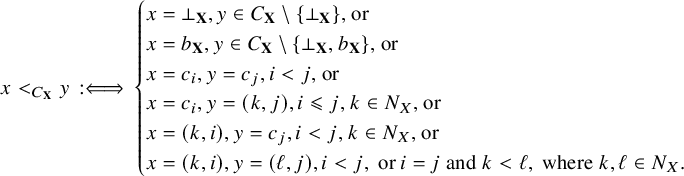 $$\begin{align*}x <_{C_{\mathbf{X}}} y \,:\Longleftrightarrow\, \begin{cases} x = \bot_{\mathbf{X}}, y\in C_{\mathbf{X}}\setminus\{\bot_{\mathbf{X}}\}\text{, or}\\ x = b_{\mathbf{X}}, y\in C_{\mathbf{X}}\setminus\{\bot_{\mathbf{X}},b_{\mathbf{X}}\}\text{, or}\\ x = c_i, y= c_j, i<j\text{, or}\\ x = c_i, y = (k,j), i\leqslant j, k\in N_X\text{, or}\\ x = (k,i), y= c_j, i<j, k\in N_X\text{, or}\\ x = (k,i), y = (\ell,j), i<j, \text{ or } i=j \text{ and } k<\ell, \text{ where }k,\ell\in N_X. \end{cases} \end{align*}$$
In other words, $C_{\mathbf {X}}$
can be expressed as an ordinal sum of chains as follows:
$C_{\mathbf {X}}$
can be expressed as an ordinal sum of chains as follows:
 $$\begin{align*}\{\bot_{\mathbf{X}}\} \oplus \{b_{\mathbf{X}}\} \oplus (N_X\times\{0\}) \oplus \{c_1\} \oplus (N_X\times\{1\}) \oplus \dots \oplus \{c_n\} \oplus (N_X\times\{n\}). \end{align*}$$
Let now  , and define
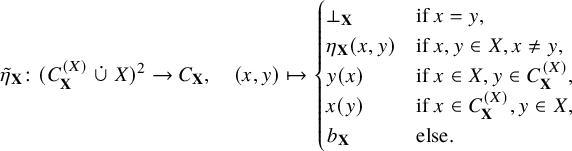 $$\begin{align*}\tilde\eta_{\mathbf{X}}\colon(C_{\mathbf{X}}^{(X)}\mathrel{\dot\cup} X)^2\to C_{\mathbf{X}},\quad (x,y)\mapsto\begin{cases} \bot_{\mathbf{X}} & \text{if } x=y,\\ \eta_{\mathbf{X}}(x,y) & \text{if } x, y \in X, x\neq y,\\ y(x) & \text{if } x\in X, y\in C_{\mathbf{X}}^{(X)},\\ x(y) & \text{if } x\in C_{\mathbf{X}}^{(X)},y\in X,\\ b_{\mathbf{X}} & \text{else.} \end{cases} \end{align*}$$
Finally, we define  , where
 $$\begin{align*}(x,y)\leqslant_{K(\mathbf{X})} (u,v) \quad :\Longleftrightarrow \quad \tilde\eta_{\mathbf{X}}(x,y) \leqslant_{C_{\mathbf{X}}} \tilde\eta_{\mathbf{X}}(u,v). \end{align*}$$
Clearly, $K(\mathbf {X})$
is an echeloned space extending
$K(\mathbf {X})$
is an echeloned space extending $\mathbf {X}$
. Moreover,
$\mathbf {X}$
. Moreover, $C_{\mathbf {X}}\cong E(K(\mathbf {X}))$
. Denote by
$C_{\mathbf {X}}\cong E(K(\mathbf {X}))$
. Denote by $\zeta _{\mathbf {X}}$
the unique isomorphism from
$\zeta _{\mathbf {X}}$
the unique isomorphism from $C_{\mathbf {X}}$
to
$C_{\mathbf {X}}$
to $E(K(\mathbf {X}))$
. Then, in particular, the following diagram commutes:
$E(K(\mathbf {X}))$
. Then, in particular, the following diagram commutes:
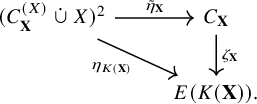
In order to make a functor out of K, we need to define its action on morphisms. In addition to $\mathbf {X}$
let us consider another finite echeloned space
$\mathbf {X}$
let us consider another finite echeloned space $\mathbf {Y}$
. Suppose that
$\mathbf {Y}$
. Suppose that $E(\mathbf {Y})= \{\bot _{\mathbf {Y}}, d_1,\dots ,d_m\}$
, where
$E(\mathbf {Y})= \{\bot _{\mathbf {Y}}, d_1,\dots ,d_m\}$
, where
 $$\begin{align*}\bot_{\mathbf{Y}}<_{E(\mathbf{Y})} d_1<_{E(\mathbf{Y})} \dots <_{E(\mathbf{Y})} d_m. \end{align*}$$
Let $\varphi \colon \mathbf {X}\hookrightarrow \mathbf {Y}$
be an embedding; that is, the following diagram commutes:
$\varphi \colon \mathbf {X}\hookrightarrow \mathbf {Y}$
be an embedding; that is, the following diagram commutes:
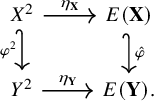
Next, we define
 $$\begin{align*}\tilde\psi\colon C_{\mathbf{X}}\to C_{\mathbf{Y}},\quad x\mapsto \begin{cases} \bot_{\mathbf{Y}} & \text{if } x=\bot_{\mathbf{X}},\\ b_{\mathbf{Y}} & \text{if } x=b_{\mathbf{X}},\\ (k,0) & \text{if } x=(k,0), \, k\in N_X,\\ d_j & \text{if } x=c_i\text{ and }\hat\varphi(c_i)=d_j, i\in\{1,\dots,n\},\, j\in\{1,\dots,m\},\\ (k,j) & \text{if } x=(k,i), \hat\varphi(c_i)=d_j, k\in N_X, i\in\{1,\dots,n\},\, j\in\{1,\dots,m\}. \end{cases} \end{align*}$$
Clearly, $\tilde \psi $
is an order embedding. Next define
$\tilde \psi $
is an order embedding. Next define
 $$\begin{align*}\psi\colon K(\mathbf{X})\to K(\mathbf{Y}),\quad x\mapsto\begin{cases} \varphi(x) & \text{if } x\in X,\\ \psi(h) & \text{if } x=h\in C_{\mathbf{X}}^{(X)}, \end{cases} \end{align*}$$
where
 $$ \begin{align} \psi(h)\colon Y\to C_{\mathbf{Y}},\quad y\mapsto \begin{cases} \tilde\psi(h(x)) & \text{if } y=\varphi(x),\\ b_{\mathbf{Y}} & \text{else.} \end{cases} \end{align} $$
The construction of $\psi $
.
$\psi $
.

Figure 1 illustrates these definitions. Since $\tilde \psi $
and
$\tilde \psi $
and $\varphi $
are injective, it follows that
$\varphi $
are injective, it follows that $\psi $
is injective, too. In order to see that
$\psi $
is injective, too. In order to see that $\psi \colon K(\mathbf {X})\to K(\mathbf {Y})$
is indeed an embedding, according to Corollary 1.4, we need to show that there exists
$\psi \colon K(\mathbf {X})\to K(\mathbf {Y})$
is indeed an embedding, according to Corollary 1.4, we need to show that there exists $\hat \psi \colon E(K(\mathbf {X}))\hookrightarrow E(K(\mathbf {Y}))$
such that the following diagram commutes:
$\hat \psi \colon E(K(\mathbf {X}))\hookrightarrow E(K(\mathbf {Y}))$
such that the following diagram commutes:
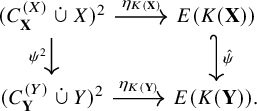
To this end, let us define  . Now what remains is to show that the following diagram commutes:
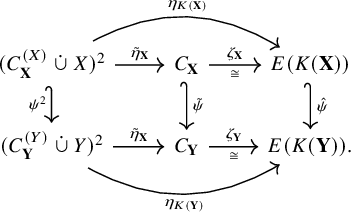
Note that the upper and the lower triangle in (5.5) commute by (5.1). The right-hand rectangle of (5.5) commutes by construction. It remains to check that the left-hand rectangle of (5.5) commutes. For this, we take arbitrary but distinct $x,y\in X$
and
$x,y\in X$
and $h_1,h_2\in C_{\mathbf {X}}^{(X)}$
, and chase them through this rectangle:
$h_1,h_2\in C_{\mathbf {X}}^{(X)}$
, and chase them through this rectangle:
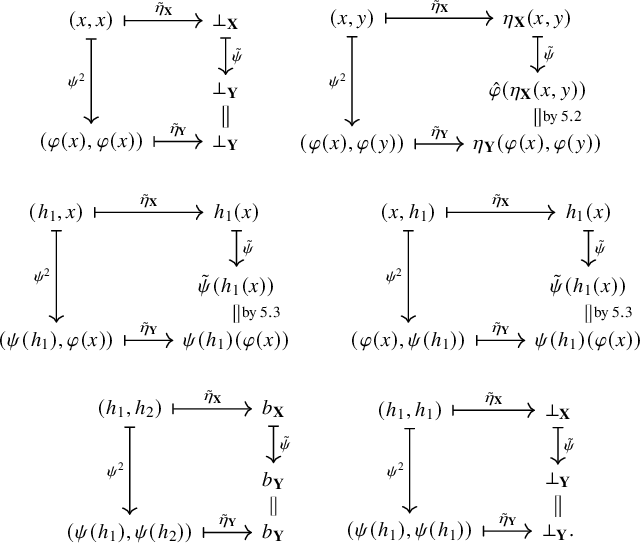
Thus, (5.5) and, in particular (5.4) commute. Consequently, $\psi $
is an embedding of echeloned spaces. Let us define
$\psi $
is an embedding of echeloned spaces. Let us define

Now that the action of K on morphisms is defined, we still need to show that K is indeed a functor, that is,
-
(i)
$\forall \mathbf {X}\in \mathcal {C}\,:\, K(\mathrm {id}_{\mathbf {X}}) = \mathrm {id}_{K(\mathbf {X})}$
, and -
(ii)
$\forall \varphi _1\colon \mathbf {X}\hookrightarrow \mathbf {Y},\, \varphi _2\colon \mathbf {Y}\hookrightarrow \mathbf {Z}\,:\, K(\varphi _2\circ \varphi _1) = K(\varphi _2)\circ K(\varphi _1)$
.


About (i): For some finite echeloned space $\mathbf {X}$
, consider
$\mathbf {X}$
, consider $K(\mathrm {id}_{\mathbf {X}})\colon C_{\mathbf {X}}^{(X)}\mathrel {\dot \cup } X\to C_{\mathbf {X}}^{(X)}\mathrel {\dot \cup } X$
. Clearly, for each
$K(\mathrm {id}_{\mathbf {X}})\colon C_{\mathbf {X}}^{(X)}\mathrel {\dot \cup } X\to C_{\mathbf {X}}^{(X)}\mathrel {\dot \cup } X$
. Clearly, for each $x\in X$
, we have
$x\in X$
, we have $K(\mathrm {id}_{\mathbf {X}})(x)= x$
. So let
$K(\mathrm {id}_{\mathbf {X}})(x)= x$
. So let $h\in C_{\mathbf {X}}^{(X)}$
. For simplicity of notation, let us denote
$h\in C_{\mathbf {X}}^{(X)}$
. For simplicity of notation, let us denote $K(\mathrm {id}_{\mathbf {X}})$
by
$K(\mathrm {id}_{\mathbf {X}})$
by $\psi $
. Then
$\psi $
. Then $(K(\mathrm {id}_{\mathbf {X}})(h))(x)= \tilde \psi (h(x))$
, for each
$(K(\mathrm {id}_{\mathbf {X}})(h))(x)= \tilde \psi (h(x))$
, for each $x\in X$
.
$x\in X$
.
-
○ If
$h(x)=b_{\mathbf {X}}$
, then
$\tilde \psi (h(x)) = \tilde \psi (b_{\mathbf {X}}) = b_{\mathbf {X}}$
; -
○ If
$h(x)=(k,0)$
, then
$\tilde \psi (h(x))= \tilde \psi ((k,0)) = (k,0)$
; -
○ If
$h(x)=c_i$
, then
$\tilde \psi (h(x)) = \tilde \psi (c_i) = \widehat {\mathrm {id}_{\mathbf {X}}}(c_i) = c_i$
; -
○ If
$h(x) = (k,i)$
, then
$\tilde \psi (h(x)) = \tilde \psi ((k,i)) = (k,i)$
, because
$\widehat {\mathrm {id}_{\mathbf {X}}}(c_i) = c_i$
;


Thus, $K(\mathrm {id}_{\mathbf {X}}) = \mathrm {id}_{K(\mathbf {X})}$
.
$K(\mathrm {id}_{\mathbf {X}}) = \mathrm {id}_{K(\mathbf {X})}$
.
About (ii): Given

Let us denote  ,
,  ,
, $\psi _1 = K(\varphi _1)$
, and
$\psi _1 = K(\varphi _1)$
, and  . Then


Suppose $E(\mathbf {X})=\{\bot _{\mathbf {X}},c_1,\dots ,c_n\}$
,
$E(\mathbf {X})=\{\bot _{\mathbf {X}},c_1,\dots ,c_n\}$
, $E(\mathbf {Y}) = \{\bot _{\mathbf {Y}},d_1,\dots ,d_m\}$
, and
$E(\mathbf {Y}) = \{\bot _{\mathbf {Y}},d_1,\dots ,d_m\}$
, and $E(\mathbf {Z})=\{\bot _{\mathbf {Z}},e_1,\dots ,e_s\}$
, where
$E(\mathbf {Z})=\{\bot _{\mathbf {Z}},e_1,\dots ,e_s\}$
, where
 $$ \begin{align*} \bot_{\mathbf{X}} <_{E(\mathbf{X})} c_1 <_{E(\mathbf{X})} \dots <_{E(\mathbf{X})} c_n,\quad \bot_{\mathbf{Y}} <_{E(\mathbf{Y})} d_1 &<_{E(\mathbf{Y})} \dots <_{E(\mathbf{Y})} d_m, \\ &\quad \text{and } \bot_{\mathbf{Z}} <_{E(\mathbf{Z})} e_1 <_{E(\mathbf{Z})} \dots <_{E(\mathbf{Z})} e_s. \end{align*} $$
Then for every $x\in X$
, we compute
$x\in X$
, we compute
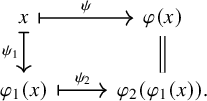
So let $h\in C_{\mathbf {X}}^{(X)}$
. Then
$h\in C_{\mathbf {X}}^{(X)}$
. Then
 $$\begin{align*}\psi(h)\colon z\mapsto \begin{cases} \tilde\psi(h(x)) & \text{if } z=\varphi(x) = \varphi_2(\varphi_1(x)),\\ b_{\mathbf{Z}} & \text{else}, \end{cases} \end{align*}$$
where
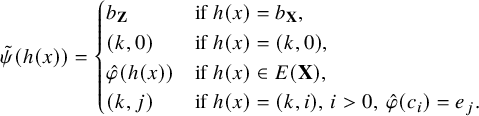 $$\begin{align*}\tilde\psi(h(x)) = \begin{cases} b_{\mathbf{Z}} & \text{if } h(x)=b_{\mathbf{X}},\\ (k,0) & \text{if } h(x) = (k,0),\\ \hat\varphi(h(x)) & \text{if } h(x)\in E(\mathbf{X}),\\ (k,j) & \text{if } h(x)=(k,i),\,i>0,\,\hat\varphi(c_i) = e_j. \end{cases} \end{align*}$$
Note that $\hat \varphi = \hat \varphi _2\circ \hat \varphi _1$
(this follows from the uniqueness of
$\hat \varphi = \hat \varphi _2\circ \hat \varphi _1$
(this follows from the uniqueness of $\hat \varphi $
for
$\hat \varphi $
for $\varphi $
).
$\varphi $
).
However,
 $$\begin{align*}(K(\varphi_2)\circ K(\varphi_1))(h) = (\psi_2\circ\psi_1)(h)\in C_{\mathbf{Z}}^{(Z)}, \end{align*}$$
and
 $$\begin{align*}(\psi_2\circ\psi_1)(h)\colon z\mapsto \begin{cases} \tilde\psi_2((\psi_1(h))(y)) &\text{if } z=\varphi_2(y),\, y\in Y\\ b_{\mathbf{Z}} & \text{else.} \end{cases} \end{align*}$$
Thus,
 $$\begin{align*}(\psi_2\circ\psi_1)(h)\colon z\mapsto\begin{cases} \tilde\psi_2(\tilde\psi_1(h(x))) & \text{if } z=\varphi_2(\varphi_1(x)),\, x\in X,\\ \tilde\psi_2(b_{\mathbf{Y}})=b_{\mathbf{Z}} & \text{if } z=\varphi_2(y),\, y\in Y\setminus\varphi_1(X),\\ b_{\mathbf{Z}} & \text{else.} \end{cases} \end{align*}$$
Figure 2 illustrates the construction of the action of $K(\varphi _2)\circ K(\varphi _1)$
. It remains to check that
$K(\varphi _2)\circ K(\varphi _1)$
. It remains to check that $\tilde \psi =\tilde \psi _2\circ \tilde \psi _1$
. As usual, we do so by considering possible cases separately. During these computations, assume that for
$\tilde \psi =\tilde \psi _2\circ \tilde \psi _1$
. As usual, we do so by considering possible cases separately. During these computations, assume that for $c_i \in E(\mathbf {X})\setminus \{\bot _{\mathbf {X}}\}$
, we have that
$c_i \in E(\mathbf {X})\setminus \{\bot _{\mathbf {X}}\}$
, we have that $\hat \varphi _1(c_i)=d_\ell $
and
$\hat \varphi _1(c_i)=d_\ell $
and $\hat \varphi _2(d_\ell )=e_j$
. Then
$\hat \varphi _2(d_\ell )=e_j$
. Then
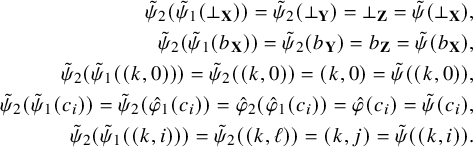 $$ \begin{align*} \tilde\psi_2(\tilde\psi_1(\bot_{\mathbf{X}})) = \tilde\psi_2(\bot_{\mathbf{Y}}) = \bot_{\mathbf{Z}} = \tilde\psi(\bot_{\mathbf{X}}),\\ \tilde\psi_2(\tilde\psi_1(b_{\mathbf{X}})) = \tilde\psi_2(b_{\mathbf{Y}}) = b_{\mathbf{Z}} = \tilde\psi(b_{\mathbf{X}}),\\ \tilde\psi_2(\tilde\psi_1((k,0))) = \tilde\psi_2((k,0)) = (k,0) = \tilde\psi((k,0)),\\ \tilde\psi_2(\tilde\psi_1(c_i)) = \tilde\psi_2(\hat\varphi_1(c_i)) = \hat\varphi_2(\hat\varphi_1(c_i)) = \hat\varphi(c_i) = \tilde\psi(c_i),\\ \tilde\psi_2(\tilde\psi_1((k,i))) = \tilde\psi_2((k,\ell)) = (k,j) = \tilde\psi((k,i)). \end{align*} $$
This finishes the proof that K is a functor.
The composition $K(\varphi _2)\circ K(\varphi _1)$
.
$K(\varphi _2)\circ K(\varphi _1)$
.
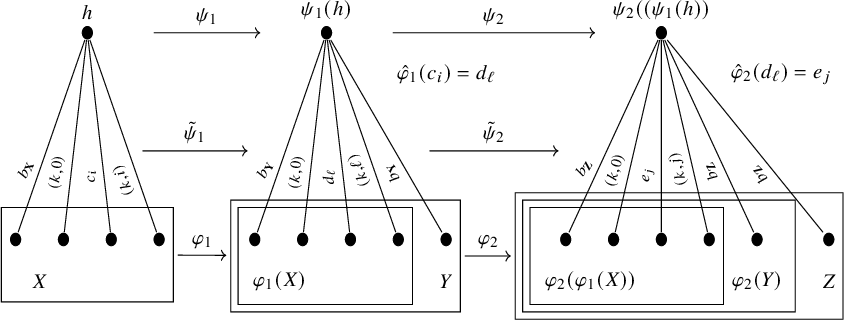
Proposition 5.3. $K\colon \mathscr {A}\to \mathscr {C}$
is a Katětov functor.
$K\colon \mathscr {A}\to \mathscr {C}$
is a Katětov functor.
Proof. Since all the morphisms of $\mathscr {A}$
and
$\mathscr {A}$
and $\mathscr {C}$
are embeddings, the condition that K preserves embeddings is trivially fulfilled.
$\mathscr {C}$
are embeddings, the condition that K preserves embeddings is trivially fulfilled.
For every finite echeloned space $\mathbf {X}$
, let
$\mathbf {X}$
, let $\lambda _{\mathbf {X}}\colon \mathbf {X}\hookrightarrow K(\mathbf {X})$
be the identical embedding. It is not hard to check that this defines a natural transformation
$\lambda _{\mathbf {X}}\colon \mathbf {X}\hookrightarrow K(\mathbf {X})$
be the identical embedding. It is not hard to check that this defines a natural transformation $\lambda \colon \operatorname {Id}\hookrightarrow K$
.
$\lambda \colon \operatorname {Id}\hookrightarrow K$
.
Let now $\mathbf {X}$
be a finite echeloned space and let
$\mathbf {X}$
be a finite echeloned space and let $\mathbf {Y}$
be a one-point extension of
$\mathbf {Y}$
be a one-point extension of $\mathbf {X}$
(i.e.,
$\mathbf {X}$
(i.e., $Y=X\mathrel {\dot \cup }\{y\}$
and the identical embedding of X into Y is an embedding of echeloned spaces). Denote the identical embedding of
$Y=X\mathrel {\dot \cup }\{y\}$
and the identical embedding of X into Y is an embedding of echeloned spaces). Denote the identical embedding of $\mathbf {X}$
into
$\mathbf {X}$
into $\mathbf {Y}$
by e. Suppose
$\mathbf {Y}$
by e. Suppose $E(\mathbf {X})=\{\bot _{\mathbf {X}},c_1,\dots ,c_n\}$
, where
$E(\mathbf {X})=\{\bot _{\mathbf {X}},c_1,\dots ,c_n\}$
, where
 $$\begin{align*}\bot_{\mathbf{X}}<_{E(\mathbf{X})} c_1 <_{E(\mathbf{X})} c_2 <_{E(\mathbf{X})}\dots <_{E(\mathbf{X})} c_n. \end{align*}$$
Then $E(\mathbf {Y})$
is of the shape
$E(\mathbf {Y})$
is of the shape
 $$ \begin{align*} &\bot_{\mathbf{Y}} <_{E(\mathbf{Y})} d_{1,0} <_{E(\mathbf{Y})} \dots d_{i_0,0} <_{E(\mathbf{Y})} \hat{e}(c_1) <_{E(\mathbf{Y})} d_{1,1} <_{E(\mathbf{Y})} \dots \\ &\quad \dots<_{E(\mathbf{Y})} d_{i_1,1} <_{E(\mathbf{Y})} \hat{e}(c_2)<_{E(\mathbf{Y})}\dots <_{E(\mathbf{Y})} \hat{e}(c_n) <_{E(\mathbf{Y})} d_{1,n} <_{E(\mathbf{Y})} \dots <_{E(\mathbf{Y})} d_{i_n,n}, \end{align*} $$
where $i_0+i_1+\dots +i_n\leqslant |X|$
. Define
$i_0+i_1+\dots +i_n\leqslant |X|$
. Define
 $$\begin{align*}h\colon X\to C_{\mathbf{X}}\setminus\{\bot_{\mathbf{X}}\},\quad x\mapsto\begin{cases} (k,j) & \text{if } \eta_{\mathbf{Y}}(y,e(x)) = d_{k,j}, \text{ where }j=0,\dots,n,\, k=1,\dots, i_j,\\ c_j & \text{if } \eta_{\mathbf{Y}}(y,e(x)) = \hat{e}(c_j),\text{ where } j=1,\dots,n. \end{cases} \end{align*}$$
Finally, define
 $$\begin{align*}g\colon Y\to X\mathrel{\dot\cup} C_{\mathbf{X}}^{(X)},\quad x\mapsto\begin{cases} x & \text{if } x\in X,\\ h & \text{if } x=y. \end{cases} \end{align*}$$
By construction, g is injective. Next, we show that $g\colon \mathbf {Y}\to K(\mathbf {X})$
is an embedding. Let
$g\colon \mathbf {Y}\to K(\mathbf {X})$
is an embedding. Let $\gamma \colon E(\mathbf {Y})\to C_{\mathbf {X}}$
be given by
$\gamma \colon E(\mathbf {Y})\to C_{\mathbf {X}}$
be given by
 $$\begin{align*}\gamma\colon \hat{e}(c_j)\mapsto c_j,\quad \bot_{\mathbf{Y}}\mapsto\bot_{\mathbf{X}},\quad d_{k,j}\mapsto (k,j)\quad \text{ for all } j\in\{0,\dots,n\},\, k\in \{1,\dots,i_j\}. \end{align*}$$
Clearly, $\gamma $
is an order embedding and the following diagram commutes:
$\gamma $
is an order embedding and the following diagram commutes:
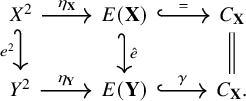
Next, we show that the following diagram commutes, too:
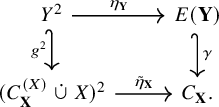
To this end, let $(x,z)\in Y^2$
. We distinguish six cases:
$(x,z)\in Y^2$
. We distinguish six cases:
Case 1: Suppose that $x=z\neq y$
. Then
$x=z\neq y$
. Then
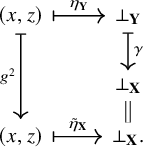
Case 2: Suppose that $x=z=y$
. Then
$x=z=y$
. Then
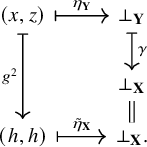
Case 3: Suppose that $x\neq z$
and that
$x\neq z$
and that $x,z\in X$
. Then
$x,z\in X$
. Then $\eta _{\mathbf {X}}(x,z)=c_i$
for some i and
$\eta _{\mathbf {X}}(x,z)=c_i$
for some i and
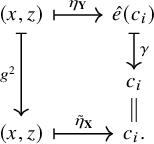
Case 4: Suppose that $x\neq z$
and
$x\neq z$
and $x=y$
, and that
$x=y$
, and that $\eta _{\mathbf {Y}}(y,e(z))= d_{k,j}$
for some
$\eta _{\mathbf {Y}}(y,e(z))= d_{k,j}$
for some $j\in \{0,\dots ,n\}$
, and
$j\in \{0,\dots ,n\}$
, and $k\in \{1,\dots ,i_j\}$
. Then
$k\in \{1,\dots ,i_j\}$
. Then
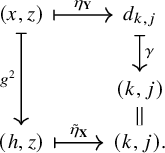
Case 5: Suppose that $x\neq z$
and
$x\neq z$
and $x=y$
, and that
$x=y$
, and that $\eta _{\mathbf {Y}}(x,e(z))= \hat {e}(c_j)$
for some
$\eta _{\mathbf {Y}}(x,e(z))= \hat {e}(c_j)$
for some $j\in \{0,\dots ,n\}$
. Then
$j\in \{0,\dots ,n\}$
. Then
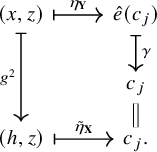
Case 6: If $x\neq z$
and
$x\neq z$
and $z=y$
, then we proceed analogously as in cases 4 and 5.
$z=y$
, then we proceed analogously as in cases 4 and 5.
At this point, we may conclude that (5.6) commutes. Combining this with (5.1), we obtain that the following diagram commutes, too:
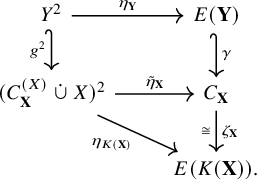
Hence, by Corollary 1.4, g is an embedding with $\hat {g}=\zeta _{\mathbf {X}}\circ \gamma $
.
$\hat {g}=\zeta _{\mathbf {X}}\circ \gamma $
.
Finally, by the definition of g, the following diagram commutes:
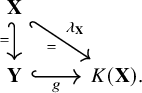
Thus, indeed, K is a Katětov functor.
6 An alternative approach to echeloned spaces
As established in Remark 1.2, an echeloned space may be perceived as a set of points accompanied by a specific $4$
-ary relation. The following definition records yet another, equivalent, approach to these structures.
$4$
-ary relation. The following definition records yet another, equivalent, approach to these structures.
Definition 6.1. An echeloned map on a set X is a surjective function $f \colon X^2 \twoheadrightarrow (C, \leqslant )$
for which:
$f \colon X^2 \twoheadrightarrow (C, \leqslant )$
for which:
-
(i)
$(C, \leqslant )$
is a linear order with minimum
$\bot _C$
, -
(ii)
$f^{-1}(\bot _C) = \Delta _X$
, and -
(iii)
$f(x, y) = f(y, x)$
, for all
$x, y \in X$
.


We refer to X as the set of points of f.
Remark 6.2. An echeloned map on a set X is finite if X is finite.
Definition 6.3. Let $f \colon X^2 \twoheadrightarrow (C, \leqslant )$
and
$f \colon X^2 \twoheadrightarrow (C, \leqslant )$
and $g \colon Y^2 \twoheadrightarrow (D, \leqslant )$
be two echeloned maps on X and Y, respectively. We say that a function
$g \colon Y^2 \twoheadrightarrow (D, \leqslant )$
be two echeloned maps on X and Y, respectively. We say that a function $\chi \colon X\to Y$
is a homomorphism from f to g, and write
$\chi \colon X\to Y$
is a homomorphism from f to g, and write $\chi \colon f\to g$
, if there exists an order-preserving map
$\chi \colon f\to g$
, if there exists an order-preserving map $\bar {\chi } \colon (C, \leqslant ) \rightarrow (D, \leqslant )$
such that the diagram below commutes:
$\bar {\chi } \colon (C, \leqslant ) \rightarrow (D, \leqslant )$
such that the diagram below commutes:
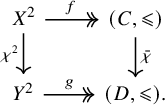
We call $\chi $
an embedding if
$\chi $
an embedding if $\chi $
is injective and
$\chi $
is injective and $\bar {\chi }$
is an order embedding.
$\bar {\chi }$
is an order embedding.
Remark 6.4. If $\bar {\chi }$
in the above definition exists, then it is unique.
$\bar {\chi }$
in the above definition exists, then it is unique.
Observation 6.5. We describe the connection between echeloned spaces and Definition 6.1 in some detail.
Let $\mathscr {A}$
be the category of echeloned spaces with homomorphisms, and let
$\mathscr {A}$
be the category of echeloned spaces with homomorphisms, and let $\mathscr {B}$
be the category of echeloned maps with homomorphisms. Clearly, if
$\mathscr {B}$
be the category of echeloned maps with homomorphisms. Clearly, if $\mathbf {X} = (X, \leqslant _{\mathbf {X}})$
is an echeloned space, then
$\mathbf {X} = (X, \leqslant _{\mathbf {X}})$
is an echeloned space, then $\eta _{\mathbf {X}}$
is an echeloned map. Moreover, the homomorphisms between two echeloned spaces are the same as those between their corresponding echeloned maps (see Lemma 1.3). This means that
$\eta _{\mathbf {X}}$
is an echeloned map. Moreover, the homomorphisms between two echeloned spaces are the same as those between their corresponding echeloned maps (see Lemma 1.3). This means that $F \colon \mathscr {A} \to \mathscr {B},\, \mathbf {X} \mapsto \eta _{\mathbf {X}},\, h \mapsto h$
is a well-defined functor.
$F \colon \mathscr {A} \to \mathscr {B},\, \mathbf {X} \mapsto \eta _{\mathbf {X}},\, h \mapsto h$
is a well-defined functor.
Now, define a functor $G \colon \mathscr {B} \to \mathscr {A}$
. To every echeloned map
$G \colon \mathscr {B} \to \mathscr {A}$
. To every echeloned map $f \colon X^2 \twoheadrightarrow (C, \leqslant )$
, we associate an echeloned space
$f \colon X^2 \twoheadrightarrow (C, \leqslant )$
, we associate an echeloned space $\mathbf {X}_f = (X, \leqslant _{\mathbf {X}})$
according to the following rule:
$\mathbf {X}_f = (X, \leqslant _{\mathbf {X}})$
according to the following rule:
 $$\begin{align*}(x,y) \leqslant_{\mathbf{X}} (u,v) \quad :\Longleftrightarrow \quad f(x,y) \leqslant f(u, v).\end{align*}$$
Again, by Lemma 1.3, $h \colon f \to g$
is a homomorphism of echeloned maps. Then
$h \colon f \to g$
is a homomorphism of echeloned maps. Then $h \colon \mathbf {X}_f \to \mathbf {X}_g$
is a homomorphism, too. Hence, the assignment
$h \colon \mathbf {X}_f \to \mathbf {X}_g$
is a homomorphism, too. Hence, the assignment $G\colon \mathscr {B}\to \mathscr {A},\, f \mapsto \mathbf {X}_f,\, h \mapsto h$
is a well-defined functor. Note that
$G\colon \mathscr {B}\to \mathscr {A},\, f \mapsto \mathbf {X}_f,\, h \mapsto h$
is a well-defined functor. Note that $G\circ F = \operatorname {Id}_{\mathscr {A}}$
. Conversely, for each echeloned map
$G\circ F = \operatorname {Id}_{\mathscr {A}}$
. Conversely, for each echeloned map $f \colon X^2 \twoheadrightarrow (C, \leqslant )$
, note that the identity function
$f \colon X^2 \twoheadrightarrow (C, \leqslant )$
, note that the identity function $\mathrm {id}_X$
is an isomorphism from
$\mathrm {id}_X$
is an isomorphism from $F(G(f))$
to f. Moreover,
$F(G(f))$
to f. Moreover, $(\varphi _f)_{f\in \operatorname {\mathrm {ob}}(\mathscr {B})}\colon F\circ G\to \operatorname {Id}_{\mathscr {B}}$
with
$(\varphi _f)_{f\in \operatorname {\mathrm {ob}}(\mathscr {B})}\colon F\circ G\to \operatorname {Id}_{\mathscr {B}}$
with  is a natural isomorphism. This shows that $\mathscr {A}$
and
$\mathscr {A}$
and $\mathscr {B}$
are equivalent categories. Note that F and G, both, preserve finiteness and embeddings.
$\mathscr {B}$
are equivalent categories. Note that F and G, both, preserve finiteness and embeddings.
All the proofs from the previous sections can be rewritten easily in this alternative approach.
Acknowledgements
The authors thank Dragan Mašulović for enlightening discussions on Katětov functors and Colin Jahel for helpful discussions concerning the Ramsey property.
The very helpful remarks by the anonymous referee that lead to a better presentation of the material are gratefully acknowledged.
Competing interest
The authors have no competing interests to declare.
Financial support
The research of the first and the fifth author was supported by the German Academic Exchange Service (DAAD) through Project-ID 57602973
The research of the second and the fourth author was supported by the Ministry of Science, Technological Development and Innovation of the Republic of Serbia through Grant No. 451-03-783/2021-09/3
The research of the third author was supported by GA ČR (Czech Science Foundation) grant EXPRO 20-31529X
The fourth author was supported by the Ministry of Science, Technological Development and Innovation of the Republic of Serbia through Grant No. 451-03-47/2023-01/200125.


 Open access

