


1 Introduction
Let G be a connected (real) Lie group and
$\mathrm {Sub}_G$
 be the space of (closed) subgroups of G equipped with the Chabauty topology introduced by Chabauty in [Reference Chabauty6]. The Chabauty topology on
$\mathrm {Sub}_G$
be the space of (closed) subgroups of G equipped with the Chabauty topology introduced by Chabauty in [Reference Chabauty6]. The Chabauty topology on
$\mathrm {Sub}_G$
 is generated by the subsets
$\{ H \in \mathrm {Sub}_G \mid H\cap K = \emptyset \}$
is generated by the subsets
$\{ H \in \mathrm {Sub}_G \mid H\cap K = \emptyset \}$
 ,
$\{ H\in \mathrm {Sub}_G \mid H \cap U \not = \emptyset \}$
,
$\{ H\in \mathrm {Sub}_G \mid H \cap U \not = \emptyset \}$
 , where
$K \subset G$
, where
$K \subset G$
 is compact and
$U \subset G$
is compact and
$U \subset G$
 is open. With respect to the Chabauty topology,
$\mathrm {Sub}_G$
is open. With respect to the Chabauty topology,
$\mathrm {Sub}_G$
 is a compact metrizable space (see [Reference Benedetti and Petronio4, Lemma E.1.1]). Moreover, a sequence
$H_n\in \mathrm {Sub}_G$
is a compact metrizable space (see [Reference Benedetti and Petronio4, Lemma E.1.1]). Moreover, a sequence
$H_n\in \mathrm {Sub}_G$
 converges to
$H\in \mathrm {Sub}_G$
converges to
$H\in \mathrm {Sub}_G$
 if and only if for any
$h\in H$
if and only if for any
$h\in H$
 , there is a sequence
$h_n\in H_n$
, there is a sequence
$h_n\in H_n$
 such that
$h_n$
such that
$h_n$
 converges to h, and for any sequence
$x_{k_n}\in H_{k_n}$
converges to h, and for any sequence
$x_{k_n}\in H_{k_n}$
 , with
$k_{n+1}>k_n$
, with
$k_{n+1}>k_n$
 and
$x_{k_n}\to x$
and
$x_{k_n}\to x$
 , we have
$x\in H$
, we have
$x\in H$
 (see [Reference Benedetti and Petronio4, Lemma E.1.2]).
The group G acts on
$\mathrm {Sub}_G$
 by conjugation:
$(g, H) \mapsto gHg^{-1}$
by conjugation:
$(g, H) \mapsto gHg^{-1}$
 . An invariant random subgroup (IRS) is a probability measure
$\mu $
. An invariant random subgroup (IRS) is a probability measure
$\mu $
 on
$\mathrm {Sub}_G$
on
$\mathrm {Sub}_G$
 that is invariant under the conjugation action of G on
$\mathrm {Sub}_G$
that is invariant under the conjugation action of G on
$\mathrm {Sub}_G$
 . Every Dirac measure supported on a closed normal subgroup is an IRS. Also, if
$\Gamma $
. Every Dirac measure supported on a closed normal subgroup is an IRS. Also, if
$\Gamma $
 is a lattice in G, that is,
$\Gamma $
is a lattice in G, that is,
$\Gamma $
 is a discrete subgroup of G such that
$G/\Gamma $
is a discrete subgroup of G such that
$G/\Gamma $
 carries a G-invariant probability measure
$\mu $
carries a G-invariant probability measure
$\mu $
 , then the push forward of
$\mu $
, then the push forward of
$\mu $
 under the map
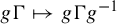
$g\Gamma \mapsto g\Gamma g^{-1}$
under the map
$g\Gamma \mapsto g\Gamma g^{-1}$
 defines an IRS on G. Thus, invariant random subgroups can be thought of as a generalization of both normal subgroups and lattices. The study of invariant random subgroups and ergodic theory is deeply intertwined. Any IRS on
$\mathrm {Sub}_G$
defines an IRS on G. Thus, invariant random subgroups can be thought of as a generalization of both normal subgroups and lattices. The study of invariant random subgroups and ergodic theory is deeply intertwined. Any IRS on
$\mathrm {Sub}_G$
 can be realized as the stabilizer of a measure-preserving action of G on a probability space (cf. [Reference Abert, Bergeron, Biringer, Gelander, Nikolov, Raimbault and Samet1, Reference Abért, Glasner and Virág3] for more details).
We say that a Borel subset
${\mathcal O}$
 of
$\mathrm {Sub}_G$
of
$\mathrm {Sub}_G$
 supports an IRS
$\mu $
supports an IRS
$\mu $
 if
$\mu ({{\mathcal O}}) =1$
if
$\mu ({{\mathcal O}}) =1$
 : a Borel subset
${{\mathcal O}}$
: a Borel subset
${{\mathcal O}}$
 supporting an IRS
$\mu $
supporting an IRS
$\mu $
 need not be the support of
$\mu $
need not be the support of
$\mu $
 , but
$\overline {{\mathcal O}}$
, but
$\overline {{\mathcal O}}$
 contains the support of
$\mu $
contains the support of
$\mu $
 .
.
In recent times, IRS have attracted many studies (cf. [Reference Abert, Bergeron, Biringer, Gelander, Nikolov, Raimbault and Samet1–Reference Abért, Glasner and Virág3, Reference Biringer and Tamuz5, Reference Gelander and Levit9] and the references therein). In this article, we are interested in the existence of invariant random subgroups supported on certain orbits of the conjugation action of G on
$\mathrm {Sub}_G$
 . We first consider the orbit of semisimple Levi subgroups. A maximal connected semisimple Lie subgroup of a Lie group G is called a Levi subgroup (see [Reference Varadarajan13, p. 245] and [Reference Vinberg, Gorbatsevich, Onishchik, Onishchik and Vinberg14, p. 19]). It is known that every connected Lie group has a Levi subgroup [Reference Varadarajan13, Theorem 3.18.3]. Let
$L_G$
. We first consider the orbit of semisimple Levi subgroups. A maximal connected semisimple Lie subgroup of a Lie group G is called a Levi subgroup (see [Reference Varadarajan13, p. 245] and [Reference Vinberg, Gorbatsevich, Onishchik, Onishchik and Vinberg14, p. 19]). It is known that every connected Lie group has a Levi subgroup [Reference Varadarajan13, Theorem 3.18.3]. Let
$L_G$
 be the set of all semisimple Levi subgroups of G. Then,
$L_G = \{xLx^{-1} \mid x \in N \}$
be the set of all semisimple Levi subgroups of G. Then,
$L_G = \{xLx^{-1} \mid x \in N \}$
 , where N is the nilradical of G [Reference Varadarajan13, Theorem 3.18.3]. In general, Levi subgroups need not be closed [Reference Vinberg, Gorbatsevich, Onishchik, Onishchik and Vinberg14, Example on p. 19], but Levi subgroups are closed for linear groups (see [Reference Varadarajan13, Exercises 40 and 41, Ch. 3] and [Reference Vinberg, Gorbatsevich, Onishchik, Onishchik and Vinberg14, Proposition 6.1, §6 of Ch. 1]).
Let G be a connected Lie group with a semisimple Levi subgroup that is closed. An IRS
$\mu $
 on G is called a Levi IRS if
$\mu (L_G)=1$
on G is called a Levi IRS if
$\mu (L_G)=1$
 .
.
Theorem 1.1. Let G be a connected Lie group with nilradical N and L be a closed semisimple Levi subgroup of G. Then, the following are equivalent:
-
(1) there is an IRS supported on the set of all semisimple Levi subgroups;
-
(2) there is an N-invariant probability measure supported on semisimple Levi subgroups;
-
(3) the semisimple Levi subgroup L is normal in G.
In particular, if G has a Levi IRS
$\mu $
 , then L is a normal subgroup and
$\mu $
, then L is a normal subgroup and
$\mu $
 is the Dirac measure supported on the Levi subgroup L of G.
The following is a consequence of the above theorem.
Corollary 1.2. The set of semisimple Levi subgroups
$L_G$
 is closed in
$\mathrm {Sub}_G$
is closed in
$\mathrm {Sub}_G$
 if and only if L is normal.
Thus, any connected Lie group G admitting a Levi IRS is of the form
$G=L\times S$
 , where L is semisimple and S is solvable. In particular, for
$n \geq 2$
, where L is semisimple and S is solvable. In particular, for
$n \geq 2$
 ,
$\operatorname {SL}(n,\mathbb {R})\times \mathbb {R}^n$
,
$\operatorname {SL}(n,\mathbb {R})\times \mathbb {R}^n$
 admits a Levi IRS, whereas
$\operatorname {SL}(n,\mathbb {R})\ltimes \mathbb {R}^n$
admits a Levi IRS, whereas
$\operatorname {SL}(n,\mathbb {R})\ltimes \mathbb {R}^n$
 does not admit a Levi IRS.
As in the case of Levi subgroups, the set of all maximal compact subgroups of a connected Lie group is also the orbit of a maximal compact subgroup under the conjugation action. We next provide a necessary and sufficient condition for the set of maximal compact subgroups to support an IRS.
Theorem 1.3. Let G be a connected Lie group and K be a maximal compact subgroup of G. Also, let
$K_G$
 be the set of all maximal compact subgroups of G. Then, there is an IRS supported on
$K_G$
be the set of all maximal compact subgroups of G. Then, there is an IRS supported on
$K_G$
 if and only if K is normal in G.
As an application of Theorems 1.1 and 1.3, we obtain the following on the cocompactness of certain finite covolume subgroups.
Corollary 1.4. Let G be a connected Lie group and H be a closed subgroup of G such that
$G/H$
 carries a G-invariant probability measure. Suppose H is either a Levi subgroup or a maximal compact subgroup. Then,
$G/H$
carries a G-invariant probability measure. Suppose H is either a Levi subgroup or a maximal compact subgroup. Then,
$G/H$
 is a compact group.
We now assume that G is a real algebraic group, that is, G is the group of
$\mathbb {R}$
 -points of an algebraic group defined over
$\mathbb {R}$
-points of an algebraic group defined over
$\mathbb {R}$
 . Let B be a Borel subgroup of G, that is, B is a maximal connected solvable subgroup of G. Also, let
$B_G$
. Let B be a Borel subgroup of G, that is, B is a maximal connected solvable subgroup of G. Also, let
$B_G$
 be the set of all Borel subgroups of G. Then,
$B_G$
be the set of all Borel subgroups of G. Then,
$B_G$
 is the orbit of B under the conjugation action. We now study the IRS supported on
$B_G$
is the orbit of B under the conjugation action. We now study the IRS supported on
$B_G$
 , which involves the amenability of the group G equipped with its analytic topology.
We say that a locally compact group H is amenable if there is a left-invariant mean on
$L^\infty (G)$
 . Abelian groups, compact groups, and solvable Lie groups are amenable; see [Reference Runde12] for more details regarding amenable groups. The next result concerns the existence of an IRS supported on
$B_G$
. Abelian groups, compact groups, and solvable Lie groups are amenable; see [Reference Runde12] for more details regarding amenable groups. The next result concerns the existence of an IRS supported on
$B_G$
 .
.
Theorem 1.5. Let G be a connected real algebraic group and
$B_G$
 be the set of all Borel subgroups of G. Then,
$B_G$
be the set of all Borel subgroups of G. Then,
$B_G$
 is closed in
$\mathrm {Sub}_G$
is closed in
$\mathrm {Sub}_G$
 , and there is an IRS supported on
$B_G$
, and there is an IRS supported on
$B_G$
 if and only if G, equipped with its analytic topology, is amenable.
Example 1.6. Let
$G= SO(3, \mathbb {R}) \ltimes \mathbb {R}^3$
 . We identify
$O(2, \mathbb {R})$
. We identify
$O(2, \mathbb {R})$
 as a subgroup of
$SO(3, \mathbb {R})$
as a subgroup of
$SO(3, \mathbb {R})$
 by the map
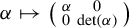
$\alpha \mapsto \big(\begin {smallmatrix} \alpha & 0 \cr 0 & \det (\alpha ) \end {smallmatrix}\big)$
by the map
$\alpha \mapsto \big(\begin {smallmatrix} \alpha & 0 \cr 0 & \det (\alpha ) \end {smallmatrix}\big)$
 . Then,
$B= SO(2, \mathbb {R}) \ltimes \mathbb {R} ^3$
. Then,
$B= SO(2, \mathbb {R}) \ltimes \mathbb {R} ^3$
 is a Borel subgroup of G and the normalizer of B is
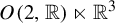
$O(2, \mathbb {R})\ltimes \mathbb {R}^3$
is a Borel subgroup of G and the normalizer of B is
$O(2, \mathbb {R})\ltimes \mathbb {R}^3$
 . Thus, the
$SO(3, \mathbb {R})$
. Thus, the
$SO(3, \mathbb {R})$
 -invariant probability measure on the quotient space
$SO(3, \mathbb {R})/O(2, \mathbb {R})$
-invariant probability measure on the quotient space
$SO(3, \mathbb {R})/O(2, \mathbb {R})$
 induces an IRS on the set of Borel subgroups
$B_G$
induces an IRS on the set of Borel subgroups
$B_G$
 of G.
of G.
Next, we consider the orbit of a maximal diagonalizable subgroup D. Here, by a diagonalizable subgroup, we mean diagonalizable over
$\mathbb {R}$
 , that is, an
$\mathbb {R}$
, that is, an
$\mathbb {R}$
 -split torus. The set of all maximal diagonalizable subgroups then consists of conjugates of D; we denote this set by
$D_G$
-split torus. The set of all maximal diagonalizable subgroups then consists of conjugates of D; we denote this set by
$D_G$
 .
.
Theorem 1.7. Let G be a connected real algebraic group and
$D_G$
 be the set of all maximal diagonalizable subgroups of G. Then, the following are equivalent:
-
(1) there is an IRS supported on $D_G$
 ;
; -
(2) D is central in G;
-
(3) D is normal in G.

Moreover, if statement (1) holds, then any Levi subgroup of G is compact and the solvable radical is a compact extension of its nilradical.
2 Preliminary
In this section, we now collect some results that connect the dynamics of G on
$\mathrm {Sub}_G$
 with projective linear actions on Grassmannians. Given a finite-dimensional vector space V, let
$\mathrm {Gr} _k(V)$
with projective linear actions on Grassmannians. Given a finite-dimensional vector space V, let
$\mathrm {Gr} _k(V)$
 be the Grassmannian manifold of k-dimensional subspaces of V. The following lemma compares the Grassmannian topology and the Chabauty topology of
$\mathrm {Gr} _k(V)$
be the Grassmannian manifold of k-dimensional subspaces of V. The following lemma compares the Grassmannian topology and the Chabauty topology of
$\mathrm {Gr} _k(V)$
 seen as a subset of
$\mathrm {Sub}_V$
seen as a subset of
$\mathrm {Sub}_V$
 . Recall that the metric on
$\mathrm {Gr} _k(V)$
. Recall that the metric on
$\mathrm {Gr} _k(V)$
 is given by

for
$W,W'\in \mathrm {Gr} _k(V)$
 , with
$P_W$
, with
$P_W$
 and
$P_W'$
and
$P_W'$
 being orthogonal projections onto the subspaces W and
$W'$
being orthogonal projections onto the subspaces W and
$W'$
 , respectively. One may look at [Reference Gelander and Levit9] for the measurability of the inclusion map
$\mathfrak {i} \colon \mathrm {Gr} _k(V) \to \mathrm { Sub} _V$
, respectively. One may look at [Reference Gelander and Levit9] for the measurability of the inclusion map
$\mathfrak {i} \colon \mathrm {Gr} _k(V) \to \mathrm { Sub} _V$
 .
.
Lemma 2.1. Let V be a finite-dimensional vector space and
$\mathrm {Gr}_k (V)$
 be the Grassmannian manifold of subspaces of V of dimension k. Let
$\mathfrak {i} \colon \mathrm {Gr} _k(V) \to \mathrm {Sub} _V$
be the Grassmannian manifold of subspaces of V of dimension k. Let
$\mathfrak {i} \colon \mathrm {Gr} _k(V) \to \mathrm {Sub} _V$
 be the canonical inclusion. Then,
$\mathrm {Gr}_k (V)$
be the canonical inclusion. Then,
$\mathrm {Gr}_k (V)$
 is homeomorphic to its image. In particular, the set of all subspaces of dimension k is a closed set in the Chaubauty topology.
Proof. Let
$\mathfrak {i} \colon \mathrm {Gr} _k(V) \to \mathrm {Sub} _V$
 be the canonical inclusion and
$Y=\mathfrak {i}(\mathrm {Gr} _k(V))$
be the canonical inclusion and
$Y=\mathfrak {i}(\mathrm {Gr} _k(V))$
 . Consider the canonical actions of the locally compact group
$GL(V)$
. Consider the canonical actions of the locally compact group
$GL(V)$
 on
$\mathrm {Gr} _k(V)$
on
$\mathrm {Gr} _k(V)$
 and on
$\mathrm {Sub}_V$
and on
$\mathrm {Sub}_V$
 . Fix
$W \in \mathrm { Gr} _k(V)$
. Fix
$W \in \mathrm { Gr} _k(V)$
 . Then, the stabilizer of W and the stabilizer of
$i(W)$
. Then, the stabilizer of W and the stabilizer of
$i(W)$
 are the same, say H. Since
$\mathrm {Gr}_k(V)$
are the same, say H. Since
$\mathrm {Gr}_k(V)$
 is compact, and the canonical action of
$GL(V)$
is compact, and the canonical action of
$GL(V)$
 on
$\mathrm {Gr}_k(V)$
on
$\mathrm {Gr}_k(V)$
 is continuous and transitive,
$Gr_k(V) \simeq GL(V)/H$
is continuous and transitive,
$Gr_k(V) \simeq GL(V)/H$
 . Therefore,
$GL(V)/H$
. Therefore,
$GL(V)/H$
 is compact. Since the map
$gH \mapsto ~g \mathfrak {i} (W)$
is compact. Since the map
$gH \mapsto ~g \mathfrak {i} (W)$
 is a continuous surjective map on Y, we see that Y is compact. This implies that
$GL(V)/H\simeq Y$
is a continuous surjective map on Y, we see that Y is compact. This implies that
$GL(V)/H\simeq Y$
 . This shows that
$\mathrm {Gr}_ k(V)$
. This shows that
$\mathrm {Gr}_ k(V)$
 is homeomorphic to its image under
$\mathfrak {i}$
is homeomorphic to its image under
$\mathfrak {i}$
 .
.
It is known that if a sequence of closed subgroups
$H_n$
 of a Lie group G converges to a closed subgroup H, then dim
$(H) \geq \mathrm {limsup} ~ \mathrm {dim} (H_n)$
of a Lie group G converges to a closed subgroup H, then dim
$(H) \geq \mathrm {limsup} ~ \mathrm {dim} (H_n)$
 (cf. [Reference Wang15, Theorem 1]). However, in the case of closed subgroups of the same dimension, we have the following proposition.
Proposition 2.2. Let G be a connected Lie group and
$H_n \to H$
 in
$\mathrm {Sub}_G$
in
$\mathrm {Sub}_G$
 . Let
$\mathfrak { G}$
. Let
$\mathfrak { G}$
 ,
$\mathfrak {H} _n$
,
$\mathfrak {H} _n$
 , and
$\mathfrak {H}$
, and
$\mathfrak {H}$
 be the Lie algebras of G,
$H_n$
be the Lie algebras of G,
$H_n$
 , and H, respectively. If
$\mathrm {dim} (H_n) = \mathrm {dim} (H)$
, and H, respectively. If
$\mathrm {dim} (H_n) = \mathrm {dim} (H)$
 for all n, then
$\mathfrak {H} _n \to \mathfrak {H}$
for all n, then
$\mathfrak {H} _n \to \mathfrak {H}$
 in Sub
$_{\mathfrak {G}}$
in Sub
$_{\mathfrak {G}}$
 .
.
Remark 2.3. Let
$\Phi $
 be the map sending a closed subgroup to its Lie algebra. Proposition 2.2 proves the continuity of
$\Phi $
be the map sending a closed subgroup to its Lie algebra. Proposition 2.2 proves the continuity of
$\Phi $
 when restricted to certain subsets of
$\mathrm {Sub}_G$
when restricted to certain subsets of
$\mathrm {Sub}_G$
 . The map
$\Phi $
. The map
$\Phi $
 is known to be a measurable map (cf. [Reference Zimmer16]) which is sufficient for our purpose.
Proof. Let V be an accumulation point of
$\mathfrak {H}_n$
 in Sub
$_{\mathfrak {G}}$
in Sub
$_{\mathfrak {G}}$
 . By passing to a subsequence, we may assume that
$\mathfrak {H}_n \to V$
. By passing to a subsequence, we may assume that
$\mathfrak {H}_n \to V$
 in Sub
$_{\mathfrak {G}}$
in Sub
$_{\mathfrak {G}}$
 . Then, V is a vector subspace. The existence of structural constants of the Lie bracket
$[ \cdot , \cdot ]$
. Then, V is a vector subspace. The existence of structural constants of the Lie bracket
$[ \cdot , \cdot ]$
 of
$\mathfrak {G}$
of
$\mathfrak {G}$
 implies that the Lie bracket is continuous in both variables together (see [Reference Varadarajan13, §2.2] for structural constants of a Lie algebra). This implies that V is a Lie subalgebra of
$\mathfrak {G}$
implies that the Lie bracket is continuous in both variables together (see [Reference Varadarajan13, §2.2] for structural constants of a Lie algebra). This implies that V is a Lie subalgebra of
$\mathfrak {G}$
 . For
$v\in V$
. For
$v\in V$
 , there are
$v_n \in \mathfrak {H} _n$
, there are
$v_n \in \mathfrak {H} _n$
 such that
$v_n \to v$
such that
$v_n \to v$
 , and hence,
$tv_n \to tv$
, and hence,
$tv_n \to tv$
 for all
$t\in \mathbb {R}$
for all
$t\in \mathbb {R}$
 . Let
$\exp \colon \mathfrak {G} \to G$
. Let
$\exp \colon \mathfrak {G} \to G$
 be the exponential map. Then,
$\exp (tv_n) \to \exp (tv)$
be the exponential map. Then,
$\exp (tv_n) \to \exp (tv)$
 for all
$t\in \mathbb {R}$
for all
$t\in \mathbb {R}$
 . Since
$H_n$
. Since
$H_n$
 converges to H,
$\exp (tv) \in H$
converges to H,
$\exp (tv) \in H$
 for all
$t\in \mathbb {R}$
for all
$t\in \mathbb {R}$
 . This implies that
$v\in \mathfrak {H}$
. This implies that
$v\in \mathfrak {H}$
 . Thus,
$V \subset \mathfrak {H}$
. Thus,
$V \subset \mathfrak {H}$
 . By assumption,
$\mathrm {dim} (\mathfrak {H} _n) = \mathrm {dim} (\mathfrak {H}) $
. By assumption,
$\mathrm {dim} (\mathfrak {H} _n) = \mathrm {dim} (\mathfrak {H}) $
 for all n, and hence by Lemma 2.1,
$\mathrm {dim} (V) = \mathrm {dim} (\mathfrak {H_n})$
for all n, and hence by Lemma 2.1,
$\mathrm {dim} (V) = \mathrm {dim} (\mathfrak {H_n})$
 . Since
$V\subset \mathfrak {H}$
. Since
$V\subset \mathfrak {H}$
 , we get that
$V = \mathfrak {H}$
, we get that
$V = \mathfrak {H}$
 . Thus,
$\mathfrak {H} _n \to \mathfrak {H}$
. Thus,
$\mathfrak {H} _n \to \mathfrak {H}$
 in Sub
$_{\mathfrak {G}}$
in Sub
$_{\mathfrak {G}}$
 .
.
3 On the support of random subgroups invariant under unipotent transformations
In this section, we consider invariant measures on Grassmannian for projective linear actions and first prove a result on the support of the invariant measure. The result of the following kind is known as Furstenberg’s Lemma (cf. [Reference Gelander and Levit9, §5]) and it has been proved for minimally almost periodic groups in [Reference Furstenberg8, Lemma 3] and when
$\Gamma $
 (as in Lemma 3.1) is a certain semisimple analytic group in [Reference Gelander and Levit9, Proposition 5.1]. Here, we prove the following using a result of [Reference Dani7].
Lemma 3.1. Let V be a finite-dimensional vector space and
$\Gamma $
 be a subgroup of
$GL(V)$
be a subgroup of
$GL(V)$
 . Also, let U be a subgroup of
$\Gamma $
. Also, let U be a subgroup of
$\Gamma $
 consisting of unipotent transformations. Let
$\mathrm {Gr} _k(V)$
consisting of unipotent transformations. Let
$\mathrm {Gr} _k(V)$
 be the Grassmannian manifold of k-dimensional subspaces of V and
$\unicode{x3bb} $
be the Grassmannian manifold of k-dimensional subspaces of V and
$\unicode{x3bb} $
 be a probability measure on
$\mathrm {Gr} _k(V)$
be a probability measure on
$\mathrm {Gr} _k(V)$
 , which is invariant under the induced action of
$\Gamma $
, which is invariant under the induced action of
$\Gamma $
 on
$\mathrm {Gr} _k(V)$
on
$\mathrm {Gr} _k(V)$
 . Also, let

where S is the support of
$\unicode{x3bb} $
 . Then,
$\Gamma $
. Then,
$\Gamma $
 is contained in an algebraic group
$\tilde \Gamma $
is contained in an algebraic group
$\tilde \Gamma $
 such that
$I_\unicode{x3bb} $
such that
$I_\unicode{x3bb} $
 is a normal subgroup of
$\tilde \Gamma $
is a normal subgroup of
$\tilde \Gamma $
 ,
$\tilde \Gamma / I_\unicode{x3bb} $
,
$\tilde \Gamma / I_\unicode{x3bb} $
 is a compact group, and S consists of U-invariant subspaces.
We first recall a result of [Reference Dani7], which is central to the proof of the lemma.
Theorem. (See [Reference Dani7, Corollary 2.6])
Let G and H be almost algebraic subgroups of
$GL(n, R)$
 for some
$n \geq 1$
for some
$n \geq 1$
 , and suppose that H is contained in G. Also, let
$\mu $
, and suppose that H is contained in G. Also, let
$\mu $
 be a finite measure on
$G/H$
be a finite measure on
$G/H$
 . If
. If

and

(where the action refers to the action by translation on the left), then
$G_\mu $
 is an
$\mathbb {R}$
is an
$\mathbb {R}$
 -algebraic subgroup of G containing
$J_\mu $
-algebraic subgroup of G containing
$J_\mu $
 as a normal subgroup and
$G_\mu /J_\mu $
as a normal subgroup and
$G_\mu /J_\mu $
 is compact. In particular,
$G_\mu $
is compact. In particular,
$G_\mu $
 is an amenable group if and only if
$J_\mu $
is an amenable group if and only if
$J_\mu $
 is amenable.
Proof of Lemma 3.1.
Let
$\unicode{x3bb} $
 be the
$\Gamma $
be the
$\Gamma $
 -invariant probability measure on
$\mathrm {Gr} _k(V)$
-invariant probability measure on
$\mathrm {Gr} _k(V)$
 . Let
$G_\unicode{x3bb} = \{\tau \in GL(V) \mid \tau (\unicode{x3bb} ) = \unicode{x3bb} \}$
. Let
$G_\unicode{x3bb} = \{\tau \in GL(V) \mid \tau (\unicode{x3bb} ) = \unicode{x3bb} \}$
 and
$I_\unicode{x3bb} = \{ \tau \in GL(V) \mid \tau ~~\mathrm {is ~~ trivial ~~ on ~} S \}$
and
$I_\unicode{x3bb} = \{ \tau \in GL(V) \mid \tau ~~\mathrm {is ~~ trivial ~~ on ~} S \}$
 , where S is the support of
$\unicode{x3bb} $
, where S is the support of
$\unicode{x3bb} $
 . Since
$\mathrm {Gr} _k(V)\simeq GL(V)/H$
. Since
$\mathrm {Gr} _k(V)\simeq GL(V)/H$
 , where H is the stabilizer of a k-dimensional subspace, by [Reference Dani7, Corollary 2.6], we get that
$G_\unicode{x3bb} $
, where H is the stabilizer of a k-dimensional subspace, by [Reference Dani7, Corollary 2.6], we get that
$G_\unicode{x3bb} $
 is a real algebraic group and
$I_\unicode{x3bb} $
is a real algebraic group and
$I_\unicode{x3bb} $
 is a normal algebraic subgroup of
$G_\unicode{x3bb} $
is a normal algebraic subgroup of
$G_\unicode{x3bb} $
 such that
$G_\unicode{x3bb} /I_\unicode{x3bb} $
such that
$G_\unicode{x3bb} /I_\unicode{x3bb} $
 is compact. Since
$\tau I_\unicode{x3bb} $
is compact. Since
$\tau I_\unicode{x3bb} $
 is unipotent in
$G_\unicode{x3bb} /I_\unicode{x3bb} $
is unipotent in
$G_\unicode{x3bb} /I_\unicode{x3bb} $
 for any unipotent
$\tau \in G_\unicode{x3bb} $
for any unipotent
$\tau \in G_\unicode{x3bb} $
 and compact groups have no unipotent elements, we get that any unipotent transformation in
$G_\unicode{x3bb} $
and compact groups have no unipotent elements, we get that any unipotent transformation in
$G_\unicode{x3bb} $
 is in
$I_ \unicode{x3bb} $
is in
$I_ \unicode{x3bb} $
 . This proves the result.
The following proposition is crucial to the proof of our results. It describes the action of the unipotent group on orbits that support invariant measures: for a connected Lie group G, Aut
$(G)$
 has a natural action on the Lie algebra of G by identifying each
$\tau \in \mathrm {Aut}(G)$
has a natural action on the Lie algebra of G by identifying each
$\tau \in \mathrm {Aut}(G)$
 with its differential
${d}\tau $
with its differential
${d}\tau $
 .
.
Proposition 3.2. Let G be a connected Lie group with the Lie algebra
${\mathfrak G}$
 and S be a closed connected subgroup of G with the Lie algebra
$\mathfrak S$
and S be a closed connected subgroup of G with the Lie algebra
$\mathfrak S$
 . Let
$\Gamma $
. Let
$\Gamma $
 be a
$\sigma $
be a
$\sigma $
 -compact subgroup of
$\mathrm{Aut}(G)$
-compact subgroup of
$\mathrm{Aut}(G)$
 and U be a subgroup of
$\Gamma $
and U be a subgroup of
$\Gamma $
 consisting of unipotent automorphisms. If either:
-
(1) there is a ${\Gamma }$
-invariant probability measure
$\unicode{x3bb} $
on
$\mathrm {Sub}_{\mathfrak G}$
with
$\unicode{x3bb} (\{ {d}\tau ({\mathfrak S}) \mid \tau \in \Gamma \}) =1$
; or -
(2) there is a ${\Gamma }$
-invariant probability measure
$\mu $
on
$\mathrm {Sub}_G$
with
$\mu (\{ \tau (S) \mid \tau \in \Gamma \}) =1$
;






then S is invariant under the normal closure of U in
$\Gamma $
 , that is, the smallest normal subgroup of
$\Gamma $
, that is, the smallest normal subgroup of
$\Gamma $
 containing U.
Proof. Let
$X= \mathrm {Gr} _k (\mathfrak {G})$
 be the Grassmannian manifold of k-dimensional subspaces of
$\mathfrak {G}$
be the Grassmannian manifold of k-dimensional subspaces of
$\mathfrak {G}$
 , where k is the dimension of
$\mathfrak {S}$
, where k is the dimension of
$\mathfrak {S}$
 . Consider the canonical action of
$\Gamma $
. Consider the canonical action of
$\Gamma $
 on X given by

If condition (1) holds, then in view of Lemma 2.1, we get that
$\unicode{x3bb} $
 is a
$\Gamma $
is a
$\Gamma $
 -invariant probability measure on X. By Lemma 3.1,
$\unicode{x3bb} $
-invariant probability measure on X. By Lemma 3.1,
$\unicode{x3bb} $
 is supported on U-invariant subspaces. Since
$\unicode{x3bb} $
is supported on U-invariant subspaces. Since
$\unicode{x3bb} $
 is
$\Gamma $
is
$\Gamma $
 -invariant, the support of
$\unicode{x3bb} $
-invariant, the support of
$\unicode{x3bb} $
 is
$\Gamma $
is
$\Gamma $
 -invariant. Now, for any W in support of
$\unicode{x3bb} $
-invariant. Now, for any W in support of
$\unicode{x3bb} $
 ,
$\alpha \in U$
,
$\alpha \in U$
 , and
$\tau \in \Gamma $
, and
$\tau \in \Gamma $
 , we have
$d\alpha (d\tau ^{-1}(W)) = d\tau ^{-1}(W)$
, we have
$d\alpha (d\tau ^{-1}(W)) = d\tau ^{-1}(W)$
 . Therefore,
$d (\tau \circ \alpha \circ \tau ^{-1}) (W) =W$
. Therefore,
$d (\tau \circ \alpha \circ \tau ^{-1}) (W) =W$
 . This shows that
$\mathfrak {S}$
. This shows that
$\mathfrak {S}$
 is invariant under the smallest normal subgroup of
$\Gamma $
is invariant under the smallest normal subgroup of
$\Gamma $
 that contains U. Since S is a connected Lie subgroup, S is invariant under the smallest normal subgroup of
$\Gamma $
that contains U. Since S is a connected Lie subgroup, S is invariant under the smallest normal subgroup of
$\Gamma $
 containing U.
Suppose condition (2) holds. Let
$\mathcal {O} = \{ \tau (S) \mid \tau \in \mathrm {Aut}(G ) \}$
 and
$\phi \colon \mathcal {O} \to X$
and
$\phi \colon \mathcal {O} \to X$
 be defined by
$\phi (\tau (S) )= {d}\tau (\mathfrak {S})$
be defined by
$\phi (\tau (S) )= {d}\tau (\mathfrak {S})$
 . Since the Lie algebra of
$\tau (S)$
. Since the Lie algebra of
$\tau (S)$
 is
$d\tau (\mathfrak {S})$
is
$d\tau (\mathfrak {S})$
 ,
$\phi $
,
$\phi $
 is well defined. Since
$d(\alpha \circ \beta ) = d\alpha \circ d\beta $
is well defined. Since
$d(\alpha \circ \beta ) = d\alpha \circ d\beta $
 ,
$\phi $
,
$\phi $
 is equivariant. By Proposition 2.2 and Lemma 2.1, we get that
$\phi $
is equivariant. By Proposition 2.2 and Lemma 2.1, we get that
$\phi $
 is continuous. Let
$\unicode{x3bb} = \phi (\mu )$
is continuous. Let
$\unicode{x3bb} = \phi (\mu )$
 . Then,
$\unicode{x3bb} $
. Then,
$\unicode{x3bb} $
 is a
$\Gamma $
is a
$\Gamma $
 -invariant probability measure and
$\unicode{x3bb} (\{ \tau ({\mathcal S}) \mid \tau \in \Gamma \}) =1$
-invariant probability measure and
$\unicode{x3bb} (\{ \tau ({\mathcal S}) \mid \tau \in \Gamma \}) =1$
 . Now, the result follows from the previous case.
4 IRS on orbits
In this section, we show the existence of invariant random subgroups supported on various orbits of the conjugation action of a connected Lie group G on
$\mathrm {Sub}_G$
 . In other words, we discuss the proofs of Theorems 1.1, 1.3, 1.5, and 1.7. We also discuss certain structural results related to these theorems.
For a group G and
$x\in G$
 , let
$i_x \colon G \to G$
, let
$i_x \colon G \to G$
 be the inner automorphism of G defined by
$i_x(g)=xgx^{-1}$
be the inner automorphism of G defined by
$i_x(g)=xgx^{-1}$
 for all
$g\in G$
for all
$g\in G$
 . For any
$H\subset G$
. For any
$H\subset G$
 , let Inn
$(H) = \{ i_x \mid x \in H\}$
, let Inn
$(H) = \{ i_x \mid x \in H\}$
 .
.
Proof of Theorem 1.1.
It is sufficient to prove that (2) implies (3). Let L be a semisimple Levi subgroup of G and N be the nilpotent radical of G as in the statement of the theorem. Then, L is a connected Lie subgroup of G. Suppose there is an N-invariant probability measure
$\mu $
 supported on semisimple Levi subgroups. Since any two semisimple Levi subgroups conjugate in G by an element of N,
$\mu (\{ xLx^{-1} \mid x \in N \}) =1$
supported on semisimple Levi subgroups. Since any two semisimple Levi subgroups conjugate in G by an element of N,
$\mu (\{ xLx^{-1} \mid x \in N \}) =1$
 . Let
$\mathfrak {G}$
. Let
$\mathfrak {G}$
 be the Lie algebra of G. Since N is a nilpotent normal subgroup of G, Ad
$(x)$
be the Lie algebra of G. Since N is a nilpotent normal subgroup of G, Ad
$(x)$
 is a unipotent transformation on
$\mathfrak {G}$
is a unipotent transformation on
$\mathfrak {G}$
 for all
$x\in N$
for all
$x\in N$
 . Therefore, applying Proposition 3.2 by taking
$S=L$
. Therefore, applying Proposition 3.2 by taking
$S=L$
 and
$\Gamma = U = \mathrm {Inn}(N)$
and
$\Gamma = U = \mathrm {Inn}(N)$
 , we get that L is normalized by N. Since any two semisimple Levi subgroups are conjugate by an element of N, we get that L is normal in G.
Proof of Corollary 1.2.
Suppose the set of all semisimple Levi subgroups is closed in
$\mathrm {Sub}_G$
 . Then,
$L_G$
. Then,
$L_G$
 is compact. Since N is amenable,
$L_G$
is compact. Since N is amenable,
$L_G$
 admits an N-invariant probability measure. Therefore, Theorem 1.1 implies that L is normal in G.
Proof of Theorem 1.3.
Suppose that there is an IRS
$\mu $
 such that
$\mu (K_G)=1$
such that
$\mu (K_G)=1$
 , where
$K_G$
, where
$K_G$
 is the set of all maximal compact subgroups of G with K being a maximal compact subgroup of G. We show that K is normal in G. We first show that K is normalized by any Ad-unipotent subgroup of G. Since K is a maximal compact subgroup of G, K is connected and
$K_G=\{xKx^{-1} \mid x\in G \}$
is the set of all maximal compact subgroups of G with K being a maximal compact subgroup of G. We show that K is normal in G. We first show that K is normalized by any Ad-unipotent subgroup of G. Since K is a maximal compact subgroup of G, K is connected and
$K_G=\{xKx^{-1} \mid x\in G \}$
 [Reference Hochschild11, Theorem 3.1, Ch. XV]. Applying Proposition 3.2 by taking
$S=K$
[Reference Hochschild11, Theorem 3.1, Ch. XV]. Applying Proposition 3.2 by taking
$S=K$
 ,
$\Gamma = \mathrm {Inn}(G)$
,
$\Gamma = \mathrm {Inn}(G)$
 , and
$U = \mathrm {Inn}(N)$
, and
$U = \mathrm {Inn}(N)$
 for any Ad-unipotent subgroup N, we get that K is normalized by any Ad-unipotent subgroup of G.
Let L be a semisimple Levi subgroup of G and
$K_l$
 be a maximal compact subgroup of L. Then,
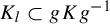
$K_l \subset gKg^{-1}$
be a maximal compact subgroup of L. Then,
$K_l \subset gKg^{-1}$
 for some
$g\in G$
for some
$g\in G$
 . Replacing K by a conjugate, we may assume that K contains
$K_l$
. Replacing K by a conjugate, we may assume that K contains
$K_l$
 . This, in particular, implies that K is normalized by compact simple factors of L. Let
$L_1$
. This, in particular, implies that K is normalized by compact simple factors of L. Let
$L_1$
 be a non-compact simple factor of L. Then,
$L_1$
be a non-compact simple factor of L. Then,
$L_1$
 is generated by the Ad-unipotent elements of
$L_1$
is generated by the Ad-unipotent elements of
$L_1$
 . Therefore,
$L_1$
. Therefore,
$L_1$
 normalizes K. Thus, the semisimple Levi subgroup L normalizes K.
Let N denote the nilpotent radical of G. Then, Ad
$(x)$
 is unipotent for any
$x\in N$
is unipotent for any
$x\in N$
 and, hence, N normalizes K. Thus,
$NK$
and, hence, N normalizes K. Thus,
$NK$
 is a closed connected subgroup of G. Since K is a maximal compact subgroup of G, K is a maximal compact subgroup of
$NK$
is a closed connected subgroup of G. Since K is a maximal compact subgroup of G, K is a maximal compact subgroup of
$NK$
 . Since N normalizes K, K is normal in
$NK$
. Since N normalizes K, K is normal in
$NK$
 . Thus, K is a maximal compact normal subgroup of the connected Lie group
$NK$
. Thus, K is a maximal compact normal subgroup of the connected Lie group
$NK$
 . Since any two maximal compact subgroups of a connected Lie group are conjugate, K contains any compact subgroup of
$NK$
. Since any two maximal compact subgroups of a connected Lie group are conjugate, K contains any compact subgroup of
$NK$
 . Let
$T=N\cap K$
. Let
$T=N\cap K$
 . Since K contains any compact subgroup of
$NK$
. Since K contains any compact subgroup of
$NK$
 , K contains any compact subgroup of N. This implies that T is the largest compact subgroup of N and T is normal in N. Therefore,
$N/T$
, K contains any compact subgroup of N. This implies that T is the largest compact subgroup of N and T is normal in N. Therefore,
$N/T$
 is a simply connected nilpotent Lie group [Reference Hochschild11, Exercise 1 of Ch. XV]. Since N is normal in G and T is the largest compact subgroup of N, T is normal in G. Since
$T\subset K$
is a simply connected nilpotent Lie group [Reference Hochschild11, Exercise 1 of Ch. XV]. Since N is normal in G and T is the largest compact subgroup of N, T is normal in G. Since
$T\subset K$
 , replacing G by
$G/T$
, replacing G by
$G/T$
 , we may assume that N is simply connected.
Let
$\tilde G = G/N$
 and
$\tilde K$
and
$\tilde K$
 be a maximal compact subgroup of
$\tilde G$
be a maximal compact subgroup of
$\tilde G$
 containing
$KN/N$
containing
$KN/N$
 . Then,
$\tilde K$
. Then,
$\tilde K$
 is connected [Reference Hochschild11, Theorem 3.1, Ch. XV] and there is a closed subgroup H of G containing N such that
$H/N = \tilde K$
is connected [Reference Hochschild11, Theorem 3.1, Ch. XV] and there is a closed subgroup H of G containing N such that
$H/N = \tilde K$
 . Since N and
$\tilde K$
. Since N and
$\tilde K$
 are connected, H is also connected [Reference Hewitt and Ross10, Theorem 7.4]. As N is simply connected, H contains a compact subgroup M such that
$H= MN$
are connected, H is also connected [Reference Hewitt and Ross10, Theorem 7.4]. As N is simply connected, H contains a compact subgroup M such that
$H= MN$
 and
$\tilde K= H/N \simeq M$
and
$\tilde K= H/N \simeq M$
 [Reference Hochschild11, Theorem 3.2, Ch. XII]. Also,
$K\subset H$
[Reference Hochschild11, Theorem 3.2, Ch. XII]. Also,
$K\subset H$
 as
$H/N =\tilde K$
as
$H/N =\tilde K$
 contains
$KN/N$
contains
$KN/N$
 . Since M is a compact subgroup of H and K is a maximal compact subgroup,
$M\subset xKx^{-1}$
. Since M is a compact subgroup of H and K is a maximal compact subgroup,
$M\subset xKx^{-1}$
 for some
$x\in H=MN$
for some
$x\in H=MN$
 . However, N normalizes K and, hence,
$M\subset K$
. However, N normalizes K and, hence,
$M\subset K$
 . This shows that
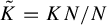
$\tilde K = KN/N$
. This shows that
$\tilde K = KN/N$
 .
.
Now, let R be the solvable radical of G. Then,
$N\subset R$
 and by [Reference Varadarajan13, Corollary 3.16.4],
$R/N$
and by [Reference Varadarajan13, Corollary 3.16.4],
$R/N$
 is the center of
$\tilde G$
is the center of
$\tilde G$
 and, hence,
$\tilde K$
and, hence,
$\tilde K$
 is normalized by
$R/N$
is normalized by
$R/N$
 . This shows that
$KN$
. This shows that
$KN$
 is normalized by R. Since the semisimple Levi subgroup L normalizes K, L normalizes
$KN$
is normalized by R. Since the semisimple Levi subgroup L normalizes K, L normalizes
$KN$
 as well. It follows that
$KN$
as well. It follows that
$KN$
 is a normal subgroup of G. Since K contains any compact subgroup of
$NK$
is a normal subgroup of G. Since K contains any compact subgroup of
$NK$
 , K is a normal subgroup of G.
The existence of an IRS supported on the set of maximal compact subgroups has certain implications on the structure of the connected Lie group G under consideration as described in the following proposition.
Proposition 4.1. Let G be a connected Lie group with solvable radical R and M be a maximal compact subgroup of G. Suppose M is normal in G. Then:
-
(1) the solvable radical R admits a compact central subgroup T so that $R/T$
is simply connected; -
(2) any closed simple Lie subgroup of G is compact or has no non-trivial compact connected subgroup.

Remark 4.2. The universal cover of
$SL(2, \mathbb {R})$
 is a simple Lie group without any compact subgroup of positive dimension. Thus, the second possibility in item (2) of Proposition 4.1 may occur.
Proof. Suppose that the maximal compact subgroup M of G is normal in G. Since any two maximal compact subgroups of a connected Lie group are conjugate, M is the largest compact subgroup of G. If R is the solvable radical of G, then
$R\cap M$
 is a maximal compact subgroup of R. Since R is a connected Lie group,
$R \cap M$
is a maximal compact subgroup of R. Since R is a connected Lie group,
$R \cap M$
 is connected. Therefore, the connected compact solvable group
$R \cap M$
is connected. Therefore, the connected compact solvable group
$R \cap M$
 is abelian. Since M is normal in G,
$R\cap M$
is abelian. Since M is normal in G,
$R\cap M$
 is normal in R. Since R is connected,
$R \cap M$
is normal in R. Since R is connected,
$R \cap M$
 is central in R. If
$T= R\cap M$
is central in R. If
$T= R\cap M$
 , then T is a central subgroup of R and
$R/T$
, then T is a central subgroup of R and
$R/T$
 has no compact subgroup. Thus,
$R/T$
has no compact subgroup. Thus,
$R/T$
 is simply connected [Reference Hochschild11, Exercise 3, Ch. XII]).
Let S be any simple Lie subgroup of G. Suppose that there exists a non-trivial compact connected subgroup of S. Then,
$M\cap S$
 is a compact normal subgroup of positive dimension in S. Since S is simple,
$S= S\cap M$
is a compact normal subgroup of positive dimension in S. Since S is simple,
$S= S\cap M$
 .
.
We now apply the above results to show that a finite covolume subgroup is cocompact if the subgroup is a Levi subgroup or a maximal compact subgroup.
Proof of Corollary 1.4.
Suppose H is a Levi subgroup of G. Then, the stabilizer, say
$G_{xH}$
 , at any
$xH\in G/H$
, at any
$xH\in G/H$
 is
$xHx^{-1}$
is
$xHx^{-1}$
 . Therefore, using the map
$xH\mapsto G_{xH}$
. Therefore, using the map
$xH\mapsto G_{xH}$
 , we obtain an IRS supported on the set of semisimple Levi subgroups. By Theorem 1.1, we get that G has a unique semisimple Levi subgroup and is normal in G. This implies that
$G/H$
, we obtain an IRS supported on the set of semisimple Levi subgroups. By Theorem 1.1, we get that G has a unique semisimple Levi subgroup and is normal in G. This implies that
$G/H$
 is a locally compact group. Since
$G/H$
is a locally compact group. Since
$G/H$
 carries a G-invariant probability measure,
$G/H$
carries a G-invariant probability measure,
$G/H$
 is compact. The other case, viz. when H is a maximal compact subgroup, can be proved similarly by using Theorem 1.3.
Now, we assume that G is a real algebraic group. Also, let B be a Borel subgroup of G and
$B_G$
 be the set of all Borel subgroups of G, that is,
$B_G=\{xBx^{-1}\mid x\in G\}$
be the set of all Borel subgroups of G, that is,
$B_G=\{xBx^{-1}\mid x\in G\}$
 .
.
Proof of Theorem 1.5.
Since B is a Borel subgroup of G,
$G/B$
 is compact and, hence, there is a compact set C in G such that
$G=CB$
is compact and, hence, there is a compact set C in G such that
$G=CB$
 . Since any two Borel subgroups are conjugate in G,
$B_G = \{xBx^{-1} \mid x \in C \}$
. Since any two Borel subgroups are conjugate in G,
$B_G = \{xBx^{-1} \mid x \in C \}$
 . It follows that,
$B_G$
. It follows that,
$B_G$
 is a compact subset of
$\mathrm {Sub}_G$
is a compact subset of
$\mathrm {Sub}_G$
 .
.
Suppose that there is an IRS
$\mu $
 such that
$\mu (B_G)=1$
such that
$\mu (B_G)=1$
 . To prove that G is amenable, it is sufficient to prove that any semisimple Levi subgroup of G is compact. Let R be the solvable radical of G. Then,
$R\subset B$
. To prove that G is amenable, it is sufficient to prove that any semisimple Levi subgroup of G is compact. Let R be the solvable radical of G. Then,
$R\subset B$
 and, hence, any Borel subgroup of G is a lift of a Borel subgroup of
$G/R$
and, hence, any Borel subgroup of G is a lift of a Borel subgroup of
$G/R$
 . Thus, replacing G by
$G/R$
. Thus, replacing G by
$G/R$
 , we may assume that G is semisimple. Now, let L be a simple factor of G. If L is non-compact, then L is generated by unipotent elements. Applying Proposition 3.2 by taking
$S=B$
, we may assume that G is semisimple. Now, let L be a simple factor of G. If L is non-compact, then L is generated by unipotent elements. Applying Proposition 3.2 by taking
$S=B$
 ,
$\Gamma =\mathrm {Inn}(L)$
,
$\Gamma =\mathrm {Inn}(L)$
 and
$U=\mathrm {Inn}(N)$
and
$U=\mathrm {Inn}(N)$
 , where N is a maximal unipotent subgroup of L, we get that B is normalized by L. Thus,
$B\cap L$
, where N is a maximal unipotent subgroup of L, we get that B is normalized by L. Thus,
$B\cap L$
 is a solvable normal subgroup of L containing a Borel subgroup of L. This is a contradiction to the simplicity of L. Hence, any simple factor of G is compact. This completes the proof.
Proof of Theorem 1.7.
Let D be a maximal diagonalizable subgroup of G and U be the unipotent radical of G. Then, there is a reductive Levi subgroup L of G containing D such that
$G= LU$
 . Let
$L'= [L, L]$
. Let
$L'= [L, L]$
 . Then,
$L'$
. Then,
$L'$
 is a semisimple Levi subgroup of G.
Let
$\mu $
 be an IRS with
$\mu (D_G)=1$
be an IRS with
$\mu (D_G)=1$
 . Then, applying Proposition 3.2 by taking
$S=D$
. Then, applying Proposition 3.2 by taking
$S=D$
 ,
$\Gamma =\mathrm {Inn}(G)$
,
$\Gamma =\mathrm {Inn}(G)$
 and
$U=\mathrm { Inn}(N)$
and
$U=\mathrm { Inn}(N)$
 , where N is a unipotent subgroup of G, we get that any unipotent subgroup of G normalizes D. If S is a non-compact simple algebraic subgroup of G, then the maximal split diagonalizable subgroup
$D_S$
, where N is a unipotent subgroup of G, we get that any unipotent subgroup of G normalizes D. If S is a non-compact simple algebraic subgroup of G, then the maximal split diagonalizable subgroup
$D_S$
 of S is contained in a conjugate of D. Replacing S by a conjugate of S, we may assume that
$D_S\subset D$
of S is contained in a conjugate of D. Replacing S by a conjugate of S, we may assume that
$D_S\subset D$
 . Since S is non-compact, S is generated by unipotent elements and, hence, S normalizes D. Therefore,
$D\cap S$
. Since S is non-compact, S is generated by unipotent elements and, hence, S normalizes D. Therefore,
$D\cap S$
 is a normal subgroup of positive dimension, which is a contradiction to the simplicity of S. Thus, the semisimple Levi subgroup
$L'= [L, L]$
is a normal subgroup of positive dimension, which is a contradiction to the simplicity of S. Thus, the semisimple Levi subgroup
$L'= [L, L]$
 of G is compact. This implies that
$D \subset Z(L)$
of G is compact. This implies that
$D \subset Z(L)$
 because
$L=[L, L] Z(L)$
because
$L=[L, L] Z(L)$
 .
.
Since the unipotent subgroups normalize D, D is normalized by U. Since
$D\cap U$
 is trivial, D is centralized by U also. Again, since
$G= LU$
is trivial, D is centralized by U also. Again, since
$G= LU$
 , D is central in G. This proves that
$(1)$
, D is central in G. This proves that
$(1)$
 implies
$(2)$
implies
$(2)$
 ;
$(2)$
;
$(2)$
 implies
$(3)$
implies
$(3)$
 is trivial. If D is normal, then
$\delta _D$
is trivial. If D is normal, then
$\delta _D$
 , the Dirac measure at D is the required IRS. This proves that
$(3)$
, the Dirac measure at D is the required IRS. This proves that
$(3)$
 implies
$(1)$
implies
$(1)$
 .
.
Now, suppose condition (1) holds. Then, the proof of the first implication shows that the Levi subgroup is compact and D is central. Let R be the solvable radical of G. Then,
$D_R=R\cap D$
 is a central subgroup of R and, hence,
$D_RU$
is a central subgroup of R and, hence,
$D_RU$
 is a nilpotent subgroup of R, where U is the unipotent radical of G. Since
$R/D_RU$
is a nilpotent subgroup of R, where U is the unipotent radical of G. Since
$R/D_RU$
 is an anisotropic torus (that is, without any split torus subgroup), we get that
$R/D_RU$
is an anisotropic torus (that is, without any split torus subgroup), we get that
$R/D_RU$
 is compact.
Corollary 4.3. Let G be a connected real algebraic group and D be a maximal diagonalizable subgroup of G. Suppose
$G/D$
 has a G-invariant probability measure. Then, G is a direct product of D and a compact group.
Proof. Let m be the G-invariant probability measure on
$G/D$
 . Then, the stabilizer,
$G_{xD}$
. Then, the stabilizer,
$G_{xD}$
 , of
$xD\in G/D$
, of
$xD\in G/D$
 is
$xDx^{-1}$
is
$xDx^{-1}$
 . Therefore, the map
$xD \mapsto xDx^{-1}$
. Therefore, the map
$xD \mapsto xDx^{-1}$
 gives rise to an IRS supported on maximal diagonalizable subgroups. By Theorem 1.7, we get that D is normal in G and the semisimple Levi subgroup of G is compact. Since
$G/D$
gives rise to an IRS supported on maximal diagonalizable subgroups. By Theorem 1.7, we get that D is normal in G and the semisimple Levi subgroup of G is compact. Since
$G/D$
 has a G-invariant probability measure,
$G/D$
has a G-invariant probability measure,
$G/D$
 is a compact group. Therefore, the unipotent radical of G is trivial. This implies that G is reductive with compact semisimple Levi subgroup and, hence, D is central. It follows that G is a direct product of D and a compact subgroup.
Acknowledgements
Both authors thank the referee for many thoughtful suggestions that have helped in improving the exposure of the article and, in the process, making it more accessible to the readers. The authors thank the International Centre for Theoretical Sciences, Bangalore for its hospitality during the program Ergodic Theory and Dynamical Systems,
$5$
 th December to
$16$
th December to
$16$
 th December, 2022, when this work was initiated. The first author thanks the Indian Statistical Institute Bangalore Centre for its hospitality during his several visits while this work was going on. The second author acknowledges the support from SERB through the grant under MATRICS MTR/2022/000429.



