The major determinants of the burden of disease today are diet-related(Reference Ezzati, Lopez and Rodgers1, 2). In Denmark, as in the rest of the world, the prevalence of overweight and obesity in both children and adults has increased dramatically over the last 60 years(Reference Bendixen, Holst and Sørensen3, Reference Pearson, Olsen and Hansen4). Obesity increases the risk of a wide range of serious medical complications, including CVD, insulin resistance, type 2 diabetes, gallbladder disease, osteoarthritis, asthma and several cancers(Reference Haslam and James5). Ensuring that the population eats a healthy diet therefore remains a public health challenge. When making dietary recommendations it is important that the diet is palatable and attractive to the consumer(Reference Sørensen, Møller and Flint6), and it has been suggested that tailoring the diet to regional conditions is also of importance(Reference Bere and Brug7).
The Danish research project OPUS was established to investigate whether it is possible to develop a healthy New Nordic Diet (NND) that is palatable, environmentally friendly and based largely on foods originating from the Nordic region. The overall aim of OPUS is to create ‘Optimal well-being, development and health for Danish children through a healthy New Nordic Diet’.
The principles and guidelines of the NND are described in a previous paper(Reference Mithril, Dragsted and Meyer8). In summary, the following principles were crucial in the development of the NND: health, gastronomic potential, Nordic identity, and sustainability. These principles led to the formulation of three fundamental guidelines as the basis of the NND as compared with the current average Danish diet: (i) more calories from plant foods and fewer from meat; (ii) more foods from the sea and lakes; and (iii) more foods from the wild countryside.
The objective of the present paper is to describe the dietary composition of the NND. A further objective is to compare the dietary composition of the NND with the Nordic Nutrition Recommendations (NNR)/Danish Food-based Dietary Guidelines (DFDG) and the average Danish diet.
Method
OPUS is a Danish project and two intervention studies within the project are currently being carried out in Denmark (one in overweight adults and one in healthy schoolchildren), so food selection for the NND in this context is based on the Danish market and food culture, with reference to average dietary patterns in the Danish population. The overall principles, guidelines and dietary components can, however, easily be translated and applied to any country in the world. In order to justify the term ‘New Nordic Diet’, it is implicit that it should be possible to apply both the selection of foods and the nutrient contents directly in the Nordic or Northern European regions with minimal adjustments.
Each dietary component is chosen because of its presumed health-promoting potential, its distinct Nordic identity, its gastronomic potential, and because it can be produced in the Nordic region with consideration for the environment. Dietary components with evident health-promoting properties included in the DFDG (e.g. fruits, vegetables, potatoes, whole grains, nuts, fish and shellfish) are included in the NND in at least the same amount as in the DFDG(Reference Astrup, Andersen and Stender9). The recommended intakes of the other dietary components of the NND (e.g. fresh herbs, plants and mushrooms from the wild countryside, seaweed, meat and game) are based on scientific arguments for their potential health-promoting properties together with considerations of acceptability, toxicological concern, availability and environmental sustainability.
Availability and local food culture have also been considered in the selection of dietary components. We included dietary components that are available in the Nordic region in abundance and which are – or could become – easily available in all localities with only reasonable exertions made in regard to gathering, distribution, marketing, shopping, etc. The challenges regarding the general availability of the dietary components of the NND are a part of the work currently being done in OPUS and will not be further elaborated in the present paper.
Dietary calculations were conducted using the software GIES system version 1·000d and the Danish Food Composition Databank version 7 (National Food Institute, Technical University of Denmark, Søborg, Denmark; www.Foodcomp.dk) to quantify the dietary components and nutrient composition of the NND. The NND was designed to follow the NNR 2004 guidelines with respect to the overall macro- and micronutrient composition. Small adjustments were made when evidence for their health-promoting properties made this appropriate. For example, the NND aims to increase the intake of whole grains, as the evidence suggests that a high intake is associated with a reduction in the risk of several diseases(Reference Mejborn, Biltoft-Jensen and Trolle10); and the amount of protein in the NND is at the high end of the recommended range, because recent studies suggest that increased protein intake (20–25 % of energy (E%)) may have a positive effect on the regulation of body weight, prevent diabetes and have a mild blood pressure-lowering effect(Reference Paddon-Jones, Westman and Mattes11–Reference Larsen, Dalskov and van Baak13). It is important to bear in mind that the NND is not a weight reduction diet, but is an everyday diet developed for normal-weight people.
Results
Dietary components in the New Nordic Diet
Table 1 illustrates the suggested average daily intakes of the dietary components in the NND compared with the DFDG recommended intakes(Reference Astrup, Andersen and Stender9) and the average daily intakes in the Danish population(Reference Pedersen, Fagt and Groth14) (A Biltoft-Jensen, unpublished results). The quantification of each dietary component should not be seen as the definite amount but rather as a guiding average amount. The figures are average daily intake over a period of time, such as a week, and not necessarily eaten each day in the specific amount. For some dietary components (e.g. fruits and vegetables, potatoes, whole grains, nuts, fish and shellfish, game) the figures are average minimum amounts, while for others (e.g. plants and mushrooms from the wild countryside, seaweed and free-range livestock) the figures are more exact but still average amounts over time, e.g. a week. All figures are calculated and expressed per 10 MJ.
Overview of the average daily content of the dietary components in the New Nordic Diet (NND) in relation to the Danish Food-based Dietary Guidelines (DFDG)(Reference Astrup, Andersen and Stender9) and the average daily content in the Danish population(Reference Pedersen, Fagt and Groth14) (A Biltoft-Jensen, unpublished results)

All figures are based on the energy-adjusted intake (per 10 MJ) of all persons aged 4–75 years.
In the following each of the dietary components are elaborated and compared with the DFDG and the average daily intake in the Danish population(Reference Astrup, Andersen and Stender9, Reference Pedersen, Fagt and Groth14) (A Biltoft-Jensen, unpublished results). The reasoning behind the selection of the various dietary components is published in a previous paper(Reference Mithril, Dragsted and Meyer8).
Fruits and vegetables
The mean intake of fruit (including berries) and vegetables (including cabbages, root vegetables and legumes) in the average Danish adult population is just over 400 g/d, although the recommended intake is 600 g/d for adults and children over 10 years(Reference Astrup, Andersen and Stender9, Reference Pedersen, Fagt and Groth14) (A Biltoft-Jensen, unpublished results; Table 1). Studies have shown that with an increasing intake of fruits or vegetables there is a proportional decrease in the risk of CVD(Reference He, Nowson and MacGregor15, Reference He, Nowson and Lucas16), overweight and obesity(Reference Duijnhoven, Bueno-De-Mesquita and Ferrari17) and probably of certain cancers(18, Reference Basu, Rhone and Lyons19). Fruit and vegetables therefore play an important role in the NND and the targeted intake was set to 700 g/d (Table 1).
Specific fruits and vegetables were designated as more identifiable with the Nordic regions: berries, cabbages, root vegetables and legumes. These were selected because of their potential health-promoting properties, clear Nordic identity and environmentally sustainable production. Berries are a popular fruit; they are found in abundance in the wild and in season are freely accessible to the public. Berries are a good source for vitamins, minerals and dietary fibre, and they contain considerable amounts of polyphenols, especially anthocyanins(Reference Battino, Beekwilder and Denoyes-Rothan20, Reference Bere21). The intake of berries in the NND is 50–100 g/d as opposed to the mean intake in the Danish population of only 5 g/d (Table 1). Cabbages and root vegetables can be a part of everyday meals all year around, and the intake in the NND is set at approximately 29 and 150 g/d, respectively, compared with the current average mean intake in the Danish population of 9 and 38 g/d, respectively (Table 1). Root vegetables are rich sources of dietary fibre, vitamins (especially A, B and C vitamins) and minerals (especially Ca and Fe in beetroot), but they have not been extensively explored for non-nutritive components of possible importance to health. In contrast, several studies indicate that cabbages may have specific health-promoting properties, e.g. as a prophylactic for cancer, above the general health benefits obtained from eating fruits and vegetables(Reference London, Yuan and Chung22–Reference Kirsh, Peters and Mayne26). Cabbages have a high content of vitamin K, antioxidants, dietary fibre, folate, and of several carotenoids and glucosinolates that are not found in other foods. The increased intake of legumes in the NND is designed to increase the amount of protein obtained from plant sources in order to reduce pressure on the environment. The amount of legumes in the NND is 30 g/d, while the mean intake in the Danish population today is 7 g/d (Table 1). Some legumes are also sources of phyto-oestrogens which may be involved in protection against CVD(Reference Bazzano, Thompson and Tees27).
Fresh herbs
In the Middle Ages fresh herbs played a major role in the Danish kitchen, but their use has decreased significantly over time. In recent decades exotic dried spices have partially taken their place(Reference Boyhus28, Reference Skaarup and Jacobsen29). The current intake of fresh herbs in the Danish population is almost non-existent (less than 1 g/d; A Biltoft-Jensen, unpublished results; Table 1). In analogy to the current more abundantly used Mediterranean herbs such as thyme and oregano, the traditional Nordic herbs such as dill, parsley and chives are rich sources of aromatic terpenoids and of phytochemicals that may have health-promoting properties(Reference Cornwell, Cohick and Raskin30). Fresh herbs are rich in vitamins and minerals, particularly vitamin C and Fe. The intake of fresh herbs in the NND was set as high as possible in order to exploit their gastronomic properties and potential health benefits. There are no official recommendations for intake of fresh herbs today.
Potatoes
Consumption of potatoes has fallen steadily since the introduction of rice and pasta to the Nordic countries and the average intake in the Danish population is now 106 g/d (A Biltoft-Jensen, unpublished results; Table 1). Potatoes are an important source of dietary fibre, vitamins B6 and C, folate, Fe, K and Mg in the Danish diet(Reference Pedersen, Fagt and Groth14) and it has been recommended that the average daily intake of potatoes should be increased to a minimum of 140 g (DFDG; Table 1). In addition, potatoes are among the foods that have the least negative environmental impact(Reference Saxe, Jensen and Petersen31). The intake of potatoes in the NND follows the DFDG of a minimum average daily intake of 140 g (Table 1). It should be emphasized that in this context potato in the form of crisps, chips, French fries, etc. is excluded.
Plants and mushrooms from the wild countryside
At present the Danish population eats practically no plants and mushrooms from the wild countryside (less than 1 g/d; Table 1). These foods have both health-promoting and gastronomic potential(Reference Mithril, Dragsted and Meyer8) and intake in the NND is therefore increased to 5 g/d (Table 1). However, wild plants have a high content of bioactive components, some of which can be toxic in large quantities. The daily intake of 5 g of edible wild plants and mushrooms in the NND corresponds, even for children, to a maximum intake of any one constituent of below 30 mg/kg body weight per d. This should give rise to no concerns regarding toxicology for the plants included in the NND(Reference Kroes, Renwick and Cheeseman32).
Whole grains
There is strong evidence that whole grains have a health-promoting potential(Reference Mejborn, Biltoft-Jensen and Trolle10) and the DFDG recommend an average intake of 75 g/d (Table 1). Studies have shown a significant inverse association between intake of whole grains and risk of CVD(Reference Kelly, Summerbell and Brynes33, Reference Pereira, O'Reilly and Augustsson34), type 2 diabetes(Reference Liese, Roach and Sparks35), cancer(Reference Egeberg, Olsen and Loft36), and weight gain or risk of obesity(Reference Howarth, Saltzman and Roberts37). The average intake in the Danish population is only 36 g/d, i.e. less than half the recommended amount (Table 1). The quantity of whole grains in the NND is a minimum of 75 g/d (Table 1).
Nuts
Nuts have a documented health-promoting potential and an intake of 30 g/d is recommended by the DFDG (Table 1). There is some scientific evidence that consumption of nuts is associated with a reduced risk of CVD(Reference Richardson, Astrup and Cocaul38, Reference Sabaté, Oda and Ros39) and weight gain and obesity(Reference Sabaté and Ang40). The health-promoting effects of nuts are probably due to their high content of MUFA, protein, dietary fibre, vitamins (especially vitamin E, but also B vitamins, particularly folic acid, niacin and B6) and minerals (particularly Mg and K)(Reference Sabaté, Ros and Salas-Salvadó41). Nuts have a lot of flavour and can be used as an alternative to sweets and to make salads, muesli and bread more appetizing. The average intake of nuts is currently about 1 g/d in the Danish population (Table 1). The amount in the NND is at least 30 g/d (Table 1). Only unsalted, non-oiled nuts are included.
Fish and shellfish
Fish and shellfish have a significant health-promoting potential and regular fish consumption is recommended(42). The DFDG recommends intakes of 200 to 300 g/week, corresponding to an average intake of 29–43 g/d(Reference Astrup, Andersen and Stender9) (Table 1). Fatty fish contain high amounts of n-3 fatty acids, which have been shown to improve child brain development and help prevent CVD and nervous disorders in adults(Reference Andersen, Büchert and Koch43). In addition, fish and shellfish have a high content of valuable vitamins and minerals, including vitamin D, iodine and Se, which are difficult to find naturally in other foods. High-quality fish are abundant in the Nordic region, but a large part of the catch is exported. Different species of fish contain different amounts of vitamins, minerals and fatty acids. Intake should therefore be alternated between fatty and lean species and between different origins (Atlantic, Baltic, freshwater) in order to get the full health benefits while minimizing risks due to pollution with organohalides, As and heavy metals. The average intake in the Danish population is 22 g/d – far below the recommended intake (Table 1). The amount included in the NND is 43 g/d corresponding to an intake of 300 g/week (Table 1).
Seaweed
Seaweed is an overlooked source of nutrition in the Western world and the intake in the Danish population is close to zero (Table 1), although is was previously part of the poor man's diet all along the Nordic coastline(Reference Mouritsen44). Seaweed has a high content of essential minerals, protein, dietary fibre, vitamins (A, B, C, E) and essential fatty acids(Reference Mouritsen44). It also has a range of bioactive compounds, which may be beneficial in relation to CVD and have a potential antiviral and anticancer effect(Reference Cooksley45). The composition of seaweeds varies greatly with species and region origin, and these can give rise to some concerns, including risks from relatively high contents of iodine. The majority of seaweeds in the Nordic region are edible and non-toxic, but the NND recommendations are set at 5 g/d (fresh weight) because of the high iodine content in certain species (Table 1).
Free-range livestock (including pigs and poultry) and game
Consumption of meat has almost doubled in the Nordic countries over the past 50 years and today the average intake in the Danish population is 143 g/d(Reference Pedersen, Fagt and Groth14, Reference Groth and Fagt46) (Table 1). There are no official quantitative guidelines for intake of meat in Denmark, but an average intake of 100 g/d per adult person is considered adequate(Reference Ovesen47). Meat is among the least environmentally friendly foods; the NND seeks to decrease the intake of meat and replace it with more environmentally friendly protein sources such as fish and shellfish, legumes and nuts. The recommendation for dietary protein in Denmark is currently 10–20 E%, which corresponds to 0·8 to 1·6 g/kg body weight(42). The amount of energy from protein in the NND is set at a minimum of 1 g/kg body weight, which can easily be achieved by a meat intake of 85–100 g/d combined with other sources of protein (e.g. fish and shellfish, wholegrain, vegetables, nuts, milk, cheese and eggs). Women of childbearing age must ensure sufficient Fe in their diet and should therefore have an intake of meat at the high end of the recommendation. The high content of fruit and vegetables in the NND gives a high intake of vitamin C, which stimulates Fe absorption in the body, and a greater proportion of the Fe intake in the NND is therefore expected to be absorbed, thereby helping further to compensate the Fe loss in these women.
The NND focuses on meat from free-range animals, for reasons of sustainability and gastronomy, and potentially also for health. Studies have shown that meat from animals that graze has a healthier fatty acid composition, with less saturated fat and more polyunsaturated fat, than meat from animals reared indoors without access to grass(Reference Scollan, Hocquette and Nuernberg48, Reference Cordain, Watkins and Florant49). In addition, the NND has a higher content of game. Game is unique in gastronomy, because the animals have fed on plants that reflect the specific climate and landscapes of the region. The intake of game in the NND is 4 g/d, as opposed to the current intake in the Danish population of less than 1 g/d (Table 1).
Other dietary components
The intakes of other dietary components in the NND follow the DFDG, e.g. dairy products (500 g/d for milk, 25 g/d for cheese), eggs (25 g/d), beverages, sweets, etc(Reference Astrup, Andersen and Stender9). We make no further elaboration on these dietary components here, as they do not differ from the DFDG.
Nutritional content of the New Nordic Diet
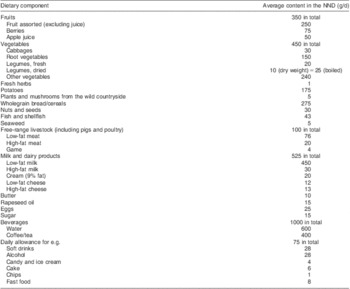
The following overview of the macro- and micronutrients in the NND was calculated from a full day's diet including the dietary components in Table 1, dairy products and eggs according to the recommended daily intake, 25 g/d for butter/oil, 15 g/d for sugar, and with a daily allowance of sweets, alcohol, etc. of 75 g/d (Appendix). Some of the dietary components in the NND are missing in the nutritional databases and best estimates have been made for items such as fresh herbs, plants and mushrooms from the wild countryside and seaweed. The result should therefore not be regarded as definitive for the NND. Tables 2 and 3 present the average daily intakes of macro- and micronutrients in the NND compared with the recommended intake according to the NNR and the average daily intake in the Danish population(Reference Pedersen, Fagt and Groth14, 42) (A Biltoft-Jensen, unpublished results). All figures are for groups of individuals 10–75 years of age (for alcohol the age group is 18–75 years). The values in Table 3 are adapted for the reference person requiring the highest dietary nutrient density.
Overview of the average daily composition and intakes of protein, fat, carbohydrates and alcohol as a percentage of total energy intake (E%) for the New Nordic Diet (NND), the recommended intake according to the Nordic Nutrition Recommendations (NNR)(42) and the average composition of the diet in the Danish population(Reference Pedersen, Fagt and Groth14, 42)

All figures are for groups of individuals 10–75 years of age, with a heterogeneous age and sex distribution (for alcohol, 18–75 years of age).
Overview of the average daily composition and intakes of nutrients in the New Nordic Diet (NND) in relation to the intake recommended by the Nordic Nutrition Recommendations (NNR)(42) and the average composition of the diet in the Danish population(Reference Pedersen, Fagt and Groth14, 42)

RE, retinol equivalents; α-TE, α-tocopherol equivalents; NE, niacin equivalents.
All figures are based on the energy-adjusted intake per 10 MJ for groups of individuals 10–75 years of age, with a heterogeneous age and sex distribution (for the NNR, 6–60 years of age). The values are adapted to the reference person requiring the highest dietary nutrient density.
Macronutrient distribution in the New Nordic Diet
As shown in Table 2, the average diet of the Danish adult population provides 14 E% from protein, 33 E% from fat, 48 E% from carbohydrate and 6 E% from alcohol(Reference He, Nowson and MacGregor15). By comparison, the recommended energy distribution according to the NNR is 30 E% from fat, 55 E% from carbohydrate, 15 E% from protein and maximum 5 E% from alcohol(42). The excess fat intake in the Danish population is primarily of SFA, where the content is 14 E% compared with the recommended level of maximum 10 E%. The Danish population has an average intake of dietary fibre of 23 g/d compared with the recommended intake of 25–35 g/d, and about 25 % of adults in the Danish population consume more added sugars than the recommended maximum of 10 E%(Reference Pedersen, Fagt and Groth14).
The NND provides 17 E% from protein, 32 E% from fat, 51 E% from carbohydrate and 1 E% from alcohol. The quantity of SFA follows the recommendations of 10 E%, and the intake of dietary fibre of 41 g/d exceeds the recommendations. The intake of refined sugar in the NND is limited to 4 E%.
The energy intake from fat is slightly higher in the NND compared with the recommended intake, but was accepted for the gastronomic properties. How this diet will affect body weight in overweight subjects remains to be tested.
Micronutrient distribution in the New Nordic Diet
The micronutrient content of the average Danish diet is generally sufficient as defined in the NNR, apart from a few exceptions (Table 3). The Danish diet contains abundant amounts of vitamin A, riboflavin, niacin, B12, vitamin C, Ca, P and iodine. The contents of vitamin E, thiamin, vitamin B6, K, Mg, Zn and Se are acceptable. The vitamin D content is too low in all age groups and the folate and Fe contents are insufficient for many females of fertile age.
The amount of all nutrients other than vitamin D and Fe is abundant in the NND (Table 3). The vitamin D content of the NND is 5 μg/d as opposed to 3 μg/d in the average Danish diet, while the Fe content of the NND is 14 mg/d as opposed to 11 mg/d in the average Danish diet (Table 3). Females of childbearing age might benefit from additional dietary Fe, so the NND recommends that they eat 100 g of meat daily. Like everyone else in Nordic countries, populations eating the NND need to ensure an appropriate intake of vitamin D-rich products, especially during the winter when sunlight is scarce and vitamin D synthesis limited. The NND has a relatively high content of iodine, due to the fortification of kitchen salt in Denmark with iodine and the relatively high content of iodine in milk because the animal feed is also fortified with iodine. The iodine content of Danish seaweeds is not known and we have therefore used data for species with the highest content of iodine in the calculations, estimating the worst-case scenario. The estimated upper level (UL) for iodine is 600 μg/d and the amount of iodine in the NND is acceptable(42). There is no figure for the content of salt in the NND, since the level of salt in the diet is very dependent on the amount added to food during cooking. The NND is not a specific low-salt diet, but is aimed at following the NNR with regard to the level of salt in the diet, which is a maximum of 5–6 g/d(42).
Discussion
Nordic foods have become gastronomically highly appreciated internationally, but as a Northern European food culture the Nordic regional diets have not been regarded as healthy. The low carbon footprint of locally produced foods makes them the more sustainable choice. The NND is an attempt to address all these aspects and to create a diet with all three characteristics, i.e. being tasty, healthy and sustainable(Reference Mithril, Dragsted and Meyer8). A diet based on Nordic foods and the NNR within the Swedish tradition has already been tested in a small human dietary study and results indicated considerable health potentials of this approach(Reference Adamsson, Reumark and Fredriksson50). Another study on Nordic foods concluded that traditional healthy Nordic foods were found to be related to lower mortality among middle-aged Danes, in particular among men(Reference Olsen, Egeberg and Halkjær51). However, the principles governing a designed diet such as the NND are not easily translated into food choices and menus. For the NND, we suggest here choices of actual foods that are consistent with the guidelines for the NND and which at the same time are in general agreement with the NNR with respect to nutrient distribution. The composition of the NND deviates slightly from the NNR, most notably in the higher fibre intake due to the high fruit, vegetable, legume and whole grains content, and for some of these the level is above that recommended in the DFDG. There is evidence that these higher levels may potentially have a positive effect on health and there are no obvious contraindications. The increased intake of vitamin C and of non-haem Fe should lead to improved Fe status in women, and the high content of legumes and fish should balance out the relative decrease in protein intake from meat.
Precise nutrient composition of many of the dietary components included in the NND is missing from the food composition databases. The risk of errors in our calculations of the nutrient content of the NND should therefore be taken into consideration. Some of the more unusual constituents of the NND, such as wild plants and seaweeds, require careful examination of the risk of adverse effects. This will be examined in more detail elsewhere, but we already know that the iodine content is, conservatively calculated, in excess of the recommended UL for safety. This may be attributable to the limitations of the data available on the different seaweeds, leading to an exaggerated mean level of iodine in seaweeds in the estimations. The limitations of the food composition databases underline the gaps in our general knowledge of the safety and/or potential benefits of food components such as seaweeds and wild plants. Further research is needed in order to pave the way for safe and healthy use of these resources in dietary improvements.
The dietary components and suggested intake of each food in the current paper are not intended to be an unequivocal final answer, but rather as one of several possible suggestions for a Danish version of a healthy and sustainable regional diet. The dietary components have been used to develop a range of specific recipes for the OPUS intervention studies and selected recipes have recently been published in a Danish cookbook(Reference Meyer and Astrup52). As we test the NND we should learn more about how to develop it further.
Concluding remarks
The NND is a prototype regional diet with concern for palatability, health, food culture and the environment. Similar regionally adapted diets could be created using these principles anywhere in the world. The principles can be used to create diets that respect the existing dietary guidelines using local produce and create recipes that are consistent with the local food culture and acceptable in the population. The effectuation of the NND in a free-living population and its possible health effects are currently being tested with an aim to provide proof of principle for the construction of a healthy New Nordic Diet.
Acknowledgements
Sources of funding: The present study is a part of the OPUS project. OPUS is an acronym of the Danish title of the project ‘Optimal well-being, development and health for Danish children through a healthy New Nordic Diet’. The OPUS Centre is supported by grant from the Nordea Foundation, Denmark, and is independent of all commercial interests. Conflict of interest: C. Mithril, L.O.D., I.T. and A.B.-J. have no conflicts of interest. C. Meyer is an owner of restaurants, food companies and a cooking school, and the New Nordic Cuisine is a theme in most of C. Meyer's companies. A.A. is an advisor, an advisory board member or a scientific board member for the Communications and Scientific Advisory Board of The Global Dairy Platform (Chicago, IL, USA), the Kraft Health & Wellness Advisory Council (Glenview, IL, USA), the Beer Knowledge Institute (Amsterdam, The Netherlands), the Pathway Genomics Corporation (La Jolla, CA, USA) and Jennie Craig (Carlsbad, CA, USA); and receives honoraria as a speaker and research funding from a wide range of Danish and international concerns. Authors’ contributions: The draft paper was elaborated by C. Mithril based on an OPUS report on the NND, which was developed by C. Mithril in close collaboration with C. Meyer, E. Blauert, M.K. Holt, L.O.D. and A.A. and with dietary input from I.T. and A.B.-J. L.O.D., I.T. and A.B.-J. helped C. Mithril shape the draft paper into its final form which was then approved with minor corrections by the other co-authors. Acknowledgements: The authors thank the Advisory Boards assisting OPUS Work Package 1 and the participants at the OPUS congress held in June 2009 in Copenhagen for their valuable input and help in the development of the NND. They also greatly thank dietitian Karin Hess Ygil from DTU Food for making the dietary calculations of the NND.
Overview of the dietary composition of an example of a full day's diet in the New Nordic Diet (NND) used for calculating the nutritional content of the NND