

Introduction
The Hong Kong (HK) government raised the eligibility age for claiming old-age social assistance from 60 to 65 years in 2019, thereby re-categorising claimants as unemployed and subjecting them to work-related duties. While the welfare conditionality imposed on claimants in HK tends to be centred on market discipline and moral obligation (Yu, Reference Yu2008; Au-Yeung, Reference Au-Yeung2023), how it is implemented or even mediated by the delivery of employment service is unknown. This article presents a qualitative study on how frontline caseworkers crafted the configuration of welfare conditionality within the contexts of the welfare system and employment regime. Using HK as a case study, this study echoes the recent research agenda to emphasise the roles played by street-level bureaucrats in shaping welfare conditionality (Hupe and Hill, Reference Hupe, Hill and Hupe2019; van Berkel, Reference van Berkel2020; Clasen and Mascaro, Reference van Berkel2022). The authors link the formation of welfare conditionality to microfoundation theories, explaining the practices of activation policies that aim to extend the job-seeking lives of older welfare claimants. Microfoundation refers to the social institutions reproduced and transformed by actors in their everyday activities (Powell and Rerup, Reference Powell, Rerup, Greenwood, Oliver, Lawrence and Meyer2017; Haack et al., Reference Haack, Sieweke and Wessel2019), which manifests the multilevel configuration of welfare conditionality.
Previous literature suggests that punitive conditionality and futile job-seeking activities may subject claimants to criminalisation, constituting a form of social abuse (Wright et al., Reference Wright, Fletcher and Stewart2020). Activation policy and public employment service (PES) are considered the tools to materialise welfare conditionality, transitioning claimants into employment or increased economic participation (Clasen and Mascaro, Reference Clasen and Mascaro2022). Although welfare conditionality is tightened amid rising social demands and fiscal pressures (Knotz, Reference Knotz2018; Nunn, Reference Nunn2020), its impact on various social groups tends to vary (Dwyer et al., Reference Dwyer, Scullion, Jones, McNeill and Stewart2022). The local welfare system and frontline contingencies constitute the governance mechanisms of service models. PES delivery plays a pivotal role in the implementation of welfare conditionality. McNeill (Reference McNeill2020) highlights the intricate roles played by ‘penal practitioners’ who navigate between mass supervision and care support, thus mediating the severity of punitive measures. Watts-Cobbe and Fitzpatrick (Reference Watts-Cobbe and Fitzpatrick2025: 297) underscore the likelihood of an ‘overlapping consensus’ to administer conditionality mildly. While the concept of street-level bureaucracy is increasingly utilised to examine how frontline workers modify policy content in everyday interactions (Lipsky, Reference Lipsky2010; Brodkin and Marston, Reference Brodkin and Marston2013; Hupe and Hill, Reference Hupe, Hill and Hupe2019; Clasen and Mascaro, Reference Clasen and Mascaro2022), the interrelations between welfare systems, organisational settings, and street-level practices have not been fully explored concerning configurational contexts (Van Berkel, Reference van Berkel2020). Accordingly, this study echoes van Berkel’s (Reference van Berkel2020) emphasis on the centrality of configurational contexts for a street-level analysis of welfare conditionality and policy implementation. In contrast to previous literature focusing solely on the street-level bureaucracy of PES concerning frontline sanctions and discretion (Lipsy, 2010; Brodkin and Marston, Reference Brodkin and Marston2013; Hupe and Hill, Reference Hupe, Hill and Hupe2019), informed by institutional theories of microfoundations, this study elucidates the welfare conditionality imposed upon older jobseekers as an outcome of negotiated configuration through the multilevel mechanism of PES intervention.
To explain the street-level (re)formation of welfare conditionality and activation policy (Van Berkel, Reference van Berkel2020; Clasen and Mascaro, Reference Clasen and Mascaro2022), this study reconceptualises PES as the microfoundation of activation policy, formulating mechanisms that evolve from shifting institutional contexts and culminate in negotiated conditionality outcomes. Two primary research questions drove this study: (1) How is welfare conditionality configured within social contexts? (2) In what ways does PES implementation negotiate the welfare conditionality of older jobseekers? Through performing in-depth interviews with twenty-four social workers and conducting a context-mechanism-outcome analysis, the findings transcend the static description of welfare conditionality as a mere set of behavioural requirements, instead emphasising its role as a product of negotiated configurations, serving as the microfoundation for extending job-seeking lives. Given the varied implementation of welfare conditionality across settings, the age-specific, relationship-orientated, and health-focused practices in PES formulated a ‘more-than-employment’ approach to older jobseekers in HK.
This research contributes to social policy studies by theorising about negotiable welfare conditionality and investigating the microfoundation of its intricate configuration. Empirically, this study adds value to the literature by linking extended job-seeking lives and older claimants to welfare conditionality within HK’s work-first model. The subsequent sections examine the implementation of conditionality through PES for older jobseekers and propose a framework grounded in microfoundation theories to explain the configuration of conditionality. After discussing research methods, we conduct a context-mechanism-outcome analysis of the negotiated conditionality in the context of extending job-seeking lives, concluding with a reconceptualisation of welfare conditionality to inform future research.
Implementing welfare conditionality via employment services for older jobseekers
Informed by the street-level bureaucracy (SLB) theories (Lipsy, 2010; Brodkin and Marston, Reference Brodkin and Marston2013; Hupe and Hill, Reference Hupe, Hill and Hupe2019), the burgeoning literature focuses on the implementation of conditionality and activation policies through PES, examining policy and governance systems, organisational settings, and professional practices (Rice, Reference Rice2013; Fuertes and Lindsay, Reference Fuertes and Lindsay2016; Van Berkel, Reference van Berkel2020; Clasen and Mascaro, Reference Clasen and Mascaro2022). Neoliberal PES intensifies welfare conditionality by imposing stricter service agreements or promoting the use of managerial administrations for host organisations (Redman and Fletcher, Reference Redman and Fletcher2022; Weishaupt et al., Reference Weishaupt, Jørgensen, Nunn, Besharov and Call D2022). The marketisation of PES relies on subcontracting and price-based financing to conduct performance monitoring and enhance competition among providers (Fuertes and Lindsay, Reference Fuertes and Lindsay2016; Greer et al., Reference Greer, Schulte and Symon2018), resulting in selective biases such as creaming and parking effects. At the organisational and professional levels, limited funding models and increasing caseloads exert pressure on service providers in the third sector (Egdell et al., Reference Egdell, Dutton and McQuaid2016; McGann et al., Reference McGann, Nguyen and Considine2020).
Moreover, the role of street-level bureaucrats in mediating the hardness of conditionality through professional judgement and discretionary practices has also been emphasised (Van Berkel, Reference van Berkel2020). Welfare conditionality is enforced through frontline workers’ appraisals of client groups’ deservingness, workability, and effort (McGann et al., Reference McGann, Nguyen and Considine2020; Stray et al., Reference Stray, Thomassen and Vike2023). Informed by the SLB theories, the use of discretionary power and decision-making is crucial in mitigating the coercive nature of conditionality and marketisation (Kim, Reference Kim2015; Kaufman, Reference Kaufman2020). Despite the inherent tension between the professional roles of caregiving and gatekeeping (Trochymiak, Reference Trochymiak2022), the client-worker relationship is determined by the working alliance grounded in trust, tailored programmes, and service providers’ perceptions (Sadeghi and Terum, Reference Sadeghi and Terum2020; Ravn and Bredgaard, Reference Ravn and Bredgaard2021).
While the literature on SLB and PES’s implementation acknowledges the disparity between formal rules and the actual administration, inadequate attention has been given to how age influences the development of welfare conditionality, activation approaches, and PES (Bowman et al., Reference Bowman, McGann, Kimberley and Biggs2016; Jones, Reference Jones2018). Neoliberal welfare reforms extend governance targets from ‘working-age’ claimants of out-of-work benefits to include more older jobseekers (Wübbeke, Reference Wübbeke2011; Bowman et al., Reference Wübbeke2016), resulting in the creation of the social category of the ‘activated retiree’ (Carmel et al., Reference Carmel, Hamblin and Papadopoulos2007). The imperative for lifelong learning and human capital investment has been disregarded (Deeming and Smyth, Reference Deeming and Smyth2016), leaving structural barriers to older adult employment unaddressed. This cost-saving approach to old-age activation is premised on job availability in the labour market without macroeconomic support and skill advancement initiatives (Wübbeke, Reference Wübbeke2011; Bowman et al., Reference Bowman, McGann, Kimberley and Biggs2016).
The parking effects of the PES, resulting from the payment-by-result system, restrict older claimants’ access to formal training and employment support, potentially hindering positive job-seeking outcomes (Bowman et al., Reference Bowman, McGann, Kimberley and Biggs2016; Nivorozhkin and Nivorozhkin, Reference Nivorozhkin and Nivorozhkin2021; Orfao and Malo, Reference Orfao and Malo2023). Meanwhile, the workfarist management of jobseekers fails to address ageist stereotypes and welfare stigma perpetuated through continuous interview attendance (Rudman and Aldrich, Reference Rudman and Aldrich2021). Lower perceived employability and health conditions among older unemployed individuals may deter them from participating in employment-related activities (Neary et al., Reference Neary, Katikireddi, McQuaid, Macdonald and Thomson2021; Nivorozhkin and Nivorozhkin, Reference Nivorozhkin and Nivorozhkin2021). Jones (Reference Jones2018) highlighted how the ageing of claimants could intensify exacerbate skill obsolescence and age discrimination in the workplace, while effective working partnerships and personalised services on a voluntary basis alleviate some challenges posed by welfare conditionality. Consequently, PES for older jobseekers exhibits significant limitations in providing tailored support, potentially intensifying precarity and uncertainty in their late careers (Neary et al., Reference Neary, Katikireddi, McQuaid, Macdonald and Thomson2021; Rudman and Aldrich, Reference Rudman and Aldrich2021).
As the ‘policy closure’ associated with the work-first approach to activation constrains SLB’s ability to innovate and personalise PES (Lipsky, Reference Lipsky2010; Fuertes and Lindsay, Reference Fuertes and Lindsay2016; Hupe and Hill, Reference Hupe, Hill and Hupe2019), it becomes crucial to explain the ‘delicate equilibrium’ of frontline practices concerning the structural configuration of welfare conditionality (Zacka, Reference Zacka2017; Van Berkel, Reference van Berkel2020). The relative autonomy exercised by administrators and organisations may contribute to the establishment, perpetuation, or disruption of conditionality in local practices (Breit et al., Reference Breit, Andreassen and Salomon2016; Dwyer et al., Reference Dwyer, Scullion, Jones, McNeill and Stewart2022). However, theoretical inquiries into the formation of welfare conditionality imposed upon older jobseekers and how conditionality is shaped by PES remained unanswered (Van Berkel, Reference van Berkel2020).
Microfoundation theories on the negotiated configuration of welfare conditionality
To delineate the configuration of welfare conditionality, theories of microfoundations (Cardinale, Reference Cardinale2018; Furnari, Reference Furnari2019; Zilber, Reference Zilber2020), drawing on organisational institutionalism (Powell and Rerup, Reference Powell, Rerup, Greenwood, Oliver, Lawrence and Meyer2017; Haack et al., Reference Haack, Sieweke and Wessel2019), offer a framework to explain the complexities of workfarist arrangements within policy, organisational, and frontline contexts (Rice, Reference Rice2013; Van Berkel, Reference van Berkel2020). This theoretical approach to welfare conditionality aims to foreground the layered institutions, practices, and processes involved in the ongoing negotiation of the conditionality regime, challenging the notion that the architecture of welfare conditionality can be solely conceived as a policy framework designed by policymakers (Van Berkel, Reference van Berkel2020). To materialise the conditional welfare, beyond the role of SLB or other standalone factors, the configuration of normative and institutional forces plays a pivotal role in structuring the management of unemployed claimants, the evaluation of work-related behaviour, and discretionary decision-making (Zacka, Reference Zacka2017; Van Berkel, Reference van Berkel2020).
Microfoundations are commonly understood as social institutions that are reproduced and transformed by actors in their everyday activities (Powell and Rerup, Reference Powell, Rerup, Greenwood, Oliver, Lawrence and Meyer2017; Haack et al., Reference Powell, Rerup, Greenwood, Oliver, Lawrence and Meyer2019). These institutions establish instrumental rules and attach normative meanings that frame individuals’ behaviours as social routines (Hwang and Colyvas, Reference Hwang and Colyvas2019; Zucker and Schilke, Reference Zucker and Schilke2020). Microfoundation theories aim to elucidate the building blocks of institutional phenomenon by highlighting micro-level processes, focusing on the social policy ‘on the ground’ (Powell, Reference Powell2019). By situating individuals’ organisational lives within institutions, microfoundation theories assume that institutional logics, material practices, and symbolic categories formulate mutually constitutive relations (Furnari, Reference Furnari2019). Haack and colleagues (Reference Haack, Sieweke and Wessel2019) suggest that the microfoundation of institutions establishes cognitive and behavioural norms for actors, limiting their meaning-making and practices, while individuals, as part of the microfoundation, possess the ability and schemas to reinterpret institutional demands and rules (Powell and Rerup, Reference Powell, Rerup, Greenwood, Oliver, Lawrence and Meyer2017). As a result, microfoundation theories unpack the enabling and constraining power of institutions, shaping actors’ reflexivity regarding their social positions (Cardinale, Reference Cardinale2018). This micro-level analysis emphasises practice and relationality to conduct macro-level accounts of institutions that transcend one-sided or single-level explanations of street-level policy implementation (Haack et al., Reference Haack, Sieweke and Wessel2019; Zilber, Reference Zilber2020).
In addition to the institution-practice nexus, microfoundation theories consider social phenomena as the explanandum and social intervention as the explanans, in which causal processes are mediated by causal mechanisms (Powell and Rerup, Reference Powell, Rerup, Greenwood, Oliver, Lawrence and Meyer2017; Cardinale, 2018; Hwang and Colyvas, Reference Powell, Rerup, Greenwood, Oliver, Lawrence and Meyer2020). The layered ontology of microfoundation theories assumes the existence of hierarchically structured social institutions, forging a multilevel theorisation of instituted processes (Felin and Foss, Reference Felin and Foss2019; Zucker and Schilke, Reference Zucker and Schilke2020). Accordingly, the causal complexity of institutional arrangements is attributed to the configuration of multifaceted factors (Powell and Rerup, Reference Powell, Rerup, Greenwood, Oliver, Lawrence and Meyer2017; Haack et al., Reference Haack, Sieweke and Wessel2019), wherein the co-occurrence of a set of conditions leads to a particular outcome (Furnari et al., Reference Furnari, Crilly, Misangyi, Greckhamer, Fiss and Aguilera2021). A configurational understanding of institutional logic should specify the combination of conceptually distinct attributes, including the interdependence and tension of the operating parts that orchestrate the relational dynamics between actors and the social environment (Powell, Reference Powell2019).
Linking microfoundation theories to welfare conditionality can enrich our understanding of its configuration, the building blocks of the conditionality regime. While a few studies have examined SLB and the implementation of PES through the lens of micro-institutionalism (see Rice, Reference Rice2013; Fuertes and Lindsay, Reference Fuertes and Lindsay2016; Gřundělová, Reference Gřundělová2021), the configurational explanation of welfare conditionality’s microfoundation remains underdeveloped. Welfare claimants and caseworkers responsible for benefits delivery and employment programmes can be perceived as the frontline actors of the microfoundation. Also, various policy stakeholders can strategically execute bounded actions and judgements interacting with organisational settings (Cardinale, Reference Cardinale2018; Felin and Foss, Reference Felin and Foss2019), such as government offices, workplaces, and service providers. The interplay of actions and events undertaken by actors to navigate resources and meanings aligns with policy expectations (Powell and Rerup, Reference Powell, Rerup, Greenwood, Oliver, Lawrence and Meyer2017; Haack et al., Reference Haack, Sieweke and Wessel2019).
Informed by microfoundation theories and van Berkel’s framework (Reference van Berkel2020), the negotiated configuration of welfare conditionality can be characterised by two domains: social contexts and institutional fields (Table 1). First, social contexts can be categorised into structural–organisational settings, comprising policy and governance, and agential practices. Together, they delineate the interdependence among the macro-, meso-, and micro-forces. Second, the institutional fields that encapsulate welfare conditionality are divided into welfare systems and employment regimes. While the welfare system includes punitive measures, governance of service delivery, professional judgement, and frontline decisions, the employment regime encompasses labour market policies, management of retraining schemes, and service approaches.
The negotiated configuration of welfare conditionality

(Author’s adaptation).
Contexts: workfare policies on older jobseekers and employment services in Hong Kong
The understanding of welfare conditionality among older claimants in HK can be attributed to the evolving global policy landscape. With the global ageing of the workforce, the policy agenda for extending working lives (EWL) aims to promote delayed retirement and continued employment post-pensions age (Taylor and Earl, Reference Taylor and Earl2016; Phillipson, Reference Phillipson2020). EWL aligns with the policy approach of active, productive, and healthy ageing, advocating for increased economic participation and productivity among older individuals (Carmel et al., Reference Carmel, Hamblin and Papadopoulos2007). EWL policies involve measures such as raising the statutory retirement age, extending the duration of employment for pension contributions, and increasing the eligibility age (Kuitto and Helmdag, Reference Kuitto and Helmdag2021). Nonetheless, some critics suggest that neoliberal governments reduce EWL to merely managing pension costs and reinforcing incentives (Ní Léime and Street, Reference Ni Leime and Street2017; Phillipson, Reference Phillipson2020).
In alignment with the EWL policy agenda, the HK government implemented tighter eligibility criteria for old-age Comprehensive Social Security Assistance (CSSA) in 2019. This included raising the age from 60 to 65 years, reducing one-third of the basic rate benefits, and introducing new activation requirements for the category of the old-age unemployed. This policy adjustment was driven by concerns regarding workforce shortages in the labour market (Labour and Welfare Bureau, 2021), the sustainability of public finance, and administrative considerations related to old-age benefits. Despite adopting the policy discourse on active ageing to promote older adult employment, it remained uncertain whether welfare reform alone could effectively address the employment barriers encountered by older individuals (Flynn and Schröder, Reference Flynn and Schröder2021).
Arguably, welfare systems in HK have strongly adhered to a work-first principle, prioritising work incentive over human capital investment (Tang and Cheung, Reference Tang and Cheung2007; Chan, Reference Chan2011; Chan and Chan, Reference Chan and Chan2013). The activation policy and PES designed for unemployed claimants emphasise a low-road approach, focusing on jobseekers’ employability based on market discipline and moral obligations (Yu, Reference Yu2008; Au-Yeung et al., Reference Au-Yeung, Wong, Tang, Chan and Zhang2024a). This cost-saving and minimal interventionist approach to supply-side intervention is institutionalised within HK’s liberal labour market, regardless of job quality and precarity. Given the absence of public pension in HK, older jobseekers’ economic security would be undermined by their own employment histories and offspring’s engagement in precarious work (Chan, Reference Chan and Au-Yeung2021). By raising the eligible age for the old-age CSSA, the scope of working-age jobseekers has been redefined and expanded, directing older claimants towards workfare measures. Consequently, older jobseekers are required to attend meetings with Employment Support Services (EmSS) before accessing benefits (Social Welfare Department, 2020; Chan and Au-Yeung, Reference Chan and Au-Yeung2024b), in which each jobseeker would be assigned to a caseworker for assessment, employment counselling, job referrals, or retraining arrangements. During the pandemic, the government shifted its funding model from a two-year to five-year basis, allocating additional resources to hire more social workers to deliver the EmSS. Despite these changes, the service agreement was still set as 25 per cent of the unemployed CSSA participants aged fifteen to sixty-four having secured employment for at least one month (Social Welfare Department, 2025).
Regarding the employment regime, the labour participation rate of the sixty-to-sixty-four age group increased from 33.4 per cent in 2010 to 47.1 per cent in 2020 (Labour and Welfare Bureau, 2021), attributed to improved health services, better education, and an increase in the percentage of part-time and low-skilled older employees. However, Oxfam Hong Kong (2022) contend that older adults still experience serious challenges related to poverty, illness, health, and unemployment. Despite the introduction of the Employment Programme for the Elderly and Middle-aged, relying on short-term on-the-job training subsidies and job fairs, employer engagement remained low as a result of the mismatch between employability and job availability. The government generally adopts in-work benefits to subsidise low-wage work, aiming to alleviate working poverty and maintain the incentive for unemployed people in the labour market (Au-Yeung et al., Reference Au-Yeung, Wong, Tang, Chan and Zhang2024a). As the in-work benefits mainly target low-wage workers with younger children, the impact of the Reemployment Allowance Scheme on older jobseekers remains unknown. Therefore, while the changing policy contexts of workfare measures on older jobseekers and the provision of employment services attempt to extend job-seeking lives, the outcomes of activation policies and welfare conditionality are shaped by many factors, such as the mediation of PES.
Methods
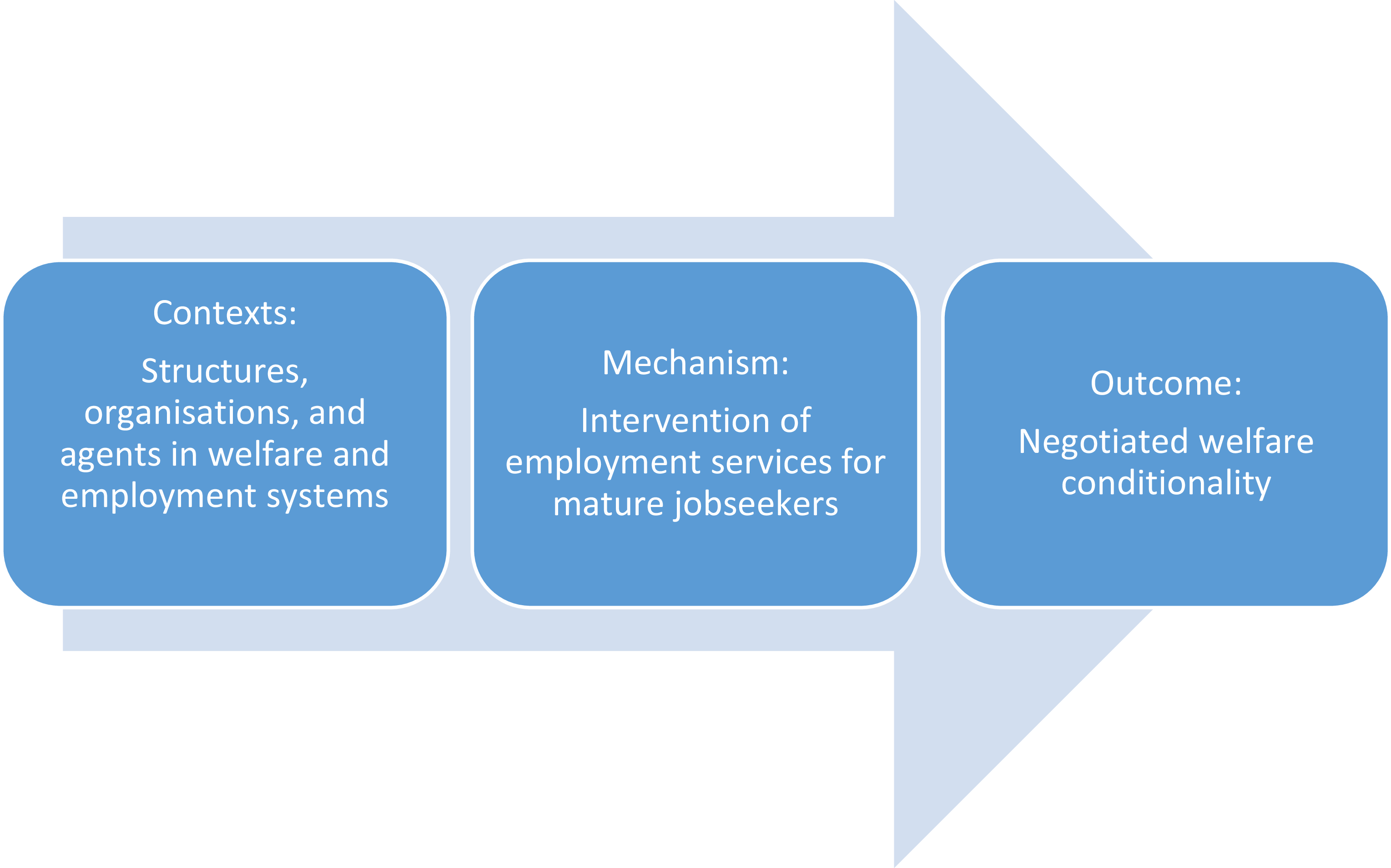
This study adopted a Context-Mechanism-Outcome (CMO) analytical approach to delineate the driving forces of welfare conditionality as an outcome of instituted processes (Pawson and Tilley, Reference Pawson, Tilley, Chelimsky and Shadish1997; De Weger et al., Reference De Weger, Van Vooren, Wong, Dalkin, Marchal, Drewes and Baan2020). Functioning as a realist evaluation of social intervention (de Souza, Reference De Souza2013; Greenhalgh and Manzano, Reference Greenhalgh and Manzano2022), the CMO analysis investigated pre-existing policy contexts as social circumstances that trigger welfare and employment programmes, acting as a generative mechanism (Dalkin et al., Reference Dalkin, Greenhalgh, Jones, Cunningham and Lhussier2015). These various mechanisms involve several components, including caseworkers’ conceptions and strategic actions. The mechanism-based explanation illustrates how social contexts shape the roles, positions, rules, ideas, and power dynamics of PES and demonstrates the causal power of operating PES, leading to outcomes and experiences (Greenhalgh and Manzano, Reference Greenhalgh and Manzano2022). The CMO heuristic proves useful in elucidating the configuration of welfare conditionality by outlining the necessary conditions of the mechanism and the ensuing intended and unintended consequences (De Weger et al., Reference De Weger, Van Vooren, Wong, Dalkin, Marchal, Drewes and Baan2020). In the policy context of extending job-seeking lives, the outcome of conditionality patterns is achieved through implementing PES (Figure 1).
The CMO analytical approach to welfare conditionality.

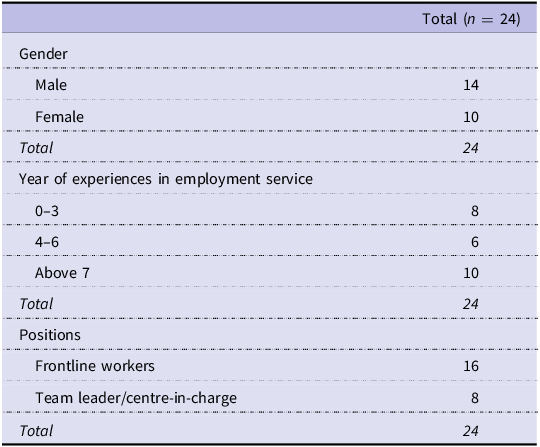
This research conducted semi-structured interviews through purposive sampling to collect qualitative data on caseworkers’ experiences within PES. The sampling criteria aimed to maximise the diversity of findings and their relevance to the framework of negotiated welfare conditionality (Flick, Reference Flick2018). The primary inclusion criteria to select respondents was working as a EmSS case manager who implemented employment services, targeting the unemployed claimants aged fifty-five or above, provided by NGOs and funded by the government (Social Welfare Department, 2020), with experience in executing regular meetings, job referrals, or employment counselling. This ensured that all interviewees could provide insights into implementing conditionality shaped by the policy context and offering employment support to older jobseekers. The data collection was conducted from March 2021 to Jan 2022. Invitations were sent to all twenty-six operating non-governmental organisations (NGOs) subsidised by the government through email and phone calls, resulting in twenty-four interviewees from thirteen NGOs being recruited (see Table 2). The gender distribution and years of experience was relatively even, which reduced the sampling bias based on workers’ gender and their seniority. Additionally, around two-thirds of respondents were frontline workers and one-third of them were holding coordinating positions, which ascertained the inclusion of practical and managerial perspectives in line with the framework entailing agential, organisational, and structural elements (Table 1).
Background of interviewees

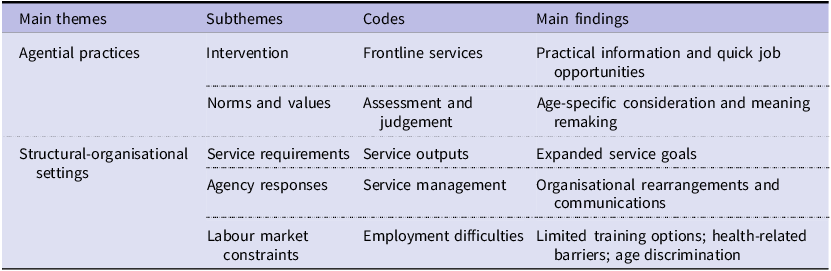
Ethical approval was obtained from the university, and written informed consent was acquired from the respondents prior to the interviews. Each interview lasted approximately one hour and was recorded and subsequently transcribed and translated. Theoretical and open coding were employed during the thematic analysis. Two main themes (agential practices and structural-organisational settings) were inspired by the theoretical coding and frameworks (Table 3), followed by the categorisation of various subthemes in accordance with findings to develop new knowledge about welfare conditionality. Under these main themes, five emerging subthemes were identified by researchers: ‘intervention’, ‘norms and values’, ‘service requirements’, ‘agency responses’, and ‘labour market constraints’. These emerging subthemes were derived from the specific codes, ‘frontline services’, ‘assessment and judgement’, ‘service outputs’, ‘service management’, and ‘employment difficulties’. These codes were linked to and represented in the keywords in the main findings, such as ‘practical information’, ‘communication’, and ‘health-related barriers’ (Table 3).
Summary of themes, subthemes, and codes used for the thematic analysis

Mechanism: implementing employment services for older jobseekers
Within the social and configurational contexts of the welfare system and employment regime in HK, the implementation of the EmSS represented a multilevel mechanism forging the age-negotiated welfare conditionality and the microfoundation of extending job-seeking lives. This process involved frontline workers’ everyday practices, organisational settings, and systemic structures (Rice, Reference Rice2013; van Berkel, Reference van Berkel2020).
Intervention and norms: age-specific consideration and meaning remaking
Based on this data, frontline workers carried out age-specific practices and need assessments that distinguished older jobseekers from younger and middle-aged claimants. They observed that older claimants often struggled more to motivate themselves and alter their attitudes. At times, older jobseekers exhibited distinct employment needs, such as shorter-term expectations regarding job referrals, requiring workers to align their interests to ensure a smoother job-seeking process.
Individuals aged over fifty-five years may have firmer opinions about their needs. Some demonstrate greater motivation to participate in job fairs, finding these activities more practical. My approach is not to pressure them as it tends to be ineffective. Occasionally, I share screenshots of job advertisements through WhatsApp. Some older unemployed individuals prefer daily cash-paid jobs or one-day work trials, so I prioritise these vacancies.
(Daniel, EmSS caseworker for three years)A slower pace of reemployment in the late stages of working life was considered acceptable compared to younger claimants, who were expected to secure full-time employment and transition out of the safety net as swiftly as possible. Frontline workers acknowledged the more realistic expectations of older jobseekers and recognised that exerting excessive pressure on them would be counterproductive. This approach was associated with the restrained use of sanctions to enforce welfare conditionality, with non-compliance cases not directly reported to the government. The ‘softer’ approach to activation was premised on the variegated treatment of different age groups in EmSS, as older jobseekers regularly participated in employment meetings to meet the minimum requirements. Frontline workers tended to differentiate themselves from government officials and elucidate the rules established by policymakers, thereby mitigating the need for sanctions.
Based on the government’s instructions, minimal cases could be exempt from punishment if unemployed claimants did not attend the interviews. In practice, owing to the fact that we are not government officials, we tend to be more empathetic towards them and less strict; older jobseekers understand the ‘game’. Sometimes we ask the claimants if they require ‘alarms’ to notify and remind them to attend meetings.
(Christina, worked there for approximately fifteen years)Moreover, caseworkers were willing to provide tailored and adaptable support, recognising the vulnerabilities older claimants encounter in the labour market. Some staff members noted that older claimants required a relationship built on trust, as they might be more sensitive or resistant to compulsory actions. In essence, the complexities of older adult employment were acknowledged, as older jobseekers may have endured multiple setbacks related to family, debt, or emotional challenges, which could undermine their confidence and motivation to work. Therefore, caseworkers must invest extra effort and attention while working with these clients.
Funded by the government, we are inevitably required to monitor the performance of the claimant. However, older adult employment becomes more complicated because they may believe that their previous experiences of being rejected by employers were not fully understood. The relationships formed are the key to successful employment.
(Calvin, worked there for five years)Regarding the life and career stages of older jobseekers, Wendy, an experienced staff member specialising in assisting older claimants, emphasised the significance of redefining meanings of work in their later life. Despite facing low morale that restricted unemployed people from advancing, maintaining some participation in society, such as visiting employment agencies and engaging in activities, was identified as an essential prerequisite for older adult employment.
Many older unemployed claimants grapple with challenges and may experience a loss of hope. Some feel burdened by factors such as ageing, poor health, loneliness, poverty, and unemployment, leading to a sense of resignation akin to ‘waiting for death’. Anyway, we recognise their inherent value and strive to uphold their belief in social participation. It is crucial to prevent them from becoming isolated at home and instead reintegrate them into the community.
(Wendy, worked on ‘hardcore’ cases for eight years)EmSS for older jobseekers adopted a less punitive and forceful approach to supervision and sanctions concerning work conditionality, acknowledging the challenges associated with older adult employment. Additionally, EmSS also embraced a ‘more-than-work’ perspective on old-age employment, placing emphasis on nurturing trustful relationships (also see Jones, Reference Jones2018). Some workers expanded their focus beyond immediate employment, rediscovering the significance of engaging in services that broadened their involvement from economic to social realms. These age-specific considerations and practices could be led by the sociocultural norm centred on stronger respect for older people and less emphasis on their responsibility to work compared to that of young people (Yu, Reference Yu2008).
Service requirements and agency responses: expanded goals, organisational re-arrangements and communications
Apart from agential practices, the implementation of welfare conditionality in EmSS was also mediated by varying organisational arrangements against the backdrop of extending job-seeking lives. As the EmSS was fully sponsored by the government, the performance of the operating NGOs was monitored under the funding service agreement primarily based on claimants’ employment outcomes. The EmSS was delivered through service bidding for a certain period. The intervention activities executed by NGOs and practitioners were driven by the government’s work-first policy approach to employment (Tang and Cheung, Reference Tang and Cheung2007; Chan and Au-Yeung, Reference Chan and Au-Yeung2024b). Currently, the EMSS’s service targets lie in short-term employment, regardless of the claimants’ age and regional variations (Social Welfare Department, 2025), which overlooked caseworkers’ input supporting clients to face extra-employment hurdles.
The higher number of older jobseekers in our service boundary ‘harmed’ our service figures. Regardless of how many services we provide for users, if our successfully employed cases are below average, we might be in trouble. I do not know why the government utilises unrealistic targets instead of more diverse indicators; regrettably, the government does not recognise employment services as a professional input but as ‘dirty work’.
(Pauline, worked there for seven years)Consequently, the existence of older jobseekers with multiple barriers to employment can be comprehended as a burden for NGOs. Although the mode of funding was not entirely and directly linked to claimants’ employment records, such as the extremely marketised models (Greer et al., Reference Greer, Schulte and Symon2018), spending time on the older unemployed might jeopardise an organisation’s performance, reputation, and funding sustainability. Nevertheless, frontline workers expressed their professional commitment to the requirements of older jobseekers by expanding and exploring their service goals based on their professional attitudes and skills.
Our organisational mission is based on social work values and the principles of employment counselling. We should aim to assist them in improving their living standards. The recent increase in funding to hire social workers in the EmSS implies a more comprehensive approach to employment services.
(Sophia, worked there for ten years)Practitioners’ professional and organisational arrangements renegotiated the role of the EmSS, expanding service priorities beyond the narrowly confined focus on work-first employment. However, this did not eradicate the role dilemma inherently anchored in EmSS, given the dual functions of employment support and behavioural governance. The approach taken by caseworkers also depended on the organisational context, including the management style and teamwork, and whether co-workers shared common beliefs in service and employment. Frontline coping strategies were shaped by the programmes’ continuity and survival, constraining the organisations’ autonomy.
When I ‘open’ the file to claimants in the meeting, it means I am performing the roles required by the government and my boss, and clients need to report employment record to me. If I ‘close’ the file, I represent the clients’ social workers. They could talk about their daily lives and share their difficulties with me … I believe that how our roles are interpreted matters, and it depends on our practices.
(Ben, worked there for eighteen years)Striking for a balanced role in the EmSS required negotiation over service goals and funding requirements to emphasise older claimants’ individuality and worthiness, despite their repeated frustration in the labour market. The organisational space for both jobseekers and caseworkers mattered to the arrangements of EmSS in response to broader social circumstance. An interviewee mentioned the agency’s additional resources to advance service quality, given the limited programme budget. This showed that the organisational re-arrangements of resources, including venue and staff development, can somewhat mediate EmSS’ under-funding problem and help older jobseekers more easily adapt to the employment programme.
Our service unit wants to have the same intervention approach to employment, which requires more resources investing for professional training and service development. As this is not included in the programme budget, our organisation must use our ‘own money’ to do so. A larger-size agency may even enable a better service environment to conduct the service, like a decent office, which helps build service users’ trust in us.
(Francis, worked there for three years)Apart from resources, a caseworker highlighted the importance of senior management’s understanding and communications with the government regarding difficulties in meeting performance indicators (Social Welfare Department, 2025).
If the employment figures are not satisfactory, our organisation will face pressure. Yet, it also depends on how our senior staff communicate with the department, and we need to make some sort of action plan to explain and improve. Anyway, regional variation is undeniable, especially for some deprived areas with a higher number of difficult cases.
(Sara, worked there for seven years)Labour market constraints: limited training options, health-related barriers, and age discrimination
The agential practices and organisational arrangements were structurally rooted in HK’s labour market institutions and macro-policy settings. Respondents were clear about the barriers to employment and training for older jobseekers in their late careers, which limited their choices and the success of the EmSS.
Older clients are reluctant to change jobs because they do not want to invest a lot of time in learning new skills. It is necessary to promote the retraining of ‘layman’ activities for them without difficult examination. However, skill-based training is costly, for example, a driving licence for a dump truck in the construction sector. The EmSS can provide them with minimal temporary financial assistance.
(Ken, worked there for approximately ten years)Many older claimants used to work in manual jobs, and it was quite difficult for them to compete for jobs in HK’s service economy, including low-skill but high-intensity jobs. Additionally, the fees for licencing safety training certificates or confined workplace certificates were not covered by EmSS and were unaffordable to unemployed people. Consequently, the access to (re)training systems has emerged as a barrier to employment among older adults. Moreover, it was reported that deteriorating health and strength also prevented older unemployed individuals from working in jobs with long working hours, such as catering and retail. Health is considered a major concern in the low-pay sector, which undermines older employees’ employability. According to the respondents, older jobseekers with health issues were not easily categorised as the cases of ‘ill-health’ or ‘disability’ in relation to the loss of workability. While such bureaucratic classification and medical judgement mandated by the welfare system were unchallengeable, caseworkers could only help clients adapt to health and work situations.
They commonly have several chronic diseases and experience occupational strain and injuries. Their pain forces them to visit doctors for medical follow-ups or regularly undergo physiotherapy. Some individuals cannot move easily. These invisible health issues can also be caused by everyday stress, which prevents individuals from being calm and engaging in productive activities.
(Helen, worked there for three years)In addition to health-related barriers, structural labour market conditions and employers’ hiring practices determined the employment experiences of older jobseekers. A discrepancy between policy discourse and reality existed because policymakers underestimated age discrimination. Therefore, policy intervention was inadequate in terms of regulatory power and incentive to alter the hiring practices in both the private and public sectors.
While the government raised the age of the older adult CSSA to sixty-five, employers would not hire older jobseekers. Ageist bias was significant. Employers engaged in manual work are worried about higher insurance and non-wage costs for older workers. Obviously, the labour market does not echo welfare reforms, and the government has no intention of hiring them.
(Harry, worked there for four years)The systemic settings structurally manufactured a range of barriers for older jobseekers that could not be addressed or alleviated by EmSS. While the welfare system extended the targets of workfarist measures, the employment regime, including the (re)training system, work intensity, and ageist treatment, excluded older jobseekers from gaining employability and access to decent work. The overemphasis on changing older workers’ incentive and readiness as a supply-side intervention downplayed the importance of transforming the labour market structure by changing employers’ attitudes and behaviours.
Outcome: the age-negotiated welfare conditionality and microfoundation of extending job-seeking lives
From the findings, EmSS appeared to be the mechanism by which frontline workers negotiated the configuration of welfare conditionality revolving around age. In other words, the microfoundation for extending job-seeking lives was crafted by the implementation of the PES and mediated by caseworkers’ roles in everyday practices, organisational settings, and system structures. The welfare conditionality of older claimants was defined by the re-categorisation of unemployed CSSA cases with the agenda of extended job-seeking lives. However, the ‘actually existing’ welfare conditionality was not determined by the policy content but the delivery of PES that enabled age-led practices and organisational re-arrangements, despite being constrained by the labour market institutions and welfare systems.
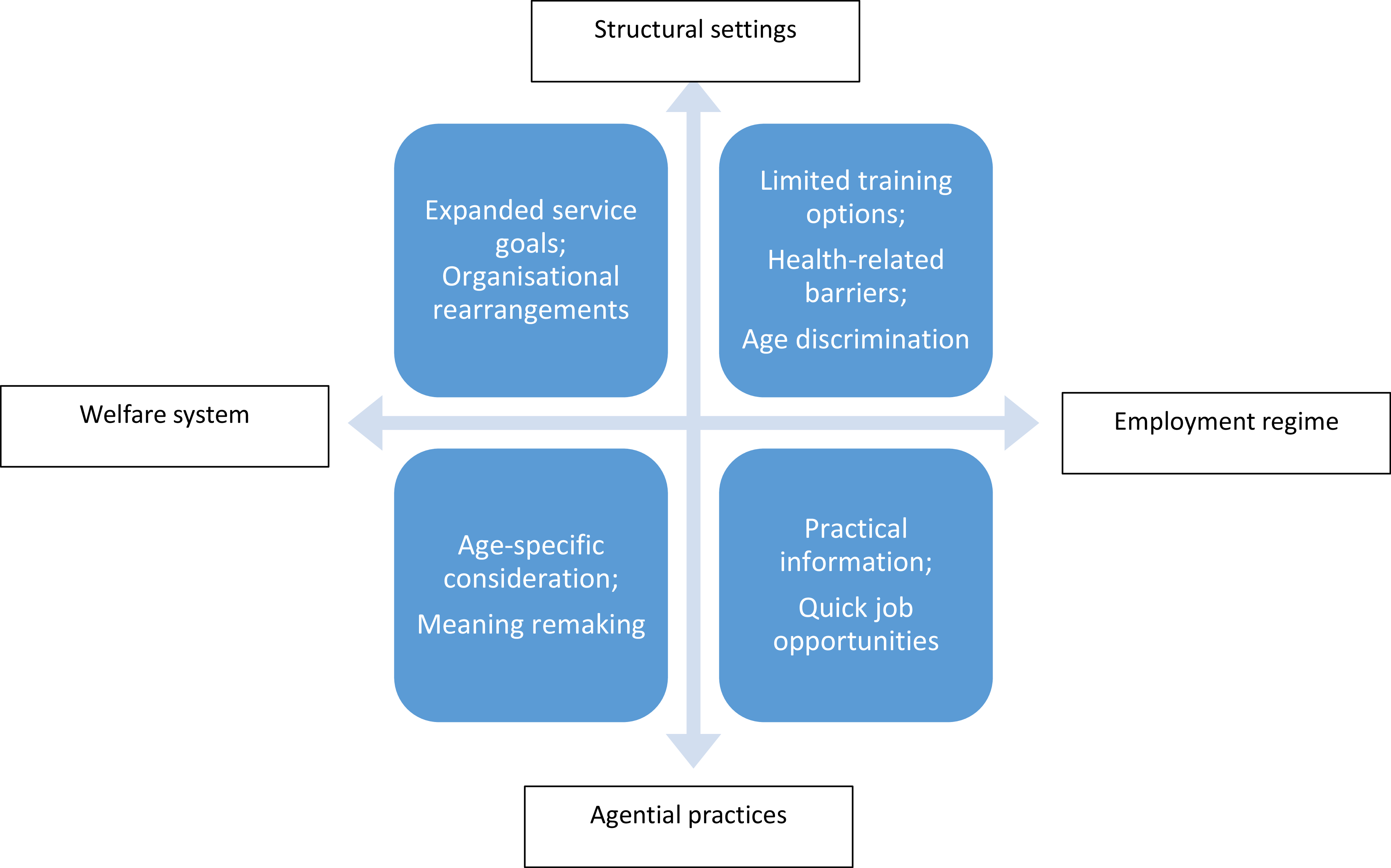
In contrast to the common understanding of the work-first approach to the activation policy in HK’s residual-productivist regime (Chan, Reference Chan2011; Chan and Chan, Reference Chan and Chan2013), the agenda of extending job-seeking lives was filtered out by the ways social workers executed the PES. This manifested as a dynamic process of the age-negotiated configuration of welfare conditionality with a mechanism composed of four parts (Figure 2). First, the structural and organisational settings reconstructed welfare conditionality, including tightening the age eligibility of the CSSA and reforming the governance and funding model of the EmSS. While the new policy extended the age of unemployed claimants, frontline workers could expand their service goals from employment figures to reducing employment-related barriers. Additionally, some service providers modified the organisational arrangements, including resources and venue, to mediate the negative impact of the underfunded programme. The senior staff also assisted in communicating with the government in case performance indicators were not met. Caseworkers emphasised their supportive role and focused more on older jobseekers’ extra-employment needs that limited their employability. Without strictly enforcing sanctions (Chan and Au-Yeung, Reference Chan and Au-Yeung2024b), such treatment softened the welfare conditionality of older claimants.
The age-negotiated configuration of welfare conditionality.

Second, the (re)training system did not offer attractive or affordable schemes, which undermined EmSS intervention options. Health issues experienced by older jobseekers also reinforced the ageist and discriminatory practices of employers, particularly in manual jobs. Hence, the older adult labour market and low-pay sectors unintentionally limited the implementation of old-age welfare conditionality from the demand side. Third, service providers exhibited age-specific considerations regarding clients’ expectations in their later careers. Under this ‘more-than-employment’ approach to employment, frontline workers remade the work-life meanings for older claimants, boosting their motivation on social and economic participation. Finally, EmSS workers tended to meet the quick employment preferences of older jobseekers and offered them more practical information. This pragmatic attitude towards job-seeking was embodied in a less punitive manner that kept contacting and informing clients.
Overall, the configuration of welfare conditionality for older jobseekers was negotiated by age-specific, relationship-oriented, and health-focused practices embedded in the PES, instead of welfare exit as the primary goal. The microfoundation for extending job-seeking lives was crafted by the employment programme contextualised in HK’s welfare system and employment regime. Unsurprisingly, this age-negotiated welfare conditionality was configured in terms of age and work ethic, which allowed older people to claim welfare without employment compared to the middle-aged unemployed (Chan and Au-Yeung, Reference Chan and Au-Yeung2024b). Furthermore, the changing funding mode of delivery, stabilising the manpower of EmSS social workers, was also considered a necessary condition for such age-negotiated conditionality, which made the service model more sensitive to clients’ intersectional barriers and less punitive, although still productivist and residual.
Discussion
Informed by microfoundation theories, this study employs a CMO analysis to elucidate the negotiation of welfare conditionality based on age in the implementation of PES. Arguably, the configuration of welfare conditionality was shaped by the structural-organisational and agential contexts of HK’s welfare system and employment regime, which orchestrated the microfoundation of extending job-seeking lives in HK. Implementing PES acted as a mechanism for mediating contextual forces and negotiating the welfare conditionality as a policy outcome that departed from the disciplinary model of activation in HK for younger claimants (Yu, Reference Yu2008).
This study makes three contributions and offers broad implications for social policy studies beyond HK. First, instead of merely defining welfare conditionality as a set of employment-related behavioural requirements, this study adopted microfoundation theories to explain how micro actions contributed to institutional development (Powell and Rerup, Reference Powell, Rerup, Greenwood, Oliver, Lawrence and Meyer2017; Haack et al., Reference Haack, Sieweke and Wessel2019) and the production of an ‘actually existing’ welfare conditionality under the policy agenda of extending job-seeking lives. The CMO analysis can identify the relationship between social and policy contexts, PES, and the outcome of welfare conditionality mediated by age. Hence, the theorisation of welfare conditionality should untangle the layered institutional arrangements and explain the relationship between policy content, implementation, and stakeholder practices under specific configurational contexts.
Second, welfare conditionality is negotiable and continually subject to configuration through actors’ interventions. The bounded agency of frontline PES workers is shaped by the two-fold contextual influence of the welfare system and the employment regime (see Cardinale, Reference Cardinale2018; Zucker and Schilke, Reference Zucker and Schilke2020). With the expanded notion of configurational contexts (van Berkel, Reference van Berkel2020), actors’ goals, priorities, awareness, and decision-making are key to reinterpreting the mode of welfare conditionality by negotiating practices and remaking meanings, leading to a more dynamic understanding of street-level policymaking beyond sanctions and discretion. Consequently, an investigation into the mechanism that drives conditionality arrangements could be more actor-focused and context-dependent.
Finally, this study linked extending job-seeking lives to welfare conditionality studies, addressing the global agenda of delaying retirement, pension reforms, and responsibilised activation (Taylor and Earl, Reference Taylor and Earl2016; Phillipson, Reference Phillipson2020). Out study’s results support the view that there will always be a gap between policy rhetoric and labour market reality regarding the extension of working lives. The supply-side intervention of neoliberal activation relies on boosting the incentive of claimants through sanctions and behavioural governance as a low-road investment (Nunn, Reference Nunn2020). However, while a less punitive approach to employment may lessen the pressure generated by welfare conditionality, older jobseekers require a ‘more-than-employment’ approach to employment to tackle their multiple barriers, including health issues and age discrimination (Bowman et al., Reference Bowman, McGann, Kimberley and Biggs2016; Jones, Reference Jones2018). Recent attention to employers’ engagement in activation policies and PES calls for stronger demand-side interventions and lifelong investment in human capital and employability in later working lives (Deeming and Smyth, Reference Deeming and Smyth2016; Ingold and McGurk, Reference Ingold and McGurk2023).
This small-N qualitative study theorised the negotiated configuration of welfare conditionality via CMO analysis to examine the microfoundation of extending job-seeking lives. With the limitation of representativeness and scale, further quantitative and comparative research is needed to explore how conditionality can be negotiated by different actors and to measure conditionality outcomes across national settings.
Acknowledgements
This research project was funded by the Faculty Research Grant (SSFRG/20/2/2) from the Research Committee at Lingnan University. Thanks also go to the social workers participated in the study.
Competing interests
The authors declare none.


 Open access

