




Introduction
This article gives a translation and comparative analysis of two ancient Chinese texts—the “Shiji jie” 史記解 (Exposition of Historical Records) from the Yi Zhoushu 逸周書 (Remaining Zhou Documents), and the “Wangzheng” 亡徵 (Portents of Destruction) chapter from the Han Feizi 韓非子.Footnote 1 Both texts concern themselves with the decline and fall of dynasties and polities, and although the contents of these two works are quite different, their underlying themes, style of writing, and handling of catastrophic political upheavals are all strikingly similar. This has not escaped the attention of earlier scholars, a number of whom have drawn attention to the connections between the two, positing that the “Shiji jie” must have functioned as a model for the “Wangzheng.”Footnote 2 However, since neither text has attracted further detailed analysis, the construction of the “Shiji jie,” and the way in which the “Wangzheng” plays upon the tropes established in the earlier work have gone unstudied. These texts offer a case study of the use of negative examples in pre-unification Chinese rhetoric, as the authors list a series of disastrous situations with a view to admonishing the reigning monarch. However, while preserving the basic format of the “Shiji jie,” Han Fei profoundly altered its purpose. Where the earlier text invited the monarch to identify problems in their own behavior lest they suffer the same fate as people in the past, the “Wangzheng” flattered the king by inviting him to identify problems in other rulers’ behavior, so that he can take advantage of their failings.
Both the “Shiji jie” and the “Wangzheng” follow the traditional understanding that a good monarch strengthens the state while a bad monarch destroys it, but at the same time they critique simplistic understandings of this process by exploring the wide range of different scenarios in which regimes collapse, focusing mainly on the interpersonal relationships and character traits of members of the ruling elite.Footnote 3 There is a strong didactic message underpinning both texts, but one that addressed what the authors clearly believed were achievable goals—reducing one’s own damaging behavior patterns in the “Shiji jie” and taking advantage of the weaknesses of others in the “Wangzheng.” Accordingly, this article begins with an annotated translation of the “Shiji jie,” in the course of which the author lists twenty-eight disastrous situations that resulted in rulers losing their states. Each set of circumstances is different, but they end with the same result. Almost all of these passages culminate in an epistrophe, in which the reader is informed that because of this situation, such-and-such a regime was destroyed (yi wang 以亡). This is followed by an annotated translation of the “Wangzheng,” which describes forty-seven situations in which rulers lost (or did not lose) their states, and here, the epistrophe is consistently maintained, with each line ending with the same set phrase: thanks to such-and-such a situation the ruler (and by extension the country) “can be destroyed” (kewang ye 可亡也). The differing structure of the final clause, as will be argued below, is due to the fact that the “Wangzheng” is deliberately constructed to be even more cryptic in its description of disastrous events than the “Shiji jie.” The theory that the “Wangzheng” does not represent a discussion of abstract examples, but instead should be viewed as a series of riddles in which the author was referring to well-known historical events, was first proposed by Chen Qiyou 陳奇猷 in his Han Feizi jishi 韓非子集釋 (Collected Explanations of the Han Feizi) published in 1958.Footnote 4 The analysis in the final part of this article is intended to demonstrate that Chen Qiyou’s argument is correct, and evidence is preserved in a number of ancient texts which can validate this theory.
“Shiji jie:” An Annotated Translation
維正月王在成周,昧爽召三公左史戎夫,曰:今夕朕寤,遂事驚予,乃取遂事之要戒,俾戎夫主之,朔望以聞。
In the first month, the king was at Chengzhou, and before it got light, he summoned the Three Dukes and the Scribe of the Left, Rongfu, to say: “This evening I have suddenly come to understand that the events of the past should be a warning to me. Let me select the important warnings [contained within] these past events, and appoint Rongfu to take charge of them, so that I may hear them on the first and fifteenth day [of every lunar month].”Footnote 5
#1 信不行,義不立,則哲士淩君政禁而生亂,皮氏以亡。
Since trustworthy actions were not performed and righteousness was not established, clever men transgressed their lord’s policies and prohibitions, giving rise to rebellion—because of this the Pi lineage was destroyed.Footnote 6
#2 諂諛日近,方正日遠,則邪人專國政禁而生亂,華氏以亡。
Since slanderers and sycophants advanced day by day, while the upright were kept at a distance that increased daily, wicked men established a monopoly over the policies and prohibitions of the country, giving rise to rebellion—because of this the Hua lineage was destroyed.
#3 好貨財珍怪,則邪人進,邪人進,則賢良日蔽而遠,賞罰無位,隨財而行,夏后氏以亡。
Since [the ruler] loved riches and rarities, wicked men were promoted. Because wicked men were promoted, the wise and the good were daily eclipsed and kept at a distance. Rewards and punishments could not be trusted and were allocated in accordance with the bribes received—because of this the Xiahou lineage (Xia dynasty) was destroyed.Footnote 7
#4 嚴兵而不囗Footnote 8 者,其臣懾,其臣懾則不敢忠,不敢忠則民不親其吏,刑始於親,遠者寒心,殷商以亡。
Since [the ruler] was harsh to his troops and not [kind], his vassals were terrified.Footnote 9 Because his vassals were terrified, they did not dare to be loyal. As they did not dare to be loyal, people felt no affection for the officials [that governed them]. When punishments were first carried out on close relatives, those more distant were frightened—because of this the Yin-Shang [dynasty] was destroyed.Footnote 10
#5 樂專於君者,權專於臣,權專於臣則刑專於民,君娛於樂,臣爭於權,民盡於刑,有虞氏以亡。
Pleasure was the sole preserve of the lord, and power the sole preserve of vassals.Footnote 11 Since power was the sole preserve of vassals, punishments were inflicted only upon the people. While the lord took delight in his pleasures, vassals vied for power, and the people suffered all the punishments—because of this the Youyu lineage was destroyed.Footnote 12
#6 奉孤以專命者,謀主必畏其威而疑其前事,挾德而責數日疏,位均而爭,平林以亡。
Those who put a small child on the throne in order to gain sole control over the administration will be concerned that the monarch will inevitably fear their might and be suspicious of their previous deeds. Holding to their virtuous [self-image] and repeatedly complaining [about the ruler not rewarding them] will result in them becoming more estranged daily, while fighting because of their equal positions—because of this Pinglin was destroyed.Footnote 13
#7 大臣有錮職譁誅者危。昔者質沙三卿,朝而無禮,君怒而久拘之,譁而弗加,譁[三]Footnote 14 卿謀變,質沙以亡。
When senior vassals have jobs for life, those who just talk about executions will be in danger.Footnote 15 In the past, Zhisha had three vassals who came to court and did not behave with proper courtesy, so their lord became angry and imprisoned them for a long time. He debated [executing them] but did not actually do so, so the three vassals conspired to launch a coup—because of this Zhisha was destroyed.
#8 外內相閒,下撓其民,民無所附,三苗以亡。
Inside and out were alienated from one another,Footnote 16 [with superiors] disturbing the people below them, so that [the people] did not have anyone to rely on—because of this the Sanmiao were destroyed.Footnote 17
#9 弱小在彊大之閒,存亡將由之,則無天命矣。不知命者死,有夏之方興也,扈氏弱而不恭,身死國亡。
When a small, weak [kingdom] is sandwiched between the strong and great, survival and destruction will depend on them, because it does not have the Mandate of Heaven. Those who do not understand the Mandate [of Heaven] will die. When the Youxia (Xia dynasty) was in the ascendant, the Hu lineage was weak and disrespectful, so they died, and their country was destroyed.Footnote 18
#10 嬖子兩重者亡。昔者義渠氏有兩子,異母皆重,君疾,大臣分黨而爭,義渠以亡。
He who gives equal weight to his sons by two of his favorites will be destroyed. In the past, [the head of] the Yiqu lineage had two sons by different mothers, and he gave weight to both of them. The lord became sick, senior vassals split into factions and fought with one another—because of this Yiqu was destroyed.Footnote 19
#11 功大不賞者危。昔平州之臣,功大而不賞,諂臣日貴,功臣日怒而生變,平州之君以走出。
He who does not reward great achievement will be in danger. In the past, a vassal of the Pingzhou [lineage] achieved great things and was not rewarded, while slanderous vassals were daily ennobled. The meritorious vassal was furious and fomented a coup,Footnote 20 and the lord of Pingzhou went into exile.Footnote 21
#12 召遠不親者危。昔有林氏召離戎之君而朝之,至而不禮,留而弗親,離戎逃而去之,林氏誅之,天下叛林氏。
He who summons people from a distance and does not behave in a friendly manner to them will be in danger. In the past, the Youlin lineage summoned the lord of the Lirong to make him pay court, but when he arrived, [the Youlin lineage] did not treat him with proper courtesy. When insisting that he stay, [the Youlin lineage] did not behave in a friendly manner.Footnote 22 The [lord of the] Lirong ran away, whereupon the Lin lineage executed him, and so All-Under-Heaven rebelled against the Lin.
#13 昔者曲集之君,伐智而專事,彊力而不信其臣,囗Footnote 23 良皆伏,愉州氏伐之,君孤而無使,曲集以亡。
In the past, the lord of Quji was proud of his own intelligence and monopolized the business of government, strengthening his own authority while never trusting his vassals, until the [loyal] and good all hid themselves away.Footnote 24 When Yuzhou attacked them, his lordship was isolated and had nobody to employ—because of this Quji was destroyed.Footnote 25
#14 昔者有巢氏有亂臣而貴,任之以國,假之以權,擅國而主斷,君已而奪之,臣怒而生變,有巢以亡。
In the past, the Youchao lineage had rebellious vassals that were ennobled; they were placed in charge of walled cities and given power. Once [these vassals] dominated their walled cities, the ruler was sequestered. His lordship took fright and tried to oust them, whereupon his vassals became angry and fomented a coup—because of this Youchao was destroyed.Footnote 26
#15 斧小不勝柯者亡。昔有鄶君嗇儉,減爵損祿,羣臣卑讓,上下不臨,後囗Footnote 27 小弱,禁罰不行,重氏伐之,鄶君以亡。
He whose axe head is too small to dominate the handle will be destroyed. In the past the lord of Kuai was thrifty and frugal, reducing titles and cutting emoluments, so his vassals withdrew from him, and superior and inferiors ceased caring about each other.Footnote 28 Later on, [the lord] was reduced and impoverished, while prohibitions and punishments were not enacted. The Zhong lineage attacked them—because of this the lord of Kuai was destroyed.Footnote 29
#16 久空重位者危。昔有共工自賢,自以無臣,久空大官,下官交亂,民無所附,唐氏伐之,共工以亡。
He who leaves weighty positions empty for a long time will be in danger. In the past, Gonggong believed himself to be wise and thought that he did not need any vassals, so he left important offices empty for a long time.Footnote 30 Junior officials got together to rebel, and the people did not have anyone to rely on. The Tang clan attacked him—because of this Gonggong was destroyed.
#17 犯難爭權疑者死。昔有林氏、上衡氏爭權,林氏再戰弗勝,上衡氏偽義弗克,俱身死國亡。
He who engages in a life-or-death power struggle without result will be killed. In the past, the Youlin and the Shangheng lineages fought for power. The Lin lineage did battle twice and were not victorious, while the Shangheng lineage acted in a righteous manner but could not defeat them, so both were killed and their countries destroyed.Footnote 31
#18 知能均而不親,並重事君者危。昔有南氏有二臣貴寵,力鈞勢敵,競進爭權,下爭朋黨,君弗能禁,南氏以分。
When [two vassals] are equal in knowledge and ability, but antagonistic, and they are both given equal weight when serving the lord, he will be in danger. In the past, the Younan lineage had two vassals that were noble and favored, equal in authority and of similar might, who competed over promotion and fought for power, while amongst their subordinates, they vied [in building up] their factions. The lord did nothing to prevent this—because of this the Nan lineage [had their lands] partitioned.
#19 昔有果氏好以新易故,故者疾怨,新故不和,內爭朋黨,陰事外權,有果氏以亡。
In the past, the Youguo lineage loved to exchange the old for the new, so the old guard got angry and could not get along with the new people, whereupon there was factional fighting inside the country and some secretly served foreign powers—because of this the Youguo lineage was destroyed.
#20 爵重祿輕,比囗Footnote 32 不成者亡。昔有畢程氏,損祿增爵,羣臣貌匱,比而戾民,畢程氏以亡。
He who piles on titles while reducing emoluments, so that [recipients] cannot support [one character missing in the original text], will be destroyed. In the past, the Bicheng lineage reduced emoluments while they increased titles, so that vassals pretended to be reduced to poverty while in fact they were tormenting the people [for money]—because of this the Bicheng lineage was destroyed.
#21 好變故易常者亡。昔陽氏之君,自伐而好變,事無故業,官無定位,民運於下,陽氏以亡。
He who loves changing old norms and shifting long-established [appointees] will be destroyed. In the past, the lord of the Yang lineage was proud of himself for the way he loved changing things around, so nobody kept their old profession, his officials had no fixed positions, and people kept moving around below—because of this the Yang lineage was destroyed.
#22 業形而愎者危。昔穀平之君,愎類無親,破國弗克,業形用國,外內相援,穀平以亡。
He who is cruel and enacts mutilation punishments will be in danger.Footnote 33 In the past, the lord of Guping was cruel and ruthless, but in crushing the country he could not conquer it entirely, so he governed the state by enacting mutilation punishment. Inside and out helped each other—because of this Guping was destroyed.
#23 武不止者亡。昔阪泉氏用兵無已,誅戰不休,并兼無親,文無所立,智士寒心,徙居至于獨鹿,諸侯叛之,阪泉以亡。
He who fights without ever stopping will be destroyed. In the past, the Banquan lineage used their military ceaselessly, executing people and fighting battles without rest, ruthlessly swallowing up [other states]. The civil arts had no place among them and clever men of honor felt bitterly disappointed, whereupon they moved to live as far away as Dulu, and the other aristocrats rebelled against them—because of this, Banquan was destroyed.
#24 佷而無親者亡。昔者縣宗之君很而無聽,執事不從,宗職者疑發大事,羣臣解體,國無立功,縣宗以亡。
He who is violent and unfriendly will be destroyed. In the past the lord of Xianzong was violent and intransigent, not following [the advice of] his officials. Those in charge of administration were afraid of undertaking anything major, and his vassals became isolated from him, so that there was no way for his country to achieve anything—because of this Xianzong was destroyed.
#25 昔者玄都賢鬼道,廢人事天,謀臣不用,龜策是從,神巫用國,哲士在外,玄都以亡。
In the past, Xuandu honored the way of ghosts, abandoning humankind to serve Heaven. They did not employ strategic advisors but followed [divinations by] turtle-shell and milfoil. Spirit shamans were employed in the country while wise men of honor were left out—because of this Xuandu was destroyed.Footnote 34
#26 文武不行者亡。昔者西夏性仁非兵,城郭不脩,武士無位,惠而好賞,財屈而無以賞,唐氏伐之,城郭不守,武士不用,西夏以亡。
He who does not put into practice the civil and military arts will be destroyed.Footnote 35 In the past, the Xixia were benevolent by nature and opposed to weapons, so their city walls and ramparts were not repaired, and their army officers did not have positions of status. They were kind and liked to give out rewards. Then they ran out of money and did not have a means to reward [people]. The Tang lineage attacked them, their walls and ramparts were undefended, and their army officers were not employed—because of this Xixia was destroyed.Footnote 36
#27 美女破國。昔者績陽彊力四征,重丘遺之美女,績陽之君悅之,熒惑不治。大臣爭權,遠近不相聽,國分為二。
Beautiful women ruin the country. In the past, Jiyang was strong and campaigned in all four directions. Zhongqiu gave them beautiful women, and the lord of Jiyang was delighted with them, as he was seduced into not governing well.Footnote 37 His senior vassals fought for power, and those near and far did not listen to him, so his country was divided into two.Footnote 38
#28 宮室破國。昔者有洛氏,宮室無常,池囿廣大,工功日進,以後更前。民不得休,農失其時,饑饉無食,成商伐之,有洛以亡。
Palaces ruin the country. In the past, the Youluo lineage’s palaces were constantly being altered, with vast lakes and extensive grounds, with the fine work required increasing day by day, as what had been done before was changed afterwards.Footnote 39 The people were not able to rest, farmers missed the seasons [for their labor], causing a famine in which there was no food. Chengshang attacked them—because of this Youluo was destroyed.Footnote 40
Contextualizing the “Shiji jie”
The “Shiji jie” is a kind of mirror for princes—a didactic text aimed at members of the ruling elite, which in this case was intended to remind readers of bad rulers whose example they should avoid because it led to the downfall of the regime.Footnote 41 Accordingly, this text adopts a format in which the reader—in the first instance the Zhou monarch—is instructed that in the past, an individual ruler or polity behaved in a certain stupid, ill-advised, or malevolent way, with the result that they were destroyed. This text covers twenty-eight such historical instances, which do not appear to be arranged chronologically; in fact, if there is a logic to the ordering of these examples, it is not readily apparent. The introduction suggests that this list was created by King Mu of Zhou, who became enlightened as to the importance of the lessons of the past and wished to avoid the behaviors of negative models.Footnote 42 Each of the events referenced in the “Shiji jie” is in the form of an encapsulated tale, in which longer and more complicated narratives with many participants have been condensed until all that is left are the key markers allowing the reader to identify the story under discussion.Footnote 43 The way this process works can be illustrated by considering the text of #4:
嚴兵而不仁者,其臣懾,其臣懾則不敢忠,不敢忠則民不親其吏,刑始於親,遠者寒心,殷商以亡。
#4 Since [the ruler] was harsh to his troops and not [kind], his vassals were terrified. Because his vassals were terrified, they did not dare to be loyal. As they did not dare to be loyal, his people felt no affection for the officials [that governed them]. When punishments were first carried out on close relatives, those more distant were frightened—because of this the Yin-Shang [dynasty] was destroyed.Footnote 44
The “Shiji jie” here describes the fall of the Shang dynasty in terms of a series of causal inferences, focusing on what the author believed to be the most salient issues, without naming King Zhou 紂王, Da Ji 妲己, Prince Bigan 王子比干, or any of the senior officials in the regime supposedly tortured and killed by the last Shang king, nor indeed the future Kings Wen 周文王 and Wu of Zhou 周武王 who eventually triumphed over him and established their own dynasty. The reader was expected to recognize the much more complicated background narrative and key individuals concerned, unpacking the details for themselves. This kind of encapsulation was a highly effective rhetorical tool known from many different transmitted and excavated materials. But today, such writings can be hard to understand, particularly in cases where knowledge of the underlying legends or historical events has not been transmitted. This is certainly a problem with the “Shiji jie,” which mentions numerous situations which are otherwise unrecorded in the transmitted or recovered traditions. Fortunately, this text is closely related to the Zhushu jinian 竹書紀年 (Bamboo Annals),Footnote 45 which not only records the composition of the “Shiji jie” itself, but also references the events mentioned in at least six sections (21 percent) out of the twenty-eight.Footnote 46 The connection between these two texts needs more study but offers some tantalizing hints as to the history of transmission of this chapter of the Yi Zhoushu. First, however, it is worth emphasizing that the “Shiji jie” is clearly textually corrupt, with the transmitted text known to be missing a number of characters. In addition to that, it is entirely possible that the disruption to the regular rhetorical pattern within some sections is the result of further textual loss. As a result, it is difficult to know whether the problems scholars have today with recognizing some of these encapsulated tales are because they have been damaged out of all recognition, or because they are simply not recorded in other writings available to us. Despite these issues, the connection between the “Shiji jie” and the Zhushu jinian remains readily observable and is too prominent a feature of the text to be coincidental.
The date of compilation of the Yi Zhoushu as a whole remains highly controversial, with Huang Huaixin 黃懷信, the current doyen of Yi Zhoushu studies in China, arguing that the reign of King Jing of Zhou 周景王 (r. 532–520 bce) forms a terminus post quem for what may have been a lengthy and complex process.Footnote 47 Meanwhile, Edward L. Shaughnessy supports a two-stage process of compilation, with a core text of thirty-two chapters compiled in the late fourth to early third century bce; and a second expanded recension compiled sometime around the first century bce, which included material both earlier and later than the core text.Footnote 48 The “Shiji jie” is itself also controversial in dating, with scholars such as Liu Wenying 劉文英 arguing that this chapter should be understood as a genuine court document written during the reign of King Mu of Zhou, because that is what it says in the Zhushu jinian; she does not believe that King Mu was a sufficiently well-known ruler in later times to have inspired further literary commemoration.Footnote 49 Meanwhile, Luo Jiaxiang 羅家湘, by analogy with other texts in the Yi Zhoushu which focus on giving admonitions and advice, dates this chapter to the early Spring and Autumn period.Footnote 50 However, both these perspectives fail to give full attention to the significance of the Jizhong 汲冢 tomb finds, where the Zhushu jinian was discovered in what was believed to be the tomb of King Xiang of Wei 魏襄王 (r. 335–319 bce) in 279 ce.Footnote 51 It was found together with the Mu Tianzi zhuan 穆天子傳 (Tale of Mu, the Son of Heaven), which describes the travels of King Mu of Zhou around his realm and beyond, indicative of a longstanding textual tradition in which this monarch was of particular interest. The Mu Tianzi zhuan has been the subject of a great deal of research, which has demonstrated that the core of this text must be genuinely ancient, given that it correctly records the names of many individuals also mentioned in contemporary bronze vessel inscriptions.Footnote 52 Furthermore, the fact that a Warring States individual was buried with multiple manuscripts of writings focused on King Mu strongly suggests a cultural context in which he continued to be an important figure. This does not mean that the “Shiji jie” cannot be a Western Zhou dynasty text, but it significantly complicates attempts to date it based upon the popularity or otherwise of its supposed creator.
The Zhushu jinian—Mu Tianzi zhuan—Yi Zhoushu group represents a corpus in which King Mu of Zhou is represented very positively. As has been argued by Zhao Fengrong 趙奉蓉, this is a very distinctive understanding of his rule (which was elsewhere universally depicted as ruinous), and hence does not correspond with other ancient transmitted texts.Footnote 53 Within this corpus, the Zhushu jinian and “Shiji jie” together represent a unique view of the past, which seems to have been part of the intellectual milieu eventually associated with the Wei 魏 ruling house whose lineage is recorded in the final sections of the Zhushu jinian. In this vision of the history of the Central States, reference is made to polities and individuals which are totally different from what may be termed the mainstream tradition, found in the Chunqiu, Zuozhuan, Guoyu 國語 (Tales of the States), and Shiji 史記 (Records of the Grand Historian), and which is alluded to in the works of masters such as Confucius 孔子, Mencius 孟子, Xunzi 荀子 and so on. While there was some crossover and variation, in the sense that the Zhushu jinian describes some events that also appear in the mainstream tradition, and the “Shiji jie” mentions happenings that are not recorded in the Zhushu jinian, these texts, together with other parts of the Yi Zhoushu and the Mu Tianzi zhuan seem to represent a discrete intellectual lineage, which had its roots back in the Western Zhou dynasty. Much more research is needed to elucidate the relationships between these writings and analyze the distinctive tradition of thought that they embody.
Creating the “Wangzheng”
It has long been recognized not just that the “Wangzheng” is closely related to the “Shiji jie,” but that the Han Feizi as a whole is a significant source of information about the early reception of the Yi Zhoushu. The “Nanshi” 難勢 (On the Difficulties of Utilizing Advantages) chapter of the Han Feizi quotes a line from the “Wujing jie” 寤儆解 (Exposition on Distress on Awakening) of this text; while the “Shuilin” 說林 (Forest of Persuasions) chapters twice include quotations explicitly attributed to the Zhoushu which are not found in the present text.Footnote 54 However, unlike some other parts of the Han Feizi, the “Wangzheng” has not received a great deal of academic attention, and there has been no detailed analysis of how this text developed and differed from the earlier work. This is a particularly striking lacuna, given that there has been much confusion over how to distinguish the text now known as the Yi Zhoushu (originally Zhoushu) from a different text of the same name discovered in the Ji Commandery tomb alongside the Zhushu jinian, Mu Tianzi zhuan and others.Footnote 55 Given that Han Fei based his work upon the “Shiji jie,” this chapter cannot possibly have come from a cache of bamboo manuscripts that was not discovered until some five centuries after his death.
To date, analysis of the “Wangzheng” has focused almost entirely on its authenticity; although there have been a few dissenting voices, most scholars have agreed that it is genuinely written by Han Fei.Footnote 56 When the dating of the “Wangzheng” is considered, it has usually been placed late in his oeuvre.Footnote 57 This chapter opens with forty-seven short descriptions of dangerous or unstable political situations, each of which concludes with an epistrophe.Footnote 58 At the end of the chapter, the author offers an explanation of the underlying theme he has been developing, stating that the circumstances that he has just outlined would in each case render a country vulnerable to attack, and that it should be entirely possible for a competent ruler to unify the Central States by taking advantage of the turmoil unleashed by such events. This aspect of the text situates the “Wangzheng” part of a long tradition of writings, focused on recognizing the subtle signs of imminent problems, which can lead to a perspicacious observer obtaining significant political or military advantage.Footnote 59 Zheng 徵 or “portents” were not an important theme in Han Fei’s writings, though he does elsewhere occasionally make reference to the idea that the seeds of disaster could be recognized in advance.Footnote 60 However, in general, the Han Feizi rarely mentions portents except when ridiculing the credulity of those who believed in esoteric techniques for divining the future.
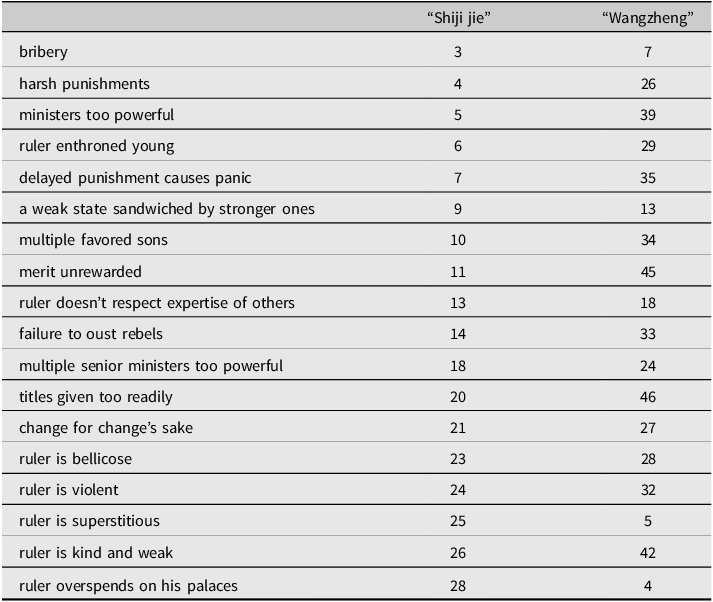
As with the “Shiji jie,” the “Wangzheng” was intended as a mirror for princes. Han Fei played an important role in establishing this genre in China, when he explicitly compared the importance of texts as a mechanism for rectifying behavior to the role of the mirror in rectifying appearance.Footnote 61 However, the relationship between these two chapters goes deeper than literary style and genre. In a number of instances, the disastrous situations described in the “Wangzheng” are identical to those in the “Shiji jie,” for all that the details are entirely different in the two texts (see Table 1). This should not be perceived as a reflection on the historicity of the events discussed in either text, for problems like government corruption and ministers quarreling amongst themselves arose repeatedly over the course of the centuries, and disasters were regularly caused by rulers possessed of weak, cruel, or violent characters. Instead, what is important to note here is the significant thematic overlap between these two texts: though it depends somewhat on how strongly the association is made, even a conservative comparison between these texts suggests that some two thirds (64 percent) of the disastrous situations described in the “Shiji jie” are also found in the “Wangzheng.” To put it another way, since the “Wangzheng” provides much more detailed and extensive coverage of potential problems, at least eighteen portents of destruction (37.5 percent) are situations also found in the “Shiji jie.” This is indicative of the way in which Han Fei took not only the form but also thematic inspiration from his source.
A thematic comparison between “Shiji jie” and “Wangzheng”

Table 1 Long description
A table comparing disastrous situations between Shiji jie and Wangzheng. The table has 16 rows and 3 columns. The columns are labeled Shiji jie, Wangzheng, and the row labels are various disastrous situations. Row 1: bribery, 3, 7. Row 2: harsh punishments, 4, 26. Row 3: ministers too powerful, 5, 39. Row 4: ruler enthroned young, 6, 29. Row 5: delayed punishment causes panic, 7, 35. Row 6: a weak state sandwiched by stronger ones, 9, 13. Row 7: multiple favored sons, 10, 34. Row 8: merit unrewarded, 11, 45. Row 9: ruler doesn't respect expertise of others, 13, 18. Row 10: failure to oust rebels, 14, 33. Row 11: multiple senior ministers too powerful, 18, 24. Row 12: titles given too readily, 20, 46. Row 13: change for change's sake, 21, 27. Row 14: ruler is bellicose, 23, 28. Row 15: ruler is violent, 24, 32. Row 16: ruler is superstitious, 25, 5. Row 17: ruler is kind and weak, 26, 42. Row 18: ruler overspends on his palaces, 28, 4.
As with the “Shiji jie,” the “Wangzheng” deals exclusively with the problems faced by rulers and was intended to be read by monarchs. Given what is known of Han Fei’s career, if it is correct that this text was indeed written late in his career, that probably means it was addressed to the future First Emperor of China, then Ying Zheng, King of Qin 秦王嬴政 (r. 247–221 bce as king; r. 221–210 bce as emperor).Footnote 62 The current transmitted text of the Han Feizi includes a memorial addressed to the king of Qin, and Sima Qian claims that the “Shuinan” 說難 (On the Difficulties of Persuasion) and “Gufen” 孤憤 (Solitary Anger) were written while Han Fei was imprisoned in Qin, so there is nothing intrinsically unlikely in the idea that other writings might also have been produced during this period.Footnote 63 In his framing of the “Wangzheng,” Han Fei relied upon his reader(s) being sufficiently well-educated that they would recognize the precise terms in which these events are described, call to mind the entire, complex narrative, and then remember whether or not, in the end, this did indeed lead to destruction.
Reading the “Wangzheng” as a series of riddles that Han Fei has set the future First Emperor profoundly changes our understanding of this text. The king of Qin seems to have been very difficult to work for—if it is correct that Li Si 李斯 (d. 208 bce) developed the formulation meisi 昧死 (risking death) to express his respect towards his monarch even in contexts where he was not implying the slightest hint of criticism, then the future First Emperor clearly required exceptionally careful handling from his court.Footnote 64 Although not known for his love of riddles (unlike some other monarchs in the Spring and Autumn and Warring States periods),Footnote 65 as an admirer of Han Fei’s writings, the future First Emperor would presumably have enjoyed the erudition shown, and noted the advice given, even if he did not necessarily intend to make use of it.Footnote 66 The king of Qin may also have been fully aware of the fact that the “Wangzheng” was modeled upon the “Shiji jie” and enjoyed the conceit that this text now framed him as superior to the Zhou kings of high antiquity.
An Annotated Translation of the “Wangzheng”
#1 凡人主之國小而家大,權輕而臣重者,可亡也。
When the ruler’s capital is small while the estates of his nobles are large; when his authority is light while that of his ministers is weighty—he can be destroyed.Footnote 67
#2 簡法禁而務謀慮,荒封內而恃交援者,可亡也。
When [the ruler] cares naught for laws and prohibitions and puts all his efforts into plots and schemes; when he lays waste to his realm and relies on others to come to his assistance—he can be destroyed [Lord Mu of Lu 魯穆公 (r. 415–377 bce)].Footnote 68
#3 羣臣為學,門子好辯,商賈外積,小民右仗者,可亡也。
When ministers act upon their learning and their sons enjoy debate;Footnote 69 when merchants accumulate wealth elsewhere and the common people bear arms—[the country] can be destroyed.Footnote 70
#4 好宮室臺榭陂池,事車服器玩,好罷露百姓,煎靡貨財者,可亡也。
When [the ruler] loves his palace with its towers and belvederes, embankments and ponds, embellishing his chariots and costumes, trinkets and fancies; when he enjoys the thought that he is exhausting and impoverishing the common people, and burning through resources—he can be destroyed [Lord Kang of Qin 秦康公 (r. 620–609 bce)].Footnote 71
#5 用時日,事鬼神,信卜筮,而好祭祀者,可亡也。
When [the ruler] acts only on auspicious days, serving the ghosts and spirits and trusting in divination by oracle bone and milfoil, loving sacrifices and ceremonies—he can be destroyed [King Daoxiang of Zhao 趙悼襄王 (r. 244–236 bce)].
#6 聽以爵不待參驗,用一人為門戶者,可亡也。
When [the ruler] listens to people according to their rank and does not wait for proof; when he uses only a single person as a conduit for information—he can be destroyed [Lord Jing of Qi 齊景公 (r. 547–490 bce) or King Kuai of Yan 燕王噲 (r. 320–318 bce)].
#7 官職可以重求,爵祿可以貨得者,可亡也。
When official positions can be demanded by the weighty; when titles and emoluments can be purchased with cash—[the country] can be destroyed.
#8 緩心而無成,柔茹而寡斷,好惡無決,而無所定立者,可亡也。
When [the ruler] is lazy and nothing is ever achieved; when he is weak-willed and indecisive; when his likes and dislikes are never settled and he does not have fixed opinions—he can be destroyed.
#9 饕貪而無饜,近利而好得者,可亡也。
When [the ruler] is greedy and never satisfied, when he is only interested in profit and cares for nothing but personal gain—he can be destroyed [Yao, Earl of Zhi 智伯瑤 (d. 453 bce)].
#10 喜淫而不周於法,好辯說而不求其用,濫於文麗而不顧其功者,可亡也。
When [the ruler] takes delight in excessive [speech] and refuses to be bound by the law; when he enjoys fine rhetorical arguments without demanding that they be practicable, steeping himself in fine literary flourishes without any concern for how [these ideas] might be successful—he can be destroyed.Footnote 72
#11 淺薄而易見,漏泄而無藏,不能周密,而通羣臣之語者,可亡也。
When [the ruler] is shallow and superficial, telling everything to everyone, so that information leaks out and nothing can be kept hidden; when it is impossible to keep secrets because he communicates his ministers’ words to all and sundry—he can be destroyed.
#12 很剛而不和,愎諫而好勝,不顧社稷而輕為自信者,可亡也。
When [the ruler] is stubborn and unpleasant, incapable of being conciliatory, ignoring remonstrance and wanting victory [at all costs]; when he pays no attention to the state altars, recklessly displaying his self-confidence—he can be destroyed [Lord Huan of Qi 齊桓公 (r. 685–643 bce)].Footnote 73
#13 恃交援而簡近鄰,怙強大之救,而侮所迫之國者,可亡也。
When [the ruler] relies on assistance from [distant] allies while treating near neighbors with contempt; when he trusts in receiving help from great and powerful kingdoms while despising those nearby—he can be destroyed [King Xuanhui of Han 韓宣惠王 (r. 332–312 bce)].
#14 羈旅僑士,重帑在外,上閒謀計,下與民事者,可亡也。
When [the ruler] provides an abode for foreign men of honor, greatly enriching them [but with that wealth] held abroad; when they are allowed to join in strategic in planning [with the ruler] above, and they participate in matters involving the people below—[the country] can be destroyed.
#15 民信其相,下不能其上,主愛信之而弗能廢者,可亡也。
When the people trust the prime minister, and subjects believe their monarch is incompetent; when the ruler loves and trusts [the prime minister] and hence is not able to get rid of him—[the country] can be destroyed [King Kuai of Yan].
#16 境內之傑不事,而求封外之士,不以功伐課試,而好以名問舉錯,羈旅起貴以陵故常者,可亡也。
When gentlemen from inside the borders are left unemployed while [the ruler] wants only foreign men of honor; when [the ruler] does not test and evaluate people according to their achievements but likes to promote them purely on the basis of their reputations; when those from abroad are raised to the nobility to the detriment of long-serving [local] officials—[the country] can be destroyed [Shang Yang 商鞅 (d. 338 bce) and Wu Qi 吳起 (440–381 bce)].Footnote 74
#17 輕其適正,庶子稱衡,太子未定而主即世者,可亡也。
When [the monarch] treats his legitimate heir lightly and his sons by secondary consorts hold the balance of power; when no Crown Prince has yet been appointed but the ruler has already passed away—[the country] can be destroyed.Footnote 75
#18 大心而無悔,國亂而自多,不料境內之資而易其鄰敵者,可亡也。
When [the ruler] is arrogant and fails to learn from his mistakes, so that even as the country falls into chaos, he is making much of his own achievements; when he does not calculate the resources available within his borders but lightly provokes neighboring enemy [states]—he can be destroyed [King Zhaoxiang of Qin 秦昭襄王 (r. 306–251 bce)].
#19 國小而不處卑,力少而不畏強,無禮而侮大鄰,貪愎而拙交者,可亡也。
When a country is small but does not occupy a humble position; when its authority is weak and yet it does not fear the powerful; when [the ruler] is rude and humiliates great neighbors, and he proves greedy, arrogant, and stupid in choosing his allies—he can be destroyed [King Fuchai of Wu 吳王夫差 (r. 495–473 bce)].
#20 太子已置,而娶於強敵以為后妻,則太子危,如是,則羣臣易慮,羣臣易慮者,可亡也。
When the Crown Prince has already been established but [the ruler] marries a second wife from a powerful enemy, the Crown Prince is in danger; if this happens ministers will change their plans. When ministers change their plans—[the country] can be destroyed.
#21 怯懾而弱守,蚤見而心柔懦,知有謂可,斷而弗敢行者,可亡也。
When [the ruler] is timorous and lacks the courage of his convictions, so that even if he sees [a problem] early on, he is too weak and fearful [to deal with it]; when he knows what to do and says it can be done, and yet having made his decision does not dare to carry it out—he can be destroyed.
#22 出君在外而國更置,質太子未反而君易子,如是則國攜,國攜者,可亡也。
If an exiled lord lives abroad and the country establishes a different ruler; or if the hostage Crown Prince does not return and the lord changes [the succession] to another of his sons; should this happen, the country will find its loyalties divided.Footnote 76 When the country has divided loyalties—it can be destroyed [Lord Dao of Cao 曹悼公 (r. 523–515 bce)].
#23 挫辱大臣而狎其身,刑戮小民而逆其使,懷怒思恥而專習則賊生,賊生者,可亡也。
When [the ruler] humiliates a senior minister by having an affair with his wife; when he subjects ordinary people to mutilating punishments and torture while making himself odious to his officials, so that they must devote themselves to his service with anger alive in their hearts and remembering every insult, it will give rise to traitors.Footnote 77 When traitors arise—[the country] can be destroyed [Lord Zhuang of Qi 齊莊公 (r. 553–548 bce)].
#24 大臣兩重,父兄眾強,內黨外援以爭事勢者,可亡也。
When two senior ministers hold equal weight; when [the ruler’s] uncles and brothers are numerous and strong, using factions inside the state and assistance from abroad to fight for political control—[the country] can be destroyed [Lord Jian of Qi 齊簡公 (r. 484–481 bce)].
#25 婢妾之言聽,愛玩之智用,外內悲惋而數行不法者,可亡也。
When the words of maids and concubines are listened to, and the schemes of favorites are employed; when those inside the court and out hate each other and repeatedly resort to illegal actions—[the country] can be destroyed [Lord Chunshen of Chu 楚春申君 (d. 238 bce) and Lord Huan of Qi].
#26 簡侮大臣,無禮父兄,勞苦百姓,殺戮不辜者,可亡也。
When [the ruler] despises and humiliates senior ministers, treating his uncles and older brothers without proper respect; when he makes the common people suffer, torturing and killing the innocent—he can be destroyed [Lord Ling of Zheng 鄭靈公 (r. 605 bce); Lord Zhao of Lu 魯昭公 (r. 541–510 bce); Lord Kang of Qin; and Viscount Xian of Han 韓獻子 (r. 573–566 bce)].
#27 好以智矯法,時以行襍公,法禁變易,號令數下者,可亡也。
When [the ruler] likes to change the law in accordance with what seems good to his mind; when he often damages what is in the public good by his actions, putting the laws and prohibitions into a state of constant flux, while commands and orders are issued repeatedly—he can be destroyed.Footnote 78
#28 無地固,城郭惡,無畜積,財物寡,無守戰之備而輕攻伐者,可亡也。
When there are no fastnesses in his territory and the inner and outer walls are in ruins, and [the ruler] does not have stores or much wealth, and has made no preparations for defense, yet still recklessly attacks others—he can be destroyed.
#29 種類不壽,主數即世,嬰兒為君,大臣專制,樹羈旅以為黨,數割地以待交者,可亡也。
When none among the ruling family live long and monarchs have repeatedly died young so that a babe in arms becomes lord, with senior ministers in complete control; when they bring in foreigners to build up their factions and repeatedly partition off land in order to generate allies—[the country] can be destroyed.
#30 太子尊顯,徒屬眾強,多大國之交,而威勢蚤具者,可亡也。
When the Crown Prince is honored and admired; when his supporters are numerous and powerful; when he has many allies among great states, and his authority and might have been established prematurely—[the country] can be destroyed [King Mu of Chu 楚穆王 (r. 625–614 bce)].
#31 變褊而心急,輕疾而易動發,心悁忿而不訾前後者,可亡也。
When [the ruler] is excitable and overemotional, is easily upset and quickly moved to precipitate action; when he is constantly angry and does not consider the consequences—he can be destroyed.
#32 主多怒而好用兵,簡本教而輕戰攻者,可亡也。
When the ruler frequently indulges in fits of rage and enjoys deploying his troops; when he thinks agricultural labor is easy and makes light of fighting battles—he can be destroyed.Footnote 79
#33 貴臣相妒,大臣隆盛,外藉敵國,內困百姓,以攻怨讎,而人主弗誅者,可亡也。
When noblemen are envious of each other and senior ministers flourish, getting support from enemy states abroad while at home they force the common people to attack their enemies, and yet the ruler does not execute them—[the country] can be destroyed [Lord Jian of Qi].
#34 君不肖而側室賢,太子輕而庶子伉,官吏弱而人民桀,如此則國躁,國躁者,可亡也。
When the lord is stupid but junior members of the ruling house are clever; when the Crown Prince is treated lightly but his half-brothers by junior consorts are powerful;Footnote 80 when government officials are weak, but the people are strong: this results in the country becoming destabilized. If the country is destabilized—it can be destroyed.
#35 藏怒而弗發,懸罪而弗誅,使羣臣陰憎而愈憂懼,而久未可知者,可亡也。
When [the ruler] hides his anger and does not release it; when he suspends punishments and does not proceed with executions, ensuring that his ministers secretly hate him as they feel ever more terrified, and this situation persists for a long time without [the ministers] knowing [what will happen to them]—he can be destroyed [Lord Zhao of Zheng 鄭昭公 (r. 697–695 bce)].Footnote 81
#36 出軍命將太重,邊地任守太尊,專制擅命,徑為而無所請者,可亡也。
When the generals employed to conduct a campaign are given too much weight; when the governors appointed to guard the borders are too honored, to the point that they have sole control and can write their own orders, doing exactly as they please without having to ask permission from anyone—[the country] can be destroyed.
#37 后妻淫亂,主母畜穢,外內混通,男女無別,是謂兩主,兩主者,可亡也。
When the queen is debauched or the dowager has affairs, that means proper distinction is not maintained between the harem and the outside world and segregation is not observed between men and women. This is called having two rulers and if there are two rulers—[the country] can be destroyed.
#38 后妻賤而婢妾貴,太子卑而庶子尊,相室輕而典謁重,如此則內外乖,內外乖者,可亡也。
When the queen is despised and maids and concubines treated as noble; when the Crown Prince is ignored and his brothers by junior consorts honored; or when the Prime Minister is treated lightly while petitions clerks are given weight; if this happens relationships between those inside and outside the palace may be strained, and if these relationships are strained—[the country] can be destroyed.Footnote 82
#39 大臣甚貴,偏黨眾強,壅塞主斷而重擅國者,可亡也。
When senior ministers are greatly ennobled and their supporters become numerous and strong; when they block [all conduits of information] so as to sequester the ruler, thereby establishing a double hold over the country—it can be destroyed.
#40 私門之官用,馬府之世【絀】,鄉曲之善舉,官職之勞廢,貴私行而賤公功者,可亡也。
When officials are employed on the basis of their service to ministerial households while the descendants of meritorious houses are spurned; when men are promoted on the basis of a good reputation back in their hometown while the achievements of officials [already employed in the government] are ignored, so that private action is considered noble while achievements for the public good are regarded as mean—[the country] can be destroyed.Footnote 83
#41 公家虛而大臣實,正戶貧而寄寓富,耕戰之士困,末作之民利者,可亡也。
When the ruling house is just an empty shell and senior ministers hold actual power; when those who stay at home are poor but those who go abroad get rich; when men who perform agricultural labor or military service suffer as speculators reap the profits—[the country] can be destroyed.Footnote 84
#42 見大利而不趨,聞禍端而不備,淺薄於爭守之事,而務以仁義自飾者,可亡也。
When [the ruler] sees a very advantageous opportunity and does not seize it; when he hears of disaster and makes no preparations to counter it; when he is negligent and uninterested about matters pertaining to attack and defense but makes every effort to gain praise for being benevolent and righteous—he can be destroyed [Lord Xiang of Song 宋襄公 (r. 650–643 bce)].
#43 不為人主之孝,而慕匹夫之孝,不顧社稷之利,而聽主母之令,女子用國,刑餘用事者,可亡也。
If [the ruler] does not act with the filial piety of a monarch, but instead admires the filial piety shown by ordinary persons, so that he pays no attention to what would benefit the altars of soil and grain, but just listens to the orders of the dowager queen; when women are employed in the government of the country and eunuchs are involved in politics—[the country] can be destroyed [Lord Huan of Qi].Footnote 85
#44 辭辯而不法,心智而無術,主多能而不以法度從事者,可亡也。
Skilled in rhetoric but unable to keep within the bounds of the law, clever but lacking in craft; when the ruler is highly capable but cannot conduct himself with moderation—he can be destroyed.
#45 親臣進而故人退,不肖用事而賢良伏,無功貴而勞苦賤,如是則下怨,下怨者,可亡也。
When new vassals are promoted and faithful old servants of the throne thrust into the background; when the stupid are employed in the government of the country while the clever and good are passed over; when those who have achieved nothing are ennobled while the hardworking are left to bitter poverty: if this happens, subordinates will seethe with resentment.Footnote 86 If subordinates become resentful—[the country] can be destroyed.
#46 父兄大臣祿秩過功,章服侵等,宮室供養太侈,而人主弗禁,則臣心無窮,臣心無窮者,可亡也。
When the titles and emoluments offered to male members of the ruling house and senior ministers exceeds their achievements, and their dress and accoutrements encroach upon those of higher rank; when their palaces and style of life are too extravagant, and the ruler does nothing to prevent this, ministers find their desires unchecked. If ministers find their desires unchecked—[the country] can be destroyed [Lord Huan of Qi].
#47 公婿公孫與民同門,暴傲其鄰者,可亡也。
When the ruler’s in-laws and grandchildren live alongside ordinary people and treat them with brutality and arrogance—[the country] can be destroyed.
亡徵者,非曰必亡,言其可亡也。夫兩堯不能相王,兩桀不能相亡,亡王之機,必其治亂、其強弱相踦者也。木之折也必通蠹,牆之壞也必通隙。然木雖蠹,無疾風不折;牆雖隙,無大雨不壞。萬乘之主,有能服術行法以為亡徵之君風雨者,其兼天下不難矣。
These are portents of destruction. I am not saying [such monarchs] will definitely be destroyed; I am saying that it is a possibility. Were there to be two Yaos, they could not both be kings together; were there to be two Jies, they could not destroy each other. The crux of whether they are destroyed or rule as kings lies in their ability to pacify the forces of chaos and manage their respective strengths and weaknesses. Wood that has been broken will be attacked by insects; a wall that has tumbled down will be riddled with cracks. However, even if the wood is wormed, it will not break except in a howling gale; even though the wall is cracked, it will not crumble unless there is heavy rain. If amongst the rulers of great states there was one who could use his mastery of statecraft and upholding of the rule of law to turn himself into the kind of gale or rain that can afflict lords who have experienced portents of destruction, it would not be difficult for him to unite All-Under-Heaven.
The “Wangzheng” Riddles
Riddling was an extremely important part of rhetoric in early China, and many examples are cited and explained in transmitted texts.Footnote 87 This form of playing with language has also attracted academic attention.Footnote 88 Riddles were important in so hierarchical and unequal a society as that of the Warring States period because they provided a mechanism for those in a subordinate position to criticize those in power without offending them, for by solving the riddle that had been proposed, the monarch was encouraged to feel pleased with themselves and receptive to advice which if presented less tactfully, was likely to be unpalatable. Riddling was also used in a wide variety of mantic practices, so this rhetoric appears widely within early writings connected to divination and prophecy.Footnote 89 In particular, glyphomancy or chaizi 拆字 is a form of riddling that has a history that stretches back to at least the time of the Zhou dynasty.Footnote 90 The connection made in antiquity between riddling and divination is particularly relevant for understanding the format of the “Wangzheng,” for as the title of this chapter suggests, its contents refer to portents of destruction. Interpreting this as a prophetic text is strongly reinforced by the author’s choice of riddles to convey this information.
In proposing his solutions to different riddles, Chen Qiyou has made certain assumptions that need to be questioned. First, he believed that one person can be the answer to multiple riddles: accordingly, Lord Huan of Qi is proposed as the answer to riddles #12, #25, #43, and #46. Secondly, some riddles are given multiple possible answers; for example, he suggested four different solutions to riddle #26. In addition, for three riddles, Chen Qiyou suggested that the answer was an individual who is not otherwise mentioned in the Han Feizi: that is riddle #5 (King Daoxiang of Zhao), #22 (Lord Dao of Cao), and #26 (Lord Ling of Zheng), since he seems to have viewed their absence from the rest of the text as insignificant. It is not at all clear that these interpretations are correct. Some riddles may indeed have multiple answers because they appear to speak of mutually incompatible situations. However, the analogy between this text and the “Shiji jie” means that it is most likely that for the majority of the riddles, there was only a single answer, in the same way that in the Yi Zhoushu text, only one historical situation is being described. This is the case with riddle #4, which is currently the only riddle that can be definitely answered. Chen Qiyou proposed a solution, suggesting that this referred to Lord Kang of Qin, but this is not correct. There is only one ruler in ancient China who had precisely this wording applied to him consistently in ancient texts, and that is King Fuchai of Wu. There are three iterations of the same story that use very closely related vocabulary to describe the thoughtless extravagance and reckless wastefulness of the last king of Wu. Chronologically, the earliest and fullest of these accounts is preserved in the Zuozhuan 左傳 (Zuo’s Tradition) which recounted the deliberations of the Chu ruling elite as the forces of Wu occupied Chen 陳 in the eighth lunar month of 494 bce. Zixi 子西 (d. 479 bce), born Prince Shen of Chu 公子申 and at this time the chief minister in that kingdom, proceeded to contrast the personalities of King Helü of Wu 吳王闔閭 (also given, with an alternate graph, as King Helu of Wu 吳王闔廬; r. 514–496 bce) and his successor, King Fuchai, much to the latter’s detriment. Where King Helü was frugal and abstemious, his heir proved extravagant and profligate—and in the quotation given below, the wording identical to the “Wangzheng” is given in bold:
今聞夫差, 次有臺榭陂池焉; 宿有妃嬙嬪御焉。一日之行, 所欲必成, 玩好必從, 珍異是聚, 觀樂是務, 視民如讎, 而用之日新。夫先自敗也已, 安能敗我?
Now I hear that Fuchai has towers and belvederes, embankments and ponds everywhere he stops, and when he spends the night, he has consorts and concubines, maids and palace women in attendance on him. For each day’s journey, he must have everything he wants, trinkets and fancies must follow him, and every rarity and marvel must be gathered [for his delectation], spectacles and music must be provided, and he sees the people as his enemy, coming up with new ways to exploit them daily. He has already destroyed himself first, so how can he defeat us?Footnote 91
There is every reason to believe that Han Fei would have been aware of this passage; not only did he frequently quote from the Zuozhuan in his writings, but he also wrote the earliest known commentary on the text.Footnote 92 Exactly the same occasion is described in the “Chuyu” 楚語 (Tales of Chu) chapter of the Guoyu and in almost identical terms. Again, the wording of the phrases “towers and belvederes, embankments and ponds” and “trinkets and fancies” can be found in this version of the story intact, and they are part of Zixi’s ringing denunciation of King Fuchai:
今吾聞夫差好罷民力以成私好, 縱過而翳諫, 一夕之宿, 臺榭陂池必成, 六畜玩好必從。夫差先自敗也已, 焉能百侮辱, 在修德以待吳, 吳將斃矣。
Now I have heard that Fuchai likes to exhaust his people’s strength in order to fulfill his own selfish pleasures, he gives reign to his mistakes and ignores remonstrance. For a single overnight stay, towers and belvederes, embankments and ponds must be provided, and the six beasts and all his trinkets and fancies must accompany him. Fuchai has already defeated himself, for unless he can endure humiliation in the cause of repairing his virtue so as to restore Wu, Wu will be eliminated.Footnote 93
A simpler version of Zixi’s words, which still repeats the key phrases of the Zuozhuan, can be found in the “Quanmou” 權謀 (Judgment and Strategy) chapter of the Shuoyuan 說苑 (Garden of Stories).Footnote 94 Accordingly, it is most likely that riddle #4 of the “Wangzheng” should be understood as denoting King Fuchai of Wu. Accordingly, Han Fei’s intended reader was supposed to first deduce that this was the historical person intended and then move to the next phase of the riddle to understand that in this instance, King Fuchai’s behavior did indeed lead to destruction. His kingdom was invaded and conquered by King Goujian of Yue 越王勾踐 (r. 496–465 bce), and King Fuchai was forced to commit suicide.Footnote 95 While none of the other riddles in the “Wangzheng” are as clear as this, it is entirely possible that in the late Warring States era, Han Fei’s readership would have deduced from the clues in the wording exactly which monarch or ruler was denoted by each passage, while admiring the linguistic skill of the author in concealing his intention so adroitly. Unfortunately, due to the poor survival of late Warring States era literature, even if we can today recognize similarities in accounts of historical events, it is difficult to pin down the wording of the rest of the “Wangzheng” with the same exactitude as riddle #4. It is very likely, for example, that Chen Qiyou is entirely correct in his assertion that riddle #23 in the “Wangzheng” was intended to denote Lord Zhuang of Qi, for this makes reference to a very specific set of circumstances:
When [the ruler] humiliates a senior minister by having an affair with his wife; when he subjects ordinary people to mutilating punishments and torture while making himself odious to his officials, so that they must devote themselves to his service with anger alive in their hearts and remembering every insult, it will give rise to traitors. When traitors arise—[the country] can be destroyed.Footnote 96
It would seem entirely plausible to associate this passage with Lord Zhuang’s affair with Lady Tang Jiang 棠姜, the wife of his senior minister, Cui Zhu 崔杼 (d. 546 bce), and his cruel whipping of his servant, Jia Ju 賈舉.Footnote 97 In this instance, readers would have been expected to understand that while the state of Qi survived, Lord Zhuang himself was murdered. Similarly, Chen Qiyou’s suggestion that riddle #42 pertains to Lord Xiang of Song is also highly plausible, with its portrayal of a foolish and ineffectual ruler who hopes to be praised as benevolent and just. Indeed, in the “Wai chushuo zuoshang” 外儲說左上 (Outer Collection of Rhetorical Devices: Part 1A) chapter of the Han Feizi, when recounting the story of Lord Xiang’s demise following the Battle of the Hong River 泓水之戰, it says: “The Song army was defeated and the lord wounded in his thigh, so that three days later he died. This disaster came about because he hoped to be thought benevolent and righteous” (宋人大敗, 公傷股, 三日而死, 此乃慕自親仁義之禍).Footnote 98 However, in these instances, the wording is not exactly identical to other surviving source texts, so it is difficult to be completely sure these proposed solutions are correct.
It is easy to read the “Wangzheng” without recognizing the riddles, viewing each passage as an abstract example of a situation that might prove disastrous. In the same way, it is entirely possible to grasp the gist of the “Shiji jie” even though many of the events mentioned are otherwise unknown. However, just as our understanding of the “Shiji jie” would undoubtedly be much enhanced by knowing more about the historical background, recognizing the stories behind the “Wangzheng” riddles will improve our grasp of what Han Fei was trying to say. A comparison with other extended riddles on historical characters illustrates the nature of the problem: for example, the Yang Taizhen waizhuan 楊太真外傳 (Scandalous Tale of Yang Taizhen) attributed to Yue Shi 樂史 (930–1007) contains a supernatural tale in which thirty-two beautiful women from history appear before Yang Guozhong 楊國忠 (d. 756), each designating herself according to a particular attribute, thus setting a series of conundrums for the reader to solve—some of which are significantly more difficult than others:
「裂繒人也。」「定陶人也。」「穹廬人也。」「當壚人也。」「亡吳人也。」「步蓮人也。」 …
“I am the person who ripped silk” [Bao Si 褒姒 (d. 771 bce)]. “I am the person from Dingtao” [Lady of Brilliant Deportment Fu 傅昭儀 (d. 2 bce)]. “I am the person who [lived in] a yurt” [Wang Zhaojun 王昭君 (c. 50–c. 8 bce)]. “I am the person who sold wine” [Zhuo Wenjun 卓文君 (175–121 bce)]. “I am the person who destroyed Wu” [Xi Shi 西施 (d. after 473 bce)]. “I am the person who stepped on lotuses” [Consort Pan 潘妃 (d. 502)] …Footnote 99
It is perfectly possible to read this tale of revenants without recognizing the women designated by these short riddles. However, all of them were supposed to be women of great beauty who lived more-or-less tragic lives—in some cases dying prematurely by violence or suicide, in others subject to posthumous execration—and this aspect of their biographies linked them to Yang Guozhong’s cousin, Yang Guifei 楊貴妃 (719–756), who was strangled during an army mutiny after her escape from Chang’an during the An Lushan rebellion. The enigmatic appearance on the scene of these unfortunate beauties serves to deepen the sense of impending doom, and the placement of this tale-within-a-tale at the very end of the first juan functions as a prelude to the terrible events to come. Teasing out the commonalities is an important part of the process of reading any historical riddle of this kind. Accordingly, our understanding of the “Wangzheng” is enhanced by viewing these individual disastrous situations not merely as abstract examples but as descriptions of events that actually happened in real life, many with significant ongoing consequences at the time Han Fei was writing, just prior to the unification of China. Reading the “Wangzheng” with these events in mind provides a new, alternative way of interpreting this ancient text.
Conclusion
The “Shiji jie” is one part of an important literary tradition commemorating the life and reign of King Mu of Zhou, a monarch of considerable charisma who left behind him a significant body of writings lauding multifarious aspects of his personality and rule, not to mention his travels around his kingdom and into the realm of the gods. This text specifically praises his ability to learn the lessons of history and understand the causes for the decline and fall of a series of earlier regimes. A significant number of transmitted and excavated texts include discussions of historical precedents given in a highly condensed form: what is unusual about the “Shiji jie” is the decision to focus exclusively on negative examples for moral and ethical instruction. The “Wangzheng” makes use of the same structure, criticizing many of the same kinds of destructive behavior of monarchs and ministers, while also highlighting some new issues of concern, most notably contentious relationships between the ruler and other members of his immediate family.
The Han Feizi preserves the voice of an extraordinarily talented author, whose vivid turns of phrase and linguistic artistry have been admired for more than twenty-two centuries. Within this corpus of writing, the “Wangzheng” is unique, with its use of an epistrophe and its cryptic, riddling format. While it is true that some aspects of the “Wangzheng” chapter’s formatting and content is taken directly from the “Shiji jie,” the decision to move from giving a series of encapsulated tales to outright riddles is remarkable. Choosing to present a series of negative examples through riddles in which all identifying names have been removed means that the author was challenging the reader to recognize the underlying stories through clues in the description and terminology, and to interpret each tale in order to judge just how disastrous these events proved to be in practice. Thus, the “Wangzheng” should be understood as an important survival within the tradition of political riddling in pre-Qin China.

 Open access

