


Introduction
Conservation planners often attempt to take short cuts when making decisions about land use by directing management towards one or a few species that will benefit the wider ecosystem (Simberloff, Reference Simberloff1998; Fleishman et al., Reference Fleishman, Murphy and Brussard2000; Poiani et al., Reference Poiani, Merrill and Chapman2001; Noon & Dale, Reference Noon, Dale and Gutzwiller2002). The umbrella species concept is one such proposed short cut, defined as protection of a wide-ranging species whose ‘conservation confers protection to a large number of naturally co-occurring species' (Roberge & Angelstam, Reference Roberge and Angelstam2004). An umbrella species is in reality a population of individuals of a particular species whose resource requirements and habitat needs encompass those of co-occurring species (Noon & Dale, Reference Noon, Dale and Gutzwiller2002; Caro, Reference Caro2003). An umbrella species can be used to determine the size and type of habitat to be protected under the assumption that protection for a viable umbrella species population will equate to effective protection for co-occuring species (Caro & O'Doherty, Reference Caro and O'Doherty1999). The umbrella species concept has been applied recently to predict or identify areas of species richness (Cardoso et al., Reference Cardoso, Silva, de Oliveira and Serrano2004; Thorne et al., Reference Thorne, Cameron and Quinn2006). There has been some support for the umbrella species concept at the local level to confer protection to specific taxa (Suter et al., Reference Suter, Graf and Hess2002; Caro, Reference Caro2003; Jones et al., Reference Jones, McLeish and Robertson2004). Other authors have proposed that the umbrella species concept is effective for conservation strategies and reserve design based on the large area requirements of the species (Wilcove, Reference Wilcove, Edwards, May and Webb1994; Wallis de Vries, Reference Wallis de Vries1995; Fleishman et al., Reference Fleishman, Murphy and Brussard2000; Suter et al., Reference Suter, Graf and Hess2002; Caro, Reference Caro2003) and ability to select sites based on a high level of coexistence (Fleishman et al., Reference Fleishman, Murphy and Brussard2000). However, while umbrella species are commonly used in conservation proposals, the concept has been poorly tested and empirical studies suggest that conservation measures focused on proposed umbrella species offer limited protection to co-occurring species (Berger, Reference Berger1997; Noss et al., Reference Noss, O'Connell and Murphy1997; Martikainen et al., Reference Martikainen, Kaila and Haila1998; Andelman & Fagan, Reference Andelman and Fagan2000; Hitt & Frissell, Reference Hitt and Frissell2004; Rowland et al., Reference Rowland, Wisdom, Suring and Meinke2006). Nevertheless, the need to develop appropriate conservation tools for ecosystem management has sustained interest in the umbrella species concept (Betrus et al., Reference Betrus, Fleishman and Blair2005).
Development and application of the use of surrogate species for conservation planning has been associated with an increase in the number of suggested criteria to guide selection of an appropriate umbrella species, resulting in the potential for uncertainty over the relative importance of these different criteria. A search of two online electronic databases (Biblioline Wildlife and Ecology Studies, 2006; Web of Science, 2006) using the phrase ‘umbrella species’ located 63 relevant publications in the 5 years (2002-2006) since the summary of literature on the topic by Caro (Reference Caro2003).
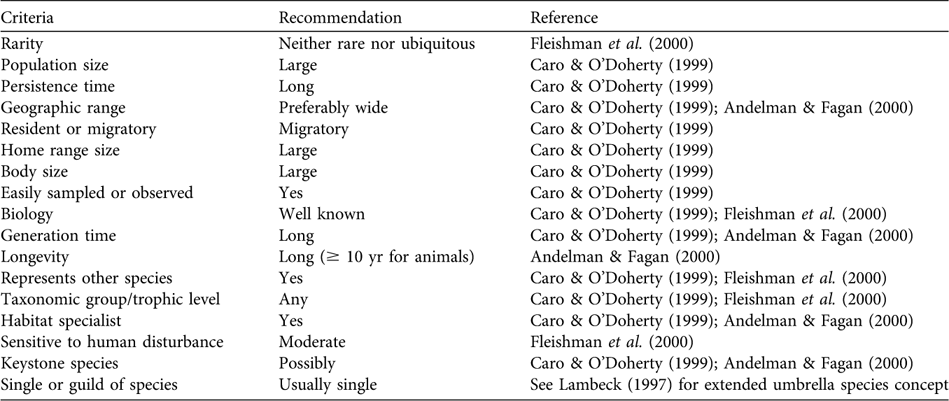
In the belief that some properties of a potential umbrella species will be more important than, or may subsume, others, we evaluate here the 17 published criteria for umbrella species (Table 1) and comment on the practicality of the concept for conservation planning and ecosystem management.
List of published criteria and recommendations for a suitable umbrella species.
Published criteria for umbrella species
Rarity, population size, persistence time and geographical range It is recommended that umbrella species should be relatively common and have a large population size, as these may signify a higher probability of long-term persistence (Berger, Reference Berger1997; Fleishman et al., Reference Fleishman, Murphy and Brussard2000), facilitate monitoring (Caro & O'Doherty, Reference Caro and O'Doherty1999) and improve the probability of co-occurrence with numerous sympatric species (Fleishman et al., Reference Fleishman, Murphy and Brussard2000). The composition and commonality of species and habitat types may differ between local areas, and therefore an umbrella species encompassing the habitat needs of coexisting species in one area may not do so at other local sites. Sympatry of a potential umbrella species and co-occurring species needs to be evaluated at smaller spatial scales (Hitt & Frissell, Reference Hitt and Frissell2004; Carrete & Donázar, Reference Carrete and Donázar2005). If conservation of an umbrella species is best carried out at local levels, emphasis should not be placed on a requirement for a wide geographical range. Similarly, overall commonality of the species may not be as important as local commonality, while consideration of population size is subsumed within the criteria for ease of monitoring (see later) and population persistence. Understandably a suitable umbrella species will not be one with a high likelihood of local extinction (Caro & O'Doherty, Reference Caro and O'Doherty1999). Confirmation of a high probability of persistence requires robust estimation of population vital rates and their associated temporal variability (Morris & Doak, 2001). In general, for large-scale regional conservation planning efforts, the data needed to evaluate umbrella population persistence are seldom available (Andelman & Fagan, Reference Andelman and Fagan2000).
Resident or migratory Migratory species may be more suited as umbrella species because they range more widely than resident species (Caro & O'Doherty, Reference Caro and O'Doherty1999). When evaluating the black rhinoceros Diceros bicornis as a potential umbrella species, Berger (Reference Berger1997) found that habitat protected for the sedentary rhino would not encompass the area required by wider-ranging migratory species. In contrast, the dispersal requirements and seasonal migration patterns of the spectacled bear Tremarctos ornatus may make it an effective umbrella species in northern Ecuador (Clark, Reference Clark2004). Whether a species is classified as migratory or not will be less important than quantification of actual total area requirements for a viable population based on reliable measures of home range size.
Home range and body size It has been suggested that the home range size of an umbrella species should be large in comparison to sympatric species to ensure that the habitat requirements of other co-occurring species are met (Berger, Reference Berger1997; Betrus et al., Reference Betrus, Fleishman and Blair2005). Home range size will probably differ between sites because of the availability and location of resources, another reason for assessing umbrella species at the local level. To some extent large body size is used as an indicator of the likelihood of large home range size because of the allometric relationship between body size and home range size (Caro & O'Doherty, Reference Caro and O'Doherty1999). Although large body size is commonly indicative of animals with large area requirements, smaller-sized animals should not be discounted as potential umbrella species as they can have large area requirements. Large body size may be a redundant criterion so long as home range size is included as a criterion of a suitable umbrella species. Perhaps of greater importance to the umbrella species criteria is that the area requirements of a viable population of the umbrella species are larger than the total area required by viable populations of each co-occurring species. It should also be considered that species with large home ranges may have greater densities and overlap in territories than species with smaller but exclusive home ranges. Ultimately reliable estimates of the total area requirements for viable populations, based on detailed quantification of umbrella species habitat use using radio telemetry or other spatial tools (Mildenstein et al., Reference Mildenstein, Stier, Nuevo-Diego and Mills2005), and taking into account seasonal changes (Berger, Reference Berger1997), will be more relevant than estimation of mean home range size alone in assessing the potential to protect coexisting species.
Ease of monitoring Because of the necessary focus on the management of a chosen umbrella species, it follows that species should be relatively easily observed or monitored (Caro & O'Doherty, Reference Caro and O'Doherty1999). In some ways this criterion can encompass those requiring large body size and non-rarity, and may possibly be at odds with any requirement that the species be sensitive to human disturbance (see below). Ease of monitoring will depend primarily on behavioural characteristics such as prominent visual or vocal displays.
Ecological knowledge, generation time and longevity Because of the need to assess candidate umbrella species against criteria such as these, it is necessary that most of the natural history and ecological information is known (Andelman & Fagan, Reference Andelman and Fagan2000). Delayed maturation and longevity (≥10 years for animals) have been proposed as criteria, the latter because this poses an additional risk of extinction due to the time lag in population recovery following declines (Andelman & Fagan, Reference Andelman and Fagan2000). It is not clear why a suitable umbrella species needs to be one that faces additional challenges to population persistence due to life history traits. More relevant would be consideration of the specific management required to ensure population persistence of the chosen umbrella species, because ideally management focused on the surrogate species would additionally benefit those species under the umbrella of protection.
Co-occurrence with and representation of other species The criterion that an umbrella species represents other species is vague in terms of how, and which, species are represented. It is unclear whether the umbrella species must simply represent the area and habitat types of coexisting species, or share the same resource requirements and threats to persistence. At a minimum, an umbrella species must spatially co-occur with other species in the area of interest (Andelman & Fagan, Reference Andelman and Fagan2000). As the umbrella species concept has been developed as a tool to delineate protected areas (Caro, Reference Caro2003; Roberge & Angelstam, Reference Roberge and Angelstam2004), this criterion may indicate that an umbrella species must represent only the area or habitat types (or even microhabitats; Chouteau, Reference Chouteau2004; Jones et al., Reference Jones, McLeish and Robertson2004) of other species. However, it seems important that the umbrella species faces common threats to persistence with co-occurring species. Generic protection of an umbrella species may be insufficient to result in measurable benefits for co-occurring taxa (Bifolchi & Lodé, Reference Bifolchi and Lodé2005) if those protection measures do not also address factors limiting the size, distribution or viability of co-occurring species. In general, the mechanisms by which protection of an umbrella species confers benefits to co-occurring species are not well understood. Rather than relying only on general habitat protection, conservation managers could usefully consider the nature and scale of more focused management needs of the umbrella species (Moran-Lopez et al., Reference Moran-Lopez, Sanchez, Costillo, Corbacho and Villegas2006). Specific management directed towards umbrella species could confer further protection to coexisting species in addition to that provided by habitat protection. For example, many species in New Zealand are threatened as a result of predation by introduced mammals (O'Donnell & Rasch, Reference O'Donnell and Rasch1991; King, Reference King2005), the control of which by traps and poisons increases fledging success of not only the targeted high-profile flagship bird species (Dilks et al., Reference Dilks, Willans, Pryde and Fraser2003) but also the survival and/or breeding success of other co-occurring species (Saunders & Norton, Reference Saunders and Norton2001). Thus this should be considered one of the umbrella species criteria.
Taxonomic group Evidence relating to cross-taxonomic protection using the umbrella species approach is equivocal (Martikainen et al., Reference Martikainen, Kaila and Haila1998; Andelman and Fagan, Reference Andelman and Fagan2000; Caro, Reference Caro2001; Reference Caro2003; Rubinoff, Reference Rubinoff2001; Suter et al., Reference Suter, Graf and Hess2002; Betrus et al., Reference Betrus, Fleishman and Blair2005; Rowland et al., Reference Rowland, Wisdom, Suring and Meinke2006). There is an understandable tendency to seek umbrella species from obvious flagship species, and there is some evidence that flagships such as top vertebrate predators may be effective umbrella species on which to base ecosystem level conservation planning (Sergio et al., Reference Sergio, Newton, Marchesi and Pedrini2006; but see Thorne et al., Reference Thorne, Cameron and Quinn2006). Taxonomic group should not be regarded as a strict criterion, as mammals, birds, vascular plants or other taxa could be used depending on the management goals and spatial scale of interest (Fleishman et al., Reference Fleishman, Murphy and Brussard2000). Representative umbrella species from different taxa or trophic levels may need to be protected to ensure the persistence of species in all taxonomic groups and/or trophic levels. To determine whether an umbrella species represents other species would require more than assessment of the presence of co-occurring species. Instead, research needs to evaluate whether populations would be viable under protection of the umbrella (Caro, Reference Caro2003; Lindenmayer & Fischer, Reference Lindenmayer and Fischer2003; Betrus et al., Reference Betrus, Fleishman and Blair2005). A more specific criterion would be that a suitable umbrella species represents the area requirements and shares habitat features and/or threats to persistence with co-occurring species.
Habitat specialist or generalist Habitat specialists are considered ideal umbrella species because their area requirements may be larger than those of generalists (Caro & O'Doherty, Reference Caro and O'Doherty1999; Andelman & Fagan, Reference Andelman and Fagan2000). However, the area requirements of a habitat specialist may be so specific that their area requirements are limited, or potentially few co-occurring species share their habitat requirements. Thus, a habitat specialist may not adequately represent the resource needs of other species. For example, the bull trout Salvelinus conuentus, an area-demanding habitat specialist inhabiting watersheds, is not thought to be an appropriate umbrella species for the protection of cutthroat trout Oncorhynchus clarki lewisi that more broadly inhabit watershed areas (Hitt & Frissell, Reference Hitt and Frissell2004). Similarly the habitat specialization of the European otter Lutra lutra may mean that their home range encompasses fewer species than do the ranges of more generalist carnivores (Bifolchi & Lodé, Reference Bifolchi and Lodé2005). Habitat generalists may occupy habitat shared by a greater proportion of coexisting species but protecting the entire area inhabited by a habitat generalist may be unnecessary if only some areas are important for survival (Fleishman et al., Reference Fleishman, Murphy and Blair2001). It may be more important that umbrella species are sensitive to key habitat features, such as the size and placement of critical landscape elements (Ozaki et al., Reference Ozaki, Isono, Kawahara, Iida, Kudo and Fukuyama2006). The criteria could be changed so that an umbrella species may be a habitat specialist or generalist, with more emphasis placed on the representation of other species.
Sensitivity to human disturbance Caro & O'Doherty (Reference Caro and O'Doherty1999) suggested that species sensitive to human disturbance are best suited to delineate suitable habitat for less sensitive species; however, because they recognized that umbrella species are sometimes employed in designing reserves in areas with little human disturbance, it was not deemed necessary that a suitable umbrella species be sensitive to human disturbance. In contrast, Fleishman et al. (Reference Fleishman, Murphy and Brussard2000) recommended at least moderate sensitivity to human disturbance. The sensitivity of co-occurring species to human disturbance could potentially go unnoticed if an umbrella species is unaffected, as all species are not equally vulnerable to human disturbance (Noss et al., Reference Noss, O'Connell and Murphy1997). Although many species may show different reactions to various forms or degrees of disturbance, sensitivity to disturbance should be emphasized as a criterion for potential umbrella species if this can be measured before conservation decisions are made.
Keystone species Keystone species have impacts on other community members that are disproportionate to their abundance or biomass (Noss et al., Reference Noss, O'Connell and Murphy1997; Andelman & Fagan, Reference Andelman and Fagan2000; Noon & Dale, Reference Noon, Dale and Gutzwiller2002). The potential of protection aimed at an umbrella species to confer protection on coexisting species could be heightened if it is also a keystone species (Caro & O'Doherty, Reference Caro and O'Doherty1999; Andelman & Fagan, Reference Andelman and Fagan2000). However, Caro & O'Doherty (Reference Caro and O'Doherty1999) did not give this much emphasis and it is unlikely to invalidate a candidate as an umbrella species if they do not act as a keystone species. In a similar vein, flagship species, charismatic species that serve to stimulate conservation efforts, can be poor umbrella species (Caro et al., Reference Caro, Englis, Fitzherbert and Gardner2004).
Single species or guild of species A single wide-ranging species could be adequate to define protected area boundaries. However, to ensure the viability of co-occurring species other limitations to persistence may need to be addressed, such as inadequate resources, dispersal ability, and the effects of predators (Lambeck, Reference Lambeck1997). One approach is to identify a species with the most critical needs relating to a specific threat, so that with multiple threats a community could be defined, the management for which could meet the needs of co-occurring species (Fleishman et al., Reference Fleishman, Murphy and Blair2001). Thus it may be preferable in some situations to employ a suite of umbrella species (Lambeck, Reference Lambeck1997; Betrus et al., Reference Betrus, Fleishman and Blair2005). Theoretically, the umbrella species concept can act as a compromise between species conservation and ecosystem conservation because resources would be allocated such that protection and management of one or a few surrogate species (Das et al., Reference Das, Krishnaswamy, Bawa, Kiran, Srinivas, Kumar and Karanth2006) would confer protection on many species in an ecosystem.
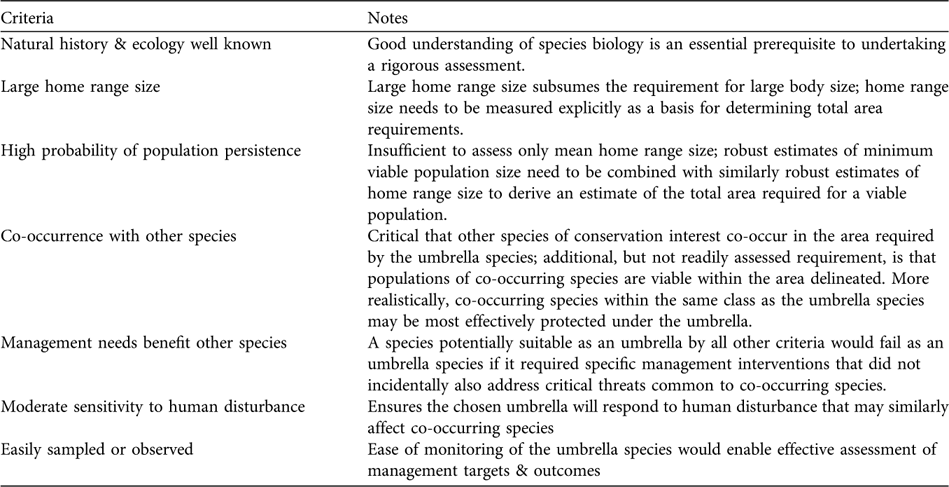
Revised criteria for umbrella species
Based on these assessments of published criteria, Table 2 sets out a revised set of criteria for evaluation of candidate umbrella species, eliminating from the original set of 17 items (Table 1) those that are subsumed within other more pertinent criteria. A total of only seven criteria are proposed: well-known biology, because this will enable assessment of suitability; large home range size (= large umbrella to encompass a viable population of the umbrella species); high probability of population persistence to avoid local extinctions; co-occurrence of species of conservation interest; management needs that are not specifically beneficial only to the umbrella species; moderate sensitivity to human disturbance; and ease of monitoring to track population trends and enable assessment of management targets.
Revised criteria for a suitable umbrella species, in order of priority.
Discussion
Although the umbrella species concept has been proposed as a conservation short cut for interim conservation plans, it is questionable whether a thorough examination of a candidate umbrella species is a short cut at all. A proper evaluation of a suitable umbrella species requires information on the movements, abundance, habitat use, vital rates and viability of many species (Caro & O'Doherty, Reference Caro and O'Doherty1999; Caro, Reference Caro2003). Intensive biotic surveys covering many years and seasons would be needed to estimate the minimum viable population size and area requirements of a proposed umbrella species, the viability of coexisting species under protection of an umbrella species, and the likelihood that suitable habitat for those other species is included within the protected area (Fleishman et al., Reference Fleishman, Murphy and Brussard2000; Roberge & Angelstam, Reference Roberge and Angelstam2004). Devotion of resources to researching potential umbrella species may limit research on threatened species, although in practice charismatic vertebrates tend to be chosen as candidate umbrellas with little a priori reference to any ecological criteria (Betrus et al., Reference Betrus, Fleishman and Blair2005). The umbrella species concept may not be a popular strategy for conservation unless the umbrella species itself is accorded high conservation priority as a result of being threatened and/or charismatic.
Studies examining umbrella species often use presence/absence data for co-occurring species to determine whether protection will be conferred on other species, rather than assessing the long-term viability of such background species, as data are often scarce (Berger, Reference Berger1997; Andelman & Fagan, Reference Andelman and Fagan2000; Caro, Reference Caro2003; Lindenmayer & Fischer, Reference Lindenmayer and Fischer2003; Betrus et al., Reference Betrus, Fleishman and Blair2005). When time-intensive surveys are required to make informed decisions on land use, decisions are sometimes made before adequate data can be collected (Thomas, Reference Thomas1990). The umbrella species concept can provide conservation managers with guidelines for habitat protection in the face of future development proposals but cannot guarantee the viability of all co-occurring species. Until the area requirements and habitat needs of most species in an area are known, conservation plans protecting habitats should be precautionary, as habitat loss and effects of human disturbance are often irreversible (Noss et al., Reference Noss, O'Connell and Murphy1997).
We recommend that the numerous criteria outlined in the literature (Table 1) be considered critically during any process of assessment of candidate umbrella species, with particular attention on local-level selection because the composition of species and how they use their habitat may differ from site to site. The 17 published criteria for a suitable umbrella species can be reduced to only seven that encompass the critical features (Table 2). Even with this streamlining of criteria however, rigorous assessment of the umbrella species concept requires such detailed knowledge of candidate umbrella species and all co-occurring species that it seems less of a short cut than one may wish.
Acknowledgements
We thank Brian Bell, Carolyn Burns, Tim Caro, Richard Clayton, Jen Germano, Ed Minot, Colin O'Donnell and Yolanda van Heezik for their insightful comments and suggestions. TL was supported by a University of Otago Postgraduate Award and by the Brenda Shore Postgraduate Research Trust.
Biographical sketches
Philip Seddon is director of the Wildlife Management programme at the University of Otago, where his research interests include the restoration and conservation management of native species. He is also the current Chair of the Bird Section of the IUCN/Species Survival Commission Reintroduction Specialist Group. Tara Leech's research and professional interests include conservation planning and science-based decision making for the sustainability of ecosystems and natural resources.



