

Introduction
Led by Sir Keir Starmer, Labour’s return to government in July 2024, after fourteen years in opposition, has reignited debate over the future of work and welfare in the UK. Its manifesto, A New Deal for Working People (Labour Party, 2024a), pledged to reform the labour market through commitments to fair pay, secure work, and a more inclusive employment support system. These proposals are framed as responses to persistent structural challenges, including long-term wage stagnation and a post-pandemic rise in economic inactivity.
The Get Britain Working White Paper (DWP, 2024) set out an ambition to reach an 80 per cent employment rate, equivalent to 2.2 million more people in work (Latimer, Reference Latimer2024). Alongside this, the Pathways to Work Green Paper (DWP, 2025a) proposed reforms to disability benefit assessments, benefit conditionality, and devolved employment support. Such measures reflect the Starmer government’s broader aim to stay within the welfare cap first introduced in 2014 (Keep, Reference Keep2025). These changes were initially forecast to reduce welfare spending by £5 billion by 2029–2030, though analysts warned the resulting income losses may outweigh the projected fiscal savings (Brewer et al., Reference Brewer, Clegg and Murphy2025).
Against this backdrop of economic constraint and political continuity, this article evaluates Labour’s post-2024 welfare and employment strategy through the lens of continuity and change. We examine how the current agenda aligns with, or diverges from, New Labour’s activation framework (1997–2010), using the Conservative-led governments (2010–2024) and ideas from Jeremy Corbyn’s leadership of the Labour Party (2015–2019) as useful points of comparison and contrast. We also place the proposals in international context by comparing them with other centre-left governments that came to power in recent years.
Specifically, we ask:
-
1. What are the key social policy challenges?
-
2. How has Labour responded pre- and post-election?
-
3. What are the limits of the emerging policy strategy?
To address these questions, we apply a diagnostic matrix across multiple policy domains:
-
areas where change has been implemented (touched),
-
areas constrained by structural or fiscal limitations (can’t touch),
-
areas the government has strategically avoided (won’t touch).
The matrix is essentially a heuristic organising tool that enables us to capture a complex policy situation and to broadly examine continuity and change.
The article begins by diagnosing the structural drivers of insecurity and the current state of the labour market, which were inherited by the Starmer government. They include the long-term erosion of collective bargaining and the restriction in union power (Beynon et al., Reference Beynon, Blakely, Bryson and Davies2021); an increasingly activation-focused approach to employment (also termed ‘work first’) (Jones, Reference Jones2021; Daguerre et al., Reference Daguerre, Ingold, Lee and Vincent2024); the rise of platform work and erosion of employment rights in a broad sense, and precarious forms of work, which goes hand in hand with outsourcing of work through agencies and the private sector (Jaehrling et al., Reference Jaehrling, Johnson, Larsen, Refslund and Grimshaw2018); the automation of manufacturing work (Cheng et al., Reference Cheng, Pien and Cheng2021); and the impact of labour supply changes driven by migration. These significant challenges, spanning decades of employment history in the UK, frame the context for the article’s core arguments. Despite the importance of macro-economics and labour supply for employment policy, the focus here remains on the specific policies and strategies of the Labour government in its first year of power.
We go on to evaluate Labour’s policy agenda from ‘Make Work Pay’ and the Employment Rights Act, to reforms under Get Britain Working and Pathways to Work, also to assess the role of devolved governance. Throughout, we reflect on how incremental reforms interact with enduring constraints, especially in relation to young people and regional inequality. We conclude by arguing that continuity and change are not opposites, but interwoven logics shaping Labour’s evolving approach to social policy.
Diagnosing the challenge: labour market insecurity and political constraints
The incoming Starmer government inherited a complex and fragile labour market, shaped by post-pandemic disruptions and persistent structural weaknesses. While headline indicators suggest modest improvement, the overall picture remains uneven. Between October and December 2025, the UK employment rate for people aged sixteen to sixty-four was estimated at 75.0 per cent, slightly down on the quarter but higher than the same period a year earlier. The unemployment rate rose to 5.2 per cent, and the economic inactivity rate remained at 2.8 per cent, largely unchanged in the quarter but lower than in 2024 (ONS, 2026).
The recent fall in inactivity has been attributed to a decline in the number of people aged thirty-five to sixty-four reporting caring responsibilities, as well as reductions among students and unpaid carers. Earlier increases in inactivity, particularly during the early pandemic period, were concentrated among those aged sixteen to twenty-four. In subsequent years, older groups, especially those aged fifty to sixty-four, became the primary contributors to the trend. Long-term sickness, especially linked to mental ill-health, remains a significant driver of economic inactivity, particularly in disadvantaged regions and among those with lower qualifications (Rocks and Atwell, Reference Rocks and Atwell2025).
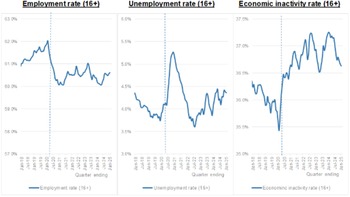
Figure 1 illustrates labour market shifts between January 2018 and January 2025, showing a decline in overall employment, a modest fall in unemployment, and a substantial increase in economic inactivity. Although there are signs of improvement, the underlying labour market challenges remain significant and continue to shape the government’s policy space.
Employment, unemployment, and inactivity before and after the first COVID lockdown.
Source: Institute for Employment Studies (2025), based on Labour Force Survey data. Dotted line indicates first COVID-19 lockdown.

Figure 1 Long description
The image contains three line graphs side by side, each representing different economic metrics for individuals aged 16 and older. The first graph on the left shows the employment rate, which fluctuates between approximately 57.0 percent and 63.0 percent. The middle graph displays the unemployment rate, ranging from around 3.0 percent to 6.0 percent. The third graph on the right illustrates the economic inactivity rate, varying between approximately 35.0 percent and 37.5 percent. A dotted vertical line indicates the onset of the first COVID-19 lockdown. The employment rate graph shows a peak just before the lockdown, followed by a decline and subsequent fluctuations. The unemployment rate graph exhibits a significant spike around the time of the lockdown, followed by a gradual decrease with some variability. The economic inactivity rate graph shows an increase around the lockdown period, with subsequent peaks and troughs. All values are approximated.
Young people have been increasingly marginalised in employment and social security policies in the decades leading up to 2024, and their precarious position was compounded during the pandemic period leading to a sharp rise in the number of young people Not in Education, Employment or Training (NEET), increasing by around 50 per cent to nearly one million sixteen- to twenty-four-year-olds (ONS, 2026). Unlike in the post-2008 period, where youth unemployment rose but inactivity stayed level, current increases are primarily driven by long-term ill-health. Over half of this growth is health-related, with mental health cited most frequently.
Insecure work further compounds these problems, and young people are disproportionately affected: 46 per cent of sixteen- to nineteen-year-olds and 27.9 per cent of twenty- to twenty-four-year-olds are in insecure employment, with 34.6 per cent and 12.7 per cent of those groups, respectively, also low paid (Richardson, Reference Richardson2023). Young people are nearly six times more likely to be on zero-hour contracts (Martin et al., Reference Martin, Williams, Atay and Florisson2024), and face significantly lower lifetime earnings than earlier cohorts, regardless of education level (Dabla-Norris et al., Reference Dabla-Norris, Pizzinelli and Rappaport2019). Research shows that minority ethnic young people are disproportionately affected by the overlapping dimensions of precarity (Arday, Reference Arday2022).
Although both the Conservative governments since 2010 and the current Starmer-led Labour government have framed economic inactivity as a fiscal challenge, the issue has a longer policy lineage. Under New Labour, reducing economic inactivity was a central objective of welfare reform. More recently, some policymakers have argued that the challenge lies less in rising ill health than in flaws in system design. For example, the Chair of the House of Lords Economic Affairs Committee has suggested that individuals face stronger financial incentives to claim health-related rather than unemployment-related benefits (House of Lords Economic Affairs Committee, 2025). This logic underpins continued reliance on work incentives in the benefits system, a thread that runs back to New Labour’s ‘no rights without responsibilities’ framing and behavioural discourses from the late 1990s onwards (Crisp, et al., Reference Crisp, Macmillan, Robinson and Wells2009; Alderwick, Reference Alderwick2012: 12). As we will show, the Starmer government attempts to address inactivity with policy tools that reflect such activation paradigms, albeit with a softer tone.
Internationally this emphasis on individual incentives and system design shapes responses to economic inactivity – even as centre-left governments pivot rhetorically toward structural solutions like ‘good jobs’ and regional investment. Post-COVID, centre-left governments in liberal market economies – including Albanese in Australia, Starmer in the UK, and former US President Biden (2021–2025) – have converged around a shared rhetorical commitment to ‘good jobs’ and targeted investment in left-behind places. This marked a turn toward recalibration without rupture: addressing the symptoms of inequality through labour market reform and place-based investment, while leaving core structures of economic power largely intact.
In Australia, this shift has been framed as thin labourism (Manwaring and Foley, Reference Manwaring and Foley2025): a pragmatic centre-left strategy built around infrastructure investment, activation services, and selective improvements in job quality, while avoiding deeper redistribution. The Starmer’s government appears to be following a similar path, blending softened enforcement in employment services with modest regulatory interventions and wage floor increases – consistent with the UK’s voluntarist industrial relations tradition.
In addition, both the UK and Australia have conducted parliamentary reviews of their benefit compliance regimes. While both have softened the tone, emphasising personalised support over punitive enforcement, conditionality remains a defining feature of employment support. New strategies like Australia’s Working Future (Treasury, 2023) and the UK’s Get Britain Working (DWP, 2024) illustrate this recalibration: activation persists, but within a more supportive and localised framework.
Labour’s 2024 platform: commitments and silences
Over the fourteen years in opposition prior to the 2024 general election, the Labour Party underwent three leadership changes offering various proposals on employment and social security. Under Jeremy Corbyn, elected as leader in 2015, the Labour Party shifted from the centre ground to the left. Reiterating Labour Party manifestos of the 1970s, the party committed to tackling in-work poverty, low pay, and raising the adequacy of social security ‘by shifting the balance of power back towards workers [to] achieve decent wages, security and dignity at work’ (Labour Party, 2019: 60).
Corbyn’s manifesto included commitments to worker ownership, e.g. establishing a Ministry for Employment Rights, supporting greater collective bargaining and repealing the Trade Union Act of 2016. Labour also sought to appeal to younger voters by proposing relatively bold policy reforms, including the introduction of a Real Living Wage, a rate based on actual living costs, and the abolition of age-based minimum wage bands. This would significantly increase pay for under-18s, effectively doubling the minimum wage for that group.
However, Labour’s significant defeat in the 2019 general election prompted a leadership transition, with Keir Starmer elected as Corbyn’s successor in 2020. By 2024 the Labour Party manifesto advocated for ‘mission-driven government’ that no longer contained the bold labour market reforms outlined five years earlier. Rebalancing power between workers and employers was no longer central; instead, Keir Starmer’s Labour manifesto offered a ‘pro-business, pro-worker’ approach based on ‘five national missions’ and ‘first centring economic growth’ and ‘tough spending rules’, as well as responding to popular election issues such as supporting the National Health Service (Labour Party, 2024a: 9). There was no mention of employment and social security in these missions, although the manifesto outlined a need for new industrial strategies, local growth plans, and proposed a renewed focus on employment support including combining the public employment service Jobcentre Plus and the National Careers Service (in England). Notably, it adopted a discourse centring ‘hard-working families’, a need to ‘move people into work’ to address poverty, plus a Youth Guarantee (including mandatory work experience and conditionality). These ideas strongly echoed some of New Labour’s policies from the late 1990s:
Labour will reform employment support so it drives growth and opportunity. Our system will be underpinned by rights and responsibilities – people who can work, should work – and there will be consequences for those who do not fulfil their obligations. (Labour Party, 2024a: 42)
The 2024 manifesto was arguably light on substantial employment and social security reforms expected of a Labour Party with strong trade union ties. Some policy ideas continued from pre-2020, including tweaks to the minimum wage age bands and the need to enforce employment rights (although this time through a less powerful single enforcement agency known as a Fair Work Agency rather than the more comprehensive and weighty policies proposed under Corbyn). However, substantial labour market reforms and a commitment to rebalance the relationship between workers and employers went missing. Instead, Labour committed to introducing legislation within 100 days to implement Labour’s Plan to Make Work Pay: Delivering a New Deal for Working People, a document that outlined a plethora of policy ideas under a commitment to ‘Securonomics’ (Labour Party, 2024b: 5), including: banning zero-hours contracts (i.e., contracts with no guaranteed minimum working time and thus regular pay expectation); developing a Fair Work Standard; ending fire and rehire practices; and introducing basic employment rights from day one (for parental leave, sick pay, and protection from unfair dismissal). These legislative proposals offered the potential for a Labour government to address some aspects of inequality and precarity affecting the UK’s labour market.
However, early hopes among left-leaning think tanks, commentators, and sections of the public for a more ambitious Labour policy agenda were tempered when Rachel Reeves, Labour’s incoming Chancellor of the Exchequer, highlighted a projected £22 billion gap in the public finances (Crerar et al., Reference Crerar, Elliott and Walker2024) and reaffirmed the party’s commitment to ‘balancing the books’ and maintaining ‘fiscal stability’ (Labour Party, 2024c). Some policy ideas, such as abolishing Universal Credit (the UK’s main means-tested benefit for working-age people, introduced in 2013) and expanding welfare entitlements, which Keir Starmer had championed between 2020 and 2023 as priorities for a future Labour government, were notably absent from the party’s later campaign messaging. Their deprioritisation signalled continuity in key aspects of social security policy, particularly in relation to low benefit levels and strict conditionality.
Early actions: labour in power
The Employment Rights Act 2025, institutional reforms, and enforcement
With expectations set for continuity in social security and employment policy, we turn to Labour’s first actions in power on employment rights, where Labour moved quickly to engage in policy reform. Meeting their manifesto promise to ‘Make Work Pay’, Labour published the Employment Rights Bill within the first 100 days of office, setting out Labour’s approach to:
[create] jobs that provide security, treat workers fairly, and pay a decent wage. (DBT, 2024: 3)
The Employment Rights Act passed in December 2025, with legislative changes to be introduced over 2026 and 2027. Reflecting long-standing concerns by trade unions and anti-poverty organisations, the Act attempts to tackle issues relating to poor work and to support those in insecure and low paid work (Budak et al., Reference Budak, Fitzmaurice and Florrison2024), the majority of whom are women (Stephenson, Reference Stephenson2024) and groups such as young people and migrants. Budak et al. (Reference Budak, Fitzmaurice and Florrison2024) equate ‘poor jobs’ to severely insecure work characterised by unpredictable hours, pay, and low wages, with few rights and protections. Conversely ‘good’ jobs’ are equated to those with guaranteed contractual hours from day one, secure, flexible working arrangements, and reasonable notice of work schedules. Strengthening statutory sick pay is also highlighted by Budak et al. (Reference Budak, Fitzmaurice and Florrison2024) as a defining characteristic of a ‘good job’. Wider dimensions, including work-life balance; the intrinsic characteristics of work; health, wellbeing, and safety; and representation and voice are also fundamental elements of job quality (Warhurst et al., Reference Warhurst, Knox and Wright2025).
In respect to individual rights, the measures claim to target insecure work through addressing ‘one-sided flexibility’. The Employment Rights Act sets out a ban on ‘fire and rehire’ practices, requires employers to offer guaranteed hours to workers on zero-hours and minimum-hours contracts that reflect their usual working patterns, and compensates for shifts cancelled at short notice. The Act extends Statutory Sick Pay, making it payable from the first day of illness and removing the lower earnings limit. Yet, the scale of this reform should not be overstated: even under these changes, a full-time worker would receive only 13 per cent of their earnings during a two-week absence, up from 9 per cent (Rocks and Atwell, Reference Rocks and Atwell2025). These proposals represent a partial recalibration of UK labour market governance, moving beyond a reliance on voluntary frameworks and employer goodwill, signalling a shift toward greater statutory protection. This policy direction responds to broader concerns raised by the Trades Union Congress (TUC), which has warned that the UK is falling behind other Organisation for Economic Co-operation and Development (OECD) countries in protecting workers’ rights and enforcing minimum employment standards (TUC, 2024).
In terms of collective rights, Labour’s ‘Make Work Pay’ proposals set out plans to ‘empow[er] workers to organise collectively through trade unions’ (DBT, 2024: 14), including repealing both of the previous Conservative government’s restrictive anti-strike laws. This focus on collectivism contrasts with New Labour’s White Paper Fairness at Work that stated there ‘was no going back’ on the 1980s anti-strike legislation (Bogg and Ford, Reference Bogg and Ford2024). Enforcement of these new employment laws will be brought under the remit of the new Fair Work Agency, which is proposed to consolidate existing regulatory bodies. This new agency is likely to receive a degree of cross-party support, as it was considered under the previous Conservative government.
Labour has also committed to establishing sectoral negotiating bodies in adult social care and among school support staff, moves broadly welcomed as potential levers for improving pay and conditions in low-wage, insecure sectors heavily staffed by (female) migrant workers. However, legal scholars have expressed concern that these institutions fall short of a systemic extension of collective bargaining rights (Ewing and Hendy, Reference Ewing and Hendy2024). In short, while the reforms mark a notable shift, they remain partial and largely consistent with the UK’s voluntarist industrial relations framework.
Applying our conceptual matrix, the verdict on employment rights is that policy addressing employment precarity has been touched, but much still depends on interpretation and enforcement, there is yet to be a detailed picture of how the proposals will be effectively enacted. In addition, the enduring presence of the voluntarist industrial relations framework also appears to constrain the Act’s potential impact. Much also remains open to interpretation, not only through statutory instruments but also through non-binding guidance and codes of practice. As a result, there is a significant risk that the Bill’s ambitions could be progressively diluted, particularly through amendments that narrow its reach. Taken together, these proposals suggest a cautious orientation toward reform, with significant limitations in addressing the foundational causes of labour market insecurity.
Income insecurity
Labour’s most prominent measure to address in-work poverty has been a real-term increase in the minimum wage. This continues a trajectory established in 2016 under the Conservatives, aiming to raise the minimum wage for workers aged twenty-one and older, known as National Living Wage (NLW), to two-thirds of median hourly pay (Aref-Adib et al., Reference Aref-Adib, Brewer, Broome, Clark, Clegg, Cominetti, Corlett, Fry, Hale, Judge, Leather, Marshall, McCurdy, Murphy, Odamtten, Pacitti, Pittaway, Slaughter, Smith, Thwaites and Try2024: 14). Increasing the NLW may support groups employed in low-paid sectors, notably ethnic minority workers (see Wilkinson, Reference Wilkinson2021). Marking a break from previous practice, Labour is reforming the minimum wage across age groups; in the Autumn 2024 Budget, the eighteen- to twenty-year-old rate increased by a record 16.3 per cent compared to 6.7 per cent for the main adult band (HM Treasury, 2024: 42). The Low Pay Commission, an independent body responsible for setting minimum wages, has also been given an updated remit to consider the cost of living in future recommendations, signalling a more equity-focused approach to wage-setting.
By Autumn 2025 the Starmer government had made few changes to the main taxes and benefits which affect low-income workers. At the time of writing, the government was committed to maintaining income tax and personal allowance freezes introduced by the previous administration until 2028. These freezes amount to real-term tax rises as inflation pushes earnings into higher tax bands. Similarly, while 37 per cent of Universal Credit recipients, around 2.7 million people, are in work (DWP, 2025b), there has been little change to its taper rates and work allowances. Despite this the government has proposed some very small adjustments, including reduced DWP debt repayment rates and an increase in the weekly earnings limit for Carer’s Allowance (HM Treasury, 2024). More significantly, in summer 2025 the Starmer government passed legislation to provide above-inflation increases to UC’s standard rate for the next four years, to accompany a cut in the disability-related element of the benefit.
In a context of stagnant wage growth, the minimum wage and small social assistance uplift alone may not suffice. In 2024, the share of jobs paying below the Real Living Wage grew at its fastest rate since records began in 2012 (Mignon, Reference Mignon2025). Moreover, the combined effect of higher youth wages and increased employer social security contributions may dampen job prospects for younger workers. This underscores the significance of proposed changes to employment rights and pay bargaining if Labour is to fulfil its pledge to ‘Make Work Pay’.
Activation, employment support, and social security
The Get Britain Working White Paper outlines a reformed vision for employment support, notably modernising Jobcentre Plus. Drawing heavily on the findings of the Pathways to Work Commission (Barnsley Council & Pathways to Work Commission, 2024), chaired by former New Labour minister Alan Milburn, the White Paper calls for devolved and pooled funding for Mayoral Combined AuthoritiesFootnote 1 , cohort-based interventions, and integrated local plans. Central to the reform is a newly proposed ‘duty to engage’ with employment support for recipients of out-of-work benefits (DWP, 2024: 11). Alongside this, it introduces new programmes such as Connect to Work, Youth Trailblazers, and a Youth Guarantee. The White Paper marks a tonal shift with personalised engagement and is emphasised over sanction-heavy enforcement. However, the structural logic of Universal Credit, including its emphasis on conditionality, remains firmly in place.
The real rupture in policy vision came with the Pathways to Work Green Paper (DWP, 2025a), which sought to overhaul incapacity and disability benefits. It proposed abolishing the Work Capability Assessment (WCA) and ‘decoupl[e] financial support from capability to work’ (DWP, 2025a: 17), instead tying entitlement to additional Universal Credit support to assessments for Personal Independence Payment (PIP), a UK government benefit for people with long-term physical or mental health conditions, with focus on daily living needs rather than work ability. In parallel, the paper floated the idea of a new, time-limited, non-means-tested Unemployment Insurance benefit to replace contributory Jobseekers Allowance (JSA, the main unemployment benefit) and Employment Support Allowance (ESA, a benefit for people with physical or mental health conditions), paid at the current ESA rate (£138/week). Though framed as supportive, these changes would maintain conditionality: claimants would still be expected to take part in periodic work-focused conversations, unless exempt (DWP, 2025a: 17).
Yet Labour’s ambition to touch disability-related entitlements was quickly curtailed. Following internal dissent and public backlash, the government was forced to water down key parts of its Universal Credit Bill in July 2025. Proposed cuts to PIP for new and existing claimants were dropped, and stricter eligibility rules were delayed pending the outcome of a new review led by Disabilities Minister Sir Stephen Timms. That review, designed to be co-produced with disabled people and representative organisations, is not expected to conclude until Autumn 2026, effectively deferring major reform beyond the near term (Whannel, Reference Whannel2025).
This episode highlights the limits of welfare reform, both politically and institutionally. As the Pathways to Work Green Paper itself acknowledges, Universal Credit has become deeply embedded: its digital infrastructure, case management tools, and frontline culture have been built up since 2010. At an Institute for Government event (May 2025), digital architect Tom Loosemore, who led the 2012–2013 rescue of UC’s failing IT system, leading to delays in the roll-out of the new benefit, summarised its core principle as: ‘More people in more work, more of the time, while protecting those who can’t work.’ This functional logic, combining digital delivery with behavioural incentives, continues to shape the system regardless of the governing party, with important variation in the detail.
Indeed, Secretary of State for Work and Pensions Liz Kendall reinforced this logic in her foreword to the Green Paper: ‘We also need to be honest about the fact that, in the majority of cases, leaving someone to be financially dependent on the state isn’t the best outcome for them’ (DWP, 2025a: 3). While rhetorical emphasis has shifted toward support and local variation, the conditional architecture of the UK’s welfare regime remains intact.
Applying our matrix, the Starmer government has touched the delivery model for employment services and signalled openness to long-term reform of contributory benefits, but has retained (not touched) conditionality as a foundational feature. Labour’s attempt to touch disability-related entitlements was politically blocked, and structural elements of Universal Credit have clearly been placed in the ‘won’t-touch’ category for now.
Youth employment
Labour’s flagship programme for young people, the Youth Guarantee, commits to providing every eighteen- to twenty-one-year-old in England with access to an apprenticeship, training or education opportunities, or help to find a job (DWP 2024: Chapter 4). Here we see an effort to make reforms, albeit in line with the existing activation approaches from previous governments. Furthermore, with limited resources, the Youth Guarantee does not involve any new policy approaches or additional investment and instead is based on joining-up policy and provision across government (e.g. through connecting Young Futures Hubs and DWP Youth Hubs). Eight place-based Youth Trailblazers in England will receive £45 million to target NEET young people in their areas and match them with job or training opportunities. Their location within Mayoral Combined Authorities reflects the government’s focus on locally led responses within a disjointed landscape of initiatives, and in doing so does offer some change from previous rounds of activation programmes that were nationally procured across contract package areas.
Governance and devolution
While international examples of centre-left governments offer valuable insights, the devolved nations of the UK provide equally important, nuanced lessons in more social democratically orientated policymaking. Employment is a cross-jurisdictional policy area in the UK with education, skills, and aspects of employment being devolved competencies in Scotland, Wales, and Northern Ireland. Social security, however, presents a more complex picture. While it is formally fully devolved in Northern Ireland, longstanding adherence to the parity principle means that Northern Ireland usually mirrors Westminster’s decisions to ensure fiscal sustainability. In Scotland, social security is partially devolved, with the Scottish Government holding responsibility for certain disability and income-related benefits administered through Social Security Scotland. In contrast, social security remains reserved to Westminster in Wales, although the Welsh Government has developed a growing role in delivering anti-poverty and discretionary support schemes (Chaney, Reference Chaney2025; Joseph Rowntree Foundation, 2025).
As of April 2025, there are twelve metro mayors across England, eleven from Labour, and one Conservative, each with varying degrees of control over employment support. The English Devolution White Paper (DLUHC, 2024) expanded powers for some mayors in this area but did not extend this to social security functions. In contrast, the devolved governments have sought to distinguish their approaches to employment and welfare, even while acknowledging administrative and fiscal constraints that limit the scope of divergence (Simpson, Reference Simpson2022; Scottish Government, 2023; Bennett and Wiggan, Reference Bennett and Wiggan2025).
The Get Britain Working agenda includes UK-wide reforms, but key elements such as the Youth Guarantee and the integration of the National Careers Service into Jobcentre Plus largely apply only in England. Scotland and Wales already operate integrated employment support systems, via Skills Development Scotland and Careers Wales, coordinated with Jobcentre Plus through formal and informal referral protocols (Pearce and Narayan, Reference Pearce and Narayan2025). No Welsh or Scottish local authorities are included in the Youth Trailblazers, highlighting the limits of policy transfer in devolved settings. However, three Welsh councils – Blaenau Gwent, Denbighshire, and Neath Port Talbot – are part of the economic inactivity trailblazer pilots, signalling some inclusion in broader UK employment experiments.
When it comes to disability benefit reform, territorial continuity is evident. Universal Credit remains a centralised, reserved benefit, and the proposed changes to the Work Capability Assessment in the Pathways to Work Green Paper apply across the UK, including Scotland and Wales. However, variations do exist; for example, the Scottish Adult Disability Payment to support people with a disability or long-term health condition that affects everyday life highlights how devolved governments can shape outcomes and lived experiences despite policy constraints (Patrick et al., Reference Patrick, Bennett, Hudson and Simpson2025).
Meanwhile, aspirations for a more balanced constitutional arrangement remain unrealised. The Council for the Nations and Regions, which will involve the Prime Minister, the First Ministers of the three devolved administrations, and the mayors of England’s combined authorities, has been called ‘[far from the] powerful, legally mandated [institution envisioned by a Commission on the UK’s constitutional future]’ (Campbell, Reference Campbell2024: 1). Labour’s reforms suggest a growing interest in place-based governance, but these remain shaped by enduring national frameworks, centralised funding, and intergovernmental asymmetries, making the UK’s welfare landscape complex, multi-layered, and politically contested.
Discussion and conclusion
This article uses a heuristic matrix to offer an overview and top-level examination of the main policies and proposals shaping Labour’s welfare and employment strategy in its first year in office, including the narratives leading up to the 2024 general election. This matrix offers a simple mechanism to draw together a wide range of complex policies and key policy developments including the Employment Rights Bill, minimum wage reform, Get Britain Working, and the Pathways to Work White and Green Papers. This article and matrix do not seek to offer more nuanced and detailed analysis of each of the related policy domains situated in a more critical analysis of labour market reforms, as this it outside our remit, albeit one that future research should address.
Through our analysis we find that despite some visible reforms, the wider picture is one of constraint. Structural limits, slow growth, fiscal rules, and political caution have kept social policy ambitions in check. A further constraint lies in the broader acceptance of what might be termed a welfare consensus, in which the tax and benefit system is expected to be pro-work. This helps explain the continued reliance on sanctions and conditionality in the administration of working-age social security. In that sense, what we see is mostly continuity, with only minor adjustments that do not seek to disrupt macro-economic approaches and the supply of labour.
Touched?
Some policies have clearly been touched. The new minimum wage marks a shift, especially through the introduction of the single rate and living-cost benchmark. Likewise, the Pathways to Work package, which scraps the Work Capability Assessment, changes the process for accessing the higher health-related Universal Credit component, but leaves underlying aims in place such as reducing ‘welfare dependency’ and getting more disabled people into work. Labour’s line about getting ‘more people in more work more of the time’ sits firmly in the ‘Work First, then Work More’ logic that has persisted for decades under New Labour and the Conservative governments (Jones et al., Reference Jones, Wright and Scullion2024: 1660).
Get Britain Working also falls into this category. Its Youth Guarantee and the rebranding of Careers England show a softer tone and more coordination, but limited structural innovation, especially compared to approaches in the devolved nations. Continuity and change, in this sense, are relational concepts, what constitutes innovation in England may simply mirror established norms in other UK nations.
Labour’s flagship Employment Rights Act will bring change, particularly around insecure work and union rights. The Act legislates the core ideas set out in the ‘Make Work Pay’ proposals, with stronger protections and collective bargaining for UK workers. However, the policy detail remains ‘almost touched’, as different components come into force over 2026/2027. The Act provides a legislative roadmap for change, but ongoing government consultation and secondary legislation will determine the final shape of the reforms.
Can’t touch, won’t touch?
Some areas of labour market, employment, and welfare policy remain politically untouchable. Universal Credit and the sanctions regime, for instance, have largely been preserved. However, describing these areas as entirely off limits risks oversimplifying the degree of control governments can exercise. In practice, significant variation is possible in how such policies are implemented. This includes, for example, adjusting the frequency or severity of sanctions or reforming key components of the health-related elements within Universal Credit. While Scotland and Northern Ireland show more willingness to deviate from Westminster and try new approaches to addressing welfare and labour market challenges, key parts of employment and social security remain centralised and uniform.
Disability benefits, much like pensions, are increasingly the third rail of UK politics, politically sensitive and largely untouchable. This makes it harder to shift spending toward younger people or low-income families. Structural space for investment in children, care, or housing is squeezed as a result.
Continuity and change
The analytical matrix helps distinguish between surface-level policy change and deeper ideological continuity. Across multiple domains, Labour’s 2024–2025 approach reflects change operating within a long-standing framework shaped by earlier Coalition, Conservative, and New Labour governments.
From 2010 to 2024, Conservative-led administrations pushed intensified conditionality, extended benefit sanctions, austerity, and constrained public investment. These were all rooted in a ‘work-first’ logic centred on individual responsibility. Labour’s current position largely continues that orientation, reflecting a cross-party consensus. Hooley and Vahidi (Reference Hooley and Vahidi2025: 15) note that both main parties now prioritise economic growth and skills over social justice, which remains secondary.
Only Corbyn-era Labour briefly disrupted this consensus, advancing rights-based, solidaristic welfare inspired by 1970s traditions and devolved experiments in Scotland and Wales (Labour Party, 2019: 60). That rupture was electorally short-lived.
The Starmer government’s 2025 Pathways to Work initiative reinforces this continuity, combining activation with targeted employment support while retaining many features of the conditional welfare model. Though the name is new, the underlying logic reflects longstanding policy orthodoxy.
The matrix adds value by tracing continuity across fiscal, institutional, political, and ideological dimensions. Even where rhetoric shifts, core frameworks persist. This helps explain the limited scope of post-election reforms and why apparent change often remains embedded in familiar terrain. As Crisp et al. (Reference Crisp, Macmillan, Robinson and Wells2009: 70) argued in an earlier period, the transition from New Labour to the Conservatives reflected continuity more than rupture. That dynamic arguably persists today, albeit in updated form.
What (if anything) is changing?
Although there are clear tonal shifts, particularly in rhetoric around support and partnership, substantive policy pivots remain limited by fiscal and budgetary constraints. It remains uncertain whether modest changes to employment support, layered on long-standing mechanisms like conditionality, will meaningfully reshape outcomes.
Welfare conditionality remains central to the government’s strategy for tackling unemployment and economic inactivity. Its scope is expanding. ‘Softer’ behavioural expectations, such as ‘keeping in touch’ conversations, are now applied to incapacity benefit claimants previously considered unfit for work. While this may reflect a more supportive tone, in line with developments in Scotland and Wales, it also brings more economically inactive people closer to the labour market and into actively seeking work status (Wiggan, Reference Wiggan2024). Conditionality thus continues to operate as both an ideological anchor and a practical lever of activation, underscoring structural continuity beneath the surface of reform.
There is some potential for inflection through evolving institutional frameworks such as the Fair Work Agency and new forms of localised governance (Green et al., Reference Green, Hughes, Sissons, Taylor, Jolly, Cefalo and Pomati2022). These developments warrant close observation. However, for policymakers, practitioners, and researchers, the key task is to track what remains untouched, not only to assess progress but to understand the structural limits of reform.
Take pensions. Labour has not touched them, for deeply rooted political reasons. As a result, significant financial liabilities remain tied up in short-term bonds, shaping the UK’s debt profile. This debt, combined with political reluctance to raise taxes or reform pension entitlements, severely limits the fiscal space available for broader social investment.
While the Starmer government is attempting to work within these constraints, for example by linking job creation to defence and infrastructure spending, it remains boxed in by structural limitations. Such policy tweaks may help maintain market confidence but do not alter the underlying dynamics. More substantive reform, including changes to how financial markets operate, would be needed to create genuine fiscal space for long-term social investment.
Final note
Labour’s first year in office has been defined more by constraint than change. The party is boxed in between the bond markets, internal divisions, and political pressure from both right-wing populists and a disengaged electorate. The social policy strategy that emerges looks increasingly like a form of defensive governance, aimed at managing decline rather than reversing it.
At the global level, the economic and political order appears increasingly unstable. Post-COVID supply shocks, trade disruptions, and capital volatility all point to a deeper systemic crisis. As markets fail to regulate and edge toward crisis, this breakdown increasingly shapes what is possible for national governments.
What remains untouched, such as pensions, disability benefits, and the tax base, reveals more about the real limits of the current settlement than most reform announcements. In that sense, the story of Labour’s first year is less about what has changed, and more about what was not, or could not, be changed.
UK Labour is just one example of a centre-left party returning to power after a long spell in opposition. Other international examples suggest that more change could have been possible. Notably, the Sánchez government in Spain has introduced regulatory and benefit reforms to strengthen employment rights and income support (Soler-Buades, Reference Soler-Buades2025; Verd et al., Reference Verd, Godino, González-Heras and Rodríguez-Soler2025). Arguably, as one of the fastest-growing OECD economies in recent years, Spain’s reforms were supported by a more favourable fiscal context. Yet they show that where political will exists, centre-left governments can make significant regulatory and fiscal decisions to tackle economic insecurity, even in a context of geopolitical crisis.
In Australia, the Labor government has pledged significant reforms to enhance job security, ensure fair wages, and improve working conditions. While some argue that the industrial relations reforms introduced since 2022 represent a paradigm shift (Quinlan and Rawling, Reference Quinlan and Rawling2024), others suggest that the Albanese government has only achieved incremental improvements within a liberal market economy where business interests remain dominant (Forsyth and McCrystal, Reference Forsyth and McCrystal2023).
In the United States, the Biden administration pursued a more proactive job quality agenda, including competitive funding linked to sustained employment for underserved communities and wage improvements in the care sector. While implementation varied by state, these initiatives demonstrated a federal-level commitment to decent work, now at risk under the new administration (Daguerre et al., Reference Daguerre, Ingold, Lee and Vincent2025).
Further comparative research is needed to explain the structural and political barriers and enablers of more ambitious employment policy reform across different liberal welfare regimes.

 Open access

