





1. Introduction
The relation between mean temperature and velocity stands as a central fundamental problem in compressible flows research, significant for reliable modelling of high-speed wall-bounded flows (Bradshaw Reference Bradshaw1977; Cheng et al. Reference Cheng, Chen, Zhu, Shyy and Fu2024). The classical relations of Crocco (Reference Crocco1932), Busemann (Reference Busemann1931) and Walz (Reference Walz1969) suggest that the mean temperature is almost a quadratic function of the mean streamwise velocity, yet these relations only hold for adiabatic flows. A crucial improvement was contributed by Duan & Martín (Reference Duan and Martín2011), who introduced a semi-empirical quadratic function of the velocity for turbulent boundary layers. The resulting quadratic temperature–velocity (TV) relation for a calorically perfect gas (CPG) is
 \begin{equation} \bar {T} = T_w + (\bar {T}_r - T_w) \left [{ C_T \frac {\bar {u}}{\bar {u}_e} + \left (1 - C_T\right ) \left ({ \frac {\bar {u}}{\bar {u}_e} }\right )^2 }\right ] + \left ({ \bar {T}_e - \bar {T}_r }\right ) \left ({ \frac {\bar {u}}{\bar {u}_e} }\right )^2, \end{equation}
where $\bar {T}$
and
$\bar {T}$
and $\bar {u}$
are the mean temperature and velocity;
$\bar {u}$
are the mean temperature and velocity; $w$
and
$w$
and $e$
denote wall and boundary layer edge, respectively;
$e$
denote wall and boundary layer edge, respectively; $\bar {T}_r=\bar {T}_e+r \bar {u}_e^2/(2c_p)$
is the recovery temperature with
$\bar {T}_r=\bar {T}_e+r \bar {u}_e^2/(2c_p)$
is the recovery temperature with $r$
the recovery factor and
$r$
the recovery factor and $c_p$
the isobaric heat capacity; the constant
$c_p$
the isobaric heat capacity; the constant $C_T$
is determined to be 0.8259 for air flows. Equation (1.1) is highly accurate for both adiabatic and diabatic turbulent flat-plate boundary layers, even with high-enthalpy effects (using enthalpy instead; Passiatore et al. Reference Passiatore, Sciacovelli, Cinnella and Pascazio2022). Moreover, it works well for turbulent channel and pipe flows if
$C_T$
is determined to be 0.8259 for air flows. Equation (1.1) is highly accurate for both adiabatic and diabatic turbulent flat-plate boundary layers, even with high-enthalpy effects (using enthalpy instead; Passiatore et al. Reference Passiatore, Sciacovelli, Cinnella and Pascazio2022). Moreover, it works well for turbulent channel and pipe flows if $\bar {u}_e$
and
$\bar {u}_e$
and $\bar {T}_e$
are replaced by the centreline counterparts (e.g. Modesti & Pirozzoli Reference Modesti and Pirozzoli2019). Due to its high accuracy, (1.1) has become a conventional method to examine newly accumulated direct numerical simulation (DNS) data. More importantly, (1.1) enables accurate and efficient recovery of the mean flow and the construction of reliable wall models when combined with velocity transformations, which provides a robust way to model the compressibility effects (Song, Zhang & Xia Reference Song, Zhang and Xia2023; Chen et al. Reference Chen, Cheng, Fu and Gan2023a; Griffin, Fu & Moin Reference Griffin, Fu and Moin2023; Hasan et al. Reference Hasan, Larsson, Pirozzoli and Pecnik2024; Chen, Gan & Fu Reference Chen, Gan and Fu2024).
$\bar {T}_e$
are replaced by the centreline counterparts (e.g. Modesti & Pirozzoli Reference Modesti and Pirozzoli2019). Due to its high accuracy, (1.1) has become a conventional method to examine newly accumulated direct numerical simulation (DNS) data. More importantly, (1.1) enables accurate and efficient recovery of the mean flow and the construction of reliable wall models when combined with velocity transformations, which provides a robust way to model the compressibility effects (Song, Zhang & Xia Reference Song, Zhang and Xia2023; Chen et al. Reference Chen, Cheng, Fu and Gan2023a; Griffin, Fu & Moin Reference Griffin, Fu and Moin2023; Hasan et al. Reference Hasan, Larsson, Pirozzoli and Pecnik2024; Chen, Gan & Fu Reference Chen, Gan and Fu2024).
An important theoretical work to interpret (1.1a
) is accomplished by Zhang et al. (Reference Zhang, Bi, Hussain and She2014) through introducing the generalised Reynolds analogy (GRA). A critical step is to introduce a general recovery factor $r_g$
, so a counterpart of (1.1a
) is derived as
$r_g$
, so a counterpart of (1.1a
) is derived as
 \begin{equation} \bar {T} = T_w + (\bar {T}_{rg,e} - T_w) \frac {\bar {u}}{\bar {u}_e} + \left ({ \bar {T}_e - \bar {T}_{rg,e} }\right ) \left ({ \frac {\bar {u}}{\bar {u}_e} }\right )^2, \end{equation}
where $\bar {T}_{rg,e}=\bar {T}_e+r_{g,e} \bar {u}_e^2/(2c_p)$
. Equation (1.1b
) takes the same form as Walz’s equation except for replacing
$\bar {T}_{rg,e}=\bar {T}_e+r_{g,e} \bar {u}_e^2/(2c_p)$
. Equation (1.1b
) takes the same form as Walz’s equation except for replacing $\bar {T}_r$
with
$\bar {T}_r$
with $\bar {T}_{rg,e}$
. Furthermore,
$\bar {T}_{rg,e}$
. Furthermore, $C_T$
is recast to be
$C_T$
is recast to be $s Pr$
, where
$s Pr$
, where $Pr\approx 0.71$
is the Prandtl number and the Reynolds analogy factor
$Pr\approx 0.71$
is the Prandtl number and the Reynolds analogy factor $s$
is approximately 1.14 for canonical air flows. Hereafter, (1.1a
) and (1.1b
) are referred to collectively as the TV relation without distinctions. Although (1.1) is constructed for turbulent flows, the recent interesting work of Mo & Gao (Reference Mo and Gao2024) shows that (1.1) is also applicable to laminar boundary layers, indicating a kind of essential similarity between laminar and turbulent flows. They proceeded to propose a laminar wall model, in combination with velocity scalings, which enables fast and accurate prediction of the skin friction and surface heat flux on a coarse mesh with very low grid density near the wall (wall-normal height of the first grid point off the wall relaxed from
$s$
is approximately 1.14 for canonical air flows. Hereafter, (1.1a
) and (1.1b
) are referred to collectively as the TV relation without distinctions. Although (1.1) is constructed for turbulent flows, the recent interesting work of Mo & Gao (Reference Mo and Gao2024) shows that (1.1) is also applicable to laminar boundary layers, indicating a kind of essential similarity between laminar and turbulent flows. They proceeded to propose a laminar wall model, in combination with velocity scalings, which enables fast and accurate prediction of the skin friction and surface heat flux on a coarse mesh with very low grid density near the wall (wall-normal height of the first grid point off the wall relaxed from $10^{-6}$
m to
$10^{-6}$
m to $10^{-3}$
m for their hypersonic cases). This laminar wall model is also applicable to curved-wall cases where no simple self-similar solutions exist. Nevertheless, the TV relation for laminar flows has not been fully examined in large parameter spaces, compared with their turbulent counterparts. It is therefore the first task of this work to take scrutiny on these TV relations over a wide range of parameters and seek for possible improvements. Moreover, in deriving these TV relations, a crucial assumption is that
$10^{-3}$
m for their hypersonic cases). This laminar wall model is also applicable to curved-wall cases where no simple self-similar solutions exist. Nevertheless, the TV relation for laminar flows has not been fully examined in large parameter spaces, compared with their turbulent counterparts. It is therefore the first task of this work to take scrutiny on these TV relations over a wide range of parameters and seek for possible improvements. Moreover, in deriving these TV relations, a crucial assumption is that $r_g$
(or the effective Prandtl number defined later) is a constant independent of wall-normal height. Consequently, two questions naturally arise. (1) Is
$r_g$
(or the effective Prandtl number defined later) is a constant independent of wall-normal height. Consequently, two questions naturally arise. (1) Is $r_g$
really a constant in laminar and turbulent flows? And (2) if it is not a constant, why does the quadratic relation still work (or not) in these regions?
$r_g$
really a constant in laminar and turbulent flows? And (2) if it is not a constant, why does the quadratic relation still work (or not) in these regions?
The last motivation of this work is from the modelling perspective. Equation (1.1) has been employed for modelling the mean flow within the frameworks of ordinary differential equations (ODEs), Reynolds-averaged Navier–Stokes (RANS) and wall-modelled large eddy simulations (WMLES) (Griffin et al. Reference Griffin, Fu and Moin2023; Hasan et al. Reference Hasan, Larsson, Pirozzoli and Pecnik2024; Chen et al. Reference Chen, Cheng, Fu and Gan2023b, Reference Chen, Gan and Fu2024). Though notable improvements have been obtained, an obvious limitation of these models is that (1.1) is explicitly dependent on boundary-layer edge values $\bar {u}_e$
and
$\bar {u}_e$
and $\bar {T}_e$
. Consequently, they cannot be directly used in more complex flow configurations, where the boundary-layer edge cannot be easily determined (Griffin, Fu & Moin Reference Griffin, Fu and Moin2021a
). Therefore, we aim to propose an alternative temperature wall model based on newly developed temperature transformations, which excludes the use of boundary-layer edge quantities.
$\bar {T}_e$
. Consequently, they cannot be directly used in more complex flow configurations, where the boundary-layer edge cannot be easily determined (Griffin, Fu & Moin Reference Griffin, Fu and Moin2021a
). Therefore, we aim to propose an alternative temperature wall model based on newly developed temperature transformations, which excludes the use of boundary-layer edge quantities.
The remaining sections are organised as follows. The TV relation and related parameters are examined in § 2 for both laminar and turbulent flows using wide DNS datasets. We explain the success of the TV relation where it works and improve its accuracy where it deviates. The modelling issues are discussed in § 3, where a new temperature wall model is proposed using recently developed temperature transformations. Finally, concluding discussions are provided in § 4.
2. Results of the TV relations
2.1. Basic relations of GRA
For CPG turbulent boundary layers, Zhang et al. (Reference Zhang, Bi, Hussain and She2014) define $r_g$
from a GRA relation on the total enthalpy,
$r_g$
from a GRA relation on the total enthalpy,
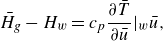 \begin{equation} \bar {H}_g - H_w = c_p \frac {\partial \bar {T}}{\partial \bar {u}}|_w \bar {u}, \end{equation}
where $\bar {H}$
is the total enthalpy and
$\bar {H}$
is the total enthalpy and $\bar {H}_g=c_p\bar {T} + r_g \bar {u}^2/2$
is the general recovery enthalpy. Equation (2.1) is explicitly expressed as
$\bar {H}_g=c_p\bar {T} + r_g \bar {u}^2/2$
is the general recovery enthalpy. Equation (2.1) is explicitly expressed as
 \begin{align} \bar {T} + \frac {r_g}{2c_p}\bar {u}^2 - T_w = \frac {\partial \bar {T}}{\partial \bar {u}}|_w \bar {u}, \quad \text {then} \quad r_g = \frac {2c_p}{\bar {u}^2} \left ( T_w - \bar {T} + \frac {\partial \bar {T}}{\partial \bar {u}}|_w \bar {u}\right ). \end{align}
By definition, $r_g$
varies with the wall-normal height
$r_g$
varies with the wall-normal height $y$
, and can be obtained a posteriori using
$y$
, and can be obtained a posteriori using $\bar {T}$
and
$\bar {T}$
and $\bar {u}$
. Zhang et al. (Reference Zhang, Bi, Hussain and She2014) further introduce an effective turbulent Prandtl number
$\bar {u}$
. Zhang et al. (Reference Zhang, Bi, Hussain and She2014) further introduce an effective turbulent Prandtl number $Pr_e$
, which relates to
$Pr_e$
, which relates to $r_g$
as
$r_g$
as
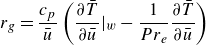 \begin{align} & \displaystyle r_g = \frac {c_p}{\bar {u}} \left ( \frac {\partial \bar {T}}{\partial \bar {u}}|_w - \frac {1}{Pr_e} \frac {\partial \bar {T}}{\partial \bar {u}} \right ) &\quad \end{align}
 \begin{align} \quad \text {or conversely, }& \frac {1}{Pr_e} = 1 + \frac {\bar {u}^2}{2c_p} \frac {\partial r_g}{\partial \bar {u}}/\frac {\partial \bar {T}}{\partial \bar {u}}. & \end{align}
The combination of (2.2) and (2.3) finally leads to an important ODE for the TV relation,
 \begin{equation} \bar {T} - \frac {\bar {u}}{2} \left ( \frac {\partial \bar {T}}{\partial \bar {u}}|_w + \frac {1}{Pr_e} \frac {\partial \bar {T}}{\partial \bar {u}} \right ) = T_w, \end{equation}
which can be solved provided a prescribed distribution of $Pr_e$
, and under the outer boundary condition,
$Pr_e$
, and under the outer boundary condition, $\bar {T}|_{\bar {u}=\bar {u}_e}=\bar {T}_e$
. Zhang et al. (Reference Zhang, Bi, Hussain and She2014) further assume
$\bar {T}|_{\bar {u}=\bar {u}_e}=\bar {T}_e$
. Zhang et al. (Reference Zhang, Bi, Hussain and She2014) further assume $Pr_e\approx 1$
, which is equivalent to assuming
$Pr_e\approx 1$
, which is equivalent to assuming $r_g$
a constant, as seen from (2.3b
). As a result, the integration of (2.4) leads to the quadratic relation (1.1). The remaining unknown
$r_g$
a constant, as seen from (2.3b
). As a result, the integration of (2.4) leads to the quadratic relation (1.1). The remaining unknown $({\partial \bar {T}}/{\partial \bar {u}})_w$
can be computed from (2.3a
) at the boundary-layer edge using
$({\partial \bar {T}}/{\partial \bar {u}})_w$
can be computed from (2.3a
) at the boundary-layer edge using $r_{g,e}$
, and
$r_{g,e}$
, and $r_{g,e}$
is related to the analogy factor
$r_{g,e}$
is related to the analogy factor $s$
as
$s$
as
 \begin{align} r_g = r_{g,e} = r \left [ s Pr + (1-s Pr) {\Theta } \right ], \quad \ \ s \equiv \frac {2C_h}{C_f} = \frac {\bar {q}_w \bar {u}_e}{\bar {\tau }_w c_p (\bar {T}_r - T_w)}, \end{align}
where the non-dimensional wall temperature $\Theta =({T_w-\bar {T}_e})/({\bar {T}_r - \bar {T}_e})$
is also called the diabatic parameter;
$\Theta =({T_w-\bar {T}_e})/({\bar {T}_r - \bar {T}_e})$
is also called the diabatic parameter; $C_f$
and
$C_f$
and $C_h$
are the coefficients of skin friction and heat transfer, and
$C_h$
are the coefficients of skin friction and heat transfer, and $\tau _w$
and
$\tau _w$
and $q_w$
are the wall friction and heat flux. Since
$q_w$
are the wall friction and heat flux. Since $s$
is found to be a robust parameter (Chi & Spalding Reference Chi and Spalding1966; Bons Reference Bons2005; Fu et al. Reference Fu, Karp, Bose, Moin and Urzay2021),
$s$
is found to be a robust parameter (Chi & Spalding Reference Chi and Spalding1966; Bons Reference Bons2005; Fu et al. Reference Fu, Karp, Bose, Moin and Urzay2021), $r_{g,e}$
can be computed a priori, so (1.1) can be fully determined. Notably, the original definition of
$r_{g,e}$
can be computed a priori, so (1.1) can be fully determined. Notably, the original definition of $Pr_e$
by Zhang et al. (Reference Zhang, Bi, Hussain and She2014) is based on turbulent fluctuations, which gives
$Pr_e$
by Zhang et al. (Reference Zhang, Bi, Hussain and She2014) is based on turbulent fluctuations, which gives $Pr_e$
physical interpretations. The resulting (2.4) provides another way to evaluate
$Pr_e$
physical interpretations. The resulting (2.4) provides another way to evaluate $Pr_e$
a posteriori, using only
$Pr_e$
a posteriori, using only $\bar {T}$
and
$\bar {T}$
and $\bar {u}$
without fluctuation statistics. As will be shown below, such an evaluation from the mean flow is critical to interpret the TV relations and improve modelling.
$\bar {u}$
without fluctuation statistics. As will be shown below, such an evaluation from the mean flow is critical to interpret the TV relations and improve modelling.
Interestingly, Wenzel, Gibis & Kloker (Reference Wenzel, Gibis and Kloker2022) (and also Cogo et al. (Reference Cogo, Baù, Chinappi, Bernardini and Picano2023)) showed that a form of Eckert number, ${Ec}=\bar {u}_e^2/[c_p(\bar {T}_r-T_w)]$
for a CPG, is an insightful parameter to account for heat-transfer effects. In fact, we note that
${Ec}=\bar {u}_e^2/[c_p(\bar {T}_r-T_w)]$
for a CPG, is an insightful parameter to account for heat-transfer effects. In fact, we note that $Ec$
can be related to
$Ec$
can be related to $r_{g,e}$
as
$r_{g,e}$
as
 \begin{align} {Ec}^{-1} = \frac {r}{2}(1-\Theta ) = \frac {r-r_{g,e}}{2(1-s Pr)} \quad \text {or}\quad r_{g,e} = r - 2 (1-s Pr) {Ec}^{-1}. \end{align}
Since the parameters $r$
,
$r$
, $Pr$
and
$Pr$
and $s$
are nearly independent of the Mach number
$s$
are nearly independent of the Mach number $Ma$
and
$Ma$
and $T_w/\bar {T}_r$
,
$T_w/\bar {T}_r$
, ${Ec}^{-1}$
and
${Ec}^{-1}$
and $r_{g,e}$
are essentially equivalent in accommodating heat-transfer effects;
$r_{g,e}$
are essentially equivalent in accommodating heat-transfer effects; ${Ec}^{-1}$
measures the departure of
${Ec}^{-1}$
measures the departure of $r_{g,e}$
from
$r_{g,e}$
from $r$
.
$r$
.
The above GRA relations are also generally applicable to turbulent channel and pipe flows, if all the edge quantities are replaced by the channel/pipe centreline quantities ( $\bar {u}_c$
,
$\bar {u}_c$
, $\bar {T}_c$
,
$\bar {T}_c$
, $r_{g,c}$
, etc.; Modesti & Pirozzoli (Reference Modesti and Pirozzoli2019); Song et al. (Reference Song, Zhang, Liu and Xia2022)). Note that (1.1) has been expressed using both the Reynolds-averaged and Favre-averaged variables among literatures. The differences between these two forms are usually minor (e.g. Zhang, Duan & Choudhari (Reference Zhang, Duan and Choudhari2018)), so the Reynolds average is used here throughout, denoted by overbars. In addition to turbulent flows, Mo & Gao (Reference Mo and Gao2024) reformulate the GRA relations for laminar boundary layers. They define
$r_{g,c}$
, etc.; Modesti & Pirozzoli (Reference Modesti and Pirozzoli2019); Song et al. (Reference Song, Zhang, Liu and Xia2022)). Note that (1.1) has been expressed using both the Reynolds-averaged and Favre-averaged variables among literatures. The differences between these two forms are usually minor (e.g. Zhang, Duan & Choudhari (Reference Zhang, Duan and Choudhari2018)), so the Reynolds average is used here throughout, denoted by overbars. In addition to turbulent flows, Mo & Gao (Reference Mo and Gao2024) reformulate the GRA relations for laminar boundary layers. They define $r_g$
the same as in (2.2), and assume
$r_g$
the same as in (2.2), and assume $r_g$
a constant, which is mathematically equivalent to
$r_g$
a constant, which is mathematically equivalent to $Pr_e=1$
and leads to exactly the same ODE (2.4) (after enforcing
$Pr_e=1$
and leads to exactly the same ODE (2.4) (after enforcing $Pr_e=1$
) for laminar flows. The constant
$Pr_e=1$
) for laminar flows. The constant $r_g$
can be obtained from (2.5) and the same quadratic relation (1.1b
) is arrived. Therefore, the relations (2.2) to (2.5) turn out to be universal for both turbulent and laminar flows, in both boundary layer and channel (and pipe) configurations.
$r_g$
can be obtained from (2.5) and the same quadratic relation (1.1b
) is arrived. Therefore, the relations (2.2) to (2.5) turn out to be universal for both turbulent and laminar flows, in both boundary layer and channel (and pipe) configurations.
In short, two components are required to solve (2.4) for the TV relation: the first is the wall-normal distribution of $Pr_e$
, which determines the shape of
$Pr_e$
, which determines the shape of $\bar {T}$
; the second is
$\bar {T}$
; the second is $r_{g,e}$
, or equivalently
$r_{g,e}$
, or equivalently $s$
, which determines the wall boundary condition
$s$
, which determines the wall boundary condition $({\partial \bar {T}}/{\partial \bar {u}})_w$
. Previous models assume constancy of
$({\partial \bar {T}}/{\partial \bar {u}})_w$
. Previous models assume constancy of $r_g$
(and
$r_g$
(and $Pr_e$
) for both turbulent and laminar flows, leading to the quadratic TV relation and temperature wall models. In the following, we carefully examine these assumptions for laminar and turbulent flows, respectively. Both channel flow and flat-plate boundary layers are considered. Although laminar flows are much easier to be resolved than turbulence, we still present the laminar TV results for three reasons. First, as mentioned in § 1, the laminar TV relation can be used to efficiently improve the prediction of
$Pr_e$
) for both turbulent and laminar flows, leading to the quadratic TV relation and temperature wall models. In the following, we carefully examine these assumptions for laminar and turbulent flows, respectively. Both channel flow and flat-plate boundary layers are considered. Although laminar flows are much easier to be resolved than turbulence, we still present the laminar TV results for three reasons. First, as mentioned in § 1, the laminar TV relation can be used to efficiently improve the prediction of $C_f$
and
$C_f$
and $C_h$
by largely relaxing the near-wall grid density; this strategy for flat plates can be directly applied to curved-wall cases which inhibits simple self-similar solutions (Mo & Gao Reference Mo and Gao2024). Therefore, a comprehensive evaluation on the accuracy of the laminar TV relation is required. Second, Mo & Gao (Reference Mo and Gao2024) only studied three severely cold-wall boundary layer cases (
$C_h$
by largely relaxing the near-wall grid density; this strategy for flat plates can be directly applied to curved-wall cases which inhibits simple self-similar solutions (Mo & Gao Reference Mo and Gao2024). Therefore, a comprehensive evaluation on the accuracy of the laminar TV relation is required. Second, Mo & Gao (Reference Mo and Gao2024) only studied three severely cold-wall boundary layer cases ( $T_w/\bar {T}_r\lt 0.2$
), where
$T_w/\bar {T}_r\lt 0.2$
), where $r_g$
has a mild wall-normal variation. Here, we explore a wide parameter space (
$r_g$
has a mild wall-normal variation. Here, we explore a wide parameter space ( $Ma$
from 2 to 10 and
$Ma$
from 2 to 10 and $T_w/\bar {T}_r$
from 0.1 to 1.6 for boundary layers), and will show that
$T_w/\bar {T}_r$
from 0.1 to 1.6 for boundary layers), and will show that $r_g$
severely differs at different
$r_g$
severely differs at different $T_w/\bar {T}_r$
but a universal distribution of
$T_w/\bar {T}_r$
but a universal distribution of $Pr_e$
can be identified. Third, a number of similarities of the TV relation between laminar and turbulent flows will be reported, suggesting some fundamental resemblance between the two flows, as already partly exhibited from their common GRA relations above.
$Pr_e$
can be identified. Third, a number of similarities of the TV relation between laminar and turbulent flows will be reported, suggesting some fundamental resemblance between the two flows, as already partly exhibited from their common GRA relations above.
Only CPG air flows are considered. The laminar flow is solved from the Navier–Stokes (NS) equations (detailed later), where the viscosity $\mu$
is from Sutherland’s law (reference temperature set to 270 K) and a constant
$\mu$
is from Sutherland’s law (reference temperature set to 270 K) and a constant $Pr=0.71$
is adopted throughout. For turbulent cases, elaborated DNS datasets of wide parameter ranges are employed. The factor
$Pr=0.71$
is adopted throughout. For turbulent cases, elaborated DNS datasets of wide parameter ranges are employed. The factor $r$
for all cases is set to
$r$
for all cases is set to $Pr^{1/3}$
.
$Pr^{1/3}$
.
2.2. Laminar channel flows
The compressible NS equations for laminar channel flow degenerate into ODEs,
 \begin{equation} \left (\bar {\mu } \bar {u}_y\right )_y = \bar {p}_x = -\frac {\bar {\tau }_w}{h}, \qquad \bar {\mu } \bar {u}_y^2 + \frac {c_p}{Pr} \left (\bar {\mu } \bar {T}_y\right )_y = 0, \end{equation}
where the subscript $y$
denotes wall-normal derivatives,
$y$
denotes wall-normal derivatives, $\bar {p}_x$
is the streamwise pressure gradient and
$\bar {p}_x$
is the streamwise pressure gradient and $h$
is the channel half-height (
$h$
is the channel half-height ( $y\in [0,2h]$
). The overbars are retained for consistency in notation. After non-dimensionalisation, the only parameter controlling the shape of the flow is the bulk Mach number
$y\in [0,2h]$
). The overbars are retained for consistency in notation. After non-dimensionalisation, the only parameter controlling the shape of the flow is the bulk Mach number $Ma_b$
, measuring the ratio of bulk velocity
$Ma_b$
, measuring the ratio of bulk velocity $\bar {u}_b$
and the wall speed of sound. The Chebyshev collocation point method is adopted to solve (2.7) using
$\bar {u}_b$
and the wall speed of sound. The Chebyshev collocation point method is adopted to solve (2.7) using $N_y=201$
grid points, which achieves grid independence.
$N_y=201$
grid points, which achieves grid independence.
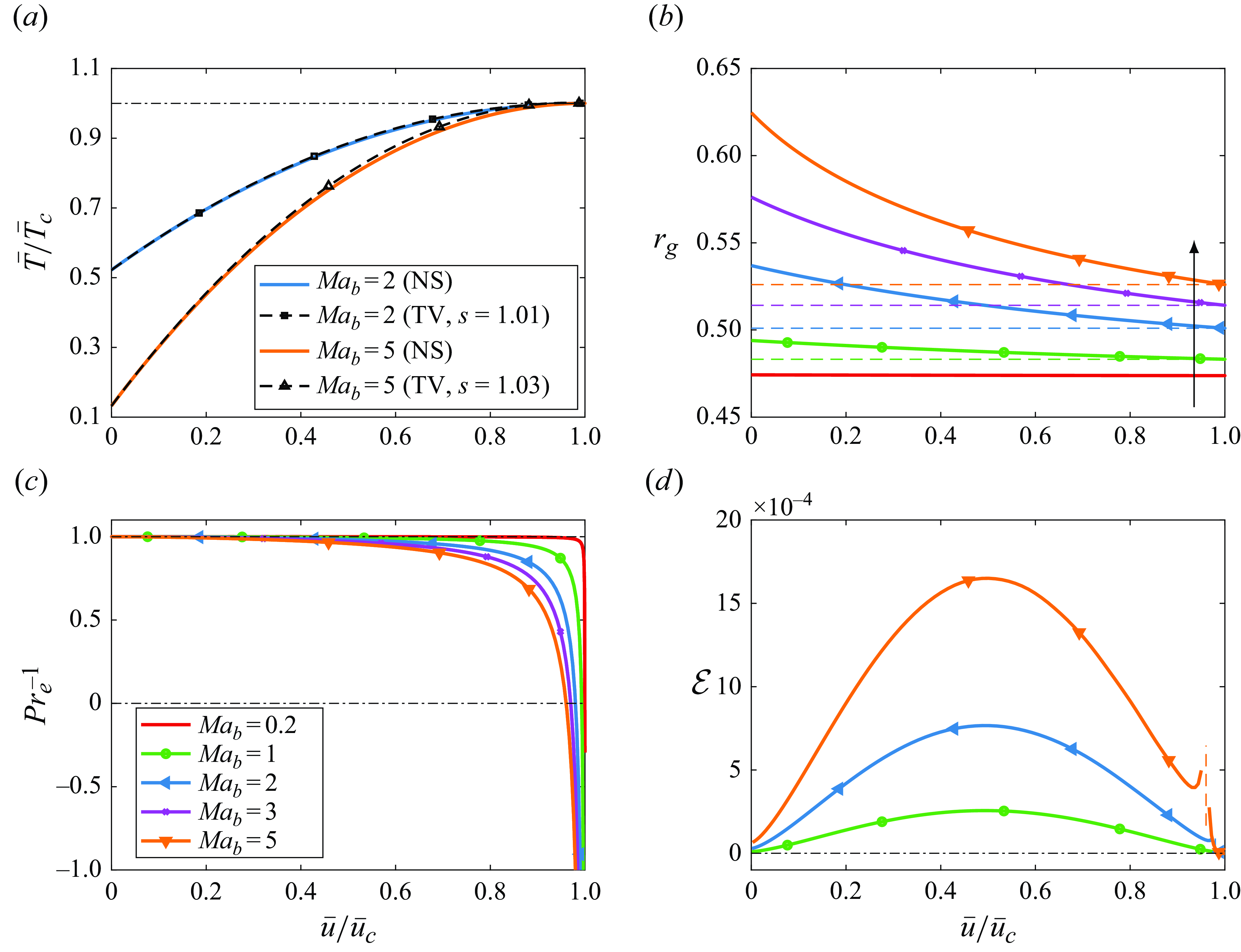
The temperature profiles at different $Ma_b$
are shown in figure 1(a) as a function of the streamwise velocity. The TV relation (1.1) is also displayed with
$Ma_b$
are shown in figure 1(a) as a function of the streamwise velocity. The TV relation (1.1) is also displayed with $s$
computed from (2.5b
), as labelled in the legend. It is shown that even with
$s$
computed from (2.5b
), as labelled in the legend. It is shown that even with $Ma_b$
up to 5, (1.1) agrees with the
$Ma_b$
up to 5, (1.1) agrees with the $\bar {T}$
from NS equations very well, which is not widely expected before for laminar channel flows. After attaining the mean flow,
$\bar {T}$
from NS equations very well, which is not widely expected before for laminar channel flows. After attaining the mean flow, $r_g$
is determined by (2.2), as displayed in figure 1(b). An immediate observation is that
$r_g$
is determined by (2.2), as displayed in figure 1(b). An immediate observation is that $r_g$
increasingly varies with
$r_g$
increasingly varies with $\bar {u}$
as
$\bar {u}$
as $Ma_b$
rises; it changes by over 15 % in the wall-normal direction at
$Ma_b$
rises; it changes by over 15 % in the wall-normal direction at $Ma_b=5$
. Also,
$Ma_b=5$
. Also, $r_g$
decreases more rapidly near the wall than in the outer region. Therefore, it seems difficult to trust the results of constancy
$r_g$
decreases more rapidly near the wall than in the outer region. Therefore, it seems difficult to trust the results of constancy $r_g$
in § 2.1, so a natural question is why does the TV relation still work?
$r_g$
in § 2.1, so a natural question is why does the TV relation still work?
Laminar channel results: (a) temperature from NS equations and (1.1), (b) general recovery factor, (c) effective Prandtl number and (d) the sensitivity factor for flows at different $Ma_b$
. The legends for panels (b)–(d) are the same.
$Ma_b$
. The legends for panels (b)–(d) are the same.
As noted in § 2.1, $Pr_e$
is more significant than
$Pr_e$
is more significant than $r_g$
in determining the shape of
$r_g$
in determining the shape of $\bar {T}$
, so we define the counterpart of
$\bar {T}$
, so we define the counterpart of $Pr_e$
in laminar flows from (2.3) and (2.4), whose physical meaning will be discussed in § 4.1. For convenience of writing, we still use the notation
$Pr_e$
in laminar flows from (2.3) and (2.4), whose physical meaning will be discussed in § 4.1. For convenience of writing, we still use the notation $Pr_e$
, so (2.2) to (2.5) take the same form for both turbulent and laminar flows. From (2.4),
$Pr_e$
, so (2.2) to (2.5) take the same form for both turbulent and laminar flows. From (2.4), $Pr_e$
can be expressed as
$Pr_e$
can be expressed as
 \begin{equation} Pr_e^{-1} = \frac {2(\bar {T} - T_w)/\bar {u} - ({\partial \bar {T}}/{\partial \bar {u}})_w}{{\partial \bar {T}}/{\partial \bar {u}}}. \end{equation}
The distributions of $Pr_e^{-1}$
are plotted in figure 1(c) at
$Pr_e^{-1}$
are plotted in figure 1(c) at $0\lt Ma_b\leqslant 5$
. Compared with
$0\lt Ma_b\leqslant 5$
. Compared with $r_g$
,
$r_g$
, $Pr_e^{-1}$
is indeed less sensitive to
$Pr_e^{-1}$
is indeed less sensitive to $Ma_b$
and is approximately unity at
$Ma_b$
and is approximately unity at $\bar {u}/\bar {u}_c\lesssim 0.6$
. In fact, its theoretical wall limit is just
$\bar {u}/\bar {u}_c\lesssim 0.6$
. In fact, its theoretical wall limit is just $Pr_{e,w}=1$
, obtained from (2.8). Further away from the wall,
$Pr_{e,w}=1$
, obtained from (2.8). Further away from the wall, $Pr_e^{-1}$
rapidly diminishes and can be negative. To better quantify the effects of
$Pr_e^{-1}$
rapidly diminishes and can be negative. To better quantify the effects of $Pr_e^{-1}$
variations, a sensitivity study on (2.4) is designed. Specifically, we compute the global variation of
$Pr_e^{-1}$
variations, a sensitivity study on (2.4) is designed. Specifically, we compute the global variation of $\bar {T}$
when the
$\bar {T}$
when the $Pr_e^{-1}$
at a specific
$Pr_e^{-1}$
at a specific $y_0$
is perturbed, i.e.
$y_0$
is perturbed, i.e.
 \begin{equation} \mathcal {E}(y_0) = \dfrac {1}{\int _{0}^{\bar {u}_c} {\bar {T}\,\mathrm {d} \bar {u}}} \int _{0}^{\bar {u}_c} {\left | \frac {\partial \bar {T}(Pr_e^{-1};\bar {u})}{\partial Pr_e^{-1}(y_0)}\right | \mathrm {d} \bar {u}}, \end{equation}
where $\bar {T}(Pr_e^{-1};\bar {u})$
represents the solution of (2.4) on the
$\bar {T}(Pr_e^{-1};\bar {u})$
represents the solution of (2.4) on the $\bar {u}$
grid, under the outer boundary condition
$\bar {u}$
grid, under the outer boundary condition $\bar {T}|_{\bar {u}=\bar {u}_c}=\bar {T}_c$
. The partial differentiation is computed after the numerical discretisation. The
$\bar {T}|_{\bar {u}=\bar {u}_c}=\bar {T}_c$
. The partial differentiation is computed after the numerical discretisation. The $\mathcal {E}$
in different cases are plotted in figure 1(d), where the spikes of
$\mathcal {E}$
in different cases are plotted in figure 1(d), where the spikes of $\mathcal {E}$
near the centreline are due to the singularity of
$\mathcal {E}$
near the centreline are due to the singularity of $Pr_e$
there (
$Pr_e$
there ( $Pr_e^{-1}=0$
). A general trend is that
$Pr_e^{-1}=0$
). A general trend is that $\mathcal {E}$
peaks in the middle regime (
$\mathcal {E}$
peaks in the middle regime ( $\bar {u}\approx 0.5\bar {u}_c$
), and diminishes towards the wall and the centreline; meanwhile,
$\bar {u}\approx 0.5\bar {u}_c$
), and diminishes towards the wall and the centreline; meanwhile, $\mathcal {E}$
is amplified with the rise of
$\mathcal {E}$
is amplified with the rise of $Ma_b$
. These features are consistent with the trend in figure 1(a) that the TV relation slightly degrades in the middle region and with
$Ma_b$
. These features are consistent with the trend in figure 1(a) that the TV relation slightly degrades in the middle region and with $Ma_b$
increased.
$Ma_b$
increased.
Therefore, the success of the TV relation in figure 1(a) can be explained. On the one hand, the temperature is sensitive to the middle-regime $Pr_e^{-1}$
, but
$Pr_e^{-1}$
, but $Pr_e^{-1}$
is close to unity there. On the other hand,
$Pr_e^{-1}$
is close to unity there. On the other hand, $Pr_e^{-1}$
deviates from unity further away towards the centreline, but
$Pr_e^{-1}$
deviates from unity further away towards the centreline, but $\bar {T}$
is already less sensitive to
$\bar {T}$
is already less sensitive to $Pr_e^{-1}$
. More physical explanations on the above trends will be presented in § 2.3, through comparisons with the boundary layer cases. For modelling usage, we note that
$Pr_e^{-1}$
. More physical explanations on the above trends will be presented in § 2.3, through comparisons with the boundary layer cases. For modelling usage, we note that $s$
varies mildly with
$s$
varies mildly with $Ma_b$
. As listed in table 1,
$Ma_b$
. As listed in table 1, $s$
changes from 0.98 to 1.04 when
$s$
changes from 0.98 to 1.04 when $Ma_b$
is ranged from 0.01 to 6. Thereby, the TV relation (1.1) with
$Ma_b$
is ranged from 0.01 to 6. Thereby, the TV relation (1.1) with $s\approx 1$
is a highly accurate model for laminar channel flows.
$s\approx 1$
is a highly accurate model for laminar channel flows.
Reynolds analogy factor (2.5b ) at different bulk Mach numbers for laminar channel flows.

2.3. Laminar boundary layers
The results for laminar boundary layers are rather different from § 2.2. The mean flow on a flat plate can be efficiently obtained by solving the self-similar equations (White Reference White1974),
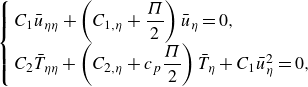 \begin{equation} \left \{\begin{array}{l} C_1 \bar {u}_{\eta \eta } + \left ( C_{1,\eta } + \dfrac {\Pi }{2} \right ) \bar {u}_\eta = 0, \\ C_2 \bar {T}_{\eta \eta } + \left ( C_{2,\eta } + c_p \dfrac {\Pi }{2} \right ) \bar {T}_\eta + C_1 \bar {u}_\eta ^2 = 0, \end{array}\right . \end{equation}
where $\eta$
is the transformed wall-normal coordinate, and
$\eta$
is the transformed wall-normal coordinate, and $C_1=\bar {\rho }\bar {\mu }/\bar {\rho }_e\bar {\mu }_e$
,
$C_1=\bar {\rho }\bar {\mu }/\bar {\rho }_e\bar {\mu }_e$
, $C_2=c_pC_1/Pr$
and
$C_2=c_pC_1/Pr$
and $\Pi =\int \bar {u}/\bar {u}_e\,\mathrm {d} \eta$
. Equation (2.10) is independent of streamwise locations, and we consider cases at different free steam Mach numbers
$\Pi =\int \bar {u}/\bar {u}_e\,\mathrm {d} \eta$
. Equation (2.10) is independent of streamwise locations, and we consider cases at different free steam Mach numbers $Ma_\infty$
(2–10) and
$Ma_\infty$
(2–10) and $T_w/\bar {T}_r$
(0.1–1.6). The Chebyshev collocation point method with
$T_w/\bar {T}_r$
(0.1–1.6). The Chebyshev collocation point method with $N_y=201$
is also adopted, which leads to grid-independent mean flow and GRA parameters.
$N_y=201$
is also adopted, which leads to grid-independent mean flow and GRA parameters.
Laminar boundary layer results: general recovery factor for (a) adiabatic and (b) $Ma_\infty =6$
isothermal cases, and (c) effective Prandtl number and (d) the sensitivity factor for 20 cases with different
$Ma_\infty =6$
isothermal cases, and (c) effective Prandtl number and (d) the sensitivity factor for 20 cases with different $Ma_\infty$
and
$Ma_\infty$
and $T_w/\bar {T}_r$
, as labelled. The jumps in panel (c) are plotted as dotted lines for conciseness, and the red dashed line denotes (2.13).
$T_w/\bar {T}_r$
, as labelled. The jumps in panel (c) are plotted as dotted lines for conciseness, and the red dashed line denotes (2.13).
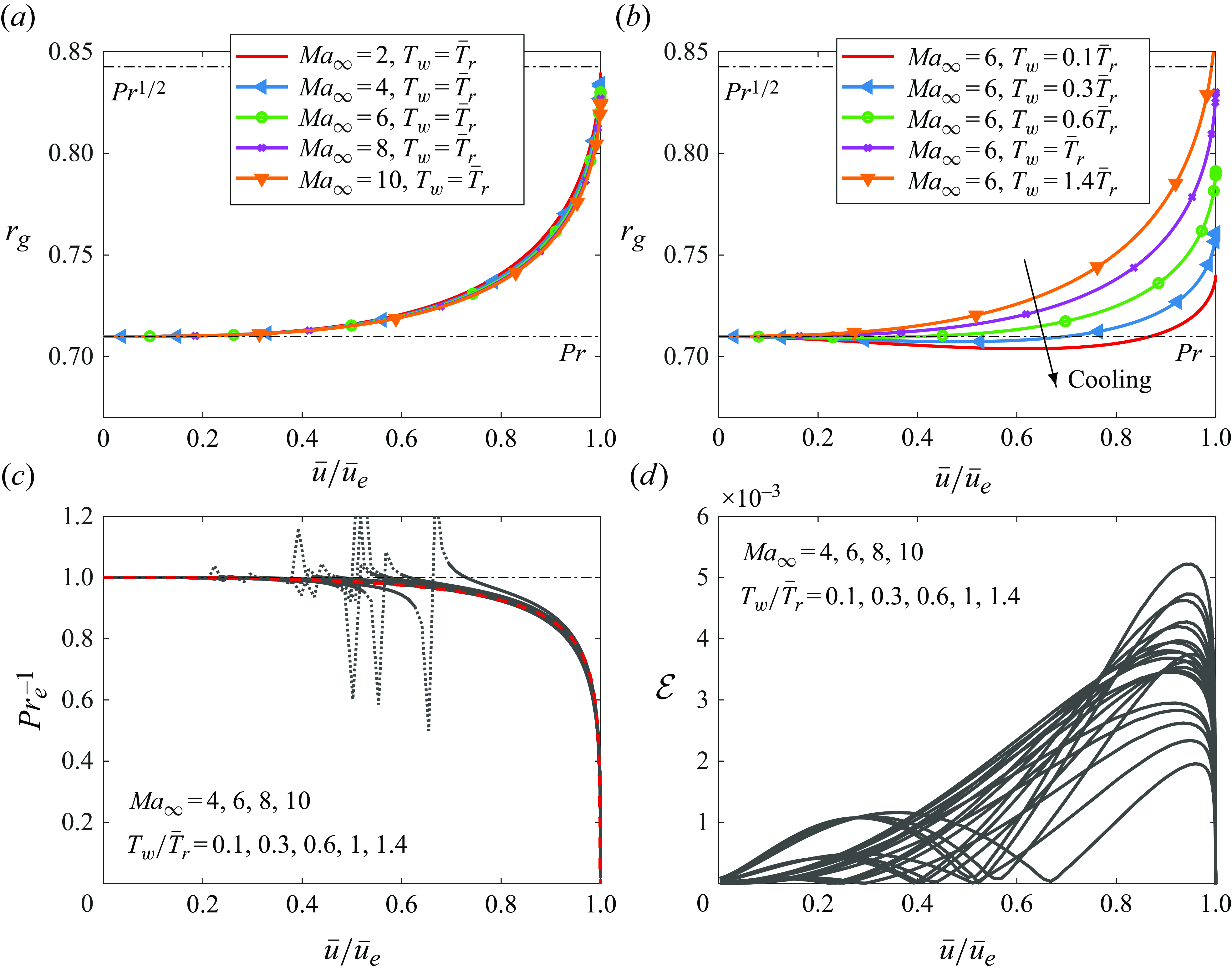
The adiabatic wall cases ( $T_w=\bar {T}_r$
) are investigated first and the
$T_w=\bar {T}_r$
) are investigated first and the $r_g$
at different
$r_g$
at different $Ma_\infty$
is shown in figure 2(a). It is found that
$Ma_\infty$
is shown in figure 2(a). It is found that $r_g$
is not sensitive to
$r_g$
is not sensitive to $Ma_\infty$
and exhibits a universal wall-normal distribution for adiabatic walls. Its theoretical wall limit, obtained from (2.10), is
$Ma_\infty$
and exhibits a universal wall-normal distribution for adiabatic walls. Its theoretical wall limit, obtained from (2.10), is $r_{g,w}=Pr=0.71$
, which represents a balance between viscous terms and molecular heat flux (see Appendix A). Nevertheless,
$r_{g,w}=Pr=0.71$
, which represents a balance between viscous terms and molecular heat flux (see Appendix A). Nevertheless, $r_g$
is not a wall-normal constant, but keeps rising away from the wall due to stronger convection terms. The effects of wall cooling on
$r_g$
is not a wall-normal constant, but keeps rising away from the wall due to stronger convection terms. The effects of wall cooling on $r_g$
are displayed in figure 2(b) at
$r_g$
are displayed in figure 2(b) at $Ma_\infty =6$
. A clear trend is that as
$Ma_\infty =6$
. A clear trend is that as $T_w/\bar {T}_r$
drops,
$T_w/\bar {T}_r$
drops, $r_g$
exhibits weaker wall-normal variations, so the assumption of
$r_g$
exhibits weaker wall-normal variations, so the assumption of $r_g$
constancy roughly holds only for severely cooled walls, which was shown by Mo & Gao (Reference Mo and Gao2024). Nevertheless, the above trend does not mean that the TV relation becomes more accurate for cooler walls, as will be shown later.
$r_g$
constancy roughly holds only for severely cooled walls, which was shown by Mo & Gao (Reference Mo and Gao2024). Nevertheless, the above trend does not mean that the TV relation becomes more accurate for cooler walls, as will be shown later.
As learned from § 2.2, $Pr_e$
is more significant than
$Pr_e$
is more significant than $r_g$
in interpreting the shape of
$r_g$
in interpreting the shape of $\bar {T}$
, so the
$\bar {T}$
, so the $Pr_e^{-1}$
at different
$Pr_e^{-1}$
at different $Ma_\infty$
and
$Ma_\infty$
and $T_w/\bar {T}_r$
are plotted collectively in figure 2(c). A surprising observation is that the 20 curves (and also other
$T_w/\bar {T}_r$
are plotted collectively in figure 2(c). A surprising observation is that the 20 curves (and also other $Ma_\infty$
and
$Ma_\infty$
and $T_w/\bar {T}_r$
cases not displayed) almost collapse with each other, except for abrupt jumps near the temperature peaks in cold-wall cases. In other words,
$T_w/\bar {T}_r$
cases not displayed) almost collapse with each other, except for abrupt jumps near the temperature peaks in cold-wall cases. In other words, $Pr_e^{-1}$
is nearly independent of
$Pr_e^{-1}$
is nearly independent of $Ma_\infty$
and
$Ma_\infty$
and $T_w$
, beneficial for a robust modelling. The sensitivity examination of
$T_w$
, beneficial for a robust modelling. The sensitivity examination of $\bar {T}$
on
$\bar {T}$
on $Pr_e^{-1}$
is also performed as in (2.9). As shown in figure 2(d), the outer region
$Pr_e^{-1}$
is also performed as in (2.9). As shown in figure 2(d), the outer region $\bar {T}$
is mostly affected by the deviation of
$\bar {T}$
is mostly affected by the deviation of $Pr_e^{-1}$
, where
$Pr_e^{-1}$
, where $Pr_e^{-1}$
systematically departs from unity. Consequently, different from the channel flows, the TV relation (1.1) for laminar boundary layers has systematic deviations in the outer region, irrespective of
$Pr_e^{-1}$
systematically departs from unity. Consequently, different from the channel flows, the TV relation (1.1) for laminar boundary layers has systematic deviations in the outer region, irrespective of $Ma_\infty$
and
$Ma_\infty$
and $T_w$
. This deviation is reflected by Mo & Gao (Reference Mo and Gao2024) (their figure 1b), and will be improved later.
$T_w$
. This deviation is reflected by Mo & Gao (Reference Mo and Gao2024) (their figure 1b), and will be improved later.
Considering the collapse of $Pr_e^{-1}$
among cases in terms of
$Pr_e^{-1}$
among cases in terms of $\bar {u}/\bar {u}_e$
, we seek for analytical relations from (2.10) for further interpretation. After eliminating the viscous parameters, an equation with separated variables is obtained (see Appendix A for derivations):
$\bar {u}/\bar {u}_e$
, we seek for analytical relations from (2.10) for further interpretation. After eliminating the viscous parameters, an equation with separated variables is obtained (see Appendix A for derivations):
 \begin{equation} (1-Pr) \frac {\Psi _{\bar {u}}}{\Psi _e-\Psi } = \frac {\bar {T}_{\bar {u}\bar {u}} - \bar {T}_{\bar {u}\bar {u},w}}{\bar {T}_{\bar {u}}} = \frac {\bar {Q}_{\bar {u}\bar {u}}}{\bar {T}_{\bar {u}}}, \qquad \Psi = \int _0^{\bar {u}} \Pi \,\mathrm {d} \bar {u}, \end{equation}
where the left-hand side relates to the velocity, and the right-hand sides correspond to the TV relation; the subscript $\bar {u}$
denotes partial derivatives. If
$\bar {u}$
denotes partial derivatives. If $\bar {T}$
is a perfect quadratic function of
$\bar {T}$
is a perfect quadratic function of $\bar {u}$
, which is denoted as
$\bar {u}$
, which is denoted as $\bar {T}_{qd}(\bar {u})$
, then the second-order derivative
$\bar {T}_{qd}(\bar {u})$
, then the second-order derivative $\bar {T}_{\bar {u}\bar {u}}$
is a constant and the right-hand sides should remain zero (
$\bar {T}_{\bar {u}\bar {u}}$
is a constant and the right-hand sides should remain zero ( $\bar {T}_{\bar {u}\bar {u}}=\bar {T}_{\bar {u}\bar {u},w}$
). This is definitely invalid since the left-hand side monotonically increases from zero as
$\bar {T}_{\bar {u}\bar {u}}=\bar {T}_{\bar {u}\bar {u},w}$
). This is definitely invalid since the left-hand side monotonically increases from zero as $\bar {u}$
rises. In other words, a quadratic
$\bar {u}$
rises. In other words, a quadratic $\bar {T}(\bar {u})$
is not supported by the governing equation. Consequently, the non-zero right-hand side continuously contributes to the deviation of
$\bar {T}(\bar {u})$
is not supported by the governing equation. Consequently, the non-zero right-hand side continuously contributes to the deviation of $\bar {T}$
from a quadratic function, though the accumulating error may be finally restricted by the enforced outer boundary condition
$\bar {T}$
from a quadratic function, though the accumulating error may be finally restricted by the enforced outer boundary condition $\bar {T}_e$
. For clarity, we further define a residual temperature
$\bar {T}_e$
. For clarity, we further define a residual temperature $\bar {Q}=\bar {T}-\bar {T}_{qd}$
, then
$\bar {Q}=\bar {T}-\bar {T}_{qd}$
, then $\bar {Q}=0$
means a perfect quadratic
$\bar {Q}=0$
means a perfect quadratic $\bar {T}(\bar {u})$
(see Appendix A for details). From (2.11), the second-order derivative of
$\bar {T}(\bar {u})$
(see Appendix A for details). From (2.11), the second-order derivative of $\bar {Q}$
relates to
$\bar {Q}$
relates to $\Psi$
, so
$\Psi$
, so $\bar {Q}_{\bar {u}\bar {u}}$
is non-zero except at the wall. However, substituting
$\bar {Q}_{\bar {u}\bar {u}}$
is non-zero except at the wall. However, substituting $\bar {Q}$
into (2.3) and (2.4) results in expressions of
$\bar {Q}$
into (2.3) and (2.4) results in expressions of $Pr_e$
and
$Pr_e$
and $r_g$
as
$r_g$
as
 \begin{equation} Pr_e^{-1} = 1 - \left (\frac {\bar {Q}}{\bar {u}^2}\right )_{\bar {u}}\frac {\bar {u}^2}{\bar {T}_{\bar {u}}}, \qquad r_g = Pr - 2c_p\frac {\bar {Q}}{\bar {u}^2}. \end{equation}
Therefore, the introduction of $\bar {Q}$
connects the deviation of
$\bar {Q}$
connects the deviation of $\bar {T}$
from
$\bar {T}$
from $\bar {T}_{qd}$
with the departure of
$\bar {T}_{qd}$
with the departure of ${Pr}_e$
from unity and of
${Pr}_e$
from unity and of $r_g$
from
$r_g$
from $Pr$
.
$Pr$
.
Model improvement is required for laminar boundary layers considering the systematic deviation of ${Pr}_e$
and thus (1.1). The robust distribution of
${Pr}_e$
and thus (1.1). The robust distribution of ${Pr}_e^{-1}$
in figure 2(c) can be modelled. For convenience of model usage, we provide a curve fitting
${Pr}_e^{-1}$
in figure 2(c) can be modelled. For convenience of model usage, we provide a curve fitting
 \begin{equation} Pr_e^{-1} = 2 - [1-(\bar {u}/\bar {u}_e)^3]^{-0.1}, \end{equation}
then (2.4) can be numerically solved. Another source of error besides $Pr_e^{-1}$
is the estimation of
$Pr_e^{-1}$
is the estimation of $s$
, required for the wall boundary condition. Unlike in § 2.2,
$s$
, required for the wall boundary condition. Unlike in § 2.2, $s$
exhibits a moderate dependence on
$s$
exhibits a moderate dependence on $Ma_\infty$
and
$Ma_\infty$
and $T_w/\bar {T}_r$
, as depicted in figure 3(a). Note that the
$T_w/\bar {T}_r$
, as depicted in figure 3(a). Note that the $s$
around
$s$
around $T_w\approx \bar {T}_r$
is not displayed because both the numerator and denominator tend to zero (see (2.5
b)); the
$T_w\approx \bar {T}_r$
is not displayed because both the numerator and denominator tend to zero (see (2.5
b)); the $s$
there is also of little significance because
$s$
there is also of little significance because $r_{g,e}\approx r$
when
$r_{g,e}\approx r$
when $T_w\approx \bar {T}_r$
. The cold-wall boundary is more frequently encountered than the heated one in realistic high-speed applications (e.g. Bradshaw (Reference Bradshaw1977); Chen et al. (Reference Chen, Xi, Ren and Fu2022b)). In the former case,
$T_w\approx \bar {T}_r$
. The cold-wall boundary is more frequently encountered than the heated one in realistic high-speed applications (e.g. Bradshaw (Reference Bradshaw1977); Chen et al. (Reference Chen, Xi, Ren and Fu2022b)). In the former case, $s$
is generally 1.0–1.2, close to the turbulent counterparts. The temperature predictions using
$s$
is generally 1.0–1.2, close to the turbulent counterparts. The temperature predictions using $Pr_e=1$
(i.e. (1.1)) and the fitted
$Pr_e=1$
(i.e. (1.1)) and the fitted $Pr_e$
(2.13) are compared in figure 3(b), where
$Pr_e$
(2.13) are compared in figure 3(b), where $s=1.14$
are used for both. As pointed out above, (1.1) systematically underestimates the temperature in the outer region (
$s=1.14$
are used for both. As pointed out above, (1.1) systematically underestimates the temperature in the outer region ( $\bar {u}\gtrsim 0.3\bar {u}_e$
) at different
$\bar {u}\gtrsim 0.3\bar {u}_e$
) at different $Ma_\infty$
and
$Ma_\infty$
and $T_w/\bar {T}_r$
. In comparison, solving (2.4) with (2.13) exhibits a notable improvement as expected, which attains a close agreement with the NS results.
$T_w/\bar {T}_r$
. In comparison, solving (2.4) with (2.13) exhibits a notable improvement as expected, which attains a close agreement with the NS results.
Laminar boundary layer results: (a) contours of the Reynolds analogy factor at different $Ma_\infty$
and
$Ma_\infty$
and $T_w/\bar {T}_r$
; (b) temperature from NS equations, (1.1) and (2.13) for three cases, and (c) the prediction error of
$T_w/\bar {T}_r$
; (b) temperature from NS equations, (1.1) and (2.13) for three cases, and (c) the prediction error of $\bar {T}$
at different
$\bar {T}$
at different $Ma_\infty$
and
$Ma_\infty$
and $T_w/\bar {T}_r$
. The notation M4Tw02 in panel (b) denotes
$T_w/\bar {T}_r$
. The notation M4Tw02 in panel (b) denotes $Ma_\infty =4$
,
$Ma_\infty =4$
, $T_w=0.2\bar {T}_r$
and the same for the others.
$T_w=0.2\bar {T}_r$
and the same for the others.

To quantify the prediction accuracy of the TV relation, the relative error to the NS results,
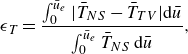 \begin{equation} \epsilon _T = \dfrac {\int _{0}^{\bar {u}_e}|\bar {T}_{NS}-\bar {T}_{TV}|\mathrm {d}\bar {u}} {\int _{0}^{\bar {u}_e}\bar {T}_{NS}\,\mathrm {d}\bar {u}}, \end{equation}
is computed. The errors from the two models are compared in figure 3(c) as a function of $T_w/\bar {T}_r$
for
$T_w/\bar {T}_r$
for $Ma_\infty =3,6,10$
. Although
$Ma_\infty =3,6,10$
. Although $r_g$
tends to be wall-normally invariant at low
$r_g$
tends to be wall-normally invariant at low $T_w/\bar {T}_r$
, the error of (1.1) for colder-wall cases is not lower but higher. At
$T_w/\bar {T}_r$
, the error of (1.1) for colder-wall cases is not lower but higher. At $Ma_\infty \gt 5$
,
$Ma_\infty \gt 5$
, $\epsilon _T$
is higher than 3 % for nearly all
$\epsilon _T$
is higher than 3 % for nearly all $T_w/\bar {T}_r$
conditions and its maximum reaches 7 %. In comparison, a notable reduction in
$T_w/\bar {T}_r$
conditions and its maximum reaches 7 %. In comparison, a notable reduction in $\epsilon _T$
is realised by using (2.13) for all the
$\epsilon _T$
is realised by using (2.13) for all the $Ma_\infty$
and
$Ma_\infty$
and $T_w/\bar {T}_r$
shown. The improvement is most evident for cold-wall cases where
$T_w/\bar {T}_r$
shown. The improvement is most evident for cold-wall cases where $\epsilon _T$
are all less than 2 %, which has practical significance for high-speed realistic applications.
$\epsilon _T$
are all less than 2 %, which has practical significance for high-speed realistic applications.
Finally, it is important to explain the different behaviours of $r_g$
and
$r_g$
and $Pr_e$
between channel and boundary layer cases. The channel flow is driven by the streamwise pressure gradient, which is a wall-normal constant, whereas for flat-plate boundary layers, the convection term acts as the driving force. In the latter case, the convection term is minor near the wall, so the rough balance between the viscous terms and molecular heat flux leads to
$Pr_e$
between channel and boundary layer cases. The channel flow is driven by the streamwise pressure gradient, which is a wall-normal constant, whereas for flat-plate boundary layers, the convection term acts as the driving force. In the latter case, the convection term is minor near the wall, so the rough balance between the viscous terms and molecular heat flux leads to $r_g\approx Pr$
in the near-wall region, as noted above. In contrast, the constant pressure gradient for channels disrupts the condition for constancy
$r_g\approx Pr$
in the near-wall region, as noted above. In contrast, the constant pressure gradient for channels disrupts the condition for constancy $r_g$
(
$r_g$
( $\approx Pr$
) near the wall, so
$\approx Pr$
) near the wall, so $r_g$
exhibits a converse trend that it varies more rapidly close to the wall than in the outer region. Another region worth discussing is that close to the boundary layer edge or the channel centreline, where the sensitivity of
$r_g$
exhibits a converse trend that it varies more rapidly close to the wall than in the outer region. Another region worth discussing is that close to the boundary layer edge or the channel centreline, where the sensitivity of $Pr_e$
largely differs between the two cases. For explanation, the numerator and denominator of
$Pr_e$
largely differs between the two cases. For explanation, the numerator and denominator of $Pr_e^{-1}$
in (2.8) are plotted in figure 4 for channel, and adiabatic and cold-wall boundary layers. The two curves in the channel case are nearly linear functions of
$Pr_e^{-1}$
in (2.8) are plotted in figure 4 for channel, and adiabatic and cold-wall boundary layers. The two curves in the channel case are nearly linear functions of $\bar {u}$
throughout the field. For the two boundary layer cases (figures 4
b and 4
c), however,
$\bar {u}$
throughout the field. For the two boundary layer cases (figures 4
b and 4
c), however, $\partial \bar {T}/\partial \bar {u}$
declines dramatically near the edge (
$\partial \bar {T}/\partial \bar {u}$
declines dramatically near the edge ( $\bar {u}\gtrsim 0.8\bar {u}_e$
), leading to the uncertainty and sensitivity of
$\bar {u}\gtrsim 0.8\bar {u}_e$
), leading to the uncertainty and sensitivity of $Pr_e$
. The sudden mismatch of the two curves near the edge is due to the thickness difference between the momentum and thermal boundary layers, i.e.
$Pr_e$
. The sudden mismatch of the two curves near the edge is due to the thickness difference between the momentum and thermal boundary layers, i.e. $\delta _u\ne \delta _T$
, since
$\delta _u\ne \delta _T$
, since $Pr\ne 1$
. Therefore, the TV relation is difficult to follow in the transition region between
$Pr\ne 1$
. Therefore, the TV relation is difficult to follow in the transition region between $\delta _u$
and
$\delta _u$
and $\delta _T$
. This transition region does not exist in the channel case because the thicknesses of the momentum and thermal layers are forced to be the same, equal to
$\delta _T$
. This transition region does not exist in the channel case because the thicknesses of the momentum and thermal layers are forced to be the same, equal to $h$
. In short, two primary factors responsible for the differences between channel and boundary layers are the spatial distribution of the driving force, and the thicknesses of the momentum and thermal boundary layers.
$h$
. In short, two primary factors responsible for the differences between channel and boundary layers are the spatial distribution of the driving force, and the thicknesses of the momentum and thermal boundary layers.
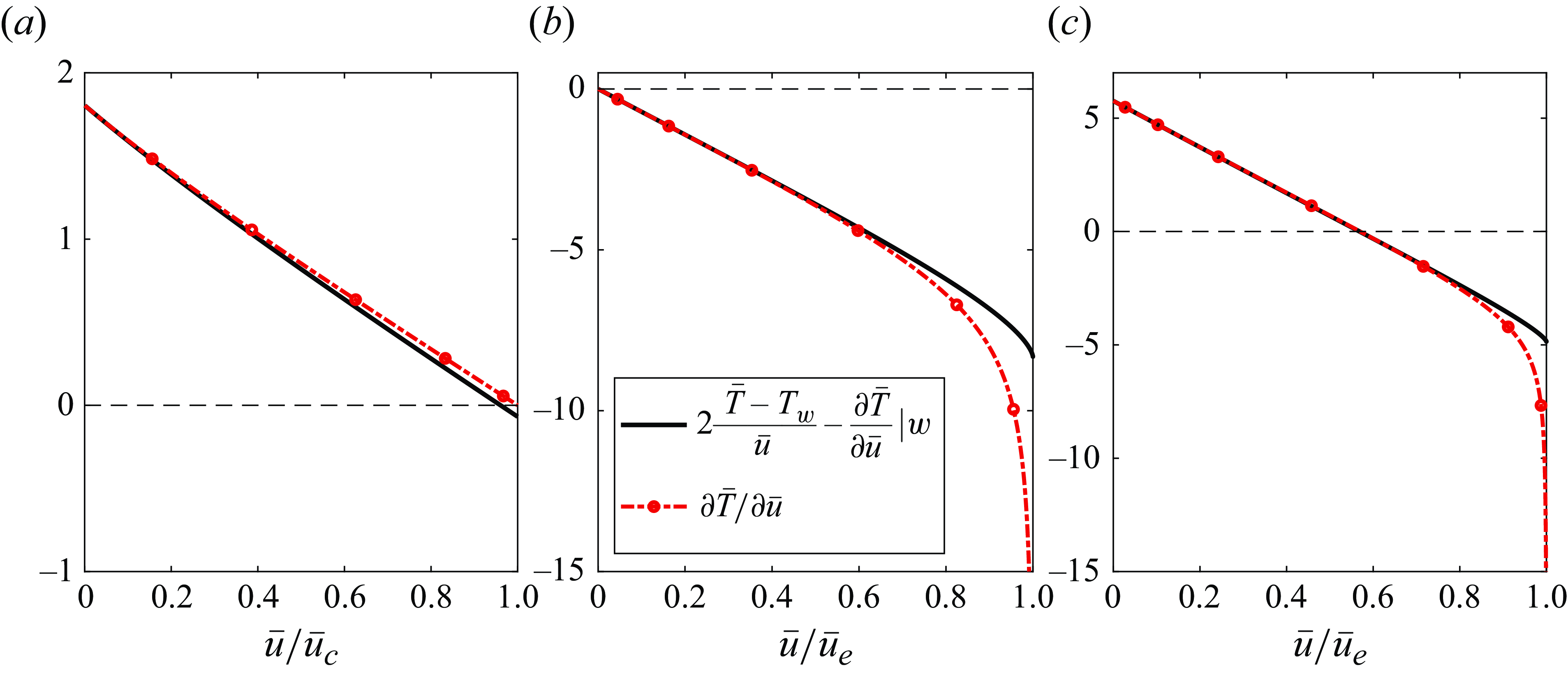
Numerator and denominator of $Pr_e^{-1}$
in (2.8) for (a) laminar channel case
$Pr_e^{-1}$
in (2.8) for (a) laminar channel case $Ma_b=5$
, and laminar boundary layer cases (b)
$Ma_b=5$
, and laminar boundary layer cases (b) $Ma_\infty =5$
,
$Ma_\infty =5$
, $T_w=\bar {T}_r$
and (c)
$T_w=\bar {T}_r$
and (c) $Ma_\infty =5$
,
$Ma_\infty =5$
, $T_w=0.1\bar {T}_r$
. All the curves are normalised by
$T_w=0.1\bar {T}_r$
. All the curves are normalised by $\bar {T}_c/\bar {u}_c$
or
$\bar {T}_c/\bar {u}_c$
or $\bar {T}_e/\bar {u}_e$
, accordingly.
$\bar {T}_e/\bar {u}_e$
, accordingly.
2.4. Turbulent boundary layers
In the following, turbulent cases are dealt with using wide elaborated DNS data. For turbulent boundary layers, 17 DNS cases from five different sources are employed with $Ma_\infty$
from 2 to 14 under cold, adiabatic and heated walls (
$Ma_\infty$
from 2 to 14 under cold, adiabatic and heated walls ( $T_w/\bar {T}_r=0.18{-}1.9$
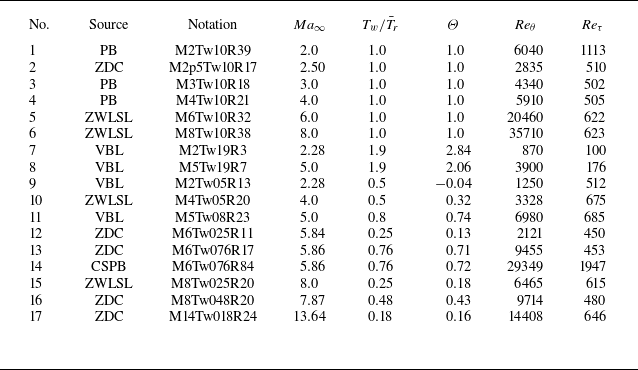
). The specific parameters and data sources of these cases are listed in table 2.
$T_w/\bar {T}_r=0.18{-}1.9$
). The specific parameters and data sources of these cases are listed in table 2.
Parameters of the turbulent boundary layer DNS datasets, where $Re_{\tau }$
and
$Re_{\tau }$
and $Re_\theta$
are the friction and momentum-thickness-based Reynolds numbers. The abbreviations for data sources are: PB for Pirozzoli & Bernardini (Reference Pirozzoli and Bernardini2011, Reference Pirozzoli and Bernardini2013); ZDC for Zhang et al. (Reference Zhang, Duan and Choudhari2018); VBL for Volpiani et al. (Reference Volpiani, Bernardini and Larsson2018, Reference Volpiani, Bernardini and Larsson2020); ZWLSL for Zhang et al. (Reference Zhang, Wan, Liu, Sun and Lu2022); and CSPB for Cogo et al. (Reference Cogo, Salvadore, Picano and Bernardini2022). The notation expresses
$Re_\theta$
are the friction and momentum-thickness-based Reynolds numbers. The abbreviations for data sources are: PB for Pirozzoli & Bernardini (Reference Pirozzoli and Bernardini2011, Reference Pirozzoli and Bernardini2013); ZDC for Zhang et al. (Reference Zhang, Duan and Choudhari2018); VBL for Volpiani et al. (Reference Volpiani, Bernardini and Larsson2018, Reference Volpiani, Bernardini and Larsson2020); ZWLSL for Zhang et al. (Reference Zhang, Wan, Liu, Sun and Lu2022); and CSPB for Cogo et al. (Reference Cogo, Salvadore, Picano and Bernardini2022). The notation expresses $Ma_\infty$
,
$Ma_\infty$
, $T_w/\bar {T}_r$
and
$T_w/\bar {T}_r$
and $Re_{\delta _2}=\rho _\infty u_\infty \delta _{99}/\bar {\mu }_w$
(divided by 100) with
$Re_{\delta _2}=\rho _\infty u_\infty \delta _{99}/\bar {\mu }_w$
(divided by 100) with $\rho$
the density and
$\rho$
the density and $\delta _{99}$
the nominal thickness.
$\delta _{99}$
the nominal thickness.
The mean flow $\bar {u}$
and
$\bar {u}$
and $\bar {T}$
are employed to compute
$\bar {T}$
are employed to compute $Pr_e$
and
$Pr_e$
and $r_g$
. The adiabatic and heated wall cases are considered first, whose
$r_g$
. The adiabatic and heated wall cases are considered first, whose $Pr_e^{-1}$
distributions are plotted in figure 5(a). Here,
$Pr_e^{-1}$
distributions are plotted in figure 5(a). Here, $Pr_e^{-1}$
is indeed around unity in most regions, which explains the wide success of (1.1) for these cases. Meanwhile,
$Pr_e^{-1}$
is indeed around unity in most regions, which explains the wide success of (1.1) for these cases. Meanwhile, $Pr_e^{-1}$
declines markedly near the boundary layer edge (
$Pr_e^{-1}$
declines markedly near the boundary layer edge ( $\bar {u}\gtrsim 0.9\bar {u}_e$
) for all cases, in line with the laminar case in figure 2(c). This is not unexpected because the flow has become episodic and intermittent near the edge (Zhang et al. Reference Zhang, Bi, Hussain and She2014), and the momentum and thermal boundary layers differ in thicknesses as
$\bar {u}\gtrsim 0.9\bar {u}_e$
) for all cases, in line with the laminar case in figure 2(c). This is not unexpected because the flow has become episodic and intermittent near the edge (Zhang et al. Reference Zhang, Bi, Hussain and She2014), and the momentum and thermal boundary layers differ in thicknesses as $Pr\ne 1$
(see § 2.3). The cold wall cases are considered separately in figure 5(b) because there are temperature peaks inside the boundary layer, around which
$Pr\ne 1$
(see § 2.3). The cold wall cases are considered separately in figure 5(b) because there are temperature peaks inside the boundary layer, around which $Pr_e^{-1}$
becomes singular due to the diminishing
$Pr_e^{-1}$
becomes singular due to the diminishing $\partial \bar {T}/\partial \bar {u}$
. The
$\partial \bar {T}/\partial \bar {u}$
. The $Pr_e^{-1}$
varies dramatically around the temperature peak, but it becomes close to unity again further away from the wall, the same as in figure 5(a). The sensitivity examination is similarly conducted as for laminar flows to study the influence of
$Pr_e^{-1}$
varies dramatically around the temperature peak, but it becomes close to unity again further away from the wall, the same as in figure 5(a). The sensitivity examination is similarly conducted as for laminar flows to study the influence of $Pr_e^{-1}$
variations on
$Pr_e^{-1}$
variations on $\bar {T}$
. As shown in figure 5(d),
$\bar {T}$
. As shown in figure 5(d), $\mathcal {E}$
is mostly amplified at
$\mathcal {E}$
is mostly amplified at $\bar {u}\gtrsim 0.7\bar {u}_e$
, where
$\bar {u}\gtrsim 0.7\bar {u}_e$
, where $Pr_e^{-1}$
is close to unity. Also, the dramatic variation of
$Pr_e^{-1}$
is close to unity. Also, the dramatic variation of $Pr_e^{-1}$
near the temperature peak for cold-wall cases limitedly influences the accuracy of the TV quadratic relation owing to the relatively low
$Pr_e^{-1}$
near the temperature peak for cold-wall cases limitedly influences the accuracy of the TV quadratic relation owing to the relatively low $\mathcal {E}$
. The above two facts support the wide accuracy of (1.1) for turbulent boundary layers.
$\mathcal {E}$
. The above two facts support the wide accuracy of (1.1) for turbulent boundary layers.
Turbulent boundary layer results: effective Prandtl number for (a) adiabatic and heated-wall cases and (b) cold-wall cases, and (c) general recovery factor and (d) the sensitivity factor for all cases. The legends (see notation in table 2) are the same for all panels, separately shown in the two boxes.
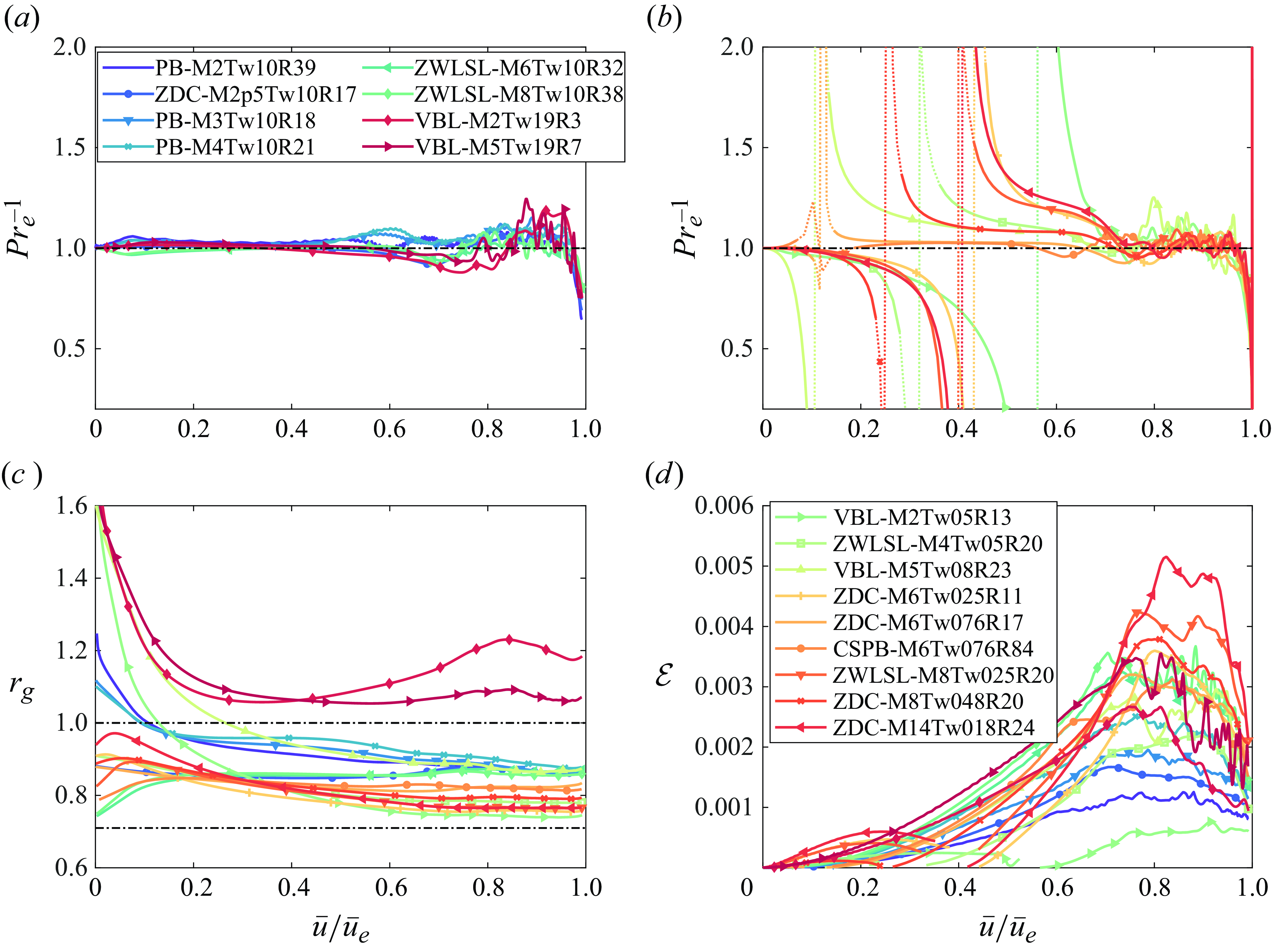
In addition to $Pr_e^{-1}$
, the
$Pr_e^{-1}$
, the $r_g$
profiles of all cases are collectively displayed in figure 5(c). We note that the near-wall
$r_g$
profiles of all cases are collectively displayed in figure 5(c). We note that the near-wall $r_g$
(at
$r_g$
(at $\bar {u}\lesssim 0.1\bar {u}_e$
) can be highly sensitive to
$\bar {u}\lesssim 0.1\bar {u}_e$
) can be highly sensitive to $\partial \bar {T}/\partial \bar {u}|_w$
and thus the post-processing discretisation schemes, because both the numerator and denominator in (2.2
b) and their first-order derivatives are zero at the wall. We use the Chebyshev collocation point method to compute these derivatives and ensure that the results are grid independent by increasing
$\partial \bar {T}/\partial \bar {u}|_w$
and thus the post-processing discretisation schemes, because both the numerator and denominator in (2.2
b) and their first-order derivatives are zero at the wall. We use the Chebyshev collocation point method to compute these derivatives and ensure that the results are grid independent by increasing $N_y$
up to 401. Using other schemes may lead to different near-wall
$N_y$
up to 401. Using other schemes may lead to different near-wall $r_g$
, but the primary conclusions remain unaltered. For all the cases,
$r_g$
, but the primary conclusions remain unaltered. For all the cases, $r_g$
tends to be invariant at
$r_g$
tends to be invariant at $\bar {u}\gtrsim 0.5\bar {u}_e$
, but the near-wall
$\bar {u}\gtrsim 0.5\bar {u}_e$
, but the near-wall $r_g$
rapidly changes, not following constancy.
$r_g$
rapidly changes, not following constancy.
The velocity and temperature transformations can provide insights into the near-wall behaviour of $r_g$
. The major difference between the temperature transformation and the TV relation is that, the former is derived from the energy equation (Patel, Boersma & Pecnik Reference Patel, Boersma and Pecnik2017; Chen et al. Reference Chen, Huang, Shi, Yang and Lv2022a
), while the latter is built upon the analogy between momentum and energy equations. Therefore, the three relations (two transformations and the TV relation) firmly connect with each other. We first consider the TL velocity transformation of Trettel & Larsson (Reference Trettel and Larsson2016) and the semi-local temperature transformation of Chen et al. (Reference Chen, Huang, Shi, Yang and Lv2022a
). In the viscous sublayer, these two transformations can reproduce the incompressible scalings of velocity and temperature, under the semi-local units. The transformed velocity and temperature (
$r_g$
. The major difference between the temperature transformation and the TV relation is that, the former is derived from the energy equation (Patel, Boersma & Pecnik Reference Patel, Boersma and Pecnik2017; Chen et al. Reference Chen, Huang, Shi, Yang and Lv2022a
), while the latter is built upon the analogy between momentum and energy equations. Therefore, the three relations (two transformations and the TV relation) firmly connect with each other. We first consider the TL velocity transformation of Trettel & Larsson (Reference Trettel and Larsson2016) and the semi-local temperature transformation of Chen et al. (Reference Chen, Huang, Shi, Yang and Lv2022a
). In the viscous sublayer, these two transformations can reproduce the incompressible scalings of velocity and temperature, under the semi-local units. The transformed velocity and temperature ( $\bar {\theta }=\bar {T}-T_w$
) follow
$\bar {\theta }=\bar {T}-T_w$
) follow
 \begin{align} & \bar {u}_{TL}^+(y^*) = \int _{0}^{y^*} {\bar {\mu }^+ \dfrac {\partial \bar {u}^+}{\partial y^+} \mathrm {d} y^*} \approx y^*, \end{align}
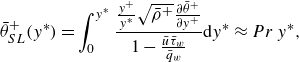 \begin{align} & \bar {\theta }_{SL}^+(y^*) = \int _0^{y^*} {\dfrac {\frac {y^+}{y^*}\sqrt {\bar {\rho }^+}\frac {\partial \bar {\theta }^+}{\partial y^+}}{1-\frac {\bar {u}\bar {\tau }_w}{\bar {q}_w}} \mathrm {d} y^*} \approx Pr\,y^*, \end{align}
where $y^*=y^+\bar {\rho }^{+1/2}/\bar {\mu }^+$
is the semi-local coordinate;
$y^*=y^+\bar {\rho }^{+1/2}/\bar {\mu }^+$
is the semi-local coordinate; $\bar {u}^+$
,
$\bar {u}^+$
, $\bar {\rho }^+$
,
$\bar {\rho }^+$
, $y^+$
,
$y^+$
, $\bar {\mu }^+$
and
$\bar {\mu }^+$
and $\bar {\theta }^+$
are normalised by the wall viscous units
$\bar {\theta }^+$
are normalised by the wall viscous units $u_\tau =(\bar {\tau }_w/\bar {\rho }_w)^{1/2}$
,
$u_\tau =(\bar {\tau }_w/\bar {\rho }_w)^{1/2}$
, $\bar {\rho }_w$
,
$\bar {\rho }_w$
, $\bar {\mu }_w/(\bar {\rho }_w u_\tau )$
,
$\bar {\mu }_w/(\bar {\rho }_w u_\tau )$
, $\bar {\mu }_w$
and
$\bar {\mu }_w$
and $T_\tau =\bar {q}_w/(\bar {\rho }_w c_p u_\tau )$
, respectively. Note that (2.15b
) is the re-derived version by Cheng & Fu (Reference Cheng and Fu2024a
) for channels and boundary layers, essentially the same as the original version for Couette flows. Also, for adiabatic walls with
$T_\tau =\bar {q}_w/(\bar {\rho }_w c_p u_\tau )$
, respectively. Note that (2.15b
) is the re-derived version by Cheng & Fu (Reference Cheng and Fu2024a
) for channels and boundary layers, essentially the same as the original version for Couette flows. Also, for adiabatic walls with $\bar {q}_w\approx 0$
and
$\bar {q}_w\approx 0$
and $T_\tau \approx 0$
, (2.15b
) can still be defined by multiplying the numerator and denominator by a factor
$T_\tau \approx 0$
, (2.15b
) can still be defined by multiplying the numerator and denominator by a factor $\bar {q}_w$
(Chen et al. Reference Chen, Huang, Shi, Yang and Lv2022a
). The combination of (2.15a
) and (2.15b
) yields a simple TV relation (derivation in Appendix A),
$\bar {q}_w$
(Chen et al. Reference Chen, Huang, Shi, Yang and Lv2022a
). The combination of (2.15a
) and (2.15b
) yields a simple TV relation (derivation in Appendix A),
 \begin{equation} \frac {\partial \bar {\theta }^+}{\partial \bar {u}^+} = Pr \left (1 - \frac {u_\tau ^2}{c_p T_\tau } \bar {u}^+\right ) \quad \text {or}\quad \ \frac {\partial \bar {T}}{\partial \bar {u}} = \frac {Pr}{c_p} \left (\frac {\bar {q}_w}{\bar {\tau }_w} - \bar {u}\right ) = \frac {\partial \bar {T}}{\partial \bar {u}}|_w - \frac {Pr}{c_p} \bar {u}. \end{equation}
Therefore, (2.16) by itself suggests a quadratic relation between $\bar {T}$
and
$\bar {T}$
and $\bar {u}$
near the wall. An analytical relation is further obtained by substituting (2.16) into (2.2
a) that
$\bar {u}$
near the wall. An analytical relation is further obtained by substituting (2.16) into (2.2
a) that $r_g=Pr$
in the viscous sublayer, irrespective of wall thermal boundary conditions (see Appendix A). This relation results directly from the balance between viscous terms and molecular heat flux, the same as the laminar case in § 2.3. Nevertheless, the near-wall
$r_g=Pr$
in the viscous sublayer, irrespective of wall thermal boundary conditions (see Appendix A). This relation results directly from the balance between viscous terms and molecular heat flux, the same as the laminar case in § 2.3. Nevertheless, the near-wall $r_g\approx Pr$
is not in line with figure 5(c), so we conclude that the accuracy of these transformations (2.15) is only guaranteed integrally. Their point-by-point derivatives may not be accurate enough. Similar analyses for the buffer and logarithmic layers can be performed using the GFM velocity transformation of Griffin et al. (Reference Griffin, Fu and Moin2021b
), and the temperature transformation of Cheng & Fu (Reference Cheng and Fu2024a
), which will be used in § 3 to implement a new temperature wall model.
$r_g\approx Pr$
is not in line with figure 5(c), so we conclude that the accuracy of these transformations (2.15) is only guaranteed integrally. Their point-by-point derivatives may not be accurate enough. Similar analyses for the buffer and logarithmic layers can be performed using the GFM velocity transformation of Griffin et al. (Reference Griffin, Fu and Moin2021b
), and the temperature transformation of Cheng & Fu (Reference Cheng and Fu2024a
), which will be used in § 3 to implement a new temperature wall model.
2.5. Turbulent channel flows
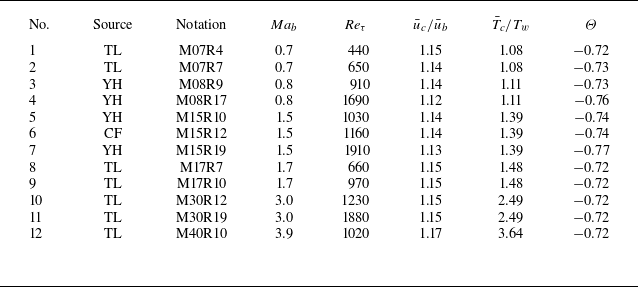
The turbulent channel flows are studied using 12 DNS cases with $Ma_b\leqslant 4$
, whose parameters and data sources are detailed in table 3. As shown in figure 6(a), the
$Ma_b\leqslant 4$
, whose parameters and data sources are detailed in table 3. As shown in figure 6(a), the $r_g$
of these cases generally experiences a decreasing trend away from the wall, and the Reynolds number effect on
$r_g$
of these cases generally experiences a decreasing trend away from the wall, and the Reynolds number effect on $r_g$
is weak. The near-wall
$r_g$
is weak. The near-wall $r_g$
also does not follow the constancy deduced from (2.16), i.e.
$r_g$
also does not follow the constancy deduced from (2.16), i.e. $r_g\approx Pr$
, like the boundary layer cases, though the two transformations in (2.15) are generally applicable to the channel cases in the viscous sublayer. Moreover, the centrelines
$r_g\approx Pr$
, like the boundary layer cases, though the two transformations in (2.15) are generally applicable to the channel cases in the viscous sublayer. Moreover, the centrelines $r_g$
(
$r_g$
( $r_{g,c}$
) all fall within
$r_{g,c}$
) all fall within $0.62\pm 0.01$
for these cases, which is also reflected from the weakly varied
$0.62\pm 0.01$
for these cases, which is also reflected from the weakly varied $\Theta$
in table 3 (see (2.5a
)). Nonetheless, substituting the
$\Theta$
in table 3 (see (2.5a
)). Nonetheless, substituting the $\bar {T}_c$
scaling derived by Song et al. (Reference Song, Zhang, Liu and Xia2022) into (2.5a
) suggests a weak dependence of
$\bar {T}_c$
scaling derived by Song et al. (Reference Song, Zhang, Liu and Xia2022) into (2.5a
) suggests a weak dependence of $r_{g,c}$
on
$r_{g,c}$
on $\bar {u}_c/\bar {u}_b$
, as
$\bar {u}_c/\bar {u}_b$
, as
 \begin{equation} r_{g,c} = Pr \left [ sr - 1.034 (1 - s Pr) {\bar {u}_b}/{\bar {u}_c} \right ]. \end{equation}
Parameters of the turbulent channel DNS datasets. The abbreviations for data sources are: TL for Trettel & Larsson (Reference Trettel and Larsson2016); YH for Yao & Hussain (Reference Yao and Hussain2020); and CF for Cheng & Fu (Reference Cheng and Fu2022). The notation expresses $Ma_b$
and
$Ma_b$
and $Re_\tau$
(divided by 100). Note that TL uses the power viscous law instead of sutherland’s law.
$Re_\tau$
(divided by 100). Note that TL uses the power viscous law instead of sutherland’s law.
Turbulent channel results: (a) general recovery factor; (b) effective Prandtl number; (c) mean temperature from DNS and (1.1); and (d) the sensitivity factor for different cases. The legends (see notation in table 3) are the same for panel (a,b,d). The black dashed line in panel (b) is a fitted curve detailed in Appendix B.
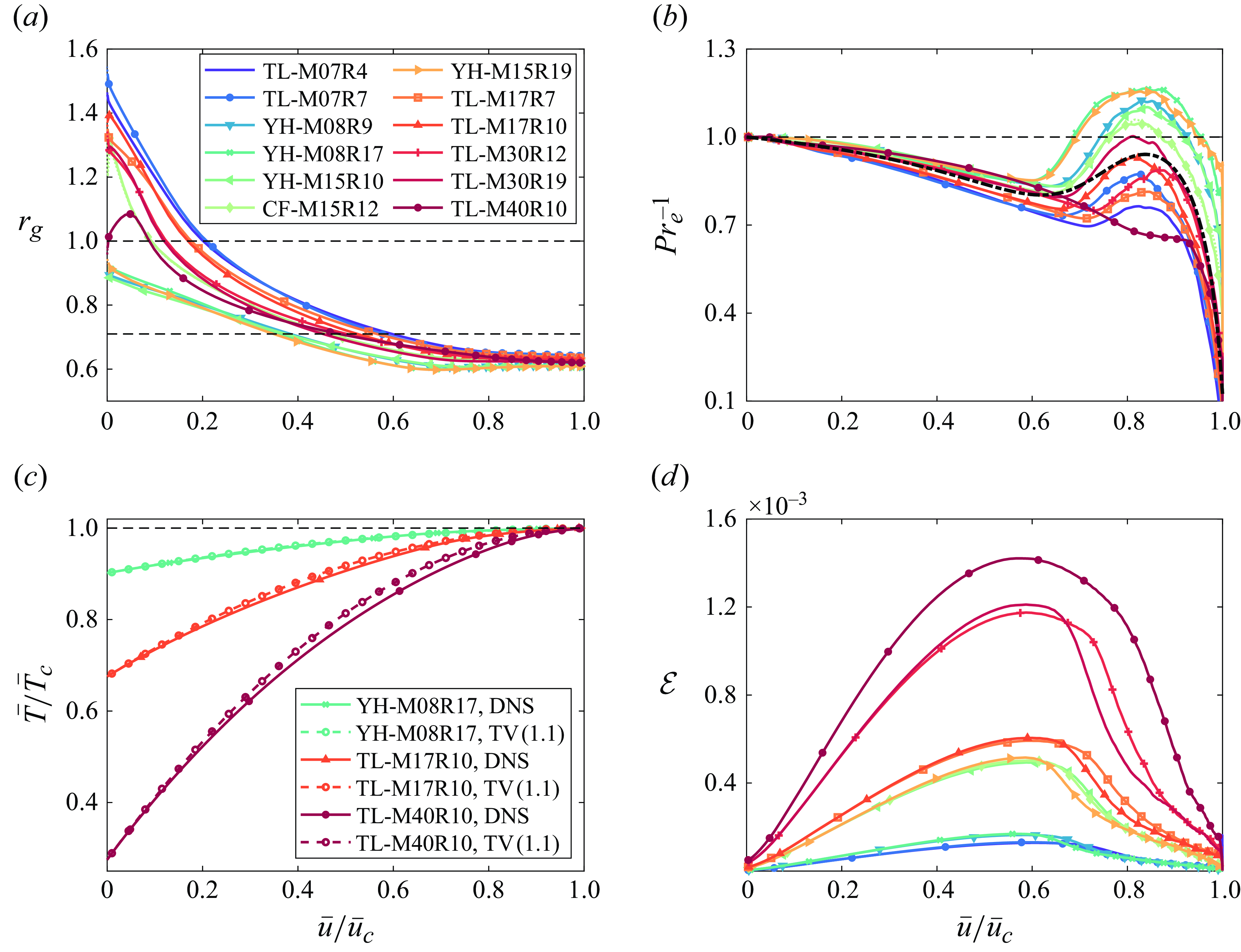
As shown in figure 6(b), $Pr_e^{-1}$
systematically deviates from unity in the middle regime
$Pr_e^{-1}$
systematically deviates from unity in the middle regime $0.2\!\lesssim \!\bar {u}/\bar {u}_c\!\lesssim \!0.7$
, different from the boundary layer cases in § 2.4. Meanwhile, there is a pronounced sensitivity of
$0.2\!\lesssim \!\bar {u}/\bar {u}_c\!\lesssim \!0.7$
, different from the boundary layer cases in § 2.4. Meanwhile, there is a pronounced sensitivity of $\bar {T}$
on
$\bar {T}$
on $Pr_e^{-1}$
in that region, as seen from figure 6(d), and the sensitivity (
$Pr_e^{-1}$
in that region, as seen from figure 6(d), and the sensitivity ( $\mathcal {E}$
) rapidly grows with the rise of
$\mathcal {E}$
) rapidly grows with the rise of $Ma_b$
. Consequently, the quadratic relation (1.1) has a modest deviation (overprediction) in the middle regime, especially for high-
$Ma_b$
. Consequently, the quadratic relation (1.1) has a modest deviation (overprediction) in the middle regime, especially for high- $Ma_b$
cases, which is clearly demonstrated in figure 6(c). The fact that (1.1) performs better for turbulent boundary layers than turbulent channel flows is reasonable, because the constant pressure gradient term in the channel momentum equation hinders the GRA between momentum and energy equations. For modelling usage, a curve fitting of
$Ma_b$
cases, which is clearly demonstrated in figure 6(c). The fact that (1.1) performs better for turbulent boundary layers than turbulent channel flows is reasonable, because the constant pressure gradient term in the channel momentum equation hinders the GRA between momentum and energy equations. For modelling usage, a curve fitting of $Pr_e^{-1}$
in figure 6(b) can be made, similar to the implementation for (2.13) and figure 3, to improve the accuracy of the TV relation for turbulent channel flows. A sample is provided in Appendix B.
$Pr_e^{-1}$
in figure 6(b) can be made, similar to the implementation for (2.13) and figure 3, to improve the accuracy of the TV relation for turbulent channel flows. A sample is provided in Appendix B.
Numerator and denominator of $Pr_e^{-1}$
in (2.8) for turbulent (a) channel case TL-M30R19, and boundary layer cases (b) adiabatic PB-M3Tw10R14 and (c) cold-wall ZDC-M6Tw025R11. All the curves are normalised by
$Pr_e^{-1}$
in (2.8) for turbulent (a) channel case TL-M30R19, and boundary layer cases (b) adiabatic PB-M3Tw10R14 and (c) cold-wall ZDC-M6Tw025R11. All the curves are normalised by $\bar {T}_c/\bar {u}_c$
or
$\bar {T}_c/\bar {u}_c$
or $\bar {T}_e/\bar {u}_e$
, accordingly.
$\bar {T}_e/\bar {u}_e$
, accordingly.
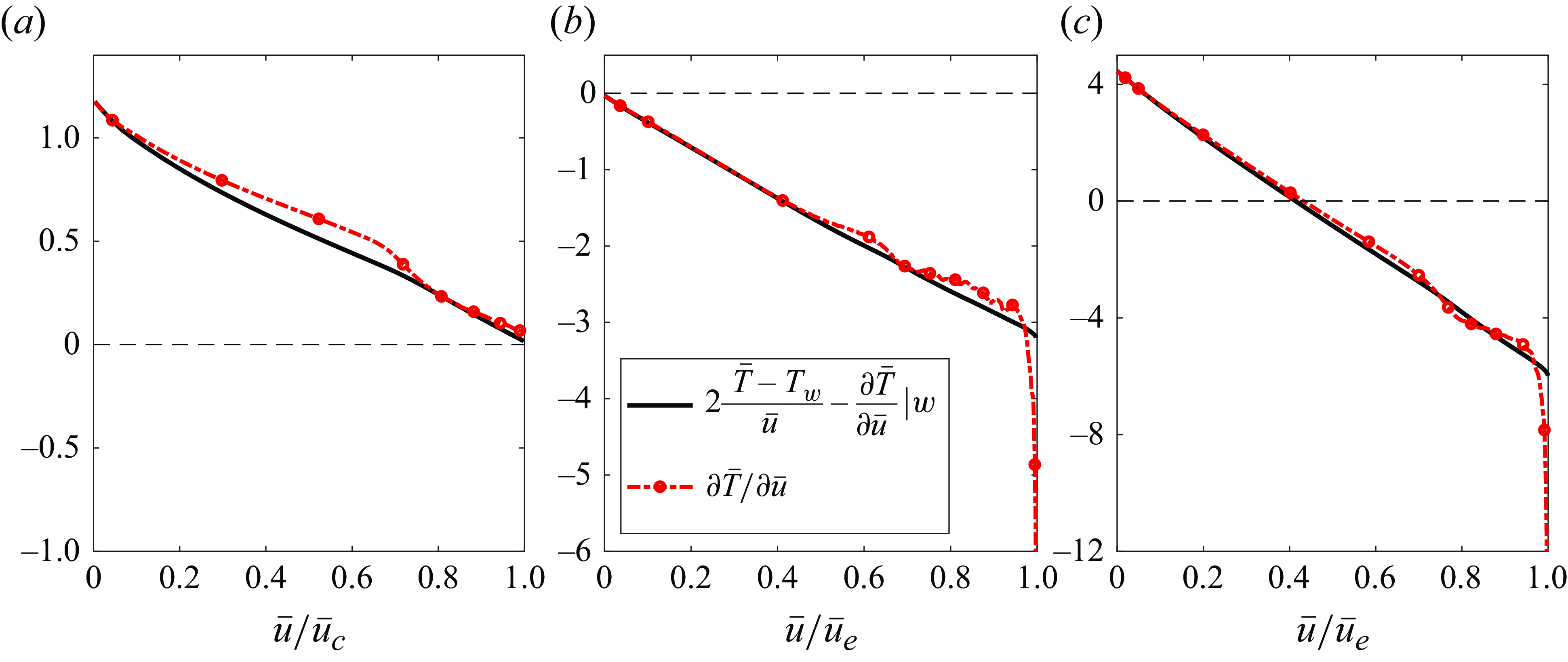
Considering the different behaviours of $Pr_e$
between laminar and turbulent cases, the numerator and denominator of
$Pr_e$
between laminar and turbulent cases, the numerator and denominator of $Pr_e^{-1}$
in (2.8) for three turbulent cases are plotted in figure 7, in a similar style to figure 4. For turbulent boundary layers, the major difference from the laminar counterpart is that
$Pr_e^{-1}$
in (2.8) for three turbulent cases are plotted in figure 7, in a similar style to figure 4. For turbulent boundary layers, the major difference from the laminar counterpart is that ${\partial \bar {T}}/{\partial \bar {u}}$
in figures 4(b) and 4(c) follow more closely the denominator, until
${\partial \bar {T}}/{\partial \bar {u}}$
in figures 4(b) and 4(c) follow more closely the denominator, until $\bar {u}\approx 0.97\bar {u}_e$
, so the TV relation is more accurate than the laminar boundary layers. This enhanced TV connection in the outer region in turbulent cases can be attributed to the intense wall-normal eddy transport of momentum and energy, and the strong TV fluctuation coupling of very large scale motions (Jiménez et al. Reference Jiménez, Hoyas, Simens and Mizuno2010; Pirozzoli & Bernardini Reference Pirozzoli and Bernardini2011; Cheng & Fu Reference Cheng and Fu2023, Reference Cheng and Fu2024b
).
$\bar {u}\approx 0.97\bar {u}_e$
, so the TV relation is more accurate than the laminar boundary layers. This enhanced TV connection in the outer region in turbulent cases can be attributed to the intense wall-normal eddy transport of momentum and energy, and the strong TV fluctuation coupling of very large scale motions (Jiménez et al. Reference Jiménez, Hoyas, Simens and Mizuno2010; Pirozzoli & Bernardini Reference Pirozzoli and Bernardini2011; Cheng & Fu Reference Cheng and Fu2023, Reference Cheng and Fu2024b
).
3. A new temperature wall model
As introduced in § 1, (1.1) has been employed as a temperature wall model for the inner layer to increase the prediction accuracy of laminar and turbulent mean flows. Nevertheless, (1.1) is dependent on boundary-layer-edge quantities $\bar {u}_e$
and
$\bar {u}_e$
and $\bar {T}_e$
, so this wall model is less applicable to complicated flow configurations. In this section, we discuss how to remove the dependence of the temperature wall model on
$\bar {T}_e$
, so this wall model is less applicable to complicated flow configurations. In this section, we discuss how to remove the dependence of the temperature wall model on $\bar {u}_e$
and
$\bar {u}_e$
and $\bar {T}_e$
for turbulent boundary layers. In fact, Mo & Gao (Reference Mo and Gao2024) has proposed one solution for laminar flows to remove the usage of
$\bar {T}_e$
for turbulent boundary layers. In fact, Mo & Gao (Reference Mo and Gao2024) has proposed one solution for laminar flows to remove the usage of $\bar {u}_e$
and
$\bar {u}_e$
and $\bar {T}_e$
, but their strategy cannot be directly extended to turbulent cases. The main difficulties and possible solutions are presented in the following.
$\bar {T}_e$
, but their strategy cannot be directly extended to turbulent cases. The main difficulties and possible solutions are presented in the following.
Illustration of the RANS/WMLES frameworks using velocity transformations and temperature wall models in the inner layer for improved near-wall scalings, following Griffin et al. (Reference Griffin, Fu and Moin2023) and Chen et al. (Reference Chen, Gan and Fu2024). $y_{mu}^*$
and
$y_{mu}^*$
and $y_m^*$
are the matching points of streamwise velocity (eddy viscosity) and temperature, respectively.
$y_m^*$
are the matching points of streamwise velocity (eddy viscosity) and temperature, respectively.
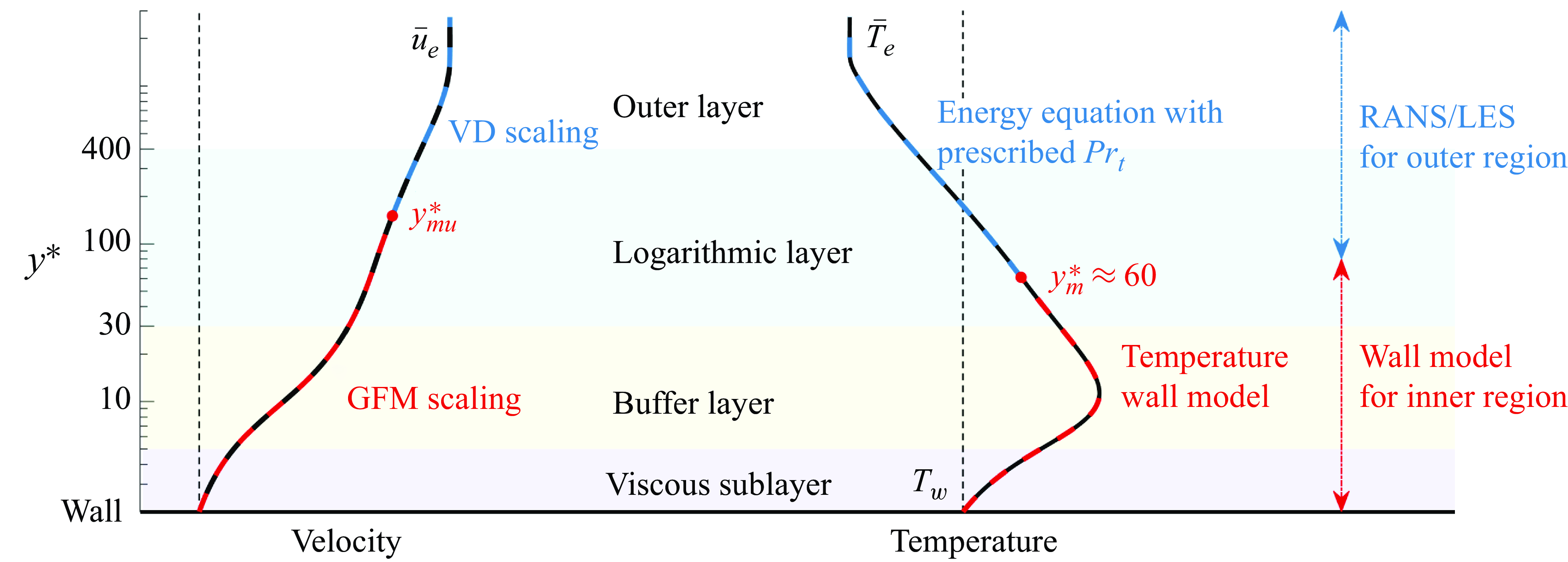
The $Pr_e\approx 1$
case is considered first. The introduction of a temperature wall model is in the same spirit as the velocity counterpart, where the inner layer and outer layer of the velocity are treated separately for improved scalings of near-wall eddy viscosity (Griffin et al. Reference Griffin, Fu and Moin2023; Hasan et al. Reference Hasan, Larsson, Pirozzoli and Pecnik2024). Within the frameworks of RANS and WMLES, (1.1) can be employed as a temperature wall model in the inner layer
$Pr_e\approx 1$
case is considered first. The introduction of a temperature wall model is in the same spirit as the velocity counterpart, where the inner layer and outer layer of the velocity are treated separately for improved scalings of near-wall eddy viscosity (Griffin et al. Reference Griffin, Fu and Moin2023; Hasan et al. Reference Hasan, Larsson, Pirozzoli and Pecnik2024). Within the frameworks of RANS and WMLES, (1.1) can be employed as a temperature wall model in the inner layer $y\lt y_m$
with
$y\lt y_m$
with $y_m$
the matching point, as illustrated in figure 8. The outer region
$y_m$
the matching point, as illustrated in figure 8. The outer region $y\gt y_m$
is still solved from the RANS or LES equations (Griffin et al. Reference Griffin, Fu and Moin2023; Chen et al. Reference Chen, Gan and Fu2024). This modelling strategy does not introduce additional empirical functions and can effectively improve the temperature prediction, especially for cold-wall cases, compared with the conventional method which solves the RANS equation in the inner layer with prescribed turbulent Prandtl number
$y\gt y_m$
is still solved from the RANS or LES equations (Griffin et al. Reference Griffin, Fu and Moin2023; Chen et al. Reference Chen, Gan and Fu2024). This modelling strategy does not introduce additional empirical functions and can effectively improve the temperature prediction, especially for cold-wall cases, compared with the conventional method which solves the RANS equation in the inner layer with prescribed turbulent Prandtl number $Pr_t$
. The reason is that the inner-layer
$Pr_t$
. The reason is that the inner-layer $\bar {T}$
is sensitive to local
$\bar {T}$
is sensitive to local $Pr_t$
, and
$Pr_t$
, and $Pr_t$
can dramatically vary with
$Pr_t$
can dramatically vary with $y$
and be singular near the wall in boundary layers, especially for cold-wall cases (Subbareddy & Candler Reference Subbareddy and Candler2012; Chen et al. Reference Chen, Gan and Fu2024). Also, the near-wall
$y$
and be singular near the wall in boundary layers, especially for cold-wall cases (Subbareddy & Candler Reference Subbareddy and Candler2012; Chen et al. Reference Chen, Gan and Fu2024). Also, the near-wall $Pr_t$
can change considerably from case to case, so a universal and simple model of
$Pr_t$
can change considerably from case to case, so a universal and simple model of $Pr_t$
(or the eddy diffusivity) for boundary layers is not currently available.
$Pr_t$
(or the eddy diffusivity) for boundary layers is not currently available.
Using the field samples at $y_m$
, i.e.
$y_m$
, i.e. $\bar {u}_m$
and
$\bar {u}_m$
and $\bar {T}_m$
, as the outer boundary condition, the solution of (2.4) reads
$\bar {T}_m$
, as the outer boundary condition, the solution of (2.4) reads
 \begin{equation} \bar {T} = T_w + \frac {\partial \bar {T}}{\partial \bar {u}}|_w \bar {u} \left (1 - \frac {\bar {u}}{\bar {u}_m}\right ) + (\bar {T}_m - T_w) \frac {\bar {u}^2}{\bar {u}_m^2}, \end{equation}
so the only unknown is $({\partial \bar {T}}/{\partial \bar {u}})_w$
. Note that for adiabatic walls,
$({\partial \bar {T}}/{\partial \bar {u}})_w$
. Note that for adiabatic walls, $({\partial \bar {T}}/{\partial \bar {u}})_w$
is zero and
$({\partial \bar {T}}/{\partial \bar {u}})_w$
is zero and $T_w$
is unknown. This case can be converted into an approximately isothermal-wall case with
$T_w$
is unknown. This case can be converted into an approximately isothermal-wall case with $T_w=\bar {T}_r$
, as adopted by, e.g. Pirozzoli & Bernardini (Reference Pirozzoli and Bernardini2011) in their DNS. From the GRA in § 2.1,
$T_w=\bar {T}_r$
, as adopted by, e.g. Pirozzoli & Bernardini (Reference Pirozzoli and Bernardini2011) in their DNS. From the GRA in § 2.1, $({\partial \bar {T}}/{\partial \bar {u}})_w$
robustly relates to the boundary-layer-edge quantities,
$({\partial \bar {T}}/{\partial \bar {u}})_w$
robustly relates to the boundary-layer-edge quantities,
 \begin{equation} \frac {\partial \bar {T}}{\partial \bar {u}}|_w = \frac {Pr}{c_p} \frac {\bar {q}_w}{\bar {\tau }_w} = \frac {\bar {u}_e r_{g,e}}{2c_p} + \frac {\bar {T}_e - T_w}{\bar {u}_e} = \frac {s Pr (\bar {T}_r - T_w)}{\bar {u}_e}. \end{equation}
Equation (3.2) demonstrates where $\bar {u}_e$
and
$\bar {u}_e$
and $\bar {T}_e$
are involved in the temperature wall model. This TV wall model using (3.1) and (3.2) is adopted by Griffin et al. (Reference Griffin, Fu and Moin2023) and Chen et al. (Reference Chen, Gan and Fu2024). For laminar flows, Mo & Gao (Reference Mo and Gao2024) propose that
$\bar {T}_e$
are involved in the temperature wall model. This TV wall model using (3.1) and (3.2) is adopted by Griffin et al. (Reference Griffin, Fu and Moin2023) and Chen et al. (Reference Chen, Gan and Fu2024). For laminar flows, Mo & Gao (Reference Mo and Gao2024) propose that $\bar {u}_e$
and
$\bar {u}_e$
and $\bar {T}_e$
can be excluded by designing the wall model as a post-processing method, or an inverse problem. This strategy is built upon the fact that even though the near-wall mesh is coarse, the laminar mean flow off the wall can be accurately attained using the NS equation, then the temperature wall model can be used inversely to improve the estimation of the wall temperature gradient. Specifically,
$\bar {T}_e$
can be excluded by designing the wall model as a post-processing method, or an inverse problem. This strategy is built upon the fact that even though the near-wall mesh is coarse, the laminar mean flow off the wall can be accurately attained using the NS equation, then the temperature wall model can be used inversely to improve the estimation of the wall temperature gradient. Specifically, $({\partial \bar {T}}/{\partial \bar {u}})_w$
can be obtained inversely from (3.1) using a coarse-mesh
$({\partial \bar {T}}/{\partial \bar {u}})_w$
can be obtained inversely from (3.1) using a coarse-mesh $\bar {T}$
(three grid samples to determine the quadratic function), then (3.2) enables accurate recovery of
$\bar {T}$
(three grid samples to determine the quadratic function), then (3.2) enables accurate recovery of $\tau _w$
and
$\tau _w$
and $q_w$
, combined with velocity transformations. Furthermore, since this laminar wall model excludes the use of the edge quantities, Mo & Gao (Reference Mo and Gao2024) showed that it can be directly applied to laminar curved-wall cases. For turbulent flows, however, this strategy of an inverse problem is not applicable due to the inclosure or inaccuracy of near-wall RANS equations. In other words,
$q_w$
, combined with velocity transformations. Furthermore, since this laminar wall model excludes the use of the edge quantities, Mo & Gao (Reference Mo and Gao2024) showed that it can be directly applied to laminar curved-wall cases. For turbulent flows, however, this strategy of an inverse problem is not applicable due to the inclosure or inaccuracy of near-wall RANS equations. In other words, $({\partial \bar {T}}/{\partial \bar {u}})_w$
needs to be determined prior to
$({\partial \bar {T}}/{\partial \bar {u}})_w$
needs to be determined prior to $\bar {T}$
, so the temperature wall model should be coupled with the governing equation during the iteration of the flow field.
$\bar {T}$
, so the temperature wall model should be coupled with the governing equation during the iteration of the flow field.
Next, we search for alternatives to (3.2) in determining $({\partial \bar {T}}/{\partial \bar {u}})_w$
. A straightforward thought is to establish relations between
$({\partial \bar {T}}/{\partial \bar {u}})_w$
. A straightforward thought is to establish relations between $({\partial \bar {T}}/{\partial \bar {u}})_w$
and
$({\partial \bar {T}}/{\partial \bar {u}})_w$
and $\bar {u}_m$
,
$\bar {u}_m$
, $\bar {T}_m$
, in a similar form to (3.2). For example, a simple idea is to directly replace
$\bar {T}_m$
, in a similar form to (3.2). For example, a simple idea is to directly replace $\phi _e$
(
$\phi _e$
( $\phi$
denotes variables) in (3.2) with
$\phi$
denotes variables) in (3.2) with $\phi _m$
. Unfortunately, the resulting
$\phi _m$
. Unfortunately, the resulting $r_{g,m}$
and
$r_{g,m}$
and $s_m$
vary markedly with
$s_m$
vary markedly with $y_m$
, as inferred from their wall-normal variations in § 2, which obstructs robust modellings. We provide another solution by incorporating the temperature transformation in the wall model. Since the temperature transformation is derived from the energy equation, it provides extra constraints to the TV relation, hence providing a closure condition. The temperature transformation of Cheng & Fu (Reference Cheng and Fu2024a
) is employed, which was shown to perform better in boundary layer cases than other transformations. The transformed temperature for the inner layer takes the form
$y_m$
, as inferred from their wall-normal variations in § 2, which obstructs robust modellings. We provide another solution by incorporating the temperature transformation in the wall model. Since the temperature transformation is derived from the energy equation, it provides extra constraints to the TV relation, hence providing a closure condition. The temperature transformation of Cheng & Fu (Reference Cheng and Fu2024a
) is employed, which was shown to perform better in boundary layer cases than other transformations. The transformed temperature for the inner layer takes the form
 \begin{equation} \bar {\theta }_S^+(y^*) = \int _0^{y^*}{\Phi _S^+\,\mathrm {d} y^*} = \int _0^{y^*} {\dfrac {\sqrt {\bar {\rho }^+}\frac {\partial \bar {\theta }^+}{\partial y^*}}{1-\frac {\bar {u}\bar {\tau }_w}{\bar {q}_w}} \mathrm {d} y^*}, \end{equation}
which does not involve boundary-layer-edge values; here, $\Phi _S^+$
is the transformation kernel. It is worth emphasising that the transformations (2.15b
) and (3.3) are derived from the original unmodelled turbulent energy equation, not from the modelled one involving
$\Phi _S^+$
is the transformation kernel. It is worth emphasising that the transformations (2.15b
) and (3.3) are derived from the original unmodelled turbulent energy equation, not from the modelled one involving $Pr_t$
models.
$Pr_t$
models.
Ideally, $\bar {\theta }_S^+(y^*)$
should collapse with the incompressible counterpart with heat transfer
$\bar {\theta }_S^+(y^*)$
should collapse with the incompressible counterpart with heat transfer $\bar {\theta }_{inc}^+(y^+)$
(Kader Reference Kader1981; Alcántara-Ávila et al. Reference Alcántara-Á vila, Hoyas and Jezabel Pérez-Quiles2021). It is important to remark that if in that case, there is no need to compute
$\bar {\theta }_{inc}^+(y^+)$
(Kader Reference Kader1981; Alcántara-Ávila et al. Reference Alcántara-Á vila, Hoyas and Jezabel Pérez-Quiles2021). It is important to remark that if in that case, there is no need to compute $({\partial \bar {T}}/{\partial \bar {u}})_w$
and use the TV relation as the wall model, because the velocity and temperature transformations already constitute a closed system to compute the inner-layer
$({\partial \bar {T}}/{\partial \bar {u}})_w$
and use the TV relation as the wall model, because the velocity and temperature transformations already constitute a closed system to compute the inner-layer $\bar {u}$
and
$\bar {u}$
and $\bar {T}$
. However, unfortunately, current temperature transformations are not as accurate as the velocity counterparts, especially for cold-wall cases. A critical challenge is the non-monotonicity of
$\bar {T}$
. However, unfortunately, current temperature transformations are not as accurate as the velocity counterparts, especially for cold-wall cases. A critical challenge is the non-monotonicity of $\bar {T}(y)$
for cold-wall cases. Based on the relation of local heat transfer (e.g. Bradshaw, Huang & Launder (Reference Bradshaw, Huang and Launder1995)),
$\bar {T}(y)$
for cold-wall cases. Based on the relation of local heat transfer (e.g. Bradshaw, Huang & Launder (Reference Bradshaw, Huang and Launder1995)), $\bar {q}\approx \bar {q}_w-\bar {u}\bar {\tau }_w$
, the denominator in (3.3) (and also (2.15b
)) can be zero near the temperature peak
$\bar {q}\approx \bar {q}_w-\bar {u}\bar {\tau }_w$
, the denominator in (3.3) (and also (2.15b
)) can be zero near the temperature peak $y_{\bar {T}_y\,=\,0}$
where
$y_{\bar {T}_y\,=\,0}$
where $\bar {q}\approx 0$
, then
$\bar {q}\approx 0$
, then $\bar {\theta }_S^+$
is ill-defined or singular. Consequently, the inner-layer
$\bar {\theta }_S^+$
is ill-defined or singular. Consequently, the inner-layer $\bar {T}$
up to the logarithmic region cannot be constructed as a whole.
$\bar {T}$
up to the logarithmic region cannot be constructed as a whole.
A positive result from Cheng & Fu (Reference Cheng and Fu2024a
) is that the two parts of $\bar {\theta }_S^+$
below and above the singular point can be constructed separately. For example, the latter part is formulated as
$\bar {\theta }_S^+$
below and above the singular point can be constructed separately. For example, the latter part is formulated as
 \begin{equation} \bar {\theta }_{S}^+(y^*) = \bar {\theta }_{\textit {ref}}^+(y_{\bar {T}_y\,=\,0}^{*(+)}) + \int _{y_{\bar {T}_y\,=\,0}^{*(+)}}^{y^*}{\Phi _S^+ \,\mathrm {d} y^*} \quad \text {for $y^*\gt y_{\bar {T}_y\,=\,0}^{*(+)}$}, \end{equation}
where $y_{\bar {T}_y\,=\,0}^{*(+)}$
is a point above
$y_{\bar {T}_y\,=\,0}^{*(+)}$
is a point above $y_{\bar {T}_y\,=\,0}^*$
and
$y_{\bar {T}_y\,=\,0}^*$
and $\bar {\theta }_{\textit {ref}}^+$
is a reference value discussed later. For all the datasets in table 2,
$\bar {\theta }_{\textit {ref}}^+$
is a reference value discussed later. For all the datasets in table 2, $y_{\bar {T}_y\,=\,0}^*$
falls within or below the buffer layer, so (3.4) can be constructed for the logarithmic region. Cheng & Fu (Reference Cheng and Fu2024a
) showed that (see their figure 14) the two parts of
$y_{\bar {T}_y\,=\,0}^*$
falls within or below the buffer layer, so (3.4) can be constructed for the logarithmic region. Cheng & Fu (Reference Cheng and Fu2024a
) showed that (see their figure 14) the two parts of $\bar {\theta }_S^+(y^*)$
below and above the singular point can generally match with
$\bar {\theta }_S^+(y^*)$
below and above the singular point can generally match with $\bar {\theta }_{inc}^+(y^+)$
, respectively. In other words, the match between
$\bar {\theta }_{inc}^+(y^+)$
, respectively. In other words, the match between $\bar {\theta }_S^+$
and
$\bar {\theta }_S^+$
and $\bar {\theta }_{inc}^+$
are piecewise, in the two regions away from
$\bar {\theta }_{inc}^+$
are piecewise, in the two regions away from $y_{\bar {T}_y\,=\,0}^*$
. Particularly,
$y_{\bar {T}_y\,=\,0}^*$
. Particularly, $\bar {\theta }_{S}^+(y^*)$
in (3.4) can follow the incompressible logarithmic scaling of temperature, where their reference point is at
$\bar {\theta }_{S}^+(y^*)$
in (3.4) can follow the incompressible logarithmic scaling of temperature, where their reference point is at $y^*=50$
. Note that very recently, Gibis et al. (Reference Gibis, Sciacovelli, Kloker and Wenzel2024) presented a comprehensive summary of
$y^*=50$
. Note that very recently, Gibis et al. (Reference Gibis, Sciacovelli, Kloker and Wenzel2024) presented a comprehensive summary of $y_{\bar {T}_y\,=\,0}^*$
for turbulent boundary layers. They revealed its dependence on
$y_{\bar {T}_y\,=\,0}^*$
for turbulent boundary layers. They revealed its dependence on $\Theta$
and
$\Theta$
and $Re_\tau$
, and showed that the temperature peak can move higher into the logarithmic region for strongly cooled walls (
$Re_\tau$
, and showed that the temperature peak can move higher into the logarithmic region for strongly cooled walls ( $\Theta \lt 0$
) and high-
$\Theta \lt 0$
) and high- $Re_\tau$
(
$Re_\tau$
( $\gtrsim { 10^4}$
) regions, so then
$\gtrsim { 10^4}$
) regions, so then $y_{\bar {T}_y\,=\,0}^{*(+)}$
needs to be larger accordingly. As a result of the match with the incompressible scaling of temperature, a combined strategy can be designed that we first compute
$y_{\bar {T}_y\,=\,0}^{*(+)}$
needs to be larger accordingly. As a result of the match with the incompressible scaling of temperature, a combined strategy can be designed that we first compute $({\partial \bar {T}}/{\partial \bar {u}})_w$
from a selected point of (3.3), and then use (3.1) to construct the inner-layer
$({\partial \bar {T}}/{\partial \bar {u}})_w$
from a selected point of (3.3), and then use (3.1) to construct the inner-layer $\bar {T}$
. This new implementation excludes the usage of boundary-layer-edge quantities. If
$\bar {T}$
. This new implementation excludes the usage of boundary-layer-edge quantities. If $Pr_e\approx 1$
is not followed, the above framework is also feasible, because (2.4) can be directly solved using a prescribed modelled
$Pr_e\approx 1$
is not followed, the above framework is also feasible, because (2.4) can be directly solved using a prescribed modelled $Pr_e$
and the
$Pr_e$
and the $({\partial \bar {T}}/{\partial \bar {u}})_w$
from temperature transformations.
$({\partial \bar {T}}/{\partial \bar {u}})_w$
from temperature transformations.
The specific expressions are presented below. Since the matching point of a wall model is usually in the logarithmic layer (see figure 8), we consider the region above the singular point of $\bar {\theta }_S^+$
, i.e. (3.4). Considering the piecewise match between
$\bar {\theta }_S^+$
, i.e. (3.4). Considering the piecewise match between $\bar {\theta }_S^+$
and
$\bar {\theta }_S^+$
and $\bar {\theta }_{inc}^+$
, the transformation is rewritten in its derivative form, based on (3.3) or (3.4), as
$\bar {\theta }_{inc}^+$
, the transformation is rewritten in its derivative form, based on (3.3) or (3.4), as
 \begin{equation} \begin{aligned} &\frac {\mathrm {d} \bar {\theta }_{inc}^+}{\mathrm {d} y^+} \approx \frac {\mathrm {d} \bar {\theta }_S^+}{\mathrm {d} y^*} = \Phi _S^+ = \dfrac {\sqrt {\bar {\rho }^+} \frac {\partial \bar {u}^+}{\partial y^*} \frac {\partial \bar {T}}{\partial \bar {u}}}{\frac {1}{Pr}\frac {\partial \bar {T}}{\partial \bar {u}}|_w - \frac {\bar {u}}{c_p}} \quad \text {for $y^*\gt y_{\bar {T}_y\,=\,0}^{*(+)}$},\\ &\text {where}\ \ \ \frac {\partial \bar {T}}{\partial \bar {u}} = \frac {\partial \bar {T}}{\partial \bar {u}}|_w \left (1 - \frac {2\bar {u}}{\bar {u}_s}\right ) + (\bar {T}_s-T_w)\frac {2\bar {u}}{\bar {u}_s^2}. \end{aligned} \end{equation}
Here, the expression of ${\partial \bar {T}}/{\partial \bar {u}}$
originates from (3.1), except for using another set of field samples
${\partial \bar {T}}/{\partial \bar {u}}$
originates from (3.1), except for using another set of field samples $\bar {u}_s$
,
$\bar {u}_s$
, $\bar {T}_s$
at
$\bar {T}_s$
at $y_s$
. The point
$y_s$
. The point $y_s$
just provides a reference to the TV relation, and for practical use, it can be any point inside or outside (then
$y_s$
just provides a reference to the TV relation, and for practical use, it can be any point inside or outside (then $\phi _s=\phi _e$
) the boundary layer, provided
$\phi _s=\phi _e$
) the boundary layer, provided $y_s\geqslant y_m$
. Compared with (3.4), the reference value
$y_s\geqslant y_m$
. Compared with (3.4), the reference value $\bar {\theta }_{\textit {ref}}^+$
is eliminated in (3.5) due to the derivative operation, hence not required to be specified. Afterwards,
$\bar {\theta }_{\textit {ref}}^+$
is eliminated in (3.5) due to the derivative operation, hence not required to be specified. Afterwards, $({\partial \bar {T}}/{\partial \bar {u}})_w$
can be obtained inversely from (3.5) at a single point, using local variables, reference values at
$({\partial \bar {T}}/{\partial \bar {u}})_w$
can be obtained inversely from (3.5) at a single point, using local variables, reference values at $y_s$
and
$y_s$
and $\bar {\theta }_{inc}^+$
. The incompressible reference
$\bar {\theta }_{inc}^+$
. The incompressible reference $\bar {\theta }_{inc}^+(y^+)$
uses the DNS data of Alcántara-Ávila et al. (Reference Alcántara-Á vila, Hoyas and Jezabel Pérez-Quiles2021), with
$\bar {\theta }_{inc}^+(y^+)$
uses the DNS data of Alcántara-Ávila et al. (Reference Alcántara-Á vila, Hoyas and Jezabel Pérez-Quiles2021), with $Re_\tau$
up to 5000. The point-by-point derivatives can be sensitive to local perturbations, so (3.5) is also rewritten into an integral manner to improve robustness, as
$Re_\tau$
up to 5000. The point-by-point derivatives can be sensitive to local perturbations, so (3.5) is also rewritten into an integral manner to improve robustness, as
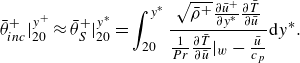 \begin{equation} \bar {\theta }_{inc}^+|_{20}^{y^+} \approx \bar {\theta }_S^+|_{20}^{y^*} = \int _{20}^{y^*} { \dfrac {\sqrt {\bar {\rho }^+} \frac {\partial \bar {u}^+}{\partial y^*} \frac {\partial \bar {T}}{\partial \bar {u}}}{\frac {1}{Pr}\frac {\partial \bar {T}}{\partial \bar {u}}|_w - \frac {\bar {u}}{c_p}} \mathrm {d} y^*}. \end{equation}
Here, the lower limit of integration is simply set to 20 in the buffer layer, considering the relatively low $y_{\bar {T}_y\,=\,0}^*$
(
$y_{\bar {T}_y\,=\,0}^*$
( ${\lt } 20$
) under the present
${\lt } 20$
) under the present $\Theta$
and
$\Theta$
and $Re_\tau$
ranges in table 2. In the following, we first examine a priori the accuracy of
$Re_\tau$
ranges in table 2. In the following, we first examine a priori the accuracy of $({\partial \bar {T}}/{\partial \bar {u}})_w$
from (3.5) and (3.6) using the DNS data. Second, we implement the new temperature wall model in RANS simulations to test a posteriori the temperature prediction.
$({\partial \bar {T}}/{\partial \bar {u}})_w$
from (3.5) and (3.6) using the DNS data. Second, we implement the new temperature wall model in RANS simulations to test a posteriori the temperature prediction.


Chen et al. (Reference Chen, Gan and Fu2024) found that the temperature wall model is most effective for highly cooled-wall cases in terms of improving the temperature prediction. Therefore, we also focus on such wall conditions and follow Gibis et al. (Reference Gibis, Sciacovelli, Kloker and Wenzel2024) to use $\Theta$
instead of
$\Theta$
instead of $T_w/\bar {T}_r$
to classify different wall-cooling regimes. For the cases in table 2, those with
$T_w/\bar {T}_r$
to classify different wall-cooling regimes. For the cases in table 2, those with $\Theta \lt 0.2$
and with
$\Theta \lt 0.2$
and with $0.2\leqslant \Theta \lt 0.5$
are termed severe and modest cooling cases, respectively. We plot in figure 9 the
$0.2\leqslant \Theta \lt 0.5$
are termed severe and modest cooling cases, respectively. We plot in figure 9 the $({\partial \bar {T}}/{\partial \bar {u}})_w$
computed from (3.5) and (3.6), respectively, for the six severe and modest cooling cases. For convenience of inter-case comparisons, the results are shown in ratios to
$({\partial \bar {T}}/{\partial \bar {u}})_w$
computed from (3.5) and (3.6), respectively, for the six severe and modest cooling cases. For convenience of inter-case comparisons, the results are shown in ratios to $({\partial \bar {T}}/{\partial \bar {u}})_w$
from the DNS data. Since the temperature transformation is not expected to work above the logarithmic region, the curves at
$({\partial \bar {T}}/{\partial \bar {u}})_w$
from the DNS data. Since the temperature transformation is not expected to work above the logarithmic region, the curves at $y/\delta _{99}\gt 0.2$
are plotted as dotted lines. As shown in figure 9(a), the accuracy of (3.5) varies dramatically with
$y/\delta _{99}\gt 0.2$
are plotted as dotted lines. As shown in figure 9(a), the accuracy of (3.5) varies dramatically with $y^*$
. The maximum relative error reaches 30 % for case ZDC-M8Tw048R20. After using the integral version (3.6), the prediction of
$y^*$
. The maximum relative error reaches 30 % for case ZDC-M8Tw048R20. After using the integral version (3.6), the prediction of $({\partial \bar {T}}/{\partial \bar {u}})_w$
becomes much more robust, and the relative errors to DNS are all less than 5 % within
$({\partial \bar {T}}/{\partial \bar {u}})_w$
becomes much more robust, and the relative errors to DNS are all less than 5 % within $y^*\lt 80$
for the severe cooling cases. Therefore, incorporating the temperature transformation is a viable path to estimate
$y^*\lt 80$
for the severe cooling cases. Therefore, incorporating the temperature transformation is a viable path to estimate $({\partial \bar {T}}/{\partial \bar {u}})_w$
without using the boundary-layer-edge values. It is worth mentioning that the accuracy of (3.6) may be further improved by adding to (3.3) the functions related to high-order fluctuation terms (Cheng & Fu Reference Cheng and Fu2024a
). Nevertheless, the simplest form is adopt here for convenience of modelling usage. Equations (3.1) and (3.6) constitute a new temperature wall model, which we term a transformation-based wall model.
$({\partial \bar {T}}/{\partial \bar {u}})_w$
without using the boundary-layer-edge values. It is worth mentioning that the accuracy of (3.6) may be further improved by adding to (3.3) the functions related to high-order fluctuation terms (Cheng & Fu Reference Cheng and Fu2024a
). Nevertheless, the simplest form is adopt here for convenience of modelling usage. Equations (3.1) and (3.6) constitute a new temperature wall model, which we term a transformation-based wall model.
Temperature predicted by different Baldwin–Lomax models and from DNS for cases (a) VBL-M2Tw05R13, (b) ZDC-M6Tw025R11, (c) ZWLSL-M8Tw025R20, (d) ZDC-M14Tw018R24 and (e) ZDC-M8Tw048R20. The first four are severe cooling cases and the fifth one is a modest cooling case.
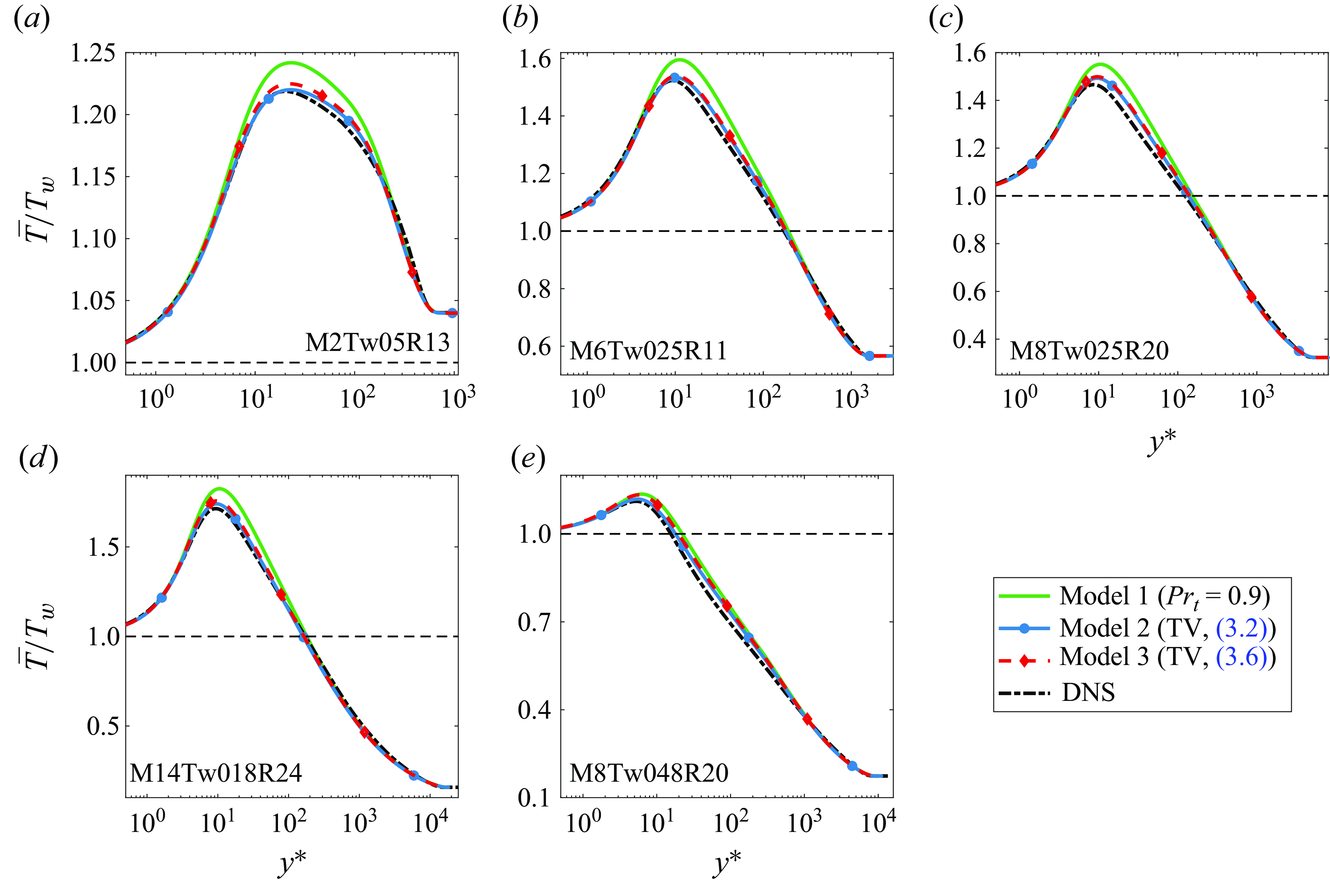
Finally, we examine the new temperature wall model a posteriori by applying it to our improved Baldwin–Lomax (BL) algebraic RANS model (Chen et al. Reference Chen, Gan and Fu2024), as illustrated in figure 8. Since our focus is on temperature prediction, the so-called BL-GFM-VD model is selected as the benchmark one, which uses the GFM and VD (van Driest Reference van Driest1951) velocity transformations for improved scalings of the inner- and outer-layer eddy viscosity, respectively. On this basis, three models are compared: Model 1 does not use temperature wall models but prescribes $Pr_t=0.9$
throughout (other choices of
$Pr_t=0.9$
throughout (other choices of $Pr_t$
have been discussed by Chen et al. (Reference Chen, Gan and Fu2024) and do not affect the main conclusions below); Model 2 uses (3.1) and (3.2) as the TV wall model; and Model 3 employs the transformation-based wall model instead. For the latter two models, the matching point is fixed at
$Pr_t$
have been discussed by Chen et al. (Reference Chen, Gan and Fu2024) and do not affect the main conclusions below); Model 2 uses (3.1) and (3.2) as the TV wall model; and Model 3 employs the transformation-based wall model instead. For the latter two models, the matching point is fixed at $y_m^*=60$
, to which
$y_m^*=60$
, to which $\bar {T}$
is not sensitive (Chen et al. Reference Chen, Gan and Fu2024). The sampling point for Model 3 to compute
$\bar {T}$
is not sensitive (Chen et al. Reference Chen, Gan and Fu2024). The sampling point for Model 3 to compute $({\partial \bar {T}}/{\partial \bar {u}})_w$
is selected to be
$({\partial \bar {T}}/{\partial \bar {u}})_w$
is selected to be $y^*=80$
, according to figure 9. The temperature prediction from these three models is compared with the DNS data in figure 10 for four severe cooling cases. A fifth case with a modestly cooled wall is also included, aiming to demonstrate that its higher prediction error of
$y^*=80$
, according to figure 9. The temperature prediction from these three models is compared with the DNS data in figure 10 for four severe cooling cases. A fifth case with a modestly cooled wall is also included, aiming to demonstrate that its higher prediction error of $({\partial \bar {T}}/{\partial \bar {u}})_w$
than the severe cooling cases (see figure 9) has limited effects on the behaviour of Model 3. As discussed by Chen et al. (Reference Chen, Gan and Fu2024), the Model 1 results have obvious deviations from DNS for severe cooling cases even though the two velocity transformations have been incorporated, due to the rapid variation of
$({\partial \bar {T}}/{\partial \bar {u}})_w$
than the severe cooling cases (see figure 9) has limited effects on the behaviour of Model 3. As discussed by Chen et al. (Reference Chen, Gan and Fu2024), the Model 1 results have obvious deviations from DNS for severe cooling cases even though the two velocity transformations have been incorporated, due to the rapid variation of $Pr_t$
below the logarithmic region. Employing the TV wall model (Model 2) effectively improves the temperature prediction and attains close agreement with DNS for all the cases shown. The results between Models 2 and 3 are close to each other, proving that the transformation-based temperature wall model serves as an ideal alternative to the TV wall model and successfully excludes the dependence on boundary-layer-edge quantities.
$Pr_t$
below the logarithmic region. Employing the TV wall model (Model 2) effectively improves the temperature prediction and attains close agreement with DNS for all the cases shown. The results between Models 2 and 3 are close to each other, proving that the transformation-based temperature wall model serves as an ideal alternative to the TV wall model and successfully excludes the dependence on boundary-layer-edge quantities.
4. Discussions and summary
4.1. Discussions
Zhang et al. (Reference Zhang, Bi, Hussain and She2014) derived and explained $Pr_e$
as the effective Prandtl number. It is related to
$Pr_e$
as the effective Prandtl number. It is related to $Pr_t$
as
$Pr_t$
as $Pr_e=Pr_t/(1+\epsilon )$
, where
$Pr_e=Pr_t/(1+\epsilon )$
, where $\epsilon$
corresponds to the wall-normal eddy transport of the residual temperature fluctuation. This residual fluctuation can be difficult to obtain in simulations and measurements, so the interpretation and examination of
$\epsilon$
corresponds to the wall-normal eddy transport of the residual temperature fluctuation. This residual fluctuation can be difficult to obtain in simulations and measurements, so the interpretation and examination of $Pr_e$
have to be made more from the mean flow perspective. In this work, we show that besides turbulence,
$Pr_e$
have to be made more from the mean flow perspective. In this work, we show that besides turbulence, $Pr_e$
is also significant in determining
$Pr_e$
is also significant in determining $\bar {T}$
in laminar flows, which demonstrates that
$\bar {T}$
in laminar flows, which demonstrates that $Pr_e$
is more fundamental than previous belief in describing the TV relation for compressible flows. In particular, the perfect collapse of
$Pr_e$
is more fundamental than previous belief in describing the TV relation for compressible flows. In particular, the perfect collapse of $Pr_e$
for laminar boundary layers over wide
$Pr_e$
for laminar boundary layers over wide $Ma_\infty$
and
$Ma_\infty$
and $T_w/\bar {T}_r$
ranges suggests that
$T_w/\bar {T}_r$
ranges suggests that $Pr_e$
serves as a robust modelling parameter, beneficial for constructing highly accurate laminar temperature models (figure 3).
$Pr_e$
serves as a robust modelling parameter, beneficial for constructing highly accurate laminar temperature models (figure 3).
This work also raises the significance of studying temperature transformations. A previous popular viewpoint is that temperature transformations are of limited interest for compressible turbulence modelling because the TV relation is already quite accurate. Nevertheless, as discussed in § 3, the TV relation is not closed by itself because it is derived from the analogy between the momentum and energy equations, while the analogy factor is left to be determined. Hence, the TV relation requires two outer boundary conditions: one is the outer field samples $\bar {u}_m$
and
$\bar {u}_m$
and $\bar {T}_m$
(not necessarily to be the edge; see (1.1) and (3.1)), and the other is the Reynolds analogy factor (3.2) which firmly relies on boundary layer edge quantities. This dependence on outer and edge values prevents the TV wall model from being a true self-determined inner-layer model, at least logically, and can obstruct its application to complex flow configurations. The combined strategy proposed in this work actually reaches a compromise between the inclosure of the TV relation and the inaccuracy of current temperature transformations. We anticipate more accurate temperature transformations in the future, which will help constitute a more solid inner-layer wall model, combined with velocity transformations.
$\bar {T}_m$
(not necessarily to be the edge; see (1.1) and (3.1)), and the other is the Reynolds analogy factor (3.2) which firmly relies on boundary layer edge quantities. This dependence on outer and edge values prevents the TV wall model from being a true self-determined inner-layer model, at least logically, and can obstruct its application to complex flow configurations. The combined strategy proposed in this work actually reaches a compromise between the inclosure of the TV relation and the inaccuracy of current temperature transformations. We anticipate more accurate temperature transformations in the future, which will help constitute a more solid inner-layer wall model, combined with velocity transformations.
Finally, from the turbulent results in §§ 2.4 and 2.5, we note that the near-wall $r_g$
may serve as a means to examine the convergence of DNS data due to its high requirement to reach convergence. The velocity and temperature transformations can provide part of the theoretical foundation. Meanwhile, an important issue is raised to the community that a comprehensive examination is urgently required on the quality (convergence, spectral resolution, effects of numerical schemes, etc.) of established DNS datasets.
$r_g$
may serve as a means to examine the convergence of DNS data due to its high requirement to reach convergence. The velocity and temperature transformations can provide part of the theoretical foundation. Meanwhile, an important issue is raised to the community that a comprehensive examination is urgently required on the quality (convergence, spectral resolution, effects of numerical schemes, etc.) of established DNS datasets.
4.2. Summary
In this work, we revisit the compressible mean TV relation for both laminar and turbulent flows, considering both channels and boundary layers. A wide range of DNS datasets are employed for a comprehensive evaluation. We inspect two primary parameters, $r_g$
and
$r_g$
and $Pr_e$
, which are fundamental in the GRA deduced by Zhang et al. (Reference Zhang, Bi, Hussain and She2014) and in deriving the quadratic TV relation (1.1). Our efforts are on three aspects: explain the success of the TV relation where it works, improve its accuracy where it deviates and relax its limitation as a wall model by removing the dependence on boundary-layer-edge quantities.
$Pr_e$
, which are fundamental in the GRA deduced by Zhang et al. (Reference Zhang, Bi, Hussain and She2014) and in deriving the quadratic TV relation (1.1). Our efforts are on three aspects: explain the success of the TV relation where it works, improve its accuracy where it deviates and relax its limitation as a wall model by removing the dependence on boundary-layer-edge quantities.
The basic TV relations and related parameters turn out to be universal for the four configurations (§§ 2.2–2.5), indicative of some fundamental resemblance between laminar and turbulent flows. Common observations are summarised as follows. First, $r_g$
is not a constant and has at least modest wall-normal variations in most cases, in contrast to the model assumption. Second,
$r_g$
is not a constant and has at least modest wall-normal variations in most cases, in contrast to the model assumption. Second, $Pr_e$
is more critical than
$Pr_e$
is more critical than $r_g$
in determining the shape of
$r_g$
in determining the shape of $\bar {T}$
, and is less sensitive than
$\bar {T}$
, and is less sensitive than $r_g$
to flow conditions. Third, the sensitivity study designed on
$r_g$
to flow conditions. Third, the sensitivity study designed on $Pr_e$
is effective in explaining the success and failure of (1.1) in specific regions. For laminar channels, we show that (1.1) with fixed
$Pr_e$
is effective in explaining the success and failure of (1.1) in specific regions. For laminar channels, we show that (1.1) with fixed $s$
is highly accurate at different
$s$
is highly accurate at different $Ma_b$
. For laminar boundary layers, we find that the quadratic TV relation has a systematic deviation (over-estimation) in temperature prediction, due to the systematic departure of
$Ma_b$
. For laminar boundary layers, we find that the quadratic TV relation has a systematic deviation (over-estimation) in temperature prediction, due to the systematic departure of $Pr_e$
from unity. The
$Pr_e$
from unity. The $Pr_e^{-1}(\bar {u}/\bar {u}_e)$
turns out to exhibit a universal distribution irrespective of
$Pr_e^{-1}(\bar {u}/\bar {u}_e)$
turns out to exhibit a universal distribution irrespective of $Ma_\infty$
and
$Ma_\infty$
and $T_w/\bar {T}_r$
. Therefore, the prediction accuracy of
$T_w/\bar {T}_r$
. Therefore, the prediction accuracy of $\bar {T}$
is significantly improved (figure 3) after introducing a curve fit of
$\bar {T}$
is significantly improved (figure 3) after introducing a curve fit of $Pr_e^{-1}(\bar {u}/\bar {u}_e)$
, especially for cold-wall cases. The quadratic TV relation is generally accurate for turbulent boundary layers and channel flows, as widely reported before. Nevertheless, we note that
$Pr_e^{-1}(\bar {u}/\bar {u}_e)$
, especially for cold-wall cases. The quadratic TV relation is generally accurate for turbulent boundary layers and channel flows, as widely reported before. Nevertheless, we note that $Pr_e^{-1}$
has a modest systematic deviation from unity in the middle regime for channel cases, which results in modest temperature overprediction in that region; this overprediction can be reduced by using an improved description of
$Pr_e^{-1}$
has a modest systematic deviation from unity in the middle regime for channel cases, which results in modest temperature overprediction in that region; this overprediction can be reduced by using an improved description of $Pr_e^{-1}$
. The velocity and temperature transformations can assist to understand the near-wall behaviour of
$Pr_e^{-1}$
. The velocity and temperature transformations can assist to understand the near-wall behaviour of $r_g$
, which may also serve as a criterion to examine the convergence of DNS data.
$r_g$
, which may also serve as a criterion to examine the convergence of DNS data.
Finally, we discuss the strategies to exclude the boundary-layer-edge quantities in turbulent temperature wall models. This is significant for expanding the applicability of the wall model because the boundary layer edge may not be easily determined in complex flows. The edge quantities are involved in the Reynolds analogy scaling to determine the wall boundary condition $({\partial \bar {T}}/{\partial \bar {u}})_w$
. As a means to exclude the dependence on the edge quantities, we propose to employ the temperature transformation of Cheng & Fu (Reference Cheng and Fu2024a
) in the logarithmic region to close the TV relation. A priori examination using the DNS data proves that the temperature transformation can accurately recover
$({\partial \bar {T}}/{\partial \bar {u}})_w$
. As a means to exclude the dependence on the edge quantities, we propose to employ the temperature transformation of Cheng & Fu (Reference Cheng and Fu2024a
) in the logarithmic region to close the TV relation. A priori examination using the DNS data proves that the temperature transformation can accurately recover $({\partial \bar {T}}/{\partial \bar {u}})_w$
for cold-wall boundary layer cases. Moreover, a posteriori examination in our improved BL model demonstrates that the new transformation-based wall model can improve the mean flow prediction compared with those without temperature wall models (using prescribed
$({\partial \bar {T}}/{\partial \bar {u}})_w$
for cold-wall boundary layer cases. Moreover, a posteriori examination in our improved BL model demonstrates that the new transformation-based wall model can improve the mean flow prediction compared with those without temperature wall models (using prescribed $Pr_t$
) for severe cooling cases (
$Pr_t$
) for severe cooling cases ( $\Theta \lt 0.2$
), and it serves as an ideal alternative to the original TV wall model.
$\Theta \lt 0.2$
), and it serves as an ideal alternative to the original TV wall model.
Future attention will be paid on possible extensions of the modified models to more complex configurations and their behaviours in the flows with moderate pressure gradients.
Acknowledgements
We are grateful to all the authors listed in tables 2 and 3 for kindly sharing their elaborated DNS datasets.
Funding
This research was supported by National Natural Science Foundation of China (No. 12422210) and CORE, a joint research centre between Laoshan Laboratory and HKUST. L.F. acknowledges the fund from the Research Grant Council (RGC) of the Government of HKSAR with RGC/ECS Project (No. 26200222), RGC/GRF Project (No. 16201023) and RGC/STG Project (No. STG2/E-605/23-N), the fund from Guangdong Basic and Applied Basic Research Foundation (No. 2024A1515011798), and the fund from Guangdong Province Science and Technology Plan Project (No. 2023A0505030005).
Declaration of interests
The authors report no conflict of interest.
Data availability statement
The data that support the findings of this study are available from the corresponding author upon reasonable request.
Appendix A. Derivations for laminar and turbulent boundary layers
First, we present the derivation of (2.11). Equation (2.10) can be rewritten as
 \begin{equation} -\dfrac {\Pi }{2} = (C_1 \bar {u}_\eta )_{\bar {u}} = \left (\dfrac {C_1}{\eta _{\bar {u}}}\right )_{\bar {u}}, \qquad \dfrac {1}{Pr} \left (\dfrac {C_1}{\eta _{\bar {u}}} \bar {T}_{\bar {u}}\right )_{\bar {u}} - \bar {T}_{\bar {u}} \left (\dfrac {C_1}{\eta _{\bar {u}}}\right )_{\bar {u}} + \dfrac {1}{c_p} \dfrac {C_1}{\eta _{\bar {u}}} = 0. \end{equation}
Then, the coefficient ${C_1}/{\eta _{\bar {u}}}$
is solved as
${C_1}/{\eta _{\bar {u}}}$
is solved as
 \begin{equation} \frac {C_1}{\eta _{\bar {u}}} = \frac {C_{1,w}}{\eta _{\bar {u},w}} - \frac {\Psi }{2} = \frac {\Psi _e - \Psi }{2}, \qquad \text {with } \Psi \equiv \int _{0}^{\bar {u}} \Pi \,\mathrm {d}\bar {u}. \end{equation}
As a result, the viscous parameters can be eliminated by substituting (A2) into (A1) as
 \begin{equation} (1 - Pr) \bar {T}_{\bar {u}} \Psi _{\bar {u}} = (\bar {T}_{\bar {u}\bar {u}} + Pr/c_p ) (\Psi _e - \Psi ). \end{equation}
The wall boundary condition $\Psi _{\bar {u},w}=\Pi _w=0$
leads to
$\Psi _{\bar {u},w}=\Pi _w=0$
leads to $\bar {T}_{\bar {u}\bar {u},w}=-Pr/c_p$
, so (2.11) is arrived after a separation of variables. In addition, the perfect quadratic function
$\bar {T}_{\bar {u}\bar {u},w}=-Pr/c_p$
, so (2.11) is arrived after a separation of variables. In addition, the perfect quadratic function $\bar {T}_{qd}(\bar {u})$
reads
$\bar {T}_{qd}(\bar {u})$
reads
 \begin{equation} \bar {T}_{qd}(\bar {u}) = T_w + \bar {T}_{\bar {u},w} \bar {u} + \frac {\bar {T}_{\bar {u}\bar {u},w}}{2} \bar {u}^2, \end{equation}
which is subject to three wall boundary conditions $\bar {T}_{qd}|_w=T_w$
,
$\bar {T}_{qd}|_w=T_w$
, $\bar {T}_{{qd},\bar {u}}|_w=\bar {T}_{\bar {u},w}$
and
$\bar {T}_{{qd},\bar {u}}|_w=\bar {T}_{\bar {u},w}$
and $\bar {T}_{{qd},\bar {u}\bar {u}}|_w=\bar {T}_{\bar {u}\bar {u},w}$
. As a result, the
$\bar {T}_{{qd},\bar {u}\bar {u}}|_w=\bar {T}_{\bar {u}\bar {u},w}$
. As a result, the $\bar {Q}$
-related expressions in (2.11) and (2.12) are obtained. Afterwards, the wall limit of
$\bar {Q}$
-related expressions in (2.11) and (2.12) are obtained. Afterwards, the wall limit of $r_g$
is derived. The numerator and denominator of (2.2b
) and their first-order derivatives are all zero at the wall, so the wall limit is obtained by using L’Hôpital’s rule twice, as
$r_g$
is derived. The numerator and denominator of (2.2b
) and their first-order derivatives are all zero at the wall, so the wall limit is obtained by using L’Hôpital’s rule twice, as $r_{g,w}=-c_p\bar {T}_{\bar {u}\bar {u},w}$
, which simply equals to
$r_{g,w}=-c_p\bar {T}_{\bar {u}\bar {u},w}$
, which simply equals to $Pr$
.
$Pr$
.
The derivation of (2.16) is next presented. From (2.15), the first-order derivatives of $\bar {u}_{TL}^+$
and
$\bar {u}_{TL}^+$
and $\bar {\theta }_{SL}^+$
in the viscous sublayer are
$\bar {\theta }_{SL}^+$
in the viscous sublayer are
 \begin{equation} \frac {\partial \bar {u}_{TL}^+}{\partial y^*} = \bar {\mu }^+ \frac {\partial \bar {u}^+}{\partial y^+} \approx 1 \approx \frac {1}{Pr} \frac {\partial \bar {\theta }_{SL}^+}{\partial y^*} = \frac {1}{Pr} \frac {\frac {y^+}{y^*}\sqrt {\bar {\rho }^+}\frac {\partial \bar {\theta }^+}{\partial y^+}}{1-\frac {\bar {u}\bar {\tau }_w}{\bar {q}_w}}. \end{equation}
As a result, (2.16) and $r_g=Pr$
are obtained after some simple algebra. This near-wall limit of
$r_g=Pr$
are obtained after some simple algebra. This near-wall limit of $r_g$
is the same as the laminar case. Similar derivations regarding the combination of velocity and temperature transformations were also provided by Chen et al. (Reference Chen, Huang, Shi, Yang and Lv2022a
) for Couette flows, though they used Walz’s equation instead of (1.1).
$r_g$
is the same as the laminar case. Similar derivations regarding the combination of velocity and temperature transformations were also provided by Chen et al. (Reference Chen, Huang, Shi, Yang and Lv2022a
) for Couette flows, though they used Walz’s equation instead of (1.1).
Appendix B. An improved fitting of $Pr_e$
for turbulent channel flows
$Pr_e$
for turbulent channel flows

As discussed in § 2.5, an improved distribution of $Pr_e$
can raise the accuracy of the TV relation for turbulent channel flows. Due to the scattering of
$Pr_e$
can raise the accuracy of the TV relation for turbulent channel flows. Due to the scattering of $Pr_e$
in figure 6(b) for different cases, an optimal model for
$Pr_e$
in figure 6(b) for different cases, an optimal model for $Pr_e$
is not currently available. Therefore, we provide a simple curve fitting of the mean
$Pr_e$
is not currently available. Therefore, we provide a simple curve fitting of the mean $Pr_e^{-1}$
for these cases, as a demonstration of the possible strategies for model improvement. Using a third-order rational polynomial function, the mean
$Pr_e^{-1}$
for these cases, as a demonstration of the possible strategies for model improvement. Using a third-order rational polynomial function, the mean $Pr_e^{-1}$
is fitted as
$Pr_e^{-1}$
is fitted as
 \begin{equation} Pr_e^{-1}\!\left (\frac {\bar {u}}{\bar {u}_c}\equiv x\right ) = \frac {1-\sum _{n=1}^{3}{a_nx^n}}{1-\sum _{n=1}^{3}{b_nx^n}}, \ \ \text {where}\; \left \{\!\!\begin{array}{lll} a_1=3.605,\,a_2=-4.432,\,a_3=1.826, \\ b_1=3.434,\,b_2=-4.030,\,b_3=1.588. \end{array}\right . \end{equation}
The fitted curve is plotted in figure 6(b) as the black dashed line for reference.
Relative error of the TV relations using different $Pr_e$
models to the DNS data for turbulent channel cases: (a) error relative to
$Pr_e$
models to the DNS data for turbulent channel cases: (a) error relative to $\bar {T}_{DNS}$
, and (b) error relative to
$\bar {T}_{DNS}$
, and (b) error relative to $(\bar {T}_{DNS}-T_w)$
; see (B2a,b
). The case numbers are defined in table 3. The horizontal dashed lines are the averaged errors of all cases.
$(\bar {T}_{DNS}-T_w)$
; see (B2a,b
). The case numbers are defined in table 3. The horizontal dashed lines are the averaged errors of all cases.
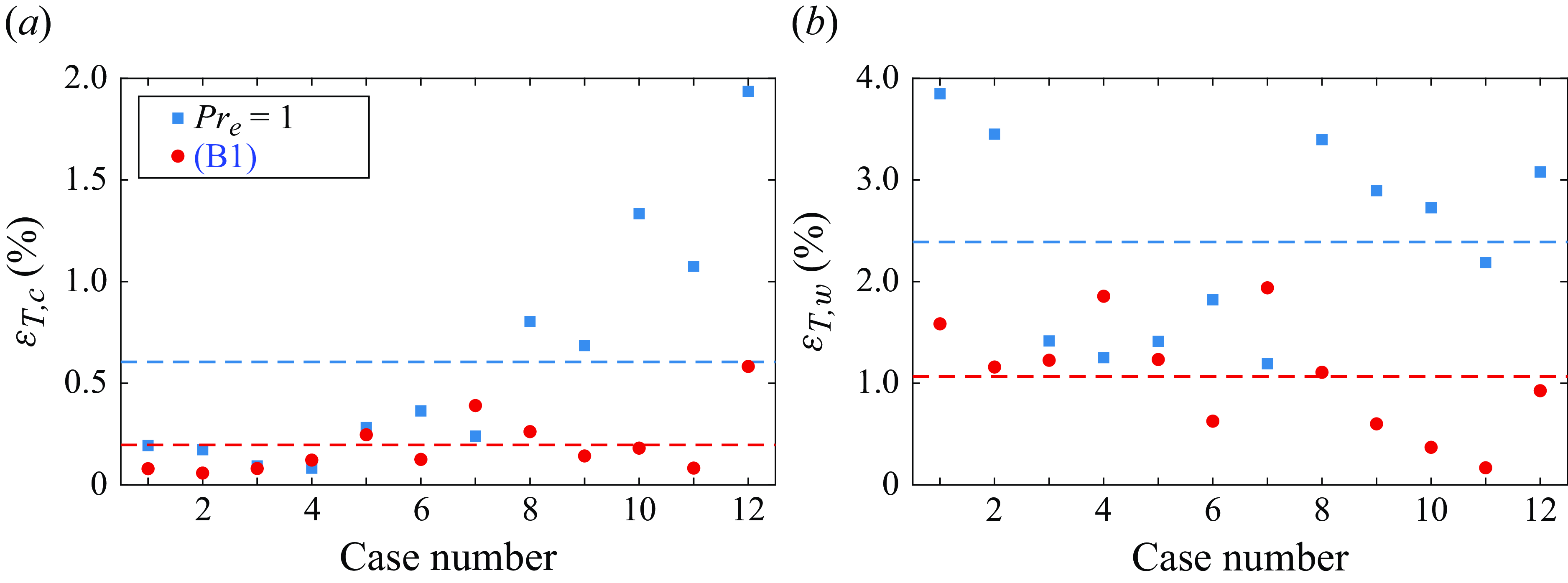
Now, the accuracy of two TV relations is compared: the first relation solves (2.4) with $Pr_e=1$
, leading to the quadratic relation (1.1); the second relation numerically solves (2.4) with (B1). Two types of errors are defined to measure their prediction accuracy relative to the DNS data:
$Pr_e=1$
, leading to the quadratic relation (1.1); the second relation numerically solves (2.4) with (B1). Two types of errors are defined to measure their prediction accuracy relative to the DNS data:
 \begin{align} \varepsilon _{T\!,c}=\frac {\int _{0}^{\bar {u}_c}{|\bar {T}_{TV} - \bar {T}_{DNS}|}\,\mathrm {d} \bar {u}}{\int _{0}^{\bar {u}_c}{\bar {T}_{DNS}}\,\mathrm {d} \bar {u}}, \qquad \varepsilon _{T\!,w}=\frac {\int _{0}^{\bar {u}_c}{|\bar {T}_{TV} - \bar {T}_{DNS}|}\,\mathrm {d} \bar {u}}{\int _{0}^{\bar {u}_c}{(\bar {T}_{DNS} - T_w)}\,\mathrm {d} \bar {u}}. \end{align}
As shown in figure 6(c), the $\bar {T}$
variation relative to
$\bar {T}$
variation relative to $\bar {T}_c$
is small for low-
$\bar {T}_c$
is small for low- $Ma_b$
cases, which may conceal the error of the TV relation, so the second type
$Ma_b$
cases, which may conceal the error of the TV relation, so the second type $\varepsilon _{T\!,w}$
is introduced for better inter-case comparisons. The distributions of
$\varepsilon _{T\!,w}$
is introduced for better inter-case comparisons. The distributions of $\varepsilon _{T\!,c}$
and
$\varepsilon _{T\!,c}$
and $\varepsilon _{T\!,w}$
for the 12 cases in table 3, sorted by
$\varepsilon _{T\!,w}$
for the 12 cases in table 3, sorted by $Ma_b$
and
$Ma_b$
and $Re_\tau$
, are plotted in figure 11. As discussed above,
$Re_\tau$
, are plotted in figure 11. As discussed above, $\varepsilon _{T\!,c}$
generally increases with the rise of
$\varepsilon _{T\!,c}$
generally increases with the rise of $Ma_b$
due to stronger
$Ma_b$
due to stronger $\bar {T}$
variations, whereas
$\bar {T}$
variations, whereas $\varepsilon _{T\!,w}$
is more uniform among cases and thus more strictly measures the errors at low
$\varepsilon _{T\!,w}$
is more uniform among cases and thus more strictly measures the errors at low $Ma_b$
. Compared with the errors with
$Ma_b$
. Compared with the errors with $Pr_e=1$
, the
$Pr_e=1$
, the $Pr_e$
model (B1) reduces
$Pr_e$
model (B1) reduces $\varepsilon _{T\!,c}$
and
$\varepsilon _{T\!,c}$
and $\varepsilon _{T\!,w}$
in most cases, suggesting improved accuracy of the TV relation. As an overall measure, the mean
$\varepsilon _{T\!,w}$
in most cases, suggesting improved accuracy of the TV relation. As an overall measure, the mean $\varepsilon _{T\!,c}$
and
$\varepsilon _{T\!,c}$
and $\varepsilon _{T\!,w}$
for all cases are reduced from 0.6 % and 2.4 % to 0.2 % and 1.1 %, respectively.
$\varepsilon _{T\!,w}$
for all cases are reduced from 0.6 % and 2.4 % to 0.2 % and 1.1 %, respectively.


 Open access

