

Introduction
Education is globally acknowledged as a cornerstone for development and social transformation, underscored by international commitments such as Sustainable Development Goal 4.1, which calls for ‘free, equitable, and quality’ primary and secondary education by 2030. Yet, despite considerable progress, global disparities remain stark. As of 2023, an estimated 251 million children and adolescents remain out of school worldwide, with Sub-Saharan Africa (SSA) alone accounting for nearly half of this total, approximately 122–126 million children (UNESCO, 2024). While multiple structural and socio-cultural factors contribute to this exclusion, chronic underinvestment in education systems across low-income countries remains a central impediment (ibid). In response, many governments have adopted bold policy initiatives to enhance basic education access. Though primary education has witnessed near-universal enrollment in much of Africa, secondary education continues to face deep access inequalities. To address this gap, attention has increasingly turned toward abolishing secondary school fees, in line with the African Union’s pledge to achieve continent-wide free senior high school by 2025 (McQuade, Reference McQuade2022). Over the past two decades, nearly half of SSA nations have introduced Free Senior High School (Free SHS) policies. Nonetheless, scholarly debate persists over the feasibility and appropriateness of such reforms in resource-constrained contexts.
Against this regional momentum toward universal secondary education, Ghana’s 2017 Free SHS policy stands out as an ambitious and early national response. Championed by the New Patriotic Party (NPP) following its electoral victory, the policy aimed to eliminate financial barriers to secondary education by guaranteeing tuition-free access for all qualified students. Its implementation yielded immediate gains: enrolment surged by over 11 per cent in the first year alone, reaching an unprecedented 470,000 students (Ministry of Education, 2017). Beyond access, emerging evidence suggests a range of positive spillovers, including improvements in girls’ educational attainment, reproductive health behaviours, and intergenerational human capital outcomes (Duflo et al., Reference Duflo, Dupas, Spelke and Walsh2024), mitigating teen birth on educational outcomes (Tabiri et al., Reference Tabiri, Tahiru, Atakorah and Novignon2025), as well as reduced household financial burden and measurable reductions in household poverty (Adu-Abaio and Osei, Reference Adu-Ababio and Osei2018). Despite aligning closely with regional and global equity aspirations, the policy has not been without controversy, triggering debates around its long-term fiscal sustainability, distributive fairness, and implementation quality.
Critics, including the then opposition party, National Democratic Congress (NDC), have questioned the Free SHS policy’s fiscal sustainability, while the NPP touts it as transformative (Kofinti, Reference Kofinti2024). Even some NPP members voiced doubts about sustaining it without additional taxes (Duflo et al., Reference Duflo, Dupas, Spelke and Walsh2024). Key concerns centre on the high cost of implementation, which has diverted nearly half of the non-salary education budget to senior high schools, compared to less than 5 per cent for all lower levels combined (Africa Education Watch, 2023). Other criticisms include overcrowded classrooms, strained resources, high rates of indiscipline (Chanimbe and Dankwah, Reference Chanimbe and Dankwah2021; Dwomoh et al., Reference Dwomoh, Tetteh, Otoo, Hazlett, Godi, Amoatey and Tornyevah2022), declining student effort (Casely-Hayford et al., Reference Casely-Hayford, Gruijters, Adjei and Yeboah2025), and fears of credential inflation in the face of 32.8 per cent youth unemployment (Bennel, Reference Bennell2021; UNDP, 2023). These challenges have led many to advocate for a phased, equity-first rollout anchored in progressive universalism, targeting the poorest first rather than pursuing a politically expedient, universal implementation (Bonsu et al., Reference Bonsu, Suhuyini, Otchere-Ankrah, Adjei-Bamfo and Silveira2025).
Empirical evidence on this debate has largely focused on student-level outcomes as anticipated (Adu-Ababio and Osei, Reference Adu-Ababio and Osei2018; Bhuwania et al., Reference Bhuwania, Huh and Heymann2023; Duflo et al., Reference Duflo, Dupas, Spelke and Walsh2024; Dwomoh et al., Reference Dwomoh, Tetteh, Otoo, Hazlett, Godi, Amoatey and Tornyevah2022; Stenzel et al., Reference Stenzel, Kwadwo and Vincent2024; Tabiri et al., Reference Tabiri, Tahiru, Atakorah and Novignon2025). More recently, scholars have also begun to examine stakeholder perspectives and elite-level discourse surrounding the policy (Akuffo, Reference Akuffo2024, Reference Akuffo2025; Bonsu et al., Reference Bonsu, Suhuyini, Otchere-Ankrah, Adjei-Bamfo and Silveira2025; Casely-Hayford et al.,; Mohammed and Kuyini, Reference Mohammed and Kuyini2021). Yet empirical research has devoted limited attention to how ordinary citizens perceive the Free SHS. A notable exception is Dzordzormenyoh et al. (Reference Dzordzormenyoh, Amoah, Dzordzormenyoh and Domeh2025), who analyse public support through regional variation but treat opinion as a largely homogeneous construct, relying on aggregate approval measures or binary responses. Such approaches risk oversimplifying public sentiment (Bell, Reference Bell2020, Reference Bell2021). Aggregate indicators can obscure latent subgroups that support the same policy for fundamentally different reasons or under different conditions (Fox et al., Reference Fox, Moule and Parry2018). In the case of Free SHS, overall approval masks the possibility that some citizens support the policy as a universal right, while others do so conditionally, preferring more targeted or phased designs. What remains missing is an analysis of the underlying attitudinal architecture, the presence of distinct opinion classes with divergent evaluative frameworks toward free secondary education.
This study addresses this gap by applying Latent Class Analysis (LCA) to uncover hidden heterogeneity in public perceptions of Ghana’s Free SHS policy. LCA identifies unobserved subgroups within a population by clustering individuals who share similar response patterns across multiple survey items. Rather than relying on single summary measures of support, this approach captures how citizens simultaneously evaluate access expansion, targeting, funding trade-offs, and implementation. In doing so, it provides a more structured and nuanced portrait of public opinion than a simple pro–con classification. The analysis then examines the political, demographic, and socioeconomic determinants of these orientations, a critical step for assessing perceived legitimacy, diagnosing implementation constraints, and informing resource allocation. The results identify five distinct attitudinal classes, Universal Access Champions, Pragmatic Inclusionists, Equity-Driven Structuralists, Access-Sceptical Reformists, and Ambivalent Observers, whose positions are shaped by partisanship, education, civic engagement, employment status, residence, and perceptions of national economic conditions. Together, these findings illuminate how public attitudes condition the sustainability and future design of large-scale education reforms in Ghana and similar SSA contexts (Gruijters et al., Reference Gruijters, Abango and Casely-Hayford2024).
This article contributes to the literature in four key ways. First, this article advances debates on secondary education fee abolition in resource-constrained settings by foregrounding public perception, an often-overlooked constituency in policy design, through the lens of policy feedback theory and deservingness heuristics, which emphasises how citizen attitudes are both shaped by and shape reform trajectories (Busemeyer et al., Reference Busemeyer, Lergetporer and Woessmann2018; Gruijters et al., Reference Gruijters, Abango and Casely-Hayford2024; Kofinti, Reference Kofinti2024; Dzordzormenyoh et al., Reference Dzordzormenyoh, Amoah, Dzordzormenyoh and Domeh2025). Second, it demonstrates that views on fairness and deservingness in equity-driven reforms are not monolithic, adding nuance to existing theories of welfare preferences (Busemeyer et al., Reference Busemeyer, Lergetporer and Woessmann2018; Bell, Reference Bell2020). Third, it contributes to scholarship on partisanship in African democracies by building on established evidence that Ghana already exhibits partisan structuring of policy attitudes similar to that observed in Western democracies, and by extending this logic to the underexplored domain of universal education policy (Carlson, Reference Carlson2016; Mattes and Krönke, Reference Mattes, Krönke and Holmberg2020; Stoecker, Reference Stoecker2023). Finally, by focusing on Ghana’s Free SHS policy, the study offers practical guidance on how inclusive design and strategic communication can bolster public buy-in, especially vital in polarised democracies where social programmes risk becoming partisan battlegrounds (Kofinti, Reference Kofinti2024; Bonsu et al., Reference Bonsu, Suhuyini, Otchere-Ankrah, Adjei-Bamfo and Silveira2025; Dzordzormenyoh et al., Reference Dzordzormenyoh, Amoah, Dzordzormenyoh and Domeh2025).
The paper proceeds as follows: the next section develops the theoretical framework, followed by the data and analytical strategy, results and discussion, and a concluding section on policy implications.
Policy feedback, deservingness heuristics and public attitudes
Policy feedback theory (PFT) posits that public policies do not merely reflect political preferences; they actively produce them. Rather than treating policies as passive outcomes of political competition, PFT emphasises that policies restructure material incentives, signal governing priorities, and generate interpretive cues that shape how citizens understand the state, evaluate fairness, and judge government competence (Pierson, Reference Pierson1993; Mettler and Soss, Reference Mettler and Soss2004; Campbell, Reference Campbell2012). Through these mechanisms, policies feed back into mass politics, shaping not only individual welfare but the beliefs, expectations, and political orientations that condition future support or resistance. Crucially, policy feedback operates through attitudinal channels. Policy design features, such as universality versus targeting, tolerance for trade-offs, and implementation quality, inform how citizens interpret what a policy is for and for whom (Mkandawire, Reference Mkandawire2005; Kimenyi, Reference Kimenyi2013). When policies are perceived as fair, effective, and competently delivered, they tend to generate positive feedback that reinforces legitimacy, compliance, and political support. When they are perceived as inefficient, poorly implemented, or misaligned with public priorities, they can generate negative feedback, amplifying scepticism, contestation, and demands for reform (Soss and Schram, Reference Soss and Schram2007). Public attitudes thus function not as epiphenomena, but as the mediating mechanism linking policy design to downstream political behaviour.
These feedback dynamics are especially pronounced in resource-constrained settings, where expansive social policies must continuously justify themselves against competing public needs (Duflo et al., Reference Duflo, Dupas, Spelke and Walsh2024). In such contexts, citizens do not simply ask whether a policy exists; they assess whether it delivers value, whether its benefits are fairly distributed, and whether its implementation reflects state capacity and responsibility (Busemeyer et al., Reference Busemeyer, Lergetporer and Woessmann2018; Gruijters et al., Reference Gruijters, Abango and Casely-Hayford2024). Support for universal education reforms, therefore, is not reducible to ideology alone. It reflects ongoing judgements about trade-offs, institutional readiness, and perceived opportunity costs, judgements that evolve as policies unfold in practice. Deservingness heuristics complement PFT by clarifying how citizens arrive at these judgements. Rather than conducting full cost–benefit analyses, individuals rely on cognitive shortcuts to assess who deserves public support, drawing on cues related to need, effort, reciprocity, and social contribution (Van Oorschot, Reference Van Oorschot2006; Petersen et al., Reference Petersen, Slothuus, Stubager and Togeby2011). These heuristics are particularly salient in distributive policies like education, where universalistic aspirations collide with concerns about efficiency, moral hazard, and implementation strain (Kimenyi, Reference Kimenyi2013). Citizens may withdraw support if they perceive benefits accruing disproportionately to the non-poor, if educational expansion is associated with negative externalities such as graduate underemployment, or if implementation failures signal weak governance. Conversely, perceptions of fair access and competent delivery can sustain legitimacy even amid visible constraints (Bell, Reference Bell2020; Dwomoh et al., 2024).
Importantly, neither policy feedback nor deservingness heuristics implies that public opinion is uniform. A central insight of PFT is that the same policy can generate heterogeneous attitudinal responses depending on how individuals interpret its design, beneficiaries, and consequences (Pierson, Reference Pierson1993; Mettler and Soss, Reference Mettler and Soss2004; Larsen, Reference Larsen2019). Citizens may converge on similar levels of support or scepticism through fundamentally different evaluative logics, with some endorsing universal education as a social right independent of trade-offs, while others condition support on targeting, sequencing, or economic context (Van Oorschot, Reference Van Oorschot2006; Petersen et al., Reference Petersen, Slothuus, Stubager and Togeby2011; Bell, Reference Bell2020). These distinct logics matter because they carry different implications for political behaviour, ranging from enthusiastic endorsement to conditional support or disengagement, and for how resilient policy support remains as implementation conditions evolve (Busemeyer et al., Reference Busemeyer, Lergetporer and Woessmann2018; Soss and Schram, Reference Soss and Schram2007). Taken together, this framework implies that heterogeneity in public attitudes is structurally embedded in policy feedback processes rather than random noise; accordingly, I employ LCA to recover the distinct attitudinal coalitions shaping political support for Free SHS.
Data
This article uses nationally representative Afrobarometer survey data, a pan-African, non-partisan research initiative tracking public attitudes toward democracy and governance across more than thirty countries (Afrobarometer, 2020). In Ghana, Afrobarometer is implemented by the Ghana Center for Democratic Development (CDD-Ghana). The analysis draws on Round 8 (September–October 2019), comprising 2400 respondents aged eighteen and above selected through a multi-stage, stratified, clustered sampling design. The survey has a ±2 percentage-point margin of error and an 89 per cent response rate. Interviews were conducted in English and major local languages using standardised translation and back-translation protocols; nevertheless, as with all multilingual surveys, subtle differences in interpretation may remain and represent a limitation of the study. Round 8 uniquely includes detailed questions on citizens’ views of the Free SHS policy. The data are publicly available, fully anonymised, and accessible without formal approval.
Based on the survey conducted, four specific dimensions of the policy attitudes towards the Free SHS were captured. In no particular order, Perceived Access Expansion (PAE) is the first dimension. This dimension assesses whether respondents believe Free SHS has effectively expanded educational opportunities, directly linking to perceptions of policy effectiveness and inclusivity. The survey item capturing this dimension asked respondents: ‘The Free SHS policy has created opportunities for many students who otherwise could not afford secondary education. Do you agree or disagree with this statement?’. Secondly, Acceptance of Employment Trade-offs (AET), this measure captures citizens’ tolerance for the potential unintended labour-market effects of increased educational access, such as graduate unemployment, reflecting a willingness to accept policy trade-offs. The relevant survey question was: ‘It is better to have Free SHS even if it leads to an increase in the number of educated citizens who cannot find jobs. Do you agree or disagree?’. Thirdly, Preference for Means Targeting (PMT), this indicator gauges respondents’ preferences between universal policy coverage versus targeted support for disadvantaged groups. It directly taps into deservingness heuristics, reflecting judgements about equity, fairness, and efficient resource allocation. The survey posed: ‘The government should have targeted only the poor who otherwise would not be able to afford secondary education. Do you agree or disagree?’. Lastly, Implementation Strategy Preference (ISP), this dimension captures respondents’ preferences regarding the implementation approach, specifically their support for proactive planning versus adaptive, incremental rollout. It reflects citizens’ evaluation of government competence and policy readiness. The item was framed as follows: ‘Which of the following statements is closest to your view? Statement 1: ‘The government should have ensured that all necessary structures for Free SHS were in place before implementation.’ (Proactive). Statement 2: ‘The government made the right decision to implement Free SHS immediately and address challenges as they arise.’ (Adaptive). All questions used a Likert-scale response format ranging from strongly disagree to strongly agree, except Question 4, which employed a modified five-point scale: 1 = strongly disagree with statement 1, 2 = disagree with statement 1, 3 = neutral, 4 = agree with statement 2, and 5 = strongly agree with statement 2.
These four dimensions align explicitly with policy feedback theory, which underscores the importance of policy design features (universality, targeting, and implementation quality) in shaping citizen attitudes, as well as deservingness heuristics, which emphasises citizens’ evaluative judgements concerning equity and reciprocity. By operationalising these theoretical dimensions directly, the study moves beyond simplistic measures of general support or opposition to reveal how citizens systematically differ in their assessments and reasoning regarding the Free SHS policy. Finally, demographic and socioeconomic covariates including age, household size, location (urban or rural), gender, employment status, education, partisanship, political affiliation, lived poverty, asset ownership, access to information, and perceptions of the country’s economic condition were incorporated into a multinomial logistic regression analysis following the LCA, to identify significant predictors of latent class membership or public perception of the Free SHS policy.
Analytical strategy
To examine public perceptions of Ghana’s Free SHS policy, the analytical approach proceeds in three stages. First, I present descriptive statistics for each of the four policy attitude indicators: access expansion, poverty targeting, employment trade-offs, and implementation strategy preference. This initial step allows us to assess the overall distribution of responses, providing a snapshot of the public’s surface-level attitudes. The mixed and sometimes ambivalent distribution across these indicators signals that support for Free SHS is not monolithic, warranting a more systematic investigation of the latent subgroups underlying these attitudes.
Second, I apply LCA to identify unobserved subpopulations within the broader public. LCA is a probabilistic, person-centred statistical approach that is able to identify homogeneous clusters of respondents based on their shared response patterns across multiple policy dimensions. In simple terms, this is akin to distinguishing apples, oranges, and bananas based on their distinct attributes. Unlike regression models that isolate dominant predictors, neglecting subtle (but still present) ‘fruit’ at the bottom of the basket (Fox et al., Reference Fox, Moule and Parry2018), LCA is particularly valuable for unpacking heterogeneous policy perceptions that aggregate analyses often mask. Also, LCA is deemed superior to other clustering techniques such as k-mode clustering and hierarchical clustering since it’s able to provide numerical goodness-of-fit measures to enable more objective and replicable results (Baye et al., Reference Baye, Zia, Merrill, Clark, Smith and Koliba2024). LCA also provides enhanced estimation accuracy compared to alternative methods (ibid). For this article, all LCA models were run using the poLCA in R studio (Linzer and Lewis, Reference Linzer and Lewis2011).
The empirical specification is as follows; assuming a latent class with N categorical variables, the response of individual i on item n is denoted by ${Y_{in}}$
with a full response vector
${Y_{in}}$
with a full response vector ${Y_i}$
. The probability P(
${Y_i}$
. The probability P( ${Y_i})$
representing a class response pattern can be specified as follows:
${Y_i})$
representing a class response pattern can be specified as follows: ${\rm{P}}\left( {{Y_i}} \right) = {\rm{\;}}\mathop \sum \nolimits_{\psi = 1}^\psi P(X^{\prime} = \vartheta )\;P\left( {{\rm{P(}}{Y_i}{\rm{|}}\;X^{\prime} = \vartheta } \right)$
where $X^{\prime}$
is a vector of the manifest variables, and
$X^{\prime}$
is a vector of the manifest variables, and $\psi$
is the latent class of
$\psi$
is the latent class of $\vartheta$
classes. The next step involves describing class-specific adoption patterns – outcome probabilities. Assuming individuals are distributed through a set of classes, it is not initially known who belongs to what group. However, we can compute the probability of an individual i choosing alternative n in a choice situation
$\vartheta$
classes. The next step involves describing class-specific adoption patterns – outcome probabilities. Assuming individuals are distributed through a set of classes, it is not initially known who belongs to what group. However, we can compute the probability of an individual i choosing alternative n in a choice situation ${Y_{in}}$
, conditioned on membership to class
${Y_{in}}$
, conditioned on membership to class $\psi$
as in Equation (2).
$\psi$
as in Equation (2). ${\rm{P}}\left( {{Y_{in}} = \;j{\rm{|}}class = \;\psi} \right) = \exp (X^{\prime}in,j\;{\beta _\psi })/\mathop \sum \nolimits_{j = 1}^J {\rm{exp}}(X^{\prime}in,j{\beta _\psi })$
where ${\beta _\psi }$
represent the class-specific parameters implying homogeneity within each latent class.
${\beta _\psi }$
represent the class-specific parameters implying homogeneity within each latent class.
Whilst the model does not inherently choose the optimal number of classes, it does provide a variety of parsimony and goodness-of-fit statistics such as log likelihood (logLik), Akaike information criterion (AIC), Bayes information criterion (BIC), Likelihood ratio/deviance statistic (Gsq), Pearson Chi-square goodness-of-fit statistic (Chisq), and entropy. However, studies have shown that BIC performs well in choosing the optimal class size when N is large, and is also able to select the most parsimonious class (Nylund et al., Reference Nylund, Asparouhov and Muthén2007). Robustness checks were further conducted by visualising the BIC and AIC to detect the point of inflection complemented by a grid search following Baye et al. (Reference Baye, Zia, Merrill, Clark, Smith and Koliba2024). Finally, after identifying the optimal number of classes, I proceed to run a simple multinomial logistic regression to predict the associated factors that identify with each of the classes, together with a set of covariates based on respondents’ demographic and socioeconomic variables as defined in the variables section. Consequently, the multinomial logistic regression is specified as follows: ${C_i} ={\delta _0} +{\delta _i}{X_i} + {\varsigma _i}$
where ${C_i}$
is the dependent variable representing the optimal number of classes selected.
${C_i}$
is the dependent variable representing the optimal number of classes selected. ${X_i}$
is a vector of covariates including age, household size, urban or rural residence, gender, employment status, education, partisanship, political affiliation, lived poverty, asset ownership, access to information, and the country’s economic condition. Then
${X_i}$
is a vector of covariates including age, household size, urban or rural residence, gender, employment status, education, partisanship, political affiliation, lived poverty, asset ownership, access to information, and the country’s economic condition. Then ${\varsigma _{i}}$
is the idiosyncratic error term. Readers should note I present the average marginal effects (AMEs) following the multinomial logistic regression to translate log-odds into more intuitive probability changes, allowing for clearer interpretation of how each predictor shifts the likelihood of class membership across latent attitudinal groups.
${\varsigma _{i}}$
is the idiosyncratic error term. Readers should note I present the average marginal effects (AMEs) following the multinomial logistic regression to translate log-odds into more intuitive probability changes, allowing for clearer interpretation of how each predictor shifts the likelihood of class membership across latent attitudinal groups.
Results and discussion
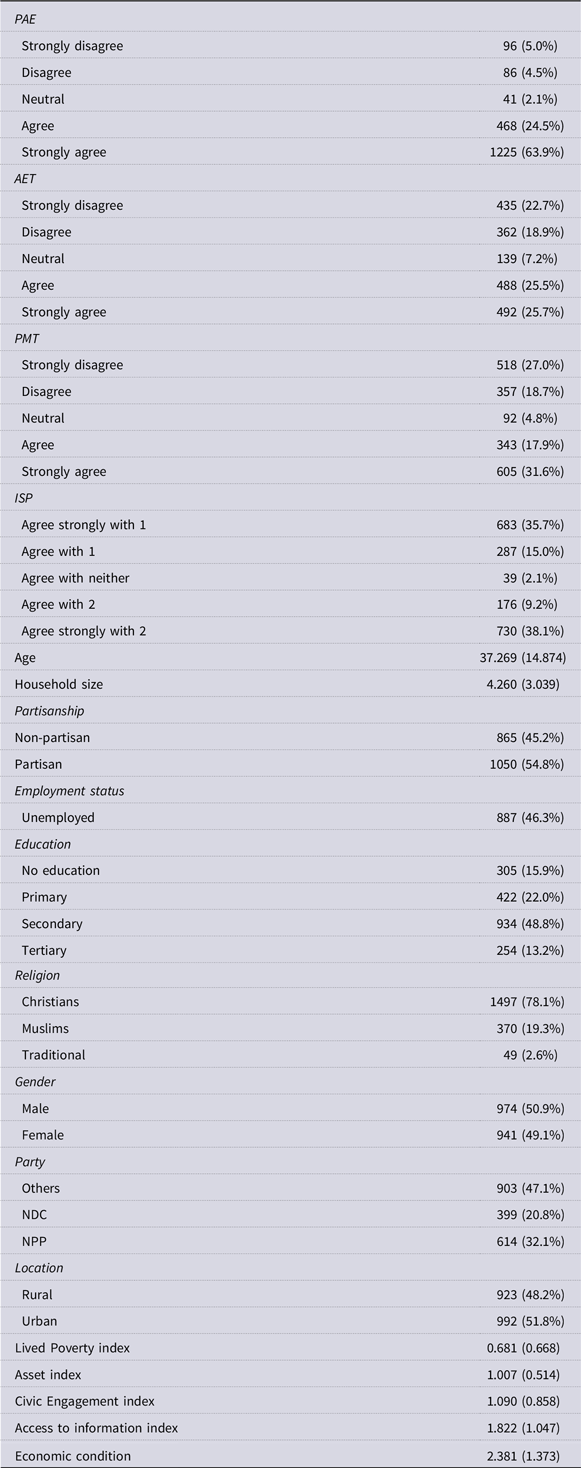
Table 1 presents descriptive statistics for the key manifest and covariate variables. Public endorsement of Free SHS appears broadly positive but not uniform across dimensions. On PAE, over 88 per cent of respondents either agree or strongly agree that the policy has improved access, indicating widespread recognition of its reach. Similarly, nearly 52 per cent of respondents express agreement with AET, suggesting moderate public tolerance for potential costs. Support for PMT is more split, about 50 per cent favour universalism, while the rest lean toward needs-based targeting. ISP are also divided, though 36 per cent endorse the proactive rollout approach (agreeing strongly with structured before launch), while 38 per cent defend adaptive execution (launch now, fix later).
Descriptive statistics

Note: PAE – Perceived Access Expansion, AET – Acceptance of Employment Trade-offs, PMT – Preference for Means Targeting, and ISP – Implementation Strategy Preference. Sample size: 1915 following complete case analysis. For categorical variables: Frequency (%) and for continuous variables: Mean (Standard deviation). Source: Author’s own computation.
Demographic patterns show a balanced sample in terms of gender, with slightly more males (51 per cent). A significant portion of the sample identifies as partisan (55 per cent), and the political affiliation distribution reflects national patterns: NPP (32 per cent), NDC (21 per cent), and others (47 per cent). The average respondent is about thirty-seven years old and lives in a household with four adults. Most respondents have at least a secondary education, and just over half are employed. Index measures such as lived poverty and civic engagement exhibit moderate variability, supporting their inclusion in later regression modelling. Taken together, these descriptive patterns highlight substantial heterogeneity in how Ghanaians interpret, justify, and condition their support for Free SHS, underscoring the analytical value of identifying underlying subgroups through LCA.
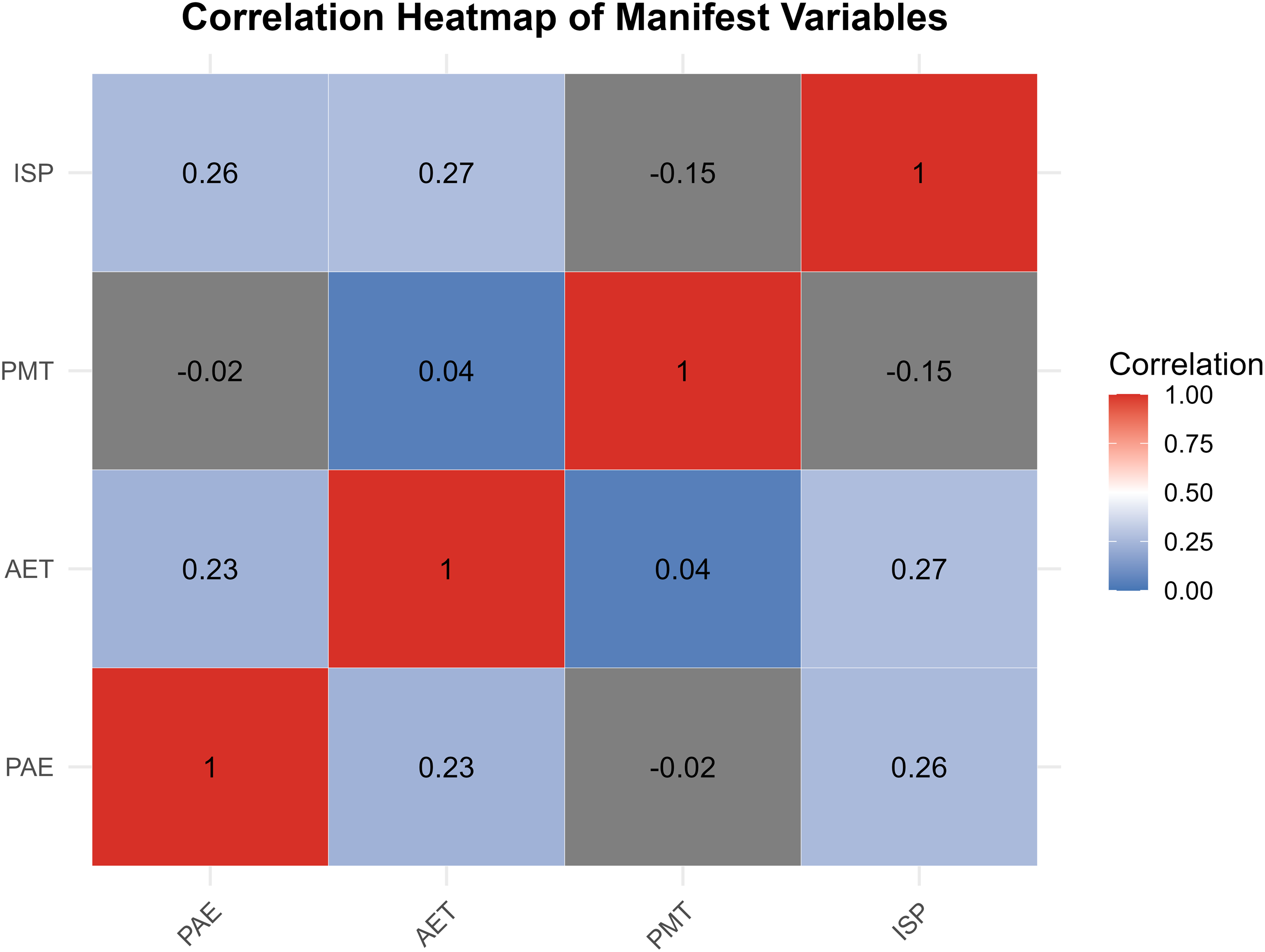
The correlation heatmap presented in Figure 1 reveals weak associations among the manifest indicators used in the latent class model. The absence of strong pairwise correlations suggests that each variable provides unique information in distinguishing between latent subgroups. This pattern offers preliminary support for key assumptions underpinning LCA, namely, local independence, indicator-specific contribution, and conditional independence (Baye et al., Reference Baye, Zia, Merrill, Clark, Smith and Koliba2024). In short, the indicators appear to function independently within classes, reinforcing the appropriateness of the LCA framework.
Heatmap of manifest variables.
Note: PAE – Perceived Access Expansion, AET – Acceptance of Employment Trade-offs, PMT – Preference for Means Targeting, and ISP – Implementation Strategy Preference.
Source: Author’s own computation.

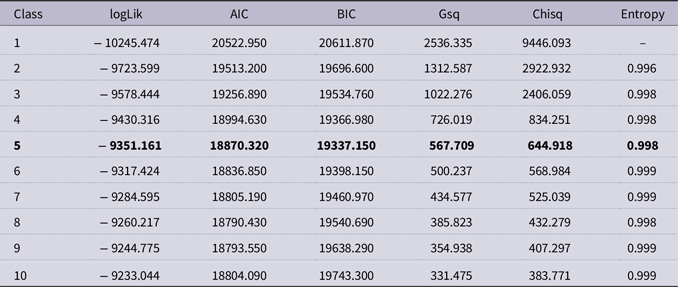
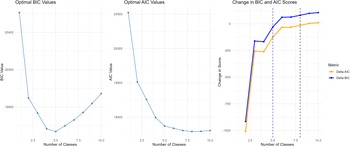
To determine the optimal number of latent classes, I estimated models with 1 to 10 classes and compared them using multiple statistical fit indices and visual diagnostics. As shown in Table 2 and the grid search plots (Figure 2), the five-class model yields the lowest BIC (19337.15), which is widely regarded as the most reliable criterion in latent class modelling due to its stronger penalty for model complexity. Although AIC continues to decrease beyond five classes, the improvements are marginal, and the corresponding entropy (0.998) indicates excellent classification quality. Additionally, the ‘elbow’ in the change-in-slope plots for ΔBIC further corroborates the five-class solution as the point of diminishing returns. Taken together, these statistical and visual criteria justify the selection of a five-class model as the most parsimonious and substantively meaningful representation of the underlying heterogeneity in public opinion toward the Free SHS policy.
Fit statistics for LCA models

Note: log likelihood (logLik), Akaike information criterion (AIC), Bayes information criterion (BIC), Likelihood ratio/deviance statistic (Gsq), Pearson Chi-square goodness-of-fit statistic (Chisq). The bolded row signifies the optimal number of class.
Grid search for the optimal BIC and AIC classes. AIC represents Akaike information criterion and BIC, Bayes information criterion.
Source: Author’s own computation.

LCA results
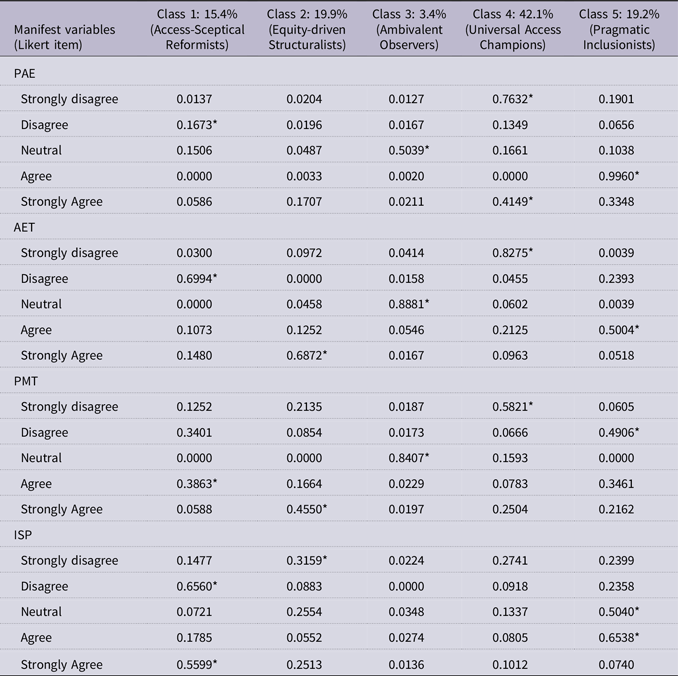
Table 3 presents the class proportions and item response probabilities from the LCA, complemented by Figure 3. The first group, representing 15.4 per cent of respondents, is labelled Access-Sceptical Reformists. This class adopts a measured, often critical, view of Free SHS; only 5.9 per cent strongly agree that access has improved, while many express neutrality or disagreement, indicating doubts about the policy’s reach. Nearly 70 per cent reject trade-offs like increased unemployment, reflecting concerns over unproductive credential inflation (Bennel, Reference Bennell2021). On targeting, views are divided; around 39 per cent favour means-testing, though many remain uncertain, likely due to fairness or administrative challenges (Muhammed and Kuyini, Reference Mohammed and Kuyini2021). At the same time, over 73 per cent support adaptive implementation despite infrastructural shortfalls, consistent with evidence that fee abolition often generates capacity pressures that elicit calls for pragmatic adjustment rather than wholesale reversal (Gruijters et al., Reference Gruijters, Abango and Casely-Hayford2024; Kimenyi, Reference Kimenyi2013), echoing findings from advanced democracies that fiscal and capacity constraints under universal education reforms lead publics to favour adaptive design over outright retrenchment (Bell, Reference Bell2020; Garritzmann, Reference Garritzmann2016).
Item response probabilities

Note: * indicates the highest probabilities per indicator across classes. Estimated Response Probabilities by Latent Class (N = 1915). PAE – Perceived Access Expansion, AET – Acceptance of Employment Trade-offs, PMT – Preference for Means Targeting, and ISP – Implementation Strategy Preference. Source: Author’s own computation.
Visualisation of item response probabilities of the 5 classes. PAE – Perceived Access Expansion, AET – Acceptance of Employment Trade-offs, PMT – Preference for Means Targeting, and ISP – Implementation Strategy Preference.
Source: Author’s own computation.

The second latent group, termed Equity-Driven Structuralists, prioritises fairness and institutional readiness in evaluating Free SHS. Representing 19.9 per cent of respondents, this group strongly endorses poverty-targeting, 45.5 per cent favour directing benefits to poorer households, the highest across classes, reflecting enduring tensions between universalism and equity in social policy design (Mkandawire, Reference Mkandawire2005) and evidence that support for free education is conditioned by perceived distributive fairness (Busemeyer and Garritzmann, Reference Busemeyer and Garritzmann2017; Bell, Reference Bell2020). They also reject trade-offs, with 66 per cent opposing outcomes such as rising unemployment, echoing concerns about limited labour-market absorption (Adu-Ababio and Osei, Reference Adu-Ababio and Osei2018). Scepticism toward access gains is pronounced; only 17 per cent strongly affirm improved access. This cautious stance extends to implementation, aligning with deservingness heuristics that privilege need, fairness, and institutional capacity over symbolic universalism (Van Oorschot, Reference Van Oorschot2006; Dwomoh et al., Reference Dwomoh, Tetteh, Otoo, Hazlett, Godi, Amoatey and Tornyevah2022).
The third group, Ambivalent Observers, represents a small but analytically important segment marked by diffuse and weakly crystallised attitudes across all policy dimensions. Only 14.8 per cent strongly affirm improved access, while nearly half select neutral responses. Ambivalence is even more pronounced regarding trade-offs, with over 60 per cent choosing neutrality when asked about potential consequences such as youth unemployment. Similar patterns appear for targeting and implementation, where no dominant preference emerges. This pattern is consistent with empirical evidence that ambivalence often reflects the simultaneous endorsement of competing values and considerations, producing unresolved evaluations rather than principled support or opposition (Gainous et al., Reference Gainous, Martinez and Craig2010). While not opposed to Free SHS, this group’s uncertainty signals a vulnerability for participatory legitimacy, as weakly crystallised attitudes may translate into fragile or unstable support.
The fourth group, Universal Access Champions, exhibits consistently strong support across all dimensions of Free SHS, marking them as the most closely aligned with its universalist goals. A substantial 77 per cent strongly agree that access has improved, while 64 per cent accept trade-offs such as potential unemployment in pursuit of broader inclusion. Their overwhelming rejection of means-testing (73 per cent) further signals a preference for universal delivery over targeted provision. Even in the presence of infrastructural gaps, over 60 per cent support continued implementation, indicating a willingness to prioritise access over procedural perfection. These response patterns align with normative arguments that frame education not merely as an equity-enhancing tool, but as a social right that warrants broad provision (McQuade, Reference McQuade2022). In Ghana, where education carries deep symbolic and intergenerational value, such support reflects strong endorsement of the state’s role in expanding opportunity despite short-term frictions, corroborating evidence from the United States showing that universal tuition-free designs are widely perceived as fairer than means-tested alternatives (Bell, Reference Bell2020).
The final class, Pragmatic Inclusionists, comprises respondents whose support for Free SHS is conditioned by feasibility and fairness rather than ideological commitment. While 52 per cent agree that the policy has expanded access, their endorsement is more restrained than that of Universal Access Champions. Caution is most evident regarding trade-offs: only 34 per cent accept potential adverse effects such as overcrowding or graduate underemployment, underscoring a demand for quality assurance alongside expansion (Dwomoh et al., Reference Dwomoh, Tetteh, Otoo, Hazlett, Godi, Amoatey and Tornyevah2022). Fifty-seven per cent favour means-testing, reflecting distributive equity concerns and a preference for prioritising the most vulnerable. Views on implementation are divided between structured and adaptive approaches, revealing uncertainty about how best to balance urgency with institutional capacity, consistent with Casely-Hayford et al.’s (Reference Casely-Hayford, Gruijters, Adjei and Yeboah2025) argument that current design risks excluding low-income students and calls for a more progressive universalism. Overall, this group supports universal education in principle but insists it be pursued through careful, accountable design, hence its pragmatic orientation.
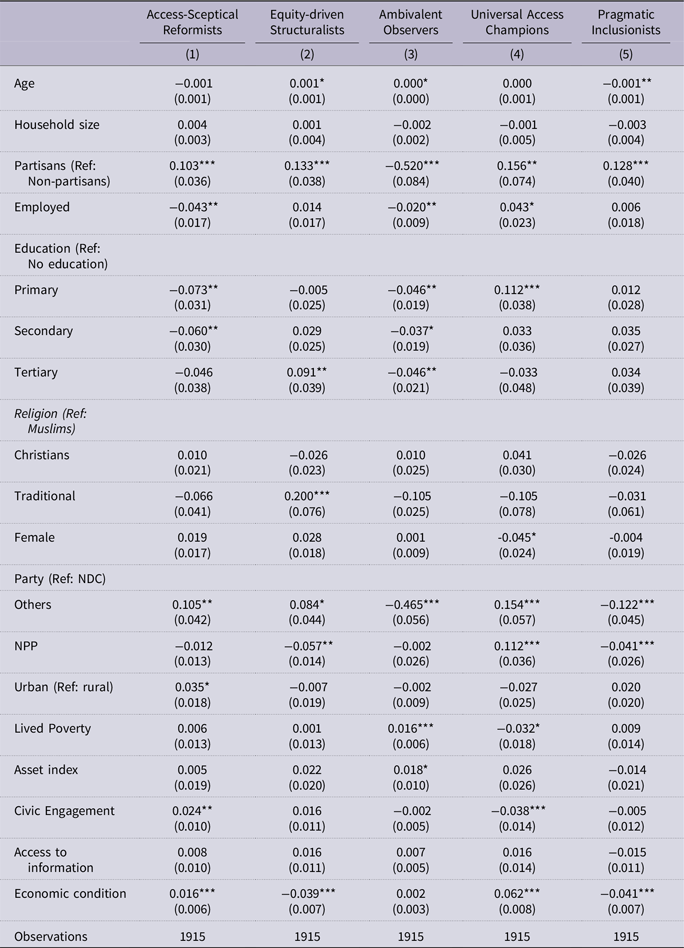
Considering the regression results from the multinomial logit as shown in Table 4, several predictors were found to be associated with the respective classes. Partisan identity is among the strongest predictors of latent class membership. Relative to non-partisans, individuals aligned with any political party are significantly more likely to belong to the Universal Access Champions class, with a marginal effect of 15.6 percentage points; similar effects appear for Access-Sceptical Reformists, Equity-Driven Structuralists, and Pragmatic Inclusionists (10–14 percentage points). These patterns suggest that support for Free SHS is shaped less by policy content than by partisan loyalty, consistent with motivated reasoning in young democracies (Stoecker, Reference Stoecker2023). Universal Access Champions disproportionately identify with the ruling NPP, reinforcing claims that Free SHS functions as a partisan instrument (Bonsu et al., Reference Bonsu, Suhuyini, Otchere-Ankrah, Adjei-Bamfo and Silveira2025), though this contrasts with null findings in Dzordzormenyoh et al. (Reference Dzordzormenyoh, Amoah, Dzordzormenyoh and Domeh2025). Pragmatic Inclusionists are more likely to affiliate with the NDC, while Ambivalent Observers show the weakest partisan attachment, signalling political disengagement.
Determinants of public perception of the Free SHS policy

Note: The results presented are the average marginal effects (AMEs). Ref implies reference category. Standard errors in parentheses. ***p < 0.01, **p < 0.05, *p < 0.1. Source: Author’s own computation.
Educational attainment shapes how citizens reason about Free SHS, not just whether they support it. Compared to those with no formal schooling, educated respondents are less likely to be Access-Sceptical Reformists or Ambivalent Observers, suggesting that schooling fosters clearer policy evaluations. Those with only primary education are most likely to become Universal Access Champions, consistent with early schooling reinforcing universalist norms and the perception of education as a social right. By contrast, tertiary-educated individuals disproportionately align with Equity-Driven Structuralists, reflecting heightened sensitivity to distributive fairness and institutional design (Mkandawire, Reference Mkandawire2005). Civic engagement further sharpens these distinctions: politically active citizens are more likely to adopt sceptical or conditional positions, indicating a shift from symbolic endorsement toward evaluative scrutiny.
Economic experiences deepen these patterns. Optimism about economic conditions amplifies universalist support, while pessimism channels citizens toward conditional or reform-oriented classes. Age and employment status also matter; younger and economically secure respondents lean toward pragmatic inclusion, whereas older, unemployed, and urban residents, more exposed to service constraints, gravitate toward conditional or sceptical positions. Notably, access to information alone does not sort attitudes, underscoring that perceptions of Free SHS are shaped less by awareness than by lived experience, identity, and interpretive frames (Carlson, Reference Carlson2016; Stoecker, Reference Stoecker2023).
Conclusion and policy recommendations
This article uncovers the heterogeneity underlying public attitudes toward Ghana’s Free SHS policy, challenging the notion that support for expansive education reforms is either uniform or uncritical. Through a latent class approach, I identified five distinct attitudinal constituencies, Universal Access Champions, Pragmatic Inclusionists, Equity-Driven Structuralists, Access-Sceptical Reformists, and Ambivalent Observers, each reflecting unique combinations of values, trade-off tolerances, and design expectations. These segments are not only theoretically illuminating but substantively consequential for understanding how citizens make sense of education policies in a low-to-middle-income democracy. By linking latent classes to political, demographic, and socioeconomic predictors, the analysis demonstrates that support for Free SHS is filtered through lived realities, ideological commitments, and political affiliation. Notably, civic engagement and partisanship consistently shape class membership, affirming the role of political identity and informational exposure in structuring policy preferences. Likewise, economic vulnerability and perceived national conditions sharpen policy scepticism, especially among those who experience the burdens of implementation most acutely.
These findings offer class-specific insights for democratic governance and education policy design. For Universal Access Champions, whose support is ideologically grounded and tolerant of trade-offs, sustaining legitimacy requires visible delivery improvements, particularly reducing overcrowding through incremental infrastructure expansion, classroom decongestion, and teacher redeployment to high-enrolment districts. For Equity-Driven Structuralists and Pragmatic Inclusionists, support is conditional on fairness and feasibility; policy communication should emphasise transparent targeting, phased capacity expansion, and credible implementation sequencing rather than blanket universalism. The presence of Ambivalent Observers highlights a civic blind spot: expanding civic literacy for this group requires low-cost, non-partisan communication strategies, such as community forums, simplified policy briefs in local languages, and radio programming, that clarify policy goals and constraints. Finally, concerns about graduate unemployment, especially salient among reform-oriented groups, underscore the need to pair Free SHS with labour-aligned interventions, including strengthened technical and vocational education and training pathways (TVET), secondary-level career guidance, and partnerships with local firms. Together, these strategies suggest that sustaining support depends not only on access, but on aligning delivery and communication with heterogeneous public expectations.
This article is not without limitations. First, the attitudinal classes reflect a single moment in time and may evolve with shifts in political discourse or economic conditions. Future research should track these changes and assess whether class membership predicts behaviour such as voting, school choice, or protest. Also, the study relies on secondary survey data not designed specifically to test policy feedback or deservingness mechanisms, which limits control over measurement and question timing. Consequently, the analysis captures citizens’ reported attitudes rather than directly observing how policies shape beliefs or behaviour. Future research could complement these findings with qualitative or experimental evidence.
Data availability statement
The data used in this study are publicly available through the Afrobarometer data portal: https://www.afrobarometer.org/survey-resource/ghana-round-8-data-2019/.
Acknowledgements
I thank the three anonymous reviewers for their constructive comments. I am also grateful to Dr Richmond Silvanus Baye for his thoughtful feedback on this manuscript. Finally, I acknowledge Afrobarometer for making its survey data publicly available, which made this research possible.
Author contributions
The author solely conceived, designed, analysed, and wrote the manuscript.
Financial support
The author is grateful for the Open Access funding agreement between the University of North Carolina at Charlotte and Cambridge University Press.
Competing interests
The author declares none.


 Open access

