





Introduction
Dirofilaria immitis is a filarial nematode commonly referred to as heartworm. It is transmitted to a variety of vertebrate hosts, primarily dogs, but also cats, wild animals, and occasionally humans through the bite of infected mosquitoes (Simón et al., Reference Simón, Siles-Lucas, Morchón, González-Miguel, Mellado, Carretón and Montoya-Alonso2012; Dantas-Torres and Otranto, Reference Dantas-Torres and Otranto2020; Alsarraf et al., Reference Alsarraf, Carretón, Ciuca, Diakou, Dwużnik-Szarek and Fuehrer2023).
In most cases, heartworm disease in dogs presents as a subclinical infection, with no apparent clinical signs (American Heartworm Society, 2024). However, in advanced stages, affected dogs may exhibit coughing, dyspnea, episodic collapse, anorexia, weight loss, ascites, anemia and thrombocytopenia, which may evolve to a potentially fatal condition (McCall et al., Reference McCall, Genchi, Kramer, Guerrero and Venco2008; Simón et al., Reference Simón, Siles-Lucas, Morchón, González-Miguel, Mellado, Carretón and Montoya-Alonso2012; Bendas et al., Reference Bendas, Alberigi, Galardo, Labarthe and Mendes-de-Almeida2022; Lemos et al., Reference Lemos, Alberigi, Labarthe, Knacfuss, Baldani and da Silva2022).
Adult worms reside primarily in the pulmonary arteries, where they contribute to the development of pulmonary hypertension followed in the most severe cases by right-sided congestive heart failure (Serrano-Parreño et al., Reference Serrano-Parreño, Carretón, Caro-Vadillo, Falcón-Cordón, Falcón-Cordón and Montoya-Alonso2017). This condition leads to reduced perfusion of peripheral organs due to cardiopulmonary impairment, resulting in secondary damage to the lungs, liver, kidneys, and overall deterioration of the animal’s health (Pasca et al., Reference Pasca, Acatrinei, Oprean and Lazar2012).
The diagnosis of heartworm disease in dogs is primarily based on the detection of circulating antigens and microfilariae, along with clinical evaluation and diagnostic imaging findings (Nelson et al., Reference Nelson, McCall, Jones and Moorhead2018; Smith et al., Reference Smith, Tomlinson, Bowles and Starkey2024).
As melarsomine dihydrochloride is not available in Brazil, the treatment of canine heartworm disease typically involves a combination of macrocyclic lactones and antibiotics, particularly doxycycline, as part of an adulticidal protocol (Moraes-da-Silva et al., Reference Moraes-da-Silva, Mendes-de-Almeida, Abdalla, Merlo, Paiva and Labarthe2016; Nelson et al., Reference Nelson, McCall, Jones and Moorhead2020; Jacobson and DiGangi, Reference Jacobson and DiGangi2021).
Although there are no published studies determining the prevalence of D. immitis in dogs in the state of Rio Grande do Norte, documented occurrences of the disease have been reported in the region (Moraes et al., Reference Moraes, Souza Pollo, Marques, de Souza Góis, Ferreira, da Silva and Hoppe2021; Silva et al., Reference Silva, Gomes, Francisco, Silva, Oliveira Filho, Feitosa and Vilela2023). These findings indicate that the parasite is indeed circulating in the state, highlighting the potential risk of transmission to the local human population.
Canine heartworm disease is a parasitic condition of significant clinical relevance in veterinary medicine, particularly in endemic regions such as Brazil. While many infections remain asymptomatic or present with mild clinical signs, severe and atypical manifestations can occur and require careful clinical attention. This report aims to describe a rare case of expectoration of blood-tinged bronchial mucus containing adult D. immitis worms following treatment with doxycycline and moxidectin.
Case report
A seven-year-old intact male Yorkshire terrier from Mossoró, Rio Grande do Norte, Brazil (05°11’16.8’’ S, 37°20’38.4’’ W), was referred to the veterinary cardiology service in July 2024 following the echocardiographic identification of structures consistent with D. immitis. The dog was asymptomatic, with a history of intermittent coughing.
On clinical examination, the patient presented with a systolic blood pressure of 140 mmHg, a heart rate of 120 bpm, and a grade III/VI tricuspid murmur. Electrocardiographic evaluation revealed sinus arrhythmia with a single ventricular premature complex (VPC). A rapid antigen test for D. immitis (Alere® Ag, Alere Inc., Waltham, MA, USA) scored positive. Treatment was initiated with oral doxycycline (10 mg/kg, BID for 30 days) and a subcutaneous injection of sustained-release moxidectin (ProHeart® SR-12; 0.05 mL/kg). The owner was advised to implement strict exercise restriction for the duration of the treatment protocol.
Nine days later, the patient returned with signs of apathy and mild dyspnea. Thoracic radiographs revealed diffuse inflammatory bronchopneumopathy and pulmonary hypervascularization. Prednisolone therapy was initiated, along with nebulization using isotonic saline.
Three weeks later, the dog presented with acute onset of coughing, hemoptysis, and marked dyspnea, accompanied by muffled pulmonary sounds on auscultation. The patient was hospitalized and treated with oxygen supplementation, butorphanol (0.02 mg/kg, QID), dexamethasone (0.5 mg/kg, SID), and dipyrone (25 mg/kg, BID).
Within hours, the dog experienced repeated episodes of intense coughing with progressive expectoration, beginning with foamy, whitish mucus and evolving into copious bloody discharge. During one of these episodes, two live nematodes were expelled orally. The specimens consisted of one male and one female, measuring 14 cm and 30 cm in length, respectively, with an approximate diameter of 3 mm (Figure 1).
Filarial worm expelled by the dog following an episode of hemoptysis.
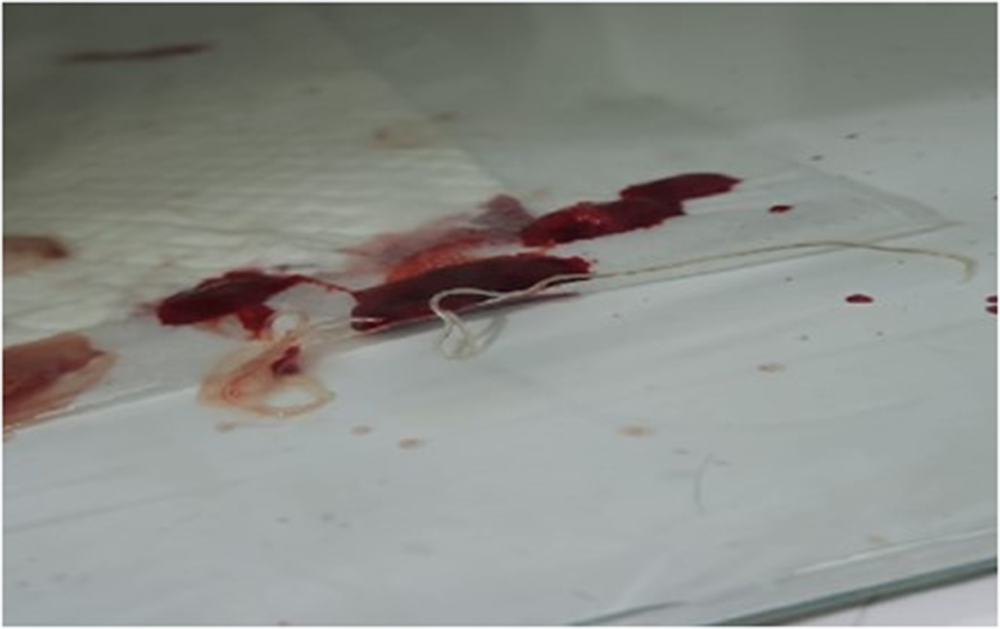
Figure 1 Long description
Title text: Blood bronchial mucus with Dirofilaria immitis adult worms after the treatment with doxycycline and moxidectin: a rare case presentation. Section heading: Rare case presentation. An illustration shows lungs and a dog silhouette. Text: A male dog, with no previous clinical alterations, was submitted to heartworm treatment with doxycycline and a single dose of injectable moxidectin. A downward arrow connects to the next text block: Three weeks later, the dog presented with acute coughing, hemoptysis and marked dyspnea and two live worms were expelled through coughing. A separate text block includes a microscope icon and a DNA icon. Text: The nematodes specimens (1 male and 1 female) were collected from bronchial mucus and morphologically and molecularly identified as Dirofilaria immitis. Text: A fragment of 635 bp of the cytochrome oxidase C subunit 1 gene was sequenced and deposited at the GenBank database (Accession number: PV729978). Section heading: Conclusions. Bullet points: This is the first documented case in Brazil of bronchial expectoration of live adult Dirofilaria immitis worms in a dog; The event occurred following treatment with doxycycline and injectable moxidectin, indicating a potential complication associated with this therapeutic approach; The case highlights the importance of individualized treatment protocols and increased clinical vigilance regarding atypical and severe presentations of canine heartworm disease.
Due to the severity of hemorrhagic complications, tranexamic acid (25 mg/kg, TID) was administered. The patient’s respiratory status improved gradually. Follow-up thoracic radiographs revealed persistent diffuse bronchopneumopathy, enlargement of the pulmonary arteries, and prominence of the pulmonary trunk. Doppler echocardiography confirmed pulmonary valve insufficiency.
Additionally, mild pulmonary hypertension (estimated systolic pulmonary arterial pressure of 38 mmHg), thickening of the tricuspid valve, moderate right-sided cardiac chamber remodeling, and the presence of filarial worms within a branch of the right pulmonary artery were identified. Three days after hospitalization, the patient exhibited stable clinical parameters with no recurrence of clinical signs.
Both of worms was observed morphologically and identified as D. immitis according Khanmohammadi et al. (Reference Khanmohammadi, Akhlaghi, Razmjou, Falak, Zolfaghari Emameh, Mokhtarian, Arshadi, Tasbihi and Meamar2020). Fragments of adult worms were subjected to DNA extraction using the commercial NucleoSpin Tissue kit (Macherey-Nagel GmbH & Co. KG, Düren, Germany), following the manufacturer’s protocol. The extracted genomic DNA was quantified by spectrophotometry using a NanoDrop™ Lite instrument (Thermo Fisher Scientific, Waltham, MA, USA), and samples were stored at – 20 °C until polymerase chain reaction (PCR) analysis.
A 635 bp fragment of the mitochondrial cytochrome C oxidase subunit I (COI) gene, specific to filarial nematodes, was amplified by conventional PCR using the primers COIintF and COIintR as described by Casiraghi et al. (Reference Casiraghi, Anderson, Bandi, Bazzocchi and Genchi2001). PCR amplification was performed under the following cycling conditions: an initial denaturation at 95 °C for 2 minutes; 40 cycles of denaturation at 95 °C for 45 seconds, annealing at 52 °C for 45 seconds, and extension at 72 °C for 90 seconds; followed by a final extension at 72 °C for 5 minutes.
Each PCR reaction was carried out in a final volume of 15 μL, containing 6.75 μL of GoTaq® G2 Green Master Mix (Promega Corporation, Madison, WI, USA), 1 μL of each primer (10 μM), 3.25 μL of DEPC-treated water, and 3 μL of template DNA. A positive control consisting of DNA from a previously confirmed positive sample was included, along with DEPC-treated water as a negative control.
The PCR amplicons were subjected to electrophoresis on a 1.5% agarose gel prepared in 1 × TAE buffer (Tris-acetate-EDTA), with Blue Green (LCG Biotecnologia Ltda., Cotia, SP, Brazil) used as the nucleic acid stain. A 100 bp molecular weight marker (GeneDirex®, Taoyuan, Taiwan) was employed to estimate the size of the amplified fragments, following the manufacturer’s guidelines. After electrophoresis, the gel was visualized under ultraviolet (UV) illumination using a transilluminator equipped with a digital imaging system.
PCR products were purified using a silica membrane-based protocol provided by the commercial PureLink™ Quick Gel Extraction and PCR Purification Combo Kit (Thermo Fisher Scientific, Waltham, MA, USA), according to the manufacturer’s instructions. DNA concentration and purity were assessed via spectrophotometry (NanoDrop™ Spectrophotometer, Thermo Fisher Scientific, Waltham, MA, USA).
Sequencing was conducted at the Human Molecular Genetics Laboratory of the Federal University of Pernambuco using the Sanger method with forward and reverse primers. Resulting sense and antisense chromatograms were quality-trimmed and assembled using BioEdit software (version 7.2.5). The consensus sequences were aligned and compared to entries in the GenBank® nucleotide database using the BLAST® algorithm to confirm sequence identity. The partial sequence of the cytochrome c oxidase subunit I (COI) gene obtained in this study was deposited in the GenBank database under the accession number PV729978.
Discussion
Most D. immitis infections are either asymptomatic or present with mild clinical signs, such as intermittent coughing, as observed in the present case (Vieira et al., Reference Vieira, Vieira, Oliveira, Simões, Diez-Baños and Gestal2014; Pietrzak et al., Reference Pietrzak, Łuczak and Wiśniewski2024).
Thoracic radiography proved to be a valuable diagnostic tool for detecting pulmonary alterations consistent with heartworm infection and for guiding supportive therapeutic interventions. However, thoracic radiographs may have limited sensitivity for identifying early or subtle vascular changes and may underestimate thromboembolic involvement, particularly when concurrent pulmonary disease is present (Falcón-Cordón et al., Reference Falcón-Cordón, Falcón-Cordón, Caro-Vadillo, Costa-Rodríguez, Montoya-Alonso and Carretón2024).
In such cases, computed tomography (CT), especially CT angiography, can provide higher-resolution visualization of pulmonary arterial branches and parenchymal lesions, serving as a useful complementary imaging modality (Jung et al., Reference Jung, Chang, Oh, Yoon and Choi2010). Nevertheless, in the present case, radiographic findings were informative and underscored that even clinically asymptomatic animals may exhibit significant pulmonary pathology during the subclinical stages of the disease (Lima et al., Reference Lima, de Paula, Mattos, Soares, Silva and Alberigi2025). Clinical findings such as tricuspid murmur and pulmonary valve regurgitation were considered common alterations in dogs infected with D. immitis (Lemos et al., Reference Lemos, Alberigi, Labarthe, Knacfuss, Baldani and da Silva2022).
Ectopic migration of D. immitis to anatomical locations beyond the heart and pulmonary arteries has been documented, with adult worms identified in the abdominal cavity, central nervous system, subcutaneous tissue, and ocular conjunctiva. However, the underlying pathophysiological mechanisms facilitating such aberrant migration remain poorly elucidated (Kotani et al., Reference Kotani, Tomimura, Ogura, Mochizuki and Horie1975; Goh et al., Reference Goh, Kim, Alkathiri, Chang, Yoon, Lee and Park2023; Barnett et al., Reference Barnett, Hammond, Chen, Grimes and Markovic2025).
Although the expectoration of adult D. immitis worms has not been previously reported in the literature, the clinical signs observed in this patient namely coughing, hemoptysis, tachypnea and dyspnea are consistent with pulmonary thromboembolism secondary to the presence of intravascular adult parasites (Ames and Atkins, Reference Ames and Atkins2020; Bendas et al., Reference Bendas, Alberigi, Galardo, Labarthe and Mendes-de-Almeida2022; American Heartworm Society, 2024).
Rishniw et al. (Reference Rishniw, Hess, Rojas, Ritchie, Laws, Staudt and Bowman2012) reported hemoptysis associated with D. immitis infection in five dogs treated with different therapeutic agents for heartworm disease. Hemoptysis, or the expectoration of blood, has been described in cases of heavy heartworm burden in dogs (Greenway et al., Reference Greenway, Rozanski, Johnson, Cornejo, Abelson and Robinson2019; Alberigi et al., Reference Alberigi, Marques de Oliveira Lemos, Nogueira de Farias, Cardozo Paes de Almeida, Mendes-de-Almeida and Labarthe2021). In the present case, we report the first documented occurrence in Brazil of blood-tinged bronchial mucus containing an adult D. immitis worm following treatment with doxycycline and moxidectin.
The molecule choice to treat heartworm infections in dogs is unavailable in many countries where heartworm is endemic (Dantas-Torres et al., Reference Dantas-Torres, Ketzis, Pérez Tort, Mihalca, Baneth, Otranto, Watanabe, Linh, Inpankaew, Borrás, Arumugam, Penzhorn, Ybañez, Irwin and Traub2023) and the combination of doxycycline and macrocyclic lactone as ivermectin or moxidectin are used (Moraes-da-Silva et al., Reference Moraes-da-Silva, Mendes-de-Almeida, Abdalla, Merlo, Paiva and Labarthe2016; Nelson et al., Reference Nelson, McCall, Jones and Moorhead2020; Jacobson and DiGangi, Reference Jacobson and DiGangi2021).
Although coughing and vomiting in dogs can result from a variety of underlying conditions, vomiting has specifically been reported during doxycycline therapy (Schulz et al., Reference Schulz, Hupfauer, Ammer, Sauter-Louis and Hartmann2011).
The exact mechanism underlying filarial expectoration remains unclear. However, it is hypothesized that rupture of the capillaries within the alveolar-capillary barrier may allow the translocation of adult worms typically located in the pulmonary arteries, into the pulmonary alveoli, bronchioles, and the secondary, tertiary, and primary bronchi. This displacement may be facilitated or exacerbated by the cough reflex, which is frequently observed in affected individuals. While the rupture of a single alveolar capillary is unlikely to be fatal, it may initiate a cascade of inflammatory responses, including pneumonia, bronchiolitis, bronchitis, and pleuritis, which can develop in the days following the initial vascular injury.
Rishniw et al. (Reference Rishniw, Hess, Rojas, Ritchie, Laws, Staudt and Bowman2012) described hemoptysis associated with D. immitis infection, demonstrating that substantial pulmonary endothelial injury can result in bloody expectoration even in the absence of a high parasitic burden. These observations support the hypothesis advanced in the present report that expulsion of an adult worm via the airways is more likely attributable to disruption of the capillary–alveolar barrier and subsequent passive translocation of intravascular parasites into the respiratory tract, potentially facilitated by coughing, rather than to erratic migratory behavior. Although erratic migration cannot be entirely excluded, the available evidence favors secondary translocation following vascular rupture as the primary mechanism of airway elimination.
Despite the occurrence of marked hemorrhage associated with worm expectoration, the condition was promptly stabilized, and the patient was discharged following three days of hospitalization. The caregiver was advised regarding the potential for long-term pulmonary sequelae secondary to parasitic infection. The authors emphasize that both hemoptysis and hematemesis, even when accompanied by the presence of adult parasites, may occur in cases of canine dirofilariosis and do not necessarily signify a severe or life-threatening stage of the disease.
Author contributions
Larissa Leykman da Costa Nogueira and Bruno Vinicios Silva de Araújo: Conceptualization, Data curation, Formal analysis, Investigation, Methodology; Moacir Bezerra de Andrade, Rafael Antonio Nascimento Ramos, Norma Vollmer Labarthe, Renata Pimentel Bandeira de Melo and João Marcelo Azevedo de Paula Antunes: Methodology, Writing - review & editing; Leucio Câmara Alves: Funding acquisition, Methodology, Project administration, Resources, Supervision, Writing - review & editing.
Financial support
This research received no specific grant from any funding agency, commercial or not-for-profit sectors.
Competing interests
The authors declare there are no conflicts of interest.
Ethical standards
Not applicable.

 Open access

