


1. Introduction
Personalized or precision medicine (PM) aims to tailor health interventions to individual characteristics, particularly molecular biomarkers. Proponents hail PM as a “revolution” in medicine (Ashley Reference Ashley2015), poised to solve 21st-century health problems (Collins and Varmus Reference Collins and Varmus2015), whereas critics challenge the hype (Plutynski Reference Plutynski, Beneduce and Bertolaso2022; Tabery Reference Tabery2023). At present, PM is best characterized as a research program—one that may or may not bear fruit. This raises the question: Is PM strategically fruitful? Is PM a uniquely or especially effective strategy for promoting individual and/or population health?
Some argue that PM is ill-suited to improving population health, which historically benefited most from systemic practices such as sanitation or vaccination—not individualized treatment (Khoury and Galea Reference Khoury and Galea2016). Epidemiologist Geoffrey Rose (Reference Rose1985) famously distinguished between high-risk and population strategies, where the former targets interventions to sick individuals and the latter to sick populations. Rose’s prevention paradox captures a tension: The population strategy may bring large benefits to the population while bringing little benefit to each individual.
PM presents the opposite possibility—call it the PM paradox: PM may bring large benefits to individuals while bringing little benefit to the population. PM’s tailoring of treatments to sick individuals using molecular biomarkers appears to be a high-risk strategy, and thus it is in tension with the aims of population health. PM is also likened to the “magic-bullet” strategy, developed by chemist Paul Ehrlich (Reference Ehrlich1908), seeking to selectively disrupt disease-causing cells or mechanisms in affected individuals while sparing healthy ones. In PM, molecular biomarkers mark the precise people and mechanisms targeted by an intervention.
To evaluate PM’s promise, this article analyzes distinct strategies that fall under its banner. Section 2 lays the groundwork, identifying four basic determinants of the population impact of a health intervention. Section 3 maps these onto three PM strategies: biomarker-stratified high-risk-targeting, biomarker-based individual targeting, and biomarker-based disease targeting. We highlight each strategy’s assumptions and alternatives, challenging PM’s claim to unique promise. Section 4 concludes that there is no principled reason to suppose that PM offers the best hope for improving individual or population health—whether PM delivers the best results depends partly on how productive PM research will be compared with research supporting alternative strategies.
Our conclusion is thus a skeptical one. But whereas many have criticized the hype surrounding PM, we criticize the hope: There are strong reasons to doubt that PM is a uniquely effective strategy for treating sick individuals and sick populations.
2. Precision medicine’s population impact
PM remains imprecisely defined (Prasad and Gale Reference Prasad and Gale2017; Tran et al. Reference Tran, Klossner, Crain and Prasad2020), yet most agree its defining aim is to individualize health interventions using molecular biomarkers. Although narrower and broader conceptions exist, this idea of biomarker-based intervention remains central to most accounts (Tabb and Lemoine Reference Tabb and Lemoine2021; Plutynski Reference Plutynski, Beneduce and Bertolaso2022; Chin-Yee Reference Chin-Yee, Schramme and Walker2024; Tabery Reference Tabery2023; Fuller Reference Fuller2025).
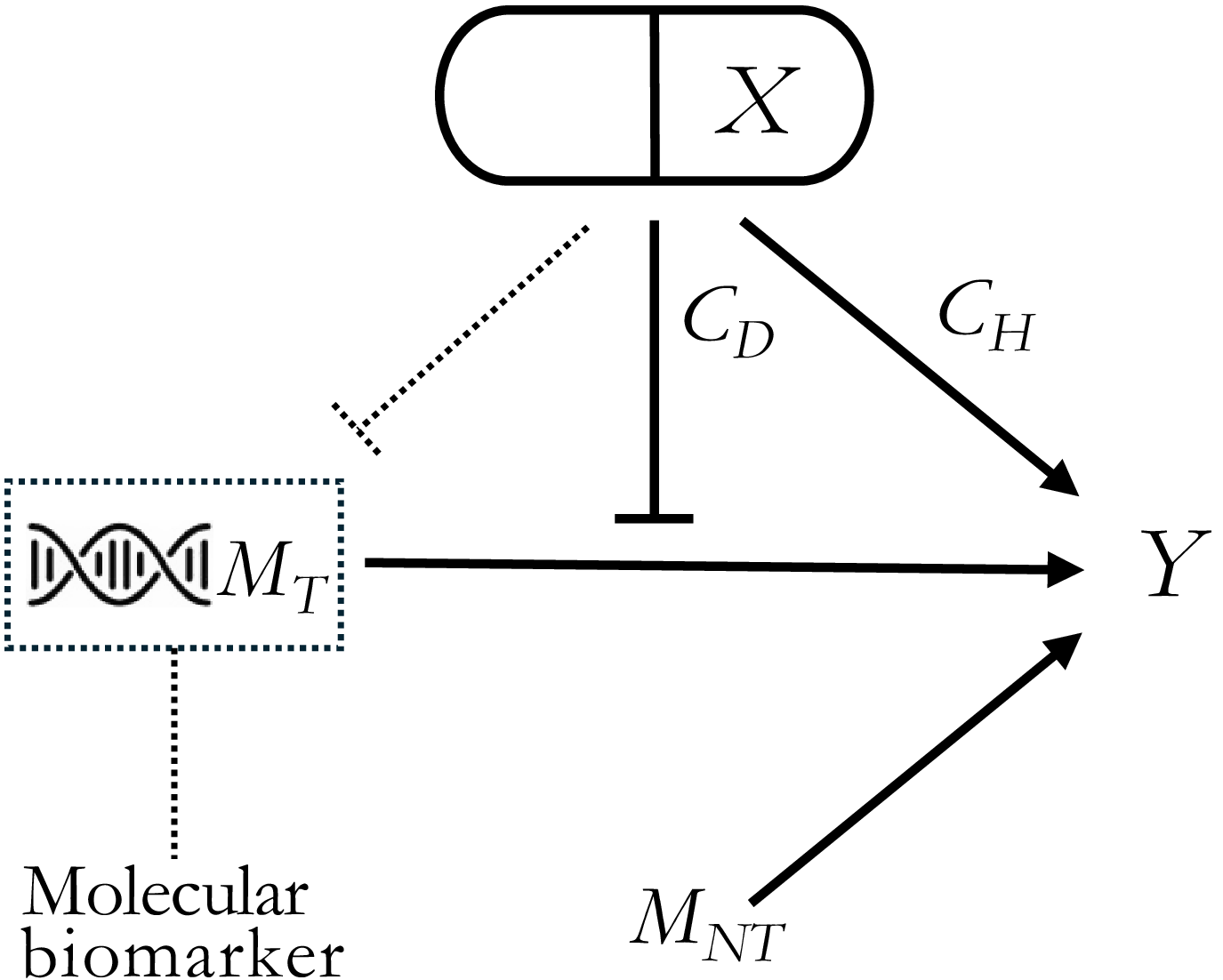
The concept of a molecular biomarker–intervention pair is thus integral to PM. Following Fuller (Reference Fuller2025), for a given biomarker–intervention pair, we can say that the biomarker measures a disease mechanism (MT) targeted by the intervention (X).Footnote 1 Disruption of MT is enabled by the presence of disruption cofactors (CD), which interact with the intervention to disrupt the mechanism and halt it from producing a health outcome (Y), such as death from the disease. There may also be other mechanisms not targeted by X (MNT) that also cause Y, regardless of X. Finally, harm cofactors (CH) can sometimes interact with X to paradoxically cause Y. The causal relationships among these variables are shown schematically in figure 1.
Variables influencing the impact of a PM intervention (X) on a health outcome (Y), which include the presence of a targeted disease mechanism (MT), disruption cofactors (CD), and harm cofactors (CH). Presence of a nontargeted mechanism (MNT) can also affect Y. A molecular biomarker seeks to measure MT as a means of predicting a favorable effect of X on Y.

Consider an example. Imatinib, approved in 2001 for the treatment of chronic myeloid leukemia (CML), is frequently cited as an exemplar of PM. Imatinib inhibits the BCR-ABL1 kinase produced by the BCR::ABL1 fusion gene, the key driver mutation in CML. The BCR::ABL1 oncogene, which drives uncontrolled cell proliferation, is part of the mechanism (MT) targeted by imatinib (X). Imatinib’s efficacy depends on the presence of certain disruption cofactors (CD), which include specific amino acid residues that enable binding to the BCR-ABL1 kinase. In the absence of imatinib, MT causes progression of CML and, ultimately, death (Y). Polymerase chain reaction (PCR)-based measurement of the BCR::ABL1 transcript is the molecular biomarker commonly used to measure MT.
There are also disease mechanisms not targeted by imatinib (MNT). For example, other mechanisms drive distinct types of leukemia, such as the PML::RARA fusion gene found in acute promyelocytic leukemia. Even among individuals with the BCR::ABL1 oncogene, some will lack the necessary disruption cofactors. For example, the BCR-ABL1 kinase produced by the T315I mutation is the most common cause of imatinib resistance, which prevents imatinib from effectively binding. Finally, certain harm cofactors (CH), such as severe liver dysfunction, increase the risk of treatment toxicity with imatinib.
The absolute risk reduction (ARR) is a common way to quantify the efficacy of a health intervention like imatinib in a population, defined as the difference in probability of the outcome Y given nontreatment (P 0(Y)) versus treatment (P 1(Y)): $\rm ARR = {{\it P}_0}\left( {\it Y} \right) {-} {{\it P}_1}\left({\it Y} \right).$
We can model the influence of the causal variables discussed previously on the efficacy of a PM treatment measured using ARR (Fuller Reference Fuller2025). For simplicity, let’s assume that each variable is dichotomous: Variables MT, MNT, CD, and CH are equal to 1 when a complete mechanism or a complete set of cofactors is present for an individual; otherwise, they are equal to 0.Footnote 2 The following relationships, then, generally obtain:Footnote 3 $\rm ARR \propto {\it P}\left( {{\it M_T} = 1,{\it M_{NT}} = 0} \right)$ $\rm ARR \propto {\it P}\left( {{\it C_D} = 1|{\it M_T} = 1,{\it M_{NT}} = 0} \right)$ $\rm ARR \propto 1/{\it P}\left( {{\it C_H} = 1} \right).$
These relationships can be explained as follows. (1) As the probability or proportion of people who have a targeted mechanism (and no nontargeted mechanism) increases, the absolute efficacy (ARR) generally increases because there are more mechanisms available for the intervention to disrupt. (2) As the proportion of these people who also have a complete set of disruption cofactors increases, the ARR also generally increases because disruption cofactors enable the intervention to disrupt its targeted mechanisms. (3) Finally, as the proportion of people with a complete set of harm cofactors increases, the ARR generally decreases because harm cofactors can enable the intervention to produce the same outcome caused by the disease.
Let’s add some numbers. Without imatinib, over 80% of patients with CML die within 10 years (Chen et al. Reference Chen, Wang, Kantarjian and Cortes2013). With imatinib, mortality plummets to less than 20% (Hochhaus et al. Reference Hochhaus, Larson, Guilhot, Radich, Branford and Hughes2017). Thus: $\rm ARR = 80\% {-} 20\% = 60\% .$
These numbers are impressive. Few health interventions achieve such an ARR in mortality. It’s for good reason that imatinib was hailed as a “magic bullet” against CML (Verweij et al. Reference Verweij, Judson and van Oosterom2001). But are such large effect sizes a universal feature of PM interventions?
Unfortunately, they are not. Consider another exemplar of PM. Trastuzumab was approved in 1998 for the treatment of HER2-positive breast cancer. HER2 (human epidermal growth factor 2) is overexpressed in ∼25% of breast cancers and drives tumor growth, leading to poorer outcomes. Trastuzumab binds the HER2 receptor and both blocks its signaling and targets cancer cells expressing it for immune destruction, thus inhibiting tumor growth. HER2 overexpression serves as a key biomarker in breast cancer, predicting a favorable response to trastuzumab.
Trastuzumab was rightfully cited as a “milestone” in breast cancer treatment (Baselga et al. Reference Baselga, Perez, Pienkowski and Bell2006). However, its effect size is more modest than that of imatinib. For patients with HER2-positive breast cancer, surgery followed by chemotherapy results in survival of around 75% at 10 years. Addition of trastuzumab to chemotherapy improves survival to 84% (Perez et al. Reference Perez, Romond, Suman, Jeong, Sledge and Geyer2014): $\rm ARR = 25\% {-} 16\% = 9\% .$
An ARR of 9% in mortality is certainly nothing to scoff at. But it’s a far cry from imatinib’s ARR of 60%. It’s also not much different from other treatments, such as hormone therapy in estrogen-receptor-positive early breast cancers (ARR = 5–10%; Early Breast Cancer Trialists’ Collaborative Group [EBCTCG] 1998) or even conventional chemotherapy (ARR = 4–5%; EBCTCG 2012).
These two examples illustrate a general framework for evaluating the efficacy of PM interventions that can be used to compare PM to other strategies that promote population health. We define the population impact (PI) of a health intervention X as the number of outcomes successfully treated or prevented in a population:Footnote 4 $\rm PI = ARR \times N.$
N is the number of individuals subject to X. This highlights a common criticism of PM: Although its treatments may be effective (high ARR), these benefits accrue rather narrowly (low N), targeting only a small number of individuals with the relevant biomarker (Letai Reference Letai2017). For example, there are around 10,000 new cases of CML and 50,000 new cases of HER2-positive breast cancer diagnosed in the United States each year. Assuming all these patients receive imatinib or trastuzumab, respectively, and focusing on the 10-year impact of treating patients diagnosed that year, we can calculate the PI as follows: $\rm P{I_{imatinib}} = 0.6 \times 10,000 = 6,000.$ $\rm P{I_{trastuzumab}} = 0.09 \times 50,000 = 4,500.$
Imatinib and trastuzumab prevent 6,000 and 4,500 deaths, respectively, over 10 years.
Compare this to smoking cessation. Conservatively estimating an ARR in mortality of 1% at 10 years (Jha et al. Reference Jha, Ramasundarahettige, Landsman, Rostron, Thun and Anderson2013; Cho et al. Reference Cho, Brill, Gram, Brown and Jha2024), if all 30 million smokers in the United States stopped smoking (Centers for Disease Control and Prevention 2023), it would have a massive PI: $\rm P{I_{smoking\ cessation}} = 0.01 \times 30,000,000 = 300,000.$
Despite a far lower ARR than imatinib or trastuzumab, because of the size of the population eligible, smoking cessation prevents far more deaths.
In summary, we can evaluate the PI of a PM intervention in terms of four key determinants: the population size (N), the presence of targeted mechanisms (MT) and nontargeted mechanisms (MNT), the presence of disruption cofactors (CD), and the absence of harm cofactors (CH). Let’s now examine the ways PM might improve population health by optimizing some of these determinants.
3. Three precision medicine strategies
Using this framework, we can identify and evaluate three PM strategies: biomarker-stratified high-risk targeting, biomarker-based individual targeting, and biomarker-based disease targeting. Each strategy seeks to maximize one of the variables influencing PI. Although not always clearly delineated, each strategy is discussed in the PM literature, and proponents sometimes equate PM with one or more of these strategies. Although these strategies could overlap in practice, analyzing them separately reveals their distinct assumptions, success conditions, and viable alternatives.
Before proceeding, it’s worth briefly considering a potential fourth strategy—the personalized population strategy. This strategy involves delivering a personalized intervention to many or most members of the sick population. It amounts to a PM spin on Rose’s population strategy for prevention (Fuller Reference Fuller2022). But whereas Rose (Reference Rose1985) emphasized intervening on a determinant of the population incidence shared by many members of the population (e.g., smoking for lung cancer or salt intake for hypertension), the personalized population strategy instead delivers a tailored intervention to each individual according to their unique biology. This has also been called radical personalized medicine (Fuller Reference Fuller2025) and is exemplified in the PM literature by proposals involving the use of patient-derived organoids (Xia et al. Reference Xia, Li, He, Aji and Gao2019; Green et al. Reference Green, Dam, Svendsen, Beneduce and Bertolaso2022) or in silico modeling of each individual’s unique pathophysiology (Marques et al. Reference Marques, Costa, Pereira, Silva, Santos and Saldanha2024). The strategy would maximize the PI by rendering as many individuals eligible for treatment as possible, thereby maximizing the size N of the population treated (PI ∝ N).
Because it’s too early to say whether such strategies would be widely applicable for diverse interventions and individuals, we will not discuss them further and will instead focus on the three strategies that are more typical of contemporary PM. However, note that unlike the personalized population strategy, the following three strategies are more selective in whom they treat: They treat select individuals based on their molecular biomarkers. In so doing, they restrict the size of the population eligible for treatment. Thus, to have any hope of achieving a substantial population impact, they must maximize the ARR by boosting the other determinants of PI.
3.1. Biomarker-stratified high-risk targeting
Biomarker-stratified high-risk targeting seeks to treat “high-risk” individuals, where molecular biomarkers are used to stratify the population and identify the high-risk subpopulation. Because there are more outcomes of interest (e.g., deaths from the disease) in the high-risk subpopulation, there will be greater potential for successfully preventing outcomes. This approach naturally goes with the term stratified medicine. It is commonly applied in oncology, where molecular biomarkers are used to risk stratify cancers and identify subpopulations that benefit from intensive treatment (Döhner et al. Reference Döhner, Estey, Grimwade, Amadori, Appelbaum and Büchner2017).
This strategy can be understood as a variant of Rose’s high-risk strategy, selecting individuals at high risk of a disease outcome but doing so using molecular biomarkers rather than traditional clinical risk factors. Classic non-PM examples of a high-risk strategy include treating individuals with cholesterol-lowering statins or blood-pressure-lowering antihypertensives, respectively, where risk factors such as high low-density lipoprotein (LDL) cholesterol or high blood pressure are used to identify individuals at high risk of cardiovascular events. The PM high-risk strategy follows the same approach but uses a molecular biomarker—for example, using pathogenic BRCA1 mutations to identify individuals at high risk of breast cancer who are candidates for prophylactic mastectomy. It may also use multiple molecular biomarkers, as in polygenic risk scores (Sugrue and Desikan Reference Sugrue and Desikan2019).
Biomarker-stratified high-risk targeting seeks to maximize the probability of disease outcomes due to a targeted disease mechanism, MT, and, in so doing, maximize PI because PI ∝ P(MT = 1, MNT = 0). This strategy assumes that the high probability of disease is due specifically to targeted disease mechanisms and that the intervention is efficient at disrupting them, which is the case with pathogenic BRCA1 mutations and prophylactic mastectomy. However, it is not the case for many prognostic biomarkers that predict high risk of disease but for which there is no intervention to disrupt the mechanism, as with clonal hematopoiesis of indeterminate potential (CHIP) mutations and leukemia (Jaiswal et al. Reference Jaiswal, Fontanillas, Flannick, Manning, Grauman and Mar2014).
An alternative to biomarker-stratified high-risk targeting is the use of traditional multivariate risk prediction to stratify a population. In oncology, molecular biomarkers are often used in risk prediction, but alongside other clinical factors. For example, the PREDICT Breast Cancer Tool incorporates clinical variables such as tumor size and grade, lymph node involvement, and molecular biomarkers like HER2 expression to risk stratify and guide additional treatment after surgery (Wishart et al. Reference Wishart, Azzato, Greenberg, Rashbass, Kearins and Lawrence2010).
Multivariate risk prediction tools, including ones incorporating molecular biomarkers, are increasingly used across medicine. Because disease outcomes are more often multifactorial and produced by causes at molecular and nonmolecular levels, rather than determined by a single mutation or genetic mechanism (Ross Reference Ross, William, Janella and Oliver2023), there is no reason to think that a high-risk approach relying exclusively on molecular biomarkers would be more impactful than one that considers diverse risk factors, except perhaps for diseases due to mutations with very high penetrance. Approaches harnessing a greater number and variety of causes will better predict the disease mechanisms that the high-risk strategy attempts to target and disrupt. And in practice, even polygenic risk scores have so far not fulfilled their promise of more effectively individualizing treatment (National Academy of Medicine Reference Whicher, Ahmed, Paulus, Kent and Washington2019; Khan and Pencina Reference Khan and Pencina2025). Thus, not only are there alternatives to PM within the high-risk strategy, but these alternatives may be more promising.
3.2. Biomarker-based individual targeting
Biomarker-stratified high-risk targeting uses biomarkers to predict targeted disease mechanisms but does not necessarily intervene on these biomarkers using a targeted intervention. For instance, pathogenic BRCA1 mutations predict carcinogenesis, but mastectomy clearly does not intervene on BRCA1 in any precise way; it simply removes the breast cells in which the biomarker may be found. By contrast, biomarker-based individual targeting starts by identifying a biomarker causally implicated in an individual’s disease and then intervening on that biomarker to disrupt the disease mechanism. In oncology, this often involves identifying the molecular subtype of an individual’s cancer and then using a treatment that targets that molecular pathway (Chin-Yee Reference Chin-Yee, Schramme and Walker2024).
Paradigmatic biomarker–treatment pairs, such as trastuzumab for HER2-positive breast cancer and imatinib for BCR::ABL1-positive CML, are examples of this strategy. Although such biomarkers may confer a high risk of adverse outcomes, this is not necessarily the case. HER2 overexpression only confers a modestly increased risk of death from breast cancer, and the BCR::ABL1 oncogene does not confer a higher risk of death compared with driver mutations found in other leukemias.
This approach resembles Ehrlich’s (Reference Ehrlich1908) concept of a “magic bullet,” which involved killing a disease-causing cell using an intervention that efficiently and selectively binds those cells. Ehrlich compared this to the binding of antibodies and even applied the idea to cancer, anticipating the now widespread use of monoclonal antibodies and antibody–drug conjugates in oncology (Strebhardt and Ullrich Reference Strebhardt and Ullrich2008). Ehrlich’s strategy involved targeting individuals who were positive for a biomarker, such as a positive Wassermann test indicating a particular kind of infection (e.g., syphilis), and then treating them with a drug (e.g., arsphenamine) that efficiently killed the infectious agent. The PM version of this strategy likewise targets individuals who are positive for a molecular biomarker, such as the BCR::ABL1 oncogene or HER2 receptor, and treats them with a small molecule or monoclonal antibody that intervenes on these molecular pathways, which are responsible for cancer progression in individuals who express these biomarkers.
Biomarker-based individual targeting seeks to maximize the probability of disruption cofactors, CD, among those with a targeted mechanism and, in so doing, maximize the PI because PI ∝ P(CD = 1| MT = 1, MNT = 0). In this strategy, the molecular biomarker does not simply identify individuals at high risk of an adverse outcome owing to MT but rather identifies the presence of disruption cofactors that enable efficient intervention among individuals with a targeted mechanism. In CML, disruption cofactors include the particular residues that enable imatinib to bind the BCR-ABL1 kinase; in breast cancer, they include the extracellular domain IV of the HER2 receptor bound by trastuzumab. These disruption cofactors are necessary for these PM treatments to successfully disrupt disease progression because those treatments selectively bind to them.
This approach makes several assumptions. Firstly, the biomarker, and therefore the disruption cofactor that it measures, must be present in all or most cells that determine the disease outcome, or else the intervention may only be partially effective or not effective at all. Second, the intervention must efficiently disrupt the mechanism in question. This requires that the biomarker is accessible to the intervention so that they can physically interact, and in turn, that interaction in some way inhibits disease progression—for instance, by targeting cells for death or blocking pathways required for disease progression. These conditions may in part explain why imatinib is more effective in CML compared with trastuzumab in HER2-positive breast cancer because the BCR::ABL1 oncogene is expressed in an early hematopoietic stem cell in CML (Quintás-Cardama and Cortes Reference Quintás-Cardama and Cortes2009), whereas HER2 can be heterogeneously expressed in breast cancer cells (Hamilton et al. Reference Hamilton, Shastry, Michelle Shiller and Ren2021).
Non-PM alternatives to this strategy pursue other ways of maximizing the probability of disruption cofactors. One way is by selecting treatments that intervene on very common or even universal disruption cofactors. For example, cytotoxic chemotherapies intervene on DNA replication machinery, which exploits the reliance of dividing cells, especially rapidly dividing cancer cells, on this machinery. Another way is by adding certain disruption cofactors, such as pretreatment with sensitizing chemotherapies to make tumors more radiosensitive. Yet another non-PM alternative could simply select individuals with disruption cofactors by means other than molecular biomarkers. Conventional cancer treatment protocols adapted to an individual’s cancer stage are one example, where certain early-stage cancers may be effectively disrupted by surgery alone, whereas surgery may not be effective for later-stage cancers.
Should we prefer the PM version of this strategy over its non-PM alternatives? Because the mechanisms driving diseases like cancer arise across multiple levels of biological organization, and likewise because disruption cofactors are found across these levels, there doesn’t seem to be a compelling reason to think that prioritizing molecular biomarkers qua disruption cofactors will prove more effective than strategies seeking disruption cofactors at higher or multiple levels. Cancer is not merely a disease of genetic mutation and molecular dysregulation but also of disordered cell proliferation, aberrant differentiation, failed tissue organization, environmental exposures, and systemic dysfunction (Plutynski Reference Plutynski2018; Bertolaso Reference Bertolaso2016; Fuller Reference Fuller2025). Accordingly, strategies targeting nonmolecular biomarkers such as cancer stage and grade with nonprecision interventions such as surgery, radiotherapy, and chemotherapy are often more effective in cancer care—especially in combination—than precision therapies, even in paradigm cases such as HER2-positive breast cancer (Candido dos Reis et al. Reference Candido dos Reis, Wishart, Dicks, Greenberg, Rashbass and Schmidt2017). In theory and practice, there are alternative ways of targeting individuals and optimizing disruption cofactors, and they often prove more successful.
3.3. Biomarker-based disease targeting
Biomarker-based disease targeting is like the prior strategy, but instead of using disruption cofactors to target individuals, it uses molecular biomarkers to target disease pathways or cells in a way that minimizes “off-target” effects within the body. The ultimate contrast for this strategy within oncology is conventional chemotherapy: Because chemotherapies conventionally affect both cancer cells and many noncancer cells, they are relatively nonselective for disease and have widespread off-target effects.
Of course, this strategy will overlap with the strategy of targeting individuals whenever the biomarkers that guide intervention on a disease pathway are only found in certain individuals. Insofar as trastuzumab’s effects are specific to cells that overexpress HER2, and insofar as this biomarker is specific to this pathway, it’s an example of biomarker-based disease targeting. Because only some individuals with breast cancer overexpress HER2, trastuzumab also exemplifies the previous strategy of individual targeting.
However, biomarker-based disease targeting also includes “targeted therapies” that are given to all patients with a disease. One example from oncology is venetoclax, a BCL2 inhibitor used in several blood cancers. BCL2 is an antiapoptotic protein, and venetoclax works by selectively inhibiting its antiapoptotic effects, thereby restoring mechanisms for cell death. Although BCL2 overexpression, or genomic abnormalities associated with its overexpression, can serve to identify cancers particularly sensitive to venetoclax, the drug’s efficacy is not limited to select individuals known to overexpress the BCL2 biomarker. Venetoclax has high specificity for this pathway, selectively inhibiting the antiapoptotic BCL2 protein (Souers et al. Reference Souers, Leverson, Boghaert, Ackler, Catron and Chen2013). By targeting an antiapoptotic mechanism that is specific to cancer cells, this strategy seeks to minimize off-target effects commonly seen with other cytotoxic chemotherapies.
By selectively targeting a molecular pathway, this strategy seeks to minimize the probability of harm cofactors, CH, that cause paradoxical harms and, in so doing, maximize the PI because PI ∝ 1/P(CH = 1). This strategy resembles another aspect of Ehrlich’s (Reference Ehrlich1908) notion of a magic bullet: the idea of a treatment that selectively targets the disease agent without much harm to the host.Footnote 5 Although Ehrlich’s own treatment for syphilis, arsphenamine, was only moderately selective in this respect and had widespread toxic effects, today, penicillin exemplifies this strategy because it kills the syphilis spirochete by disrupting mechanisms of cell wall synthesis that are specific to the spirochete and other bacteria but are absent from human cells.
This strategy assumes that paradoxical harms are driven by off-target effects rather than effects from targeting cancer cells. However, this is not always the case. One of venetoclax’s main toxicities is tumor lysis syndrome, which is not an off-target effect but rather is directly linked to the drug’s mechanism of action in restoring apoptotic pathways and thereby causing destruction of tumor cells.
Non-PM alternatives to this strategy minimize harm cofactors by other means. This can involve eliminating harm cofactors—for example, by supporting blood counts with growth factors during cytotoxic chemotherapy to prevent paradoxical harms due to infection. It can also involve simply selecting individuals who lack harm cofactors, such as reserving intensive chemotherapy for those deemed “fit” for treatment. Finally, dose reductions can also be used to minimize a treatment’s paradoxical harms.
Although it’s commonly assumed that high binding specificity makes PM interventions less toxic, in practice, their selectivity for disease cells or mechanisms may not always be so pronounced, leading to important off-target adverse effects; meanwhile, on-target adverse effects are also not uncommon (Strebhardt and Ullrich Reference Strebhardt and Ullrich2008). Thus, biomarker-based disease targeting may not always lead to fewer treatment harms than alternative approaches.
4. Conclusion
This article has surveyed three PM strategies (biomarker-stratified high-risk targeting, biomarker-based individual targeting, and biomarker-based disease targeting), examining how each seeks to maximize (or minimize) a key determinant of PI. Although each has had successes, viable non-PM alternatives also exist, harnessing the same determinants of PI (maximizing MT or CD, or minimizing CH) through nonmolecular means. In some cases, we have good reason to believe that these alternatives are or will be more effective than their PM counterparts, undermining claims of PM’s unique promise. Put more strongly, there’s nothing revolutionary in PM—nothing that isn’t found in approaches advocated decades ago by epidemiologists like Rose, who saw the trade-offs between population and high-risk strategies, or even a century ago by scientists like Ehrlich, who saw the potential of targeting specific individuals and specific sites in their bodies with “magic bullets.”
One thing that is unique about PM is its reliance on molecular biomarkers to guide treatment. These data were not available to Ehrlich, or even to Rose just a few decades ago. Molecular biomarkers have certainly deepened our understanding of disease and enhanced our ability to intervene. But as we and others have argued (Plutynski Reference Plutynski2018, Tabery Reference Tabery2023), the case for privileging molecular causes is at best controversial and at worst thin.
To conclude, then, there’s no compelling reason to suppose that PM offers the best hope for improving individual and population health. Our skeptical conclusion is not intended to dissuade further PM research. To argue that PM is not uniquely promising is not to say that it is unpromising. Rather, we hope to encourage a plurality of research programs in medicine and public health that focus on determinants of PI as a means of evaluating the most effective strategies for treating or preventing disease—to hedge our bets rather than going “all in” on PM. Instead of a research agenda driven by molecular biomarkers, an agenda that considers the fundamental determinants of PI holds greater promise for sick individuals and sick populations.
Acknowledgments
We thank participants and audience members at the symposium “Precision Medicine and (In)Justice: Methodological, Conceptual, Evidential, and Ethical Challenges,” held at the 2024 Biennial Meeting of the Philosophy of Science Association, at which this paper was initially presented, especially Anya Plutynski for providing commentary. We also thank anonymous journal reviewers for their comments.
Funding Statement
B. C. Y. received funding from the Gates Cambridge Trust and the Social Sciences and Humanities Research Council of Canada. We have no conflicts of interest to declare.
Declarations
None to declare.

 Open access

