

‘We will pay, sooner or later, for the errors we are making.’1 So, in September 1883, wrote Thomas-Ismaïl Urbain, an interpreter and official in the French War Ministry, great-grandson of a slave in French Guiana, sometime advisor on Algerian affairs to the Emperor Napoleon III, and Saint-Simonian social reformer who had converted to Islam while in Egypt and married an Algerian woman from Constantine.2 The history of Algeria over the previous fifty years had been one of hesitation and inadvertence, ruthlessness and catastrophe, of struggles for survival and ascendency, and of the tumult of nineteenth-century politics, both Maghribi and French: state-building jihad, millennial revolt; imperial glory-seeking, industrious citizenship. The next sixty years would see the apparent stabilisation of ‘French’ Algeria, a settler society and a colonial state within the republican body politic that had emerged, after 1871, from the uneasy settlement of France’s own eighty years of post-revolutionary ferment. As Urbain was writing, the battery of legal provisions set in place under the nascent Third Republic (1870–1940) was finally breaking the last grasp of Algerians on their land, and establishing a new colonial regime dominated, as the settlers had argued since the 1840s it should be, by the European civilian and citizen population and its interests, expressed by its elected representatives in civil and democratic institutions.
Urbain and other indigénophiles, particularly those Saint-Simonians in the army and the administration who, like him, had been active in the 1850s and 1860s in attempting to create an alternative model of state and society in Algeria, were equally committed to the ascendency and durability of French imperial dominion in North Africa. They had argued, though, that Algeria was not only a European colony but also an ‘Arab kingdom’, and that the former should preserve and ‘improve’, rather than destroy and replace, the latter. This was an idea congenial to conservative, aristocratic and hierarchically minded army officers who, since the 1830s, had seen Algeria as their special domain, as well as to the imperial and authoritarian regime of Napoleon III (r.1852–70). For them, older notions of noble, equestrian Arabs as worthy opponents and possible ‘vassals’, and of Algeria as a vast, as yet untamed and adventurous land of conquest, an open stage for the demonstration of martial valour and virtue, held a special attraction.

Figure 3.1 The Place du gouvernement, Algiers, 1890. The equestrian statue of the Duc d’Orléans, to the French a hero of the war of conquest in the 1840s, stands in front of the Ottoman jami‘a jadid (‘New Mosque’) near the waterfront. Until the eastward relocation of the city centre between 1910 (when the central post office was built at the eastern end of the rue d’Isly) and the 1930s (when the new Government General building was completed), this was the political and symbolic centre of colonial Algiers (A. Beglet. FR ANOM 8Fi431/2).
Such ideas were anathema to the settlers. In the ascendant after 1870, they saw their own place within the free and equal republic of citizens as viable only by the complete subordination of Algerian territory and its resources – including, crucially, its inhabitants’ cheaply exploitable labour – to their economic and political control. They saw their security of livelihood, home and person as dependent on the continued subjugation of the Algerians, the ‘native peril’ whom they saw through a confused combination of racial and religious stereotypes, exotic fantasies, imagined paternal benevolence and, from time to time, hysterical terror. In their view, the army was in Africa to protect the settlers, their families, their land and their labour from ‘these savages with a human face’, as one European deputy exclaimed after the Margueritte revolt,3 not to protect the ‘natives’ from the march of progress and the market, and certainly not to rule ‘despotically’ over hard-working and tax-paying French citizens, as before 1870, when Algeria was governed through the Ministry of War, it was seen to have done.
If the secure place of Algeria and its European population within the French polity was constantly reaffirmed under the changing colours of the Second Republic (1848–51), the Second Empire (1852–70) and the Third Republic (1870–1940), and, indeed, those of Vichy and Liberation from 1940 to 1944, the anxieties, resentments and insecurities that marked relations between the settler population and their government were nonetheless persistent.4 They would reach their climax in the final agonies of the war of independence, with the ‘revolution of 13 May’ in 1958, the OAS and its reign of terror in 1961–62.5 But whatever their intensity, such tensions were fought out within the French polity, and within its politics of citizenship, progress and the protection of persons and property, from an equal part in which by far the greater part of Algeria’s inhabitants, disinherited in their own land, were excluded. It was through these conflicts, indeed, more than by design, that French Algeria took on its particular, and particularly perverse and intractable, shape.
France’s Algeria was neither the contemporary American West of extermination and reservation, nor the later South Africa of apartheid, though both would be invoked in Algeria as examples at different times and to different purposes. There was – despite the arguments of some virulent pamphleteers – no deliberate near-extermination, or a legally enforced spatial segregation, of the subordinate population. But – despite the proclamations of colonial theorists about ‘assimilation’ – nor was there any serious attempt by the colonial state to make ‘Algerians into Frenchmen’. And despite frequent daily contacts between poor working-class or small peasant-proprietor French Algerians and their equally poor and laborious Algerian neighbours, or between lycée-educated professional Algerians and their French counterparts, nor could there be a cross-community, multi-confessional social harmony that could blot out the fundamental political character of a colonial society.6 The great, if obvious, irony of colonial Algeria’s peculiar position within the French polity was that it was citizenship and democracy, the liberal-revolutionary gains of the European nineteenth century enjoyed by the settler society of French Algeria, that sealed the subjection of Algerian Algeria, once ‘pacified’, to a fate of exclusion, dispossession, denigration and impoverishment. The means by which this subjugation was achieved, while all the time its proponents spoke the language of improvement, progress, liberty and civilisation, were hardly less disastrous than the wars that had gone before. What is remarkable – as we shall see in the next chapter – is the way in which Algerians not only survived the effects of this enormous paradox, but worked to turn it to their own purposes.
By Sword and Plough
Swiftly in the wake of the uncertain and brutal conquest came speculators, settlers and heated arguments over what kind of colony Algeria was to be. Just as the war of conquest was largely a matter of intention and policy attempting to catch up with and control, rather than initiating and directing, the logic of events on the ground, so European settlement, at first, was a disorderly business compounded by disputes over what form it ought to take and who, above all, ought to make it. The colonial state that ultimately emerged from the combined and conflicting actions of Algeria’s military and civilian conquerors reflected all the tumultuous tensions of France’s metropolitan politics in the years between the overthrow of the Restoration monarchy in 1830 and the crisis of the Third Republic a century later. But as with the devastation wrought by the immediate effects of war and the repression of insurrections, so a century of disputed colonial politics, however muddled, contradictory and bitter, had the overwhelming effect of dispossessing and demeaning Algerians, subjugating them to the rule of an especially punitive and authoritarian law, confining them in a legal no-man’s-land that subjected them to all the obligations of membership of the French body politic while granting them none of its freedoms or protection, and reducing the great majority of them to pauperisation and penury.
When Algiers fell, there were a few hundred Europeans in the territory of the former Regency. The diplomatic crisis with France had led some of those previously established in Algeria – Mediterranean migrants of an older type such as Lazarist missionaries who occasionally functioned as French consuls, and whose presence had been tolerated since 1646 – to leave after 1827.7 By 1834, Europeans numbered almost 10,000, and four years later, more than 20,000, a number that doubled again in 1842. By 1848 there were over 100,000 Europeans in Algeria; between 1854 and 1856, their birth rate for the first time exceeded their mortality; and in 1872 the European population stood at 244,600. In addition, 34,574 Algerian Jews living in civilian territory, without yet being considered ‘European’, had also become French citizens. Immigration to Algeria, though much less dramatic than the currents of ‘explosive’ colonisation transforming the Americas and Australasia, expanded at the end of the century, but the European population that had taken root in Algeria began, from the 1890s, to outnumber incomers. In 1901, for 340,000 Europeans who had migrated to the colony from France or elsewhere in Europe, there were 355,000 (plus 65,000 French citizens of Algerian Jewish origin) who had been born in the territory. The 1911 census counted 752,043 French Algerians. Thereafter, with the end of large-scale immigration, the population stabilised; in 1936, it stood at 946,000 and in 1954, at 984,000.8
This growing population, initially, neither grew as rapidly nor followed the patterns desired by the politicians and publicists who, in the colony’s formative years under the July Monarchy (1830–48), sought to shape and direct it. Colonial settlement was intended to be agricultural; to provide French markets with ‘exotic’ and tropical goods; to have a moralising and fortifying effect on the poor labourers who would undertake it, and a purgative effect on the too-rapidly growing metropolitan towns and cities from which they were drawn. For some, its ‘contact’ with Algerians and the example of diligent, scientific and purposeful labour it would provide, in a market of ‘free competition’ that would stimulate productivity and prove, ultimately, to be universally beneficial, would even serve to ‘regenerate’ the conquered society and bring Algerians, by material interest, ever closer to their conquerors.9 But early settlers were concentrated overwhelmingly in Algiers and its immediate vicinity, as far south only as Boufarik in the Mitidja, and in the other coastal towns, Oran, Philippeville and Bône. Only in the 1850s did the proportion of Europeans living in rural areas reach 50 per cent, and this proportion declined thereafter. From the 1920s onwards, the absolute number of Europeans in the countryside was progressively reduced. Between 1936 and 1954, the rural population came to account for fewer than 200,000 of Algeria’s almost 1 million ‘French’ inhabitants.10
Moreover, as model agricultural colonisers, the first settlers were a great disappointment. In 1832, the government later complained, they had been given ‘rations, tools, seeds, and draught animals. But these penniless men opened bars [cabarets], carted goods, and did precious little farming.’11 Of the 109,400 Europeans counted by the administration in Algeria in 1846, only 16,422 were engaged in agriculture, while an alarming 1,500 of them sold tobacco or alcohol for a living. Already in 1837, there had been one alcohol vendor for every twenty-six Europeans in the colony, proportionally almost four times as many as in Paris (which had more cafés or public houses per head of population than any other European city). Instead of the ‘true colonisation’ founded on virtuous free labour, fructifying investment, moral hygiene and the public interest imagined by the theoreticians and advocates of colonisation, ‘bad colonists’ – speculators, innkeepers, ‘loose women’ – risked the ruin of the enterprise.12
The administration congratulated itself in 1840 that its population figures, showing a ratio of women and children to men of two to three, along with ‘a real progression in the number of women’, demonstrated that ‘the family is gaining ground in Algeria, that the population is becoming stronger and attaching itself to the soil’.13 But at the same time, like other frontier societies, in the eyes of the bourgeois social reformers and conservative administrators of the mid-1800s, colonial Algeria suffered from a propensity to moral degradation especially apparent in its alarming gender imbalance, with between 1.5 and 3 adult European men to every European woman in the colony from 1833 to 1847, and the large numbers of women (more than one in a hundred, or proportionally between five and fifteen times as many as in Paris) working as prostitutes.
Regulating prostitution – in order to control sexually transmitted diseases, and with soldiers’, rather than women’s, health most in mind – was one of the first acts of the colonial government, in August 1830. In 1838, officials reckoned that although 227 filles publiques were registered in Algiers, the total number was probably between 350 and 400 (in mid-1845 they would count 381), ‘which means one prostitute for every fifteen inhabitants: in Paris the ratio is one to 225’. In 1857, the authorities registered 375 filles inscrites, but emphasised ‘the terrible influence, much worse yet’ of clandestine prostitution, whose practitioners were thought to be at least twice as numerous. Worries about public hygiene and ‘moral health’ extended to the Algerian population: indeed, over time concerns about hygiene and morality in colonial society came to be concerned less with European women than with Algerian prostitution. The Civil Intendant’s office noted delicately in 1838 that in addition to the presence of large numbers of troops, it was especially the ‘constantly increasing malaise’ of the dispossessed ‘Moorish’ and Jewish inhabitants of Algiers that ‘throws the young women of these two communities into vice’, and that had contributed to the alarming rate of prostitution. At the same time, among these most vulnerable and disadvantaged of women workers, one registered fille mauresque in five (40 of 213) was being treated for illness (presumably, mainly syphilis), a ‘frightful result’ compared to the Parisian figure of one in twenty-one. In 1836 and 1837, between 2 and 3.5 times as many Algerian as European women were found to need treatment at the special dispensary set up for prostitutes in Algiers.14
While the colonial authorities themselves already recognised that it was the malaise into which the subjugated populace had been thrown that was responsible for this situation, the durable image covering the exploitative reality of colonial prostitution would portray it as an inherent part of Algeria’s simultaneously alluring and degenerate ‘native’ landscape for a century to come, from the generically captioned, semi-nude femmes Ouled Naïls or danseuses in Jean Geiser’s (d.1923) photographs that were frequently reproduced on postcards, to the ‘girls of all nations’ mentioned in the opening sequence of Julien Duvivier’s much-admired 1937 film Pépé le Moko.15 Here, as in other respects, important patterns are discernible from the very beginning of the occupation: colonial society was not what colonial theorists envisaged; if its effects produced moral anxieties among the elite, they were catastrophic for the most vulnerable; and the conditions into which indigenous society was thrown by the force of conquest came over time to be imagined as its ‘natural’ state.
Denounced in its early stages as ‘anarchic’, colonisation was only gradually brought under control, officially sponsored and regulated, over the course of the 1840s. ‘Official’ colonisation, moreover, which recruited emigrants, provided them with assisted passage to Algeria, and furnished them with land concessions or access to a locally organised labour exchange once there, was far from being a straightforward business of state control. As early as 1831, local authorities in Paris and the provinces sought ‘to sponsor the emigration of beggars, criminals, and other troublemakers’ to alleviate social tension and prevent ‘Disorderly Riot’, as the Parisian Prefect of Police put it, but troublesome and indigent immigrants were unwelcome to the army’s government in Algiers, and by 1834 the first organised immigrants from Paris were being sent home.
After restricting emigration as far as possible to more desirable and self-sufficient workers and their families, the first wave of official colonisation began in 1838, followed by a larger-scale program in 1848. Workers applying for passports had to furnish certificates of morality and of physical aptitude as well as demonstrating their suitability to a trade required in the colony (although matching the demand for manual labour or artisan trades to the availability of suitable immigrants proved exceedingly difficult to manage), such that colonial settlement should be restricted to ‘workers whose capacity and morality give them a right to the government’s benevolence’, in the words of the mayor of Nantes. Other local officials nonetheless continued to see Algeria as an outlet for ‘an excess of Proletarians’, and colonisation as a means ‘to create a future for them, and above all to rid the country of them’.
For their own part, would-be emigrants petitioned the authorities as deserving fathers, mothers, sons or daughters, respectable folk thrown into necessity and anxious to fulfil their duties, not to some imperial ideal, but to their families and, as historian Jennifer Sessions observes, to a ‘conception of working-class honour defined by skilled labour and economic independence’, especially for men, and by the need to find ‘honourable’ work for women. While the government sought to rid French provincial towns of ‘dangerous elements’ or to mobilise a ‘deserving poor’, workers themselves saw in colonial emigration an opportunity to improve their lot and even, in the official schemes promoting it, the chance of asserting claims on the state to an ‘incipient right to labour’. For the agricultural colonists of 1848, free transport, rations, land, housing, tools and seed, work on public projects in the off season and the promise of a secure property title after three years of fruitful labour held out a prospect of betterment that matched the inclusive aspirations of citizens of the new Second Republic. ‘I take the liberty, Citizen Minister’, wrote one inquirer from Amiens, of asking how he might go about benefitting from ‘the advantages that the State is according to all French citizens’. Five fathers from Cuvilly, north of Paris, awaiting the departure of the convoy in which they were due to travel to Algeria (and listing under each of their names the number of their dependent children), petitioned the ‘citizen representatives’ of the National Assembly, expressing ‘the impatience we feel that this hope should be realised as soon as possible, because of the absence of work that makes our situation ever more miserable; we earnestly desire to see arrive the painful, perhaps, but happy moment when … we shall be able to find in that other homeland the means of existence that we lack’.16
Bugeaud had envisaged the colonisation of Algeria by soldiers: the veteran, married, settled in a disciplined agricultural community, drilled against the threat of Arab insurrection, would ‘never let his rifle rust’. Rejecting the distinction between ‘civil’ and ‘military’ colonisation, he maintained that the only viable settlement in Algeria was a necessarily militarised one: ‘the sword and the plough’, in his phrase, were to work together. Projects for such soldier colonies, proposed or experimented between 1842 and 1847, uniformly failed.17 Other projects for ‘ideal’ colonies proliferated, some in surprisingly similar form though inspired by entirely different political visions. Prosper Enfantin, the ‘father’ of Saint-Simonian social reform, argued in his 1843 brochure Colonisation de l’Algérie that Algeria could provide the ground for a new ‘association’ of settler and indigenous interests that, by regenerating society through communal labour, would ultimately re-‘civilise’ France itself, overcoming the social ills of industrial capitalism and urbanisation, and ensuring a more peaceful future of progress for all. Enfantin was an energetic proponent of civil government, as opposed to military rule, but the communities of his model colonies were imagined along highly disciplined lines, with uniformed colonists organised in groups of families, three families to each section, twenty-four to a company, with a hierarchy of officer-engineers to supervise them.18 At the other extreme, by the 1860s, large-scale investment by private capital, organised in joint-stock companies that acquired vast estates, was increasingly turned to in preference to the generally failing agricultural smallholders who had originally been imagined as the ideal colonial population. Ironically, European settlement was actually reduced in those areas, such as the great wheat fields near Setif, where such grande colonisation, like that of the Compagnie Génévoise, had its intensive, market-oriented farms. The cheaper labour of dispossessed Algerians, now working as tenants or agricultural wage-labourers on what had been their own lands, replaced that of the petits colons, and enabled correspondingly greater profits, ‘spectacular fortunes’ that settler commentators would denounce as contrary to the national interest.19
All such schemes, however, had in common one preoccupation: the constitution of private property as the essential foundation on which colonial society must be built. This meant the transfer of land, on as large a scale as possible, from Algerian to French hands. The sack of existing urban property rights had proceeded apace in Algiers, where speculative frenzy, demolition and remodelling, and new imperatives to document and map urban space had ‘dismantled the very logic of the city’ in a few years after the conquest.20 Dispossessing the greater mass of Algerians of their rural property was more complex, and took more time. The process began almost immediately, with a decree of 8 September 1830, by which the properties of the defunct Ottoman state, including all properties held personally by officials of the Regency as well as all beylik lands, were taken over by the state domain.21 Habus properties were added by a decree of 7 December; later, a royal order of 21 August 1839 allowed for the disposal of habus and other domain properties equally, and all remaining habus properties not already on the registers were merged with the state domain in March 1843.
Given the absence, destruction or disappearance of records, and the uncontrolled property transfers that were already taking place, however, it proved impossible to identify, reconstitute and seize the domains of the state as they had actually existed prior to the invasion, and the decrees on habus, whose location, value and status were equally difficult to establish, were only very partially applied. Nonetheless, in both practical and symbolic terms the impact of this first land grab was very great. In addition to insurgent tribes whose lands were summarily sequestered, peasants who had enjoyed recognised use rights to beylik land, as well as notable families connected to the Ottoman establishment, found themselves dispossessed. More seriously, although confiscated habus properties made up only 4.5 per cent of the land turned over by the state domain to colonisation by 1852,22 the violation of the religious principle that they represented, and the despoiling of the educational and benevolent infrastructure that had depended on them, was a grievous affront to Muslims. While the state formally became merely the ‘guardian’ of these endowments, and undertook to support the mosques, schools and almsgiving to which they had been dedicated, this commitment was paper-thin. As far as Algerians could see, the French had stolen property made over in dutifulness to God and the community, and given it away to Christian settlers.23 Regaining control of habus would be a central, and popular, demand of the ‘ulama into the 1940s.
The acquisition and disposal of Algerian land by French law, the French state and France’s settler population now proceeded through two major series of measures which would accelerate colonial settlement through the end of the nineteenth century. Firstly, royal orders of 1 October 1844 and 21 July 1846 set aside Islamic law in respect of prior property transactions, ruled that perpetual leases or those without fixed terms (which had been common in early transactions between Algerian owners and European speculators) constituted a ‘definite and irrevocable transmission’ of ownership, and that uncultivated land, or land without verifiable title, in areas designated for colonisation would be annexed to the state domain. By 1852, a total of 364,341 hectares of the land acquired by the state had been allocated to colonisation, the greater part having been classed as former beylik property or acquired through the application of the laws of 1844 and 1846. Another 249,000 hectares would be seized during the 1850s. Although the administration spent great pains in justifying its various measures, in the circumstances there was little difference between legal expropriation for public utility (for which owners would supposedly be indemnified, although often, in the absence of prior valuation, they were not) and summary confiscation.24 Algerians living closest to the cities, or who had entered into property transactions with Europeans, were worst affected. Many populations were dispossessed of their best lands for want of a ‘verifiable’ title acceptable to commissioners of inquiry, and the evidence of customary recognition of rights of access and use, which as we saw were more central to the old Algerian property regime than formal titles of ownership, was of no avail.
The general effect of these operations was the cantonnement, or restriction, of Algerian populations within reduced areas of their previously customary landholdings, following the widespread and energetically promoted belief that Algerians’ extensive agriculture and mixed patterns of peasant-pastoral land use were ‘wasteful’. Cantonnement, an army staff officer explained in 1859, ‘has two purposes, one of which consists in creating resources for European colonisation, the other in giving to the natives the land necessary for their existence’.25 Algerians, colonial observers believed, obviously had more land than they could possibly need. They were generally allowed to retain less than they could possibly live on. In the Mitidja, the Beni Khelil were left with 12.5 hectares on average per family; the Beni Moussa were reduced to 6.5 hectares per family. Near Jemmapes, one of the agricultural colonies created in 1848 southeast of Philippeville, Algerian peasants lost two-thirds of their land, retaining only 15 hectares per family, of which less than half was cultivable: as a native affairs officer noted drily, ‘this is recognised as being insufficient’.26 Peasants were pushed by these inadequate resources into wage labour for incoming colonists; in bad years, or when usurious debts mounted up, they were frequently further obliged to sell much of what land they had retained. Losing their resources in land and increasingly reduced to dependence, such populations also saw their internal social relations, which had been based, as we saw in Chapter 1, on collective ecological and economic interests, coming under strain.
These pressures, already felt by the 1850s, would be intensified thereafter. The second series of measures began with the land law of 16 June 1851, which established the state’s ‘private’ rights of property (domaine d’Etat) distinct from those of the public domain (domaine public), and both confirmed the immunity of titles previously acquired by Europeans against invalidation under Islamic law, and recognised, without defining them, Muslim property rights existing prior to the conquest. But the most important instrument was the Sénatus-Consulte of 22 April 1863. This law was inspired by a combination of the desire to extend to Algeria the ongoing extinction of common-land property, and its replacement by partages, ‘parcelling out’ into individual private ownership, in rural France, and, in place of the disastrous practice of cantonnement, to apply the Saint-Simonian notions of protection, improvement and ‘association’ of Algerian society alongside the progress of European settlement. ‘We must convince the Arabs’, wrote Napoleon III in a famous letter to Marshal Pélissier, his governor general in Algeria,
that we have not come … to oppress and despoil them, but to bring them the benefits of civilisation … The land of Africa is sufficiently vast … that each should be able to find his place there and let his activities freely flourish, each according to his nature, his customs and his needs … The natives like the colonists have an equal right to my protection; I am the Emperor of the Arabs just as much as I am Emperor of the French.
The ‘tribes of Algeria’ were declared to be ‘proprietors of the territories of which, under whatever title, they have permanent and traditional use’.27 Algerian property was to be set on a legally secure footing by surveying these ‘territories’; classifying beylik and forest lands that reverted to the state, communal land (as ‘arsh) and private property (as milk); delivering titles to the latter and preparing the way for the eventual conversion of collective properties into individual ones by subdividing tribes into territorially fixed douars-communes (from duwar, the traditional term for ‘circles’ of tents, now inscribed into French law as a geographical unit of administration) whose assembly (djemaa, from the existing jama‘a of rural self-government, which it ostensibly revived) would manage communal lands. Ultimately, undivided family land rights and collectively held cultivable land would be parcelled out among the ‘proprietors’ thus identified, their ownership certified by legal title – and ready to enter the market.
If the intentions were mixed, the effect was dramatic. Although very incompletely enacted, by 1870, 372 tribes, or half the total Algerian population counted in 1872, were covered by the provisions of the Sénatus-Consulte. The Domains administration acquired just over 1 million hectares, or 14.9 per cent of the land surveyed.28 Rural social organisation was heavily, although unevenly, impacted; some areas, notably in Kabylia, escaped the ‘parcelling out’ of tribal groups and their lands, while others, like the Ouarsenis along the course of the Cheliff river, felt its full force. But the Sénatus-Consulte was important less for its immediate effects than for what it subsequently enabled: the private acquisition of Algerian property by Europeans on a large scale. Napoleon III and his Saint-Simonian advisors would be swept from the scene by the Prussian victory over France’s Second Empire in 1870, and the settlers – to whom the notion of Algeria as an ‘Arab Kingdom’ had been insufferable, and the idea of protecting ‘Arab’ property an absurdity – lost no time in benefitting from the possibilities henceforward open to them.
First came the massive sequestration of 446,406 hectares inflicted on Algerians after the 1871 insurrection, and the resumption of official colonisation (only in part to benefit displaced French citizens of Alsace-Lorraine whose former homes were now in German territory). The ‘Warnier law’ (named for Dr Auguste Warnier, ex-Saint-Simonian and now a vocal advocate of settler interests) of 26 July 1873 placed all property transactions involving Europeans, and those between Algerians for property already surveyed or registered in any way by the state, entirely under French law, and the 1887 land law completed the legal arsenal by giving Europeans the means to force the sale of undivided Algerian property.29 The 1851 land law had already annexed forests and watercourses to state ownership; the introduction of a forest protection law in 1874 criminalised traditional practices of grazing, gathering, seasonal brush-clearing and planting in woodlands, on which, as they were pushed off more fertile lands in valley floors, Algerian populations were increasingly reliant.30
These measures all acted in concert. Between 1871 and 1885, more than half a million hectares passed into European hands. From 1881 to 1890, another 227,500 hectares were bought up in private transactions alone, and if the pace of expansion slowed in the 1890s, it recovered after 1900: every year up to 1919, European landholding grew by an average of 23,445 hectares.31 ‘Official’ smallholding colonisation gave way to private investment and the accumulation of lands into larger, more efficient and more profitable estates. While, fed by credit and vulnerable to market downturns, fortunes made in the 1880s could be lost again by 1900, and then recover by 1914, in general, and with political support that included, for example, a favourable tax regime for European landed property, the colonial economy became able to withstand the fluctuations both of market prices and of yields and rainfall. Algerians, on the other hand, suffered disproportionately both from global slumps and from the local vicissitudes against which they had increasingly reduced margins of manoeuvre. Special taxes, known as the impôt arabe, and still classified by Ottoman-era terminology as hukr, ashur and zakat, were increasingly payable in cash and at fixed rates, instead of being proportional to any year’s agricultural return. Tax receipts that rose rapidly, from less than 300,000 francs in 1840 to above 4 million by 1845, then to 22 million annually in the 1860s and almost 41 million in 1890, demonstrated the expanded reach and acquisitiveness of the state, not an increasing prosperity among Algerian farmers.32 After several years of drought, from 1876 to 1881, and while colonial agriculture was expanding and shifting from wheat to more profitable wine, even Algerian populations that had lost little or no land, as in the south Constantinois, saw their flocks and herds halved or decimated, and their harvests collapse.33
In total, by the First World War, Algerian peasants had lost the ownership or use of almost 11.6 million hectares of farm, pasture and other land, including some 2.5 million hectares of forest, 2,317,447 hectares of which were in private European hands. The latter figure would rise more modestly to 2,614,798 hectares in 1944 and 2,706,130 hectares in 1950.34 In 1944, Algerian-owned agricultural property was reckoned in total at 7,577,099 hectares.35 But aside from both the obviously unbalanced ratio of land to population (in 1944, 23 per cent of Algeria’s total agricultural property was in the hands of 1.7 per cent of the rural population), and the fact that the European-owned sector constituted most of the country’s best agricultural land, the overall extent of landholdings was also intensely unevenly distributed. In 1944, almost 2 million of the 7.6 million hectares of Algerian-owned land was in lots smaller than a bare-subsistence 10 hectares, and another 3 million was in parcels of 10–50 hectares. A smaller number of owners held 1.3 million hectares in farms of between 50 and 100 hectares, and another 1.1 million hectares in farms between 100 and 500 hectares in extent. By contrast, almost 2.1 million of the 2.6 million hectares in European hands were concentrated into larger farms of over 100 hectares. Almost a quarter of this was in estates larger than 1,000 hectares. Figures for population density in 1936, correspondingly, calculated that the rural population numbered seventy-nine Algerians per square kilometre of arable land, and five Europeans. Moreover, peasant proprietors who owned some land accounted, by the 1940s, for barely half of the Algerian rural population: landless sharecroppers (khammès) and agricultural labourers made up the rest.36
The colonial land regime and the market pressures it brought to bear resulted, then, on the one hand, in the fragmentation, diminishing size and reduced returns of Algerian landholdings (while the Algerian rural population, after the 1880s, steadily increased), growing mainly the Algerian food staples of hard wheat and barley, and on the other, in the concentration, increasing mechanisation, and increasing profitability of those that belonged to (relatively ever fewer) Europeans, growing hard and soft wheat but also citrus fruits and, from the late 1880s especially, vines for winemaking. The Bank of Algeria, created in 1851, provided accessible credit to Europeans while Algerians were forced into short-term, high-interest loans, and hence into near-permanent indebtedness that became a widespread rural condition by the 1930s. In 1937, after two years of declining harvests, an administrator at Souk Ahras, near the Tunisian border, reported that:
the native working class that forms the greater part of the population is at the present time in extreme distress. Every calamity has come down upon it …: ferocious usury, acute unemployment, depressed wages, a total absence of public works … The nerve-centre of the situation lies in the agonising contrast between, on one hand, the marvellous prosperity of colonisation whose abundant production finds no buyers, and on the other, the extreme, unspeakable misery, to which there is no end of sight, of an entire underfed population … The supply of labour may be plentiful, but it can hardly justify famine wages, which, truth be told, are profiteering from poverty.37
If, indeed, by the 1880s the threat of the ‘disappearance’ of Algerians through war, expropriation, starvation, and refoulement (‘driving away’ onto marginal lands) had receded from view – if Algerians had narrowly escaped ‘the sad fate of the redskins’, as a future leader of Algerian nationalism would later put it – and if this fact was not uncongenial to the European society that now dominated the towns and countryside, this was above all because the colonial economy had come to rely very substantially on Algerian labour.38 Although wages varied across and within regions, and were briefly higher during the First World War, by the 1920s, agricultural workers earned three or four francs for a twelve-hour day, workers in rudimentary rural industries like processing palm fibres, which employed women and children as well as men, between two and a half and four and a half francs for a slightly shorter day. The state paid Algerians between three and five francs per eight-hour day (and European supervisors between six and eight francs) on public works projects to soak up unemployment. In 1929, women were paid between five and twelve francs for agricultural or industrial work (e.g. canning, match-making, tobacco processing) in the Algérois, although the largest numbers of identifiable wage-earning women were employed as domestics at thirty-five to forty centimes an hour. In 1910, the equivalent wage for Algerian women in Algiers had been only ten to sixteen centimes per hour; but in 1910, European maids in the city were already being paid twenty-five centimes hourly.
Europeans, indeed, were consistently paid more for the same work: in 1934, European farm workers could expect wages of between fifteen and twenty-four francs per day, while for corresponding labour, Algerians earned between six and fourteen francs. The diet and living standards of poor Algerian peasants and even poorer agricultural day-labourers were therefore basic in the extreme: barley bread twice a day, some vegetables and potatoes, meat once a week and couscous on feast days if one was relatively fortunate. At the end of the colonial period, a European agricultural worker’s income was up to one hundred times that of an Algerian.39 As historian Charles-Robert Ageron observed, ‘If “free competition” between the strong and the weak in economic terms is in any case a charade, all the more is it so between the master and his subject’.40
From the ‘Rule of the Sabre’ to a Colonial Democracy
An ‘eternal supplicant, an obstinate demander of his due, rather than the free pioneer of legend’, in the words of Ageron, the settler who had become ‘the master’ in Algeria was nonetheless a ‘perpetual complainant’ who, ‘in revolt at every opportunity against the power of the state’, was ‘concerned more to profit from his agitation than to seek a proud independence’.41
The political culture of French Algeria made much of the ‘legend’ of the settler pioneer, the hardships endured by the colonists of the ‘heroic’ early period and the independent spirit of the new ‘Algerian people’ that they generated. ‘Wild beasts, still numerous, attacked their livestock even in the villages; parasites ravaged them and the cholera epidemic, which killed 250 people at [the colonial village of] Mondovi in 1849, did worse; the natives committed ever more numerous thefts and their insurrections claimed victims in several villages … ’42 Albert Camus, who was born in Mondovi, a small settlement at the edge of the plain south of Bône, in 1913, left among the notes for his unfinished and semi-autobiographical last novel, Le premier homme, an image of the pioneer drawn starkly from his own research on the early colonists: ‘At Boufarik, they work with rifles on their shoulders and quinine in their pockets. [They would say, of someone looking sickly, that] “He has a Boufarik face.” … Quinine is sold in cafés, like a drink.’43
But, as we have seen, while colonial farming came to dominate the countryside, with the extension of European landholding came its consolidation, and throughout the colonial period, Algeria’s European society was primarily urban, concentrated in the coastal cities and in the larger interior towns. Most of these people were not, in their own estimation, colons, wealthy and exploitative ‘colonists’ in the image of the mid-nineteenth-century, aristocratic colons en gants jaunes, ‘yellow-gloved colonists’ with their great estates, but simply poor, self-reliant migrants who, by dint of hard work and tenacity, had gained a measure of rights and prosperity. Early on, the term colon was used in Algeria specifically to denote agricultural settlers, and especially, by the late 1800s, large landowners;44 much the greater part of Algeria’s Europeans were urban small proprietors, artisans and workers, generally of modest origins and modest means. The gains they made, in property and politics, as a colonial population living in legal privilege over the majority of the country’s inhabitants, were defended with all the more determination. Prosper Enfantin, the Saint-Simonian visionary, had declared in 1843 that ‘no-one thinks … to govern the settlers of Algeria as if they were in France’.45 But this was precisely what the settlers expected.
From almost the first days of the occupation, tensions emerged between the civil and military imperatives of governing Algeria. Bugeaud, the authoritarian paternalist and social conservative, was convinced that only he could make Algerian policy, and bridled at taking orders from mere Ministers of State (even when the minister was Soult, a soldier since 1785 whom Napoleon had made Marshal in 1804). He saw security as the foremost concern, and military freedom of action as the foremost principle of a government necessary to ensure it. In time, he thought, Algeria’s settlers would have ‘civil interests’ for which municipal organisation and civil law would provide, but in the meantime, at least, the only government appropriate to the colony was a military government. Other military governors whose own politics were not necessarily aligned with Bugeaud’s nonetheless adhered continuously to this fundamental belief. General Eugène Cavaignac, who from the office of governor general went in 1848 to that of Minister of War, and was responsible for the repression of the Parisian workers’ insurrection in June that year, but who in the revolution of 1830 had been a declared republican, considered from his early experience in Algeria that ‘security can only be the result of … war, which we consider indispensable. However one views the question of Africa, … war is necessary, not to destroy nor to drive out the Arabs, but to contain and subdue them.’46 Marshal Patrice de Mac Mahon, governor general from 1864 to 1870 and commander in 1871 of the troops that liquidated the Paris Commune, an avowed conservative and monarchist who nonetheless respected democratic legality as President (1873–79) of the Third Republic, liked to remind Paris that Algeria ‘has been subdued, but has not submitted’.47
Other advocates of France’s colonial ‘mission’, equally desirous of ‘order’ at home as overseas, nonetheless denounced the army’s ‘rule of the sabre’ and insisted that liberty, as well as security, was necessary for the success of ‘true colonisation’ in the new, liberal, post-slavery, entrepreneurial and capitalist world of the nineteenth century. Alexis de Tocqueville, in his lengthy 1841 work on Algeria, denounced military government as ‘violent, arbitrary, and tyrannical, and at the same time … weak and powerless’ to make real progress in the work that colonisation required. What colonisation required was the rule of law as well as force, and the liberation of ‘all the energy of the passions to which private property gives birth’, ‘to allow the settler as much freedom of action as possible, and to open to his hopes as vast a field of action as possible’. As Tocqueville had observed in his work on America, the promotion of civil liberties and private interests, associating individuals in local self-government, was the surest way to promote a successful colony, but in Algeria ‘the very principle of municipal life [had] been destroyed’.48 ‘You forget that we are your brothers!’ a petition in the name of the colonists exclaimed to their metropolitan compatriots in 1846:
We have the same love for the patrie and her laws; we are as jealous of her liberties and as proud of her glory [as you are] … And yet for fifteen years you have abandoned us to oppression … We wish only to obey your laws, to enjoy your rights, and share them with all men, whatever their country or race, who are worthy of adoption by our generous and liberal nation. [But] … we are condemned … to be governed by subalterns, and administered by soldiers.
French settlers in Algeria, declared another petition the following year, ‘were citizens like you; they have the right to that title when they return to French soil, they do not wish to lose it in a land that has become French. … Give us laws, the laws of France … as law-givers for Algeria, you will be the first among colonisers.’49
From the 1840s, therefore, although the same outcome – the perpetuation and preponderance of the colonial presence – was agreed by all, the principal dynamic of French Algerian policy was an ongoing tussle between different means of achieving it. The conflict was resolved after 1870 to the benefit of the settlers’ demand for civil government and the juridical ‘assimilation’ of Algerian institutions to those of the metropole. Along the way, it had produced arguments that by the 1880s routinely and rhetorically evoked ‘assimilation’ as a more general principle of colonial government, espoused by republicans and imbued with the democratic, post-revolutionary universalism that they saw themselves as carrying over from the inheritance of 1789. ‘Assimilation’ thus conceived was opposed to ‘association’, a more cautious and yet more expansive view that, borrowing from the Saint-Simonians’ notion of ‘protecting’ indigenous institutions against capitalist rapacity, as well as from the army officers’ instinctive social conservatism and dislike of democracy, had emerged simultaneously as the principle that colonial territories, with their specificities of population and culture, could not be ruled simply as extensions of the metropole. The latter view, briefly ascendant in Algeria during the 1860s under the influence of Urbain and his colleagues, gained ground again in arguments over the ‘new imperialism’ of the 1880s and would go on to inform colonial doctrine in the expanding French empire at the turn of the century and over the following twenty years. Algeria, with its long history of uncertainty and insurgency, would often serve in these arguments (especially over Morocco) as a counter-model.50 But by then, the Algerian settler community had established its hold over both the geographical and the political space of the country – its vineyards and wheat fields, its municipal councils and parliamentary representation – and had begun to celebrate its triumph, and the principle of ‘assimilation’, as France’s ‘great colonial work’.
In an outburst of republican enthusiasm following the February revolution of 1848, a decree of 4 March declared Algeria to be ‘an integral part of French territory’; in November, the constitution of the Second Republic created three départements, of Oran, Algiers and Constantine, in place of the three royal provinces, and in the image of the post-revolutionary administrative organisation of metropolitan France.51 Each département would be administered by a Prefect, answerable initially to ministers in Paris and then, from 1870, to the governor general, with an elected conseil général (first constituted in 1858) to deliberate on matters of civil government. In ‘civil territory’, where ‘pacification’ was assured and European population centres were established, settlers were afforded self-government in ‘full’ municipalities (communes de plein exercice), with mayors and municipal councils: there were 96 such communes in 1871, 196 in 1882 and 276 in 1921. Supposedly just as French as their homologues in Burgundy or Bordeaux, Algeria’s European municipalities were often ten times the size of their metropolitan equivalents, their territory – and, crucially, their income – swollen by the annexation of neighbouring Algerian douars whose tax receipts were spent, inevitably, by and for the Europeans. In 1881, for example, Tizi Ouzou had 236 French citizens on the electoral roll; their chosen representatives controlled the revenue raised from 22,537 Kabyle tax-payers. Algerians laconically expressed nostalgia for ‘the time of the military’ before the depredations of ‘the government of the mayors’.52 The Federation of Mayors, collectively articulating the most local-level expression of this settler politics, became the most vocal and intransigent defender of European preponderance.
At the opposite end of the political scale, in Paris, Algerian affairs were also addressed by elected representatives: from 1881, two deputies (increased to three in 1928) were elected from each département, joined after 1884 by one senator per département.53 Some of these, around the turn of the century, would dominate Algerian politics for decades. Emile Morinaud, the lawyer son of landowning colons from Philippeville first elected on an anti-Semitic ticket in 1898, held office in the National Assembly continuously from 1919 until 1942, and at local level until 1947. Gaston Thomson, a left-wing republican journalist and defender of Dreyfus, born in Oran in 1848, was re-elected continuously for Constantine from 1877 to 1932. Eugène Etienne, four years Thomson’s senior and the leading spokesman of the ‘colonial party’ in the National Assembly, was continuously deputy and then senator for Oran from 1881 to 1921. While often enjoying successful political careers in Paris (Morinaud, Thomson and Etienne all held ministerial posts), Algeria’s elected representatives made themselves first of all the spokesmen of settler interests, and not infrequently ensured their constituencies by promising land allocations to voters: ‘The influence of an Algerian parliamentarian’, in Ageron’s judgment, ‘was measured especially by the number of hectares distributed to his clientèle’.54
Local political office was equally, if not more, important than seats in Paris, and was often combined with national-level mandates – or extra-parliamentary influence. Morinaud was Constantine’s mayor as well as its deputy. Henri Borgeaud, proprietor of an immense winemaking estate near Algiers and of a large portfolio of industrial and commercial interests, from banking and automobiles to cigarettes and cement, was mayor of Chéragas, in the Algiers suburbs, from 1930 to 1962, conseiller général from 1933 to 1960 and senator for Algiers from 1946 to 1959. Jacques Duroux, an industrialist and landowner of modest origins who in the interwar period became the richest man in Algeria, was a délégué financier for only a year in 1920, and senator relatively briefly, from 1921 until 1939. But thanks to his wealth and contacts, he was probably the colony’s most politically influential figure. Added to these men’s economic and political influence was their weight in informing and shaping opinion: Duroux owned L’Echo d’Alger, the colony’s most widely circulated newspaper, Borgeaud, the Dépêche quotidienne.
The military maintained a residual grip on Algeria in the first years of the Third Republic, as Admiral Louis de Gueydon and General Alfred Chanzy governed the colony, but from 1879 onwards, with the appointment of Albert Grévy, the first ‘civil’ governor general with a non-military background (a lawyer and politician, he was the brother of a president of the Republic), the Governorship-General, responsible to the Ministry of the Interior, became one of the highest offices in the republican bureaucracy. Algeria’s military forces were placed constitutionally under civilian control, and the settlers’ ‘republican’ colony gained its durable hold over the country. ‘Civil’ territory grew rapidly, from just over 12,000 square kilometres in 1869 to over 100,000 square kilometres, or practically the whole of northern Algeria, by the end of 1881. The area under military rule, the territoires de commandement, correspondingly shrank, until in 1902 Algeria’s three départements were delimited to the south, with the army’s authority remaining intact only over the vast Territoires du Sud in the Sahara.55
By a law of 13 April 1900, the colony’s self-government was reinforced with budgetary autonomy, exercised by an elected assembly sitting in Algiers, the Délégations financières. Created in 1898 to provide for Algeria’s ‘social and economic self-government’, the Délégations comprised forty-eight Europeans – twenty-four elected by colons, i.e. rural proprietors or managers, and twenty-four by the much more numerous non-colons, urban rate-payers – and, initially, twenty-one (from 1937, twenty-four) Algerians. The latter were divided into Arab and Kabyle sections, ostensibly to recognise different tax systems, but doubtless also to split the ‘Muslim’ vote and over-represent Kabylia, where European influence was (wrongly) believed to be more welcome. A ‘colonial parliament’ dominated by European agricultural interests, the Délégations became, especially from the mid-1920s, a body sufficiently powerful to impose its views on the governor general’s office.56 Finally, a Conseil supérieur du gouvernement (Higher Government Council) convened since 1860 to advise the governor general, and presided over by him, brought together thirty-one indirectly elected members chosen from the conseils généraux and Délégations with the Government-General’s twenty-two heads of department and seven appointed ‘notables’, four of whom were Algerians. Essentially unreformed until 1945, the Conseil supérieur and Délégations financières were replaced, in the Statute of Algeria of 20 September 1947, by an Assemblée algérienne, elected in April 1948.57
Together, over the century from the revolution of 1848, these different levels of representative government entrenched the minority rule of the European population. But it is important to appreciate that the construction of this system followed no pre-determined plan. On the contrary, it was improvised in response to the tensions, as we have seen, of military and civilian rule, and also out of the conflicts that arose within the politics of the settler community itself. From coalescing in the 1880s and 1890s into a self-defining, fractious and turbulent ‘Algerian’ or ‘Franco-Algerian’ people, in their own and contemporary observers’ terms, the Europeans came to see themselves by the 1940s as all the more decidedly French in that their Frenchness was recent and, it seemed, only reluctantly accepted by the metropolitan Français de France. Correspondingly, they were all the more ferociously attached to their distinctiveness and their rootedness in Algeria in that their hard-won rights and freedoms had, in their own eyes, been carved out from the poverty and marginality of their penniless migrant origins, in a land they had made their own for ‘civilisation’ in the face of malarial fever and Muslim ‘fanaticism’, and under a government that as often despised as supported them. ‘Public officials disdain us’, wrote an Algerian-born European lawyer in Bône in 1900, ‘newcomer schoolteachers treat our children as incapable … Yes, the French treat us as pariahs.’58 Algeria’s Europeans were ‘animated by the desire to be French’, wrote a sympathetic historian in 1967, ‘combined with the feeling of being such in very particular conditions, which they would not disavow for anything in the world and of which they [were], indeed, very proud’.59
The desire to be French, in fact, developed very slowly and as a function of social and economic necessity, as well as of political opportunity. Non-French immigrants and their offspring outnumbered French citizens in Algeria until the 1850s. Despite official colonisation’s efforts to implant a solidly French colony, ‘foreigners’ – mainly Spanish, Italian, Maltese and Balearic islanders known as Mahonnais – continued to account for almost half of Algeria’s Europeans, and in the 1870s the balance again began to tilt slightly in their favour. Although naturalisation was available, there was initially no drive to acquire French nationality among non-French settlers; indeed, there was sometimes little desire to settle permanently in Algeria as part of an orchestrated European, let alone French, presence. Instead, at least into the 1880s and to a degree thereafter, older types of Mediterranean mobility persisted. Coral fishers and construction workers migrated seasonally, in winter, from southern Italy and Sicily, returning home in the summer. Agricultural workers from southern Spain, derisively considered des traîne-savates andalous, ‘Andalusi foot-draggers’, little better than vagabonds, and nicknamed escargots (snails), carried their tools and belongings on their backs around French-owned farms. Even after coral fishing, for example, was closed to non-French workers in 1885, and Italians rushed to be naturalised (a thousand of them almost immediately, compared to fewer than 2,000 over the preceding twenty years), many continued to return to Italy after the season, just as they had always done. Other Europeans continued to supply a mobile and relatively cheap workforce in the towns and countryside until the First World War. In 1911, in addition to the almost half a million French citizens in Algeria, the census found 137,746 Spaniards and 36,795 Italians.60
To absorb and settle non-French immigrants, the nationality law of 26 June 1889 automatically naturalised as French citizens all children born in Algeria to foreign fathers, marking a decisive step in bringing Algeria’s heterogeneous non-Muslim population within the fold of the Republic, and in welding that population into a single community that would become les Français d’Algérie, ‘Algerian French’, and who would eventually become more generally known as pieds noirs. The ‘fusion of the races’, as this was called, between Europeans of different origins, was largely achieved by the 1920s in both political and cultural terms. And, as the divisions between communities and individuals of different European origins became blurred and tended to dissipate, so the line demarcating Europeans en bloc from Algerians, with the latter ethno-religiously defined as ‘Muslims’, became harder, remaining as the primary focus of social and political antagonism.61
But this was not immediately apparent, and while much celebrated in colonial literature, the ‘fusion of the races’ was neither rapid nor uncomplicated. Indeed, in the 1890s, the central conflict of settler politics was articulated around European ‘racial’ tensions. On one side was a ‘French party’, whose press denounced the ‘foreign threat’ (le peril étranger) that the newly naturalised ‘neo-French’ (les néos) as well as the still numerous non-French Europeans supposedly posed to French sovereignty in the colony. On the other was a so-called ‘Algerian party’, loosely imagined as expressing both the resentful pride and the conquering self-confidence of the ‘European people of Algeria’ in aspirations to autonomy or even separation from the metropole. In 1895, Felix Dessoliers, a law professor who had been a left-republican deputy for Oran in the 1880s, published ‘an economic study of Algeria’ under the inflammatory title L’Algérie libre, ‘Free Algeria’, which, on the basis of a comparison with the British dominions, proposed a financial and commercial autonomy to be governed by an elected ‘colonial council’ in Algiers with budgetary powers independent of Paris. His younger readers went further, declaring that ‘Tomorrow, or the day after, Algeria will be simply Algerian’; ‘The patrie will be Algeria.’62

Figure 3.2 A coffee house (kahoua; café maure) in Algiers, ca. 1890. In both urban and rural areas, cafés were vital and multifunctional spaces of Algerian male sociability, both preserving social ties and exclusions, and, from the early 1900s, incubating a new ‘civil society’ where work, music, news, football and politics were all organised and expressed (Library of Congress).
Such ideas, envisioning more complete settler self-determination in a ‘Canadian’, a ‘South African’ or even a ‘Cuban’ Algeria, were especially welcome against the background of widespread anxieties over a multifaceted ‘crisis’ in the colony at the turn of the century. The effects of economic downturn, fears of insecurity and the péril étranger were all amplified by a particularly virulent press, whose free expression, since the application to Algeria of the liberal French press law of 1881, was eagerly seized by local politicians and journalists in a frenzy of competitive rumour-milling, recrimination and incitement. Into this boiling pot, in March 1891, came a Senatorial commission of inquiry under the patronage of Jules Ferry, the former prime minister of the Republic and champion of colonialism’s ‘civilising mission’ whose government had established the French protectorate over Tunisia in 1881 before being unseated in 1885 by the failure of the Tonkin expedition in northern Vietnam, and who was now a leading figure in the Senate. The scandalous state of the colony, its corrupt local politics, embezzling mayors and rampant oppression of the indigenous population had affronted liberal Parisian opinion. The subsequent purge of mayors, disciplining of bureaucrats and threats to entrenched interests alarmed the colony’s ‘French’ party. Its interests now joined with the ambition of local radical republicans and socialists, Ferry’s political opponents, in the ‘Algerian’ party, to wrest power from the moderate ‘opportunist’ republicans who had been the dominant political current in Algeria, as in the metropole, since 1870.

Figure 3.3 The Europeans’ city: Algiers harbour, the Marine quarter and waterfront seen looking inland from the lighthouse, with the casbah on the hillside beyond, ca. 1899 (Library of Congress).
The dominance of the ‘opportunists’ in France was a function of the weight of pragmatic republican opinion, led by Léon Gambetta and then by Ferry, seeking gradual social reform against both right (monarchist and Bonapartist) and left (radical socialist) oppositions. In Algeria, radicals and ‘autonomists’, seeing themselves as the authentic expression of the settler petit peuple against disdainful officialdom, identified ‘opportunist’ electoral advantage with the bloc vote of Algerian Jews living in civil territory. Northern Algeria’s Jews had been naturalised as French citizens by decree in 1870, but were reviled among their new fellow-citizens by a poisonous anti-Semitism that was as strong among Algeria’s Europeans, in the years around the Dreyfus affair, as in metropolitan France and elsewhere. In elections between 1896 and 1898, candidates combining the defence of settler self-determination against metropolitan meddling with a politicised anti-Semitism, and proclaiming themselves both Algériens and antijuifs, won control of municipalities in the major towns, majorities in the conseils généraux, and four of the colony’s six seats in the National Assembly. Edouard Drumont, the ringleader of French anti-Semitic nationalism whose propaganda sheet, La libre parole, created in 1892, had stoked the campaign, was elected as deputy for Algiers. Organised attacks on Jews and Jewish property intended to intimidate the community into abstention had the desired effect, and anti-Semitic rioting, having begun already in Tlemcen in 1881 and in Algiers in 1884, became a prominent feature of Algerian political life. In the mid-1890s anti-Jewish electoral ‘leagues’ flourished; rioters attacked Jewish shops and homes in Oran and Mostaghanem in May 1895. In January 1898, a crowd led by a student activist, Maximilien Milano, known as Max Régis, the son of an Italian immigrant and ‘political director’ of L’antijuif algérien, mouthpiece of the Algiers Anti-Jewish League that had begun publication the previous year, burned and pillaged for five days in central Algiers, killing two people, destroying the synagogue and several homes, and ransacking eighty-seven businesses. The same crowd enthusiastically fêted Drumont when he visited Algiers, elected him alongside local anti-Semite Charles Marchal in May and voted Régis into office as Mayor of Algiers in November.63
Régis’ Antijuif, whose columns in January 1898 carried overt calls for extermination in the form of popular patriotic songs, echoed Drumont’s metropolitan anti-Semitism in its slogan of ‘France for the French’, and proclaimed a decidedly assimilationist French nationalism aimed at the colonial working class: ‘We’ve been too long stuck in poverty/Kick out the foreigners/That’ll make work/A better wage is what we need … ’.64 At the same time, the popular movement of which Régis was briefly the darling flirted ostentatiously with the idea of autonomy, claiming to represent the true voice of an ‘Algerian’ people belittled and downtrodden by the Français de race and promising to wrest ‘freedom’ from the metropole, seizing on the vocabulary and imagery of revolutionary France – the Third Estate, the doléances, the ‘tree of liberty’ which, said Régis, they would ‘water … with Jewish blood’ – to do so.65 The politics of autonomy were short-lived: the electoral alliance between ‘French’ and ‘Algerian’ parties that had made it briefly powerful was bought off by a new governor general, Laferrière, who arrived in Algiers in August 1898 and announced the creation of the Délégations financières alongside other conciliatory measures. Alarmed by settler unrest, the Paris politicians conveniently lost interest in Algeria’s ‘scandals’, and stopped trying to reform the colony’s local politics. The ‘crisis’ dissipated, leaving the would-be revolutionaries without an audience and, soon afterward, out of office. Their vision of the settlers’ ‘proud independence’ was the expression of a popular politics without a real separatist agenda. Anti-Semitism, like autonomism, drew on underlying social prejudices and frictions, but became a political force and a popular movement only in particular circumstances, in the alignments of electoral politics, amplified by a feverish press and manipulated by ambitious politicians for short-term gain.66
But the conjoined ‘anti-Jewish crisis’ and ‘autonomist moment’ of 1898 were a fulcrum, a watershed in the emergence of popular settler politics and the coalescing of French Algerian society, its self-image and its political culture that would become entrenched over subsequent decades. The assertive popular ‘street’ of European Algeria, imbued with a sense of its own heteroclite ‘Latinity’, its distinctiveness from the metropole and its no-nonsense tenacity rooted in the hard graft of workers who had earned their right to respect, nonetheless expressed itself, even when threatening secession, within the legal spaces – the free press, the electoral lists, the right to assembly – and the symbolic politics of the French Republic.
Nowhere was this cultural and social self-view more vividly expressed than in the popular literary character of Cagayous, the swaggering, foul-mouthed, mischievous, comic Artful Dodger of the Bab el Oued street invented by an Algiers-born minor civil servant and journalist, Auguste Robinet (writing as ‘Musette’), whose adventures were first published in 1895 in the satirical journal Le Turco, and remained popular into the 1930s and beyond. Portrayed at Algiers’ fishing port quayside, his hat askew, in striped jersey, checked trousers and short jacket, his exploits narrated in the first person and a comically exaggerated rendering of the pataouète (‘potato-eater’) dialect of the Algiers working class, Cagayous was the hero of the European petit peuple. At the height of his popularity, the ten-centime feuilletons carrying Musette’s stories regularly sold out from newsstands within a few hours of publication; anisette distillers and men’s tailors sought the character’s endorsement to advertise their brands.67 It can be no accident that, while the character would subsequently be remembered with fond nostalgia for less virulent expressions of ‘Algerianist’ sentiment, Cagayous’ popularity was established in the years around 1898. In the ‘crisis’ of that year, Musette published Cagayous antijuif, in which his protagonist rails against ‘the Jews’ with all the racial hatred of contemporary anti-Semitism, declaims, ‘Down, down with the Jews, that’s my opinion, my own … We’ll kick them into the sea off the soles of our shoes!’, and boldly greets Drumont on his arrival in Algiers.68
For all his distinctiveness, his famous riposte Êtes-vous Français? – Algériens nous sommes! (‘Are you French?’ – ‘Algerians we are!’), the nous autres, ‘we others’ for whom Cagayous speaks and who, as his reading mass public, identified themselves in him, were increasingly and self-consciously French Algerians, their language increasingly French, and no longer Spanish, Italian or the pataouète that never became an autonomous creole, but remained a French dialect peculiar to Algeria. This dialect, moreover, increasingly gave way to the French learned by the settlers’ children in the republican primary schools that were provided free of charge, and at which attendance was compulsory, after Jules Ferry’s landmark public education laws began to be applied to Algeria in 1883. By 1901, 84 per cent of European children were in these schools.69 Before the First World War, Cagayous’ popularity was already an expression of nostalgia for a cultural particularism that was passing away. Its importance would remain in its fusion with the assertive, demanding posture towards the metropole that the politics of settler citizenship had always required. Cagayous’ last adventure, serialised in L’Écho d’Alger in 1919 and published separately in 1920, was, fittingly enough, Cagayous poilu, in which the Algiers street-fighting man shoulders his part of the greater burden as a soldier of the Republic.70
After 1900, fears of the ‘foreign threat’ receded, the settler population stabilised and reproduced; schooling, marriage patterns, work and settlement in the vivacious working-class districts of Algiers, Oran and Bône, or in colonial villages like Rio Salado (El Maleh), Boutlelis or Hammam Bou Hadjar, near Oran – which a century later would retain their characteristic, straight main streets of two-storey, whitewashed, shuttered buildings lined with clipped trees, municipal buildings in a central square, and lower-status housing at their edges – produced a common culture and an attachment to common interests.71 Some 22,000 Europeans from Algeria, of 115,000 who saw action, were killed on the battlefields of the metropolitan patrie in 1914–18, and this common service and sacrifice, abundantly memorialised across Algeria as in the metropole during the 1920s, solidified a vocal French nationalism combined with a persistent ‘Algerian’ particularism. Together, they created a myth of French Algeria as ‘saviour of the republic’. This idea, already expressed in 1848, when the settlement of Algeria was thought a sovereign remedy against workers’ uprisings in the metropole, was enhanced in the 1940s, when an Algerian resistance, albeit a very small minority within the settler population, assisted the Allied landings in North Africa, and the Republic’s Provisional Government under Charles de Gaulle established itself in Algiers before the liberation of the mère-patrie. A belief in Algeria as France’s bastion and saviour, and identification with a tradition of popular colonial politics as resistance against ‘tyranny’, would resurface, with disastrous effect, in 1958–62.
This pattern of a relatively rapid, if uncomfortable and at times violent, transition from older Mediterranean and Maghribi patterns of movement, settlement, economy and community to republican incorporation would also be followed, though with very different implications and in a diametrically opposed way, by those very Algerian Jews against whose inclusion in the body politic settler anti-Semitism had reacted, and against whom settler self-identity had in large part coalesced. In the first years after 1830, Jewish entrepreneurs and intermediaries had inventively negotiated their way through the unstable circumstances of the conquest. David Duran, from a leading rabbinic and merchant family established in Algiers since the fourteenth century, served as emissary between the French and Abd al-Qadir (and was accused, on occasion, of supporting the latter rather than representing the former). Jacob Lasry, a merchant born in Morocco, based in Oran, and a British subject with family connections in London and Gibraltar, consolidated his social position by his death in 1869 as a pillar of French ‘civilising’ in Algeria generally and among Algeria’s Jews in particular. But as Joshua Schreier has shown, Lasry’s activities during the 1830s, when he advanced finances for the first French expedition against Constantine and was involved in collecting the indemnity assessed on the population of Tlemcen, while hedging his position between British consuls, French generals and the beylical court in Tunis, demonstrate much less adherence to a new colonial reality than a continuity of older Mediterranean business practices on which the ill-resourced French army was sometimes obliged to depend, and which ‘both underwrote and undermined’ the chaotic French advance.72
A tenacious pattern in North African Jewish historiography has tended to reiterate liberal colonial images of previously downtrodden Algerian Jews being emancipated and uplifted by the civilising influence of French law and education, but, as other historians have argued, the true picture is, once again, much more complex.73 The cases of Duran and Lasry illustrate how notable members of the Jewish community, like their counterparts among their Muslim neighbours, tentatively sought for opportunity and tested the limits of the unpredictable new order that they, as well as the equally uncertain French, thereby shaped. A language of improvement and ‘regeneration’ was systematically directed at Algeria’s Jews through the Jewish consistories, governing councils of the community, that were established in Algiers, Oran and Constantine in 1845, extending to Algeria the institutions for ‘enlightening’ Jews and incorporating them into the citizenry that had existed in France since 1808. The same mission would be embraced by the Alliance Israélite Universelle after its creation in 1860.
But Algerian Jews, unsurprisingly, did not consider themselves in need of ‘regenerating’. They both resisted the reformers’ policies, and adopted their language and institutions to their own ends, seeking to protect and preserve the continuity of their own religious, educational and familial practices that were marked out by the government and by metropolitan Jewish liberals as obstacles to their becoming properly ‘civilised’. In 1848, Jewish protestors in Oran and Mostaghanem echoed the revolutionary language of democracy and universal suffrage to oppose the imposition of consistorial authority and to recover ‘the liberty to govern themselves’ as they had ‘during the times of the Regency’. In the 1850s and 1860s, locally prominent figures used the internal politics of the consistories to fight local battles over rabbinical authority, to preserve local practice against norms imposed from outside or, conversely, to press for the abolition of rituals now considered too close to ‘Arab’ (Muslim) ones, and to keep their own midrashim (religious schools), private synagogues and marriage practices. Attitudes to citizenship were not straightforward; as a man named Sasportès explained before the assize court of Oran in 1875, ‘We all want to be French for business, … so foreigners no longer abuse us. But for all that concerns marriage and repudiation, we want to remain Jews.’
Sasportès, who had contracted a second marriage, was on trial for bigamy, which was illegal under French civil law. He, along with all the Jewish inhabitants born in ‘the départements of Algeria’ (excluding those in military-ruled Saharan territory), had become a French citizen by decree on 24 October 1870, and Jewish civil law, regulating matrimony, divorce and inheritance, was held no longer to apply to him. Sasportès did not see it that way, as he declared on the stand, ‘French law cannot change my religious law … I never asked to become French … I am Jewish. I want to remain Jewish. That’s all there is to it.’ Sasportès had seemingly, nonetheless, taken the precaution of backdating his bigamous marriage contract to 1869, before his acquisition of citizenship: his protestations of ignorance of the law were disingenuous. But his case demonstrates the extent to which Algerian Jews after 1870 ‘accepted citizenship but nonetheless quietly refused to accept French jurisdiction’ over their personal lives and domestic affairs. It was precisely these areas that French law and liberal ‘regenerators’ wished to ‘civilise’.74
The decree of October 1870 became known as the ‘Crémieux decree’ after its sponsor, Isaac Adolphe Crémieux, a distinguished republican lawyer and parliamentarian who found himself interim Minister of the Interior and of War in the government of national defence at Tours while Prussian armies besieged Paris. Rather than a worked-out policy of colonial emancipation, it was thus a radical measure issued at an opportune moment of national emergency in the first weeks of the embattled Third Republic, and when ‘normality’ returned it would be savagely attacked by opponents of Jewish emancipation. Settler opinion wrongly attributed the insurrection of Muqrani and shaykh al-Haddad, which broke out five months later, to Muslim outrage at the social betterment of the Jews. The decree’s application to Algerian Jews in the Sahara, notably in the Mzab, would be resisted until they were finally and abruptly accorded citizenship in 1961.75 At the same time, the decree was a decisive resolution of the protracted wrangles over a ‘civilising mission’ towards the Jews of Algeria that had gone on for almost forty years, since 1833, when Crémieux himself and other members of the Paris consistory had first pressed for the inclusion of Algerian Jews in France’s enlightening project. The language of these arguments both presaged the later ideological rhetoric of the Third Republic and set up, as we shall see, legal structures that were intended to prepare the entry of ‘backward’ colonial populations into citizenship, but that served to exclude them durably from it. Northern Algeria’s Jews, who uniquely escaped this trap by virtue of Crémieux’s astutely peremptory decree, were the exception that proved the rule.
After 1870, as the Sasportès case illustrates, there was no sudden embrace of ‘civilising’ norms imposed from above. But there was, over the following generations, a slow but steady transition of the Jewish community from its rootedness in the ‘indigenous’, Arabic- and Berber-speaking population, to identification with European, French Algeria – much to the horror of the Europeans. In 1872, identifying Crémieux with a program of separating church and state, secularising education, progressively assimilating Algeria to the metropole and guaranteeing a ‘truly civil’ administration, radical republicans in Algiers voted him into the National Assembly as their representative.76 But for the same constituency, soon afterwards, the prospect of Algerian Jews’ political and cultural proximity to their own privileged status breached the racialised boundary beyond which they saw only the threatening and polluting ‘native’. As Emmanuel Sivan pointed out, the settler anti-Semitism in Algeria that was largely responsible for ‘the birth of modern anti-Semitism as a mass movement’ in France was a ‘hatred of the Jew as an Arab’. As a former prefect of Oran wrote in 1871, Jews remained ‘outside of Western civilisation’. Their morals, language and clothing marked them as ‘Oriental’; they were ‘Arabs of the Jewish faith’. The stereotypical features of ‘Arabs’ (meaning Muslims) in colonial popular culture – ‘savagery, poverty, dirtiness, dishonesty, lasciviousness’ – were also those attributed to Jews, all the more so as Jews increasingly secularised their lifestyles, adopted the French language and European dress, and became socially mobile.77
Anti-Semitism continued to be a feature of Algerian politics, although its expression shifted, from the 1890s to the interwar period, from being an expression of radical and socialist republicanism to being more firmly associated with the racialised nationalism and fascism of the right. Increasing again in tone in the 1920s and 1930s, anti-Semitic agitation was central to local politics in Oran, where Dr Jules Molle, the founder of the Unions Latines, an anti-Semitic popular movement, became mayor in 1925 and deputy in 1928, and the abbé Gabriel Lambert, who flirted with fascism and denounced the left’s ‘Jewish imperialism’, became mayor in 1934. In Constantine, the left-leaning but ferociously anti-communist deputy and mayor Morinaud’s alliance with local Jewish councillors in the early 1920s did not prevent him from returning to anti-Semitic tirades in the 1930s. Local newspapers in both cities – La Tribune in Constantine and Le Petit Oranais – made anti-Jewish propaganda their stock in trade. In 1934, European anti-Semitic agitators and local political divisions between Jewish and Muslim electorates in Constantine combined to inflame community tensions, resulting for the first time in anti-Jewish violence by an Algerian crowd in the city. In rioting on 3–5 August that year, twenty-five Jews and three Muslims were killed, and Jewish property was ransacked.78
Settler anti-Semitism thus provided a propitious environment for the Vichy regime and the application in Algeria of its anti-Jewish statutes after the fall of the Republic in 1940. Many Europeans (including Morinaud) who argued against collaboration and wished to pursue the war with Germany were nonetheless enthusiastic when, on 7 October 1940, a law named for Vichy’s interior minister Marcel Peyrouton abrogated the Crémieux decree and stripped Algeria’s Jews of their citizenship. This measure was rescinded three years later, as de Gaulle consolidated his position at the head of the Comité français de libération nationale.79 By 1940, Algeria’s Jews had come to see themselves as fully and loyally French: the community’s leadership protested against the Peyrouton law to Pétain, the Vichy head of state, that ‘this undeserved measure … exacerbates, for us, the present distress of the patrie … Hitherto French citizens, we remain entirely French at heart. Long live France! Long live French Algeria!’80 Just as the néos had come to cling all the more strongly to a visceral nationalism because of its newness and fragility, so, and even more so, did most of Algeria’s Jews come to feel themselves both particularly Algerian and ‘desperately French’.81
Conversely, until the First World War, it was possible for isolated Europeans, brought by the hazards of life into the deep interior of Algeria, to form strong attachments in local society. Some of these âmes-frontières were thoroughly exceptional. The writer and adventuress Isabelle Eberhardt, daughter of a Russian anarchist father and aristocrat mother, dressed as a man, married an Algerian spahi sergeant, considered herself to have been born Muslim and embraced Sufism and the Sahara before dying in a flash flood at Aïn Sefra in 1904.82 Aurélie Picard, a seamstress from a modest background, married Ahmad Ammar al-Tijani, grandson of the founder of the Tijaniyya brotherhood, whom she met at Bordeaux, in 1871, and lived at the grand house she built at Kourdane near Aïn Madhi until her death in 1933, a figure of fascination to romantically inclined Europeans and a dutiful and godly benefactress in the eyes of the Tijaniyya.83 Other, more modest but no less extraordinary lives crossed the colonial lines and forged links that endured even through the turmoil to follow. Baptiste Capeletti, born to Italian immigrant parents near Constantine in 1875, settled in the Aurès where he became a miller, and was successively married to two local, Shawi Muslim women, with one of whom he had a son named Chérif. Well regarded in the region, he discovered an important prehistoric archaeological site and was close friends with the region’s most celebrated social bandit, Mas‘ud Ben Zelmat: he remained in the Aurès through war and revolution, until his second wife, Hmama, died in 1975. Baptiste himself lived on, eventually in the care of Catholic nuns at Annaba, until 1978.84
Exceptional in his longevity, Baptiste was no less so in having left traces for historians to find: in the countryside around 1900, there must certainly have been many other such individual life stories, isolated and perhaps ‘eccentric’, escaping from the norms of colonial society and colonial government, but nonetheless part of colonialism’s everyday life.85 Such lives lived on the edge of the colonial order no doubt became rarer after the First World War. There were still Muslim, Jewish and European families living alongside one another, even sometimes in the same shared houses, in towns like Setif, into the 1950s.86 But among the overwhelmingly urban European population, by 1950, less than 2 per cent spoke any Arabic. In the countryside, as the nationalist leader Ferhat Abbas later remembered, there remained ‘French people [who] lived among us, were our neighbours and often our friends and the friends of our peasants’.87 Such surviving petits colons spoke Arabic, laboured in the fields and lived ‘sometimes on the edge of poverty’; here, everyday life, friendships and solidarities still blurred and crossed community lines. But these were small margins: such colonial smallholders, by the 1950s, accounted for one-third of all European rural proprietors, but owned between them less than 1 per cent of all rural property in European hands (even in the Mitidja, the figure was only 2 per cent).88 So although the lines that divided the European and Algerian, the citizen and subject populations of colonial society could in places be blurred, and in others, crossed, over time they grew more clearly defined and less easily traversed, and in some respects – in civil rights, in the administration of taxation and ‘justice’, in access to social mobility – they were sharp and inflexible. Increasingly, as the colonial regime stabilised after 1900, Algerians would begin to ‘work’ this system, which had developed to keep them down and out of the settlers’ politics of citizenship, to articulate their own aspirations and demands, moving into the social and political spaces, and adopting the languages of dignity and rights, from which settlement and cantonnement had sought to exclude them. But to do so, even within the terms set by the system itself, they had a formidable machinery of repression to contend with.
The Bureaux Arabes and the Indigénat
Algeria’s European ‘masters’ fought vigorously to achieve and maintain their political as well as their economic dominance. Arguing against proposals, in the 1880s, for elected representation for Algerians on the departmental conseils généraux, one Constantine newspaper insisted, ‘It would be a good thing if we stopped assimilating the vanquished to the victors, and reminded the former that we are, once and for all, the masters; that we wish to take care of our own affairs, and even of their interests, without their having any say in the matter.’89 ‘The day will come, no doubt’, wrote Algiers’ senior lawyer in 1860, ‘when, emancipated, Algeria will be nothing more than a French province, when every law passed at the seat of government in the metropole will run with equal force up to the edge of the Sahara and into its oases. Then, there will no longer be any question of exceptional laws … or administration.’90 This, however, remained a far-off prospect, and the mechanisms of colonial rule established to ensure the ‘maintenance of order’ and the settlers’ management of ‘their own affairs’ in the meantime ensured that it would never come to pass.
As a general, and as governor general, Bugeaud had believed unswervingly in the primacy of armed force: ‘You have made them submit by force of arms, you will maintain their submission only by force of arms’, he wrote in 1842. ‘Do you believe’, he rhetorically asked his liberal critics, ‘that this people, so proud, so warlike, so quick to revolt, which knows no government but military rule … can be contained and conducted by your administrators and [their] code of law?’ For the same essential reason of ensuring the security of settlement, he also wrote that ‘after the conquest, the first duty and the principal interest of the conqueror lies in the good government of the conquered: he is commanded in this both by policy and by humanity’.91 What ‘good government’ meant in this context can only be understood, in an inversion of Clausewitz’s adage, as the pursuit of war by other means. ‘The King, your master and ours’, Bugeaud announced to Algerians under French rule in 1845,
wishes that his Arab and Kabyle subjects should be as well governed and as happy as the French are … The first means to make good the evils of war and to be happy is to remain loyal to the promise of submission that you have made … You must frankly accept the decree of God by which we have come to govern this country. You know what ills have befallen those tribes who have risen in revolt against us and against the will of God. The second means is to engage yourselves, with activity and intelligence, in agriculture and trade … We love you as brothers, and it pains us each time that you oblige us to do you harm.92
As his subordinate and successor Cavaignac had already written, Algeria was to be ruled, not by wiping out Algerians, but by ‘containing’ them. And while the settlers and their vociferous deputies had trumpeted their demands for liberty and denounced the ‘tyranny’ of military rule, they and the civilian government set up in their interests fully adopted, and further developed, the colonial state fashioned by the army as an instrument for the containment of Algerians and the restriction of their liberties. Hemmed in spatially and economically by cantonnement and the 1863 Sénatus-Consulte, Algerians were also subjected to a constant regime of both euphemised and overt violence, by legal text and administrative practice, whose basic pattern was set in 1844 with the establishment of the bureaux arabes, the military ‘Arab bureaux’ tasked with governance of the countryside and its populations, and which endured for a century thereafter. Only in 1944 would France’s government of Algerians begin to be ‘normalised’, moving away from exceptional ‘native’ statutes and towards a politics of citizenship – and then, as we shall see, the consequences were far from peaceful.
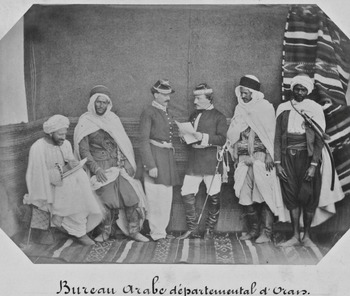
Figure 3.4 The bureau arabe of Oran, 1856. L-R, Muhammad ibn al-Hajj Hassan (the khodja, secretary and interpreter), Qaddur ibn Khadra, a tribal shaykh, Mouin and Olivier, the adjoint and chef de bureau, respectively, Mustafa wuld al-Hajj Mustafa Bey, shaykh of the ‘village nègre’ (the new Algerian quarter, inland of the old city, known to Algerians as mdina jdida, the ‘new town’), Salim ben Jafar (chaouch, from Arabic shawush, sergeant-at-arms) (F. Moulin. FR ANOM 8Fi429/4).
The bureaux arabes, run on a shoestring budget by army officers and their minuscule local staffs, exercised largely unregulated and unrestricted authority over Algerians in the countryside in the wake of the conquest. Sometimes celebrated in the literature as benevolent, ‘enlightened despots’, armed with an intimate knowledge of the territories and an instinctive sympathy for the people under their jurisdiction, as well as with a youthful dynamism, dash and élan, some of them were certainly animated by Saint-Simonian ideas of progress and improvement.93 But as we have seen, such ideas were more usually the conjoined twin, not the antithesis, of repression and dispossession, and the bureaux’s officers remained generally as dismissive of civil liberties and liberal law as Bugeaud had been. Summary executions of suspects and ‘exemplary’ punishment were the norm. ‘I had no formal power of life and death’, one former officer wrote, ‘but I could have exercised it without anyone causing a stir’.94
Initially, from the 1840s, administration in the countryside was calqued on the system established by Abd al-Qadir’s state, with French territorial divisions and jurisdictions replicating the aghaliks and khalifaliks through which the amir had exercised authority. Local ‘chiefs’, conservative figures invested with ‘aristocratic’ authority, were sought as the natural allies of the new, conservative and sometimes equally aristocratic, rulers. Settlers and liberal opinion denounced the ‘feudalism’ and arbitrariness of the bureaux, and in the 1850s their ‘despotism’ was attacked in press campaigns and even in judicial proceedings. Except in the south, where the bureaux system remained in place in the Saharan regions under military rule, after 1870 local administration even in military areas was subordinated to the civilian bureaucracy, and, as we have seen, ‘civil’ territory absorbed most of the army’s rural territoires de commandement. The ‘chiefly’ system with its Ottoman nomenclature of aghas, bashaghas and khalifas was reduced in stature and in attributions, leaving the ‘native adjutant’, the adjoint indigène or qa’id (‘caïd’), an essentially clerical functionary, as the sole, and sorrily denigrated, interlocutor between Algerians and the administration. Old families thus saw their standing, and sometimes their self-respect, reduced; and yet, as we saw in the previous chapter, they often endured.95 In 1798, Mahfuz ibn Abi Zayd ibn Salem, the head of a saintly family living at the southern edge of the Atlas southeast of Algiers, had been presented with a certificate exempting his family from taxation under the Ottomans. His son, Muhammad Ben Salem, was agha of the Beni Ja‘d makhzen at the end of the Regency. One son of Muhammad Ben Salem, Ahmad Tayyib, was invested as bey of this strategic corridor, towards the south-western edge of Kabylia, by the amir Abd al-Qadir; another, his brother Omar, was made bashagha by Bugeaud. Omar’s two sons became qa’ids; two of Ahmad Tayyib’s sons went into exile in Syria, but his eldest son, Muhammad, remained in possession of the family estate and in office under the French. By 1910, Muhammad’s son Aomar Bensalem, the great-great-grandson of Sidi Mahfuz, aged 28, ‘literate in Arabic, of a gentle character … with a good education’ and holding himself aloof from the local Europeans, had inherited the office of caïd from his father and held the family’s 300 hectares together with his two younger brothers.96
The rule of the army, attacked by the settlers as well as by metropolitan reformers for its unaccountability and violence, was civilianised rather than reformed after the 1860s.97 Military rule, however ‘well intentioned’ and progressive in purpose, had never been a beneficent despotism; its guiding principle had remained the expeditious discipline by which disorderly ‘natives’ had to be kept in line. Government by law now sought to codify and regulate the colonial state already established under government by the sword.
The crucial legal measure that now came to define the position of Algerians within the colonial order was a second Sénatus-Consulte, that of 14 July 1865, on personal status (statut personnel) and naturalisation. As with the 1863 measure on landownership, the 1865 law was imagined as a normalising, liberalising step away from the wars of conquest, towards the incorporation of Algerians under the French empire’s improving ‘Arab kingdom’. Louis-Hugues Flandin, the lawyer-parliamentarian who presented the bill to the Senate, declared that ‘There are two ways to pacify a country; the first … is the subjugation or destruction of the conquered people. The second, which alone accords with the traditions and morality of France, is that which has begun … It consists in a patient and continuous work of assimilation, of progressive initiation into the benefits of civilisation.’ ‘The Muslim native is French’, declared article 1 of the statute; ‘Nonetheless, he will continue to be governed by Muslim law.’ An Algerian Muslim man (since the law considered legal agency as open only to men) could serve in the army or navy, could (theoretically) hold public office – and could, at his request, be admitted to the plenitude of rights afforded the French citizen, in which case he would henceforward be governed by French civil and political law. Article 2 defined the legal status of Algerian Jews in the same way; a subsequent article opened French citizenship to (European) foreigners who had resided in Algeria for three years.98
This brief statute would be the keystone of Algeria’s political architecture for the next eighty years. Declared a French national, but not a French citizen, Algerian Muslims (and, until 1870, Algerian Jews) as a whole were legislated into a false promise of emancipation that in fact created the legal space of their oppression. Once again, the system emerged gradually, in response to practical difficulties faced by administrators and the courts – in this case, questions of adjudicating family law, especially regarding polygamy, and access to the liberal professions – rather than by design. But the effect was to produce a durable, intractable regime that, even given a political will to reform it, proved unreformable.99
The logic of personal status law, on the one hand, defined Algerians as indigènes (natives) trapped – for the present – in a debilitating indigénat (the condition of being a native, ‘native status’). This, to republican lawmakers, was a matter of social norms, behaviours and religious beliefs that, like immaturity in adolescents or irrationality in women, were incompatible with the full exercise of citizenship. The Sénatus-Consulte also enshrined the principle that Algerians were legally French, and that their full admission into the cité, the political community of citizens, was a matter of time, of individual or familial social promotion and of more general social ‘evolution’. In the meantime their religious and customary practices in matters of civil law (marriage, inheritance, divorce) would be respected – and, thereby, sharply differentiated from the properly ‘civilised’ norms expected of citizens, especially in matrimonial and sexual matters. But, at some future time, thanks to cultural ‘contact’, economic and social ‘uplift’, moral and material ‘civilisation’, Algerians might be expected to escape or to ‘abdicate their indigénat’, as administrators liked to put it. The colonial situation – the political dominance of the minority community – was thus posited as a transitional state, awaiting the effects of the ‘patient and continuous work’ of civilisation.
This did more than provide a seemingly practical solution to the immediate difficulties of regulating the rights and duties of persons. It opened a liberal horizon of ‘improvement’ that would serve for decades to structure the public discourse of a humane and generous ‘civilising mission’. It combined the preserving principles of ‘association’ with the universalist aspiration of ‘assimilation’ in a powerfully reassuring idea of colonisation as progress, while in fact it made ‘progress’, towards the resolution of the colonial situation in the ultimate emancipation it affected to imagine, impossible.
For on the other hand, the legislation that gave practical, institutional form to indigénat ensured that this ‘transitional’ state would be perennial. What colonial lawmakers thought of as a debilitating and temporary condition coincided, for Algerians, with the one remaining domain of Islamic law over their lives. In matters of criminal, commercial and property law, Islamic law had already been set aside in the 1840s; in criminal law, the indigène musulman was already by 1865 subject to both French common law and to the particular repressive measures meted out by the officers of the bureaux arabes and, from 1860, their disciplinary commissions. The colonial state’s ‘respect’ for what it called ‘Muslim law’ in civil matters defined a residual jurisdiction of shari‘a that would become correspondingly all the more central to the community’s self-definition, as a space of solidarity and self-preservation, voluntary abdication of which, for most Algerians, was equated with apostasy. Algerian community leaders vigorously opposed proposals by radical reformers in France, beginning in the 1880s, for the abolition of discriminatory ‘personal status’ and the collective conferment of citizenship, following Crémieux’s example, on Muslims. And, until it was too late and had become meaningless, the mass acquisition of citizenship for Algerians dans le statut, without renunciation or abolition of Muslim personal status, was not a practical proposition – although, as we shall see in the next chapter, it would nonetheless become central to Algerian politics. Unlike northern Algeria’s Jews, sufficiently few to be ‘emancipated’ (with, as we have seen, conflictual consequences), and unlike the small, and largely Muslim, electorates of the French ‘Four Communes’ of Senegal whose citizenship had been granted in 1848, the majority community of Algeria’s Muslims had to be contained in the indigénat and excluded from citizenship.100 The colony’s minority rule, which for the settlers was coextensive with French sovereignty, depended upon it; the settlers and their elected representatives, from the mayors of the Algerian communes upward, insisted upon it. Algerians’ containment in the trap of indigénat, and their concomitant exclusion from the cité, indeed, was the primary concern and the necessary condition of the settler republic’s fragile stability. As we shall see, when this delicate and brutal mechanism began to cease to function, after 1944, the intrinsic, legal violence that it embodied began, correspondingly, to erupt in overt, physical form.

Figure 3.5 Women in an Algiers interior, 1890s. A relatively sympathetic version of a common theme, this photograph avoids the exoticisation of the ‘harem interior’ fantasy common in European portrayals of feminine domesticity. From the moment the Romantic painter Eugène Delacroix unveiled his celebrated Femmes d’Alger dans leur appartement in 1834, the ‘secret life’ of Algerian women was a subject of eroticised fascination for European artists and their public, and unvarnished erotic photography became a staple of colonial popular culture and postcards. Anxiety over the seclusion and ‘protection’ of women became all the more important to Algerian society, and women’s education and emancipation from paternal or fraternal discipline, and from the rigours of the domestic or rural economy, was made correspondingly more difficult (Library of Congress).
In the meantime, as indigènes Algerians were subject to an especially coercive system of government. Administered from 1844 to 1870 by the army’s Arab bureaux, from the 1870s they fell under ‘the government of the mayors’ in European municipalities, or that of civil administrators in the rural communes mixtes, ‘mixed communes’ with too few Europeans for full municipal government, where, up to the 1950s, most Algerians lived. Imagined, as we have seen, as ‘protection’ and preservation, ‘regeneration’ and reform, colonial rule for Algerians effectively meant a disciplinary regime diametrically opposed to the expansive democratic freedoms demanded, and increasingly enjoyed, by Algeria’s Europeans. The latitude of the army’s discretionary powers of repression, the ‘despotism of the sabre’, was preserved by the Republican governments’ régime de l’indigénat, or ‘native-status’ regulations.
Rather than a body of law, despite being often referred to as a code, the indigénat in this sense was a hazily defined set of repressive practices whose common features were a lack of due process and the fact that only non-citizens, indigènes, were subject to them. Seeking to regulate its practices more firmly, the colonial government enacted a series of laws to codify aspects of the ‘indigénat regime’, most prominently in the law of 28 June 1881 that enabled commune mixte administrators to inflict fines or imprisonment for infractions, proven or suspected, ‘particular to the indigénat’, that is, committed by non-citizen Algerians. Higher officials retained existing powers to order individual internment, house arrest or exile, and collective fines or seizure of property, and no single legal text ever formalised the full extent of the repressive system. But the local administrators’ disciplinary powers under the 1881 law came to sum up and symbolise the indigénat for those subjected to it.101
Many of the ‘infractions’ subject to punishment under this system were neither clearly defined nor, in many cases, ordinarily punishable under French criminal law: acts of disorder in markets and public places, delayed payment of taxes, departure from place of residence without authorisation, departure on pilgrimage without authorisation, lack of respect for authority, refusal to comply with requisitioning orders, refusal to provide information to the authorities, seditious speech, ‘acts hostile to French sovereignty’. The procedures required were minimal; sentences could be multiplied, and when handed down by the governor general could be of indefinite duration. Justified as emergency powers in a context of insecurity, and initially supposed to expire after seven years, the repressive provisions of the law of 1881 in fact codified existing practice, and would be repeatedly renewed until their final abolition in 1944. In addition, from 1902 to 1931, Algerians accused of committing common crimes were tried by special ‘repressive tribunals’, with expedited procedures and minimal provision for appeal, instead of by the regular courts. Special criminal courts were also set up in 1902 to try cases with Muslim defendants, who since the introduction in 1870 of trial by jury – juries being composed exclusively of citizens, and therefore of Europeans – had, to liberal alarm, suffered disproportionately in the assize courts. But these special courts, without juries, where cases were tried by three French judges assisted by two Muslim assessors, were not noticeably kinder to Algerians than the settler juries of the assize courts. They remained in place until 1942.102
The logic of the indigénat, following the principle that anything escaping the administration’s control was potentially a danger to its security, and must therefore be regulated, was to criminalise almost anything Algerians might do, or omit to do, from failing to show respect for the government’s local auxiliaries through concealment of potentially taxable goods to moving around the country without a permit. Most aspects of the everyday behaviour of dominated peasant populations, in other words, that fell far short of ordinary criminality, let alone insurrection, became punishable on the spot and without appeal.103 After a peak in 1883, when 30,837 punishments were recorded, sentencing rates under the indigénat generally fell, and after 1914 became much lower, but from 1892 to 1913, administrators in communes mixtes handed out between 17,000 and 27,000 punishments every year. In the first ten years of the indigénat, almost 1.7 million francs were levied in fines, and Algerians served over 700,000 days in prison. From 1897, fines or imprisonment could be transmuted into sentences to forced labour: by 1910, 600,000 days’ work had been thus exacted from Algerians in penalties.104 In 1883, with the exercise of disciplinary powers under the indigénat added to convictions in all the regular courts combined, some forty-two Algerians per thousand of the total population faced judicial or administrative sanctions, compared to seventeen in every thousand inhabitants of metropolitan France. At the more frequent level of ‘petty crime’, Algerians were at least three times more likely to face conviction than were inhabitants of the metropole.105
But the arbitrary iniquities that administrators’ powers could inflict on Algerians’ daily lives go beyond what statistics alone make visible. The women of the Tablat commune mixte, in the Atlas south of Algiers, were restricted in January 1892 to washing their laundry between sunrise and 5 pm on Saturdays only, so as not to inconvenience the local European women; the decree was still in force in 1904. The Algerian families of the colonial village of Renault, near Mostaghanem, were obliged in December 1893 to obtain a written permit to live within the ‘European’ town limits, and threatened with expulsion from their homes within forty-eight hours if they failed to receive one. Three men – Moulay Ali ben Ahmad, Ahmad ben Muhammad Lagab and Muhammad ben Ali Kerbib – agricultural workers from coastal Kabylia probably reliant on itinerant, seasonal employment – were placed under surveillance and denied travel permits for six months in July 1901, on nothing more than suspicion of involvement in a theft from a farm at Birkhadem in the Algiers suburbs. Thus, and in thousands of similar cases, at the height of the indigénat, the petty despotism of the administration fenced Algerians round with decree after onerous, and sometimes illegal, decree.106
Colonial rule, imagined as a patient work of peaceful progress, was thus in fact a routinised infliction of low-intensity warfare: criminalisation, collective punishment, denial of due process and of an effective right of appeal, the slow, continual erosion of property and the grinding effects of impoverishment, the arbitrary and stingingly disproportionate exercise of everyday ‘ordinary violence’ characterised Algerians’ experience of their subjection to the state up to 1944. The eventual abolition, in that year, of the indigénat statutes and the promised opening, at the same time, of access to citizenship for all Algeria’s inhabitants, finally opened to Algerians the formal public space that had been shaped a century earlier by the politics of colonisation. But it did so in the midst of a global conflict in which the meaning and the future of colonialism everywhere was radically at stake, and in the context, within Algeria, of increasing community tension and violence. And at the same time, as we shall now see, Algerians had already and increasingly moved uninvited into the colony’s public sphere, into the public spaces of its ‘French’ towns and cities, and into the symbolic politics of the Republic, all of which the settlers intended to keep to themselves.

Map 2: Colonial Algeria.


