





Introduction
Awareness of an ecological crisis of global proportions began to emerge in the second half of the last century and has gathered pace ever since. Once the preserve of scientists and a few activists, it has become an integral part of the political and social fabric of most countries around the world, including the UK. Social scientists early on became interested in describing and understanding what was termed the ‘New Environmental Paradigm’ (Dunlap and Van Liere Reference Dunlap and Van Liere1978), an alternative perspective on human relationships with the planet that rejected the idea that the Earth was an unlimited resource that could be exploited without cost to meet human needs. A wide range of instruments were created and subsequently developed to assess the social and psychological factors that might dispose individuals to pro-environmental attitudes and behaviours. A recent meta-analysis sought to link interventions with established determinants of pro-environmental behaviour (van Valkengoed et al. Reference van Valkengoed, Abrahamse and Steg2022). Included in their list of 13 determinants were ones related to knowledge, problem awareness, personal values and norms and perceptions of more widely held social norms and values.
As more studies emerged, it became clear that predicting who will actually engage in pro-environmental behaviours is difficult because being aware of problems, being concerned about the environment or being willing to support pro-environmental policies are not necessarily closely correlated with what people actually do. The attitude–behaviour ‘gap’ is a well-known phenomenon in environmental studies (Bamberg Reference Bamberg2003; Blake Reference Blake1999; Kollmuss and Agyeman Reference Kollmuss and Agyeman2002; Siegel et al. Reference Siegel, Cutter-Mackenzie-Knowles and Bellert2018) and consumer choice (see Caruana et al. Reference Caruana, Carrington and Chatzidakis2016). This has led some researchers to develop various models that include mediating or moderating factors that are more closely related to behaviours than general attitudes or dispositions. For example, ‘green efficacy’, where individuals believe they have the power to act in pro-environmental ways, has often been shown to mediate or moderate the relationship of attitudes to behaviour (Innocenti et al. Reference Innocenti, Santarelli, Lombardi, Ciabini, Zjalic, Di Russo and Cadeddu2023; Lauren et al. Reference Lauren, Fielding, Smith and Louis2016).
Although it is possible to conceptualize and measure specific, ‘downstream’ factors, such as environmental self-efficacy or knowledge of issues, that are more closely correlated with environmental behaviours than general, ‘upstream’ factors, such as personality or environmental values and norms, the latter may be useful because they indicate factors that may dispose people to pro-environmental behaviours whatever the particular issue or context. Religion is among the more general, upstream factors that have been shown to be linked both positively and negatively to pro-environmentalism (Arbuckle and Konisky Reference Arbuckle and Konisky2015; Hand and Liere Reference Hand and Liere1984; Preston and Shin Reference Preston and Shin2022; Toros Reference Toros2025). How the association emerges may vary between religions, and it may depend on specific beliefs about the relationships of humans to the cosmos. These specific beliefs may in turn be related to more general theological stances, such as liberalism or conservatism, which in turn may be related to non-religious factors such as personality (Village Reference Village2019).
For religious organizations trying to encourage pro-environmental behaviour, it would be useful to understand how general factors are related to environmental behaviour, even if the associations are neither direct nor particularly strong. Knowing what groups or types of people within the organization are more likely to be concerned about the environment, or more willing to make sacrifices to improve it, might indicate where efforts would best be applied to change behaviour in relation to specific issues. Alternatively, understanding which groups or types of people tend to have apathetic environmental attitudes could help in understanding what beliefs or dispositions make it difficult to accept the case advanced by the environmental lobby that individuals have to change the way they live to save the planet.
This study of clergy and laity in the Church of England seeks to examine personal, psychological, contextual, ecclesial and theological factors that predict concern about the environment, willingness to make sacrifices to help the environment and levels of pro-environmental activity. The Church of England is an appropriate religious organization in which to study this topic because, although adherents share a common liturgical heritage, there are considerable variations in beliefs and attitudes among different traditions within the same Church (Randall Reference Randall2005; Village Reference Village2018a).
Assessing Environmental Attitudes and Behaviours
The issue of how to assess environmentalism has been widely debated ever since it began to be studied by social scientists. In the 1970s and 1980s, there were a plethora of instruments developed, with little consensus on whether they were assessing a single construct or many (Stern Reference Stern1992). Some instruments asked general questions about worldview or stance on the environment, such as the scales designed to assess the New Environmental Paradigm (NEP) (Hawcroft and Milfont Reference Hawcroft and Milfont2010), while others assessed environmental concern (Dunlap Reference Dunlap, Telesiene and Gross2016; Schultz Reference Schultz2001; Weigel and Weigel Reference Weigel and Weigel1978) or activity (Markle Reference Markle2013) related to specific issues. These sorts of instruments have both their advantages and disadvantages: general attitudinal items do not necessarily address the concerns most relevant to the population at that time, whereas items on specific issues can become dated and lack generalizability.
Some general social surveys have either asked about how concerned people are in relation to particular issues (Liu et al. Reference Liu, Vedlitz and Shi2014) or asked about how willing respondents are to make specific sacrifices such as paying more of their income to support environmental taxes (Franzen and Vogl Reference Franzen and Vogl2013). Although these surveys have their critics, they point to ways of assessing pro-environmental attitudes that relate to specific issues. Working in this tradition, the present study uses two scales that each contained a range of different issues of concern (e.g. climate change, population growth or pollution) and a range of actions that respondents might be willing to support if it helped the environment (e.g. increased taxation, allowing windfarms or paying more for food). This enabled specificity about issues without relying on single items, which might not be typical of all issues. Unlike many population-level social surveys, which are delivered in person, and where items can be designed for verbal delivery, the scales here were delivered online, so items needed to be as concise as possible.
Much of the underlying interest in studying environmental attitudes has been because of the perceived need for populations and societies to change what they do to avert ecological disasters. Politicians need to gauge how far people are likely to vote for measures that direct societies towards sustainable and eco-friendly behaviours. One way to judge that is to assess the proportions of individuals who engage in various sorts of behaviours such as altering their diet or travelling habits, or actively protesting about environmental issues. Studies suggest there are different levels of activity that range from altering some individual behaviours, to joining protests or movements, to leading groups or activities (Stern Reference Stern2000). Clearly, responses at all levels, particularly the latter categories, depend both on willingness to act and having agency (‘green efficacy’). This study uses data collected as part of a general survey, where space considerations made measuring agency difficult. Instead, it uses a scale that included items related to individual, group and leadership activities, with the assumption that most respondents might change some behaviours at the individual level, but fewer would be likely to lead others in education or action.
Factors Shaping Environmental Attitudes
Pro-environmentalism is not evenly distributed in populations but tends to vary among people with different demographic profiles, living in different contexts, with different psychological dispositions and with different beliefs.
Personal Factors
The tendency for women to be more pro-environmental than men had been widely reported over the last half century. An early review based mainly on surveys from the United States suggested the evidence was inconclusive (Liere and Dunlap Reference Liere and Dunlap1980), but studies across different countries since then have shown that in many societies women tend to be more concerned about the environment than men. For example, a recent review of studies that used the NEP scale concluded that women were generally more aware and concerned about environmental issues and more willing to change to pro-environmental behaviour compared to men, whose attitudes and behaviours tended to be more varied (Gyurián Nagy Reference Gyurián Nagy2024). The sex difference has been attributed to various factors such as differences in psychological dispositions (Desrochers et al. Reference Desrochers, Albert, Milfont, Kelly and Arnocky2019) and men’s perceptions of femininity (Desrochers and Zelenski Reference Desrochers and Zelenski2023).
The widely held assumption that younger people tend to be more environmentally aware and active is not necessarily borne out by evidence. A meta-analysis carried out over a decade ago found inconsistent trends between studies, but overall there was a small but significant trend for older people to be more likely to exhibit pro-environmental behaviours (Wiernik et al. Reference Wiernik, Ones and Dilchert2013). Similar results emerged from a more recent analysis of data from 31 countries that participated in the 2010 International Social Survey Programme (Wang et al. Reference Wang, Hao and Liu2021). Reasons for this were unclear, but the authors suggested it may be because, as people age, they generally seek meaning beyond material items and engage in more prosocial behaviour.
Psychological Factors
There is growing evidence that pro-environmental attitudes are related to general psychological dispositions associated with personality. Studies that have used the Big Five or HEXACO models of personality have often shown the strongest positive associations with openness to new experience, with agreeableness, conscientiousness and extraversion also being positively correlated but to a lesser extent (Brick and Lewis Reference Brick and Lewis2016; Gibbon and Douglas Reference Gibbon and Douglas2021; Markowitz et al. Reference Markowitz, Goldberg, Ashton and Lee2012; Soutter et al. Reference Soutter, Bates and Mõttus2020). A study using an extended psychological-type model has shown corresponding results using different, but related, measures of psychological dispositions. In the perceiving process of the extended psychological type model, high intuition or low sensing is parallel to openness in other models; in the judging process, high feeling or low thinking is parallel to agreeableness; and high emotional volatility is equivalent to neuroticism (Village and Francis, Reference Village and Francis2022b, Reference Village and Francis2023a). In a study of 825 churchgoers in England (Village Reference Village2020), high sensing scores (implying low intuition scores) and high thinking scores (implying low feeling scores) were associated with reduced environmental concern. These dispositions indirectly influenced environmental concern because they were associated with biblical literalism (high sensing scores) and theological conservatism (high thinking scores). A measure of emotional volatility (neuroticism) was directly positively correlated with environmental concern. These studies suggest that personality may have direct and indirect effects on environmental concern and pro-environmental activity.
Contextual Factors
The relationship between rural and urban living and pro-environmentalism has been studied in several countries, with varying results (Berenguer et al. Reference Berenguer, Corraliza and Martín2005; Sierra-Barón et al. Reference Sierra-Barón, Olivos-Jara, Gómez-Acosta and Navarro2023; Weckroth and Ala-Mantila Reference Weckroth and Ala-Mantila2022). A study based on a large, nationally representative sample from England found that rural and coastal dwellers tended to be more pro-environmental on average than those living elsewhere, though individuals varied according to the constraints and opportunities they had to visit natural areas (Alcock et al. Reference Alcock, White, Pahl, Duarte-Davidson and Fleming2020). A wide range of social factors related to life processes or experience have also been shown be related to pro-environmentalism. Education has featured as a predictor variable in many social surveys, and most have found greater environmental concern among those with higher levels education (Arıkan and Günay Reference Arıkan and Günay2021), but this may not apply consistently, nor to pro-environmental behaviours (Hoekstra et al. Reference Hoekstra, Noordzij, de Koster and van der Waal2024; Weckroth and Ala-Mantila Reference Weckroth and Ala-Mantila2022). Education may be associated both with knowledge and understanding of environmental issues, but also with opportunities and capacities to enact pro-environmental behaviours.
Religious Factors
Even within a particular religion such as Christianity, there can be widely varying views on environmental issues (Arbuckle and Konisky Reference Arbuckle and Konisky2015; Harmannij Reference Harmannij, Leal Filho and Consorte McCrea2019), which might be partly shaped by specific religious beliefs or more general theological stances. Among Christians, environmentalism has been linked to beliefs about human ‘dominion’ over creation, humans as stewards of God’s creation, the sacramental nature of the created order and specific beliefs about the ultimate fate of the Earth (Barker and Bearce Reference Barker and Bearce2013; Guth et al. Reference Guth, Green, Kellstedt and Smidt1995; Peifer et al. Reference Peifer, Ecklund and Fullerton2014; Village Reference Village2015, Reference Village2020). Those who believe that there is divine mandate for human dominion over creation or who believe that God will ultimately destroy and/or renew the Earth tend to be more sceptical about the need to make sacrifices in order to save the planet. In the United States, there has been a long-running link between religious and political conservatism, which tends to confound religious belief, political ideology and views on the environment (Arbuckle Reference Arbuckle2017). This has been less evident in Europe, especially in Britain, where until very recently there have been fewer clear-cut links between religion, social ideologies and political allegiances (Beckford Reference Beckford1991; Carter Reference Carter2014; Tilley Reference Tilley2015). Church of England affiliates tend to be more conservative than the general population and more likely to vote for the Conservative Party (Kotler-Berkowitz Reference Kotler-Berkowitz2001; Tilley Reference Tilley2015), but within the Church of England itself there is wide variation in theological stance ranging from extreme liberal to extreme conservatism (Francis et al. Reference Francis, Robbins and Astley2005). General liberal versus conservative stance in relation to doctrine or morality has been shown to relate to a wide range of specific beliefs and attitudes among Church of England laity and clergy (Village Reference Village2018b, Reference Village2025; Village and Francis Reference Village and Francis2026). One aim of the present paper was to test the effect of general theological stance on environmental attitudes and behaviours.
Environmentalism in the Church of England
The Church of England has been aware of environmental issues at grassroots and national levels for some years (Church of England 2005), but the profile at national level has increased in the last few years as resolutions at General Synod have demanded more urgent action. A proposed timeline for achieving net zero carbon emissions by 2045 presented to the General Synod in February 2020 (Church of England 2020) was amended in debate to 2030, a much more demanding target. This target seems ambitious but was reaffirmed in 2022 when a route map for achieving it was passed by the General Synod (Church of England 2022), though not without some opposition (Wyatt Reference Wyatt2022). A more recent initiative has recognized the equal importance of maintaining biodiversity alongside reducing carbon emissions (Church of England 2024). Whether these initiatives will achieve their goals remains to be seen, but they have led to financial investment and the creation of a range of resources and support to help parishes and dioceses become more eco-friendly (Church of England 2025a).
Alongside national initiatives, there have been long-running local initiatives that have tried to engage churches at diocesan and parish levels. The ‘Eco Church’ programme set up by the Christian charity A Rocha (A Rocha UK 2025) encourages churches to develop sustainability by offering a series of awards as they achieve given standards. In the Church of England at the end of 2024, there were 1870 Bronze, 899 Silver and 40 Gold awarded churches, 12 Bronze, 23 Silver and 4 Gold Eco Cathedrals, and 32 Bronze Eco Dioceses (Church of England 2025b). The numerous stories from parishes around the country point to a growing awareness of environmental issues, which has not always been the case at grassroots level (DeLashmutt Reference DeLashmutt2011; Harmannij Reference Harmannij, Leal Filho and Consorte McCrea2019).
Research Questions
Against this background, this paper explores three main questions:
-
1. What are levels of pro-environmentalism among clergy and lay people in the Church of England?
-
2. How does opinion vary by demography, ordination status and church tradition?
-
3. What factors predict environmental attitudes in the Church of England?
Method
Procedure and Participants
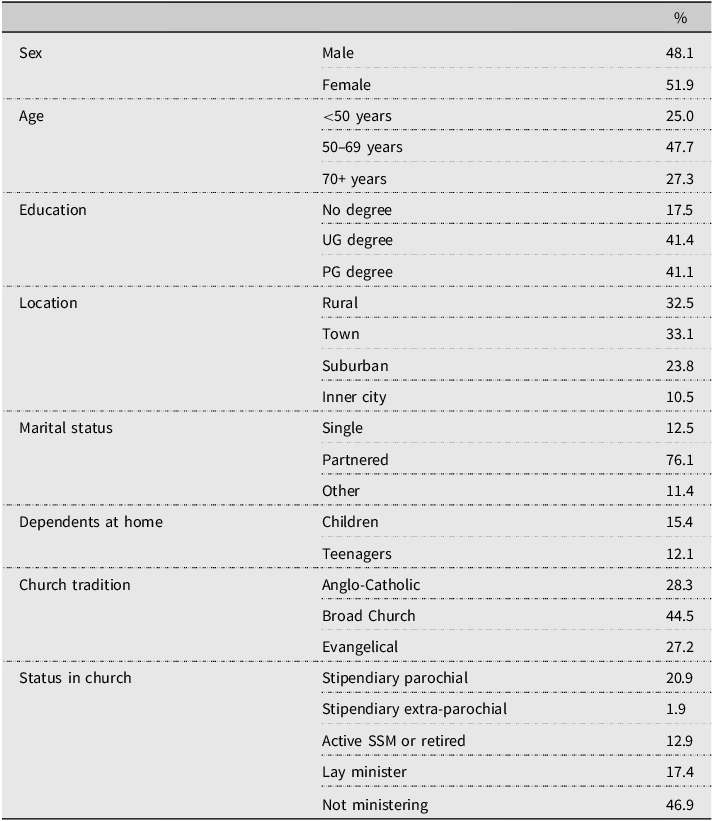
The Church 2024 survey was an online survey delivered using the Qualtrics platform and available from March to November 2024. Invitations to participate were published during the year in the Church Times and the Church of England Newspaper as well as in a number of diocesan newsletters. Of the 5141 total responses to the survey, 3826 (74.4%) were people living in England who affiliated with the Church of England. The final sample used here consisted of 3229 individuals who had no missing values for variables used in this analysis (Table 1). Comparison of the sample with available data from Church of England suggests, as far as the available national data allow, that the sample used here was reasonably representative of the Church of England as whole (see Village Reference Village2025 for more details).
Profile of the sample
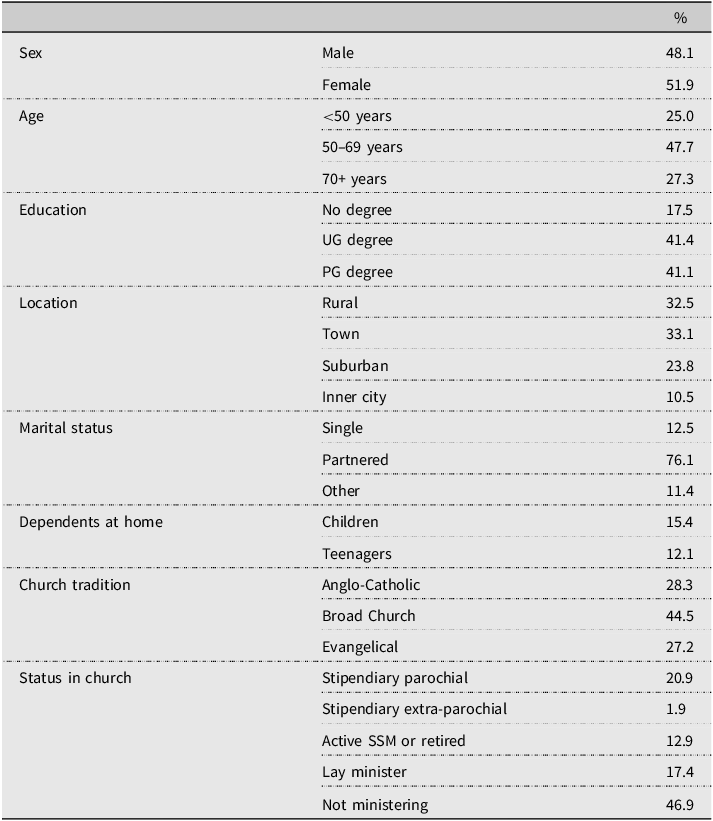
Table 1 Long description
The table presents the demographic profile of a survey sample related to the Church of England. It includes data on sex, age, education, location, marital status, dependents at home, church tradition, and status in church. The table has 10 rows and 2 columns. The columns are labeled Sex, Age, Education, Location, Marital status, Dependents at home, Church tradition, and Status in church. The values are presented as percentages. Row 1: Sex, Male, 48.1 percent. Row 2: Sex, Female, 51.9 percent. Row 3: Age, less than 50 years, 25.0 percent. Row 4: Age, 50-69 years, 47.7 percent. Row 5: Age, 70+ years, 27.3 percent. Row 6: Education, No degree, 17.5 percent. Row 7: Education, Undergraduate degree, 41.4 percent. Row 8: Education, Postgraduate degree, 41.1 percent. Row 9: Location, Rural, 32.5 percent. Row 10: Location, Town, 33.1 percent. Row 11: Location, Suburban, 23.8 percent. Row 12: Location, Inner city, 10.5 percent. Row 13: Marital status, Single, 12.5 percent. Row 14: Marital status, Partnered, 76.1 percent. Row 15: Marital status, Other, 11.4 percent. Row 16: Dependents at home, Children, 15.4 percent. Row 17: Dependents at home, Teenagers, 12.1 percent. Row 18: Church tradition, Anglo-Catholic, 28.3 percent. Row 19: Church tradition, Broad Church, 44.5 percent. Row 20: Church tradition, Evangelical, 27.2 percent. Row 21: Status in church, Stipendiary parochial, 20.9 percent. Row 22: Status in church, Stipendiary extra-parochial, 1.9 percent. Row 23: Status in church, Active self-supporting minister or retired, 12.9 percent. Row 24: Status in church, Lay minister, 17.4 percent. Row 25: Status in church, Not ministering, 46.9 percent.
Note. N = 3229. SSM = self-supporting ministers.
Dependent Variables
Concern for the environment was assessed using a six-item scale (‘Concern’) listing a range of statements modified from Village (Reference Village2020) and headed by the question ‘How concerned are you about the following environmental issues?’. Each item had a five-point response scale ranging from ‘Totally unconcerned’ (=1) to ‘Very concerned’ (=5). Factor analysis (principal components extraction with varimax rotation) identified a single factor accounting for 63% of the variance, and the alpha reliability (Cronbach Reference Cronbach1951) for the scale was .87.
Willingness to sacrifice was assessed using a seven-item scale (‘Sacrifice’) modified from Village (Reference Village2020) which was headed by the question ‘If it helped to protect the environment, how willing would you be to:’, followed by items such as ‘pay higher taxes?’, or ‘allow more windfarms in the countryside?’. Each had a five-point response scale ranging from ‘Totally unwilling’ (=1) to ‘Very willing (=5). Factor analysis identified a single factor accounting for 62% of the variance, and the alpha reliability for the scale was .90.
Environmental activity was assessed by a seven-item scale (‘Activity’) expanded from Village (Reference Village2020) and headed by the question ‘Have you ever:’ followed by items such as ‘changed what you eat for environmental reasons?’ or ‘actively protested about an environmental issue?’, each with a no (=0) or yes (=1) response. Factor analysis identified two components accounting for 54% of the variance, with possibly two factors, one of three items related to low-level activity (changing eating or travel habits and donating to an environmental organization) and one related to more high-level activism such as protesting or joining environmental organizations. This scale was assumed to be additive so was treated as a single scale with an overall score indicating levels of activity. Alpha reliability for the scale was .74.
Predictor Variables
Predictors were placed in five groups:
Personal Factors
Sex was coded male (0) and female (1) and used as a dummy variable in regressions labelled ‘female’. Age was coded: 18–19 (1), 20s (2), 30s (3), 40s (4), 50s (5), 60s (6), 70s (7) and 80s+ (8) and treated as a continuous variable in regressions.
Psychological Factors
Psychological variables were assessed using the revised shortened version of the Francis Psychological Type and Emotional Temperament Scales (FPTETS) (Village and Francis Reference Village and Francis2023a, Reference Village and Francis2023b, Reference Village and Francis2024). This is a 30-item instrument comprising four sets of six forced-choice items related to each of the four components of psychological type theory: orientation (extraversion or introversion), perceiving process (sensing or intuition), judging process (thinking or feeling) and attitude towards the outer world (judging or perceiving), and six items related to emotional temperament (calm or volatile), a measure of trait neuroticism (Village and Francis Reference Village and Francis2022a). Scores in each component were complementary and summed to six; for this analysis, the scores for extraversion, intuition, feeling, perceiving and emotional volatility (neuroticism) were used in regressions. Alpha reliabilities were .82 for the EI scale, .68 for the SN scale, .79 for the TF scale, .78 for the JP scale and .82 for the emotional temperament scale.
Contextual Factors
Highest level of education was coded: no school qualifications (1), school level (2), university certificate or diploma (3), undergraduate degree (4), master’s degree (5) and doctoral degree (6). Location was used to create dummy variables of rural (=1, other = 0) and inner city (=1, other = 0). Marital status was used to create dummy variables single (=1, other = 0) and partnered (=1, other = 0), with other categories (e.g. separated, divorced or widowed) as the base used for comparison. Household status was used to create two dummy variables representing respondents who had children under 13 years or teenagers living at home (in each case no = 0, yes = 1).
Ecclesial Factors
Ordination status was coded as clergy (1) and laity (0). Church tradition was assessed using a seven-point bipolar scale labelled ‘Anglo-Catholic’ at one end and ‘Evangelical’ at the other. It is a good indicator of differences in belief and practice in the Church of England (Randall Reference Randall2005; Village Reference Village, Anthony and Ziebertz2012) and was used to identify Anglo-Catholic (scoring 1–2), Broad Church (3–5) and Evangelical (6–7) respondents.
Theological Factors
The survey included two seven-point bipolar scales used in other studies of the Church of England measuring the extent of conservative (versus liberal) stance on doctrine and on moral issues (Village and Francis Reference Village and Francis2021). These two scales were used instead of the more general LIBCON scale because they distinguish two related but somewhat independent aspects of liberal versus conservative belief (Village Reference Village2018b).
Analysis
Analysis was in three stages:
The first stage examined responses to items on the three scales to assess overall levels of pro-environmentalism. The second stage examined variations in levels of agreement between groups using one representative item from each scale, namely Concern: ‘climate change’, Sacrifice: ‘pay higher taxes’ and Activity: ‘actively protested about an environmental issue’. For ease of analysis and interpretation, the first two scales were recoded into binary responses, using the highest two categories as endorsement (‘Concerned’ and ‘Willing’, respectively). Contingency table analysis was based on counts and used chi-squared to test for significant differences between groups.
The final stage was to explore the factors that predicted scores on the three scales of pro-environmentalism. This was to examine more rigorously the contribution of personal, psychological, contextual, ecclesial and theological factors to a person’s overall score. Bivariate correlations among the predictor variables showed that some were themselves correlated, so hierarchical multiple regression was used to identify the independent effects of predictor variables on the dependent variables. Predictors were added successively to the model in the following order: Model 1: personal factors (sex and age), Model 2: psychological factors (extraversion, intuition, feeling, perceiving and neuroticism), Model 3: contextual factors (education, rural, inner city, single, partnered, children at home and teenagers at home), Model 4: ecclesial factors (clergy, Anglo-Catholic and Evangelical) and Model 5: theological factors (doctrinal conservatism and moral conservatism). This order assumed that personal and psychological factors operate prior to the more ‘downstream’ factors such as general liberal or conservative attitudes.
Results
Overall Responses
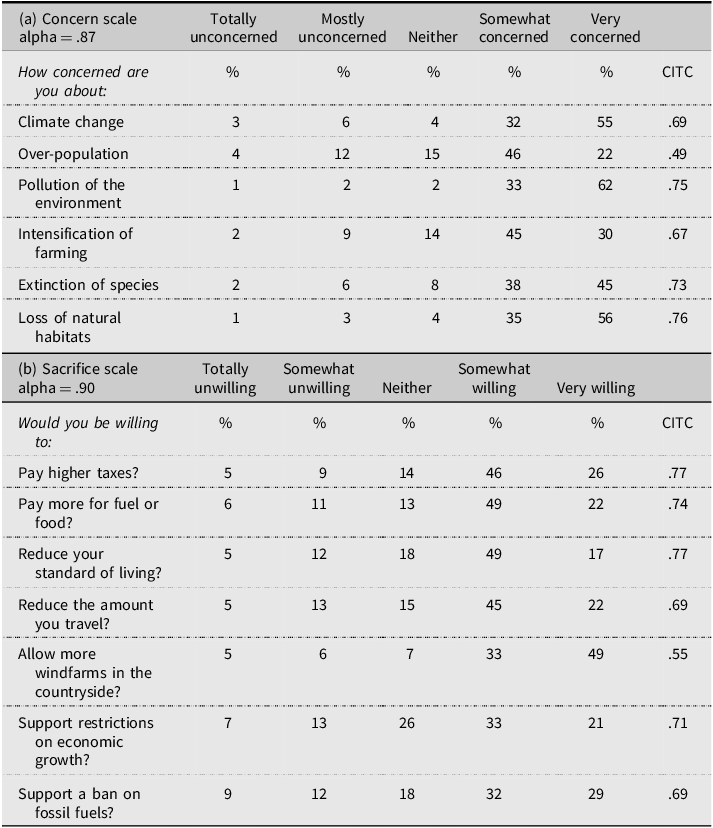
Levels of concern were generally high, with 68–95% of the respondents indicating they were somewhat or very concerned, depending on the item (Table 2a). The items that had the most ‘Very concerned’ responses were pollution (62%), loss of natural habitats (56%) and climate change (55%); those with the least were extinction of species (45%), intensification of farming (30%) and over-population (22%).
Environmental concern and willingness to sacrifice item responses
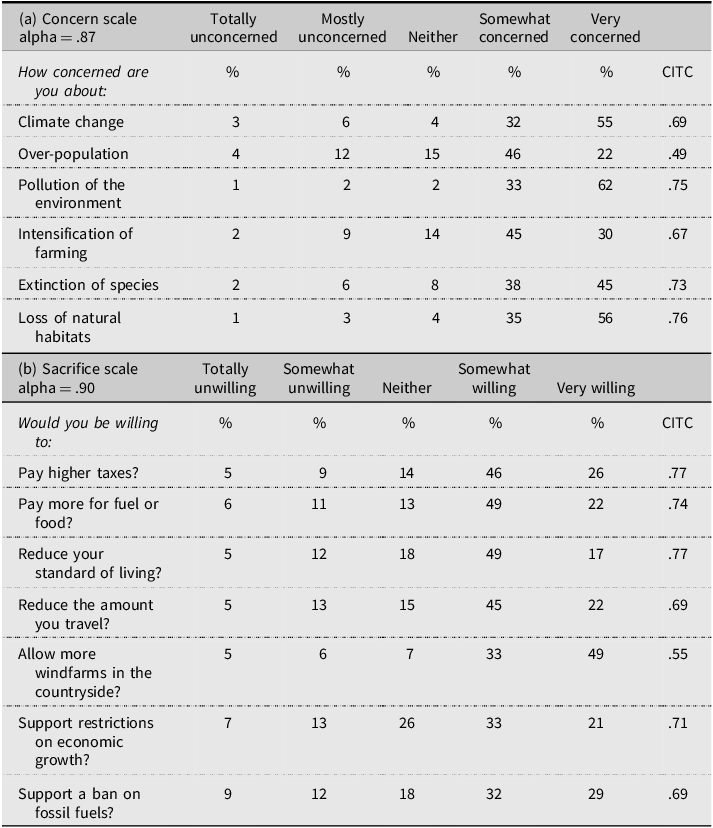
Table 2 Long description
The table is divided into two main sections: (a) Concern scale and (b) Sacrifice scale. Section (a) has six rows and five columns, detailing levels of concern about various environmental issues. The columns are labeled as Totally unconcerned, Mostly unconcerned, Neither, Somewhat concerned, and Very concerned, with percentages provided for each category. Section (b) has seven rows and five columns, detailing willingness to make sacrifices. The columns are labeled as Totally unwilling, Somewhat unwilling, Neither, Somewhat willing, and Very willing, with percentages provided for each category. Each section includes a CITC value at the end of each row.
Note. N = 3229. CICT = corrected item-total correlation.
Levels of willingness to sacrifice were generally lower than for concern, with 54–82% indicating they were willing or very willing to make some sort of sacrifice, depending on the item (Table 2b). The items which had the most ‘Very willing’ responses were allowing windfarms (49%), banning fossil fuels (29%) and paying higher taxes (26%); those with the least were restricting economic growth (21%) and reducing personal standards of living (17%).
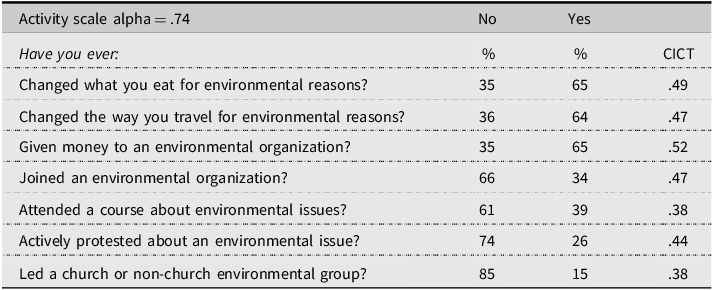
Items assessing pro-environmental behaviour (Table 3) showed the distinction between those that involved personal lifestyle changes (donating, changing diet and travel behaviour), which were endorsed by about 65% of respondents, and those involving more social involvement or activism (protesting, joining organizations, attending courses and leading courses), which were endorsed by 15–39% of respondents.
Environmental activity items responses
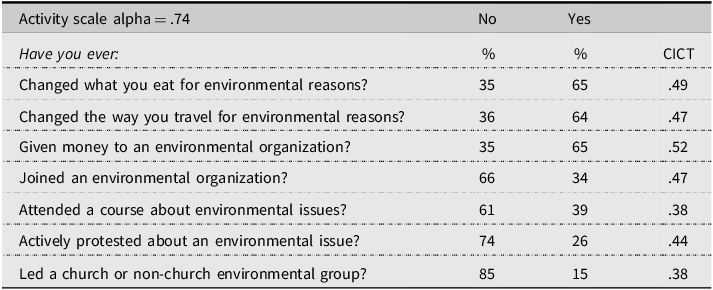
Table 3 Long description
A table with seven rows and five columns. The columns are labeled ‘Activity scale alpha’, ‘No’, ‘Yes’, and ‘CICT’. The rows are labeled with different environmental activities. The first row indicates an activity scale alpha of 0.74. The subsequent rows list activities such as ‘Changed what you eat for environmental reasons’, ‘Changed the way you travel for environmental reasons’, ‘Given money to an environmental organization’, ‘Joined an environmental organization’, ‘Attended a course about environmental issues’, ‘Actively protested about an environmental issue’, and ‘Led a church or non-church environmental group’. Each row shows the percentage of respondents who answered ‘No’ and ‘Yes’ to these activities, along with a CICT value. For example, 35 percent of respondents changed what they ate for environmental reasons, while 65 percent did not. The CICT value for this activity is 0.49.
Note. For explanation, see Table 2.
Variations between Groups
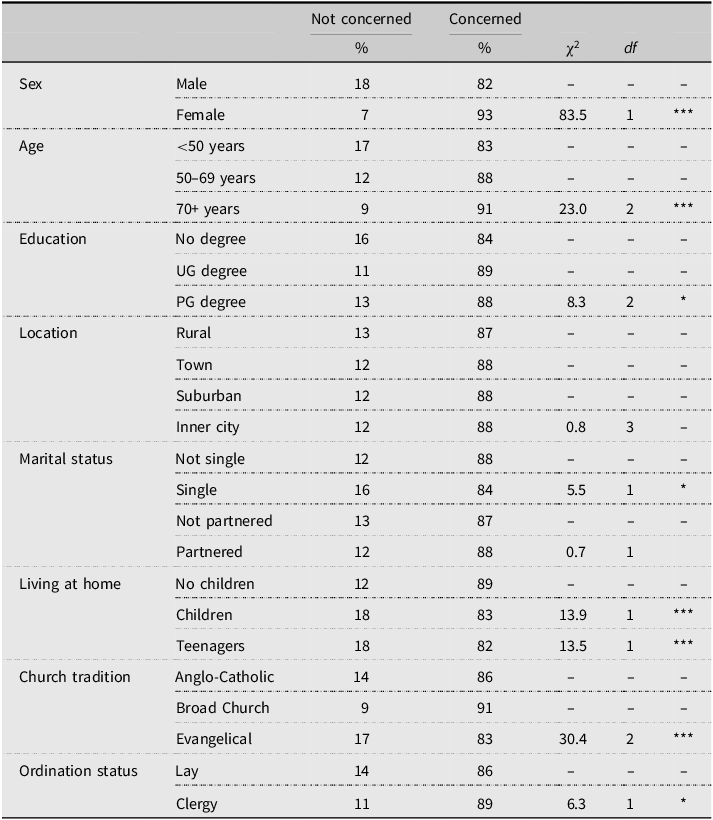
The second stage of analysis was to compare responses between different groups in the sample using representative items from each of the three scales. The item chosen from the Concern scale was climate change because this has been among the highest profile and most discussed environmental issues in recent years. There was little or no difference by education, location, marital status or ordination status (Table 4). There were more significant differences between some other groups, with women showing more concern than men (93% versus 82%), those aged 70 years or older showing more concern than those under 50 (91% versus 83%) and concern among those in the Broad Church tradition (91%) being higher than among either Anglo-Catholics (86%) or Evangelicals (83%). A lower, rather than higher, proportion of those with either children or teenagers living at home expressed concern than those who had no younger dependents. This may have been confounded with age, however, because older people showed more concern and were also less likely to have children living at home.
Responses to concern about climate change in different groups
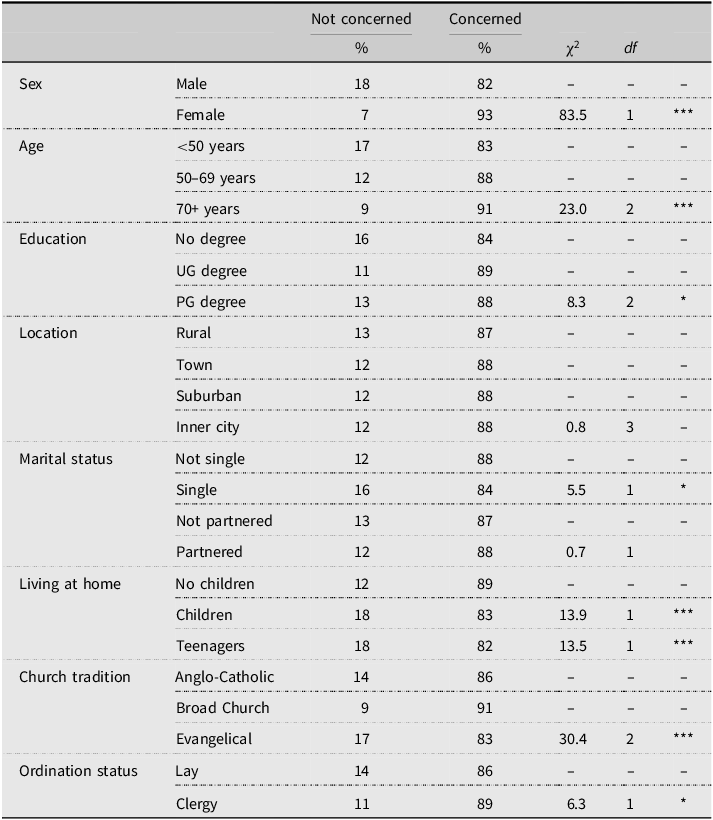
Table 4 Long description
A table comparing concern about climate change across different groups. The table has 11 rows and 5 columns. The columns are labeled as Not concerned (%), Concerned (%), χ2, df, and *** for significance. The rows are labeled as Sex, Age, Education, Location, Marital status, Living at home, Church tradition, and Ordination status. Each row contains subcategories with corresponding percentages for not concerned and concerned, along with chi-square values and degrees of freedom. Notable trends include higher concern among females, older age groups, those with a PG degree, and those in the Broad Church tradition. Lower concern is noted among those with children or teenagers living at home.
Note. Figures are percentages, but contingency tests were on counts.
*p < .05; ***p < .001; otherwise not significant.
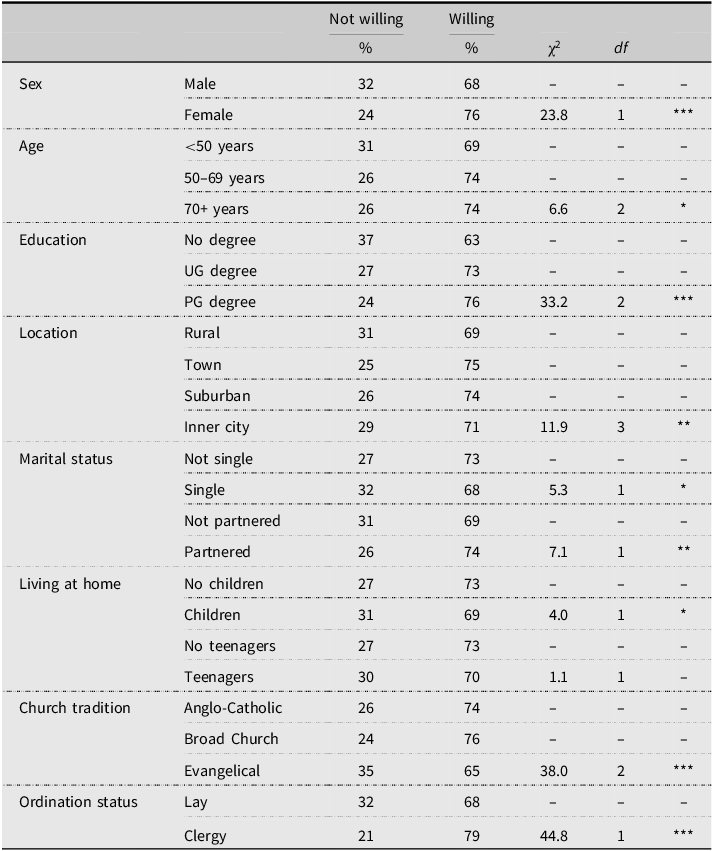
There were similar differences by sex and church tradition when it came to willingness to pay more tax to help the environment (Table 5). For this item, there were also differences with education, with a higher proportion of those with postgraduate degrees being willing (76%) than those with undergraduate degrees (73%) or no university degrees (63%), and by ordination status, with a higher proportion of clergy being willing (79%) than laity (68%). Willingness may partly reflect ability to pay, though there were no obvious patterns that pointed to this being the underlying reason for differences.
Responses to willing to pay more taxes in different groups
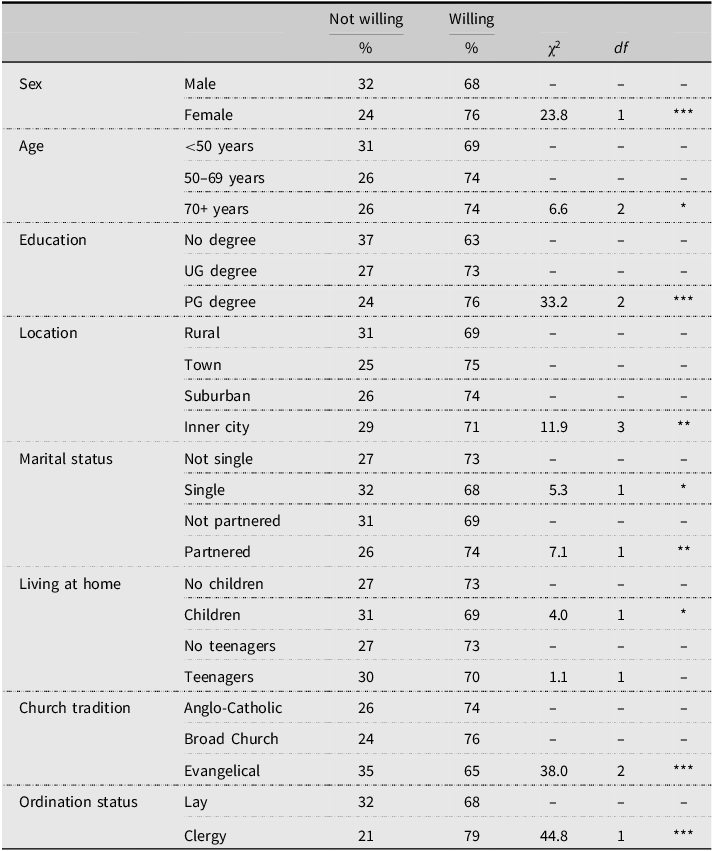
Table 5 Long description
The table presents data on the willingness to pay more taxes to help the environment across various demographic groups. It includes columns for Not willing and Willing percentages, chi-square values, and degrees of freedom. The table has 8 rows and 5 columns. Row 1: Sex, Male, 32, 68, -. Row 2: Sex, Female, 24, 76, 23.8, 1, ***. Row 3: Age, <50 years, 31, 69, -. Row 4: Age, 50-69 years, 26, 74, -. Row 5: Age, 70+ years, 26, 74, 6.6, 2, *. Row 6: Education, No degree, 37, 63, -. Row 7: Education, UG degree, 27, 73, -. Row 8: Education, PG degree, 24, 76, 33.2, 2, ***. Row 9: Location, Rural, 31, 69, -. Row 10: Location, Town, 25, 75, -. Row 11: Location, Suburban, 26, 74, -. Row 12: Location, Inner city, 29, 71, 11.9, 3, **. Row 13: Marital status, Not single, 27, 73, -. Row 14: Marital status, Single, 32, 68, 5.3, 1, *. Row 15: Marital status, Not partnered, 31, 69, -. Row 16: Marital status, Partnered, 26, 74, 7.1, 1, **. Row 17: Living at home, No children, 27, 73, -. Row 18: Living at home, Children, 31, 69, 4.0, 1, *. Row 19: Living at home, No teenagers, 27, 73, -. Row 20: Living at home, Teenagers, 30, 70, 1.1, 1, -. Row 21: Church tradition, Anglo-Catholic, 26, 74, -. Row 22: Church tradition, Broad Church, 24, 76, -. Row 23: Church tradition, Evangelical, 35, 65, 38.0, 2, ***. Row 24: Ordination status, Lay, 32, 68, -. Row 25: Ordination status, Clergy, 21, 79, 44.8, 1, ***.
Note. For explanation, see Table 4.
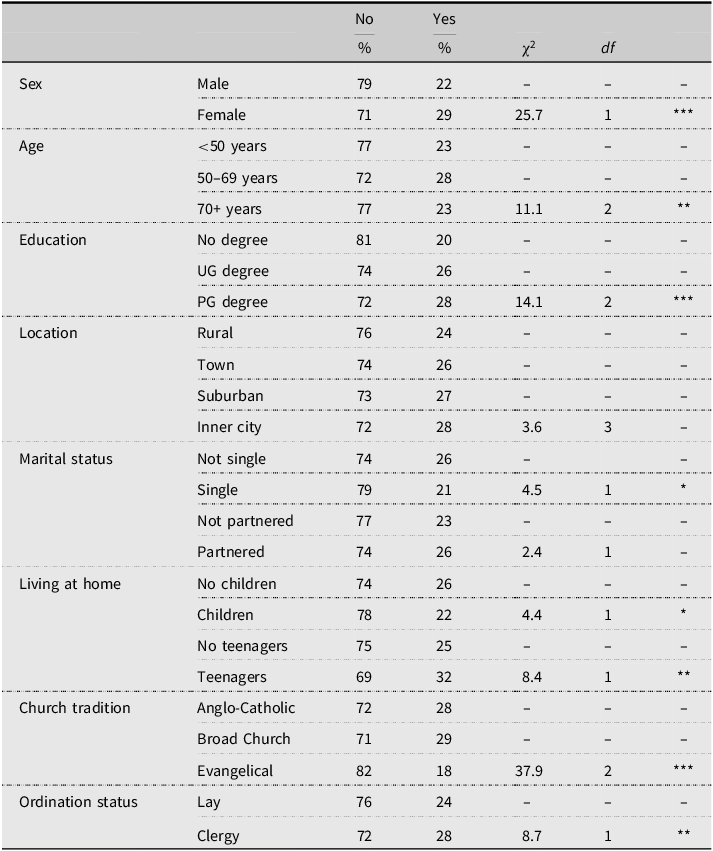
The item from the Activity scale was about taking part in environmental protests (Table 6), and this was again more likely among women (29%) than among men (22%), among those with postgraduate degrees (28%) than among those with no degrees (20%), among clergy (28%) than among laity (24%) and among those in the Broad Church (29%) or Anglo-Catholic (28%) tradition than among Evangelicals (18%). The latter group seemed particularly unlikely to take part in such protests.
Responses to engaged in environmental protest in different groups
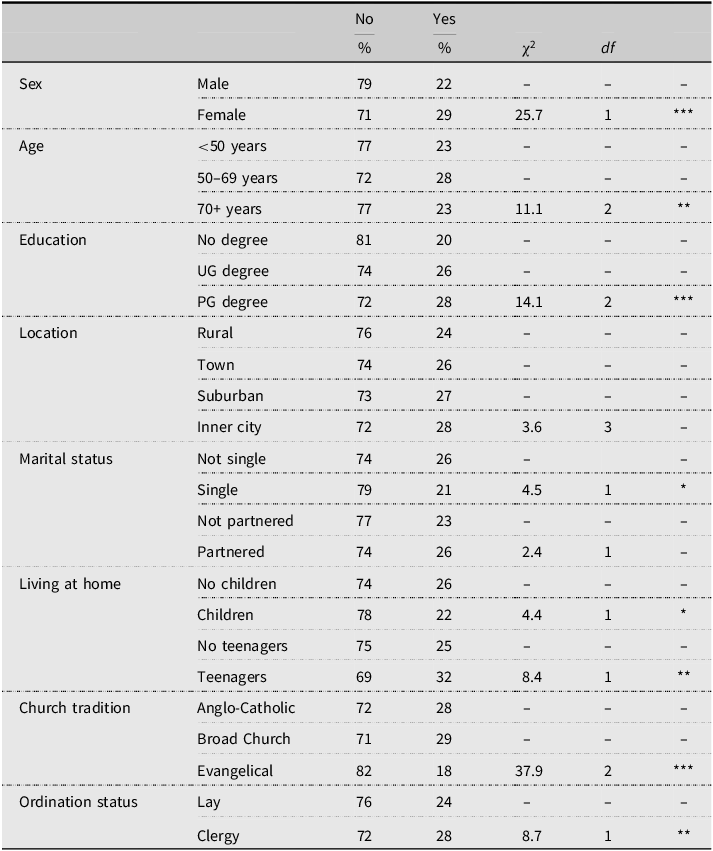
Table 6 Long description
The table presents data on the percentage of individuals engaged in environmental protests across various demographic and social groups. It includes columns for ‘No’ and ‘Yes’ responses, with corresponding percentages, chi-square values, and degrees of freedom. The groups analyzed include sex, age, education, location, marital status, living at home, church tradition, and ordination status. Notable trends include higher participation among women, individuals with postgraduate degrees, clergy, and those in the Broad Church or Anglo-Catholic traditions. The table highlights significant differences in protest participation based on these factors.
Note. For explanation, see Table 4.
Predictors of Scores
The final stage of analysis was to use hierarchical regressions to identify the independent effects of different factors on the environmental scale scores. The advantage of doing this was first because scales give a more reliable assessment of attitudes than single items, and second because in samples such as this there are often relationships between the predictor variables themselves (see Village Reference Village2025 for more details of such relationships in this survey).
Concern
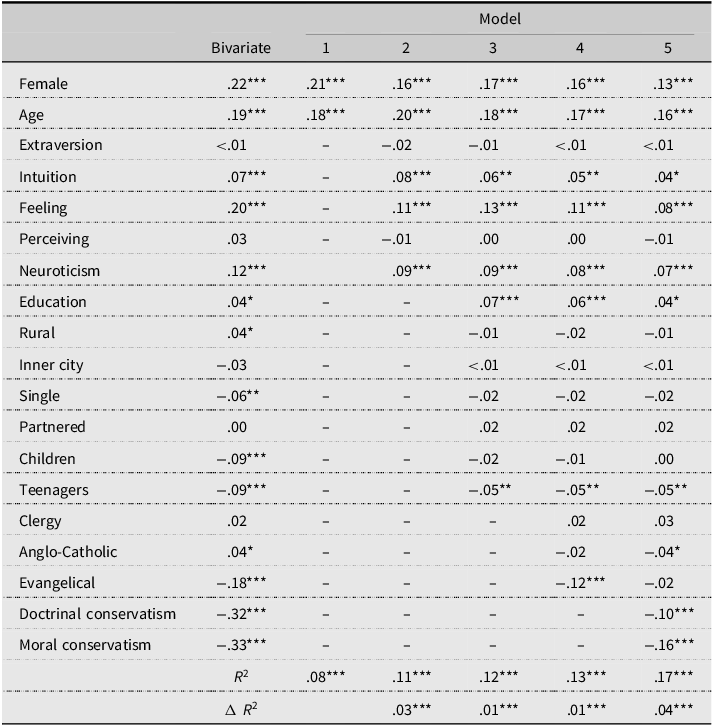
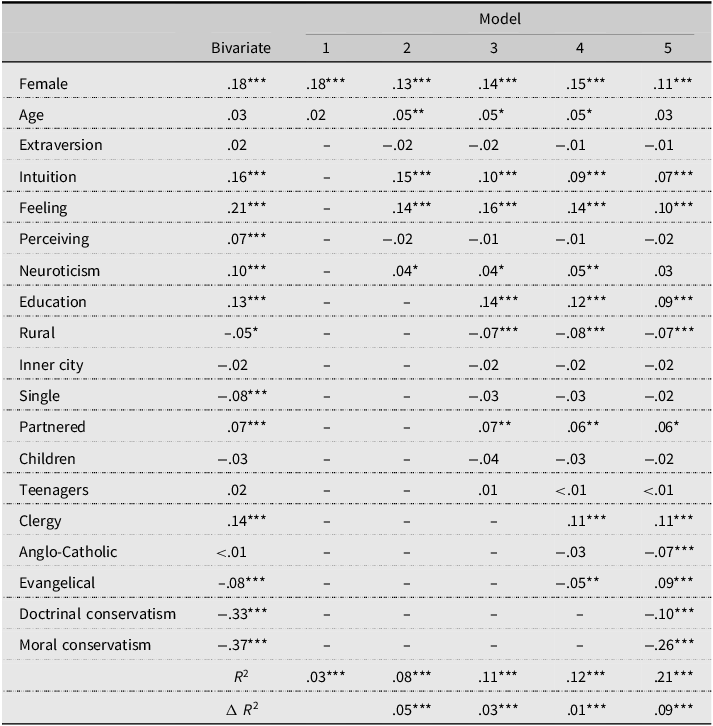
Analysis of the Concern scale demonstrated that the two personal factors showed the same trends as for the individual item on climate change, with higher scores for women than men and a positive correlation with age (Table 7). Of the psychological variables, intuition, feeling and neuroticism all had positive correlations with Concern scores, which remained statistically significant after controlling for other variables in the final model. For contextual variables, education showed a slight but statistically significant correlation with Concern scores, the negative correlation with having children at home did not persist when controlling for age. Evangelicals showed a negative correlation (implying lower concerns than among the other traditions), but this was no longer significant in the final model, when doctrinal and moral conservatism were included. These latter predictors showed the strongest bivariate negative correlations with Concern scores, and it seemed that a key driver of being concerned for the environment is having liberal rather conservative stances on issues of doctrine and morality.
Hierarchical multiple regression of the concern scale
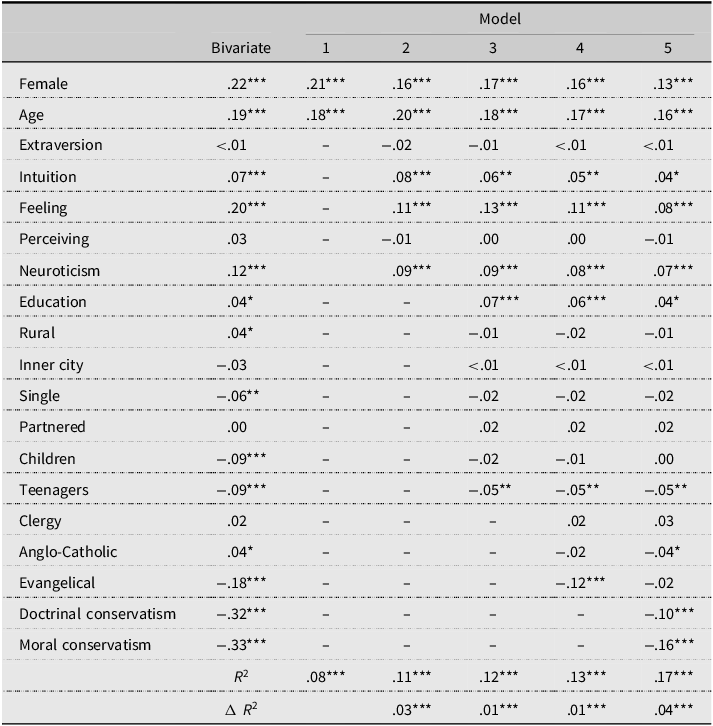
Table 7 Long description
A table with 20 rows and 6 columns. The columns are labeled Bivariate, Model 1, Model 2, Model 3, Model 4, and Model 5. The rows are labeled Female, Age, Extraversion, Intuition, Feeling, Perceiving, Neuroticism, Education, Rural, Inner city, Single, Partnered, Children, Teenagers, Clergy, Anglo-Catholic, Evangelical, Doctrinal conservatism, Moral conservatism, R squared, and Delta R squared. Each cell contains numerical values representing correlations or statistical significance. Notable trends include positive correlations for Female, Age, Intuition, Feeling, and Neuroticism across all models, and negative correlations for Evangelical, Doctrinal conservatism, and Moral conservatism.
Note. *p < .05; **p < .01; ***p < .001. Standardized beta coefficients are given.
Sacrifice
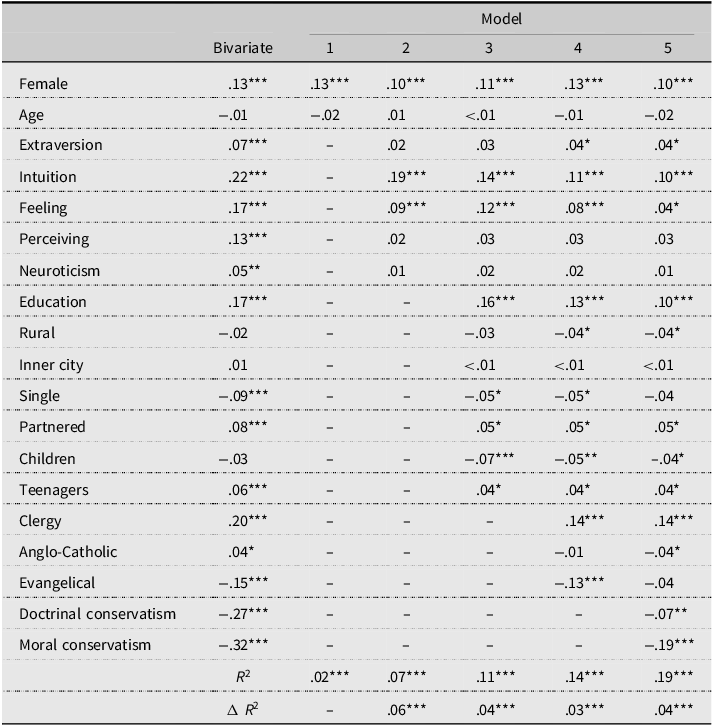
Analysis of the Sacrifice scale demonstrated that psychological variables had some effects on willingness to sacrifice, with preferences for intuition rather than sensing, and feeling rather than thinking, predicting higher Sacrifice scores (Table 8). Doctrinal and moral stance were again the best predictors of scores. In bivariate correlations, Evangelicals showed a negative correlation with Sacrifice scores and Anglo-Catholics no significant correlation. When doctrinal and moral stance were added to the model, however, Evangelicals showed a slight but significant positive correlation with Sacrifice scores, whereas Anglo-Catholics had a slight negative correlation. Evangelicals may overall have been slightly less willing to make sacrifices than were other traditions, but this seems to be due mainly to their generally more theologically conservative stance.
Hierarchical multiple regression of the sacrifice scale
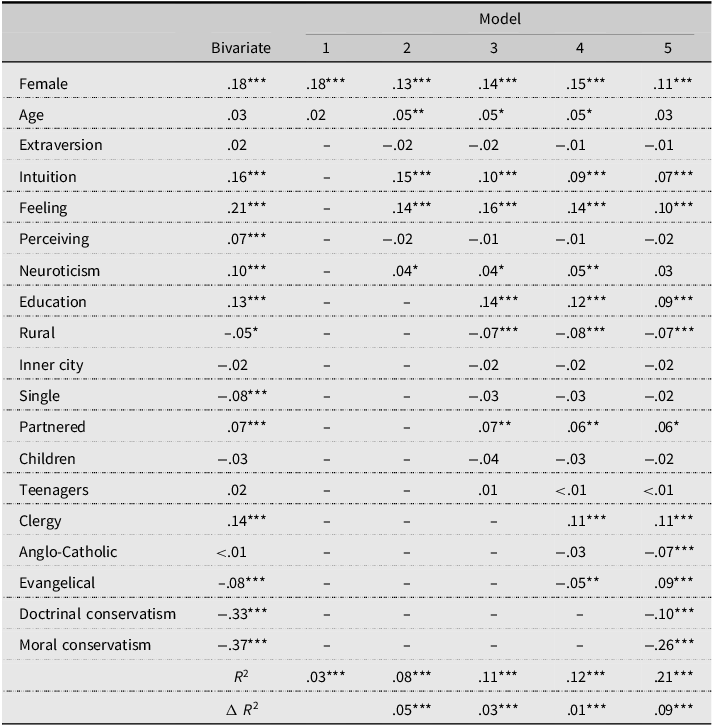
Table 8 Long description
A table showing the hierarchical multiple regression of the sacrifice scale, including various psychological and doctrinal variables. The table has 19 rows and 6 columns. The columns are labeled Bivariate, Model 1, Model 2, Model 3, Model 4, and Model 5. The rows are labeled Female, Age, Extraversion, Intuition, Feeling, Perceiving, Neuroticism, Education, Rural, Inner city, Single, Partnered, Children, Teenagers, Clergy, Anglo-Catholic, Evangelical, Doctrinal conservatism, and Moral conservatism. Each cell contains a value representing the correlation or regression coefficient. Notable trends include significant positive correlations for Female, Intuition, Feeling, and Education across most models, and significant negative correlations for Doctrinal conservatism and Moral conservatism. Evangelicals show a negative correlation in the bivariate model but a slight positive correlation in subsequent models when doctrinal and moral stance are included.
Note. *p < .05; **p < .01; ***p < .001. Standardized beta coefficients are given.
Activity
Analysis of the Activity scale demonstrated that environmental activity was higher among women than men, among clergy than among laity, and showed positive correlations with intuition, feeling and education (Table 9). Doctrinal and moral conservatism again showed a negative correlation with Activity scores and seemed to explain the lower Evangelical and higher Anglo-Catholic Activity scores in the bivariate correlations.
Hierarchical multiple regression of the activity scale
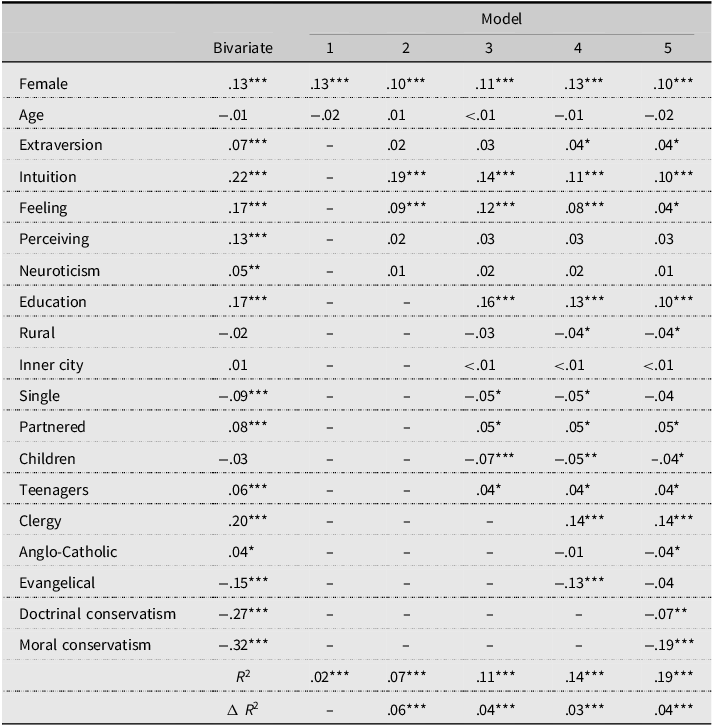
Table 9 Long description
A table with 18 rows and 6 columns showing hierarchical multiple regression of the activity scale. The columns are labeled Bivariate, Model 1, Model 2, Model 3, Model 4, and Model 5. The rows are labeled Female, Age, Extraversion, Intuition, Feeling, Perceiving, Neuroticism, Education, Rural, Inner city, Single, Partnered, Children, Teenagers, Clergy, Anglo-Catholic, Evangelical, Doctrinal conservatism, and Moral conservatism. Each cell contains a numerical value representing the regression coefficient. The table also includes R-squared and delta R-squared values at the bottom.
Note.*p < .05; **p < .01; ***p < .001. Standardized beta coefficients are given.
Discussion
This paper set out to address three main research questions in relation to environmental attitudes among 3229 clergy and lay people in Church of England who took part in the Church 2024 online survey. Three scales were developed to measure environmental concern, willingness to make sacrifices for the environment and levels of pro-environmental behaviours.
Overall Levels
The first question referred to overall levels of pro-environmentalism in the sample. The items causing the most concern were pollution of the environment and loss of natural habitats, with over 90% of respondents indicating they were somewhat or very concerned. Figures for climate change and extinction of species were slightly lower (88% and 84%), while intensification of farming (75%) and over-population (68%) registered the lowest (but still high) concern. These levels were generally slightly higher than those recorded among a sample of churchgoers in England in 2015–2017 (Village, Reference Village2020), apart from over-population, where concern was much lower. It can be argued that over-population is the root cause of many environmental problems (Cafaro et al. Reference Cafaro, Hansson and Götmark2022), at least on a global scale, but for religious people and especially Christians, it is hard to imagine a world where God might want there to be fewer, not more people.
Willingness to make sacrifices again varied according to the particular item. The highest support was for allowing more windfarms in the countryside, with 82% being somewhat or very willing for this to happen. In the survey reported by Village (Reference Village2020), the equivalent figure was 74%. This has been a contentious issue in England, where inshore windfarms have been all but banned in favour of offshore ones over the last decade (unlike Scotland). Despite this, the level of willingness increased from the earlier survey, suggesting recent moves to change the policy may be supported by Anglicans in England. Lowest support (54%) was for restricting economic growth: low growth has been cast as a crucial problem by politicians in the UK for some time, so the call from some activists to limit growth for the sake of the planet (Kallis Reference Kallis2019; Spash Reference Spash2021) may not be welcomed across the Church of England.
As might be expected, the activities most often reported were those that individual actions such as changing diet, travel or giving to environmental organizations where just two-thirds of the sample indicated they had done one or more of these things. Just over a third had attended a course or actively protested, which suggests a reasonable level of engagement across the Church.
Variations between Groups
The second question was to examine how pro-environmentalism varied between groups in the sample, by demography, ordination status and church tradition. This was done by using single items from each of the three scales and comparing groups using contingency tests. The results generally confirmed what others have found in terms of the greater concern over climate change, willingness to pay more taxes for environmental causes, and having engaged in pro-environmental protests.
A higher proportion of women than men fell into the concerned (93% versus 82%), willing (76% versus 68%) and active categories (29% versus 22%), which is in line with the widely reported greater pro-environmentalism of women (Desrochers et al. Reference Desrochers, Albert, Milfont, Kelly and Arnocky2019; Desrochers and Zelenski Reference Desrochers and Zelenski2023; Gyurián Nagy Reference Gyurián Nagy2024; Li et al. Reference Li, Wang and Saechang2022). It seems likely this may reflect the same forces at work in the Church of England as in wider society, so efforts to ‘green’ churches may need to find ways of overcoming this particular gendered barrier.
Those aged 70 years or older were more likely to express concern than were younger people (91% versus 83% for those under 50), which is line with findings from wider populations (Wang et al. Reference Wang, Hao and Liu2021; Wiernik et al. Reference Wiernik, Ones and Dilchert2013). However, there was less difference in terms of being willing to pay more tax, with under thirties (69%) slightly less willing than the rest of the sample (74%), and it was those in their 50s and 60s who were most likely to have taken part in protests (28% versus 23% for the rest of the sample). Those under 50 seemed to be the least likely to show pro-environmentalism in all three areas so it is, perhaps surprisingly, this group that may need most help to raise their game.
Levels of climate concern were slightly higher among clergy (89%) compared with laity (86%), but there were bigger differences in willingness to pay more tax (79% versus 68%) and having protested (28% versus 24%). In all three areas, Evangelicals had lower scores than either Anglo-Catholics or those from the Broad Church, which fits with the widely held observation that it is this tradition that tends to be the least concerned about climate change (Barker and Bearce Reference Barker and Bearce2013; Skeel Reference Skeel2008; Village Reference Village2015). Whether this is because of their identity per se, or because beliefs associated with being Evangelical required addressing in the final question.
Predictors of Pro-Environmentalism
The third question was to identify the factors that independently predict environmental attitudes in the Church of England. This involved using multiple regression and including measures of psychological type preferences and theological stance. The results confirmed the sex difference in all three measures, and the greater concern (but not willingness to sacrifice or activism) of older people. The gender difference persisted after controlling for psychological differences between men and women, and the fact that women in this sample tended to be slightly less conservative than men.
In terms of psychological dispositions, there were consistent effects of intuition and feeling on all three scales, with intuition showing the strongest effect on concern. This is in line with the widespread finding that openness (as measured in trait models of personality) tends to be associated with greater environmental concern (Hirsh Reference Hirsh2010; Milfont and Sibley Reference Milfont and Sibley2012; Soutter et al. Reference Soutter, Bates and Mõttus2020). In the psychological-type model, the intuitive function is associated with an interest in new ideas, the possibilities of the future and linking ideas imaginatively. These would seem to be ways of perceiving the (relatively) novel ideas related to environmental crises in ways that are receptive to recognizing the dangers. The opposite function, sensing, is more attuned to the familiar, the practical and what is perceptible by the senses, so sensing types may find the idea of acting now to prevent possible future dangers more difficult. As the effects of climate change and loss of biodiversity become more evident in everyday life, sensing types may become more concerned and more willing to act. Higher feeling scores also predicted higher scores on all three scales, but especially Concern and Sacrifice. This is also in line with studies that have shown that Agreeableness is associated with pro-environmentalism (Soutter et al. Reference Soutter, Bates and Mõttus2020; Swami et al. Reference Swami, Chamorro-Premuzic, Snelgar and Furnham2010). The feeling function responds with empathy to others and helps individuals make decisions related to shared values and concerns. The thinking function, in contrast, relies on objective logic to make decisions, so thinking types may resist the pleas from environmentalists unless they are convinced by the evidence.
Emotional volatility is not a component of the psychological-type model, but it is part of the FPTETS instrument used in this study and is known to be comparable to neuroticism as measured in trait models (Village and Francis Reference Village and Francis2022a). The tendency to anxiety and guilt may explain why those with higher volatility scores had higher Concern scores, but there was effect on neither Sacrifice nor Activity scores. This has been shown in other studies of churchgoers in England (Village Reference Village2020) and may suggest that the link may be related to eco-anxiety (Arcanjo Reference Arcanjo2019; Panu Reference Panu2020; Stanley et al. Reference Stanley, Hogg, Leviston and Walker2021; Usher et al. Reference Usher, Durkin and Bhullar2019).
The lower pro-environment scores of Evangelicals than other traditions that was evident in the bivariate correlations disappeared from Sacrifice and Activity scores, and the trend was reversed for Concern scores, when doctrinal or moral conservatism were added to the models. This suggests that the difference between the traditions is probably linked to the broadly conservative perspective of most Evangelicals compared to Anglo-Catholics or other Anglicans in the Church of England. These measure of liberalism versus conservatism in the Church of England have been shown to drive attitudes to other contemporary issues (Village Reference Village2025; Village and Francis Reference Village and Francis2026), and they are a reminder that variations in opinions are not driven by simple party affiliations but by more fundamental attitudes and beliefs that inform the way that individuals react to novel issues that demand some specific moral or theological reasoning and response. If the Church of England wants to raise the levels of pro-environmentalism among some members, it may need to show that spending time and money making the Church and the lives of its members Greener is more than a liberal fad, but that it is driven instead by theologies that are derived from biblical and divine mandate.
Conclusions
One of the aims of this study was to help churches to identify those factors that might foster or hinder pro-environmentalism among their members. The results have confirmed work from wider population studies that show that pro-environmentalism is gendered, can vary with age, is partly related to psychological dispositions and has some contextual components. It has also confirmed that religion is an important component that is associated with variations in attitude, in this case even within people who belong to the same Anglican province. Just because some members tend to have less pro-environmental attitudes than others does not mean that this has to remain the status quo. What may be unfruitful is to keep messaging the need for change in ways that appeal more to women, older people, intuitive and feeling types, or doctrinal and moral liberals. That may be preaching to the converted. Men may respond better to different ways of involvement than women, and the same may be true of sensing and thinking psychological types. Some conservative Christians have begun to develop Green apologetics that express the need to respond to the environmental crisis in ways consistent with their wider beliefs (Swoboda and Bouma-Prediger Reference Swoboda and Bouma-Prediger2014; Van Dyke Reference Van Dyke2005; Wilkinson Reference Wilkinson2012), and this sort of theological reflection would be especially helpful to Evangelicals in the Church of England.
Limitations of this Study
Although this was a large and reasonably representative sample of the Church of England, it may not have captured the views of those who are on the fringe of the Church and who are unlikely to read the religious press or diocesan newsletters. Capturing their attitudes is harder and might require a shorter questionnaire given to whole congregations during services. The items used here were part of a much larger survey, so they could not assess some factors such as efficacy and agency which may also be involved in shaping levels of pro-environmental behaviour.
Acknowledgements
We thank all those who took part in the survey and to those who promoted it through their networks. The editors of the Church Times and the Church of England Newspaper helped to promote the survey, as did the network of diocesan communications officers.
Competing interests
No conflicts of interest were reported by the authors.
Ethical approval
Ethical approval was granted by the Research Ethics Committee for the School of Humanities, Religion and Philosophy at York St John University (approval code: ETH2324-0130). All participants had to affirm they were 18 years or over and give their informed consent by ticking a box that gave access to the rest of the survey.

 Open access

