


Niuean (ISO 639-3 code niu) is a Polynesian language spoken on the island of Niue, with an additional population of speakers living in New Zealand. Figure 1 indicates where Niue is located with respect to other neighboring islands in the South Pacific. The 2011 Niue Census of Populations and Households cited the number of individuals who had either basic or fluent spoken abilities at 1121 (with 101 non-speakers) (Statistics Niue 2012). English is the second most widely used language on the island. The 2013 New Zealand census cited 4548 individuals living in New Zealand who listed Niuean as one of their languages (Statistics New Zealand 2013). Niuean is classified as ‘definitely endangered’ by UNESCO (Moseley Reference Moseley2010). There are historically two distinct dialects: the older Motu dialect from the northern area, and the more recent Tafiti from the southern area. These dialect differences were once reflected in slight phonological differences in vocabulary items, but the differences have since eroded in the modern language (see McEwen Reference McEwen1970: ix). Previous research on Niuean phonetics and phonology includes a brief outline in Seiter (Reference Seiter1980: x), two dictionaries (McEwen Reference McEwen1970, Sperlich Reference Sperlich1997), and an article on vowel length (Rolle & Starks Reference Rolle and Starks2014). While these works provide an overview of some of the phenomena to be addressed below, this sketch attempts a more thorough documentation of the phonetic structures of Niuean, and provides novel acoustic and articulatory data from the language. Recordings accompanying this paper are of a male speaker (Mr. Krypton Okesene) and a female speaker (the second author).
Map of Niue and surrounding islands.

Consonants

Examples of each of these consonants are given below, with both phonetic and orthographic representations. In each case, the consonant in question appears in word-initial position.

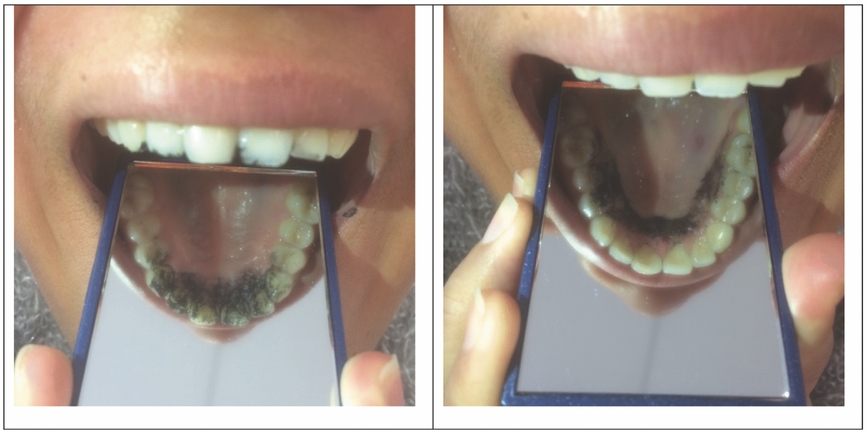
The articulations of [t] and [l] are dental, while [n] and [s] are alveolar. This is supported by palatograms from a female native speaker (Figure 2).
Palatograms of dental [t] (left) in the word [ˈutu] ‘to fill’ and alveolar [n] (right) in the word [ˈunu] ‘to wash’.
There is some variation between [s] and [ʦ] before the front vowels [e] and [i]. In intervocalic position, /k/ tends to spirantize to [x]. The female production of fakaleoaga [faxaleoˈaŋa] ‘sound system’ illustrates this. This lenition is optional, and does not occur in some forms, such as the word keke [ˈkeke] ‘traditional throwaway instrument’, nor in most other instances of words with the causative prefix faka-. [s] occurs as an allophone of /t/ and also occurs in some loanwords (consider the name ‘Jesus’ pronounced as either [iˈesu] or [iˈetu] in Niuean). The approximant [ɹ] is found in some loanwords from English for some speakers, but is not common. The language lacks the approximants [j] and [w]. While there is no glottal stop in Niuean, there are phonetic traces of the glottal stop inherited from the ancestral language, which will be explained below.
Vowels

Phonetically there are five short vowels with five long counterparts. Long vowels in the language are orthographically indicated with a macron over the vowel. Examples illustrating these contrasts are as follows:

The long and short vowels are presented as phonemic pairs, following the Polynesian tradition of considering vowel length as phonemic. However, while there is a phonetic durational difference between vowels, this does not mean to imply that vowel length constitutes an underlying phonemic distinction in the language. This issue will be expanded on below.
Duration data for the short and long vowels in the above words, for both the male and female speakers, is presented in Table 1. The mean duration for the short vowels (n = 10) is 134.8 msec (s.d. 59.2) and 300.3 msec (s.d. 46.7) for the long vowels (n = 10). The durations for the short vowel [i] are considerably longer than the other short vowels in this set, presumably due to the fact that it is found in a monosyllabic context. The durations for long [iː] are also longer than those for the other vowels, including [uː], which is in a similar monosyllabic context.
Duration of short and long vowels in msec.

In the Niue Language Dictionary, a difference is reported between short vowels, long vowels, and long vowels derived from sequences of two short vowels (‘rearticulated vowels’), a difference which is reflected in the orthography:

Rolle & Starks (Reference Rolle and Starks2014) point out that long and rearticulated vowels are in complementary distribution: long vowels are simply sequences of identical vowels where the first is stressed, while rearticulated vowels involve stress on the second vocalic portion. In connected speech, long vowels and rearticulated vowels surface with comparable durations; however, there is a higher pitch on the final vowel of a rearticulated sequence; consider the difference between [aːˈfou] ‘adze’, without primary stress on the long vowel, versus [aˈafu] ‘to be hot’.
The Niue Language Dictionary notes many rearticulated vowels in derived contexts, such as in reduplication: ega [ˈeŋa] ‘to be rosy’, egaega [eŋaˈeŋa] ‘rosy things’; ene [ˈene] ‘to poke’, eneene [eneˈene] ‘to poke continuously’. There is also a pause or glottalization that occurs medially in these forms, characteristic of a prosodic word boundary. Rearticulated vowels also occur in contexts derived through affixation. The following examples illustrate how the prefix faka- ‘to cause, to make’ can attach to roots to create rearticulated vowels:

Derived sequences of vowels whereby a long vowel is followed by an identical short vowel may involve a production that includes a slight pause, or glottalization before the rearticulated second vowel portion. This is the case for the female production of the word [fakaat ːˈaŋa] ‘permit’, while the male production involves only a single long vowel [fakaataːˈaŋa]. The same phenomenon occurs in root words which historically had a glottal stop between two vowels, and which has been lost in modern Niuean. Examples include mooli [moˈoli] ‘true’ and maama [maˈama] ‘bright’, where there is a glottal stop between the identical vowels in the related Tongan language, and laā [laˈaː] ‘sun’ (from Proto-Polynesian *laqaa ‘sun’). In most cases, there is no residual glottalization, and the vowels are produced as long vowels (with the exception of [laˈaː] ‘sun’, which involves a short vowel plus an identical long vowel sequence), though the female production of [laˈaː] ‘sun’ involves glottalization between the two vowels.
Conventions
As noted above, sequences of the dental stop followed by the high front vowel surface as [si] or as [ʦi]; this is also true in contexts preceding the mid front vowel [e]. This is evident in some loans, where [s] occurs preceding [i] or [e]: sēvolo [seːˈvolo] ‘devil’, tī [si] ‘tea’. The only case in our corpus of a native word having [t] followed by a front vowel is in a contracted form: the word tuai (as in oti tuai [ˈosi tuˈai] ‘to be finished’) can be contracted to oti tai [tai] or oti tei [tei], due to loss of the high back vowel at normal speech rates. Some other loanwords retain [t] instead of [s] before [i, e]: pitiluti [pitiˈluti] ‘beetroot’, pateta [paˈteta] ‘potato’.
Stress
Word-level stress falls on the penultimate mora (see the Niue Language Dictionary, and Rolle & Starks Reference Rolle and Starks2014), a pattern characteristic of many other Polynesian languages. Examples of word stress include the following (where stress is here indicated for monosyllabic forms):

This stress pattern results in ‘breaking’ (the rearticulation of the vowel) when a diphthong or long vowel occurs before __CV# (see the Niue Language Dictionary and Rolle & Starks Reference Rolle and Starks2014). The effect is a prominence on the latter vocalic portion, including a rise in pitch, and often with rearticulation of the vowel, as discussed above.

According to the Niue Language Dictionary, pretonic surface long vowels also attract a secondary stress:

Rolle & Starks (Reference Rolle and Starks2014) note that secondary stress is not entirely consistent for some speakers.
Syllable structure
Niuean has a relatively simple syllable structure: single onset consonants are allowed, and a nucleus consists of a vowel. The Niue Language Dictionary notes that there are some diphthongs which behave as single units with respect to syllable structure (Sperlich Reference Sperlich1997: 9), i.e. as a single nucleus. Sequences that we can identify as nuclei include [ae, ai, ao, au, ea, ei, eo, eu, ia, ie, io, iu, oa, oe, oi, ou, ua, ue, ui, uo]. Examples of syllables are as follows:

Intonation
Clemens (Reference Clemens2014) notes that there are H phrasal pitch accents on the stressed syllable of the lexical head, followed by a boundary L-, and the Niue Language Dictionary (Sperlich Reference Sperlich1997: 10) notes that most sentences end in rising intonation; however, the data here indicate that there is a consistent pitch accent found near the left edge of clauses. This is illustrated with a pragmatically neutral declarative statement, where the nuclear pitch accent falls on the stressed syllable of tutala (see Figure 3):Footnote 1

Waveform and pitch trace of female production of [tuˈtala e fiˈfine ke he taˈŋata taˈane] ‘The woman talked to the man’.

Since the word order of the language is typically VSO, the nuclear pitch accent appears on the predicate, which is in initial position. In focused constructions, the focused constituent (tagata taane) appears preverbally and bears the accent (see Figure 4):

Waveform and pitch trace of female production of [ko e taˈŋata taˈane ne tuˈtala e fiˈfine ki ai] ‘It is the man that the woman is talking to’.

This is also true of wh-questions, consistent with the idea that wh-words in clause-initial position constitute the predicate in Niuean (Potsdam & Polinsky Reference Potsdam, Polinsky, Moyse-Faurie and Sabel2011). Here, the nuclear pitch accent falls on the focus marker ko (see Figure 5):

Waveform and pitch trace of female production of [ko hai ne tuˈtala e fiˈfine ki ai] ‘Who did the woman talk to?’.

Finally, yes/no questions also exhibit the cross-linguistically unusual pattern of falling intonation (see Figure 6):

Waveform and pitch trace of female production of [tuˈtala naˈkai e fiˈfine ke he taˈŋata taˈane] ‘Did the woman talk to the man?’.

Recorded passage
This narrative is a direct translation of ‘The North Wind and the Sun’, which was read by each speaker. The orthographic version follows the broad transcription, as does a version with interlinear glosses.
Phonetic version
ko e feˈiŋa e maˈtaŋi tokeˈlau mo e laˈaː he faː e taufeˈtoko ko hai ha laˈua ne mua ˈatu e maloˈloː he maŋaˈaho ne ˈhoko mai ai e taˈŋata ˈfano feˈnoŋa ne tui paˈleu maˈfana. kua taˈlia ai e laˈua ke feˈtoko ke kiˈsia ko hai ha laˈua ne mua ˈatu e maloˈloː. ko e ˈpatu ne mua atu e maloˈloː mai ha laˈua niː ka maˈeke ke fakalaŋaˈlaŋa e taˈŋata ˈfano feˈnoŋa ke aˈaki e haˈana a peleˈue maˈfana. kua uˈulo he maˈtaŋi tokeˈlau ke he fakaosiˈaŋa he haˈana a tau uˈulo ke ˈlali ke fakalaŋaˈlaŋa e taˈŋata ˈfano feˈnoŋa ke aˈaki e haˈana a peleˈue maˈfana ka e au ˈatu ni e taˈofi he taˈŋata ˈfano feˈnoŋa e haˈana a peleˈue maˈfana ˈasi fiu tuˈai ni e maˈtaŋi tokeˈlau si fakaˈosi e tau uˈulo haˈana. na kaˈmata ni e laˈaː ke kiˈkila si aˈaki aŋaˈtaha ni he taˈŋata ˈfano feˈnoŋa e haˈana a peleˈue maˈfana, ˈasi talaˈhau ai ni he maˈtaŋi tokeˈlau mo e haˈana a ˈŋutu ko e laˈaː ne maloˈloː mai ha laˈua.
Orthographic version
Ko e feiga e Matagi Tokelau mo e Laā he fā e taufetoko ko hai ha laua ne mua atu e malolo he magaaho ne hoko mai ai e tagata fano fenoga ne tui peleue mafana. Kua talia ai e laua ke fetoko ke kitia ko hai ha laua ne mua atu e malolo. Ko e patu ne mua atu e malolo mai ha laua nī ka maeke ke fakalagalaga e tagata fano fenoga ke aaki e haana a peleue mafana. Kua uulo he Matagi Tokelau ke he fakaotiaga he haana a tau uulo he lali ke fakalagalaga e tagata fano fenoga ke aaki e haana a peleue mafana ka e au atu ni e taofi he tagata fano fenoga e haana a peleue mafana ati fiu tuai ni e Matagi Tokelau ti fakaoti e tau uulo haana. Na kamata ni e Laā ke kikila ti aaki agataha ni he tagata fano fenoga e haana a peleue mafana, ati talahau ai ni he Matagi Tokelau mo e haana a gutu ko e Laā ne malolo mai ha laua.
Orthographic glossed version

‘The North Wind and the Sun were arguing to see which of them was stronger when a traveller arrived wearing a warm overcoat.’

‘They agreed to compete with each other to see who was stronger.’

‘The one who wins is the strongest between the two of them who will be able to cause the traveller to take off his warm overcoat.’

‘The North Wind blew to the ends of his blowing ability to try and cause the traveller to take off his warm overcoat but the traveller just kept holding on to his warm overcoat and so the North Wind was fed up and stopped his blowing.’

‘As soon as the Sun started to shine, the traveller immediately took off his warm overcoat and the North Wind had to say with his own mouth that the Sun was the stronger one between them.’
Acknowledgements
Thanks to Krypton Okesene, two anonymous reviewers, and Adrian Simpson and Amalia Arvaniti for helpful comments. All errors are our own.



