




Introduction
Since 2019, the COVID-19 coronavirus has infected nearly 800 million people and caused over seven million deaths (WHO 2025). During the early stage of the pandemic, most countries responded by instigating stay-at-home orders and banning or severely restricting public gatherings, including religious services. In most cases, these were in place for various periods during 2020 and 2021. Although the virus continued to circulate thereafter, the widespread use of vaccines has attenuated its effects, and the World Health Organization declared an end to the pandemic in May 2023. Alongside the effects of illness, deaths and lockdowns on economic and social life, there were widely reported effects on religious groups, including Christians (Eagle et al. Reference Eagle, Johnston, Headley and Holleman2022; Shoko Reference Shoko and Mbaya2024; Weller Reference Weller2024). Many churches worked rapidly to develop online patterns of worship, which were met with varying degrees of enthusiasm (Edelman et al. Reference Edelman, Vincent, Kolata and O’Keeffe2021; Village and Francis Reference Village and Francis2023b). The strains on ministers were noted early on as they tried to maintain some sort of liturgical and pastoral ministry, sometimes with little or no support (Francis and Village Reference Francis and Village2025b; McFerran and Graveling Reference McFerran and Graveling2021; Village and Francis Reference Village and Francis2021d). As restrictions were lifted, researchers and national church organizations began to try and assess what impact the pandemic had had on attendance, finance and the well-being of clergy and lay people. Assessing the longer-term effects on churches is important because events which disrupt the worship patterns of churchgoers (such as moving to a new area) can often lead to people leaving church altogether (Francis and Richter Reference Francis and Richter2007; Richter and Francis Reference Richter and Francis1998). Those who remain might be pessimistic about the future, especially if numbers are lower than they seemed to be pre-pandemic. On the other hand, times of disaster can sometimes increase people’s faith and religious commitment, factors that might lead to a resurgence in affiliation and attendance. Data are beginning to emerge that allow assessment of changes to churches since the pandemic, and this article contributes to this body of knowledge by analysing survey data collected from clergy and lay people from the Church of England in 2024, about 3 years after the end of lockdown restrictions.
Evidence of the State of Churches after Lockdowns
The evidence for the state of churches after the pandemic is likely to emerge from several different kinds of sources. One line of evidence is the statistics of attendance collected by mainstream denominations, usually based on summing the returns sent in from individual churches or congregations. (For example, from Anglican provinces, see Church of England 2024b; Scottish Episcopal Church 2025; The Episcopal Church 2023). These are probably the most objective statistics, but they do not necessarily show how clergy or churchgoers perceive the changes that are happening, which may be important to their levels of optimism or pessimism. Several churches around the world have reported increases in numbers after 2022. For example, the Episcopal Church in the US saw a 43% fall in average Sunday attendance from 2019 to 2021 but a 31% increase from 2021 to 2023 (The Episcopal Church 2023).
Another source of data is from pollsters who ask about attendance from purportedly representative samples of general populations (for examples, see Jones Reference Jones2023; Macchi Reference Macchi2025; McAleer and Barward-Symmons Reference McAleer and Barward-Symmons2025). The items in these surveys usually ask how often respondents attend church, and the proportion attending ‘regularly’ (which might be at least weekly or monthly) is used to assess changes in the fortunes of churches. Some care is needed in defining ‘attendance’, especially since the pandemic, when attending digital services became more popular. US Gallup polls asking respondents about church attendance (including digital services) in the previous seven days showed a decline from 34% in January 2019 to 29% in January 2021 and a subsequent increase to 31% in January 2023 (Jones Reference Jones2023). A recent survey in the UK by the Bible Society has caused a considerable stir in the media because it claimed that churches generally are experiencing a period of rapid growth in attendance, fuelled by increased attendance by young adults, especially young men (McAleer and Barward-Symmons Reference McAleer and Barward-Symmons2025). Their figure of 12% of the adult population attending services was up from 8% for a similar survey in 2018, suggesting more than a simple rebound from the pandemic. This picture of growth in attendance has been challenged by some, who point out that it runs against the trends reported by long-term surveys such as the British Social Attitudes Survey, and it may be the result of unusually low attendance reported in the 2018 survey (Humanists UK Reference Humanists2025; More or Less BBC 2025).
As well as surveys of the general population, there have also been surveys of those who regularly attend church, asking about their patterns of attendance, beliefs, well-being etc. (Thumma Reference Thumma2025; Village and Francis Reference Village and Francis2025). The Exploring the Pandemic Impact on Congregations (EPIC) survey sampled some 24,000 churchgoers across the United States in 2024 (Thumma Reference Thumma2025). The findings suggested that 80% of people who responded (who went to church anyway) had similar or increased levels of attendance compared to before the pandemic. Over half reported stronger faith and spirituality since the pandemic, and volunteering and financial giving seem to have returned to pre-pandemic levels. A large majority (83%) were pleased with how their congregation had adapted to the pandemic. This generally positive response may hide the fact that there are some who have found post-pandemic church life more difficult than others. For example, research on the financial impacts of the pandemic on United Methodist congregations in North Carolina suggested that those from larger, urban congregations rebounded more easily than those from smaller, rural ones (Eagle et al. Reference Eagle, Johnston, Headley and Holleman2022). This echoes a wider study of 2963 churches in the same denomination, which suggested the negative effects on non-urban congregations were greater than those from urban areas (Niazi et al. Reference Niazi, Ahmed, Kifayat, Kifayat, Niazi and Khan2024).
The Church of England and the COVID-19 Pandemic
The Church of England has been in numerical decline for many years. Davis Voas (Reference Voas and Goodhew2017) examined trends in a range of attendance and membership statistics that all showed steady declines from 1980 to 2013. Usual Sunday attendance declined steadily by 37% over that period from 1,240,000 to 775,000, and the trend continued until just before the pandemic in 2019 (Church of England 2024b) when average Sunday attendance for adults and children was 707,100 (Church of England 2021b, from Table 5). This numerical decline has placed financial pressures on dioceses. Parish income increased steadily in absolute terms from the turn of the century, but in real terms (allowing for inflation) it peaked around the time of the financial crisis in 2008 and has remained fairly constant since then (Church of England 2025: 9).
The situation in the Church of England during and after the pandemic was likely to be driven by similar factors to those reported more widely from other denominations. In line with many other countries, the UK government’s main response to the advent of COVID-19 was to severely limit social mixing, with an initial stay-at-home order issued in March 2020 (Brown et al. Reference Brown, Kirk-Wade, Baker and Barber2021). In this first lockdown, the Church of England issued guidance that went beyond the general prohibition of public worship by banning clergy from even entering churches (McGowan Reference McGowan2020). Most churches, including the Church of England, had to rapidly devise forms of online worship and meetings, which suited some but not others (Campbell Reference Campbell2020; Edelman et al. Reference Edelman, Vincent, Kolata and O’Keeffe2021; Village and Francis Reference Village and Francis2021c). The first lockdown ended when death rates declined in late spring and early summer.
As infection rates rose again in the autumn of 2020, different parts of the UK diverged in their approaches to gatherings and wearing facemasks. England used a tiered system of restrictions related to local rates of infection. As schools and universities returned for the autumn term, there was another surge in cases, prompting a second national lockdown in England during November, though this time, schools, universities and a range of businesses remained open. This failed to check infection rates, so a third national lockdown ran from January to July 2021. As vaccines were now becoming available, restrictions were less stringent for public worship, which was permissible as long as there was social distancing and worshippers wore face masks. Many congregations began to meet, so there was a ‘mixed economy’ of face-to-face and online worship, which again suited some but not others (Village and Francis Reference Village and Francis2023b, Reference Village and Francis2024a).
The availability of mass testing and vaccination in 2021 meant that there was no repeat of the peaks in COVID-19 deaths seen in May 2020 or February 2021 in the winter of 2021–22 or thereafter (ONS 2023a). The wearing of facemasks in public was recommended after the end of the 2021 lockdown, but has gradually declined, and by 2023, there was little evidence of social restrictions related to the COVID-19 pandemic (ONS 2023b).
The COVID-19 pandemic had a devastating effect on the Church of England in terms of finance and attendance at services. Overall financial giving fell by 15% from 2019 to 2020 (Church of England 2022), and adult in-person attendance in October 2020, when churches had re-opened with social distancing, was down 57% on the previous year (Church of England 2021a). Since restrictions were fully lifted in 2021, there has been some recovery but not quite to 2019 levels. Although parish income in 2023 was higher than in 2019 in absolute terms (£1111m versus £1097m), this represented a 15% fall after allowing for inflation. Adult weekly attendance in 2023 was still 19% down on pre-pandemic levels, though there was a 2.5% increase from 2022 to 2023, suggesting some continuing recovery (Church of England 2024b).
Objective and Subjective Realities
Attendance and financial data are based on parish returns and probably represent the most objective measure of the general state of the Church of England after the pandemic. They do not, however, capture the perceptions of those who lead or attend parish worship, which may be driven by both objective and subjective reality. Subjective impressions are important because they may ultimately have more influence on whether individuals persist with their religious commitments than the actual level of attendance at their church or its long-term viability. The ‘glass half empty or glass half full?’ idiom expresses the fact that two people looking at the same objective phenomenon may have very different reactions to it. This article examines how clergy and lay people in the Church of England perceived the state of their local church in 2024, some 3 years after the end of pandemic lockdown restrictions.
We assume that these perceptions may partly relate to ‘objective’ realities such as whether they belong to rural or urban congregations, the size of the congregation, or the tradition to which it belongs. These perceptions may also relate to differences between individuals, such as their personality. Psychologists have long noted that optimism tends to be positively associated with extraversion and negatively with neuroticism (Marshall et al. Reference Marshall, Wortman, Kusulas, Hervig and Vickers1992; Williams Reference Williams1992). Extraverts tend to function psychologically in the outer world by engaging with others, while introverts tend to function psychologically internally through introspection and contemplation. Neuroticism is characterized by emotional volatility and the tendency towards anxiety, depression and feelings of guilt. Most psychologists believe the tendency to demonstrate neurotic symptoms is the product of an underlying personality trait, which may be manifested to varying degrees, including non-clinical or pre-clinical negative behaviours. To examine the influences of psychological factors, we developed scales to measure levels of optimism or pessimism in relation to the Church after the pandemic and related these to personality. Understanding the importance of objective and subjective predictors of perceptions of the state of the church may help future studies of congregations that rely on reports from key informers.
Objectives
-
1. To develop self-report measures of the state of the church since the end of pandemic lockdown restrictions
-
2. To identify factors that predict levels of optimism or pessimism among those reporting on the state of their congregation.
Method
Procedure
The Church 2024 survey was an online survey delivered using the Qualtrics platform. It ran from March to November 2024. Invitations to participate were published several times in the Church Times and the Church of England Newspaper as well as in diocesan newsletters. It was also promoted through Roman Catholic networks in the UK and the Republic of Ireland. Of the 5141 total responses to the survey, 4395 (85.5%) were people living in England, 171 (3.3%) elsewhere in the UK and Northern Ireland, 481 (9.4%) in the Republic of Ireland and 95 (1.8%) elsewhere. In terms of religious affiliation, 4027 (78.3%) were Anglicans, 731 (14.2%) Catholic and 383 (7.5%) other denomination (mainly Methodist and Baptist). The final convenience sample used here consisted of 2874 individuals who chose Anglican as their denomination, who lived in England and who had no missing values for variables used in this analysis. Extra-parochial clergy and lay people whose main place of worship was not in a parish church were excluded from the sample.
Participant Profile
The overall sample profile is shown in Table 1. This was a convenience sample, and it is difficult to tell if it was fully representative of the Church of England as a whole because there is little recent or accurate data on the profile of lay people or of retired clergy who attend the Church. The Church of England last did a diversity audit in 2014, which was based on returns from 36,000 people in 600 congregations (Church of England 2015). In that sample, 59% were female, which is close to the figure of 57% female for lay people in this study. Average adult age in the diversity audit was 61 years: age was measured to the nearest decade in this study, and averaging on that basis gave an average age for lay people of about 56 years. In the diversity audit, 6% were minority ethnic, compared with 5% for this study. In the diversity audit, 36% were in rural areas, compared with 33% for this study. The profile of clergy in the Church nationally is reported regularly in terms of sex and age, the latest figures being from 2022. Comparing stipendiary parochial clergy (the largest group of clergy), national figures suggest 34% were female (Church of England 2024a, worksheet F) compared with 41% in this study. In terms of age, national data showed that 21% of stipendiary clergy were in their 40s, 33% in their 50s and 29% in their 60s. The equivalent figures for the sample in this study were 24%, 36% and 22%. These comparisons suggest that the Church 24 survey was reasonably representative, at least in terms of variables that could be compared, for both lay and clergy. The clergy sample may have included a higher proportion of women than is the case of stipendiary clergy nationally.
Profile of the sample

Note: N = 2874. SSM = self-supporting ministers.
Instruments
Dependent Variables
Perceived changes in numbers were assessed by a single item preceded by the rubric ‘Compared with before the pandemic, are the numbers attending your church(es):’. Possible responses were ‘much lower,’ ‘a little lower,’ ‘about the same,’ ‘a little higher,’ ‘much higher,’ and ‘Don’t know’. The latter responses, accounting for 5.6% of the sample, were excluded from analyses of this item, leaving a five-point ordinal response. For compatibility with the other dependent variables, responses were reverse-coded to create a scale of perceived numerical decline, with high scores indicating greater perceived decline in attendance.
The survey also contained ten items related to perceived changes to local congregations since the pandemic, which were headed by the rubric ‘This question is about your church(es) / congregation(s) after the Covid pandemic’. Each item had a five-point response scale ranging from ‘agree strongly’ to ‘disagree strongly’. The items were based on those used in online surveys of the Church of England during the pandemic (Francis et al. Reference Francis, Village and Lawson2021b), but phrased to refer to the present rather than the future tense. Factor analysis (principal components extraction followed by varimax rotation) suggested the items loaded on two slightly different constructs, which were termed ‘fragile church’ and ‘church post-pandemic’ (Table 2). Two summated rating scales were produced and coded such that a high score indicated a more pessimistic attitude toward the state of the local church. Cronbach’s alpha was .80 for the fragile church scale and .79 for the church post-pandemic scale, suggesting a good internal consistency reliability.
Exploratory factor analysis of post-pandemic items
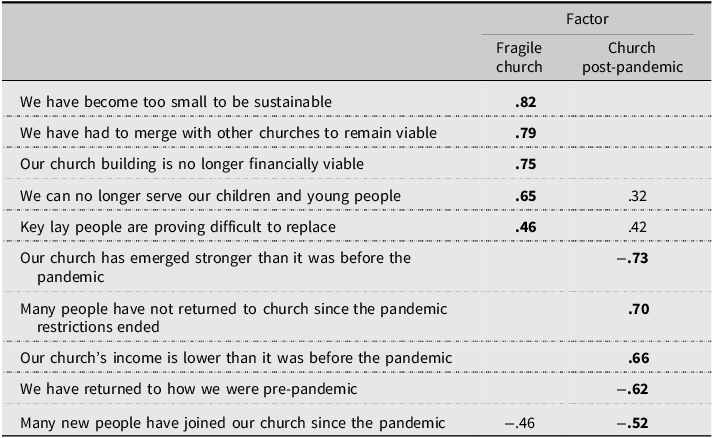
Note: Rotated component matrix after principal component extraction and varimax rotation. Loadings less than .3 are not shown for clarity. Loadings in bold indicate which items loaded on which factor.
Predictor Variables
Predictor variables were grouped into a hierarchy that ran from personal factors to ecclesial factors.
Personal factors were sex (female = 1, male = 0), and age, coded as 18–19 (1), 20s (2), 30s (3), 40s (4), 50s (5), 60s (6), 70s (7) and 80s + (8).
Psychological factors were assessed using the revised shortened version of the Francis Psychological Type and Emotional Temperament Scales (FPTETS) (Village and Francis Reference Village and Francis2023a, Reference Village and Francis2023c, Reference Village and Francis2024b). This is a 30-item instrument comprising four sets of six forced-choice items related to each of the four components of psychological type theory: orientation (extraversion or introversion), perceiving process (sensing or intuition), judging process (thinking or feeling) and attitude toward the outer world (judging or perceiving), and six items related to emotional temperament (calm or volatile) (Village and Francis Reference Village and Francis2022). Previous studies have demonstrated that the parent instrument (which contains just the four psychological type scales) functions well as a measure of psychological type preferences in a range of church-related contexts (for example, see Francis et al. Reference Francis, Edwards and ap Sion2021a; Francis et al. Reference Francis, Robbins and Craig2011; Village Reference Village2016). Alpha reliabilities for these six-item scales were extraversion: .81, sensing: .67, thinking: .78, judging: .78 and emotional volatility: .82.
Contextual factors were derived from a measure of location (rural, town, suburban or inner city), which was used to create dummy variables of rural and inner city, with town and suburb as the reference category.
Ecclesial factors included the size of the usual Sunday congregation participants attended, recorded on a nine-point scale ranging from ‘less than 10’ to ‘over 300’. Status in the Church was measured by a series of dummy variables: stipendiary parochial clergy, active self-supporting or active retired ministers and lay ministers. These allowed comparison with the reference category of non-ministering lay people (which included a few retired clergy who were no longer ministering). Church tradition was assessed using a seven-point bipolar scale labelled ‘Anglo-Catholic’ at one end and ‘Evangelical’ at the other. It is a good indicator of differences in belief and practice in the Church of England (Randall Reference Randall2005; Village Reference Village, Anthony and Ziebertz2012) and was used to identify Anglo-Catholic (scoring 1–2), Broad Church (3–5) and Evangelical (6–7) respondents. Anglo-Catholic and Evangelical were used as dummy predictor variables with Broad Church as the reference category.
Analysis
The first stage of analysis examined the responses to the items in the perceived change in numbers, fragile church and church post-pandemic scales. The second stage of analysis explored which factors predicted scores on the three scales using the multiple linear regression procedure of SPSS 29 (IBM_SPSS 2023). The perceived change in numbers was an ordinal scale and was initially analysed using the ordinal logistic model in the generalized linear models procedure of the software. This identified the same significant predictors as when using the multiple linear regression procedure, so the latter was used on all three scales for ease of presentation. Independent variables were added in successive models: Model 1: sex and age; Model 2: psychological variables; Model 3: rural and inner-city; Model 4: congregation size and status in the church variables; and Model 5: church tradition variables.
Results
Responses to Items
Most respondents reported that, compared with before the pandemic, numbers in their church(es) were either about the same (26.5%) or a little lower (39.5%), with 9.4% reporting they were much lower, 18.6% that they were a little higher and 6.1% that they were much higher. This suggests an overall trend of numbers being somewhat lower than pre-pandemic, which is in line with the latest usual Sunday attendance figures reported for 2023 by the Church of England (Church of England 2024b).
In terms of the fragile church, there was more concern from participants about finding volunteers than there was about the viability of their local churches (Table 3). Only 12% agreed or agreed strongly that their church building was no longer financially viable, with equivalent figures of 8% for the idea that their congregations were too small to be sustainable and 8% for the necessity of merging with other churches to remain viable. When it came to replacing key lay people, however, 57% of participants agreed or agreed strongly that this was proving difficult, and 20% felt their church could no longer serve their children or young people. This implies that the loss of human rather than financial capital was the most pressing issue for many.
Details of the fragile church and church post-pandemic scales
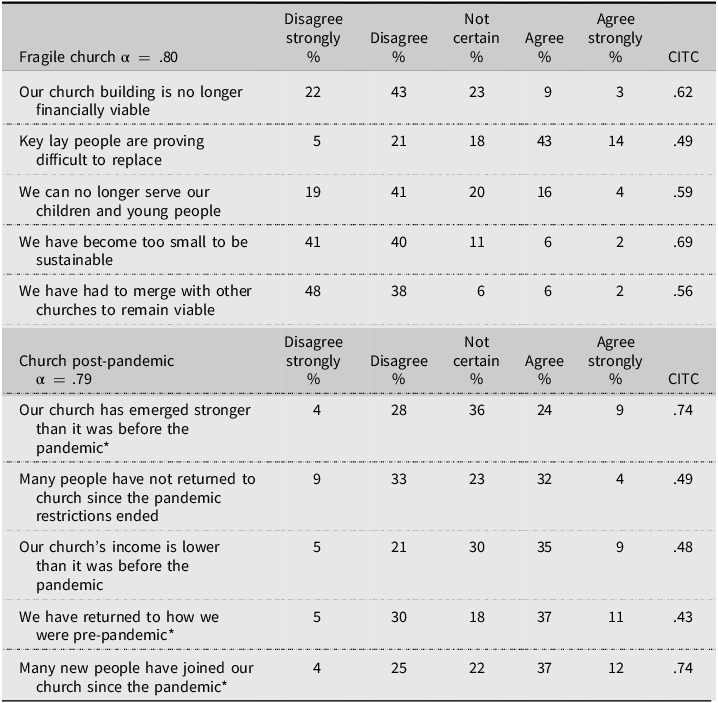
Note: N = 2874. *These items were reverse coded. α = Cronbach’s alpha. CITC = Corrected Item-Total Correlation.
In terms of the church more generally, after the pandemic (Table 3), there was roughly equal agreement with both positive and negative items. Thus, 33% agreed or agreed strongly that their church had emerged stronger than it was before the pandemic, 48% that things had returned to how they were before the pandemic and 49% that many new people had joined their church since the pandemic. On the other hand, 36% agreed or agreed strongly that many people had not returned to church post restrictions, and 44% that the level of income was lower than pre-pandemic. These data suggest that there may have been a lot of turnover as a result of the pandemic, with losses and gains, and that the experience may have strengthened some congregations, even if finances remain tight.
Factors Predicting Scale Scores
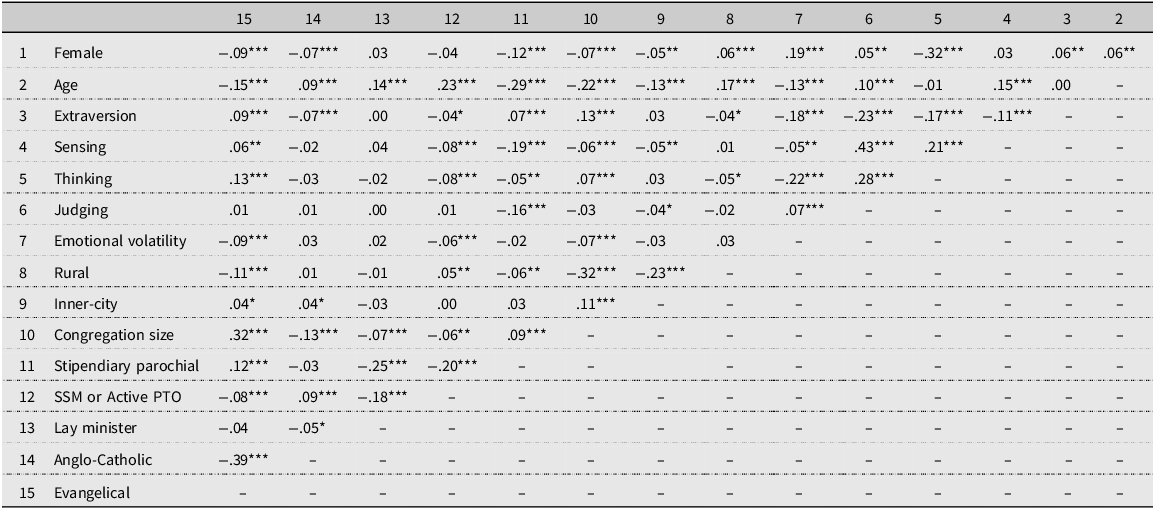
The correlation matrix of independent variables (Table 4) indicated why multiple regression was needed to identify the independent effects of possible predictors of the numerical decline, fragile church and church post-pandemic scales. For example, personal variables were correlated with many of the other variables. Women in the sample were slightly older than men on average; there was a higher proportion of women in rural areas and lower in inner cities compared to men, and women were more likely than men to be in small, Broad-Church congregations. Women also had a slightly different psychological profile to men, with higher scores for emotional volatility and lower scores for thinking (implying higher feeling), which is in line with findings among general populations (Goodwin and Gotlib Reference Goodwin and Gotlib2004; Kendall Reference Kendall1998). The profiles of clergy and laity also differed for a range of reasons, with self-supporting ministers, actively ministering retired clergy and lay ministers being older, on average, than most lay people and stipendiary clergy being younger. There were also correlations between church tradition and individual or congregation variables, with Evangelicals being younger and attending larger congregations, on average, than the other traditions.
Correlation matrix for independent variables
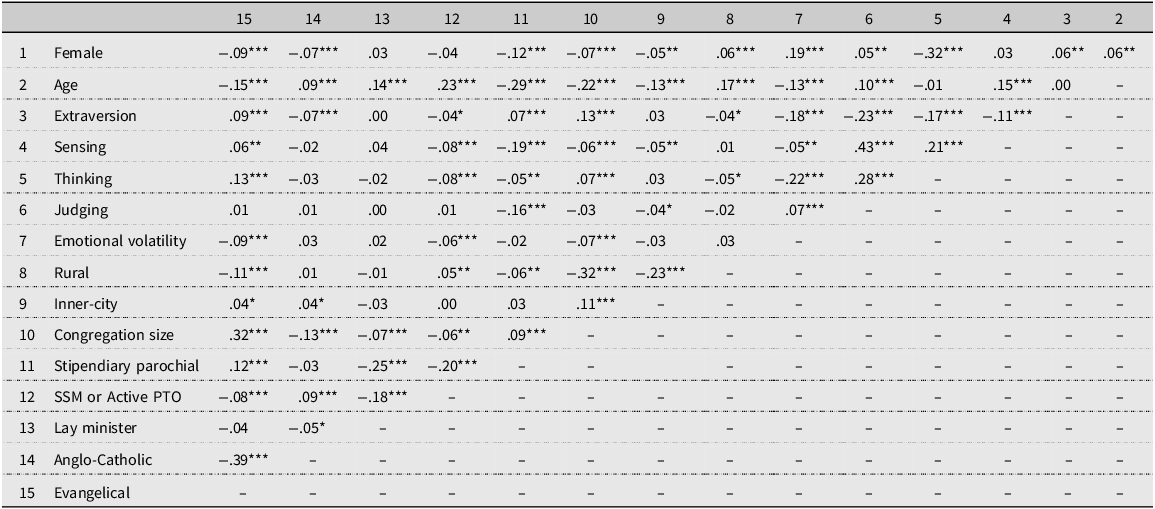
Note: SSM = Self-supporting ministers; PTO = Permission to officiate. *p < .05, **p < .01, ***p < .001, otherwise not significant.
Multiple regression of perceived decline in numbers scale
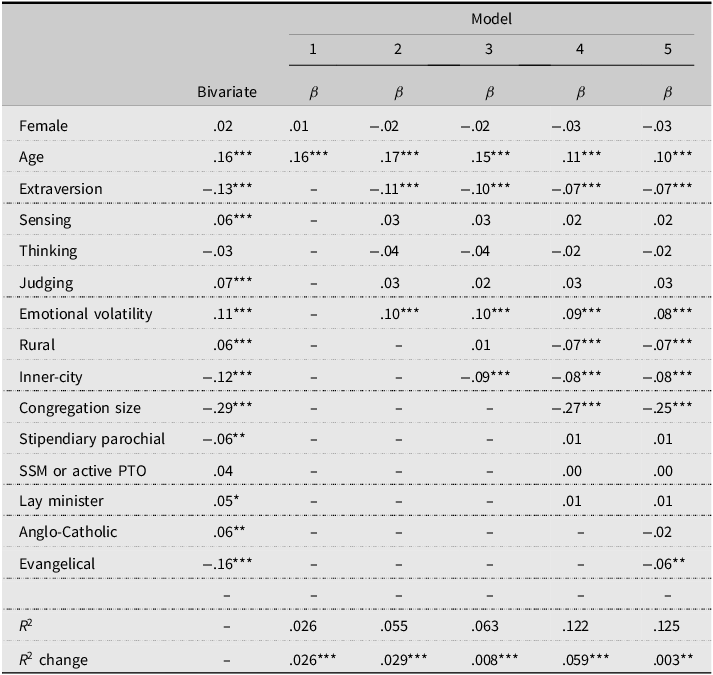
Note: N = 2714. For explanation, see Table 4.
Bivariate correlations for the perceived decline in numbers scale (Table 5, column 2) showed higher (more pessimistic) scores for older people, those with higher sensing, judging and emotional volatility scores, those in rural parishes and those in Anglo-Catholic churches. There were lower (more optimistic) scores for those who scored higher on extraversion, those from inner-city parishes, those in larger congregations and those from the Evangelical tradition. The biggest effects were with age, extraversion, emotional volatility, inner-city location, congregation size and being Evangelical, all of which persisted when controlling for other variables in the model. After controlling for personal, psychological and contextual factors, there were no differences between clergy, lay ministers or non-ministering lay people in how they perceived changes in numbers since the pandemic.
Bivariate correlations for the fragile church scale (Table 6, column 2) showed higher (more pessimistic) scores for women, older people, those with higher emotional volatility, those in rural parishes and those in Anglo-Catholic churches. There were lower (more optimistic) scores for those who scored higher on extraversion or thinking, those from inner-city parishes, those in larger congregations and those from the Evangelical tradition. The biggest effects were with emotional volatility, rural location, congregation size and being Evangelical, all of which persisted when controlling for other variables in the model. The sex difference seemed to reflect the different psychological profiles of men and women, which in turn were related to different psychological type profiles of those in different locations, different roles in the church or different traditions. After controlling for personal, psychological and contextual factors, stipendiary parochial clergy emerged as being slightly more pessimistic about the fragility of their church than were other clergy or lay people.
Multiple regression of the fragile church scale

Note: N = 2874. For explanation, see Table 5.
Bivariate correlations of the church post-pandemic scale (Table 7, column 2) showed higher (more pessimistic) scores among older people, those with higher judging or emotional volatility scores, those from rural parishes, self-supporting or active retired ministers and those from the Anglo-Catholic traditions. There were lower (more optimistic) scores among extraverts, those from inner-city parishes, stipendiary clergy, those from larger congregations and those from Evangelical traditions. After controlling for other variables, the effects that persisted were age, emotional volatility, location, congregation size and being Evangelical. Unlike the fragile church, participants from both rural and inner-city areas tended to have lower (more optimistic) scores after controlling for personal and psychological variables, which was in line with the more optimistic scores for changes in numbers reported from these areas. Although rural churchgoers were likely to be older and less likely to be Evangelical, after allowing for this, they were generally more optimistic about their churches post-pandemic than were those from towns or suburban areas.
Multiple regression of the church post pandemic scale
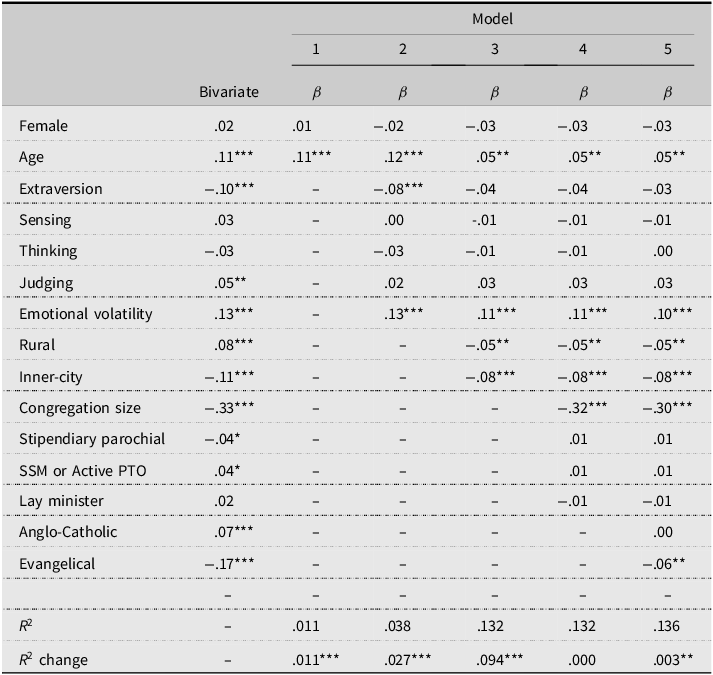
Note: N = 2874. For explanation, see Table 5.
The best predictor for all three scales was congregation size. Plotting the relationship for the two attitude scales suggested that scores (i.e. pessimism) declined with every increase in size category up to 150, beyond which there was little effect of size on either score (Figure 1).
Mean fragile church (solid circles) and church post-pandemic (open circles) scale scores by size of congregation.

Discussion
This study of 2874 clergy and lay people from the Church of England examined how they perceived their local church 3 years after the last restrictions of the COVID-19 pandemic were removed. It was based on ten items included in the Church 2024 survey, a wide-ranging exploration of attitudes and beliefs which was partly designed to assess how far the Church of England had changed or recovered from this sudden and unexpected traumatic event. The assumption was that perceptions would be based partly on what had actually happened in different churches since the pandemic and partly on how different individuals perceived those changes. The results suggested that both factors were operating because levels of optimism or pessimism were related partly to differences between congregations and partly to differences between people. The study demonstrated three main findings.
Measuring Perceptions of the State of the Local Church
The first finding was that perceptions of the state of the local church fell into two slightly different constructs. The first was related specifically to the fragility of the local church and relates to the previous studies of fragile churches both before and during the pandemic (Francis et al. Reference Francis, Village and Lawson2020; Francis et al. Reference Francis, Village and Lawson2021b; Lawson Reference Lawson2019, Reference Lawson2020, Reference Lawson2023).The most obvious marks of fragility were the high proportion of participants who reported that their church was either having difficulty in recruiting volunteers to key positions (57%) and/or being able to serve children or young people (20%). There were fewer who felt their church building was no longer financially viable (12%), their congregation was too small to be sustainable (8%) or their congregation had to merge with others to be viable (8%). It might seem that the latter three would only apply to the smallest, rural congregations, but the difference between rural and other locations was small, and the effect of congregation size on all five of the ‘fragile church’ items was apparent even in congregations of up to 150. Fragility seemed to be sensed at some level in all but the largest congregations.
The second construct was labelled ‘church post-pandemic’ and related to the extent to which participants felt that their congregation had suffered gains or losses in numbers, a reduction in income, or whether it had emerged stronger since the pandemic. This measure was correlated with the fragile church scale (r = .58, df = 2873, p < .001) but assessed a slightly different set of perceptions about the state of the local church that were specifically related to how it had changed since the pandemic. Turnover seems to have been evident in some places, with 36% of participants agreeing that many people had not returned post-pandemic and 49% agreeing many new people had joined their congregation over that period. Losses may have been related not only due to deaths or incapacity over the pandemic period but also because some people may have gotten out of the habit of going to church (Francis and Richter Reference Francis and Richter2007; Richter and Francis Reference Richter and Francis1998; Village and Francis Reference Village and Francis2024a). The statistics on usual Sunday attendance in the Church of England suggest some recovery since the pandemic, though not to levels seen in 2019 (Church of England 2024b, Table 5). The lower income reported by 34% of the sample is in line with the latest available national statistics, which suggested that in 2023 there was a 17% reduction in giving compared with pre-pandemic levels, and 46% of parishes spent more than their income (Church of England 2025). The two may not be unconnected if the pandemic led many congregations to experience the loss of longstanding members and some replacement by new members, and if it is long-standing members who tend to give more regularly and generously than those who have only just started attending. If this is true, congregations post-pandemic may need to work on embedding new attendees so they can give regularly to support the financial needs of the Church.
Individual Differences in Perception
The perceived change in numbers, fragile church and church post-pandemic scale scores were all related to some extent to personal or psychological differences between people. Some of these correlations were indirect and reflected the different distributions of types of people across congregations in different areas or in different traditions. So, for example, the higher fragile church scores of women and older people in the overall sample were probably because there were higher proportions of women and older people in rural churches than elsewhere, and those in rural churches tended to be more pessimistic about church fragility. The same was true for preference for thinking (rather than feeling), which predicted lower fragile church scores in the overall data but not after allowing for the fact that these dispositions were also associated with other factors. Extraversion has been linked to general optimism (Marshall et al. Reference Marshall, Wortman, Kusulas, Hervig and Vickers1992; Williams Reference Williams1992), and there was a significant positive correlation with perceived change in numbers, suggesting extraverts may have been more likely to report stable or growing numbers than were introverts. For the other two scales, the overall association with extraversion may have arisen indirectly because participants from rural areas tended to score lower on extraversion (and therefore higher on introversion) than those from elsewhere.
One personality trait that was consistently associated with more pessimistic scores in all three scales was emotional volatility. This subscale of the FPTETS was created to align with the neuroticism scales of other measures of personality (Village and Francis Reference Village and Francis2023a). Psychologists have long noted the close connection between neuroticism and pessimism (Marshall et al. Reference Marshall, Wortman, Kusulas, Hervig and Vickers1992; Williams Reference Williams1992), and it seems that those people disposed to emotional volatility and general pessimism may have had a more negative view of the state of their church after the pandemic. The association of age with more pessimistic scores for perceived change in numbers and the church post-pandemic scales was the only other personal variable whose effects persisted after controlling for other factors in the model. Older people perceived their church to be in a generally weaker state than before the pandemic. This might be because older people tended to belong to churches that struggled after the pandemic. However, the correlations with personality suggest that individual differences may shape how people perceive the state of their church. This is a reminder that assessing the state of churches or congregations using single ‘key informers’ (a common method in congregation surveys, Frenk et al. Reference Frenk, Anderson, Chaves and Martin2010) could be subject to some bias if the data being gathered relates to subjective impressions rather than objective information.
Differences between Congregations
Not all of the differences in scores on the three scales were related to individual differences. The main predictors of scores were more ‘objective’ factors such as congregation size or church tradition. Here, it may be possible to discern what sorts of congregations may have been faring better or worse than others in the years since the pandemic by looking at how participants reported the size of their congregations and the tradition with which they personally identified most closely.
In terms of tradition, the greater optimism of Evangelicals was apparent in all three scales. Evangelicals in the Church of England tended to show better well-being than others during the pandemic (Village and Francis Reference Village and Francis2021b), were least affected by the closure of church buildings in the first lockdown (Village and Francis Reference Village and Francis2021a) and were better at adopting the digital technology that became part of ministry during lockdowns (Francis and Village Reference Francis and Village2025a). It seems that Evangelicals may have emerged more optimistic about their congregations than those in other traditions. How far this was because the Evangelical tradition promotes a sense of optimism about God in all circumstances, and how far it was because Evangelicals generally fared well in the Church of England during the tenure of Justine Welby as Archbishop of Canterbury, is hard to tell. Both factors may have been operating.
Participants who worshipped in larger rather than smaller congregations tended to be more optimistic. Although Evangelicals tended to come from larger congregations, and congregations were smaller on average in rural areas than elsewhere, the size effect persisted across traditions and locations. Levels of both attitude scales declined consistently between congregations of less than 10 to those of 150 (Figure 1), suggesting greater optimism in larger congregations. This is perhaps unsurprising, but the trend was striking in that it was not just in the very smallest of congregations that size was linked to pessimism or optimism. Given that the average usual Sunday attendance in the Church of England was 36 in 2023 (Church of England 2024b), it seems that some pessimism about the state of the Church is evident among many clergy and lay people, even 3 years after the pandemic.
Conclusions
Three main conclusions emerge from this study:
First, perceptions of the state of the Church of England 3 years after the COVID-19 pandemic could be assessed by three distinct but correlated scales. The first related to perceived changes in numbers, the second to the fragility of churches and the third to the general state of churches in terms numbers, mood and finances.
Second, scores on these scales were partly related to personal or psychological factors. In particular, emotional volatility, a measure of trait neuroticism, was associated with more pessimistic scores on both scales.
Third, the two main ecclesial predictors of scale scores were church tradition and congregation size. Evangelicals were generally more optimistic compared with those from Anglo-Catholic or Broad-Church traditions. Optimism declined as congregation size increased, up to about 150, when it remained constant.
Taken together, these results may have important theological and practical implications for churches. Theologically, there are questions about how far the psychological dispositions to optimism or pessimism, which are part of human diversity, should be accepted as ‘normal’ or how far the tendency to pessimism should be viewed as an unhealthy emphasis on the negative that runs counter to the hope that is a cornerstone of the Christian faith. Our results show that discerning the line between legitimate psychological diversity and the onset of unhelpful pathology is important because it has consequences for how people view their church life, especially in difficult times. In practical terms, there are questions about the way that the size of congregations may shape perceptions of their members. We tend to link small congregations with failure and large congregations with success, but there are many positives about ministry in small churches (Dudley Reference Dudley2010; McLaughlin Reference McLaughlin2015), so there may be work to be done to help members of small congregations overcome their fears of fragility.
Limitations of the Study
This study was based on a large convenience sample and used subjective measures to assess the state of the Church in the post-pandemic period. Although these perceptions are important, they need to be supported by more objective measures gathered from a random sample of congregations.
Competing interests
No conflicts of interest were reported by the authors.
Ethical approval
Ethical approval was granted by the Research Ethics Committee for the School of Humanities, Religion and Philosophy ay York St John University (approval codes: HRP-RS-AV-04-20-01(2021) and ETH2324-0130 (2024)). All participants had to affirm they were 18 or over and give their informed consent by ticking a box that gave access to the rest of the survey.




 Open access

